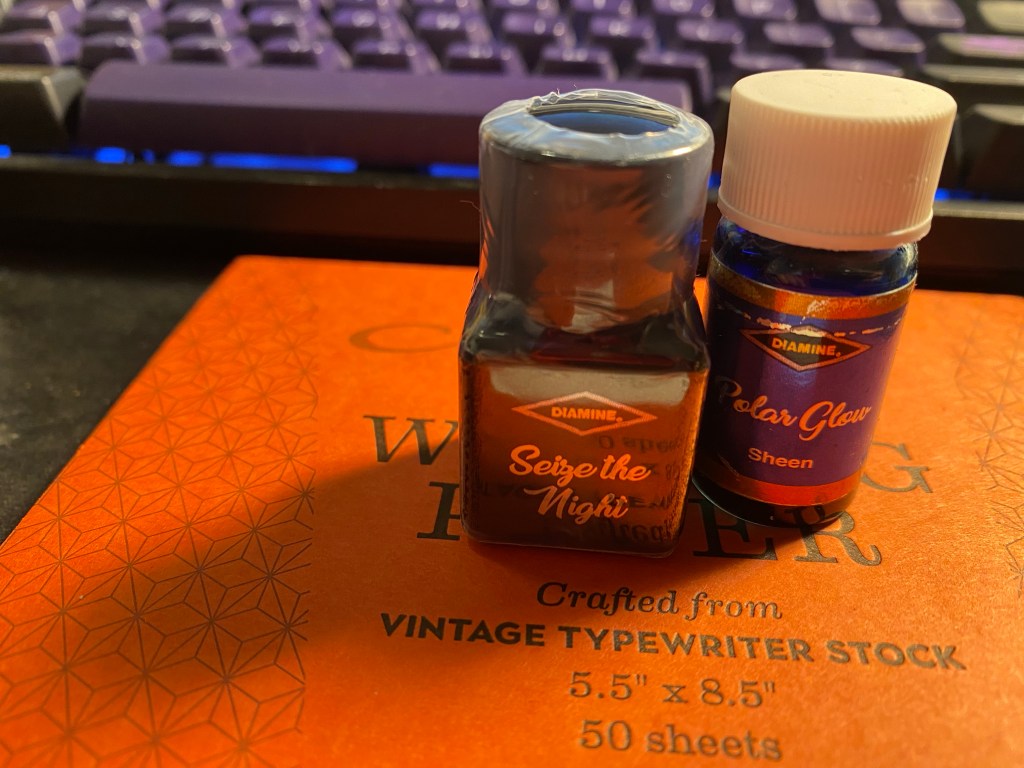
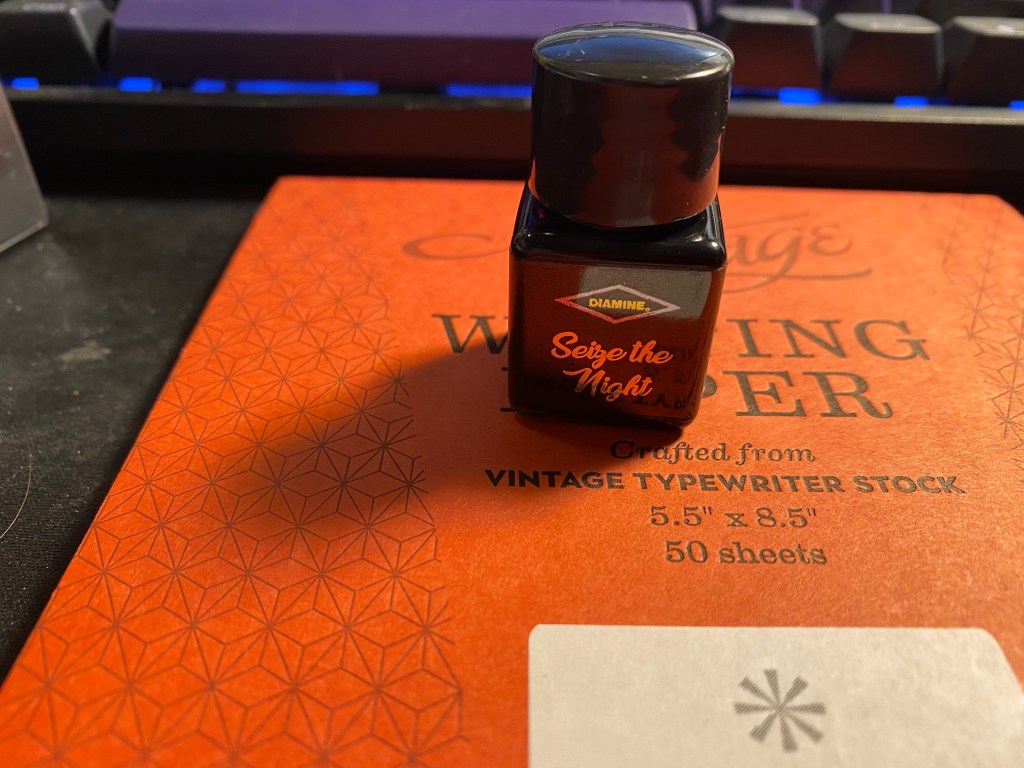
It’s Diamine Inkvent time! In 2019 Diamine came out with a fantastic fountain pen ink based advent calendar: the Inkvent Calendar. Behind each of the 25 doors was a tiny ink bottle (except for day 25, which got a larger bottle), each one of them was holiday themed and made specifically for the calendar. I created a review post a day for each any every one of those 25 inks. It was exhausting but worth it because it allowed me to select my favourites of the bunch . Eventually, as I’d hoped, Diamine reissued these inks in beautiful glass bottles, and so I was able to purchase full bottles of my favourites.
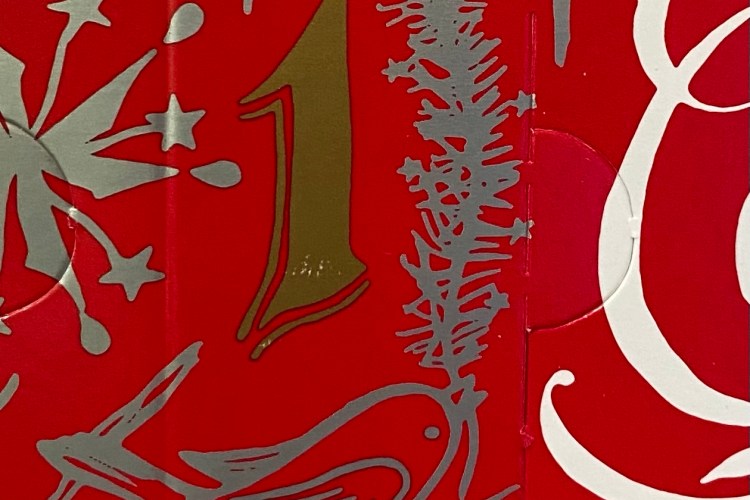
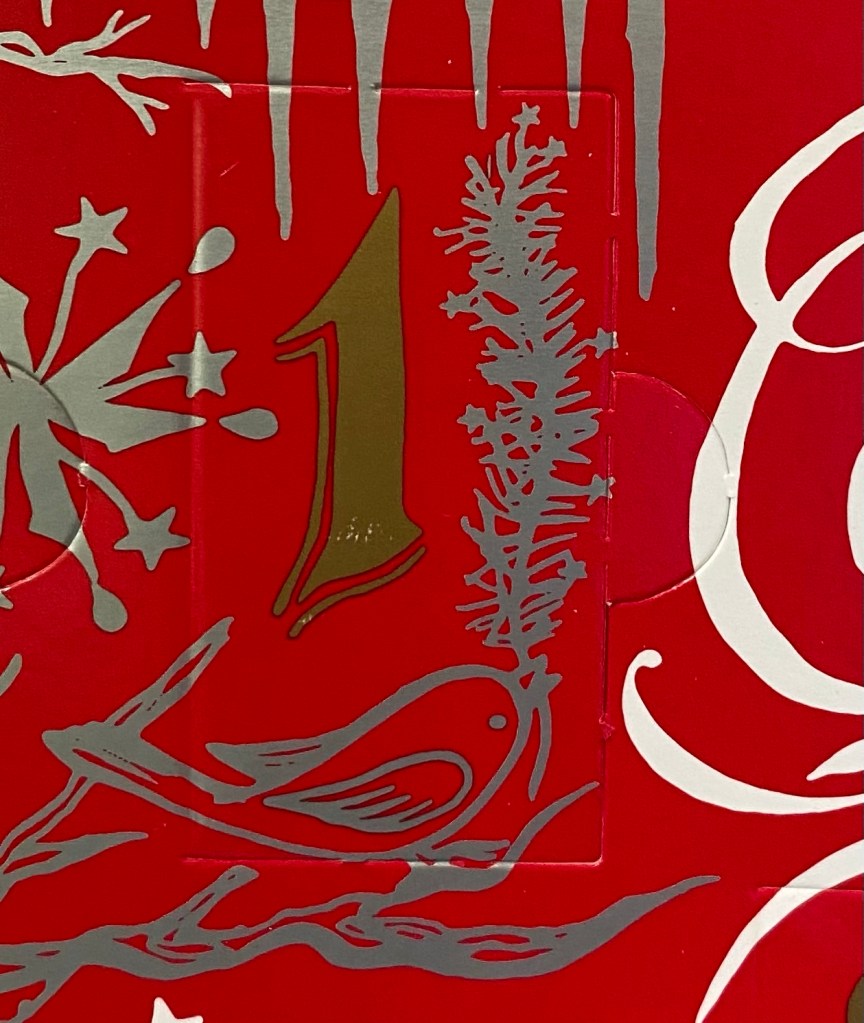
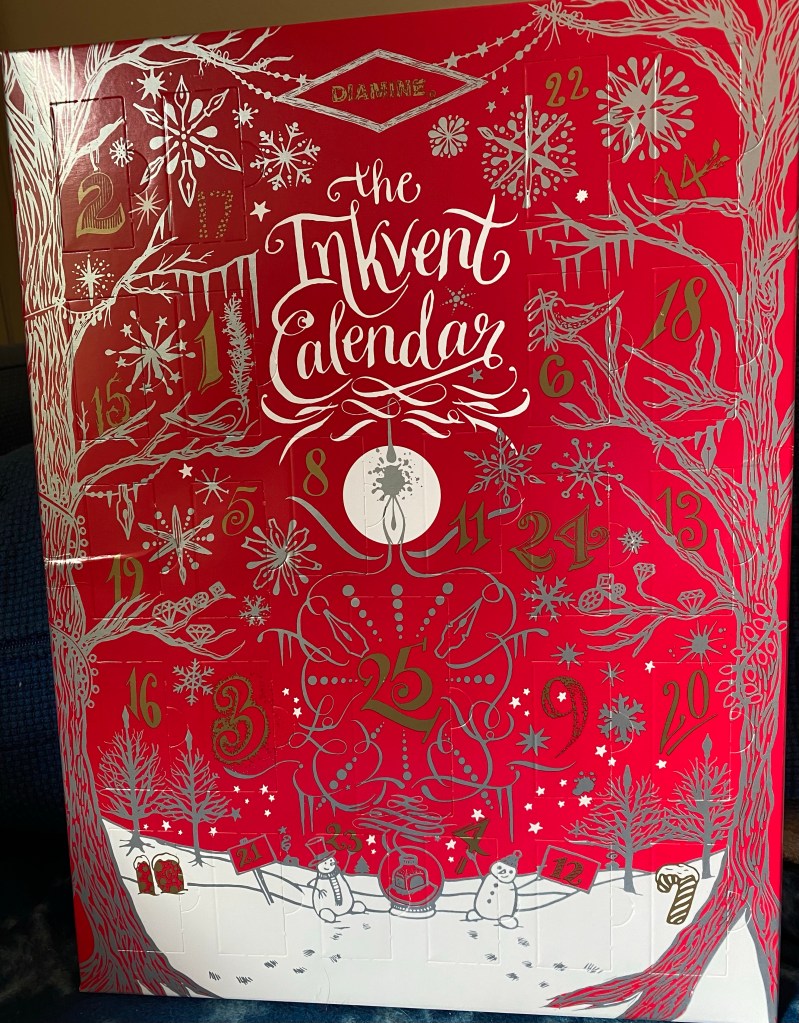
Front of the Inkvent calendar
This year Diamine came out with a new Inkvent calendar, this time also with 25 exclusive and thematically appropriate (at least by name) inks. I plan on posting a review of each one on the appropriate day. I’m not promising not to open some of the doors in advance. Due to my neuropathy and my treatments there will be days when I otherwise won’t be able to post.
This is meant to be a fun project, and I’m also hoping that Diamine comes out with larger ink bottles of the Inkvent line. So the reviews should help me select the few larger ink bottles that I may order.
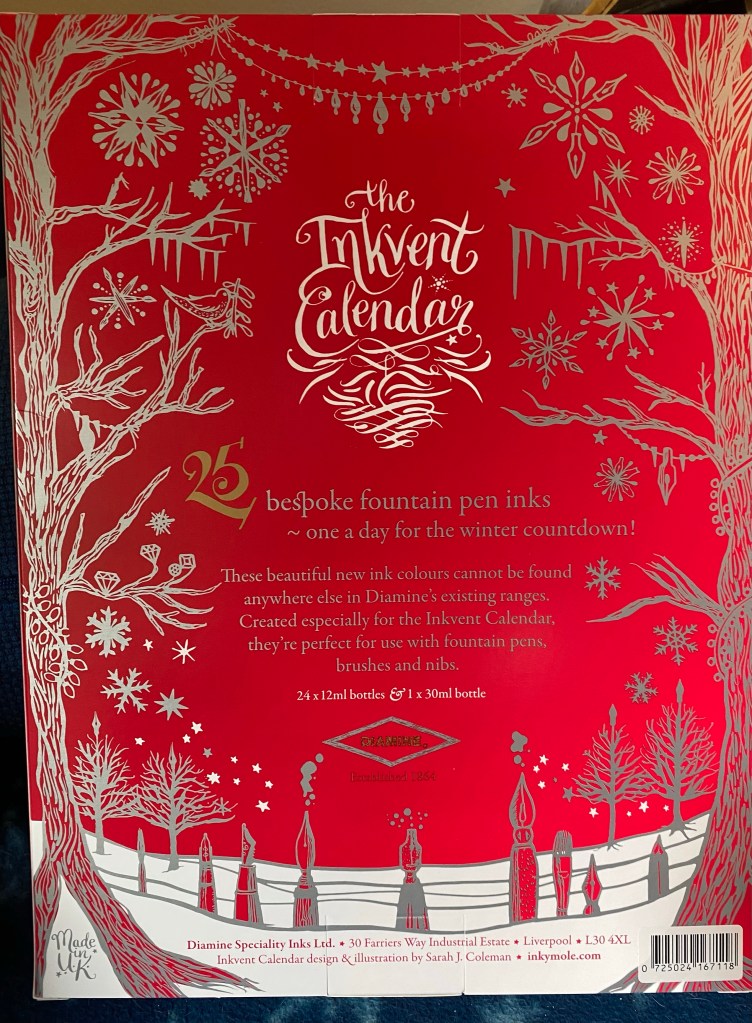
The back of the Diamine Inkvent calendar.
My plan is to use cartridge/converter fountain pens to test the inks. They’re less of a hassle to fill from tiny bottles, and they’re easy to clean. This calendar will contain inks with a lot of sparkles in them, so the cleaning aspect of the business is important.
So, expect a daily review, as we go out on an inkventure.
I got this Midori MD Notebook Journal A5 Dot Grid as part of the Cult Pens Paper Box, which is no longer being offered. I’ve used and liked Midori paper before, as part of their Traveler’s Notebook offering, but I’ve never taken the opportunity to purchase one of their notebooks before. One of the main reasons I purchased the Paper Box was to give this notebook a try.
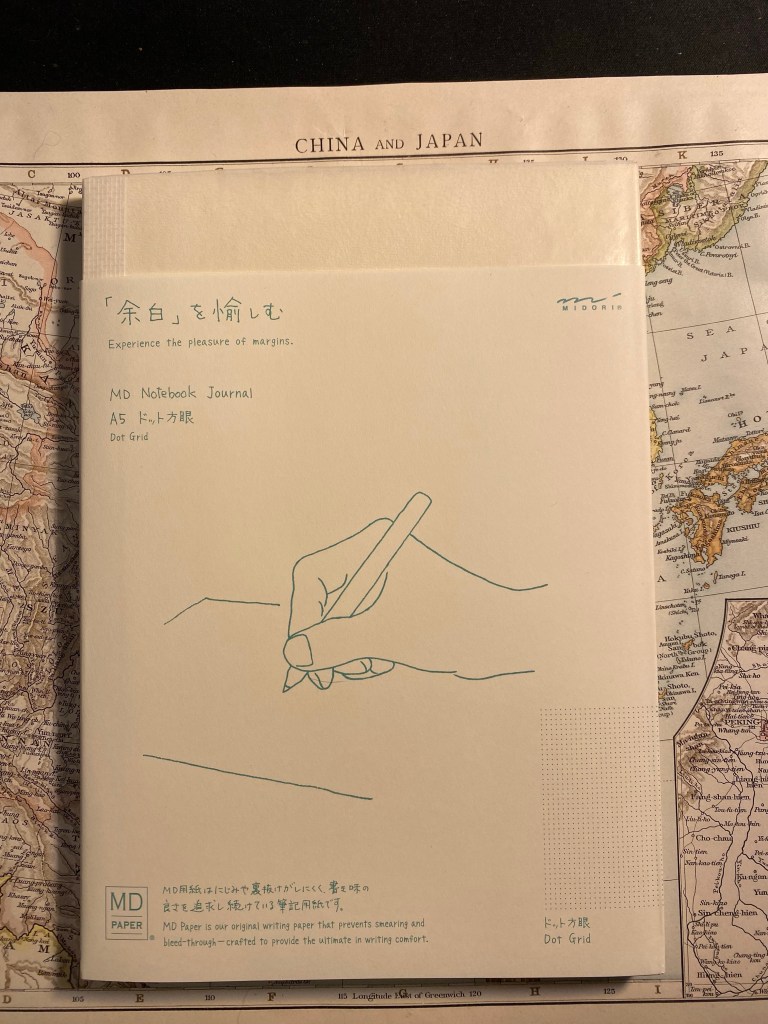
MD Notebook Journal A5 front cover
The MD Notebook Journal is a soft cover notebook with a minimalist design. It’s an A5 dot grid notebook that opens flat, has 192 fountain pen friendly pages, and comes with the bare minimum needed to turn it into a more structured journal: two enlarged dots for the dates and an index insert that you can use to mark the months. Everything you need to know about the notebook is thoughtfully written on its paper wrapper. Everything but the paper weight. I’d start a rant here, but I don’t think it will do something to solve the various standardization issues in the notebook/journal world, so I’m just going to note that I find it annoying. Write the gsm please. It’s not that hard.
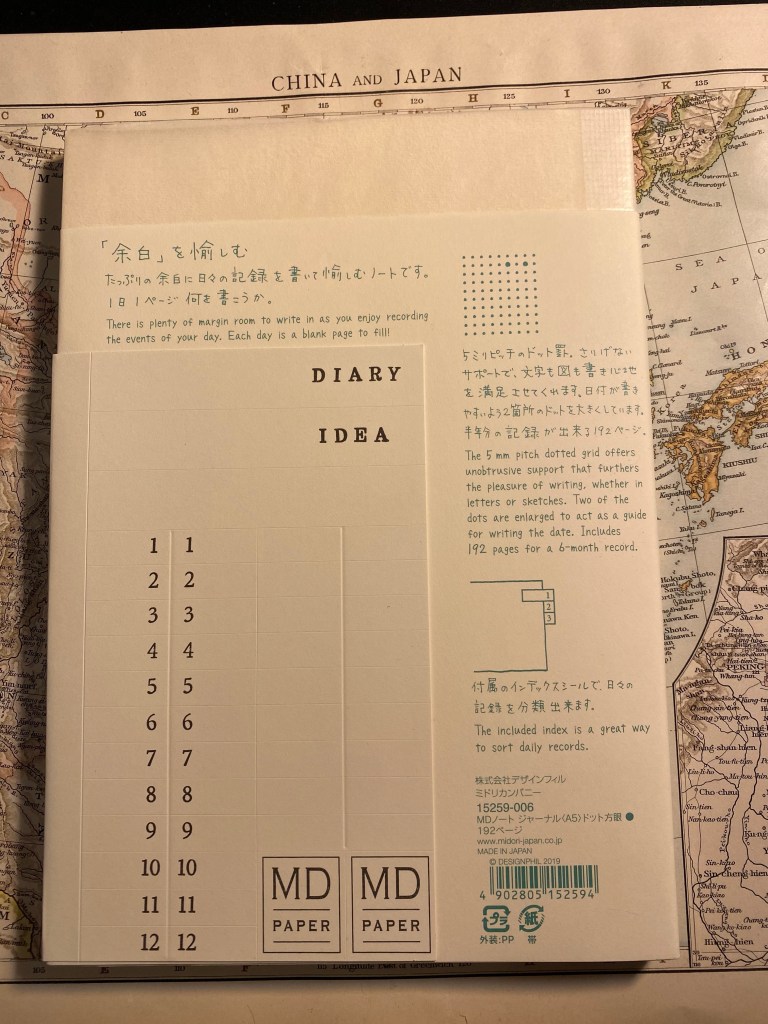
MD Notebook Journal A5 back cover with index.
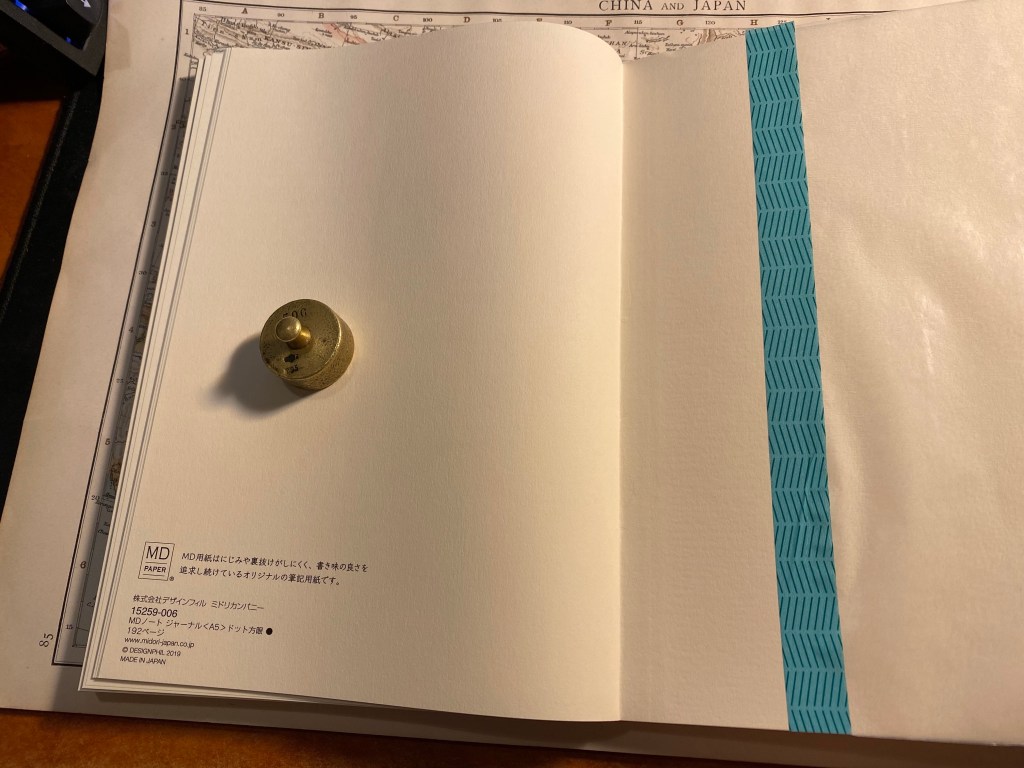
The MD Notebook Journal comes wrapped in a crinkly parchment paper that is meant to protect the cardboard covers, and I kind of liked the way that it felt. On a whim I grabbed some washi tape and taped it to the cover as a cover protector. I don’t know how long it will last (I’ll probably need to add more tape later on), but for now I’m enjoying it.
Inside the front cover is a place to write your details. As usual, I highly recommend writing your name and email, in case of loss.
Front endpaper.
The backend paper contains information about the notebook, and no pocket. It really isn’t missed on such a minimalist design, although you could easily tape an envelope here to serve as a pocket if you are so inclined.
Back endpaper.
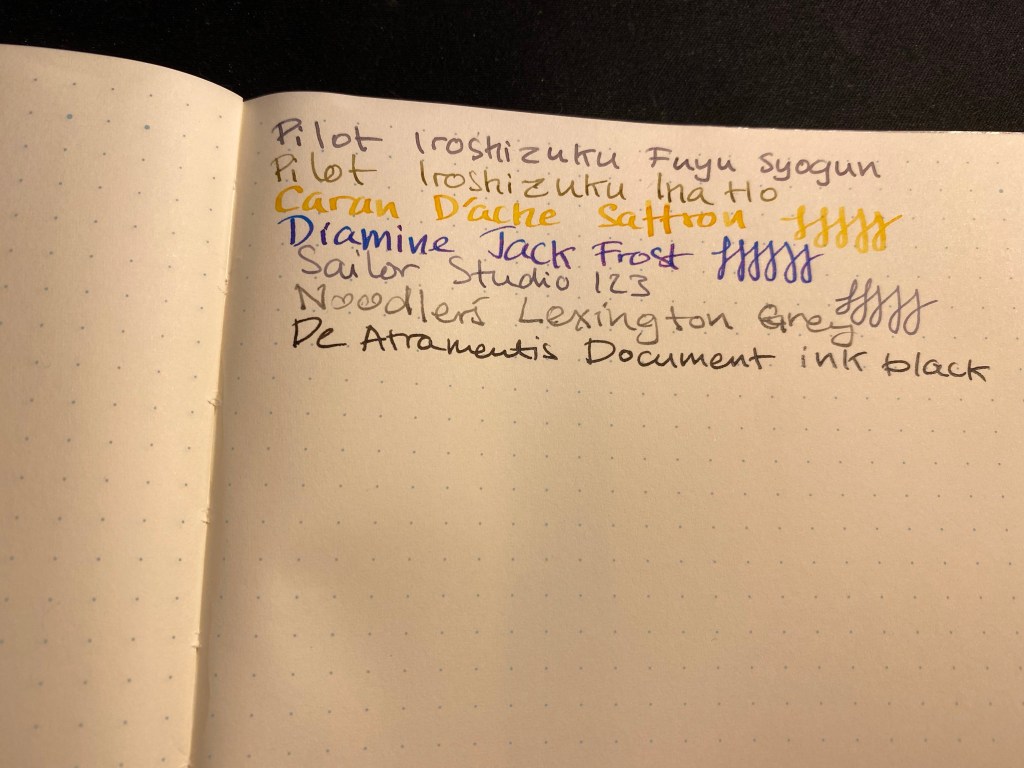
The MD Notebook Journal paper is fountain pen friendly and shows off the various properties of fountain pen ink very well. The drying time isn’t great, but that’s to be expected considering the coating on the paper. Now for a little side note: I purchased the 2021 Diamine Inkvent calendar and I plan on reviewing all of the inks in it, opening each one on the relevant day, just like I did in 2019. I’ll be using old Tomoe River Paper and this MD Notebook Journal for the purposes of the review. So if you want to see this notebook get a little more use before giving it a go, stay tuned.
Fountain pen friendly paper that shows sheen, shading and outlining well.
The paper in MD Notebook Journal isn’t very thick, so there is some show-through, but no bleed-through, with all the inks that I used. It wouldn’t bother me, but if you find show-through distracting, you might want to use lighter inks, fine and extra fine nibs, or just one side of the paper.
Show-through on the back side of the paper.
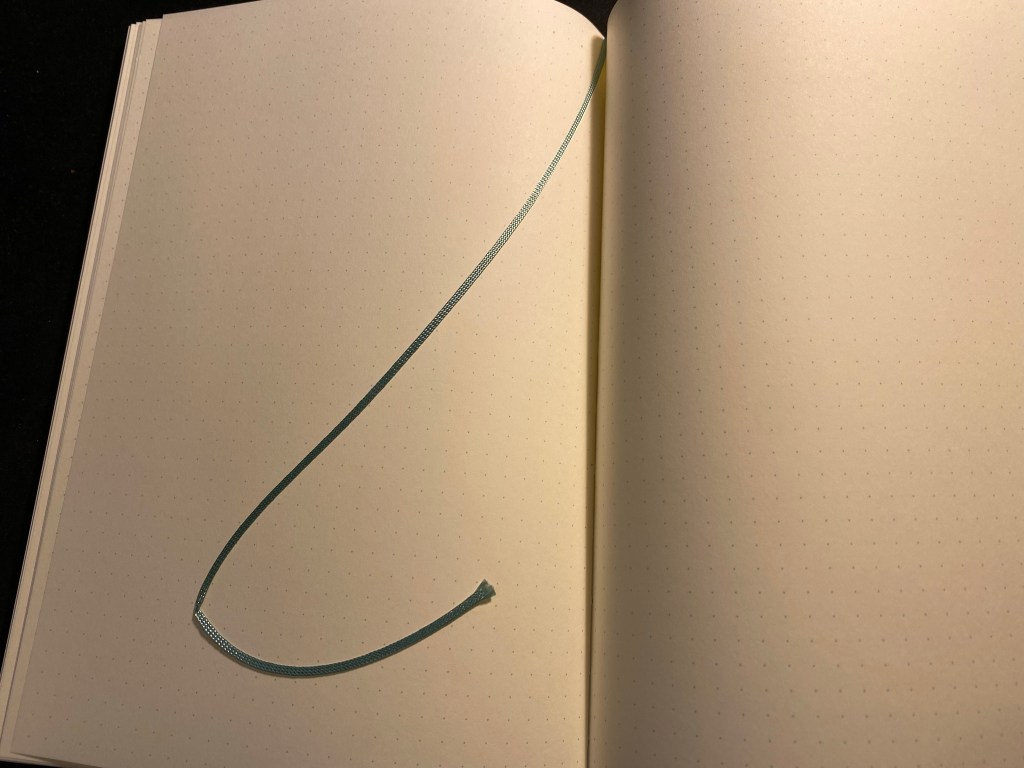
There’s a thin ribbon bookmark attached to the notebook, which is both charming and adds the only touch of colour (a lovely teal) to this minimalist journal.
The bookmark.
I look forward to giving the Midori MD Notebook Journal A5 dot grid a thorough try out next month. From what I’ve seen of it so far it’s going to be a fun notebook to use (and I don’t even like dot grid notebooks normally). There’s something about the starkness of it that makes it appealing, in that it really is a sandbox that you can play in. I can imagine people placing it in various notebook covers, or covering the covers with stickers and drawings, or just trashing it with use.
A journal with endless potential and excellent paper – what more do you need?
I’m not a fan of ballpoint pens. Their refills tend to streak and glob, the ink they use isn’t ass dark or vibrant as their gel ink and rollerball counterparts, and something about them (probably the lightness and inconsistency of the refill) makes me grip them with “the grip of death,” which inevitably brings on hand cramps and pain. They are, however, useful at times, so I am constantly on the lookout for new and better ballpoint pens and ballpoint refills.
Enter the Uni Jetstream Edge, a ballpoint pen with a strikingly modern design and the world’s first 0.28mm ballpoint refill (there’s also a 0.38mm refill option but I won’t review it here).
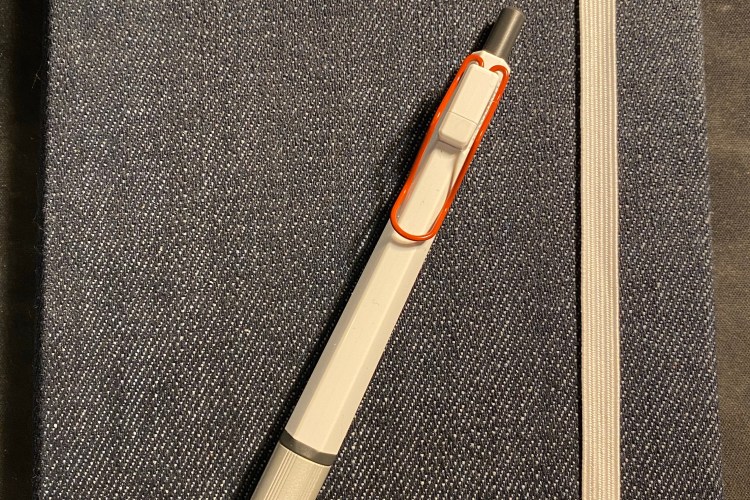
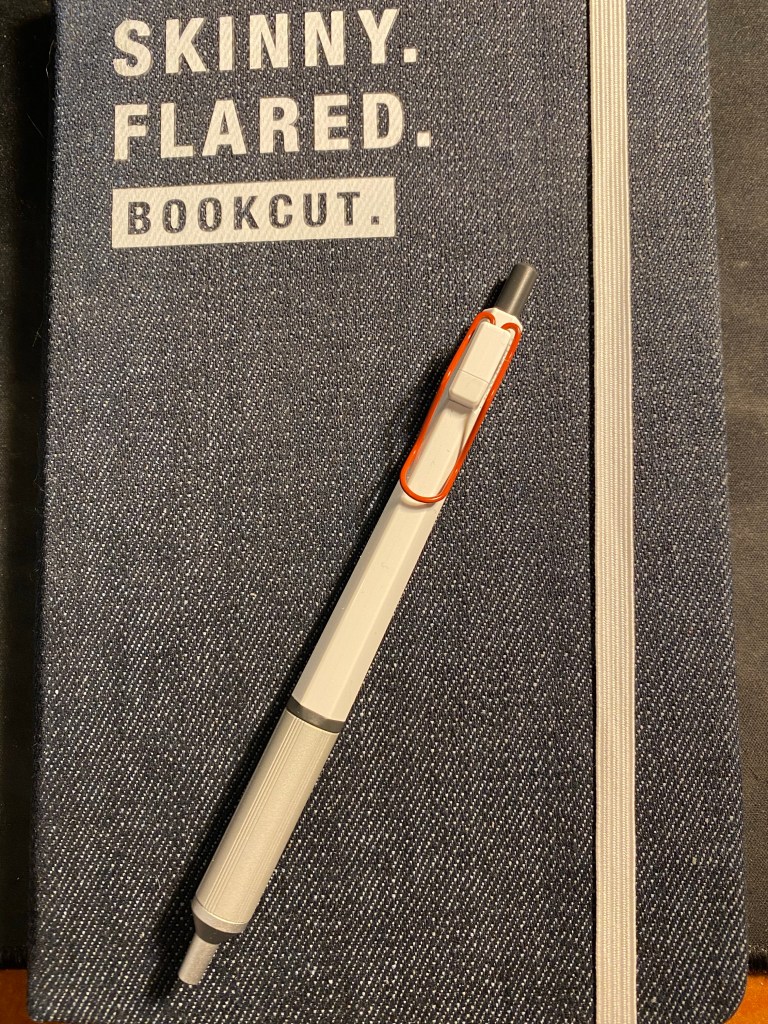
Uni Jetstream Edge white and red body with 0.28 mm refill on a Moleskine Denim.
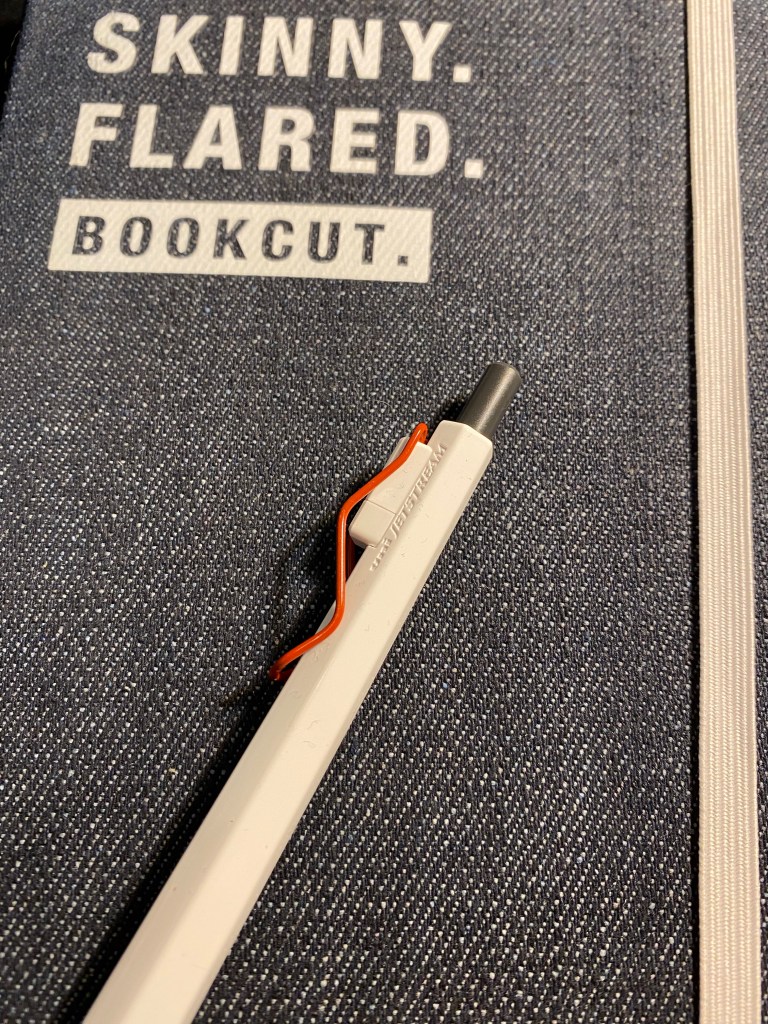
I love the design of this pen. The body is plastic, but the grip area is metal and relatively wide, which makes for a very well balanced pen. The bent wire shape of the clip adds to its modern and clean aesthetic, and I like that chose to make it red and not black or silver in the white edition of this pen. The clip looks like it would be a fun and springy fidget tool, but it’s quite inflexible and immobile. That’s great if you plan on using it to clip it to a shirt pocket, but the unusual clip shape means that clipping it to paper will likely crumple and even tear the paper. I don’t normally clip my pens to things, so that’s not going to be an issue for me, but YMMV.
The clip, and the subtle Uni Jetstream branding.
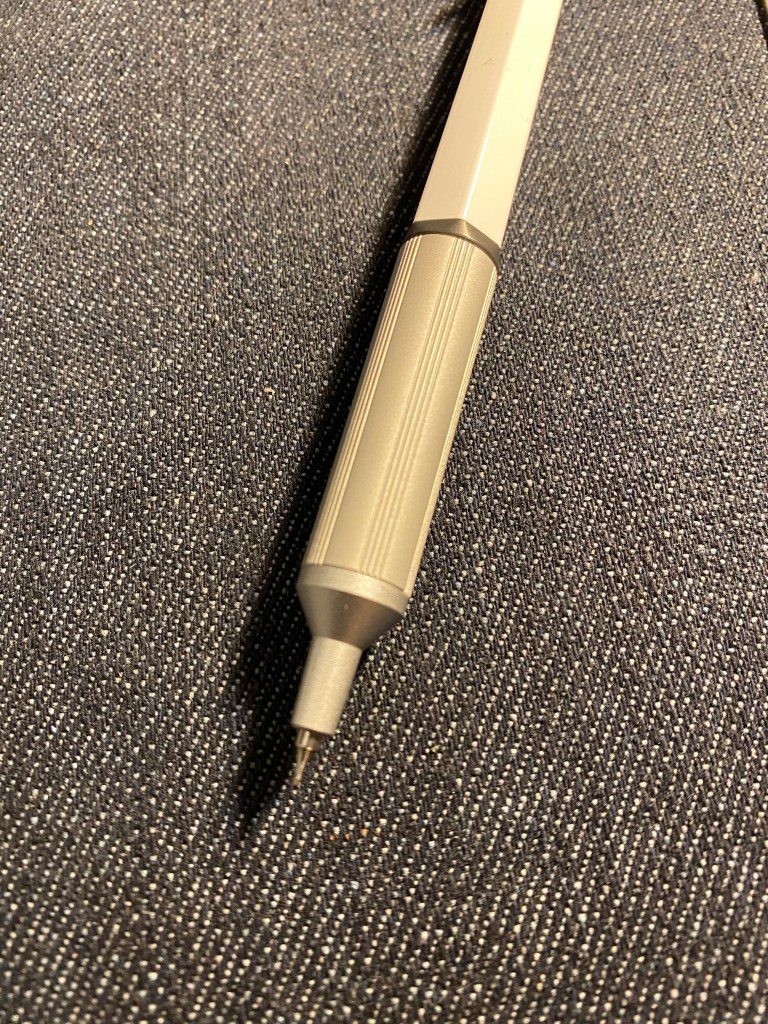
The Jetstream Edge grip section is metal and round, unlike the plastic, faceted pen body. There are grooves carved into it that make it comfortable to hold, and the refill sits very snugly in the pen sleeve. This is a pen that’s not going to rattle while you write.
Jetstream Edge grip and business end.
The 0.28 mm Jetstream ballpoint refill has been designed so that the tip won’t suffer the usual “bent out of shape the moment you breath too hard on it” fate of the Pilot Hi-Tec-C refills. Its sturdy but still keeps a tapered, fine tip, which means that you can use it with rulers and templates if you so desire.
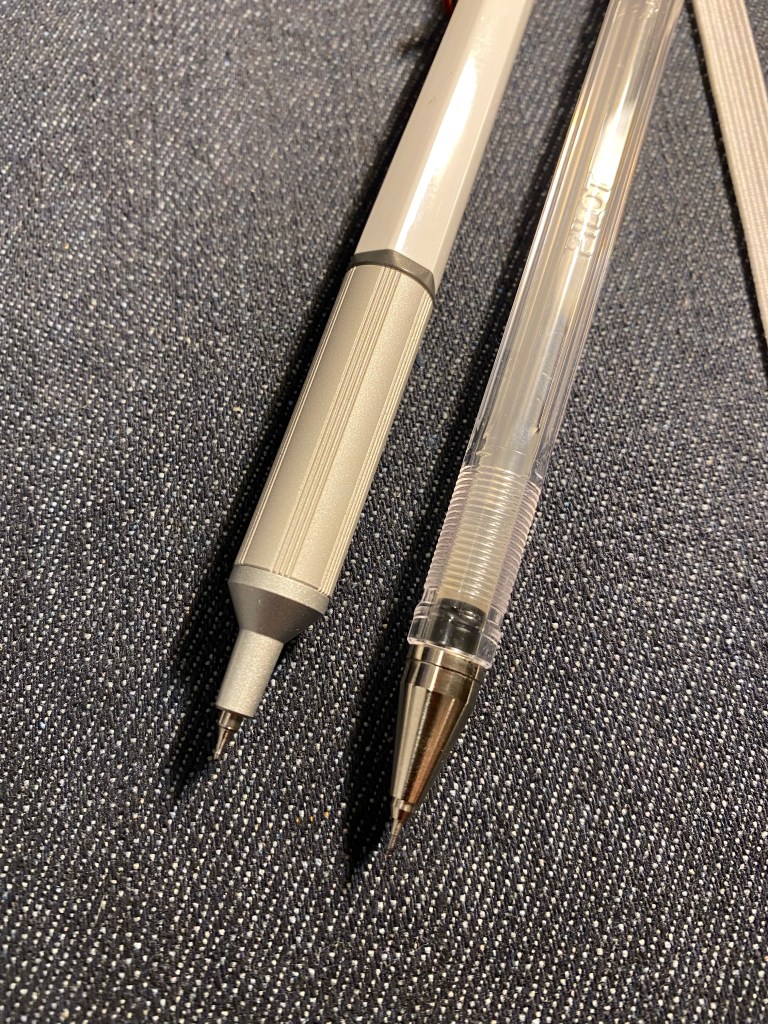
Jetstream Edge on the left, Hi-Tec-C on the right. Note the difference in the tip and nose cone design between the two, and that the Edge grip is wider.
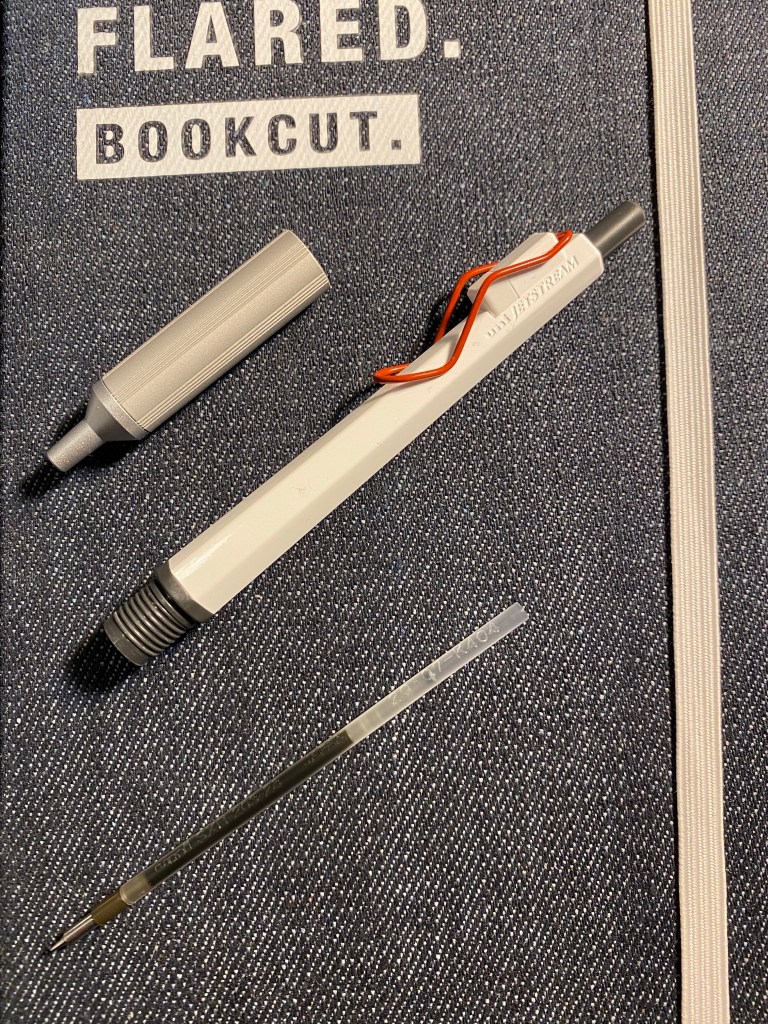
The refill the Jetstream Edge uses is the SXR 203-28 for the 0.28 mm or the SXR 203-38 for the 0.38mm tips size, although it appears that can also accept the Uni SXR-80 line of refills used for Uni-ball’s multi-pens. If so, that could open a wider range of refill colours and tip sizes. The original, SXR 203, refill is very slim, which would have been problematic if it was a gel ink refill (you’d have written it dry in a day), but shouldn’t be a problem with a ballpoint refill. That being said, I doubt that this refill will last as long as a standard Parker one, not to mention the Caran d’Ache Goliath.
The Jetstream Edge dismantled with the refill on the side.
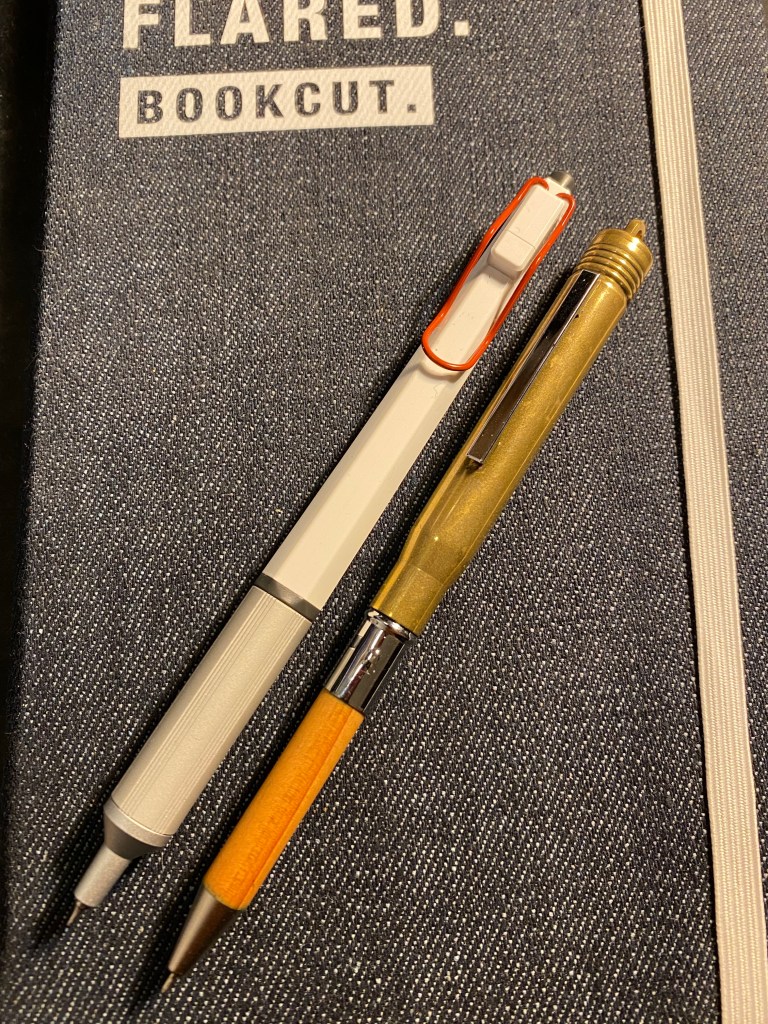
While Uni-ball brags that the Edge uses the first 0.28mm ballpoint refill in the world, there are other brands that use ultra fine ballpoint refills not far from it in size. My Midori (now Traveler’s Company) Brass Ballpoint pen has a refill that is around that size, so I thought I’d compare the two.
Jetstream Edge on the top left, the Traveler’s Company Brass Ballpoint is on the bottom right.
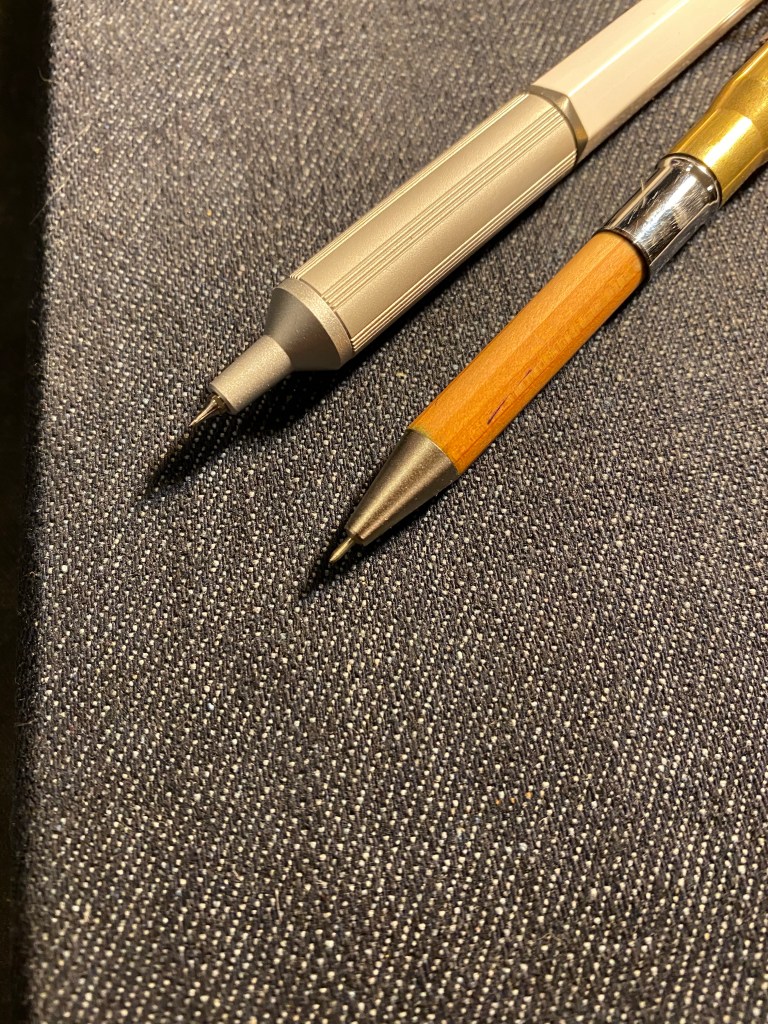
Here are the pen tips side by side. The barrels, grips and cones are very different but the refill tups are very much alike.
Jetstream Edge on the top, the Traveler’s Company Brass Ballpoint is on the bottom.
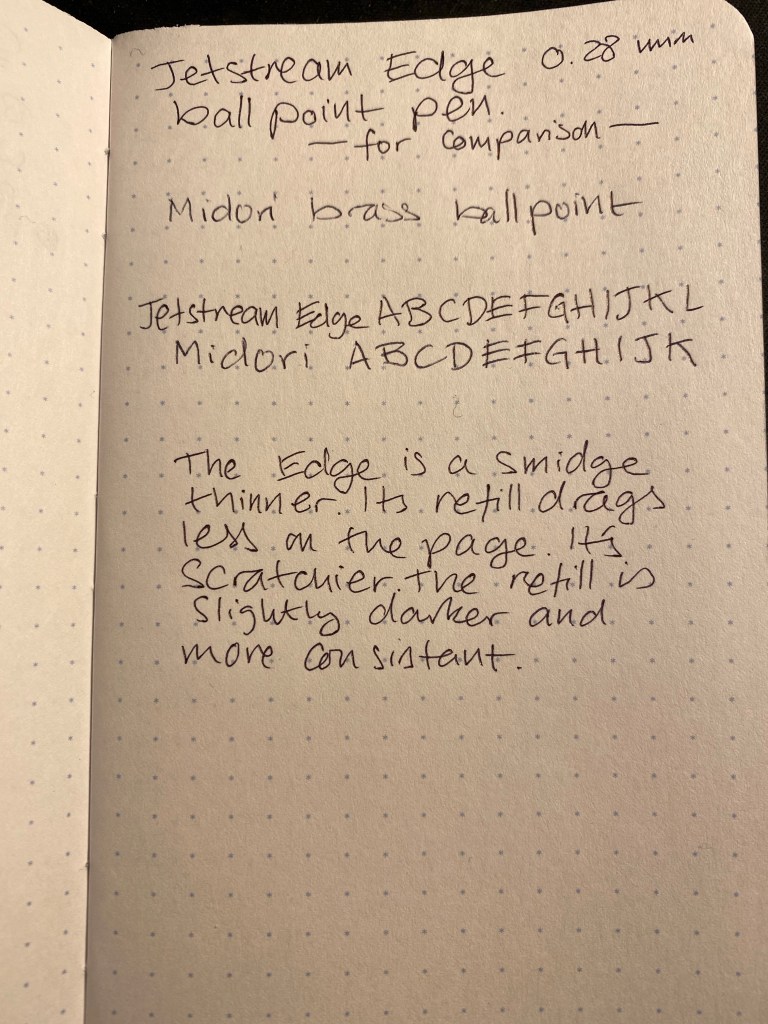
Below you’ll find a writing sample of the Jetstream Edge, and one of the Midori/Traveler’s Company Brass Ballpoint for comparison. Perhaps unsurprisingly, being a Jetstream refill, the Edge’s refill is better than the Midori’s even though it is slightly thinner. It lays down a more consistent and slightly darker line (although nowhere near as dark as a gel ink pen’s line).
I wrote seven full A5 pages with the Jetstream Edge, to see how consistent the line is over time, and to see if it would cause hand cramps after prolonged use. While I was writing I made a concentrated effort to keep a light grip on the pen. The barrel design helped with this, and the pen’s light weight and front heavy balance made it nice to hold and write with. But the Jetstream Edge is a pen with a sweet spot, not unlike certain fountain pens. Angle it too much and the refill starts to skip, so you need to write with the pen as vertically as possible. That slightly awkward writing angle may have been the cause of my hand cramps, but whatever the cause may be, this is not a pen that will work for long writing sessions for me.
So, do I recommend the Uni Jetstream Edge? If you’re a ballpoint fan and an ultra micro tip fan, then yes. Otherwise, there are cheaper and better ballpoint pens out there, even within the excellent Uni-ball Jetstream line. Will I be using the Jetstream Edge? Yes, although not for long writing sessions. I love the line it lays down, and I like the aesthetic of this pen. Then again, I’m a fan of the Pilot Hi-Tec-C…
Happy fountain pen day everyone! I hope you get the chance to enjoy your pens today. I thought I’d celebrate with a review of one of the more interesting fountain pens that I have: the PenBBS 535 Pen of the Year of the Ox.
I like pens with interesting filling mechanisms, and I’ve purchased pens from PenBBS before and really enjoyed them so I decided to give this unusual (and inexpensive) pen a try. What’s unusual about it? Well it’s a long pen with an uncommon silhouette, a filling mechanism that doubles as an ink stop, and it has a gem as a roll-stop.
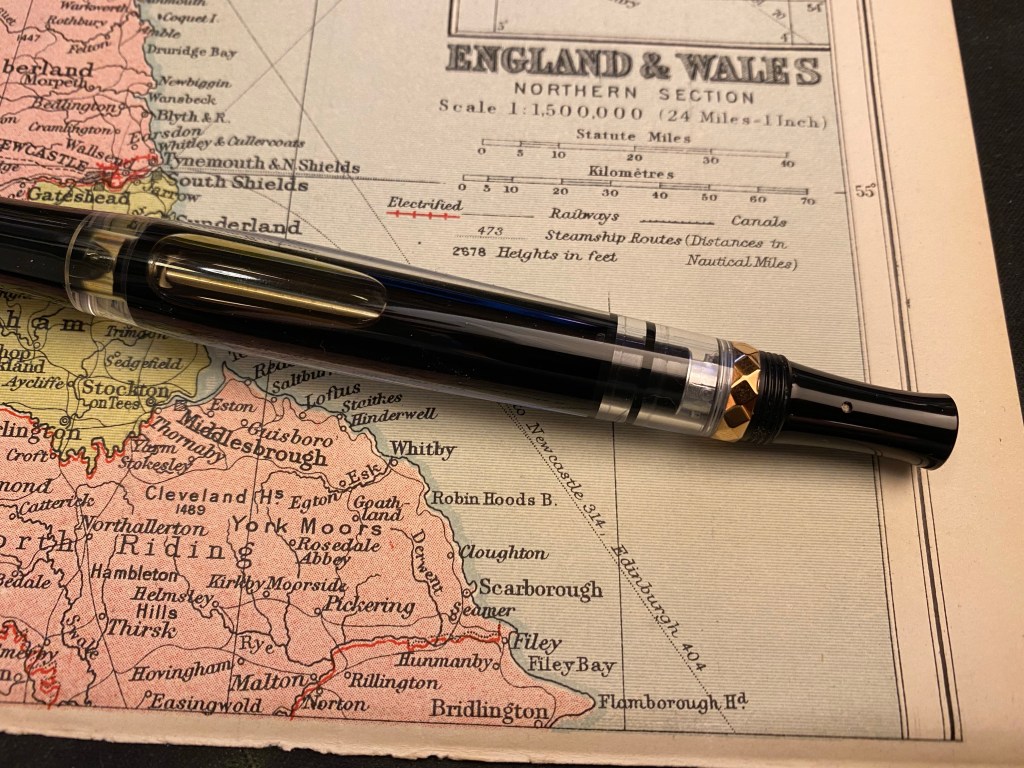
Let’s start with the pen body. It’s long. A Lamy Safari/AL-Star is 13 cm long uncapped. The PenBBS Year of the Ox is 15 cm long uncapped, and about 16 cm long when you unscrew the blind cap to allow for ink to flow (more on that later). That means that it holds a massive amount of ink (make sure you love the ink that you plan to use in this pen), all of which you can see since the main body part is transparent. The cap, blind cap and grip are black with rose gold detailing which is very attractive, and the cap and nib have special Year of the Ox inscriptions (2021 is the year of the ox in the traditional Chinese calendar). I have no idea why this wavy, long silhouette was chosen for the pen, but it reminds me of a bamboo stalk, particularly when capped, and I quite like it.
There is an engraving of an ox head on the rose-gold coloured steel nib, and the pen cap has a rose-gold coloured medallion on it with an engraving of an ox in the middle and “PenBBS 2021 Year of the Ox” engraved around it.
The grip section is surprisingly comfortable to use, as at first glance I was worried that perhaps it would be too narrow for comfort. There’s a slight step at the end where the threads go, and you can see from the picture below that there are very few threads for the cap. This is the weakest part of this pen’s design. While it makes gripping the pen very comfortable (no threads in the way), it makes capping the pen a hassle at times. It’s easy to miss the threads and have the pen not be properly capped. The cap itself is unlined and very short, particularly when compared to the long pen body. It is designed this way so you can post it on the back using the threads and the bottom of the piston.
You can see the threads on the piston below. Apart from checking that the cap can be posted in this way, I chose not to post this pen. It’s not that the posting affects its balance, as the cap is light and doesn’t weight down the back of the pen, but that the threads are so short and shallow that it’s not worth the hassle to use them to post the cap. Plus, I don’t post my pens’ caps anyway.
You also can see the filling mechanism in the previous photo. This is a little complicated to understand and hard to explain, but there’s a good video here showing how it works. You basically twist the piston nob to engage the piston mechanism and fill the pen with ink, and then twist it in another direction to disengage the piston and just allow the plunger rod to move.This allows you to return the piston to place, and is also the mechanism you’ll use to unscrew the piston blind cap and allow ink to enter the transparent chamber at the top of the pen and into the nib. I know this explanation is confusing – please check out the video to see the mechanism in work. It’s pretty easy to get it going once you’ve seen someone demonstrate it to you.
Is this the most convenient filling mechanism? No, not by a long shot. But it fills the pen entirely in one shot (something you can’t get with most converters), and allows the pen to have a really large ink capacity. This and the very decent nib turn this pen from a novelty item into an actual workhorse. This is a pen that is a joy to use, and you can use it for pages and pages of writing.
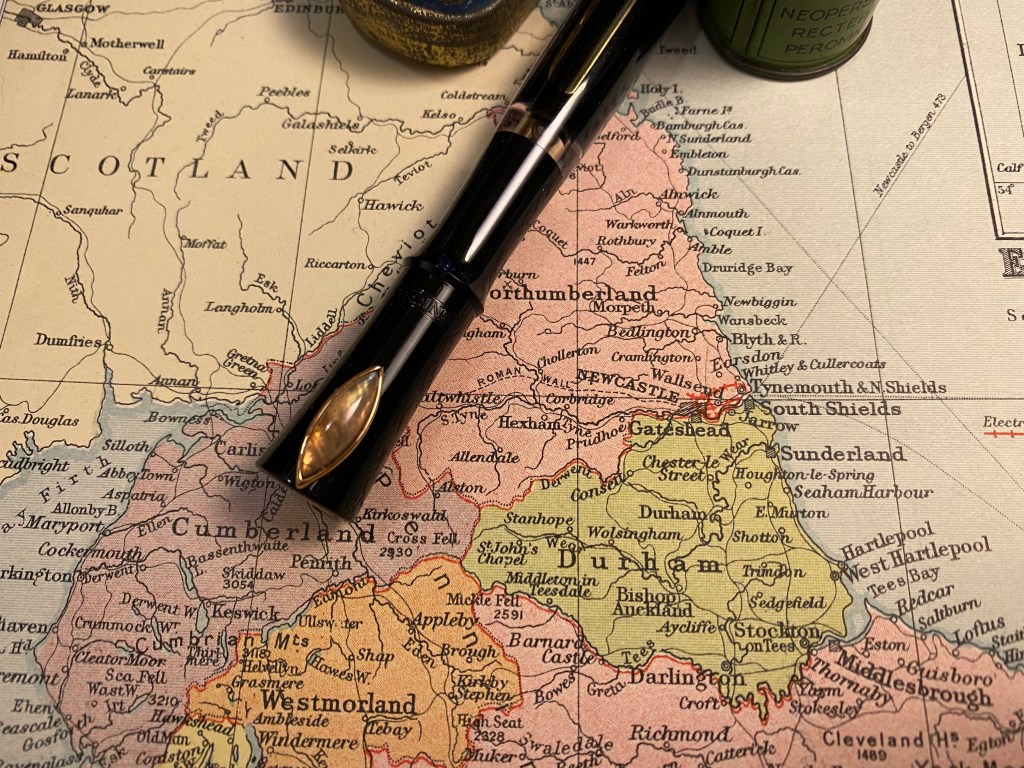
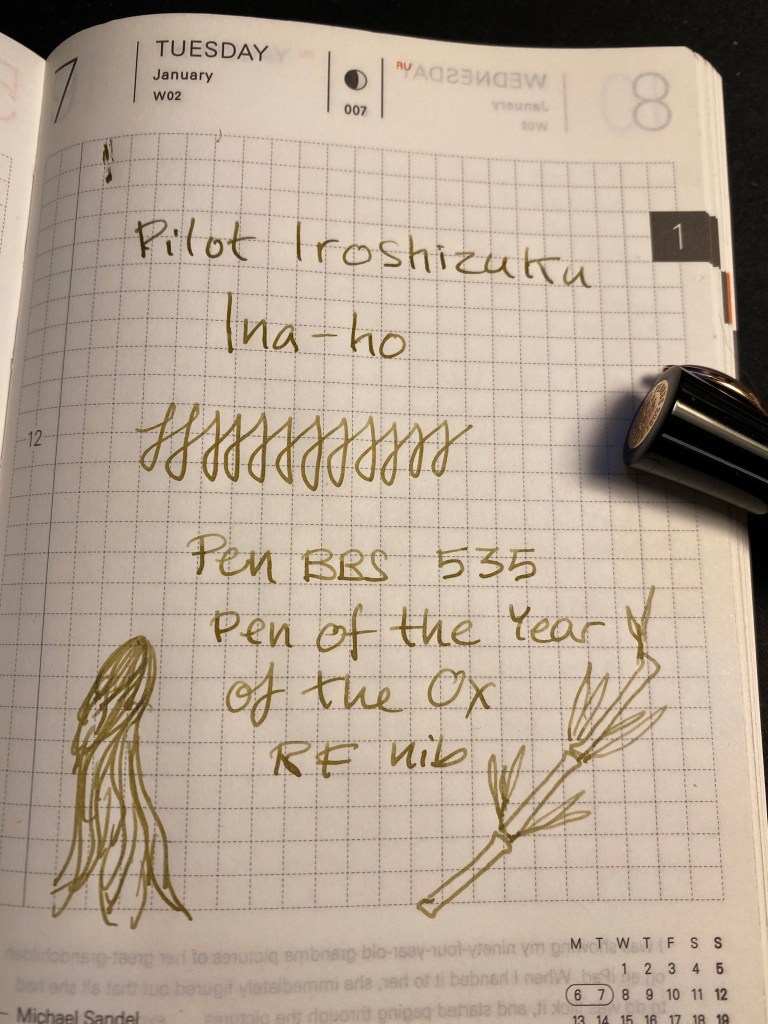
The Year of the Ox pen comes with a labradorite roll-stop, which is very cool looking and ensures that each and every pen is unique. I have no idea why labradorite was chosen, but I like its colour and I think that it works well with the rose-gold on the pen. It’s also what inspired me to fill this pen with Pilot Iroshizuku Ina-Ho.
To start writing with the Year of the Ox pen you need to unscrew the piston until ink can enter the small chamber near the pen grip. You can see the mechanism at work here:
The RF (round fine, or just simply fine) nib is smooth but not glass smooth, and if you plan on sketching with this pen, flipping the nib gives you a very good extra fine line. The nib and the ink capacity really make this pen something you can probably use throughout NaNoWriMo without having to stop for refills.
I wasn’t expecting much from the PenBBS 535 Pen of the Year of the Ox, because it really does look like a novelty pen. But somehow, the pen’s design, it’s weight, it’s large ink capacity and its good nib make for the ideal workhorse pen. This is a pen that’s fun use and fun to have lying around on your desk. Just be sure to fill it with an ink you really love, because you’re going to be using it for a while…
When I received the Nock Co newsletter Brad Dowdy sent, letting people know that he was closing the company down, the first thing I did was rush to buy every case I could lay my hands on. After I had secured my order I let myself feel the full measure of regret that such a great company is soon going to be no longer.
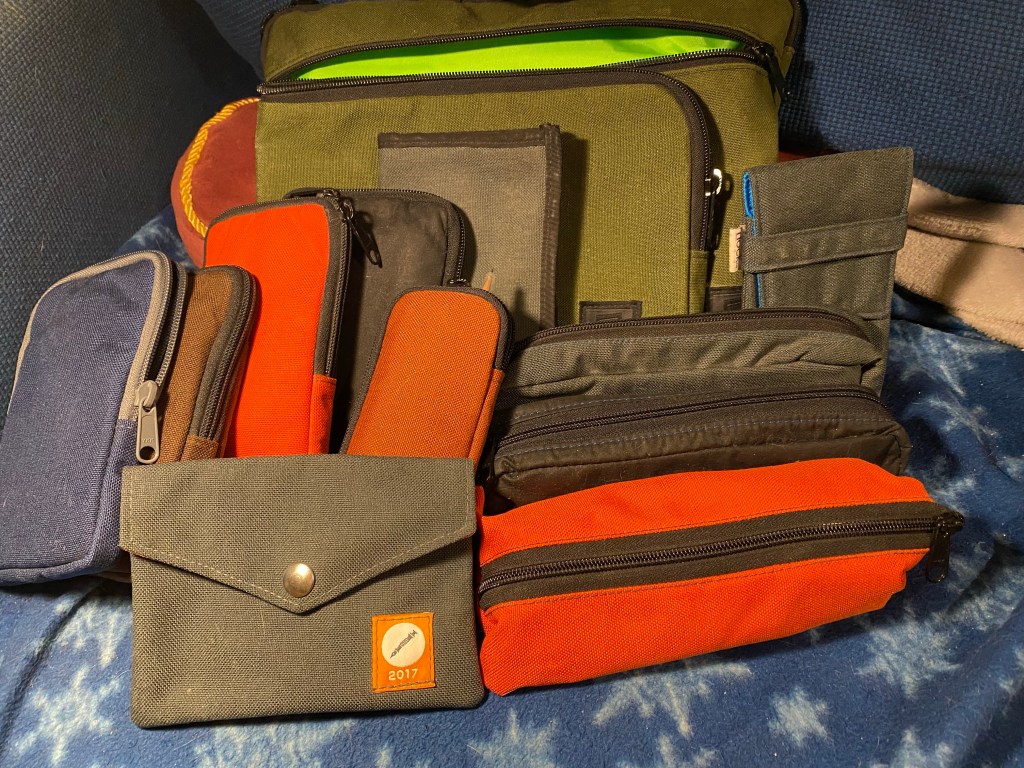
I use Nock Co cases a lot. This is just what I scrounged from a quick pass around the house:
Final Nockshot? A bevy of Nock Co cases.
The Nock Co website is still up and there’s still some stock left, so I thought this would be a good opportunity to write how I use some of my Nock Co cases, and recommend that you go get a case or two or more while they’re still around.
Sadly the Sinclair, my go to Urban Sketching case is out of stock at the moment. If it will be restocked or you find one in the secondary market I highly recommend it. Like all Nock Co cases it is built to last, and like all Nock Co cases it can hold much, much more than is advertised. My Sinclairs hold a slew of brush pens, fineliners, a mechanical pencil and an eraser, a waterbrush and a folded up piece of paper towel. I have several of these Urban Sketching kits deployed in several sketching bags, ready to go when I am.
The Tallulah is not sold out, and is also a must have case for Urban Sketchers. It holds a mini version of what my Sinclairs hold (again, it can hold so much more than the advertised two pens) and is compact enough for me to be able to toss it and a Stillman and Birn pocket alpha into my purse as an ultra portable urban sketching kit.
Got coloured pencils? Like sketching with woodcase pencils? The Chimneytop is for you. That’s where I keep my coloured pencils and their graphite counterparts. The design is simple but effective in that the middle zipper allows you a better view and access to the pencils you’ve placed inside.
The Brasstown is also sold out at the moment, but if it comes back in stock it’s a must have. This is where I keep the fountain pens and machined pens that I have in rotation. If they aren’t in a Sinclair, they are in a Brasstown. The Brasstown keeps them safe from scratches, and can hold even the widest barrelled pen. Like all the other cases, it can hold much more than advertised.
You really can’t go wrong with a Nock Co case, and I’m really going to miss them. The design, the material, the construction quality – there are many case makers out there but not many that get it so right all the time.
Cult Pens offered a paper box about a month ago. For £25 you got 3 notebooks, 2 sketchbooks, 1 fineliner, 1 marker, 4 pencils, 4 pens and a handful of Smile Clips. I don’t usually buy boxes of stationery (I especially avoid mystery boxes), but as I was interested in trying out the Moleskine Studio that was already part of the box, and as I was interested in most of the rest of the box’s contents, I decided to give it a try.
The box is no longer being offered, but if it was I’d suggest that Cult Pens would do better to pack the notebooks in an actual well-fitted box and not in a zip-lock bag that bumps around in a large box. The result is that the corner of the Moleskine Studio box was crushed, and one of the pads that came in the box was also damaged.
Now for the Moleskine Studio: this is a new offering from Moleskine, made in collaboration with six artists. Each artist’s artwork is featured on the front cover, on the end papers, on a sheet of themed stickers, and on the box the notebook comes in. The box serves as a frame for the artwork, allowing you to hang it if you wish. The notebooks are available in Plain or Ruled layouts, and, here’s the really interesting bit, contain 100 gsm ivory coloured paper.
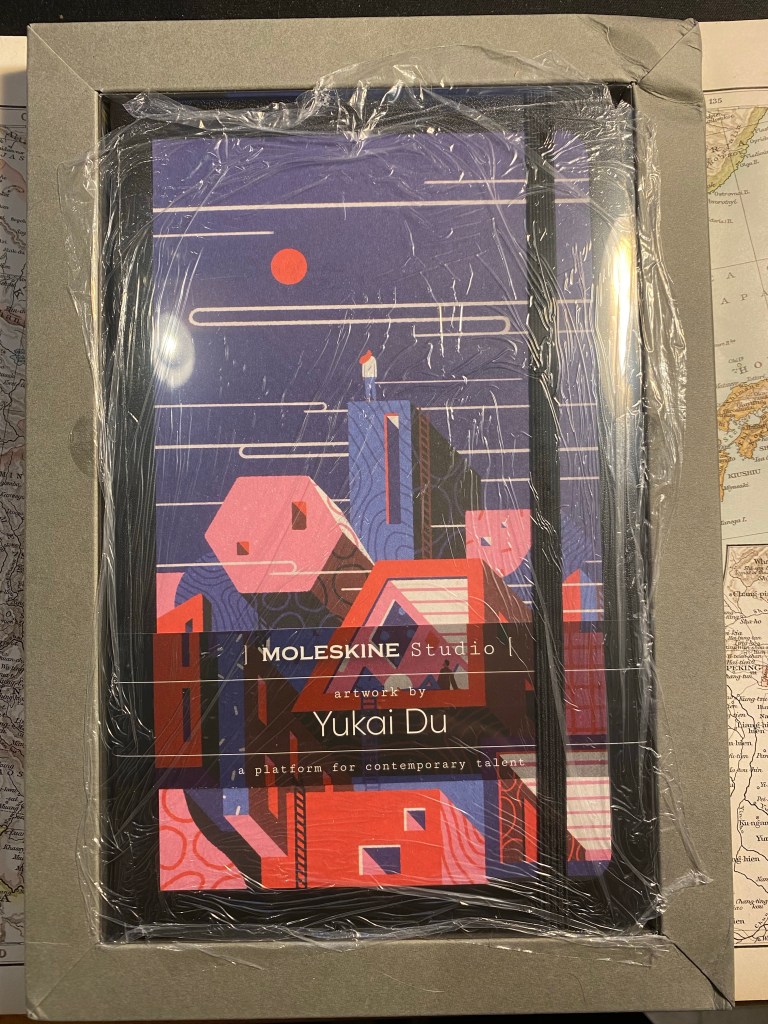
Here’s the box as I received it:
Crushed corner, weird cling film wrapping – there’s a lot going on here
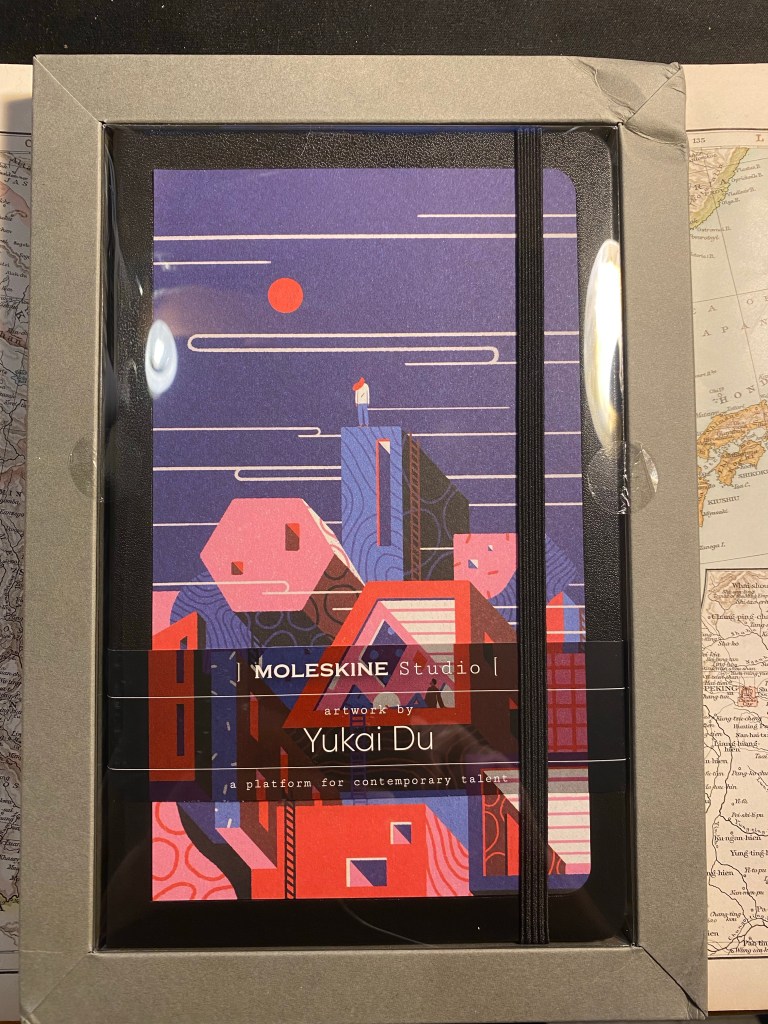
So the notebook’s box/frame came with a crushed top right corner, which is unfortunate. The notebook itself was covered with cling film, a form of packaging I’ve never seen come from Moleskine before, and a plastic cover that was attached to the box/frame. While the frame is designed to be reusable, I’ve purchased another Moleskine Studio that came completely without it, and I have a feeling that there’s very little chance for the frame to survive shipping without being mangled. As it is, I feel that there’s way too much packaging here.
Box frame, notebook, and plastic cover.
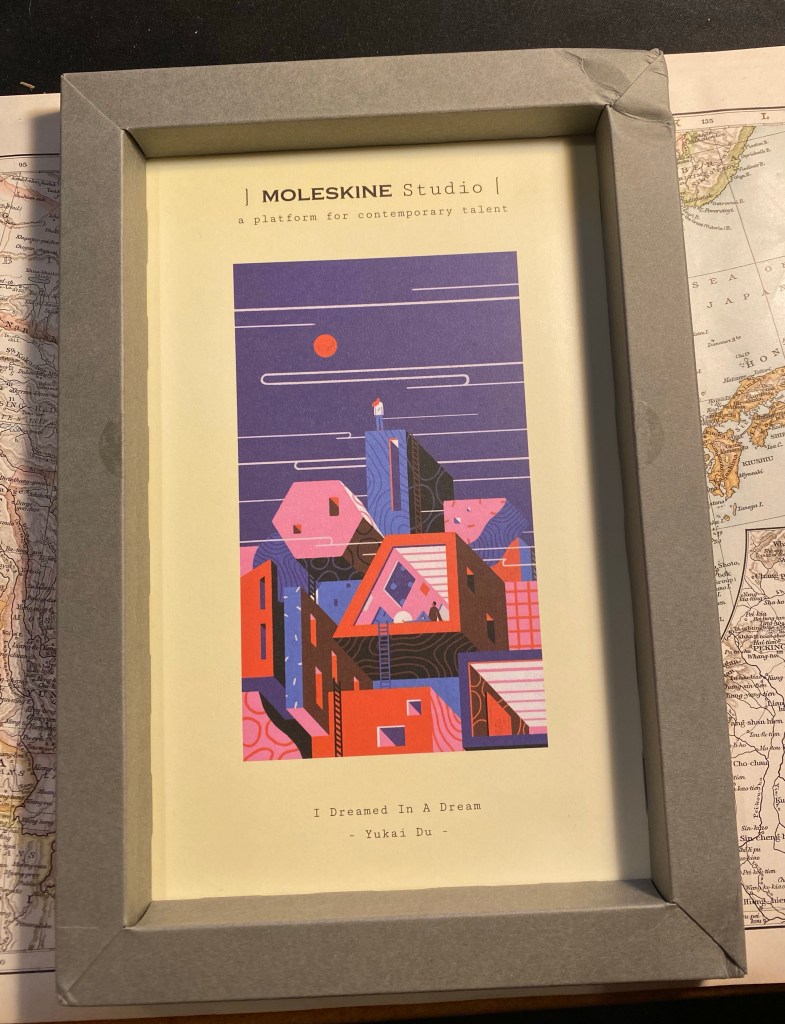
The frame with the artwork inside:
Yukai Du’s “I Dreamed In A Dream”
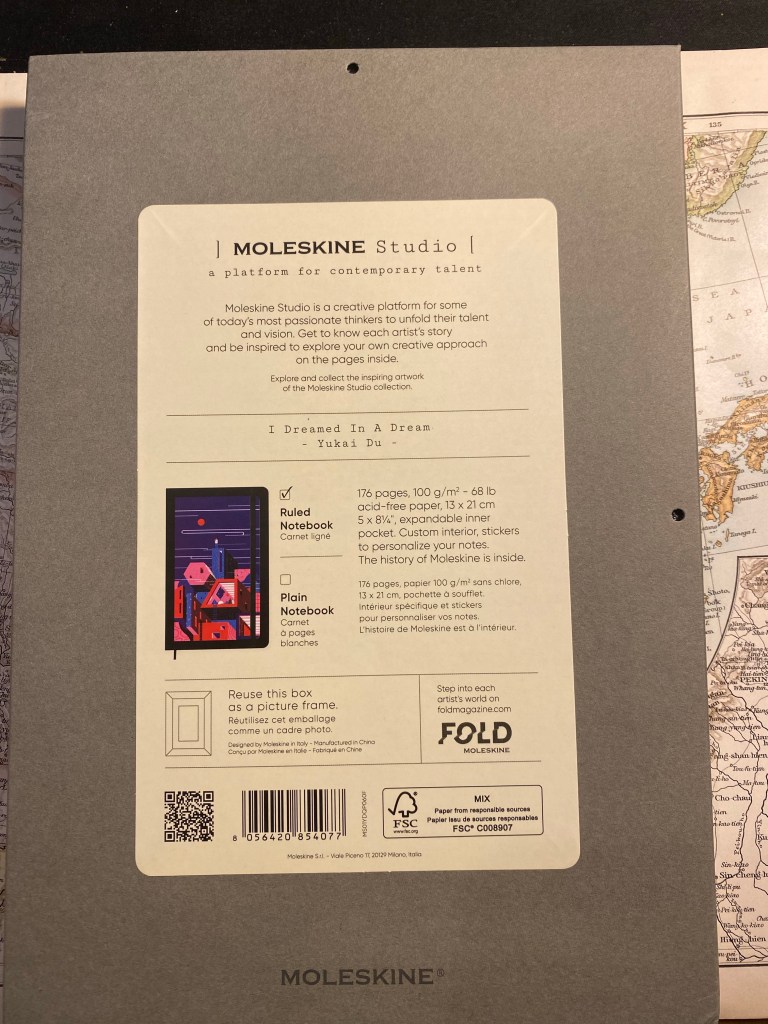
The flip side of the frame. You can see that there are holes for hanging the frame, as well as information about the paper in the notebook (gasp!). I wish Moleskine would print this info on every notebook they sell.
The back of the frame box.
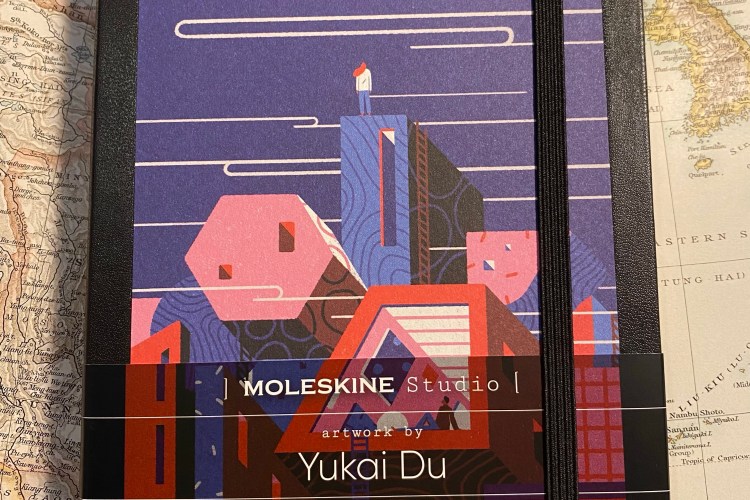
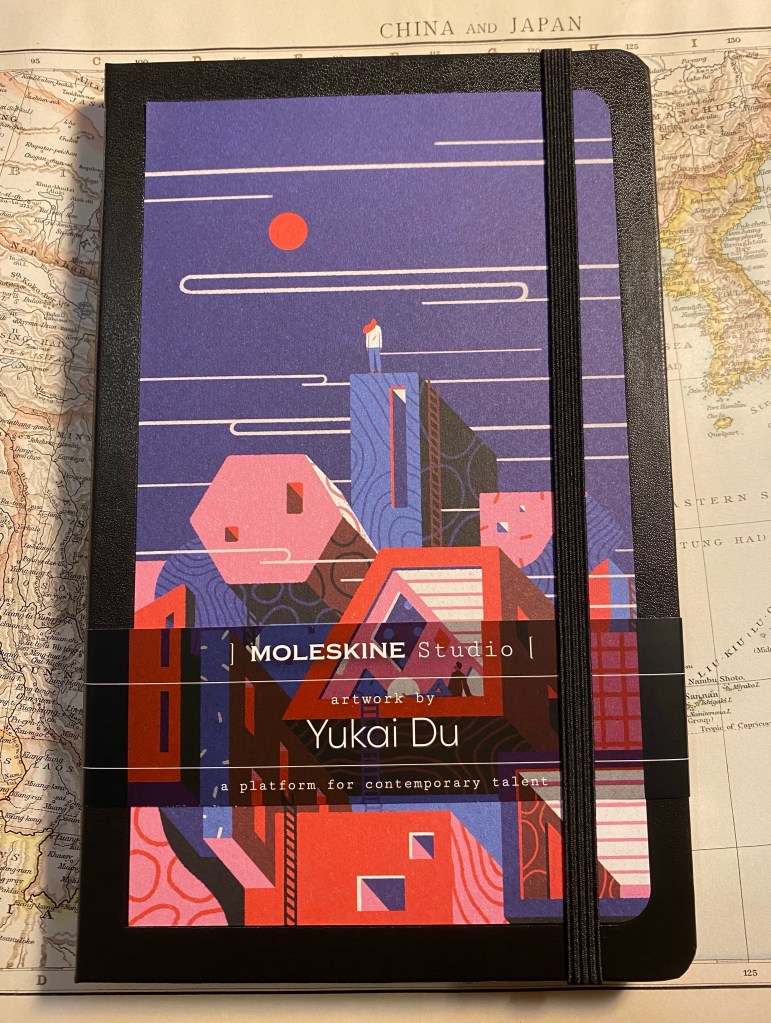
Here’s the notebook, and here’s where I start having more serious reservations about Moleskine’s manufacturing choices regarding this lineup. The artwork isn’t printed on the notebook cover, it’s glued onto it. I have a feeling that the glue isn’t going to last long, and in general it just cheapens an otherwise premium notebook experience.
Front cover (with paper wrap still on)
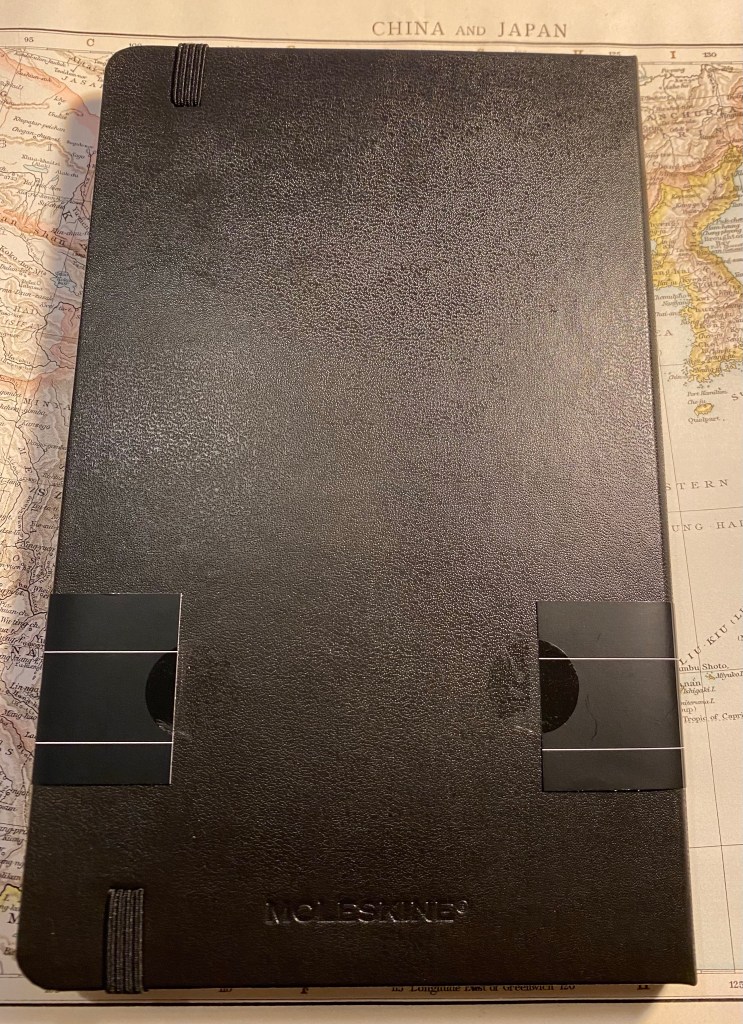
The back cover is a bit weird in that the paper wrap doesn’t reach all the way around and is just stuck to the cover with two stickers. The stickers are easy to remove and don’t leave any residue, but it’s the only Moleskine I’ve seen with this setup and I can’t help but wonder why.
Back cover.
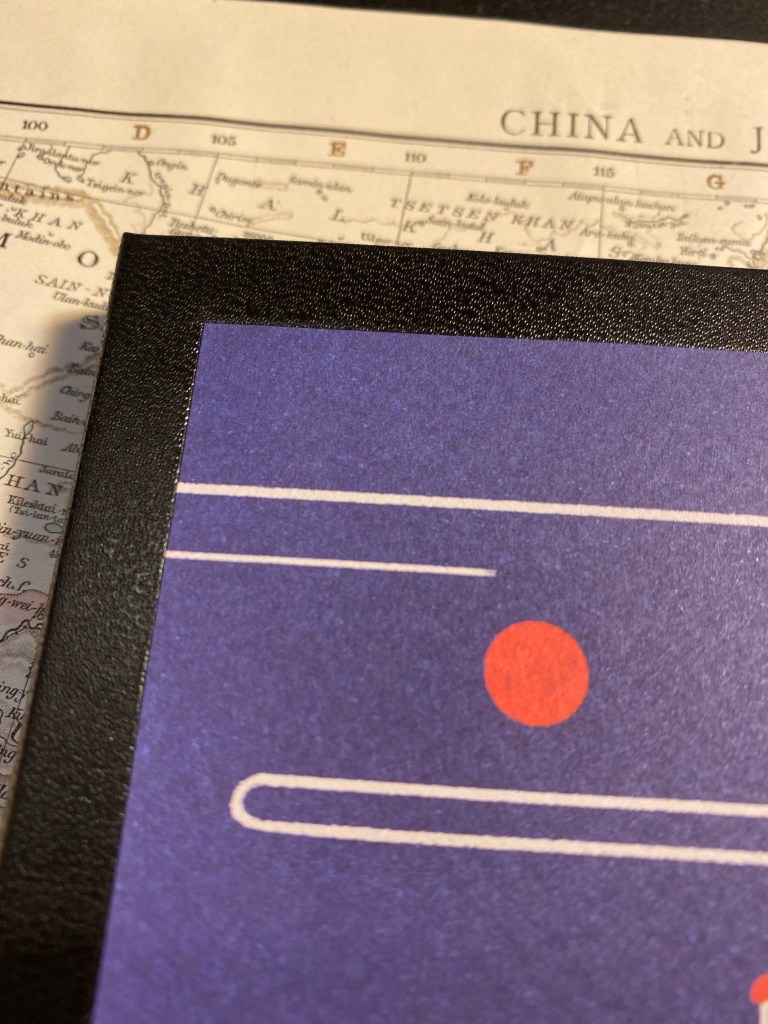
Here’s a closeup to the glued artwork on the cover. I’m also a little disappointed that the artwork hasn’t been signed by the artist, Yukai Du.
Closeup on the glued corner of the artwork.
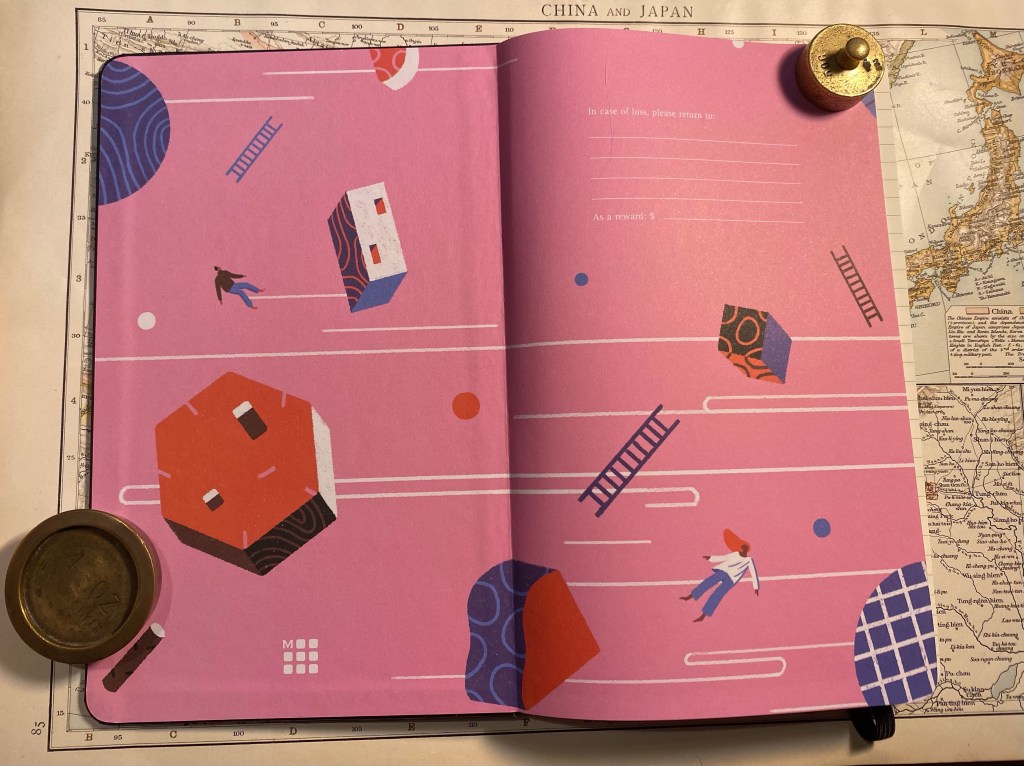
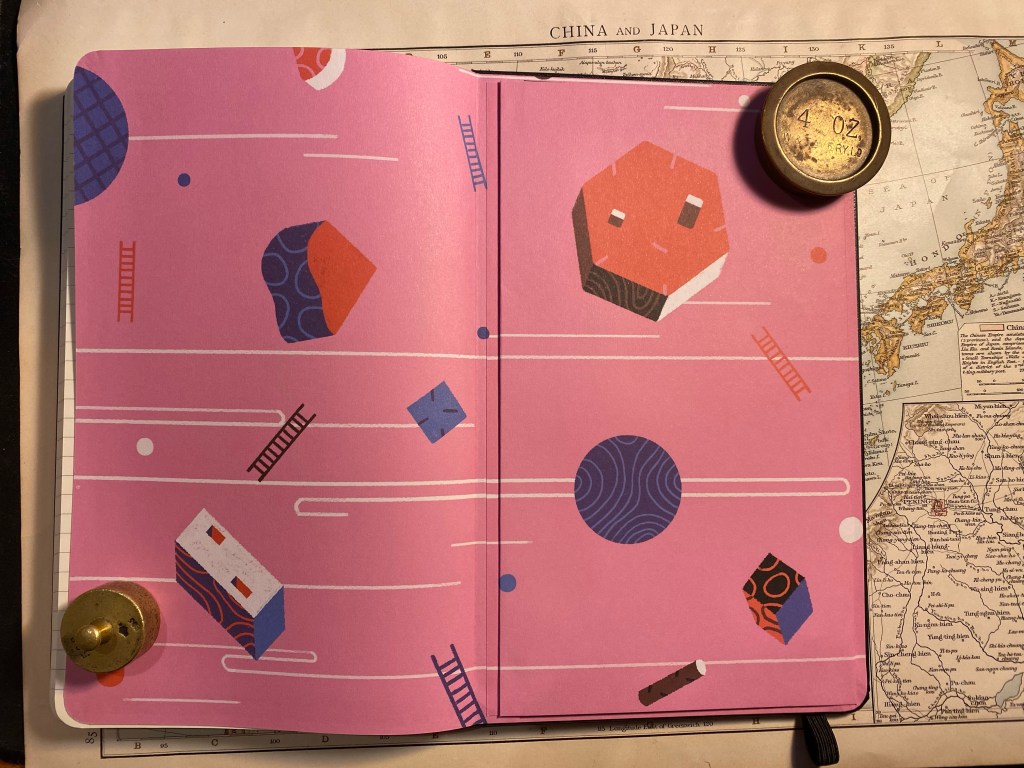
Inside the front covers is more of Yukai Du’s work, and it’s wonderful. This is where Moleskine shines, and I wish these artists could have had their work properly printed or even embossed on the covers of a Moleskine. They deserve it.
Inside the front cover, with “In case of loss”.
The paper is very good (not your standard Moleskine affair, which has its particularities). Ivory coloured, 100 gsm, not glass smooth but not textured, and it lays flat. There’s some writing samples ahead, but spoiler alert, yes it’s fountain pen friendly. There’s also the famous ribbon bookmark, which I wish was pink but in this case is black.
Paper and bookmark.
The back cover end papers feature more of Yukai Du’s artwork, perfectly aligned on the back pocket.
Inside the back cover.
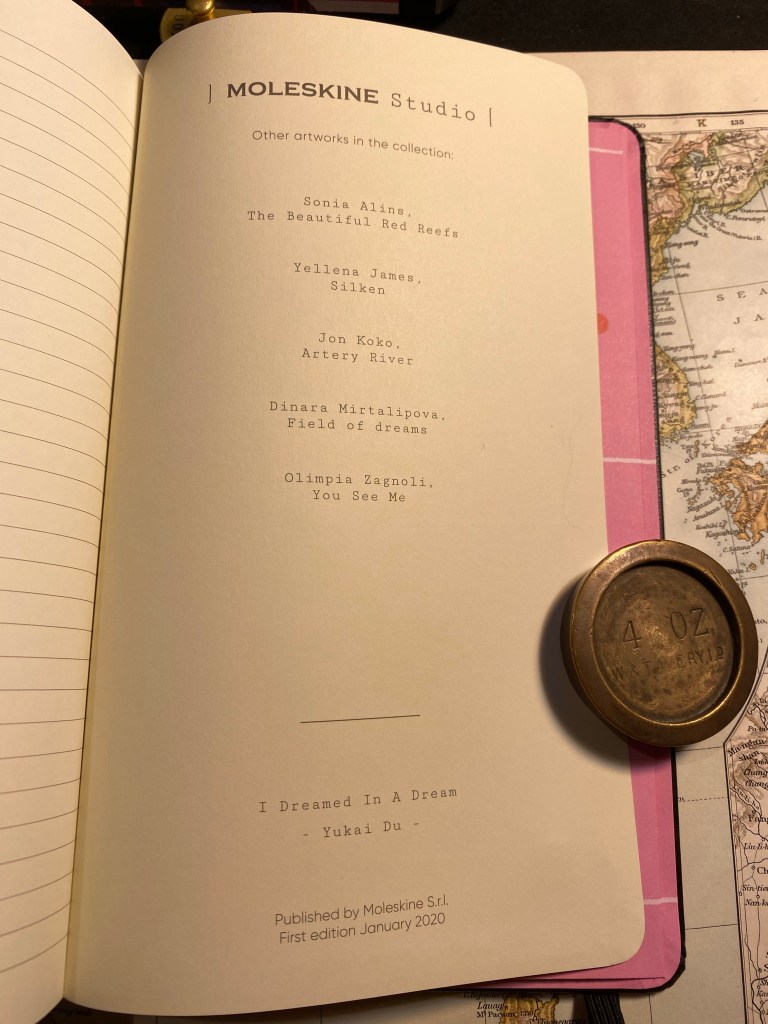
On the last page in the notebook, usually left blank, Moleskine has featured more information about the Moleskine Studio edition. In their marketing they’re calling this a new platform for collaboration with artists, and this page makes me think that this is going to be an ongoing project for them. I hope that they do continue with these, as the overall result is very good.
The last page.
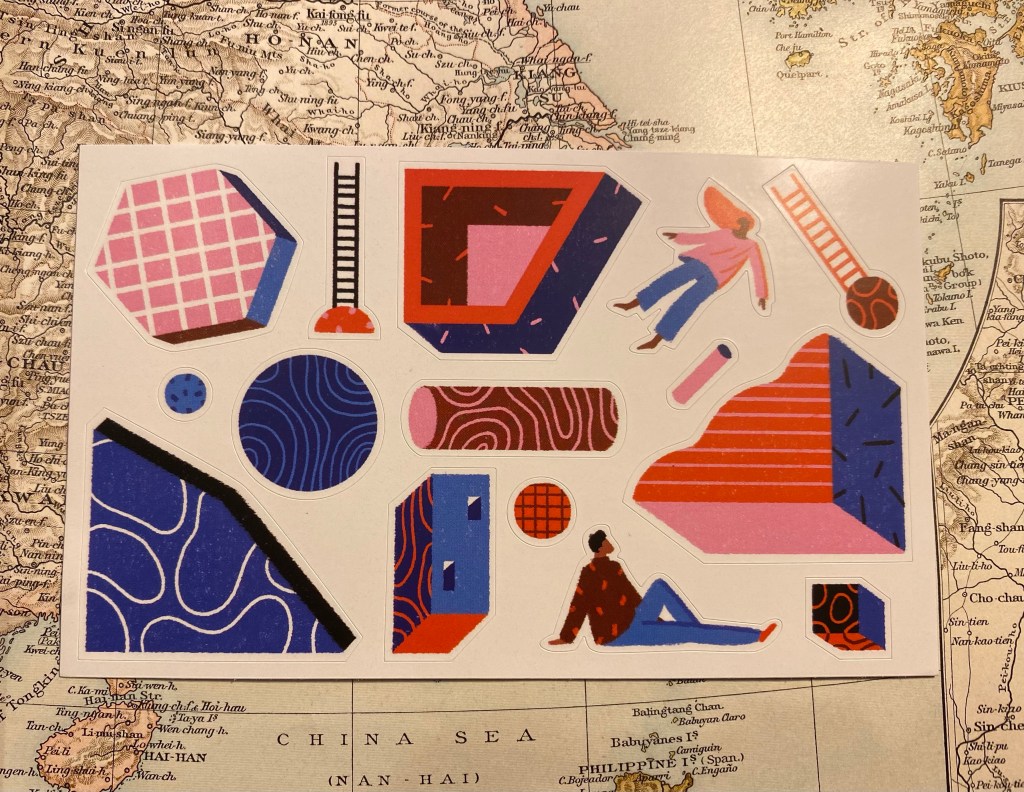
Here’s the sticker page that comes with this edition. Again, very well made:
Sticker page.
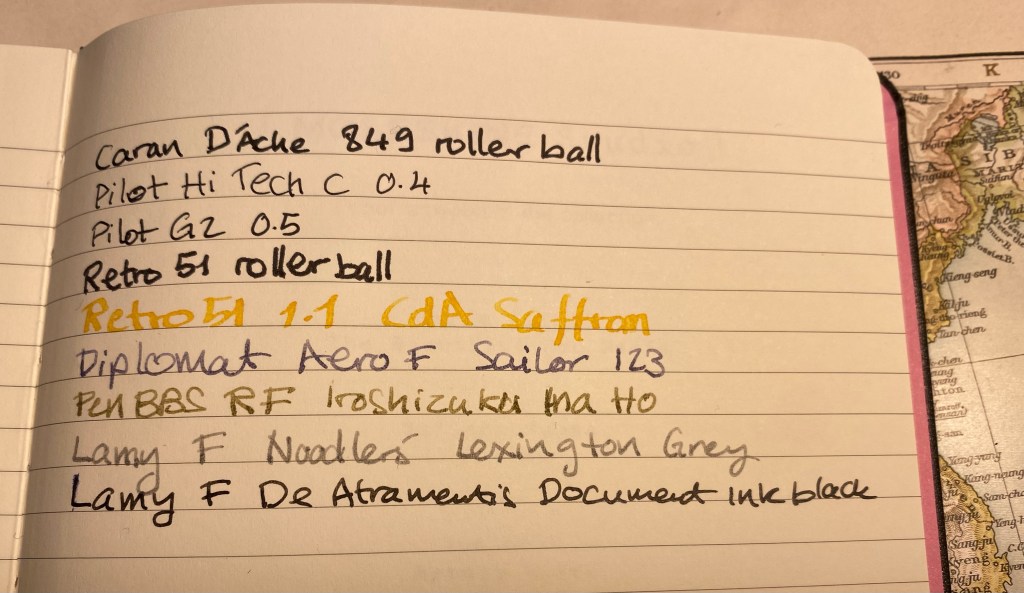
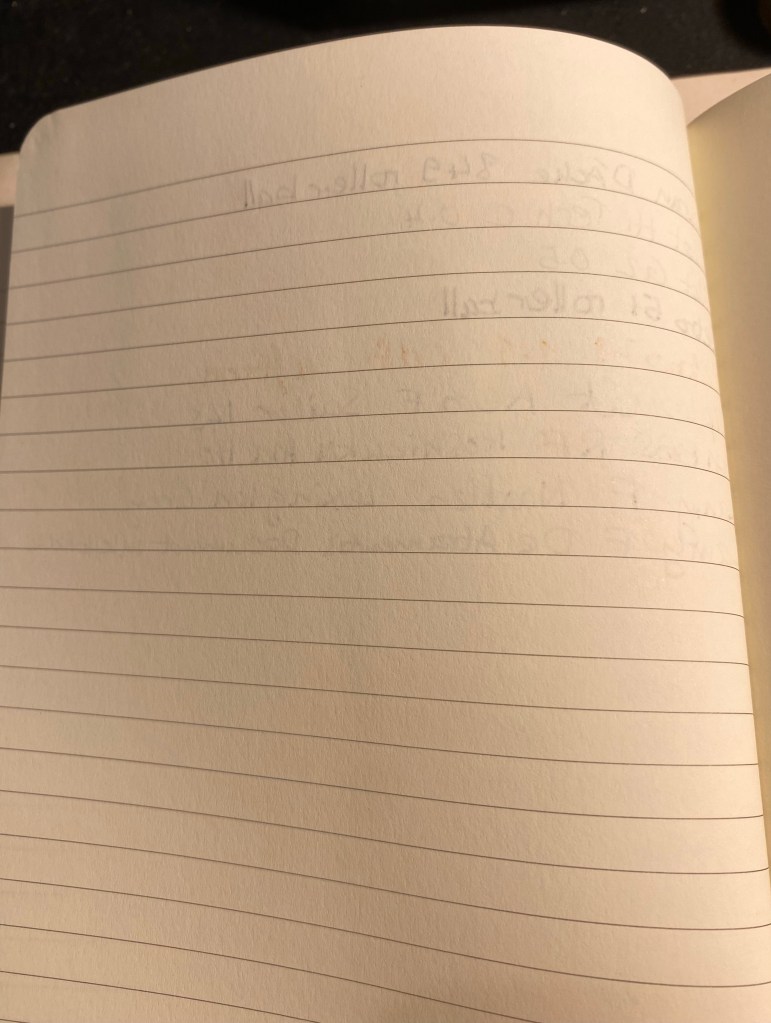
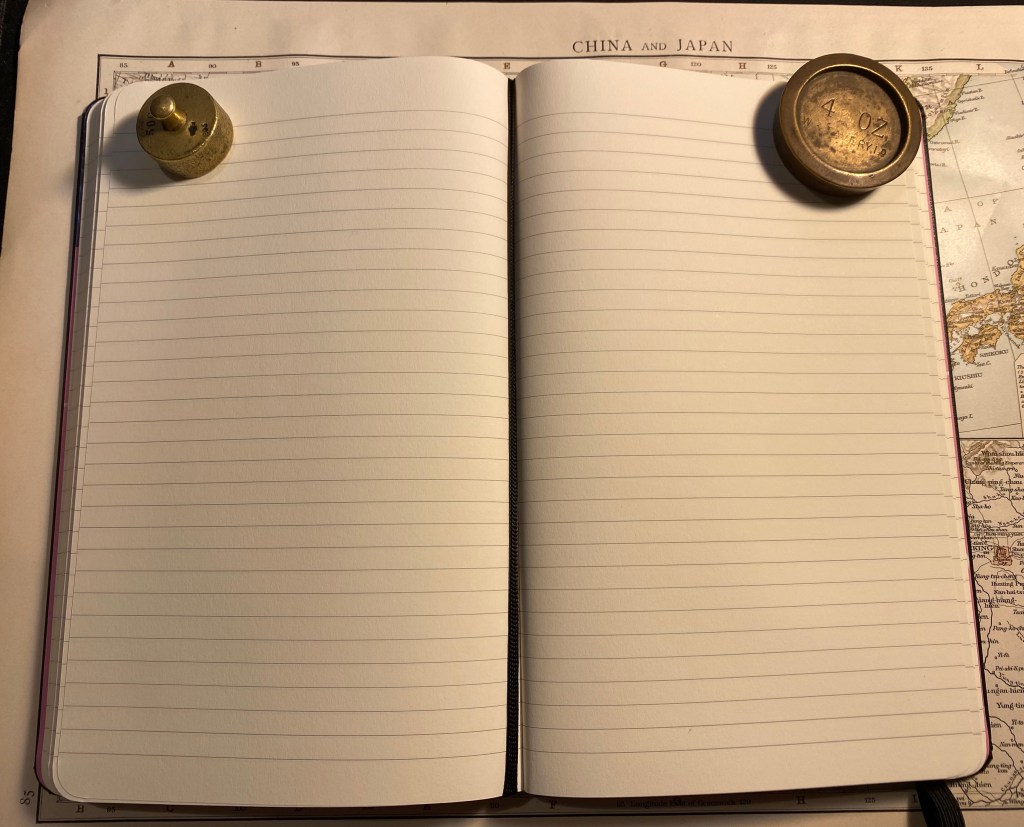
Finally, the paper. I was hoping that this is going to be a fountain pen friendly Moleskine and it is. There’s no feathering, no spreading, no bleed through and very little show through with this paper (there’s more show through with the rollerballs than with the fountain pens). Your milage may vary, but I am very happy with this paper, and a Moleskine Studio is going to be my next journalling notebook.
Ink test.
The reverse side of the page:
The reverse side of the page.
Overall, the Moleskine Studio is a strong new offering from Moleskine, one that really plays to their design strengths. It’s not perfect, but I hope to see them iterate and improve on it with time, and I hope that many artists get to have their artwork featured on an iconic notebook.
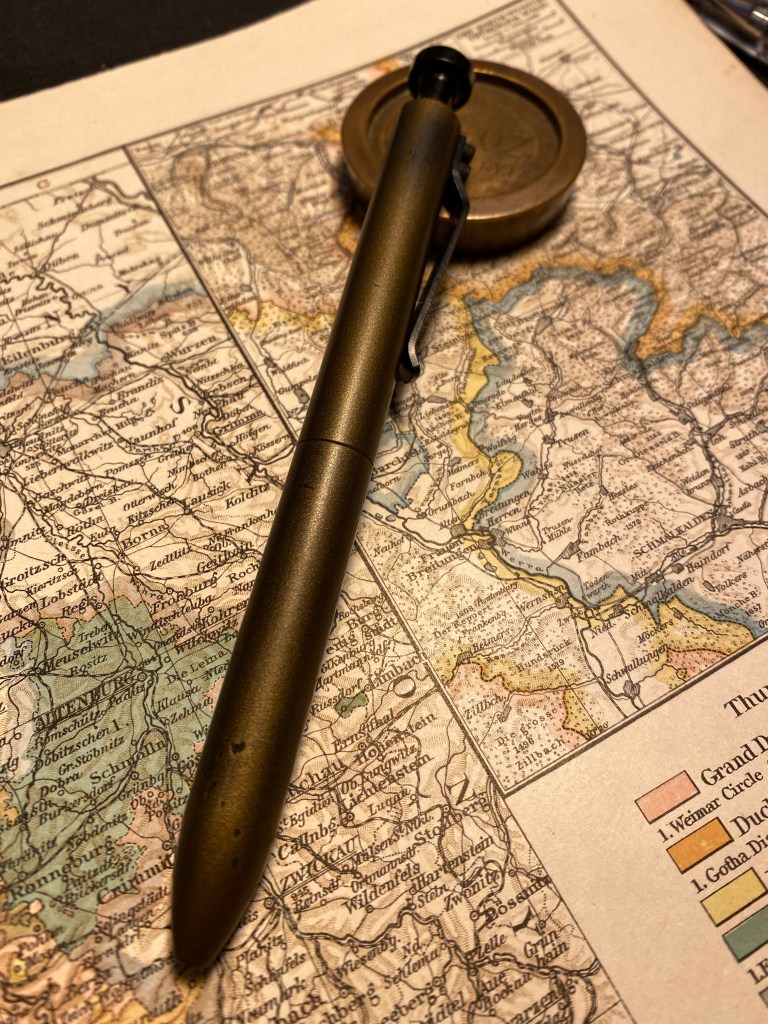
I wasn’t planning on reviewing the Karas Kustoms Steampunk Bolt V2 pen because I was sure that it would be sold out by the time I got to it. Somehow, however, there appear to be a few still on sale on the Karas Kustoms site.
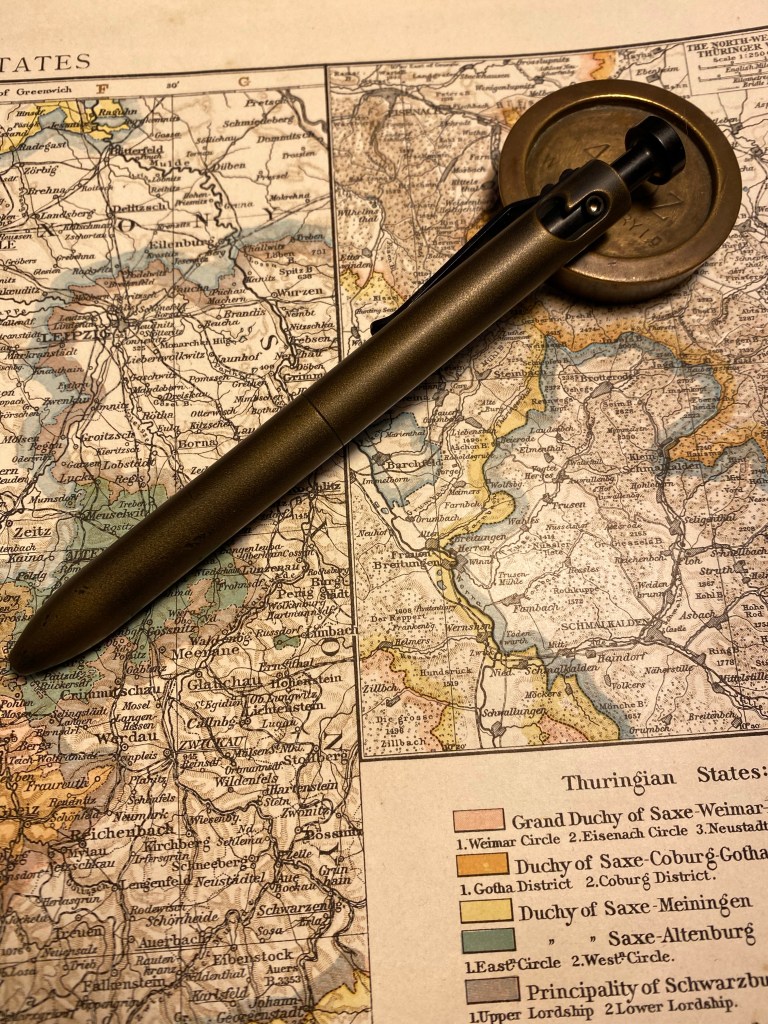
Dinges and Cerakote finish work together to create a really unique pen.
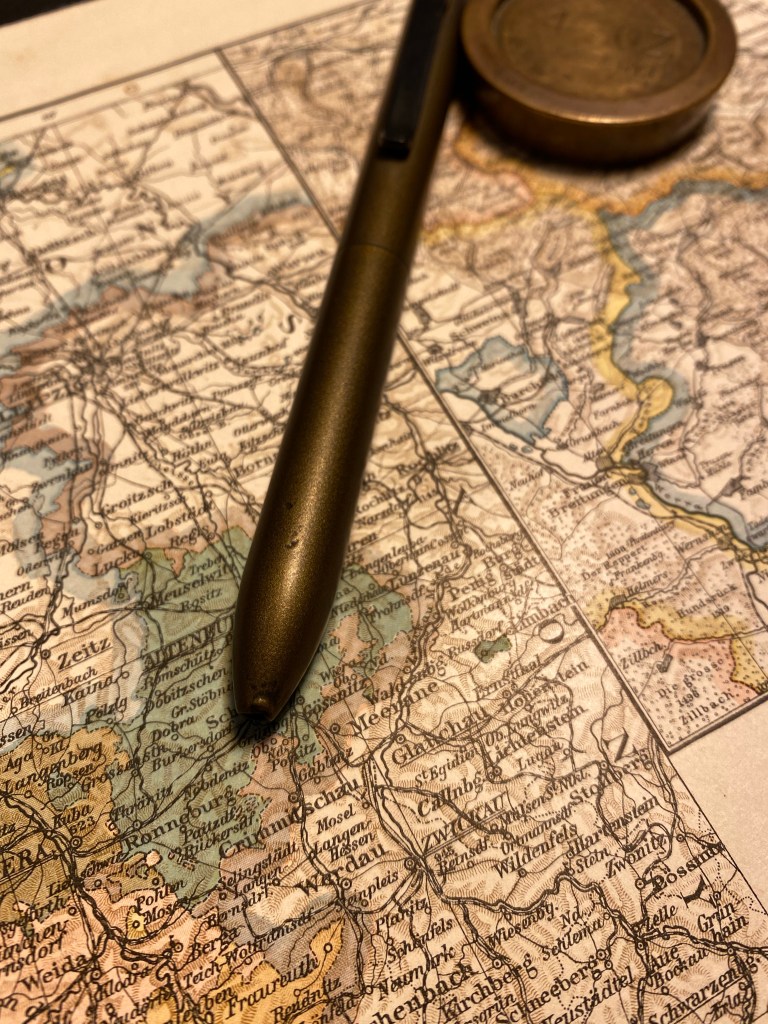
The Steampunk Bolt v2 has the same aluminium body and shape as the anodised Bolt V2, but it’s gotten a distressed bronze treatment in Cerakote. The basic Bolt pen has been dinged before the Cerakote finish has been applied, and the result is fantastic. The pen really earns the “Steampunk” title.
Big dent in the end of the pen, smoothed over and covered with bronze coloured Cerakote.
The Cerakote finish is smooth but not slippery, and really fantastic to hold. It’s also nothing like any other Cerakote finished pen that I’ve seen so far: it really gives the pen a bronze look without the bronze weight or smell. The pen is light (for a machined pen – don’t compare it to plastic), and well balanced. The black anodised bolt mechanism is as smooth to engage as ever, and works well with this finish.
Every ding adds to this pen’s looks. It’s just going to look better with time, I think.
There are two caveats to take into account with this pen (and other Karas Kustoms Bolt V2 pens):
The pen comes with a Pilot G2 LG (as in large) 0.5 refill. I haven’t been able to customise it to work with my beloved Uni-Ball UMR-85 refills (the bolt won’t engage). It’s a decent enough refill, but I wish that it had been built around the standard G2, and so had more customisation options.
There is a slight amount of play in the tip which makes it faintly click at times when you write.
All in all this is a very good machined bolt action pen, with a fantastic and very unique finish.
I am a huge fan of the original, vintage Esterbrook fountain pens. They are beautiful, versatile workhorses that are easyto find and affordable, provided you’re not after the rarer colours/models/nibs. If only they didn’t have lever fillers, one of my least favourite filling systems, they would have been my go to vintage pens.
I don’t buy vintage brand reboot pens. In my early days of fountain pen use there was a lot of hype about the reboot of Conklin. Conklin fountain pens had an interesting filling mechanism that I wanted to check out, but they were all too expensive for me at the time. Then came the brand reboot in the mid 2000’s which made the pens more affordable and more widely available. So I bought a Conklin Mark Twain in 2009, and it was terrible. It looked and felt like a $10 pen, it skipped and hard started all the time, and it fell to pieces after the first use. I still keep it as a reminder to be circumspect with my purchases in the future. The experience made me leery of vintage brand reboots, and so when Esterbrook was rebooted I stayed clear of their pens. They didn’t look like Esties, they looked like generic fountain pens, so I decided that this too must be a QC nightmare money grab that would ruin the Esterbrook name.
I was wrong.
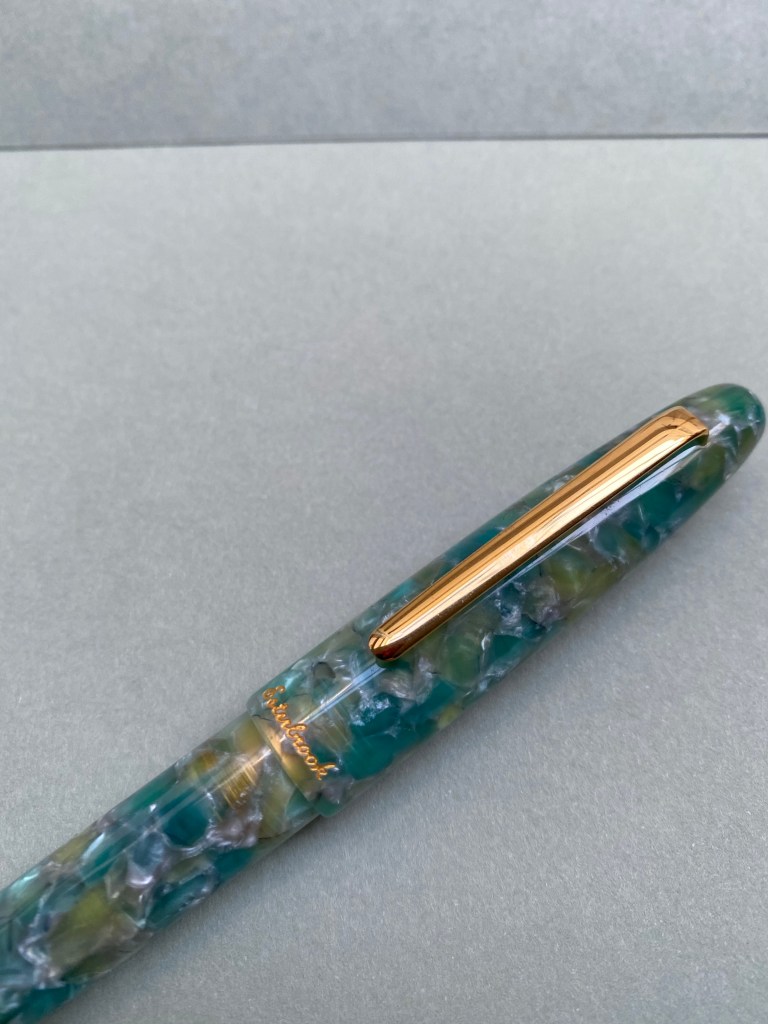
My photos do not do this pen justice. The Esterbrook Estie Sea Glass. It’s gorgeous, trust me.
After a mountain of good new Esterbrook reviews came in, and after I reconciled myself to the idea that the new Esterbrooks did not look like the old Esterbrooks I decided to give the Esterbrook Estie a try, and picked up a Sea Glass with a journalling nib. I normally don’t buy pens with gold hardware, but this was what was available at the time, and so a gold hardware Esterbrook Estie Sea Glass it is.
First of all, the pen is gorgeous. It has the classic cigar/torpedo shape that many fountain pens share, but the material of the Sea Glass pen sets it apart. It’s partly translucent, partly chatoyant, and vibrant without being Benu loud.
You can see some of the effects in the pen body here, but my photos don’t do it justice.
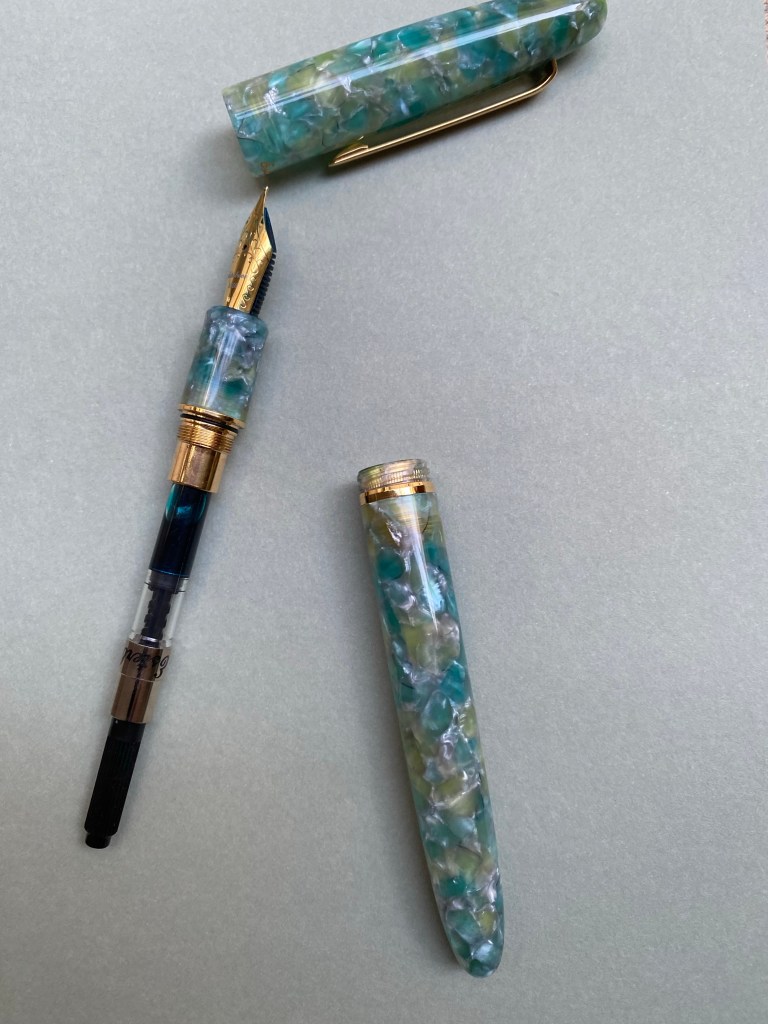
What took me by surprise is the capping mechanism. It reminded me of a child safe pill bottle, where you also have to push down as you twist to get the bottle to open. The mechanism does work well to make sure that the Estie doesn’t dry up or accidentally uncap itself, but it also means that it takes longer and a bit more effort to uncap the pen. If you write in short bursts this mechanism is going to be an annoyance.
You can see the capping mechanism threads. Esterbrook gets bonus points for making them attractive.
The “cushion cap” mechanism is well made and is attractive and unobtrusive when writing, so I don’t think it detracts from the pen. It’s just something to be aware of, since it is so unusual. It reminds me a bit of the Visconti Homo Sapiens caps.
The cushion cap inside.
The nib has scrolls and the Esterbrook branding on it, as well as a four digit number, like the old Esterbrook nibs. You can unscrew the nib and replace it with a vintage Estie nib, though I’ve been enjoying my Gina Salorino medium stub journalling nib enough to not want to change it. The fact that Kenro industries, the makers of the new Esterbrook, have teamed up with nibmeisters to offer custom nib grinds is amazing. Apart from the journalling nib they also offer an architect grind.
The nib.
The pen is branded on the cap lip below the clip with an “Esterbrook” imprint in gold script. I really don’t like the branding, as I feel like it cheapens the pen. If it were just an imprint then I think it would have been classier.
When the branding calls too much attention to itself…
The Esterbrook Estie is a cartridge-converter pen, and it comes with an excellent converter. The fact that this isn’t a lever filler like vintage Esties is great, as it’s much easier to fill, clean and check how much ink you have left in a converter, plus sometimes cartridges are convenient.
Cartridge converter at work.
The Esterbrook Estie is on the larger side but not heavy, with its weight distributed closer to the nib. It makes for a very comfortable writing experience, especially for me now. The cap posts, but I wouldn’t post it because it makes the pen overly long and unwieldy.
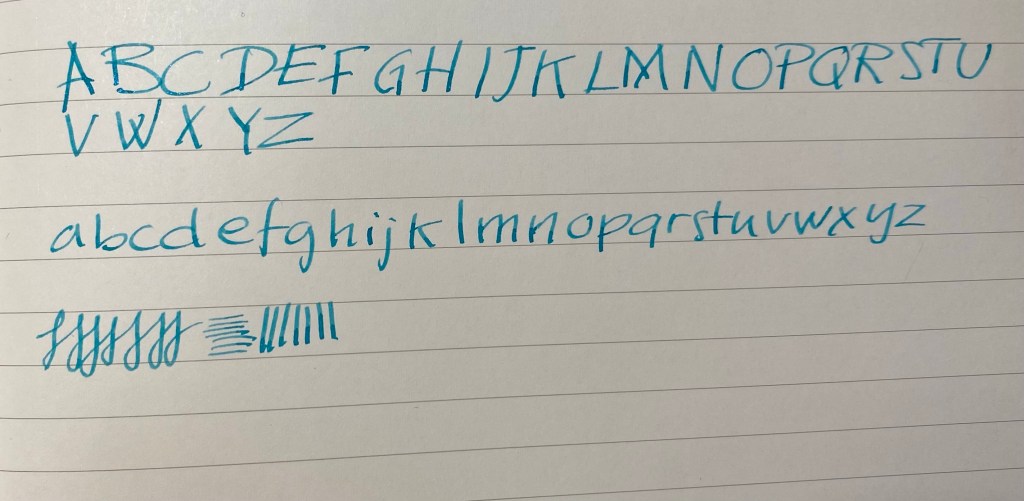
Here’s a writing sample with the journalling nib. It’s a lot of fun to use, and very forgiving to whatever writing angle you use it with:
Writing sample.
The Esterbrook Estie is more than a reboot to an old beloved brand. It’s a fantastic pen to select as your first “more than $100” fountain pen. It’s very well made, comfortable to use, has a classic fountain pen look, and an interesting selection of nibs that you can get directly from the manufacturer. It’s also very forgiving: easy to clean due to the combined cartridge-converter system and nib unscrewing, not likely to dry up or leak due to the cushion cap, and comes with easy and cheap ways to customise the nib post-purchase if you find that your tastes have changed. There are a lot of vintage Estie nib units out there.
The pen that I was leery of buying turned out to be one of the best fountain pens I have.
This is a super quick review because the Tactile Turn Nautilus is available only until the 8th of September, and I can’t write a more detailed review in my current circumstances (more on that in a later update).
This is the Tactile Turn Nautilus (the standard version), a limited edition Tactile Turn side click pen. Photographs do not do this pen justice. It’s stunning in person:
The Tactile Turn Nautilus
It’s a titanium bodied pen with a metallic, colour shifting Cerakote finish, and it’s that finish that transforms this pen from a good machined pen into a triumph of craftsmanship and design.
It’s impossible to photograph the colour shifting of the finish.
There are gold undertones to the finish that, coupled with the grooves on the pen body, the glittering gold clip and the Cerakote finish texture on everything, make this pen mesmerising.
The clip.
The clip has a gold Cerakote finish that evokes the golden undertones of the blue metallic Cerakote finish on the pen body. The gold is muted, and helps make the pen classy not flashy 🙂
The finish adds texture to an already textured pen (due to the Tactile Turn rings that are engraved on all the body). This makes the pen easy to grip, as it has an almost sandy feel to it.
The Tactile Turn Nautilus isn’t a light pen and is top heavy, but it’s still a pen that’s a joy to write with. If you’re considering a Tactile Turn pen, or any machined pen for that matter, I recommend giving the Nautilus a try.
In lieu of a longer review, if you have any questions, please post them in the comments and I’ll be glad to answer.
Drop is continuing its cooperation with Marvel and is issuing Infinity Saga themed keycap sets. The first set issued was of course, the Captain America one. Alas, it featured dark red modifiers with light red text on them, which is unfortunate. Next came the Iron Man set, which was better than the Captain America one but still too red for my liking. Third in line was the Black Panther set and it is gorgeous.
The set comes with a nice poster-like sleeve around the box that contains the keycap trays. It’s a nice added bonus, and something that you can easily cut out and display as a mini poster.
Outside wrapper with cool T’Challa themed art.
The box the keycap set comes in has the same design as the custom keycap that Drop sold before they started selling sets. It’s elegant and functional and I love the logo design on this.
Drop + Marvel debossed on the box.
The set itself comes in three trays, ready to easily assemble, and carefully packed so that the keys don’t move around or get scratched in transit:
Keycap tray with the clear cover and protective bubblewrap still on.
The first tray contains the purple alphas:
Purple alphas plus two spacebars in different sizes.
This is a full set that will fit practically any keyboard layout so there are a lot of “extra” keycaps here.
The second tray contains black modifiers as well as purple numpad keycaps and some extras.
Black modifiers and purple numpad keycaps.
The third and final tray contains the novelties (which are excellent) and more black modifiers. The novelties are T’Challa’s mask, necklace, a silhouette of the ancestor tree scene from the movie, and two Marvel logo keycaps.
Novelties and more modifiers.
The keycaps are doubleshot ABS and thick. You can see one of them compared to a keycap from the SA Dasher set.
Black Panther keycap on the left, Dasher keycap on the right.
Here are the keycaps on my Code TKL keyboard, without backlighting. Yes, I know that the spacebar is flipped. That’s how I use it.
Keycaps assembled 🙂
And here they are with backlighting:
I really like how elegant this keycap set looks like.
You can see the texture of the keycaps in the photo below. They are really fun to type with. I usually use SA keycaps, so it took me a minute or two to get used to smaller keycaps again. However, the MT3 profile is really comfortable to use, with the same feeling you get with SA keycaps of the keyboard coming to meet you. As with SA sets, the homing keys are just the same keycaps with a deeper scoop to them.
The keycap texture and a closeup of the sculpt on the keys.
Here are the novelties in action. The ancestor tree:
And the mask, logo and talon necklace keycaps:
I haven’t bought a new keycap set in years, but this one really called out to me and I’m glad that I purchased it. It’s elegant, understated but not pedestrian, and its a joy to use. I can only hope that future sets in this collaboration come out as well as this one.