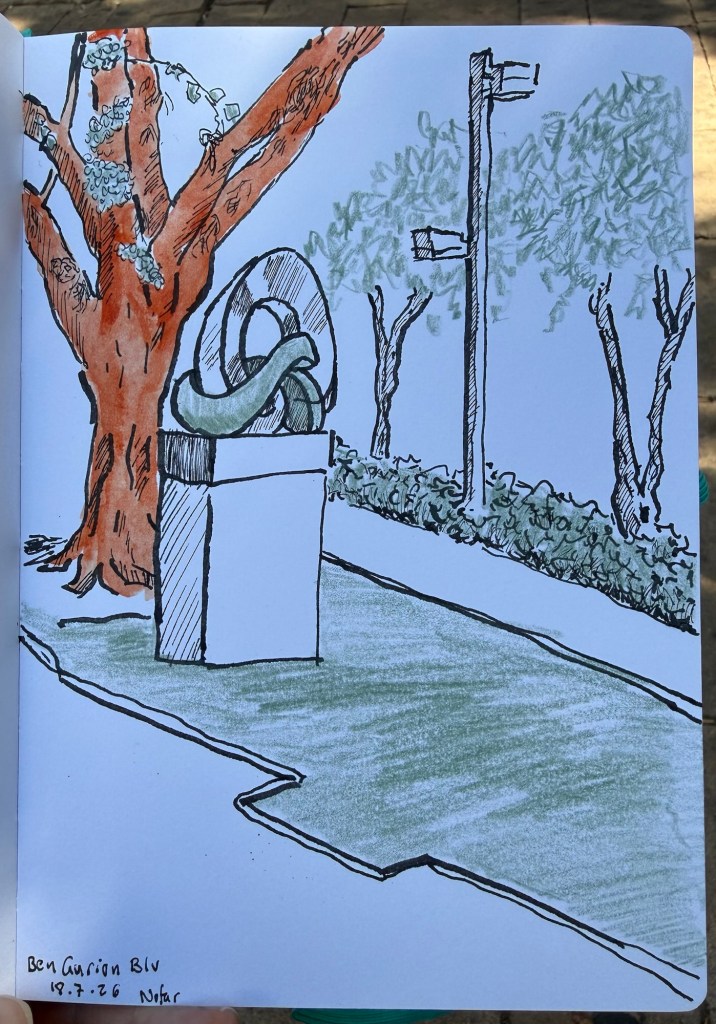
I wasn’t feeling well earlier this week, so I decided to sketch close to home and to simplify my setup. I was feeling the “Toulouse Blues” (where you’re part of the urban sketchers community but miss out on the urban sketchers symposium in Toulouse), so I wanted to sketch to cheer myself up.
The sketch
The setup was unusual for me on all counts:
The notebook is a Leuccchturm1917 sketchbook that I’ve had since my first urban sketchers symposium in Porto back in 2018. It was Leucchturm’s first foray into sketchbooks, and so the paper isn’t the best. They have since improved it somewhat, even though it’s still far from a high end sketchbook. In this case I wanted something simple and serviceable, and it helped that this evoked fond memories of symposiums past.
The pen is a Sailor Fude Mannen fountain pen with De Atramentis Black Document ink. I usually don’t bother with the Fude pen and use fineliners but in this case I wanted something more expressive.
Two colors only – the green is a Faber Castell Polychromo earth green (172) and the Sienna is a Daniel Smith Quinacridone Sienna watercolor stick. That with a waterbrush provided the reddish earth tones on the tree trunk. The stick was a gift from the Poznan symposium goody bag, and I still find it very cumbersome and messy to use.
I kind of like the result, and I’ll try to create more experiments like it in the future.
As part of the Urban Sketchers symposium in Toulouse and general summer travel I know that a lot of sketchers will be visiting Paris this summer. Paris is full of wonderful art supply shops but I wanted to highlight three in particular that are worth visits. Each store caters for a different need, at a different price range, and with a different ambience. If you can, I recommend visiting all three, but if you can’t hopefully this will help guide to the store that best suits your needs.
Rougier & Plé Saint German – the most centrally located and accessible of the three stores, Rougier & Plé is on boulevard Saint German not far from Saint Michelle. This multi-level store is easy to navigate and expansive. The top floor is for sketching supplies – pencils, pens, markers, charcoal, sketching paper, glue, erasers, measuring and cutting tools, etc. The second floor is dedicated to watercolors, ink, printmaking and their related materials (brushes, paper, masking fluids, etc). The first floor is where you’ll find the discounted section, student art supplies, packing materials, hobby materials (beads, clay, etc) and stationary items. They provide tax free forms if you spend more than 100 euros (which won’t be hard), they have a very good selection of brands (this is a good place to buy Schmincke watercolors) and they usually have a good selection of products on sale – particularly paper. This is the “bread and butter” store and if you only have time for one I’d select this one. There’s also a good selection of stores nearby that can interest other members of your party, a nice coffee shop (Cuvée Noire) and a nice park just around the corner (Jardin médiéval du Musée de Cluny) so if you’re traveling with none-sketchers you don’t have to drag them in with you. There is an elevator so if you have accessibility needs this store caters for you. The staff is a bit surly and I wouldn’t go in looking for assistance, but they do have a decent website so you can check things out before you go.
Magasin Sennelier – You’ll find this store all over Paris art supply store recommendations but this is a store with quite a few caveats. On the pro side it’s beautiful, it has a wide selection of supplies that you just won’t find anywhere else (like Etchr sketchbooks for instance, Japanese fountain pen ink, certain sketching supplies), the staff is knowledgeable, and they have tax-free shopping over 100 euros. However the store is open in very particular hours (10:00-12:45 after which they close until 14:00 when they open until 18:30) and they will kick you out at 12:45 regardless of whether you’re just about to pay them or not. It is also inaccessible in terms of public transport because it’s on a one way street with no nearby metro station (so you can take the bus one way to the place, but you’ll have an issue getting back – or vice-versa, depending on where you’re coming from). It’s best to pair a visit to the store with a visit to the d’Orsay or the Louvre but make sure that you don’t end up there when they’re closed for lunch. The store is on two floors, but there’s no elevator and the place is very cramped and chaotic. It’s most likely that you’ll need to ask for help finding things, and you may have to rummage around or ask the staff to bring up things from the back. The staff is helpful (up until lunchtime when they become surly and brusque), and while the prices aren’t the best to be found they do have things that you just can’t get anywhere else so it may be worth scheduling a visit there. This is, however, not a store that you can spontaneously slip into your schedule. Plan your visit carefully so as to not be disappointed.
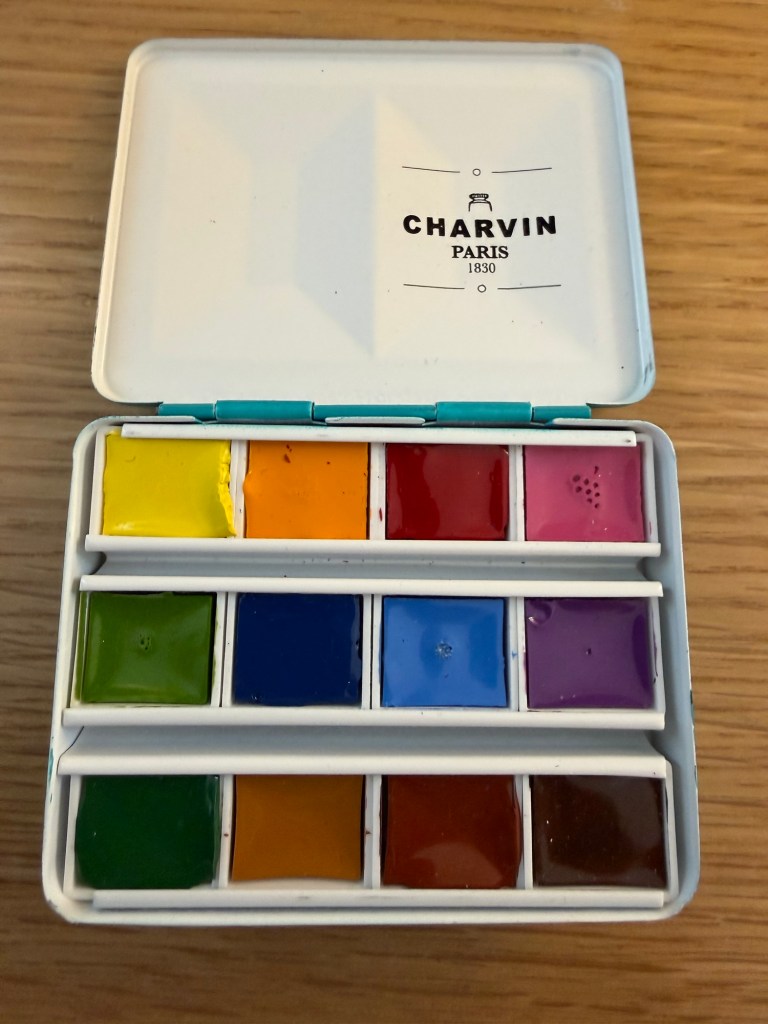
Charvin watercolours purchases in Le Géant des Beaux-Arts
Le Géant des Beaux-Arts – this store is not as centrally located as the other two, but is still not too far away from public transport to make in inaccessible. This is a warehouse kind of store, huge, sprawling, and the cheapest by far of the three. You won’t get a tax return here, but you will get a significant discount on practically everything you buy (the cashiers will sign you up as a member for free if you aren’t, so you’ll get the most discounts on your shopping). They have a very wide selection of supplies and brands (though not everything – it’s worth checking their website first), and the biggest problem there is not getting lost in the cavern of supplies or overdoing it. There are stairs here and there so if you have accessibility issues I’d stick with Rougier & Plé, and there is only some method to the madness (particularly in the paper section). The staff is largely busy stacking art supplies and while they’re nice and try to be helpful, usually only the staff behind the till is knowledgeable. You will find Paris exclusive brands like Charvin and the widest array of Clairfontaine paper you could ever want, so it’s worth visiting the store even if you’re not particularly in search for bargains.
Paris is a wonderful city for artists in terms of its art supply stores, so this is far from a comprehensive list (there’s Charvin, various Sennelier stores, etc). Use this if you are short on time and want to hone in on which store best suits your needs and budget.
The Urban Sketchers Symposium in Toulouse is starting next week, and this year I won’t be participating. For the lucky few that are going to be there, whether as official symposium participants or as “free range” sketchers I thought I’d write down some insights and tips that I gathered from last year’s symposium in Poznan.
In no particular order, here they are:
Talk to people – even if you’re shy or an introvert, the symposium is THE place to connect with people not only because everyone will be nice and kind and many are also introverts, but also because you have a guaranteed shared interest: urban sketching. If you’re unsure how to approach people, just ask them about their favorite sketching setup or tool and see what happens.
Wear your badge everywhere, even at breakfast at the hotel, even if it’s “just” an urban sketcher ID tag. This lets other sketchers know who you are, and opens up opportunities to connect and share with other sketchers. Invite them to join your table at the busy hotel buffet, or ask them where they had lunch or where they’re going to sketch next.
Swap and share art supplies. People rush from place to place, and people forget or misplace art supplies all the time. It’s worth packing some extras and sharing them around – pencils, pens, a tube of paint, etc. You could save someone’s workshop experience with this simple gesture, and it costs you next to nothing. And swapping art supplies, even for a brief sketch is a great cost-effective way to try before you buy. I packed a whole pencil case full of a range of pencils for a workshop and then forgot it on the desk in my hotel room. Thankfully the wonderful instructor and workshop participants had enough to share to help me out and allow me to fully participate in the workshop.
Don’t be afraid to ask for help – whether it be directions to the starting point of the sketchwalk, help with understanding something you didn’t get in a workshop or demo, or assistance with your gear, people are ready to help if you just ask them.
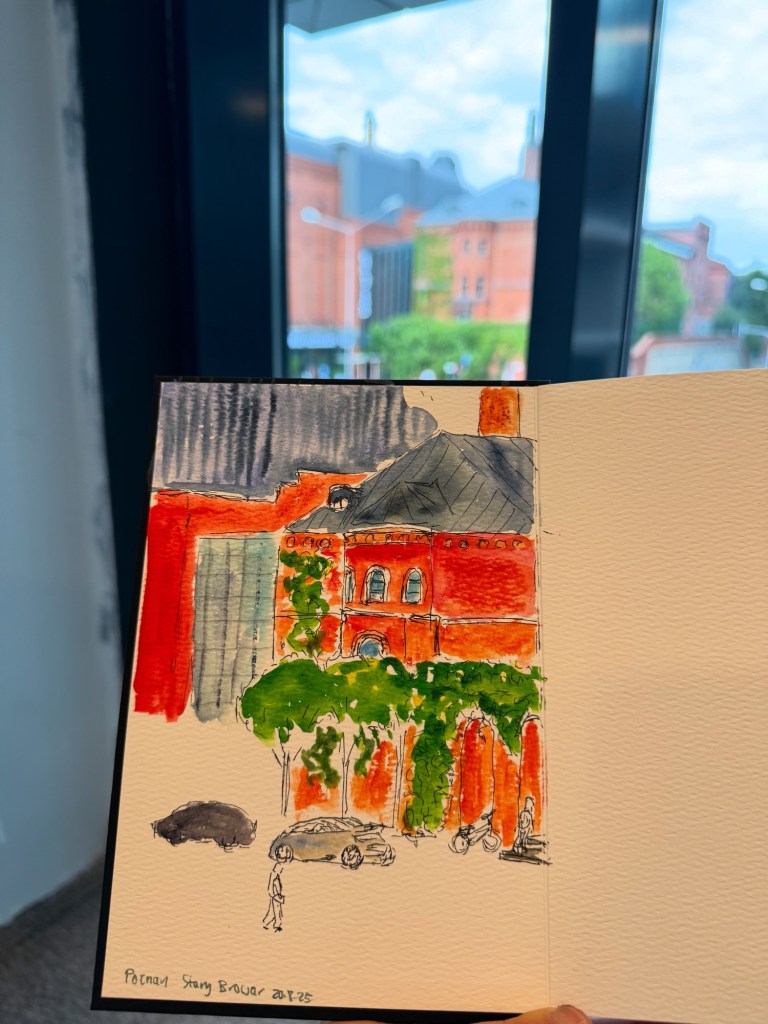
Quick sketch made from goody bag supplies just outside the art market
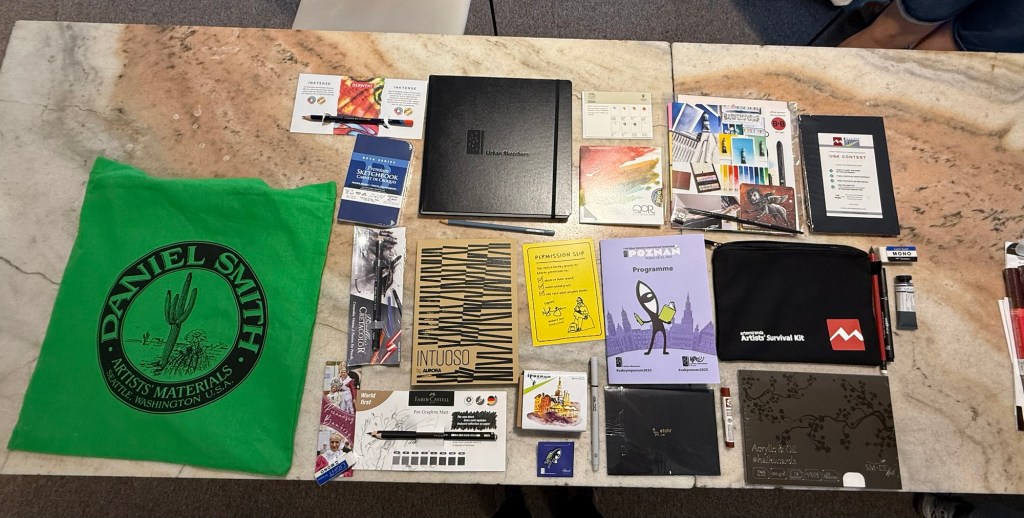
Go early to collect your badge and goody bag and take time to appreciate them. The symposium crew put in a LOT of effort to create amazing goody bags with the sponsors. Collect the bags early and help the symposium and sponsor out by posting about them on social media (Instagram in particular, using the correct tags), and by using them and enjoying them. In Poznan most of the attendees sat in a room adjacent to the one where we collected the bags, did a throw down post and then a sketch with lovely supplies that we got. There was a wonderful view of a historic building next door and it was really fun to create this shared sketching moment. Also remember to share and swap with other sketchers and the volunteers.
Goody bag from the Poznan symposium
Follow the official symposium instagram and use the official tags. The Instagram will have giveaways and useful information (some of the giveaways are also open to non-symposium participants), and the tags help spread the word around and bring positive attention to the city and the sponsors. It was amazing to see as the symposium advanced how much attention Poznan got due to hundreds of talented sketchers bringing it to life.
Embrace the locals. They will notice you because you’ll be noticeable – large groups of sketchers call attention to themselves. Remember to represent the urban sketchers community, be kind and welcoming, and answer any questions they have. From my Poznan experience the locals will embrace you in return – with kind words, tips, stories and sometimes a free drink or a bite to eat (but don’t do it for the freebies!). Children in particular are attracted to sketchers, and we oftentimes shared bits of sketching paper and art supplies and invited them to join in.
Respect the instructors and lecturers. It’s tough to stand in front of a crowd and talk about your art. Don’t mess with your phone during lectures, listen to the instructors, be kind and respectful, and be open to learning. This is a given, but it’s worth stating anyway just in case because it’s that important.
Be nice and kind to the volunteers and talk to them. Many of them are sketchers, many of them are just locals who answered ads and are curious about sketching and the symposium. Share your work and be kind to them – it’s a tough job performed by a dedicated and small group. People gave them stickers, sketches, art supplies, and just chatted with them. A great volunteer can really improve a workshop, and it’s worth acknowledging their work.
Be nice and kind to restaurant and cafe waiters, baristas and owners. Urban sketchers love to camp in these locations to sketch, but be aware of your surroundings. Don’t hog tables during rush hour, be sure to order food and drink (don’t share one dish for four people, even if you’re broke. It’s not fair for the waiter or for the restaurant), tip well, and clean up after yourself. Tag places if you sketch them to raise awareness to the meal you enjoyed there, and remember that you represent urban sketchers everywhere.
Come with art supplies to donate. There will be an opportunity to do so throughout the symposium. We all have too much or supplies that we no longer use, so donate them (if they’re in good condition) to the local charity the symposium is sponsoring. The front desk volunteers usually start the collection on the first full day of the symposium.
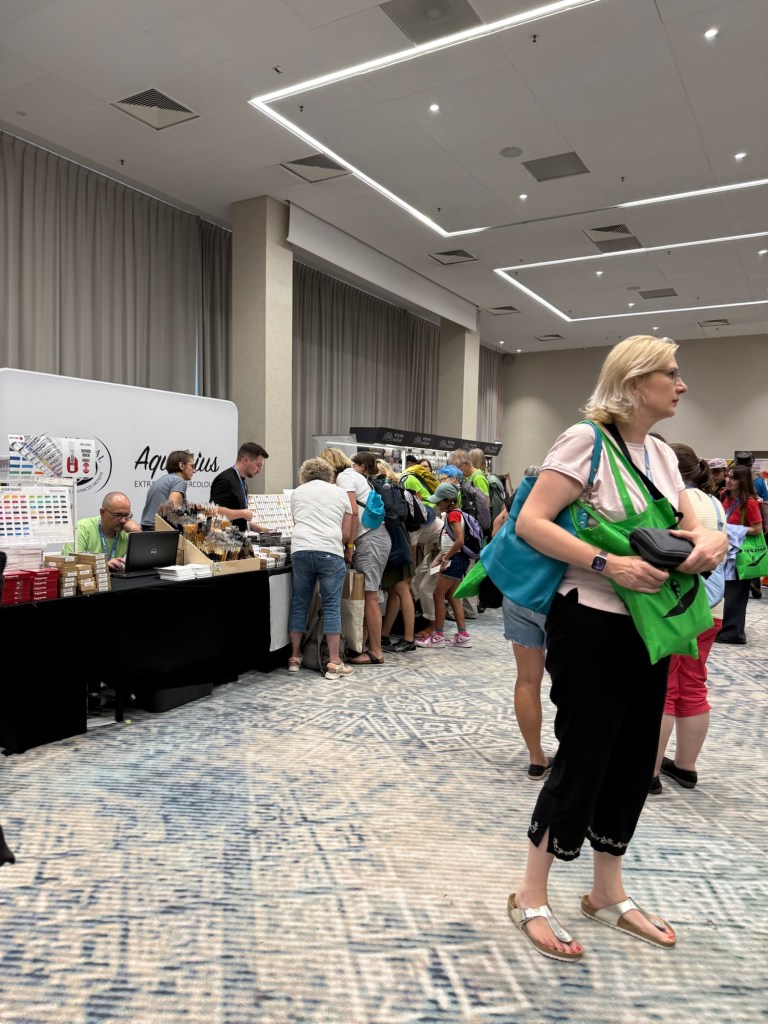
Go to the art market. Make sure to visit all the stalls – many if not all of them are sponsors, and there will be local suppliers that are worth checking out. Try new things, talk to the vendors (they’re usually very knowledgeable), and be prepared for the rush of the first day crowds. Many stalls will also have giveaways and contests set up, so be sure and ask about them.
Art market first day madness
If you are looking for deals, go the art market during the final hours it is open. Although you will find many things out of stock, most vendors will have deals on the last hour or two of the market, to avoid having to ship back supplies.
Talk to the locals, whether they are sketchers, volunteers or instructors. Ask them for good, cheap restaurants for lunch, cafes worth visiting, shops and market stalls of note, cool places to sketch in, and where they get their art supplies. Their local knowledge is priceless.
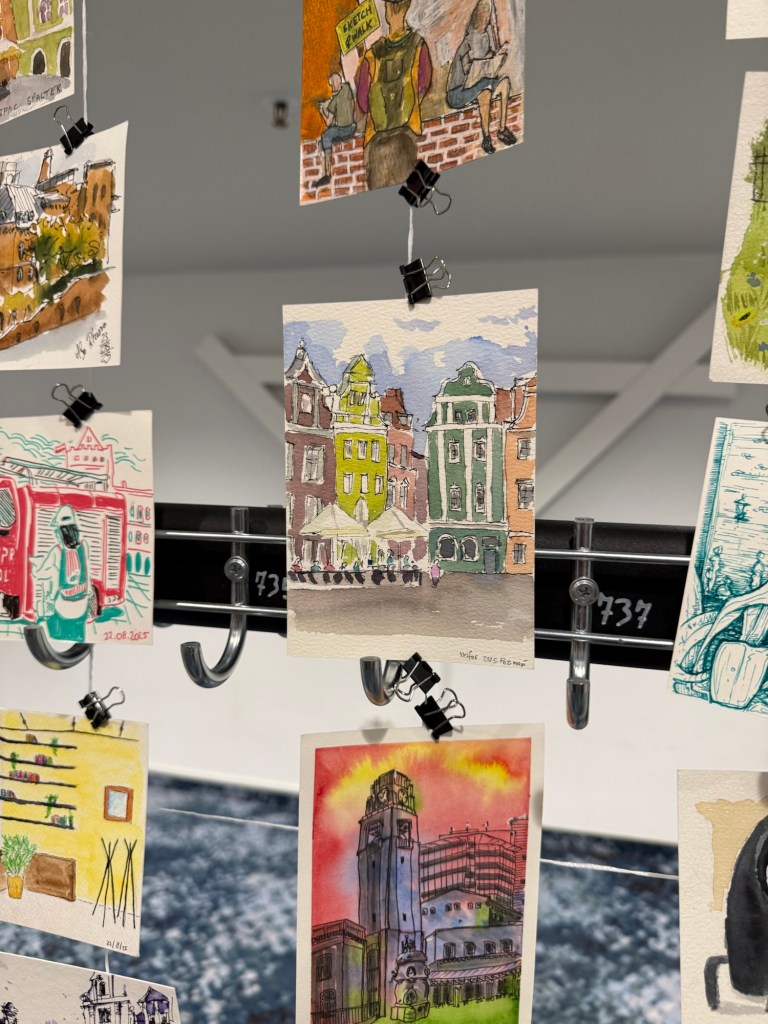
Sketch a postcard. Even if you don’t work in postcard size, or you don’t love the paper, or you feel self-conscious about your work, sketch a postcard and participate in the postcard exhibition. It’s fun to see your work out there, and most participants get prizes, plus you can always donate the postcard for the silent auction and help raise some money for the organization.
Go to the daily morning briefing. Even if you’re tired, even if you don’t feel like it. It’s short, it starts on time, and it has a lot of important information that you just won’t get anywhere else. Also there are giveaways, but I won’t ruin the surprise…
Go to the demos, lectures, drink and draws – the morning lectures were great, and worth listening to and learning from. The demos were a fantastic way to get to experience the techniques of sketchers that you couldn’t get a workshop with, and the drink and draws are just a nice way to connect with people and share your sketching love. I will confess that I was so tired at the end of each day that I missed out on the drink and draws and I regret it.
Be ready to be tired, and try to pace yourself. It’s a lot of fun but very draining to run around town and sketch all day. If you take a lot of workshops or go to all the sketchwalks you will have very little down time between events. Be sure to hydrate, rest, and know your limits. Take into account that you’ll be lugging a lot of weight around (art supplies, a stool, water), and that adds to the fatigue. Check your schedule and if you have only an hour or so between workshops, find someplace close and convenient to grab a bite to eat. Save the fancy restaurant for the evening.
Share knowledge among the group – found a great place to sketch in? A wonderful restaurant or patisserie? A clean toilet or a decent supermarket? Share that information with other sketchers.
Follow people on Instagram. Even if you normally avoid social media, this is how you can stay connected with other sketchers after the symposium, and be inspired by other artists.
Never, ever, ever critique someone’s work. Ever.
We share, we don’t compare. This is a Liz Steel mantra and something you should carry with you during the symposium. Be inspired, not intimidated, by other sketchers’ work.
Follow along with the demos – if you’re going to a demo, it’s OK to watch and listen but it’s equally valid to sit down and sketch while the demo is going on, trying to follow along as you work. There is value in both these approaches – don’t be afraid to start out by observing and then dig in with a sketch of your own.
Try new things, and don’t worry about the results. This is a tough one, but an important one – the point of the workshops and demos isn’t for you to come out with masterpieces, but for you to try out new things. When you do that, you may not like the results, or it may take a few tries. That’s OK. The best workshop I had in Poznan was also “traumatic” in this way – I made several sketches and they were all terrible. Only on the last sketch did things click, and I got one of the best sketches I have ever made – and one that took third place in the postcard exhibition.
My postcard on display (it’s the one in the middle)
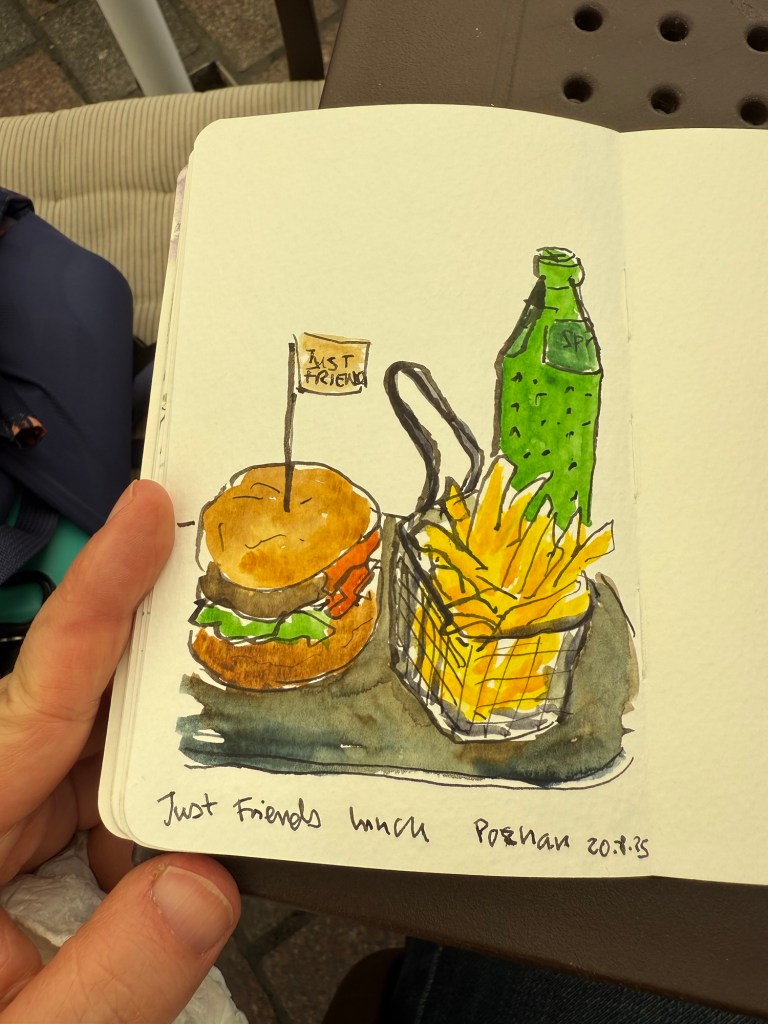
Draw your food. It’s an urban sketchers tradition and a great way to remember a restaurant or cafe.
Drawing food
Take reference photos – you may not be able to finish a sketch, but if you have reference photos you can return to it later on and complete it.
If you can, give away sketches. People who were kind to you love receiving sketches as a gift, and you should see them light up when you give them that quick napkin sketch, or a page from your sketchbook. Also consider donating artwork to the silent auction if you can – it helps Urban Sketchers raise money for the great work they do.
Tell the instructors how great they are. They really are amazing, and they’re artists so they all have imposter syndrome and they love to hear good feedback about their demo, workshop or compliments about their sketches. They are all volunteers and they put in a LOT of work and research into their sessions so be generous with your praise.
Tell the organizers how great they are. They’re also volunteers and they work like crazy before, after and during the symposium. Let them know that you see them and appreciate them.
Be very, very kind to the symposium correspondents – they put in a crazy amount of work and effort into bringing the symposium to life for those of us who can’t be there. That means that while you were at that one workshop they zigzagged across the city and went to three, making sure to sketch and take photos in each. And while you were sleeping they were staying up late editing photos and posting to social media. They do a mammoth amount of work every single day, so take the time to be extra nice and helpful to them.
Be kind. People can get tired, hot, blustered, overwhelmed. Give them the benefit of the doubt and be kind. Look out for each other and help each other through the whirlwind of this symposium.
Take time after the symposium to decompress and process what you’ve learned. Go over your notes and sketches, look back and what you’ve learned, try out the new techniques and supplies that you’ve gathered, and go out there and sketch!
Have fun, remember to hydrate and use sunscreen, and bring Toulouse to life with sketches!