Caveat: this year’s Inkvent appears to have elusive ink colours. I suggest reading my description of the inks and not going by the photos alone, and comparing my results with those of other reviewers.
The Diamine Inkvent calendar is an advent calendar with 24 tiny (12ml) bottles of fountain pen ink behind 24 doors, and a larger, 30ml, bottle of ink behind the 25th door. All the inks are limited edition, and, at the moment, only available through this calendar.
Day 7’s door.
Day 7’s ink is Diamine Candle Light. It’s a standard yellow colour, and the first bright and festive ink of the bunch. Hooray!
Diamine Candle Light.
Nothing standard about an ink that fits the Christmas theme in this year’s Inkvent, but Candle Light is a standard ink:
A standard ink.
Here’s a Col-o-Ring swab of Diamine Candle Light. It’s a bright orangey yellow with a good amount of outlining and some shading. It dries darker on the page, so take that into consideration when selecting a nib size for it (I wouldn’t go less than medium for this).
Col-o-Ring swab.
I used a Pelikan Pelikano with a medium nib to test this ink out.
Pelikan Pelikan and Col-o-Ring swab.
I decided to draw a lion in a savannah for this one, and you can see the outlining and the shading quite well here:
Diamine Candle Light is the bright and cheerful ink we’ve been waiting for this Inkvent. It’s also a surprisingly legible yellow, and if I was in search of a yellow ink I definitely would have given it a try. It reminds me of Caran d’Ache Saffron, which is my favourite yellow to date. Will I be purchasing a full bottle of this? No, because I rarely use yellow inks. Is it a fantastic yellow ink? Yes it is.
Caveat: this year’s Inkvent appears to have elusive ink colours. I suggest reading my description of the inks and not going by the photos alone, and comparing my results with those of other reviewers.
The Diamine Inkvent calendar is an advent calendar with 24 tiny (12ml) bottles of fountain pen ink behind 24 doors, and a larger, 30ml, bottle of ink behind the 25th door. All the inks are limited edition, and, at the moment, only available through this calendar.
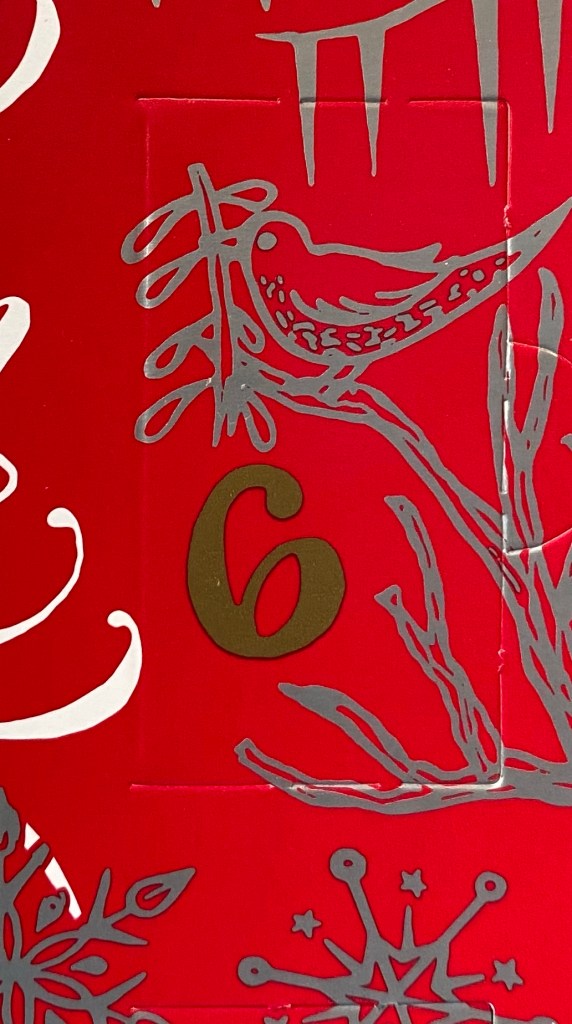
Day 6’s door.
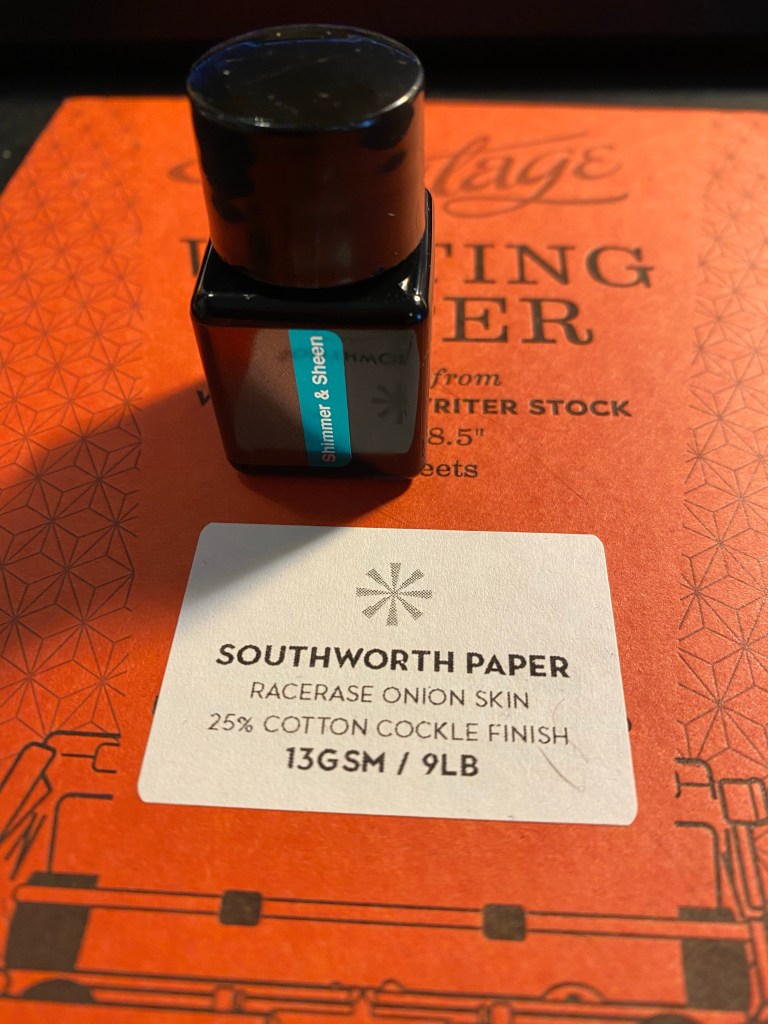
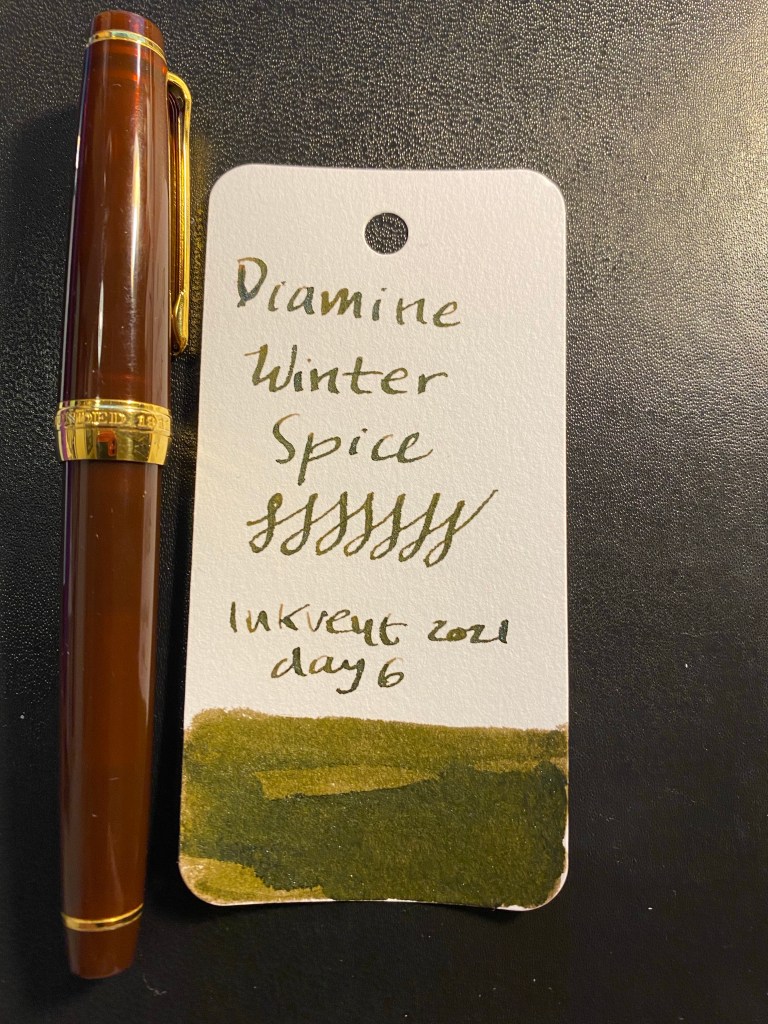
Day 6’s ink is Diamine Winter Spice. It’s a rich brown colour with a blue shimmer and a green sheen.
Diamine Winter Spice. Shimmer and Sheen.
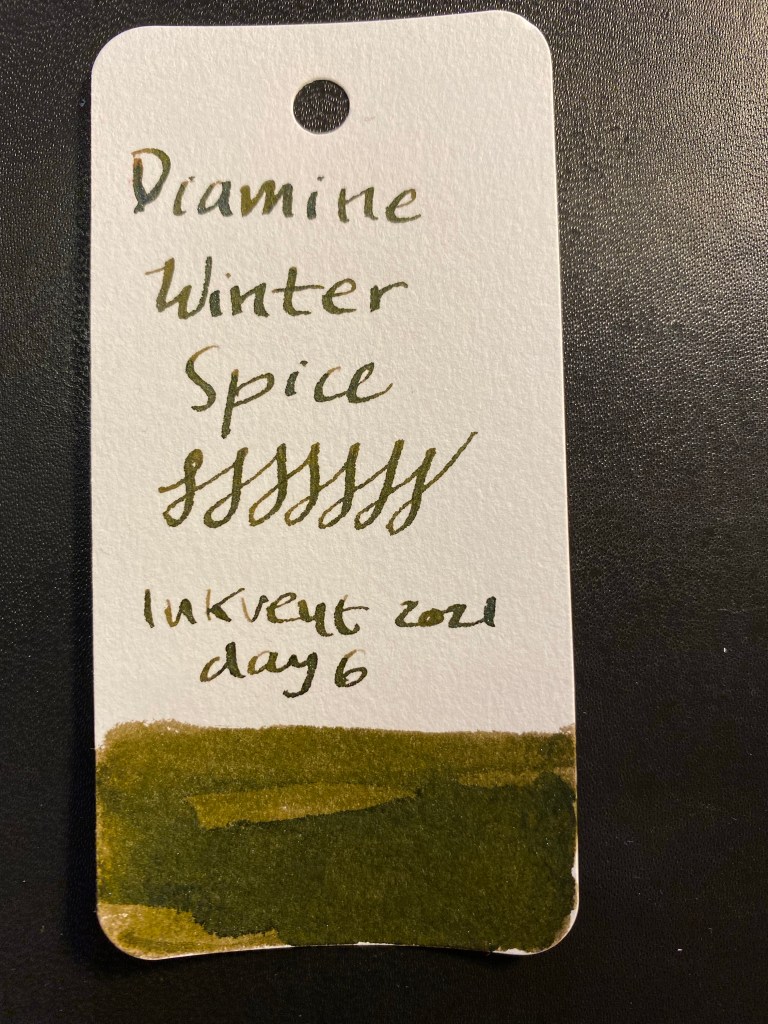
Here’s a Col-o-Ring swab of Diamine Winter Spice. It came out more yellowish in the photo than it looks like in reality – the Tomoe River sketch below is more true to colour. There’s a significant amount of blue shimmer and green sheen, especially with the music nib that I used to test out this ink.
Col-o-Ring swab.
I used a Sailor Pro Gear with a music nib to test Diamine Winter Spice, and it lays down a generous amount of ink.
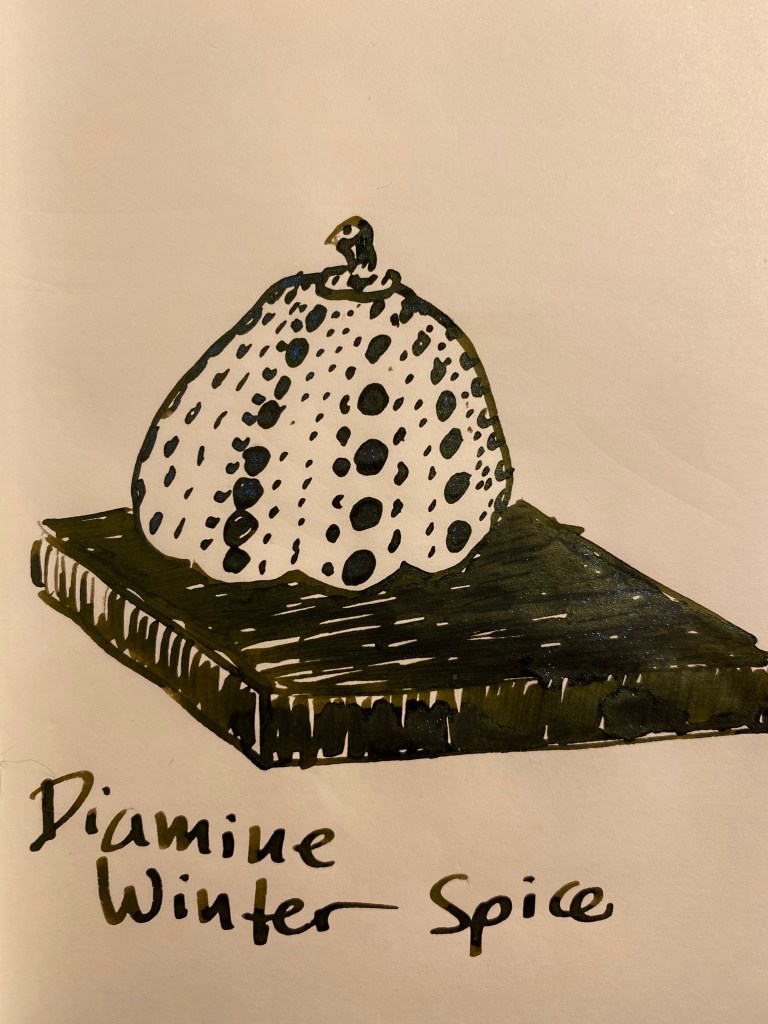
I drew a Yayoi Kusama pumpkin to test Diamine Winter Spice out, and it shows the colour of the ink pretty well.
Diamine Winter Spice is the least favourite of the Inkvent 2021 inks that I’ve tested yet. Something about the combination of the brown with the green sheen and the blue shimmer makes the ink take on a sickly yellowish green tinge in certain lighting conditions. You can see it in the Col-o-Ring swab above. It’s another peculiar colour choice for the occasion, and not an ink that I see myself using in the future.
The Diamine Inkvent calendar is an advent calendar with 24 tiny (12ml) bottles of fountain pen ink behind 24 doors, and a larger, 30ml, bottle of ink behind the 25th door. All the inks are limited edition, and, at the moment, only available through this calendar.
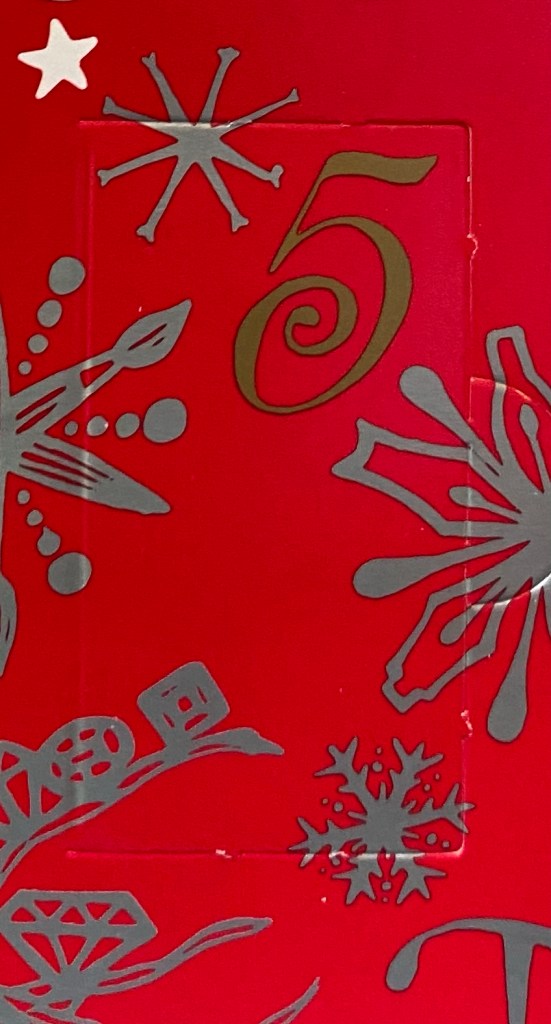
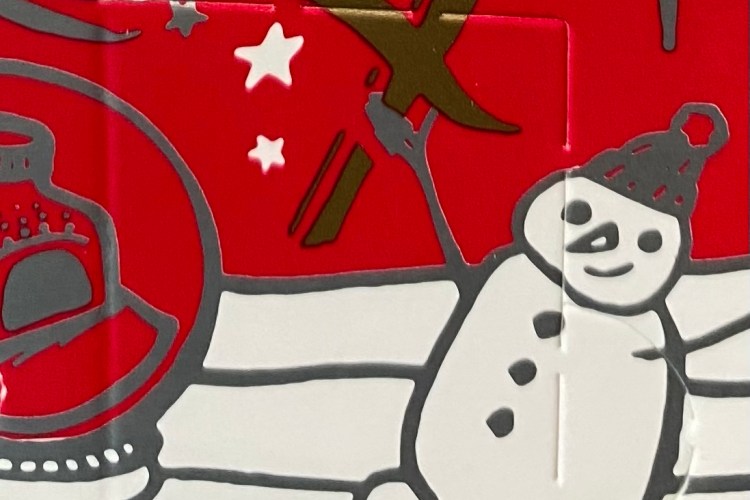
Day 5 door.
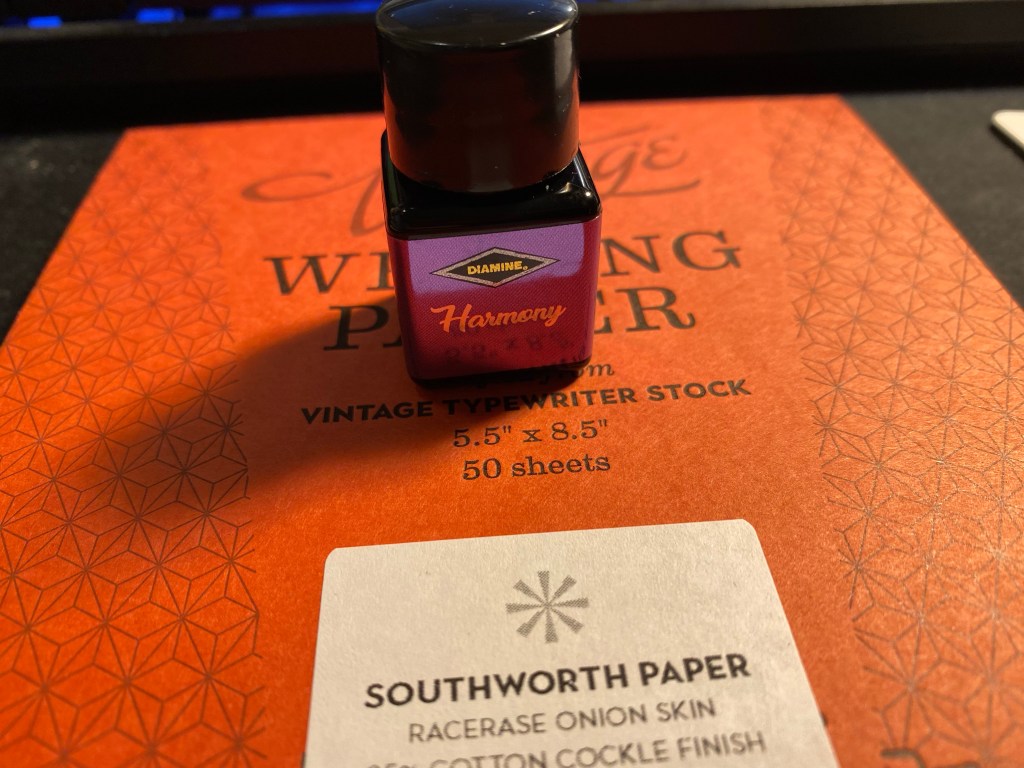
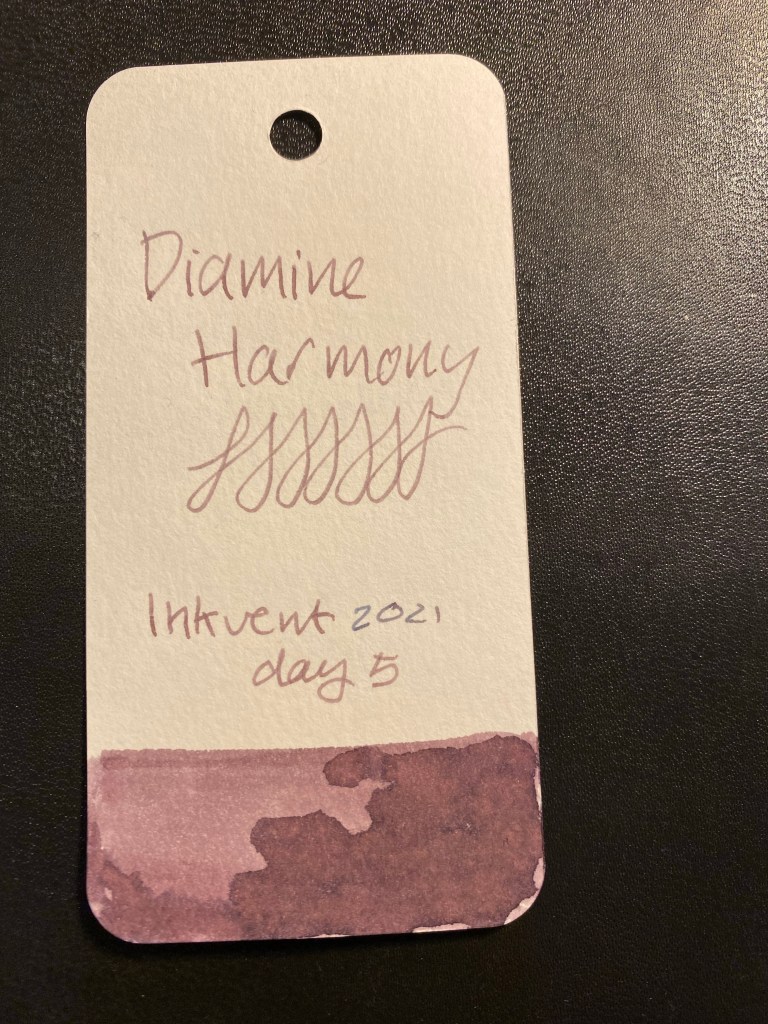
Day 5’s ink is Diamine Harmony, a standard ink in lavender (i.e. light, slightly pinkish-grey purple). As with all the Inkvent inks so far it’s far from what I’d expect to find in this calendar, and it’s elusive to photograph.
Diamine Harmony.
Here’s a Col-o-Ring swab of Diamine Harmony. It’s a pinkish-grey purple with a lot of beautiful shading. It goes down slightly bluish on the page and then dries to a lavender colour. A really interesting ink.
Col-o-Ring swab.
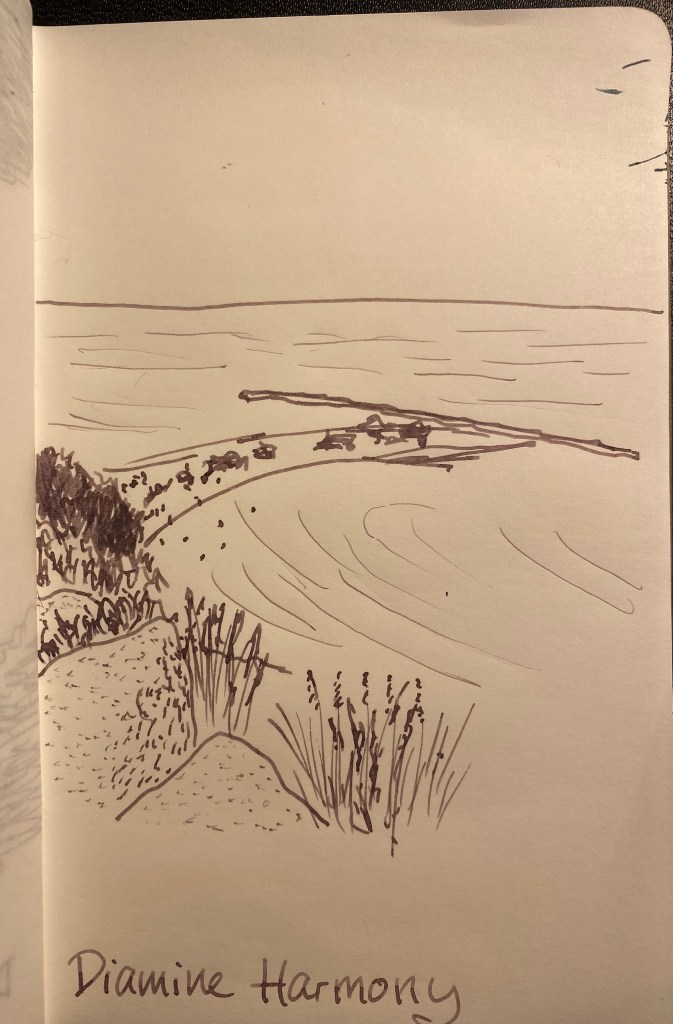
I used a Lamy Lx Palladium with a fine nib to test this ink out.
Lamy Lx Palladium and Col-o-Ring swab.
I drew the view of the Mediterranean from one of my morning walks to test this ink out. The photo doesn’t do this ink justice – it’s a more vibrant and less grey than it appears here. Diamine Harmony shades beautifully even in a fine nibbed pen. It’s a shade lighter than Diamine Seize the Night, and it doesn’t have the shimmer or the sheen of that ink, which makes it distinct enough from the other purple Inkvent calendar ink.
Diamine Harmony is very deserving of the name, and a lovely shade of lavender that I plan on adding to my ink stock. Is it the right ink to include in a Christmas themed advent calendar? I’m not so sure, but then again, it’s an interesting and optimistic colour, so I’m very happy that it’s there.
Caveat: this year’s Inkvent appears to have elusive ink colours. I suggest reading my description of the inks and not going by the photos alone, and comparing my results with those of other reviewers.
The Diamine Inkvent calendar is an advent calendar with 24 tiny (12ml) bottles of fountain pen ink behind 24 doors, and a larger, 30ml, bottle of ink behind the 25th door. All the inks are limited edition, and, at the moment, only available through this calendar.
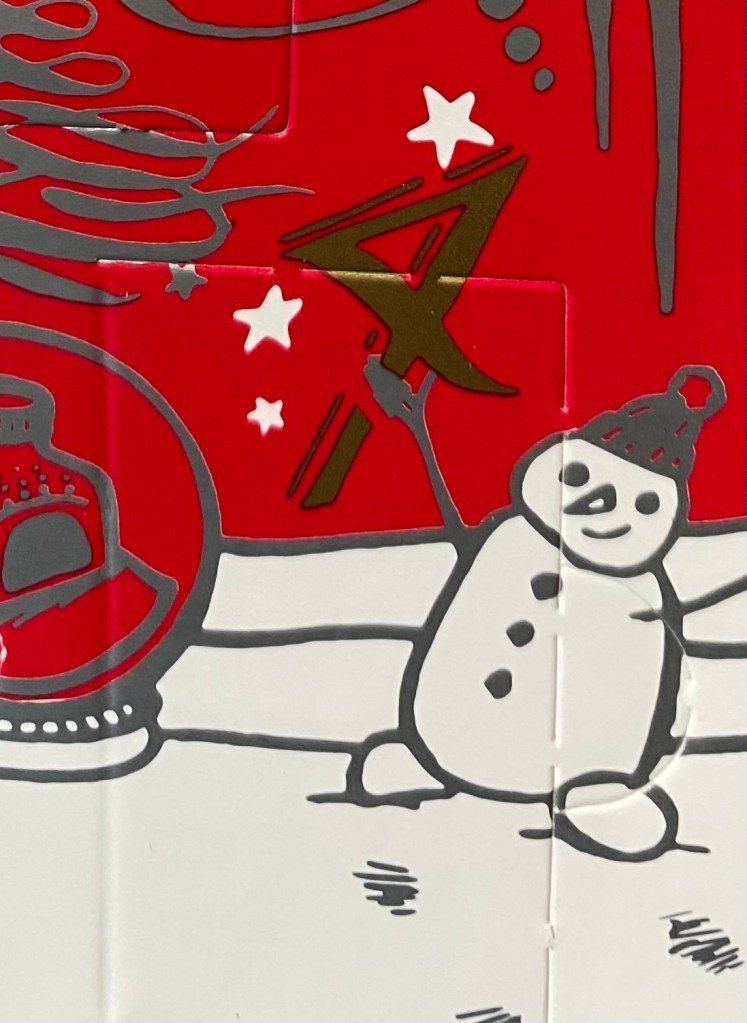
Day 4’s door.
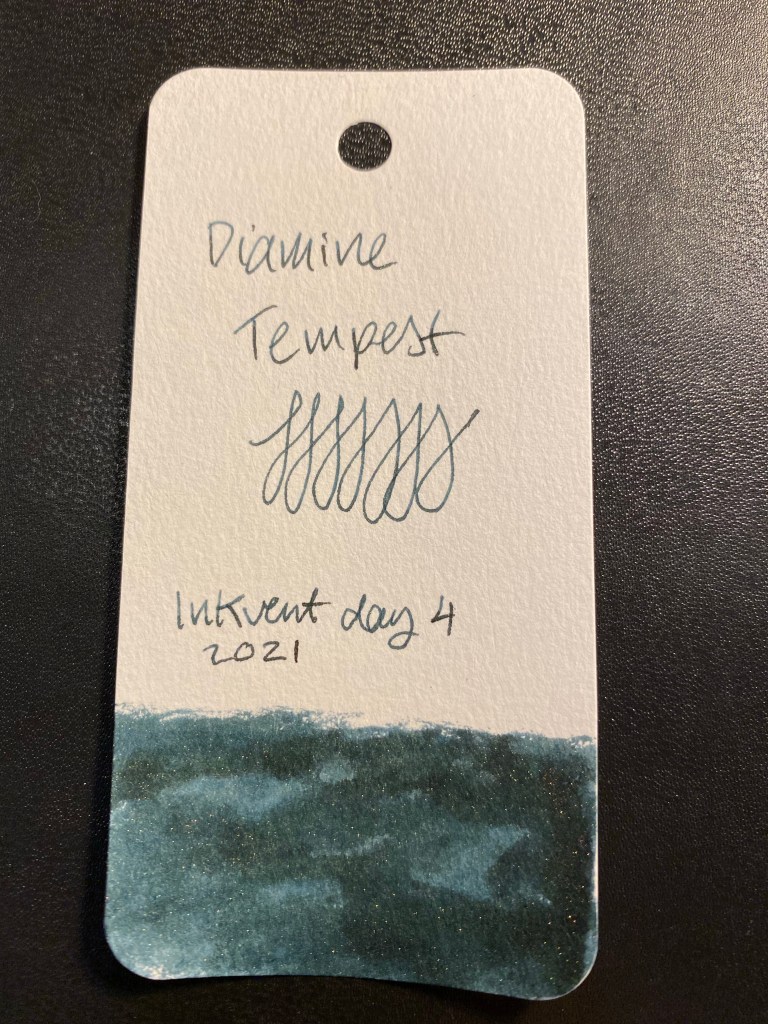
Day 4’s ink is Diamine Tempest. It’s a shimmering ink in an indigo/blue black colour with silver sparkles in it.
Diamine Tempest.
Here’s a Col-o-Ring swab of Diamine Tempest. It was photographed slightly lighter than it appears in real life. The basic colour is a gorgeous and rich Indigo or blue-black, and the shimmer is subdued enough to allow the ink’s shading to show through.
Col-o-Ring swab.
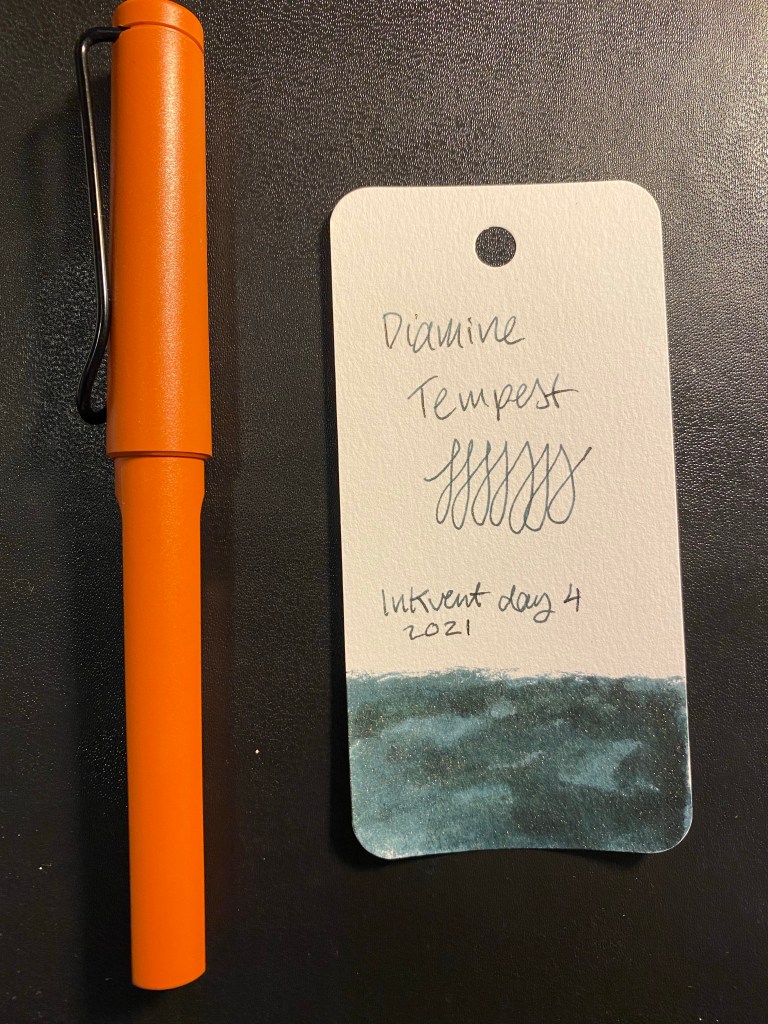
I used a Lamy Safari Terracotta with a fine nib to test this ink out.
Lamy Terracotta and Col-o-Ring swab.
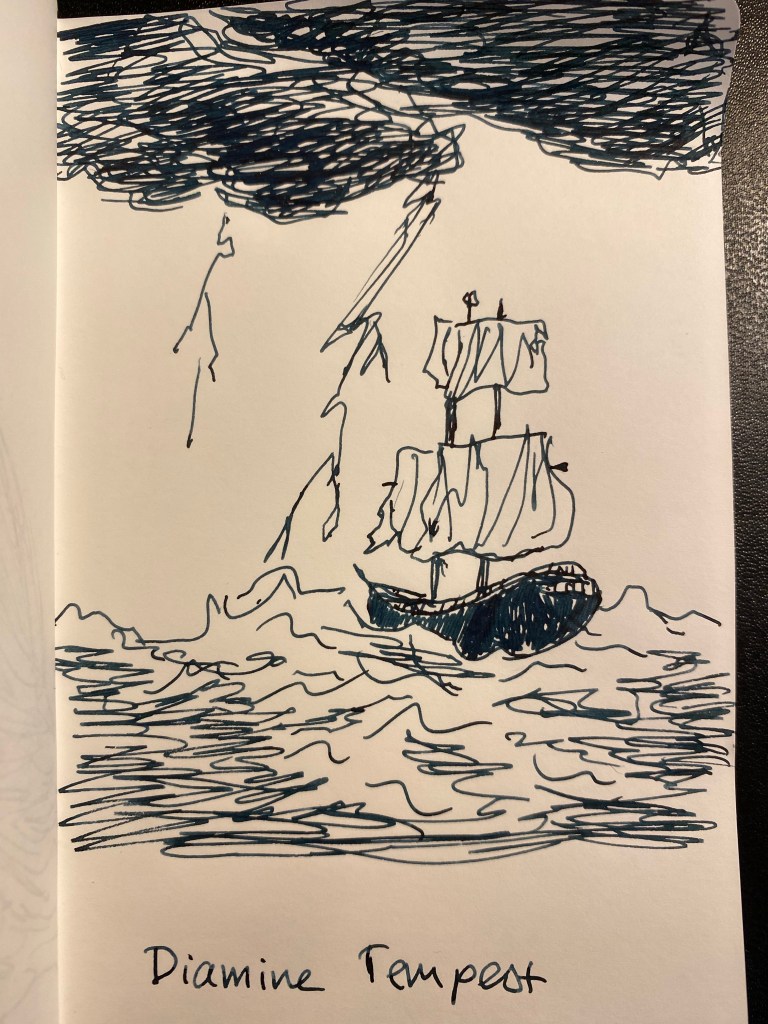
I had to draw a ship in a tempest to test out this ink. It’s quite a dark ink, and the shimmer isn’t in your face – it reminds me of last Inkvent’s Diamine Solstice.
This is not a festive or cheery ink, but I still love it. Something about having such a dark and “serious” colour paired with a subtle shimmer really speaks to me, and I’m quite likely to buy a full bottle of Diamine Tempest should I get the opportunity to.
Caveat: this year’s Inkvent appears to have elusive ink colours. I suggest reading my description of the inks and not going by the photos alone, and comparing my results with those of other reviewers.
The Diamine Inkvent calendar is an advent calendar with 24 tiny (12ml) bottles of fountain pen ink behind 24 doors, and a larger, 30ml, bottle of ink behind the 25th door. All the inks are limited edition, and, at the moment, only available through this calendar.
Day 3’s door.
Day 3’s ink is Diamine Ash, a standard neutral to slightly warm grey. Another surprising choice in what looks to be a very surprising calendar. I’m really enjoying the diversity of colour in this year’s Inkvent compared to the 2019 one.
Diamine Ash.
Here’s a Col-o-Ring swab of Diamine Ash. The ink shades beautifully, and goes down with a distinctive green tone that largely vanishes once it dries.
Col-o-Ring swab.
I used a Lamy Safari Savannah with a medium nib to test this ink out.
Lamy Safari Savannah Col-o-Ring swab.
I thought an owl sketch would be appropriate for this ink. It shades wonderfully, and it’s definitely not too light a grey to be useful.
I don’t have an ink in this shade of grey, even though I have a sizeable amount of grey ink bottles. The ink has a green hue to it that largely disappears once it dries, and I wonder if I applied a water wash to it if it would make its reappearance. Something for me to try out once I can use brushes again. As it is, Diamine Ash is an ink that I would consider buying a full bottle of.
The Diamine Inkvent calendar is an advent calendar with 24 tiny (12ml) bottles of fountain pen ink behind 24 doors, and a larger, 30ml, bottle of ink behind the 25th door. All the inks are limited edition, and, at the moment, only available through this calendar.
Day 2 door.
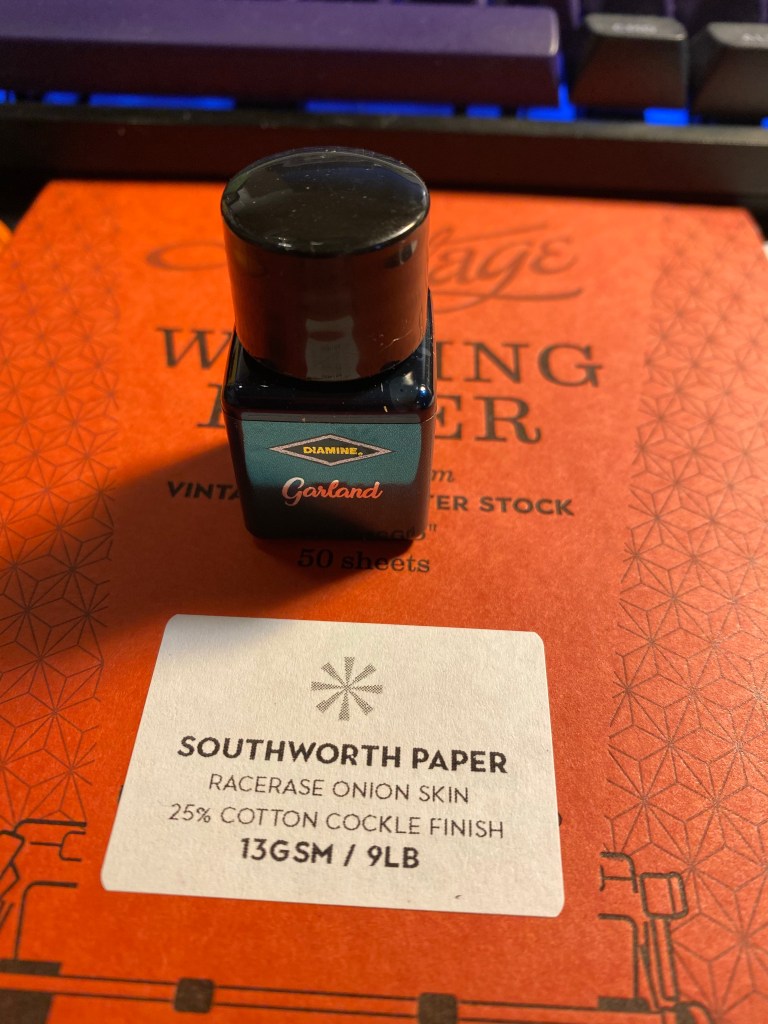
Day 2’s ink is Diamine Garland. It’s a shimmer and sheen ink, with a green-blue base, red sheen and green sparkles. As I guessed on day 1 of Inkvent, the label colour is meant to evoke the colour of the ink, though it’s far from a faithful reproduction of it.
Diamine Garland bottle.
Shimmer and sheen on the label:
It’s a shimmer and sheen ink!
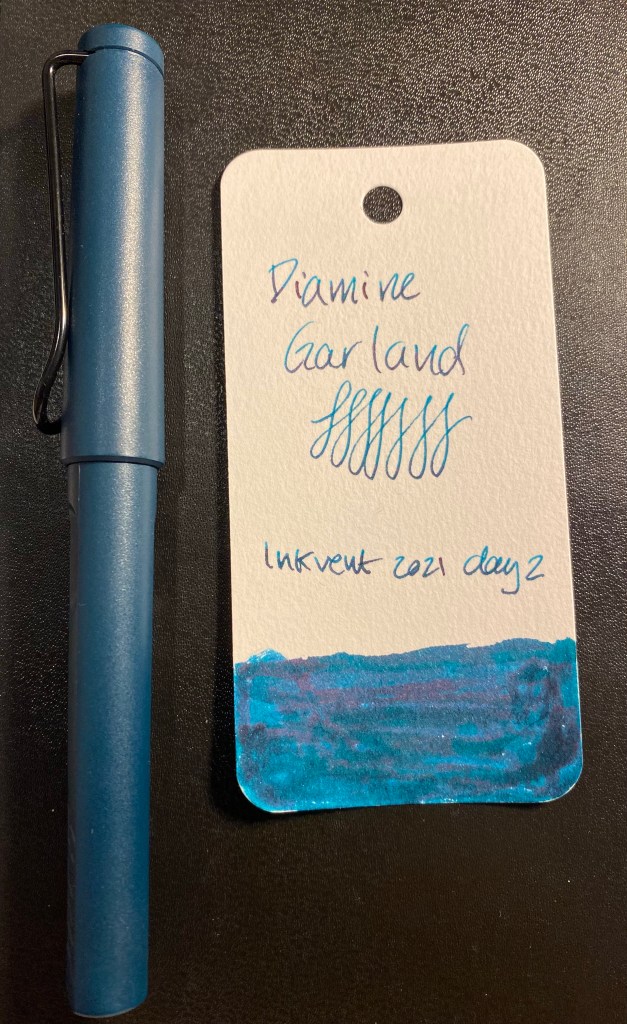
Here’s a Col-o-Ring swab of it. The ink looks more blue than green here, but in reality it’s more of a green than a blue. If I had to compare the base colour to my Schmincke watercolours, it would be a Prussian green or a cobalt green turquoise.
Col-o-Ring swab.
I used a Lamy Safari Petrol fine nib to test this ink out. Again, cartridge converters for the win.
Lamy Petrol with Col-o-Ring swab.
I felt like sketching a cat, so I drew one lazing about on a yet to be hung garland. The photo doesn’t pick up the crazy amount of red sheen that Diamine Garland has. You can barely notice the shimmer with the sheen being so pronounced.
Diamine Garland looks a lot like someone took Diamine Holly from 2019’s Inkvent and added a splash of Prussian blue or indigo to it. I think that the shimmer gets a bit lost in this ink because of the strong sheen, and I’m not sure that the colour stands out enough from other inks in this colour range to justify ordering a bottle of it. It is Christmassy colour, and a pretty one, it’s just not one that is as unique as day 1‘s Seize the Night.
The Diamine Inkvent calendar is an advent calendar with 24 tiny (12ml) bottles of fountain pen ink behind 24 doors, and a larger, 30ml, bottle of ink behind the 25th door. All the inks are limited edition, and, at the moment, only available through this calendar.
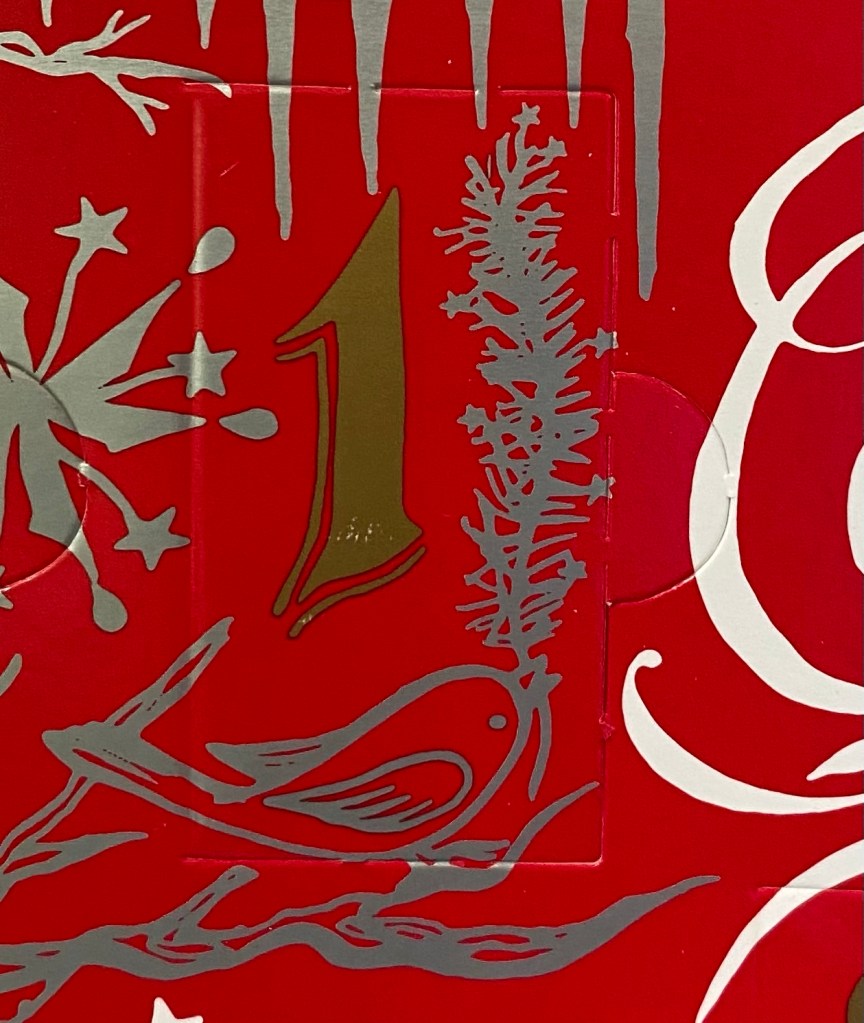
Day 1 door.
The first thing that caught me by surprise is the bottle. The 2019 Inkvent calendar had tiny, tall and circular glass bottles. This year’s Inkvent has plastic bottles that are square and squatter and have wider mouths. That makes them much easier to use, with less of a chance for accidental spills. I like the redesign, even though I would have liked glass bottles better. However, as glass is more expensive, I understand the reasoning for going for plastic this year.
New bottle on the left, 2019 bottle on the right.
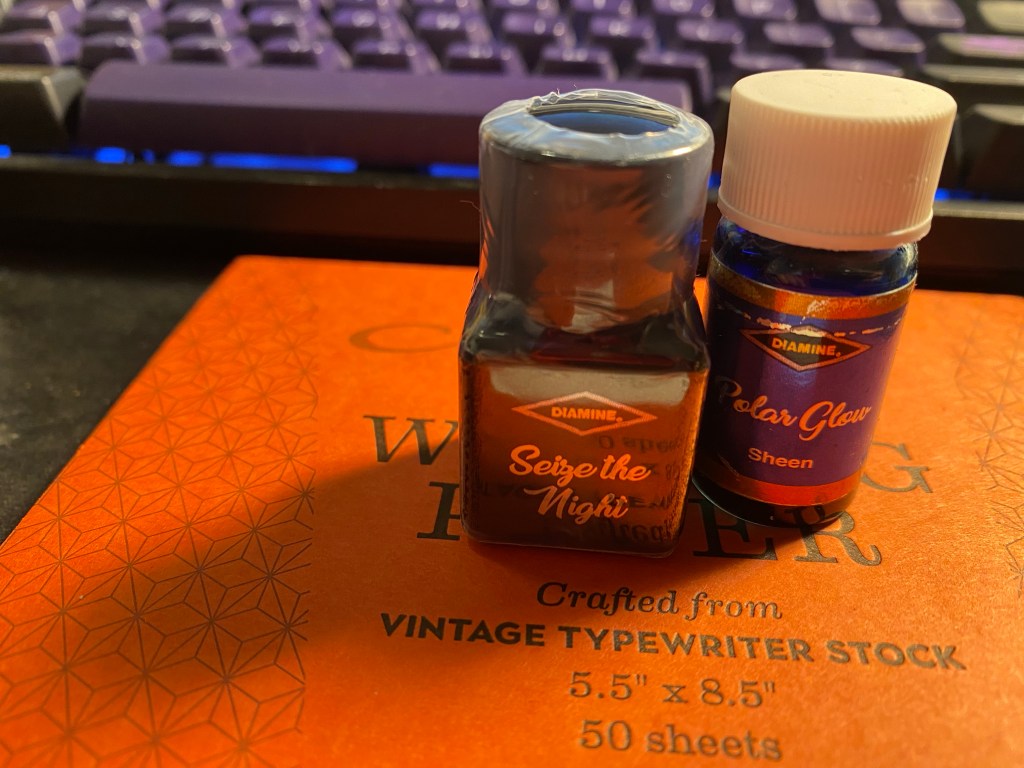
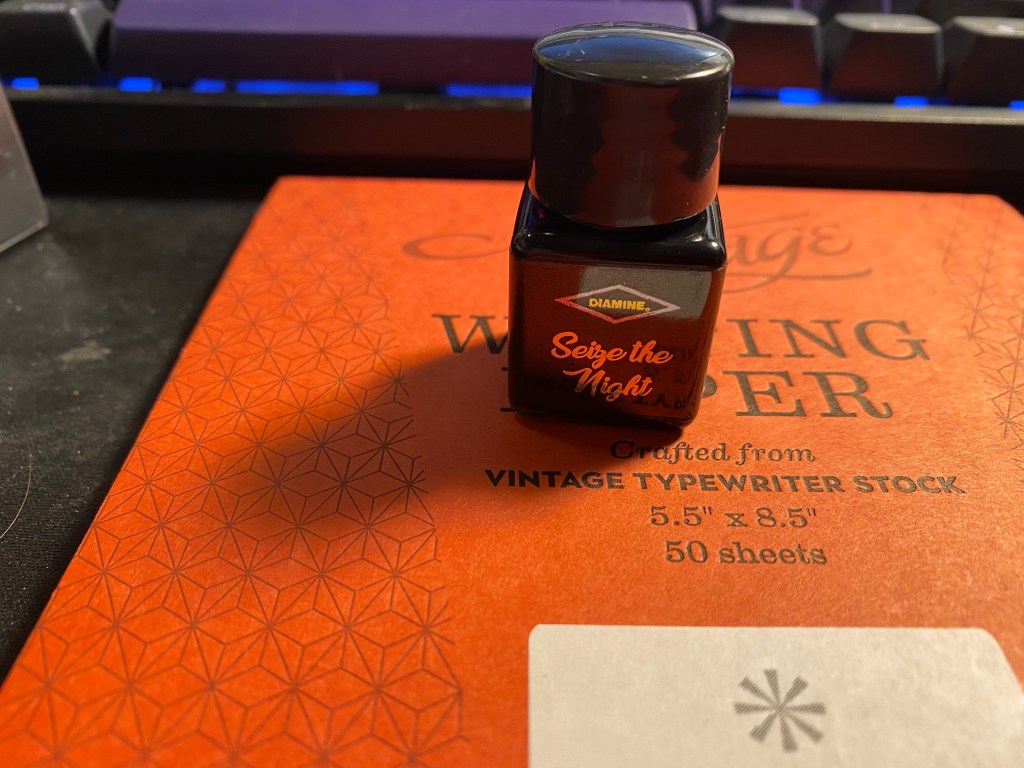
The day 1 ink is “Sieze the Night”. It’s a standard ink in a very non-standard colour. I’m not sure if the label on the bottle is meant to reflect the colour, as it did in the 2019 Inkvent, but if so they did a poor job of it.
Seize the Night.
The bottle comes wrapped in shrink wrap, likely to prevent leaks, and on the side of the label you can see what kind of ink it is (in this case standard). The plastic wrap is surprisingly difficult to open.
Label on the side marking it as a standard (i.e. not shimmer or sheening) ink.
So what’s the colour like? It’s a dusky purple that goes down on the page lighter and brighter than it dries. Seize the Night is a greyish-lavender ink with a good amount of shading and a slight golden sheen if you flood the page with it.
Here’s a Col-o-Ring swab of it. You can see the sheen on the swab, where the ink pooled.
Col-o-Ring swab of Diamine Seize the Night.
I used my Diplomat Elox Rings with an extra fine nib to test out this ink. A wider nib would have shown more shading, but even with this nib there’s a fair amount of shading going on, particularly on less absorbent paper.
Diplomat Elox Rings with the Diamine Seize the Night ink swab.
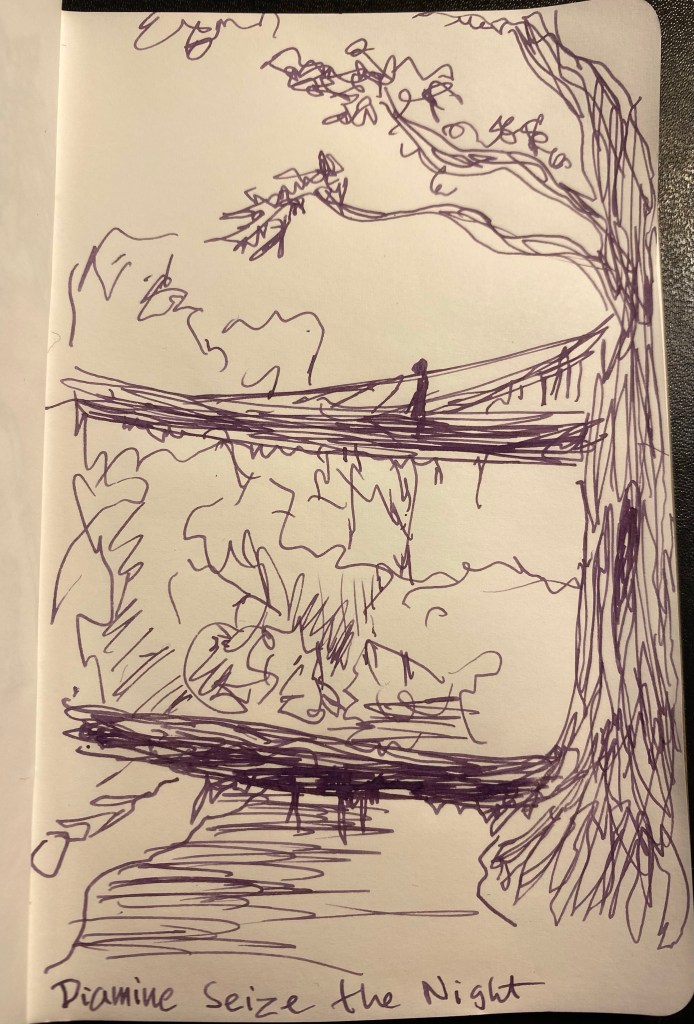
I read an article about villagers in India training the air roots of local trees into bridges across a local river, and decided to do a quick sketch of that scene to test the ink out.
I wasn’t expecting this ink shade at all in a Christmas themed ink sample set like the Inkvent. That being said, I love it. It’s a unique colour that is dark enough and muted enough to use in the office, but is also interesting and unique. From a distance it reads like a black/brown/grey until you take a closer look and its purple nature is revealed. It flows well, there’s plenty of shading to be had, and there’s a very good chance that I’ll be picking up a bottle of this should Diamine eventually offer them up for sale.
It’s Diamine Inkvent time! In 2019 Diamine came out with a fantastic fountain pen ink based advent calendar: the Inkvent Calendar. Behind each of the 25 doors was a tiny ink bottle (except for day 25, which got a larger bottle), each one of them was holiday themed and made specifically for the calendar. I created a review post a day for each any every one of those 25 inks. It was exhausting but worth it because it allowed me to select my favourites of the bunch . Eventually, as I’d hoped, Diamine reissued these inks in beautiful glass bottles, and so I was able to purchase full bottles of my favourites.
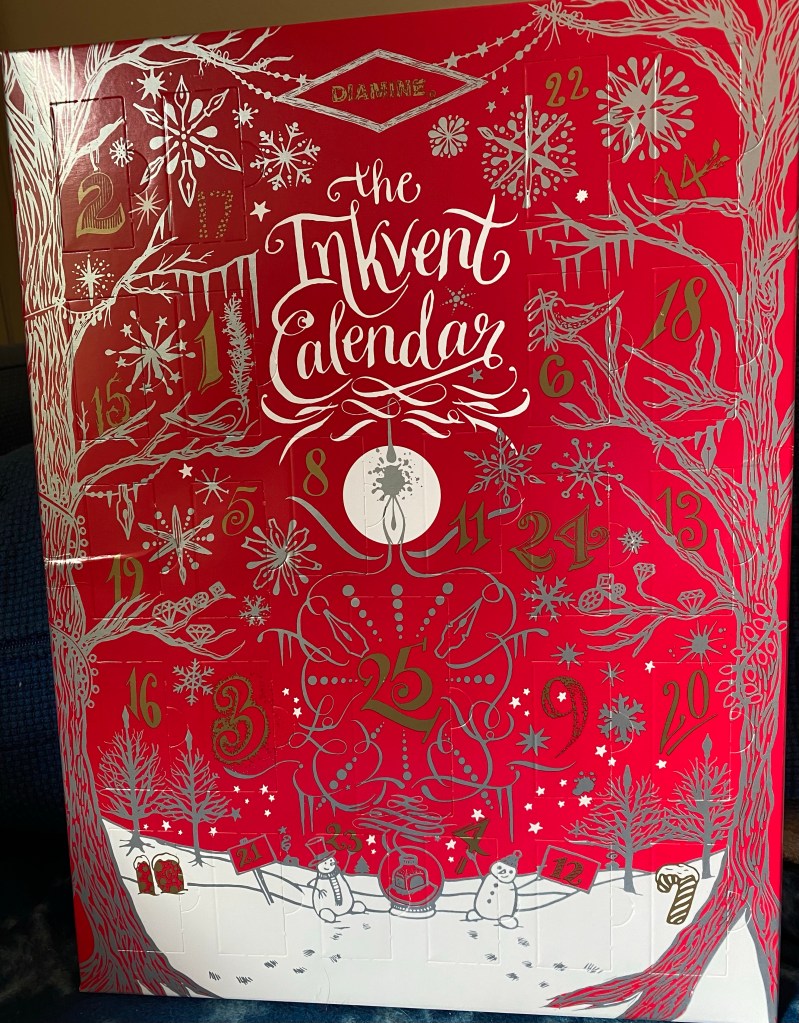
Front of the Inkvent calendar
This year Diamine came out with a new Inkvent calendar, this time also with 25 exclusive and thematically appropriate (at least by name) inks. I plan on posting a review of each one on the appropriate day. I’m not promising not to open some of the doors in advance. Due to my neuropathy and my treatments there will be days when I otherwise won’t be able to post.
This is meant to be a fun project, and I’m also hoping that Diamine comes out with larger ink bottles of the Inkvent line. So the reviews should help me select the few larger ink bottles that I may order.
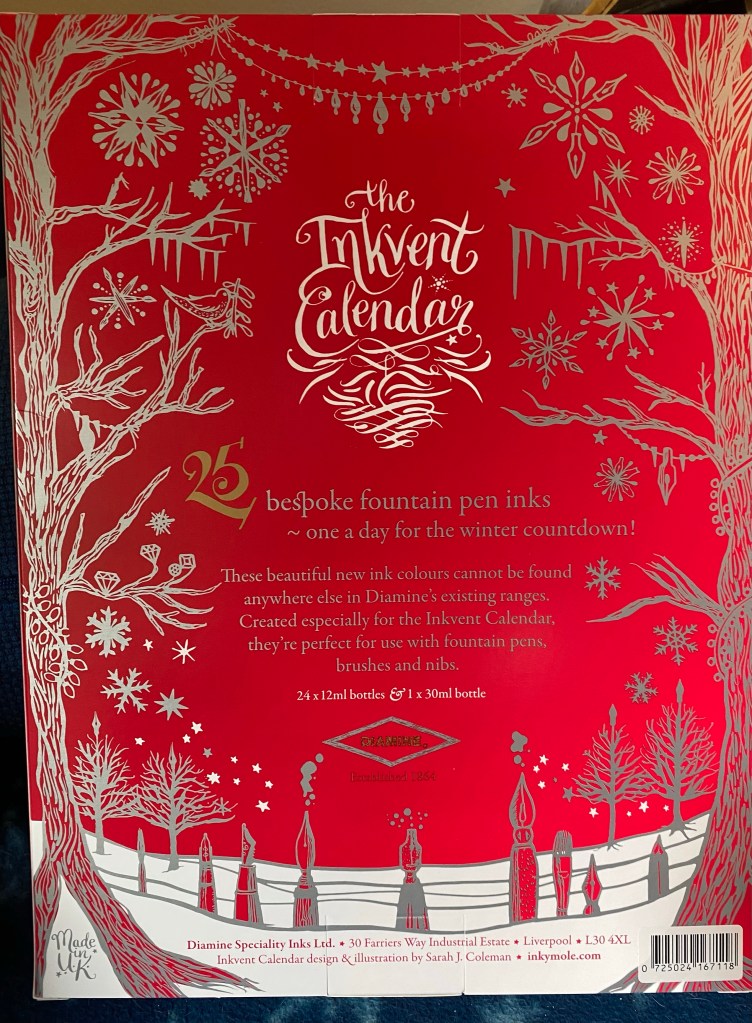
The back of the Diamine Inkvent calendar.
My plan is to use cartridge/converter fountain pens to test the inks. They’re less of a hassle to fill from tiny bottles, and they’re easy to clean. This calendar will contain inks with a lot of sparkles in them, so the cleaning aspect of the business is important.
So, expect a daily review, as we go out on an inkventure.
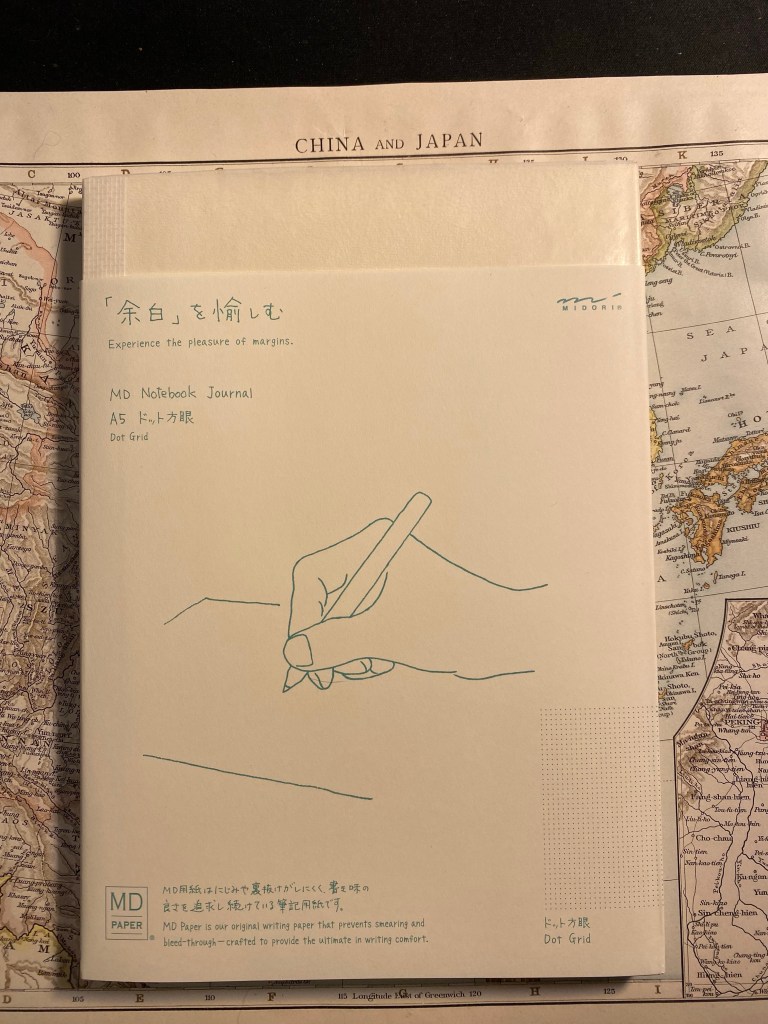
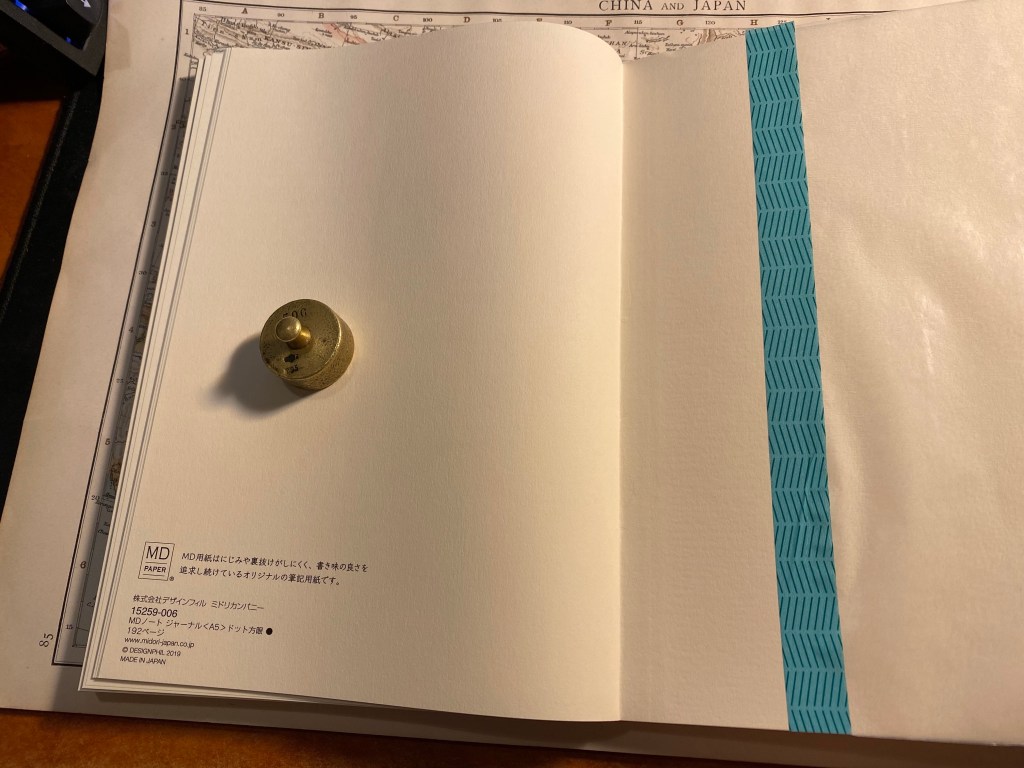
I got this Midori MD Notebook Journal A5 Dot Grid as part of the Cult Pens Paper Box, which is no longer being offered. I’ve used and liked Midori paper before, as part of their Traveler’s Notebook offering, but I’ve never taken the opportunity to purchase one of their notebooks before. One of the main reasons I purchased the Paper Box was to give this notebook a try.
MD Notebook Journal A5 front cover
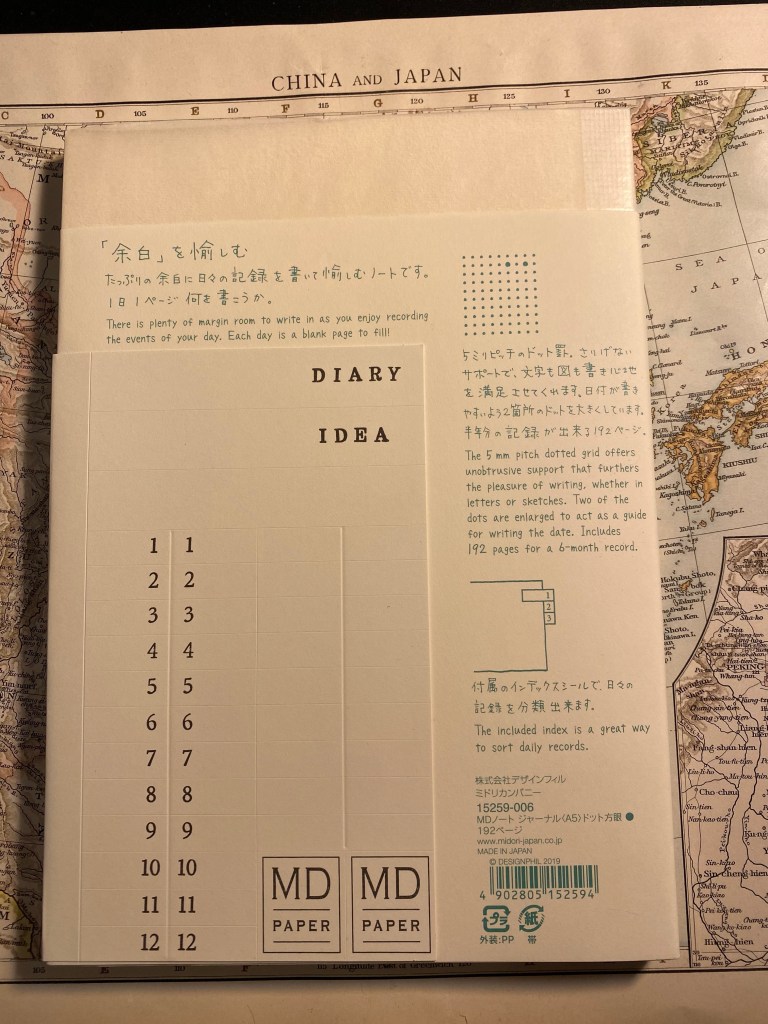
The MD Notebook Journal is a soft cover notebook with a minimalist design. It’s an A5 dot grid notebook that opens flat, has 192 fountain pen friendly pages, and comes with the bare minimum needed to turn it into a more structured journal: two enlarged dots for the dates and an index insert that you can use to mark the months. Everything you need to know about the notebook is thoughtfully written on its paper wrapper. Everything but the paper weight. I’d start a rant here, but I don’t think it will do something to solve the various standardization issues in the notebook/journal world, so I’m just going to note that I find it annoying. Write the gsm please. It’s not that hard.
MD Notebook Journal A5 back cover with index.
The MD Notebook Journal comes wrapped in a crinkly parchment paper that is meant to protect the cardboard covers, and I kind of liked the way that it felt. On a whim I grabbed some washi tape and taped it to the cover as a cover protector. I don’t know how long it will last (I’ll probably need to add more tape later on), but for now I’m enjoying it.
Inside the front cover is a place to write your details. As usual, I highly recommend writing your name and email, in case of loss.
Front endpaper.
The backend paper contains information about the notebook, and no pocket. It really isn’t missed on such a minimalist design, although you could easily tape an envelope here to serve as a pocket if you are so inclined.
Back endpaper.
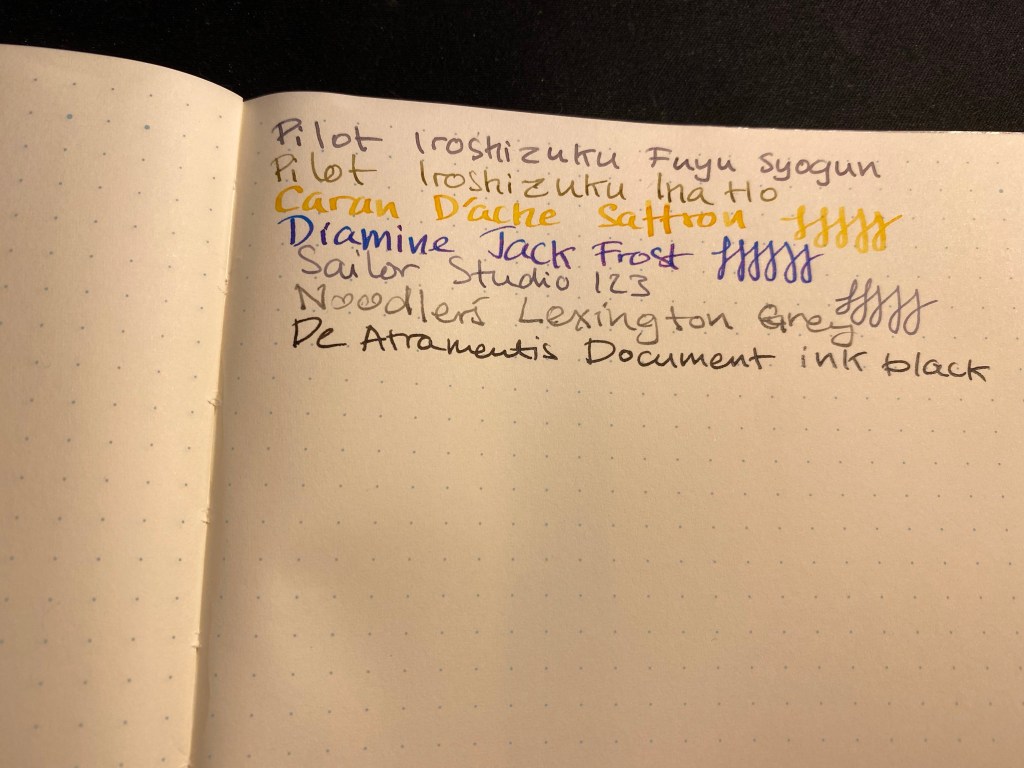
The MD Notebook Journal paper is fountain pen friendly and shows off the various properties of fountain pen ink very well. The drying time isn’t great, but that’s to be expected considering the coating on the paper. Now for a little side note: I purchased the 2021 Diamine Inkvent calendar and I plan on reviewing all of the inks in it, opening each one on the relevant day, just like I did in 2019. I’ll be using old Tomoe River Paper and this MD Notebook Journal for the purposes of the review. So if you want to see this notebook get a little more use before giving it a go, stay tuned.
Fountain pen friendly paper that shows sheen, shading and outlining well.
The paper in MD Notebook Journal isn’t very thick, so there is some show-through, but no bleed-through, with all the inks that I used. It wouldn’t bother me, but if you find show-through distracting, you might want to use lighter inks, fine and extra fine nibs, or just one side of the paper.
Show-through on the back side of the paper.
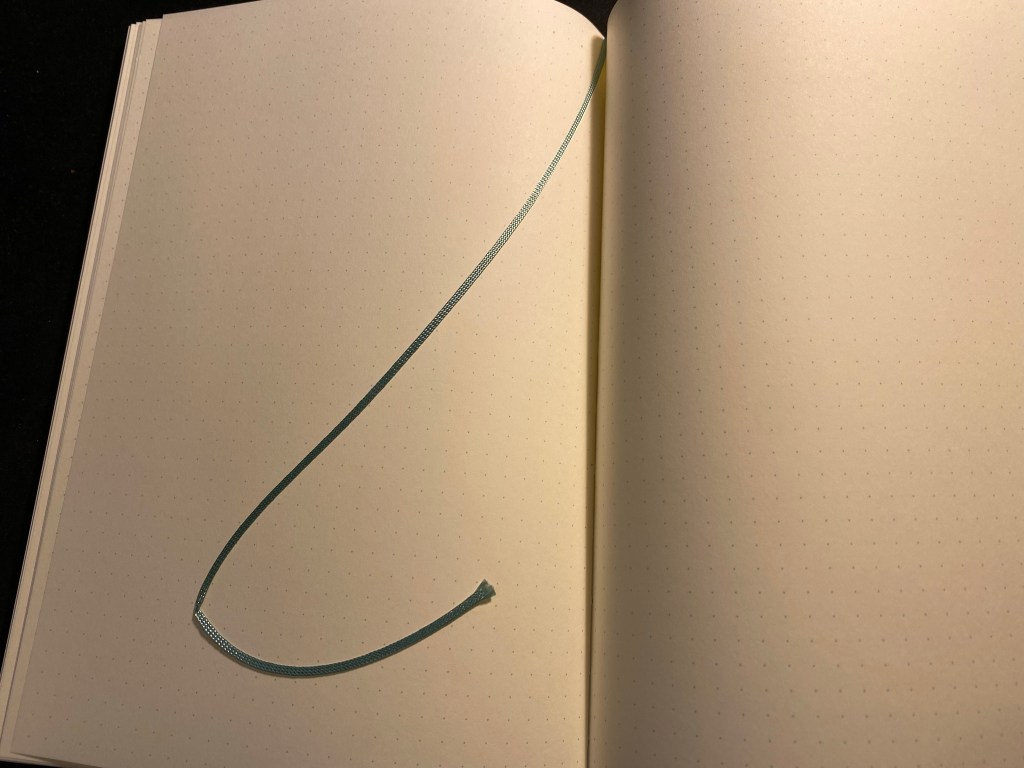
There’s a thin ribbon bookmark attached to the notebook, which is both charming and adds the only touch of colour (a lovely teal) to this minimalist journal.
The bookmark.
I look forward to giving the Midori MD Notebook Journal A5 dot grid a thorough try out next month. From what I’ve seen of it so far it’s going to be a fun notebook to use (and I don’t even like dot grid notebooks normally). There’s something about the starkness of it that makes it appealing, in that it really is a sandbox that you can play in. I can imagine people placing it in various notebook covers, or covering the covers with stickers and drawings, or just trashing it with use.
A journal with endless potential and excellent paper – what more do you need?
I’m not a fan of ballpoint pens. Their refills tend to streak and glob, the ink they use isn’t ass dark or vibrant as their gel ink and rollerball counterparts, and something about them (probably the lightness and inconsistency of the refill) makes me grip them with “the grip of death,” which inevitably brings on hand cramps and pain. They are, however, useful at times, so I am constantly on the lookout for new and better ballpoint pens and ballpoint refills.
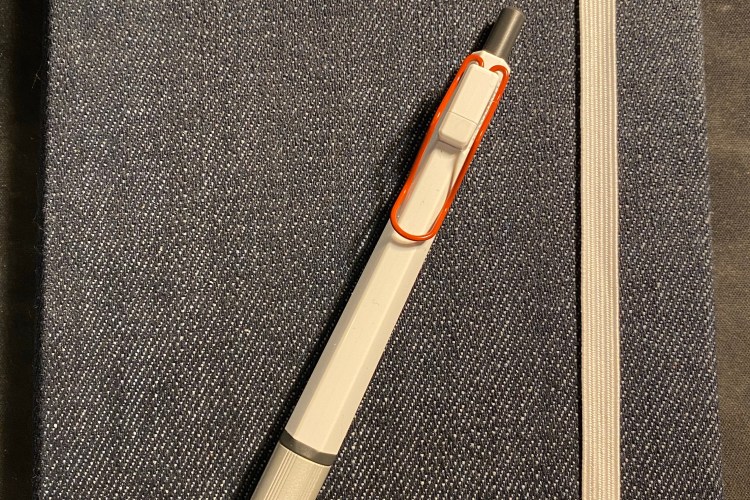
Enter the Uni Jetstream Edge, a ballpoint pen with a strikingly modern design and the world’s first 0.28mm ballpoint refill (there’s also a 0.38mm refill option but I won’t review it here).
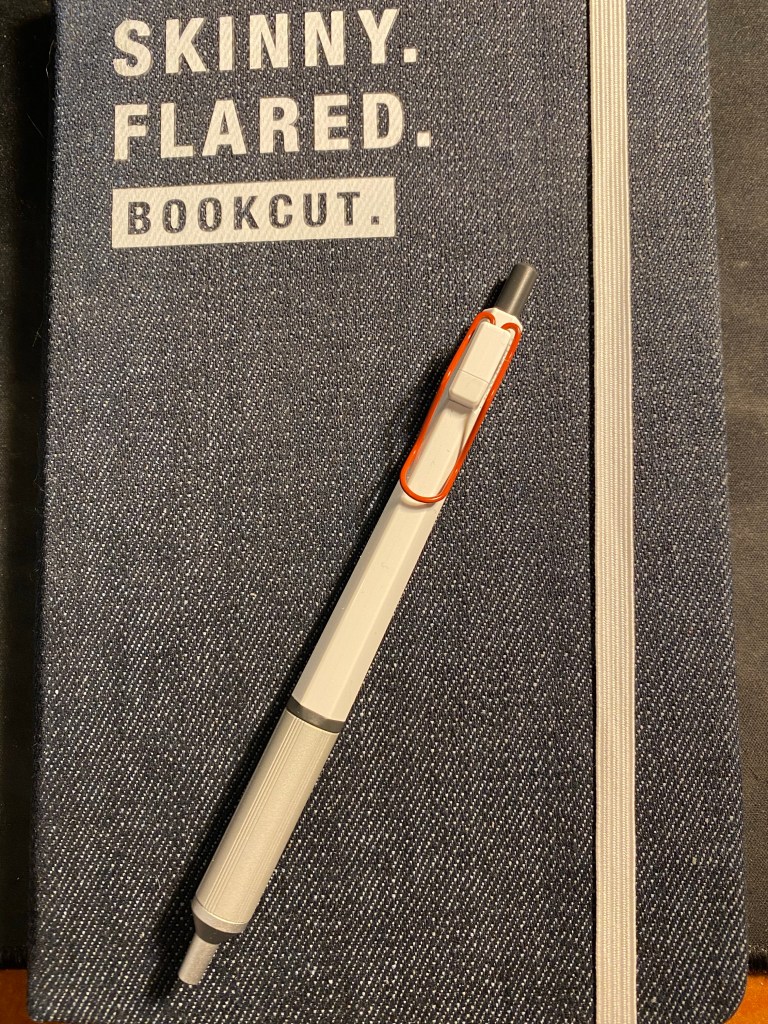
Uni Jetstream Edge white and red body with 0.28 mm refill on a Moleskine Denim.
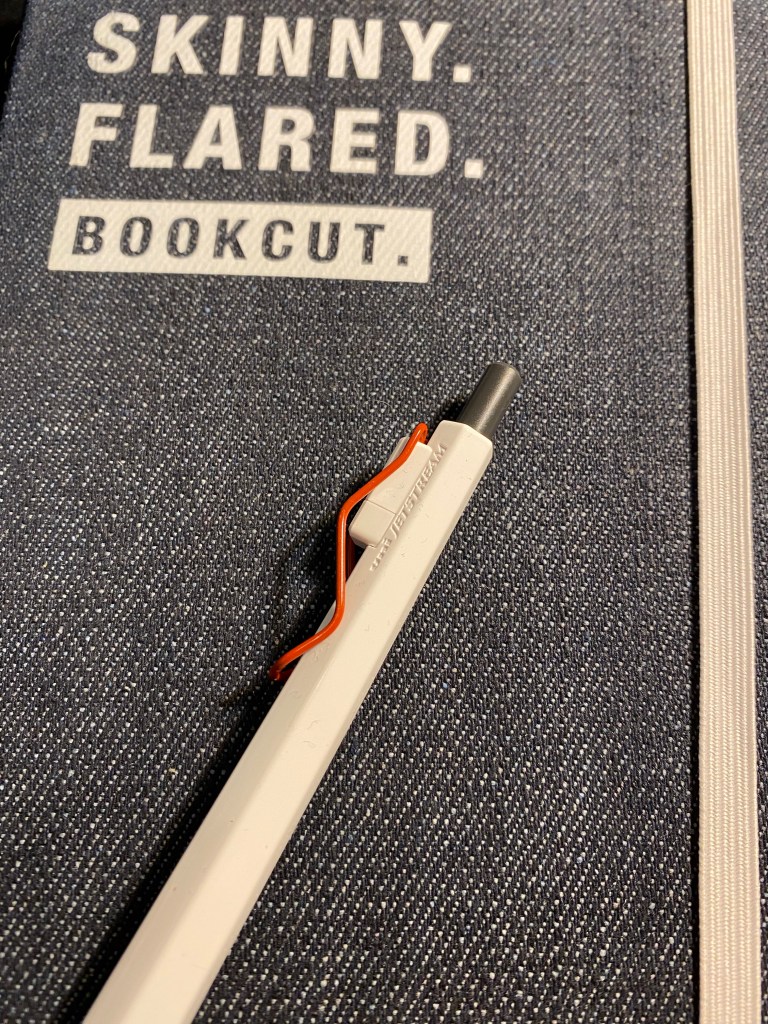
I love the design of this pen. The body is plastic, but the grip area is metal and relatively wide, which makes for a very well balanced pen. The bent wire shape of the clip adds to its modern and clean aesthetic, and I like that chose to make it red and not black or silver in the white edition of this pen. The clip looks like it would be a fun and springy fidget tool, but it’s quite inflexible and immobile. That’s great if you plan on using it to clip it to a shirt pocket, but the unusual clip shape means that clipping it to paper will likely crumple and even tear the paper. I don’t normally clip my pens to things, so that’s not going to be an issue for me, but YMMV.
The clip, and the subtle Uni Jetstream branding.
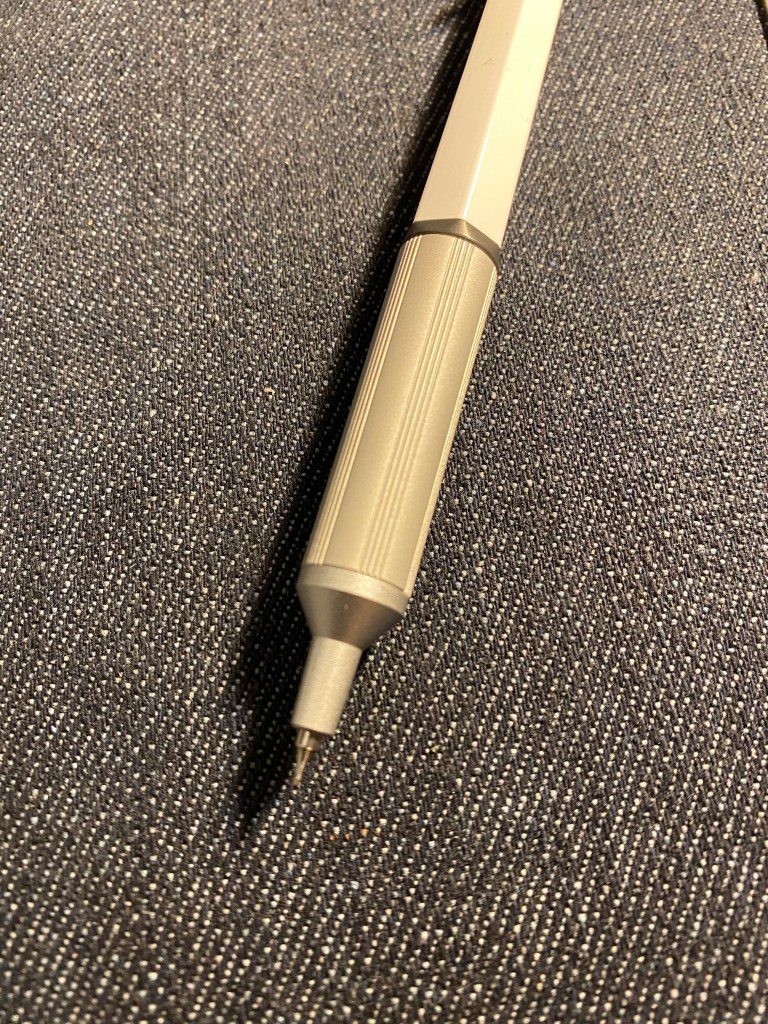
The Jetstream Edge grip section is metal and round, unlike the plastic, faceted pen body. There are grooves carved into it that make it comfortable to hold, and the refill sits very snugly in the pen sleeve. This is a pen that’s not going to rattle while you write.
Jetstream Edge grip and business end.
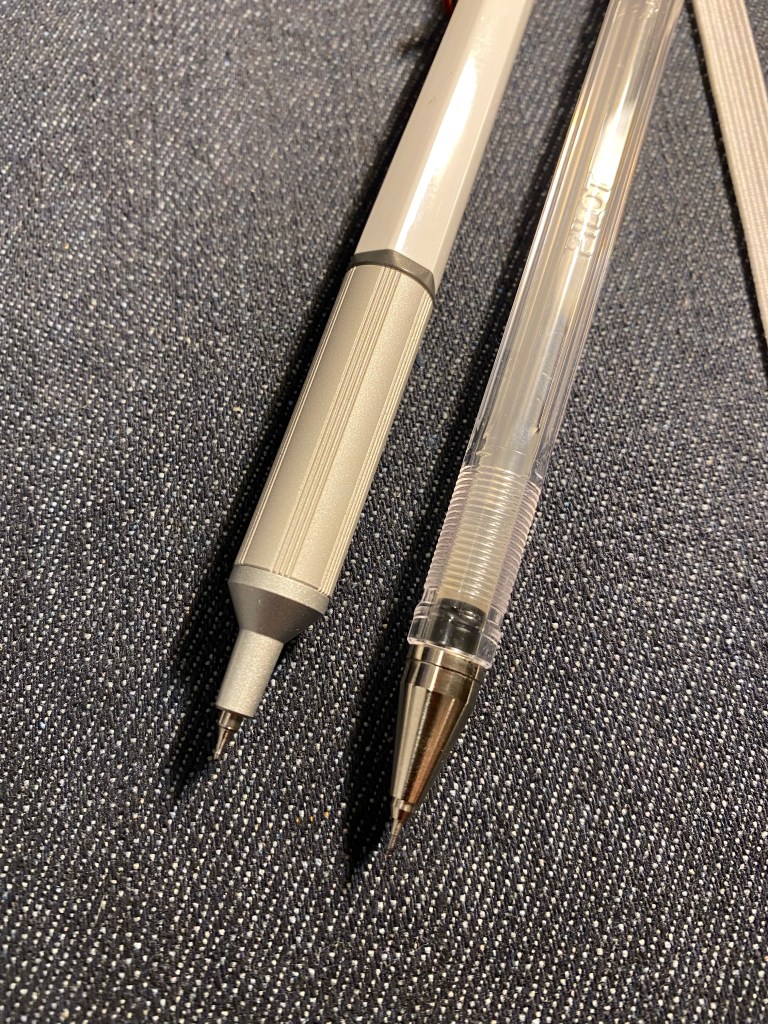
The 0.28 mm Jetstream ballpoint refill has been designed so that the tip won’t suffer the usual “bent out of shape the moment you breath too hard on it” fate of the Pilot Hi-Tec-C refills. Its sturdy but still keeps a tapered, fine tip, which means that you can use it with rulers and templates if you so desire.
Jetstream Edge on the left, Hi-Tec-C on the right. Note the difference in the tip and nose cone design between the two, and that the Edge grip is wider.
The refill the Jetstream Edge uses is the SXR 203-28 for the 0.28 mm or the SXR 203-38 for the 0.38mm tips size, although it appears that can also accept the Uni SXR-80 line of refills used for Uni-ball’s multi-pens. If so, that could open a wider range of refill colours and tip sizes. The original, SXR 203, refill is very slim, which would have been problematic if it was a gel ink refill (you’d have written it dry in a day), but shouldn’t be a problem with a ballpoint refill. That being said, I doubt that this refill will last as long as a standard Parker one, not to mention the Caran d’Ache Goliath.
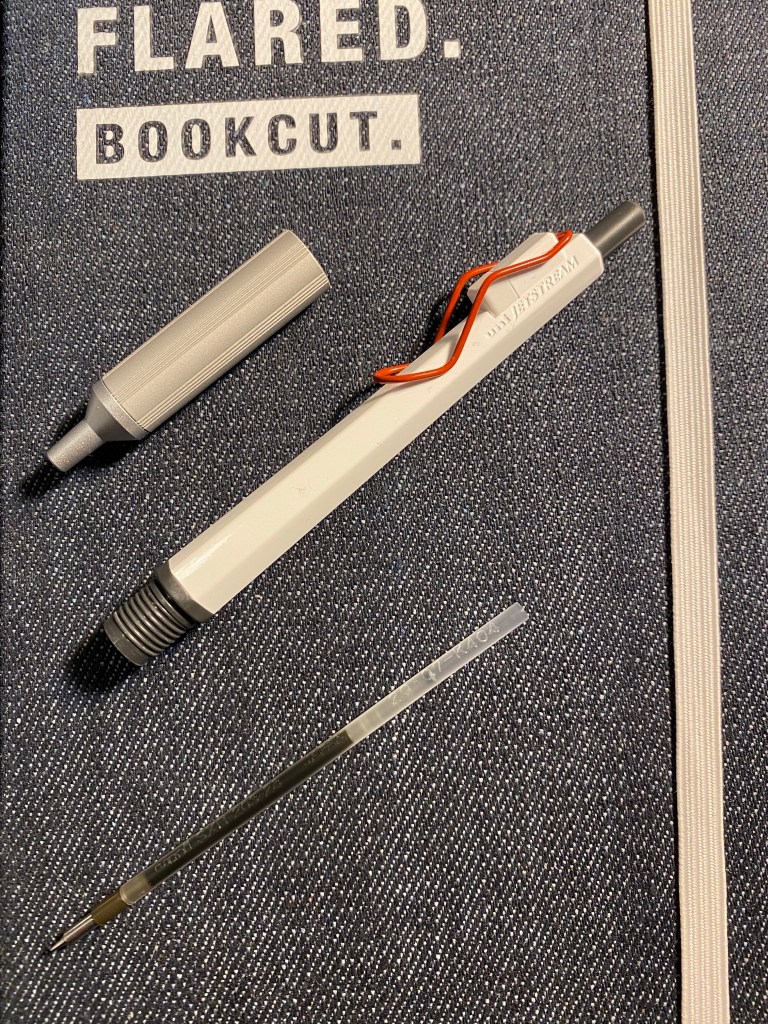
The Jetstream Edge dismantled with the refill on the side.
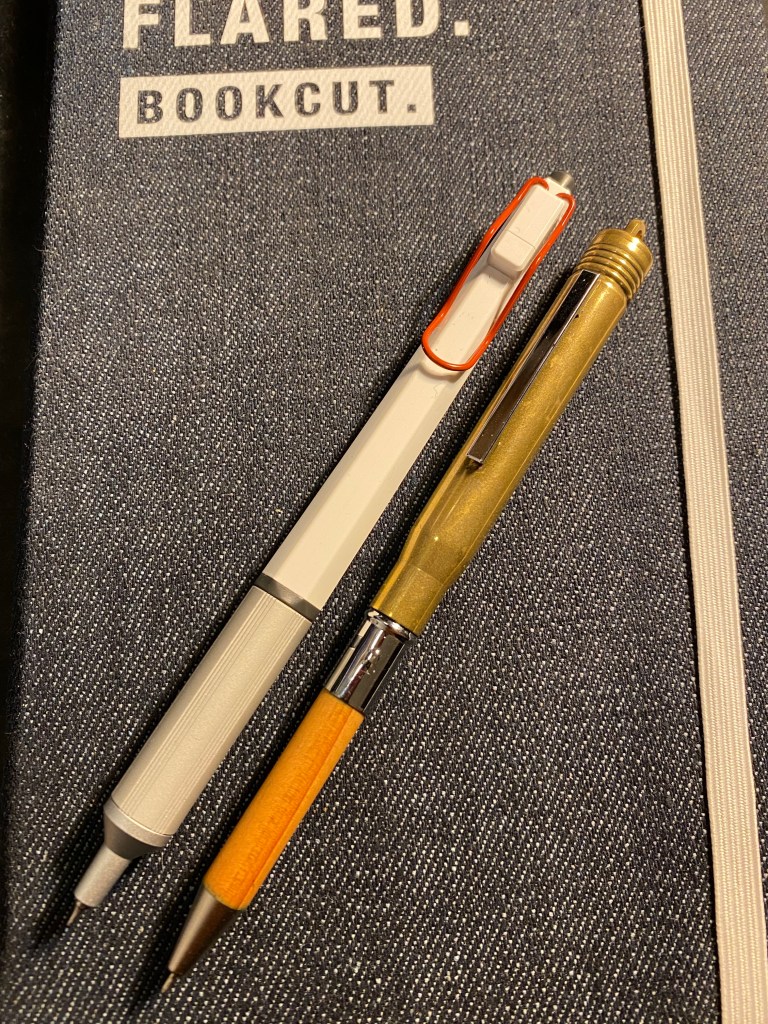
While Uni-ball brags that the Edge uses the first 0.28mm ballpoint refill in the world, there are other brands that use ultra fine ballpoint refills not far from it in size. My Midori (now Traveler’s Company) Brass Ballpoint pen has a refill that is around that size, so I thought I’d compare the two.
Jetstream Edge on the top left, the Traveler’s Company Brass Ballpoint is on the bottom right.
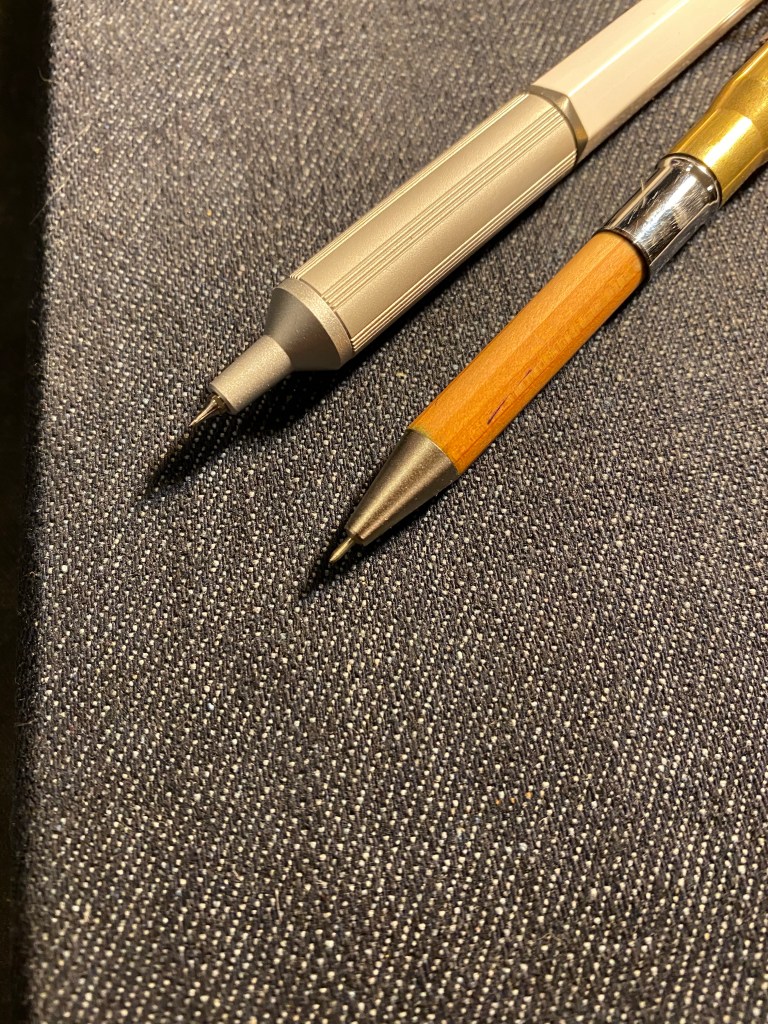
Here are the pen tips side by side. The barrels, grips and cones are very different but the refill tups are very much alike.
Jetstream Edge on the top, the Traveler’s Company Brass Ballpoint is on the bottom.
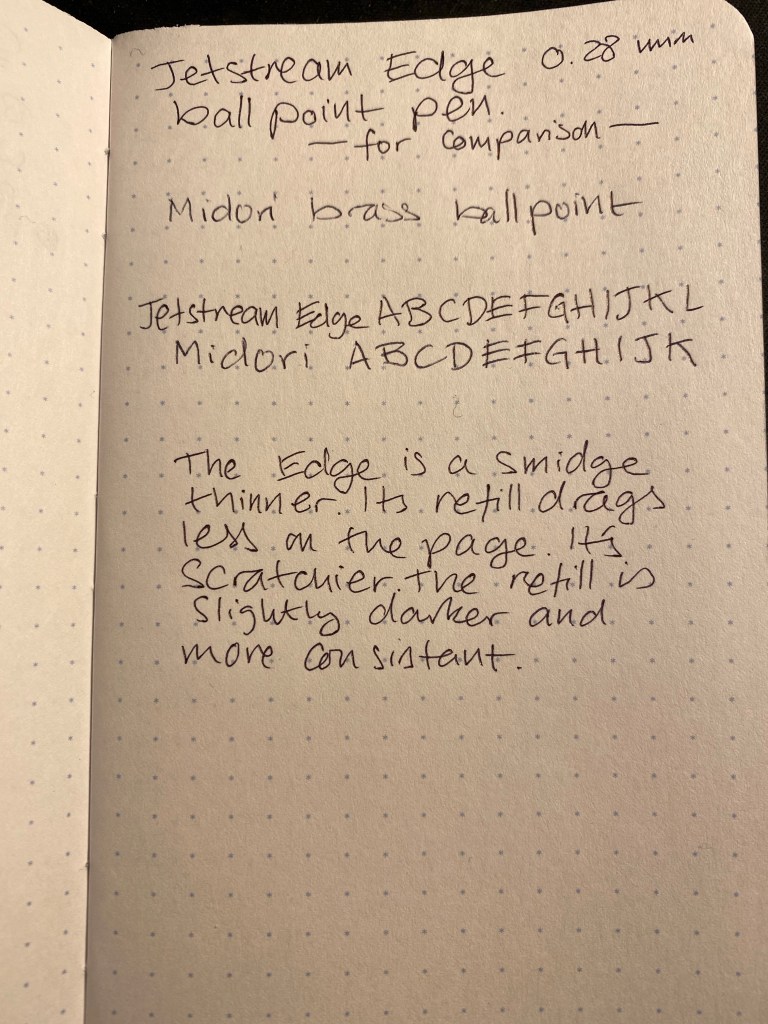
Below you’ll find a writing sample of the Jetstream Edge, and one of the Midori/Traveler’s Company Brass Ballpoint for comparison. Perhaps unsurprisingly, being a Jetstream refill, the Edge’s refill is better than the Midori’s even though it is slightly thinner. It lays down a more consistent and slightly darker line (although nowhere near as dark as a gel ink pen’s line).
I wrote seven full A5 pages with the Jetstream Edge, to see how consistent the line is over time, and to see if it would cause hand cramps after prolonged use. While I was writing I made a concentrated effort to keep a light grip on the pen. The barrel design helped with this, and the pen’s light weight and front heavy balance made it nice to hold and write with. But the Jetstream Edge is a pen with a sweet spot, not unlike certain fountain pens. Angle it too much and the refill starts to skip, so you need to write with the pen as vertically as possible. That slightly awkward writing angle may have been the cause of my hand cramps, but whatever the cause may be, this is not a pen that will work for long writing sessions for me.
So, do I recommend the Uni Jetstream Edge? If you’re a ballpoint fan and an ultra micro tip fan, then yes. Otherwise, there are cheaper and better ballpoint pens out there, even within the excellent Uni-ball Jetstream line. Will I be using the Jetstream Edge? Yes, although not for long writing sessions. I love the line it lays down, and I like the aesthetic of this pen. Then again, I’m a fan of the Pilot Hi-Tec-C…





















 Writing at Large