Big Celebratory Birthday Update Part 4

The final post of this series, you can find part one here, part two here, and part three here. Grab a cup of tea or coffee and settle in – this one is long but there’s a lot going on here that’s worth your time.

32. I have been tracking my memory recall issues (a chemotherapy side effect) using the Tally app, which I’m hesitant to recommend. On the one hand it does work as a quick tracking app for a handful of things, but on the other hand it has a scammy pricing model – a fair price for the first year (and free if you just track up to three things, like I do), but then the subscription jumps to about $5 a month. That may be justified for apps that have a lot of features and utility, but Tally is not one of those apps. Day One, a magnificent journaling app for those who prefer to digitally journal, does much more and costs much less.

33. If you haven’t heard of KT tape and you’re a runner or athlete of any kind (or just injury prone) I highly recommend it (and no, I’m not getting paid for this). It’s a roll of pre-cut elastic fabric tape strips that you use in various configurations and levels of tension to relieve the pain and take some of the load off of injured muscles, tendons or joints. It eases recovery and it’s worth having a roll of it in your house and travelling with a few strips when you go abroad. There are YouTube videos that show you how to apply the tape- just search for the area or injury you want to address and “KT tape” and you’ll find official videos and ones made by physical therapists that will guide you. I recommend going for the Pro or Pro Extreme – they cost a bit more but last longer as their adhesive is stronger so you can keep them on for a few days. The tape leaves no residue and is easy to apply by yourself, although there are areas where another pair of hands does help. If you don’t want to buy the tape online, you can find it at your friendly local running store or in certain sporting goods stores.

34. If you are planning on travelling abroad with older relatives or people with a mobility disability, here are some tips that may help:

  • Ask for special assistance when you book the flights (there’s an option there). It helps with the long distances and long lines in the airport. Arrive early and wait patiently for the assistance – it’s worth it.
  • Book hotels and not Airbnbs. You want a place, preferably a well established chain, that you can rely on in terms of catering for your accessibility needs. I can’t tell you how many times we arrived at an Airbnb only to discover that the promised elevator has been broken for weeks, or the place has stairs to the elevator, stairs in the apartment and a bath instead of the promised shower. You want a hotel and not a boutique one because they’ll have an elevator bank, accessible rooms, and someone you can talk to if you run into issues. Chains are good because if there’s an issue with your room there’s a possibility of being catered in another hotel in the network. Contact the hotel ahead of time in writing and reconfirm your needs – elevator, shower with no lip or step, mini-fridge for medication, etc.
  • Use taxis (or rideshares) and buses, not the metro/underground/subway. There’s less walking involved, there’s less stairs involved, and it’s worth the additional time and money.
  • Check the parks you plan to visit – some have motorized tours for disabled patrons.
  • Talk to the staff at museums and exhibitions, preferably ahead of time. There may be an accessible route in that Dior special exhibition that isn’t advertised (there is), or they may tell you that it’s better to arrive at a certain entrance.
  • Theatres oftentimes have special accommodation and pricing for disabled people and their companions. If it’s not on their official site, email or call them and they will likely be able to help.
  • Don’t pack your days full, but rather plan or returning to the hotel for an afternoon nap before the evening’s activities.
  • Plan ahead as much as possible. You are less flexible in your needs so this is not the time to be spontaneous.
  • I can’t stress this enough: spend time, effort and money when selecting travel insurance. Don’t go for the cheapest option because it’s likely to leave you hanging when you need it. Pay a premium for insurance that pays back upfront and doesn’t have you chasing after it if possible. Take the time to read the small print and talk to them if possible.

35. I have gotten several questions about rucking, so here’s a good article describing what it is and the benefits and risks involved. I will add that you need a good pair of shoes with decent ankle support, you need moisture wicking socks to help avoid blisters (I just use my running socks), and you don’t need to buy a GoRuck bag. In fact I don’t recommend them – they’re heavy, overpriced and don’t provide the back support you want. Instead buy a good hiking day pack (I use the Osprey Manta 24) for about half the price and twice the support. My Osprey Manta comes with a hydration system (2.5 litres, which is a good chunk of the weight in my bag), wide padded straps, load lifters, a great hip belt and sternum strap, plus a mesh that is fantastic for the hot climates I ruck in. Also weigh your bag with useful things – water, food, first aid, extra layers, flashlights, sunscreen, etc. – and not with useless weight plates. Put the heaviest things on top, as close as possible to your shoulder blades and upper back. I use a waterproof Rumpl travel blanket at the bottom of my bag, and 80% of my weight is water. The rest is books, which I don’t mind using as weights as I’m rucking in a city park really close to home. If I was hiking in the great outdoors, I wouldn’t carry anything that wasn’t useful if I somehow got stuck on the way.

36. Do you have to generate QR codes and are tired of the spammy, ad filled sites that provide the service when you Google for it? As Cory Doctorow puts it:

“Just a QR Code” is a new site that generates QR codes, operating entirely in your browser, without transmitting any data to a server or trying to cram ads into your eyeballs. The fact that it runs entirely in-browser means you can save this webpage and work with an offline copy to generate QR codes forever – even if the site goes down:

https://justaqrcode.com/

37. My journal is at that delicious phase where it’s passed the 3/4 full mark but hasn’t reached the “only a handful of pages left” mark. I recommend making it a goal to reach that phase in every notebook you use – it’s the best.

38. These little fans are a lifesaver. I’ve used them on trips, on buses with fault ACs, when I’m outdoors waiting in the sweltering heat, etc. Again, not an affiliate link and this isn’t a paid anything – it’s purely a recommendation of a product that I’ve been using and enjoying for a few years.

39. Journaling Tip #4: Did you have weird, overblown reaction to something or someone recently? Take the time to journal about the experience. Write down what happened (facts only), what was your reaction/feeling (be honest), why it’s surprising under the circumstances and finally why do you think that you reacted the way that you did? Does it reveal something about how you view yourself, your insecurities or fears?

40. Lightening Book Review #7: What We Talk About When We Talk About Love, by Raymond Carver. This is a collection of 17 short stories set in rural American in the 70’s first published in 1981 and it hasn’t aged well. The protagonists drink a LOT, they are violent, sexist, despairing and desperate. It’s like watching a series of car crashes – you become numb to the experience after the third or fourth. Carver can write, and there are a few gems here, but it’s all so very miserable and depressing – like hosting an alcoholic for a week. Their stories may be intriguing, but they’re also all so very terrible and tragic that there’s only so much of it that you can take.

41. I opened a new Moleskine notebook – after not having opened a new one in over a year. This is the one will be used for some writing projects, and it’s one of my favourite limited editions, the Blue Note Hub Tones edition. I’ll maybe post a review of it later, but for now, this is a reminder to use the good china.
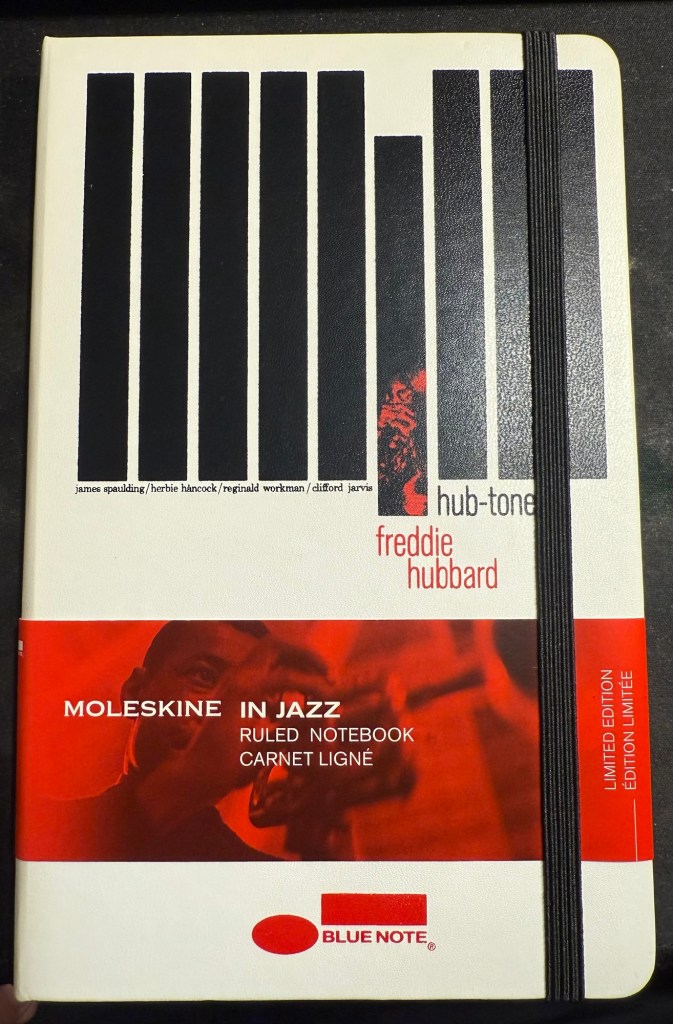
Moleskine Blue Note

42. Journaling Tip #5: look at someone close to you, someone you admire for having a skill or approach to life that you don’t have, and write down what you can do over the next few days, week, month to be more like what you like them. That’s what got me to go to more plays, concerts, shows and exhibitions now instead of just waiting until I’m on holiday abroad.

43. Great advice from Adam Savage’s latest Tested livestream – Q-Tip: Quit Taking It Personally. More often than not other people’s behaviour and choices has nothing do with you and everything to do with them.

That’s it – 43 points for 43 years. Have a great week!

View from my rucking session

How I Use My Notebooks: Gym Journal

Here’s an idea that I haven’t seen discussed before: take a pen and a pocket notebook with you to the gym and journal in between sets.

This is my gym journal:

Moleskine Pocket lined hardcover Mickey Mouse limited edition and Zebra G-405 pen

It’s a battered Moleskine pocket hardcover lined notebook, a limited edition Mickey Mouse one from years ago. There was a series gash in the spine, so I fixed it with some gaffer tape. I use a Zebra G-450 gel ink pen, and it lays down a bold, 0.7 black line.

I don’t use this notebook during every gym session, but when I’m trying out new things, when I’ve got a lot on my mind, or when I’m trying to solve a specific problem I take it with me. I don’t write details about my workout (rep numbers, weights, etc) as I have an app for that.

So what do I write in this notebook?

  • How things felt during the workout, particularly when I’m trying something new or if I’m recovering from an injury.
  • Notes on other gym goers bad behavior. I don’t want to confront them, but I do get frustrated when people don’t return weights, don’t use a towel or wipe down the equipment, and hoard equipment during the gym rush hour. Writing it down allows me to let off steam and focus on more productive things (like my workout, or returning equipment that I know is no longer in use back to its place, or on anything else).
  • Ideas or projects that I’m brainstorming at the moment. I oftentimes use a workout to think about something I’m considering or something I’m stuck on. I jot a few notes in between sets to not forget the ideas I came up with during that time.
  • Things I want to journal about later, in my “regular” journal. These are usually things that I forgot to journal about and want to get back to later in the day, when I have time to sit down and better process them.

The main point of this journal is to get me as much as possible off my phone. It’s tempting to check the news for the umpteenth time, or doom scroll various feeds, or play mindless games while you wait between sets. My goal is to bring these habits down to a minimum, and this journal is a useful tool in the search for less screen time.

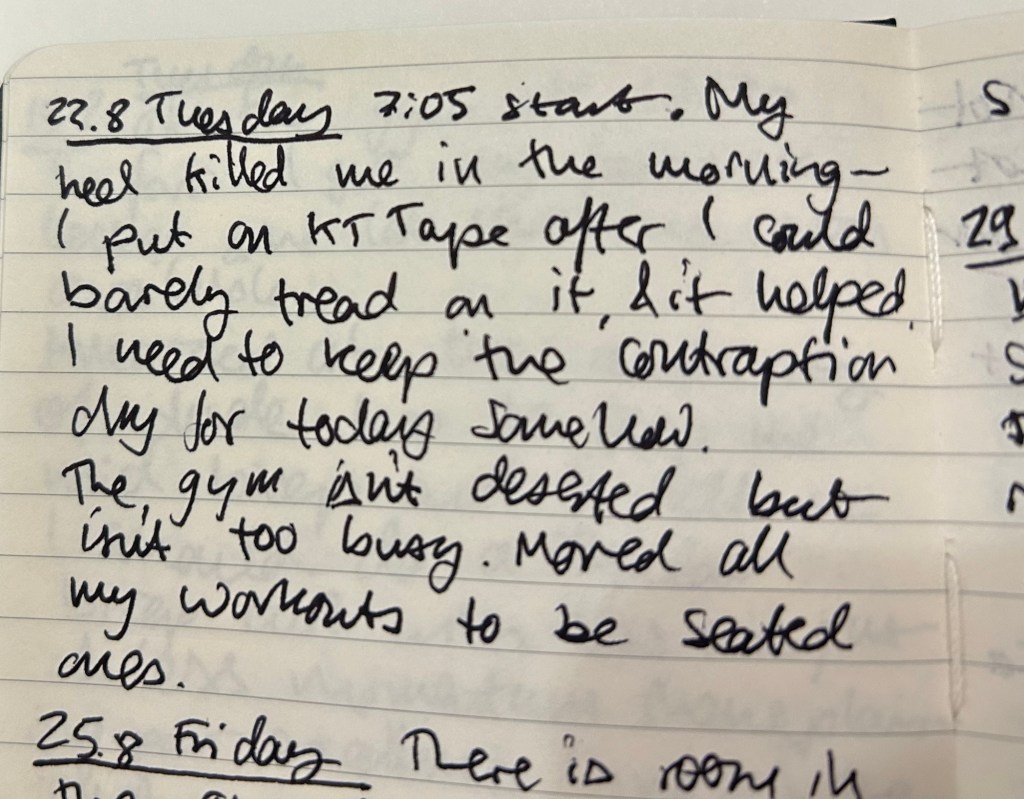
Sample entry from last year. I write with gym gloves on, hence the atrocious handwriting.

I originally thought that it would be embarrassing to use a notebook in the gym, but I decided that “so what, who cares” is the attitude to take in this case. People do much more embarrassing things at the gym and nobody comments on it. I use an inconspicuous notebook that isn’t at all precious, and a hardy, inexpensive, inconspicuous gel ink pen to go with it. Both have survived falls and encounters with misplaced weights, so they are gym hardened, Don’t bring large, colourful notebooks with you, and don’t bring pens that look expensive or draw attention to themselves. You’re going for the “boring, not worth paying attention to” look here.

Would you consider taking a pen and notebook with you to the gym? If you already do, how do you use your gym notebook?

Journaling Series: Journaling in Response to Media

There’s a new show out on a streaming service and I’ve started watching it. It’s part of a large franchise with a vocal fandom, and as usual, the fandom has opinions. These opinions are extreme, because that’s what social media and news sites amplify. Outrage sells. Hate sells. Abusive bot attacks drive up traffic and “engagement” so why should these companies stop them?

I too have opinions about this series, but they aren’t of the outrage kind. A few years ago I would have expressed them on Twitter, More recently I would have written about them in various group chats. These days I do neither.

I journal about them instead.

We have been trained to think that our opinions on the media we consume must be packaged attractively and shared as widely as possible. We have been told that it’s our responsibility to go on social media and let everyone know how we feel about a show, a movie, an album, a book, about every bit of culture we consume. We have been told that it’s for the benefit of our friends and for the benefit of the artists we like. It is not. It is for the benefit of a small group of shareholders.

I have no interest in feeding the outrage machine. Screaming into the bot filled void does nothing but make you hoarse, miserable, angry, and possibly part of a mob.

I also realized that I’m not interested in entering a debate or an echo chamber about this particular series. I just wanted to clarify for myself what worked in this series, what didn’t, and should I continue watching it or not.

So I journaled about it. No outrage. No drama. Just me and a blank page having a bit of a think about a streaming series. There’s no personal affront here, no mob cheering you on to hurl abuse on the series creators, no mob telling you what to think about certain casting choices, plot choices or the series creators.

My thoughts and conclusions about this series aren’t interesting, just as the name of the specific series is irrelevant. I recommend this process with every bit of media you feel the need to share your opinion about, BEFORE you share your opinion on it. It’s what I do with the books that I review. It’s what I do about podcasts, movies, series and shows. It allows for a guiltless, safe place to voice my opinions, to consider and rework them. It’s also far from the maddening crowd, which means I know that these are my own opinions and not the regurgitated opinions of others.

If you’re interested in the process, here are some questions you can use as prompts:

  • Why did I start watching/reading/listening to this?
  • Who would I recommend this to?
  • Am I enjoying each episode/chapter? Am I looking forward to the next one?
  • What is my favourite thing about this show/movie/etc? What is my least favourite?
  • Bonus: How would I change the show/movie/etc to make it better? What would be gained and what would be lost with this change?

Do you journal about media? What prompts do you use?

Journaling in Hospital

  1. I’ve been spending practically every day for the past week or so with my dad in hospital.
  2. There’s this phenomena that when you most need journaling, the it will help you the most, you find yourself least able to do it.
  3. Hospitals are journaling hostile environments. There are no tables to use, there’s constant noise and distractions, there’s zero privacy and you never know when the staff will pop into the room with something. Whether you yourself are hospitalized or you’re there with someone else, there’s very little opportunity to crack open your journal and start writing.
  4. Hospitals are also where weird, interesting, scary and new things happen, so you generally do what to write about them, to process them on paper. Fo instance, today three policemen escorted a prisoner into the heart surgery department. It wasn’t something I ever expected to see, a sort of non-sequitur that took me a minute or two to process.
  5. The solution is to take temporary notes on your phone, put a reminder for an appointment with your journal in the evening or when things quiet down around you.
  6. If you’re the one hospitalized, try to journal two or three times a day, documenting what’s going on, how you’re feeling, what the staff said, who visited you, etc. The best time to journal is during the nursing staff shift changes, because that’s when nobody will bother you.
  7. Journaling is like running – oftentimes it’s really hard to start, but I haven’t regretted a run or a journaling session yet.
At night you can escape to these empty spaces and write

Stocking Stuffer Ideas for Sketchers

If there’s a sketcher in your life and you’re looking for some stocking stuffers for them, here are a few ideas:

Sweat Bands

These are not only useful for tennis players, they’re great for Urban Sketchers or anyone who sketches on the go. You can find them very cheaply at any sports brand store, and they’re oftentimes discounted (so you can splurge on brand named ones). You wear one of these on your wrist as you use your waterbrush, and you can quickly and conveniently clean your brush on it. When it gets too “colourful” (pun intended) you just toss it into the washing machine. I have two pairs of these in rotation at all times (one from Nike and one from Lululemon, both cost about $5), and they’re an integral part of my portable watercolour kit.

Well used sweat band

Waterbrush

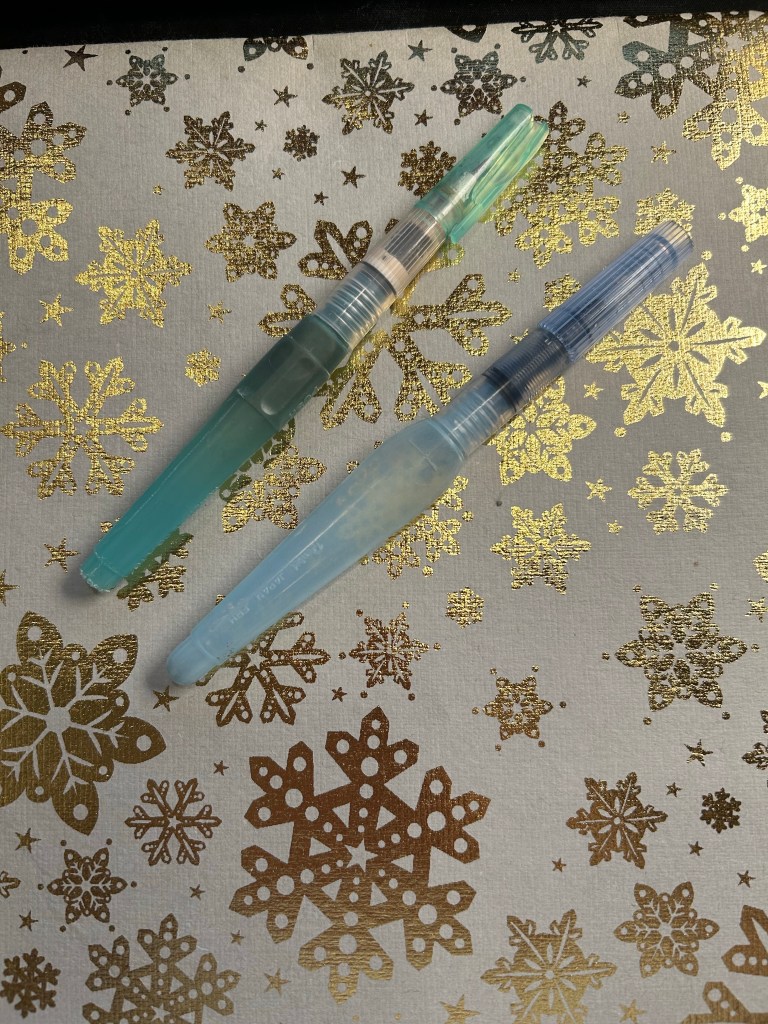
These are inexpensive and every sketcher can use one – even if they have one or two already. They can be used with watercolour or filled with a mixture of ink and water and used for sketches on the go.

Waterbrushes

Small Spray Water Bottle

These are great for anyone who uses watercolours. They can be used to quickly clean your palette, to wet your paint pans, to create effects on your paper, or even to play with ink. Plus, even if they have one, another one will still come in handy.

Spray water bottle.

Fineliner Pens

My favourites are Staedtler but Sakura may be more widely available (Uniball and Zebra also make good ones). In any case a 0.1, 0.3, 0.5, 0.7 will always be appreciated, even if they already have them. Buy black and not any wild colours, and avoid buying the Copic metal ones because they’re needlessly expensive.

Staedtler Pigment Liners

Excellent Pencils

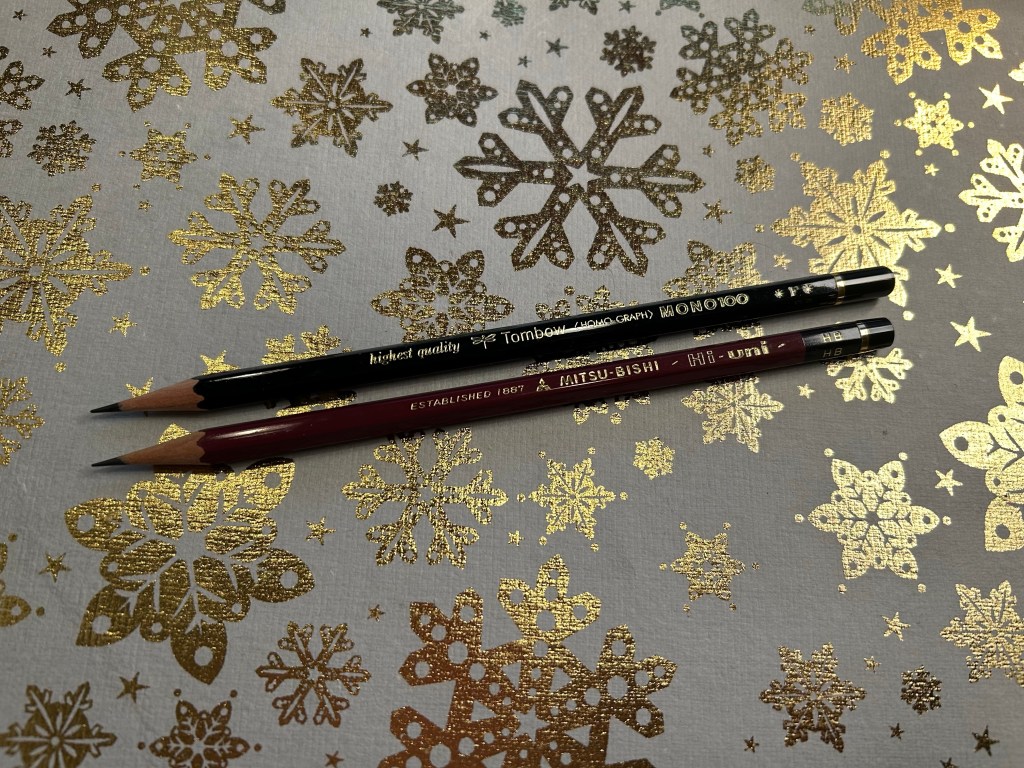
These can be a bit more expensive, depending on the quantity you buy them in, but Tombow Mono 100 pencils in 2B, B, H, F and/or HB or Mistubishi Hi-Uni also in 2B, B, H, F and/or HB would be greatly appreciated. Add a Tombow Mono Light eraser or a kneaded eraser for added thoughtfulness. If you can only purchase one harness, go for B or 2B, unless they work exclusively in watercolour, in which point go for F or H.

Tombow Mono 100 and Mitsubishi Hi-Uni

Faber-Castell Pitt Brush Pens

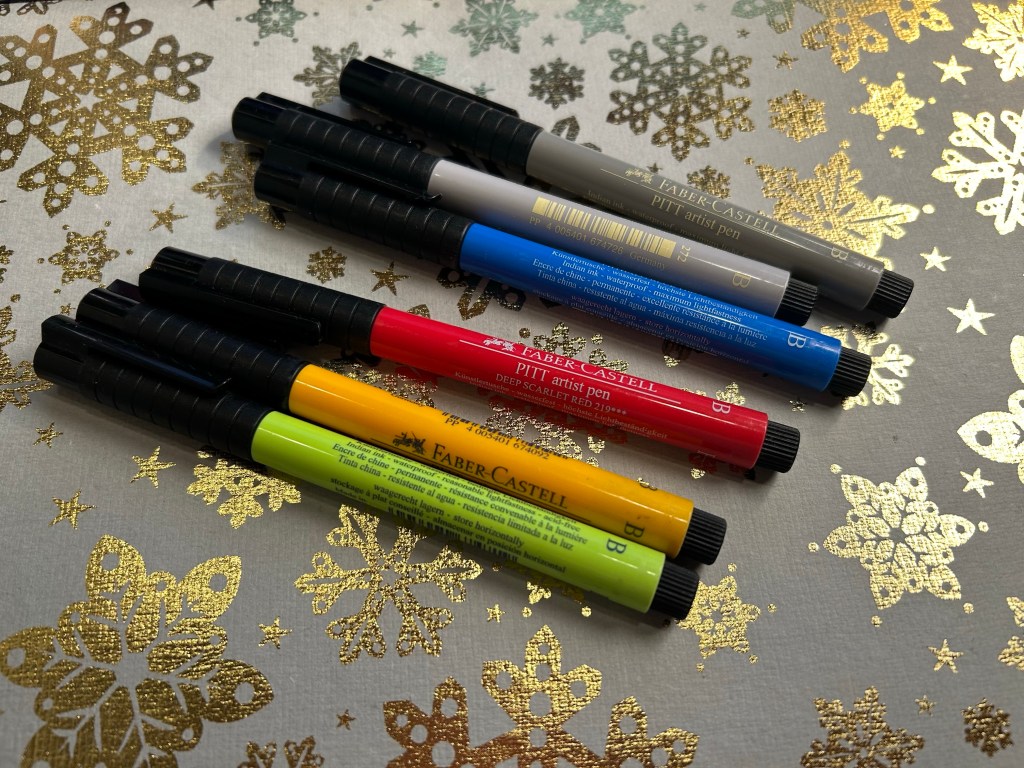
These are waterproof, and great for quick sketches. The tips wear down relatively quickly so even if they have them already, additional ones will be appreciated. Go for cool greys or just wild on the colours, and make sure that they’re brush pens, not fineliners (there’s a B on the end of the pen that denotes brush tip).

Faber-Castell Pitt brush pens. Notice the B on the end of the pens

I’d skip the black, because for that there’s:

Pentel Pocket Brush (GFKP)

A favourite with sketchers, cartoonists and calligraphers, this is the best black India ink brush pen that you can find. Throw in a a few refill cartridges or a Uni-ball Signo Broad white gel pen if you’re feeling generous.

A classic – Pentel GFKP

Stillman and Birn Pocket Alpha Sketchbook

A favourite among Urban Sketchers for good reason, this pocket sketchbook can take anything you can throw at it, has a plenty of pages, and can take a beating. Don’t be tempted by the Beta paper, it’s thicker but also contains fewer pages. Throw in a Fineliner or a Bic (you can splurge for a golden one if you’re bored), and a binder clip to keep the sketchbook closed and you have a complete Urban Sketcher set.

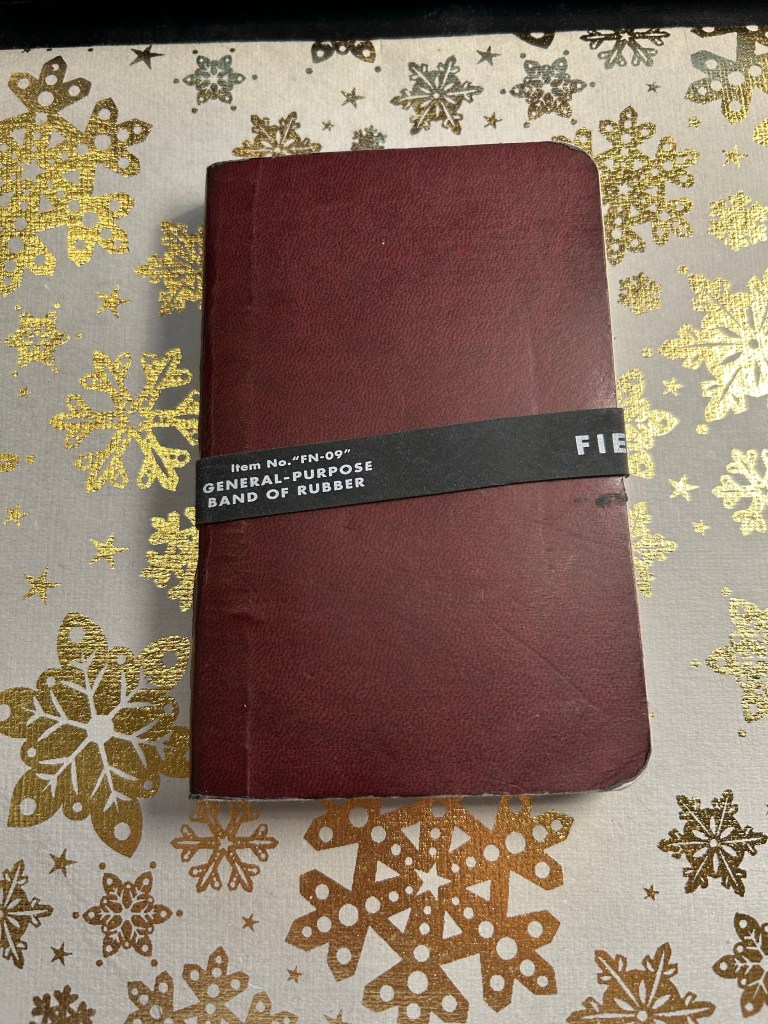
My battered and well-loved Stillman &Birn Pocket Alpha with a Field Notes rubber band to keep it closed.

Hopefully you’ll find some inspiration in this list. If you have any more ideas for stocking stuffers for sketchers, please write them in the comments below. Happy holidays!

How I Use My Notebooks: Daily Planner Update

I last posted about my planner and to do list setup here. To recap, my planning system includes two large Moleskine hard cover squared notebooks, one in which I plan my week, and one in which I use as a daily to do planner. I started using this setup once Covid hit and I started working from home. It worked very well for a year and a half.

Then I got cancer.

I was hospitalized for a month, in which I discovered that I have zero control over my time or how my day will shape out. When I got out I was already on a Chemo regiment. I had to make adjustments to my life, this time because of my personal health, not a global pandemic.

Score (another) one for self-made planners.

My old system was generic enough that it fit into my new lifestyle with very little adjustment. The weekly notebook stayed mostly the same, as you can see below. The main difference is that I manage less stuff there and more using reminders in Fantastical. It’s not that I don’t like paper planners any more, it’s just that Chemo Brain is a possible side effect of my treatment and I don’t want to risk not getting something important done because I forgot to check my weekly planner at the right moment, or I saw something there but didn’t remember it after I’ve seen it.

So why keep the weekly planner at all? Because it helps me see how the week is shaping up, and because it allows me to do a little long term planning, despite everything. All my plans at the moment are in two week batches (dictated by my chemo regiment), and this layout allows me to manage them.

Another addition to this notebook is a few tracker pages, marked by tabs. Some track purchases that I’m waiting for, some track bureaucracies that I need to take care of, others list things that I want to get done eventually but I haven’t decided yet when or how.

As for my daily planner notebook, I just finished one and started another. Here’s the finished notebook:

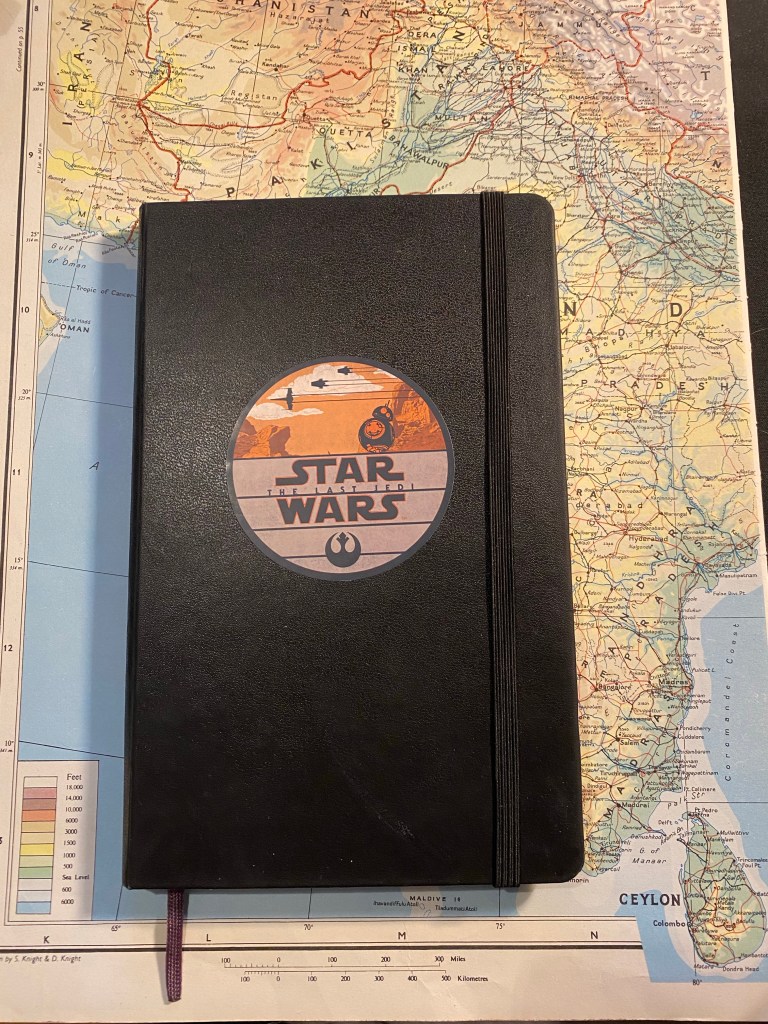
Moleskine Large Hardcover squared with a Star Wars The Last Jedi decal on the cover.

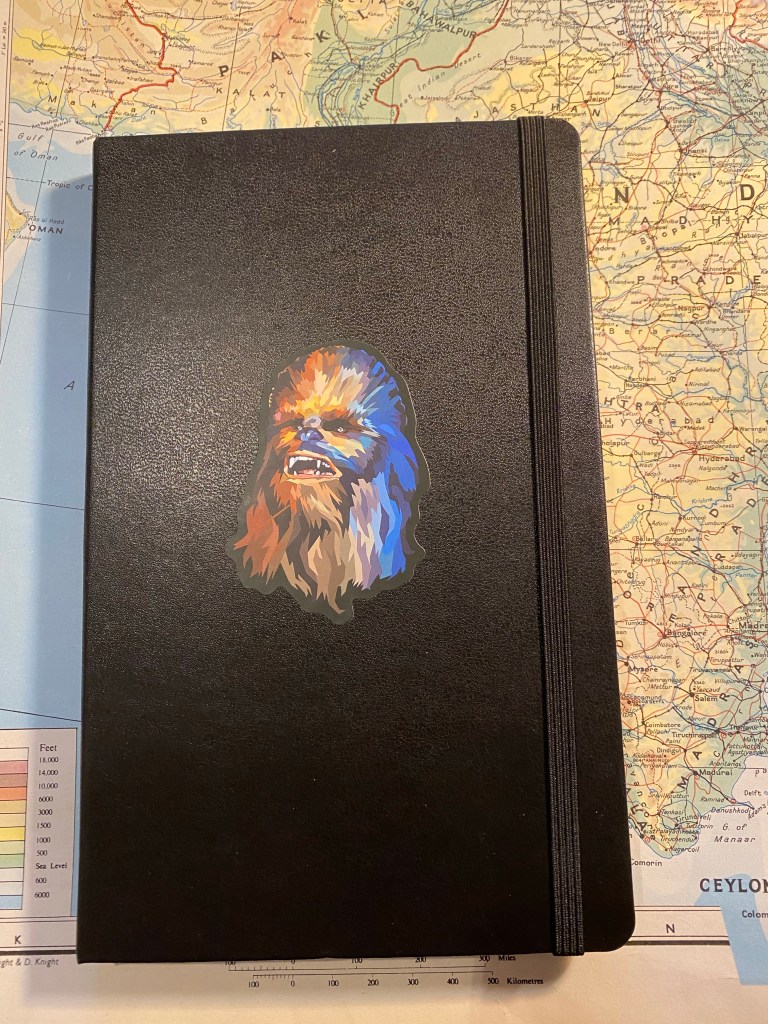
Here’s the new notebook. I love using these decals to make these notebooks my own:

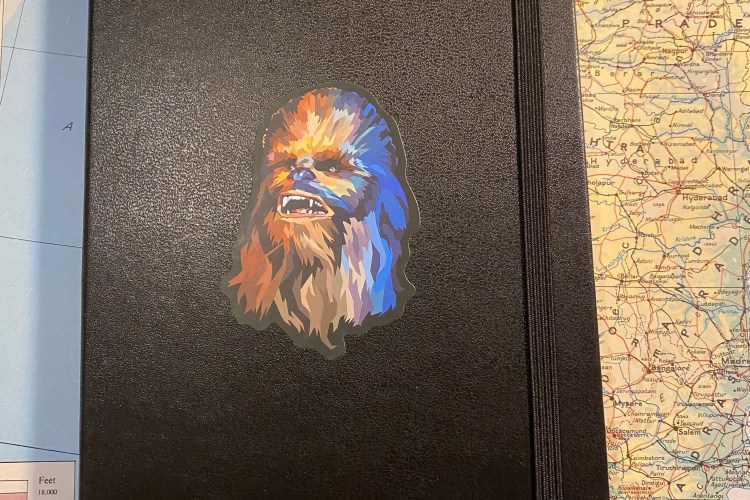
Moleskine Large Hardcover squared with a Star Wars Chewbacca decal on the cover.

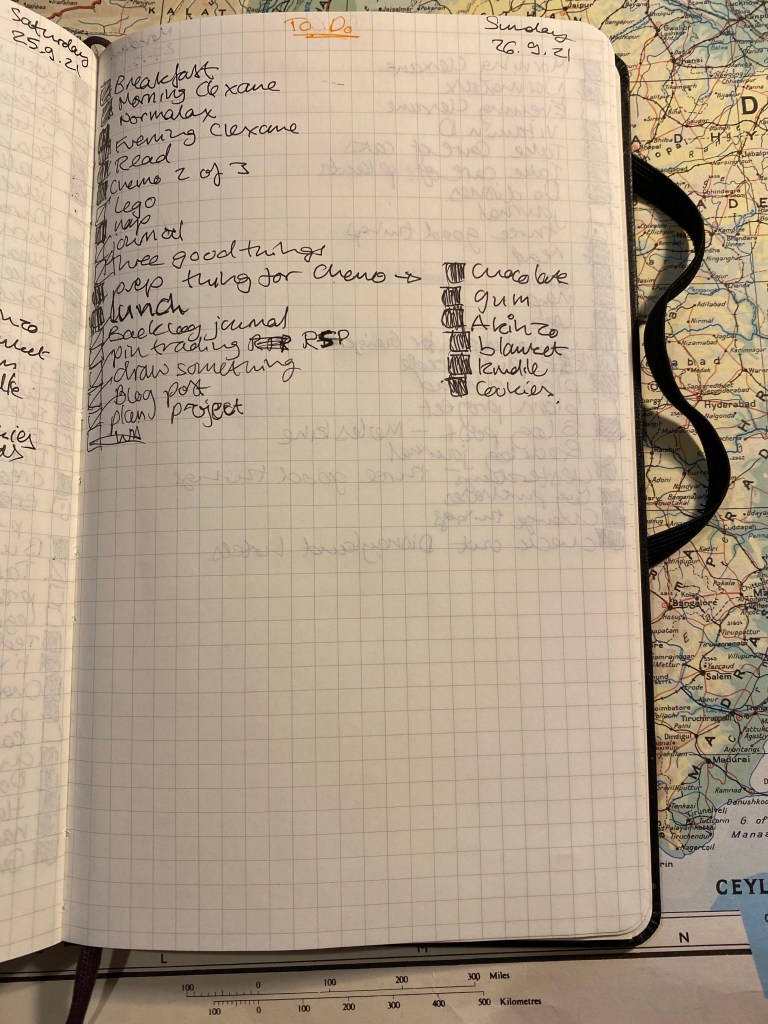
I used to manage every day on a full spread, with personal to dos on one side of the page and professional ones on a another. Since my life is less busy now than it used to be, I’ve downsized my to do to one page per day, with personal and professional mixed in (I work from home). This is a sample of my least busiest day: it’s a chemo day and I wasn’t planning on working after this treatment since it was a long one. Door to door I was in the hospital from 6:40 to 14:00, and completely wiped out after it. I don’t usually list my meals or naps in my notebook, but chemo days are so crazy (in terms of what my brain does on steroids) that I have to write everything down. Things that I didn’t do get a strike in them and are moved forward to another day.

Everybody has different needs from their planner, and those needs oftentimes change unexpectedly, and out of sync with “planner season”. It’s one of the reasons why I find making your own planner, working just a few days or a week or two ahead is the best and most consistent way for me to manage my time. There are some great planning systems out there, but if you’ve struggled with using them, or if your circumstances make you need a very flexible system, I highly recommend picking up a squared or lined notebook and creating your own.

How I Use My Notebooks: Three Good Things

I’ve been going through a rough time lately, and as many people have been so kind to say, staying optimistic despite all the bad things that I’ve had to deal with lately is key to getting through this terrible time. That is, of course, easier said than done. My mind tends to latch on to the painful and scary parts of the day, to the bad feelings, anxiety and doubt. It doesn’t help that we are all living through difficult times, and it’s hard to see and end in sight.

So I’ve started a new habit during the past month, and it’s helping me end the day on a positive note, with an added bonus of helping me use up some of my many notebooks.

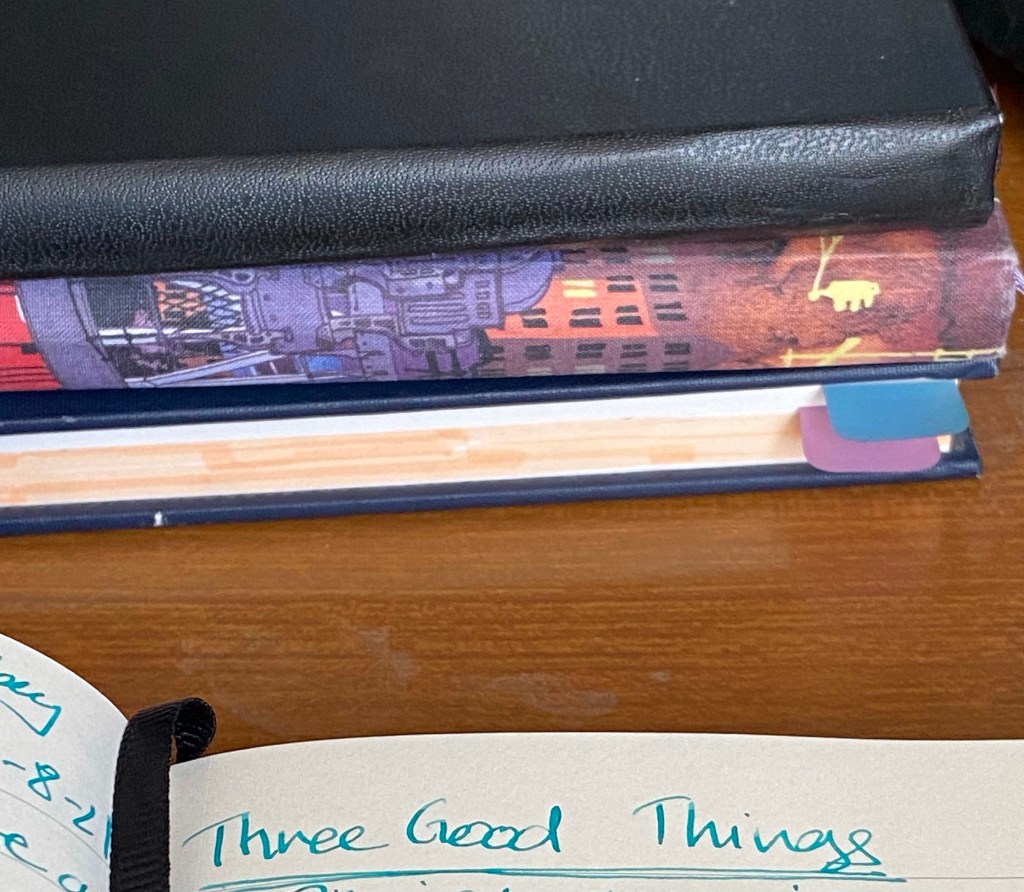
I end each day by writing at least three good things that happened that day. I dedicate a page for each day, in my Dingbats notebook, with “Three Good Things” as the title, the date and day, and then the list of good things. It doesn’t take more than a few minutes to find that day’s three good things, and for most days so far I’ve managed to find more than three good things to reflect on. They are usually conversations that I had with friends, or moments where I felt like my old self, or things that I enjoyed reading or watching.

Writing these down has been so helpful in getting me to see the good in each day, and in trying to stay positive when life is pretty tough.

London: A Trip to a City Emerging From a Pandemic

I was in London for the past two weeks, and it was a strange and unique experience. Until Covid-19 I used to visit London once a year, every year. Once the travel restrictions changed so that I didn’t have to quarantine on the way there or on the way back, I decided to book a trip. It ended up being a good but somewhat bittersweet trip, with a lot of interesting new caveats and restrictions that I had to take into account.

Kensington Gardens on a sunny Sunday with very few people outside.
  • I was travelling to London from a Green List country. That meant taking a Covid test 72 hours before the flight, filling a Locator Form, and taking a Covid test within 2 days of arrival. On the way back I had to take a Covid test 72 hours before my flight back, as well as another test upon arrival. These were all PCR tests in my case, which were uncomfortable to take (first time I took a Covid test) but not painful. They were expensive, and dealing with them did add an added layer of hassle to the trip. In London I bought a test package from Randox, using the British Airways code to bring the price down (it was still much, much more expensive than local tests here – 60 GBP per test after a 50% discount), and dropped the test at a clinic near the British Museum. I would have said that the experience was smooth, except one of the kits that I ordered had a test tube that wasn’t sealed properly, which meant that all the preserving liquid inside leaked. I got a replacement from Randox, but it was a hassle to get them on the phone and get my test kit replaced.
  • London is not for the spontaneous at the moment. You have to book every museum visit in advance. There are fewer musical and theatre tickets on sale as social distancing requirements are still in effect, and there are less show on, which means you need to book well in advance and there is no lining up for day-of tickets. Exhibitions are also at limited capacity, which means that for the popular ones at the V&A, for instance, you will have to book more than a month in advance. Concerts are the same deal, and many churches no longer offer concerts due to social distancing requirements. If you want to see or hear anything, you’re going to have to plan it out to the minute well before your trip.
  • Places are closed or have closed down. I expected that to some extent, as this was case here as well, but I was taken by surprise by the amount of closures, considering just how much support (relatively) the UK government provided to citizens during the lockdowns. Antique markets seem to have taken most of the brunt, with Portobello being a gutted (many arcades are half or three quarters shuttered), Spitalfields reverted mostly to crafts and food, and Greenwich losing one of its markets. A lot of stores in the most expensive and touristy parts of town (Covent Garden, Oxford/Regent Street) are closed and papered over with posters etc so you won’t notice as much. Some have moved to places with lower rents, most have shut down.
Socially distanced performance of Six: The Musical. Chairs with the cardboard sign remained empty. About half the chairs in the picture are marked with signs.
Socially distanced performance of Six: The Musical. Chairs with the cardboard sign remained empty.
  • There are upsides to visiting London now: there are much fewer tourists, which means much fewer lines to things, accommodation prices are lower, and as long as you book a ticket in advance, museums and attractions are emptier. There’s no shortage of cabs after a show, and you usual can find a place to sit in any restaurant you want to.
  • A lot of places have moved to contactless payment only (i.e. no cash), and restaurants are among the most aggressive of the bunch in terms of movement to no cash payment. In many places you will order your meal via an app or a website, and in almost everywhere you’ll be required to scan in via the NHS covid tracker app, or provide your personal details for tracking purposes. If that’s something you feel uncomfortable with, I understand, but do know that you are in one of the most surveilled cities in the world when you’re in London, so maybe it’s not the city for you.
  • Masks and disinfectants everywhere. Not much else to say about that.
  • Museums and larger stores have designated entrances and exits now, which means that you can’t go in through any door that you want.
Trafalgar Square deserted.
  • London is still London though: there are a lot of interesting things to see and do, especially if you plan ahead. We saw the refurbished wings of the National Gallery (they take you through one of three set tours across the gallery, or you can do more than one tour. It’s not a guided tour – just a path that they want patrons to follow). It’s well worth the visit. We saw the Alice exhibition in V&A and it was wonderful, and the Fantastic Beasts exhibition the Natural History Museum, and it was nice, especially for children (very interactive).
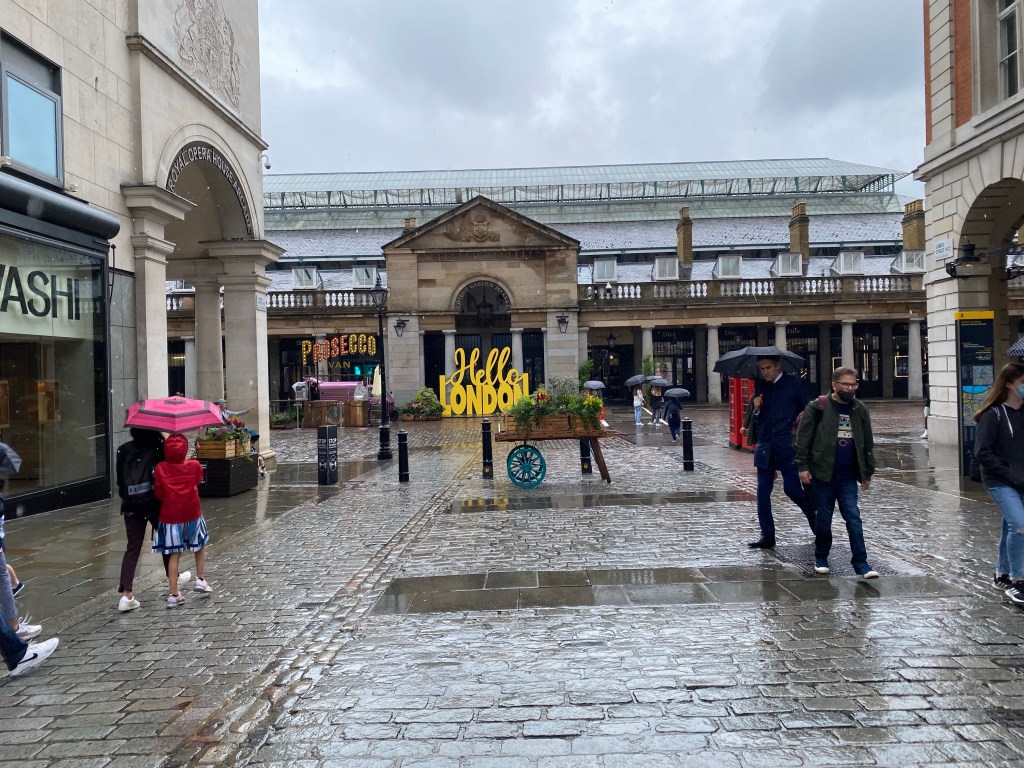
Covent Garden. very few people outside.
Covent Garden. I have never seen it so empty before.
  • We also heard a jazz concert in St Martin in the Fields, heard Handel’s Messiah at the Royal Albert Hall, and even managed to see Princess Diana’s dress at Kensington Palace. All in all it was a good, if peculiar trip.
Fantastic Beasts

Analogue Planning and Task Management in Covid Times

When Covid-19 hit last year and I started working from home my old task management system completely disintegrated. It was a combination of trying to find a new work/life/health balance, coupled with starting a new job that really made me aware that my old running daily work checklist and home checklist were no longer going to work. I was also keenly aware that I could no longer do any long term planning, and yet that I had to find a way to plan ahead somehow, or I’d accomplish none of my long term goals. After trying several systems with little to no success, it took until January 2021 for me to find a system that worked for me. In the hopes that this may help someone build out their own system, here is a glimpse into mine.

The system is built into two separate Moleskine Large Hardcover Squared notebooks. This was my notebook of choice for my previous system, and it has served me well. I don’t use fountain pens for my planning, just fine gel pens, and I don’t mind the ghosting, as I find that it’s more pronounced in photos than it is when I actually use the page. One notebook is my weekly planner, and I reference it about once or twice a day. The other notebook is my daily task list, and I reference and update it all the time. Why two notebooks and not one notebook with both a weekly plan and daily pages? I tried that and the need to constantly flip between pages with no ability to see my weekly plan before me as I create my daily task lists was too much for me to deal with. I don’t have a dearth of notebooks and I do have dearth of time and attention, so two notebooks it is.

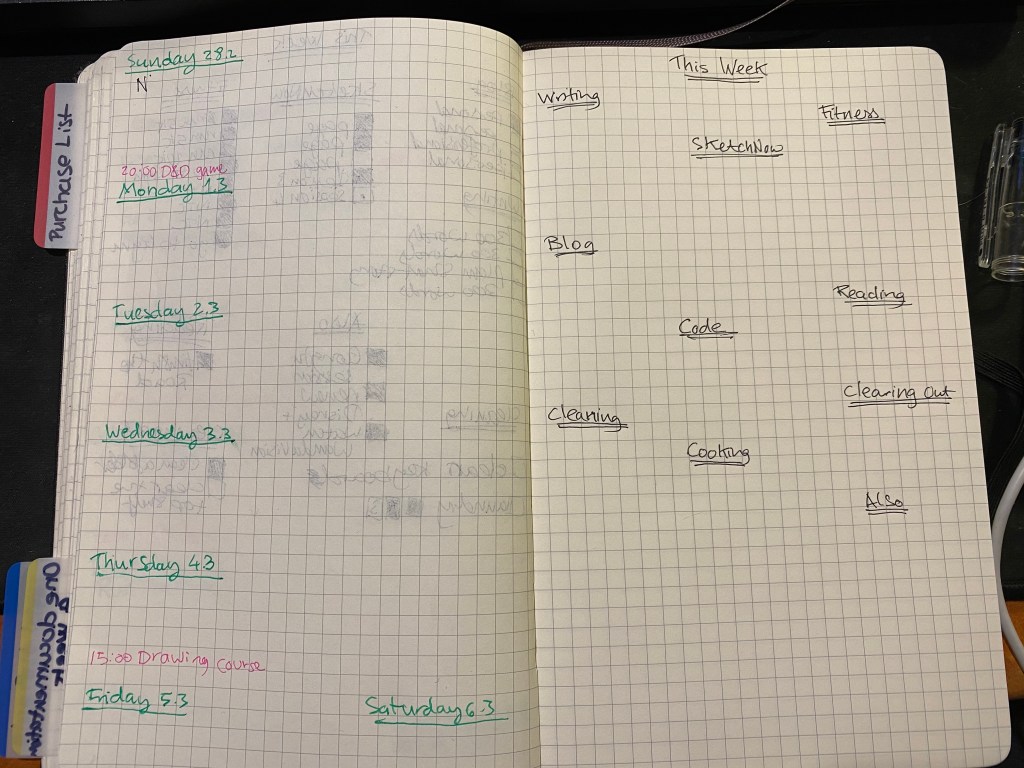
Here’s a weekly notebook spread:

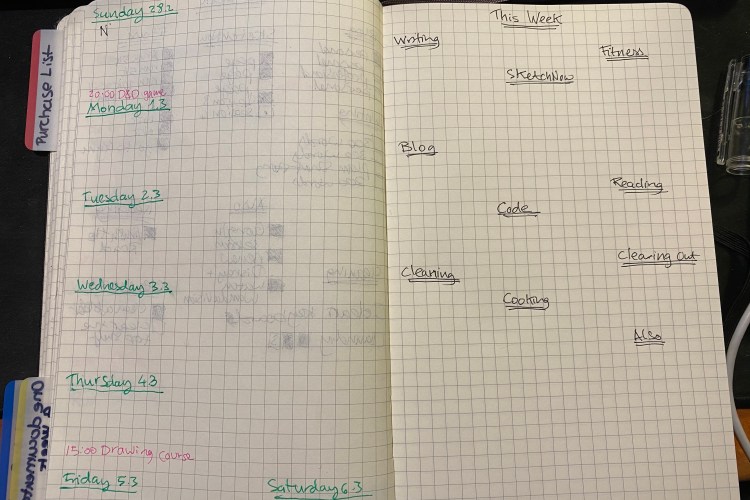
Weekly notebook spread, before filling.

Each spread in my weekly notebook is divided between my weekly schedule/plan on the the left hand side of the spread, and a weekly goal list on the right hand side. This is a sample of the following week’s spread before I start really filling it. On the left hand side I fill in the days of the week and the dates. I put in appointments and things that I need to take into account while doing my planning, but this page isn’t a replacement for my Fantastical calendar. I still want and heavily use a digital calendar with reminders, but this notebook page is crucial for my ability to see and plan ahead. I plan and think better on paper, and so if I have a D&D game on a certain day, I know that I need to schedule time to prep for it. This is also where I plan my weekly training: when I run, when I go to the gym and when I rest. I also use it to plan ahead things that I need to be aware of for my mother’s various doctor’s appointments, from reminders, to various forms that need to be filled, blood tests scheduled etc.

The right side of the page is the most important part of each spread, as it is where I plan out what I want to get done each week. My yearly goals are broken down and mapped out week by week here. I break the goals down by title, and then write down 2-3 related goals under each one (except the fitness goal which gets more). Some goal groups are consistent – fitness, reading, writing, blog, cleaning. Other goal groups change depending on the week and my focus. The “Also” goal group is for miscellany, such as watching a weekly episode of a show that I don’t want spoiled, or renewing/cancelling subscriptions.

The daily notebook is much simpler, and is merely an evolution of my old task system, adapted to working from home:

Daily task list, in the afternoon of the day it was created.

On the left side of every work day there is a professional task list, with work related things that I want to do that day. On the right side of the page is the personal task list, with stuff that I want to do before and after work. On weekends the two sides of the page simply both list out personal tasks. This system is clear, simple to use, flexible and doesn’t require a lot of “meta” effort to set up or maintain.

If you’re struggling with time management lately, take some time to create a system that works for you and doesn’t overwhelm you. I highly recommend not using a planner but rather creating your own schedule, since it saves you from the disappointment and stress of empty planner pages. It also allows you to add specific pages to your setup as the need arises. For instance, as global shipping and our local post office have gone haywire since Covid, I dedicated a spread in my weekly notebook to tracking various shipments. When I need to go to the post office to collect a package I note it down in my schedule, and so it was easy for me to use a different page on the same notebook to track the status of each package.

Let me know if this was helpful, and if you’ve also been forced to revamp your planning over the past year.

2020 Yearly Goals (New Year’s Resolutions)

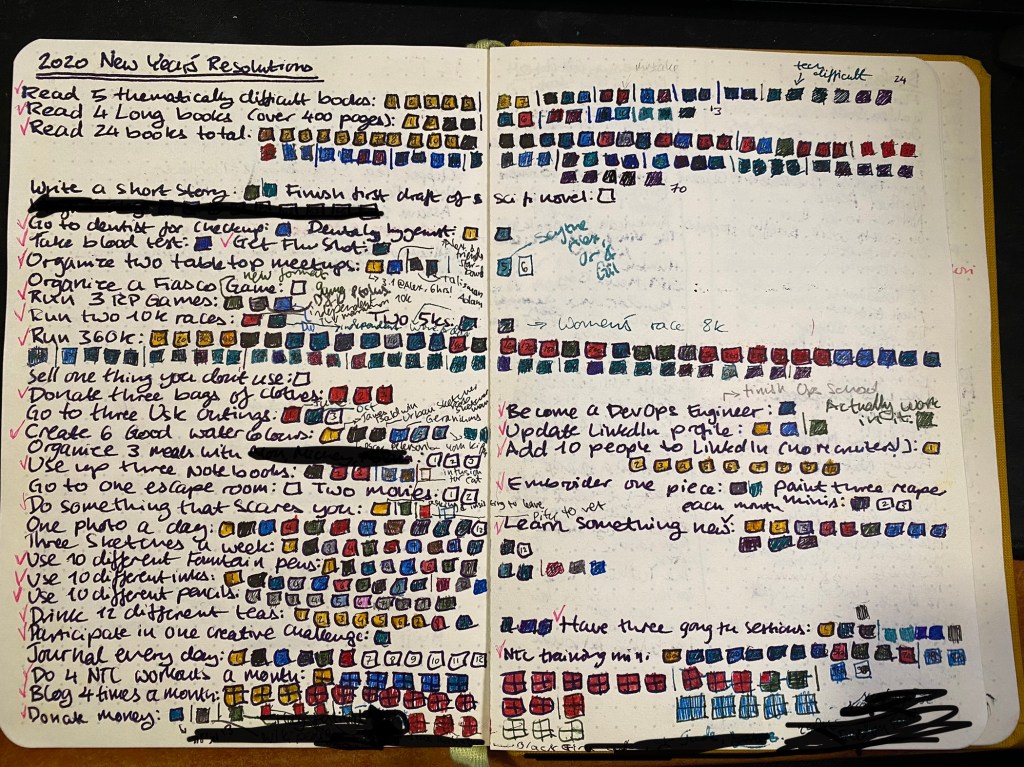
2020 was a pretty terrible year for most people, which is why I debated whether to even go over my 2020 goals or just talk about my 2021 ones. In the end I decided to talk about them, because 2020 really stress tested my system of yearly goals/resolutions.

At around March I thought that I’d have to trash the whole thing, as we went into our first lockdown of the year. My travel plans were cancelled. Any option to meet friends went out the door. My plans to change careers were at risk. I couldn’t even run, because the first lockdown involved extremely strict rules and the police were constantly around my house, yelling at people to go home and fining people. My writing was on the rocks, my drawing course was cancelled, and for the first time in my life I spent Passover alone.

Journal spread with my 2020 goals filled in with my terrible handwriting.
How 2020 looked like.

After some debate I reminded myself that my goals were built with failsafes in mind, since my 2018 annus horribilis, and so I had a chance of completing most of them, even if I’d miss any “stretch goals” that I had in mind. The basic goals were there to keep me focused, motivated and moving in the right direction. In the end they worked. The got me working out when I couldn’t run, running in circles (literally) when I could only move in a 500 meter radius from my house. They got me to keep on reading, keep on writing (not as much as I would have liked, but I’ll take it), and to dare to make the career change that I promised myself.

I hit most of my basic goals, missed a few completely, and got a few more partially. Yet the point of this post isn’t to brag, as my year could have shaped out worse than it had. The point is that I would have given up on myself if I didn’t have a plan that I thought that I had a fighting chance to accomplish, given the circumstances. I couldn’t participate in any races, but I enrolled and ran in several virtual races. Races keep me motivated to run, and running makes me feel better and gets me out of the house. I couldn’t go the gym, but I could do NTC workouts at home, so I had a chance to get that in. Reading provided me with an escape, and my reading goals and reading journal provided me with motivation to read, and to read books that were challenging as well books that were comforting. I couldn’t meet up with friends to play tabletop and RPG games, but thanks to Discord, Steam and Zoom we could still play together.

All of these things required extra effort in a year that really did its best to convince me that it would be a good idea to give up in advance and write the year off. The infrastructure that my goals provided kept me on track, and helped me salvage something of this terrible year. They also taught me how to structure my goals for 2021 better, but more on that in a separate post.