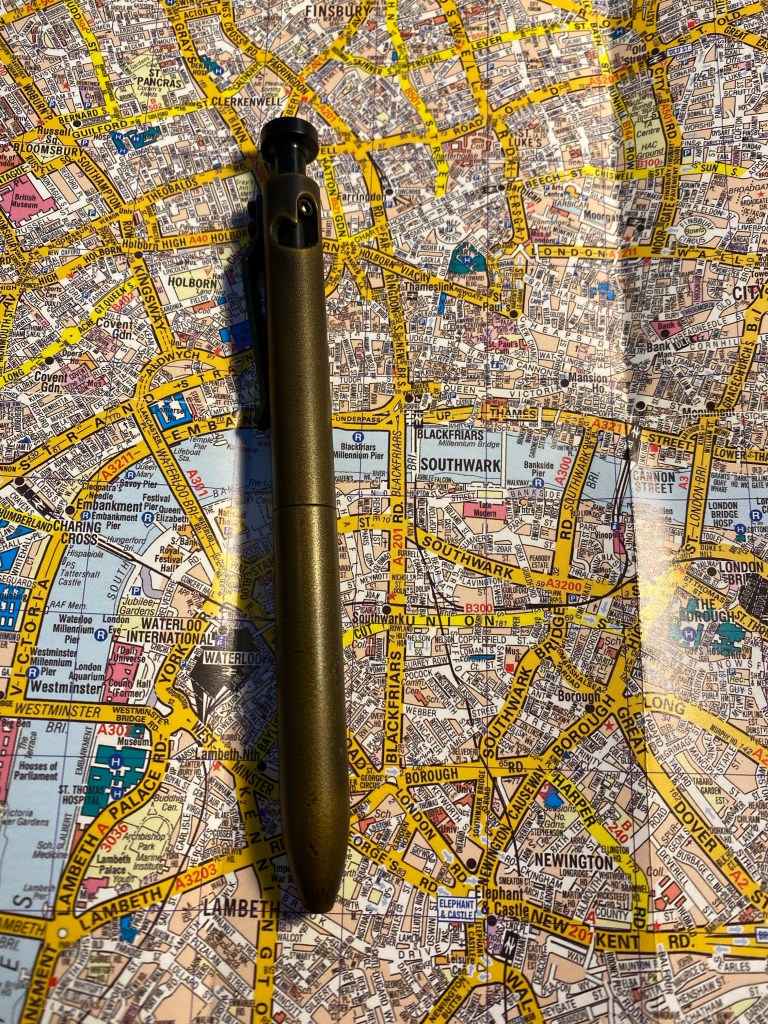
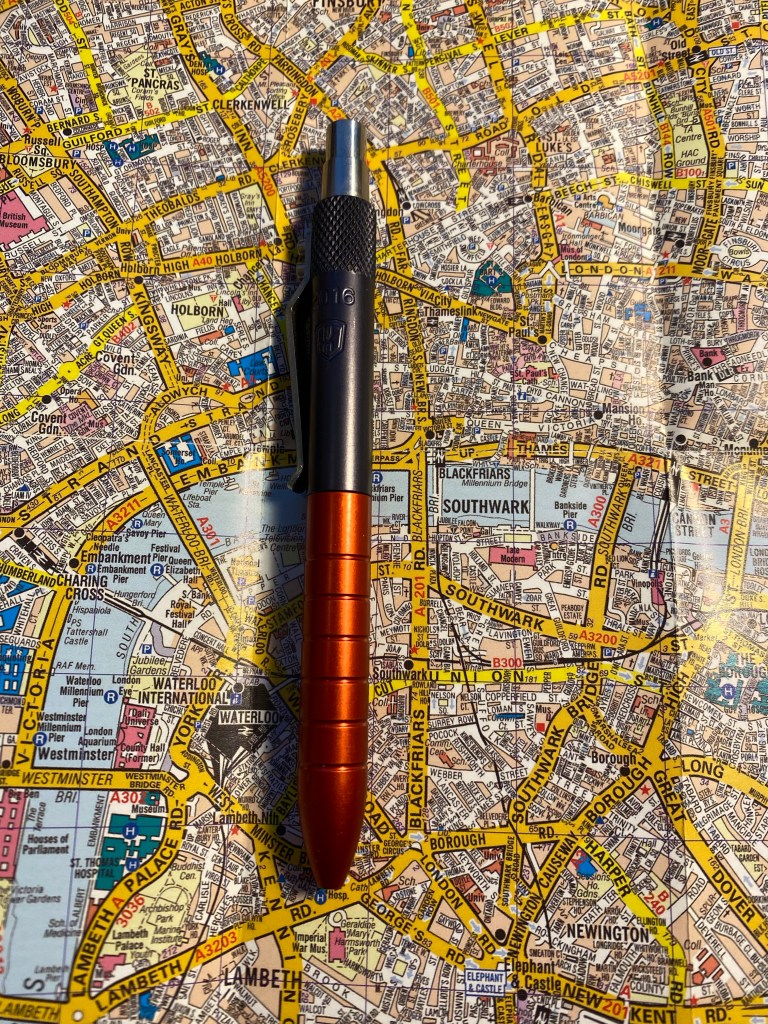
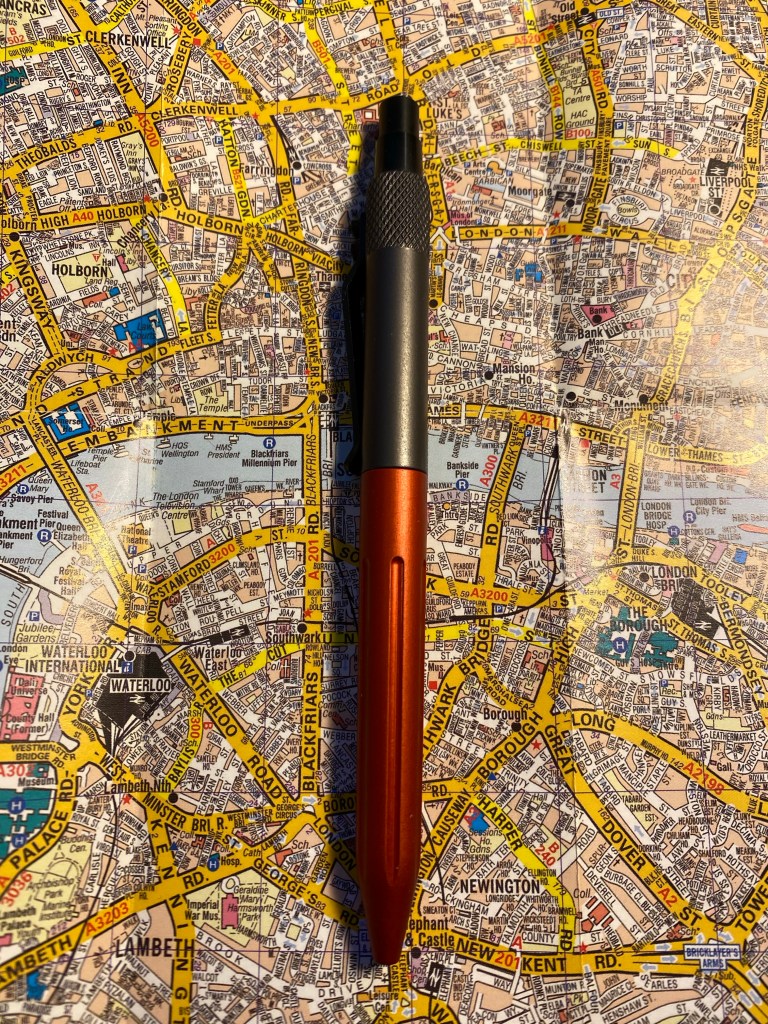
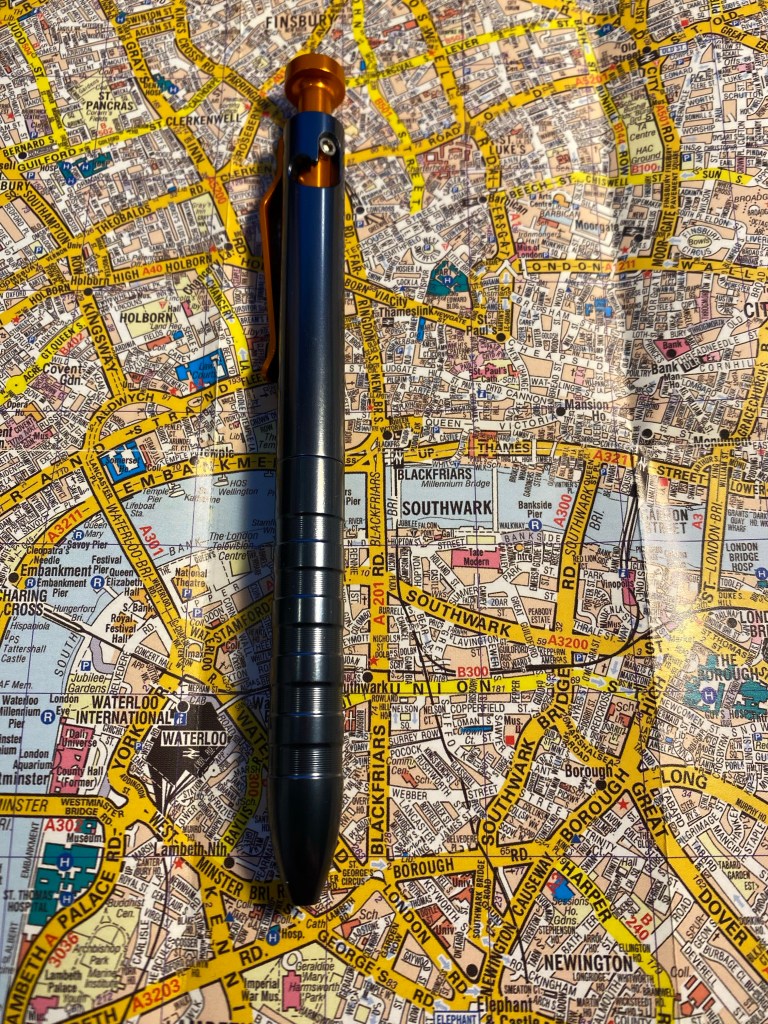
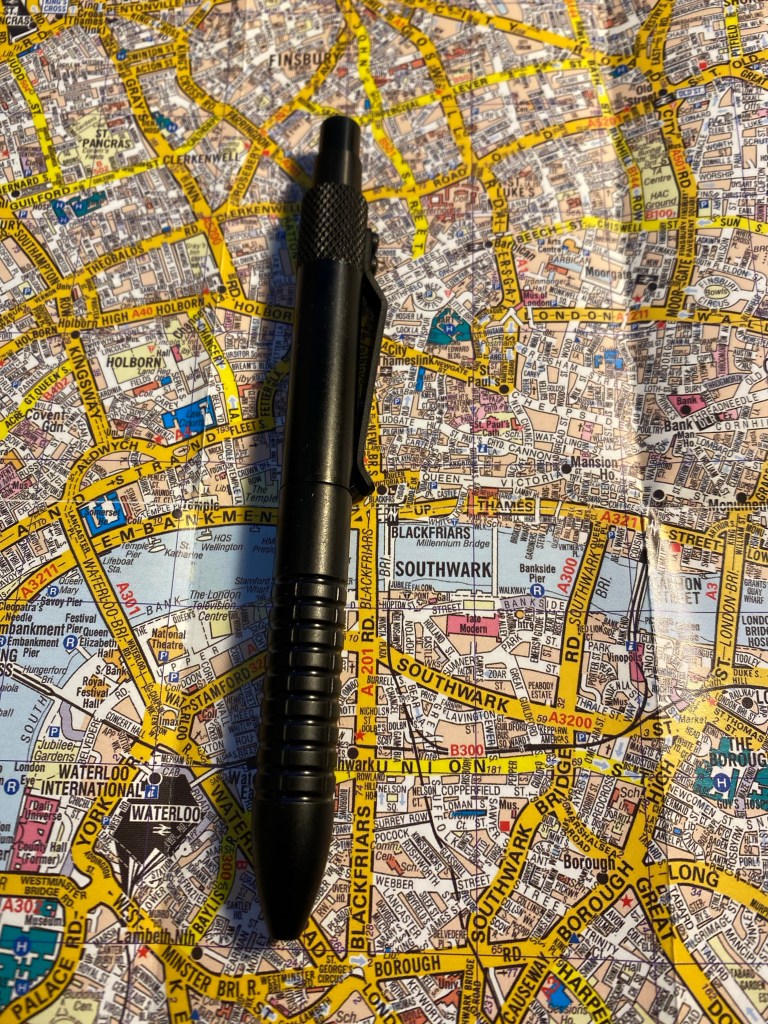
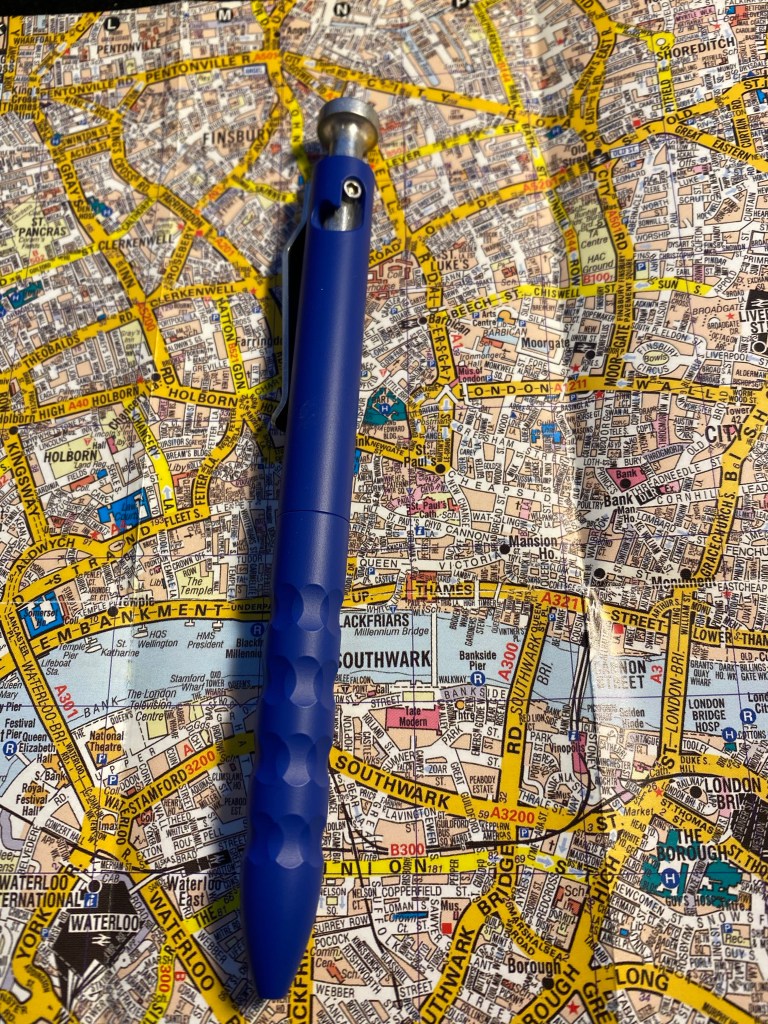
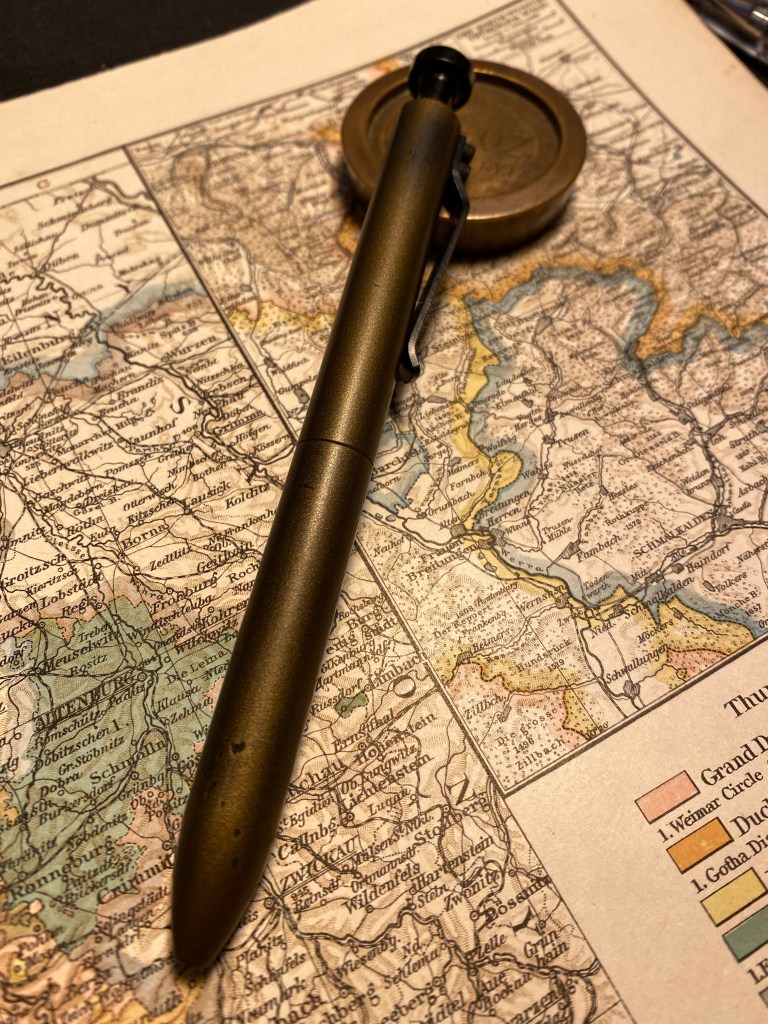
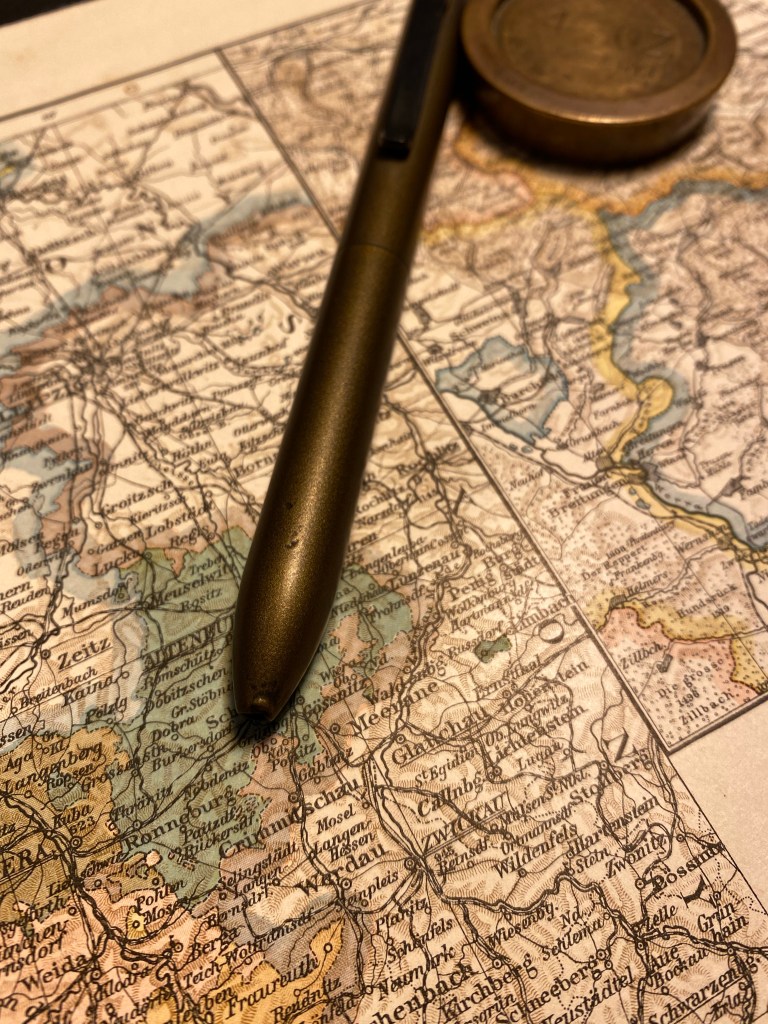
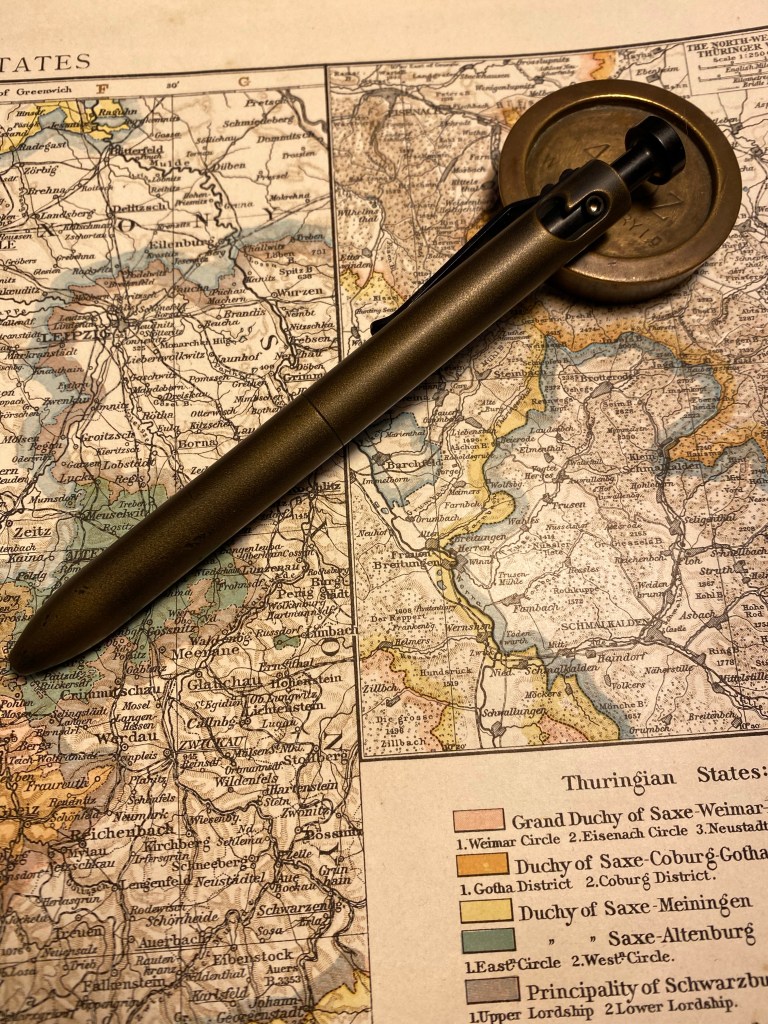
Big Idea Design Base Line Bolt Action Review

I’m a big fan of Big Idea Design pens, ever since I bought their Ti Arto (still their most innovative and all around useful pen). I have their Ti Click EDC and liked it enough to buy the Cerakote version, their Ti Arto EDC, the Ti Mini (and the Mini Click and Mini Bolt), their Dual Side Click, their Fountain Pen EDC, their Bolt and Slim Bolt, Pocket Pro, some of them in several versions. I’m on their mailing list whenever they come out with a new Kickstarter (Big Idea Design use Kickstarter as a pre-order system, with very little risk to backers and a nice discount on whatever new product they’re working on), and I tend to back almost every new pen they come out with.

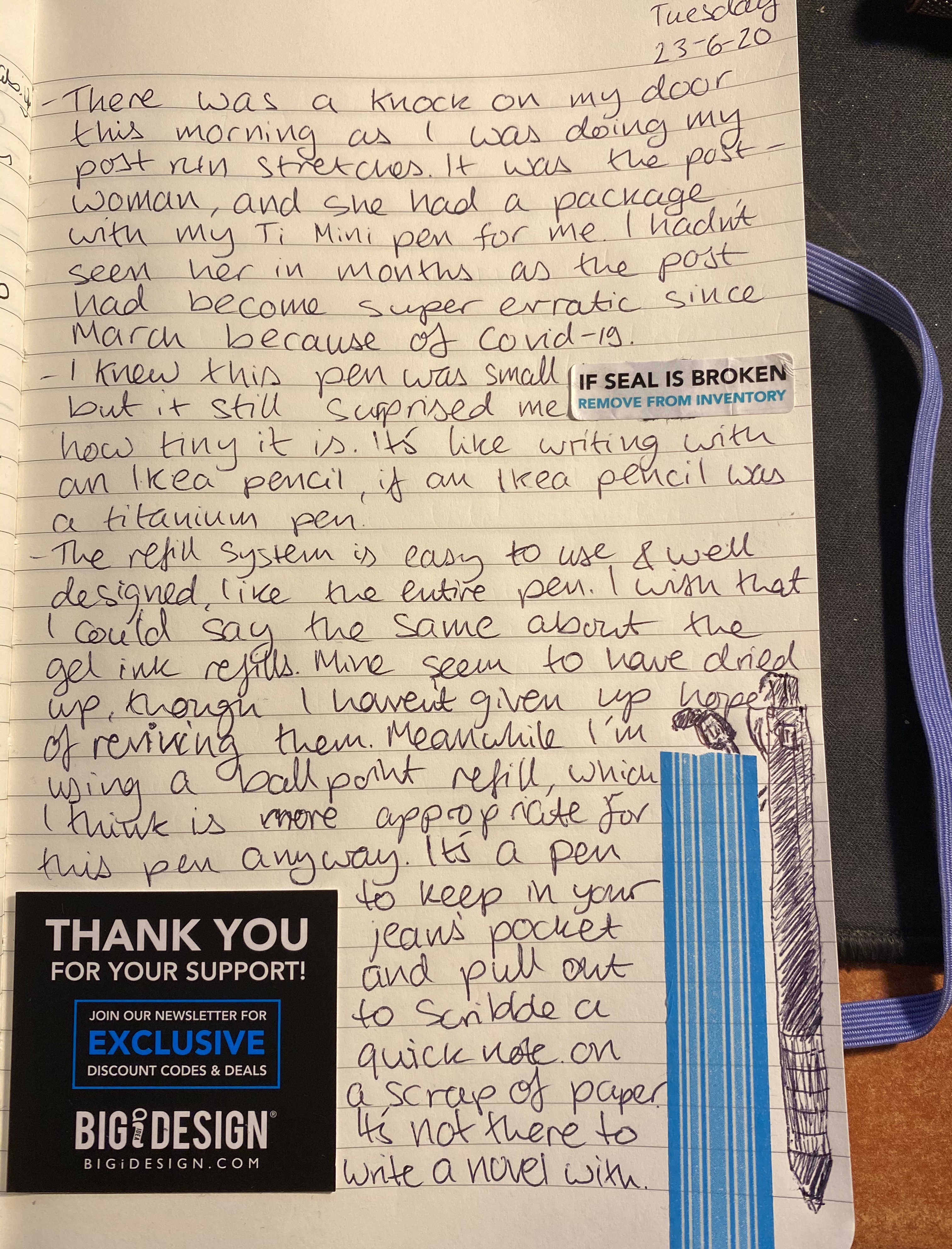
Base Line Bolt Action sketched on Moleskine paper with a Base Line Bolt Action

So when I got the email about the new Base Line Bolt Action titanium pen Kickstarter, I backed it. Unsurprisingly the Kickstarter was successful and the pen arrived in time. While the base price of the Base Line Bolt Action pen is $65 (including free world wide shipping), the Kickstarter price I paid was $55. I’m mentioning the price up front because this is one of the main selling points of this pen.

So what do you get for $65 all-inclusive? The Base Line Bolt is a short (116mm or 4.59 inch length, 11 mm or 0.435 width) full metal machined pen, with a titanium (or brass, or copper) body and clip, a Schmidt P900 ballpoint refill (it’s compatible with Parker style refills) and a bolt action mechanism that is smooth and fun to fidget with. As usual for Big Idea Design, the brass and copper versions cost the same as the titanium one.

You also get a decent enough package, one that is good enough to ship to someone as a gift. Even after our local post office mangled the package, it came out mostly intact with just a few dings. It’s a solid shrink wrap covered cardboard box, with the pen nestled inside on a foam insert.

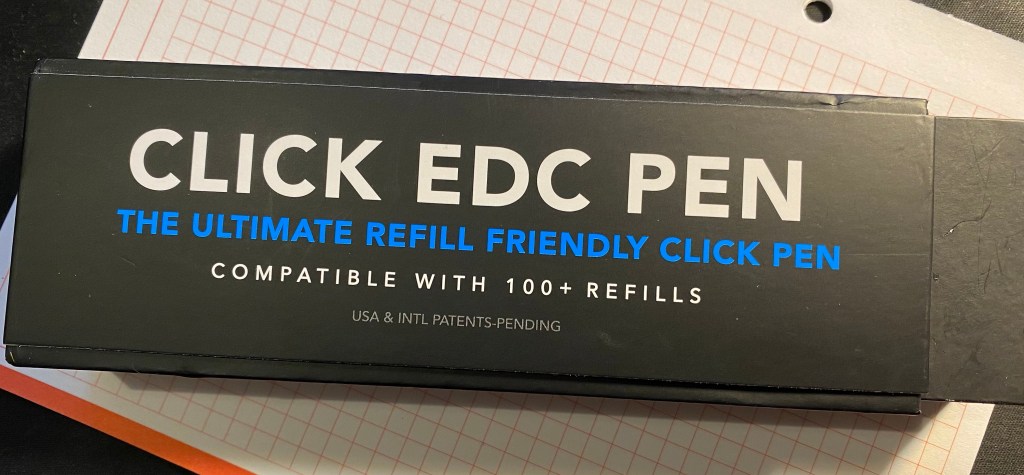
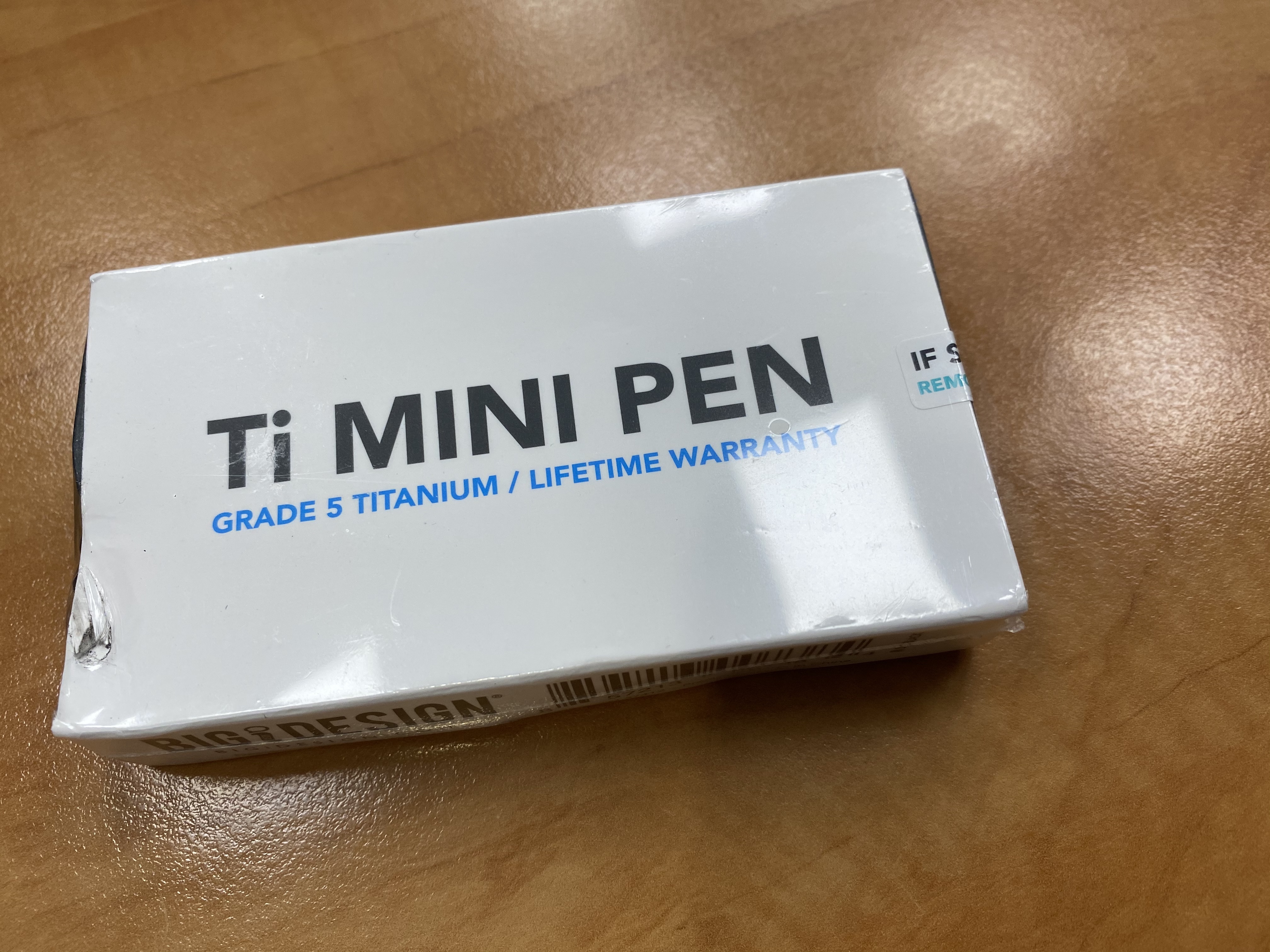
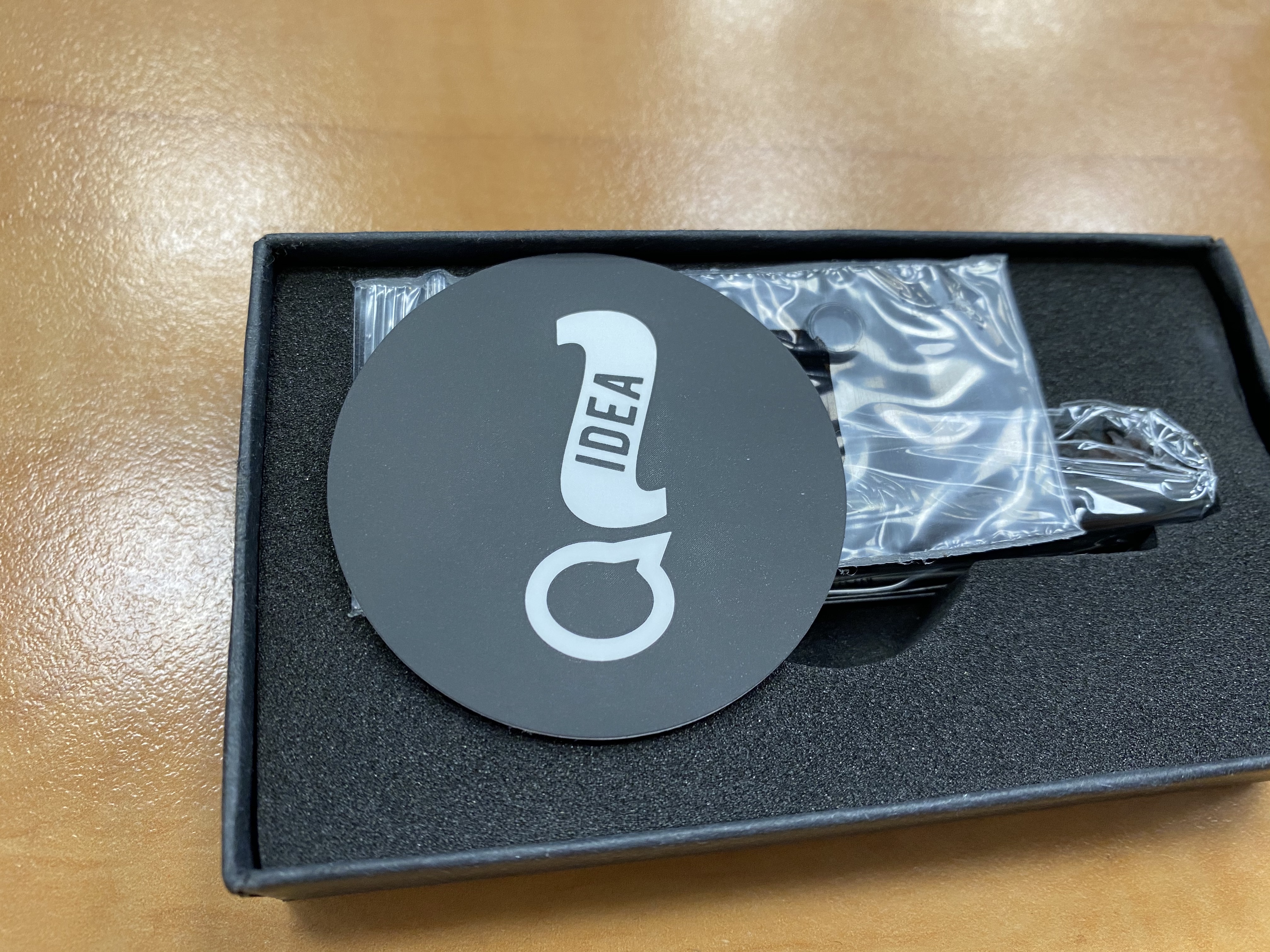
The front of the box

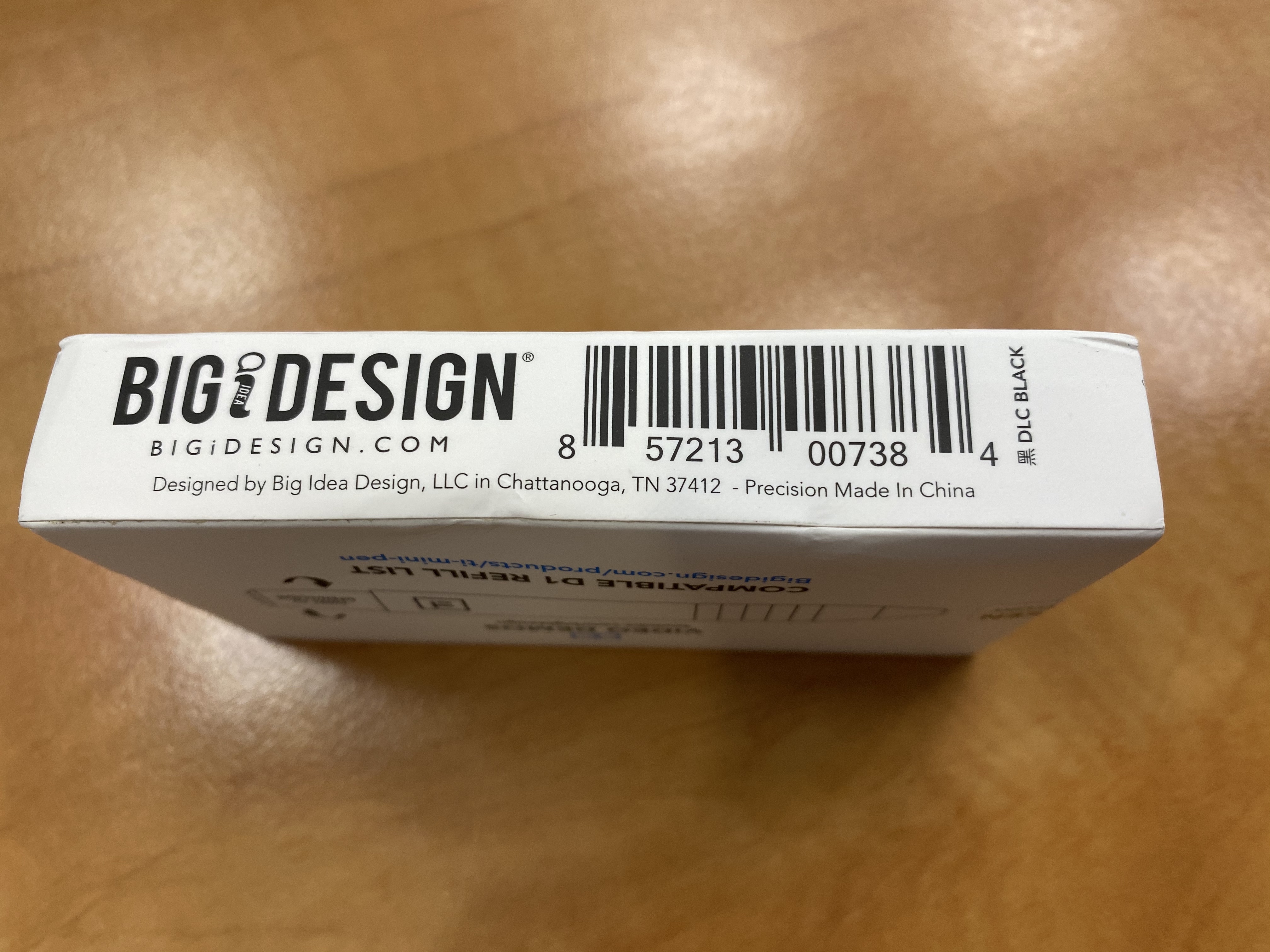
The pertinent information about the pen is printed on the back of the box, with a reference to the Big Idea Design YouTube channel, where you can learn more about the pen.

The back of the box

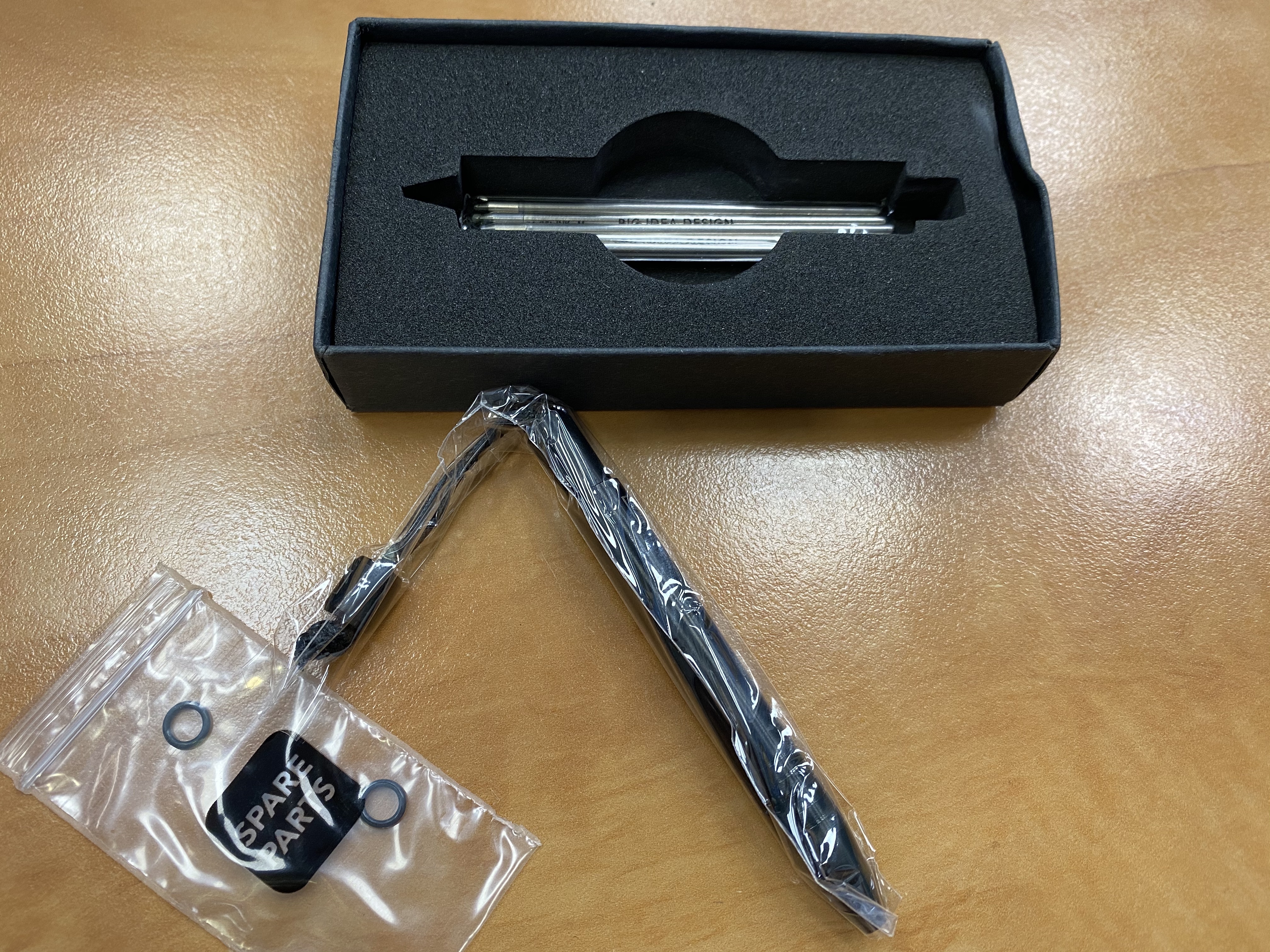
The pen itself is well protected inside the box and comes wrapped in a plastic sheath. While I would have preferred a more environmentally friendly box, I appreciated the packaging because considering the shape that the padded envelope came in, I would have likely gotten a less than pristine pen without it.

The Base Line Bolt arrives well packaged.

Moving on to the pen itself, the Base Line Bolt is an interesting departure for Big Idea Design. Normally the pens that they make feature some sort of clever mechanism that allows for things like supporting every kind of pen refill there is, or having two kinds of click mechanisms on the same pen. The Base Line Bolt is instead focused on price point: when everyone else is raising their prices, can Big Idea Design make a good, affordable, machined metal bolt action pen?

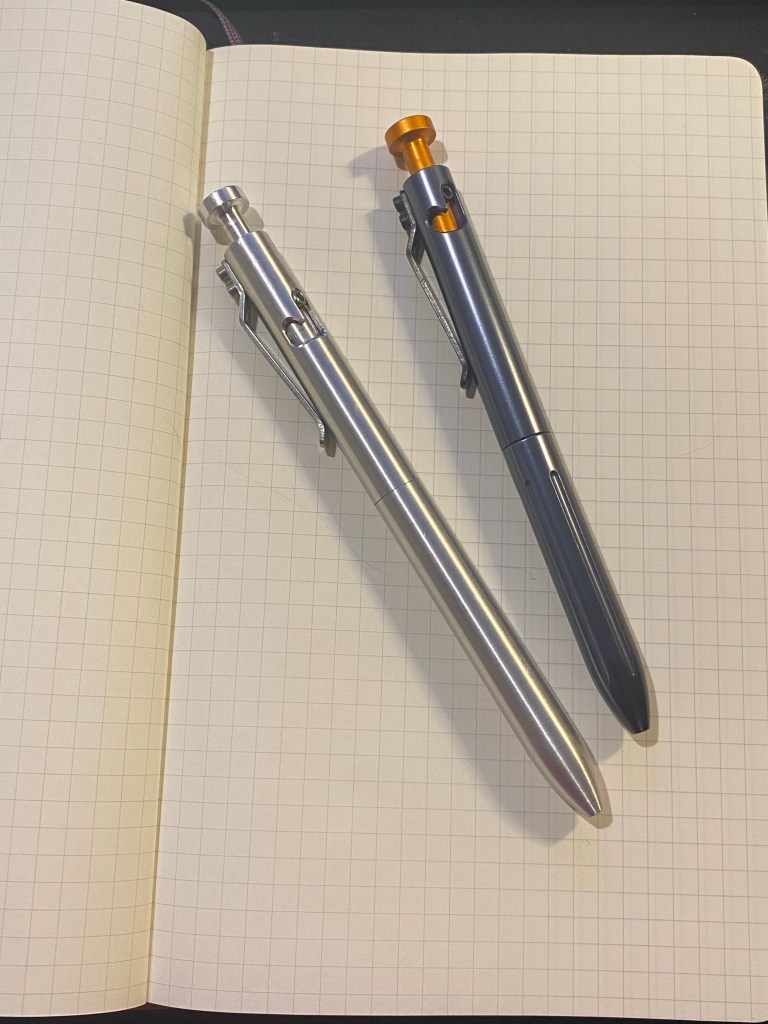
The Base Line Bolt

The answer is “it depends”. Big Idea Design isn’t really inventing the wheel with the Base Line Bolt – the pen itself is a combination of the Ti Pocket Pro, and the Slim Bolt Action pen. It is, however, cheaper than both of these pens, which is again, the Base Line Bolt’s main selling point. As the name suggests – if you’re looking to get into your first machined pen, or you’re looking for a bread-and-butter EDC pen, the Base Line Bolt is what Big Idea Design expect you to buy. I largely agree with them, but more on that later.

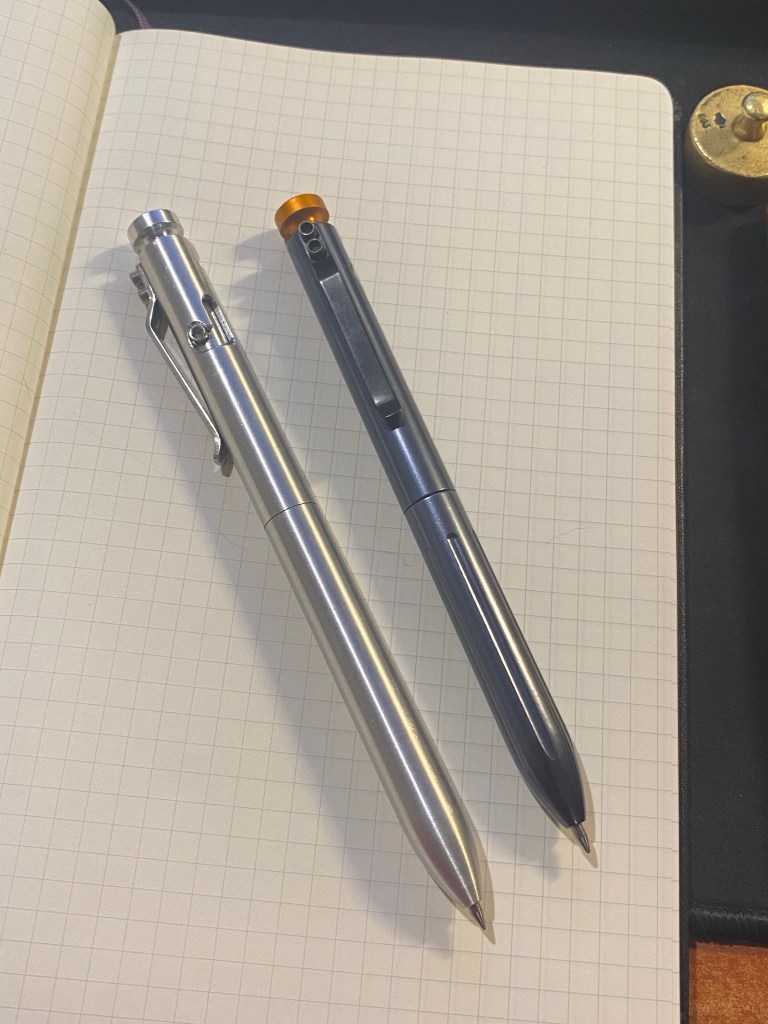
The bolt mechanism, clip and finial of the pen, down to the T8 Torx screw and stepped machining, was first conceived with the Bolt Action pen. If you sliced off the business part of these two pens (and ignored the orange Cerakote on the Carryology pen), these two pens would be identical:

The Carryology version of the Bolt Action pen on top, and the Base Line Bolt on the bottom

Compare the Ti Pocket Pro with the Base Line Bolt and you can see what Big Idea Design were going for: they’re almost identical in length and in design (and they ship with the same refill), with the Base Line Bolt just being a slimmer, slightly longer version of the Pocket Pro, that supports less refill types. The difference here lies in the mechanism – the Ti Pocket Pro is a twist pen, and the Base Line Bolt is a bolt action pen. My guess is that the bolt action will be more popular because it looks good, works well, and is a fun fidget toy.

Ti Pocket Pro in metallic Cerakote blue on top, Base Line Bolt pen in the middle, black DLC with Damascus bolt and clip Bolt Action pen on the bottom

Another way to look at the Base Line Bolt is as an oversized Mini Bolt Action pen, but one way or another, this isn’t a pen that they had to factor in a lot of R&D time to design. They’ve done it before, and they know that it works. Thus the innovation in this pen lies mostly in its price point, which is also what Big Idea Design emphasizes in their marketing.

Mini Bolt in black DLC on top Base Line Bolt in the middle, Uniball Signo RT on the bottom

The Base Line Bolt is great as an everyday carry pen that you have in your bag or pocket and use to jot down a few words, maybe sign a document, or leave a note on someone’s desk. It’s too small and the Schmidt P900 ballpoint refill that it comes with is too frustrating to use in long writing sessions (the refill skips every once in a while). The choice of the design, the refill it comes with, and the refill compatibility (Parker style refills) is geared towards that – a pen used to write a paragraph or two at a time, not much more.

If you want a pen for longer writing sessions, you need to look at Big Idea Designs larger pens: the Ti Arto, the Bolt Action or Slim Bolt, the Click or Dual Click pens, etc. The Base Line Bolt is build to be the Ti Pocket Pro’s counterpart: the same pen with a bolt mechanism that supports only Parker refills, for a lower price.

Close up on the bolt and the finial

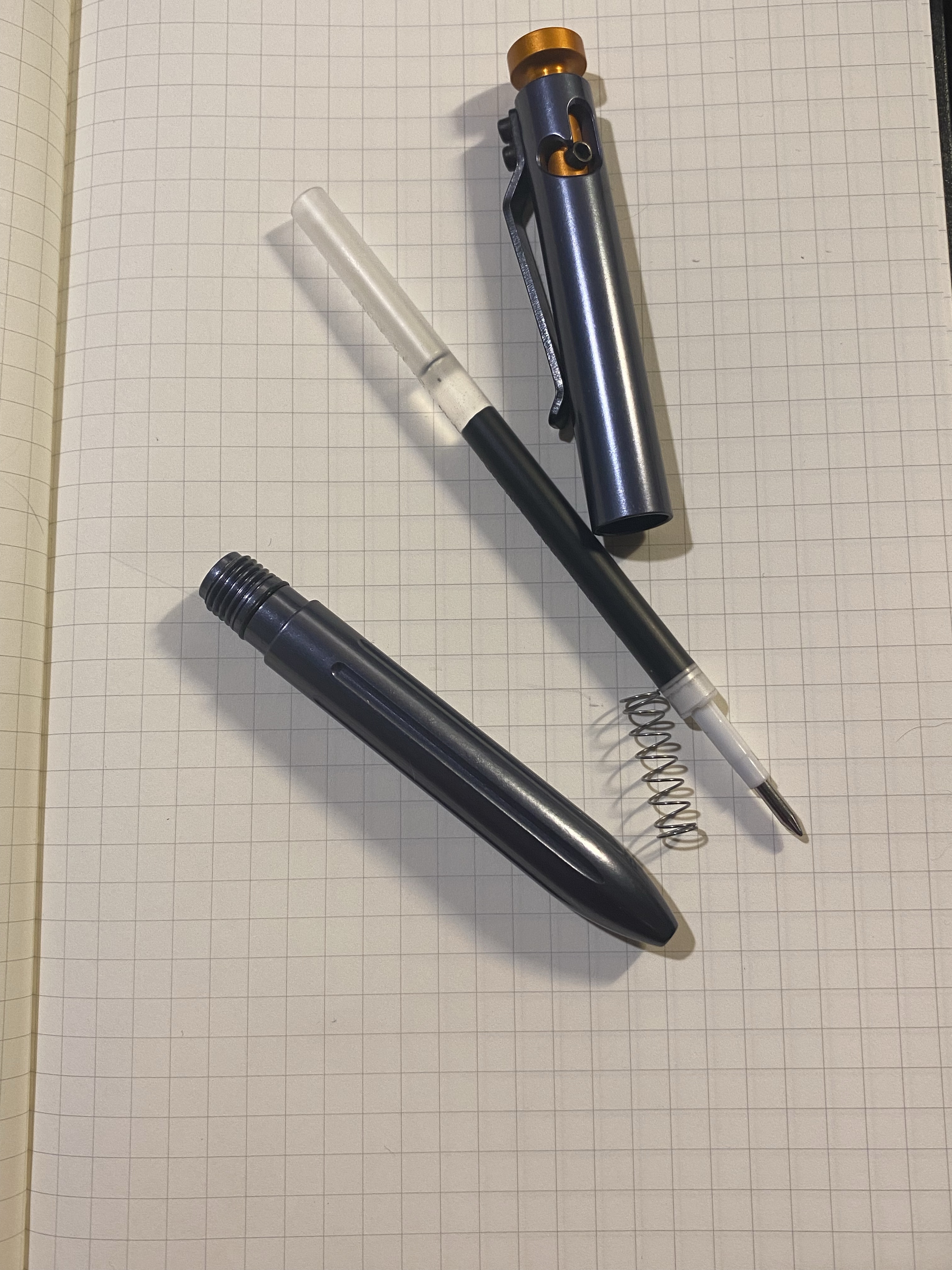
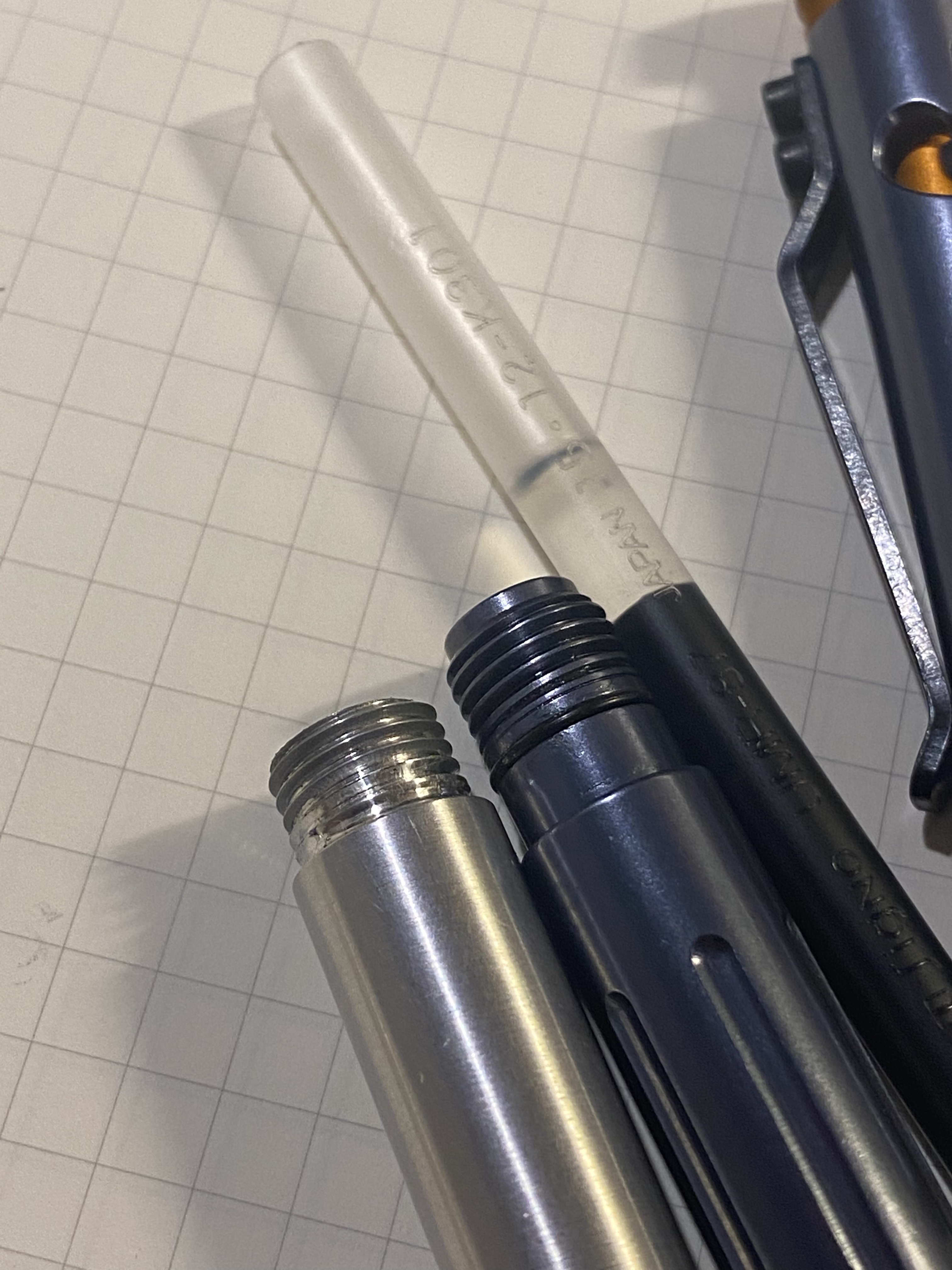
The biggest minus of the Base Line Bolt is that you need a separate tool to take the pen apart and change the refill. This isn’t the first Big Idea Design pen to require this, but I still don’t like this design choice. That being said, my assumption is that the audience for this pen (namely the EDC crowd) will have a way to deal with a T8 Torx screw. The pen ships with a decent enough refill (the Schmidt P900 costs around $1 retail, while the Parker costs $4-5, which explains why you won’t find pen sellers that use the Parker refills), and a ballpoint is the obvious choice for an EDC pen. Gel refills tend to deal poorly with temperature swings, and aren’t normally waterproof, which makes them less viable as an EDC pen refill choice.

Should you buy this pen? It depends:

  • If you’re looking for a gift pen for someone new to machined pens, this is a great choice that costs a fraction of what other machined pen manufacturers ask for titanium, copper or brass machined pens. The closest competitor in price and quality is Karas Kustoms, and you’re getting a different beast there (they make great pens, just not as compact).
  • If you’re new to machined pens and want a compact EDC pen, then the Base Line Bolt is a great choice for you.
  • If you’re curious about bolt action pens, or copper and brass machined pens, then this is likely the cheapest way you can try them out for yourself (using a high quality pen with great warranty and support).
  • If you’re looking for an EDC pen that is sleek and without the “tacticool” vibe of aggressive knurling or glass breakers, then the Base Line Bolt is a great choice.
  • If you are looking for a workhorse pen, one that you can write your next novel with, the Base Line Bolt isn’t for you.
  • If you already have a good selection of machined pens, particularly Big Idea Design pens, then you’ll likely not find the Base Line Bolt to be very exciting or particularly interesting. I’d skip this pen.
  • If you want to experiment with many refill types, pick the Ti Pocket pro or any one of the Big Idea Design’s full sized pens (the Ti Arto supports the most refills).

The Base Line Bolt is a solid addition to the Big Idea Design pen portfolio, and at $65 all-inclusive you get a lot of pen. Mine will reside permanently in my bag, as an “emergency pen” for those times where I need a pen but I haven’t brought my pen cases with me.

BigIDesign Pens Overview

BigIDesign is one of my favourite machined pen manufacturers, and I have practically every machined pen they make (apart from the PHX, which I don’t like visually). I’ve backed many of their kickstarters, including their newest one which ends in a few days, and I know that they deliver on what they promise, on time. That’s no mean feat, and it’s that consistency, not just the quality and design of their pens, that keep me coming back to them.

I have a lot of BigIDesign’s pens, and there are a few more on the way.

While I reviewed many of their pens in the past, I thought that I’d do a quick overview post, for those just getting into machined pens or into BigIDesign’s pens and wondering where to start.

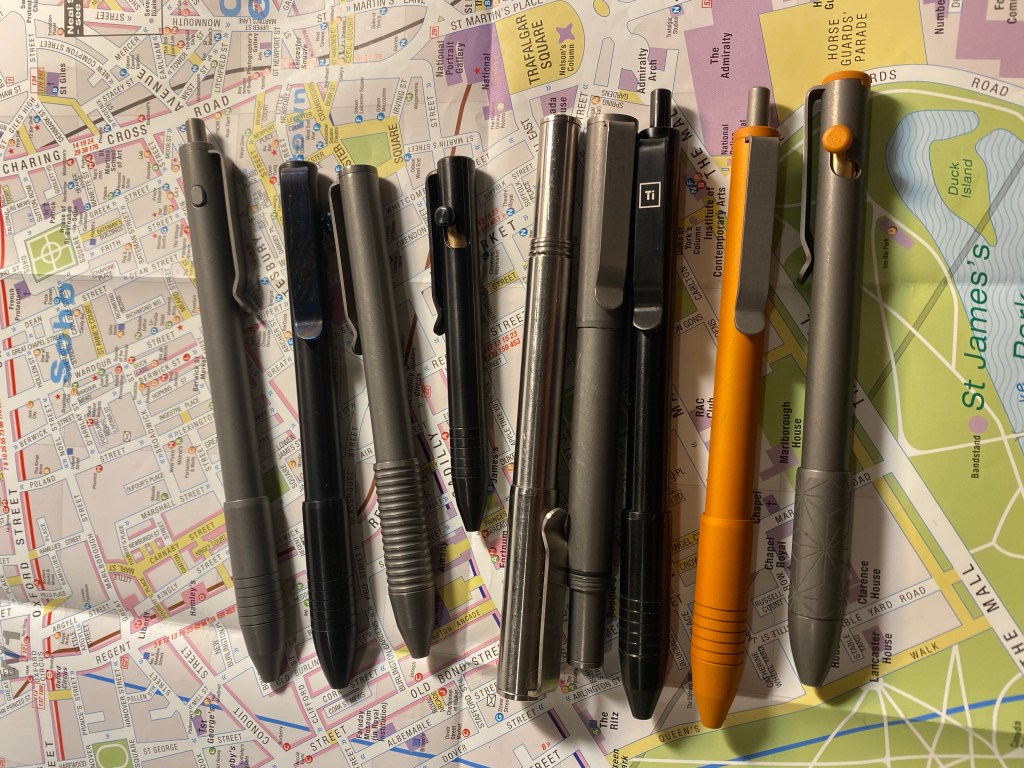
Almost the entire standard pen lineup. I don’t own the PHX, and the Ti Mini pen is in one of my travel backpacks and I don’t remember which one.

BigIDesign create machined metal pens, and the first thing to know is that they have two sites. If you’re based in the USA go here, and if you’re from anywhere else in the world go here. They are one of a very few companies that offer free international shipping on their pens, and that’s no small thing. Their service in general is top notch, and the pens come in functional, well thought out packaging that is gift appropriate without being incongruously fancy. These pens are workhorses, not status markers.

BigIDesign pens all accept more than one kind of refill, and most of them accept a very long list of refills. When in doubt, consult the pen’s product page for a link to a spreadsheet with the full refill compatibility list.

The pens are made of stainless steel, titanium alloy, brass, copper or zirconium. Certain special edition pens (like the orange one/orange highlighted one) are Cerakote finished. These are handsome pens, but if you’re looking for durability, these aren’t for you. The finish chips off and mars when bashed around. The bolt pens come with optional damascus clips and bolts.

The titanium pens come in three finishes, which you can all see in the photo above: machined raw, stonewashed, and midnight black. Of the three finishes, the stonewashed weathers the best, and machined raw shows scratches the most. I happen to like that look on my Ti Arto, but of the three finishes, stonewashed is my favourite (also in terms of grip and feel), which is why I have the most of it.

I don’t like listicles, so I’m not going to rank these pens. I will just note what they’re best at, and who I think should get them:

Ti Arto – accepts the most refills by far. If you like experimenting with refills, and enjoy using capped pens, this is the pen for you. It was my first BigIDesign pen, and remains my favourite because of its versatility and the fact that while it’s built like a tank, it doesn’t look like one. This isn’t a pen for people who like fidgeting with their pen, or just want to jot down a quick word or two, because it is capped.

Ti Arto EDC – the same as the Ti Arto but smaller, and accepts less refills, this is a great option for a pocket or purse pen. The cap means that even misbehaved refills won’t leak onto your belongings or clothes. It is large enough to be used unposted, unless you have really large hands.

Ti Pocket Pro – the number one choice for those looking for a pocketable, EDC, workhorse pen. Uses a twist mechanism, built like a tank, and with very good support for a variety of refills, this is the pen that I take on trips and to the hospital with me. The Pocket Pro and the Ti Artos are very easy to clean/disinfect.
Ti Click EDC- if you want a click pen, go for the side click. This pen looks good, but has a mushy click mechanism that will probably only appeal to those who like quiet click pens. The Ti Dual Side Click is better than this pen in every way.

Dual Side Click – the latest arrival to the BigIDesign family (minus the slim bolt, that isn’t shipping yet), this is one of the best pens that BigIDesign offers. The click mechanism is satisfying and fun to fidget with, the design is sleek and functional, and it supports a wide variety of refills.

Bolt Action – good looking, with a very solid bolt mechanism that’s also a fun fidget toy. If you like bolt action pens, this is a good one to have, and it supports a good amount of refills, but take into account that the Ti Dual Side Click and most of the rest of BigIDesign’s pens support more.

Ti Mini/Mini Bolt Action/Mini Click – skip these unless you really, really want a tiny, compact pen. The issue is less with the pens, and more with the refill options at these sizes.

Which BigIDesign pen is your favourite?

Karas Kustoms Machined Pens Grip Section Review

Karas Kustoms makes some of my favourite machined pens, and even with all the great new machined pens in the market I still think that a Kara’s Kustoms Retrakt, Render K or Bolt are the best first machined pens to buy. They are well made, well designed, tough, and well priced. In the past year or so they’ve added a lot of new grip options to the lineup, so I thought that I’d go through the various options and review them, to help those wondering which grip option to try.

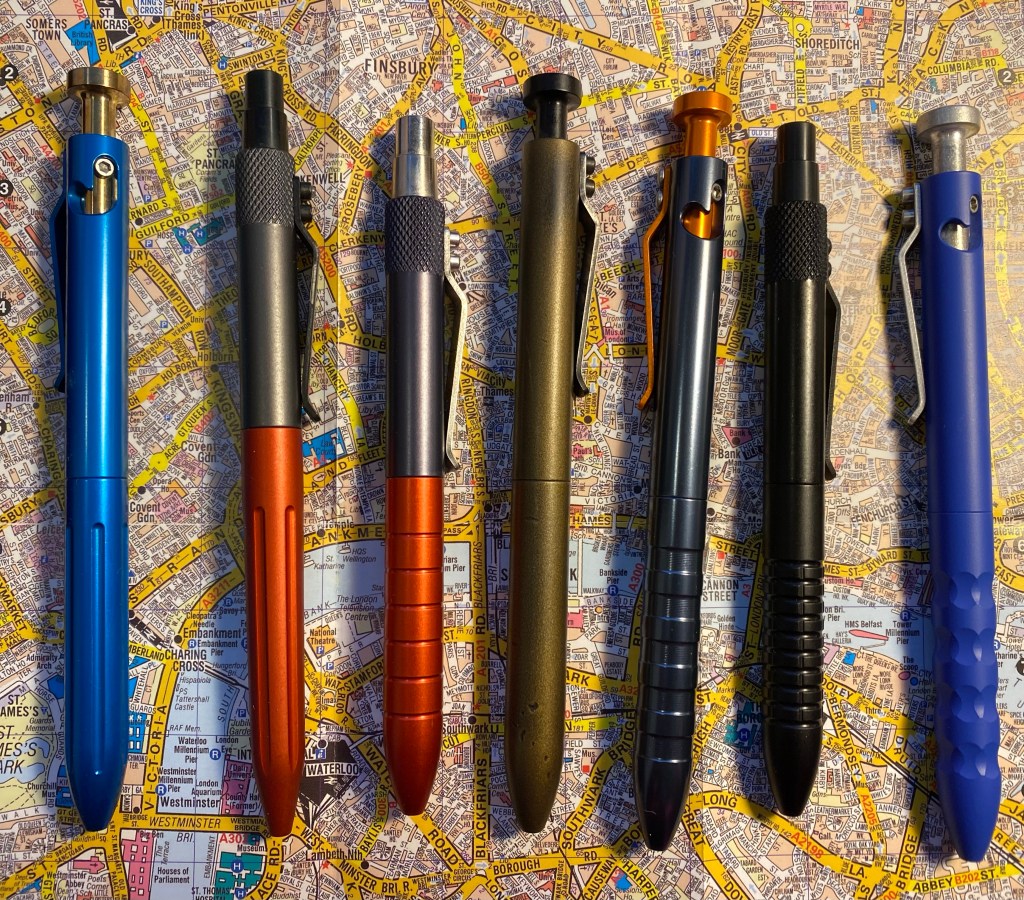
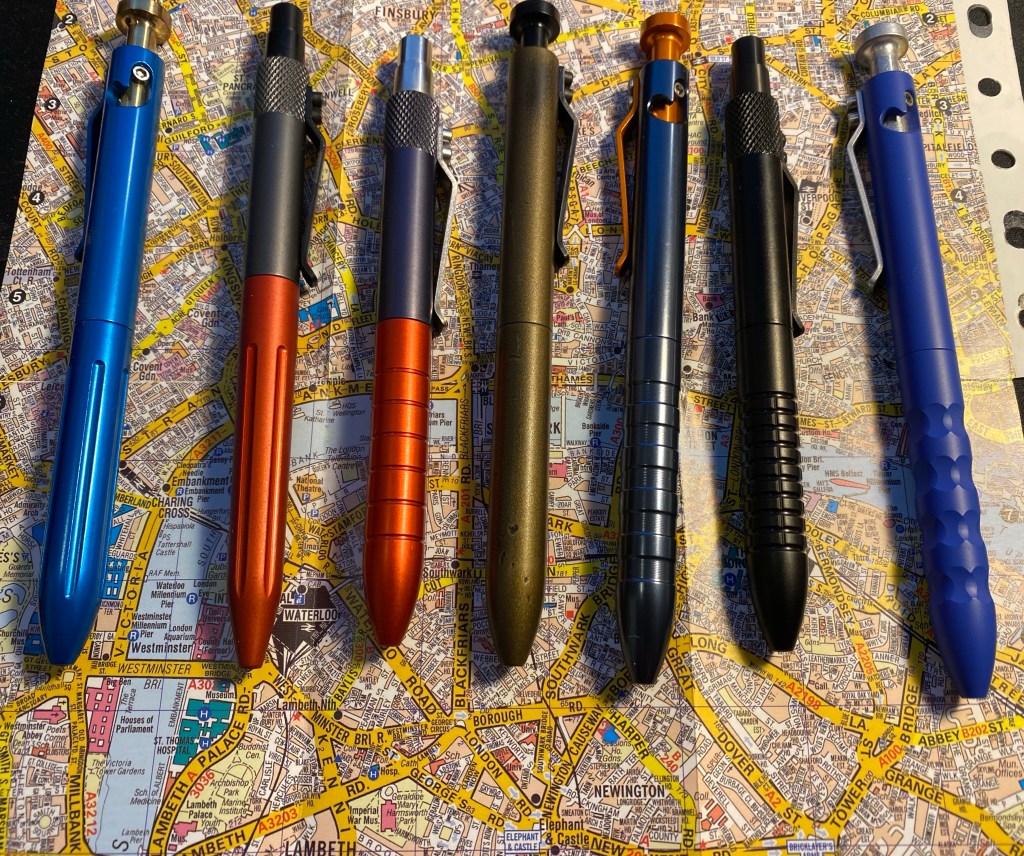
Grip options from left to right: shiny anodized fluted, matte anodized fluted, anodized rings, Cerakote “plain”, anodized speed groove, anodized MK II, Cerakote dragonskin.

Not all of the grip options nor all of the finishes are offered in all of Karas Kustoms’ pens, however, if there is a particular combination you are looking for and it isn’t currently available there’s a good chance that it will show up in a limited edition at some point. Kara’s is always experimenting with their pens, so even though you may not be able to purchase any of the specific pens shown here, you’ll likely be able to find something else just as good.

Grip options from left to right: shiny anodized fluted, matte anodized fluted, anodized rings, Cerakote “plain”, anodized speed groove, anodized MK II, Cerakote dragonskin.

The newest of Kara’s grip options are the speed grooves, the MK II and the Dragonskin. Of the three, Karas seem to be issuing more MK II and Dragonskin lately, and these two grip options are the “grippiest” of them all. If you find machined pens problematic to grip because they tend to be slippery, the Dragonskin or the MK II grip options are made for you.

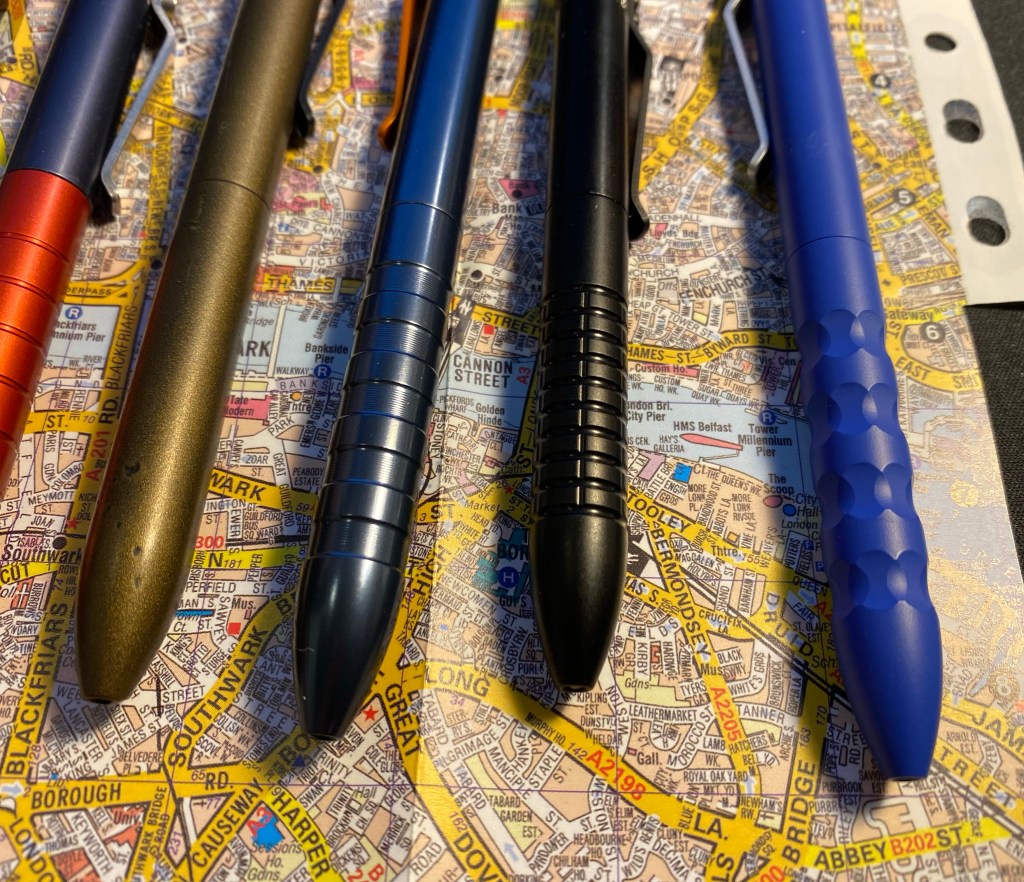
From left to right: speed groove, MK II and dragonskin.

Of the older grip options, the rings seems to be offered only on the EDK, while the fluted options are available on the Bolt and the Retrakt. The fluted options provide decent enough grip, but depending on how tightly how grip the pen you may find them uncomfortable for long writing sessions. They don’t dig into your fingers, they just feel a little “off” if you use the grip of death. The rings on the EDK provide little additional grip beyond what you get from the plain anodized options. I see the rings as more of an aesthetic statement here than something that provides more traction.

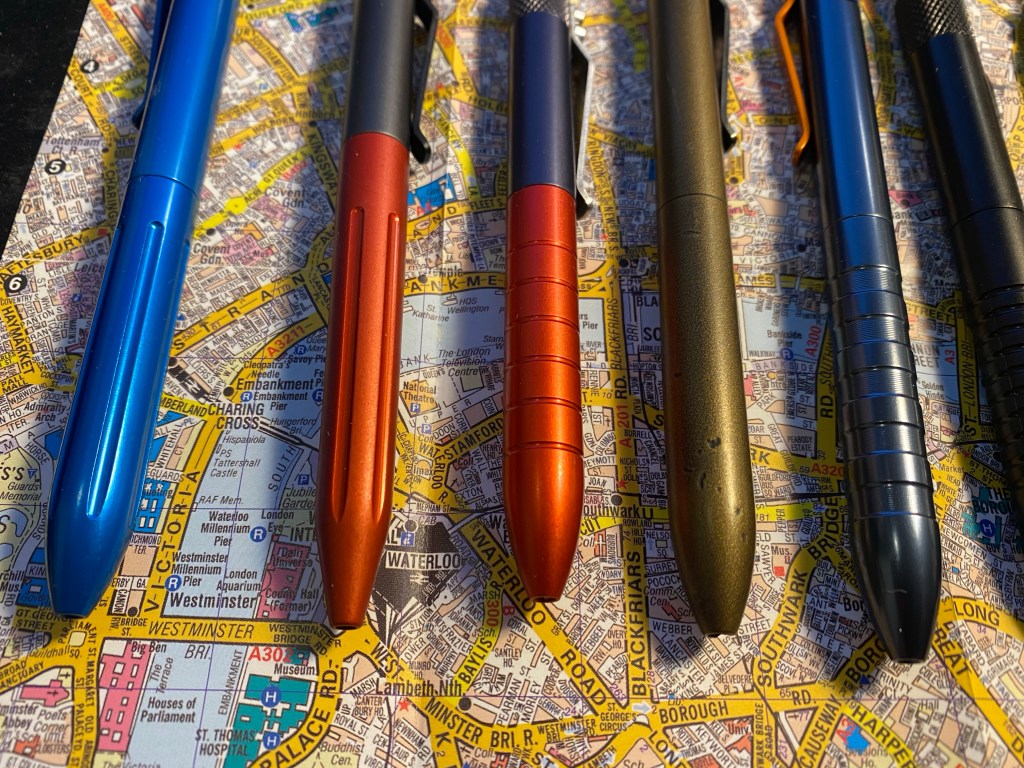
From left to right: fluted with shiny anodization, fluted with matte anodization, rings, plain Cerakote and anodized speed groove grip sections.

Karas has started creating more Cerakote (a kind of durable ceramic finish) pens lately, and in general they provide a little more grip than their anodized counterparts. In terms of finish, the shiny anodization and matte anodization are almost the same in terms of grippiness, and the Cerakote is slightly better than them, but not by much. If your hands tend to sweat a lot, these aren’t the best options for you.

Plain Cerakote Bolt V2

The rings on the EDK’s grip are honestly more for aesthetics than for added grip. I like the look and it suits the EDK very much, but don’t expect it to add functionality to the pen.

EDK with a ringed grip.

The fluted grip works, although it works better on the matte finished pens than the super shiny ones. The pen won’t slip from your hand, but it may not be the most comfortable thing to write with over time (depending on your grip). It is one of the more attractive and classy grip options, particularly suited for the longer pens.

Retrakt V2 with matte anodization and a fluted grip.
Bolt V2 with shiny anodization and a fluted grip.

The Speed-Groove grip option looks very slick and is pretty slick. Buy it for the looks, not out of any expectation that it will add to the grippiness of the pen. It’s comfortable, and a bit better than the plain and ring options in term of the traction it offers, but if you have sweaty hands, this is not the grip for you.

Bolt V2 with a Speed-Groove grip

The MK II will speak to those with a penchant for militaria (the grip design is based on the US MK II grenade) and to those looking for a robust grip option. It provides the most grip and has a traditional and understated profile. For a “wilder” option with the same amount of grip, see the Dragonskin below.

Retrakt V2 with an MK II grip.

The newest grip option that Karas offer is the Dragonskin. It’s dramatic, it calls attention to itself, but it’s also comfortable to hold and provides plenty of added grip. I like the look and love using this grip, but if you want the same functionality with a more traditional look, the MK II will probably be the best option for you.

Bolt V2 Cerakote finished pen with a Dragonskin grip.

Ti Click EDC Pen Orange Cerakote Review

I’m a big fan of BigIDesigns pens. I’ve supported many of their kickstarters, I have all of their pens (except for the Ti Ultra), and I enjoy seeing their takes on EDC pens and tools. They have recently started issuing some of their pens with Cerakote coating, so I thought that I’d do a quick review of the Ti Click EDC pen in orange Cerakote, which they made for the Fall (i.e. Halloween).

I’m not a packaging sort of person, but the new packaging the BigIDesign pens come in is clever enough to warrant a note.

Ti Click EDC Pen outer box

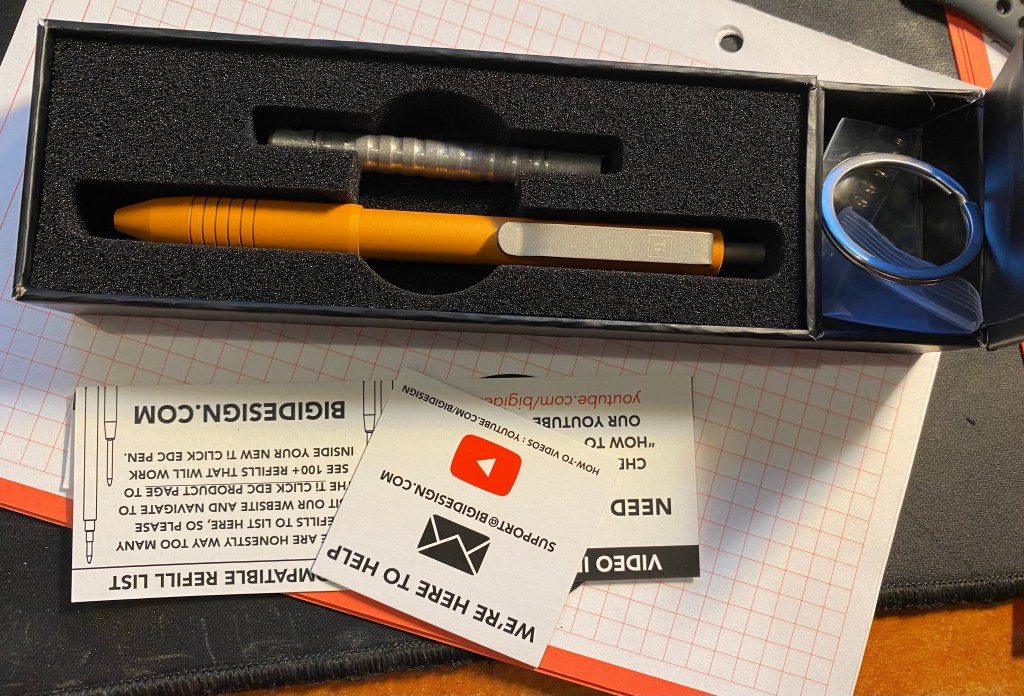
The thick cardboard box comes with two compartments, the large one with a slip cover and the other one with a magnetic clasp mechanism.

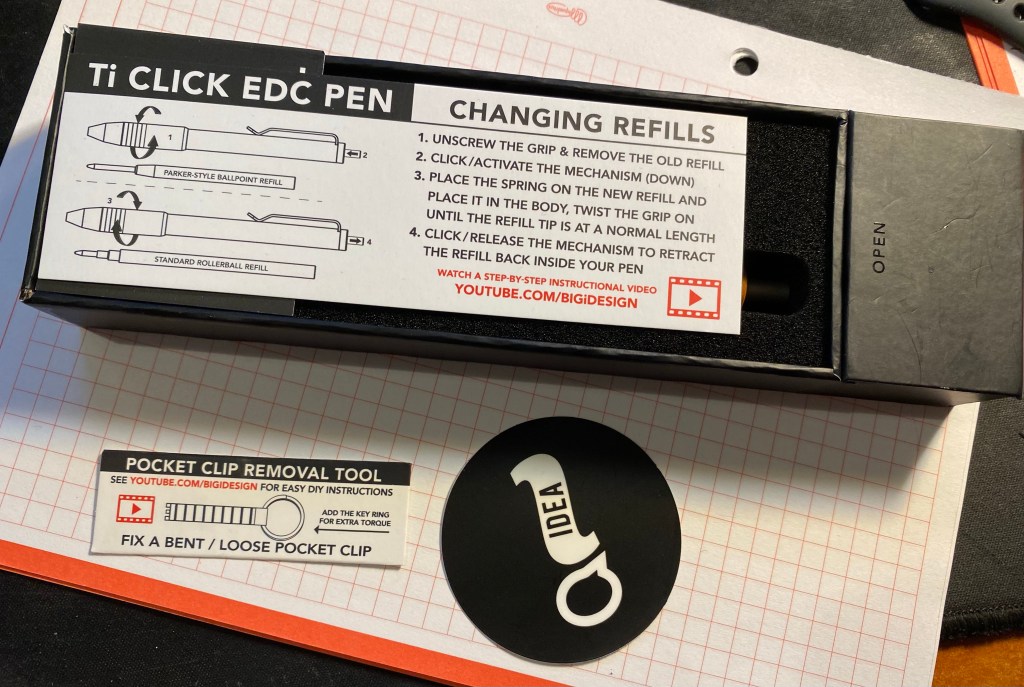
Large compartment on the left, with the instructions for changing refills. Small compartment on the right. You can see the instructions for the pocket clip removal tool and the logo sticker that came with the pen.

The large compartment houses the pen and part of the clip removal tool, in foam inserts that protect them. The small compartment houses a bag with spare parts (a spring and two o-rings, a very thoughtful addition), and a key ring to be used with the clip removal tool, to add torque to it.

On the left from top to bottom: clip removal tool, Ti Click EDC pen. On the right you can see the key ring and the bag with the spring and the o-rings.

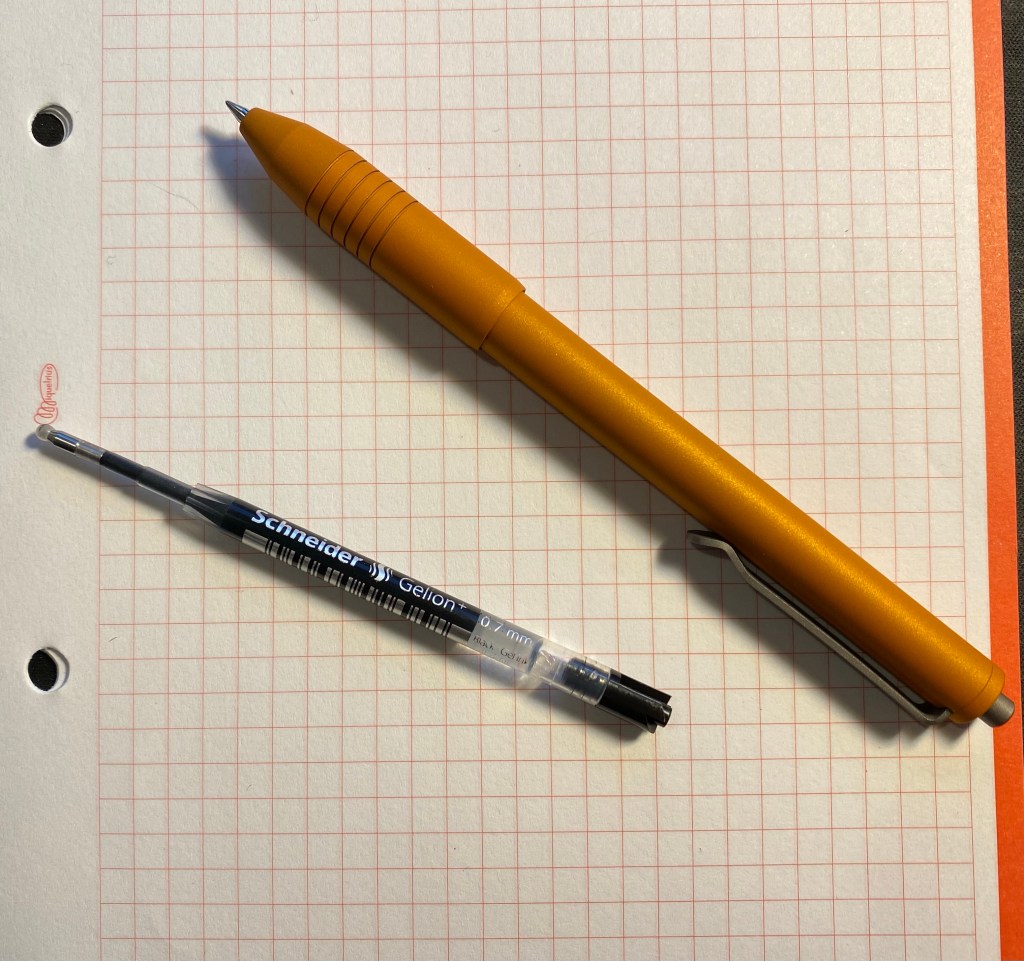
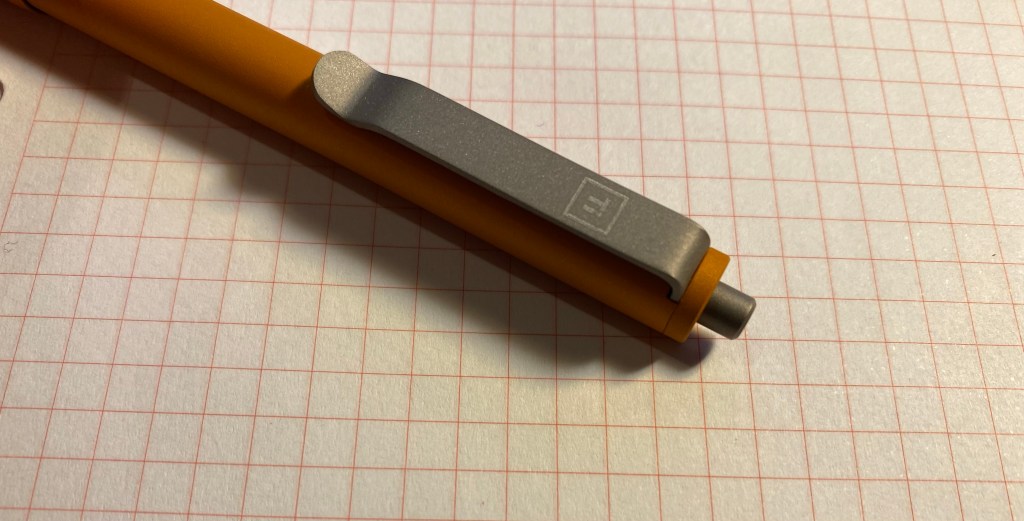
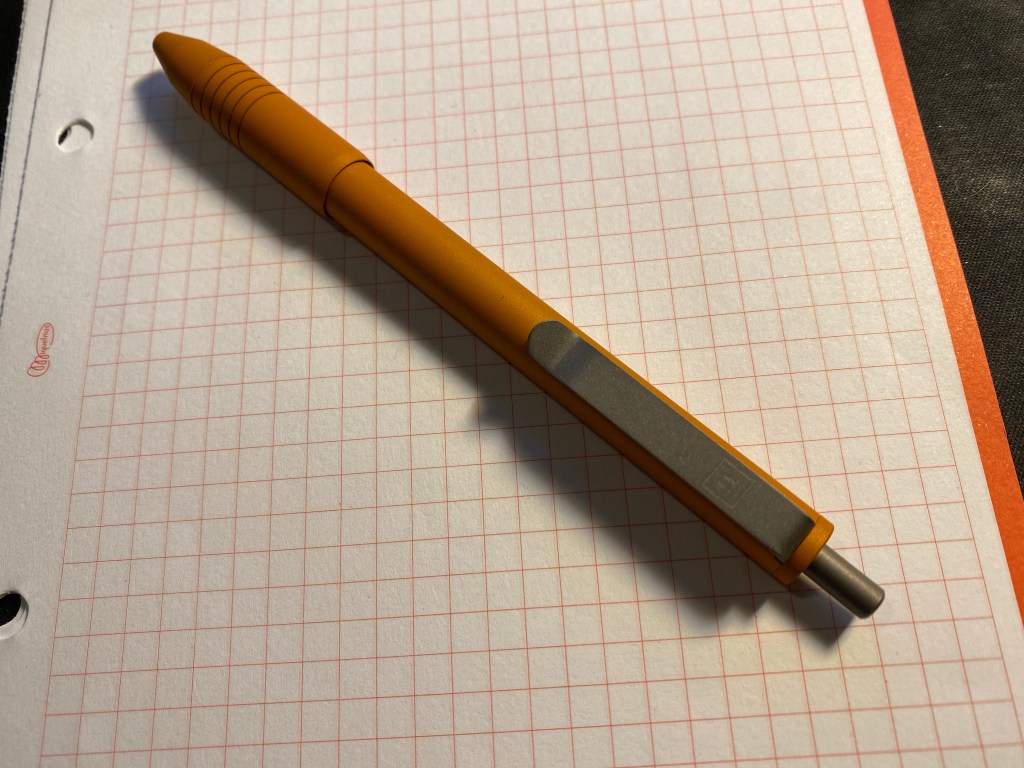
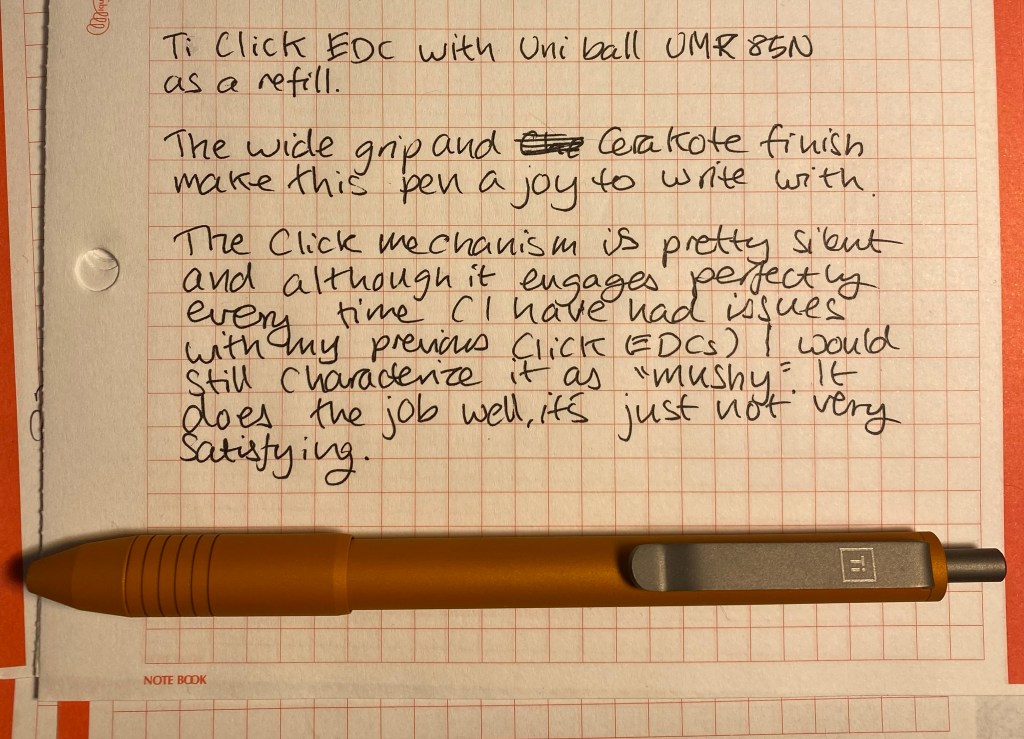
The pen comes in a golden orange Cerakote finish over a titanium body, with the clip and knock in stonewashed titanium. It arrived with a Schneider Gelion 0.7mm gel ink refill which I haven’t tried out. I swapped in my favourite refill instead – the Uni-ball UMR-85N gel ink refill.

Ti Click EDC with its original refill.

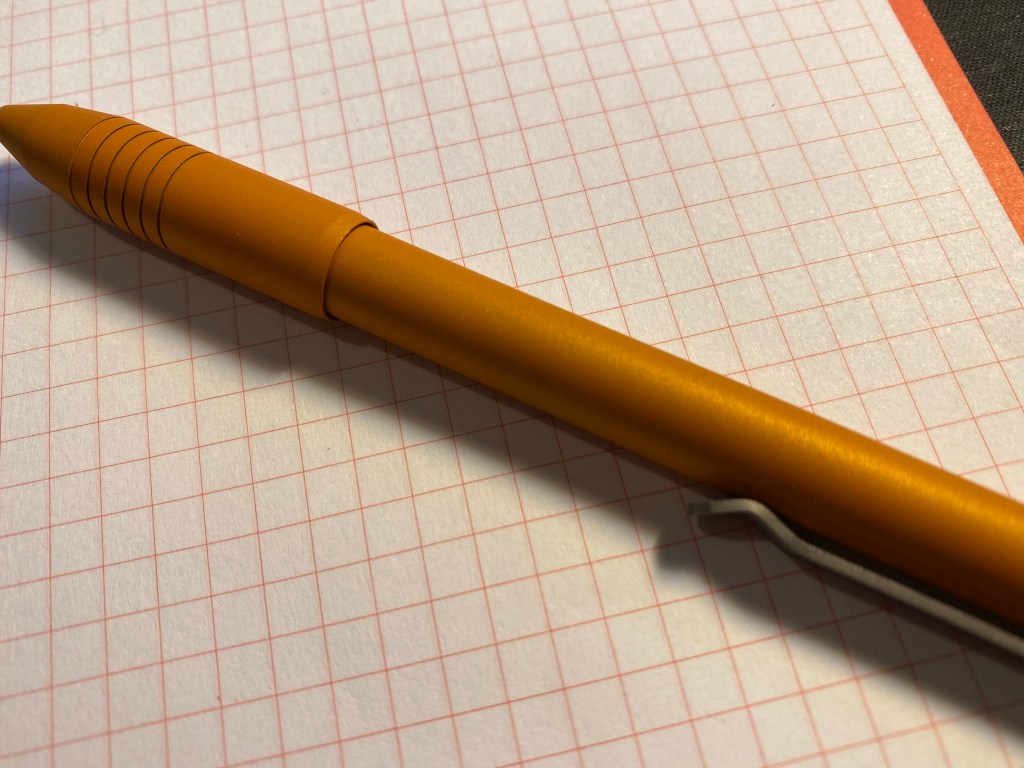
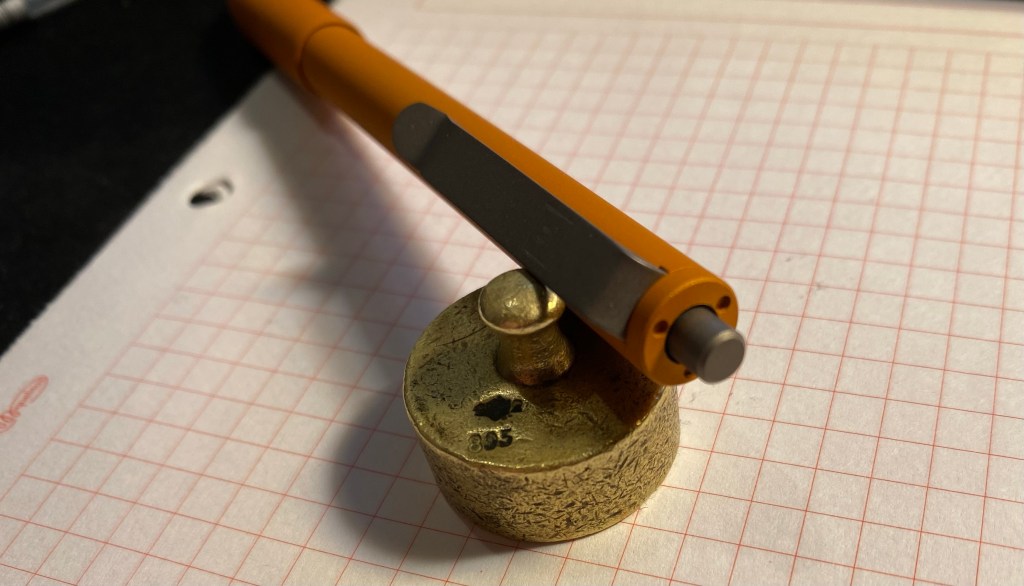
The texture on the Cerakote refill is amazing. It’s matte and yet it sparkles, and its grippy without being abrasive. The result is an attractive pen that is comfortable to hold and use, because of the combination of a wide grip section, the textured coating and the grooves on the grip section.

Cerakote finish glowing.

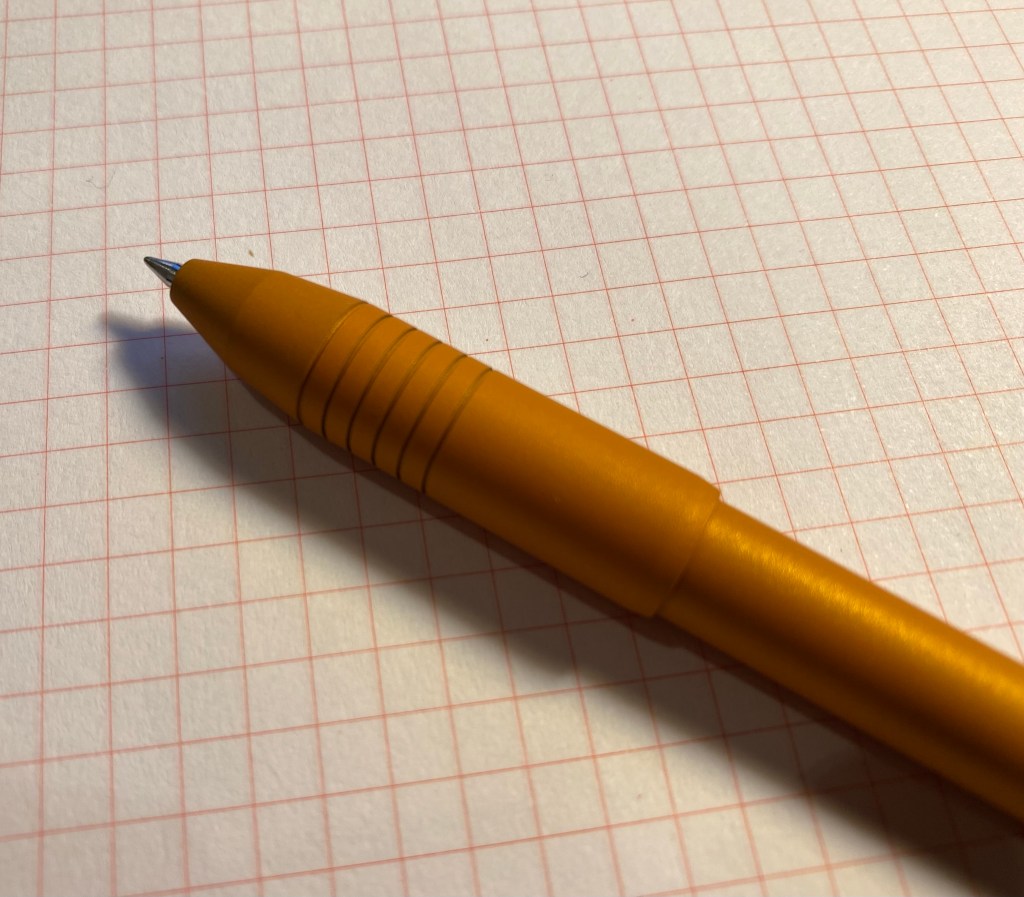
The grip section is also where all the cleverness of this pen design resides: this is what allows you to customize the Ti Click EDC to accept practically every pen refill on the planet.

Grip section closeup.

The clip and knock mechanism are in stonewashed titanium, which suits this finish very well, but not all the new Cerakote finished pens offered come with this finish – some come with raw titanium clips and knocks, so read the description on the pen’s page to make sure you know what you’re getting and that you’re happy with it.

Clip and click.

I love the design on the end of this pen:

Closeup on the knock area.

This is a beautiful pen that is no longer available, but I still recommend buying a BigIDesign pen in Cerakote (green or bronze are now on offer. Navy and orange were on offer in the past) because they are such good EDC pens and the Cerakote finish only adds to their appeal in terms of form and function.

Ti Click EDC

Here’s a size comparison of the Ti Click EDC against a Caran d’Ache Fixpencil and a Sharpie. You can see just how wide the grip section is.

From top to bottom: Fixpencil, Ti Click EDC and Sharpie.

The “weak” spot on the Ti Click EDC is still the click mechanism. It engages successfully every time, but is quiet and gives very little feedback as it engages, making it feel “mushy”. This doesn’t affect its utility (it works every time, unlike in the earlier iterations of this pen), but it does make it an unsatisfying fidget tool. If that’s what you’re looking for in a pen, the Ti Bolt may be a better choice for you. Otherwise, the Cerakote finish just made a great machined pen even better.

Karas Kustoms Steampunk Bolt V2 Quick Review

I wasn’t planning on reviewing the Karas Kustoms Steampunk Bolt V2 pen because I was sure that it would be sold out by the time I got to it. Somehow, however, there appear to be a few still on sale on the Karas Kustoms site.

Dinges and Cerakote finish work together to create a really unique pen.

The Steampunk Bolt v2 has the same aluminium body and shape as the anodised Bolt V2, but it’s gotten a distressed bronze treatment in Cerakote. The basic Bolt pen has been dinged before the Cerakote finish has been applied, and the result is fantastic. The pen really earns the “Steampunk” title.

Big dent in the end of the pen, smoothed over and covered with bronze coloured Cerakote.

The Cerakote finish is smooth but not slippery, and really fantastic to hold. It’s also nothing like any other Cerakote finished pen that I’ve seen so far: it really gives the pen a bronze look without the bronze weight or smell. The pen is light (for a machined pen – don’t compare it to plastic), and well balanced. The black anodised bolt mechanism is as smooth to engage as ever, and works well with this finish.

Every ding adds to this pen’s looks. It’s just going to look better with time, I think.

There are two caveats to take into account with this pen (and other Karas Kustoms Bolt V2 pens):

  1. The pen comes with a Pilot G2 LG (as in large) 0.5 refill. I haven’t been able to customise it to work with my beloved Uni-Ball UMR-85 refills (the bolt won’t engage). It’s a decent enough refill, but I wish that it had been built around the standard G2, and so had more customisation options.
  2. There is a slight amount of play in the tip which makes it faintly click at times when you write.

All in all this is a very good machined bolt action pen, with a fantastic and very unique finish.

Karas Kustoms Bolt V2

I am a huge fan of Karas Kustoms machined pens, and I have their Render K, Ink, EDK, and Retrakt but I only recently purchased a Bolt v2. Why? For one thing, I was waiting for an interesting colour combination to come along. For another, I have the Bolt v1 one and have found it practically unusable, so I was hesitant to give the v2 a try. But then Karas Kustoms created a bluish-grey and orange Bolt v2, and the colour combination made me decide to give the Bolt a second chance.

I’m glad that I did.

Bolt v1 on the left, Bolt v2 on the right.

The Bolt v2 that I bought has a bluish-grey and orange anodization and fluted grooves in the grip. My Bolt v1 is raw aluminium, has no grooves in the grip section, and as you can see, is very, very long. This is the main reason that I couldn’t use the Bolt v1, as I have small hands and the pen is about 15cm long, which makes it unwieldy. The Bolt v2 is about 2cm shorter, and so about standard size of a pen.

Bolt v1 on the left, Bolt v2 on the right, refills extended.

The v1 and v2 Bolt have a similar design, but the Bolt v1 is a much more impressive pen, even with no anodization. Every time I pulled it out, people asked what it was, and said that it looked like a surgical tool. The Bolt v2 is more practical, and while it’s an attractive pen, it (so far) hasn’t been one to draw too much attention to itself. That may be a good thing, because someone did make an attempt to steal my Bolt v1 when I brought it to the office, which is why I stopped bringing it with me.

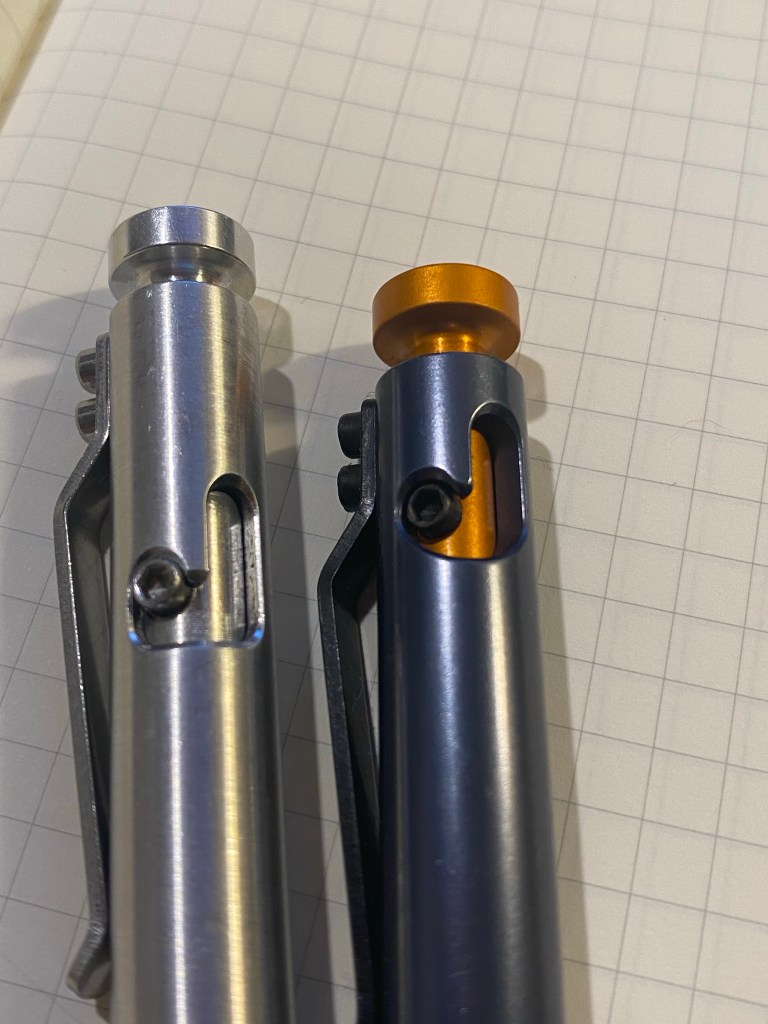
Bolt v1 mechanism on the left, Bolt v2 on the right.

The bolt mechanism on the v1 and v2 are very similar, but the v2’s mechanism has been streamlined and rounded (see the bottom of the cutout) which means that it’s much easier to engage than the v1. It makes the v2 much nicer to use, and as an added bonus, it turns the pen into a great fidget tool.

Bolt v1 on the left, Bolt v2 on the right.

I know that the seam between the grip and the body of the Bolt v1 looks tighter and better fitting than the Bolt v2’s but those looks are misleading. Like the rest of Karas Kustoms v1 pens, the threads that connect the pen grip and pen body were the weakest point on the pen. The threads kept unscrewing themselves, at times while I was writing with the pen. It’s no wonder that they have been redesigned from scratch in the v2, as you can see below:

Bolt v2 parts.

The threads start in a shoulder, are much tighter, and there’s an added o-ring at the bottom. All these together prevent the pen from unscrewing itself unless you deliberately want to unscrew it.

Bolt v1 threads on the left, Bolt v2 on the right.

If you have an interest in machined pens, and specifically in bolt action machined pens, then a Karas Kustoms Bolt v2 should be high up on your list. It’s been my daily pen for a few weeks, and I don’t see it leaving my rotation any time soon. I would recommend checking out Karas’s special projects, since the colourways there are often more striking than in their regular line.

Karas Kustoms Battleworn Ink 2.0 Rollerball

I am a big fan of Karas Kustoms machined pens, and up until recently I owned all of their lineup except for the Ink rollerball. So when Karas offered a grab bag of matching battleworn Ink 2.0 rollerballs I decided to roll the dice and purchased two of them. There’s always a risk when buying grab bag pens, but I had some tremendous luck and got two pens that are not only in some of my favourite colours, but also in colours that I don’t yet own. I was also fortunate enough to get one pen with a tumbled aluminum grip and one with a regular one, which means that I had a chance to experience both of my preferred grip styles in these pens.

Beautifully designed machined pens.

First thing’s first: the anodization on these pens is spectacular. The colours are really vibrant, and the Battleworn finish does not take away from that. They pop out in any pen lineup, rivalled only by my Spoke pen in terms of brightness:

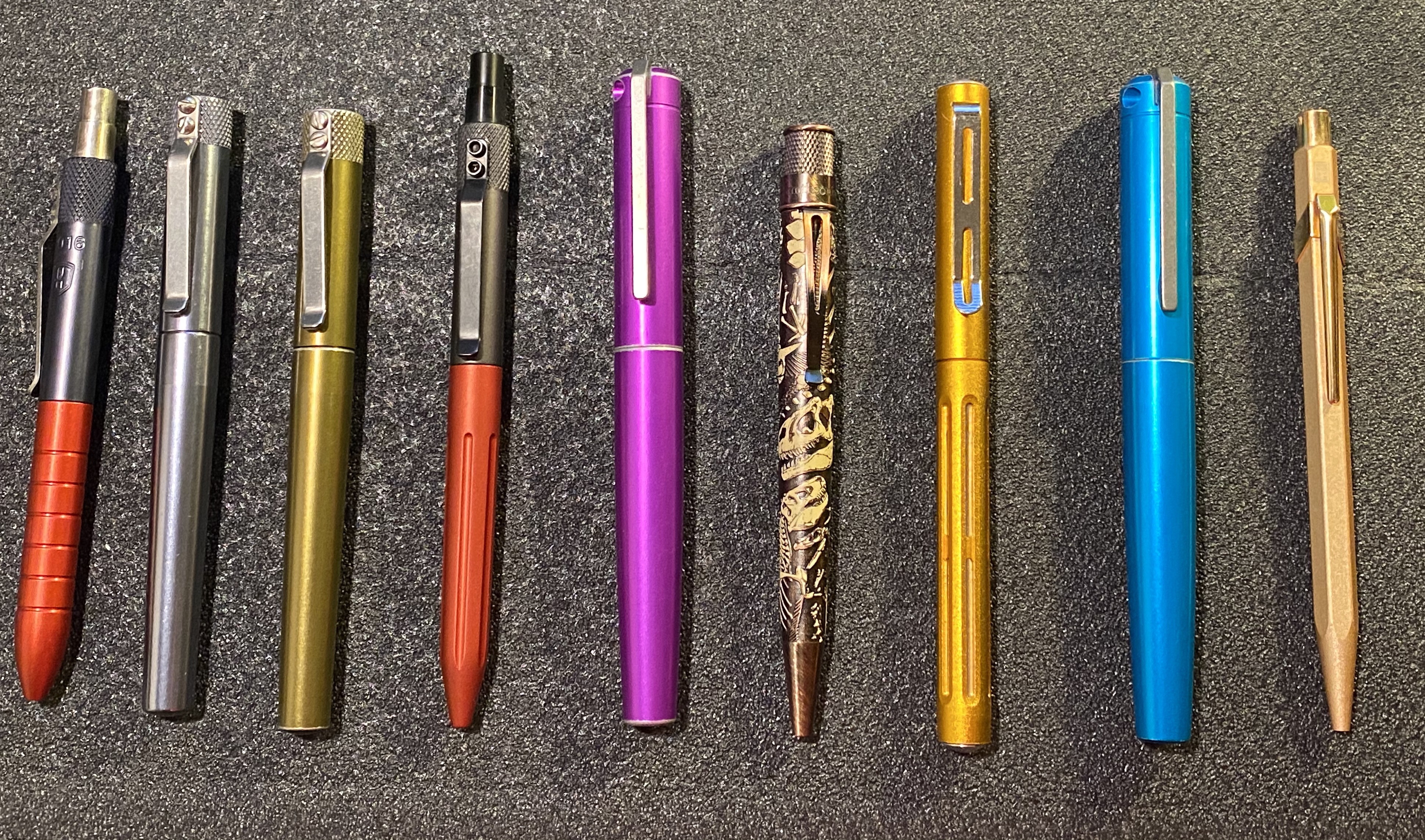
From left to right: Karas EDK, original Render K, Battleworn Render K, Retrakt V2 , Ink 2.0, Retro51 Dino Fossil, Spoke Pen Orange Crush, Ink 2.0, Caran d’Ache 849

As you can see from the lineup photo above, the Ink 2.0 is a big, chunky pen. It’s larger than any other pen that Karas offers, and while it’s about the same length as the Spoke Pen, it’s much wider. Even so, this is not an overly heavy pen, and the added girth does make for a pleasant writing experience. This is a workhorse pen, built to last, and build to accompany long writing sessions.

The Ink 2.0 uncapped.

There’s quite a distance between the tip of the pen and the threads, and so there’s little chance of them getting in the way of your grip. Despite that, Karas has taken the precaution of ensuring that the threads aren’t overly sharp. Do take into account though that despite the 2.0 name, this is the older version of the Karas Ink rollerball, and so it has the old version of the threads and the cap. The threads on the new Ink V2 (I know, the naming could have been better, but at least it’s consistent across their lineup) are shorter, and have a flat area before them. This serves to even further place your fingers away from the threads, and is required for their Sta-Fast cap system. This system adds an o-ring to the cap, and prevents the pen from unthreading itself. My Ink 2.0s don’t have this system, and so they unthread themselves rather too easily, although nowhere nearly as bad as the original Render K. Again, this is a problem that you won’t encounter if you’re purchasing a new Ink V2 from Karas site right now, and they do a good job of clearly pointing the differences out.

You can see the differences in the tumbled grip and the regular aluminum grip.

The grip on the Ink rollerball is really where the pen’s design shines. It has such a unique profile, with the flare right before the tip cone. It makes for a very comfortable grip section, with added “grippiness” provided by the tumbled finish, should you choose to get it. The grip also comes in black anodized, brass and copper.

Unusual but beautiful design.

A closeup on the old threads shows the difference in the levels of Battleworn finish between these pens. The cyan pen was clearly less tumbled than the magenta one, so I am considering switching the grips between the two, to complete the extra Battleworn look.

The new Ink V2 threads don’t look like this.

Here you can see even better the different levels of Battleworn finish between these pens:

My pens arrived with a Pilot G2 large 0.5mm gel ink refill, and so far I haven’t replaced it. It’s very easy to unscrew the section and replace the refill with anything else that you like, and Karas does a fairly good job on their site, listing popular refills that fit their pens.

I think that the Karas Ink is one of their most beautiful and well designed pens, and there’s a good chance that I’ll buy the Ink V2 once I see a colour and finish combo that catches my eye. Everything from the robust clip design, the placement of the visible screws on the cap, to the length and girth of this pen and especially the grip design is well thought out. It’s clearly a step up from the (excellent) Render K, and if you’re looking for an impressive yet practical machined pen, the Karas Ink V2 is probably the pen for you.

Spoke Roady Gecko Pen Review

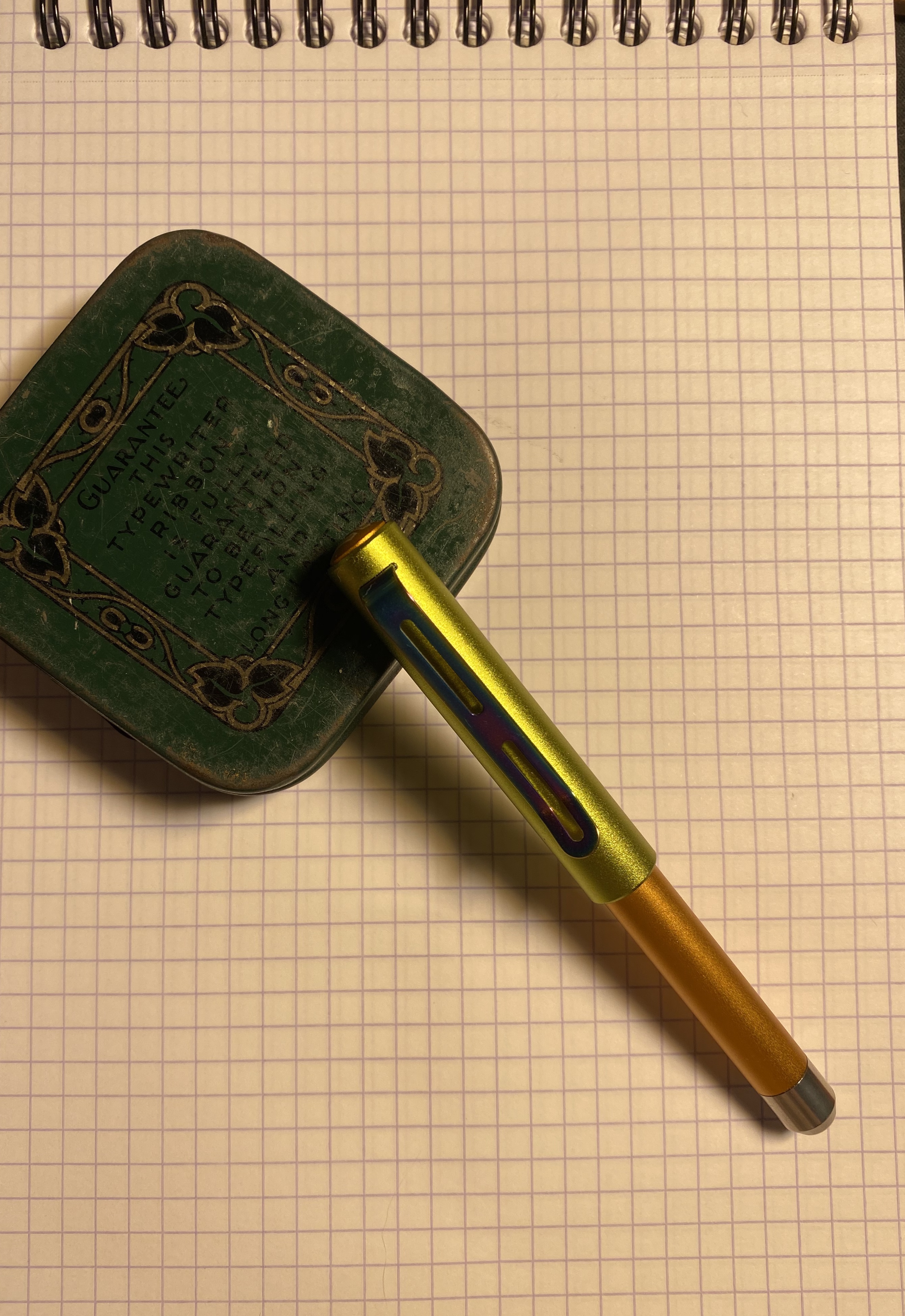
The Spoke Design Roady Gecko pen about a week ago, and I’ve been using it constantly since then. The Roady is an EDC pocket pen made of machined aluminum that is built around the Uni-ball Jetstream SXR-600 refill. Unlike its predecessor, the excellent Signo DX compatible Spoke Pen, the Roady is capable of accepting a wide variety of Parker style refills, including the Fisher Space Pen refill, much beloved in EDC circles.

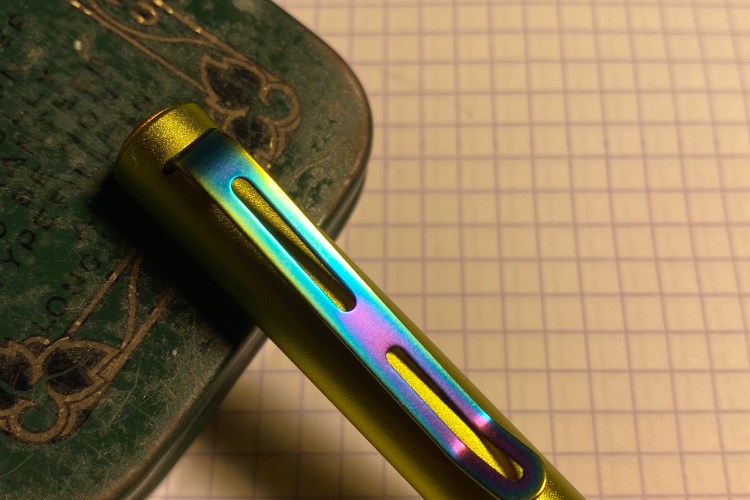
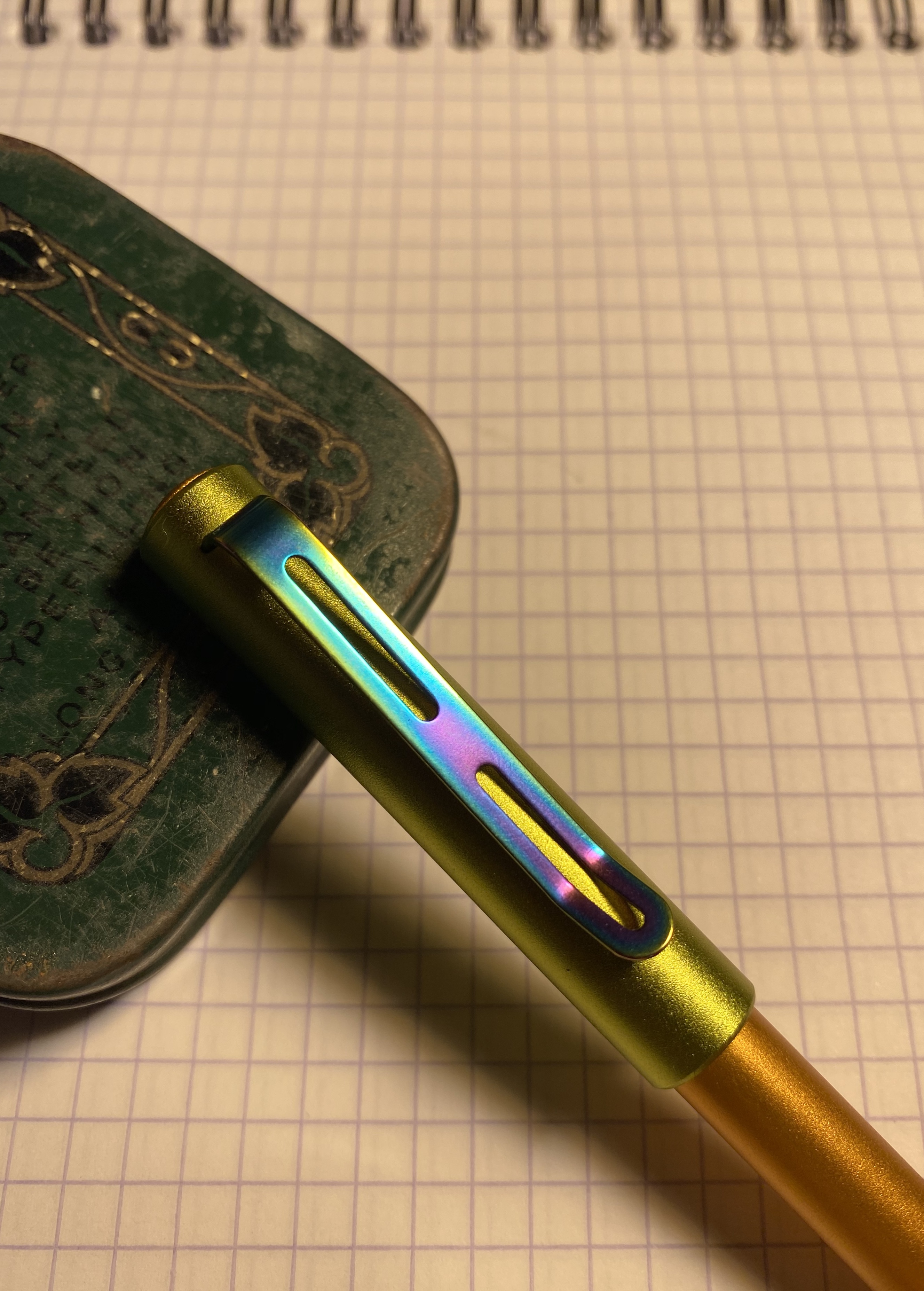
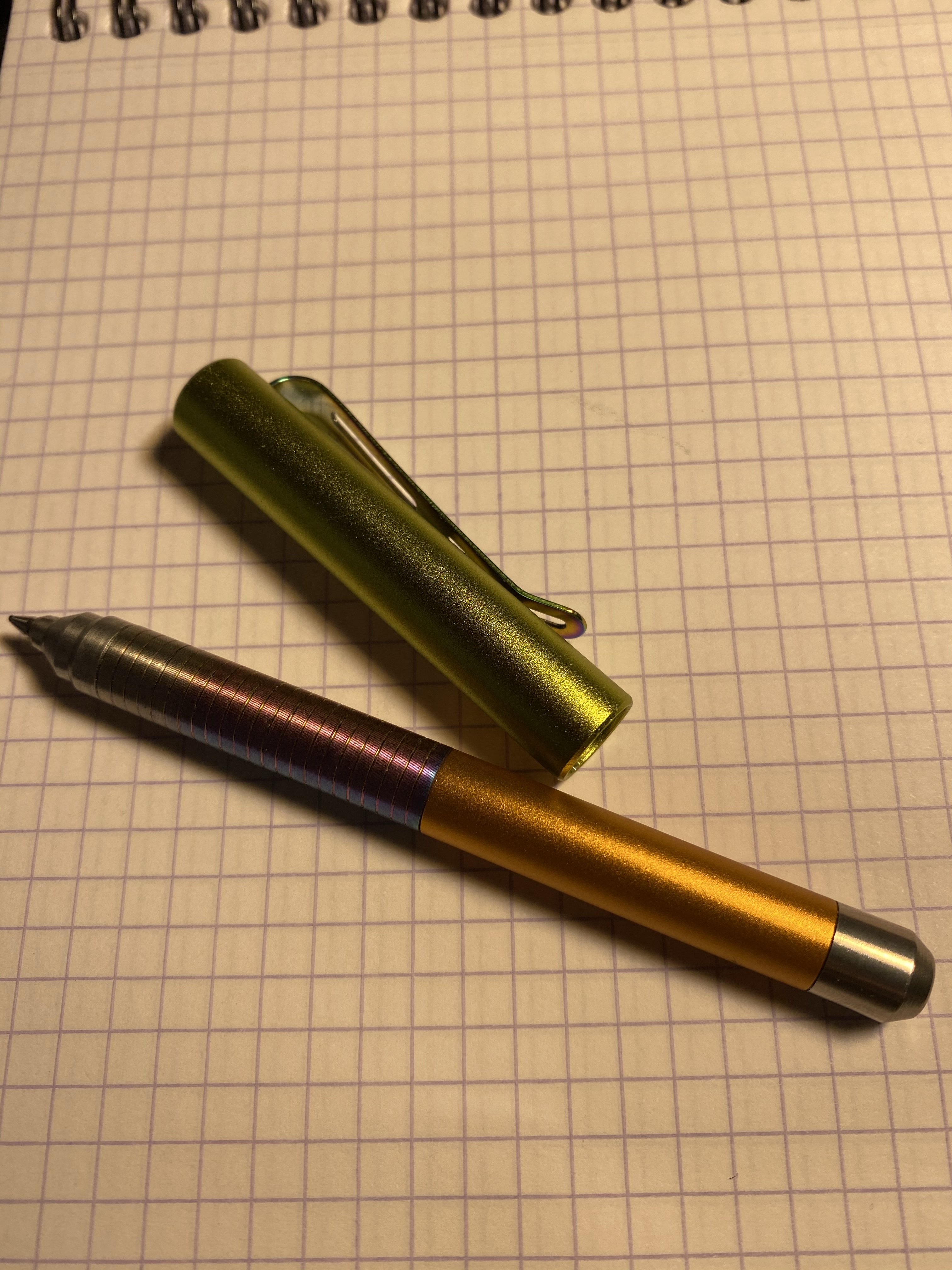
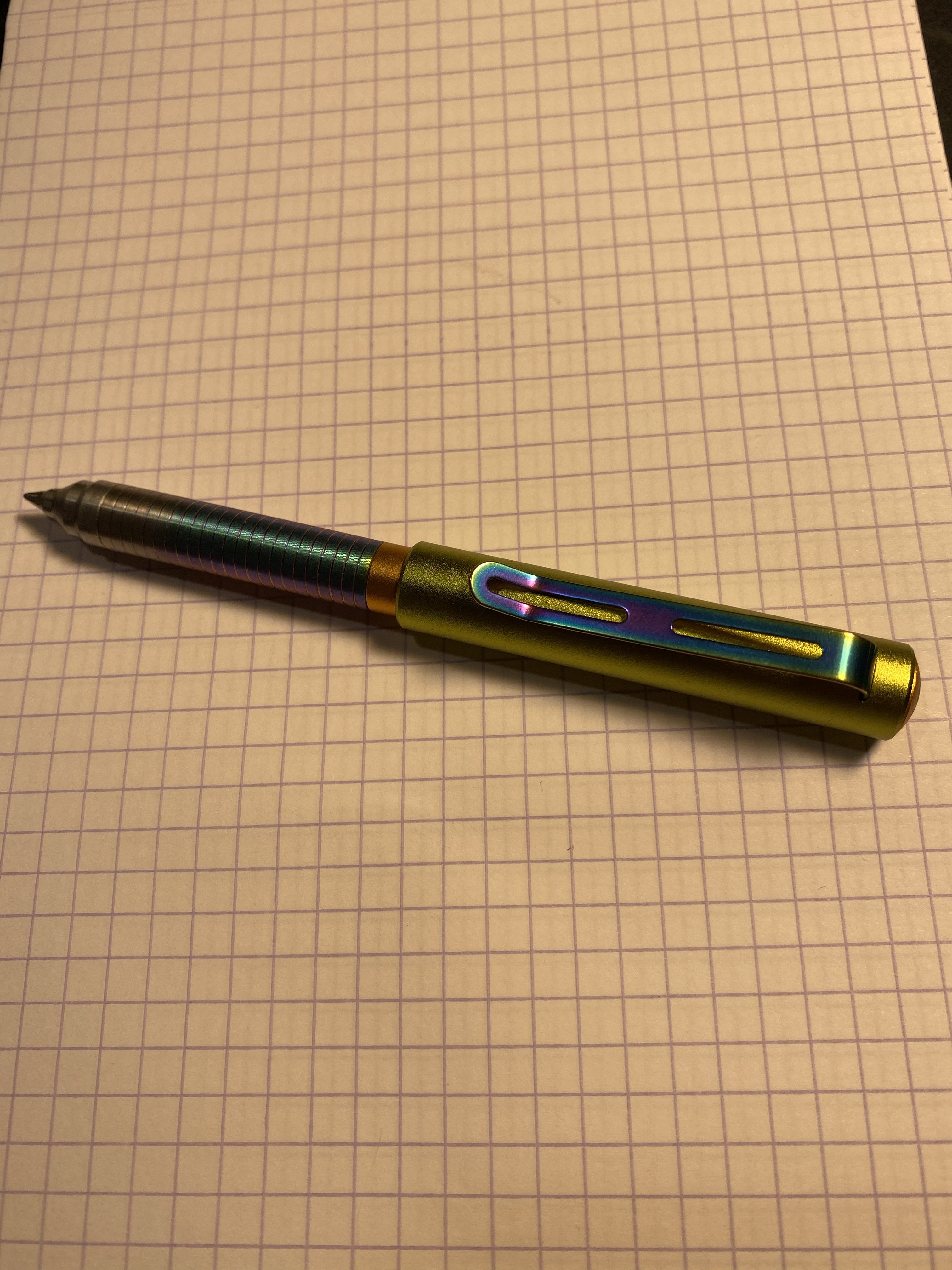
I don’t usually go for flashy pens, but something about the design of the Roady and the colour options offered made me grab the Gecko. This charmingly named colourway has a lime green cap, an orange barrel and finial, and rainbow coloured grip and clip. The result is even better in person than it is in photos – a pen that makes you smile and is bound to draw attention to itself.

Capped the Spoke Roady is tiny, and ought to fit comfortably in your pockets, if you have some.

There are a few other colourways with similar rainbow patterns on their grip and clip. The result is gorgeous, and I’m glad that Spoke Design haven’t offered these only as limited edition pens, or charged an additional markup for them. That is commendable and impressive, particularly in today’s machined pen market.

Rainbow clip.

Trying to write with the Spoke Roady unposted is asking for trouble, as it’s verging on golf pencil short in its body length. This is a pen clearly designed with posting in mind.

Too short for comfort unposted.

When posted the Spoke Roady becomes a viable EDC pen, although it’s still on the short side. This means that it’s great for short notes on the go, which is what it’s intended for, and not the best for long note taking sessions. The Roady posts using magnets, making a satisfying click when posted. It’s not as great a fidget toy as the Spoke Pen is, not that this should ever dissuade you from purchasing it.

Capped and ready for work.

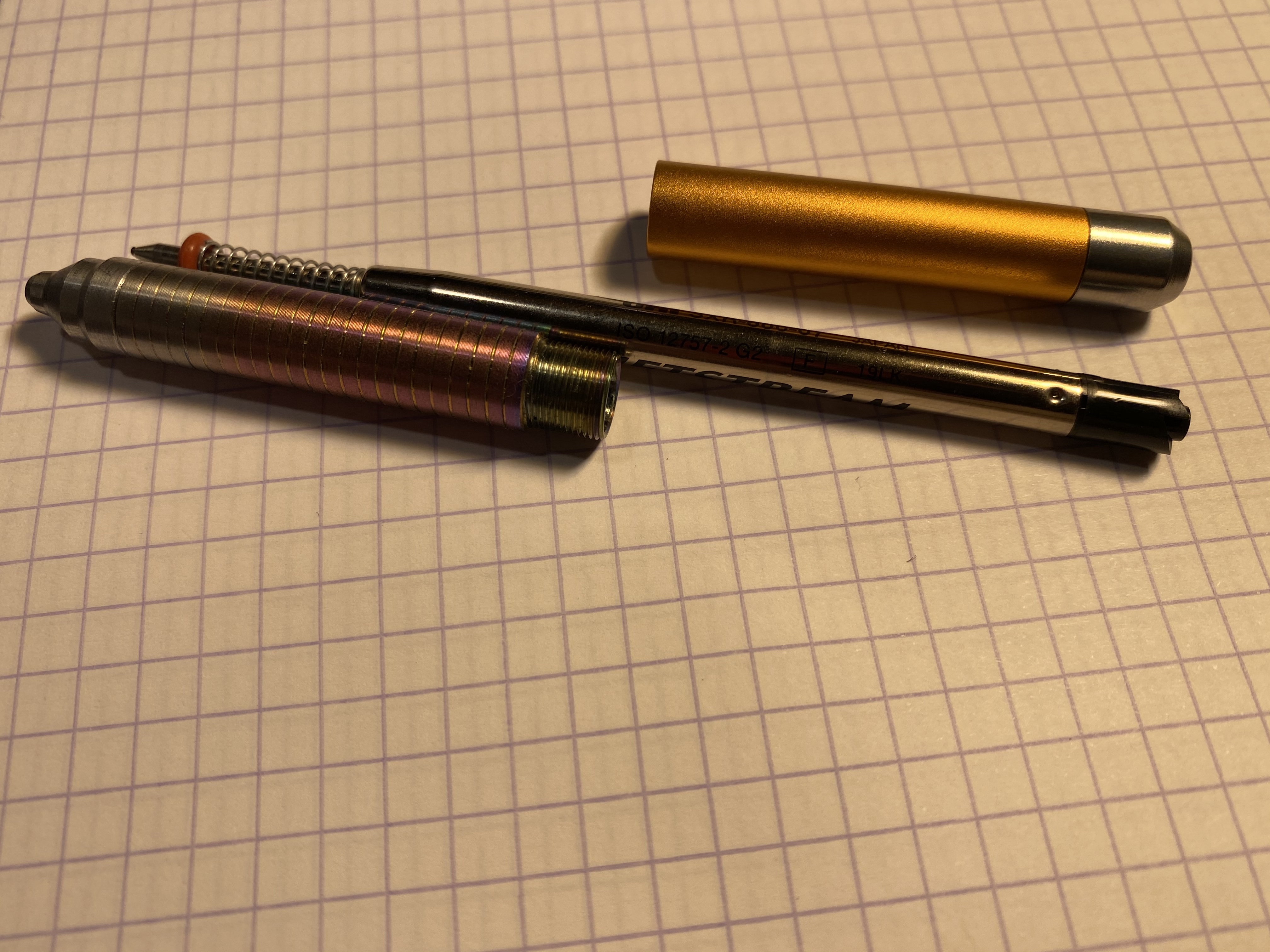
For some reason the refill came shipped in a separate sleeve and not inside the pen. This is a peculiar choice since the refill came in a Uni-ball refill bag, but with the spring and o-ring already installed, and for some reason a bit of tubing meant to be used as a spacer of some kind? It’s not really clear. Also, while you get a cool sticker and generally nice packaging with the Roady, you don’t get an explanation of any kind with the pen. That’s a shame because it assumes that everyone will know how to handle the refill when it comes to changing the pen’s refill. It feels like a missed opportunity for Spoke.

The refill, Jetstream SXR-600

Here’s the Spoke Roady next to the Spoke Pen. If you can only afford one pen and you’re out and about a lot and like wild colours, then I’d recommend getting the Roady. Otherwise, get the Spoke pen, especially if you like writing in fine lines. Both are good pens, just each one is suited for a different use case.

Roady on the left, Spoke Pen on the right.

Writing sample on Rhodia paper. The Jetstream SXR-600 in 0.7 is an excellent refill choice in the Parker refill category, and the Parker style refill itself is a great choice for an EDC type of pen.

The Roady is a great little pen to have handy, and it’s reasonably priced for a machined pen. I won’t be surprised if I end up buying one or even two more.

Ti Mini Review

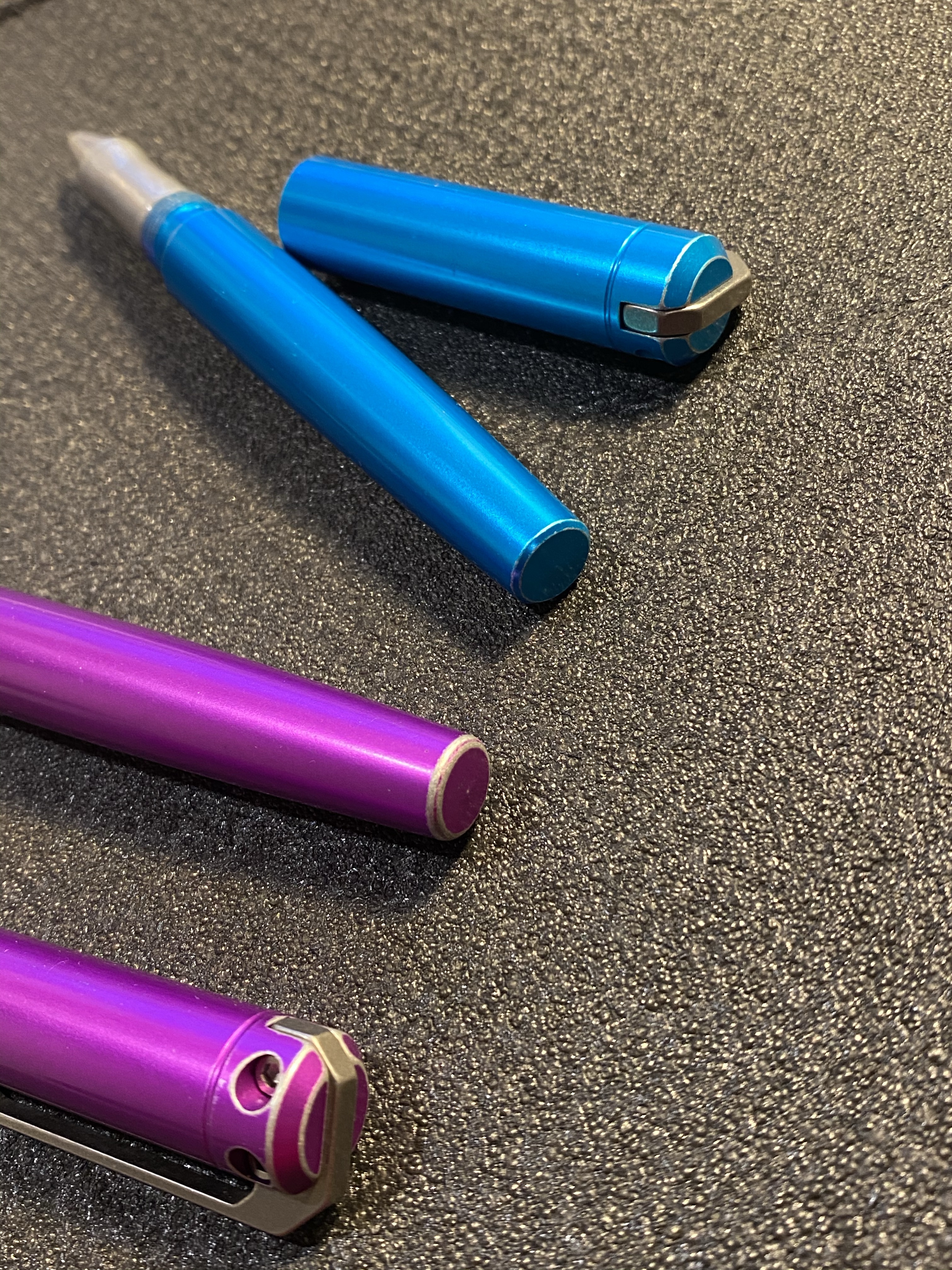
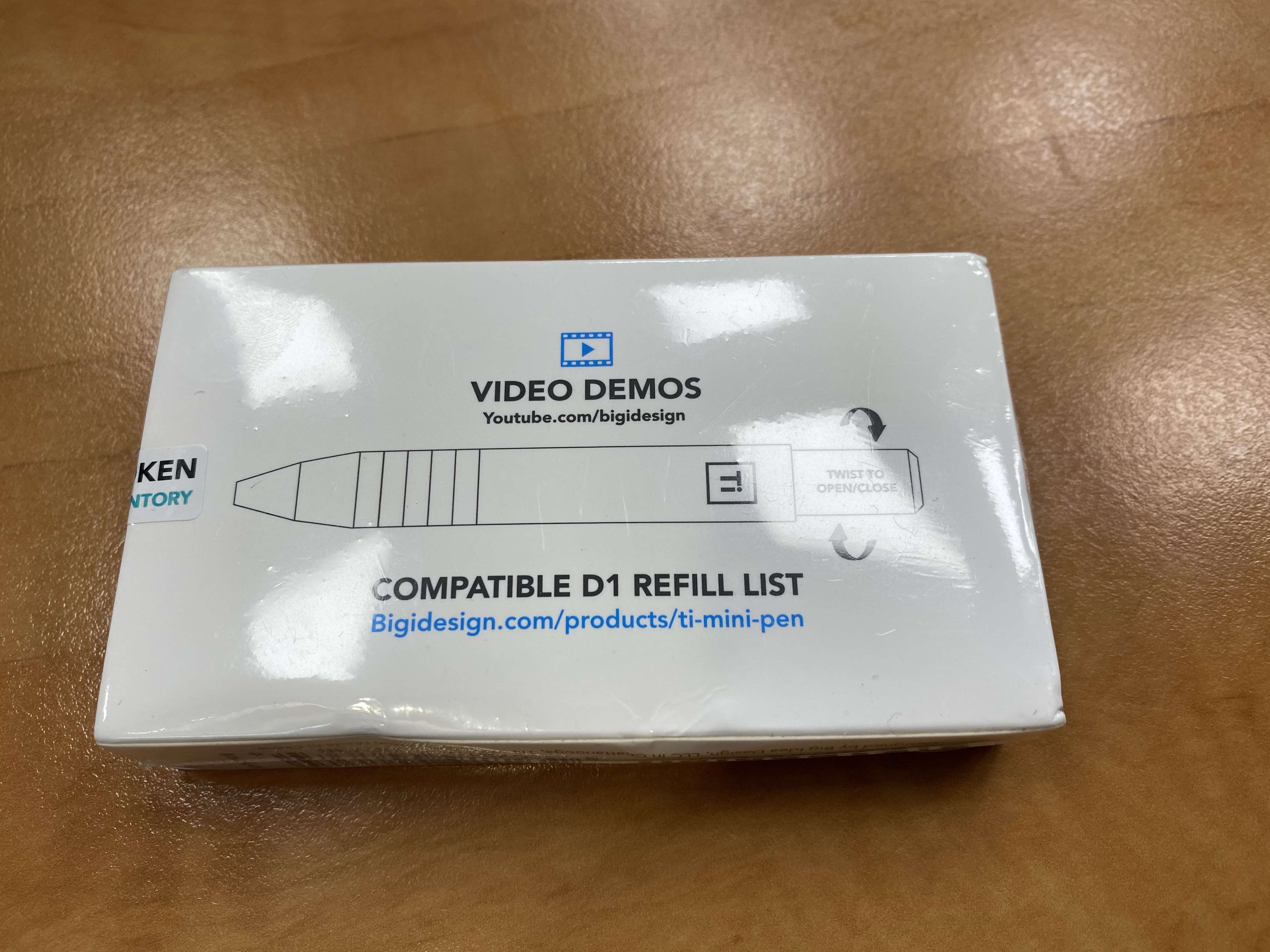
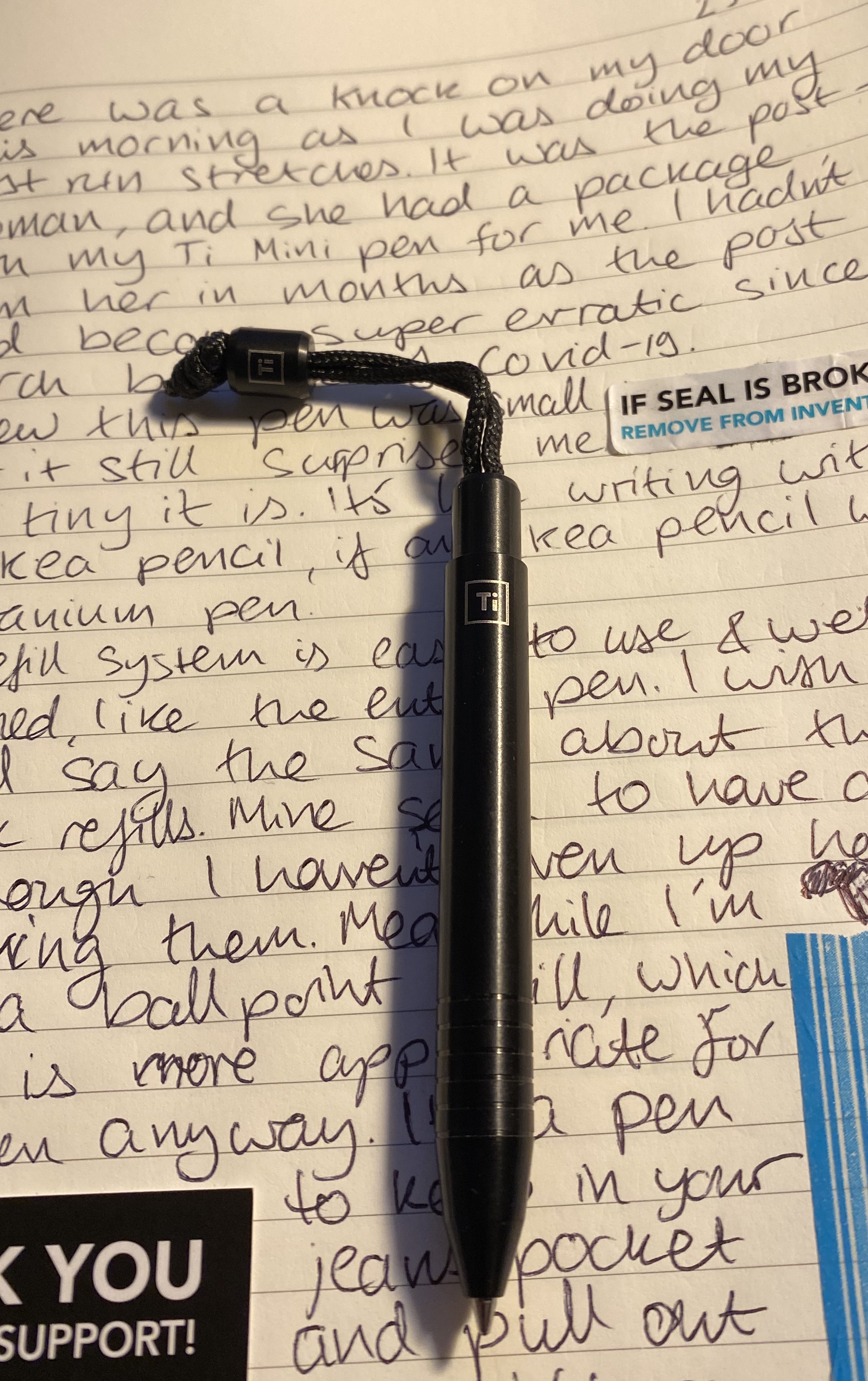
Look what arrived in the mail today! It’s the Big Idea Design Ti Mini, fresh from their latest Kickstarter. I generally love all Big Idea Design pens (except the for the click, which I still enjoy, though it’s not my favourite), but I still hesitated before backing this one. The form factor is so “extreme” that I wasn’t sure that I’d like it or find use for it. A small pocket pen (i.e. a pen that’s small even for a pocket pen), the Ti Mini is a titanium machined pen that uses D1 refills and is basically built for the watch/change pocket of your jeans. It’s the emergency pen you pull out when you need to scribble something on a note, something that you can carry around without even remembering it’s there until you need it.

The post was enthusiastic so the package got a bit smashed in transit.

The packaging is standard Big Idea Design: utilitarian, full of useful information, well thought out and designed and with a bit of an Apple vibe to it.

Smashed package, but you get the gist
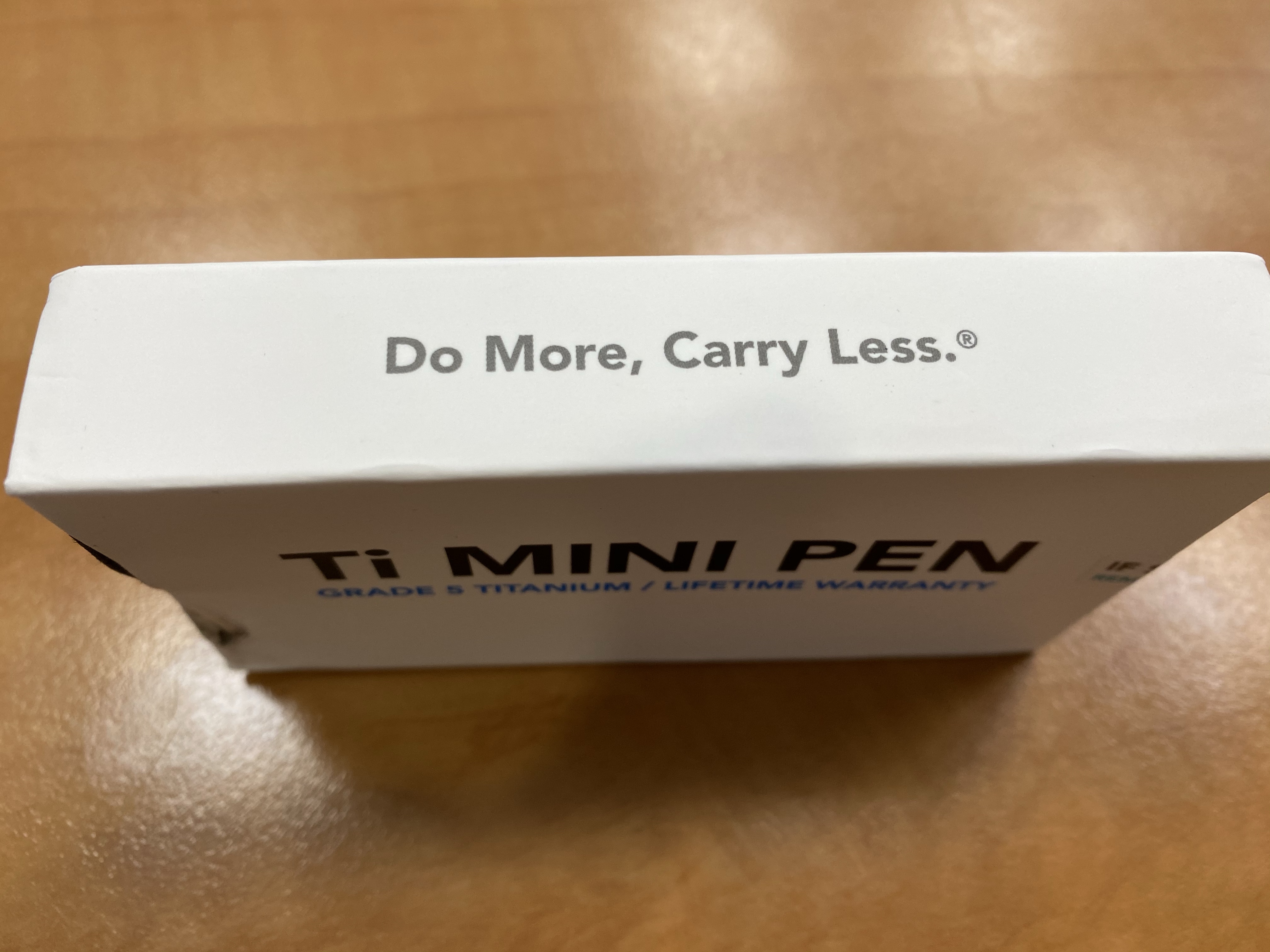
That is just a great tagline
Designed by Big Idea Design, Made in China. Remind you of something?

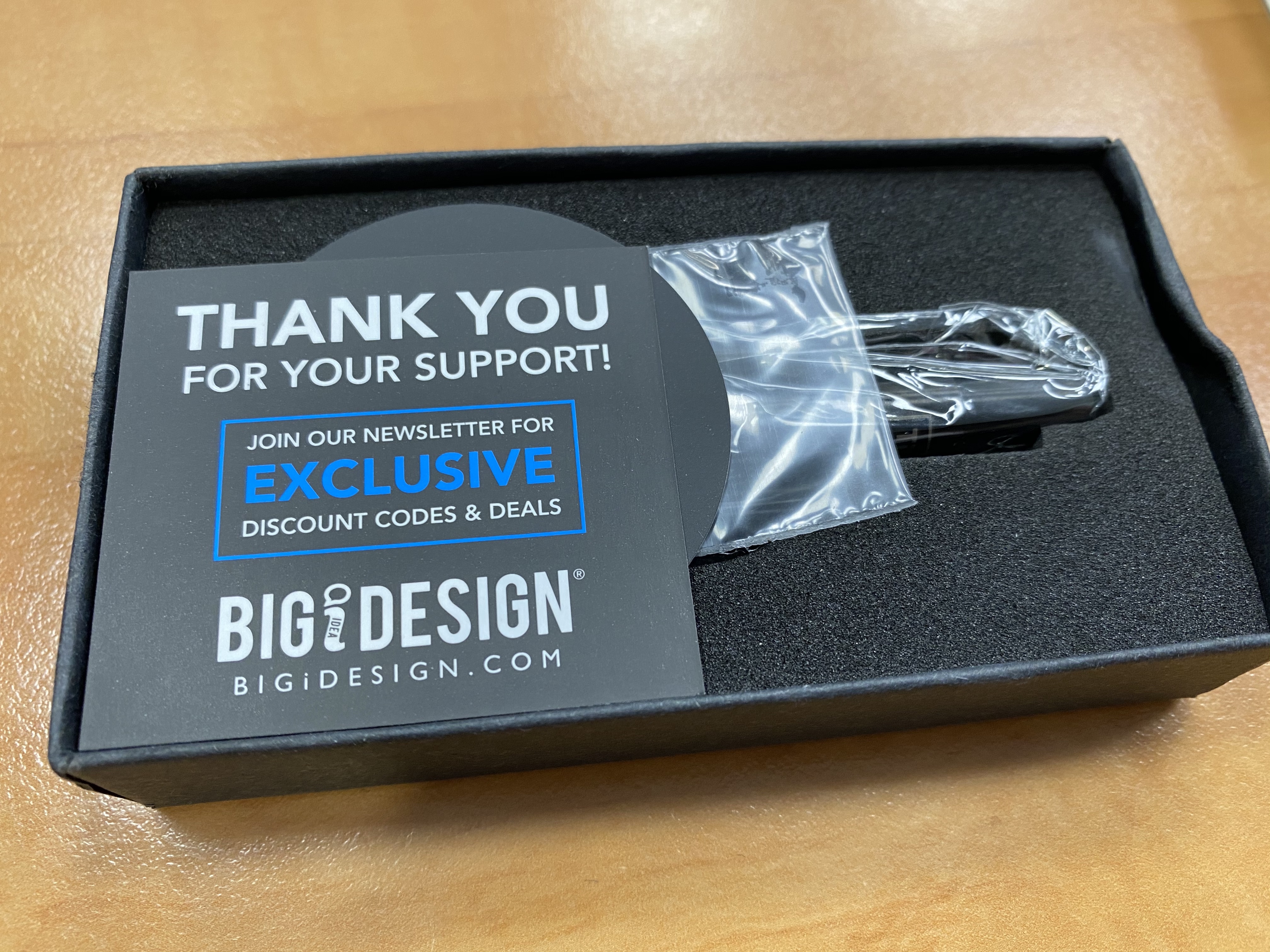
There’s a bit of marketing material when you open the box, but I’m just going to pause and say that I’ve paid a lot more for machined pens that weren’t half as well packed as this, and the reason that my pen survived the rough-handling that my package received is because someone took the time to consider good packaging. And I’m not even someone who usually appreciates packaging (unless it’s particularly good or downright insultingly bad).

Not a scratch on the pen even though the box was smashed in.
Nice logo sticker to go with the pen.

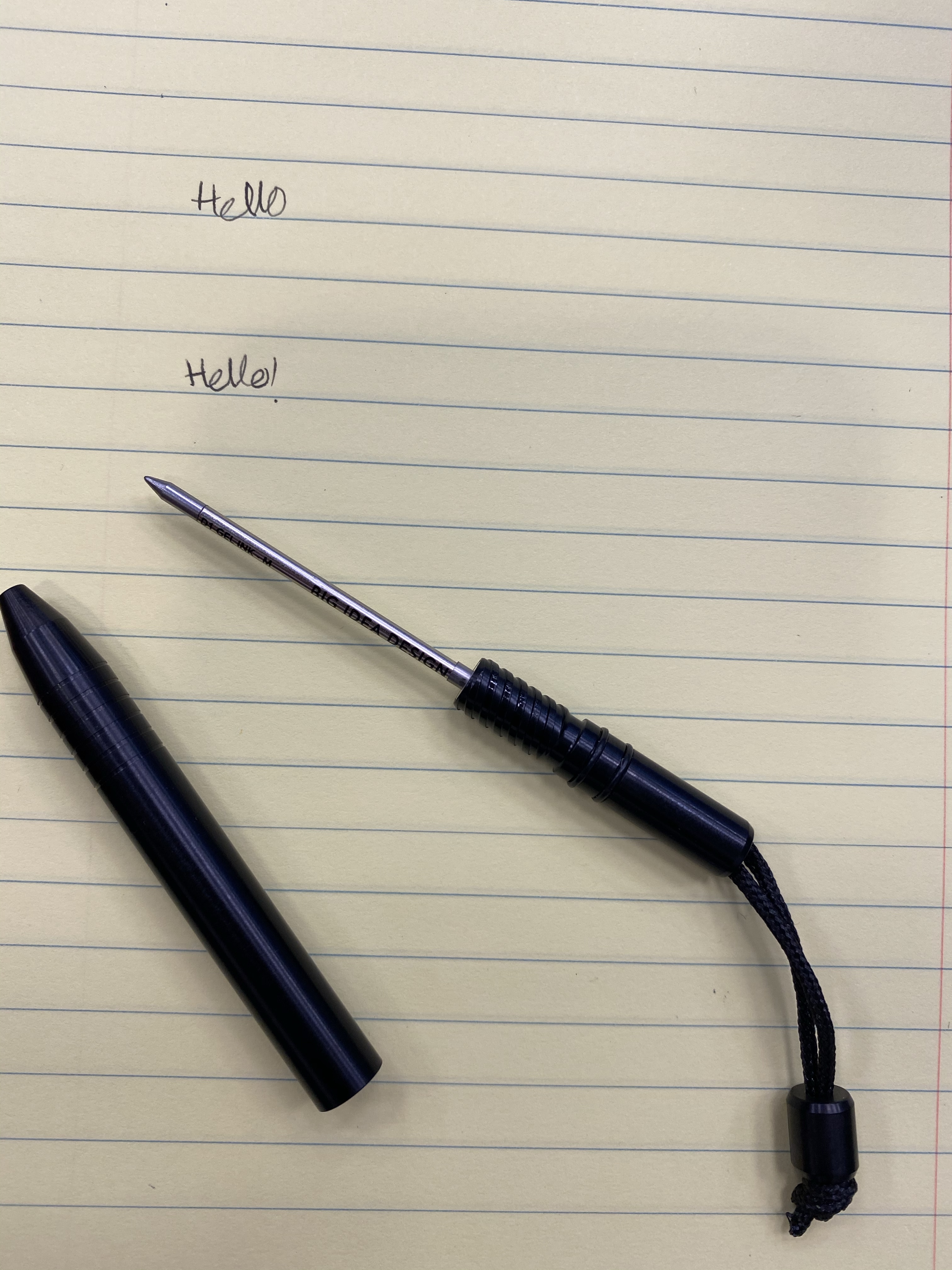
The Ti Mini comes with two spare o-rings and six D1 refills: three gel ink refills (one in the pen, two others in the refill bag), and three ballpoint refills. All refills are Big Idea Design branded, and all of them are medium refills. You have everything you’ll need to write with this pen for months if not for years, right out of the box.

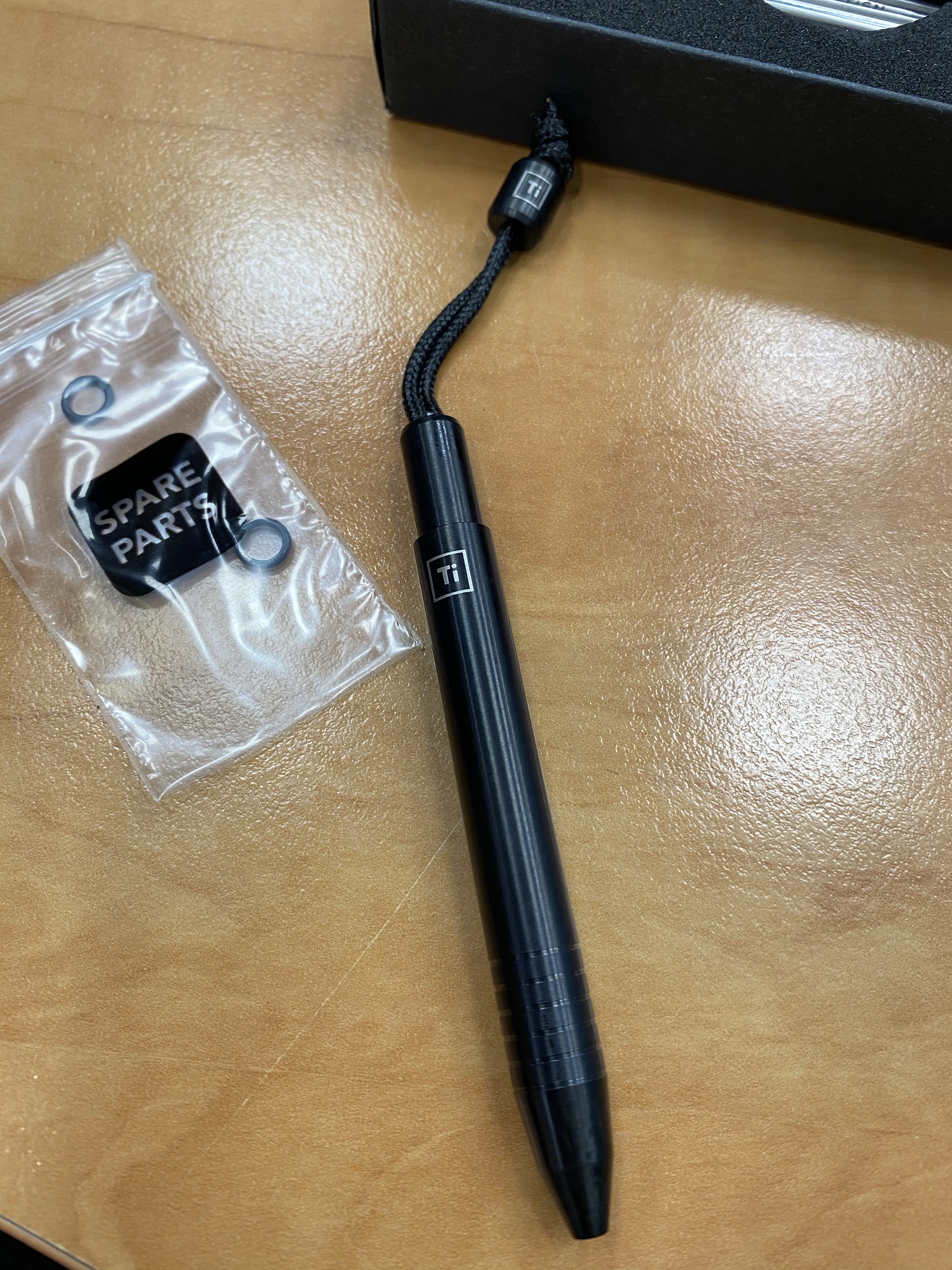
The Ti Mini in DLC Black

The pen has the classic look of any Big Idea Design pen, with an addition of a titanium bead at the end of a lanyard, to make it easy to pull out of your jeans’ change pocket. It’s an extremely well designed pen, built perfectly for its purpose.

The Ti Mini isn’t built for long form writing, but for a few lines and a scribble when you’re on the go it’s perfect. The gel ink refills that came with my pen seem to be duds, which is a shame, and the only strike agains this pen purchase. It’s not too bad though, because if there’s a pen that calls for a ballpoint refill, it’s this one.

Changing refills is a breeze: unscrew the top, and then unscrew the refill, replacing it with another D1 refill by simply screwing the refill in and then screwing the top back on.

If you’re looking for an “emergency” EDC pen, something that’s always there and ready for when you really need it, the Ti Mini is perfect for the job. It also makes for a great gift pen, even though now is not the time when people travel around much (stay at home!). Just be careful not to forget about it and leave it in you jeans when you wash them. The pen will survive, I’m not so sure about the washing machine…

Karas Kustoms Retrakt Review

Back in 2016 I purchased the 2016 Anniversary edition of the Karas Kustoms EDK. It was a Parker refill machined pen (i.e. relatively short) that came with a Schmidt P2186 rollerball refill (and a Rickshaw bag pouch with a notebook which I won’t review here).

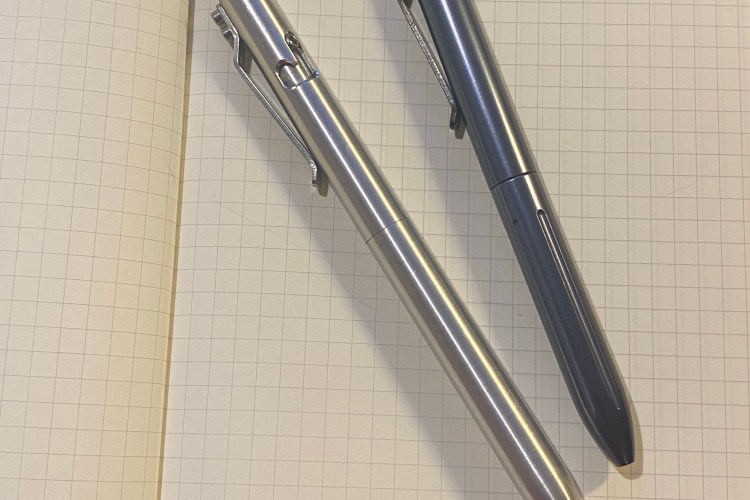
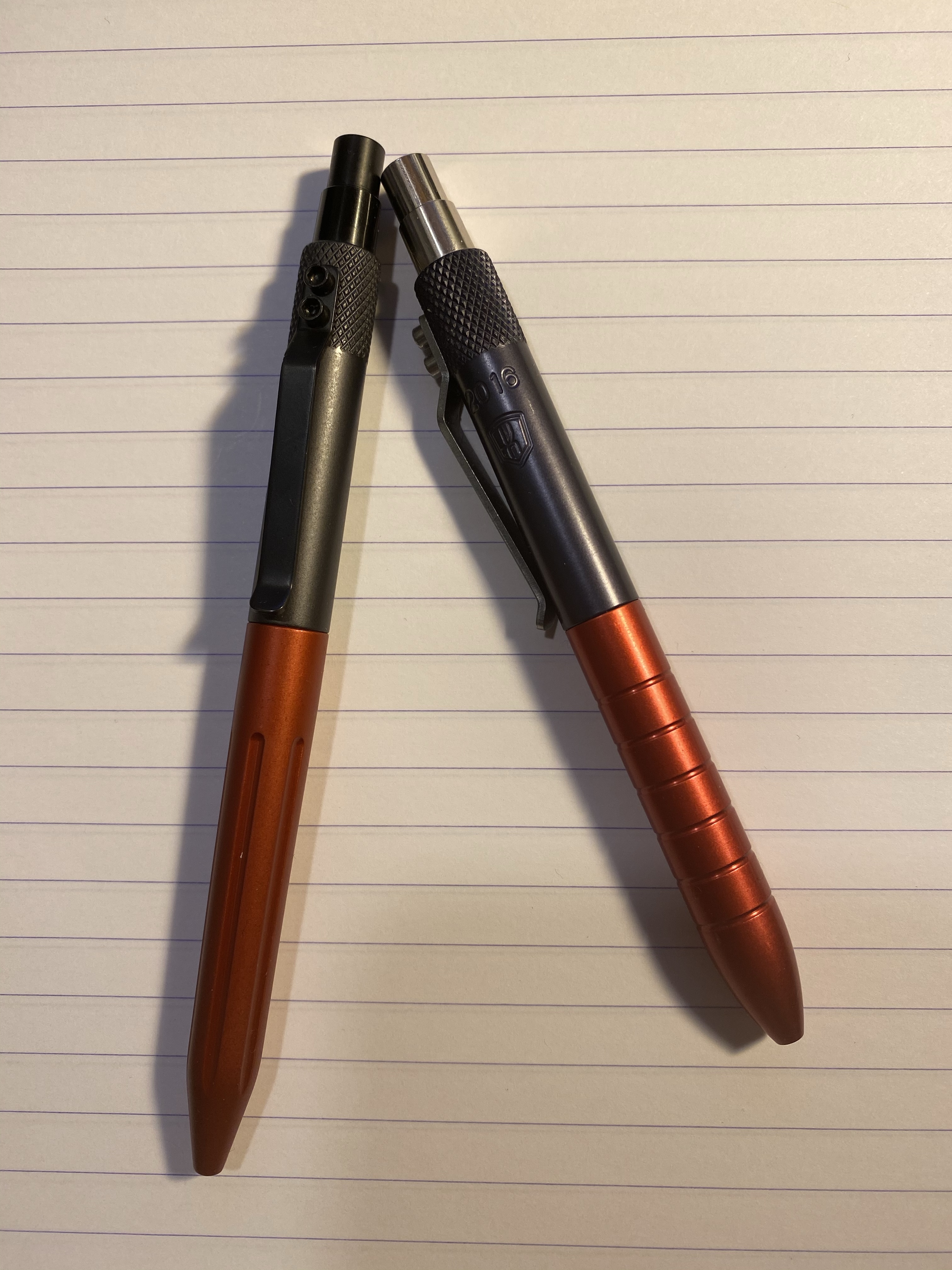
You can see that pen on the right, with it’s grey red finish and its Karas logo with the year 2016 engraved into the barrel:


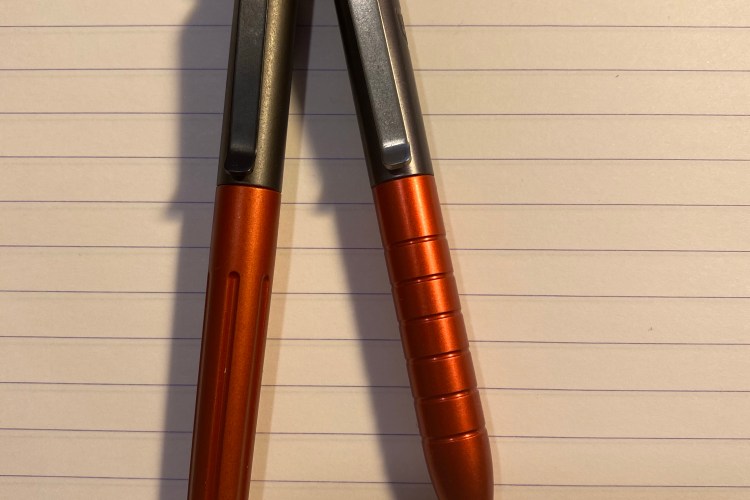
The 2019Anniversary Retrakt is the pen on the left, and when I first saw it during Karas end of the year sale I fell in love with the sleek design. The 2019 anniversary Retrakt fits a Pilot G2 refill (astrix. We’ll get to that later), comes in a matt finish with a black click mechanism and clip, and a “fluted” grip. Unlike the 2016 edition, it’s completely unbranded.


Both pens have a distinctive and attractive industrial design, and both are built like tanks. The anodization is fantastic, and both the clip and click mechanism are rock solid. The pens are fairly priced for the quality you get, they have good heft and balance, and are a joy to use. I personally found the fluted grip slightly less comfortable for use in long writing sessions than the regular grip, but I have a tendency to go “grip of death” sometimes. The fluted grip just reminds me to let go a bit, the pen isn’t going anywhere without me.
2016 Anniversary Retrakt on the right, 2019 Anniversary Fluted Retrakt on the left

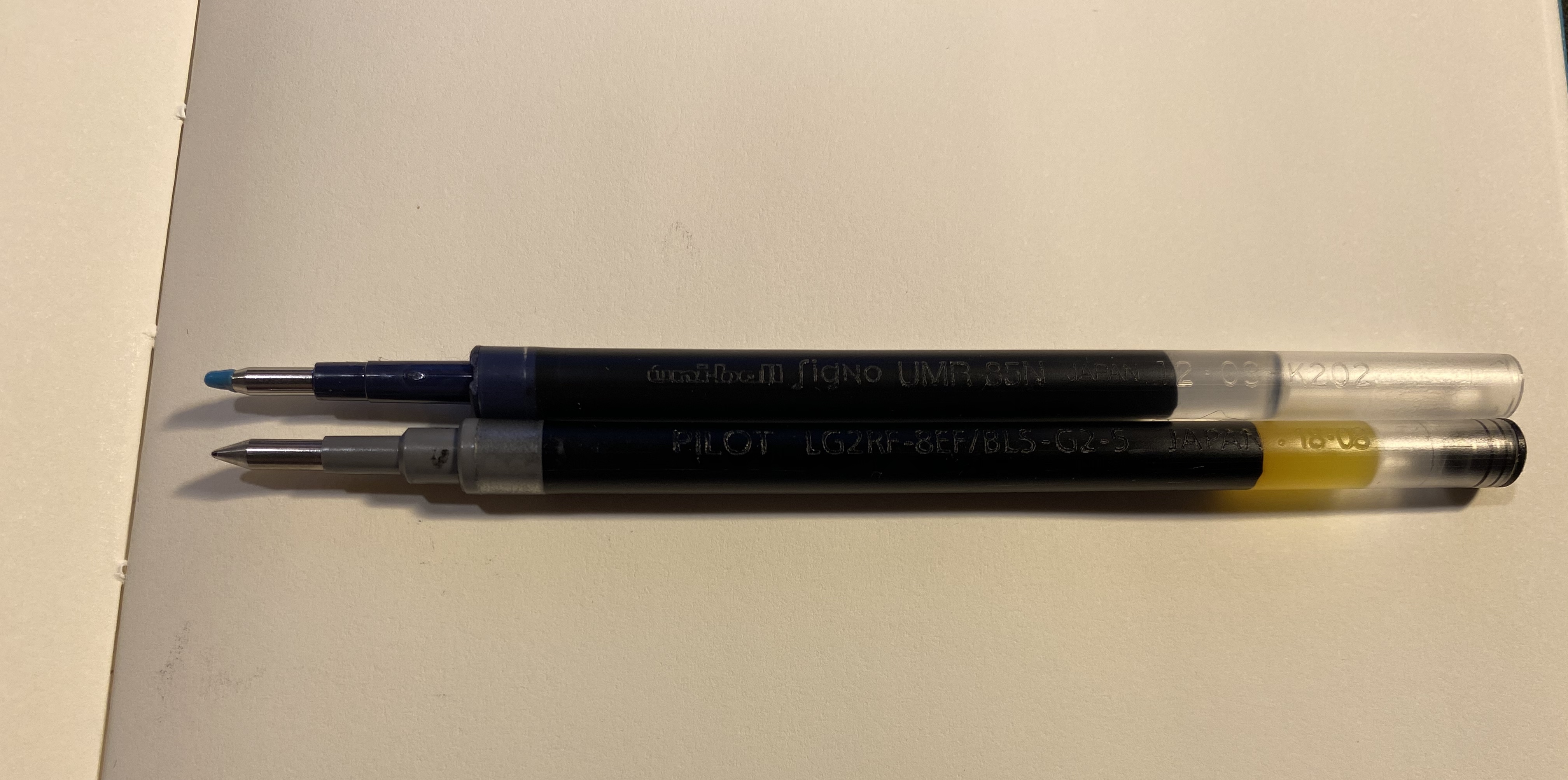
This brings us to the refill situation on the 2019 Anniversary Retrakt. As soon as I got it I took out the Pilot G2 refill it came with and tried to replace it with my favourite G2 compatible refill, the Uni-ball UMR-85. It’s something that I do automatically with every G2 compatible machined pen. The click mechanism wouldn’t engage. The plunger went down but didn’t stay down, the tip of the refill never saw the light of day. This has never happened to me with a G2 compatible pen before, so I grabbed the original refill and placed it side by side with the Uni-ball one:

Uni-ball UMR-85N on the top, Pilot G2 on the bottom

This was when I realized that the Retrakt V2 must have somehow been designed to accommodate the Pilot G2 tip configuration and only the Pilot G2 tip configuration (unless you purchase a Parker style conversion kit from Karas). This was a big disappointment to me.
Schmidt vs Pilot G2 Retrakts

I probably wouldn’t have purchased this pen had I known this going in. I don’t hate the Pilot G2 refills, but I’m also not a huge fan of their tendency to be globby or stop working while they’re still half full. This means that I’ll be trying to hack a Uni-ball refill into this pen one way or another. Here’s hoping that I succeed because this the 2019 Anniversary Retrakt is a handsome and well made pen that I would really like to have in my rotation.