Three Habits Worth Keeping

Happy New Year!

This is the time of year when people set resolutions, themes, goals, intentions, words of the year, etc. Ambitions are high, intentions are good, but well before March most of these efforts will be abandoned and forgotten. I’ll be writing about my quarterly plan and my 2025 planner later on, but for now here are three habits that worth keeping in 2025 and in general, and a few tips on how to get into them and persist:

Exercise

Any amount and any kind that you can do is excellent. Let’s repeat that: ANY amount of exercise and ANY kind of exercise is a tremendous win. Start with walking if nothing else speaks to you, but try to make sure it’s a brisk walk and not a shuffle if you can. It doesn’t need to take an hour, and it doesn’t need to be 10,000 steps. Remember, anything you can do is good. Local gyms and community centres usually have classes you can try out if you want to give yoga, pilates, kickboxing or jiujitsu a try.

Running offers the best “bang for your buck” in terms of time and money invested per health and fitness gains, but not everyone can run, and not everyone enjoys running. If you want to give running a start, I recommend using any “couch to 5k” app, and then transitioning to the excellent guided runs and training plans in the free NRC app to keep you going. If you need someone to keep you accountable, either join a group of some sort or find a friend or family member to work out with.

The NTC app offers a huge variety of training options – from yoga to full equipment gym workouts, with some excellent body-weight workouts in between. Swimming is a great low impact way to build up cardio and a bit of strength, and weight-lifting isn’t as intimidating as you think – a pair of dumbbells at home is a great way to start exploring it. Yoga with Adriene is great way to get into yoga if you don’t or can’t take a class and the NTC app seems too intimidating.

Soccer, basketball, baseball and other group sports are great ways to expand your social circle, and tennis, pickleball, badminton are great ways for couples to work out together.

The easiest way of getting into the habit is doing a little something every day, and doing it as soon after you wake up as possible. That way you start the day with a win and some endorphins, which is always a nice way to start your day.

If you think you don’t have time to work out, be honest with yourself and track your time for a day or two. How much time is spent on social media? Binge watching TV? Mindless scrolling? Could you cut some of that out? Could you go to sleep a little earlier and wake up a little earlier so you can have some alone time to exercise and clear your mind?

If you already have a solid exercise routine in place, take the time to diversify it if you can. This goes particularly to us runners: strength train. Swim. Cycle. Do things that aren’t just running, because just running is one of the main causes of such relatively high injury rates amongst runners compared to other athletes.

Reading

Most people don’t read, which is their loss because reading is a superpower. Train your brain off the social media dopamine hamster wheel and teach it how to focus for significant stretches of time by picking up a reading habit. You’re standing in line bored? Open your Kindle app and pick up that detective novel or space opera from where you left off. Replace TikTok, social media and YouTube with books, and make sure that they’re books that you want to read. Don’t go off bestseller lists or influencer recommendations or whatever one this or that award, or is considered a classic. When you’re getting back into reading you need to gradually train your mind to get used to this activity. Start with a book that really interests you (not one that’s impressive), and start with a physical copy because they’re easier to read. Reading will do to your brain what exercise does for all of your body: make you better, stronger, faster, healthier and happier.

If you’re already a reader, then mix things up a bit: if you only read non-fiction, read fiction for a change and vice versa. Try something new, because you may just end up liking it. If you’ve only done light reading so far, pick a challenging book and work your way through it. Treat your brain like a muscle you are training, where you gradually progress to bigger and bigger weights. Challenging books are often the most rewarding, but you probably should start with them.

Journaling

Digital or analog, it doesn’t matter, journaling is worth doing. Gain insight to yourself, unleash your creativity, and let loose to your thoughts in a safe environment. This is the path to self improvement, learning to be kind to yourself, and having a positive mental attitude towards life.

If you’ve never journaled before, start small and simple: pick a notebook that you will enjoy writing in (whatever speaks to you, no matter what other people think), use whatever pen or pencil you fancy, and write 3-5 things you are grateful for each day. Add more sections to your daily journal as you go along: a “story of the day”, an account of what you did or what you consumed and what you thought about it, a nightly summary, etc.

Make it a ritual of sorts: write in your journal every morning and evening, every time you switch between major tasks during the day, or when you feel the need to respond to something (don’t post online, post in your journal instead).

Don’t be intimidated by gorgeous and elaborate works of art in various journaling forums, blogs and on Instagram. These are journals as craft projects, and while they are nice, they aren’t what we’re trying to get to here. It’s OK to add stickers and bits and bobs to your journal, but its purpose shouldn’t be to be photographed and posted. It’s there to work for you, so treat it like a workhorse, not a circus pony. Also, remind yourself that many of these journal photos are there to sell: stickers, washi tape, pens, notebooks, ink, the poster’s journaling course, etc. People rarely show off their “real” journals because if you’re honestly journaling only for yourself, that’s just not something that you’ll want to share.
Adventures in Time Blocked Planning

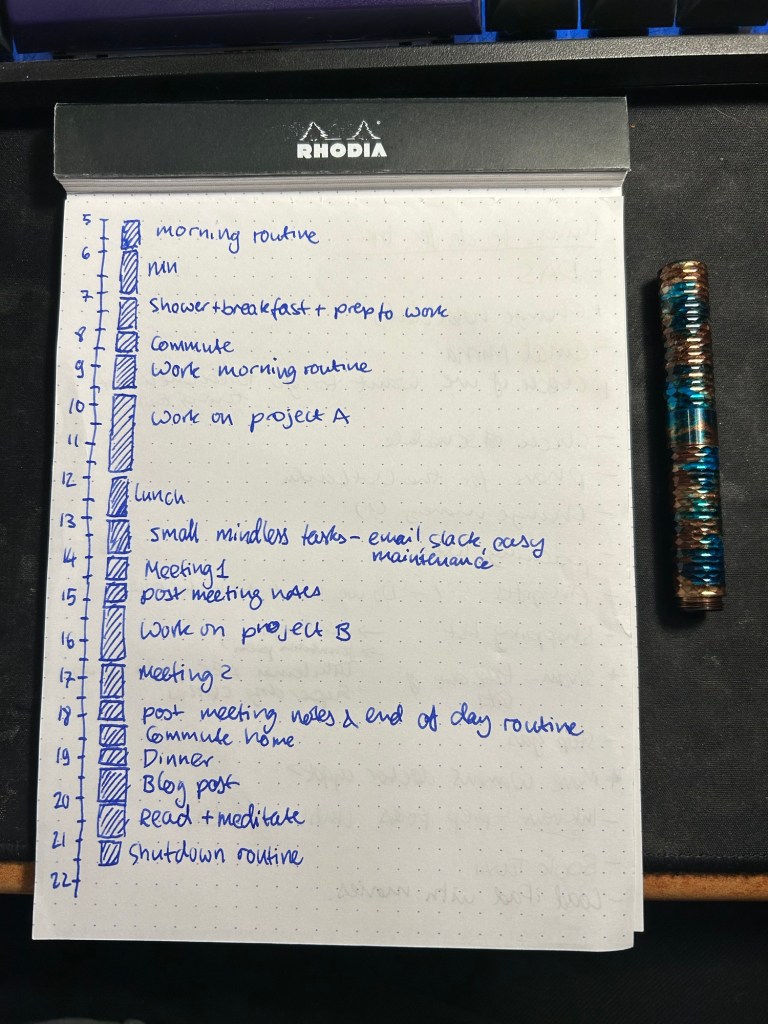
With time blocked planning the idea is to break down your day into blocks of time where you do things. The point is to structure your day so that you’re never faced with the question of “what do I do next?” Instead you sit down ahead of time and block out large sections of time where you do a specific large task, or bundle together a group of small tasks. You don’t block the day out into a minute by minute plan, but instead work in blocks of at least 30 minutes and usually 1-2 hours.

The idea isn’t new, and I haphazardly gave it a try when I was a student, and not surprisingly I failed spectacularly at it. It was only very recently when I decided to give it a serious try. The reason I decided to give time blocking a try was to solve a problem that I think is pretty common: I’d run out of steam about two-thirds into my day and end up just vegging out in the evenings, not accomplishing what I wanted, not even consuming the sort of media that really interested me. There’s only so many decisions my mind could make throughout the day, and late in the afternoon I would run on empty.

Since I was already “front-loading” my day (i.e. doing the really important work first thing in the morning or as early as possible) it was pretty easy to see the benefit of deciding what to do at a given point of time early on in the day, or even the night before. My issue with time blocking in the past had been that my work day is inherently unstructured. I may plan to work on something in the morning, but then a slack message or an email comes in, or someone bursts into the room with a problem and suddenly I’m working on something completely different.

Here, however, is where maturity kicks in. When I gave time blocking a chance years ago, I didn’t really take it seriously as an approach to work and life. Once something interrupted my day (and something always interrupted my day), the plan went out the window never to return. The plans rarely survived until lunchtime, and very quickly I decided that there was little point in time blocking for people like me. What I failed to realize at the time was that the majority of people are people like me: we live in a world where we are constantly being interrupted, and rarely does the day end in the way we envisioned it at the beginning.

Given this new found realization, and the realization that some very smart, very accomplished people whose work I follow use time blocking successfully and consistently, it was clear that the issue wasn’t with time blocking itself but with how I was approaching it. So I decided to make a more consistent, serious attempt to use time blocking for at least a month or two and see where it gets me.

I’m still very early into the process, but I decided to write about it as I go along, so I’ll have a record of how I tweaked things, and for those who like me, wanted to try time blocking but have failed in the past. Maybe my successes and failures will help them in their journey.

The First Mistakes

I started out with two mistakes, one easily fixed and another a mistake that I’m still working on correcting. The first mistake was trying to create separate time blocks for my work day and my “home day”. That failed spectacularly. Lesson learned: you need to follow one timeline, one plan, from waking up until going to sleep. If you use two different plans you are setting yourself up to fail because you’re creating two points in the day where you have to switch plans. While the morning switch may be relatively easy, by the time you’re off work you don’t feel like opening a different notebook or calendar and seeing what it is exactly that you’re supposed to be doing right now. I kept my home plan on a Rhodia dot pad and my work plan on a Moleskine squared notebook, and it just didn’t work for me. I had to carry two different plans with me, I had to reference and cross reference them, it was a mess. Now I have one plan per day, on a Rhodia dot pad.

The second mistake is one that I’m still working on correcting, which is what do I do when things don’t go as planned. What I should be doing is taking 5 minutes and replanning the rest of my day basically from that point onwards. What I currently do and doesn’t work well is either try to get back to the plan the moment I can (at which point things start to fall apart pretty quickly), or try to make only minor adjustments to the plan. The reality is that if there’s a significant break in my plan (i.e. something that takes more than 30 minutes to deal with), then I need to take a few minutes to stop and completely reassess my day. No, I will not be able to fit everything I planned into it now. Yes, my energy reserves are most likely more depleted at this point than I originally planned. Rather than trying to stick to the plan and crashing and burning, I need to be kinder to myself and look at what’s left of my day with fresh eyes. “That production outage took a lot from me, so let’s switch things up so I have a lighter workload until I’ve had a chance to recover, maybe even schedule a significant break here. Then rebuild my evening so I also have a bit more recovery time then – add a meditation session, or more reading time, etc.”. This is something I’m currently working on doing consistently.

The First Successes

While I’ve been time blocking only for a short time, I have already seen the value of this system. I’m getting much more done, and I am able to dedicate long stretches of time focused on meaningful work. I batch emails to the beginning and end of the day, and slack messages only to the times between large blocks of deep focus. I haven’t had an episode of mindless YouTube watching in the evenings since I’ve started. I’m reading more, journaling more, meditating more, spending more meaningful time with friends and family. I’m also being much more realistic about my goals. Once you start putting things in the context of the hours you have in the day, it becomes easier to assess how much you can get done in a given day.

A sample of a time block plan.

It’s not just a result of the time blocking itself, of course. It’s also the way I’ve structured my year, a commitment to deep focus and digital minimalism which mean no social media, no mindless media consumption, more reading and more deliberate practice of the things that matter to me. I’m also far from reaching a point where the way in which I time block my day is stable, well-defined routine. Things are still shifting around as I’m recording in my journal what worked and what didn’t work. While I’m not looking for perfection, I do want to reach a point where I have a system that works for me (and not I for it), and that helps me better shape my days.

I’ll be writing more about time blocking in the future, whether my experiments with it succeed or fail. If you’re giving it a try or use time block planning regularly I’d love to hear your thoughts on it in the comments.

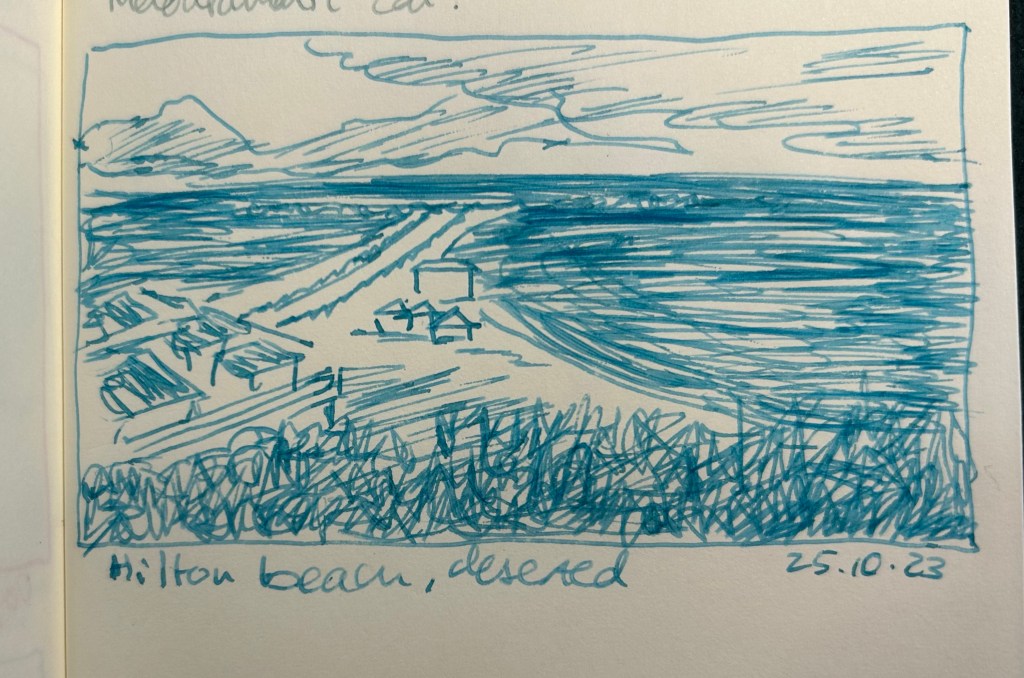
Living Through Difficult Times and Inktober Day 25

I had a phone call with an old friend today, and he asked me what I do to stay sane these days. I told him that I’m back to my chemo routine:

  • Wake up in the morning, take care of my cats and my plants.
  • Do some form of physical activity: run, gym, Nike Training Club workout, walk, something. This is non-negotiable since without it I get very depressed very quickly.
  • Work as best as I can.
  • Have a conversation with at least one friend. Messaging and emails don’t count — phone calls, zoom calls, face to face only. Yes, it makes a difference. I hate making phone calls too — it’s still worth it.
  • Talk to my family as much as possible.
  • Cuddle my cats. They’re very cuddly, and it helps. The little one in particular is velcro.
  • Journal, at least two times a day (morning and evening). These days I go for a midday session too. Write what’s going on and what I’m feeling to process it.
  • Read. It’s always been a comfort to me, and while most people can’t read during treatments and many can’t bring themselves to read anything but the news now, I’ve always found comfort in books.
  • Build Lego every night. It’s the best meditation ever. You can’t feel scared while building Lego. Your mind can’t race while building Lego. There’s only the Lego. And in the end you have something cool in your hands that you’ve built.

It worked then, and so far it works now.

Rockets on Tel Aviv

Woke up at 6:30 to rocket sirens. Multiple barrages, terrorists breached the fence, dead and wounded on the morning of the Sukkot holiday. Sketched this between barrages.

One Year Since I Finished Chemo

When you finish your chemo treatments that’s not the end of your journey with cancer. In a way, it’s just beginning. You enter a new phase, one of constant dread, one of “wait and see”. You are in remission – for now.

And who are you to complain? You are in remission. Many cancer patients don’t get to this blessed state, and you are happy you made it, but it’s alway a happiness with an asterisk. Especially during the first year post treatment.

So, it’s been a year. I got my last treatment on the 21st of December 2021 (nice date: 21.12.21), and then had about a month of feeling like absolute trash – like three locomotives carrying every ailment in the world slammed into me at once. I was on old school chemo, not the new fangled targeted stuff, no immunotherapy for me: my treatment was discovered in the ’70s and it’s good enough to remain the gold standard 50 years later.

But I kept on walking, and I kept on eating and drinking and taking my meds, and gradually I started to feel better. I got my tastebuds back. My hair started to grow again. My blood tests started to improve. The number of meds I was on got smaller and smaller until it was replaced just by a few vitamins that I was prescribed to take care of the damages still left. I got to see my doctor less and less often. We’re now at the wonderful “every three months” mark. I lost the weight that I gained from the steroids.

I got back to running: 1k, 2k, 3k for while as my lungs got better, my heart got better, and I learned to deal with my PTSD better. Then 4k, 5k, and back to long runs. These days I run five times a week, four 5ks and one 10k long run. And running means so much to me I can’t express how much it means that I get to enjoy it again.

I also got back to lifting weights at the gym, to meeting people face to face, to listening to podcasts that I used to love (though there are some old favourites that I can’t listen to these days). I went back to the office, back to public transit, back to travelling abroad, back to participating in races. I went to two escape rooms with my friends.

But I didn’t go back to being the same person.

That’s impossible, and all the time I see cancer survivors struggling to come to terms with that. Even if you lucked out and didn’t get PTSD (about 25% of patients do), cancer leaves an indelible mark on you, on the way you think, feel and react.

Thankfully I realised that about halfway through my treatments, and I like the new me. And I’m comfortable enough saying that without hedging, explaining or apologising. Period.

I have another year of high risk of relapse, which means a checkup every three months, and then three more years after that of checkups every six months. Then, at the five year mark, I’m ostensibly free. From the cancer patients groups I know there’s no real freedom from this, but it’s something that I’m gradually learning to live with.
Right now I’m still at the “every twinge, cough and ache is a cause for panic” phase. It’s not a fun place to be, and you get to stay there for a good long while. But I’ve made it through the most high risk year for my kind of cancer, the first year, so I get to celebrate for a bit. I brought a cake to work this week, and I plan on celebrating with my family this weekend, and completely ignoring the panicking voice in my head that is yelling that I am tempting fate. If my cancer returns, it returns and I’ll deal with it then.

For now it’s been one year since I finished chemo and I get to celebrate.

Weekly Update: Go on a Run Anyway

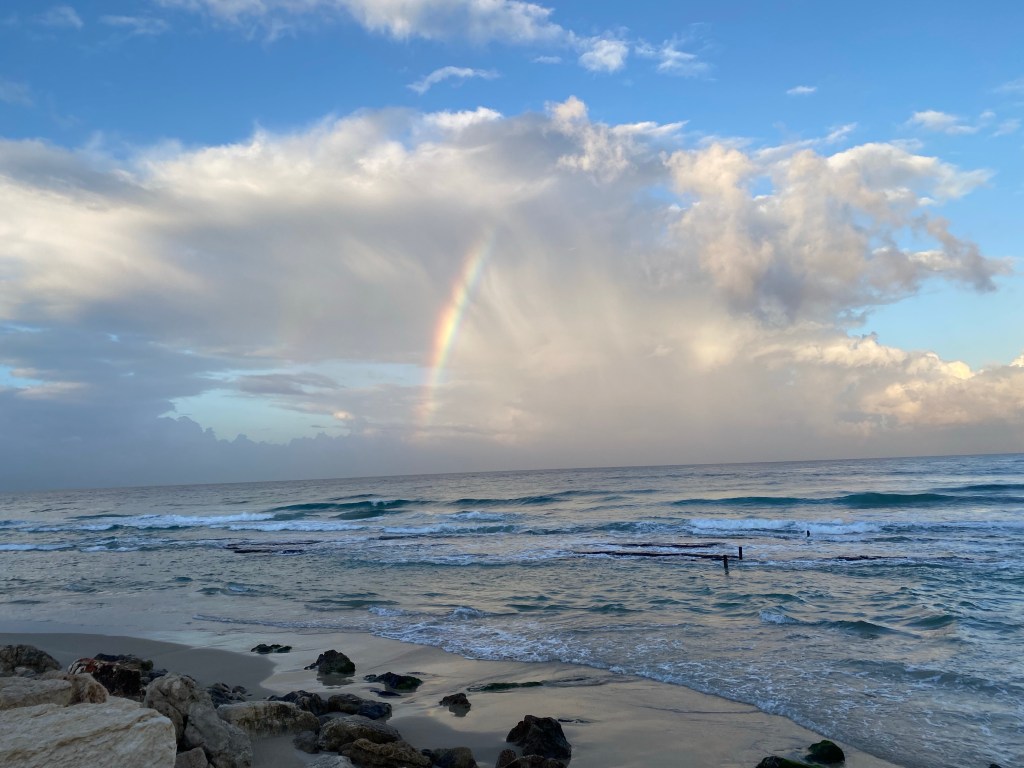
It was cold and dark outside this morning, with a chance of rain. My legs and body were sore from a combination of an intense gym session and standing/walking around at a conference yesterday. I didn’t feel like running. I went on a run anyway.

This was my reward:

Rainbow over the Mediterranean

I’ve never regretted a run yet, and today was no different.

Health

I started getting my post chemo treatment tests done, and while my lungs still aren’t 100% (but hopefully will someday get there), my heart and SVC got a clean bill of health. As both the tumour and the chemo slammed it, I’m very relieved that my ticker survived. Can I chalk it up to years of running? Maybe. It surely didn’t hurt.

Reading

I just finished reading “The Golden Enclaves” by Naomi Novik, the final book in the Scholomance trilogy.

It’s rare that I see an author really working out a new concept, a new kind of world building out of a tired trope, and doing it so well. It’s even rarer that the author in question is able to pull it off while still creating a readable and enjoyable story, and one so cohesive that it is clear at every point that this was constructed as a trilogy on purpose, from the start, with every piece of the narrative falling exactly into place in the end with elegance, and without calling attention to itself. This is a mechanically excellent piece of writing that doesn’t call attention to its mechanics.

Instead it calls attention to its characters, their relationships with each other, and in particular their relationship to the deep, inherent, and seemingly justified inequalities in their world. Inequalities and injustices that aren’t very hard to map onto many of those that exist in our world today.

Is the Scholomance trilogy perfect? Of course not. The characters don’t attain true depth because the cast is too large, the world needs building and that needs room, plus, these are teenagers after all. Many of them are still working out their personality. But despite its imperfections this is a very enjoyable trilogy that is worth reading, and won’t leave you feeling like you just consumed several hours of empty air. There’s substance here.

Other stuff

I’ve been creeping back to writing, albeit only adventure writing for D&D. I’m creating a new campaign, in a new world, something that I haven’t done for years.

I’m also looking into planning for next year. I have been really struggling with this mostly because of my cancer related PTSD. More on that maybe in later posts.

If you have Disney+, I recommend watching “The Magic of Animal Kingdom”. It made me smile.

Happy New Year!

Happy New Year! May 2022 be better than 2021 in every possible way.

From the Yayoi Kusama exhibition in the Tel Aviv Museum of Art

A Day at Chemotherapy

I’m having my (hopefully) last round of Chemo today and I’d thought I’d document the procedure as I go through it.

4:45 – Woke up and started taking care of my cats, making breakfast, getting ready to leave for the hospital. I need to drink at least two glasses of water before I go, one of then with Normalax. The water is because I have to have a blood test before the Chemo starts. The Normalax is to prevent one of the less pleasant side effects of my Chemo: constipation. As in all the rest of the adverse effects, prevention is easier than treatment.

6:00 – I leave my house and set out for the hospital. My dad is giving me a ride as there’s little chance that I’ll be able to catch a cab in this weather. I’m wearing athleisure clothes (sweatpants, t-shirt, hoodie and a coat because it’s raining). I never wear jeans to your Chemo, because logistically they’re harder to manage one handed, and depending on where you have your IV inserted, you may have to manage your pants one handed. It’s the little things.

6:30 – I’m at the hospital. At 6:45 the line opens up for the secretaries of the Hemato-Oncology outpatient treatments. The secretaries themselves start working at 7:30, even though the nursing staff is here largely by 7:00. The Oncology secretaries start working at 7:00, and I have no idea why. The Oncology outpatient treatment area is across the hall from the Hemato-Oncology one. Usually when I get here at 6:30 there’s 3-4 older gentlemen already waiting to get a number in line for the secretaries. I have no idea when they arrive (I joke that they must have spent the night here to be first), but they’re almost always here, and once they get their number they start a parliament of news analysis and general gossip. Why arrive so early when at the earliest you can start pre-treatment procedures at 7:30? Because this department has outgrown this building a while ago and the new building expansion won’t be ready for 2-3 years yet. That means that there’s a dearth of seating areas for treatment, and and even bigger shortage of good seating areas. When you spend 4-5 hours at least sitting getting treatment getting a good place is a thing. There are two rounds of treatment – the morning one and the noon one. I’m always here in the morning, and if I don’t get here by 6:45 at the latest, I’ll be 10-11th in line and with little chance for a decent spot. You snooze, you lose. Although this time, maybe because of the weather, I’m the first one here.

6:50 – I’m the first in line! The parliament of elderly gentlemen arrived, but arrived later than usual. A lot of sour faces that I beat them to the punch. 😂 As usual, I’m the youngest person around by a pretty large margin. I only once saw a person my age getting treatment while I was here.

7:47 – got my IV in (from a fantastic nurse), blood test done, got a great seating place (private and near a window), and I’m now waiting for my blood test results and to see my fantastic doctor.

8:10 – The usual technician that analyses blood tests isn’t here, so my blood work is delayed. It’s going to take a while.

8:20 – My blood test results are back and they’re good enough for me to get treatment. Yay! Going into the doctor’s office. My brother is saving my seat downstairs, and will be my escort for today. There’s a 30 minute interval where I’m not allowed to move, and during that time I need someone at my side to help me out and call the nurses if they’re busy and don’t hear the call bell to change IV bags. Also, I need help in general once I’ve started the treatment, and it’s nice having someone around to talk to.

There’s a festive feeling now that it’s the final treatment.

8:30 – done at the doctor’s office, and brought my prescription to the nurses. Took my Akynzeo pill, which is a strong anti-emetic with an effect that lasts for 5 days.

8:40 – first IV bag starts – 10mg of Dexamethasone (steroids). It used to be 20mg but I asked for it to be lowered during the last three treatments. It’s still a lot of steroids. They serve as an anti-emetic and to help me survive the treatment.

9:05 – first IV bag finished. Spent the time talking with my funny and entertaining brother.

9:10 – it’s not a busy day here, so the pharmacy fulfilled my prescription quickly. They prepare the IV bags for me specifically, on the spot. I get a paracetamol pill (only one, because it’s part of the protocol, nobody is sure why), and two nurses cross check my personal details against what’s printed on the IV bags and is the computer. I get connected to my first chemo IV bag, Adriamicin. It’s a red fluid that can burn my veins if the IV isn’t in properly, so my nurse checks the IV. This and the next bag are given without the use of a machine, just gravity and my veins. I’m not allowed to move while it’s being given.

9:20 – second IV bag, also outside of the machine and of potentially burning chemicals. It’s Vinblastine, which is what causes the neuropathy side effect. I’m also not allowed to move during this. My favourite nurse came to say hi, and congrats for getting to the end of my treatments.

9:30 – Scary IV bags are done. I get a vein wash and am connected to Bleomicin, my third IV bag, this time through a machine. In 10 minutes I can move and go to the bathroom.

9:50- had my first bathroom break. It’s always a bit of sensation because the pee comes out red because of the first chemo bag. I didn’t know that the first time so it kinda freaked me out. I will be getting two litres of water as part of my chemo (the chemicals are diluted in water), and I’ll be drinking at least another 0.5 litre this morning as one of the chemicals really dries my mouth out. That’s on top of the two cups of water and one cup of coffee that I had this morning. So lots of bathroom breaks in my future, though I won’t be documenting them.

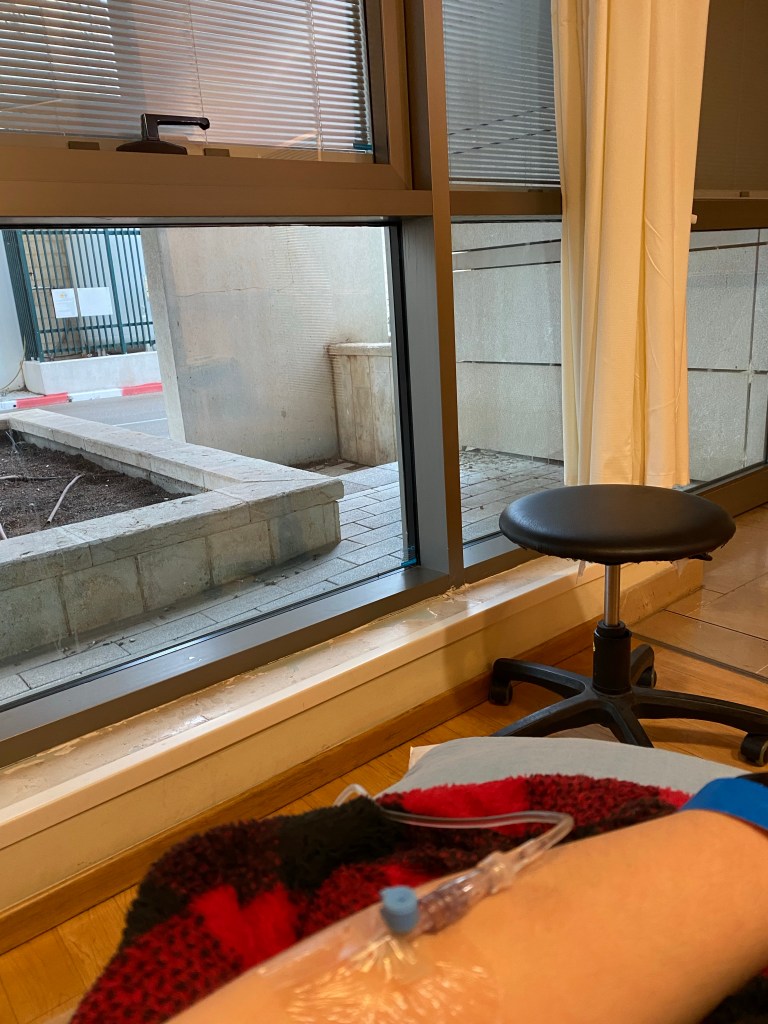
Not a great view outside but at least it’s a view.

10:05 – third bag done. Now waiting for the nurse to change my IV bag. The last chemo IV burns when you get it, so they administer it slowly, and I might need a hot compress on my arm if the vein is narrow.

10:10 – connected to what is hopefully my final chemo bag. Decarbazine.

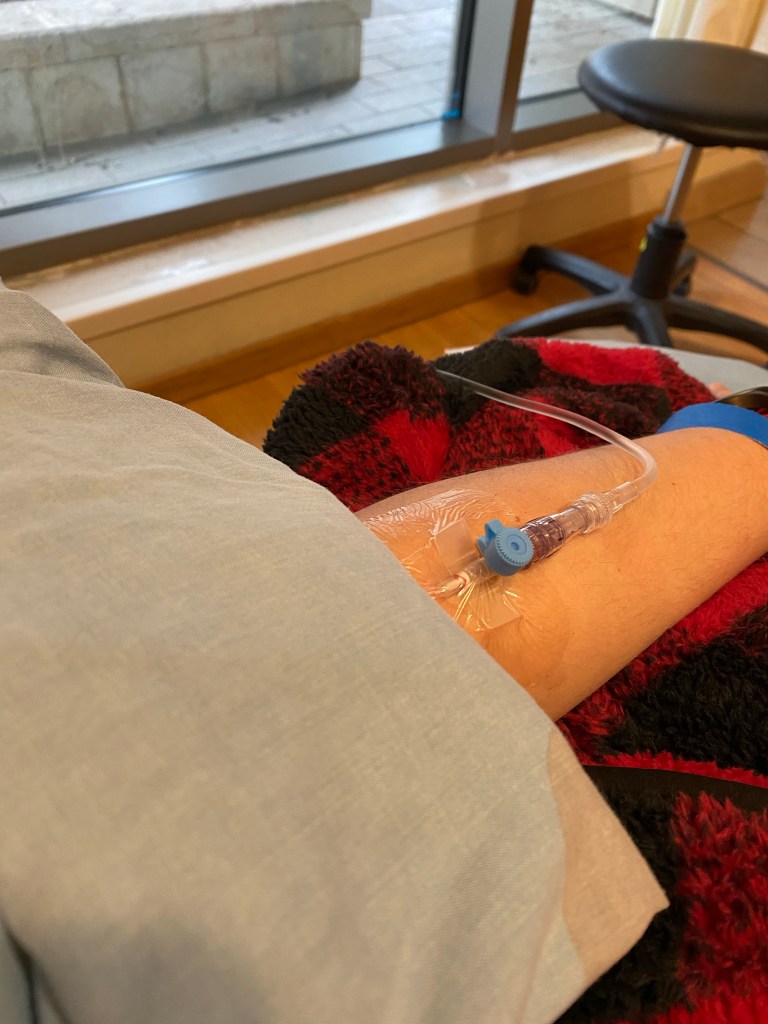
10:18 – the IV hurts so I get a hot compress (a water IV bag heated in the microwave and placed in a pillowcase) to press to my arm and expand the vein. The alternative is to lower the IV rate, but as it is this bag will take 1.5 hours.

Me and my hot compress.

11:00 – still on my last chemo IV bag. There will be a water IV to rinse out my veins in the end. Got my compress reheated, and I’m reading “Harlem Shuffle” on my Kindle. I’m still using only one hand, so the Kindle is the best for reading under the circumstances.

11:30 – finished the fourth and final bag of chemo. Waiting for an IV flush.

11:45 – I’m done. One of the fastest treatments yet. 🎉🎉🎉

Resilience: A Health Update

While I was taking a walk a few days ago I saw this tree branch grow out of a tiny crack in a solid stone wall and I was impressed enough by its tenacity and resilience to draw it. By chance this drawing is on the opposite page of the one I made for my last health update, which seems appropriate.

I underwent a PET CT on the 9th of September, and thankfully the results were good. The treatment is working, kicking my cancer’s ass and not just making me feel bad. I went through another round of Chemo on the 12th, my fifth round so far, and the side effects are stronger and taking longer to fade away between sessions. This is to be expected, as the Chemo’s effects are cumulative, but I’ve decided to be like that tree: resilient. I’m making minor adjustments to get me through the post-Chemo days, working out ways to help me ride out the pain and unpleasantness of the worst of the side effects. It’s hard to pick up a pen or brush in the first days after treatment, and I sometimes lose fine motor control. So I’m using larger and lighter pens, and I take photos of things that I want to draw instead of working on location. At home I can take my time while sketching, take breaks, experiment with looser drawing. The drawing above isn’t large or complicated, but it took me two days to complete (one for line work and one for the watercolour).

Resilience. One treatment at a time.

Health Update for the New Year

It’s been a while since my last update, so I thought that I’d write a new one. On August 24th I had my fourth chemo treatment, and it went rougher than the ones before it in terms of side effects. The worst of the bunch has been my neuropathy, which until now has been not so bad. This time however, both my hands were numb and tingly, and the tips of my fingers actually hurt. It’s been hard typing, holding a pen, drawing. It’s not that I’ve stopped doing these things, it’s just that it’s been a challenge to overcome the pain, to focus more to get my hands moving the way that I want them to. But I haven’t given up, and I’ve managed to type, write with my pens, and even create this drawing:

Not bad for someone with semi functioning fingers, right?

My hands have gotten better with time, but they are getting better slowly, and they still haven’t returned to normal. I’ve discovered that lighter fountain pens with bigger barrels are the best in terms of being easy on my hands, and although my handwriting has suffered a bit due to the pain, it is still recognizably my handwriting.

What’s next? On Thursday I have a PET CT which will determine what the rest of my chemo treatment will be, and on Sunday I’ll have the fifth chemo treatment. I’m not looking forward to either of these things, and as the PET CT is approaching my anxiety levels are rising (I really need good results on it). Meanwhile I’m trying to distract myself with work, books and season 2 of “Ted Lasso”. Here’s hoping for good results, and less pain for the Jewish New Year.