Diamine Inkvent 2024 Day 2

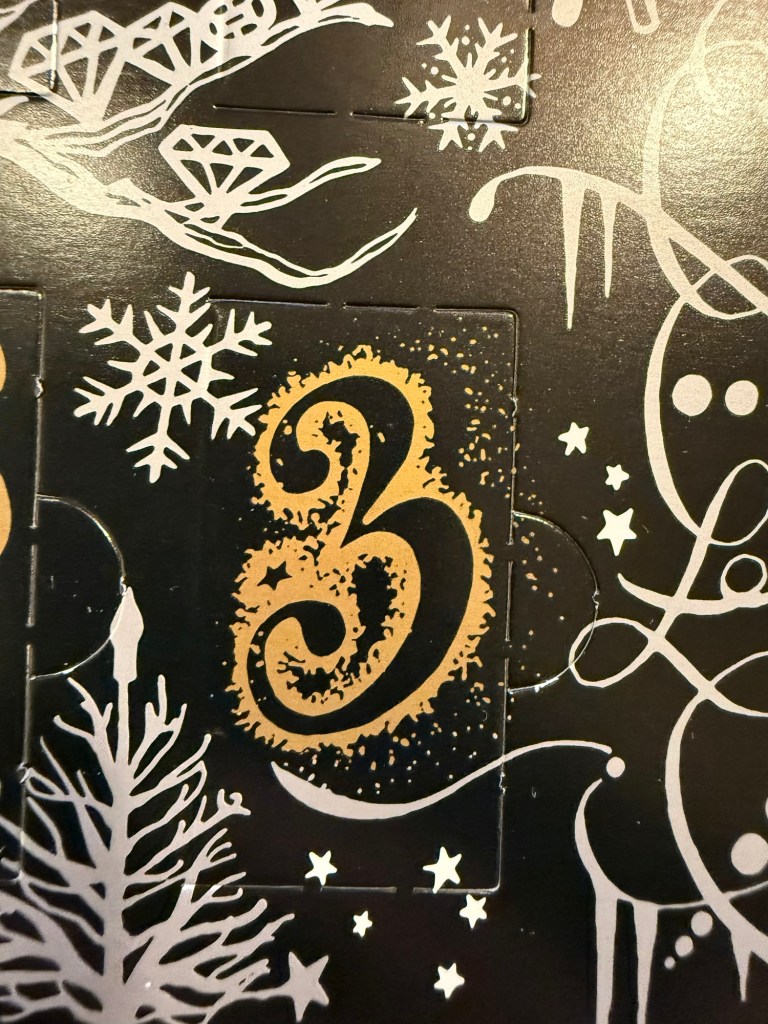
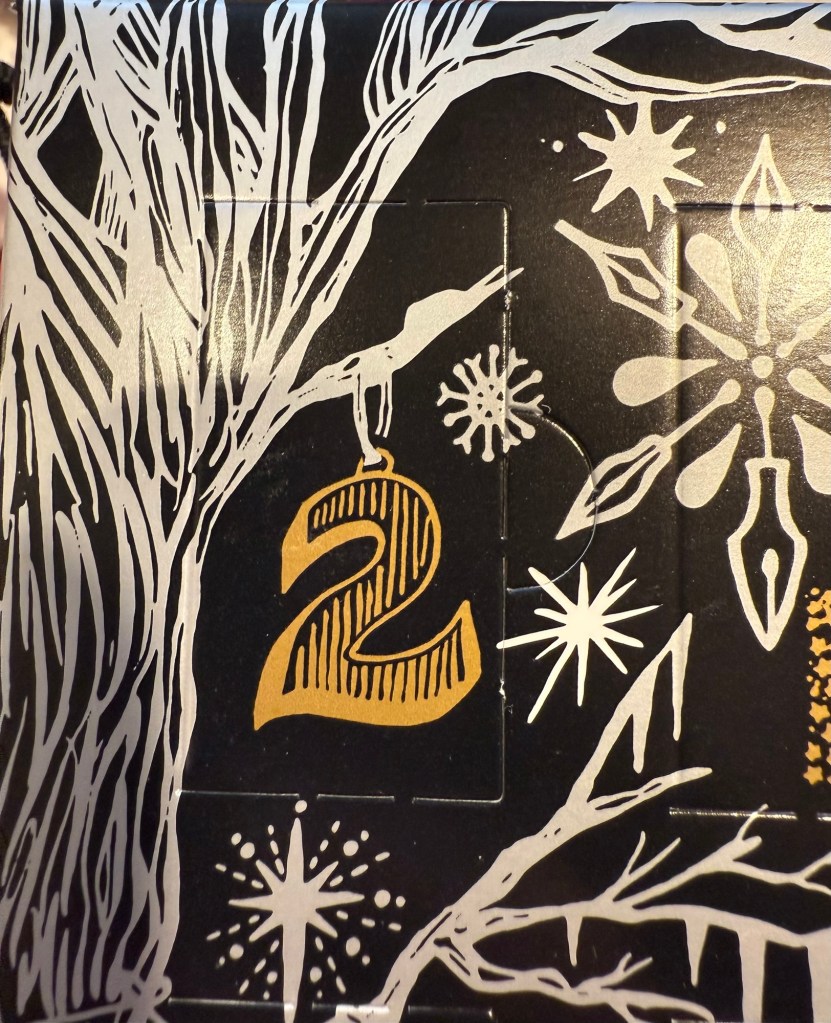
This is the Diamine Inkvent 2024 day 2 door:

The door

Day 2’s ink is Diamine Wilted Rose, a standard ink in a dark dusty rose shade. I tested it using a Lamy fine nibbed fountain pen.

The Col-O-Ring swab

Diamine Wilted Rose has an interesting colour and a good amount of shading. It’s dark enough to be seen on both white and cream paper (and it would work particularly well on cream coloured paper). It’s well behaved though it’s a wet ink, so I would shy away from using it in wide nibs. I find the decision to include it in a Christmas themed product like the Inkvent calendar a bit peculiar, but Diamine have made stranger choices in the past.

Writing sample on Rhodia paper

As Diamine Wilted Rose is pretty similar to last year’s Diamine Masquerade (minus the shimmer), I decided to compare the two swabs. Wilted Rose is darker and redder than Masquerade, and more easily readable. It is also a wetter ink that shades a bit less than Masquerade as it’s more saturated.

Which one of these do you prefer? I like Masquerade’s colour more, but Wilted Rose is a more practical choice.

Diamine Masquerade and Wilted Rose comparison.

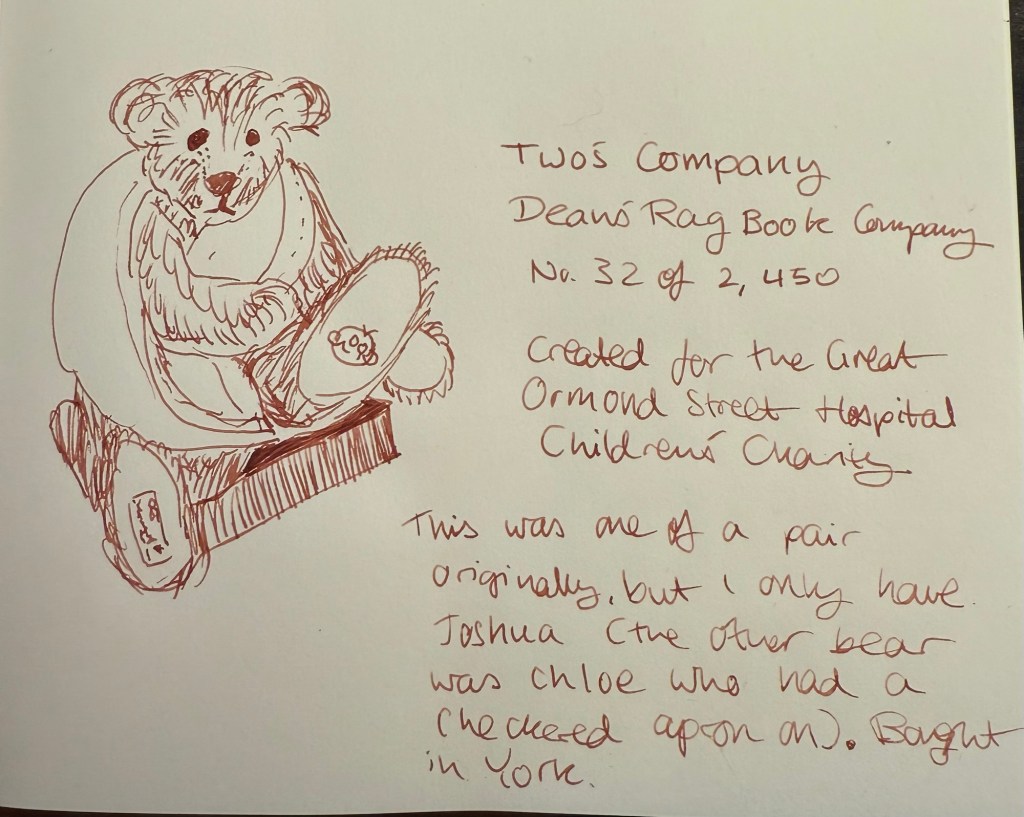
Today’s bear sketch features a charity collectible teddy bear that was originally part of a pair, but when I purchased him had been separated from his counterpart. Joshua has his paw in a sling, and has a lovely Dean’s Bears face. There’s something childish and innocent about him, which fits the charity he’s supporting very well.

You can see Diamine Wilted Rose’s shading well here, much better than in the writing sample, likely due to the Midori MD Cotton paper.

Sketching sample on Midori MD Cotton paper

Here’s Joshua from the Two’s Company Dean Rag Book company. He’s a British bear, and I bought him second hand in York from a store called Mary Shortle’s.

Joshua the bear

Diamine Wilted Rose scores relatively high on practicality, as it’s a standard ink that is readable. It’s not a perfectly practical ink, as it’s on the wet side and you can’t use this shade of ink for everything. It is a good ink for journaling and personal correspondence though, as it’s an interesting colour of ink with a good amount of shading. I wouldn’t hesitate to use in my vintage pens.

In terms of theming, I think that it likely adds variety and interest to this year’s Inkvent but it’s not a very “Christmasy” colour (nor does it have a very festive name). It’s a good addition to the Diamine lineup, and while I don’t see myself buying a full bottle as I don’t use pink very often in my pens, it is a much better purchasing choice than yesterday’s Baltic Breeze.

What do you think? Do you use pink inks in your pens often, and would you buy a bottle of Diamine Wilted Rose? Would you rename the ink to something more seasonally themed?

Diamine Inkvent 2024 Day 1

This is the Diamine Inkvent 2024 day 1 door:

The door

Day 1’s ink is Diamine Baltic Breeze a shimmer periwinkle blue ink:

The bottle

The sample came out a bit rough because I tried to use a dip pen for the first few lines of writing.

The Col-O-Ring sample

Diamine Baltic Breeze is a gorgeous dusty, purplish blue in with a good amount of shading and a copper shimmer that really makes the ink come to life. This is a wet ink that will sheen if used in wide nibs.

Writing sample on a Rhodia

On the Rhodia there was some feathering and a lot of show through and bleed through, but as I was using a wide 1.1 Monteverde nib, this is to be expected. On the Midori paper there was still some feathering, but you can also see the richness and depth of this ink.

Sketch on Midori MD Cotton

Here’s a closeup on the shading, shimmer and sheen of this ink, and you can also see where it feathered a bit.

Sketch close up

And here is the bear that I sketched, Topaz, made by Dean’s Bears and bought in York.

Diamine Baltic Breeze is a gorgeous ink that doesn’t score high on the practicality side. It’s a wet ink that is pretty saturated, so it takes a while to dry, and the shimmer, feathering and bleeding doesn’t help it in the every day use department. I won’t be getting a bottle of this, but I think that it’s a great ink for the calendar, as it fits thematically and is an attractive ink. Sometimes a sample is all that you need to enjoy an ink.

What do you think of Diamine Baltic Breeze? Do you see yourself buying a bottle?

Diamine Inkvent 2024: Spoiler Free Introduction

It’s Inkvent time again!

As I have done every year since Diamine started issuing their Inkvent calendars, I will be reviewing each of the inks in the calendar, publishing one post per day for 25 days, and then a summary post looking back at the calendar as a whole. As a reminder, there are 24 doors with 12ml bottles of fountain pen ink behind them, and one 30ml bottle of ink behind door 25. All of the inks in the Inkvent calendar are new for the calendar, and they will all likely be issued in full “black edition” glass bottles sometime mid 2025.

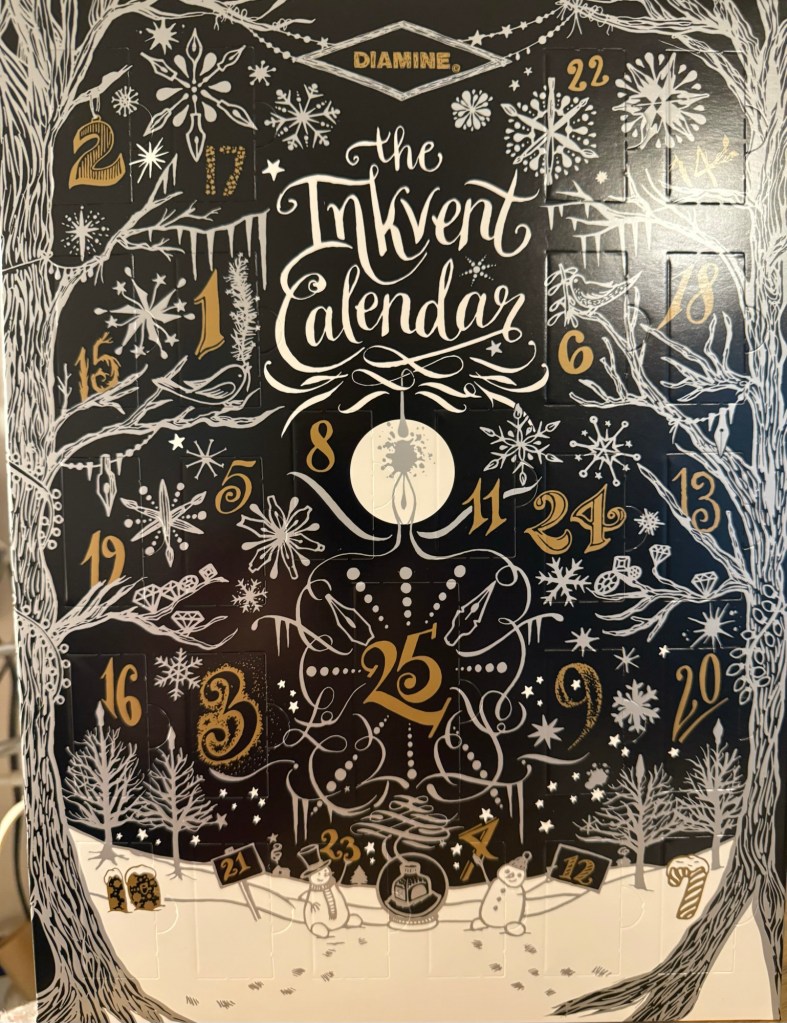
The Diamine Black Edition 2024 Inkvent Calendar

This year’s calendar is the Black edition. You can find my review of the 2019 Blue edition starting here, the 2021 Red edition starting here, the 2022 Green edition starting here, and the 2023 Purple edition starting here.

This year I will be using a Rhodia lined notebook for my writing samples (it’s a fairly standard fountain pen friendly paper that should be a good baseline for the ink), a Midori MD Cotton notebook for the bear sketches that I will be doing (the MD Cotton is a more expensive alternative to the Rhodia, but features better paper), and a Col-O-Ring for the ink swabs. I tried to use dip pens at the start of the first sample, to save me needing to fill and clean up 25 fountain pens, but as I didn’t like the ink flow with my dip nibs, I will be filling up 25 fountain pens again this year. It’s a mammoth undertaking, and as I have taken a break from posting for a while, I’m a bit daunted by the prospect.

But we do hard things because they’re worth doing, and in this case they will help me get back to a regular posting schedule and a regular sketching schedule.

My Flock of Fountain Pens for the Pelikan Hubs 2024

We just had the 2024 Pelikan Hubs event and I wanted to talk about which Pelikan fountain pens I brought with me to the event, and to note a few things that may be useful for those looking to get into Pelikan fountain pens.

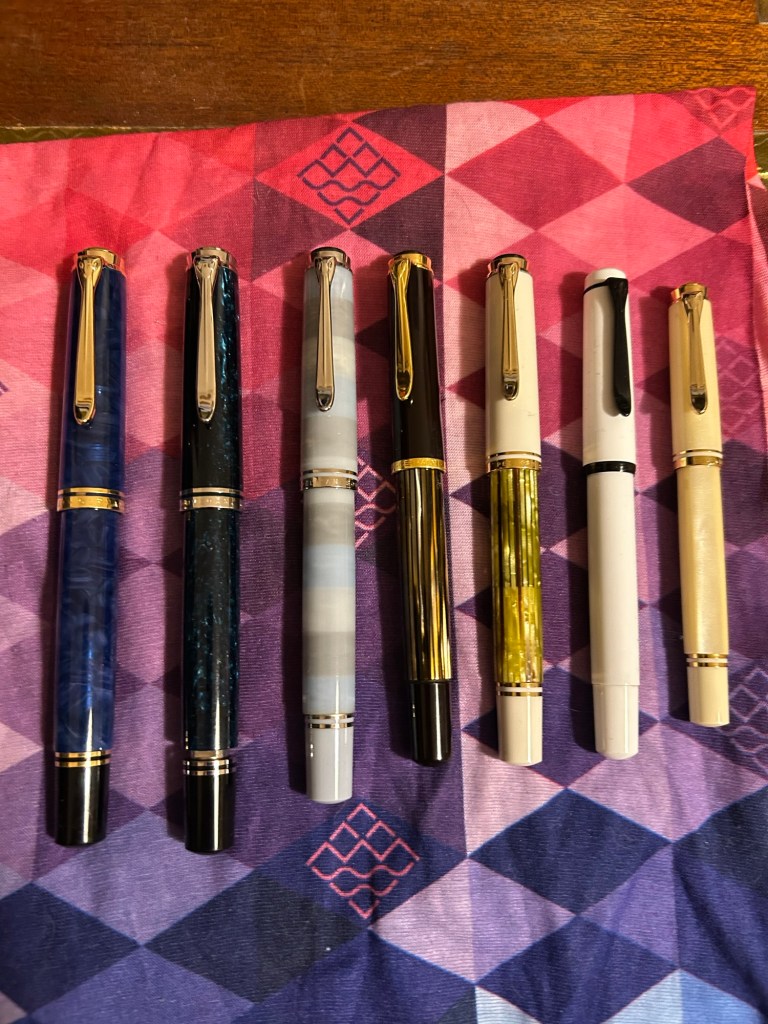
This was my flock:

From left to right they are:

  • Pelikan M800 Blue O Blue – one of the most expensive pens in my collection, and one that I (partially) got as a gift for my birthday. This pen has an 18 Karat fine nib that is soft and springy. Note: Some of Pelikan’s gold nibs are softer than others, so it’s worth testing the pen out before you buy it, especially if you’re not used to Pelikan nibs. This pen has a semi transparent blue swirly body and a typical Pelikan wide and juicy nib.
  • Pelikan M805 Ocean Swirl – gorgeous, gorgeous pen that draws attention every time I use it. The depth and shade of the material is something else, and the palladium trim and rhodium plated 18k nib work very well with the turquoise and black shades of this pen’s body. This pen also has a fine 18k nib but this one is much firmer than the one in the Blue O Blue.
  • Pelikan M620 Place De La Concorde – so, so glad I got this pen though it was expensive for me at the time. This was part of Pelikan’s city series and the only Pelikan I have in the M600 size, which is just a shade longer than the M400. There’s marbling in this pen’s stripes, as is befitting its name, and the 18K M nib is wide and juicy and of a standard Pelikan nib firmness.
  • Pelikan M400 W. Germany vintage black and brown tortoise shell – I brought this pen so that people could compare the old tortoise shell design to its modern counterpart. There’s just one band on the cap, the bottom and top finials are more rounded and there’s the old Pelikan logo engraved (not screen printed) onto the finial. The nib design is also completely different, though it still feels like a standard fine 14k Pelikan nib (wide and on the firm side).
  • Pelikan M400 white tortoise shell – this is the modern counterpart of the previous pen, and it has a 14k medium nib that is on the soft side. Both the black and white tortoise shell pens have semi transparent pen bodies so you can easily see the pen level through them.
  • Pelikan M100 storm trooper – on the rarer side of Pelikans, this steel nibbed fountain pen has a medium nib that feels just as good as Pelikan’s gold nibs. While I understand why Pelikan didn’t want to continue making M100 still nibbed fountain pens, I kind of wish they would have. These could have been slightly higher end alternatives to Lamy’s Al Stars and Safaris – a step down from the M200.
  • Pelikan M320 Pearl – the rarest Pelikan in my flock, and always a crowd pleaser. This fountain pen is tiny, and came as part of a set with Pelikan brown ink and a nice presentation box. I bought it more than 10 years ago in Berlin, and nobody was interested in them because of the pen’s size. It’s a piston filler, a fantastically well made pen and it has a very soft 14k medium nib.

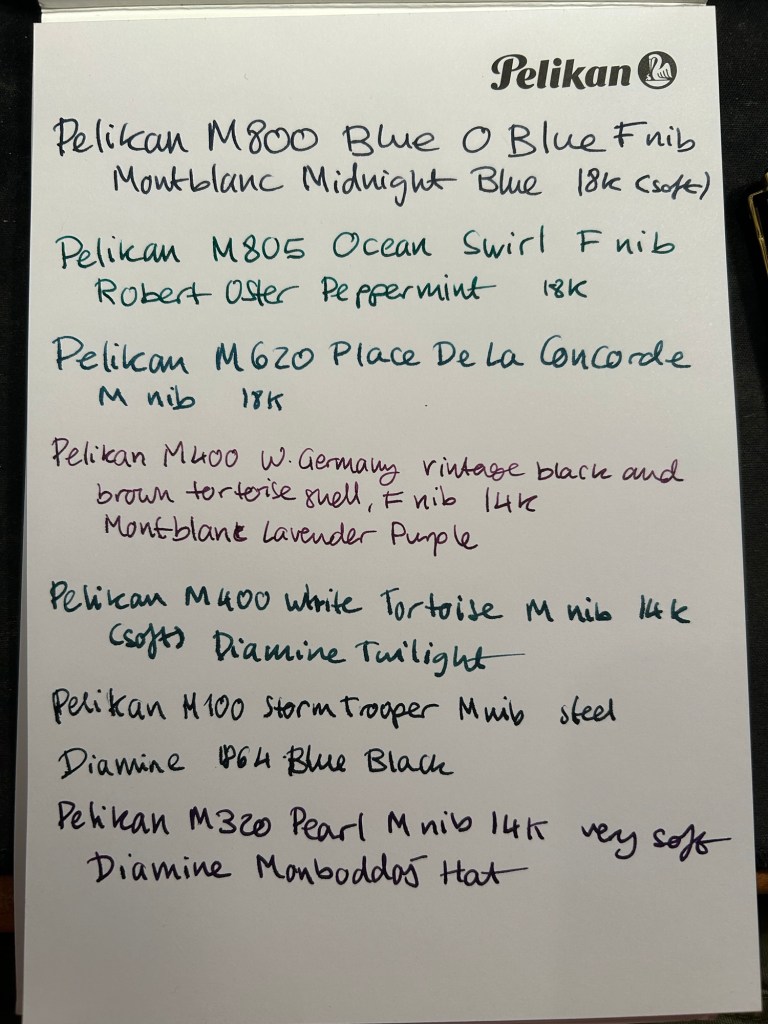
Here’s a writing sample for all these pens:

Writing sample on a Pelikan Hub 2022 notepad

Did you go to a Pelikan Hub this year? If so, which pens did you bring with you?

Pelikan Edelstein Ink of the Year Golden Lapis Review and Pelikan Hubs 2024

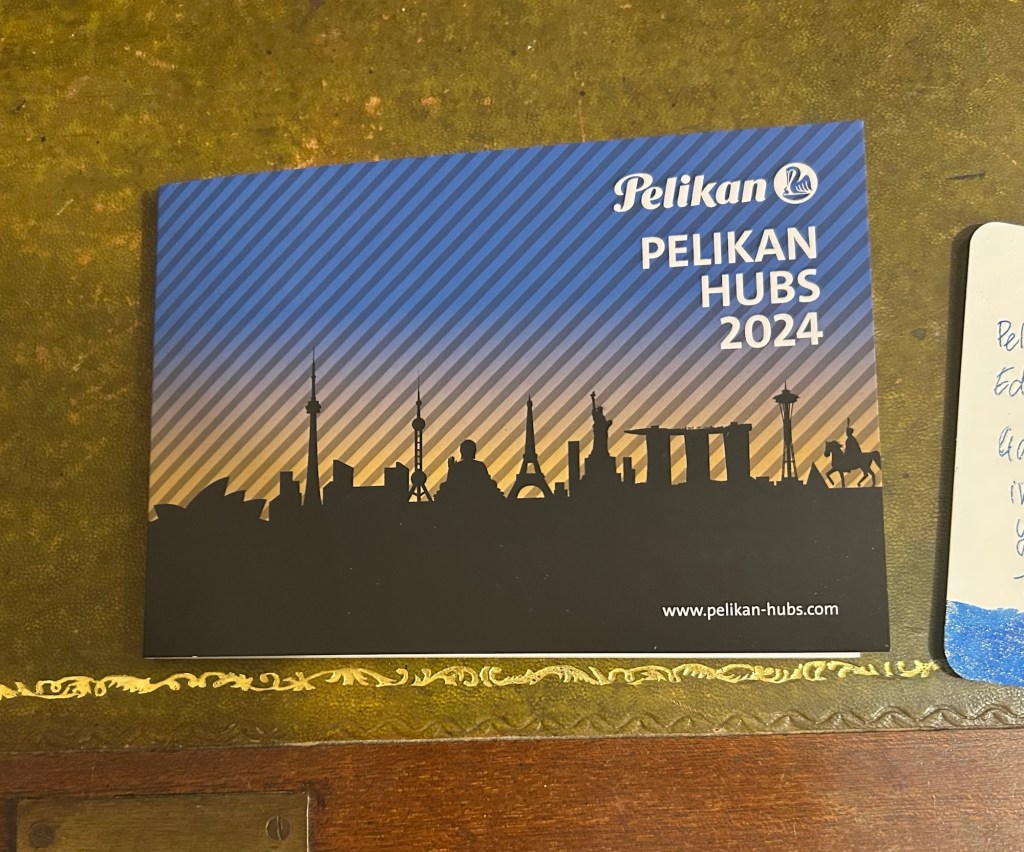
Yesterday Pelikan celebrated their annual Pelikan Hubs event, and we had a local Pelikan Hub. Since 2014 the German pen company has invited its fans to gather in groups all around the world and for one evening celebrate their love of Pelikan fountain pens and ink. The events are well organized, with a local volunteer in each country organizing the Hub location and orchestrating the event. And every year Pelikan gives Hub participants a generous gift for their participation.

This year was no different, and Pelikan Hub participants got a full sized bottle of Pelikan’s premium ink collection, Edelstein, in the Ink of the Year 2024 colour: Golden Lapis.

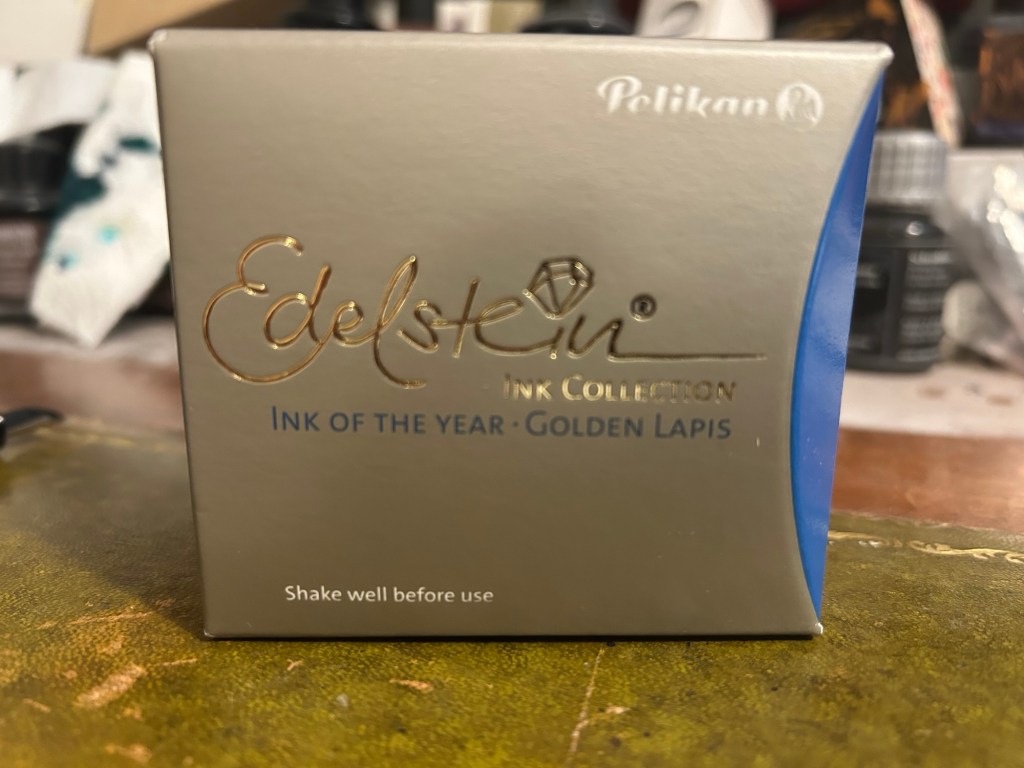
Pelikan Edelstein Ink of the Year Golden Lapis

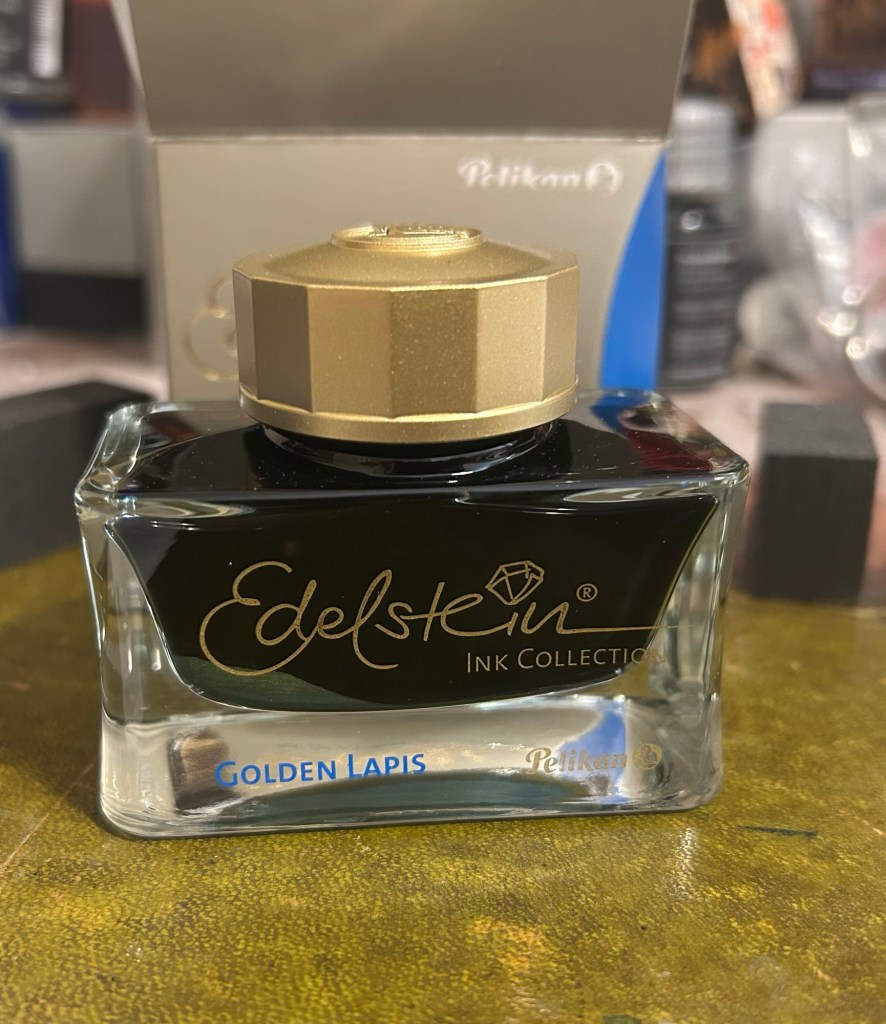
As is customary with luxury inks, the bottle is a glass work of art:

Edelstein ink bottle.

The extra thick base and wide opening work well with Pelikan Souveran pens which tend to be wider barrelled and often difficult to impossible to fill with certain ink maker’s narrow and tall ink bottles. With certain Sailor ink bottles and Diamine’s 30ml plastic bottles there’s a risk of your M400 or M800 not fitting into the bottle or of tipping the bottle while trying to fill the pen with ink. There’s no risk of that with Edelstein bottle design, though when the ink level runs very low its likely you’ll need to get creative when trying to fill your pens with ink.

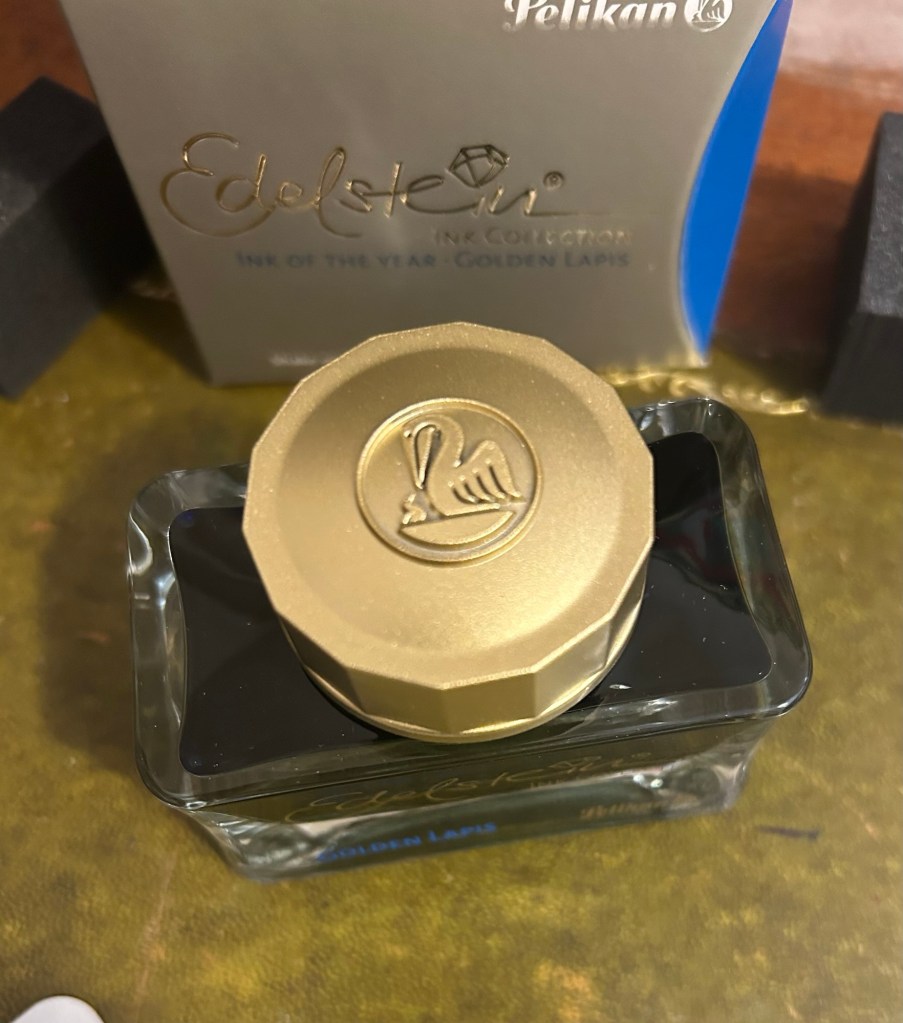
The golden cap has the modern Pelikan logo on it, with a Pelican and one chick:

The Edelstein cap

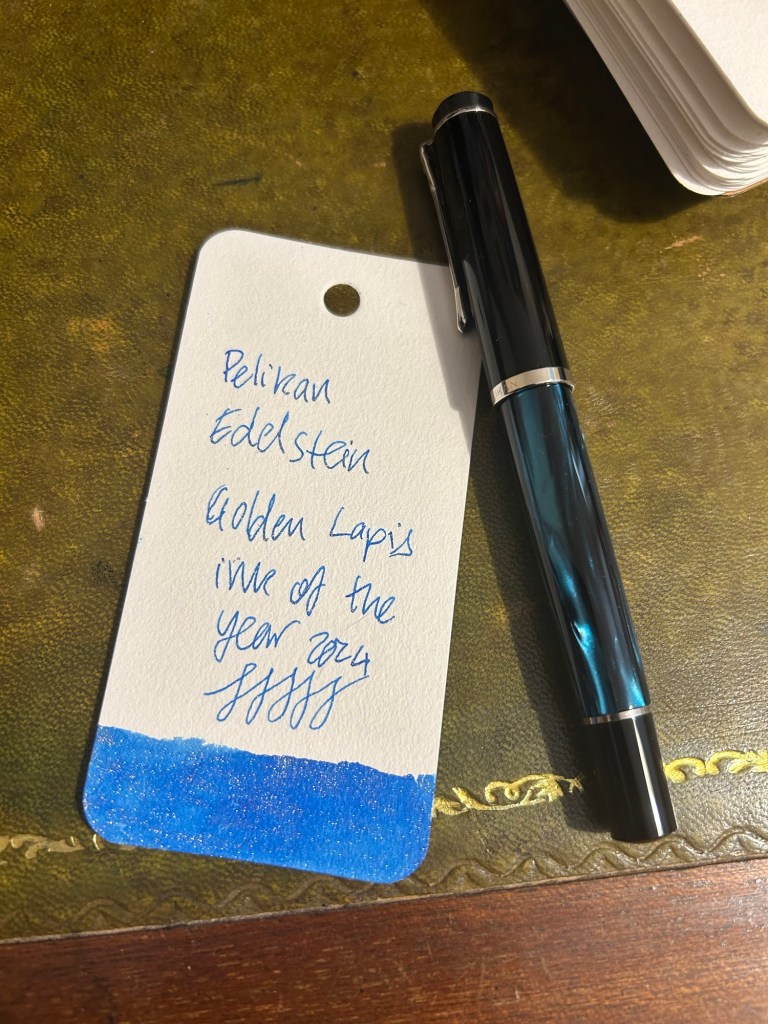
I filled a Pelikan M205 Petrol Marbled EF pen with the ink and used it for the swab and writing sample below. Here’s Golden Lapis on a Col-O-Ring card:

Pelikan Edelstein Golden Lapis ink swab

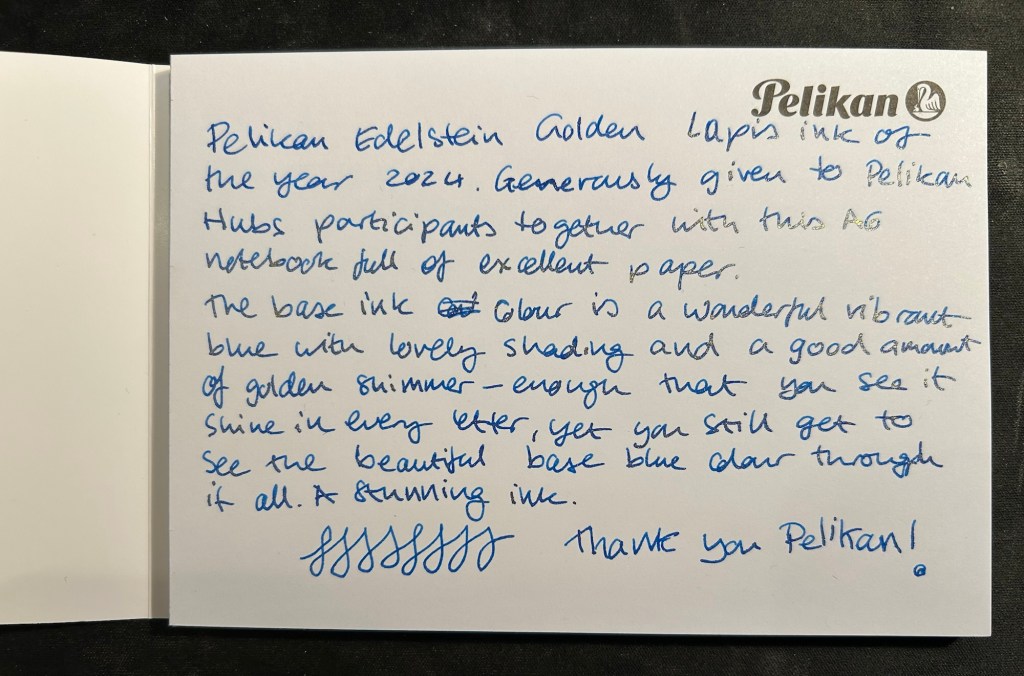
We got a nice A6 writing pad with bristol thick fountain pen friendly paper in it as part of the Pelikan Hub 2024 gifts. The paper is great though I wish there wasn’t a Pelikan logo on each page mostly because it takes so much space. The paper is thick enough for both sides of it to be useful, so it’s a shame to have to flip the page over and write only on one side if you want the full A6 page to yourself.

The A6 notepad that we received as part of the Pelikan Hub

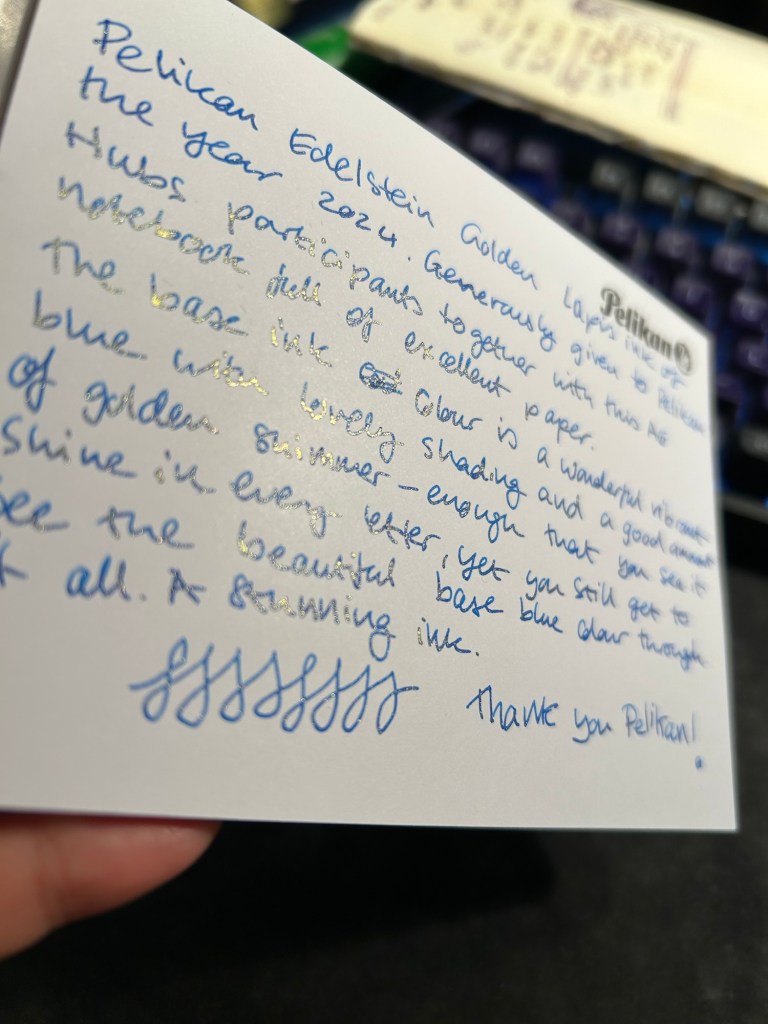
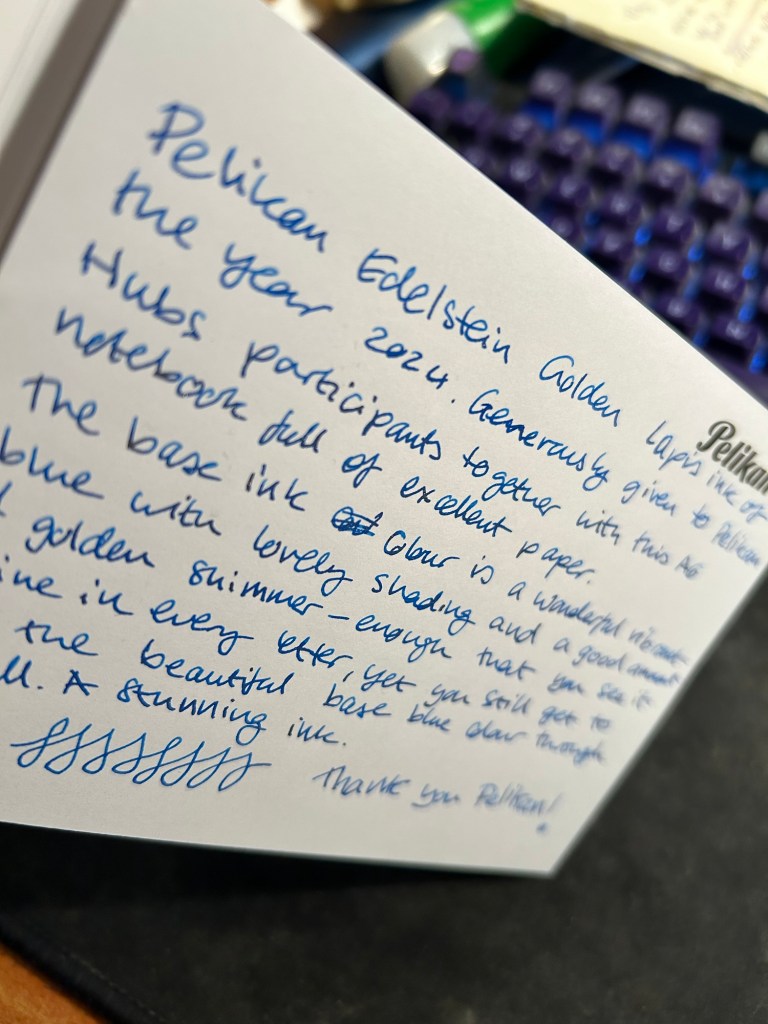
Pelikan Edelstein Golden Lapis is a gorgeous ink, period. The base rich, turquoise-y blue reminds me of Pilot Iroshizuku Asa Gao and that is high praise. The colour is rich, vibrant and has a good amount of shading that sets it apart from standard blues. To this fantastic base ink Pelikan added lots of fine, golden shimmer, and the result is stunning. Viewed directly from above the shimmer is present but subtle, oftentimes taking on the look of sheen:

Writing sample on the Pelikan A6 pad

But tilt the page slightly and the amount of gold in each letter makes the page glow:

Tilt it to the other side and the shimmer “vanishes”, which allows you to see the lovely blue ink’s colour shading much better:

Pelikan Edelstein Golden Lapis is a spectacular ink that manages to be unique in a market overflowing with blue inks with gold shimmer. The combination of the base colour, its shading properties, and the good spread of the shimmer make this an ink worth having in your collection if you’re a shimmer ink fan.

As for the Hub I participated in: it was fantastically well organized and I had a lot of fun meeting other fountain pen enthusiasts and seeing the pens they brought.

August’s Currently Inked Fountain Pens

August is going to be a month of pens and inks that I haven’t used in a good long while. While I still have a small amount of ink in four of my July pens (the Kanelea, the TWSBI ECO-T Saffron, the Big I Design Fountain EDC and the Schon Design Faceted Pocket 6), they will all be written dry by the end of next week at the latest. It was time for a new lineup, and this is this month’s assortment:

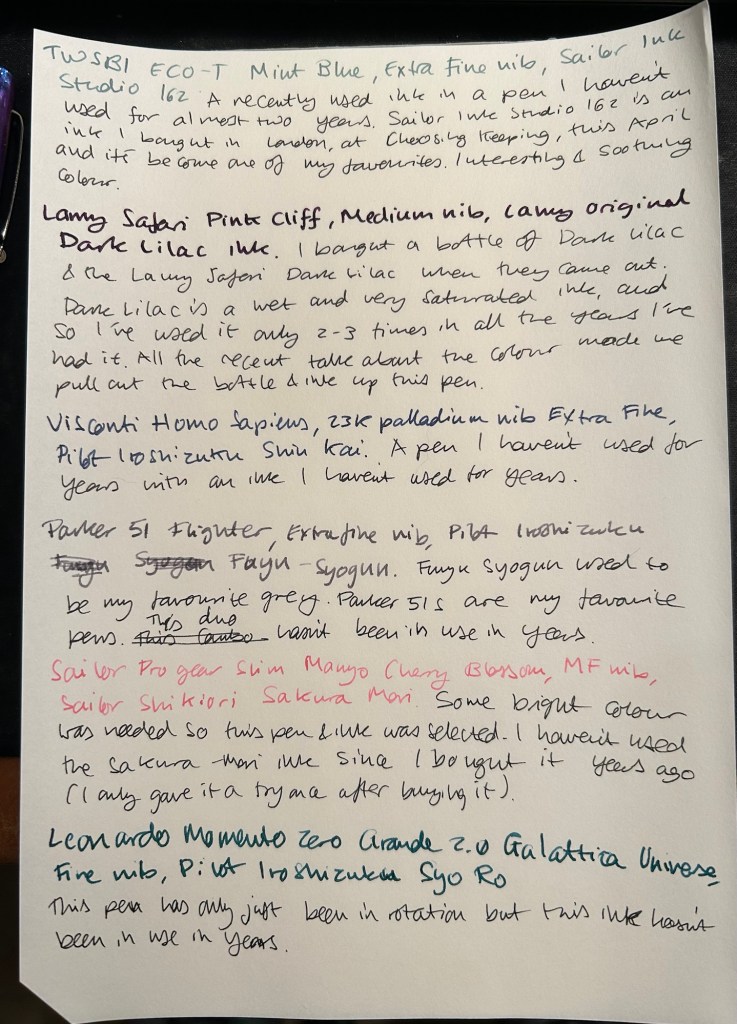
Writing sample of August’s pens

The TWSBI ECO-T is one of my favourite TWSBI designs, and so I have a few of them. The TWSBI ECO-T Mint Blue hasn’t been in use for about two years, so I decided to pull it out and use the Sailor Studio 162 with it, just for colour matching reasons. The 162 is an ink that I’ve used a few months ago but I really like it, so I felt like giving it another month in rotation.

The Lamy Safari Pink Cliff is a recent purchase that I made in Paris last April. I’ve only now inked it up as I wasn’t sure what ink to use with it — until all the discussion about the new (and not as great) Lamy Dark Lilac ink made me want to use the original Lamy Dark Lilac ink. I purchased a bottle of Dark Lilac and the Dark Lilac Safari back when they first came out, but I haven’t used the ink very much. It’s wet and very saturated and so it works best with only a handful of paper options that I have. Still, it’s a very attractive ink.

Visconti Homo Sapiens — this is the original Homo Sapiens, the one that created quite a splash when it came out. At the time it was my most expensive fountain pens, and it’s still one of my most precious pens. I bought it at Mora Stylos in Paris and had it customized with the special initial badges on the finial. I got Pilot Iroshizuku Shin Kai as a gift with my purchase, and though I love this ink I haven’t used it in a while simply because I misplaced it behind another rarely used ink.

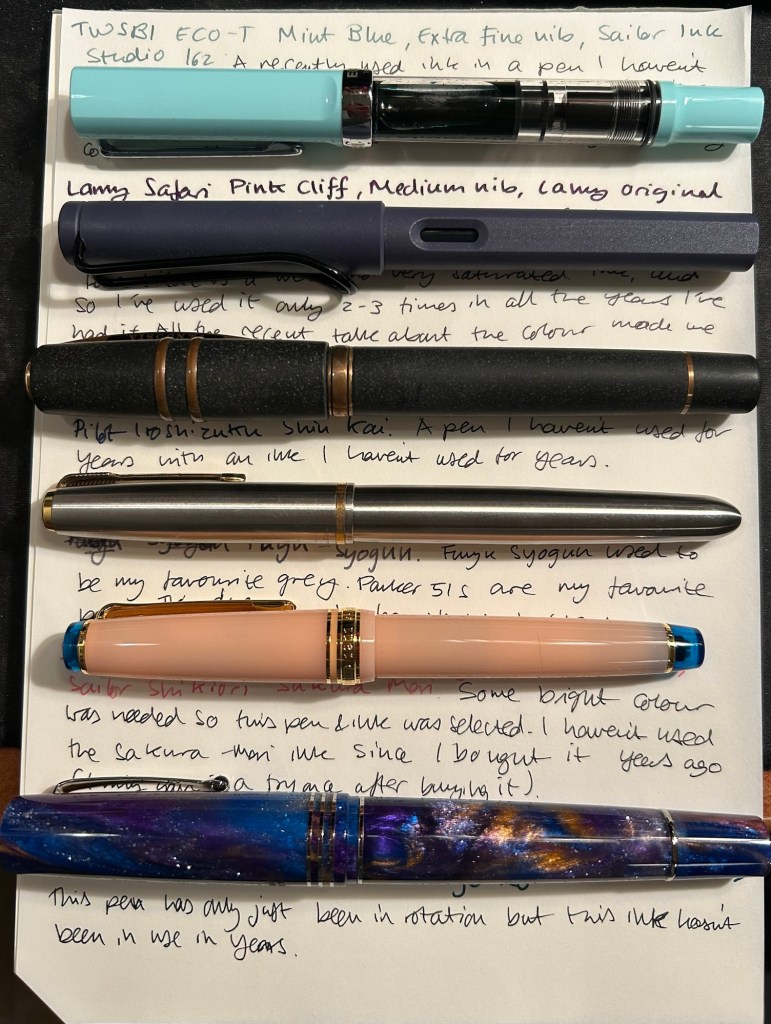
The pens from top to bottom- TWSBI ECO T Mint Blue, Lamy Safari Pink Cliff, Visconti Homo Sapiens, Parker 51 Flighter, Sailor Pro Gear Slim Manyo Cherry Blossom, Leonardo Momento Zero Grande 2,0 Galattica Universe

Vintage Parker 51 pens are my absolute favourites, to the point where I have a hard time seeing one in the wild and not buying it. This Parker 51 Flighter hasn’t been in use in years, but in the spirit of “use the good china” I’ve inked it up. Pilot Iroshizuku Fuyu Syogun used to be my favourite grey ink — and then Diamine came out with a series of excellent grey inks and Sailor came out with the 123. I haven’t used it in years, so I dusted off the bottle and decided to give it another try.

The Sailor Pro Gear Slim Many Cherry Blossom has been in rotation relatively recently, but the ink inside it, the Sailor Shikiori Sakura Mori, is one I haven’t used in years. I don’t have or use many pink inks, but I decided I needed something to brighten up this lineup, and the Sakura Mori ink is relatively readable. It also perfectly matches this pen, which is a nice bonus.

Leonardo Momento Zero Grande 2.0 Galattica Universe is also a relatively recently purchased pen that has been in rotation not too long ago. I just love the Momento Zero so much that I decided I wanted to ink one up, and so I chose the Pilot Iroshizuku Syo Ro to ink it up with. I haven’t used this inks in years, and I love teal inks so it was about time.

What have you got inked up for this month? Anything new? Old favourites or long forgotten pens or inks?

July’s Currently Inked Fountain Pens

This month features a few new inks, and a lot of old favourites that I haven’t used for a while.

Big Idea Design’s Fountain EDC is far from perfect, and yet I’ve inked it up again. It’s the ultem and the ease of capping an uncapping it – it makes it a great EDC fountain pen even though it still has infuriating flow issues. This, however, is the last time I’m inking it for a while (after filling it three times in a row) as I have lost patience with getting it to work properly when I’m journalling. The Schneider Cognac is a new ink for me, a cartridge packet that I bought in London for a pretty steep discount. The colour is a nice orange brown with a good amount of shading and good flow.

Kanilea Pen Co Haleakala Silhouette is gorgeous and overpriced pen that I haven’t used in a while. Sailor studio 123 ink was also in my previous rotation, but I now have two bottles of this most gorgeous of grey inks, so I feel like I should give it more use.

Omas Bibliotheque Nationale is a pen that I bought about a decade ago at Mora Stylos in Paris. The nib is extraordinary, and I decided that I wanted to use it again. It lays a thick, juicy line of ink that works well with Diamine Earl Grey. Diamine Earl Grey is not only a great grey ink at a fraction of Sailor Studio 123’s cost, it also doesn’t bleed through to the other side of the paper in even the Omas’s generous ink. So I get a dark grey with plenty of shading and character, but I can also journal on the other side of the page.

Rotring Levenger 600 is a wonderful pen that Rotring needs to make more of, and Sailor Jentle Sky High is a discontinued ink that Sailor likely makes under a different name and a higher price now. I like the colour, even though it’s a blue and blue inks tend to be boring, and the Rotring works well in use for my office notes.

Writing sample part 1

Sailor Pro Gear Slim Graphite Lighthouse is one of the last Sailor pens that I bought, and it’s one of my favourites. The H-EF nib is extremely fine, and not for everyone. Sailor Jentle Epinard is a great discontinued dark green ink from Sailor, and they likely make something similar under a different name and higher price (or you can find a parallel Diamine ink for much cheaper). The Sailor Jentle ink’s discontinuation was when I bought this and the other Jentle inks in use here, and I kind of regret my shopping rush. There’s no point in buying discontinued ink, as you’ll likely easily find something else similar to that (something that doesn’t use the Jentle ink’s terrible flat bottle design), or something better.

Schon Design faceted pocket six patina is a great pocket pen, and the Schneider Bermuda Blue is a great teal ink. The shading on this ink is excellent, and if I get a chance to buy another box of cartridges when this one is empty, I will.

The TWSBI ECO T isn’t as interesting to me as the ink inside it. I’ve been wanting to try out Diamine Ancient Copper for a long time, and when I was in Oxford I managed to get a bottle. It does not disappoint – great flow, great shading, great rich burnt sienna colour.

Writing sample part 2

I haven’t used the Platinum 3776 in a while, and I almost forgot what a great workhorse of a pen it is. Sailor Jentle Ultramarine, a very bluish purple, long discontinued, is kind of on the boring side.

Here are the pens from top to bottom:

Big Idea Design Fountain EDC

Kanilea Pen Co Haleakala Silhouette

Omas Bibliotheque Nationale LE from 1999

Rotring Levenger 600

Sailor Pro Gear Slim Graphite Lighthouse

Schon Design Faceted Pocket Six Patina

TWSBI ECO T Saffron

Platinum 3776 Demonstrator

The pens

What have you got inked up this month?

Sketching with Iron Gall Fountain Pen Ink: Rohrer and Kilngner Ebony

I have recently purchased the Rohrer and Klingner limited edition Ebony iron gall ink, and I’ve filled one of my Lamy Safaris with it. While iron gall fountain pen ink can be corrosive to pens, and it does change colour over time, it does have a pretty nifty trait: it’s waterproof when dry.

So I made this quick sketch with my Lamy Safari extra fine nibbed fountain pen on a Cass Art recycled paper sketchbook:

And then I added some watercolour to the sketches (note that although this isn’t watercolour paper, the paper in this sketchbook does take light watercolour washes):

As expected, it worked pretty well. Note two things about the combination of iron gall ink and watercolour:

1. The ink must be dry before applying the watercolour.

2. As the water causes the paper fibers to expand, your ink lines may “spread” or display soft edges if you apply watercolour over them. You can see this in both sketches. Different paper will lead to different results, of course.

This was a fun little experiment, and a great way to test out this ink a bit more.

Full sketching kit.

Have you ever used iron gall ink with watercolour in your sketches?

May 2024 Currently Inked Pens

April was a travel month which meant that I cleaned out all of my fountain pens apart from the Big Idea Design Fountain EDC that I took with me on my travels. So in the beginning of May I inked up five more fountain pens, many of them with new inks that I bought during my trip.

The Big Idea Design Fountain EDC is still a troublesome writer, but I keep reaching for it, so it’s still in the rotation with its second cartridge of Diamine Autumn Oak. Diamine Autumn Oak is a reddish orange with a lot of shading and it’s dark enough to be readable even with a fine nibbed pen.

There are two Franklin Christophs currently in my rotation (I misspelled the brand name in the writing sample, my apologies), and I am using them to compare the Sailor Studio 123 ink to the 224 ink. 224 is slightly more bluish and has less of a pink tint to it, but both are so similar that if you’re looking for 123 and it’s out of stock, you could use 224 and likely not notice the difference. I’ve been using these pens so much that I wrote the Sparkling Rock dry already, and the Thomas Hall Tibaldi edition is well on its way to joining it.

The Momento Zero Mother of Pearl is a gorgeous pen with a gorgeous, springy nib, and a joy to write with. Sailor studio 162, which I purchased on a whim at Choosing Keeping in London, is now one of my favourite inks. It’s a very unique shade of green/teal that makes me want to fill the same pen with it the minute I write it dry.

The Lamy Safari Savannah has Pilot Iroshizuku Kosumosu ink in it because I wanted something bright after all the muted greys and greens. The issue is that previously the pen had a shimmer ink in it and I apparently didn’t clean out all the particles, so I now have a shimmer version of Kosumosu. The result is fetching so I don’t mind this accident, but I will have to properly dismantle the pen and give it a thorough cleaning once I write it dry. It’s about halfway full now.

I like Rohrer and Klingner inks so when I saw the limited edition Ebony iron gall ink at Choosing Keeping, I immediately bought it. It’s very well behaved for an iron gall ink, but it’s not really a saturated black. I prefer darker blacks, but I’m getting used to the shading that Ebony provides.

A slightly late addition to the flock is the Leondardo Momento Zero Grande 2.0 Galattica Universe fountain pen, which arrived just in time for my birthday. It’s a stunning pen, and this photo does not do it justice. I knew I wanted a turquoise ink in it, and I haven’t used Bungo Box’s June Bride Something Blue in a while, so that’s the ink I chose. It was difficult to fill the pen from the flat Sailor shaped bottle, and I didn’t get a full piston-full of ink in it because of the awkward shape of the bottle. Lesson learned for next time.

What pens and inks did you use in May?

BIGiDESIGN USA Fountain EDC Review

I’m a fan of Big Idea Design (BIGiDESIGN) and have been for years. I’ve supported many of their kickstarters, and they make some of my favourite pens and I have reviewed quite a few of them: Ti Arto Review, Ti Arto EDC Review, BigIDesign Dual Side Click Pen Review, BigIDesign Pens Overview.

When they originally came out with the Fountain EDC, their first fountain pen offering, I decided to not purchase it. I don’t generally like metal fountain pens, and I rarely use pocket fountain pens because of the hassle of posting them every time you write.

Fountain EDC box

So how did I end up with a Fountain EDC?

I backed their kickstarter of course. Big Idea Design launch all of their products via kickstarter, and this one was no different: a kickstarter for an Ultem Fountain EDC made in the USA in their new machine shop there.

You got a sticker and a little badge if you backed the project. Very cool.

The ultem rage swept through the fountain pen community in recent years (? it could be months, time is meaningless to me since cancer and COVID), and left me cold. I found the material ugly, and the fact that it was touted as extra light and durable didn’t make it more attractive to me. It’s basically a plastic that’s available in black or a singularly ugly orangey-yellow, with certain chemical properties that aren’t very applicable to fountain pens (are you steaming your fountain pens or boiling them regularly? If so, ultem might be for you but fountain pens are clearly not). I’m being cynical, I know, but there’s a twist, I promise. It all works out in the end.

Tiny, light and ugly – the Ultem Fountain EDC

Big Idea Design generally work with titanium, so seeing them use another material was intriguing. It was also a material that is perfect for an EDC type of pen, as it’s both light and durable. The yellowish colour also works well with the matte grey of the titanium hardware that they selected for this pen, and unlike other ultem pens, the price of this one was reasonable. So I decided to try the ugly plastic and see what all the fuss was about.

Ultem Fountain EDC in all of its… glory?

So I backed the kickstarter and the pen arrived very quickly (Big Idea Design kickstarters work like that. They deliver on time, and fast). The box was the usual great Big Idea Design box that they’ve been using in recent years, and it came with a sticker and a tiny velcro rubber patch – very cool.

I was stunned by weight of the pen.

It’s a pocket pen, so it’s bound to be light, and I knew that ultem is supposed to be light, but it’s jarring how light it is. The ultem had a nice, matte finish, the ugly yellow did work well with the brushed titanium clip, but the entire weight of the pen is basically in that clip and the (Kaweco) nib.

The pen, posted as it is when you write with it.

This pen has to be used posted, it’s just too short to use it unposted, much like the Kaweco Sport. There’s a step in the back and an o-ring on the cap that make posting supposedly more secure, but you need to make sure you’re applying enough pressure when posting or the cap will go flying off. On the plus side, the cap is made of ultem so it will likely be unscathed, but it really isn’t the most convenient experience.

The Fountain EDC capped

In terms of size it’s about the size of a Kaweco Sport, just a smidge longer, when capped:

Fountain EDC on the left and Kaweco Sport on the right

However, things are different when the pens are posted: the Fountain EDC is significantly longer than the Kaweco Sport. It would be much more comfortable for long writing sessions than the Kaweco Sport if not for two flaws in the design: the cap posting, and the ink flow.

I mentioned the cap becoming easily unposted before, but it’s worth mentioning again. The design of the pen is such that you really need to push the cap on to pen body and check that the o-ring is engaged, otherwise the slightest jarring will pop the cap off.

The second flaw is the most major one with this pen, and it’s a big enough deal that it makes me not recommend this pen until Big Idea Design solve it. The pen has a very, very hard time starting. It’s not related to the cartridges you choose to use, but rather to the design of the nipple that connects to the cartridge. Enough Kickstarter backers had this issue for Big Idea Design to post a YouTube video addressing it. They say that it’s the coating they put on that nipple, and that taking a pin and scraping that coating off should help. Well, I did the procedure more than once with various tools and it helped a bit, but the pen still requires literal shaking every paragraph or so to get the ink flowing again after it dries out.

Fountain EDC drying out sample

As this is the only fountain pen I used as I was travelling for three weeks, this was very frustrating. I love the feel of the pen, but the ink flow issue, the cap issue, and the weird balance with the ultra-light ultem material that makes this pen very back-weighted when posted makes this not a product that I would recommend.

The back-weighting and the cap posting issue should have been taken into account during the design process. The flow issue should have definitely been caught during production, especially as it’s a made in the USA pen (i.e. local to the Big Idea Design people, in a shop owned and operated by them).

So bottom line:

I really wanted to recommend the Fountain EDC but I really don’t. The pen needs to be redesigned to have better flow, better balance and better capping.

Ultem itself is as ugly as I thought it would be, but it’s a lightweight and durable material with a nice feel to it, so I get the hype a bit better now.

Product design is difficult, even for experienced designers.