My dad went through open-heart surgery to replace his aortic valve and to repair his aortic aneurysm on Thursday night. The surgery went well, and he spent about 12 hours in the ICU before being transferred to an intermediate department prior to being transferred to the “regular” heart surgery department. He started eating today, and they started to gradually remove the tubes and wires he was connected to. He’s still on oxygen support, he’s still not able to sit independently or walk, and he’s still got a long road to recovery, but we’re getting there.
This week’s blog post was written in advance, and though I approved the comments on it, I haven’t had time to read them. My days are now devoted to hospital runs, hospital bureaucracy (always a delight), and running to maintain my sanity throughout this process. As my PTSD has had a significant flare up with all the extra hospital time, running, reading, journaling and meditation are what’s helped me stay on the path.
I don’t know how next week will unfold. I will resume posting and replying to comments when I can. In the meantime, there’s a pretty good archive of posts here which you are welcome to browse.
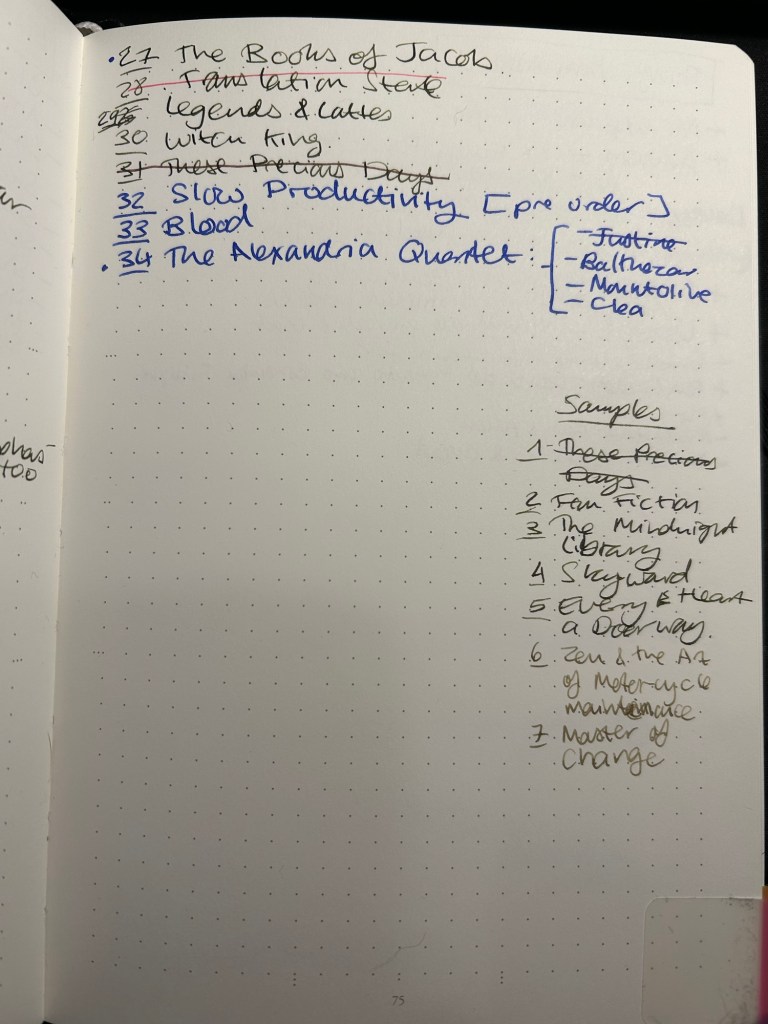
One of the things that I set up in my Leuchtturm1917 Bullet Journal is a list of the unread books on my Kindle. It’s supremely easy to buy books on a Kindle, as the whole system is set up a way to make book purchasing as fast and frictionless as possible.
This is a problem for me.
I love books, I adore reading, and I have pretty large group of friends that love reading too. This means that I’m inundated with great recommendations that run the gamut from light hearted fantasy and sci-fi to contemporary and classic literary fiction, with a whole host of fiction and non-fiction books in the middle (I don’t read horror and I don’t read romances and I rarely read poetry but that’s about the only limits I have in terms of my reading tastes). I get several such book recommendations a month, and with my initial impulse to rush out and buy them, and with the ease of purchasing books on a Kindle, things could get out of hand very quickly. This was one of the reasons why for years I was so resistant to buying a Kindle.
You see, it’s very easy to lose track of just how many unread books you have on your device. Even if you sort by unread books, you just don’t get a real feel for how many of them are actually waiting to be read. There’s no bookshelf groaning with the weight of unread books, and I was feeling the lack of that.
Enter my list of unread books on my Kindle:
It’s a simple numbered list of books that I haven’t read and are on my device. As I read a book, I cross it out. As I purchase more books I add them to the end of the list. As I’ve gotten into the habit of downloading samples, I’ve started to write them down too so they don’t get out of hand. It’s super simple, as bare-bones as it can be, and as practical as possible. The point is just to give my brain an idea of the scale of unread books on my device, and it works.
It works.
I’ve stopped compulsively buying books in the fear of “running out of something to read” or “forgetting what I was recommended”. Recommendations go into my GoodReads “Want to Read” list. And my brain can now see that there’s just no chance that I’ll run out of things to read any time soon. If I buy something I have to go over the list and convince myself that what I’m buying deserves precedence over the lovely books waiting patiently in line, some of them for years. I also photograph this list and keep it on my phone for reference, to prevent me from accidentally buying the same book in physical format (unless I purposefully intend to, which is rare).
What about the physical books stacked on shelves, some of them two books deep? I would love to have such a list for them as well, but that task is too daunting for me now. I remember where my books are visually, and moving them all just to catalogue them not only seems like an awful lot of backbreaking work, it will destroy my “memory catalogue of books”. So it seems that my physical books will remain uncatalogued for years to come.
Do you keep a list of all the books you own but haven’t read yet? Do you just keep a list of the books you intend to read next? Do you track your physical books in some way?
When my brother and I visited The Wizarding World of Harry Potter at Universal Orlando we bought a pack of postcards and some postage at Hogsmeade and posted some postcards home. They have a little “Owl Post” booth where you can get your postcard stamped with an owl post stamp, and it’s a charming experience. We ended up with a few postcards left over, so we posted them from our Disney hotel. A few weeks after we got home the postcards arrived and made out day.
I was just at a Shalom Sebba exhibition at the Tel-Aviv Museum of Art and after my visit I went to the museum store and bought some postcards there. Later that evening I spent some time writing postcards for my family, with little sketches inspired by Sebba’s work:
I had no idea where I would post them, as most of the post boxes in my area have been removed, but I wanted to at least try to post them before my dad’s surgery this week. With today’s postal service sending them would be a bit like tossing a message in a bottle into the sea and hoping it would eventually arrive at its destination. Yet there’s something about not just the wonderful experience of receiving snail mail which I wanted to give to my family, but something particular about postcards that made me want make the effort to post these cards that I could more easily hand deliver myself.
More than letter postcards evoke some things to me – a break from routine, a holiday, exotic places, better days. There’s something creative about the selection you make, and they make me want to sketch in them, write in their margins, be creative in the tiny space I’m given to work with. The limited space, zero privacy and the need to withstand the elements at least somewhat makes them a creative challenge we rarely encounter in days where everyone is an instant message away.
Yet that’s what made them appeal to me, because more than anything postcards speak of hope, and these days I need all the hope I can get.
January was a big month in terms of writing pens dry. For the first time ever I managed to write all of the Inkvent pens dry by the end of the month. That’s 12 fountain pens written dry, which is the most I’ve ever written dry in a month. The secret is not filling them more than 50% full, and making sure to journal and note-take consistently.
In terms of paper products I’ve journaled in my Stalogy 365 B5 journal and will be switching to a new journal next month (also a Stalogy 365 B5 because I like the paper and the format). I do have a little quirk with these notebooks – I use them upside down because I don’t like the header with the dates on it, so I flip the notebook around so that it’s at the bottom of the page. That way it doesn’t bother me as much.
Stalogy 365
I’ve also been using a Rhodia A5 dot pad to time block my day, and Kokuyo A4 KB which I cut in half (to get two A5 pieces of paper) and write my daily todo list on. At work I use a Maruman Mnemosyne horizontal A5 notebook (either squared or blank) to brainstorm on, track my tasks, take meeting notes, etc. My weekly plans and long term 12 week year goals are in a Leuchtturm1917 Bullet Journal that stays at home, on my desk. The rest (Stalogy B5 journal, two pieces of daily planning paper, and the Mnemosyne) travel with me when I go to the office.
I have a monthly calendar with some monthly reading, running, gym, swimming and blogging targets on it and I draw that on a Well Appointed Desk “Rebel Plans” notepad.
Earlier this month I used the wonderful Pelikan Hubs paper to do my daily planning, and it was amazing (cardstock thick and fountain pen friendly). I was running out of it quickly though, which is why I moved to the Kokuyo.
Pelikan Hubs paper pad
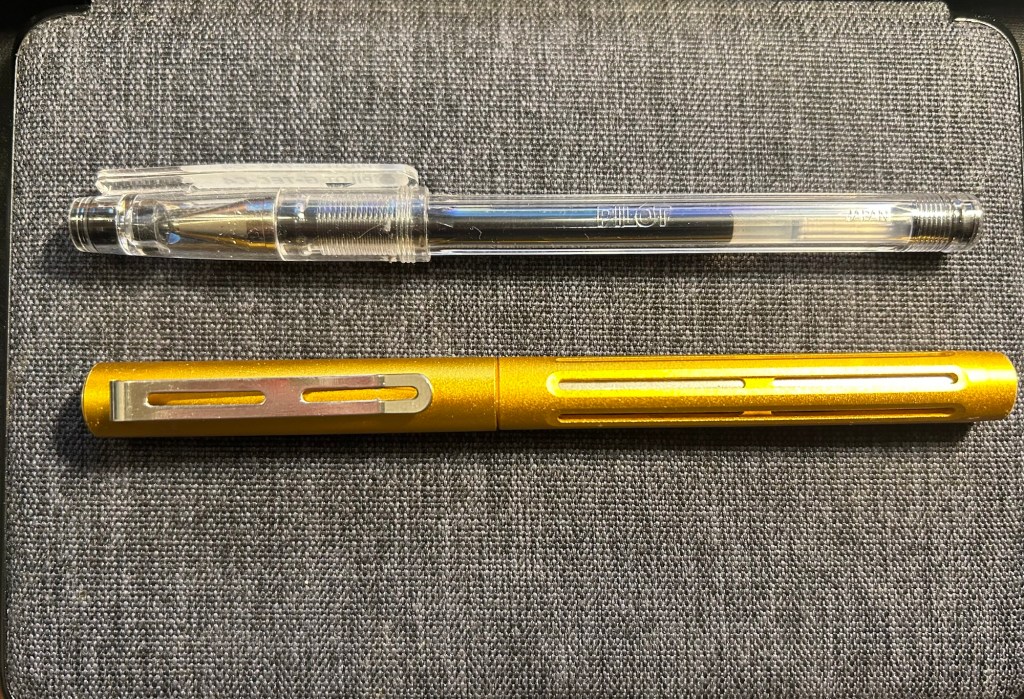
In terms of standard pens I’ve used the Pilot Hi-Tech-C in 0.4, my Spoke Design Spoke Pen in orange crush, and a Pilot Juice Up 04 in orange and light blue. As I will be spending a lot of time at hospitals next month, I will likely be using more standard pens then.
Pilot Hi Tec C and Spoke Design Pen
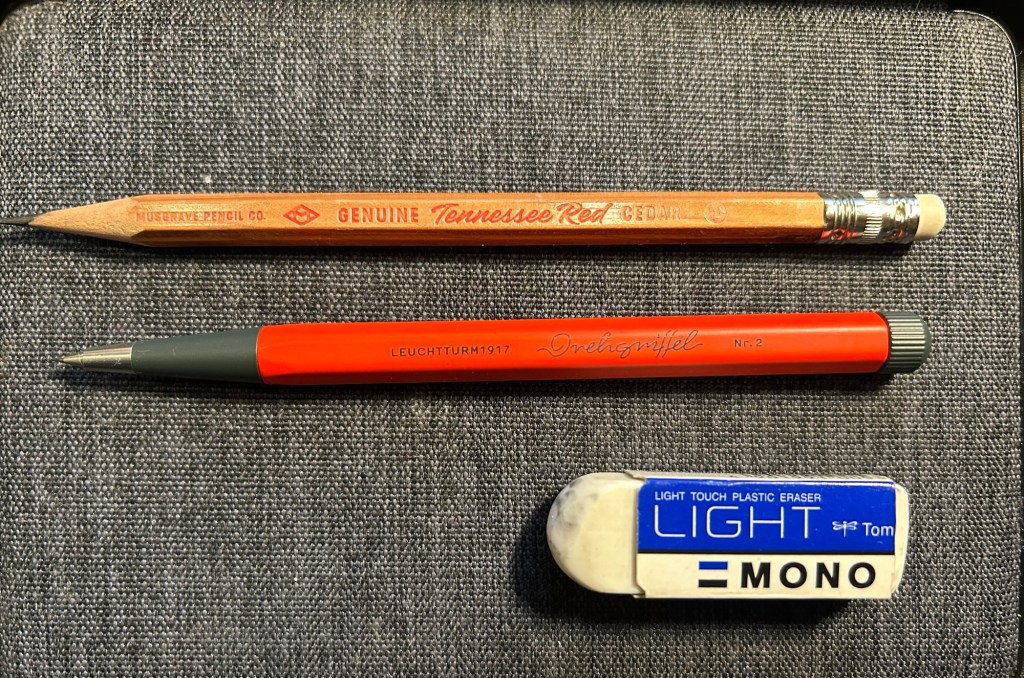
Pencils in use were the Tennessee Red, which is gorgeous and a treat to use, and Leuchtturm1917 Drehgriffel Nr.2 mechanical pencil in red and grey. I have better mechanical pencils that this one, and yet I keep returning to it. Something about the Drehgriffel design is simply appealing to me. You can read my review of it here.
Next month will likely see more use of standard pens and pocket or cheap fountain pens. I will be in the hospital a lot, so that means that my setup will change to reflect that.
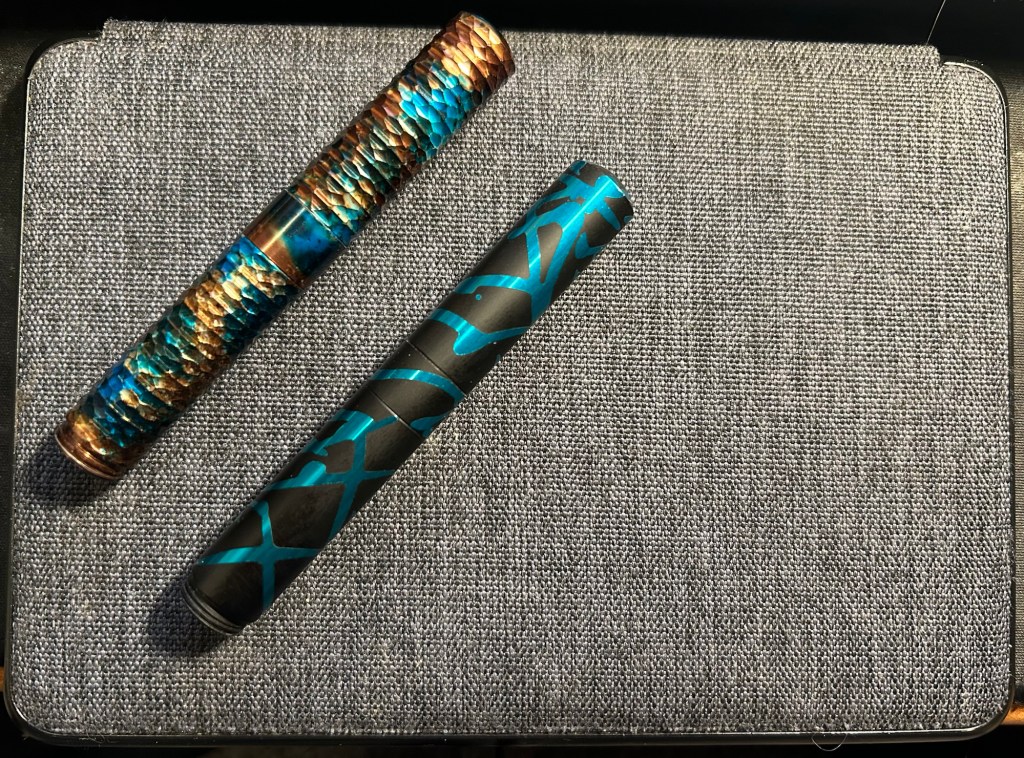
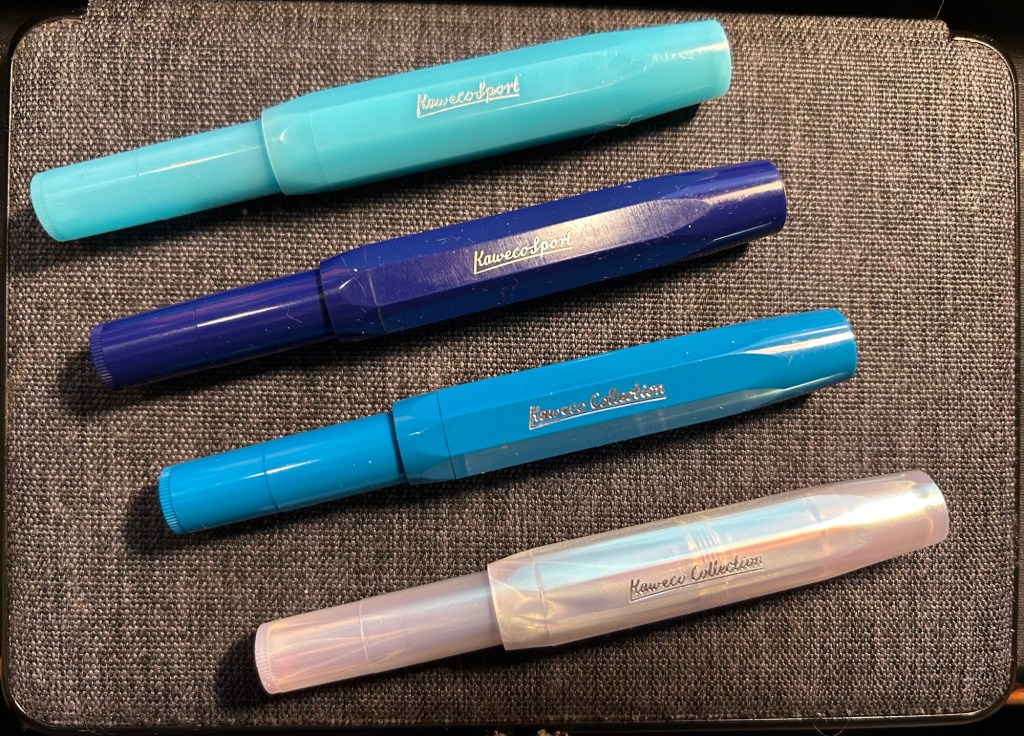
Here are the fountain pens I filled for February:
Schon Design Pocket 6 pens.Kaweco Sports.
The new and challenging setting will mean that I’ll likely go back to my trusty Moleskine hardcover and Ti Arto for the duration of my dad’s stay in hospital.
What stationery products have you been using in January?
I decided to try and create monthly reading reviews of what I read instead of individual reviews or a giant yearly reading list post. Here’s what I read this January:
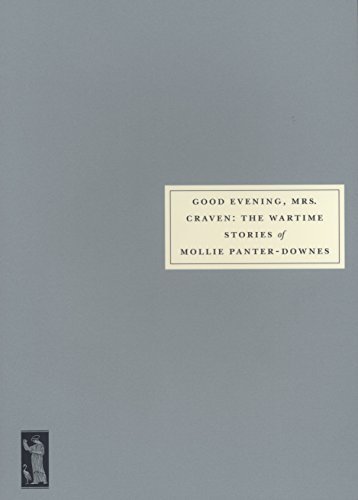
Good Evening, Mrs. Craven: The Wartime Stories of Mollie Panter-Downes, by Mollie Panter-Downes
A collection of very well written realistic short stories mostly about British women during WWII. Mollie Panter-Downes was a prolific and long time contributor to the New Yorker, and wrote both fiction and non fiction pieces for the magazine. This collection is bookended by two of her “Letter from London” non-fiction pieces, one from the beginning of WWII and one from the end. In between are 21 gems of short stories, all very realistic, all showing aspects of the war rarely discussed. Panter-Downes shows the great upheaval in British society at the time, both in the role of women and in the class system. She is sympathetic to her characters with all their flaws and foibles, and you grow to love them over their brief appearances. There are hints of dry humour, wonderful characterization, and an exploration of character that is both tied to Britain during WWII, and yet still universal. Highly recommended, even if you’re not a fan of short stories or historical fiction.
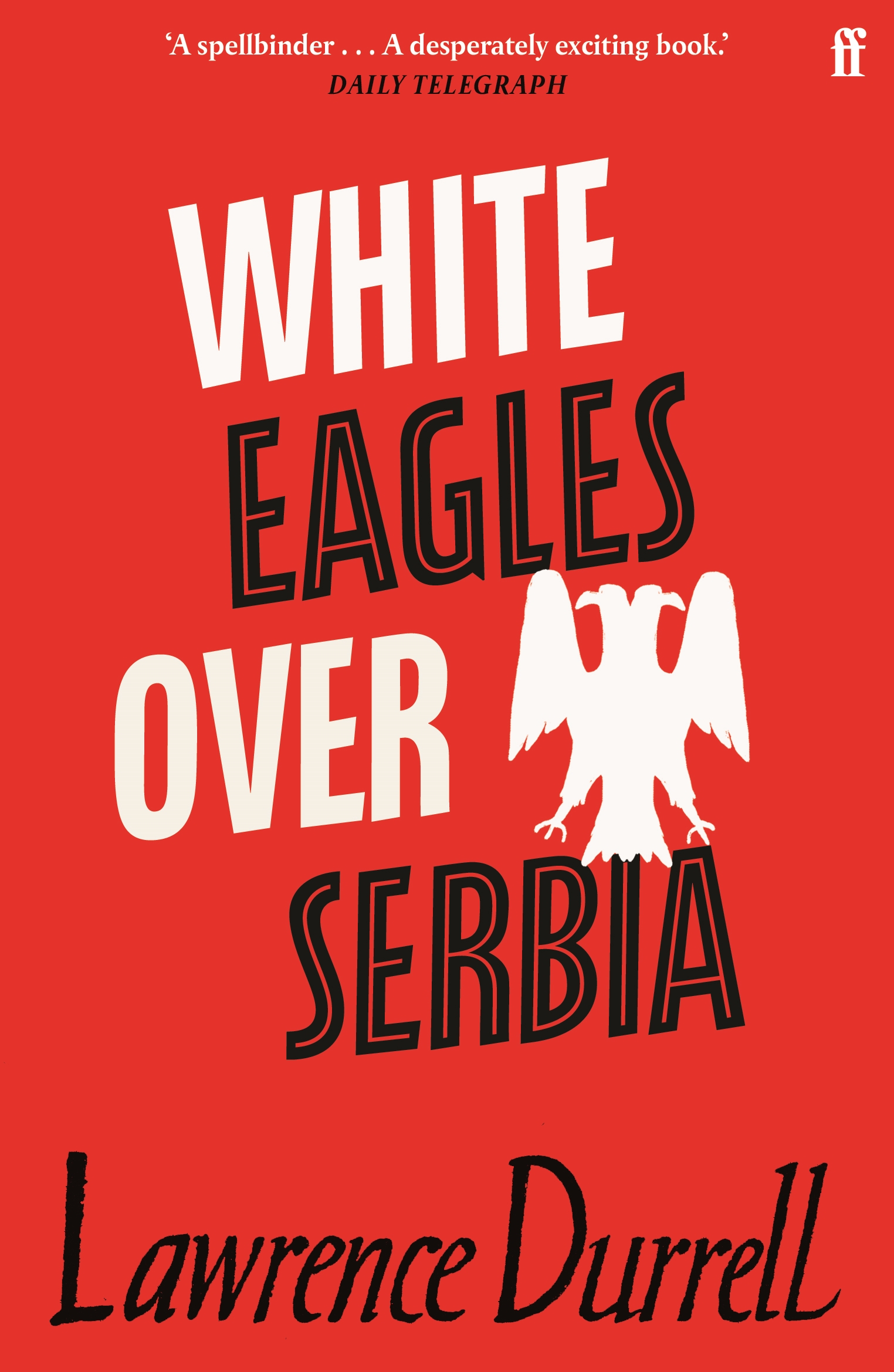
White Eagles Over Serbia, Laurence Durrell
Laurence Durrell started his career as a writer writing poetry, and it shows. The descriptions of landscape and character here are stunning. Never have I read a spy thriller that is written like a Literature with a capital L on the one hand, yet is still supremely entertaining and exciting to read – and very realistic.
Durrell is an excellent writer, and White Eagles is based on his experiences working for the British Foreign Office. The book is not flashy, it’s not high stakes, and it reads like something that could actually happen. The main character, Methuen, is a reluctant, tired hero spurred to action by his love of fishing more than his love of danger and intrigue. The descriptions read like poetry, and the characters are all individual gems – none of them are perfect, none of them are heroic, they are real people in very real situations. I wish there was a series of Methuen books (there isn’t), and I recommend this even to those who normally don’t read Cold War era spy thrillers.
Ragtime, E.L. Doctorow
Set in the New York area at the turn of the 20th century to the syncopated beats of ragtime, Ragtime is a tour de force of modern writing. The first part of the book is slightly overwhelming, as Doctorow takes us with lightening speed and fast cuts through many luminaries of New York city during the early 20th century, and intersperses them with the story of a wealthy WASP family, a Jewish immigrant family and a black family to be. The cuts remind me of a Wes Anderson movie, and it takes a while to realize that the narrator is actually creating a ragtime with his description of the events: the emphasis on seeming minutiae is deliberate, and the juxtaposition of things that don’t go together is purposeful. You feel like all the books you’ve read so far have been horse drawn in comparison to this piece, and suddenly you’re speeding your way on a model-T.
Very original, not an easy read, but highly recommended.
Note: the narrator speaks in the voice of a reporter from that era, and hence there’s a lot of the N-word (and worse) in this book.
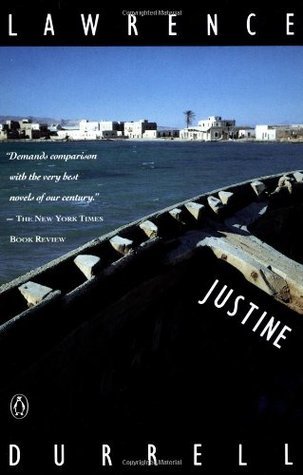
Justine, Lawrence Durrell
The first of Durrell’s Alexandria Quartet of novels.
Some books are easy to review, but this one isn’t. I’ll try to do it justice, but reading Justine was an experience difficult to summarize in words.
The good – the writing is exquisite. Durrell is a phenomenally good writer, and he’s at his best when bringing Alexandria to life. Alexandria itself appears to be the main character here, and it’s a fascinating portrait of the city during the ’30s. Durrell is doing interesting things with narrative structure here, and while it makes following along difficult at the start, the narrative builds up in layers over time. You aren’t viewing the story of the four lovers chronologically, but rather through the reminiscences of the narrator, as things come to his mind and gain importance. Thus you survey the scene several times from different angles, through the growing understanding of the narrator. It’s a fascinating narrative structure, and it adds nuance and interest to the story, and fits well with Durrell’s evocation of Alexandria.
The bad – the characters aren’t quite there. They remain ghosts of themselves, mythical creatures, never becoming palpably real. The only exception is Scobie, a character that seems to have been created as a caricature of sorts, a comic relief, and yet is the most fully realized character in the novel. My guess is that as we are returning to the same characters from different points of view in the following novels of the quartet, that this issue may be resolved.
The ugly – whether these are Durrell’s views or his narrator’s views, Justine is rife with misogyny, homophobia and whiffs of racism and antisemitism. The novel was written in the ’50s and its views on homosexuals were likely advanced for the time, but they’re still terrible. There’s also depictions of child prostitution, prostitution, and mentions of slavery that seem perfectly fine with the narrator and the people around him.
Justine is a difficult book to read, both for the narrative structure, which is disorienting at first, and the way it jars on modern sensibilities. It is well written and intriguing enough for me to give the rest of the Alexandria Quartet a chance.
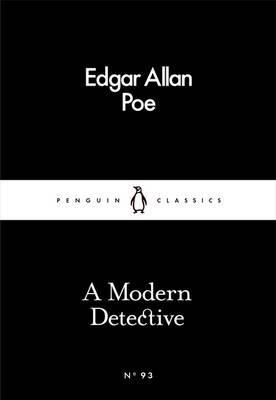
A Modern Detective, Edgar Allan Poe
This is a mini collection of two short detective stories featuring C. Auguste Dupin, the first fictional detective.
Poe is pretty talkative here, and his detective, Dupin, is a long-winded, charmless, cerebral Sherlock Holmes type. The cases discussed are interesting, and the second story in this collection was inspired by a real unsolved murder case. The characters, though, lack charisma, mystery or charm, and the reader is left wondering why they ended up spending time with them.
The detecting techniques are more primitive than those portrayed by Conan Doyle, and they are magnificently padded with paragraph upon paragraph of Poe delighting at his protagonist’s cleverness. A full third of the first story is skippable without missing a beat, and the second one fares much the same. What Poe does do well is evoke an atmosphere of gothic horror around both cases. What he utterly fails to understand (but Agatha Christie knew so well) is that the heart and interest of a detective story is the characters in it, not so much the analytical prowess of the detective at large. Holmes, Marpel, Poirot, and Father Brown are all first and foremost compelling characters. Dupin has not earned his place among them, and is remembered merely for being the first, not (as Poe would have you think) for being the best.
Dull, overly wordy, not worth reading, despite its historical importance.
That’s it for January 2024. What interesting books did you read this month?
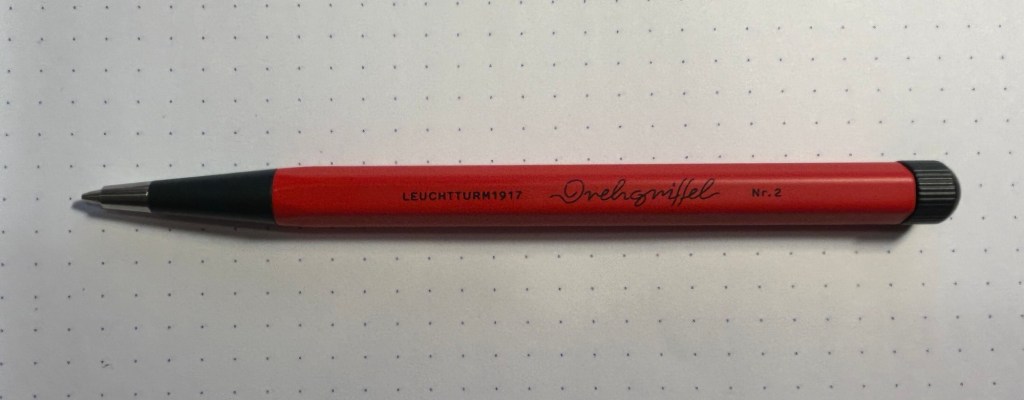
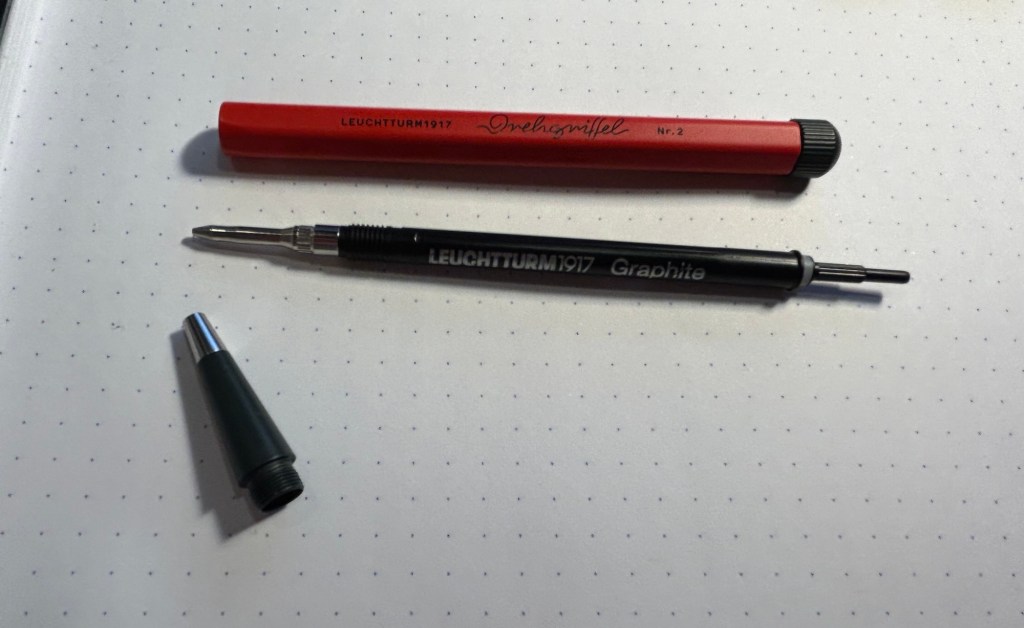
The Leuchtturm1917 Drehgriffel Nr.1 is a charming little pen that comes with either a gel refill or a ballpoint refill. The Drehgriffel Nr. 2 is its pencil counterpart: a short but hefty mechanical pencil with a twist mechanism that comes in a variety of colours. My pencil is a bright red and dark grey one, and it has quickly become my most used pencil by far.
Small but mighty, the Drehgriffel Nr. 2
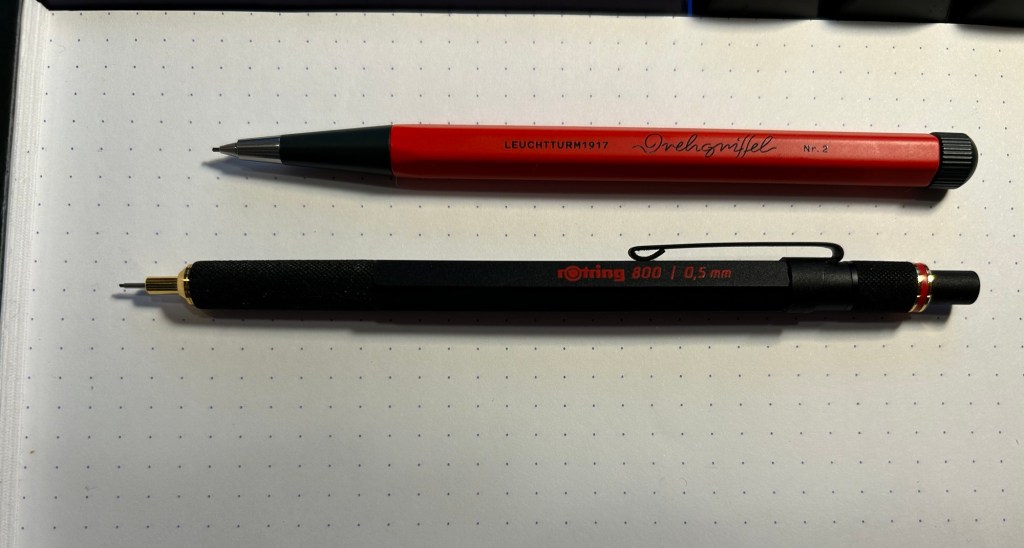
The pencil is shorter than other mechanical pencils, but as it’s an aluminium bodied pencil with a steel tip it has some weight and heft to it. It’s lighter than the Rotring 800, and the weight is balanced towards the tip so it’s very comfortable to use.
Drehgriffel Nr. 2 on top, Rotring 800 on the bottom
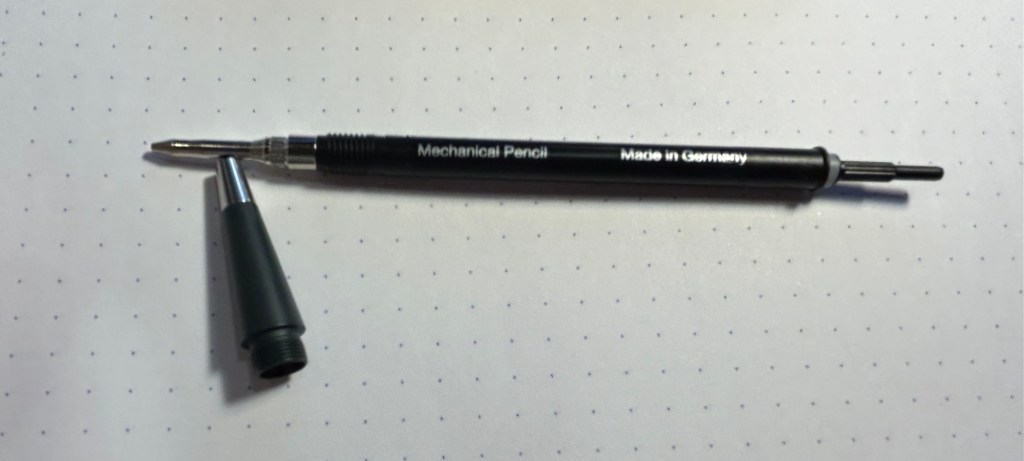
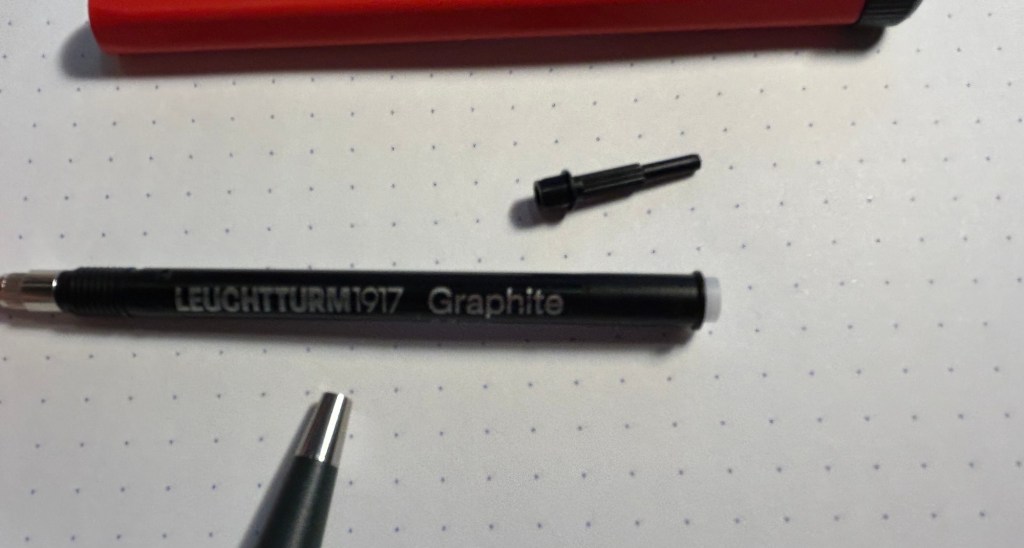
The pencil mechanism is proprietary to Leuchtturm, and it’s a pretty unique affair. You give the nob on the top a quarter twist and then you hear a satisfying click and the lead advances. The pencil mechanism looks like a gel ink or ballpoint refill, but the little pole on the top pulls out and you can add more pencil leads to the pencil that way. You get to the mechanism through unscrewing the front cone tip of the pencil.
The Drehgriffel Nr. 2 and its mechanism
Here’s a closeup of the mechanism (my camera had issues focusing on the lettering):
Here you can see where the leads go in:
The Drehgriffel Nr. 2 is a 0.7 mechanical pencil and it comes with HB leads inside. It’s a great pencil with a classic, sleek design, and a very solid and unique mechanism. The size is plus as it makes it ideal for everyday carry, and it doesn’t have the silly little eraser that certain mechanical pencils have and is always terrible. The only minus to this design is that to add more leads to it you basically have to take the pencil apart. That’s no big chore, but the end bit (the little pole thing) is very small and would be easy to misplace. I’d suggest doing the refilling in batches of a few leads at a time, and being careful to not lose sight of the mechanism end bit.
Otherwise this is an excellent mechanical pencil, a solid and handsome little workhorse that’s a joy to use and would make for a great gift even for people who are not great pencil lovers.
My dad is going through open heart surgery next week to replace his aortic valve and repair his aorta. It’s a serious surgery. I’ve been lining up so posts in the buffer for the next two weeks, but my posting schedule may be erratic in the near future.
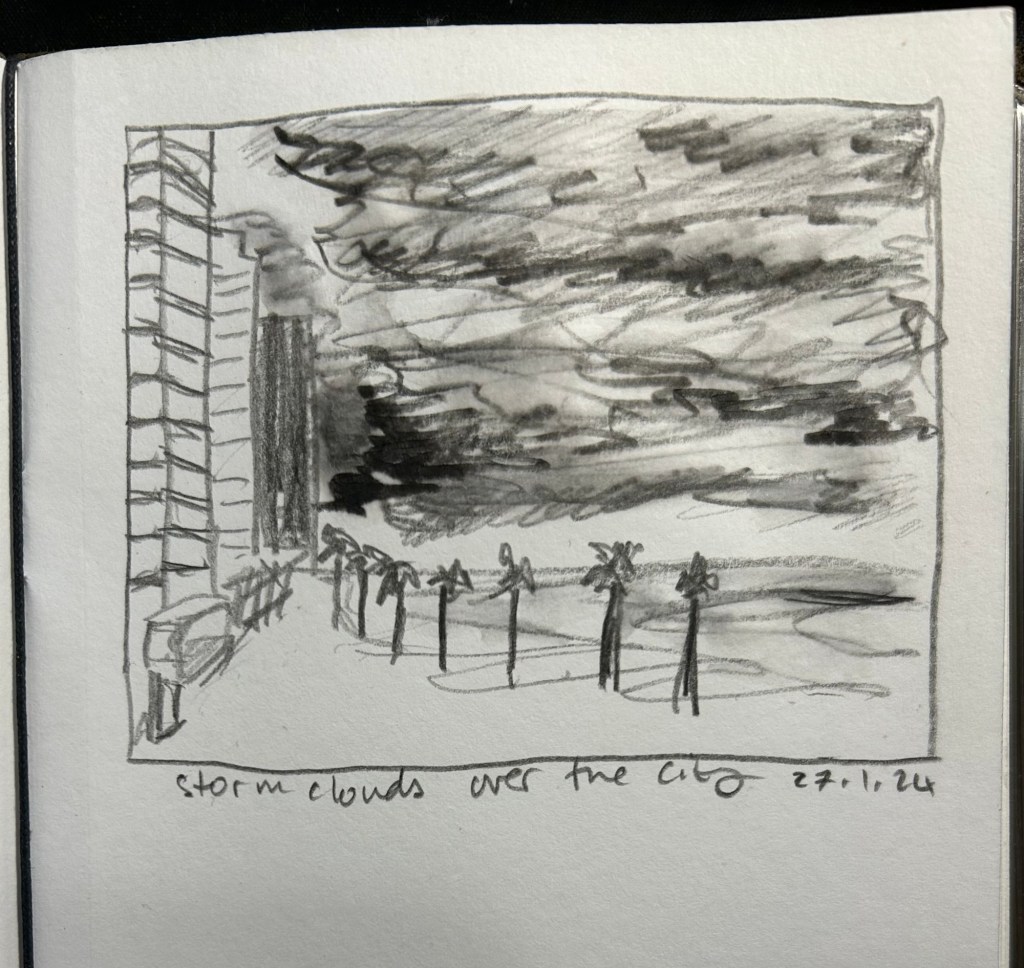
Sketch on Midori TN sketch paper with a Faber Castell 4B water soluble graphite.
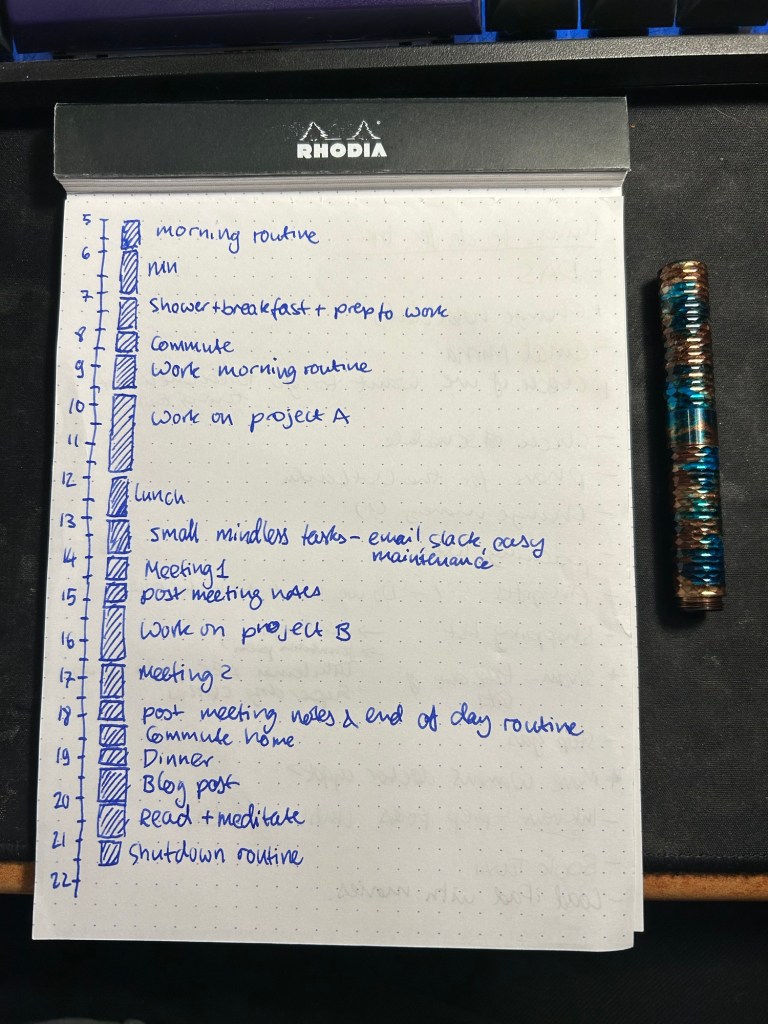
With time blocked planning the idea is to break down your day into blocks of time where you do things. The point is to structure your day so that you’re never faced with the question of “what do I do next?” Instead you sit down ahead of time and block out large sections of time where you do a specific large task, or bundle together a group of small tasks. You don’t block the day out into a minute by minute plan, but instead work in blocks of at least 30 minutes and usually 1-2 hours.
The idea isn’t new, and I haphazardly gave it a try when I was a student, and not surprisingly I failed spectacularly at it. It was only very recently when I decided to give it a serious try. The reason I decided to give time blocking a try was to solve a problem that I think is pretty common: I’d run out of steam about two-thirds into my day and end up just vegging out in the evenings, not accomplishing what I wanted, not even consuming the sort of media that really interested me. There’s only so many decisions my mind could make throughout the day, and late in the afternoon I would run on empty.
Since I was already “front-loading” my day (i.e. doing the really important work first thing in the morning or as early as possible) it was pretty easy to see the benefit of deciding what to do at a given point of time early on in the day, or even the night before. My issue with time blocking in the past had been that my work day is inherently unstructured. I may plan to work on something in the morning, but then a slack message or an email comes in, or someone bursts into the room with a problem and suddenly I’m working on something completely different.
Here, however, is where maturity kicks in. When I gave time blocking a chance years ago, I didn’t really take it seriously as an approach to work and life. Once something interrupted my day (and something always interrupted my day), the plan went out the window never to return. The plans rarely survived until lunchtime, and very quickly I decided that there was little point in time blocking for people like me. What I failed to realize at the time was that the majority of people are people like me: we live in a world where we are constantly being interrupted, and rarely does the day end in the way we envisioned it at the beginning.
Given this new found realization, and the realization that some very smart, very accomplished people whose work I follow use time blocking successfully and consistently, it was clear that the issue wasn’t with time blocking itself but with how I was approaching it. So I decided to make a more consistent, serious attempt to use time blocking for at least a month or two and see where it gets me.
I’m still very early into the process, but I decided to write about it as I go along, so I’ll have a record of how I tweaked things, and for those who like me, wanted to try time blocking but have failed in the past. Maybe my successes and failures will help them in their journey.
The First Mistakes
I started out with two mistakes, one easily fixed and another a mistake that I’m still working on correcting. The first mistake was trying to create separate time blocks for my work day and my “home day”. That failed spectacularly. Lesson learned: you need to follow one timeline, one plan, from waking up until going to sleep. If you use two different plans you are setting yourself up to fail because you’re creating two points in the day where you have to switch plans. While the morning switch may be relatively easy, by the time you’re off work you don’t feel like opening a different notebook or calendar and seeing what it is exactly that you’re supposed to be doing right now. I kept my home plan on a Rhodia dot pad and my work plan on a Moleskine squared notebook, and it just didn’t work for me. I had to carry two different plans with me, I had to reference and cross reference them, it was a mess. Now I have one plan per day, on a Rhodia dot pad.
The second mistake is one that I’m still working on correcting, which is what do I do when things don’t go as planned. What I should be doing is taking 5 minutes and replanning the rest of my day basically from that point onwards. What I currently do and doesn’t work well is either try to get back to the plan the moment I can (at which point things start to fall apart pretty quickly), or try to make only minor adjustments to the plan. The reality is that if there’s a significant break in my plan (i.e. something that takes more than 30 minutes to deal with), then I need to take a few minutes to stop and completely reassess my day. No, I will not be able to fit everything I planned into it now. Yes, my energy reserves are most likely more depleted at this point than I originally planned. Rather than trying to stick to the plan and crashing and burning, I need to be kinder to myself and look at what’s left of my day with fresh eyes. “That production outage took a lot from me, so let’s switch things up so I have a lighter workload until I’ve had a chance to recover, maybe even schedule a significant break here. Then rebuild my evening so I also have a bit more recovery time then – add a meditation session, or more reading time, etc.”. This is something I’m currently working on doing consistently.
The First Successes
While I’ve been time blocking only for a short time, I have already seen the value of this system. I’m getting much more done, and I am able to dedicate long stretches of time focused on meaningful work. I batch emails to the beginning and end of the day, and slack messages only to the times between large blocks of deep focus. I haven’t had an episode of mindless YouTube watching in the evenings since I’ve started. I’m reading more, journaling more, meditating more, spending more meaningful time with friends and family. I’m also being much more realistic about my goals. Once you start putting things in the context of the hours you have in the day, it becomes easier to assess how much you can get done in a given day.
A sample of a time block plan.
It’s not just a result of the time blocking itself, of course. It’s also the way I’ve structured my year, a commitment to deep focus and digital minimalism which mean no social media, no mindless media consumption, more reading and more deliberate practice of the things that matter to me. I’m also far from reaching a point where the way in which I time block my day is stable, well-defined routine. Things are still shifting around as I’m recording in my journal what worked and what didn’t work. While I’m not looking for perfection, I do want to reach a point where I have a system that works for me (and not I for it), and that helps me better shape my days.
I’ll be writing more about time blocking in the future, whether my experiments with it succeed or fail. If you’re giving it a try or use time block planning regularly I’d love to hear your thoughts on it in the comments.
I realized that the last journaling sample that I uploaded is three years old and my setup and journaling format changed considerably, so I decided to post an update.
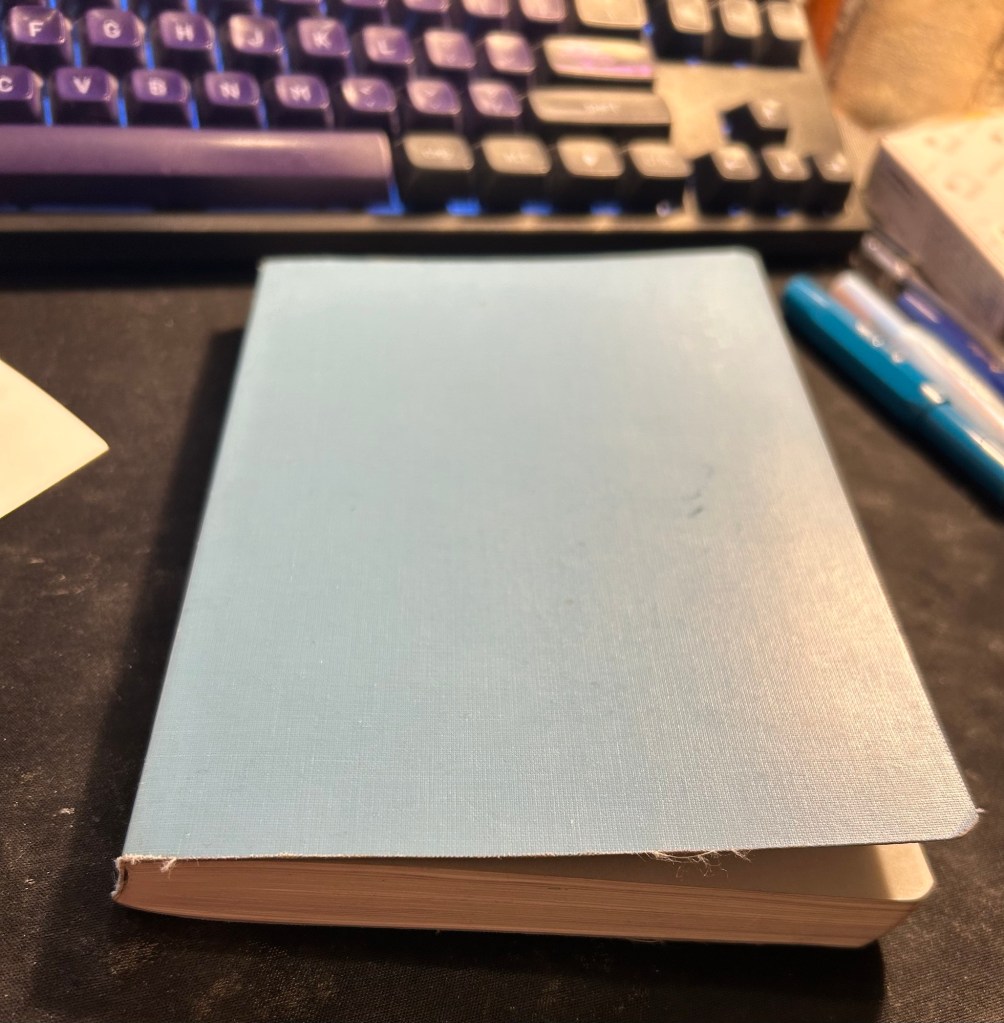
I currently use a Stalogy 365Days B5 grid notebook in light blue. This is the second such notebook that I’ve used, the previous one being black. Before that I used Moleskines, and it’s quite possible that I’ll return to using Moleskines, but currently I enjoy both the smaller format of the Stalogy B5, and its fountain pen friendly pages. The notebook is thick but the pages are thin, so there’s show through (and sometimes bleed through) on every page. It doesn’t bother me, but if it bothers you then you’ll need to either write on only one side of the page or choose a different notebook.
I exclusively use fountains pens in this notebook, whatever is currently inked, though I prefer fine nibbed pens.
My journaling format has also changed, and it’s now as follows:
Gratitude – I tried writing this in the evening but I found that it works better to write this part as early as possible in the morning. Sometimes it’s divided into sections (health, family, work, home, etc), but it’s usually a bulleted list of around 4-5 things. I try to be specific, and I try to remember even the most mundane of things. Especially during tough times it’s super helpful, and it also serves to get me journaling early in the day. Some days I only get this done, but those days are rare.
Notes on what happened during the day. I used to try and be a completionist, but that was just a source of frustration and eventually gaps in my journaling practice. Instead I now journal only things that are meaningful, which means that I journal less to record the day and more to reflect on key moments in it. I try to include a story of some kind (like seeing something interesting on the bus drive to work), and a reflection or insight of some sort (for example, my thoughts on someone being fired, or what the news appears to do to people’s mood and patience).
I end with something out of Acceptance Commitment Therapy (ACT), which is a note on how I tried to advance each of my chosen values (for me it’s self development, courage, creativity, fitness and friendliness). This helps me manage my PTSD, especially during tough days. I know that I’ll be keeping myself accountable in the evening, so I try to keep them top of mind throughout the day.
I journal in the morning, and usually also once or twice during the day and once in the evening. I’m trying to develop both a shutdown routine and a task switching routine, and use them both as opportunities to journal and reflect.
Apart from these, once a week ever since the beginning of the year I reflect on how well I achieved my goals for the week, and once per month I reflect about the month. At the end of the year I review the entire year, and that’s usually the longest entry in my journal for that year. I tend to write 2-3 pages a day, though some days it’s just one page, and some days it closer to 5-6.
Sometimes I sketch in my journal, but it’s rare, and unlike my Moleskines, I don’t glue things in my Stalogy (so not ticket stubs, tags, stickers, business cards, etc).
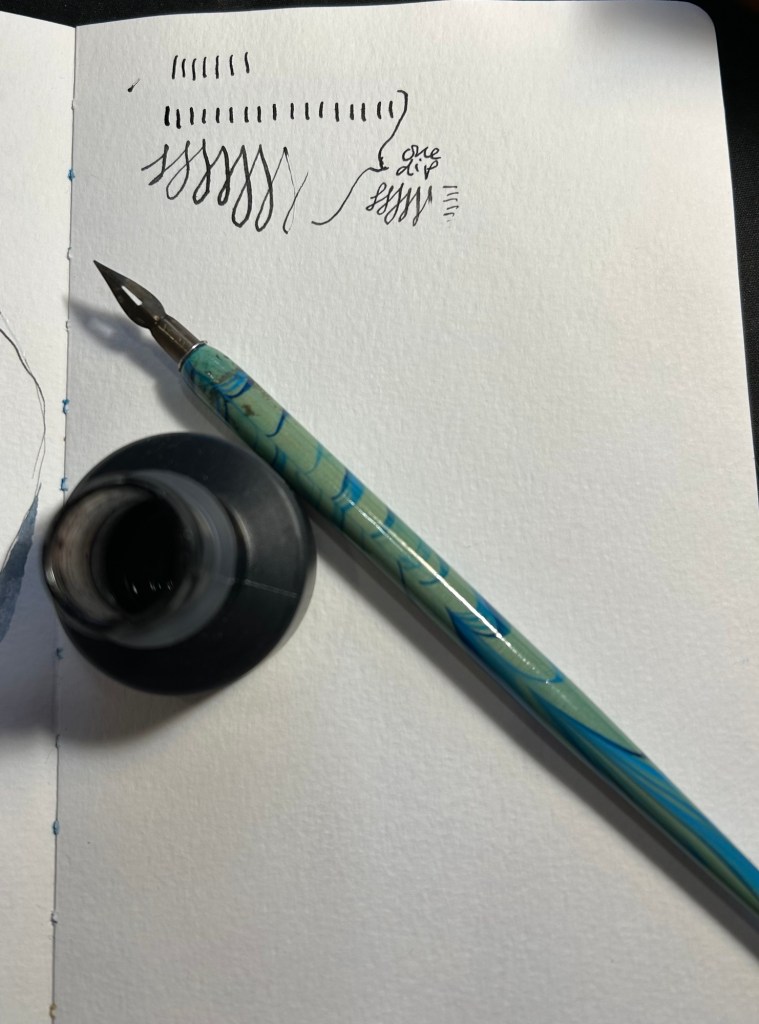
Sketch sample on the right, the blotting paper on the left, and the fountain pen I used.
I keep a folded piece of A5 blotting paper in my journal, as the ink takes time to dry in the Stalogy, and without it the whole page becomes a mess.
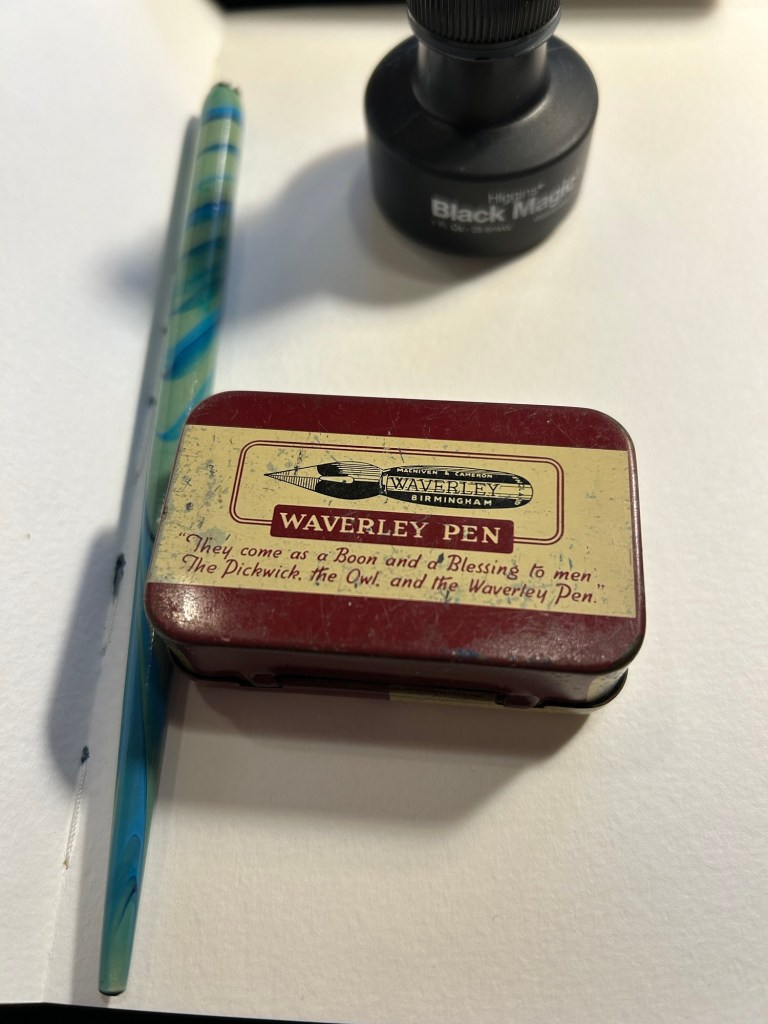
This time I decided to combine testing out a new (to me) India ink, a new (vintage) nib and watercolours. The ink is US made Higgins Black Magic. The bottle shape is unique, and it’s a plastic bottle, not a glass one like my British made inks. While the very wide base of this bottle does cut down the possibility of you accidentally tipping it over, I don’t like the bottle design. The bottle opening is too narrow and tall, and it’s very easy to get ink on your nib holder and hands this way. The ink itself is less shiny and flows wetter than other India inks that I’ve tried, but that’s not a bad thing.
The nibs are Waverley Pen nibs, made in Birmingham (a British steel producing city), and made by Macniven and Camron Ltd.
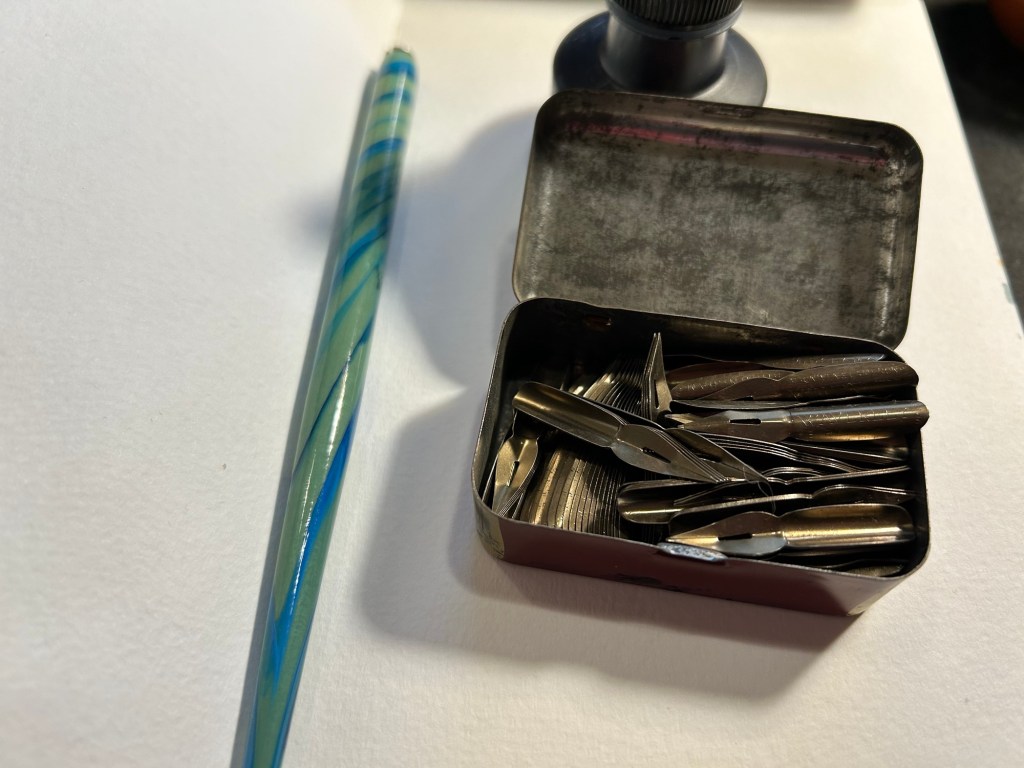
The tin itself is a delight, with the Waverley Pen advertising doggerel on it (the Pickwick, Own and Waverley were all nibs made by the Macniven & Cameron company). I bought it for a few pounds at Spitalfields market, London, and would have bought the tin even if it was empty:
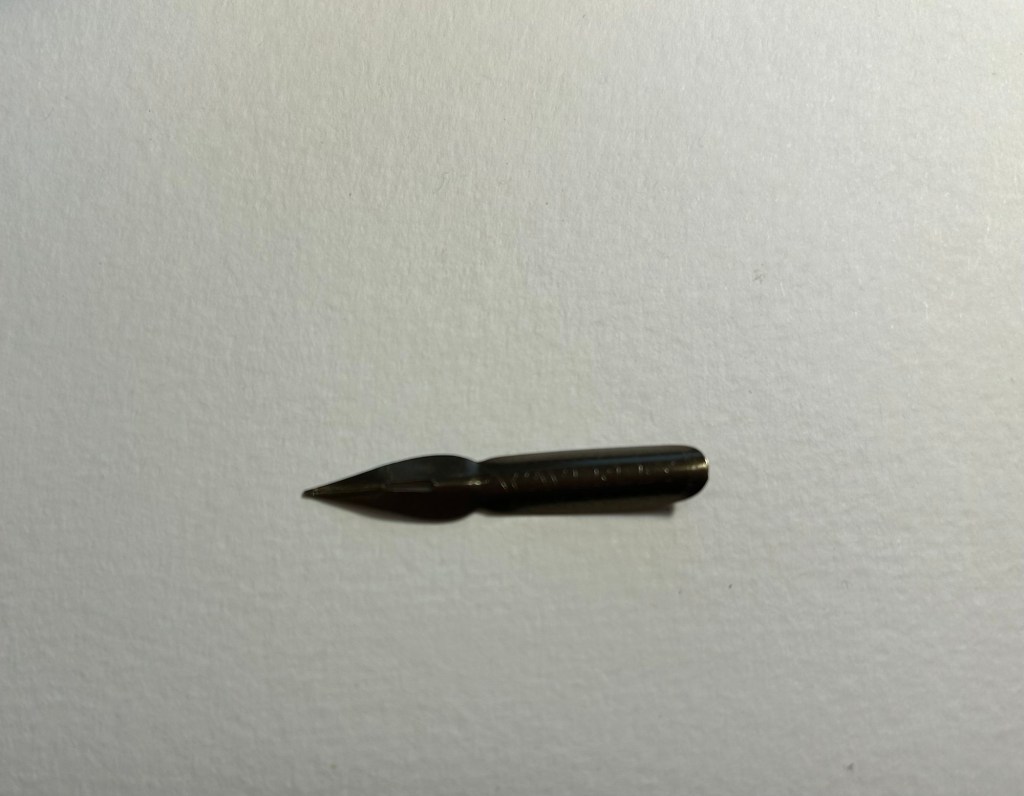
It’s not empty, but rather filled with dozens of Waverley nibs in excellent condition. I took one out, tested its flexing properties (medium flex), and then primed it as described here. To test a nib for its flexing properties you gently push the tines against your thumbnail (don’t ever do this with fountain pen nibs!).
Here’s the nib. It has a bit of kink to it that helps it hold more ink than it otherwise could hold:
I took one dip and tested out how much ink it holds. It’s quite a lot:
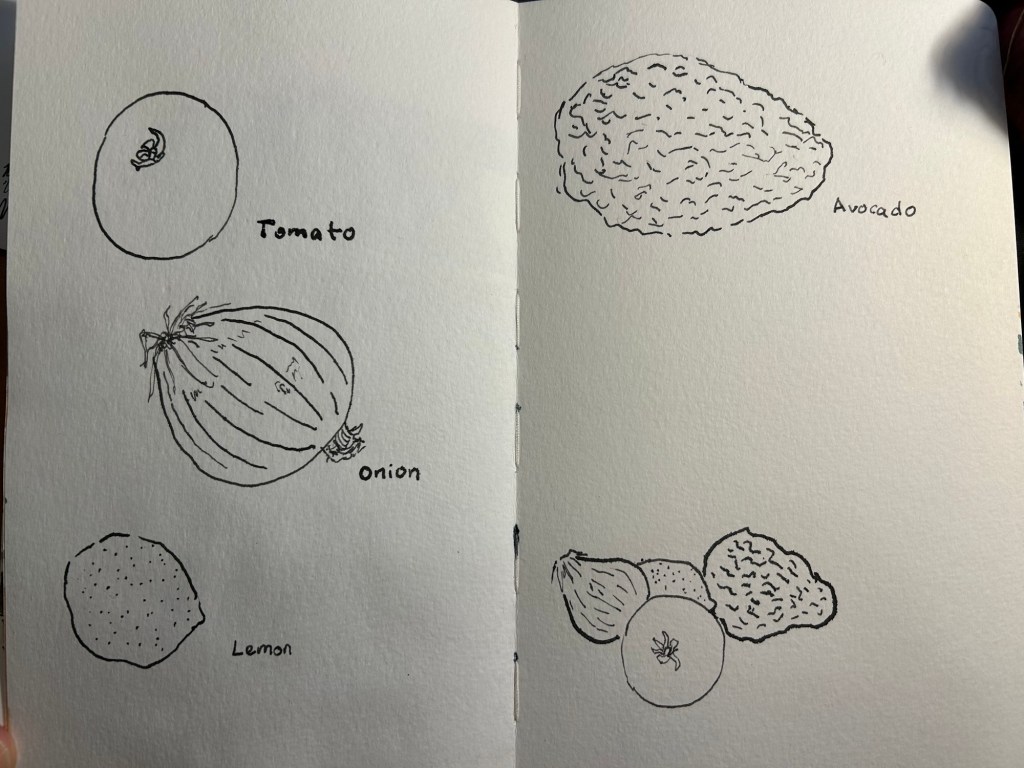
I decided to use it on a Moleskine Watercolour sketchbook. The paper isn’t ideal for dip pens (it’s not smooth and the properties that make it watercolour friendly mean that the ink will spread and feather no matter what), but I wanted to use it with watercolours. As in this case the line sketch wasn’t crucial to me (i.e. it didn’t need to be particularly accurate), I decided to accept some level of feathering and spread for a decent watercolour wash.
Here’s the ink sketch:
A closeup on the onion sketch shows how much line variation you can get from this kind of nib, just how expressive these nibs are, and some of the feathering and spread that I talked about earlier:
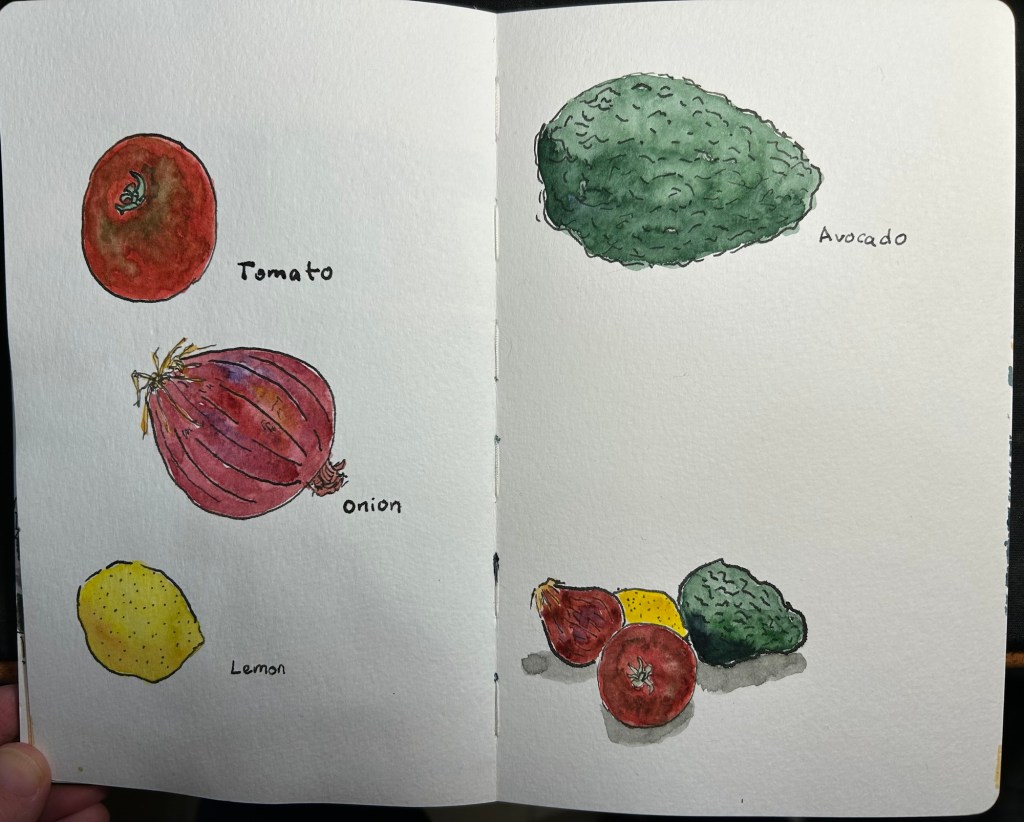
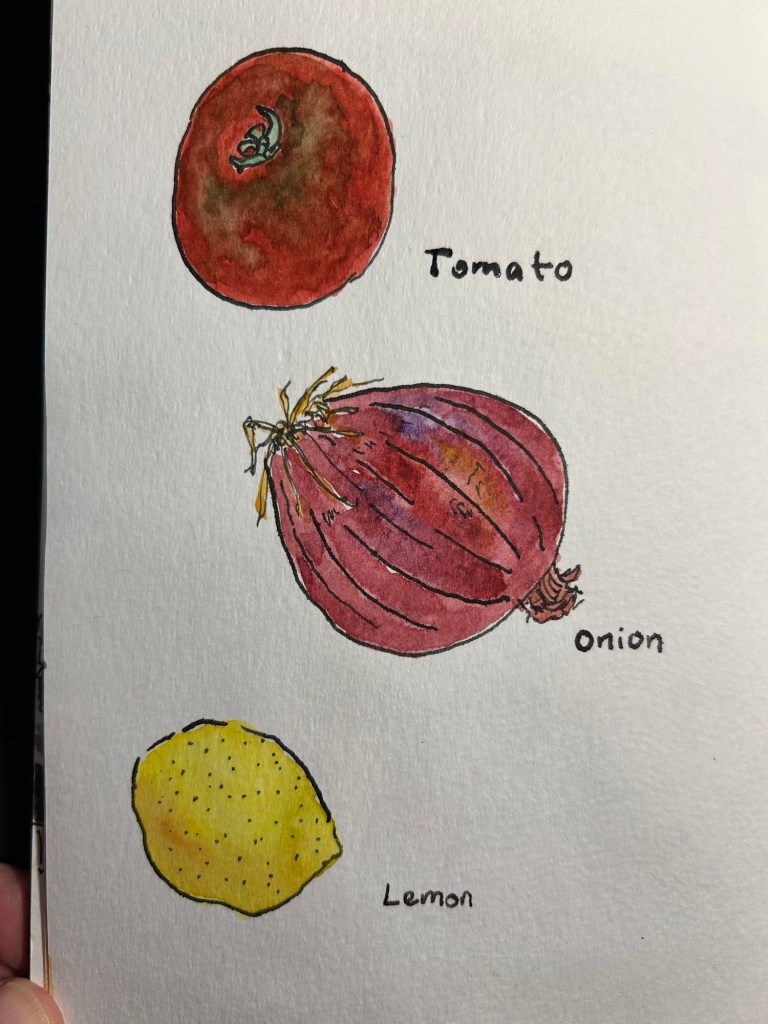
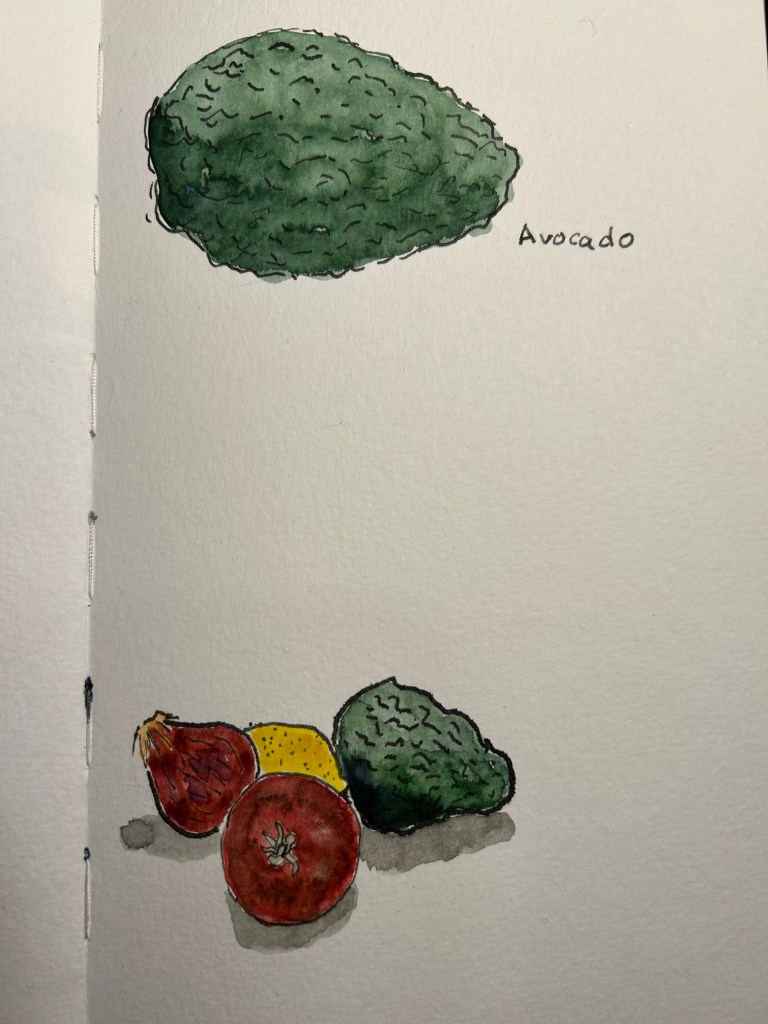
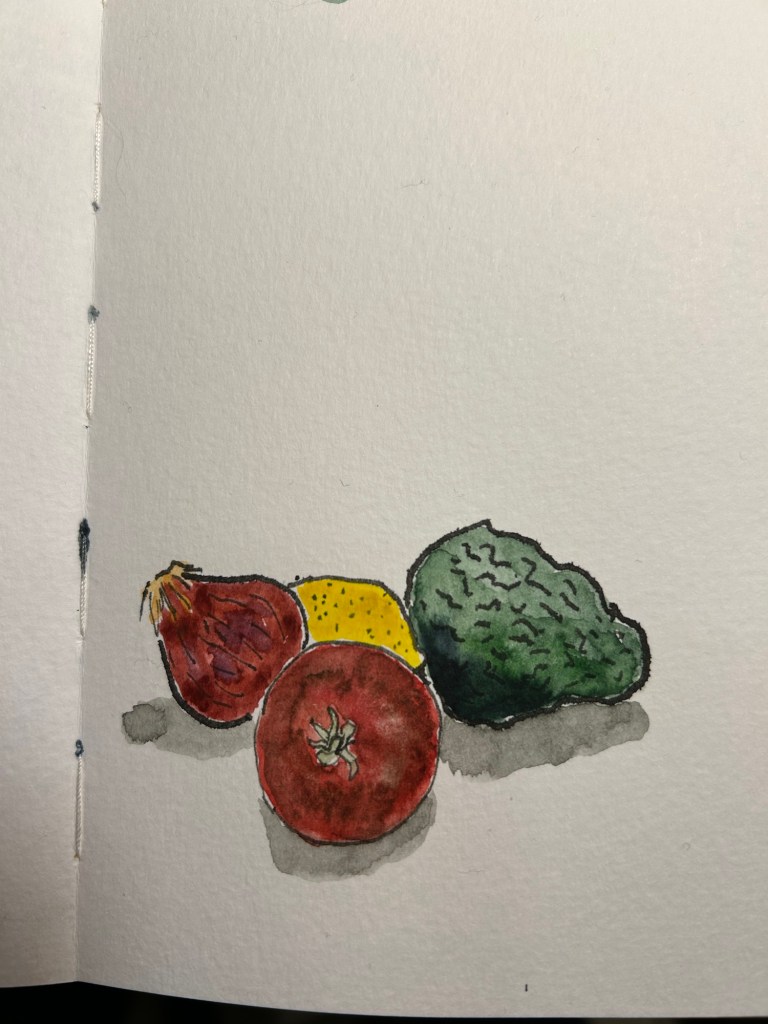
Watercolour brings these sketches to life, and makes the ink compromises worth it:
A closeup on the sketches:
The second page:
The group thumbnail:
There are a few things that you need to remember when combining dip pens and watercolours:
You must let the ink completely dry or you’ll have a ruined drawing, and potentially a ruined brush (if this happens immediately wash your brush well, as India ink will destroy it if left to dry).
The more cotton content in your paper the better the watercolour washes will be, and the worse the India ink will behave. I wouldn’t go over 25% cotton content.
The rougher the paper the better the watercolour washes will be, and the worse the ink sketches will be.
Hot pressed watercolour paper will give you washes with more sharp edges and hard transitions, but will be best for the India ink in terms of smoothness.
Mapping nibs provide less dramatic lines, but they also lay down less ink and so the ink will dry faster and spread less. On the other hand they will snag more easily on rougher watercolour paper.
Have you tried combining the two mediums? If so, let me know how it went.









 Writing at Large