I used to be a heavy Twitter use. I discovered the service pretty early on through webcomic artists like Scott Kurtz, and I found the challenge of crafting short tweets to be a fun writing exercise. Yes, I was among those disappointed when they raised the character limit – half the fun of the service was trying to be as clear and concise as possible.
When Twitter stopped supporting third-party clients like Tweetbot, and started becoming an unpleasant place to hang out, I left. It hasn’t gotten better in the interim years and as I have largely cut social media out of my life so I have no plans of ever going back. However, while I don’t miss Twitter (not as it is, not even as it used to be) I do miss the challenge of crafting short and punchy snippets of text: the haiku like nature of tweets. I also have a large pile of unused Field Notes pocket notebooks, and a not insignificant stock of really cool gel ink pens, rollerballs and ballpoints that are all seeing very little use.
Could I put these together to achieve an analog version of what I enjoyed most about Twitter?
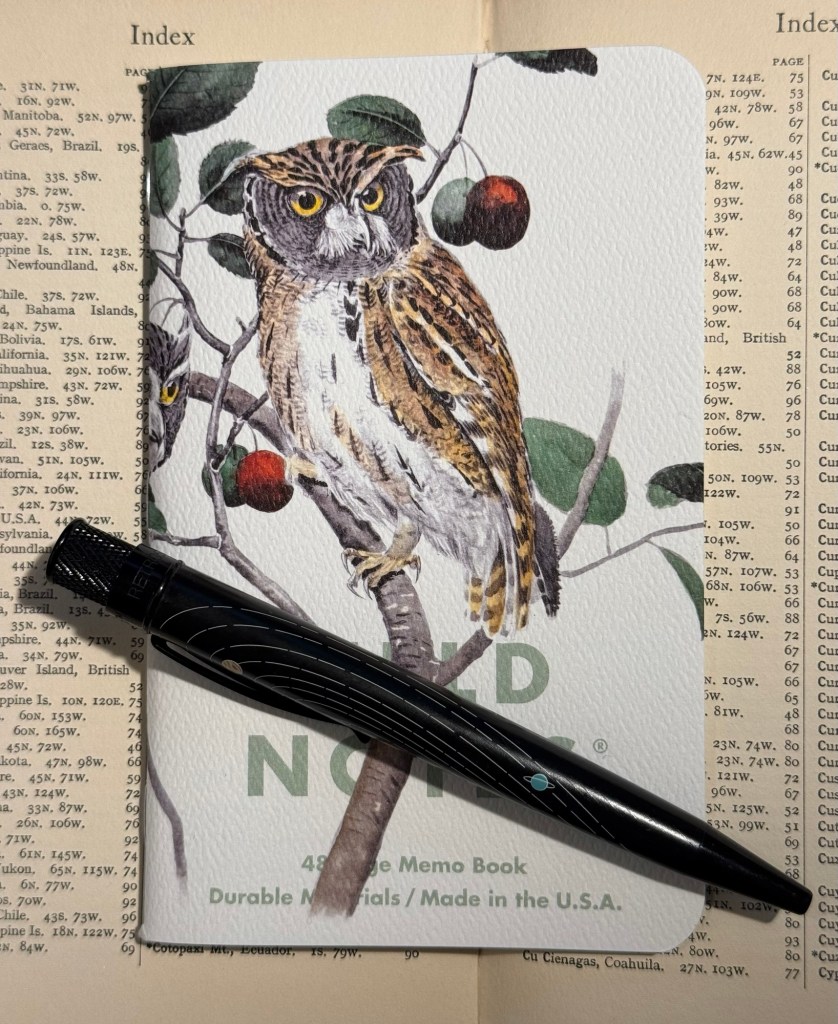
The Birds and Trees of North America, Fall 2024 seasonal edition of Field Notes.
Yes, I could and I did and it has been glorious.
I selected a Field Notes notebook out of the the Fall 2024 “Birds and Trees of North America” edition because it’s a beautiful edition, it has lined paper (which I rarely have use for in pocket notebooks), and it seemed appropriate. I randomly selected a Retro 51 Tornado – The System limited edition one which has Uniball Jetstream SXR-600-05 hybrid ballpoint refill in it instead of the original Schmidt refill which I don’t like. Then I started writing down “tweets” in it throughout the day.
Rocky Mountain and Mexican Screech Owls Field Notes notebook (illustrated by Rex Brasher) and Retro 51 Tornado The System limited edition pen
I’m not dating them, I’m not counting characters, I’m just limiting myself to a few rows for each entry, and I’m writing them as if I would be publishing them. The writing style is therefore different than what I would write in my journal, and so far it’s also focused exclusively on things that I don’t write about in my journal (mainly reactions to things I did or saw or read). I have no intention of ever publishing anything in this notebook, but I do enjoy the challenge of writing it as if it would be something that I would post somewhere.
So I get to practice my writing skill in a new way, I get to use some of my wonderful Field Notes stash, and I get to use some of my great standard pens. All this without filling the pockets of various billionaires with my work, and without encountering the bots and the foaming hordes of professional haters and rabble rousers online.
I highly recommend this practice, whether you do it with a fancy Field Notes or just any pocket notebook you have on hand. Using a notebook of this size will remind you to keep your entries short, and it’s something that you can easily carry with you and use in waiting rooms, boring meetings, or when you need a little break between tasks throughout the day.
I have finally written dry all of my Inkvent 2024 fountain pens, which means that after two months I get to write with a whole new set of fountain pens and inks. I normally don’t spend too much time selecting which pen and which inks I’ll use next, but this time I decided to use some criteria for the next pens in my rotation:
They need to include at least 50% vintage pens. I don’t use vintage pens with Inkvent inks, and vintage pens make up most of my pen collection.
All the pens need to be pens that I haven’t used in a long time (at least a year). It was time to mix things up.
The inks needed to be inks that are new to me, or that I haven’t used in years, and all of them need to be inks that I haven’t swabbed before. This was not only to mix things up, but to get me to use and swab more inks in my collection, instead of going again and again to a few select favourites.
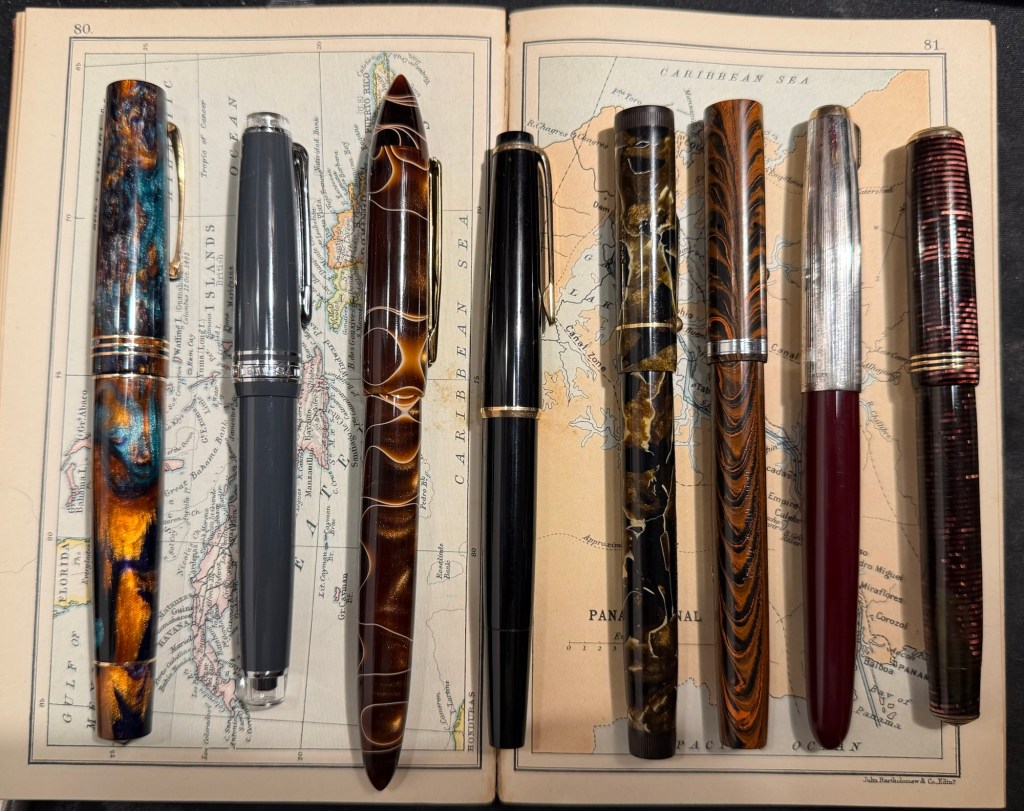
Here’s February’s fountain pen lineup:
The pens from left to right: Leonardo Momento Zero Bohemian Twilight, Sailor Pro Gear Slim Graphite Lighthouse, Edison Nouveau Premiere Cappuccino, Montblanc 32, Mabie Todd Swan L2 Leverless pen, Waterman 52, Parker 51, Parker Vacumatic Standard double striped jewel.
And here are ink swabs of the inks that I’ll be using:
Ink swabs on Col-o-Ring cards
The Vintage Pens
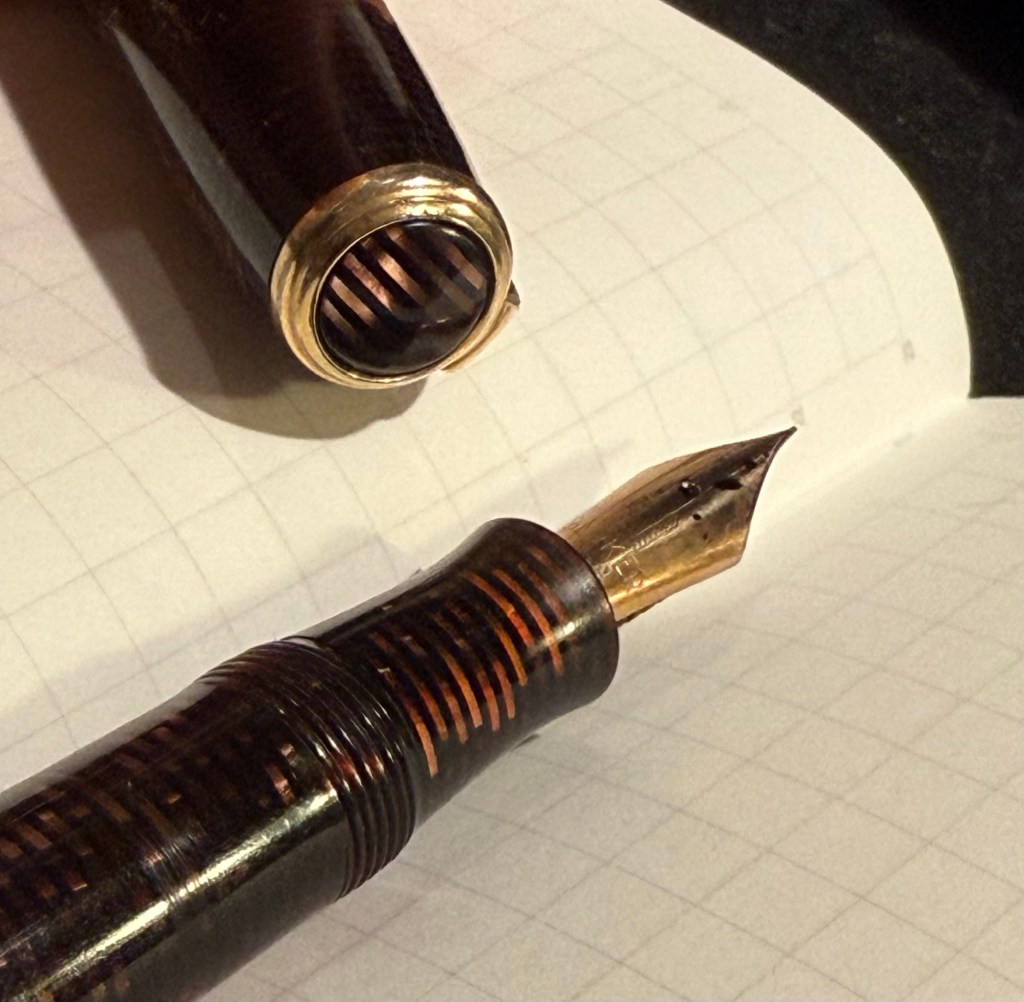
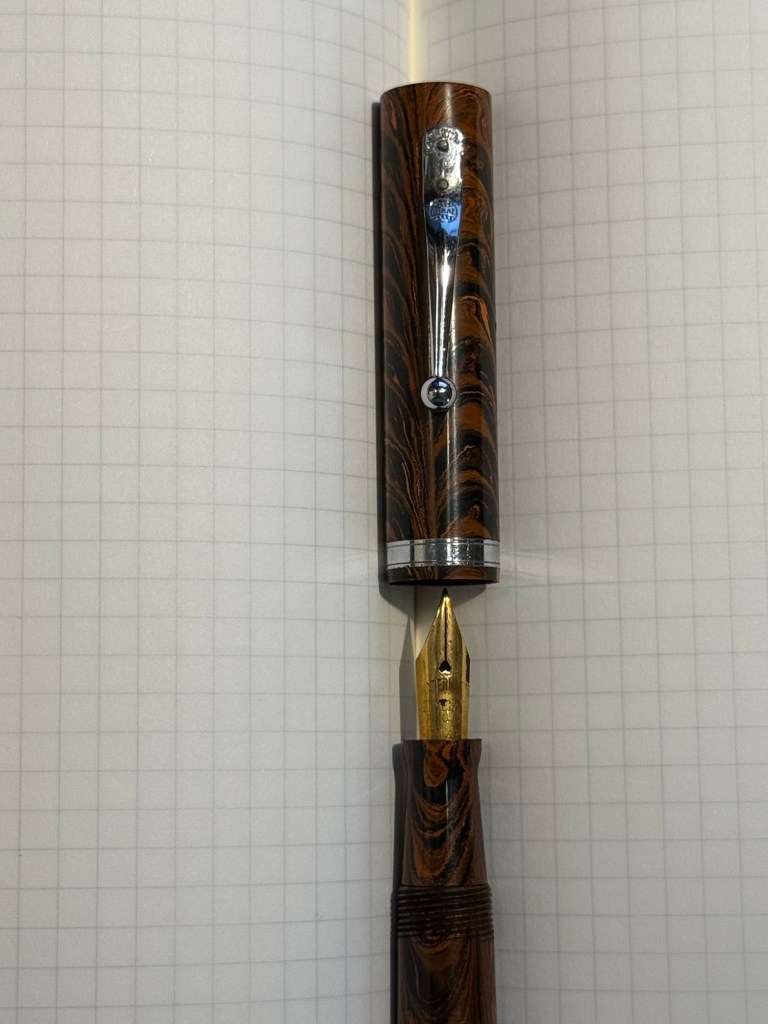
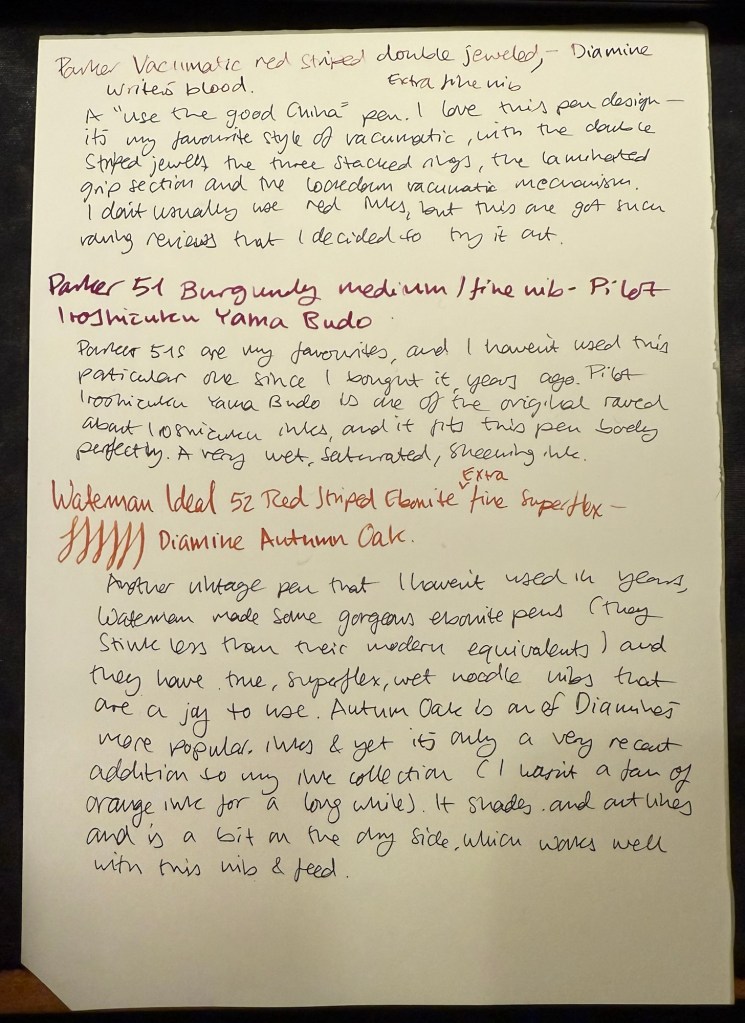
Parker Vacumatic 1st generation Laminated Burgundy Pearl Double Jewel (striped jewels, striped section) – I adore Parker Vacumatics and this is a “use the good china” pen. The grip section is also laminated (and not plain black), the body is transparent, and the nib is a sharp extra fine gold nib with a bit of character to it. It’s filled with a brand new ink for me, Diamine Writer’s Blood. I never use red inks, but this got raving reviews and seemed dark enough for me to try. I bought the ink in Oxford last year, and the pen years ago from the late Henry Simpole (Henry the Pen Man) in London. I don’t think I inked up this pen since I bought it, as it was too precious, and I still won’t let it leave the house, but I am looking forward to actually using it.
Parker Vacumatic first generation burgundy laminated grip sectionCloseup on the striped jewel and the grip section of the Parker Vacumatic
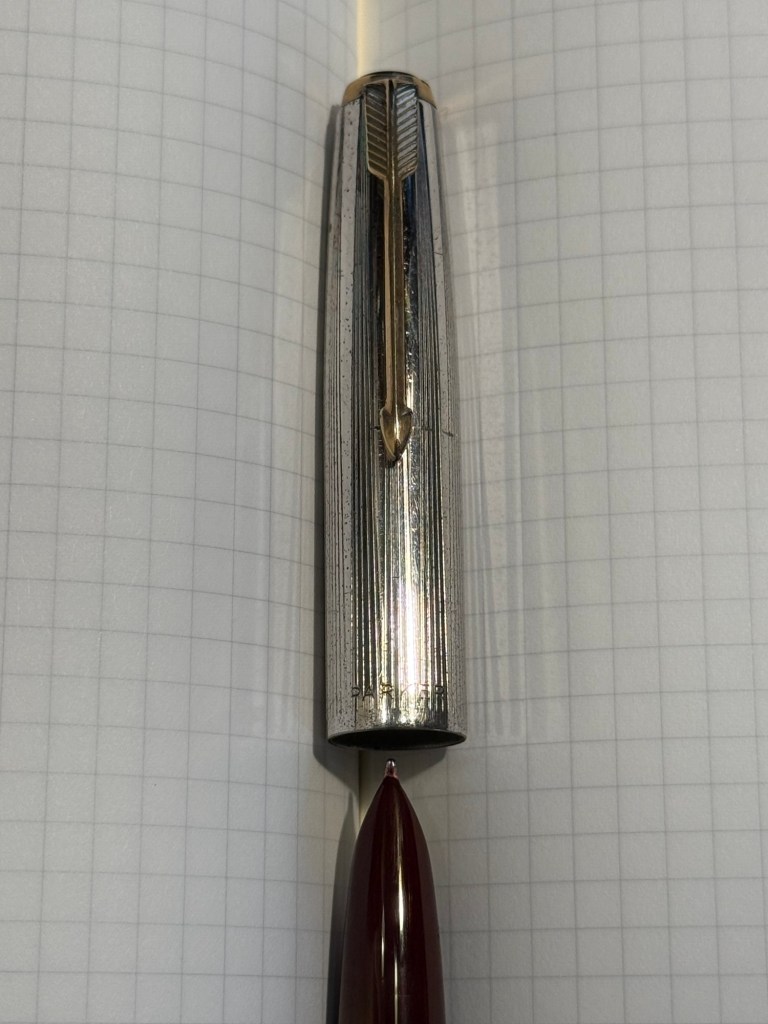
Parker 51 Burgundy aerometric with a silver cap and gold filled arrow clip. I love Parker 51s, they are my absolute favourite fountain pens. I believe this cap is on the rare side, though it’s far from pristine or attractive (it’s blackened in specks, and there are a few scratches and micro scratches on it). The nib is a generous fine, bordering on medium, and like all other 51s that I’ve used, it’s magic. I haven’t used this pen since I bought it, so it’s time to give it a whirl. It’s filled with Pilot Iroshizuku Yama Budo, which is a lovely, sheening burgundy ink, one of the more popular inks in the Iroshizuku lineup. In hindsight coupling this ink with this pen wasn’t the best choice, as the 51 has generous nibs and Iroshizuku inks are on the wet side. It just means that I’ll have to steer clear of cheap paper with this combination.
Parker 51 cap and nib closeup
Waterman Ideal 52 Red Ripple fountain pen with a super flex extra fine nib – my word but this pen has the most glorious nib. The pen itself is elegant and pristine, and because of its age it doesn’t have the ebonite stink to it. The nib is why I bought this pen, and it effortlessly moves between extra fine and broad or double broad lines, with the feed easily keeping up with tines. Like all Waterman nibs that I’ve tried, there is some feedback, so if you like butter on hot pan nibs this one isn’t for you. This is the kind of nib that you can only get in a vintage pen, and it puts modern flex pens to shame. It’s only minus is that this is a lever filler, and I hate cleaning out lever fillers, which is why I rarely use them. This pen is filled with Diamine Autumn Oak, which I haven’t used yet (in bottle form at least – I have cartridges of it). I wanted a brighter ink in this lineup, so Autumn Oak was a perfect choice.
Waterman 52 cap and nib closeup. You know the nib is going to be fabulously flexy once you see that heart shaped breather hole and the slight bend down in the nib. Writing sample on Midori MD Paper. Notes written with a Platinum Preppy.
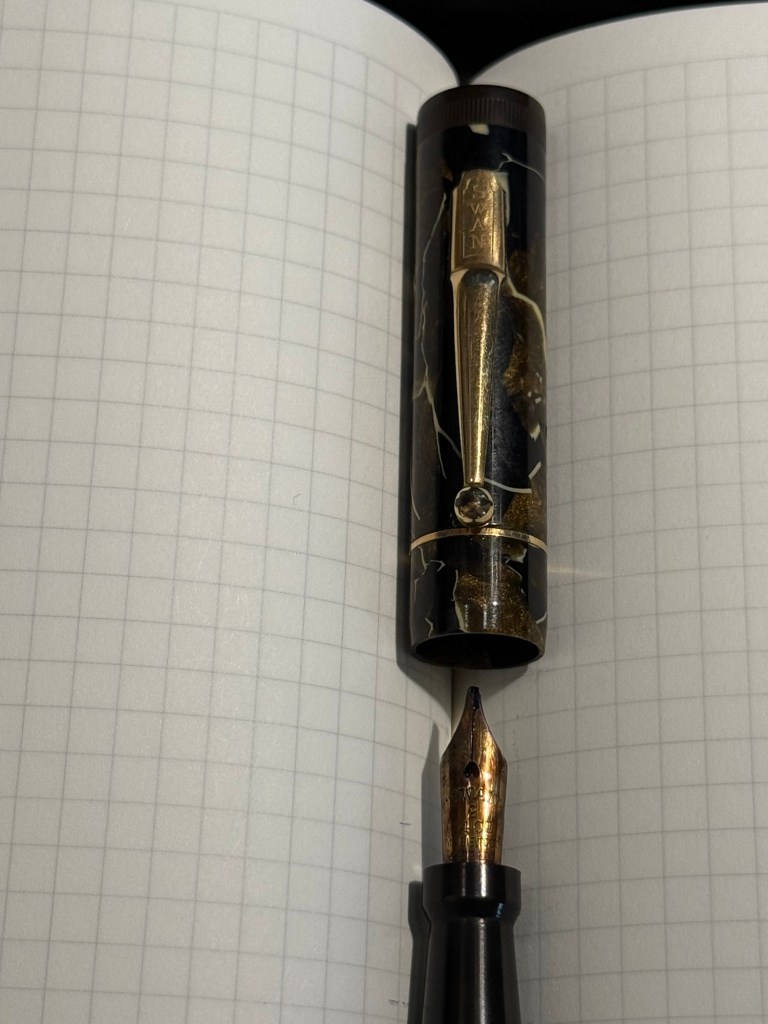
Mabie Todd Swan L2 Leverless L205/62? Not sure – Swan did a poor job labeling their pens, and I didn’t write down notes when I bought it. This is a lovely pen that I bought from Henry Simpole years ago because of the phenomenal Swan nib. It’s an oblique flexible nib with Swan’s gimmicky “Leverless” filling system (which is a lever system in disguise, but such were the ’30s – you needed a gimmick to sell pen). I haven’t used it at all since I bought it because I don’t remember the experience of cleaning it out very fondly – imagine all the bother of cleaning out a Lamy 2000, but with a piston that has just one twist of travel. I used Pilot Iroshizuku Asa Gao with this fountain pen, and it’s a gorgeous ink with a good amount of sheen with this nib. I love this shade of royal blue, and I haven’t used this ink in a while. Take a look at the Swan above – it’s almost 100 years old and works perfectly.
Closeup on the nib and cap of the Swan Leverless penWriting sample on Midori MD Paper. Notes written with a Platinum Preppy.
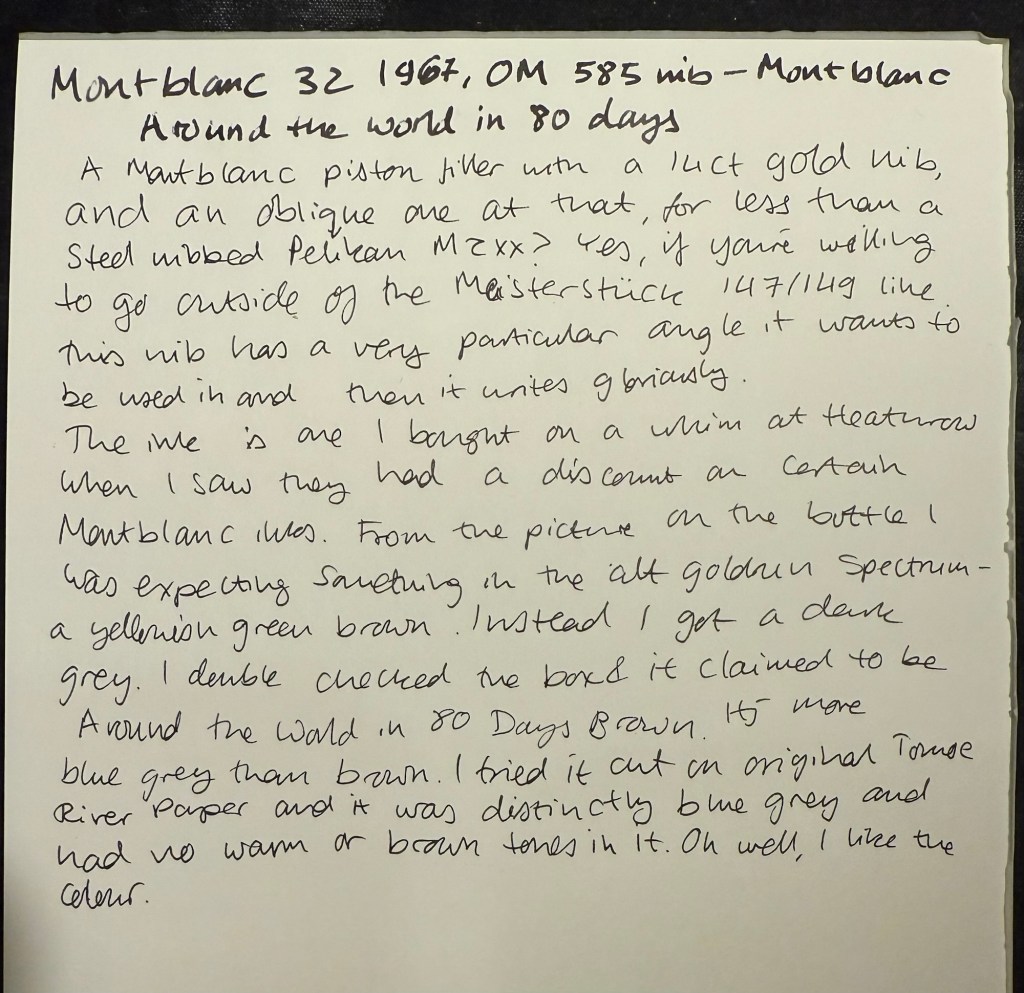
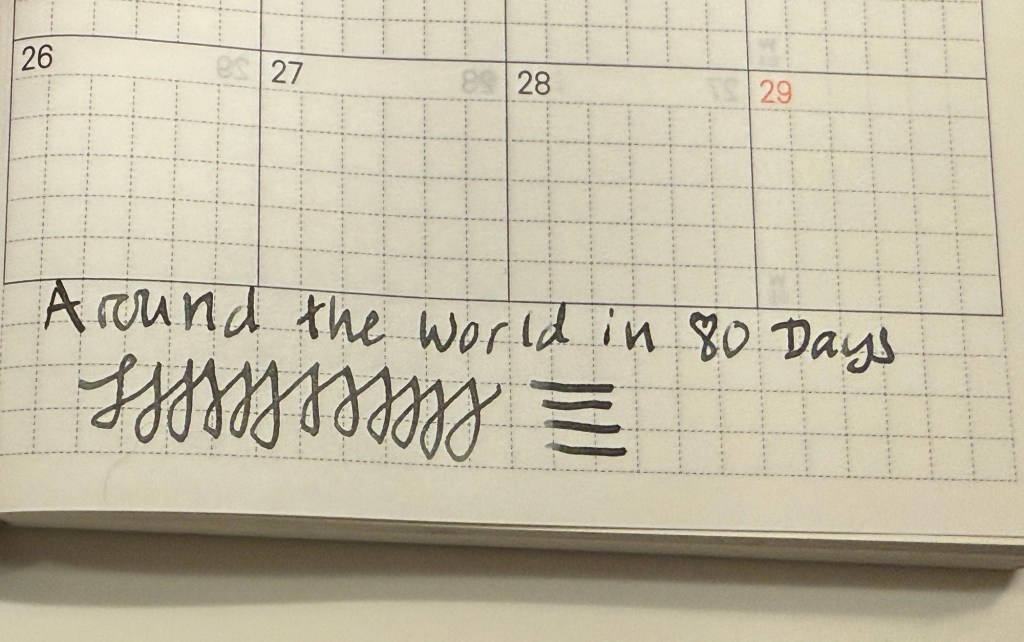
Montblanc 32 (1967) OM 585 nib – heavens, you can get a gold nibbed, piston filling original Montblanc with an Oblique Medium nib for less than a steel nibbed Pelian M2xx costs? Yes, you can. I love the design of this pen (you can read about it more here) and the nib is great… provided you write in the exact angle it expects. The Swan’s nib is generous in terms of the writing angles it accepts, and the Monblanc 32 is demanding: you will use the nib at the precise angle it is designed for, or it will not work at all! I only wish that the Montblanc Around the World in 80 Days ink was so exact. From the description and the illustration on the box I was expecting a brownish gold ink, maybe with a hint of green. In reality I got a dark, cold grey ink, with a hint of blue to it. No brown, no gold, nothing at all to do with the elephant illustration on the box. I had to double check just to make sure that I hadn’t landed on a bad bottle by chance.
Montblanc 32 semi hooded nib Writing sample on Midori MD Paper. Notes written with a Platinum Preppy.Writing sample on original Tomoe River Paper
Modern Fountain Pens
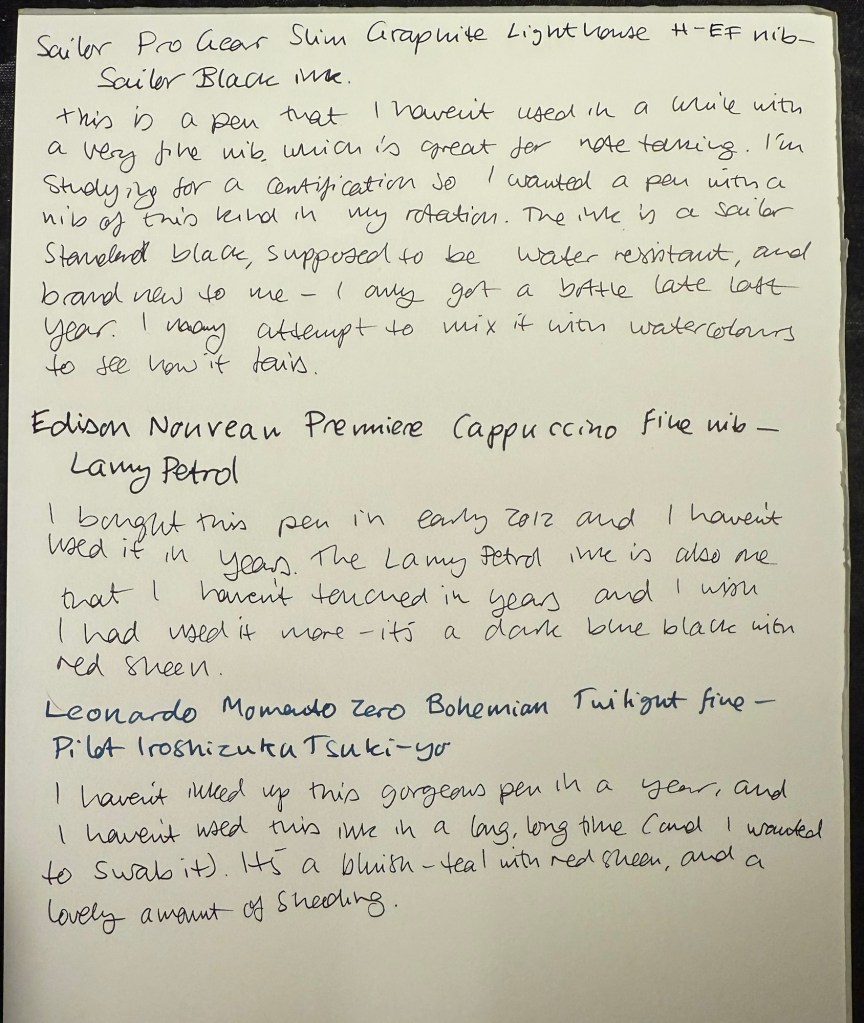
Sailor Pro Gear Slim Graphite Lighthouse H-EF nib – I haven’t used this pen in over a year, and I wanted a pen with a very fine nib, so that I can use it for note taking. It’s inked up with Sailor Black, a new ink for me and one that’s supposed to be water resistant. I’m using this combination for my certification study notes, and I may also try it out with some watercolours in a sketch, just to see if I can use Sailor Black ink as part of my sketching kit.
Edison Nouveau Premiere Cappuccino fine nib – I bought this pen in early 2012, before they did a run of seasonal limited editions of this pen design. I haven’t used in years, and the same goes for the ink in it: Lamy Petrol. This is a limited edition ink, one that Lamy issued with the Lamy Safari Petrol, and it’s a wonderful blue-black with red sheen.
Leonardo Momento Zero Bohemian Twilight fine nib – this pen has “only” been a year out of rotation, and it’s one of my favourite Leonardos. The colour of the resin is gorgeous, and it works very well with the Pilot Iroshizuku Tsuki-yo ink that it’s filled with. Tsuki-you is a bluish-teal with red sheen and a wet flow, and it suits the Leonardo’s fine nib.
I’ve been unhappy with my watercolour palette lately, and so I’ve been experimenting with new colours instead of some of the old ones. I usually swap out one colour at a time, try out the new colour for a while, and then either keep it or swap it out for something else. This time I’m doing my usual swap procedure, and also building a completely new palette on the side. The idea is to speed up the new colour discovery process, as there are 5-6 colours that I want to replace in my current palette, and that’s a lot.
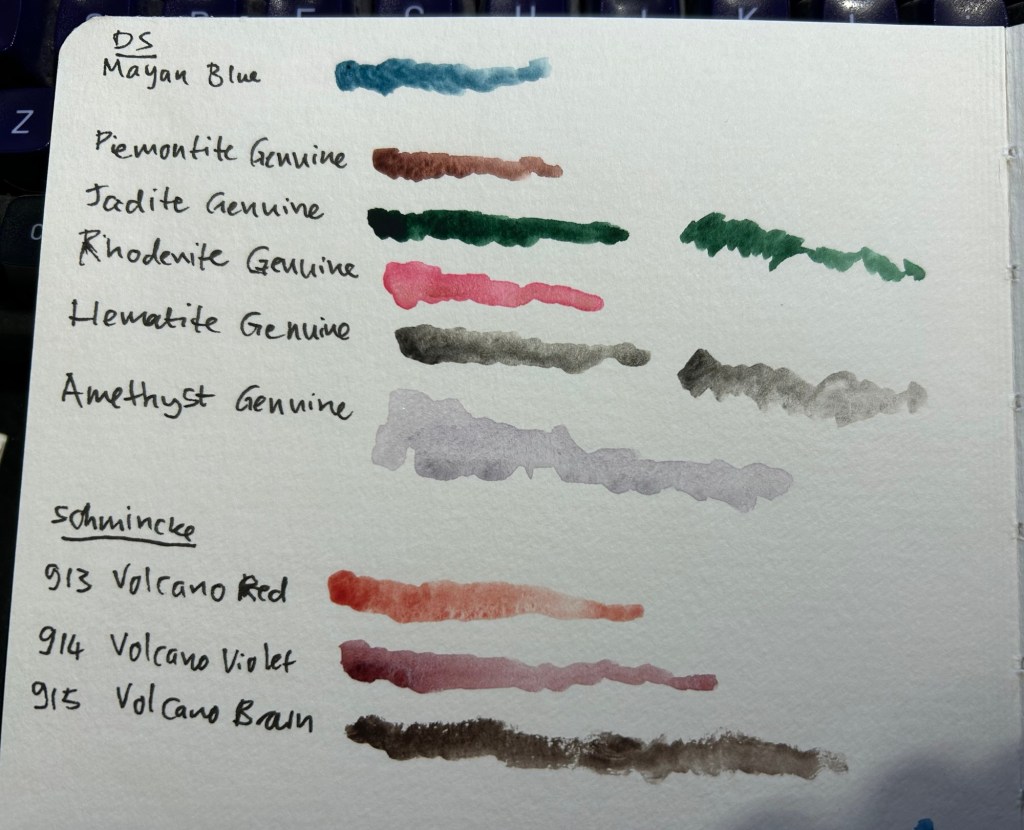
The first colour to leave was Daniel Smith Cerulean Blue Chromium. I have too many similar blues and it’s slowing me down having to decide between them every time I need a blue. In its place I swapped Daniel Smith Rhodenite Genuine, which is a bright pink.
Samples of some of the colours I considered swapping in. Amethyst Genuine was a genuine disappointment – I don’t think I’ve seen such a bland, pale, washed out purple anywhere.
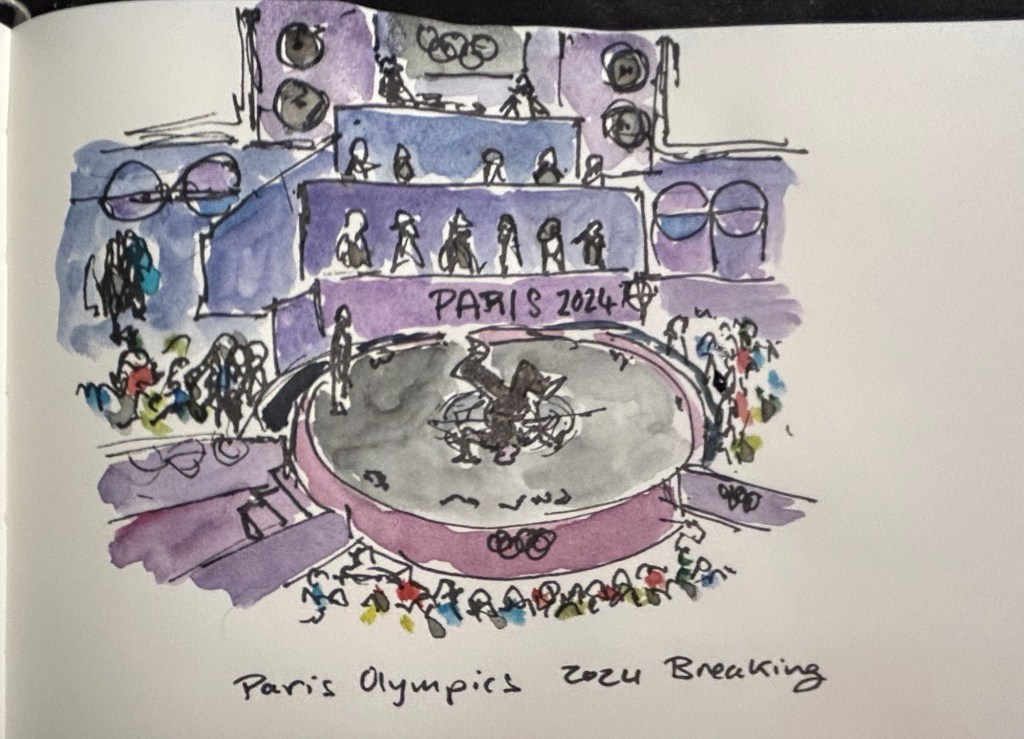
I then sketched one of the scenes from the 2024 Paris Olympics Breaking final, which I was going to see in person before I had to cancel my trip. Luckily my brother was there and sent me photos and videos, which I had fun sketching from. There was a lot of purple in this scene, so I had fun mixing Rhodenite with blues and purples on my palette.
Quick Paris Olympics Breaking sketch
The new palette is something I’m building in a Daniel Smith plastic paintbox. It’s not a box that I’d regularly use (it doesn’t have enough mixing space for me), but it’s useful for the testing I want to do.
This box came as part of a set of two, one of which had paints in it.
I then set up a legend in my sketchbook:
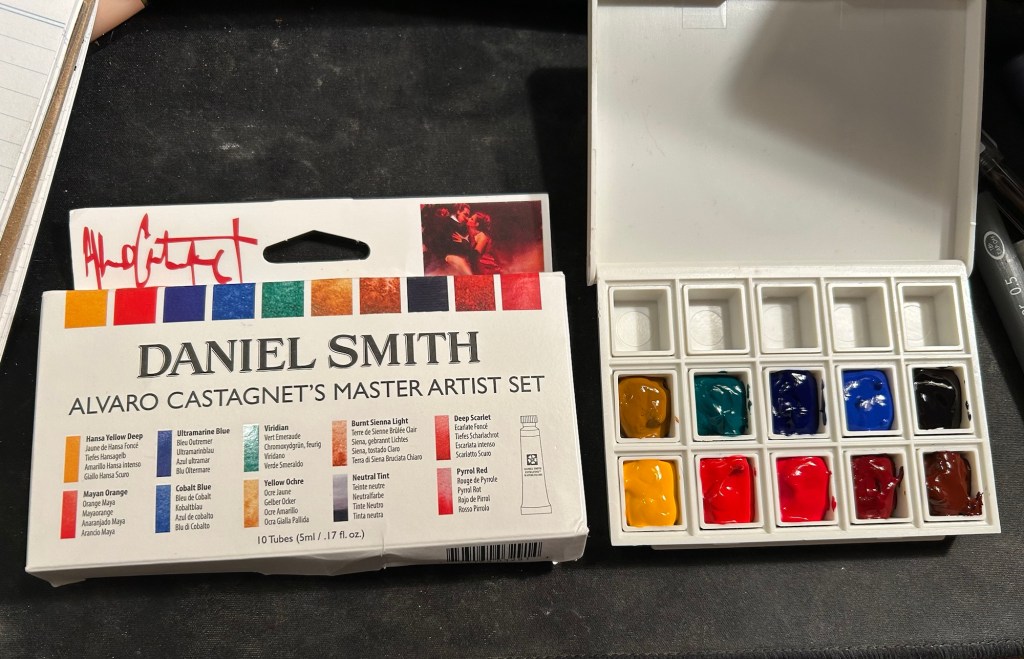
Next I broke ou the Alvaro Catagnet Daniel Smith Master Artist set and filled the pans with paint. I’ll give them 2-3 days to completely dry out before finishing the legend and trying them out. I would never have built a palette which is so heavily skewed towards reds, but this is part of the experiment – after a heavily blue skewed palette it’s time to try something new.
I can’t wait to give these new paints a try. I’ve worked with the Schmincke versions of Yellow Ochre (I no longer use it because of its opacity), Viridian (way to artificial a green for my tastes), Ultramarine Blue and Cobalt Blue, but it will be interesting to see Daniel Smith’s take on these colours.
It’s a battered Moleskine pocket hardcover lined notebook, a limited edition Mickey Mouse one from years ago. There was a series gash in the spine, so I fixed it with some gaffer tape. I use a Zebra G-450 gel ink pen, and it lays down a bold, 0.7 black line.
I don’t use this notebook during every gym session, but when I’m trying out new things, when I’ve got a lot on my mind, or when I’m trying to solve a specific problem I take it with me. I don’t write details about my workout (rep numbers, weights, etc) as I have an app for that.
So what do I write in this notebook?
How things felt during the workout, particularly when I’m trying something new or if I’m recovering from an injury.
Notes on other gym goers bad behavior. I don’t want to confront them, but I do get frustrated when people don’t return weights, don’t use a towel or wipe down the equipment, and hoard equipment during the gym rush hour. Writing it down allows me to let off steam and focus on more productive things (like my workout, or returning equipment that I know is no longer in use back to its place, or on anything else).
Ideas or projects that I’m brainstorming at the moment. I oftentimes use a workout to think about something I’m considering or something I’m stuck on. I jot a few notes in between sets to not forget the ideas I came up with during that time.
Things I want to journal about later, in my “regular” journal. These are usually things that I forgot to journal about and want to get back to later in the day, when I have time to sit down and better process them.
The main point of this journal is to get me as much as possible off my phone. It’s tempting to check the news for the umpteenth time, or doom scroll various feeds, or play mindless games while you wait between sets. My goal is to bring these habits down to a minimum, and this journal is a useful tool in the search for less screen time.
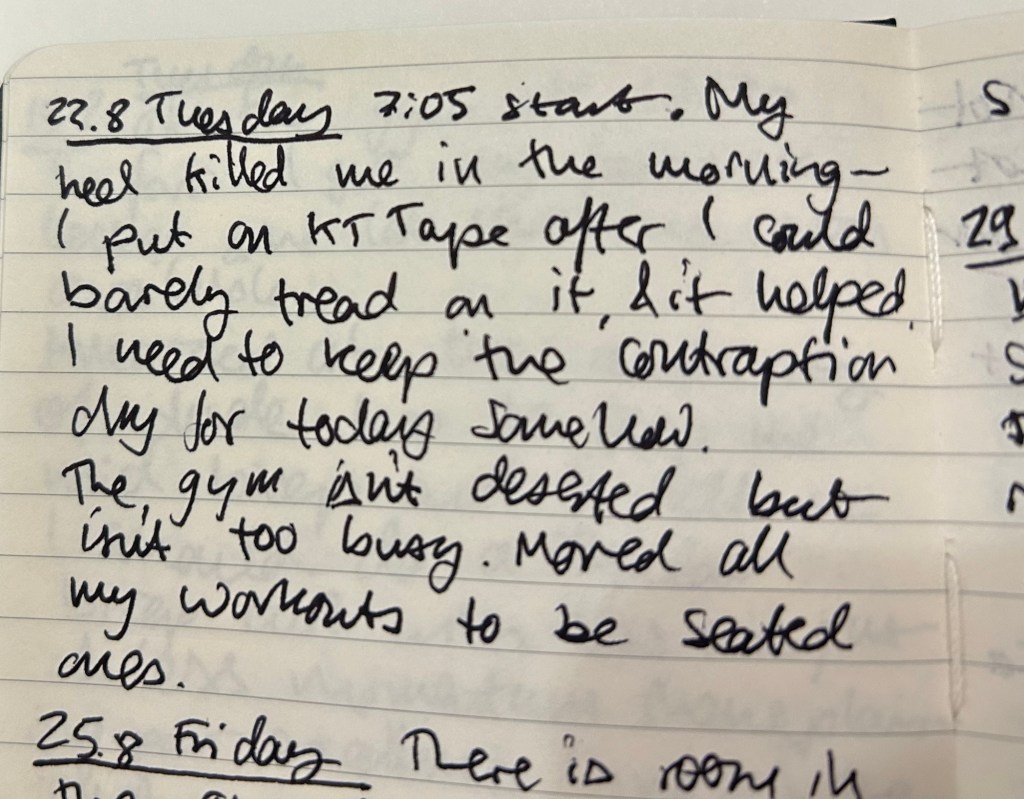
Sample entry from last year. I write with gym gloves on, hence the atrocious handwriting.
I originally thought that it would be embarrassing to use a notebook in the gym, but I decided that “so what, who cares” is the attitude to take in this case. People do much more embarrassing things at the gym and nobody comments on it. I use an inconspicuous notebook that isn’t at all precious, and a hardy, inexpensive, inconspicuous gel ink pen to go with it. Both have survived falls and encounters with misplaced weights, so they are gym hardened, Don’t bring large, colourful notebooks with you, and don’t bring pens that look expensive or draw attention to themselves. You’re going for the “boring, not worth paying attention to” look here.
Would you consider taking a pen and notebook with you to the gym? If you already do, how do you use your gym notebook?
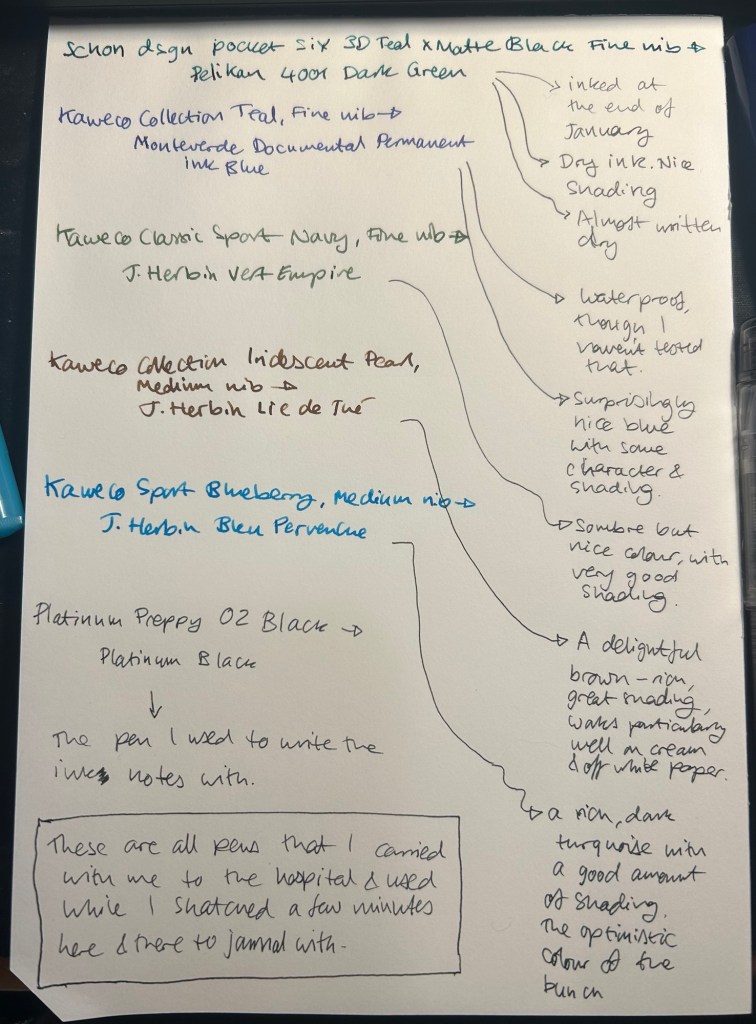
I started the month ready to spend the first half of it in hospital, with my dad. So the fountain pens I chose were all expendable pocketable pens that I was willing to have stolen (apart from the Schon Design Pocket 6 which was a leftover from January and never left my desk). So that meant I inked 4 Kaweco Sport fountain pens using various ink cartridges that I had on hand.
The portable lineup:
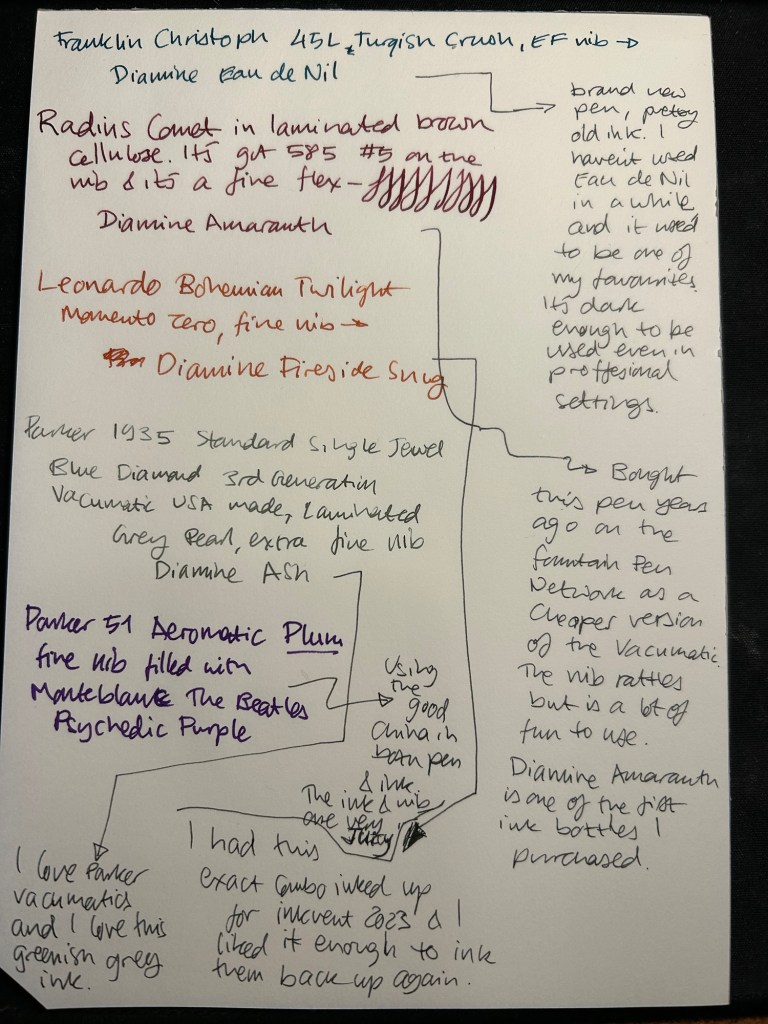
Once my dad got out of hospital and back home, I decided to celebrate by “shopping” from my collection. I inked up a Parker 51 Plum (use the good china!), a Parker Vacumatic, a Franklin Christoph 45L Turqish (spelled like that on their site) Crush that I had purchased but hadn’t inked before, and a vintage Radius Comet (because I heard that the brand was being revived).
The Franklin Christoph EF nib isn’t the best companion to the Eau de Nil as the ink tends to dry in the nib, causing hard start issues. The Radius is a flexible nib of the vintage kind, which means it’s really flexible and not just springy. It also rattles, which makes me not carry it around with me — it stays at home at my desk. The Leonardo is a beautiful pen with a beautiful ink that I refilled immediately — the only Inkvent 2023 ink I did that with. The two vintage Parkers are phenomenal, as usual. The extra fine nib on the vacumatic somehow really well with Diamine Ash, though I was worried at first that the combination would be too light to be readable. The Parker 51 Aeromatic is a treat to use. It’s the rare Plum colour, and it’s got a fantastic nib (as all 51’s have) which pairs very nicely with the Monteblanc The Beatles Psychedelic Purple.
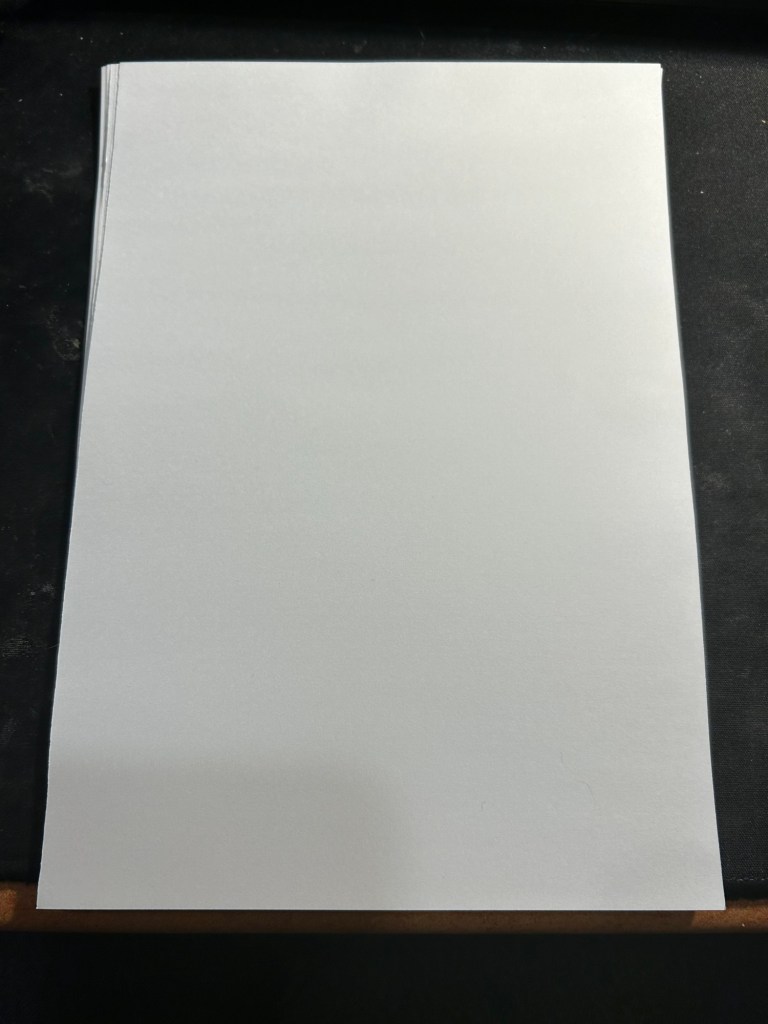
In terms of paper I’ve been using Kokuyo A4 KB paper which I cut to half size (so A5) to manage my daily to do list. The paper is relatively cheap and very fountain pen friendly. I’m also able to use both sides of the page despite there being some show through.
Kokuyo A4 KB paper cut in half to A5 size. This is why standards are great.
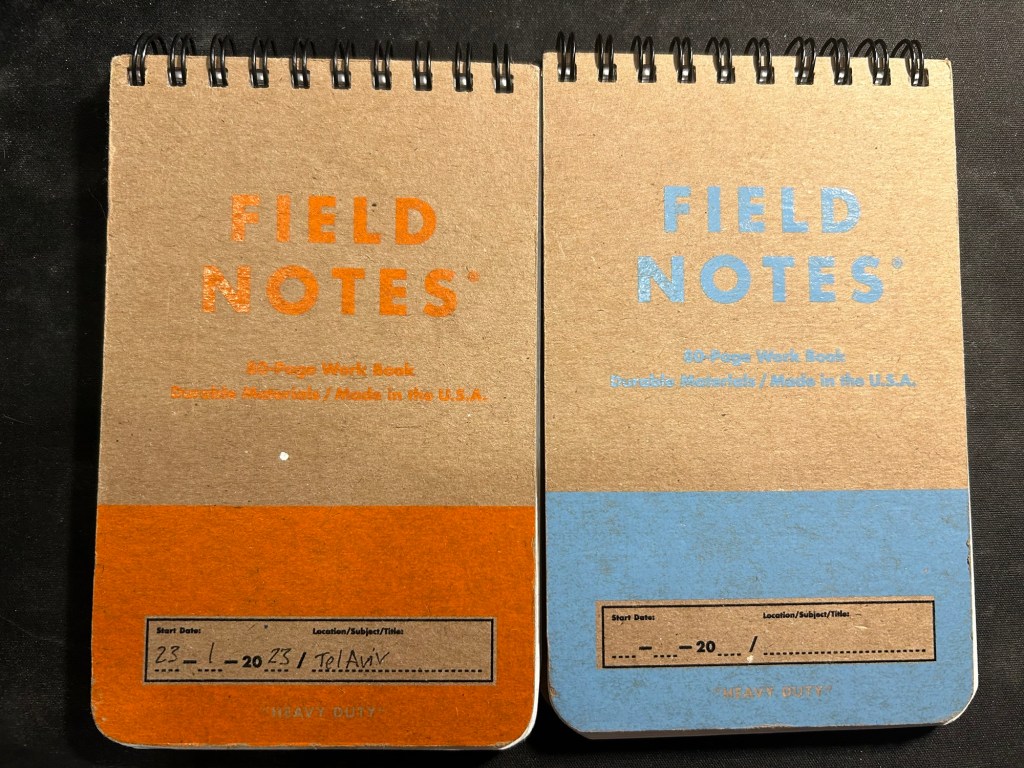
I’ve got a Field Notes Heavy duty on my desk at home and at work, and I just bought a new stock of them. These are where I jot down quick notes, phone call details, doodles during boring meetings. When they’re filled up they get tossed out as nothing in them is permanent — everything important in them moves to somewhere else as I work my way through them.
Field Notes Heavy Duty pocket spiral bound reporter notebooks
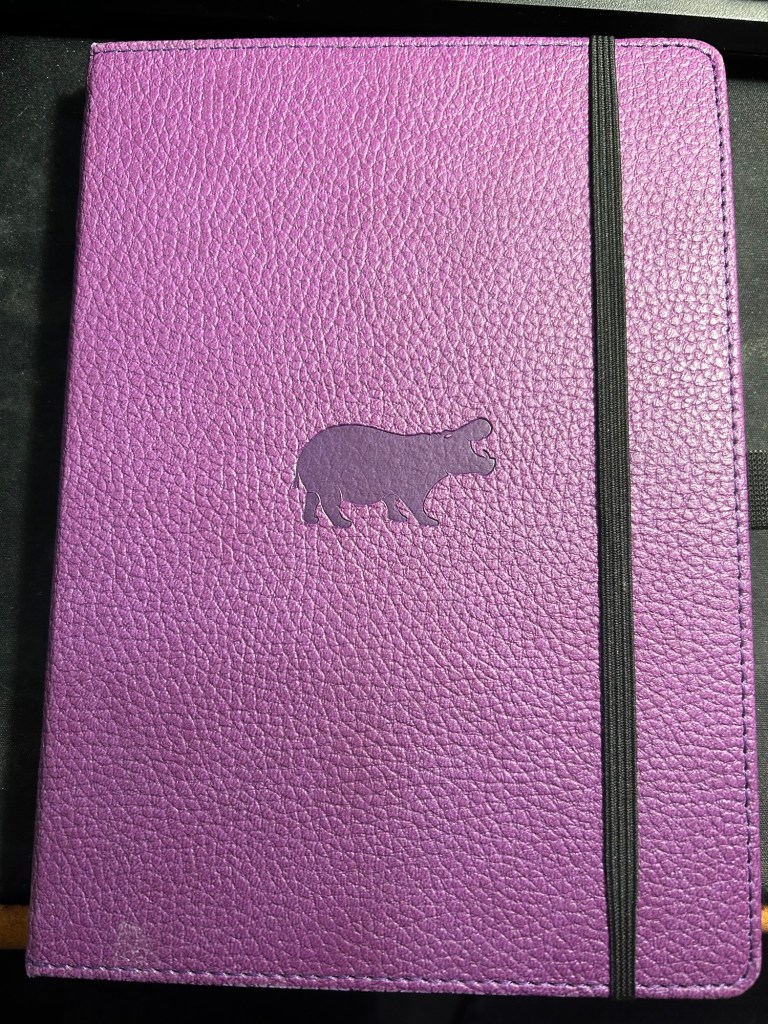
I have finally found a use for my Dingbats notebooks (beyond giving them away as gifts, as I have in the past): this lined purple hippo one is my blog notebook. I discovered that I have a much easier, much quicker time writing blog posts if I first draft them on paper, and this is where I do it in. I’ll likely write a dedicated post to this notebook soon.
Dingbats Puple Hippo A5 lined notebook
Apart from them I still use the notebooks I used last month.
Pencils
I’ve been using the Drehgriffel Nr. 2 as my daily driver. I use pencils extensively to plan, as my plans tend to change, and there’s something about this solid little mechanical pencil that makes me want to use it.
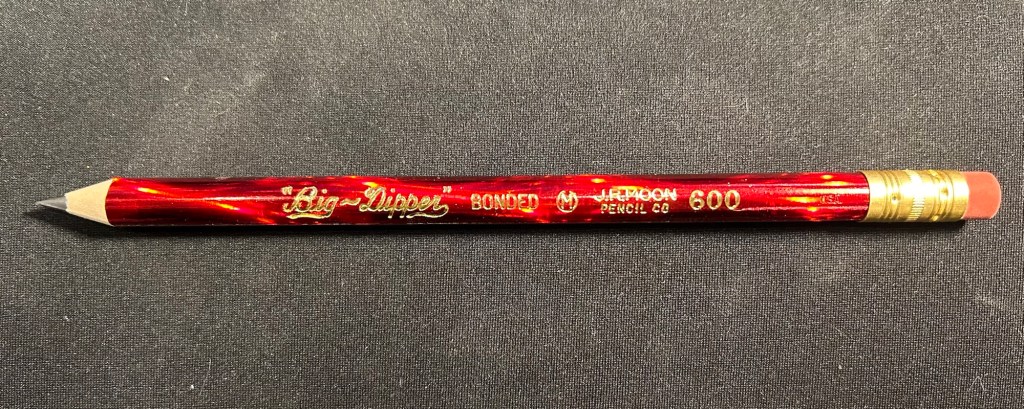
Apart from that I brought two pencils into the rotation, to try to use. One is from my last purchase from the late and great C.W. Pencils Enterprise, and it’s the “Big Dipper” J.R. Moon Pencil Co 600. It’s an oversized pencil, the kind of pencil that kids who are learning to write are expected to use. I’ve been having pretty significant neuropathy in my hands lately and I thought that this would be nice and easy to use, as after all it’s designed for kids just learning to develop their fine motor skills. So far it’s been a disappointment – the eraser and ferrule make it very top heavy, and I’ve been having a hard time manipulating it. I can’t imagine kids using this pencil and having an easy time with it. I like the over the top red foil with gold writing look though, so I haven’t given up on it yet.
Big Dipper J.R. Moon 600
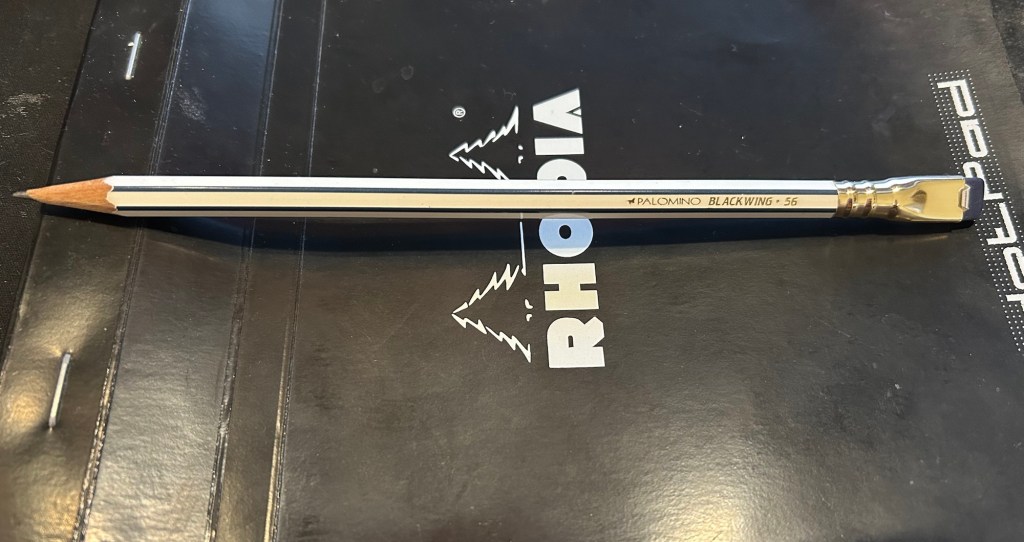
The second pencil is a Blackwing Volumes 56, the baseball themed one. The core is soft and dark, and I’ve been using it for quick and loose sketches. I’m trying to ease into one week 100 people by training myself to work faster than I normally would.
Blackwing Volumes 56
What did you use in February? Any planner changes? Pencil revelations? Pen preferences?
After finishing my previous journal I just started a new journal, which is both an exciting and daunting prospect whenever it happens. There is so much potential in a new journal – it makes me want to crack it open and fill as many pages as possible in the first sitting. Yet opening that first blank page also makes me freeze in fear of “ruining” a perfectly good notebook with my scrawls.
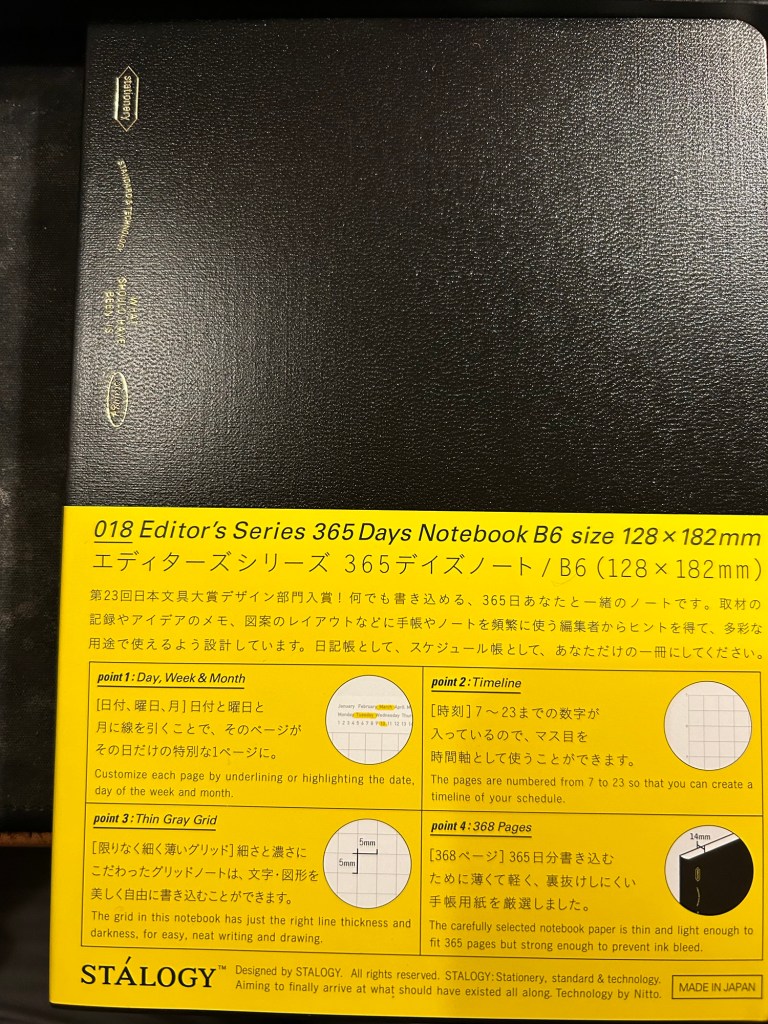
Stalogy 365 Days B6
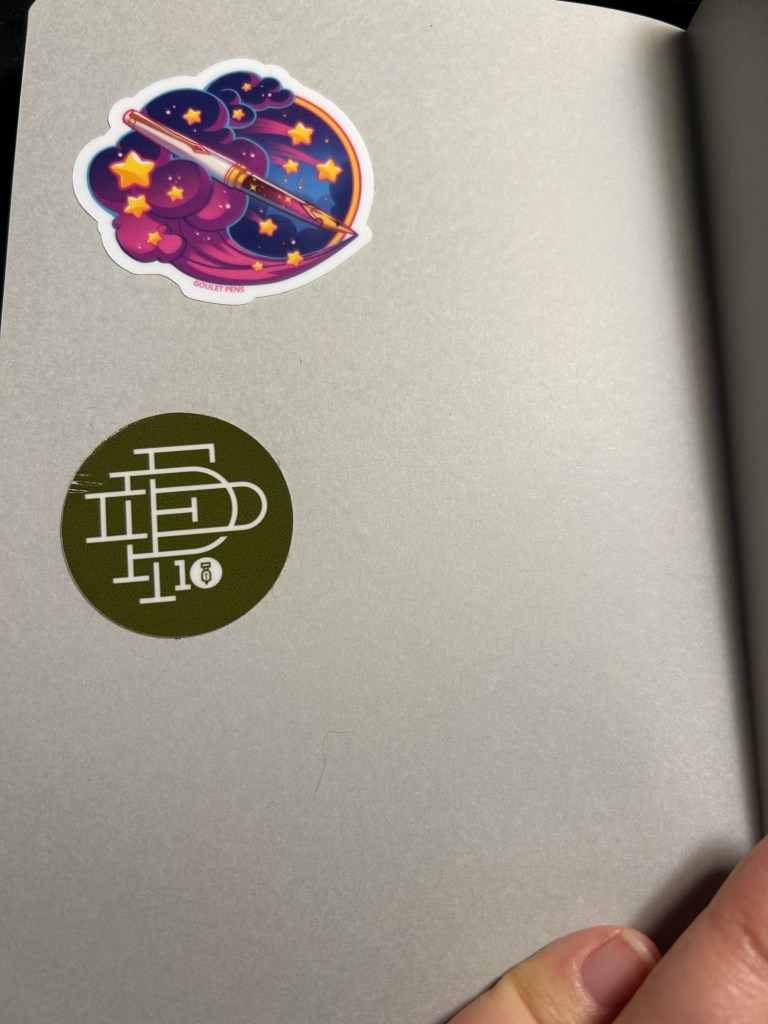
There are many tips on how to overcome that fear, ranging from deliberately destroying the first few pages to using various formulas to inspire you to fill those first pages. What I currently do is just open a new Stalogy 365 Days notebook, turn it upside down (so the header, which I don’t like, is at the bottom) and slap 2-3 stickers on the back endpages. This time I chose a 10th anniversary fountain pen day sticker and a Goulet Pens dream pen sticker to start off, but I usually add a few more stickers as I use the journal.
Stickers on the back
I then turned to the first page and started my first journal entry with the following sentence:
“New journal! My third Stalogy 365.”
After that came my usual daily gratitude list, and so I had most of the first page filled up in no time and had no problem moving on after that.
For those still in search for “new journal” inspiration, here are some pointers:
Personalize your new journal in some way. It’s about to hold your innermost thoughts, so you might as well make it your own.
Switch formats mercilessly if you find an old journaling format isn’t working for you – page size, ruling, type, etc.
Have a starting formula for your journal. If you find it difficult to start journaling each day, then pick a formula that you can use each day – like a daily gratitude list, a quote, notes about the weather, your plans for the day.
The first few entries are the hardest, but they’re also only 2-3 days out of the entire life of a journal. It’s worth remembering that and plowing through those days.
When in doubt pick a quote from a book or article you’re reading and start a discussion with the author.
If you’re really at a loss for starting ideas, use the first page, not the last one, as an ink testing page.
Do you have any new journal rituals or tips? Do you enjoy starting a new journal or find it daunting?
I’ve been spending practically every day for the past week or so with my dad in hospital.
There’s this phenomena that when you most need journaling, the it will help you the most, you find yourself least able to do it.
Hospitals are journaling hostile environments. There are no tables to use, there’s constant noise and distractions, there’s zero privacy and you never know when the staff will pop into the room with something. Whether you yourself are hospitalized or you’re there with someone else, there’s very little opportunity to crack open your journal and start writing.
Hospitals are also where weird, interesting, scary and new things happen, so you generally do what to write about them, to process them on paper. Fo instance, today three policemen escorted a prisoner into the heart surgery department. It wasn’t something I ever expected to see, a sort of non-sequitur that took me a minute or two to process.
The solution is to take temporary notes on your phone, put a reminder for an appointment with your journal in the evening or when things quiet down around you.
If you’re the one hospitalized, try to journal two or three times a day, documenting what’s going on, how you’re feeling, what the staff said, who visited you, etc. The best time to journal is during the nursing staff shift changes, because that’s when nobody will bother you.
Journaling is like running – oftentimes it’s really hard to start, but I haven’t regretted a run or a journaling session yet.
At night you can escape to these empty spaces and write
One of the things that I set up in my Leuchtturm1917 Bullet Journal is a list of the unread books on my Kindle. It’s supremely easy to buy books on a Kindle, as the whole system is set up a way to make book purchasing as fast and frictionless as possible.
This is a problem for me.
I love books, I adore reading, and I have pretty large group of friends that love reading too. This means that I’m inundated with great recommendations that run the gamut from light hearted fantasy and sci-fi to contemporary and classic literary fiction, with a whole host of fiction and non-fiction books in the middle (I don’t read horror and I don’t read romances and I rarely read poetry but that’s about the only limits I have in terms of my reading tastes). I get several such book recommendations a month, and with my initial impulse to rush out and buy them, and with the ease of purchasing books on a Kindle, things could get out of hand very quickly. This was one of the reasons why for years I was so resistant to buying a Kindle.
You see, it’s very easy to lose track of just how many unread books you have on your device. Even if you sort by unread books, you just don’t get a real feel for how many of them are actually waiting to be read. There’s no bookshelf groaning with the weight of unread books, and I was feeling the lack of that.
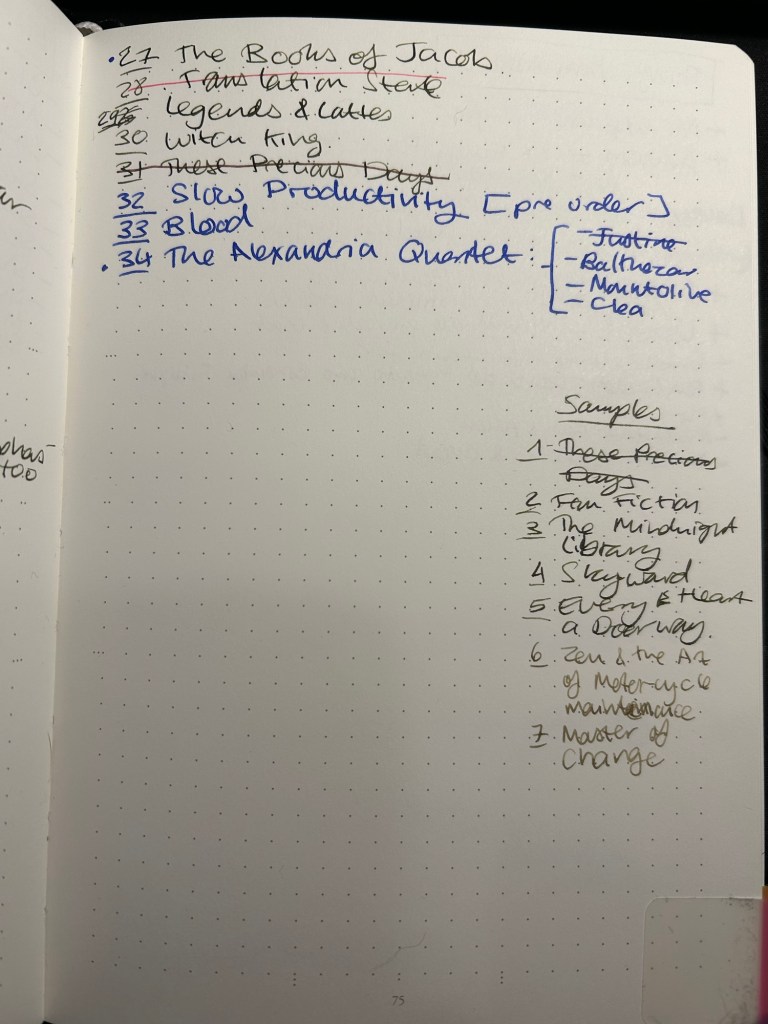
Enter my list of unread books on my Kindle:
It’s a simple numbered list of books that I haven’t read and are on my device. As I read a book, I cross it out. As I purchase more books I add them to the end of the list. As I’ve gotten into the habit of downloading samples, I’ve started to write them down too so they don’t get out of hand. It’s super simple, as bare-bones as it can be, and as practical as possible. The point is just to give my brain an idea of the scale of unread books on my device, and it works.
It works.
I’ve stopped compulsively buying books in the fear of “running out of something to read” or “forgetting what I was recommended”. Recommendations go into my GoodReads “Want to Read” list. And my brain can now see that there’s just no chance that I’ll run out of things to read any time soon. If I buy something I have to go over the list and convince myself that what I’m buying deserves precedence over the lovely books waiting patiently in line, some of them for years. I also photograph this list and keep it on my phone for reference, to prevent me from accidentally buying the same book in physical format (unless I purposefully intend to, which is rare).
What about the physical books stacked on shelves, some of them two books deep? I would love to have such a list for them as well, but that task is too daunting for me now. I remember where my books are visually, and moving them all just to catalogue them not only seems like an awful lot of backbreaking work, it will destroy my “memory catalogue of books”. So it seems that my physical books will remain uncatalogued for years to come.
Do you keep a list of all the books you own but haven’t read yet? Do you just keep a list of the books you intend to read next? Do you track your physical books in some way?
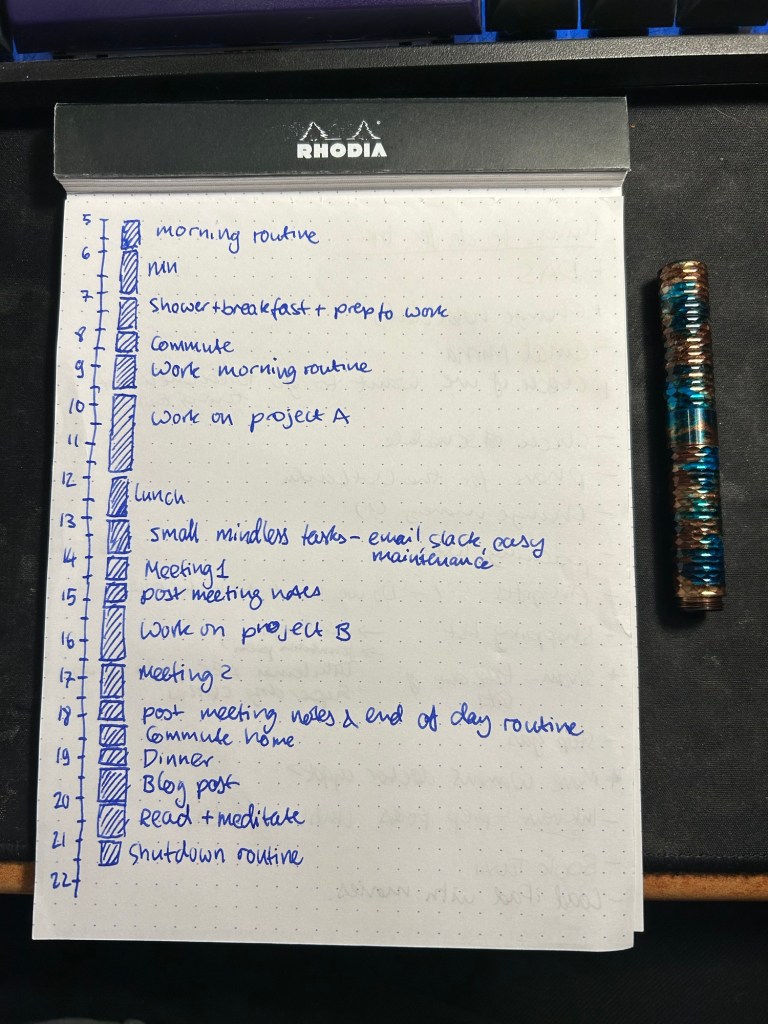
With time blocked planning the idea is to break down your day into blocks of time where you do things. The point is to structure your day so that you’re never faced with the question of “what do I do next?” Instead you sit down ahead of time and block out large sections of time where you do a specific large task, or bundle together a group of small tasks. You don’t block the day out into a minute by minute plan, but instead work in blocks of at least 30 minutes and usually 1-2 hours.
The idea isn’t new, and I haphazardly gave it a try when I was a student, and not surprisingly I failed spectacularly at it. It was only very recently when I decided to give it a serious try. The reason I decided to give time blocking a try was to solve a problem that I think is pretty common: I’d run out of steam about two-thirds into my day and end up just vegging out in the evenings, not accomplishing what I wanted, not even consuming the sort of media that really interested me. There’s only so many decisions my mind could make throughout the day, and late in the afternoon I would run on empty.
Since I was already “front-loading” my day (i.e. doing the really important work first thing in the morning or as early as possible) it was pretty easy to see the benefit of deciding what to do at a given point of time early on in the day, or even the night before. My issue with time blocking in the past had been that my work day is inherently unstructured. I may plan to work on something in the morning, but then a slack message or an email comes in, or someone bursts into the room with a problem and suddenly I’m working on something completely different.
Here, however, is where maturity kicks in. When I gave time blocking a chance years ago, I didn’t really take it seriously as an approach to work and life. Once something interrupted my day (and something always interrupted my day), the plan went out the window never to return. The plans rarely survived until lunchtime, and very quickly I decided that there was little point in time blocking for people like me. What I failed to realize at the time was that the majority of people are people like me: we live in a world where we are constantly being interrupted, and rarely does the day end in the way we envisioned it at the beginning.
Given this new found realization, and the realization that some very smart, very accomplished people whose work I follow use time blocking successfully and consistently, it was clear that the issue wasn’t with time blocking itself but with how I was approaching it. So I decided to make a more consistent, serious attempt to use time blocking for at least a month or two and see where it gets me.
I’m still very early into the process, but I decided to write about it as I go along, so I’ll have a record of how I tweaked things, and for those who like me, wanted to try time blocking but have failed in the past. Maybe my successes and failures will help them in their journey.
The First Mistakes
I started out with two mistakes, one easily fixed and another a mistake that I’m still working on correcting. The first mistake was trying to create separate time blocks for my work day and my “home day”. That failed spectacularly. Lesson learned: you need to follow one timeline, one plan, from waking up until going to sleep. If you use two different plans you are setting yourself up to fail because you’re creating two points in the day where you have to switch plans. While the morning switch may be relatively easy, by the time you’re off work you don’t feel like opening a different notebook or calendar and seeing what it is exactly that you’re supposed to be doing right now. I kept my home plan on a Rhodia dot pad and my work plan on a Moleskine squared notebook, and it just didn’t work for me. I had to carry two different plans with me, I had to reference and cross reference them, it was a mess. Now I have one plan per day, on a Rhodia dot pad.
The second mistake is one that I’m still working on correcting, which is what do I do when things don’t go as planned. What I should be doing is taking 5 minutes and replanning the rest of my day basically from that point onwards. What I currently do and doesn’t work well is either try to get back to the plan the moment I can (at which point things start to fall apart pretty quickly), or try to make only minor adjustments to the plan. The reality is that if there’s a significant break in my plan (i.e. something that takes more than 30 minutes to deal with), then I need to take a few minutes to stop and completely reassess my day. No, I will not be able to fit everything I planned into it now. Yes, my energy reserves are most likely more depleted at this point than I originally planned. Rather than trying to stick to the plan and crashing and burning, I need to be kinder to myself and look at what’s left of my day with fresh eyes. “That production outage took a lot from me, so let’s switch things up so I have a lighter workload until I’ve had a chance to recover, maybe even schedule a significant break here. Then rebuild my evening so I also have a bit more recovery time then – add a meditation session, or more reading time, etc.”. This is something I’m currently working on doing consistently.
The First Successes
While I’ve been time blocking only for a short time, I have already seen the value of this system. I’m getting much more done, and I am able to dedicate long stretches of time focused on meaningful work. I batch emails to the beginning and end of the day, and slack messages only to the times between large blocks of deep focus. I haven’t had an episode of mindless YouTube watching in the evenings since I’ve started. I’m reading more, journaling more, meditating more, spending more meaningful time with friends and family. I’m also being much more realistic about my goals. Once you start putting things in the context of the hours you have in the day, it becomes easier to assess how much you can get done in a given day.
A sample of a time block plan.
It’s not just a result of the time blocking itself, of course. It’s also the way I’ve structured my year, a commitment to deep focus and digital minimalism which mean no social media, no mindless media consumption, more reading and more deliberate practice of the things that matter to me. I’m also far from reaching a point where the way in which I time block my day is stable, well-defined routine. Things are still shifting around as I’m recording in my journal what worked and what didn’t work. While I’m not looking for perfection, I do want to reach a point where I have a system that works for me (and not I for it), and that helps me better shape my days.
I’ll be writing more about time blocking in the future, whether my experiments with it succeed or fail. If you’re giving it a try or use time block planning regularly I’d love to hear your thoughts on it in the comments.
It’s 2024 and this time I’m doing neither yearly goals nor themes. I find themes to be too vague to be useful: they don’t provide enough structure or motivation for my needs. My old yearly goals worked perfectly before I got cancer, but now I can’t commit to a full year of goals (my brain just won’t let me). So I’m trying something new this time: the twelve week year. The idea is to treat each quarter as a new year, with all that entails.
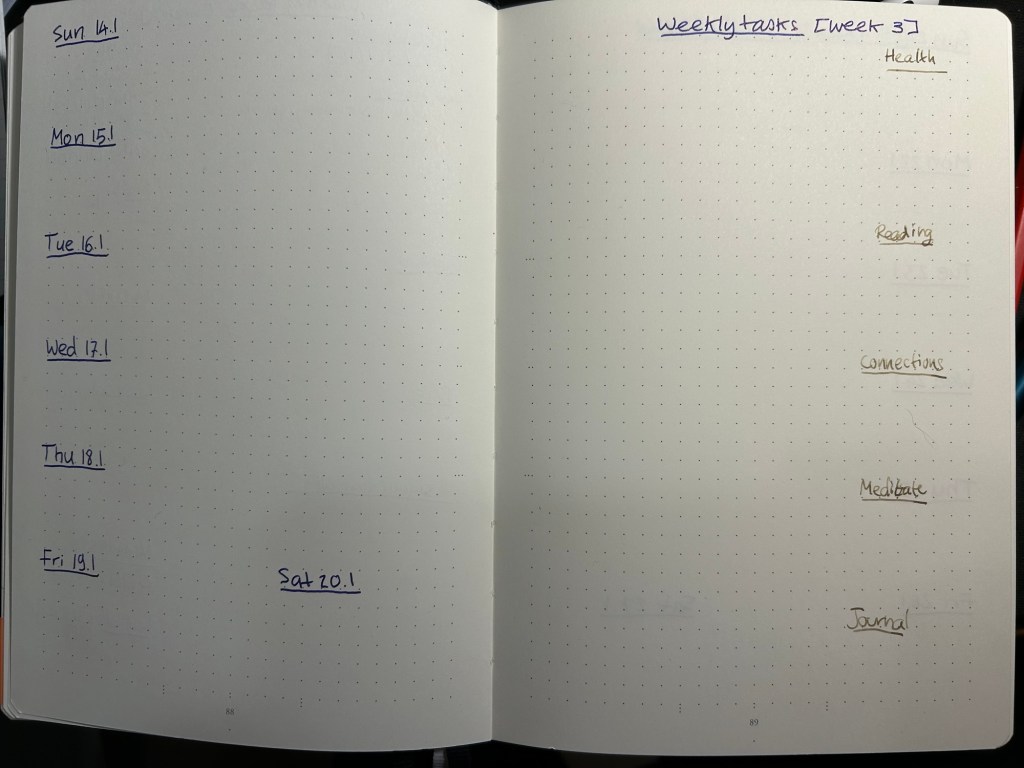
I mapped out the first 13 weeks (from the 31st of December to the 30th of March) in my Leuchtturm1917 Bullet Journal, each week on two pages. On the left are the days of the week and on the right is my set of tasks for the week. The list of tasks is divided into two columns, and each column is divided into categories. The left column is for categories and tasks that vary widely from week to week: blogging, general tasks, various courses and challenges I’m taking. The right column is for my permanent categories that happen every week in the quarter: health, reading, connections, meditation and journaling.
The weekly layout
The health category tracks fitness and health related tasks (on a given week it will have checkboxes for running, swimming and gym sessions for example, as well as reminders to go to the dentist or get my blood pressure checked). The reading category is for where I want to be with my reading in a given week (halfway through book x, 30 pages into book y). Connections is something I added after reading Cal Newport’s Digital Minimalism and it’s been well worth doing: I call or meet up with 2-4 friends every week. Messaging doesn’t count, only phone calls, zoom calls, or physical meetups. If there’s one habit I’d recommend picking up in 2024 it’s this one. Meditate and Journal are just tracking locations for my meditation and journaling sessions.
I then set out goals in various categories for the entire “12 week year”, as if it was a full year. Each of these will be evaluated at the end of the 13 weeks, and a complete new set of goals will be set for next quarter. The goals are all SMART goals: specific, measurable, achievable, relevant and time bound. Unlike themes there’s a possibility of not achieving all my goals, but that’s also something worth learning and carrying on to the next “year”.
So for instance under my health category for the next “year” is to get back to a 5k running base and an 8k long run (I’ve had a break in running for a few weeks due to illness and travel). If at the end of March I’m only at a 7k long run that’s not the end of the world, it just means that I need to take that into account when planning my next 12 weeks.
I then break down the goals into tasks that go into the weekly page. Each week I look at my goals, calculate where I am and where I want to be by the end of the week and fill out the weekly planning page accordingly. I use the calendar side of the page to block out time sensitive things or things that provide useful context (days of the week where I work from home and those where I work from the office, rainy days, holidays, etc).
To be clear: I don’t block the tasks for all the “year” in advance, but rather on a week by week basis. Only the goals for the entire 12 week period are planned in advance. The goals themselves are realistic, and many of them are broken into “base goals” and “stretch goals” much like in Kickstarter. At the last week of the quarter I set aside time to review and “shutdown” the quarter and plan and set up the new one coming up. If I end up not liking the weekly page setup, if there’s a goal that just didn’t work for me, if there’s something new in my life I can easily take it into account without feeling like I’ve “wasted” precious planning time or I’m bailing out on my plans.
So, if you’re unsure on how to plan your year, I suggest just planning the next 12 or 13 weeks. It may just work for you.











 Writing at Large