Tournament of Books: There There

There There” by Tommy Orange was originally going to be the last Tournament of Books  novel that I read, but because “The House of Broken Angels” was delayed by the post office, it turned out to be the penultimate book to be read. It was up against “America is Not the Heart” by Elaine Castillo in one of the toughest rounds to judge, at least for me.

Wow this book was quite a ride. There are 12(!) protagonists in this book, and a good deal of the subject matter is difficult, but the challenge is worth it. The stories of several Urban Indians converge as they gather to celebrate the Great Oakland Powwow.
Are all the characters necessary? No. But most of them are, and the story that emerges, of urban Native American life is worth reading. It’s a tight-knit and small community so there are a lot of ties between the various characters, and it could have been a very small, very anecdotal story if not for Orange’s moving interstitial background passages. The tragedy of the characters’ lives is made manifest through these pieces, and the result is not unlike a patchwork quilt, where a lot of small parts make a beautiful, interconnected whole.
Not an easy read, well worth your time.

Tournament of Books: The Parking Lot Attendant

The Parking Lot Attendant” was up against “The Mars Room” in the Tournament of Books, and it was no surprise when (spoiler alert) it won. I have no idea how “The Parking Lot Attendant” got into the competition proper and books like “America is Not the Heart“, “Speak No Evil“, and “A Terrible Country” had to fight it out in the play in round. “The Parking Lot Attendant” was one of the few books in the competition that was genuinely I-have-no-idea-how-this-was-published bad (the other two were “Warlight“, which somehow almost won the competition, and “Call Me Zebra“).

I have no problem with books that have complex and often confusing narrative structures, provided that the difficulty presented is justified by the work of fiction you end up with. In short – it had gotta be worth it. “Milkman” was worth it. “The Dictionary of Animal Languages” was worth it. “The Parking Lot Attendant” was not. The narrative was jumbled, confusing, vague, and all for nothing. I could not have cared less about any of the characters, as none of them materialized as a real person, and the plot was beyond preposterous. There was nothing here worth spending any time with, and even the premise was uninspired. At the very most, in the hands of a very skilled storyteller, this could have been a decent short story. As it was, it was a 200+ page waste of time.

Tournament of Books: The Mars Room

The Mars Room” was the book that I most dreaded reading once the final list of the Tournament of Books 2019 contest was published. The story of a stripper sentenced to three life sentences in a California prison for killing her stalker didn’t seem like the kind of reading that I’d enjoy. In some ways I was right — this wasn’t a fun read. What I hadn’t anticipated was being moved and touched by a story not so dissimilar from those that I’ve recently read and heard about in the news or in “This American Life”.

“The Mars Room” is about as far from light reading as you can get. It’s gut-wrenching. It’s violent. It’s relentless. It’s excellent.
We are living in a time where at least in parts of America there seems to be a growing awareness of the failings and injustices of their criminal justice system. There are a lot of non-fiction pieces coming out now that are bringing to light the toll mass incarceration, the “war on drugs” and prison privatization have taken on communities. So why read a work of fiction, no matter how well researched, when you can read an article or a book, listen to podcasts or watch documentaries on the American criminal justice system and the people at its mercy?
Because Kushner lets you into Romy’s mind, into her fellow inmates minds, into her victim’s mind. You see the people working in the system and incarcerated in the system as intimately as you possibly can – their mistakes, the tragedy of their lives, their big and small moments, their cruelties and their kindnesses. They aren’t opaque any more, they aren’t invisible. You get to see not only the systems of poverty, injustice, racism and abuse that started them on their respective journeys to prison, but you get to see them, to experience them as full human beings. That’s what makes it so terrible, and such a great work of fiction to read.

Tournament of Books: So Lucky

I’m still charging ahead on my Tournament of Books challenge, even though the competition has long ended (what a weird choice of a winner and a finalist. I don’t get it). Since I’ve been trying to read the books as fast as I can, I’ve limited myself to notes on them in my reading journal, and so the updates on the site have been somewhat delayed. It’s just easier to write my book thoughts with pen on paper.

I was going to read “The House of Broken Angels” by Luis Alberto Urrea first, but for some reason it was pulled off the kindle store, so I had to wait for the paperback to arrive. That meant that I went on to read “So Lucky” by Nicola Griffith next as the 14th book I read in the competition. It’s up against “The House of Broken Angels” in the sixth round of the competition.

It is so rare to find a work of fiction that centres around a young, healthy, active person discovering that they have a serious disease that isn’t cancer. There’s nothing sexy or hip about the subject matter. There’s nothing about MS that inspires the same kind of charity and feeling as cancer or AIDS. And Mara, the protagonist, is so aware of that.
That’s just another layer of realness in a novel that reads like a work of non-fiction while still showing us Mara’s inner world in a way that only fiction can. It moved me, it rattled me, it made me furious and it gave me hope. This is a must read not because it’s great literature with-a-capital-L, but because it is a profoundly human and humane piece of fiction that is both deeply personal and utterly universal. It says a lot about how we treat the sick and the disabled, it says a lot about what it’s like becoming sick and disabled (these days in America, but not only), and it says a hella of a lot about our ability to evolve and adapt to the most harrowing of conditions.
Also, it really made me want to learn karate.

The latest books to arrive

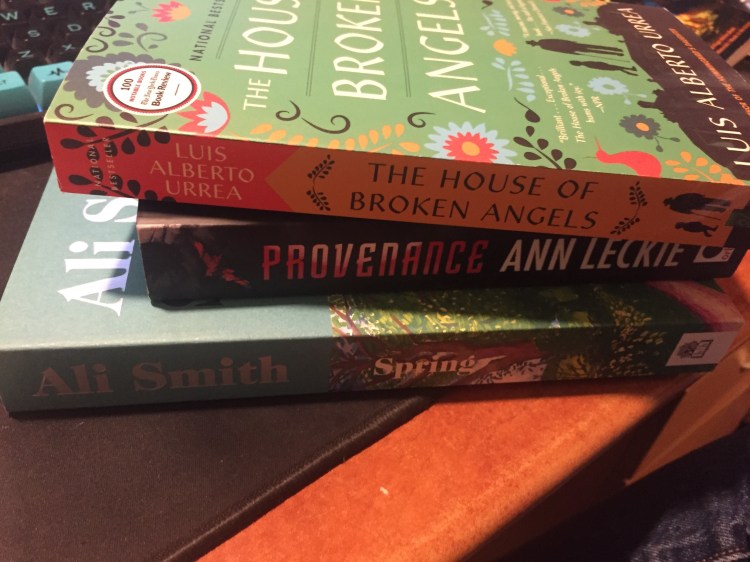
The latest books to arrive today:

The House of Broken Angels by Luis Alberto Urrea, which is the last Tournament of Books 2019 book that I still haven’t read.

Provenance by Ann Leckie, which ties into her masterful and award winning Imperial Radch trilogy.

Spring by Ali Smith, which is the third in her season’s project. I loved Autumn and Winter and I can’t wait to dig into this one.

I’m in the middle of Lies Sleeping the latest Ben Aaronovitch Rivers of London book and it’s difficult to put it down, but I’ve decided to put it on hold and finish with the Tournament of Books as I originally planned.

Field Notes Rooster 2019 Limited Edition Notebook Review

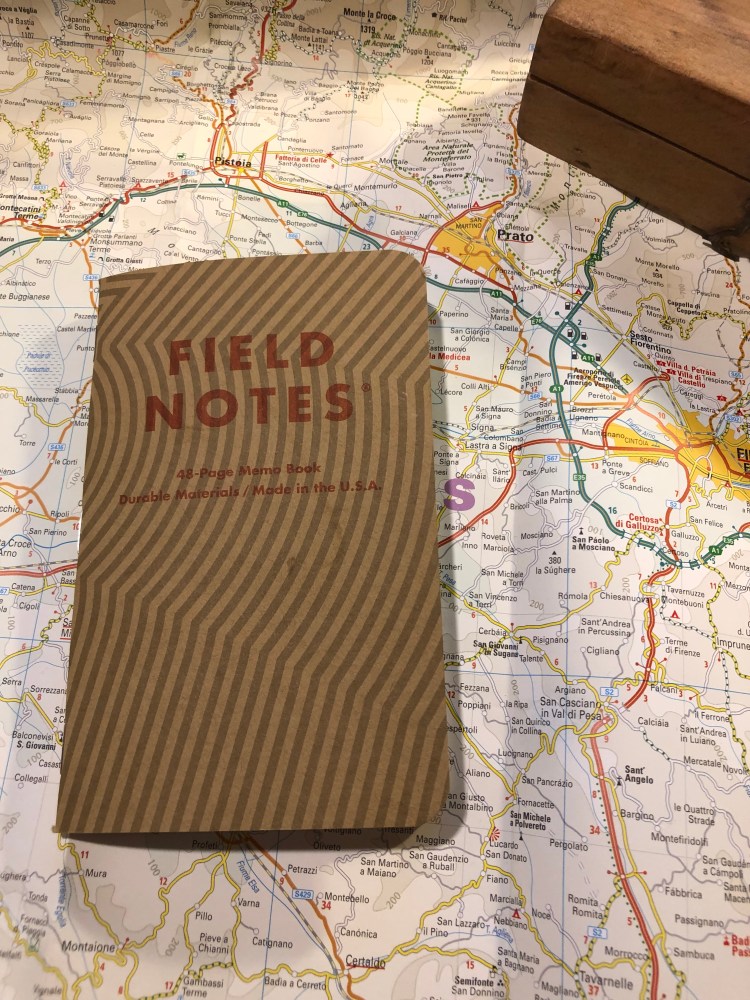
Field Notes is a major sponsor of the Morning News’ Tournament of Books, and every year they celebrate the tournament by creating a specially themed notebook for the occasion. The notebooks are sold as singles and 100% of the proceeds from them are donated to the 826 National, which provides free educational programs to under-resourced youth. This year, the Rooster Book looks like this:

The party is all in the back, with this year’s ToB Rooster logo:

I really feel like colouring it in crazy psychedelic colours.

The notebook is lined, and the craft front cover is pretty standard for a Field Notes:

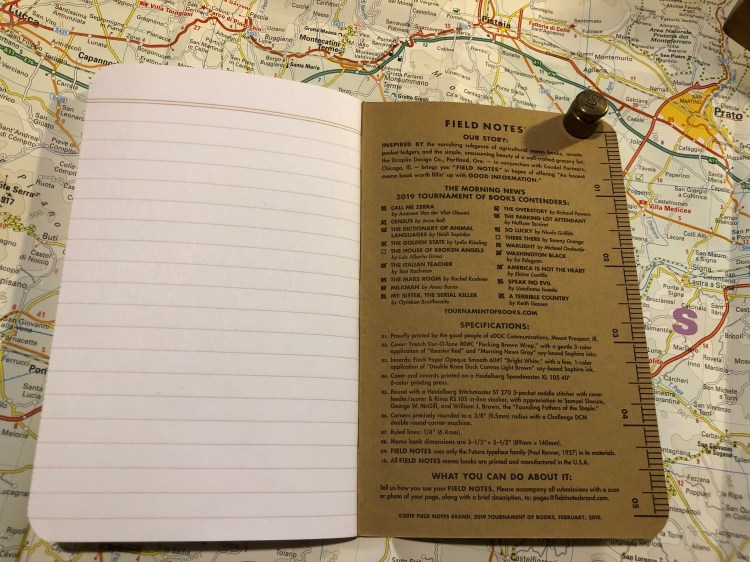
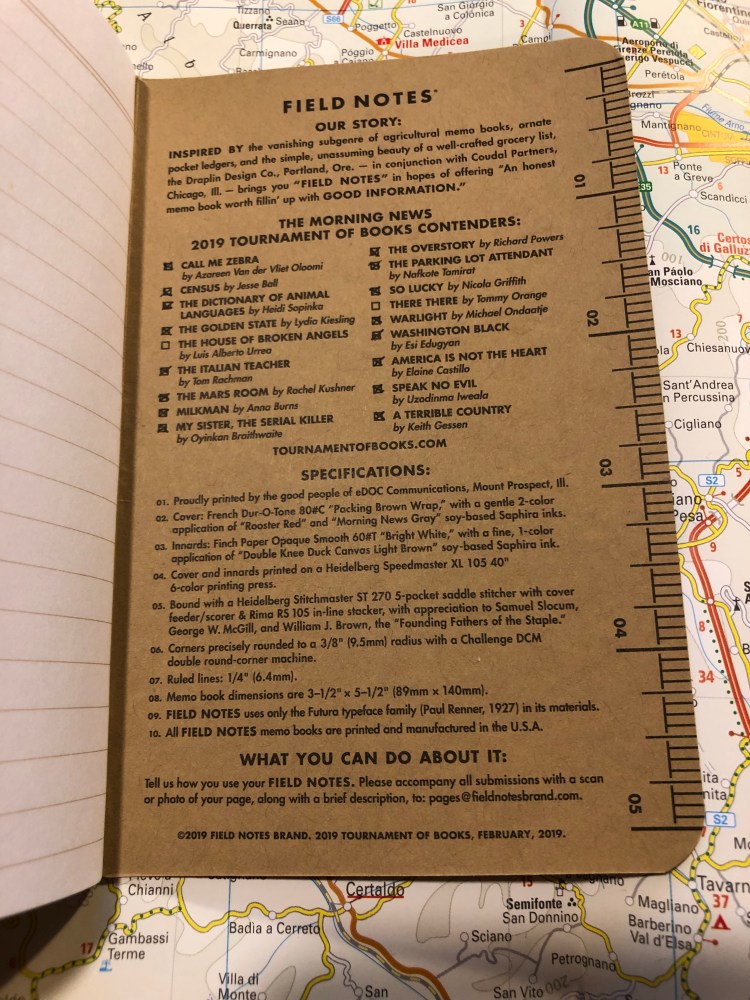
Again the back is where it’s at, with a list of this year’s Tournament of Books contenders.

You can check off the books that you’ve read, and I admit it was pretty fun checking almost all of them off.

This is a cool little edition that helps out two wonderful causes. The only thing I would change about it is its publication date. If Field Notes would have issued it at the time the list of contenders was announced then you could really use this notebook to follow along with the tournament. But I bought a few notebooks as a memento of my plan to read all the books in the tournament this year, and excellent for that.


Tournament of Books: My Sister, Serial Killer

I finished reading the thirteenth (how appropriate) Tournament of Books 2019 book, Oyinkan Braithwaite’s “My Sister, Serial Killer“, which is running against Richard Power’s “The Overstory” in the fifth round of the competition.

This was a fast, sharp read, so I’ll try to make it a fast, sharp review.

I was worried that this would be horrible slasher novel, and it was far from it. Yes, it’s full of dark humour, but it’s also full of intense understanding of how family ties work, especially ties between sisters. It can be read as a lightweight, lighthearted humour piece, or as something that explores the darker sides of female bonds and male and female power relationships, but either way, you’re in for an enjoyable two hour ride.

Read it, ma. It’s worth it.

Tournament of Books: The Overstory

I finished reading the twelfth Tournament of Books 2019 book, Richard Power’s “The Overstory“, which is running against Oyinkan Braithwaite’s “My Sister, Serial Killer” in the fifth round of the competition.

“The Overstory” is a good book that’s difficult to recommend. Why? Because this is not an easy read, both in terms of material and structure. The question in this case is always: “Is it worth the effort?” In this case, the answer is “sometimes”.
There are parts of this novel that could have been pollarded, parts where Powers was clearly very much in love with the words that he was producing. Other parts are a joy to read, pure poetry brilliantly written. The structure is stunningly complex: Powers introduces each character in a story of their own, and then weaves some of those stories together tightly, and others just tangentially. The result is a dizzying book that will make you love trees and love those who love them.
If the book was shorter and the structure clearer (note that I say structure. The book has very little going on in terms of pure plot), it would have been a must read. As it is, if you decide to put an effort in a book of this kind, allow me to recommend “Milkman“. If you’ve read that and are ready for more, much more, then “The Overstory” is for you.

Tournament of Books: The Golden State

I finished reading the eleventh Tournament of Books 2019 book, Lydia Kiesling’s “The Golden State“, which is running against Jesse Ball’s “Census” in the fourth round of the competition.

You would be forgiven if you read the premise of “The Golden State” book and thought that you are about to read an “Eat, Pray, Love” kind of book. This is nothing of the sort. Kiesling has written an intensely realistic and touching piece about loneliness, particularly female loneliness.
The heroine of “The Golden State”, Daphne, is a young, neurotic mother to a precocious 2 year old, left alone due to the machinations of the US Immigration system. The daily grind at her unfulfilling job finally makes her snap, and she decides to take her toddler and run back to Altavista, where her late grandparents lived. The narrative follows her through the 10 days of her escape. So far the “Eat, Pray, Love”.
Daphne is a victim of a society that does nothing to help young mothers (except pile guilt and anxiety on them in the form of study after study), especially young mothers who marry outside the tribe. She is caged in a pointless job that is full of daily humiliation, but the money is “good” (not good enough for SF) and the health insurance… She has no friends, no family, nothing of interest in her life except her daughter, who she can’t afford to spend time with. Her husband and his loving family is in Turkey, and apart from skype calls, she has very little chance of seeing them any time soon. No wonder she snaps.
Altavista is no paradise, and isn’t portrayed as such. It’s a semi-deserted place full of angry white people, only a handful of which remember Daphne and her grandparents. She has unknowingly fled to the only place where she could be more lonely than she was back home. So when an old lady who visited Turkey one time befriends her, she can’t help but reach out.
This novel would not work in any place but today’s US. It’s a novel of time, place and character more than plot. Every breathless rush to change diapers or calm a screaming toddler becomes momentous once you realize just how alone Daphne is, just how alone the society she lives in wants her to be.
The novel is interesting, fresh, sharp and well written, and it beautifully breaks down large political ideas to small, everyday encounters.

This book is running against “Census” in the fourth round of the Tournament of Books, and though they have very little in common apart from being stories about single parents and their children out on a trip, it was not hard for me to pick “The Golden State” as a winner. It’s a better book in terms of writing accomplishment, and it has much more heart than “Census”. I highly recommend skipping “Census” entirely, and reading “The Golden State”. It’s a very good piece of contemporary fiction.

Tournament of Books: Census

A few days ago I finished reading the tenth Tournament of Books 2019 book, Jesse Ball’s “Census“, which is running against Lydia Kiesling’s “The Golden State” in the fourth round of the competition.

Perhaps unfairly, but when I first saw “Census” I thought that it was going to be novel in the vein of Max Porter’s “Grief is a Thing With Feathers”. I blame the the cormorant on its cover and the published blurb about it for putting me in that frame of mind. It was very clear a few pages in that “Census” would not survive that comparison. Then again, so few books could.

“Census” is book with a very moving preface and some very moving photos at the end. In the middle is a featureless wasteland. It is populated by unnamed characters that function in an unnamed, ill defined world that is maybe desolate, where a peculiar census is conducted each year in which people are asked questions by a census taker who then marks them and posts their answers onwards. Nothing in this novel is given edges, well defined. Everything is wishy washy, vague, seen through thick, milky glass. But that preface… so you stick to it, and it helps that the book is short, though it has no plot to speak of and the setting is bleak and bland. The key to this novel is its characters then, and that’s not surprising because after all, you’ve read the preface and that’s what’s keeping you here.

And that’s the biggest frustration, because when Jesse Ball lets himself write good characters then by God the man knows how to write good characters. There’s a tiny vignette of a ex-fossil loving boy that’s so precise, so concise and so convincing that you want to howl that the rest of the novel isn’t like that. That the surgeon-father-protagonist isn’t like that. That the son, the whole reason for this novel, remains a shapeless mass with nothing making him hum – no distinct feature, tic, preference. That the wife is the best defined major character and even she is seen through thick fog. It’s never personal, emotional, realistic or if he’s really going for the absurdist (which is a poor stylistic choice for the subject matter IMHO) then it’s far from fully embracing that even.

What is feels like is that the writer took a subject that was too close to home, too painful, and tried to deal with it while not dealing with it at the same time. The result is a novel that does everything possible to make it difficult for you to feel anything for any of its characters, including empathy. It very easily lets you slip into the “oh this has nothing to do with me” mode, and from there to “none of these characters are likable, hate-able or even interesting, so why should I care” mode.

But then, the preface…