How to Buy Your First Vintage Fountain Pen

I just listened to the latest Pen Addict Podcast, where a listener asked for tips on buying their first vintage fountain pen. I have well over 100 vintage fountain pens, and I’ve been buying vintage fountain pens since the early 2000s, so I decided to take the time and write a guide to buying your first vintage fountain pens (for the sake of this guide vintage fountain pens are those made before the ’70s).
  1. First, set a budget. Vintage pens are no different than modern pens in this respect, but somehow vintage fountain pen buying guides tend to skip this step. You can get great vintage fountain pens for under $50 and well over $500. Pick a number you’re comfortable with, and stick to it, no matter what.
  2. Decide why do you want a vintage pen:
    1. Flex – You’re looking to add line variation to your writing or drawing. Apart from dip pens, vintage fountain pens are the cheapest way to get that desirable flex. No modern fountain pen, despite any manufacturer promises, offers the line variation of a vintage flex fountain pen, and the premium you pay for a bit of springiness in modern nibs is painfully high. Vintage fountain pens also offer flex “combos,” such as italic flex, needlepoint flex, etc. And if you’re considering the Noodler’s fountain pen lineup, I recommend going dip pen instead. They require less fiddling and are more reliable.
    2. Gold/Specialty Nib – You want to get into gold nibs as cheaply as possible, or you want non-standard nib configurations (a fountain pen that works on carbon copy paper, perchance?). You can get fantastic gold and crazy nibs on vintage fountain pens for much, much less than certain manufacturers ask for a generic steel nib pen with a colourful plastic body.
    3. Looks – You can find a vintage fountain pen that utterly matches your style, whether it’s an understated elegant pen, a stunning showstopper one, or an out of this world wacky wildcard pen. Did I mention also that these lookers will likely cost you much less than any modern equivalent?
    4. History – You’re looking for something with a past, with a story. It can be something that’s passed down the family, a treasured pen found in an estate sale and begging to be researched, or a bold attempt by a brazen small company to create something completely new.
    5. Quirkiness – Things were wild in the heyday of the fountain pen, and you want  a piece of that. Retractable and adjustable nibs, crazy filling mechanisms, pens made out of strange materials: works of genius and madness that call out to you.
    6. Collectable Value – This is the first thing people think about when they hear about vintage fountain pens, and there’s a reason it’s the last on my list. If this is what interests you, I highly recommend walking away before you even start. This isn’t a money making venture. There are no great deals or finds to be made. All the good ones have been taken long before you, and are now passing from hand to hand, available only to people in the know. If you get into vintage pens for another reason and then decide you want to collect a few of the same kind, maybe nab one that’s a bit hard to get – fine. Otherwise, you’re getting into a losing game.
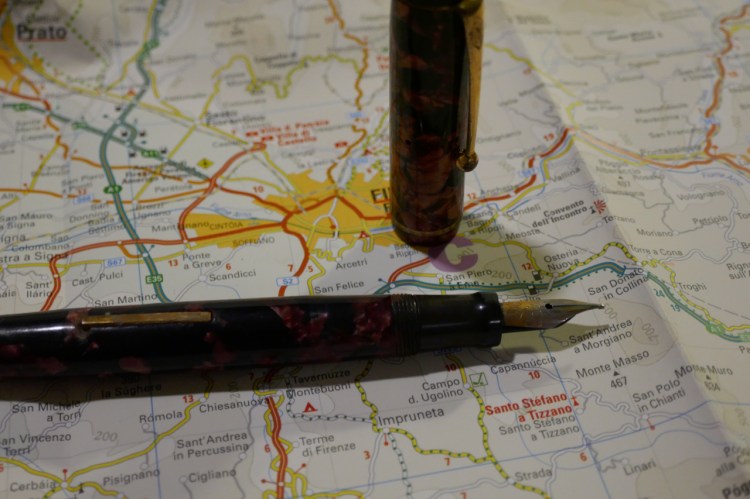
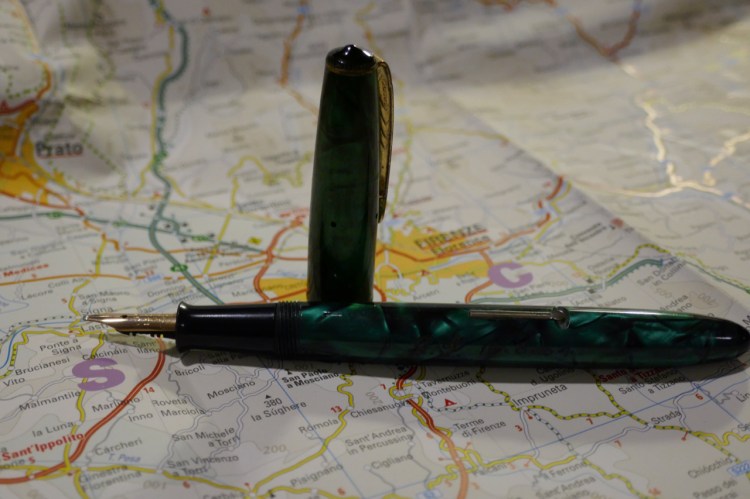
    P1010319
    Ugly no name lever filler with phenomenal gold wet noodle nib and feed, in utter user-grade condition. Bought for $30. 
  3. Your next move depends on what you chose in the last step:
    • Flex – Get thee to a vendor. Writing samples on the internet are lovely, and they’re a great way to shop for inks. Vintage flex needs to be held in hand and tested. Go to a pen show or a vendor and specifically ask for pens with a flex nib. Then ask to dip them, and try writing with them. Be very gentle at first, until you figure out how the nib works. The magic of vintage flex isn’t so much the nibs themselves, it’s the feeds. A good vintage wet noodle can keep the ink flow going even when you’re writing in giant poster letters. A modern pen’s feed will give up and you’ll end up with railroading. Things to remember:
      • A vintage flex nib may look wonky (dropping, slightly wavy). Ignore that – the test is in the writing. If the vendor won’t allow you to dip test, say thank you politely and walk away.
      • You’re interested in the nib, not the pen. Ask if the filling mechanism works (99% of the time vintage flex are lever fillers), and check the body for cracks. That’s it. It can be a black chased hard rubber (BCHR) Waterman brown with discolouration, brassing, and 3 different personalizations, it shouldn’t matter. You’re there for the nib, and the uglier the pen, the cheaper it’s likely to be. Vendors used to not even repair these ugly ducklings until recently, when the interest in vintage flex spiked and people figured out that you can get a wet noodle for $30.
      • The maker doesn’t matter. Waterman made great vintage flex nibs, but people know that, so you’re going to pay a premium for it. Some of my best flex nib pens are from no-name small manufacturers, and I got them all for a song. Waterman is great, just don’t get locked in to looking only at them. Test the nib and let it speak to you.
      • If you want to be extra sure that the pen works, ask the vendor to fill the pen for you once you’ve completed the purchase but before you’ve left the table. Just don’t forget to empty the pen out if you’re going on an airplane later on.
      • Never touch a pen, especially not a flex nib pen, without talking to the vendor first.
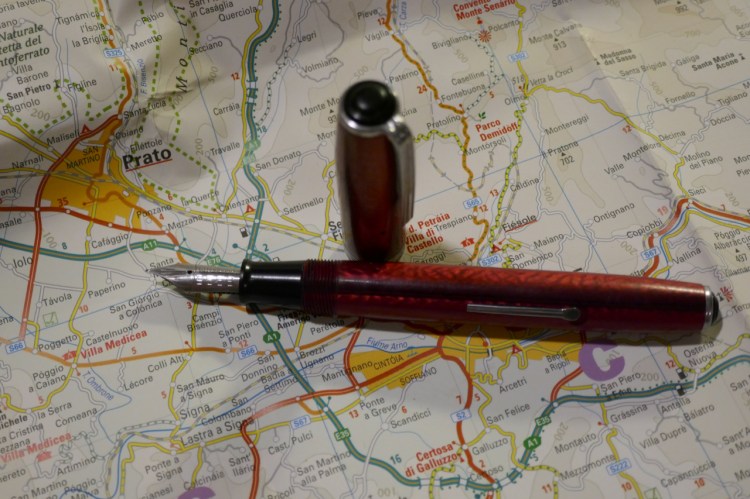
P1010317
Ugly no name Italian pen with personalization, bought for the phenomenal flex italic nib. Bought for £25
    • Gold/Speciality Nib – Much of what applies to flex nibs applies to these types of nibs. Unlike with flex nibs, online shopping for vintage gold/specialty nib pens is an option, but going to to a pen show or a vendor and try them out is still the best and safest approach. Don’t buy for the pen’s looks or condition (beyond checking that it works and there are no visible cracks), but for how it feels to write with this nib. Things to remember:
      • Great vintage pens with gold nibs are very common. If the price for a pen is high, you’re not paying for the nib, you’re paying for something else. Walk away.
      • If you just want your first gold vintage fountain pen, I recommend the Parker 51. You can get a great one for well under $100 (often under $50 if the body’s been personalized), so long as you aren’t fixated on one of the rare colours or an early year. Focus on aeromatics, in Black, Navy Grey, Burgundy, Forest Green, Midnight Blue, Teal Blue with a lustraloy cap. You pay a premium for special colours, caps in gold and sterling silver, red band vacumatic filling systems, and the cap condition. If the cap is dinged or lost its frosting, or if the pen is personalized, you can get it for a song. The Parker 51 nibs are PHENOMENAL. There’s absolutely nothing like them, and they make your writing look great. This is a large part of their appeal. The nibs aren’t graded, and most of them are in the fine-to-medium range. Just make sure there’s plenty of tipping material when you buy the pen (try out the pen and feel if it’s scratchy/look at the tip/ask to see a close up of it when buying online). The Parker51 website and the Parker forum on the Fountain Pen Network are a great place to learn more about these pens.
      • Speciality nibs are harder to find, so focus on two companies: Esterbrook or Pelikan. Both made great pens with a wide variety of interesting nibs, and both can be had relatively cheaply. These pens were also built like tanks, so they’re very likely to be in great working condition when you buy them, just be sure to ask. If you’re in Europe, Pelikans will be cheaper for you to acquire, and if you’re in the US Esterbrook is your friend. These are also pens that you can buy online relatively safely. Start with the Fountain Pen Network Esterbrook/Pelikan forums (FPN is still the #1 resource for vintage fountain pens), Esterbrook.net or the Pelikan’s Perch to educate yourself and purchase pens. I’ve purchased great vintage Pelikans from Berlin Collectibles, but again, I’d recommend trying the pen in person before going to the online shopping route. Esterbrook is going to be significantly cheaper than Pelikan, and you can buy one pen body (I recommend the J) and several nib units. But Pelikan has phenomenal OB, OBBB, OBBBBB… nibs that Esterbrook just never made.
P1010318
Esterbrook J double jewel (i.e. super common) with a 9556 nib. Bought for $16.5
P1010310
Pelikan 140 with a flexible OM gold nib. Piston filler, bought for 120 euros.
    • Looks – this is probably the hardest one to give recommendations for, except go to a pen show and look around to see what catches your eye, but there is one thing worth noting. If there’s a particular design you like but it’s beyond your budget, look for “knock offs” made in the same era. Smaller makers made great pens “inspired” by more expensive ones made by the big manufacturers. You can get a Parker Vacumatic Golden Web look alike for $50-$80, gold nib and all, and only you’ll know that it’s a lever filler made by a no-name Italian maker and not the real deal (don’t sell it as such, though).
  • P1010309
    Waterman, bought for the crazy look and the superflex nib. Notice how the nib looks dented.
    • History – tell friends and family that you’re into fountain pens, and you’ll likely be inundated with old pens that they’ve found in the back of desk drawers. Most of them will be ruined, but you may get grandpa’s Parker 51, or grandma’s Esterbrook nurse pen, you never know. If it’s something from the family, I recommend investing in having it professionally repaired and restored if the history aspect interests you. Otherwise, this category of purchase requires dedicated research. I’d check the Fountain Pen Network, and go on from there. If you like to know that your pen had a past, skip stickered pens and go for personalized ones and you’ll also save a lot of money.
    • Quirkiness –  this is the most fun category. Go to a pen show or vendor and ask if they’ve got anything strange. A pen with a weird body design/colour. A pen with a strange filling mechanism. Something wild engineering attempt to make the pen leak proof. The prices here can vary a lot, depending on whether the pen works or not, and if you plan on restoring one of these and they have a strange nib or filling mechanism take into account that it will add a lot to the price, and not every restorer will take the job. I wouldn’t start with one of those.
    • Collectable Value – don’t. If you really, really want to, go to the relevant Fountain Pen Network forum and check what everybody’s wild about. Don’t go by what eBay sellers call “rare,” and remember that not everything that’s rare is desirable.
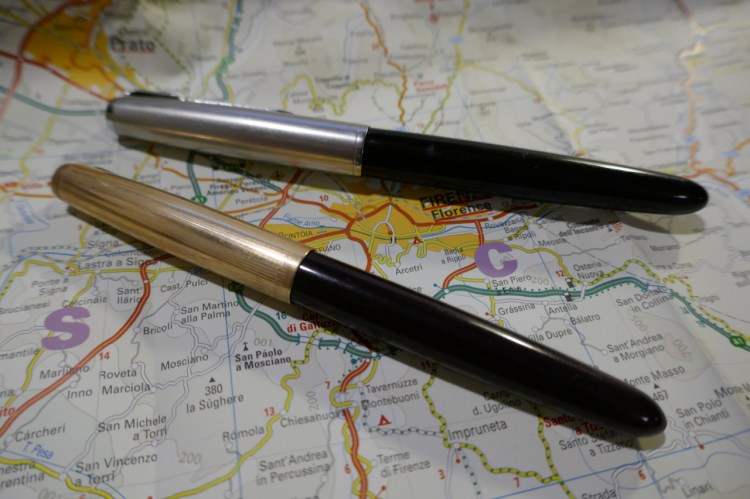
P1010308.jpg
One of these is a user grade black Parker 51, and the other is a plum Parker 51. Would you pay well over 4 times the price of one for the other?

Ti Arto EDC Review

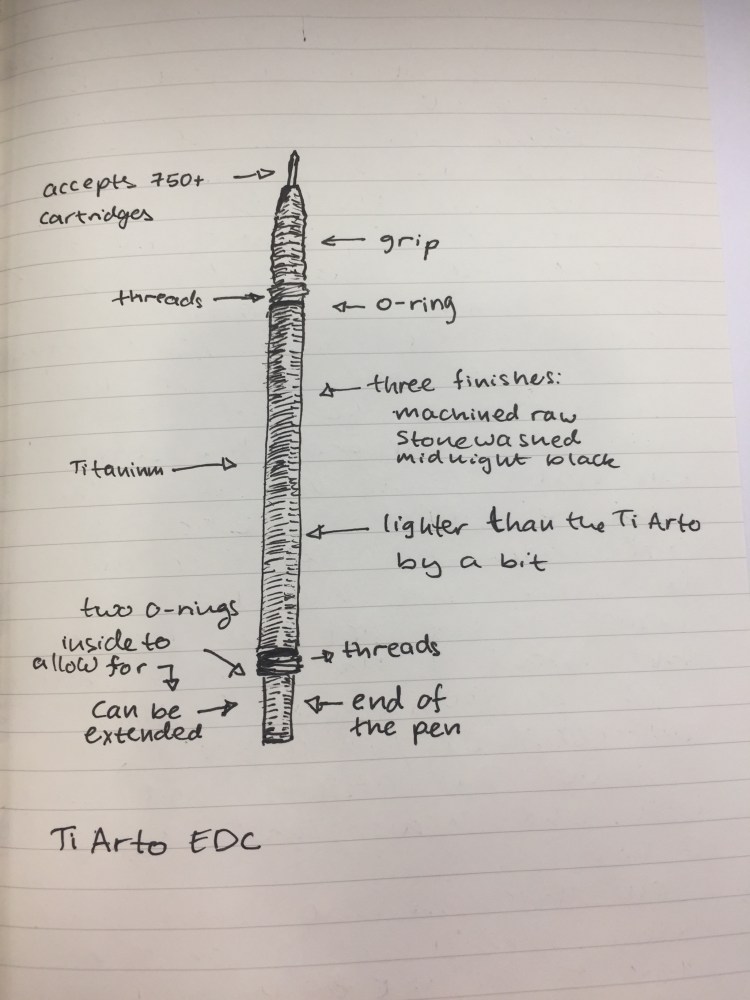
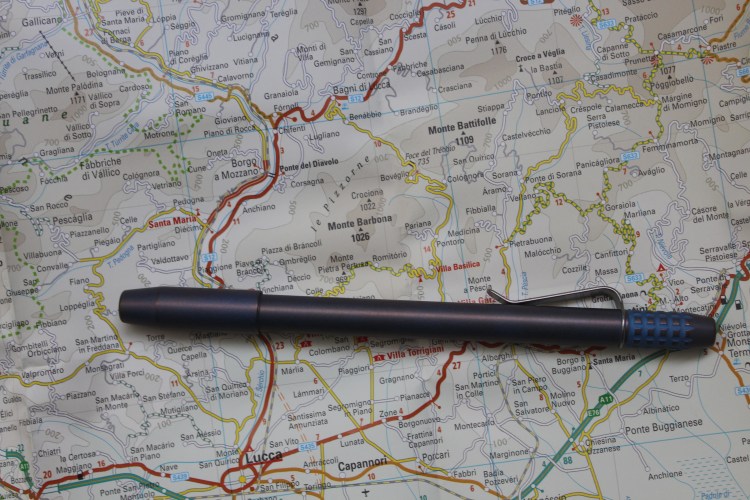
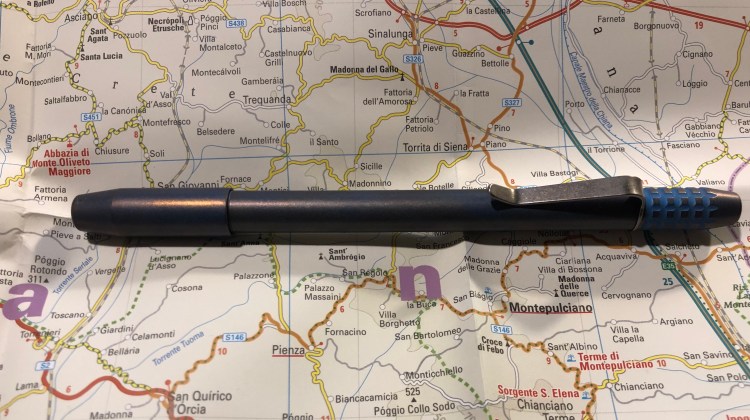
While the original Ti Arto is my favourite machined pen, the newer Ti Arto EDC comes in at a close second. Like its older BIGiDESIGN brother, the Ti Arto EDC is a machined titanium pen which can accept hundreds of different refills with no need for hacks or spacers and with no tip wiggle. Unlike the Ti Arto it comes in three different finishes, accepts many more refills, and can be adjusted in length.

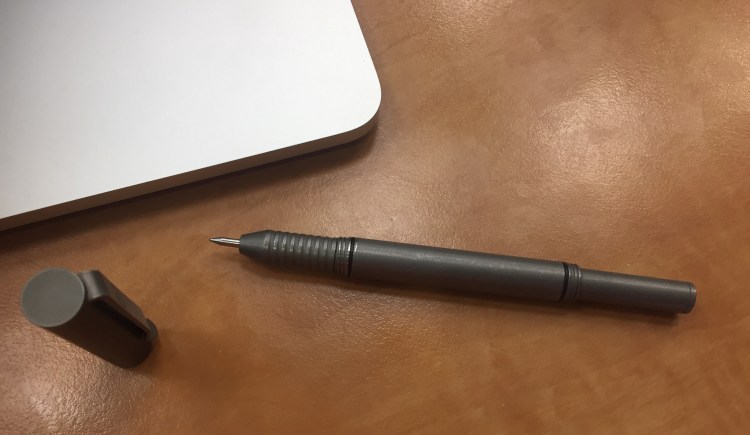
The Ti Arto EDC looks a lot like a slightly slimmer version of the Ti Arto, with a bigger step down in the end section, and almost no gap between the section and the body.

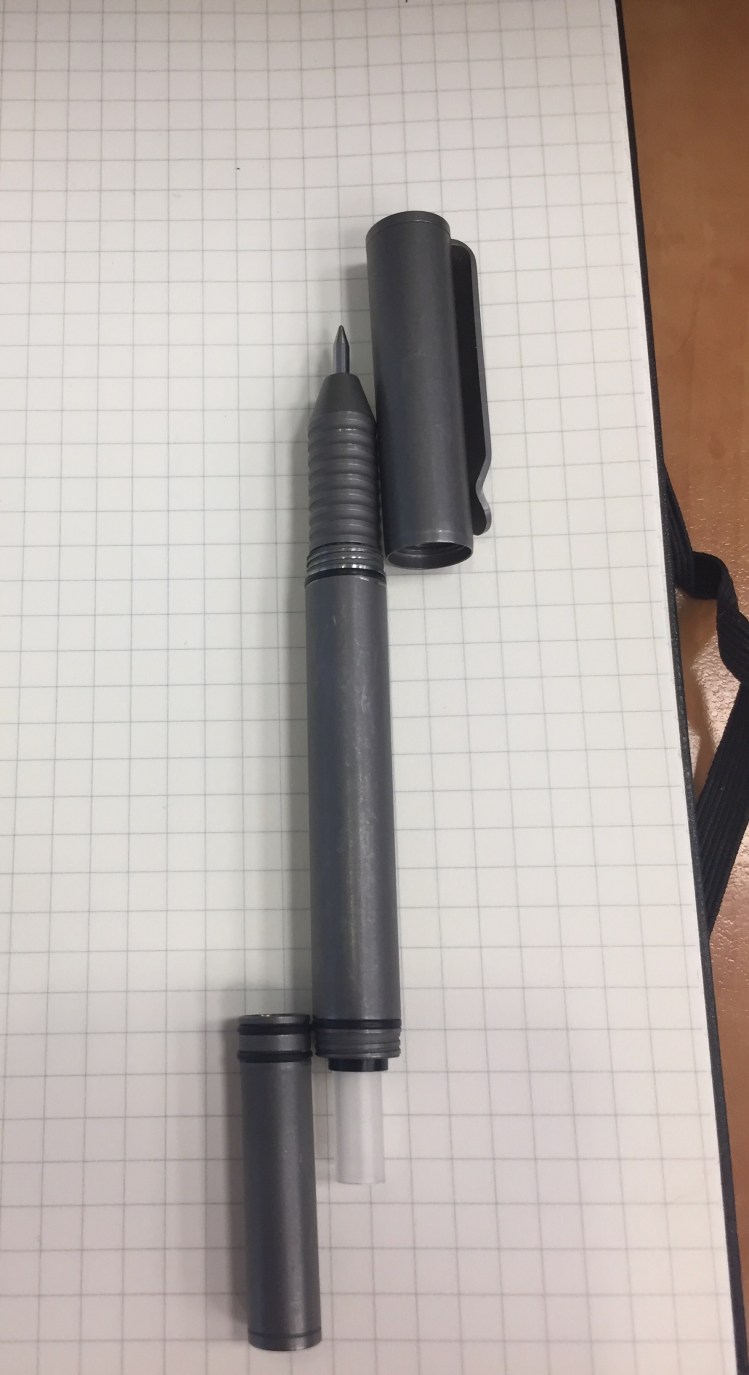
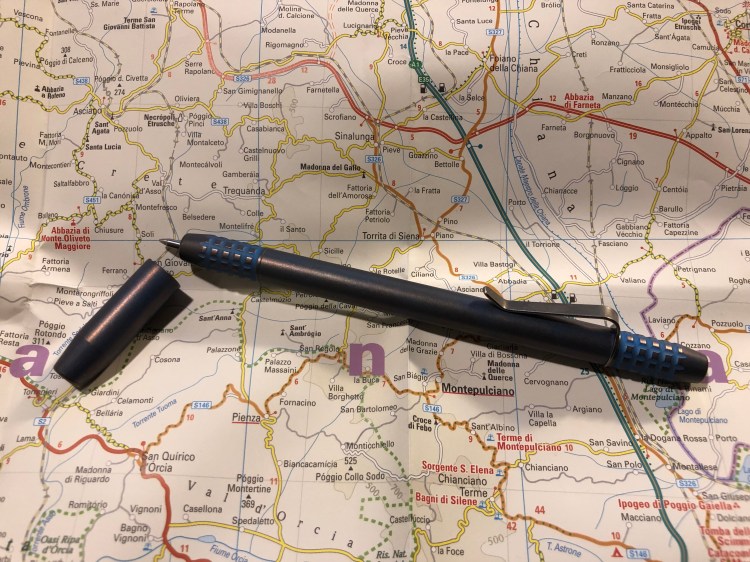
Those looks are a little deceiving, because this the Ti Arto EDC has a completely different build. The end of the pen can be extended or retracted, unlike the Ti Arto, where it is static. In the Ti Arto EDC the end of the pen is also what you unscrew to change refills, unlike the Ti Arto, where the grip unscrews. If you assume that they’re the same, as on a cursory glance it looks like the Ti Arto EDC’s grip section unscrews (and it really, really doesn’t).

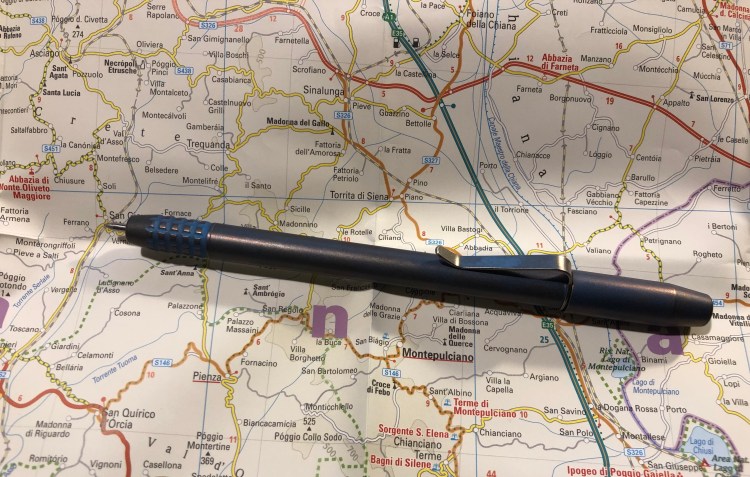
The body of the Ti Arto EDC is slightly slimmer, and the entire pen is slightly lighter than the Ti Arto. It comes in a machined raw finish (like the Ti Arto), in a stonewashed finish (which you can see in the pictures) and in a midnight black finish (which you can see on my Ti Click EDC). Of the three, the stonewashed finish has the best grip and feel, and it also shows wear and tear the best.

The trick with the extendable end section is where the cleverness of this pen lies, and that’s what allows you to use more refill types in this pen, and to extend or compress this pen’s length (to the limits of the refill size). The two o-rings make the end section action super smooth, and the same dual thread design allows you to cap and post this pen super securely. Nothing on this pen is going anywhere without your permission.

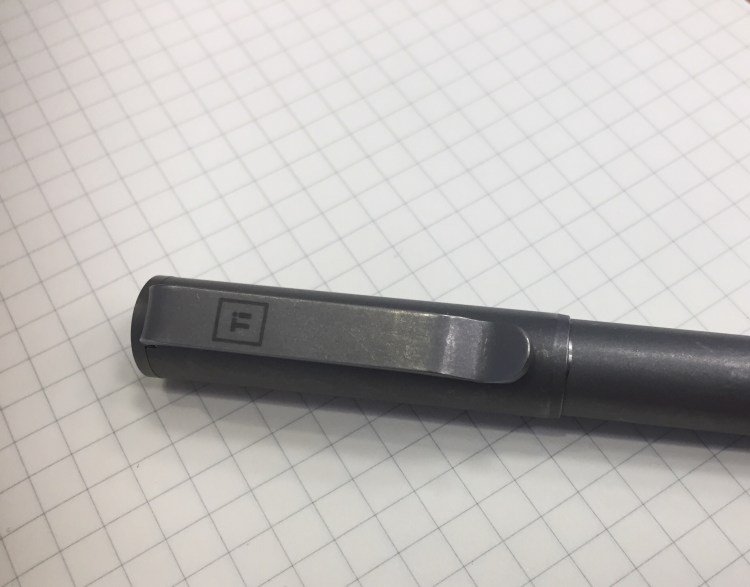
The Ti logo, elegant and understated, is the only branding on this pen. You can see how substantial the clip is and how the pen wear in the photo above. It’s like an old pair of jeans, so the stonewashed name for this finish is totally appropriate.

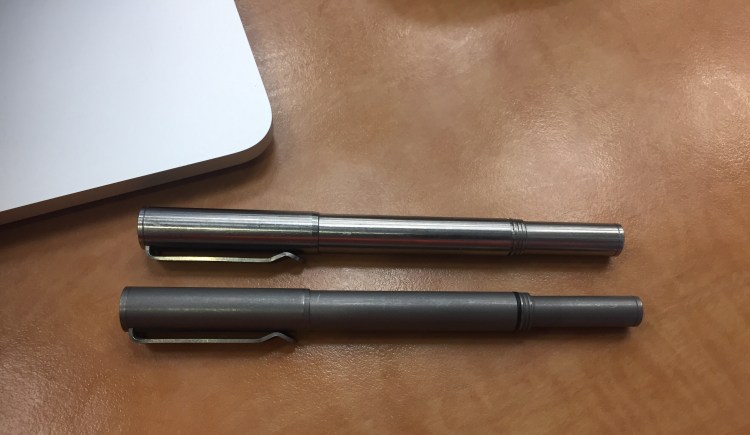
Fully extended, the Ti Arto EDC is the same length of the Ti Arto. However, depending on the refill you use, this pen can get pretty tiny.

I use the Uni-ball UMR-85N refill in this pen, and this is as far as it will contract. If you use a Parker or Schmidt refill the end section can be screwed in almost all the way. However, even partially extended the Ti Arto EDC is a more pocketable pen than its predecessor.

So why do I prefer the Ti Arto more? For longer writing sessions the Ti Arto’s wider girth makes it more comfortable to use than the Ti Arto EDC, although the difference is minor. The Ti Arto is also slightly less ungainly than the Ti Arto EDC, having a more streamlined design, with no step down. I don’t mind the Ti Arto’s gap between the grip and the pen body, and I don’t need a pen that accepts more refills than the Ti Arto. As you may have noticed by now, the choice between the Arto and the Arto EDC is likely going be one of personal taste and preference. Either pen is an excellent choice for a machined pen, an EDC pen, or a titanium pen.

Uni Do! Posca Paint Marker White Extra Fine Review

I am on a quest in search for a white, waterproof pen that reliably lays down a thin, opaque line. You’d think that this wouldn’t be so hard to find, but this combination (opaque-and-thin-and-waterproof-and-reliable) has so far proven to be elusive. The closest so far has been the Uni-ball Signo Broad UMR-153 white gel ink pen, but it tends to dry out and blob, so it is far from perfect.

The Uni Do! Posca paint marker in white, extra fine (0.7) is a welcome addition to the white pen field. It’s waterproof, water-based (so not smelly like other paint markers), lightfast, and can be used on a multitude of surfaces. I’m going to focus its use on paper, but if you’re looking for a way to label a dark coloured object, this may be the pen for you.

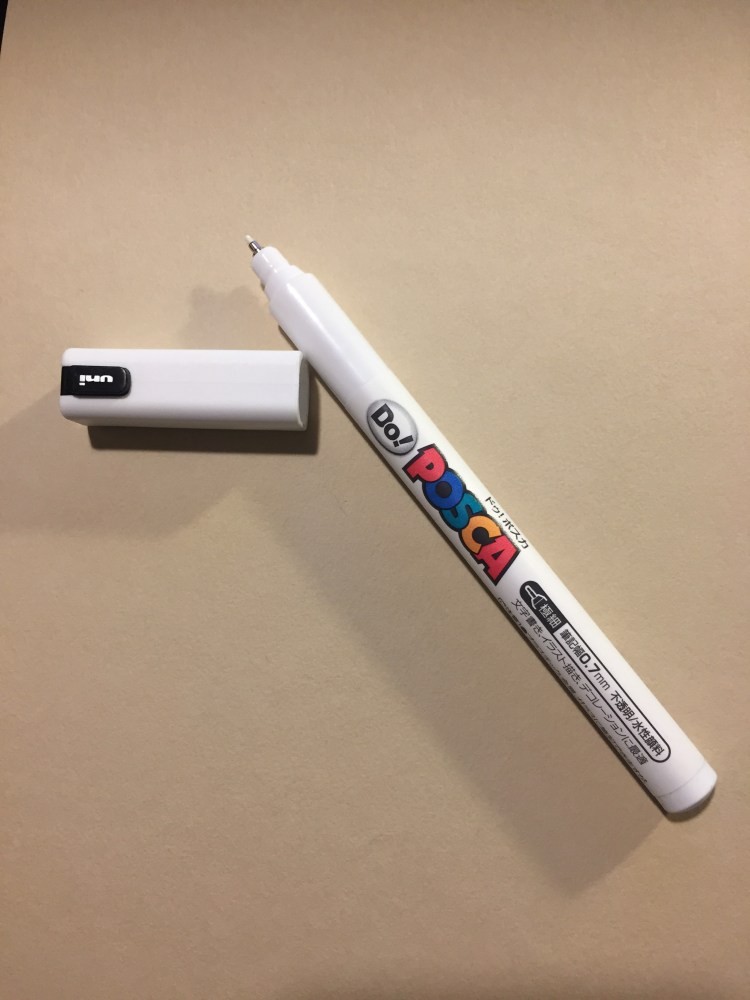
The Do! Posca’s design is pretty well designed. The pen is narrow enough in diameter for you to comfortably use it like a regular pen, and the square cap keeps the pen from rolling off the table, and looks great. The pen body is much too busy for my liking, but that’s a minor quibble.

There’s a tiny metal ball inside the pen, and you need to shake it well before use to get the paint ink flowing. When you use the Do! Posca for the first time you need to prime it by shaking the pen thoroughly and then pressing the plastic tip in several times until the white paint flows. I had no problem getting the pen to start up after a good shake, but I’d recommend keeping it horizontally and cap it immediately after use.

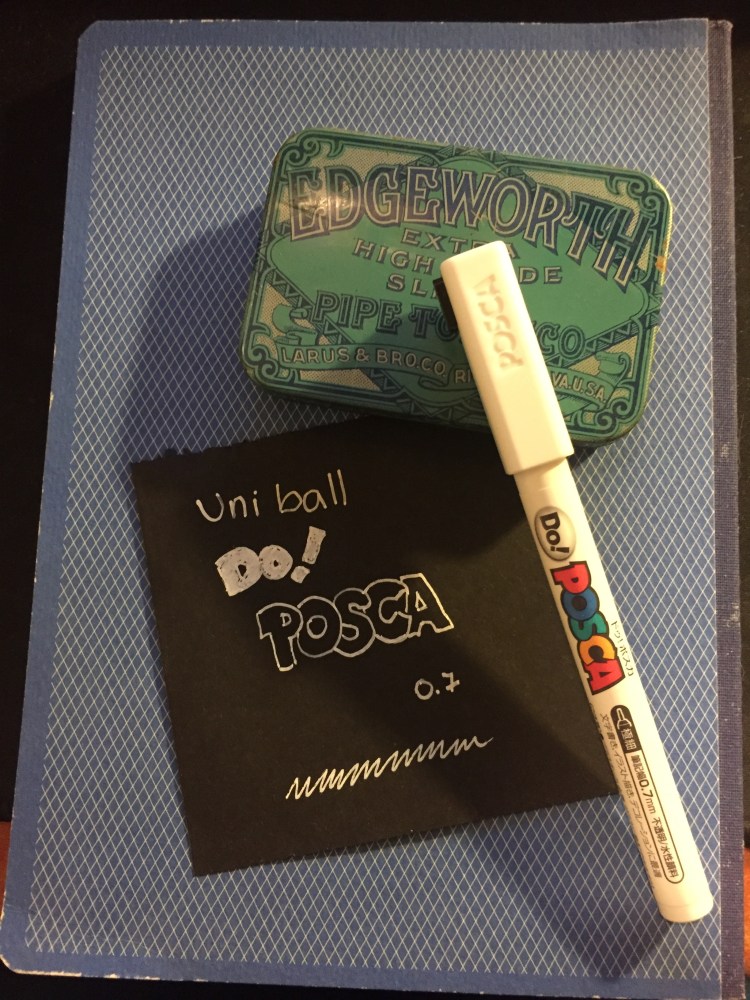
The Uni Do! Posca doesn’t blob, and it’s excellent for small details. I wouldn’t use it to fill in large expanses of white, as it offers pretty poor coverage and doesn’t layer well. If you’re looking to use it for highlights, correction or detail work, this is the pen for you.

I drew this journal comic on a Clairefontaine Paint On Naturel A5 pad.

The Uni Do! Posca extra fine paint marker in white was available for a time at Jetpens, but now you can find it easily enough on eBay. If you’re looking for an opaque, extra fine, waterproof white pen, I highly recommend it.

Ti Arto Review

It’s strange that I haven’t yet reviewed the pen that I use most, but that’s life, I guess. The Ti Arto is a titanium machined pen that accepts 200+ refills, and it has been my EDC and journaling pen since November 2016. There’s no pen I use more, and no pen I like more than this one.

Since the Ti Arto bashes around freely in my bag, it’s got quite a few scratches on it. I personally like that it shows some wear and tear, but as not everyone feels the same, I thought I’d take a few photos that show how the Ti Arto looks like when it’s not brand new.

The Ti Arto is made out of solid titanium, and doesn’t get dented even if you drop it. It does, however, show micro-abrasions and scratches.

None of these scratches is deep enough to be felt – they’re at surface level only. So it really is just an aesthetic thing. If you like your pen to look brand spanking new, the Ti Arto comes with a protective felt sleeve. I personally wouldn’t bother: this isn’t a fountain pen, but a tough, machined, EDC pen. It’s built to tumble around in your bag.

Now to the review proper: the Ti Arto was originally launched on Kickstarter, and became available on the BigiDesign site sometime in 2016. The pen is machined out of solid aluminium, and made to easily accept 200+ refills with no tip wiggle or need for spacers.

The Ti Arto is well balanced, both capped and uncapped, and very comfortable to use, even for someone with small hands that likes to write a lot. Unlike some other machined pens, the Ti Arto’s cap will stay on, even after years of use and after the threads start to wear out a bit. See that semi opaque silicone ring just below the threads? That’s the magic that makes sure the cap closes nice and tight. No refill is going to dry out or leak in this pen.

If you want to post the Ti Arto you can, by threading the cap to the back of the pen. The resulting pen is a bit longer, but still well balanced, and the cap doesn’t rattle when you write. It does take time to screw the cap on, so if you uncap and post often it will become a chore. Since the Ti Arto isn’t a fountain pen, though, there should be no problem leaving the pen uncapped for a while.

I use the Uniball Signo UMR-85N refill in this pen (the same refill that goes into the Signo RT). To change the refill you unscrew the section, pop the refill in, screw the section almost all the way back on, then tip the pen body forward until the refill tip protrudes, and then you tighten the section. Since you probably aren’t going to actually use 200+ different refills in this pen, I recommend finding a refill that you enjoy and buying replacement refills in boxes of 10 or 12 on Amazon or eBay. I go through a box and a half to two boxes of UMR-85N refills a year in this pen, and it takes less than a minute to switch out the refill.

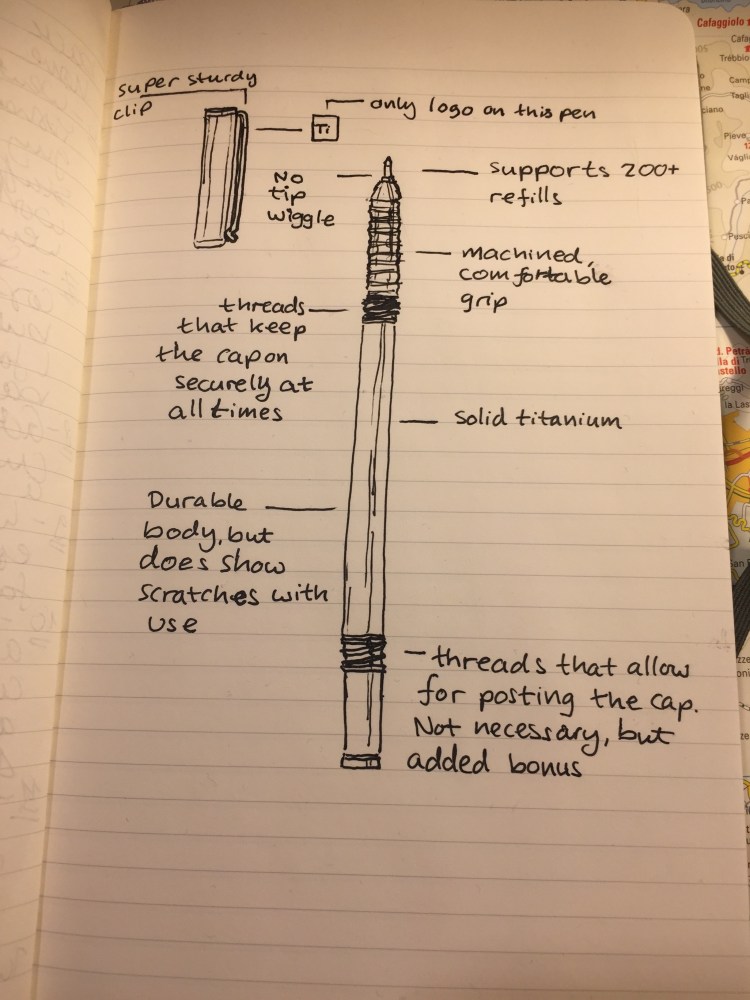
Here’s are a few points about the Ti Arto, drawn and written with the Ti Arto:

If you are looking to own just one good pen, or if you’re looking for an EDC or machined pen, the Ti Arto is the pen you should buy. I’ve tried a good number of machined pens so far, including all the other (non-stylus) offerings from BigiDesign and nothing comes close to this pen.

Franklin Christoph Antique Glass Model 66 and Robert Oster River of Fire Review

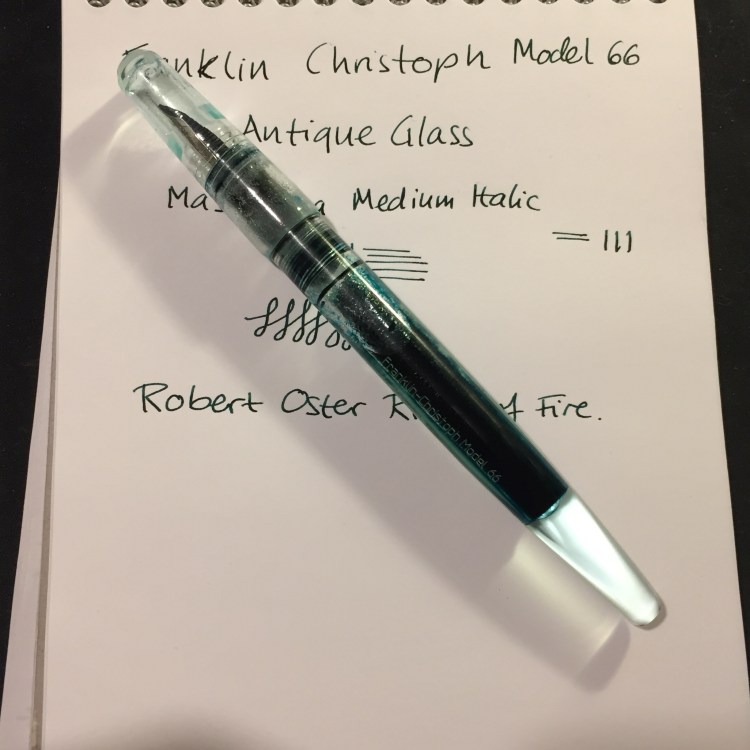
Every once in a while Franklin Christoph comes out with a batch of their pens in “Antique Glass”, a clear acrylic with a bit of a green tint to it that makes it look like an old coke bottle. The material is both minimalist and beautiful. It allows you to show off the ink that you’re using while still having a pen that has more character than a run-of-the-mill demonstrator. Franklin Christoph’s pens and the nibs that they use are excellent and very well priced. The result is that these limited runs having a waiting list (from which a 100 names are drawn), and there’s a good chance that you won’t be able to even get on that. I had to wait for two years until I was able to purchase mine.

The wait is worth it though.

img_0226

The Franklin Christoph Model 66 is a long and sleek pen that can’t be posted. The pen is light but still substantial, because of the extra acrylic in the finial. I was worried at first that it would be top heavy, but the Model 66 is perfectly balanced, and one of my favourite pens for long writing sessions.

img_0221

The Model 66 is a demonstrator pen that is built to be eye-droppered. Yes, you can use the supplied converter or cartridges, but what’s the point of having a pen that looks like this if not to eye dropper it? Franklin Christoph even supply the requisite o-rings and silicone grease, making it super easy to transform it into an eye dropper.

img_0224

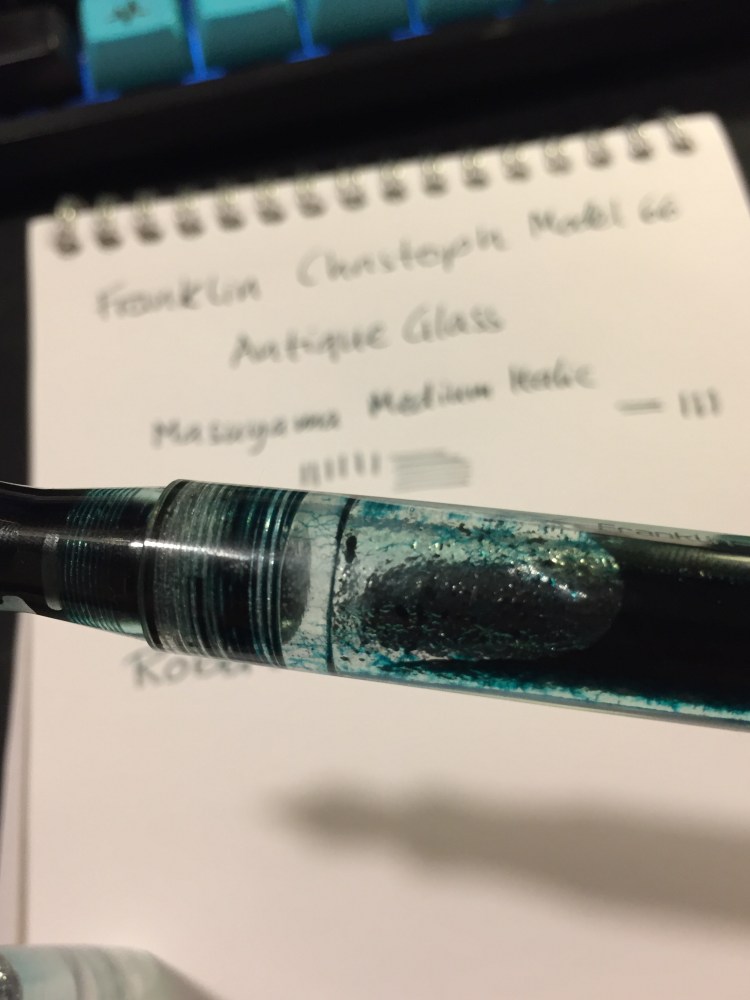
The pen body is made of smooth acrylic on the outside, but is pebble textured on the inside. The result shows off the ink colour and the pen colour even more, but it also means that staining inks have even more surface area to stain. I decided early on to use only turquoise, teal, blue and green inks in this pen, as even if they stained the pen it would work well with its “natural hue”.

img_0225

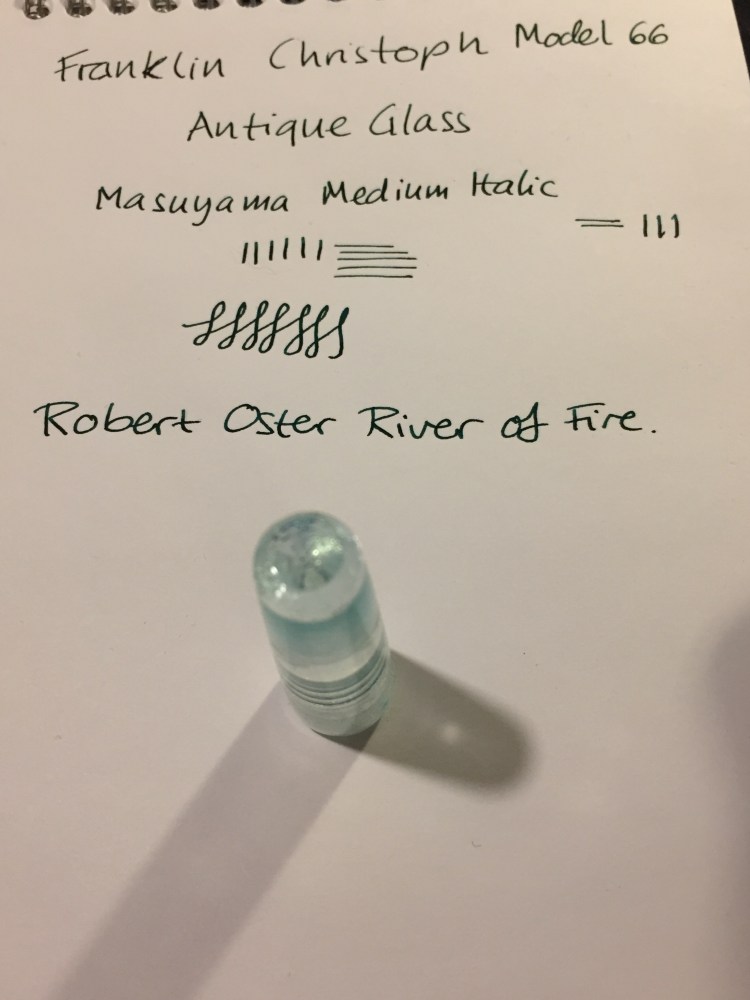
You can see the greenish “antique glass” tint best in the cap.

In terms of design, this is a desk pen and is designed as one, so it has one flat side which keeps it from rolling off the table even though it’s a clipless pen.

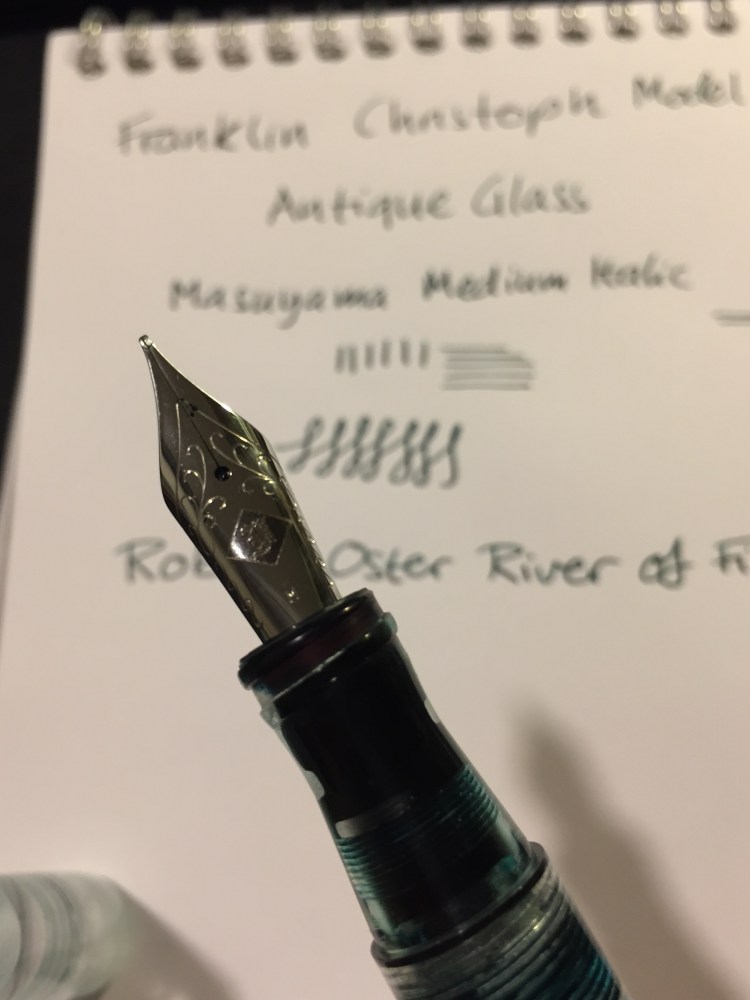
There’s a wide variety of Jowo nibs that you can order with your pen, and I decided to pay a little extra for a Mike Masuyama medium italic nib. The nib is buttery smooth, and the feed keeps up with flow. This italic isn’t super sharp, which is a plus for me, and together with the large ink capacity that an eye-dropper pen offers, it’s writing heaven.

img_0223

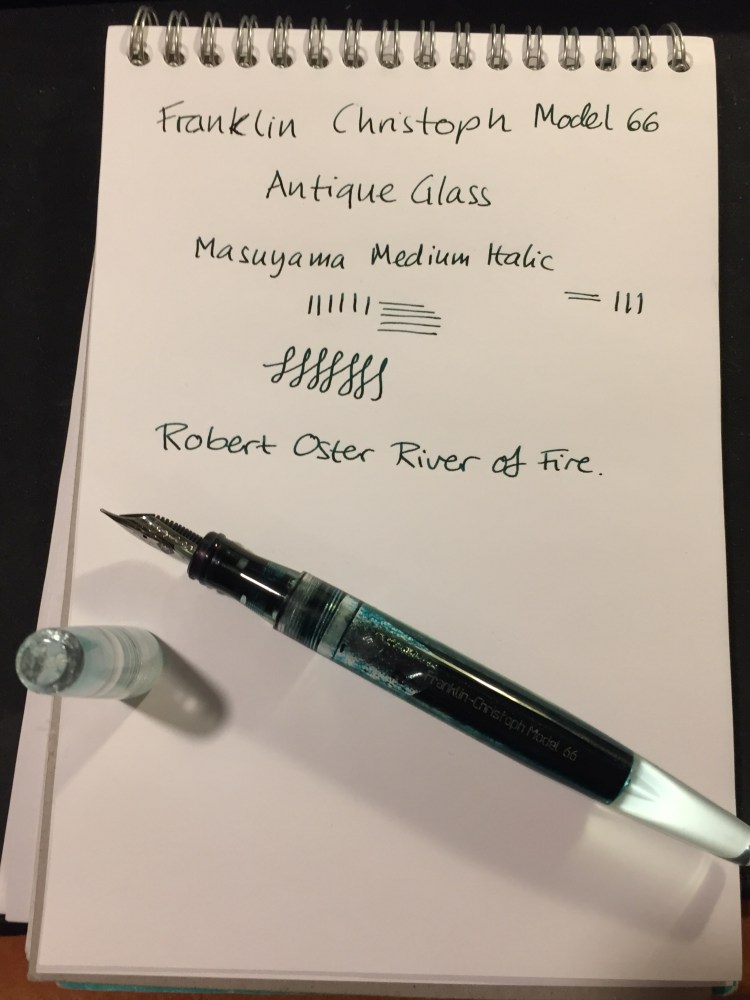
The Franklin Christoph Model 66 Antique Glass with a Mike Masuyama medium italic (what a mouthful) is build to show off interesting inks. Although I would never use shimmering inks in it, it’s great for inks that shade or sheen. And Robert Oster is the king of sheening inks.

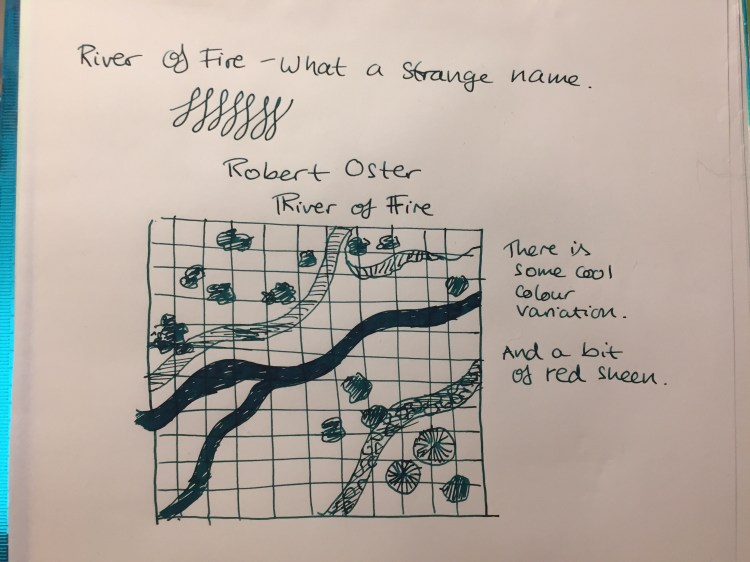
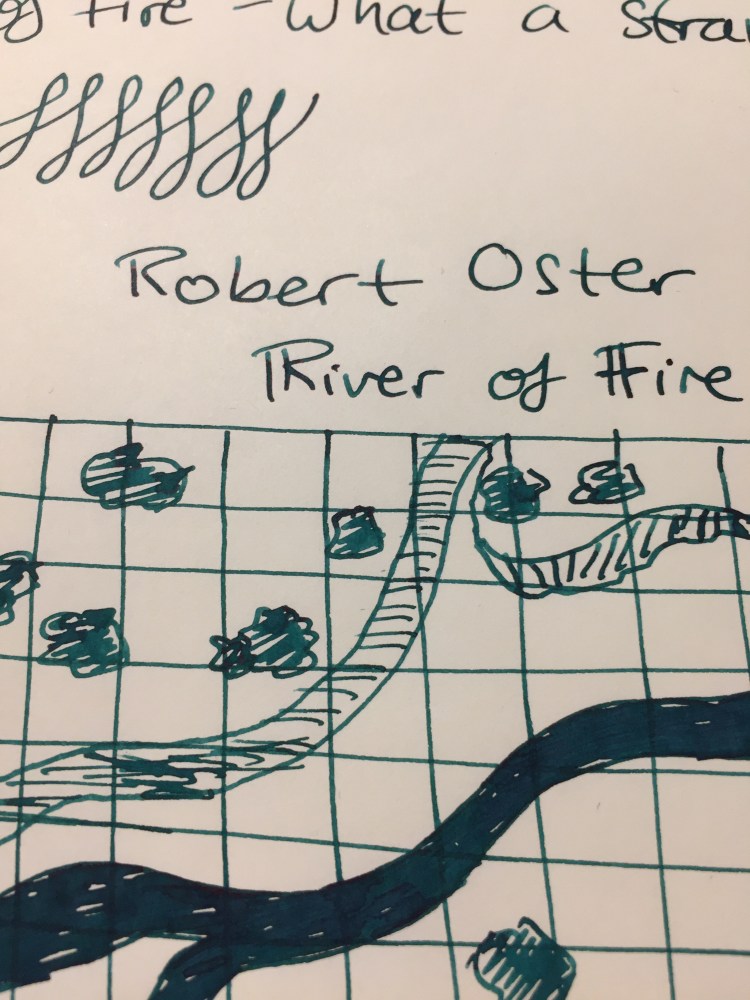
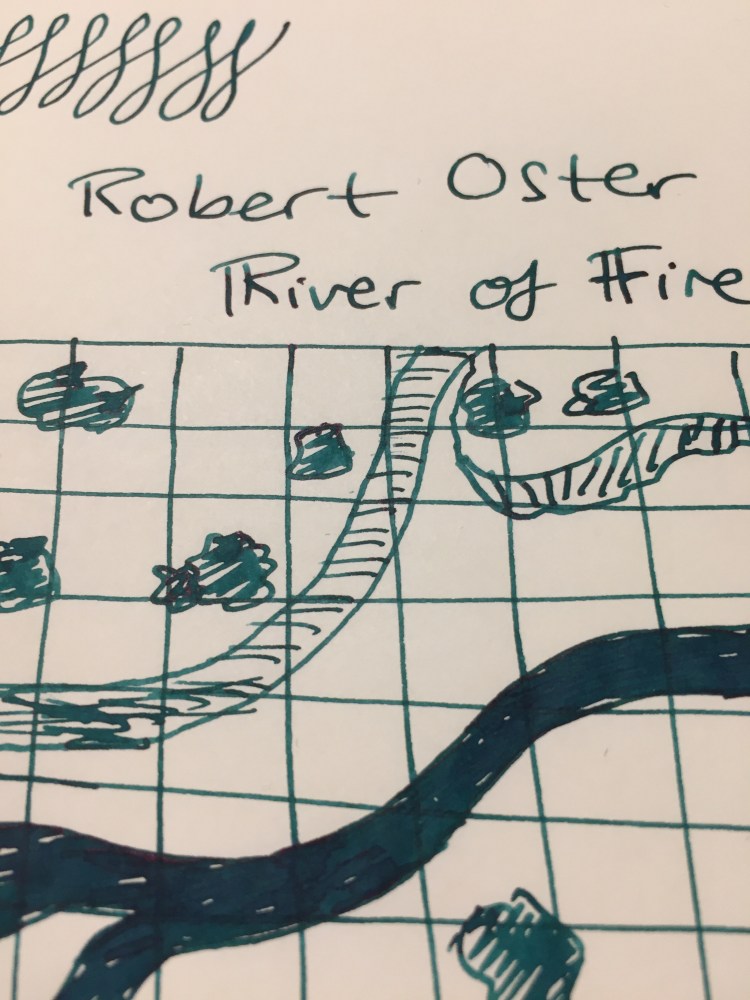
The River of Fire is a dark teal ink that has significant red sheen and a good amount of shading.

I felt like drawing a D&D map here, I don’t know why.

As usual with inks of this kind, the paper and nib affect how much sheen or shading you see. This nib is perfect for that, and the paper I used here is Tomoe River Paper, which brings out the best in every ink.

You can see a bit of the properties of the ink here, particularly the shading, but this ink really does have a lot of sheen. It’s just difficult to photograph, so you can only see a bit of the golden red that happens where the ink pools.

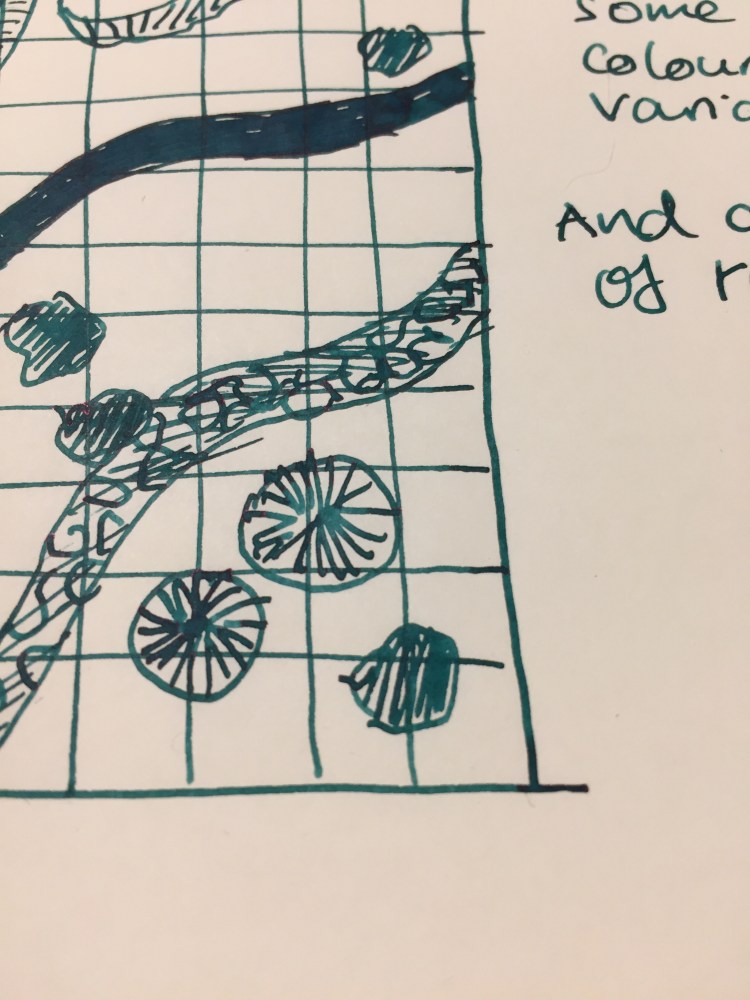
This is such a pretty ink. Look how much variation and interest it offers:

So, if you can get on one of the Franklin Christoph antique glass waiting lists, I highly recommend it. As for the Robert Oster River of Fire, I think that it’s a gorgeous ink, but it’s not unique enough in Robert Oster’s large ink offering. If you have something in the turquoise or teal shade in their lineup, then there’s probably no need to buy the River of Fire. If yo don’t then I recommend this ink since it’s wild and yet dark enough to “pass” in an office setting.


Lamy Studio Terracotta Fountain Pen Review

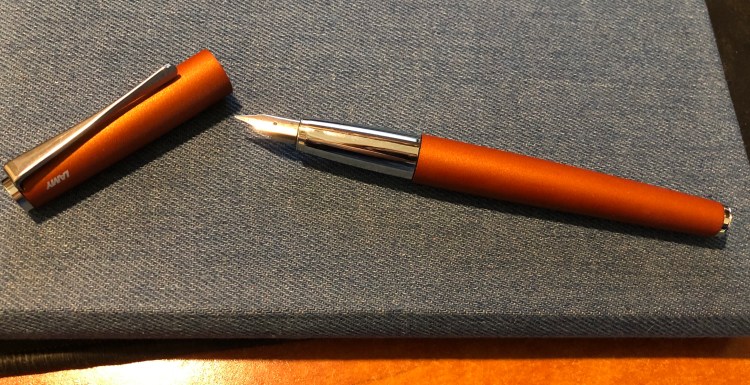
I’ve been eyeing the Lamy Studio for years now, but until now I haven’t purchased one because I found the available colours kind of boring and drab. Then they came out with the Terracotta limited edition, and I decided to give it a go.

The Lamy Studio Terracotta is a full metal bodied pen, and so it has some heft to it, although it’s nothing close to the weight of a Karas Kustoms Ink. Even if you have a small hand, the weight of this pen shouldn’t be an issue.

The colour of the pen is vibrant, and the matt finish on the pen practically glows in the light.

This fountain pen is famous for its propeller-like clip design, and it’s nice and functional but not something you notice after a little while. The Lamy 2000 and the Lamy Safari have much more striking designs.

The Lamy Studio uses the same nib units that the Lamy Safari uses, and the same converters too. The pen arrives in a beautiful, super sized box that makes for great gift packaging, complete with an ink cartridge and a converter.

The main issue with this pen is its grip. As you can see from the photos, it’s a shiny, slippery metal grip. That’s a problem, especially if you tend to sweat, or if you use hand cream. It’s not that the pen slipped when I wrote with it, but as my fingers had no real purchase on the grip, the pen felt insecure in my hand. Like it was going to fly out of my grip at any moment. That doesn’t make for an enjoyable writing experience.

As I was taking photos to try and get the colour of this pen, it rolled away (uncapped) and fell to the floor. The nib got slightly dinged, but I straightened it pretty easily. Even if it would have been badly damaged it would have been no big deal as I have plenty of Lamy Safari nibs to choose from to replace this one. That’s a big plus for this pen, since if you’ve invested in a few Safari or AL-Star or Vista Lamy fountain pens, you can swap the nibs around very easily.

I filled the Lamy Studio Terracotta with the Diamine Terracotta 150th Anniversary ink, and they go fabulously together. The Diamine Terracotta (and the Diamine Safari) are my favourites of the Diamine 150th anniversary inks, as it’s such a unique colour, with some nice shading, but it isn’t super saturated. This means that it can be used safely with vintage fountain pens, and that it can add a little va-va-voom to your office work without drawing too much attention to itself. It almost looks like a boring brown, but it very much isn’t. I love that in an ink.

A close up on the shading, that goes from a lighter reddish brown to a darker reddish brown on the ends of downstrokes even in a fine nib pen.

So, what’s the verdict? If the Lamy Studio had a different grip then it would be a five star pen. As it is, I don’t recommend it. The Diamine Terracotta though is an ink worth having, especially if you’re just starting out with exploring brown ink, or if you want an interesting ink to use in vintage fountain pens.

Mark One and Ohto Flash Dry Review

After waiting for over two months, my Mark One (purchased post Kickstarter) finally arrived. The pen, by Studio Neat, is made of aluminium and features a ceramic finish and a custom click mechanism. It also comes with a Schmidt P8126 rollerball refill (the same kind that Retro51 uses in their pens), which is absolutely horrible, so I switched it with an OhtoFlash Dry 0.5 gel ink refill instead.


The pen comes in a cork box that is very pretty, but not really functional. If you have tons of spare room on your desk you can reuse it as a pen tray for the Mark One, but as I don’t the box will just go to recycling. I would have preferred a simpler box, of the kind that TWSBI or Lamy uses, but this is a great box if you plan to give someone the Mark One as a gift.

The Mark One box is held closed by a piece of cardboard that doubles as an instruction sheet for the pen. That’s a nice idea, and the sheet is well designed and clear.

The box without the sheet doesn’t have a sealing mechanism (it’s just two pieces of cork), so it’s not really built to be a pen case, just a pen tray.

I chose the white and copper Mark One, which is very popular based on the waiting times on the Studio Neat website.

The pen is very comfortable to hold and use for long periods of time. It looks heavy but is super light, and the ceramic finish makes it very grippy. The wide barrel helps ensure that you don’t slip into “death grip” mode even if you have a tendency to.

The click mechanism is excellent and very solid and satisfying to use. It’s also very far from silent. The pen tip doesn’t rattle, and the pen looks as gorgeous as the pictures make it appear.

The Ohto Flash Dry 0.5 gel ink refill (PG-105NP)  is a needle point, parker refill that dries in a flash. It’s very dark and produces a line that is slightly wider than the Uniball 0.5 gel ink refills, but it somehow doesn’t smudge. Even on Moleskine, Rhodia and Tomoe River paper the OHTO Flash Dry dries almost instantaneously. It’s a left hand writer’s dream, and an excellent gel ink refill in and of itself. I have no idea why this refill hasn’t gotten more reviews, since there are so few parker style gel ink refills to begin with, not to mention good ones or ones that dry in a second or less. Maybe it’s because I don’t think it’s the kind of refill that’s widely available. It is, however, totally worth the price and effort.

Here’s a sample from my journal (which is a Moleskine). New Moleskines don’t have the spidering problem that they used to have, and there is no spreading or smudging with this pen/ink combo. The show through is a more significant than with a Uniball UMR-85 refill (the Signo 207), but the line is also wider and a good deal darker.

Here’s a writing sample on a Field Notes, where the first line (“Mark One”) was written with the original refill, and the rest with the Ohto Flash Dry.

Here’s the refill, which is available at JetPens and CultPens (I am not an affiliate of either):

I highly recommend the Mark One, as it’s a beautiful pen that’s just a joy to use. I would recommend switching the Schmidt refill out for the Ohto Flash Dry 0.5, or just using the Flash Dry in any parker compatible pen that you’ve got. It’s one of the best refills out there, especially if you’re left handed or tend to smudge your writing.

Ti2 Techliner Review

Ever since I first saw a review of the Ti2 Techliner on The Pen Addict I have wanted this pen. At the time it was on Kickstarter, and I wasn’t comfortable with paying that much for a pen that I wasn’t sure that I would get.

Later on it was for sale on the Ti2design website, but that site looked dodgy enough for me to hesitate giving them my money. This is an expensive pen, especially considering that it’s not a fountain pen, and I was unsure if I wanted to spend the money on it. It didn’t help that Ti2design noted that it was no longer using the Uniball Signo 207 refills (which are my absolute favourites), but have switched to Uniball Jetstream refills (which I’m not a fan of). As the FAQ at the Ti2design site said, the two were not interchangeable, due to different nose cone designs on the refill, each requiring a different combination of magnets, spacers and o-rings.

That turned out to be wrong, but more about that later.

When JetPens got the Ti2 Techliners, I decided to take the risk and buy the fallout titanium edition, hoping that I could hack a Uniball Signo 207 refill into it. It arrived super fast in the ugliest, cheapest looking packaging I have ever seen. It was just a plastic tube with a bit of paper stuck on it, not even in a clean and professional way. I don’t care about packaging, but if I would have bought this as a gift for someone I would be hugely embarrassed if it arrived like that. It’s a $92 pen — they couldn’t even splurge for a nicely designed cardboard tube? The TWSBI GO costs a third and comes with much, much nicer packaging.

IMG_3525

The pen itself is gorgeous in my opinion. It’s obviously got a design that not everyone will like, but you can see that every detail has been considered and designed. The fallout finish is stunning, with a blue hue over the tumbled titanium finish giving it a purplish glow, especially at the raised edges of the pen (the top of the cap, the grip knurls, etc.).

IMG_3527

The cap closes magnetically, which is very satisfying, and it posts magnetically too. Those magnets close with a satisfying click (what a great fidget toy), and they are STRONG. That means that the pen will attract various metal knickknacks lying around, and you need to be careful where you place it.

I photographed it both in natural light and warm light, just to try and bring out the colour a bit more, but neither photo does it justice.

The knurling on the grip is pretty comfortable to use, but if you have a death grip and you use it for long periods of time, it will start digging into your fingers. This is also a long pen, both capped and uncapped, at 14.1 cm uncapped, 14.7 capped and 15.5 posted. It is well balanced though, so even with my tiny hands it didn’t feel unwieldy.

The knurling is tumbled so that it won’t cut into your hands, and it looks great with the fallout finish. It’s one of the most comfortable machined pen grips that I’ve used so far, and the only reason that it may encourage a bit of “death grip” is that the pen is long and it may feel like you need to. You don’t.

You can see the purply-copper finish a bit here, on the capped end, and see the clip too. JetPens only sells the Ti2 Techliner with the clip, but if you go to Ti2design’s site they’ll sell you one without one. The clip looks nice and does a decent job.

The uncapped end of the pen also has knurling on it, and looks cool.

I like the truncated nose cone design, and it shows off the magnet that holds the refill in place and allows the cap to snap on. There may be those that don’t like it, but I really think that it works on this pen, especially since it’s repeated on the end of the pen.

The end of the pen is also truncated, and you can see the magnet that allows posting here too.

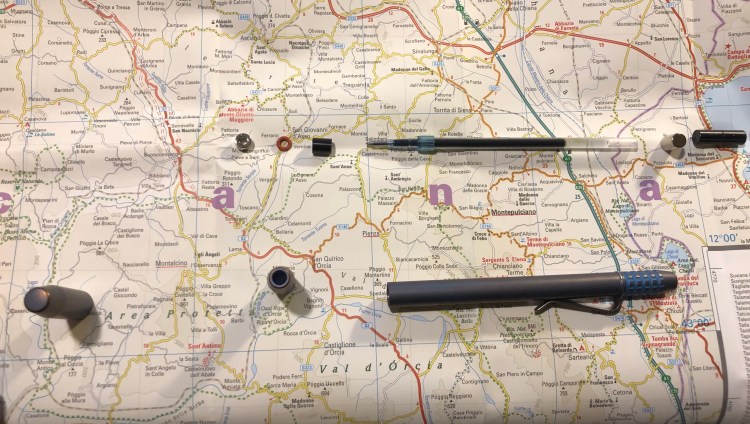
This brings us to the insides of the pen and some things worth knowing before you buy this pen. The pen comes with two magnets, two spacers and an o-ring, and a Uniball Jetstream SXR 0.7 ballpoint refill. That’s a great refill if you like ballpoint pens, but otherwise and unlike what the Ti2design FAQ says, you can totally use other refills in this pen. Jetpens has a list of compatible refills here, and the Uniball UMR gel refills (the Signo 207 refills) totally fit. You could have 0.38 mm gel refill in this pen!

Before unscrewing the pen and changing the refill, do take a moment to:

  1. Go to the Ti2 Techliner FAQ page, just to understand which parts go where. The magnets are directional, so if you put them back the wrong way in your pen won’t cap or post. Just take it apart again and flip the magnets. You can’t get the front and back end magnets or spacers confused, as the front ones have a hole in them for the refill, and the back ones are solid.
  2. PUT THE CAP FAR, FAR AWAY BEFORE STARTING!!!! The cap has a magnet inside it, and if you’re not careful you front magnet (which is tiny and light) will get sucked into it, and you’ll need a pair of tweezers and some effort to get it out. Save yourself the hassle and put the cap away first before you disassemble the pen.

I love the Ti2 Techliner and I’m happy with my purchase. Do I recommend it? If you like the aesthetic and aren’t shocked by the price, then yes. I wouldn’t give it as a gift (not until the packaging is sorted out), and I’d recommend the Ti Arto over it because it’s much more versatile, but in my opinion this is still a very well designed, beautiful pen.

Just beware of the magnets…

Kaweco Liliput Brass Fountain Pen Review

A certain famous young actress, whose work I love, was recently photographed while pensively holding the copper version of this fountain pen, and this summarises this pen perfectly: it’s very, very photogenic.

I got this pen at a close out sale in a local art supply store, and the only reason I was tempted to buy it was because it was so shiny and pretty and at bargain price. Even so, I should have left it to languish unloved at that store’s counter. This is not a good pen. It’s not even a usable pen. It’s a lovely prop.

As its name suggests, this pen is tiny. You can’t use it unposted, and even posted it’s far from comfortable to use. I have tiny hands and even for me the Kaweco Liliput, posted, is just a hair breadth above the Steinbeck stage.

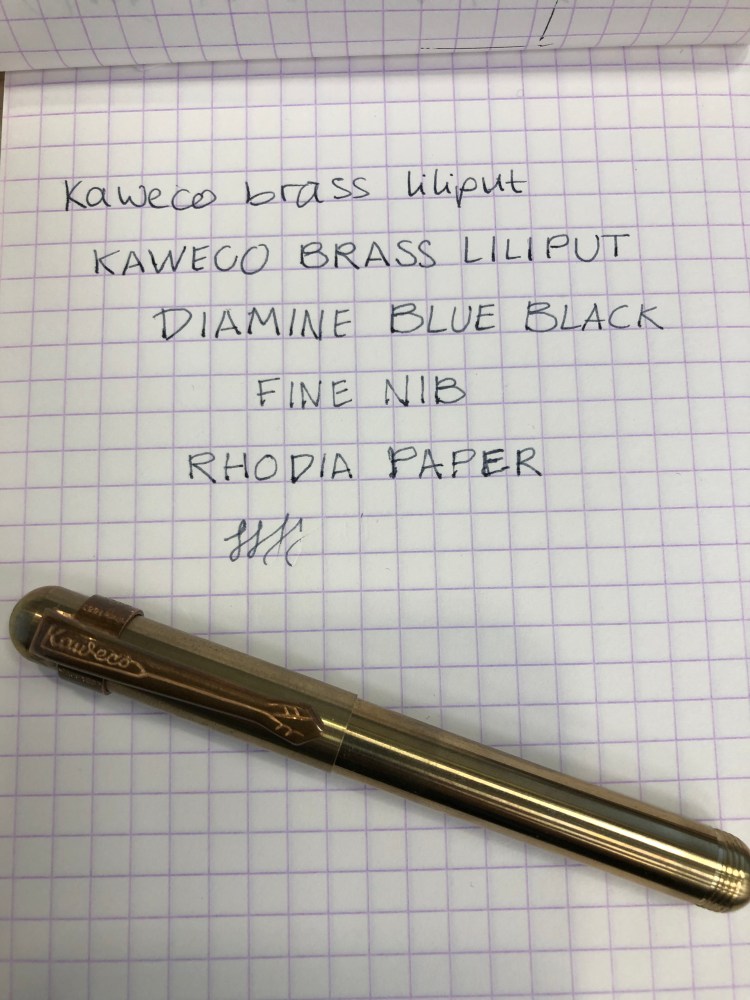
How does the pen write? Fine, as long as it writes. This is a fine nibbed pen and it writes like a Japanese fine nib (despite being made in Germany), if the Japanese fine nib that you have in mind has serious flow issues. The nib constantly dries up. I used a Diamine blue black cartridge in it (there’s no really viable converter option for this pen), a good, middle of the road ink, and the Liliput behaved as if I was using the driest ink ever and had left it uncapped for at least 10 minutes before I started writing. I wouldn’t even call it a writing experience, as so little writing went on. Start, stop, shake. Start, stop, shake. Nothing but shaking would get it writing again for another letter or two.

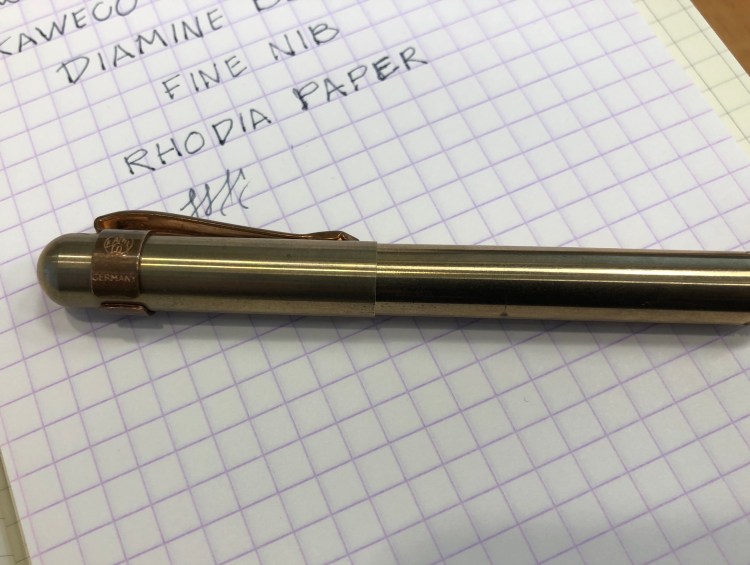
The pen is already starting to show some patina, which is excellent (you buy a brass pen for the patina potential after all). This means that it will only look better with time. If you’re a petite actress trying to look pensive and sophisticated for a photo op, this is wonderful news for you — the Kaweco Liliput Brad’s is the perfect pen for you. Everyone else: spend your money elsewhere.

Paper for Fountain Pens Notebook Review

Back in the (not so good) old days, Tomoe River Paper was an exotic kind of paper available only in bulk order from Japan, or through various indie creators that advertised mostly on the Fountain Pen Network. The magical paper that made all your inks shine (not literally, this was in the pre-sparkle days of ink, when shading is all we dared dream of in an ink) was very hard to obtain, and very expensive.

It was at that time, in 2013, when I was looking for reasonable priced Tomoe River Paper notebooks that could be shipped to Tel Aviv, that I ran into Paper For Fountain Pens, through the Fountain Pen Network. Since I just received my latest three-pack of notebooks from Jay at PaperForFountainPens.com, I decided that now would be as good a time as any for a review.

The notebooks that I ordered are the larger, 374 pages (187 sheets), ones, which are available only around this time of year. The regular notebooks have 320 pages, but are otherwise identical. Jay uses 52 gsm Tomoe River Paper for the notebooks, which are 4 3/4 x 8 3/8 inch page size; 5 1/4 x 8 1/2 inch cover size.

The notebooks used to be shipped with a paper cover, now they arrived vacuum packed as well, to protect them from the elements, and in a heavy duty box that prevents them from getting damaged by the postal services of the world.

Vacuumed packaging.
Paper wrapper.

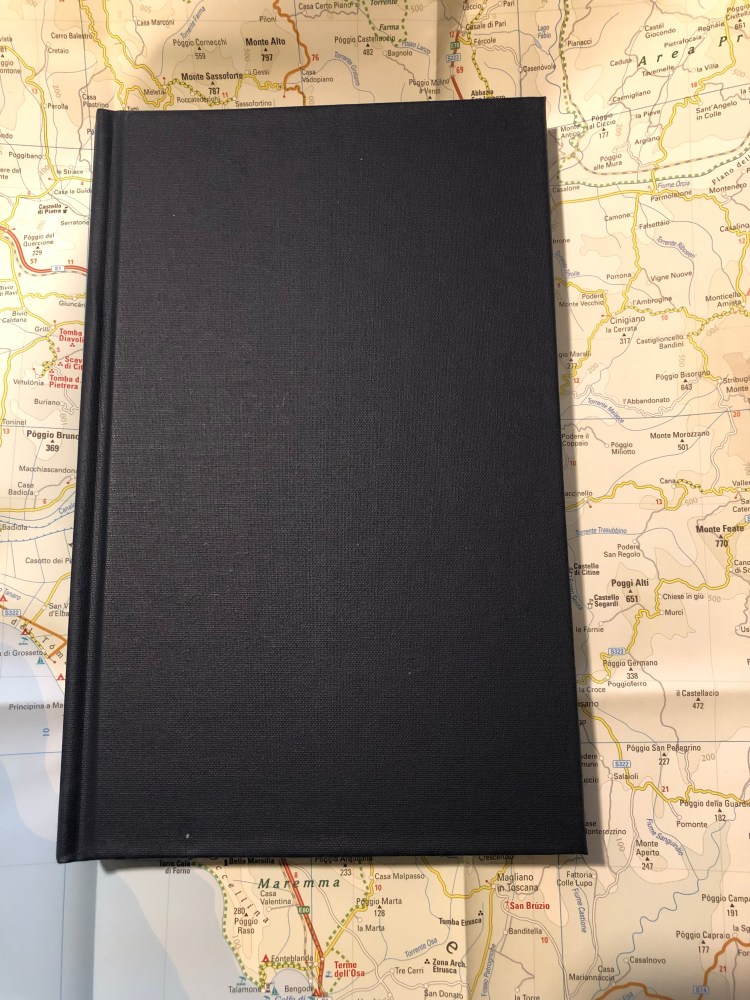
Tomoe River Paper is much easier to find now and these notebooks aren’t cheap, as you are paying for the binding. The covers are very durable, made from a material that (with the binding) makes the whole notebook look and feel like a vintage hardcover book. It has that solid, over-engineered feel to it, and is very pleasant to use and hold.

The notebook isn’t inconveniently thick, even with the larger page count.

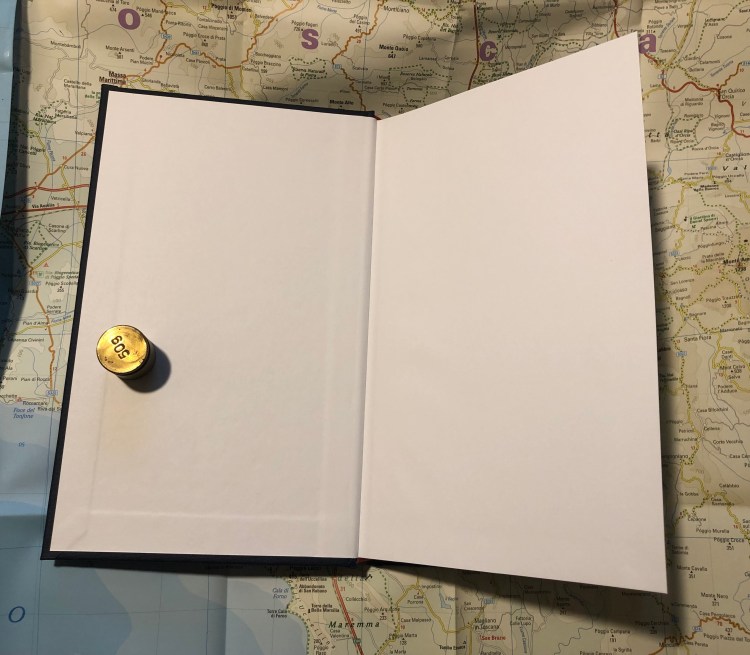
There are no frills to this notebook, just blank end papers, no elastic closure or bookmark, nothing but the paper and the covers. The pages lie flat, and the binding is extremely durable (I page a lot, a lot in my Paper for Fountain Pens notebook and not a page has wavered in my years of using it).

The front endpaper 

I’ve used the slimmer version of this notebook as a research notebook for my novel and it has held up well through years of use. I do, however, only keep it on my desk. Travelling with such fragile paper in a notebook with no elastic closure is a recipe for disaster, so if you do intent to use one of these beauties as your everyday carry notebook or journal, I highly recommend placing it in some kind of protective cover that you can zip up.

The back endpaper

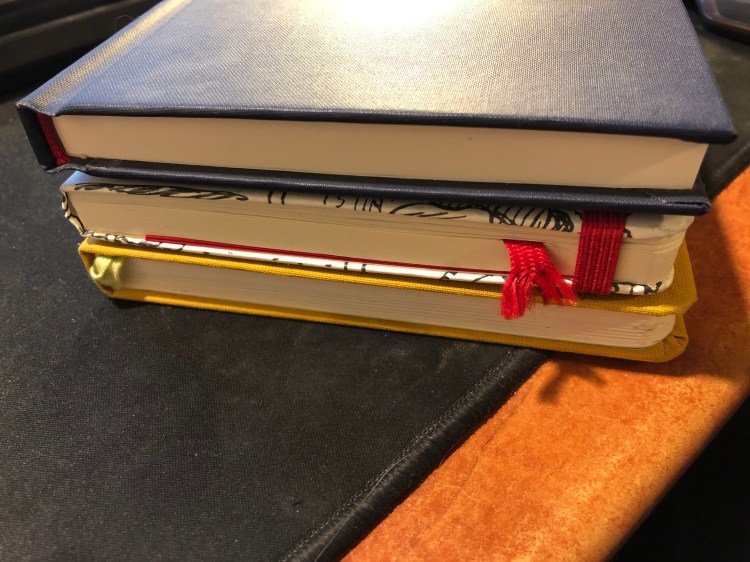
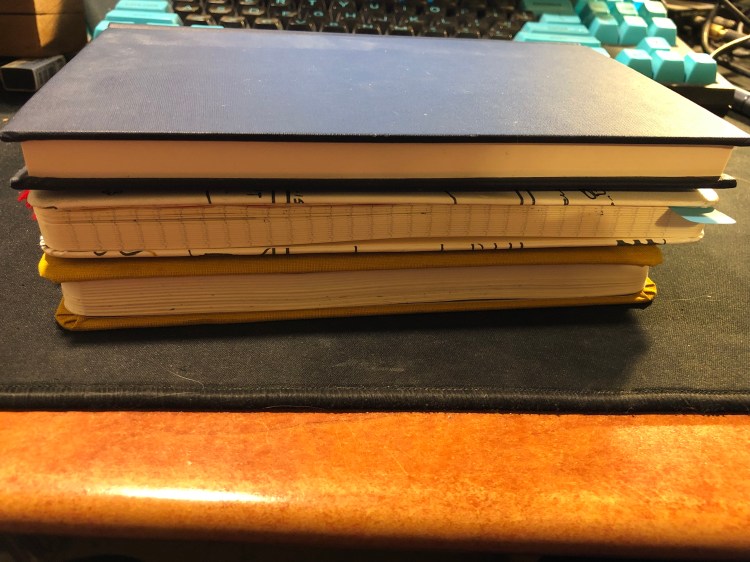
This notebook is slightly thicker than the Baron Fig Confidant and Moleskine large notebook, is about as wide as the Moleskine, but a tad taller.

Paper for Fountain Pens above a Moleskine Large notebook and a Baron Fig Confidant

You can see the difference in sizes with the notebooks stacked up. The Paper for Fountain Pens notebooks have thicker and heavier covers than the Moleskine and Baron Fig ones, but the lightweight paper in them keeps them from being overly heavy to carry around.

Paper for Fountain Pens above a Moleskine Large notebook and a Baron Fig Confidant

All in all I recommend these notebooks, with one caveat: they may intimidate you to a point where you won’t use them. There’s something about their book-like format that makes you feel that you can only write the next Booker prize winning novel in them. Notebooks should be used and not stacked and stared at, so if this one will scare you off, pick a more humble notebook instead. Otherwise, buy a three-pack of these — it’ll come out cheaper (particularly with shipping), and there’s an excellent chance that they’ll become your new favourite.