Dip Pens Part 1: Some Basics

It’s been a while since I used my dip pens, and since I had a project in mind for them, I thought I’d document parts of it here.

I was looking to draw a map, part of a series of maps for a D&D game. Since I was trying to get a certain look to these maps, I pulled out a mapping nib and a mapping nib holder, and some Sennelier Sepia ink.

The ink is shellac based and meant to be used in dip pens only. If you use it in a fountain pen it will destroy it upon first use. You only need to see how sticky these inks are once to understand that, but most of them helpfully provide warnings on the bottle.

The nib is a Leonardt 801 mapping nib, made in England by the British company Manuscript and purchased, together with the mapping nib holder at Cornelissen & Son in London. They have the largest and best variety of dip nib supplies that I’ve ever seen, and are used by many illustrators and cartoonists. The beauty of dip nibs, however, is that they’re pretty easily and cheaply obtainable. Speedball sells a kit that includes a wide variety of nibs, including a mapping nib, and two holders (a standard one and a mapping one, known as a crow quill).

What’s the deal with a mapping nib? It’s a small, round nib with an end that’s actually a cylinder, and you pop it onto the little peg at the top of the holder. Mapping nibs allow for very thin lines, and yet also a good line variety as the tines are sensitive to pressure.
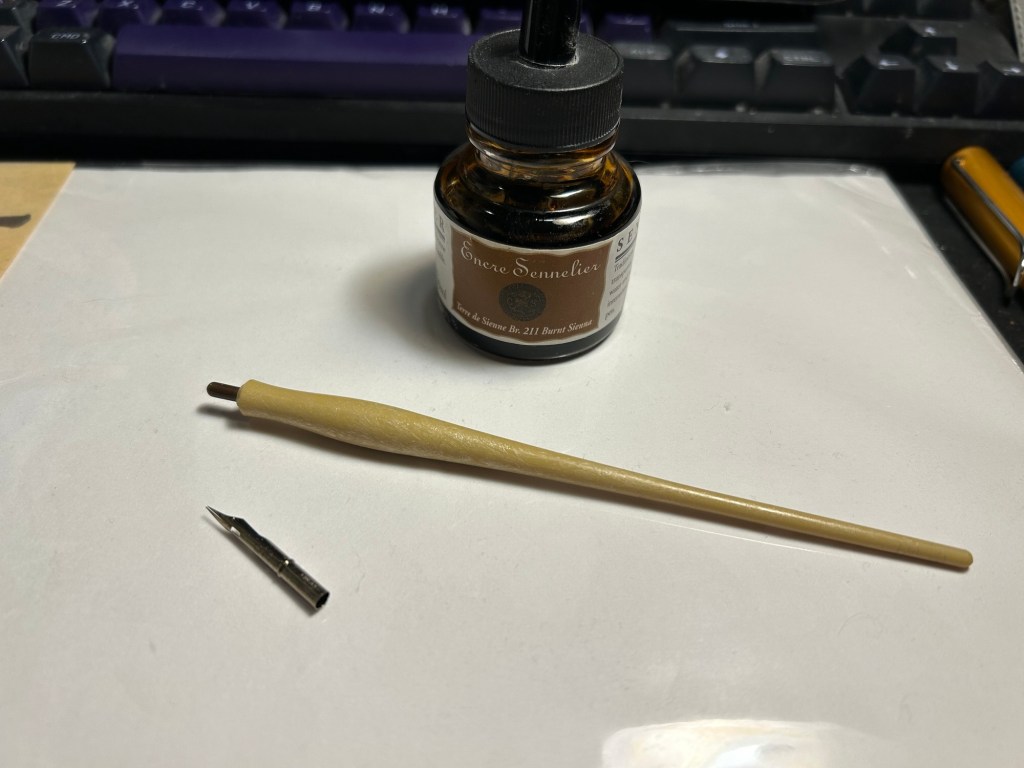
If you’ve used a fountain pen before and then try to use a dip pen, you’ll likely be surprised by several things. The first is that most dip pen nibs, and mapping nibs in particular, are very sensitive to pressure. The slightest push down will give you more line variation that you’ll get from even the most flexible of flexible fountain pens. The second is that there’s no tipping material. That means more feedback from the page, and that you need to be aware of the directionality of the nib if you don’t want it to snag and spray ink everywhere. This is also why the paper you want to use will be smooth. Smooth surface cartridge paper is your friend.

India ink (the shellac based ink used for dip pens) lays on top of the paper and retains a level of gloss and a dimensionality that you just don’t get with fountain pen paper. You can feel the ink lines with your fingers once the ink dries. The ink dries quickly, and is sticky and staining when wet, so beware of nice clothes and wash your hands well once you’re done.

You can see the line variation and shiny properties of the ink.

The nib itself needs to be prepared before you use it for the first time. New nibs are coated in oil and sometimes with wax before being packaged. This prevents them from rusting, and helps them not stick to each other too much as they’re being packaged. If you use a new nib without preparing it, you’ll be disappointed. It will carry little to no ink, and you’ll find yourself dipping the nib again and again. The map above was made with 4-5 dips only, using a new nib, but one that I prepared.

How do you prepare a dip nib? The simplest and safest way (no, don’t take a lighter to it) is as follows: gently clean the nib with water and dish soap (you can use a soft toothbrush if you want, but it doesn’t really require scrubbing) and then put it in cup with boiling water for 1-2 minutes. Then fish the nib out and dry it very, very, very well with a paper towel. You don’t want to air dry the nib at any point or it will rust.
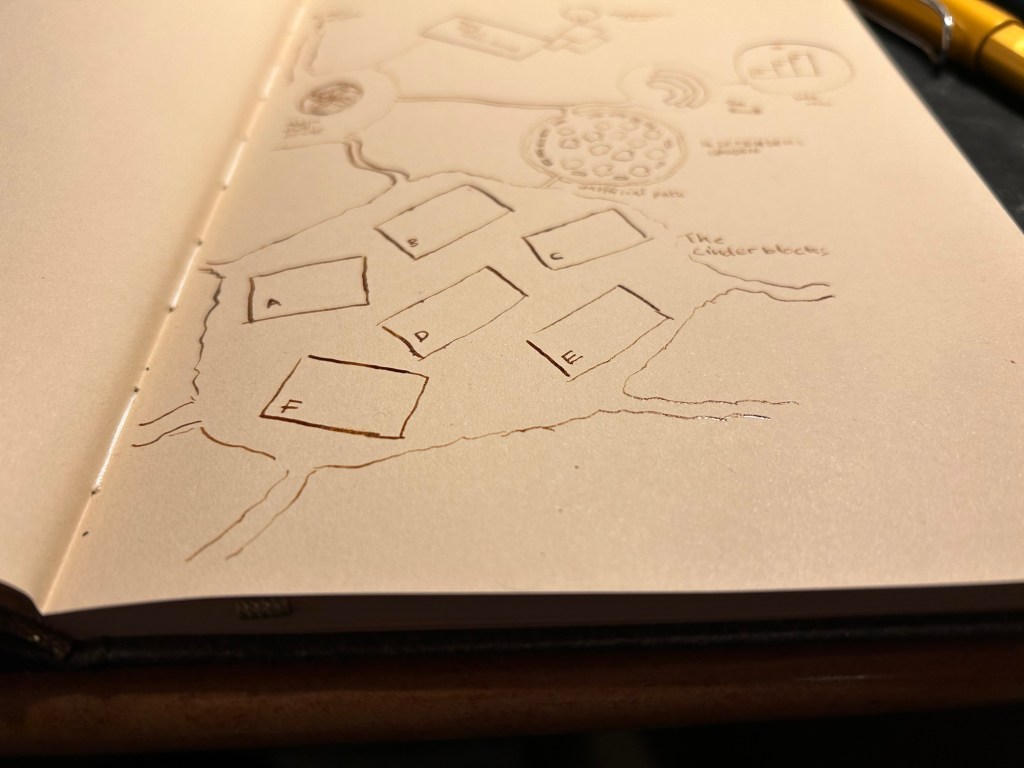
You can see that the ink is raised above the paper and retains its shininess

You can use fountain pen ink with dip pens, but I don’t recommend it. Fountain pen ink is thin and water based, so it doesn’t cling to the nib like India inks. You’ll be dipping a lot more often, and your results won’t be as good. If you plan on using a dip pen to test out fountain pen inks, know that your test will only show the colour properties of the ink but not its flow (wet/dry). Also don’t use a mapping nib for that – mapping nibs are best used for small sketches, maps, things that require very thin lines and some line variation.

When I work with a dipping nib I keep the nib constantly wet with ink (not water!), and immediately when I’m done I either wash the ink from the nib and dry it very well, or I wipe the ink off with a cotton rag if I just plan to take a short break. Ink left to dry on the nib may clog it (particularly with mapping nibs), and soaking a nib in water will cause it to rust.

You may find dip nibs in flea markets for very cheap, usually in a pile in a little box. Check if they aren’t rusted (don’t buy rusted nibs), and then clean them as you would a new nib (water, soap, heat).

I’ll be going over various kinds of India inks and various kinds of nibs in future posts, but in the meanwhile if there’s anything that interests you in dip nibs let me know in the comments.
Weekly Update: Reading and Pen Inking

Long time no update, so I decided that it’s about time to write one up.

Reading

I’ve been in a terrible reading rut, and I blame the book that I’m currently reading: “The Books of Jacob” by Olga Tokarczuk, a 912 (!) page historical epic about Jacob Frank and his followers. I’m halfway through, and I’ve decided to put it aside for now and train my brain to enjoy reading again with some lighter and more fun material.

The book itself is masterfully written and researched, with the narrative made out of a carefully pieced together mosaic of characters, voices and narrative styles. I just cannot handle the subject matter right now. As my rights are being taken away by religious, power hungry fanatics, I don’t want to spend my free time reading about religious, power hungry fanatics. It has reached a point where I balk at the idea of reading again, and that’s just not healthy. I hate giving up on books like that, especially good books, but if I want to actually read again and not just beat myself up for not reading, I’m going to have to start reading something else.

Health

I went through a CPET (Cardiopulmonary Exercise Testing) last week and it was pretty intense. My lungs aren’t working well in high intensity since my chemo, and so a lung specialist sent me to get this test, to see whether my heart or my lungs are the issue.

It started with a spirometry test (which is a simple test done to check your lung capacity and performance), and then went on to the CPET itself. I was hooked up to an EKG and pre-test measurements were taken. Then I was fitted with a special mask and filter that recorded my air intake and CO2 levels. Finally I was put on a special stationary bike, attached to a blood pressure monitor and a blood oxygen level monitor, and told to pedal without stopping until I felt chest pain or was about to faint, or until I was told to stop. As the technician calmly told me, they have a lot of people fainting during this test, which is why they do it on a bike and not a treadmill. I said it was intense, right?

Anyway, I pedalled for my life, with the bike’s resistance being constantly raised, and me gradually getting out of breath. The point was to see why, so I didn’t stop until the technician stopped me, at which point a little over 10 minutes of constant intense exercise had gone by and I was drenched in sweat and panting. H

ere’s hoping that I get some useful insights from the results. In the meanwhile I’m still running 5 times a week, just not as fast as I would like.

Pens and Ink

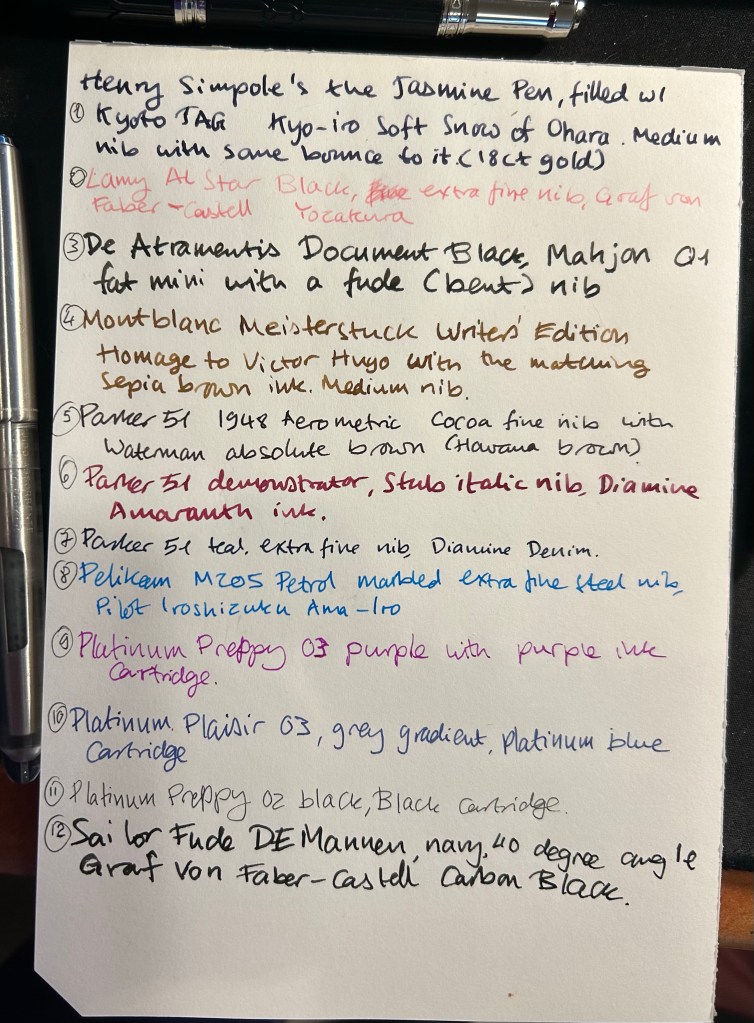
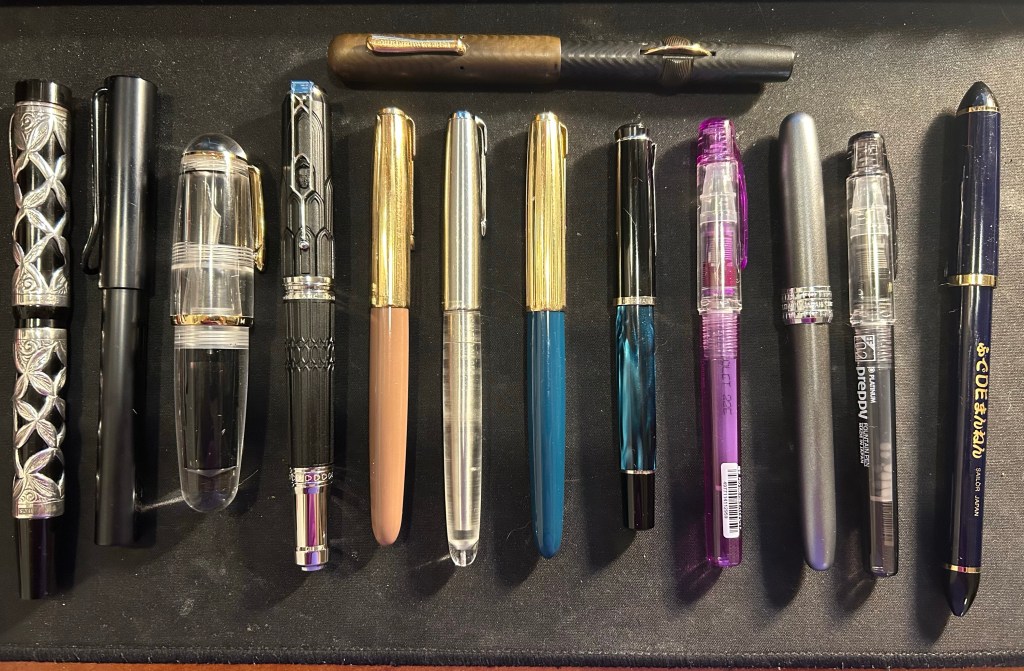
I wrote most of my pens dry and filled in a new batch, this time consisting of mostly vintage pens. There are also two expensive pens in this rotation, a few old ink favourites and some completely new to me inks, and a weird selection of colours.

Writing samples
  • The Henry Simpole Jasmin Pen is one of the most expensive fountain pens I own, and one that doesn’t leave the house because I can never ever replace it. It’s a Conway Stewart button filler with a bouncy 18K gold nib, with silver overlay created by Henry for it. The late Henry’s birthday was on the 4th of July, and so to commemorate him and his work I inked this pen up. I chose the Kyo-iro ink because it’s an interesting dusky purple that I haven’t had enough time with. Like the Jasmine Pen (bought in Portobello Road market), I bought the ink in London (at Choosing Keeping).
  • The Lamy AL Star isn’t interesting, but the ink in it is new to me. The Graf von Faber-Castell Yozakura is a pale and shading pink that I normally would never have purchased, because it’s so light it’s almost unreadable. It was deeply discounted during the closeout of a local pen shop, and I came in late and had very little to buy to show my support. I probably should have inked a much wider nibbed pen with this, but I have a big bottle of it, so there’s always another time.
  • In the Mahjon Q1’s case the pen and nib are interesting, the nib is not. This is one of two pens (the other being the Sailor Fude in the end) which I inked solely for sketching purposes. It’s a weirdly shaped pocket eyedropper fountain pen that I bought with a fude (bent) nib. I’ll probably review it at some time in the future.
  • The Montblanc Victor Hugo was a pen that I bought at the end of last year, during my last visit to Mora Stylos. This was an impulse buy, something that would never have happened if not for the display that Montblanc used to sell this pen. I love the Notre Dame de Paris, I’ve visited her and sketched her many times, and my heart broke when she burnt down. She’s a survivor, and seeing this pen displayed in a diorama of the Notre Dame in all her white glory, I just had to buy it. The ink was a gift that Mr. Mora gave me with the pen.
  • Parker 51 pens. The cocoa and the teal were all purchases made in the local flea market, and the cocoa is part of a set (with a pencil) and the earliest of the bunch (from 1948, a first generation Aerometric). The teal was in pretty bad shape, and took me a while to flush out. The demonstrator Parker 51 is from Mora Stylos, has a gorgeous stub italic nib, and is likely one of the Argentinian, aftermarket demonstrators. The Parker 51 is my favourite pen, and I have a hard time not buying all of them.
  • The Pelikan M205 Petrol was a Black Friday purchase, and I haven’t inked it until now. The nib is great, the pen is great, and Iroshizuku Ama-Iro turquoise ink is quickly becoming one of my favourites. Such an optimistic, summery colour.
  • The Platinums include two Preppy’s that I’m trying out, after being disappointed with their durability in the past. The Plaisir is the pen that’s been inked the longest of the bunch.
  • The Sailor fude is filled with a new ink to me, the Graf von Faber-Castell Carbon Black. The ink was purchased in the same closeout sale as the pink Yozakura, and I’m planning on testing it out as a non-waterproof sketching ink.
  • I wrote the Conklin Lever filler on top dry just as I was planning this post, so it’s here for reference only. I purchased it at Mora Stylos, it’s from 1919 and it’s in user grade condition (cap discolouration, significant brassing, the imprint isn’t in perfect condition). The lever filling mechanism is infuriating to use, both for filling and for cleaning the pen, but there nib is magnificent. It’s a true flex nib, going from medium to triple broad with no effort or railroading, and it’s a joy to use. The fact that I enjoyed it so much, coupled with its tiny ink capacity, meant that it took me about a week to write it dry. I used Waterman Serenity Blue in it, and that ink once again proved its worth in troublesome vintage pens. It’s a great shade of blue that is very pen safe and super easy to clean out of pens (think the opposite to Bay State Blue). A must have for anyone dabbling in vintage pens IMHO.
The pens, from left to right, matching the order of the writing samples with an added guest on top

Other Stuff

I’m working on an adventure for a 30+ tabletop roleplaying convention at the end of the month. I may publish something here about how I write adventures for conventions.

In the meanwhile my D&D 5E game, set in a university like setting and a university town next to it, is progressing nicely. It’s the most complex campaign that I have ever written, but it’s wonderful to see the players rush around in this world, having the time of their lives exploring, interacting and trying to break stuff. D&D is a pure joy and a wonderful escape from the pretty dark reality we live in these days.

Speaking of both dark reality and things that cheer me up:

  • It’s week 27 of the pro-democracy protests, and we’re still showing up in numbers (that are growing again). It’s great seeing whole families show up, including the dogs, to say no to stripping the judicial branch of its oversight powers.
  • I’ve been sketching people’s dogs, and it’s a pure delight to try and capture their personality with each sketch. Plus, it’s making people happy, which is a good thing.
  • I’ve managed to help a few people get back to running, and that’s always a joy. Go get some exercise. Do something you enjoy, and even 10 minutes is enough. As Dr. Jen Gutner says, exercise is like finding money in the street: if you find $10 lying around, you’re not going to leave them there because they aren’t $100. Invest a little in yourself, because you’re worth taking 10 minutes a day for.

Journal Comic: Cheap Art Supplies

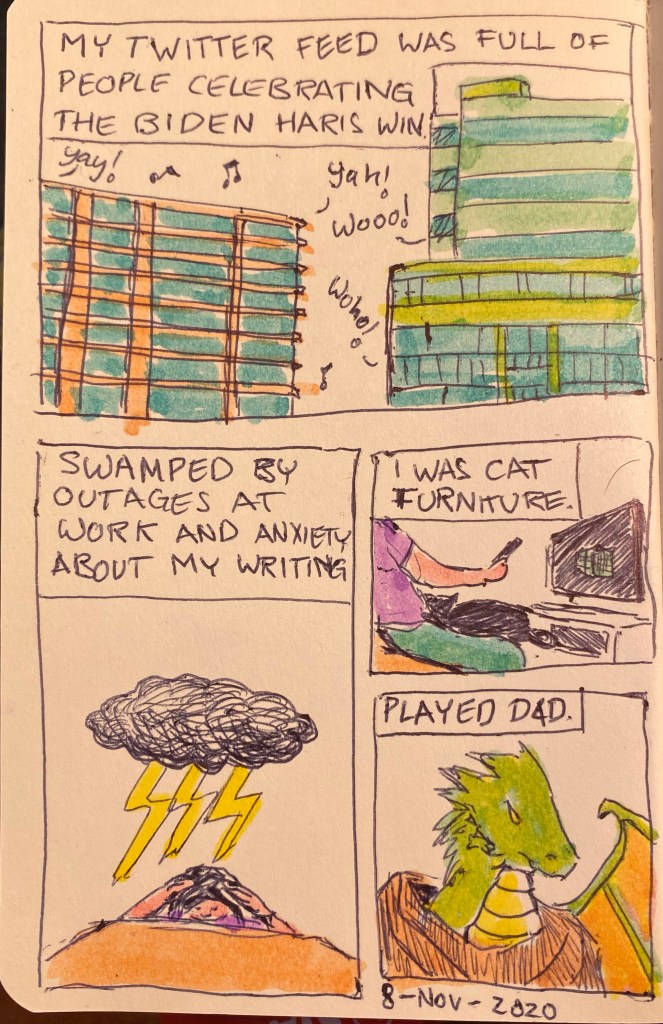
Used a Bic Crystal ballpoint pen, a set of Stabilo Pastel highlighters and a pocket Moleskine sketchbook to create this journal comic. Was inspired to use things that I already had laying around, not in use, to fill in a page in a long abandoned sketchbook. I was actually surprised at how relatively well the highlighters worked here.

Painting Minis

ReaperCon started yesterday and for the first time ever I’m actually able to participate. Yesterday I just listened to the classes, but today I jumped back in to painting minis.

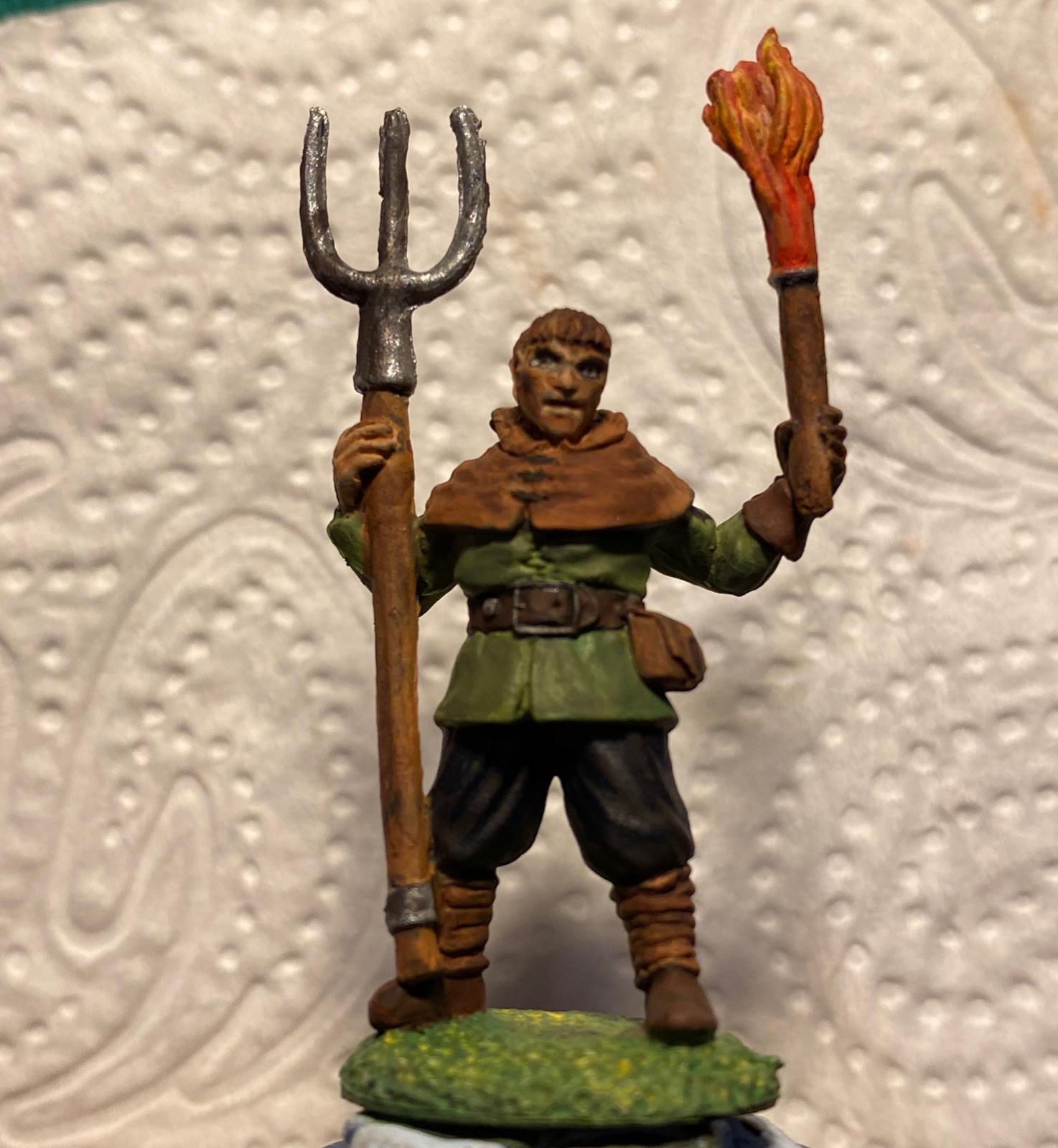
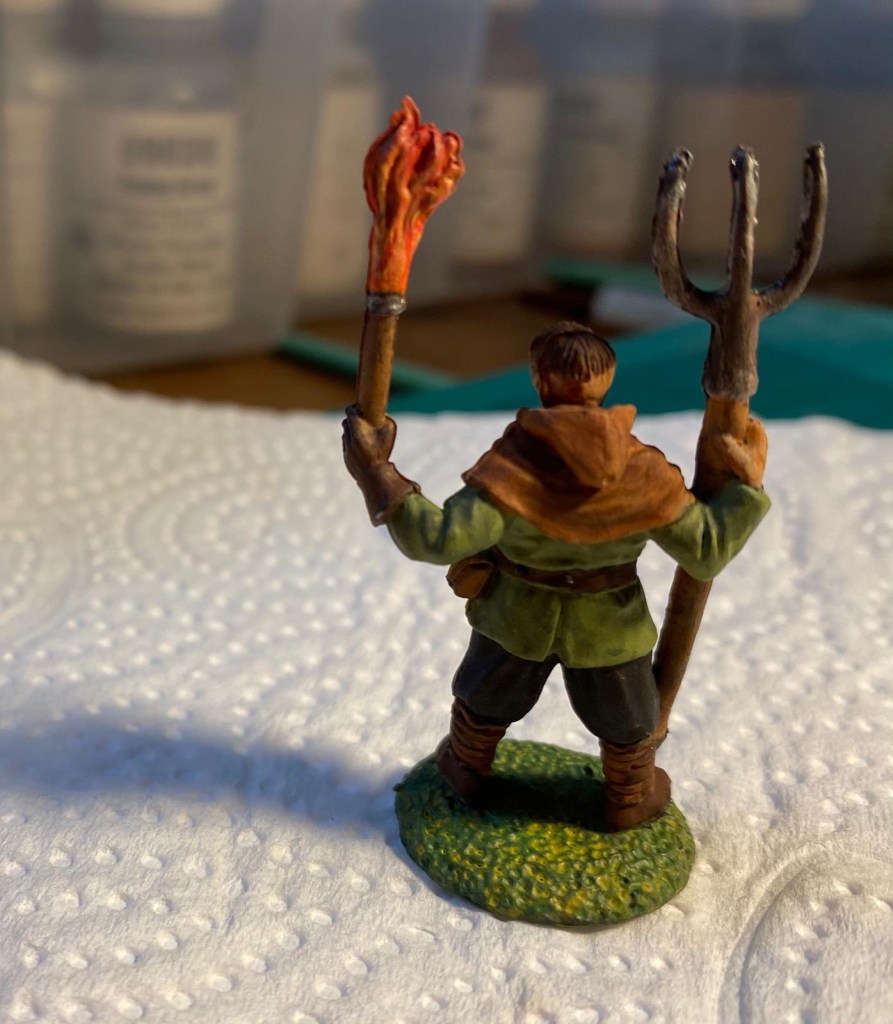
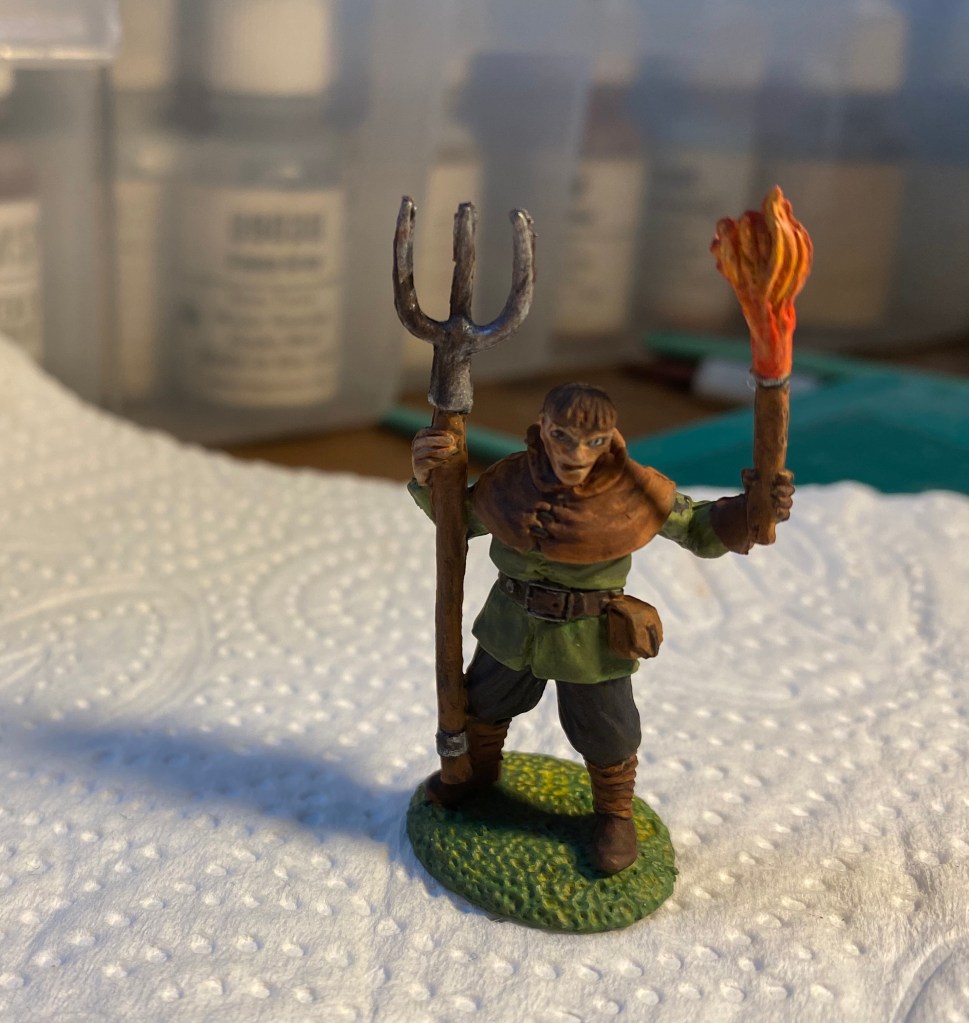
This is the Reaper Bones Townsfolk Rioting Villager. After I took these photosI went back and softened the shading on his face a bit. I gave him a dirty, rusty pitchfork, and I tried not to take too much time on him (it still took longer than I would have liked). I also had a bad time with cutting off the mold lines, so I gave up after a few tries. In any case he’s not a display piece, but meant to be used in a game (when I can return to in person games).

He looks scary, right?

I made a wet palette out of an old takeout box, some paper towels and a bit of parchment paper. I’ll later improve on it, but for now it gets the job done. I’m also experimenting with a new of taking painting notes in a notebook, but l’ll see if it works before I write about it.

Wet palette.

Starting a New Roleplaying Campaign and Running a Game Remotely

So I’ve been drafted today to run a new roleplaying game for three players over Discord. Two of the players are experienced, one of the players is completely new to roleplaying games. After a bit of debate we settled on Dungeon World as our system. As an aside I’ll say that I highly recommend Dungeon World both for newcomers to roleplaying, and to GMs and players who are short on time. It’s a phenomenal system which lets you get to do a lot of cool stuff fast, and allows you to have a character that is fun and functional from level 1.

The challenge with this adventure is that I need to create something fast, so that we can have our first session sometime next week, and something that’s appealing and accessible to players with vastly different experience levels. Also, I actually need to have fun running it.

I’m also running the second session of a very dense urban D&D 5E campaign tomorrow. It’s a game that is challenging to run particularly in terms of tracking the vast and complicated cast of characters, and the various locations the game can unfold in.

So I thought that I’d write a few posts on the various tools that I use to plan, organize and track my games. What I use changes based on the game, and also based on how happy I am with the results I previously had with it. I’ve been DMing and GMing for 17 years now, and during that time I’ve tried out a lot of tools and approaches to handing the “backstage” parts of roleplaying games.

A few words about Covid: my main RP group moved to playing over Discord a few years ago, when one of the players moved abroad and we wanted to keep on playing together. We started out in Google Hangouts before Google did terrible business-y like things to it, and then we moved to Discord, which has been our home for a good long while. Due to Covid a lot of groups have now been forced to make that same move or else forgo playing at all, and the internet has exploded in the past few months with a lot of resources for running online games successfully. A lot of these resources are very helpful, but a lot of them also just add “noise” and added pressure to the already tough job of being a DM/GM. If you are running a game for an online group, whether it’s your first game or not, don’t feel the pressure to run a game at the level of production that you see on various podcasts/twitch/YouTube channels. You don’t have a production budget, you don’t have a production team, and here’s the thing: your players aren’t expecting that. They just want to get together and have fun for a few hours. Prep as you would for a face to face game, with a little added attention to images that you can send in the chat (monsters, NPCs, maps, etc), and make sure that you have video on, or the players will miss a lot of nuance in your body language. Keep it simple and add complexity only if needed, later on. I recommend using Discord with the Sidekick and DiceParser bots (you want two as a backup, because eventually one of them will lag or break), and Google Docs/Dropbox to share sheets and information between sessions. If you’re playing D&D 5e then I highly recommend managing the character sheets on D&D beyond, and gradually learning to use the Avrae bot in your game (it’s got a lot of commands, so don’t sweat it if you don’t start running all your combat scenes with it from the first session on). If you need a mapping resource, here’s a free, open-source browser based tool called mipui that one of the former players in our game made. It’s very simple to use, and it works just fine for D&D games. I recommend using it in Chrome. Remember that technology has a tendency to break and jitter, and be patient.

If you’re someone that’s always wanted to play but never had a group, now is your golden age. Tons of new groups are forming up using Facebook, Reddit and Discord to find new players.

This post came out longer than I expected, so I’ll go an brainstorm and plan for my games, and I hope that you find your people and start gaming too. There’s nothing like RPGs to bring a group people together for a few hours of blissful, harmless fun.

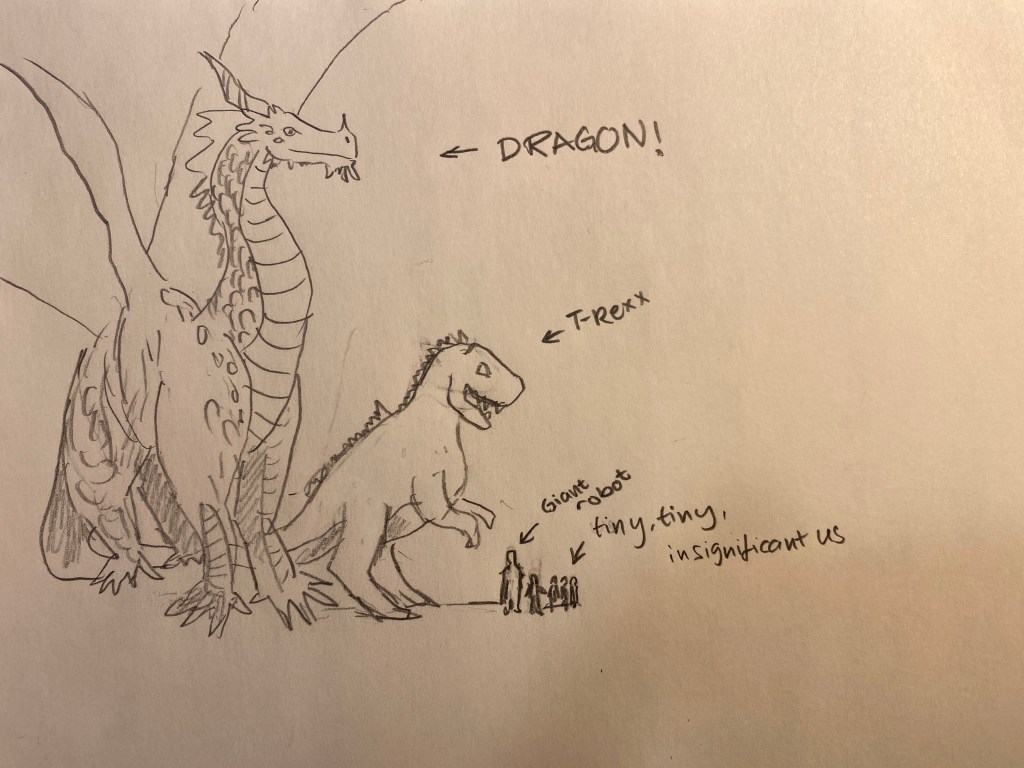
Tiny, tiny, insignificant us

Our D&D group found itself next to a colossal sleeping white dragon, and one of the characters suggested that we could take it on. I grabbed my Blackwing (811) and created a quick illustration of relative sizes to emphasise just how crazy that idea was.

We didn’t attack the dragon.