Book Review: Erebus: The Story of a Ship, Michael Palin

I enjoy reading Michael Palin’s (he of Monty Python fame) travel books. Palin is a good travel writer, combining keen observations of humanity, nature and location with a good sense of history and a sprinkling of oftentimes self-depreciative humour. “Erebus: The Story of a Ship” differs from his other travel writings in that it mostly isn’t his travels that are narrated, but those of the Erebus and its sister ship, Terror. These two former bomb ships spent the mid 19th century exploring the antarctic and then the arctic, with great success and to great acclaim. And then they disappeared for 160 years.

Palin starts the story with the crew, and the crew are at the heart of his tale. He could have focused on the tenacious people trying to piece together the story of the ship over the decades. He could have focused on Erebus’s last voyage and the long and oftentimes disastrous search attempts after it. But he chose to bring the ship to life through its crew, the era it was built in, and the state of the world around it. He masterfully weaves charming anecdotes of the ship’s daily life together with serious discussions of corporal punishment, racism, colonialism and the ecological damage mindlessly wrought by the Victorians. You get to hear about astoundingly brave and talented men doing the impossible, and about how ego and rigid thinking could be the downfall of their peers.

Palin traces the story of the Erebus from before it was built, through the story of its would be captain and crew and their Arctic exploits. He then goes through its creation, to its early days as a bomb ship with nothing to bomb, to its early retirement, and then its resurrection as an Antarctic explorer. He is sympathetic to its crew even as he pokes fun at some of them, and he always does his best to bring the daily life on the ship alive to the reader. There are a few well selected photos, prints and some excellent maps in this book, and they go well with Palin’s narration.

He also traces part of the Erebus’s journey himself, either by recalling past visits to certain key locations, or by actually travelling to remote places around the globe in the wake of this ship. He doesn’t sugarcoat its demise, the hardship its crew suffered, or the mistakes that they and their peers made.

“Erebus” was found in 2014 and “Terror” in 2016. They appear larger than life in many bits of literature, music and art, and it is worth learning their story. What Palin does in this book is not merely tell it as it was, but bring it vividly to life, and tie it inexorably to our lives right now.

P.S. I bought this book at the National Maritime Museum at Greenwich, which is very apt, as a branch of the museum appears in this book, and the museum helped Palin with the research for it. If you haven’t visited this wonderful museum, I highly recommend it.


Ghosts of Planners Past: GTD and Friends

This is probably going to be the hardest post to write in this series, and so I’ve been postponing it.

I got into Getting Things Done around 2005, when it was really starting to gain momentum with tech workers online. I first heard about it via PvP Online’s creator, Scott Kurtz. Yes, I found a productivity and planning system via one of the first webcomic creators. The internet is funny that way.

Notes from 2011 on doing GTD better

If you have no idea what GTD is, then I suggest starting here. It’s a 15 minute guide to David Allen’s all-encompassing planning and productivity system. If it resonates with you, then the GTD book is pretty good for a book in the productivity genre. Books in this genre tend to be repetitive, padded with anecdotes, and oftentimes poorly written. The GTD book is readable, and while it contains the inevitable productivity guru anecdotes, there aren’t very many of them.

There are a few things to note about GTD that set it apart from other productivity systems, and make knowing about it worthwhile:

  • While it was developed for a paper office based world and appears on the face of it to be very rigid, it is in fact extremely customizable and flexible, and it converts very well to digital planning and to do list systems. Many of the most popular to list applications have their roots in GTD, for good reason.
  • While it was developed for an office setting and busy executives, it easily works well for students, designers and other creatives, developers, teachers, and just about anybody that doesn’t lead a leisure filled life. If you have “stuff to do”, if you feel overwhelmed, then GTD in some form or another could very likely help you.
  • This system spawned dozens and dozens of other systems. You can see the roots of GTD in BuJo (Bullet Journalling), there’s a monster list of GTD implementations, and 43folders (Merlin Mann’s old productivity site) is full of info on various GTD tweaks and variants. This, by the way, is my favourite one.
  • The basics of GTD are worth implementing no matter which system you use, because they just work, and because they will likely fit whichever system you use. They are:
    • Make a list of all the things you have on your mind that you need to do. They need to be actions that you can perform in the real world, and you need to be able to clearly envision what “done” means.
    • Curate that list – make sure that things on it are actually ACTIONS that you can take IN THE IMMEDIATE FUTURE. Break big tasks into little ones, things that you are able to do it small chunks of time. Make sure there aren’t any hidden dependencies or prerequisites to these tasks. Make sure you know what DONE looks like. Make sure that they are REAL and actually need to be done, and need to be done by YOU. If things on that list take less than 2 minutes to do, just do them. T
    • Go over that list and do the things. If you’re stuck, make sure the thing was properly defined and isn’t a hidden project (i.e. isn’t actually one task but rather 20), something that you can delegate or not do, or something that you can’t start working on now. If you’re balking at doing it open a timer (the famous pomodoro technique enters here).
    • Once a week prune the list. Be ruthless.
    • Don’t schedule anything on your calendar unless it absolutely has to be on your calendar – a doctor’s appointment, a child’s graduation, an exam date, etc.
  • You can get carried away by GTD and become more interested in the organizational part of it (“Productivity Pr0n”) than in actually getting the work done.

The last bullet is what earned GTD a place in this blog post series.

I love GTD. I’ve been using it in various form for almost two decades. I have the book and have read it twice, and I have a good grasp of the major players in the GTD cinematic universe. I know the system well enough to be comfortable to get rid of its mannerisms and streamline it to my own needs. I can see its influences in Jira, in BuJo, in Omnifocus and other to do apps. And it’s very powerful dark side is that it really invites you to tweak and tinker with it. You are tempted to make your system a little bit sleeker, better, more efficient, better suited for your needs, to the point where you suddenly find yourself spending more time and care on the system than the tasks that it is supposed to help you manage. So while GTD taught me how to define and manage my tasks, it also taught me to be constantly aware of how much time I’m spending on my task management systems.

So if you are worried about being carried away by GTD’s siren call to tweak, tweak, tweak, here are some basic ideas from the system that I think are worth taking with you or thinking about no matter what:

  • Our minds aren’t good at keeping track of things. Write them down.
  • Not everything is a real task. It if it isn’t an action that you need take in the world, then it needs to be trashed/delegated/better defined.
  • Tasks that languish in your planner/to do system are either ill defined (see bullet above) or require deliberate action to get out of the way (see pomodoro technique, dashes and timers).
  • Don’t clutter your calendar. It just adds needless stress to your life.
  • The best definition of a task is a physical action, that can be accomplished at a sitting, supports valuable progress towards a recognized and desirable goal, and something that YOU are the most appropriate person to perform.

Weekly Update: Short Edition

I’m in a bit of a rush, so this one’s going to be quick:

Fountain pens: I’m down to 11 inked fountain pens, with most of them being half empty at least. I’ve been writing a pen or two dry a week, which is good.

Reading: I’ve got a few reviews to post, and I’m now reading the stunning “Drive Your Plow Over the Bones of the Dead” by Olga Tokarczuk, the Noble prize in literature winner. The prose in this is something else.

Running: I’ve upped my long runs to 10.5-11k, and with the weekly walks to the protests have reached around 19k of running and walking every Saturday. I’ve also enrolled to my first every 12k, and will be enrolling to a few more races this month.

Drawing: One Week 100 People is over and already I miss sketching people daily. It was a tough but fun challenge, and messing around with different medium types really added an interesting dimension to it all.

Apart from all that I have several projects in the works, including a few long blog posts, some volunteer work, a good amount of decluttering, a bit of professional up-skilling and more.

Have a great week!

One Week 100 People Day 8: Protest Bookend

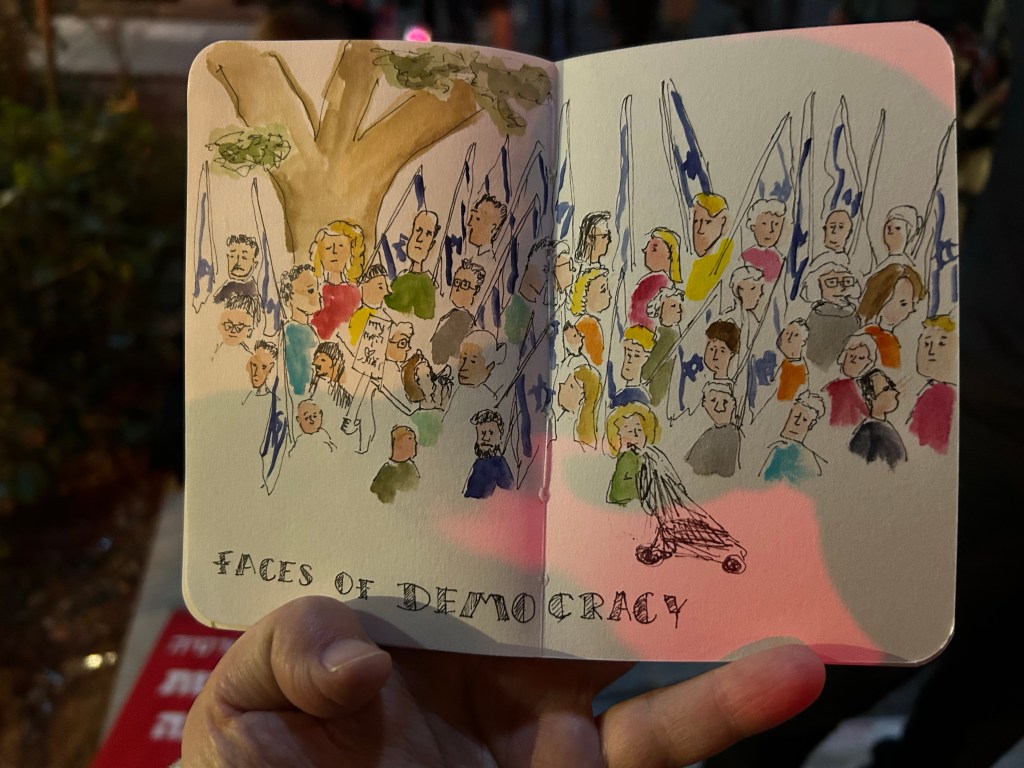
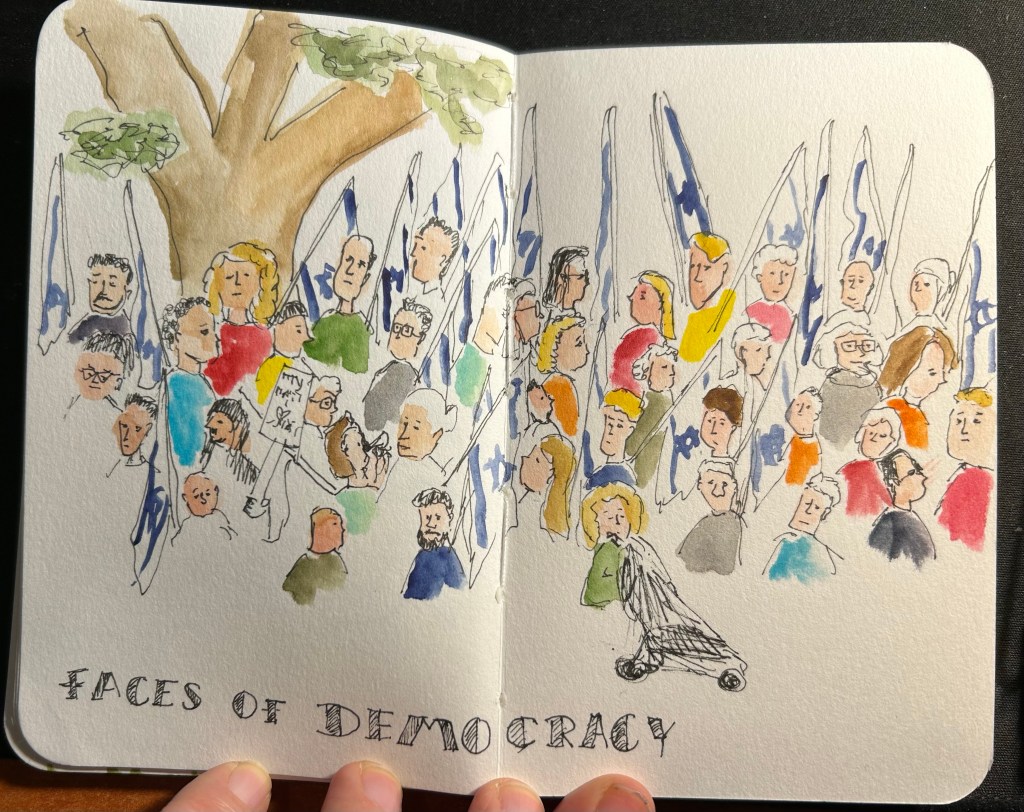
I started the One Week 100 People challenge with the pro-democracy protests last week, and I finished it with them this week.

Fighting for the soul of our country
Every week more people take to the streets.

These were sketched with watercolour and a 0.1 Staedtler pigment liners. As I was drawing a 3-year-old girl snuck up to see what I was doing, and we had a lovely chat with her and her parents. I ended up drawing dinosaurs in a forest for her to take home and colour, while she explained the merits of democracy and pizza with olives to us. I was enchanted.

I finished the challenge with 112 people sketched. I had a lot of fun sketching people, and there’s something in playing with various medium types that made it more fun and expressive than my attempts in previous years, at least to me.

One Week 100 People Day 7: Mixed Media

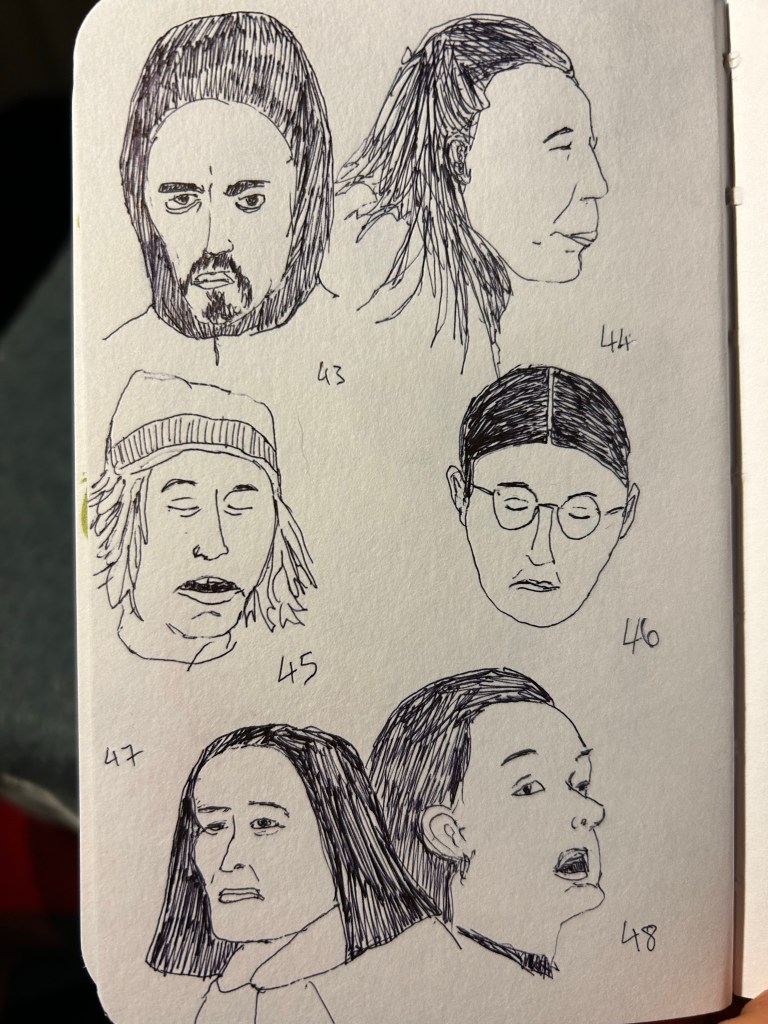
Today turned out to be busier than I planned so I struggled getting these 12 in. They are sketched in ballpoint, red and blue Caran D’Ache pencil, a Caran D’Ache coloured lead, a vintage Mongol pencil, Faber Castell Pitt brush pens, and two different fountain pens. Can you guess which is which?

That makes 72.

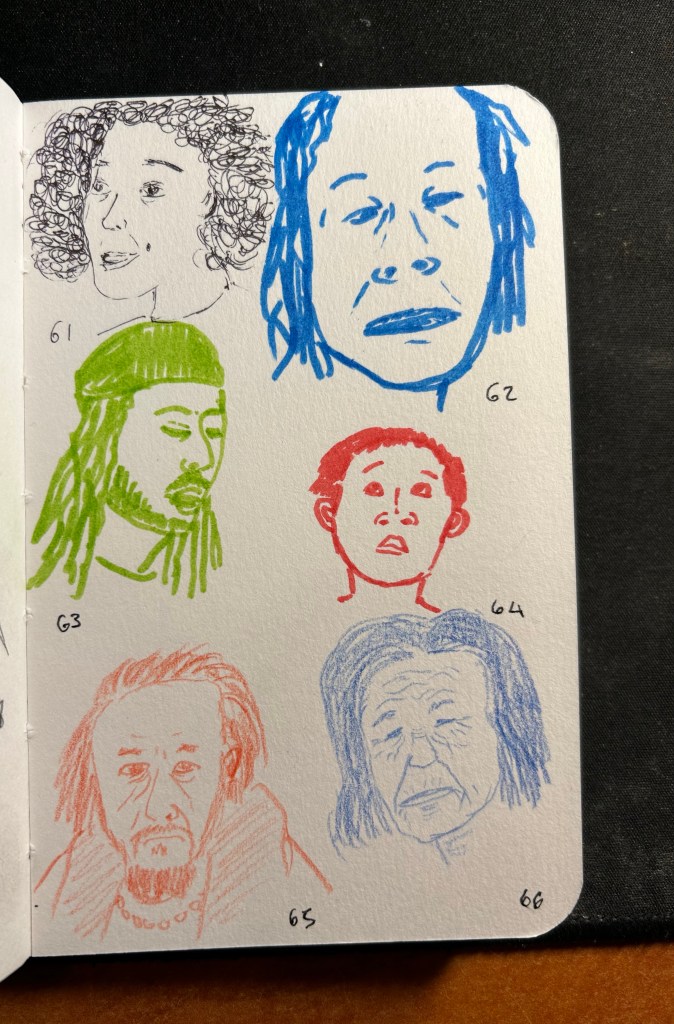
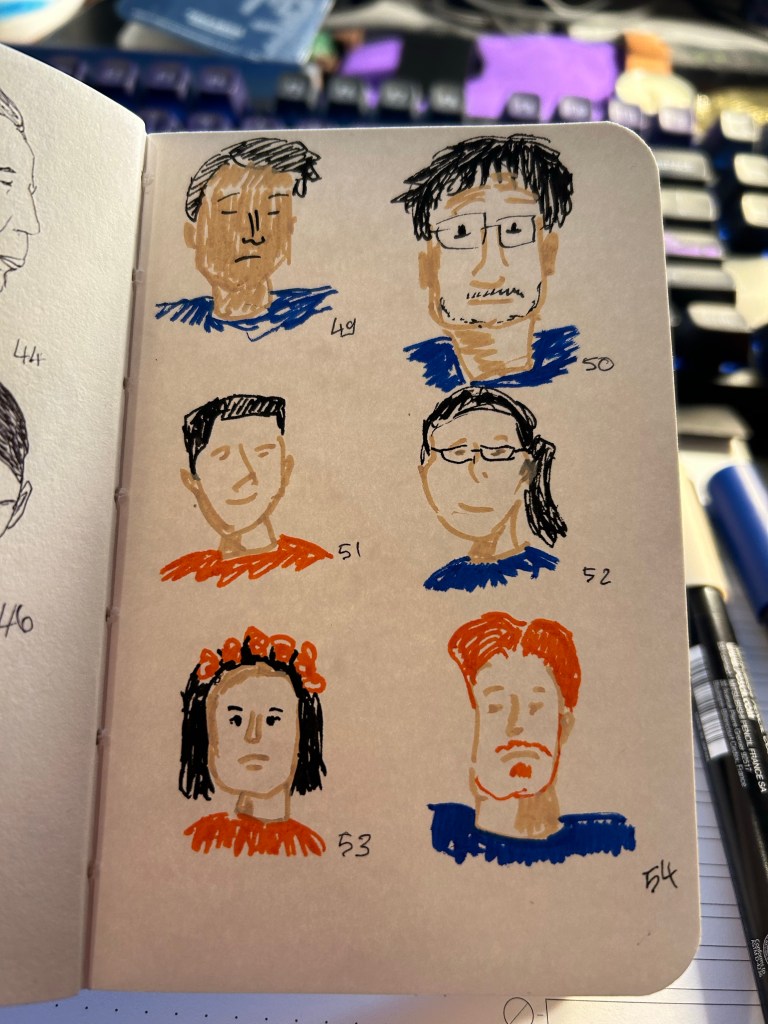
One Week 100 People Day 6: Posca Pens and Pencil

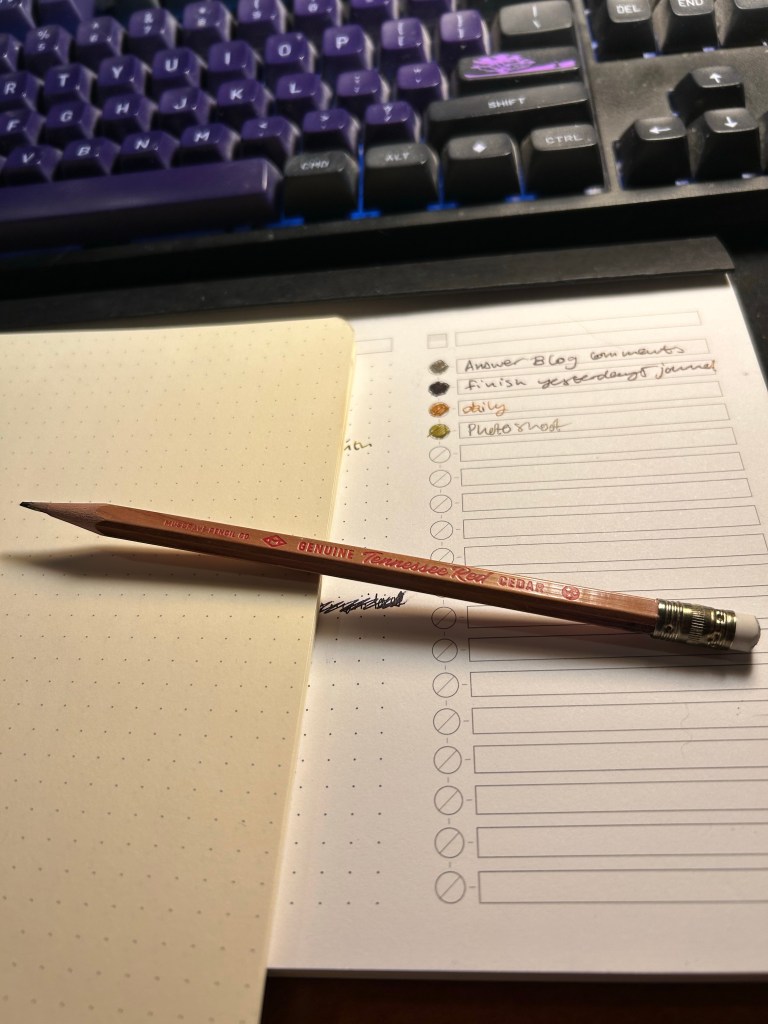
I used Posca paint markers for the first six sketches and a Musgrave Tennessee Red pencil for the next six sketches. The Poscas aren’t great for portraits, but are a lot of fun to use.

Yes that’s a Cortex Brand Sidekick in the background. Testing it out.

That brings me to 60. I’ll likely finish the rest during the weekend.

One Week 100 People Day 3: Joe

Crazy day today so only one sketch, done while zooming with our friend Joe. This one was done using the Pentel Multi 8 lead holder, which I plan to review later on.

This brings up the count to 33.

One Week 100 People Day 2: Purim Party

We had a Purim party at a club after work and I tried to sketch people in the dark. These were all done very quickly with Faber Castell Pitt brush pens.

Day 2 brings the count up to 32.