My New Weekly Review Format

I previously discussed how I plan my quarter, my week and my days, but there’s another side to planning: reviewing. The goal isn’t to set out a plan, then attempt to follow it and disregard any successes or failures in the process, but rather to take the time to figure out what tweaks and changes need to take place for your plan to work better for you. And remember – the plan works for you, you don’t work for the plan.

I’ve tried various review formats over the years, some were more successful than others, but here’s what I’ve come to realize: the weekly review is more crucial to the success of a quarterly plan (a 13 week year) than a quarterly review. I still perform a review of the previous quarter before planning the next one, but the weekly review is where the keys to happiness lie.

After a good amount of trials and errors, here’s the weekly review format that I’ve been using over the past few months and that has been working:

The weekly review format
  • What Worked – this is where I write down things that I did differently (first priority), consistently (second priority) and well (third priority) during the past week. The focus is things that I can learn from to take with me to the next week and to weeks following it.
    An example from the past week: I changed my running form, and had a faster series of runs that also felt better. This change required effort, but the results mean that it’s something I want to keep doing. The effort was worth it and it’s something that I want to emphasize for next week’s plan.
  • What Didn’t Work – this isn’t an opportunity for me to beat myself up. The point is to notice where my plans were too ambitious and need refactoring, where the context changed and my plan lacked enough flexibility to account for that, and where I need more infrastructure. What’s infrastructure? It’s the things you do ahead of time to help you build up consistent success: plan the next day every day, put reminders for everything, set out clothes for tomorrow (particularly exercise clothes). Have present you help future you make the decisions you want them to make.
    An example from the past week: I did not do well with my social connection goals. I didn’t take into account the fact that I had several busy evenings that week, and so ended up not making the calls that I wanted to make. I was more careful to add time for morning phone calls and visits into my schedule, and I cut down on the number of calls that I planned on making, which made this week much better. Context is crucial when planning. (Yes, you need to schedule these things and not do them spontaneously because otherwise you won’t do them. You’ll tell yourself that the Like on the Instagram post counts as staying in touch with your friends. It doesn’t. It counts for a billionaire’s bottom line.)
  • One Win – this may seem redundant, as the “what worked” is there, but I still think that this is important. We don’t take the time to celebrate our wins, even tiny ones, and then we feel depressed and go on shopping sprees, social media binges, etc to get a bit of a dopamine hit. Even if your week sucked, there was something in it worth celebrating. I try where possible to make it something that I did, but sometimes its something that happened to me.
    An example from the past week: I had a tough conversation with someone at work that ended up in us reaching a compromise that is much better than I thought that I could achieve. We both felt better after that conversation, even though neither of us wanted to have it.
  • One Challenge – this is something that I learned this week that is worth gearing up and preparing for. It’s a chance for the “anxiety” character in your mind to be productive in a safe environment. I don’t always fill this in, but I want it to be there to let me have space for this if I need to. An example can be feeling like you’re about to be come sick or are maybe are on the verge of an explosive situation at work or at home. This is a chance to note it, figure out if it’s a real challenge or an imagined one, and prepare to avoid it or deal with it.
    A past example: I felt a shoulder strain coming on, so I changed my training days and exercises around. Another example: I talked to my boss about my need to have a bit more variety in my work after I realized that I was getting progressively bored with the tasks that I was given.
  • People of the Week – so important – this is for people that made your week or that you want to particularly remember after the week you’ve had. They can be friends that came to your rescue, colleagues that made your day, family members that were there for you, or mentors and heroes that helped motivate you. I try to make it people that I know personally and not figures from the news or celebrities. No examples here, as this is too personal.

I write this review on Friday or Saturday in my regular journal, longhand. I then check if my weekly plan needs to change due to it. It takes me about 30 minutes, because I spend time thinking about it. Focusing on the wins and positive people in my life, working to continue with the successes and mitigate the failures, and looking with clear eyes and a level head to the challenges ahead helps make me happy. That’s the point of these reviews, and that’s why I do them.

Do you do a weekly review? What format do you use?

Book Review: Dealing With Difficult People – Harvard Business Review

Dealing with Difficult People is part of a series of small booklets on the topic of emotional intelligence that the Harvard Business Review published. It’s a collection of essays, each of them short, well-written, and contains useful and practical information on different aspects of dealing with difficult people in workplace settings: colleagues, bosses, reports and even how do you avoid being a difficult person to work with yourself.

The articles in this collection include “To Resolve a Conflict, First Is It Hot or Cold?” by Mark Gerzon; “Taking the Stress Out of Stressful Conversations,” by Holly Weeks; “The Secret to Dealing with Difficult It’s About You,” by Tony Schwartz; “How to Deal with a Mean Colleague,” by Amy Gallo; “How To Deal with a Passive-Aggressive Colleague,” by Amy Gallo; “How to Work with Someone Who’s Always Stressed Out,” by Rebecca Knight; “How to Manage Someone Who Thinks Everything Is Urgent,” by Liz Kislik; and “Do You Hate Your Boss?” by Manfred F. R. Kets de Vries.

The essays are all interesting and make their points well and concisely. Many of them offer relatively realistic scenarios that you can encounter when dealing with a certain type of difficult person, and then walk you through how to best deal with each scenario. Because all the essays are short the ratio of actionable advice to lines of text in the articles is excellent – there’s no padding or fluff here. There is a good range of tools that you can add to your “people wrangling” toolbox, and that’s always a plus.

Where this booklet falls short is precisely in its brevity. Complex scenarios are breezed through, things are solved relatively easily and on the first try. In reality dealing with difficult people in the workplace is a “superpower” that requires a lot of consistent effort and skill. You will never reach a tolerable equilibrium on the first try – indeed there’s a chance that you will never reach it at all. There is no book, let alone a slim booklet, that can teach you all that it takes in one fell swoop. You’ll need to deal with every situation and person as they occur, and what books of this kind can do is provide you with tools and approaches to do that.

If you are dealing with difficult people in the workplace, then this is book is a good place to start from. Just take into account that it’s going to be a long and hard process, and one little book isn’t going to solve all your problems and give you everything you need. Set your expectations accordingly and you won’t be disappointed.

Weekly Update: Ink and Prickly Pears

I haven’t done a watercolour sketch in a while, so I broke out the trusty Moleskine Watercolour sketchbook, my Staedtler Pigment Liners (0.3 and 0.5) and my Schmincke and Daniel Smith watercolours and made this quick sketch:

Prickly pear watercolour sketch

It was fun and it took me less time than I thought, so I should do it more often.

This was a big ink week, as I wrote many of my Inkvent fountain pens dry: Wishing Tree, Snow Globe, Winterberry, Salted Caramel, Pine Needle, Nutmeg, and Wilted Rose. I also dumped Sleigh Ride as I found the ink colour depressing. This leaves me with 9 Inkvent inks still inked in my pens, with most of them half or quarter full. I doubt that I’ll be able to write them all dry by the end of the month, but hopefully I’ll get as close to that as possible. In any case I’ll reassess in the beginning of February if I want to keep using my Diamine Inkvent inks or if I’ll just dump out and clean up whatever I still have inked at the time and start fresh.

I finished reading “The New York Trilogy” and it’s a very Paul Auster book. Next week I’ll start on “The Last Kashmiri Rose” by Barbara Cleverly and finish “The Comfort Crisis” by Michael Easter.

Have a great week full of pens, books and good news.

Big Idea Design Base Line Bolt Action Review

I’m a big fan of Big Idea Design pens, ever since I bought their Ti Arto (still their most innovative and all around useful pen). I have their Ti Click EDC and liked it enough to buy the Cerakote version, their Ti Arto EDC, the Ti Mini (and the Mini Click and Mini Bolt), their Dual Side Click, their Fountain Pen EDC, their Bolt and Slim Bolt, Pocket Pro, some of them in several versions. I’m on their mailing list whenever they come out with a new Kickstarter (Big Idea Design use Kickstarter as a pre-order system, with very little risk to backers and a nice discount on whatever new product they’re working on), and I tend to back almost every new pen they come out with.

Base Line Bolt Action sketched on Moleskine paper with a Base Line Bolt Action

So when I got the email about the new Base Line Bolt Action titanium pen Kickstarter, I backed it. Unsurprisingly the Kickstarter was successful and the pen arrived in time. While the base price of the Base Line Bolt Action pen is $65 (including free world wide shipping), the Kickstarter price I paid was $55. I’m mentioning the price up front because this is one of the main selling points of this pen.

So what do you get for $65 all-inclusive? The Base Line Bolt is a short (116mm or 4.59 inch length, 11 mm or 0.435 width) full metal machined pen, with a titanium (or brass, or copper) body and clip, a Schmidt P900 ballpoint refill (it’s compatible with Parker style refills) and a bolt action mechanism that is smooth and fun to fidget with. As usual for Big Idea Design, the brass and copper versions cost the same as the titanium one.

You also get a decent enough package, one that is good enough to ship to someone as a gift. Even after our local post office mangled the package, it came out mostly intact with just a few dings. It’s a solid shrink wrap covered cardboard box, with the pen nestled inside on a foam insert.

The front of the box

The pertinent information about the pen is printed on the back of the box, with a reference to the Big Idea Design YouTube channel, where you can learn more about the pen.

The back of the box

The pen itself is well protected inside the box and comes wrapped in a plastic sheath. While I would have preferred a more environmentally friendly box, I appreciated the packaging because considering the shape that the padded envelope came in, I would have likely gotten a less than pristine pen without it.

The Base Line Bolt arrives well packaged.

Moving on to the pen itself, the Base Line Bolt is an interesting departure for Big Idea Design. Normally the pens that they make feature some sort of clever mechanism that allows for things like supporting every kind of pen refill there is, or having two kinds of click mechanisms on the same pen. The Base Line Bolt is instead focused on price point: when everyone else is raising their prices, can Big Idea Design make a good, affordable, machined metal bolt action pen?

The Base Line Bolt

The answer is “it depends”. Big Idea Design isn’t really inventing the wheel with the Base Line Bolt – the pen itself is a combination of the Ti Pocket Pro, and the Slim Bolt Action pen. It is, however, cheaper than both of these pens, which is again, the Base Line Bolt’s main selling point. As the name suggests – if you’re looking to get into your first machined pen, or you’re looking for a bread-and-butter EDC pen, the Base Line Bolt is what Big Idea Design expect you to buy. I largely agree with them, but more on that later.

The bolt mechanism, clip and finial of the pen, down to the T8 Torx screw and stepped machining, was first conceived with the Bolt Action pen. If you sliced off the business part of these two pens (and ignored the orange Cerakote on the Carryology pen), these two pens would be identical:

The Carryology version of the Bolt Action pen on top, and the Base Line Bolt on the bottom

Compare the Ti Pocket Pro with the Base Line Bolt and you can see what Big Idea Design were going for: they’re almost identical in length and in design (and they ship with the same refill), with the Base Line Bolt just being a slimmer, slightly longer version of the Pocket Pro, that supports less refill types. The difference here lies in the mechanism – the Ti Pocket Pro is a twist pen, and the Base Line Bolt is a bolt action pen. My guess is that the bolt action will be more popular because it looks good, works well, and is a fun fidget toy.

Ti Pocket Pro in metallic Cerakote blue on top, Base Line Bolt pen in the middle, black DLC with Damascus bolt and clip Bolt Action pen on the bottom

Another way to look at the Base Line Bolt is as an oversized Mini Bolt Action pen, but one way or another, this isn’t a pen that they had to factor in a lot of R&D time to design. They’ve done it before, and they know that it works. Thus the innovation in this pen lies mostly in its price point, which is also what Big Idea Design emphasizes in their marketing.

Mini Bolt in black DLC on top Base Line Bolt in the middle, Uniball Signo RT on the bottom

The Base Line Bolt is great as an everyday carry pen that you have in your bag or pocket and use to jot down a few words, maybe sign a document, or leave a note on someone’s desk. It’s too small and the Schmidt P900 ballpoint refill that it comes with is too frustrating to use in long writing sessions (the refill skips every once in a while). The choice of the design, the refill it comes with, and the refill compatibility (Parker style refills) is geared towards that – a pen used to write a paragraph or two at a time, not much more.

If you want a pen for longer writing sessions, you need to look at Big Idea Designs larger pens: the Ti Arto, the Bolt Action or Slim Bolt, the Click or Dual Click pens, etc. The Base Line Bolt is build to be the Ti Pocket Pro’s counterpart: the same pen with a bolt mechanism that supports only Parker refills, for a lower price.

Close up on the bolt and the finial

The biggest minus of the Base Line Bolt is that you need a separate tool to take the pen apart and change the refill. This isn’t the first Big Idea Design pen to require this, but I still don’t like this design choice. That being said, my assumption is that the audience for this pen (namely the EDC crowd) will have a way to deal with a T8 Torx screw. The pen ships with a decent enough refill (the Schmidt P900 costs around $1 retail, while the Parker costs $4-5, which explains why you won’t find pen sellers that use the Parker refills), and a ballpoint is the obvious choice for an EDC pen. Gel refills tend to deal poorly with temperature swings, and aren’t normally waterproof, which makes them less viable as an EDC pen refill choice.

Should you buy this pen? It depends:

  • If you’re looking for a gift pen for someone new to machined pens, this is a great choice that costs a fraction of what other machined pen manufacturers ask for titanium, copper or brass machined pens. The closest competitor in price and quality is Karas Kustoms, and you’re getting a different beast there (they make great pens, just not as compact).
  • If you’re new to machined pens and want a compact EDC pen, then the Base Line Bolt is a great choice for you.
  • If you’re curious about bolt action pens, or copper and brass machined pens, then this is likely the cheapest way you can try them out for yourself (using a high quality pen with great warranty and support).
  • If you’re looking for an EDC pen that is sleek and without the “tacticool” vibe of aggressive knurling or glass breakers, then the Base Line Bolt is a great choice.
  • If you are looking for a workhorse pen, one that you can write your next novel with, the Base Line Bolt isn’t for you.
  • If you already have a good selection of machined pens, particularly Big Idea Design pens, then you’ll likely not find the Base Line Bolt to be very exciting or particularly interesting. I’d skip this pen.
  • If you want to experiment with many refill types, pick the Ti Pocket pro or any one of the Big Idea Design’s full sized pens (the Ti Arto supports the most refills).

The Base Line Bolt is a solid addition to the Big Idea Design pen portfolio, and at $65 all-inclusive you get a lot of pen. Mine will reside permanently in my bag, as an “emergency pen” for those times where I need a pen but I haven’t brought my pen cases with me.

Book Review: Deacon King Kong – James McBride

This novel contains multitudes.

There’s a story of tight-knit community under threat. There’s a love story of a kind rarely portrayed in fiction these days – one deeply mundane, pragmatic, pedestrian, and also deeply tragic, transformative and profound. There’s a Bildungsroman element, a gangster story element, a mystery, a religious element, and even time devoted to plants. There are many stories of friendships, many of them unlikely, and a few stories of rivalries, some of them rivalries to death. There’s a particular story of friendship, through hardship, alcohol, cheese and furnaces, that is alone worth the read. There’s a budding romance between two star-crossed and not young lovers. There are heart breaking moments, and there are laugh out loud funny ones (the funny ones outnumber the heartaches, I promise). There’s a cop story, a feisty grandma story, a story of racial struggle, and a story of medieval religious art.

Read this book. It’s a delight, it’s full of heart and surprises, and it’s one of the most original works of fiction that you’ll get to read. Wonderfully well written, jumping with life, and a joy to experience.

Weekly Update: Motorcycle Sketch

Running

I’m a week away from getting back to a 10k long run, and the running weather has been pretty perfect so far. I ran a 30 minute hilly recovery run today and for the first time ever I ran it without headphones. I normally run with earbuds and listen to podcasts or music, except during races where I leave my earbuds at home for safety reasons (and to get the full race experience). It was relatively early and the trail I was running through was deserted, so it was quite the experience listening just to birds and the sound of my feet and my breath. This is definitely something that I plan on adding to my running routine.

Reading

I’m two thirds into “The New York Trilogy” by Paul Auster and I’m dreading starting the 3rd and final story. The writing is excellent, but it’s like reading through version after version of Bartleby the Scrivener – not something that you particularly want to do. I’ve come so far that I will finish the book at this point, but after reading several Auster books it’s clear to me that while he’s a very good writer, his books are not for me.

Meanwhile I’ve started on “The Comfort Crisis” by Michael Easter, and though it is clear that it suffers from many of the same problems that books of this kind suffer from (cherry picking or hand waving “research” over complex and nuanced topics), there are some interesting ideas within.

Fountain Pens

I’ve decided to sketch more with my Inkvent ink filled fountain pens to try and run them dry more quickly, so here’s a motorcycle sketch done with a Levenger True Writer Cappuccino with a fine nib and Diamine Nutmeg.

Motorcycle Sketch on Midori MD Cotton paper

Have a nice and peaceful week.

How I Plan a Quarter: 2025 Q1 Plan (13 Week Year)

It’s the beginning of January, and usually at this point people’s resolutions are starting to unravel. For years I used to do yearly goals but over 2024 I moved to using a 13 week year, or quarterly planning model. It affords me more flexibility and seasonality in my planning, and it’s a good, low stakes way to start long term planning and goal setting if you’ve never done it before.

There are those that say that you should go on a retreat to plan your year or quarter, and I’m sure that’s nice if you can afford to do it but unfortunately I can’t. What I do instead is take some time in the weekend before the end of a quarter to plan the next quarter, and this is the process I go through, step-by-step.

How I Plan A Quarter

I start my planning on a piece of scrap paper, sitting with my calendar, and start mapping out what big block of “stuff” I have next quarter. In particular I take Travel into account at this point. If I have a trip planned, then it means that I will have less time for non-trip related stuff this quarter, and I need to realize that I have less than 13 weeks to work on the rest of my goals. So if I have a week long trip, I calculate that I have only 11 weeks to work on the rest of my stuff. Why 11 and not 12? Because there’s time that will go to trip related stuff before and after I return, and it takes time after a trip to get back into routine.

Once that’s done and I realize how much actual time I have to achieve any goals, I divide my plan into Large Categories.These are areas I want to work on throughout the next quarter, and they generally stay the same from quarter to quarter.

Working Within Categories

The different categories I work on are the backbone of my plan, the basis of the quarter which I flesh out with detail during my planning session. For me these currently are (not in order of importance): Health and Fitness, Reading, Conversations, Mental Health, Creative Projects, Productivity, Professional Development, Blog, Decluttering, Money.

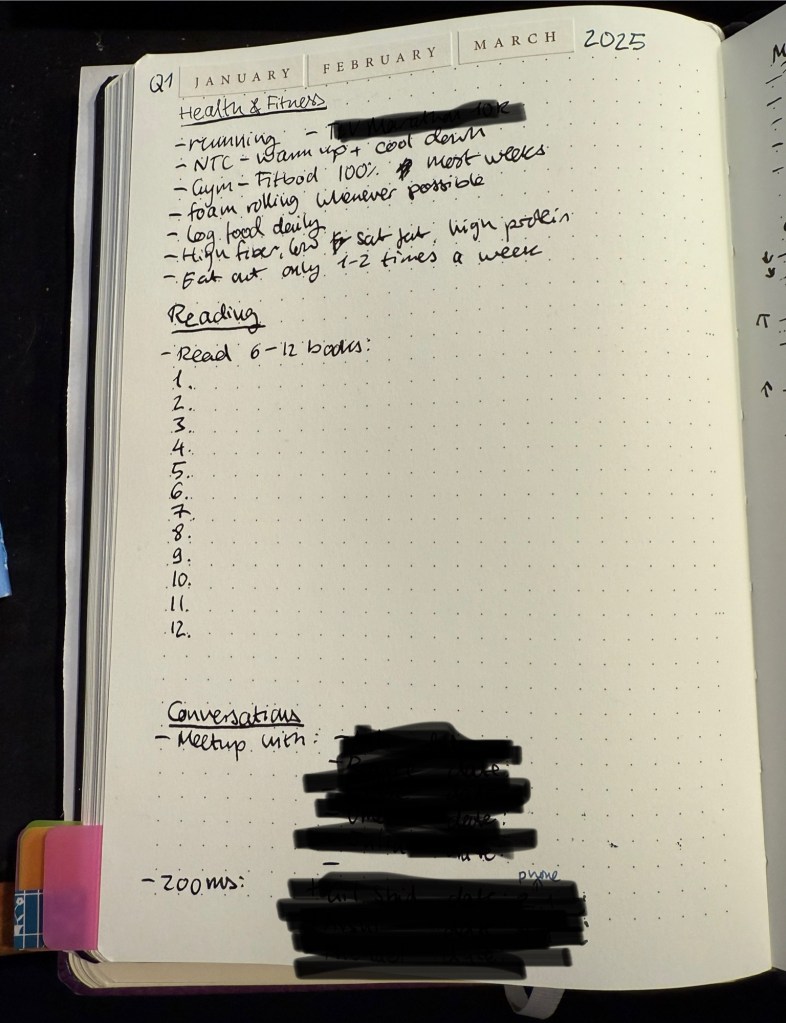
Page 1 of my Q1 2025 plan

I set individual goals for each category, all of them measurable, and this is the plan that I reference at least once a week, usually two or three times.

Wherever possible I set up the Streaks App and/or a tracker for the goals in my weekly plan. This makes sure that 60-70% of my goals are set on “auto pilot” and are included in every weekly and daily plan. I address the rest of my goals either when I plan my week, or not at all.

Wait, what?

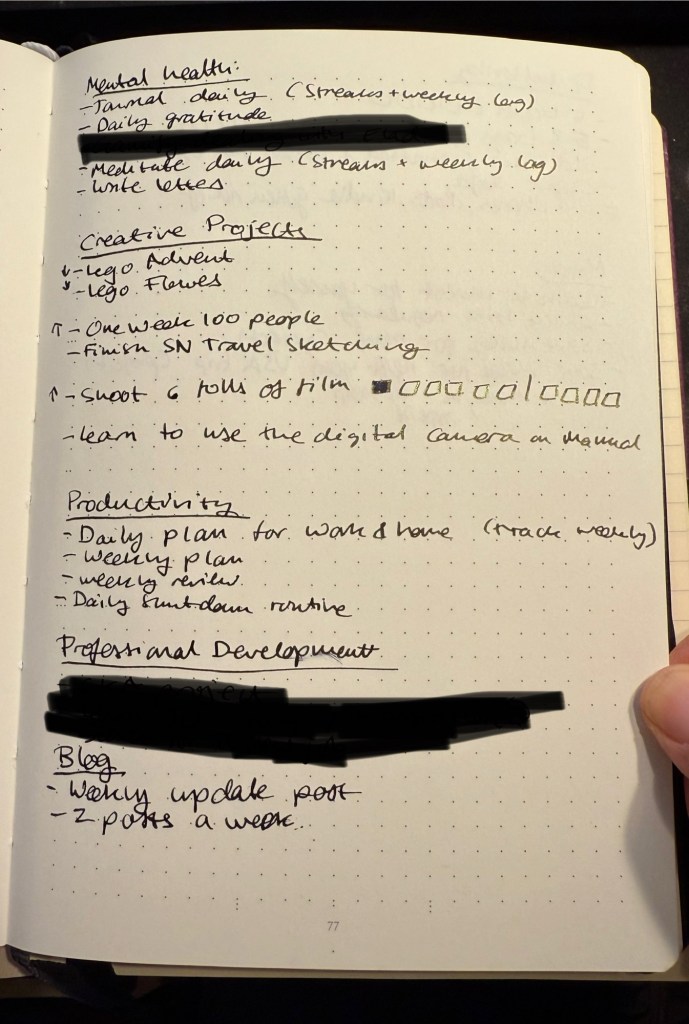
Page 2 of my Q1 2025 plan

I deliberately include goals that I know that I will have to stretch or significantly stretch to get to every quarter. Why? Because I view these goals not just as a plan, but as a call to action, a bit of a challenge. A good quarter is one where I got to 80% of my goals. I great quarter is one where I got to 90% of my goals, and if I ever get to 100% of my goals, then I’ve likely not been ambitious or creative enough when setting them.

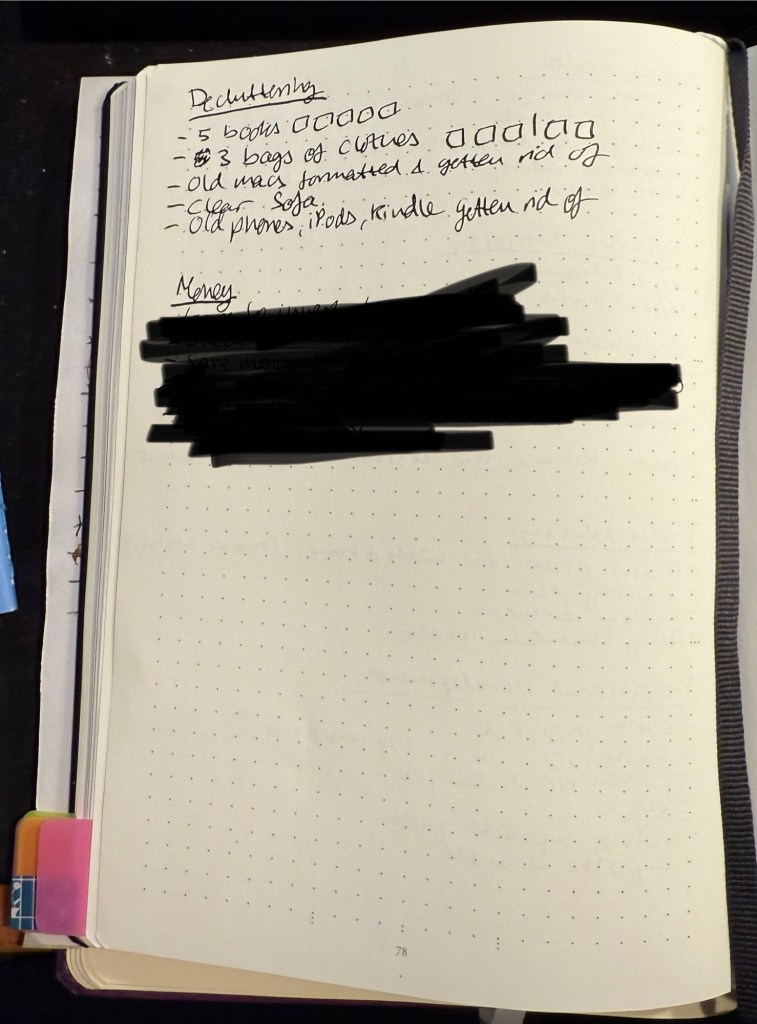
Page 3 of my Q1 2025 plan.

Life tends to throw us curveballs, and so I leave wiggle room in my plan (there are goals that I mark ahead of time as less important, and entire categories that I’m willing to neglect if things get to that), and room to recreate the plan from scratch if the need arises. The plan works for me, it’s a tool that I use, it’s not something that I have to tie myself in knots over. I refuse to beat myself up for missing a goal, because if I missed a goal it just means that:

  1. It was poorly planned.
  2. Circumstances/context significantly changed (a war broke out, a pandemic broke out, a family member or I got non-trivially sick, I got injured, etc).
  3. It was a “stretch goal”.

In this case I expect myself to rethink my goals and what I want to achieve, and replan them.

A bit about my current categories and how I planned out each one:

  • Health and Fitness – the most “auto pilot” of my planning categories and absolutely non-negotiable. I’ve been working with largely the same goals in this category for months and sometimes years, so this is the quickest and easiest category for me to plan. It’s also one where I have the most trackers set up for: there’s a tracker for my running, swimming, gym workouts, NTC workouts and food logging. I use various health and fitness apps that track these, and the Streaks app to make sure that I work on this category daily. As a cancer patient in remission, I am not messing around with my health or my exercise routine. It’s also a must for my mental health, even though that’s tracked in a different category. If possible I try to have a road race to train for each quarter, though usually I only have 2-3 races a year, and last year I only had one. The food logging is something I do to make sure that I’m getting the fibre, protein, calcium and other nutrients I need, and keeping my saturated fat and sodium intakes relatively low.
  • Reading – pretty self explanatory, this category has been with me for years. I try to read between 2-4 books a month, and this reflects this.
  • Conversations – this category is all about having real conversations with people – not just liking their posts and messaging them. I set a goal of meeting certain people face to face for coffee, a meal or any sort of outing, and another for talking with friends that are abroad on zoom. Beyond this I have weekly recurring goals of calling people – usually between 1-3 friends a week. Yes, you need to schedule and track this. You’re busy, it’s easier and less risky to message people and so we stop calling them or meeting up with them, and we trick ourselves into thinking that these messages are the same as having a real conversation with these people. It’s not the same. It’s worth investing time and effort into this, I promise. Even if you have social anxiety, even if you’re very busy. I’m going for a minimum of six 1:1 get togethers with friends, and 3 zoom calls (though I’ll likely get 5-6 zoom calls in).
  • Mental Health – most of this category is automatically tracked in the Streaks app and is part of my daily plan and daily routine. I suffer from cancer related PTSD so I don’t neglect this stuff. If I do the panic attacks return and I physically dread them, so this, like the Health and Fitness category, is a non-negotiable category. It always happens. What goes in here? Journaling, daily gratitude (goes in my journal), meditation, and other things that I may write about later in a separate post.
  • Creative Projects – this is a fun category, and it’s here to remind myself to enjoy my life. It included sketching goals, Lego building goals, photography goals, etc. I try to get at least half the things in this category done.
  • Productivity – this is here mostly as a reminder to plan every day, plan my week, and perform a shutdown routine on workdays so I don’t think about work when I’m not at work.
  • Personal Development – these are professional personal goals, usually tied to learning new skills or obtaining a certain certification.
  • Blog – I used to track this as part of my creative projects, but as I ended up neglecting this blog for a month or two last year, I separated this to its own category so that I can give it more focus. This is tied to a weekly tracker and just tracks the amount of posts I publish a week.
  • Decluttering – lists things that I want to get out of my house over the next quarter. Simple enough.
  • Money – this is a list of money related things that I want to take care of – pension and investment reviews and plans, saving up money for certain goals, reducing certain bills, etc. This is a useful category because if you’re anything like me then this is something that you dread and will put off unless you force yourself to be really on it.

Since I’ve been working with most of these categories for a long time and since many of them are repeatable, much of my planning is just reviewing and copying over last quarter’s plan. The rest of the plan is things that I put a bit of effort into researching before I commit to, sometimes drafting them a few times before settling on my final quarterly goals.

I hope this inspires you to create your own quarterly plan. Let me know if it does and if there’s anything else you want to know about my planning setup.

My Planner Setup for 2025

It’s the beginning of 2025, so it’s time to go over my full planner setup for both work and home. None of this setup is truly new, as I’ve used much of it during part or all of 2024, but there are a few tweaks and minor adjustments that I’ll highlight. As I use a 13 week year (or a quarter) in my planner, I started Q1 of 2025 on the 29th of December and not the 1st of January.

Home Planner Setup

The planner setup I use while I’m at home includes a Leuchtturm1917 Bullet Journal as my weekly planner, a Well Appointed Desk Rebel Plans pad as my monthly planner, and a stack of Kokuyo KB A4 paper that I cut in half to make A5 sheets.

The heart of the system is my weekly planner. I started a new one in 2025, and after some deliberation I decided to splurge on a Leuchtturm1917 Bullet Journal and not just the 120gsm edition because I like the endpapers and it was only a few dollars more.

The setup of this planner is divided into two parts:

Lists

I crossed out all the bullet journal related headers and created list pages of my own from page 3 to (potentially) page 75. Currently they include: Unread Books on My Kindle, Mindful Consuming (a list of things that I actually want to watch, not algorithmically recommended), Conversations not Connections (A list of people that I want to invest time in, not just like their Facebook posts. This makes sure that I don’t fall out of touch with people, but actively initiate phone calls, meetups or skype/zoom calls for those that are abroad), List of Courses that I’ve Enrolled To (I started this list during Covid, and it tracks which online courses I’ve enrolled to and need to complete), Things from Abroad (a running list of packages that I’m expecting. Yes, I know there are apps for this, but writing it down helps me be more aware and careful with what I’m buying and how much), Blog Post Ideas (self explanatory), Books to Review (self explanatory), Medium Post Planning (as part of my focus on work, I decided to make my work more visible by writing more Medium posts this year). I will be adding to these lists over the next year, and copying them over to the next notebook once I finish with this one.

Quarterly and Weekly Planning

Starting at page 76, this section will include four quarterly plans and four 13 week double spreads. Each quarterly plan can take up to four pages (Q1’s plan takes 2.5 out of the 4 currently, but that’s OK. The extra is in case something major happens and I need to work out a pivot or significant change into my plans), and is divided into various subsections. I’ll write a separate post about my Q1 plan and how I worked on it, but you can read about the process here.

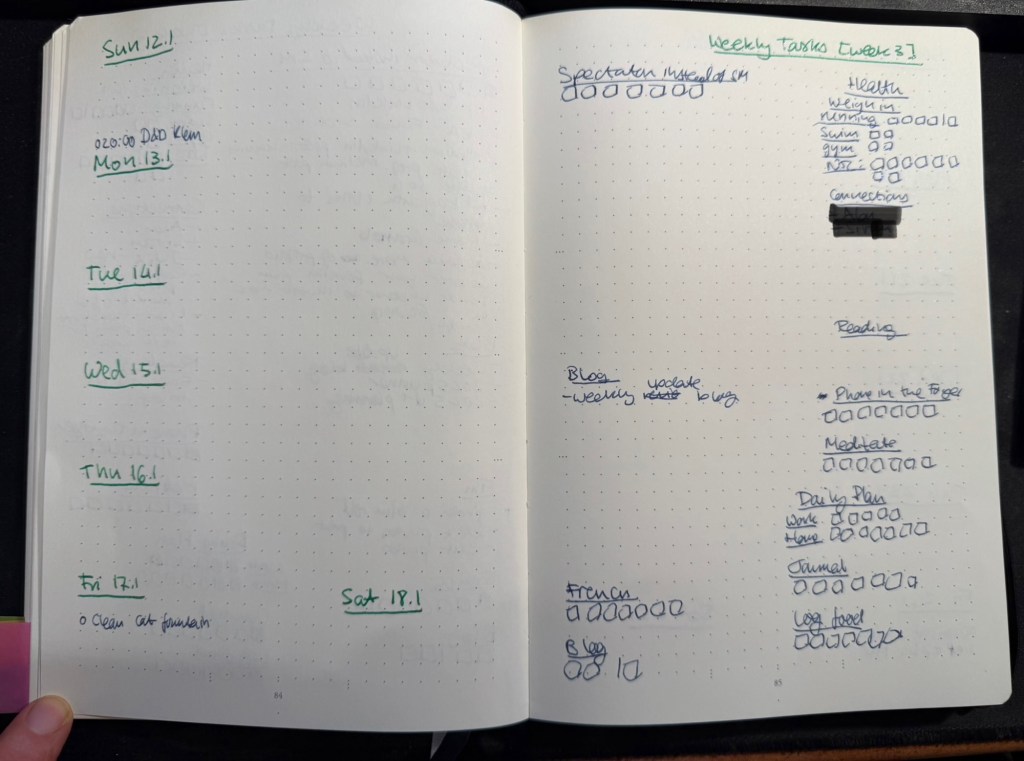
Then come 13 weekly spreads, each one taking two pages. The left side of the page has the weekly calendar, with events on it plus my exercise plan for the week. It’s also where I note things that I want to remember that need to happen on a certain day that week. Every week on Friday or Saturday evening I plan the next week, and for this side of the weekly plan I mark significant weather events, plan my running, swimming and gym schedule, transfer important events and meetings from my calendar (these are all things that I need to prepare for actively), and set reminders (like clean the cats’ water fountain on Friday, or replace filters on things, etc).

The left side of the page is taken mostly by various trackers, and by my weekly goals (they go in the empty spot in the middle) which I select from my quarterly goals each week. Any goals that can be managed by trackers are managed by trackers – either trackers in my planner, or trackers in the Streaks app. The reason I don’t track everything in an app, is to make sure that I have to reference this planner at least once, likely twice a day, every day. That helps keep the weekly goals, which are tied to the quarterly goals, top-of-mind.

I use two different colours of ink for these pages – when I plan the quarter I create 13 weekly spreads with just the dates and the “Weekly Tasks” title with the week number. Then I work everything else in on a week by week basis with whatever fountain pen I am using at the time. That helps keep things clearer for me without me having to spend a lot of time “prettifying” my planner.

Weekly page in my home planner

Daily Plan

Every day I take a sheet of A5 Kokuyo KB paper and write the day and the date on top. Then I write a running list of tasks that I want to complete that day. This includes chores, daily routines, and tasks that I’ve pulled from my weekly planner. I cross them off as I go along, and at the end of the day either I flip the page and create another daily planner for the next day on the other side of the page, or I crumple the page up (if it’s used on both sides) and throw it into the recycling bin. I don’t keep these pages, since anything important in them is already in my journal.

I recently started tracking if I prepare a daily plan for every day at work and at home, and the reason is that I’ve discovered time and again that if I don’t have a plan, I am liable to just get back from work and veg out with a book or silly YouTube videos.

Monthly Plan

The monthly planner is tiny, and its only goal is to give me a better feel for how my month looks, and what major events lay ahead. It also tracks some things – books (which I track on a monthly basis), running (I track this twice because I also want to get a feel for my monthly load), swimming (the same – tracked on both weekly and monthly basis to get a better feel for my training load), gym (which doesn’t appear in the photo below because I haven’t finished creating the page), blog (how many blog posts I’ve written this month), and there’s usually an Apple challenge tracker.

Monthly planner

What About Projects/Backlog Items?

Most of my long term projects are tracked as part of the quarterly plan. For instance, I’m working on getting a certain professional certification this quarter, so I have that certification listed under my professional goals. The breakdown of this headline to individual tasks is something I do in the project specific notebook that I’m using for my study notes, tips that I’ve collected about the exam, etc. I then can just reference the headline task (the certification name in this case) in my weekly and daily plans, and reference what exactly I’m supposed to be working on next in my project notebook. It saves having to copy a lot of things over and over.

As for general “backlog” items (shopping lists, packing lists, travel plans, things I want to get to sometime in the future but aren’t part of my quarterly plan, recurring tasks tied to various medical checkups, etc) – these are all managed in the Things app. It’s easier to manage recurring and long term tasks like these in an app, and when it comes time to actually do them I reference them (or sometimes copy them) into my weekly and daily plans. I have very few tasks in Things, and sweep of the tasks there once or twice a week is enough to ensure that I haven’t forgotten anything.

Work Planner Setup

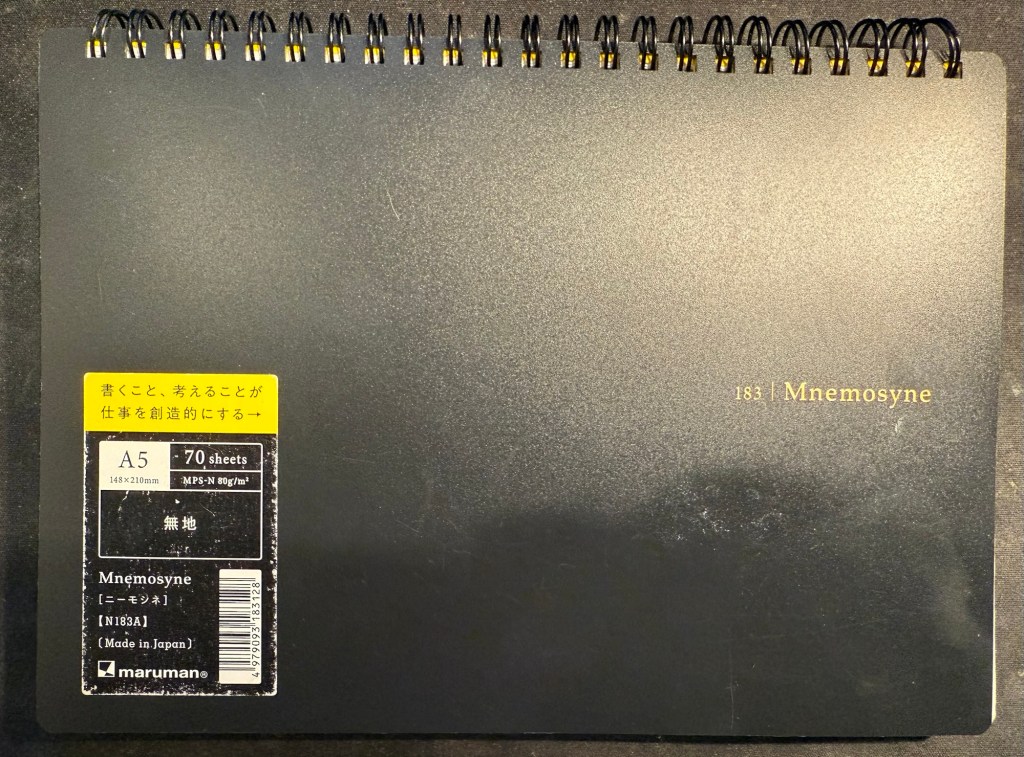
This consists of a Leuchtturm1917 dotted A5 hardcover notebook that I bought at the local art museum, and Maruman Mnemosyne A5 with blank paper (though I also use the squared paper Mnemosyne indiscriminately, if that happens to be what’s available). As I work 3 days a week from an office and 2 days a week from home I needed a setup that’s as simple and as light to carry as possible, and after some trial and error this is what I’ve been using for over a year.

My work planner and a piece of blotting paper – a must with this paper

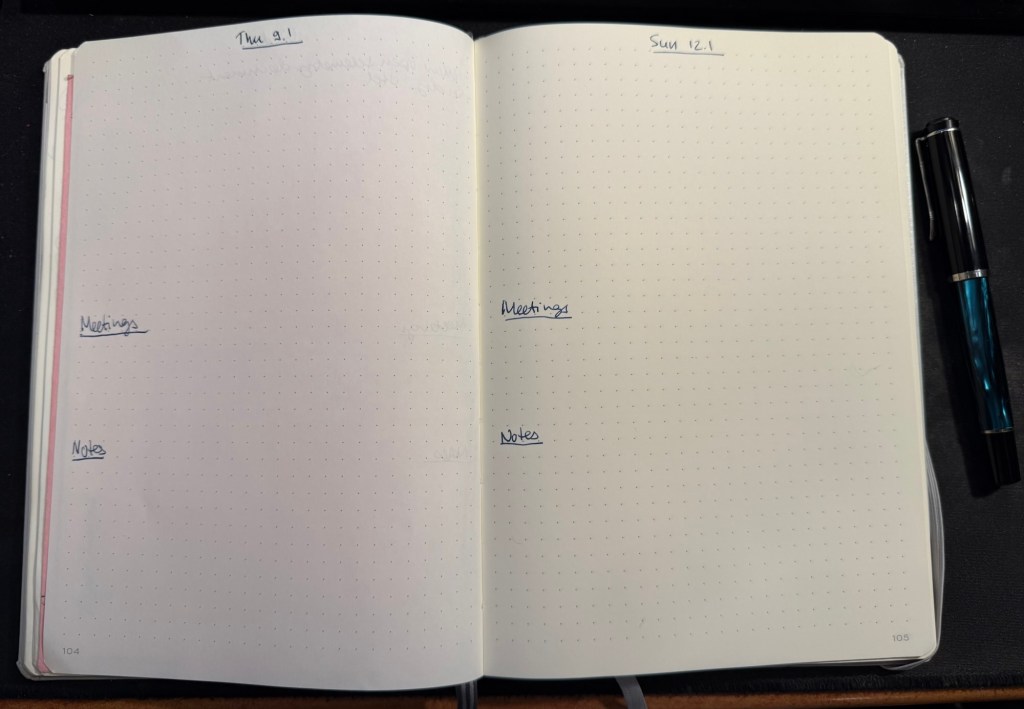
The work planner, my Leuchtturm, is a daily planner, with each day divided into three parts. The top of the page has the day and the date, and the upper third part of every page is for the tasks I plan on working on that day. I deliberately make sure that less than half of the A5 page is left for tasks, because otherwise I’ll just jam in much more than I can do in a day and then feel bad at the end of the day for no good reason.

The last thing I do before signing out at work is to fill in the next day’s page. That includes pulling out the next tasks I plan on working on from Jira (we use Jira to plan tasks and projects at work), and leaving about half of the task area open for things that will pop up during the day. The nature of my job is that I’m constantly working on about 50% unplanned things, so I have to leave myself enough room to take that into account.

Next come the meetings, which I track under a separate heading. I set them apart so that they don’t disappear into my ever changing task list. This is also useful for me to reference when I’m planning my day, both in terms of how many tasks I think I can get to, and in terms of preparing for certain meetings.

The Notes section is where I write down things that I need to take into account or remember that day. If a team member is taking a day off I note it here to remind myself not to message them. If I am on “on call” duty I note it here so that I can significantly reduce the number of tasks I’m working on that day. I also look ahead a bit, and if I see a project deadline looming, I’ll note it in the notes section, so that I remember to prioritize my tasks accordingly.

Daily spread in my work planner

The Mnemosyne serves as my “dashboard” and catch all. If I’m working on a project, this is where I’ll plan out the project before inputting whatever relevant tasks there are into Jira. I reference and work with this page while I’m working on the project, and that’s why I view this notebook as the “dashboard” for my current work.

The Mnemosyne is also where I keep a running list of things I want to get to. All of these things will have to be formalized into Jira tasks before I can work on them, but it’s useful for me to have them down on paper first because I think better on paper.

Maruman Mnemosyne “Dashboard”

I don’t use scrap paper at work as I want to be able to reference these things in the future, and as a rule I don’t journal about my work tasks.

That’s my full planner setup for 2025, and as all of it has been in use throughout 2024 with great success I doubt that it will see much change.

What are your planner plans for 2025?

Weekly Update: Happy New Year!

Happy New Year!

This week and next week are pretty busy, so this update will be short and in bullet points:

  • I wrote three Inkvent fountain pens dry, leaving me with 17 (!) pens to go. I’m prioritizing the pens based on how damaging the ink can potentially be, so I’ve written the Star Bright inks dry (Chilly Nights and Noble Fir) and I’m working my way through the shimmer inks and chameleon inks next.
  • I spent a few minutes every day for the past 2-3 days unsubscribing from various email lists, store newsletters and SMS message lists. The joy of a less cluttered inbox and less noise on my phone is fantastic, and it took less time and effort than I thought.
  • I’m still reviewing 2024. It’s going to take a while because I have such a busy start of the year.
  • Goodreads have really started to gamify and commercialize their site more, and so I’m using it less. I know there are alternatives out there but I just don’t have time to actively seek them out at the moment – let me know in the comments if you have any recommendations.
  • I don’t do resolutions (or yearly themes, etc. I do quarterly plans with quantifiable goals), but my stationery goals for 2025 are to buy nothing (or as close to nothing as possible) and to use what I have instead. I have too much stuff and it’s time I used it.
  • I checked out the Tournament of Books shortlist and decided yet again not to participate. A few years ago the list had interesting and exciting contemporary fiction, but now there are only a slack handful of shortlisted books that seem worth reading, and I’ve heard of many of them from other places already. It’s a bit of a shame as I had a lot of fun following along when I did.

Have a great week!

Three Habits Worth Keeping

Happy New Year!

This is the time of year when people set resolutions, themes, goals, intentions, words of the year, etc. Ambitions are high, intentions are good, but well before March most of these efforts will be abandoned and forgotten. I’ll be writing about my quarterly plan and my 2025 planner later on, but for now here are three habits that worth keeping in 2025 and in general, and a few tips on how to get into them and persist:

Exercise

Any amount and any kind that you can do is excellent. Let’s repeat that: ANY amount of exercise and ANY kind of exercise is a tremendous win. Start with walking if nothing else speaks to you, but try to make sure it’s a brisk walk and not a shuffle if you can. It doesn’t need to take an hour, and it doesn’t need to be 10,000 steps. Remember, anything you can do is good. Local gyms and community centres usually have classes you can try out if you want to give yoga, pilates, kickboxing or jiujitsu a try.

Running offers the best “bang for your buck” in terms of time and money invested per health and fitness gains, but not everyone can run, and not everyone enjoys running. If you want to give running a start, I recommend using any “couch to 5k” app, and then transitioning to the excellent guided runs and training plans in the free NRC app to keep you going. If you need someone to keep you accountable, either join a group of some sort or find a friend or family member to work out with.

The NTC app offers a huge variety of training options – from yoga to full equipment gym workouts, with some excellent body-weight workouts in between. Swimming is a great low impact way to build up cardio and a bit of strength, and weight-lifting isn’t as intimidating as you think – a pair of dumbbells at home is a great way to start exploring it. Yoga with Adriene is great way to get into yoga if you don’t or can’t take a class and the NTC app seems too intimidating.

Soccer, basketball, baseball and other group sports are great ways to expand your social circle, and tennis, pickleball, badminton are great ways for couples to work out together.

The easiest way of getting into the habit is doing a little something every day, and doing it as soon after you wake up as possible. That way you start the day with a win and some endorphins, which is always a nice way to start your day.

If you think you don’t have time to work out, be honest with yourself and track your time for a day or two. How much time is spent on social media? Binge watching TV? Mindless scrolling? Could you cut some of that out? Could you go to sleep a little earlier and wake up a little earlier so you can have some alone time to exercise and clear your mind?

If you already have a solid exercise routine in place, take the time to diversify it if you can. This goes particularly to us runners: strength train. Swim. Cycle. Do things that aren’t just running, because just running is one of the main causes of such relatively high injury rates amongst runners compared to other athletes.

Reading

Most people don’t read, which is their loss because reading is a superpower. Train your brain off the social media dopamine hamster wheel and teach it how to focus for significant stretches of time by picking up a reading habit. You’re standing in line bored? Open your Kindle app and pick up that detective novel or space opera from where you left off. Replace TikTok, social media and YouTube with books, and make sure that they’re books that you want to read. Don’t go off bestseller lists or influencer recommendations or whatever one this or that award, or is considered a classic. When you’re getting back into reading you need to gradually train your mind to get used to this activity. Start with a book that really interests you (not one that’s impressive), and start with a physical copy because they’re easier to read. Reading will do to your brain what exercise does for all of your body: make you better, stronger, faster, healthier and happier.

If you’re already a reader, then mix things up a bit: if you only read non-fiction, read fiction for a change and vice versa. Try something new, because you may just end up liking it. If you’ve only done light reading so far, pick a challenging book and work your way through it. Treat your brain like a muscle you are training, where you gradually progress to bigger and bigger weights. Challenging books are often the most rewarding, but you probably should start with them.

Journaling

Digital or analog, it doesn’t matter, journaling is worth doing. Gain insight to yourself, unleash your creativity, and let loose to your thoughts in a safe environment. This is the path to self improvement, learning to be kind to yourself, and having a positive mental attitude towards life.

If you’ve never journaled before, start small and simple: pick a notebook that you will enjoy writing in (whatever speaks to you, no matter what other people think), use whatever pen or pencil you fancy, and write 3-5 things you are grateful for each day. Add more sections to your daily journal as you go along: a “story of the day”, an account of what you did or what you consumed and what you thought about it, a nightly summary, etc.

Make it a ritual of sorts: write in your journal every morning and evening, every time you switch between major tasks during the day, or when you feel the need to respond to something (don’t post online, post in your journal instead).

Don’t be intimidated by gorgeous and elaborate works of art in various journaling forums, blogs and on Instagram. These are journals as craft projects, and while they are nice, they aren’t what we’re trying to get to here. It’s OK to add stickers and bits and bobs to your journal, but its purpose shouldn’t be to be photographed and posted. It’s there to work for you, so treat it like a workhorse, not a circus pony. Also, remind yourself that many of these journal photos are there to sell: stickers, washi tape, pens, notebooks, ink, the poster’s journaling course, etc. People rarely show off their “real” journals because if you’re honestly journaling only for yourself, that’s just not something that you’ll want to share.