Word Notebook

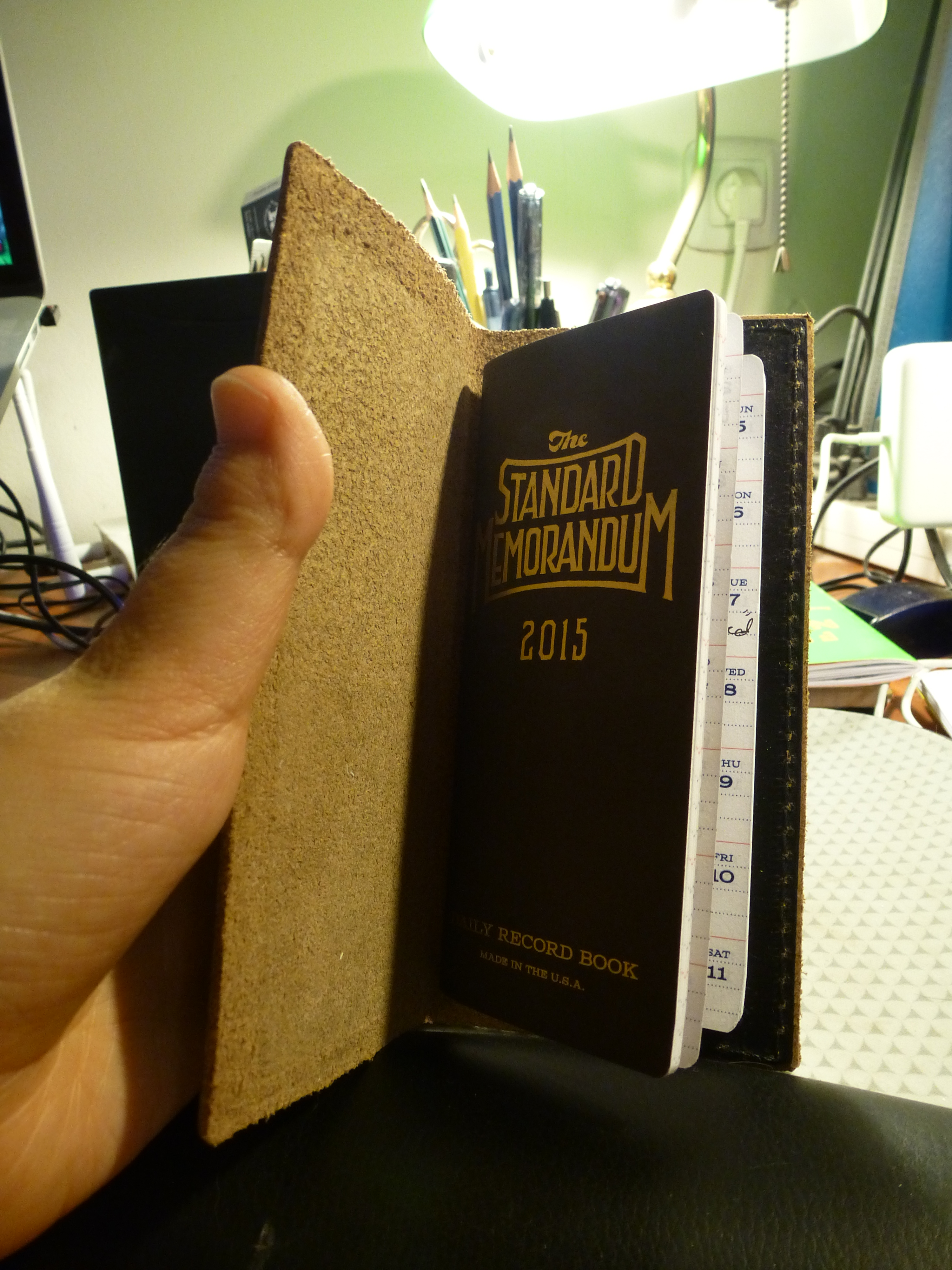
Earlier this year I won this little notebook by sheer chance from (wonderful)  Pen Addict blog giveaway.
P1030046

The notebook is a Word Standard Memorandum notebook and the cover is a Word Standard Memorandum cover in black.  It’s tiny, and much longer than it is wide — so it’s not in any standard format. Inside it looks like this:

P1030047

So you’ll notice that there isn’t very much writing room there. At first I wasn’t so sure what to do with it. It was too small to be useful as a planner, calendar or an exercise log (not that I didn’t try). But I liked the notebook too much to just let it languish on my desk.

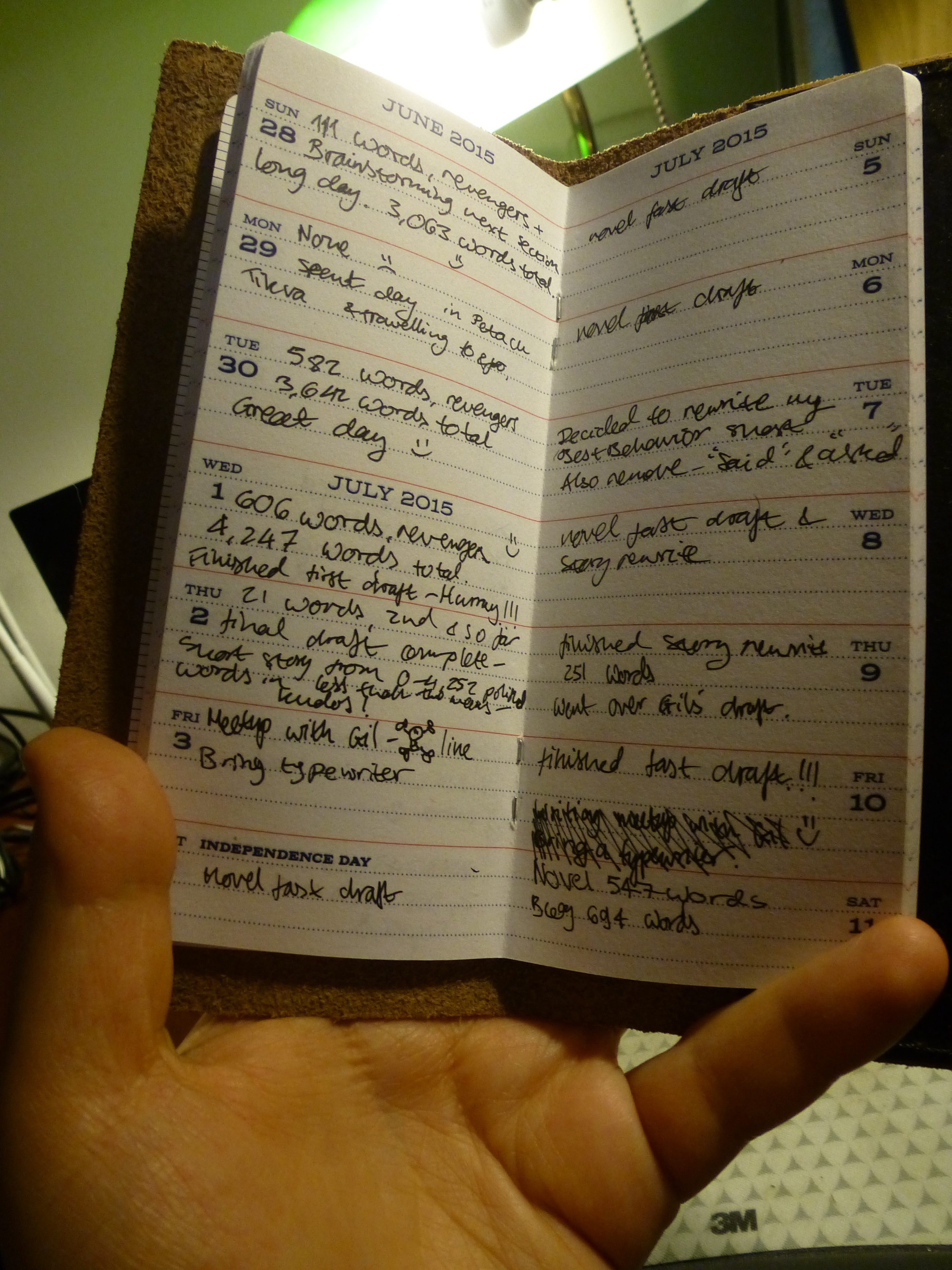
So on a whim I started using it as a word count log. At the end of each day  I write down how many words I’ve written, for which piece, and whether I am happy with my progress or not. On quick drafting days, I just note that I did some brainstorming and produced a quick draft. Since the notebook is so tiny, I use little smiley faces to note whether I made good progress that day or not.

Here is a sample page, filled in:
P1030048

This new little habit has been a great boost for my confidence as a writer, and has boosted up my daily word count considerably. It introduced not only a way of viewing my progress, but also a gamification of kind into my writing.

If you are writing anything, whether it’s a seminar paper or a novel, I highly recommend that you keep a word journal to keep tabs of your progress during those long writing hours.

Deadlines

I am very good at procrastinating. It cost me my MA thesis, which I wasn’t able to complete because it looked like such a Herculean task that I managed to scare myself into complete paralysis.

When I started working on my first piece of fiction (a short story), I very quickly found myself going back to my bad habits:

  •  Expanding the work to such proportions that it becomes impossible to complete in a reasonable amount of time. I managed to turn that short story into a not very good novella.
  •  Fiddling with my workflow to the extent that it is no longer helpful to me, but rather becomes a liability. I tried using a typewriter for the story at first, and while I discovered a very useful tool for very specific problems, forcing myself to use it for the entire first draft of said novella, did me no favours.
  • Setting totally achievable deadlines, and then letting them go “swoosh” by me.

I procrastinate when  the work that I’m setting out to do seems too unclear, too large, or too tasking. It’s a way of avoiding problems that most of the time I created myself.

While I still procrastinate, I’ve found that over the last few months I’ve been doing it less and less. Most of the problems of scale that I caused myself were solved by using the Foolscap Method and Quick Drafting. The rest of my problems I have solved by creating external deadlines that I can’t easily blow off.

Every two weeks I meet with a fellow writer that I appreciate, and we swap writing samples that we want critique on. Knowing that those two weeks will fly by whether I’ve written something or not, and not wanting to show up empty handed, have really pushed me to stop playing and start writing. My output has been better and more consistent since we’ve started these get togethers, and it had been a sheer blessing for my work.

If you are a procrastinator, try setting yourself an external deadline. Find a fellow writer, a friend or a family member whose opinion you appreciate and who you can trust with your work. Set a deadline with them (I recommend every two weeks, because it is often enough to not let you to fall off the wagon and get really far behind, yet not to often to become a burden).

More likely than not, it will be a deadline you’ll keep.

The Foolscap Method

Steven Pressfield’s Foolscap Method is way to map out the bare bones of your plot, get you thinking about the narrative itself, and help you consider what your story is about in one page of foolscap paper.

If you haven’t yet given the Foolscap Method a try, I highly recommend it, even if you are already in the midst of writing something. It takes only a few minutes to do, and it saved me hours of wondering what comes next, or having to rewrite my story in the first person because it works better this way.

If you only take one thing out of the Foolscap Method, let it be Pressfield’s “step four: theme”, also known as what is the story about. It really helps focus my writing to nail this down as early as possible.

Even though Pressfield recommends breaking the story rather arbitrarily into three acts, and I do so, I find this the weakest point of the Foolscap Method. It would likely be more productive to just list the major scenes that you need to go through from the “Inciting Incident” to the story’s climax. For obvious reasons this is also when I prefer to note the inciting incident and the climax, rather than at the very end, as Pressfield does.

Finally, here’s the post on Pressfield’s blog where he discusses the Foolscap method, what it is and why he uses it.

Using quick drafts

A quick draft is something that I only very recently started doing. It replaces the need to write outline after outline, which are never detailed enough, or my previous time consuming habit of writing the entire first draft by hand. The idea is to just write out the entire piece, in a kind of shorthand that just roughly outlines all the scenes, and gives broad details of key points in the narrative and the dialog. It’s a kind of long summary of the plot, for your eyes only. The point is to go over all the scenes and make sure that there aren’t any plot holes or things that you need to embed earlier in the narrative to help explain a later scene. A quick draft also helps me get a better idea of the shape of the narrative (the way it moves from beginning to end), break it down to chapters and scenes, and get a better idea of who the characters are within the narrative. As an added bonus, it makes doing the Foolscap Method much easier later on.