Schedule Update
This is just a quick post to let everyone know that this blog will now be updating every Monday, Wednesday and Friday with blog entries, and every Thursday with interesting writing related links.
A blog about writing, sketching, running and other things
This is just a quick post to let everyone know that this blog will now be updating every Monday, Wednesday and Friday with blog entries, and every Thursday with interesting writing related links.
A little while back I saw this vlog entry by Casey Neistat:
Now Casey has a great, great vlog, and I highly recommend it, if you’ve got some free time (i.e. Not time you should be spending writing). He oftentimes gives inspirational bits about the importance of working harder on the things that you care about, and about how you can do a whole lot with very little if you only have the courage to create.
In this video he maps out his day, and basically urges his viewers not to become fat and lazy. The videography is great, as usual, and the piece is very inspiring. Do the work, push yourself to the limit every day, cut down on your leisure time, invest time and effort in what is important to you. All of these things have been said before, but Casey puts them in a wonderfully vivid and fresh way.
But as someone who is working very hard everyday for a good while now not to be “fat and lazy,” I have a few issues with it.
Casey does have leisure time, and so should you. Unlike what he says in this video, if you’ve ever watched one of his vlog entries you know that he does have leisure time — he just doesn’t count it as leisure (go ahead and watch a few entries if you don’t believe me). Yes, you should cut down the time you spend on video games, TV, social networks, etc. No, you should not cut them down to zero. I recently talked to a friend of mine who used to love playing the piano and taking landscape photographs. His life is now all work and family, with barely enough time for friends, let alone his hobbies. “Don’t you miss them?” I asked. “Of course I do,” he answered wistfully, “but I don’t have time for them in my life anymore”. Don’t do that to yourself. Leave some time for yourself, to recharge and have fun.
If Casey slept four hours a day regularly, he’d probably be dead. We need a minimum of six hours of sleep to, you know, live, and we could all use more sleep than we allow ourselves. We live in incredibly sleep deprived times, and we all need to work hard to get more and better sleep, not less. This is your short and long term health we are talking about here. Don’t cut corners (or sleep hours) on this one.
So yes, work harder. But no, don’t kill yourself doing it.
I finished writing the second chapter of my novel today. It’s also been a month of consistently writing every day, which is a big achievement for a veteran procrastinator like me.
I’ve learned that when I get stuck in my writing or my mind starts to wander into the depths of the internet I need to pull back and do a quick draft of whatever it is I am working on at the moment.
I’ve also learned that when an idea comes to my mind I need to write it down as soon as I can. That means carrying a pocket notebook on whenever possible, but also writing things on scraps of paper or my phone and sorting through them as soon as I get home.
Finally, I’ve learned that I need to “brake for nobody” when I write. No looking up anything, no pausing to find a better word, no contemplating the merits of this name over that one. Get it all out on paper or on your computer, then go back to edit, polish, do the research, and figure out the nuances.
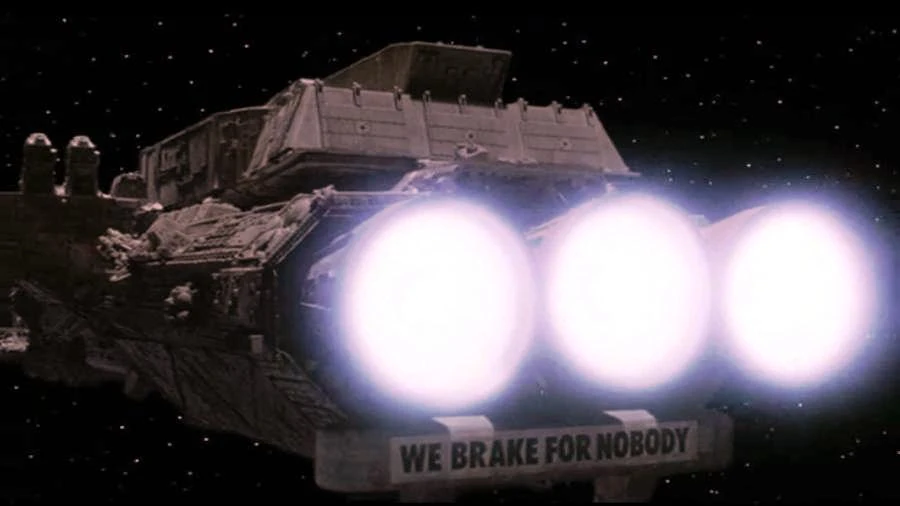
In writing like running, stopping for anything just makes starting back up again ten times as hard.
Went running in the park today, and saw several things that would make for great story ideas:
Story ideas are everywhere. I just need to remind myself to peel my eyes off the phone and take a good look around me.

Somedays you don’t really feel like working on your novel/story/article/paper, and then while procrastinating online you’ll find this piece of advice: “write something every day. It doesn’t matter what you write, so long as you write”. Write a journal entry, a blog post, a tweet or Facebook status: everything counts.
But does everything count?
If you’ve ever done any writing before you know that there is writing, and then there is “writing”. Writing a journal entry or a blog post doesn’t require the same level of effort that writing a short story, a novel, an essay or article requires. When you tell yourself that they are the same, are you not cheating yourself a little?
Blog posts have value.
Journal entries have value.
But at the end of the day, when you look at the work that you’ve done, do you count them when you say, “I’ve written X stories, Y articles, and a novel?”
Today’s post is short, because I spent what little writing time I had pounding out 700 words for my novel, instead of 300 words here. I think I made the right choice. I think I made today count.
I didn’t feel like writing yesterday. I was out and about all day, and it was extremely hot and humid, so when I came home the last thing I wanted to do was sit down and write. I procrastinated, I started telling myself that it was OK to skip a day, since I wasn’t feeling that great, and that I could make up for that day tomorrow.
I know that voice very well now. It’s the same little lizard brain voice that tells me that I shouldn’t go running today because it is too hot/too cold/too wet/too humid/I’m tired/I’m feeling so-so. It’s hard to resist that voice, since it’s easier to watch TV or waste time on the internet than it is to write or run.
When it comes to running, I get out the door by just lacing my shoes, and reminding myself that I’ve yet to regret going out on a run.
I’ve never regretted going out on a run.
So yesterday I plunked my sorry ass by the computer and started typing. When the words came out slowly and painfully, I took out a pen and paper and did a quick draft of the scene that I’m working on. And then I typed it.
When the scene came out as mediocre (since I was writing for the sake of writing, not for the sake of writing well), I went back and rewrote it. “Sorry little lizard brain. If you are going to act up, this is only going to take longer,” I told myself.
I finished my session target (a little over 500 words) yesterday, and while it took my twice as long as usual, I sure as hell don’t regret doing it.
This post is a month old but I only just stumbled upon it: Fight, by Shawn Blanc.
Shawn talks about deciding what is important to you, and how you should make sure that you really are making that thing a priority. If you’ve read Merlin Mann’s 43Folders, listened to the early episodes of his Back to Work podcast, or have been following Seth Godin then a lot of what he’s saying won’t be new to you. But there is something powerful about the succinct way he puts some of these same old ideas into words:
What then if you lived like nobody else?
- Don’t spend hours each day watching television or scrolling through social networks.
- Don’t let your work life dominate over family time, personal values, or happiness.
- Don’t ignore the importance of investing over the long-run and planning for the future.
- Live as far below your means as is reasonable, and don’t derive your happiness or self-worth by the fanciness of the things you own.
- Don’t let laziness or busywork keep you from building something meaningful.
- Don’t assume you need a better tool in order to do better work.
It’s funny. Simply doing the opposite of what most people do can actually open up many opportunities for you to do meaningful work.
It’s not a long piece, I recommend giving it a read. And then getting back to writing.
So I just finished writing my first chapter, and it went quicker than I expected. I think that after 7 years of academic writing, I finally figured out how to get myself to write quicker. Of course, this would happen when it’s already too late to help me with any of my degrees, but what can you do? Writing isn’t easy, and there really is no magic formula. There is only trial and a lot of error.
I used to handwrite in long hand draft after draft, and only when I was semi-satisfied type it up and polish it. That was painfully slow, so I cut it down to just writing my “shitty first draft” in long hand with (fountain)pen and paper.
Behold the reams of paper required to produce just that rough draft:
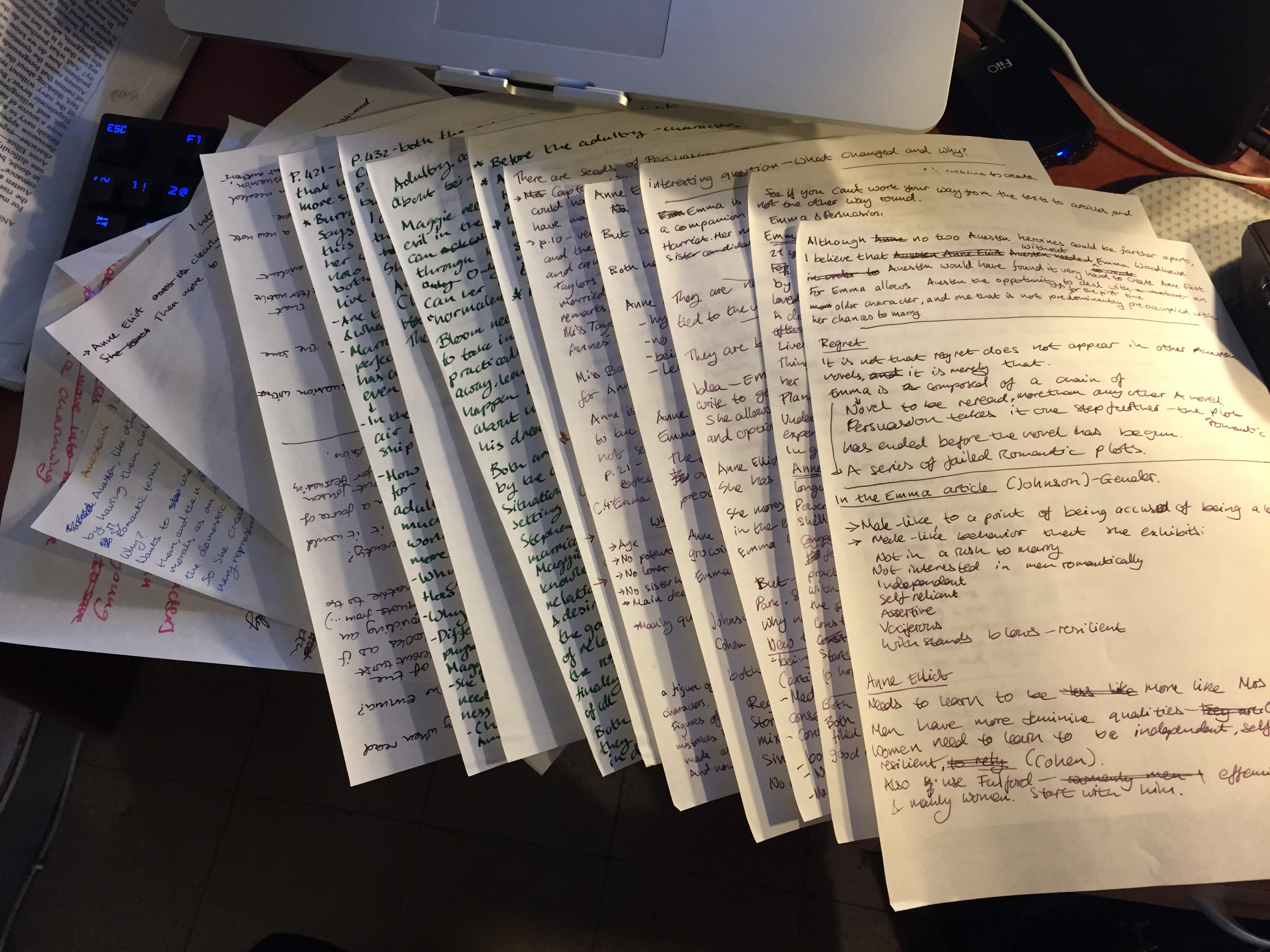
This was not working.
My draft was over-polished for a rough first draft, and so it took too long to complete.
Once I completed it I didn’t feel like typing it up in Scrivener.
Once I typed it up, I often discovered that I had managed to go off on a tangent, or dig myself into a useless hole, so I had to rewrite half the paper again.
Again — this was not working.
I tried writing directly in Scrivener, but I think better when I use pen and paper. So cutting out the analogue part of my writing process just made me produce really mediocre papers which I had to work twice as hard on during the loathed editing and polishing phase.
The solution for me is just to do a handwritten quick draft of the overall piece , and then start writing in Scrivener. If I get stuck, or want to try out a few options, I just quick draft each one, and then continue typing along. So my writing method still combines analogue and digital, but the balance between them has changed. I spend less time planning, and planning, and planning, and more time just doing the writing and seeing what works.
After all, I can always go back and change it later.
I started using Scrivener during the late stages of my MA. If I would have known of it sooner, then believe me I would have used it throughout my BA and MA.
What is Scrivener?
It’s a writing application. A thumping good writing application.
But I have Word for that.
I thought Word was a writing application too, until I downloaded Scrivener’s free trial and gave it a spin. Word is great for word processing (i.e. formatting things, playing with fonts and tables and tables of content), it is a very poor writing app.
Why? Because it tempts you to play with the font and the paragraph formatting, and fiddle with footnotes and endnotes, etc. Scrivener is keyed towards the writing process itself.
To see what I mean, download Scrivener from here, and open a blank project (there are other great project formats there, but for now a blank project is all you need), create a new text file under “Draft”, and just start writing. If you are a distraction prone writer (who isn’t?), press on the full composition mode button on top (I dare you to have trouble finding it), and enjoy an all encompassing writing experience.
Notice the lack of font-and-margin-and-style buttons on top? That’s because Scrivener wants you to finish all of your writing (and your veggies), and play with formatting only during the compile phase, which happens after the text is finished.
You can do all your writing in a app that respects your writing process, and then chuck the whole thing easily to Word for formatting, or do the formatting during the compile phase and create Word documents or ebooks directly from Scrivener itself.
Try using a writing app for once – I’ll bet you’ll like it.
 Writing at Large