Moleskine Large Dotted Hardcover Notebook

So it appears that Moleskine has finally hopped on the dot grid bandwagon, releasing several of their classic collection notebooks in dot grid, even going as far as creating dot grid versions of some of their seasonal colours (gasp!). Next thing you know they’ll be releasing limited edition notebooks in squared and dot grid paper, and then where will we be? (Don’t worry, it’s not going to happen).

The classic Moleskine collection consists of their hardcover and softcover notebooks, in pocket, large and extra large. Currently the dot grid is offered in black covers, both in hardcover and softcover, and in underwater blue (such a pretty seasonal colour) and beige in softcover. However, it apparently was enough of a success for them to issue the dot grid option in all their classic collection core colours (black, red, blue sapphire, and myrtle green), and in seasonal reef blue (both hardcover and softcover). These colours will start being available in February-March, so it may be worth waiting a little while before purchasing (although some of the hardcover core colour options already seem available).

Now to the review. I got the classic large black hardcover notebook, as it’s probably Moleskine’s best selling notebook, and what people have in mind when they say “Molekine”.
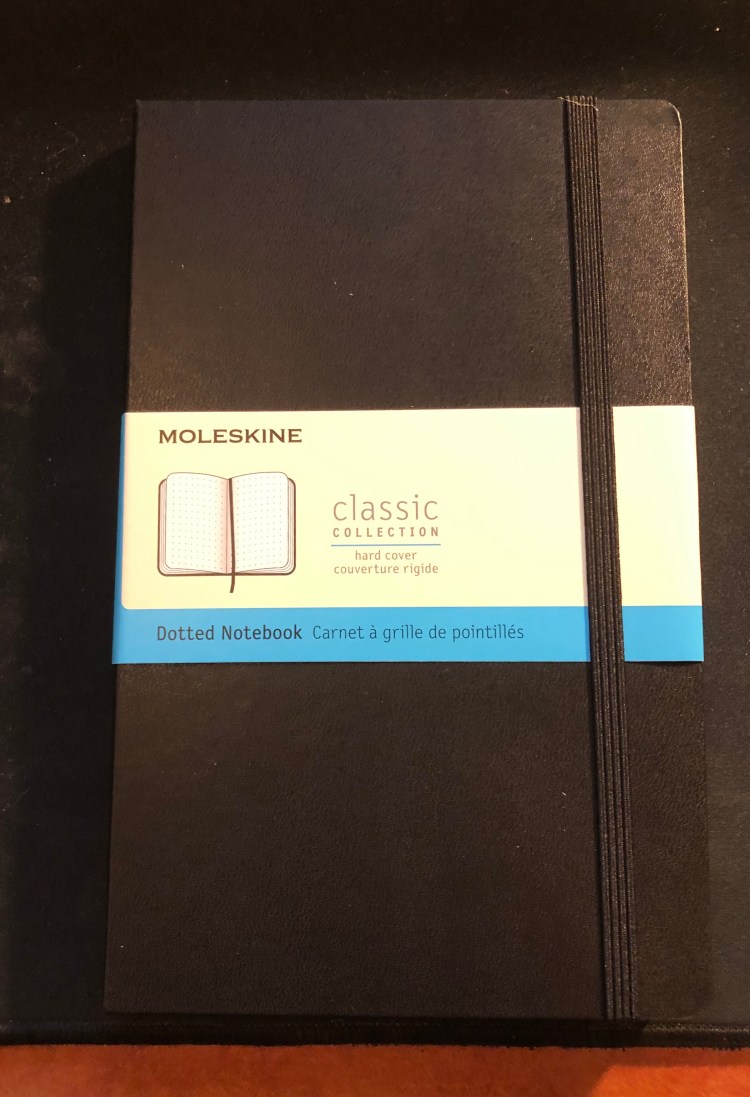
Dotted paper gets a new band colour – blue.

First thing’s first, Moleksine have listened to customer feedback and significantly strengthened their notebooks’ elastic bands. They’re a little thicker and wider, and there’s little chance that they’ll turn into the floppy mess that some of their earlier elastic closures turned into after a few months of use.

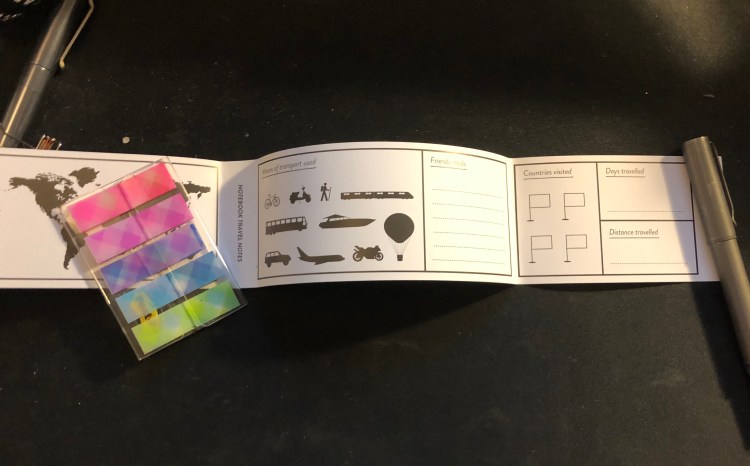
The sleeve also has a B-Side, this one is pretty travel oriented, and I love it because maps!

Phileas Fogg would have been proud.

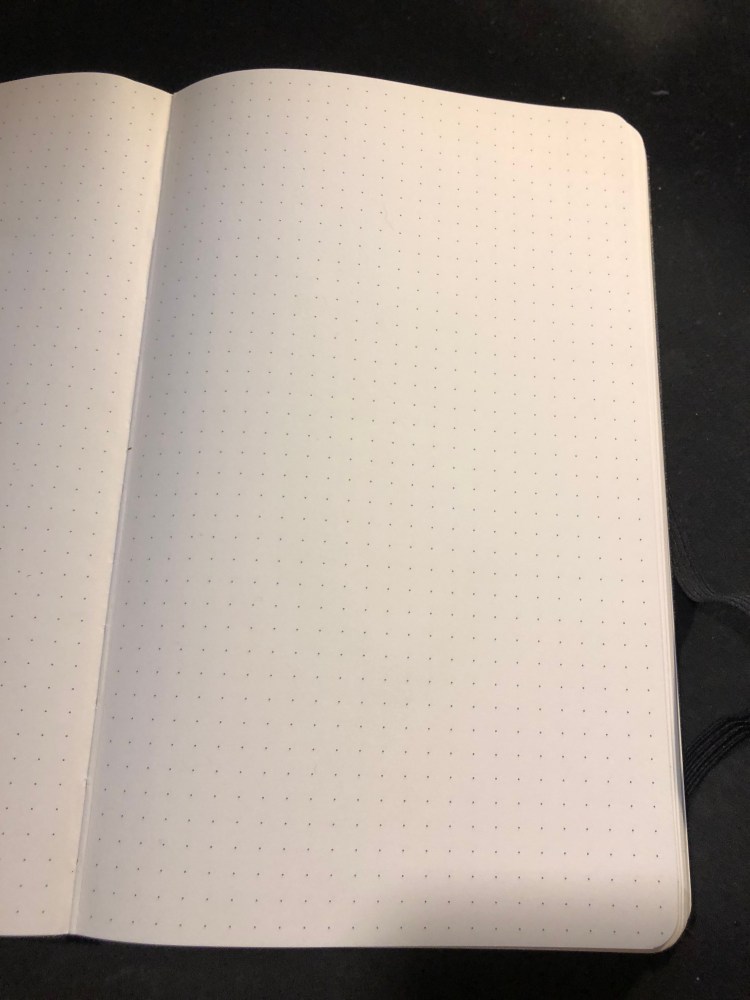
Which brings us to the paper. The dot grid pattern is medium grey, dark enough to be visible, light enough to not be too distracting. It also is very precisely aligned on all pages, if those kind of things bother you.
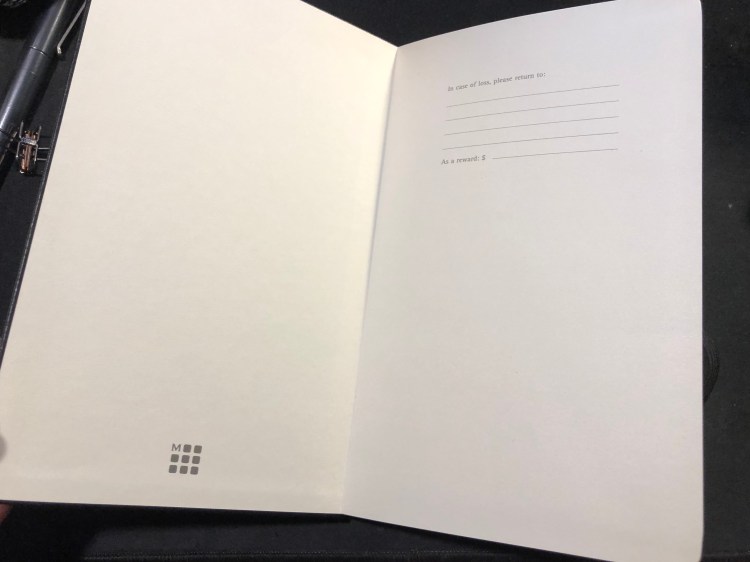
The “In case of loss” endpaper, with the Moleskine logo, a relatively recent addition.
How does the paper perform? Better than you’d expect. Gel, ballpoint and pencil work well with the paper, but even fountain pen inks, including pretty saturated messes like the Montblanc psychedelic purple work pretty well. There’s no more weird spidering, as there used to be and the spreading is minimal (better than Baron Fig, well above average). If you don’t insist on super saturated inks, you’ll be able to enjoy using fountain pens in this notebook.
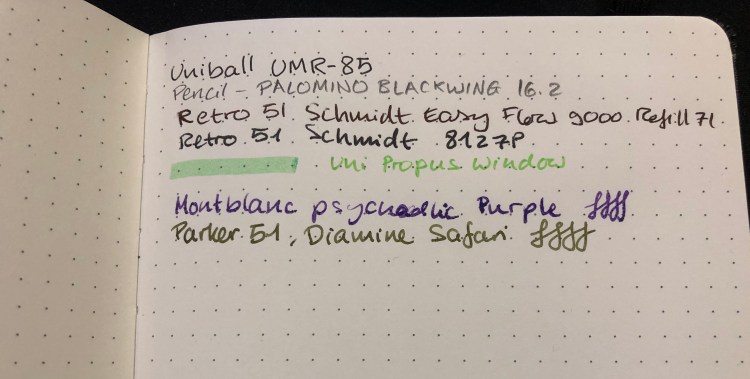
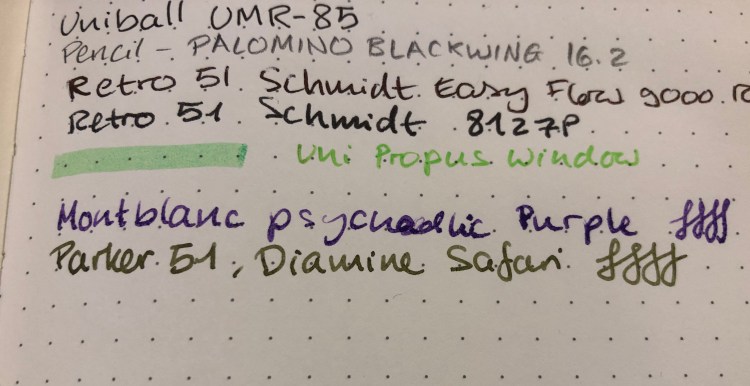
A closeup of my writing samples. Montblanc purple has behaved this way on Rhodia paper too, so I blame the ink, not the notebook:
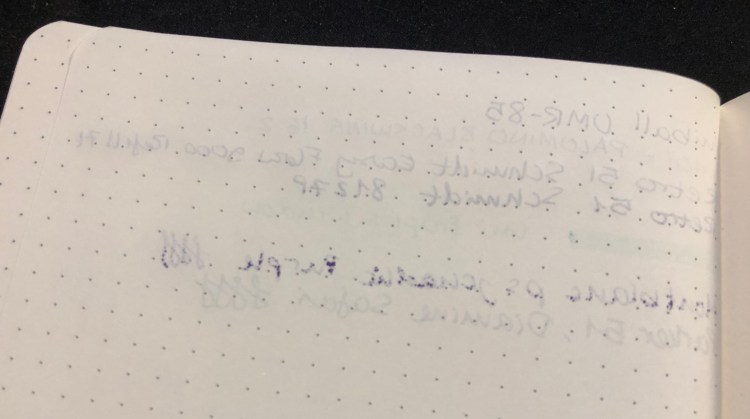
Show through is better than tomoe river paper, but not as good as Rhodia (I’ve had mixed results with Baron Fig, so I’m not using them for comparison here). Again, the only real problem was with the Montblanc ink, which is a problematic ink in general, so I’m not using it for comparison. I’d find this notebook to be usable on both sides of the page, but again, that comes down to preference.
Moleskine seems to be making an effort not only to come up with innovative limited editions, but also to give their regular line-up a bit of a refresh (with new added colours) and boost (with new dotted paper, better quality paper, and a fix for their elastic closure problems). That’s a move in the right direction, and one that I plan to enjoy.

I still need to figure out what’s going on with that Montblanc ink, though…
TWSBI GO and J Herbin Caroube de Chypre Ink Review

I’ve tried shimmering fountain pen inks (inks with little sparkly bits in them) only once before, when J Herbin first started producing them, and they ruined a Lamy Safari pen and converter with their non-removable sparkle. Over time more and more reviews came out lauding these pretty, shiny inks and saying that they’re completely fountain pen friendly nowadays, yet I kept my distance. No amount of glitter was worth another ruined pen, after all.

Enter the TWSBI GO, which is a a TWSBI nib connected to a toy pen that is so cheap that it practically has “Bay State Blue ready” written on it (I still don’t recommend going anywhere near the stainiest of stainy inks, no matter how gorgeous it is).

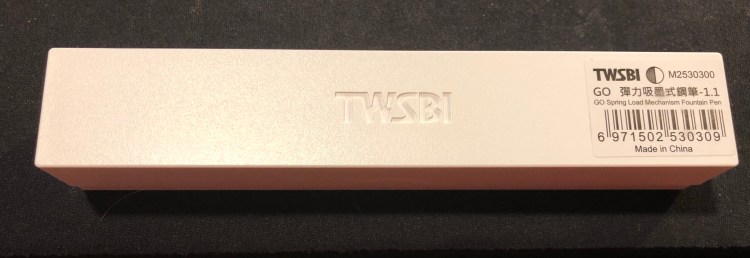
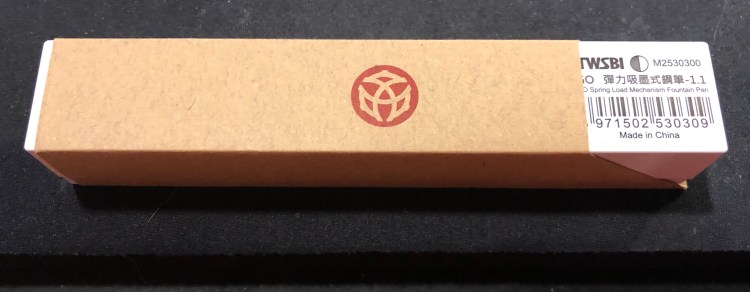
The packaging is bewilderingly good for such a cheap fountain pen. A cardboard sleeve over a plastic box that puts the cardboard Lamy Safari packaging (and price point) to shame.

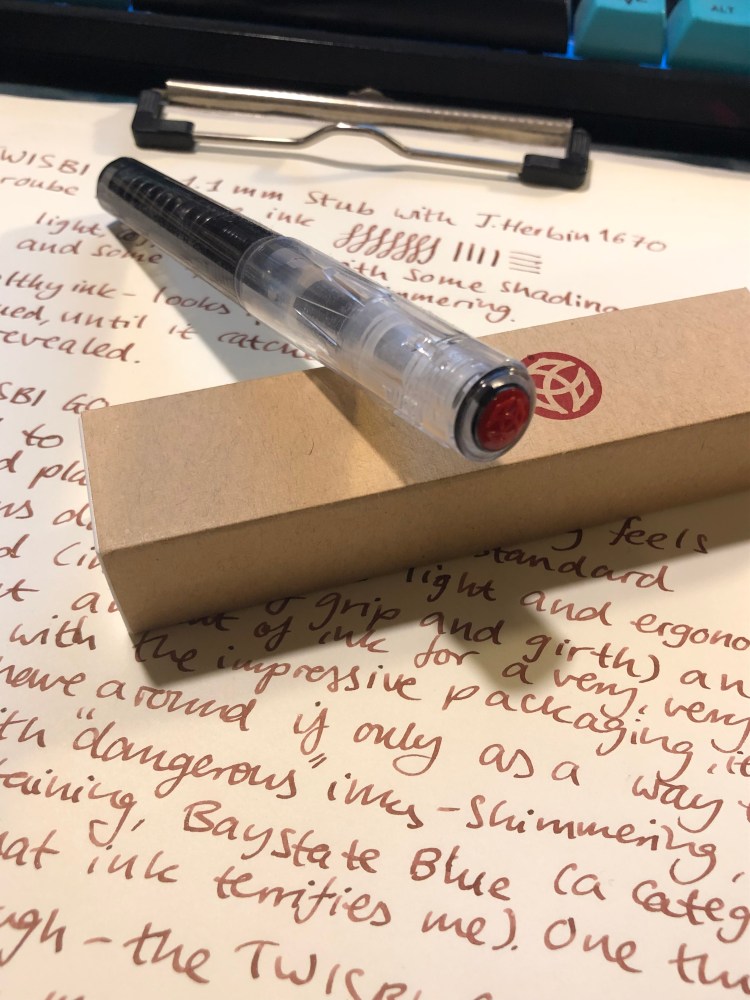
Cardboard sleeve with TWSBI logo
Solid plastic box for the pen. I’m not a packaging person, but this is disproportionally good for the price.

Then you open the box, and laugh. The pen looks and feels like a child’s toy, with its cheap feeling plastic, its light weight and ridiculous spring filling mechanism. It takes the ugly duckling bit a step beyond what even other TWSBI functional but ugly pens, like the ECO, have.

Ugly.

But then you start to write with it, and the silly little body has good ink capacity, is easy to fill, and most importantly, it has a TWSBI nib. TWSBI nibs are phenomenally good for the price, and they come in 1.1 stub sizes, which are super fun to use.

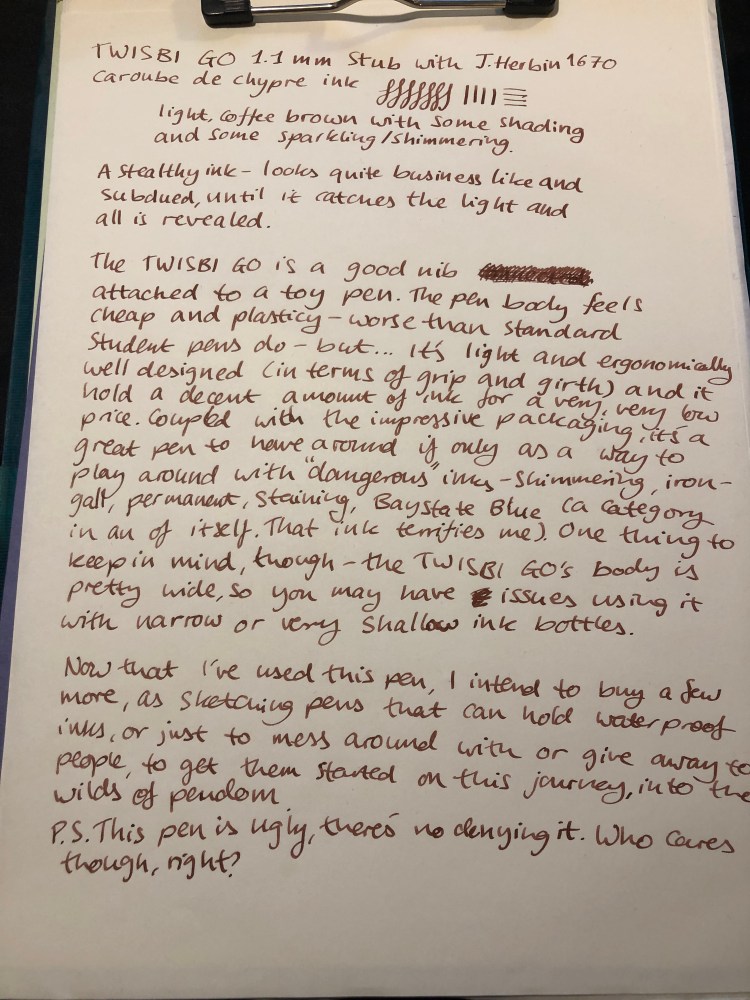
Here’s a writing sample with a TWSBI GO 1.1 stub, which I did late at night when I was pretty tired, and so I spelled TWSBI phonetically, so whoopsie.

The ink is J Herbin’s Caroube de Chypre, which I had bought but not yet used. It’s a light, coffee brown ink with a medium amount of shading and some gold sparkle that is just-impossible-to-photograph-unless-you-pour-half-a-bottle-of-the-stuff-on-the-page-so-you’re-going-to-have-to-trust-me-on-this-it-is-pretty.

Writing sample.

Can you get away with using this ink in a work setting? I believe you can, since the colour itself is pretty tame and the sparkle isn’t in your face, but just glints in the light in certain angles.

img_5626.jpg
This photographed darker than it appears in reality, but is shows some of the depth of shading that you can expect to see with this ink.
img_5627.jpg
Ugly pen, ugly handwriting, pretty ink.
TWSBI logo on the cap.
The nib, which is the main reason to buy this pen.
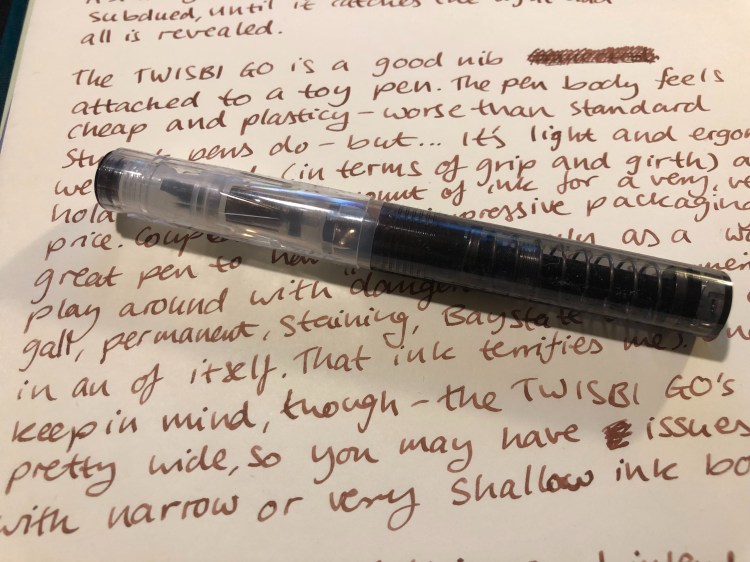
Pen grip and pen feed, with ink capacity on display.

The pen itself is a paragon of practicality: super light, super comfortable grip, good ink capacity, excellent nib and feed, easy to use filling mechanism. For less than $20 that’s a tremendous feat on TWSBI’s part and it makes this pen a “no-brainer”. Whether you’re a beginner or a hardened collector, you should have at least one of these in your pen case. It’s a great workhorse, good for experimenting with “dangerous” inks (keep well away from Bay State Blue, yes you, I’m talking to you. I can see what’s in your shopping cart), good as a loaner pen to get more people into the wonderful world of fountain pens, and even good for people experimenting with nib grinds. In the beginner fountain pen category it is uglier than even the platinum preppy, but when it comes to bang for your buck, this pen puts all others to shame.


Moleskine Limited Edition Peanuts and How to Start a New Journal

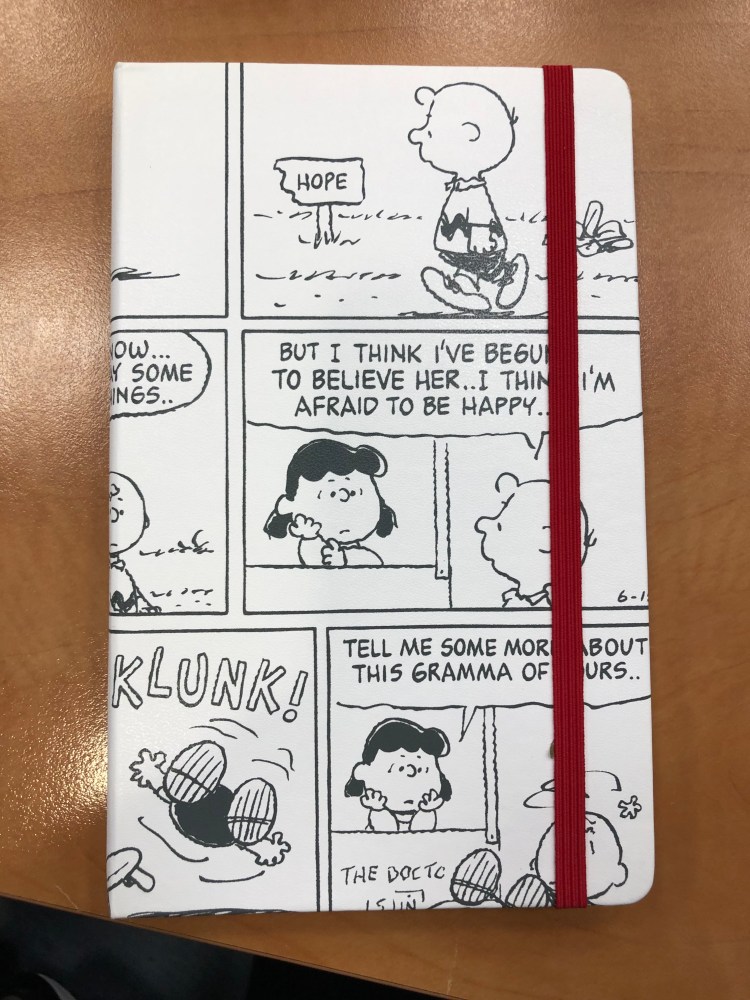
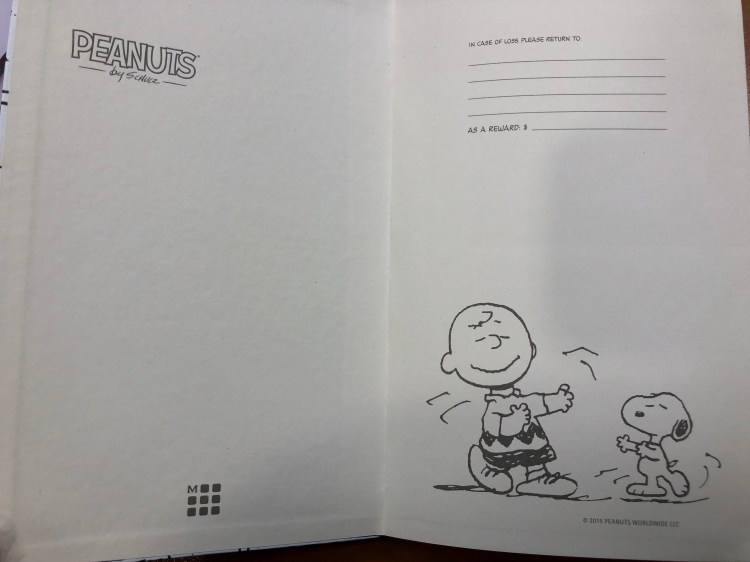
I started a new journal this month, this time a Peanuts limited edition Moleskine. This is one of Moleskine’s best designed limited editions in recent years, because of the simplicity of the design and the limited palate choice (white, black and red). So first up, here are some pretty pictures, and then I’ll get into how I start a new journal.

That sleeve looks transparent, but is just perfectly aligned, that’s all. 
“Are you happy right now?” “I guess so..”
Gramma knows best.
No Problem
Only the best end papers in any Moleskine edition to date.
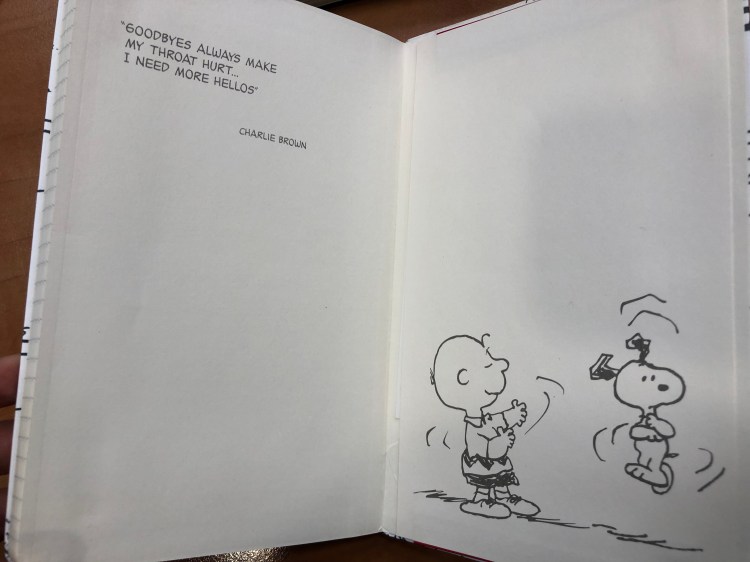
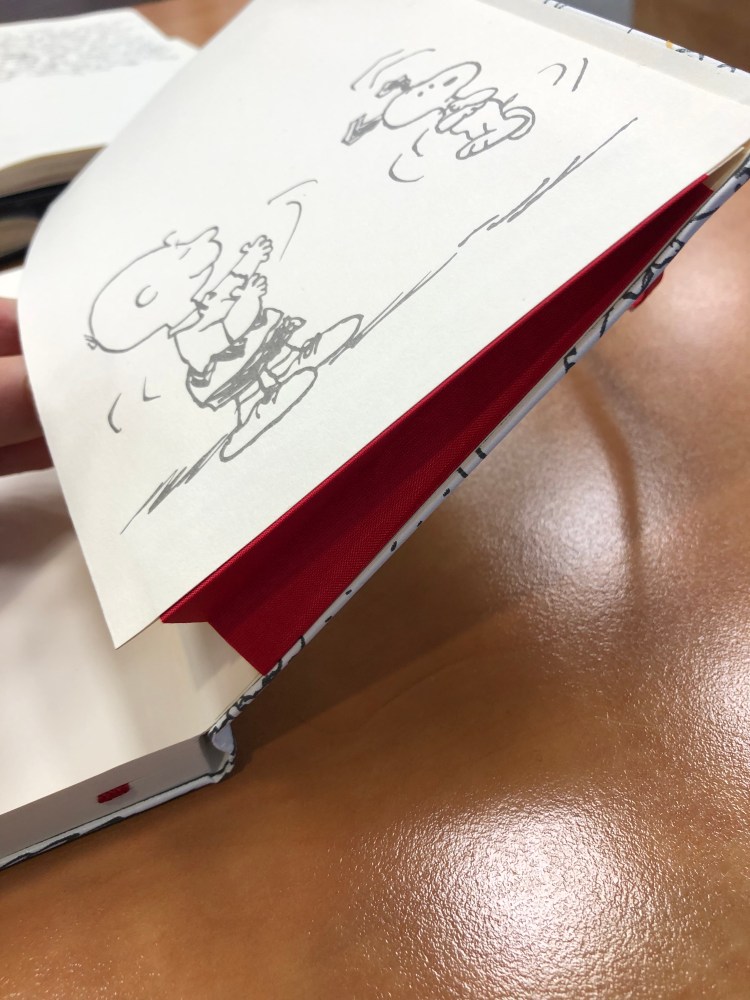
The back end paper is a sweet and a little heartbreaking – like the best Peanuts strips.
Bonk! Stickers galore.
Red detail on the famous back pocket.
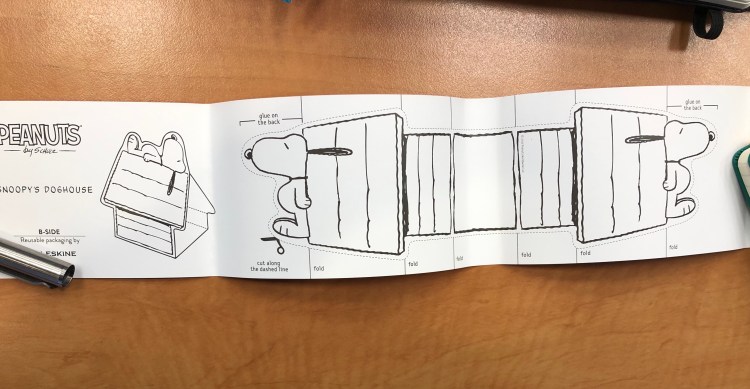
Build your own Snoopy’s doghouse from the B-Side of the sleeve. 

So this is definitely a top 10 edition for me, both because I love Peanuts so much, and because it is such a well-designed notebook.

Now to how I actually start a new journal:

I’ve noticed that the hardest part of journaling for me is when I’m just getting started with a new notebook. Blank pages are scary and discouraging, and at that point I’ve invested so much time and effort in my old notebook that I really don’t feel like moving to a new one. Like Charlie Brown says, “Goodbyes always make my throat hurt… I need more hellos”.

The trick is to get the new journal started well before you actually “move into” it, so that by the time you start using it full-time it’s already an old friend.

Once I get to about 20 pages before the end of my current journal I select a new one, fill in my personal info, and start filling the first few pages with various project ideas/running and training plans/writing plans/home improvement plans. These are specifically things that I know that I’ll need to start updating and referencing before I start using the new journal, so that it’ll start filling up with meaningful content ahead of time. I also use the last pages of the journal to test new pens, jot notes for myself or just for various stamps. By the time I start using it, the notebook isn’t just randomly used or “wrecked”, but meaningfully mine. It’s already working for me, being my outboard brain and eye and heart. And it doesn’t take a lot — I was too preoccupied this time to notice that my old Star Wars Duel notebook was running out, so I started the Peanuts one in a rush, only a few days before I fully moved into it. All it took was a running plan and a list of things that I want to pack up and give to charity for me to easily transition into it, as if I was merely turning another page in my old notebook.

If you have trouble starting new notebooks, give this idea a try, it may help you out.

Moleskine James Bond Limited Edition Boxed Set

Completing my Moleskine James Bond limited edition reviews (see here for the Titles notebook and here for the Carbon one) is the crowning glory of them all: the boxed set.

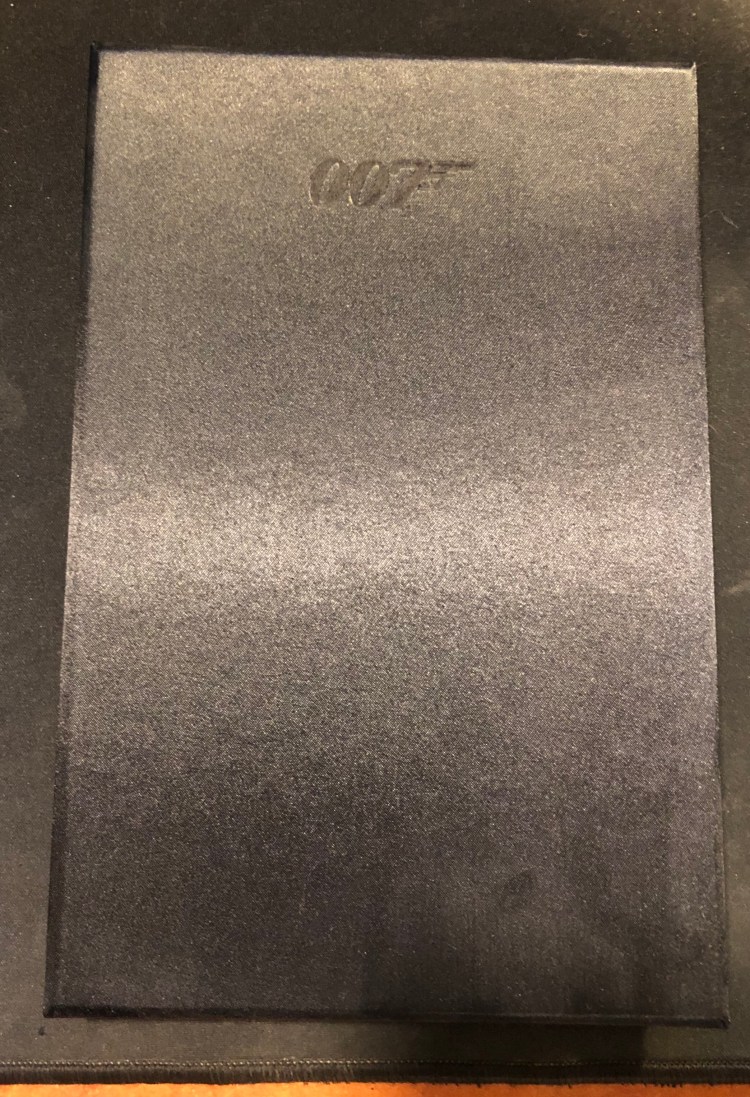
Unlike the other two notebooks, this is a numbered edition with 7007 notebooks total made worldwide. It comes in a silk covered box, with its own matching “tie” (to help you get the notebook out. It’s not really necessary, but adds another touch of luxury to this set), and is itself covered in black silk. All of this is terrifically excessive, like Q’s elegant little gadgets on an already over the top car. The result is a notebook and box that you just want to stare at and stroke every once in a while.

The Box
The “tie” inside the box

The notebook with its shiny silk cover:

Moleskine did a limited edition run of silk covered pocket notebooks years back, for the van Gogh museum in the Netherlands. They were all the rage, especially at a time when Moleskine was not doing limited editions except for special events, and they were exceptionally difficult to obtain. The silk on those covers was thinner and rougher, and after a bit of use tended to fray, likely because silk is not an easy fabric to work with, and the company had very little experience with fabric covered notebooks.

The James Bond Boxed Set comes after the Blend, Rolling Stones, Denim and Marauder’s Map fabric covered editions, and you can tell that they know what they’re doing now. The silk on the cover is densely woven and substantial, and unlike the van Gogh notebooks, it actually shines with sheen. It feels like the notebook is wearing a high end tuxedo and just waiting for a gorgeous woman in a skimpy dress and a silly name to bring it a martini, shaken, not stirred.

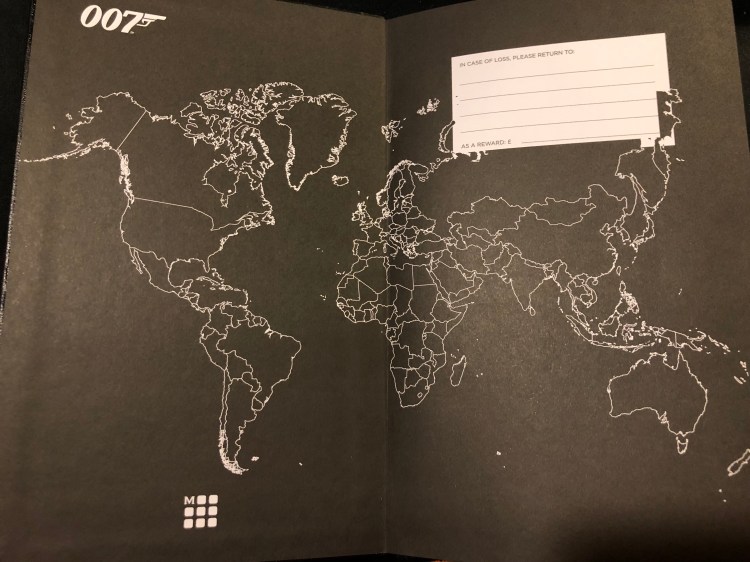
Front end page, with the well designed map and the number of the edition
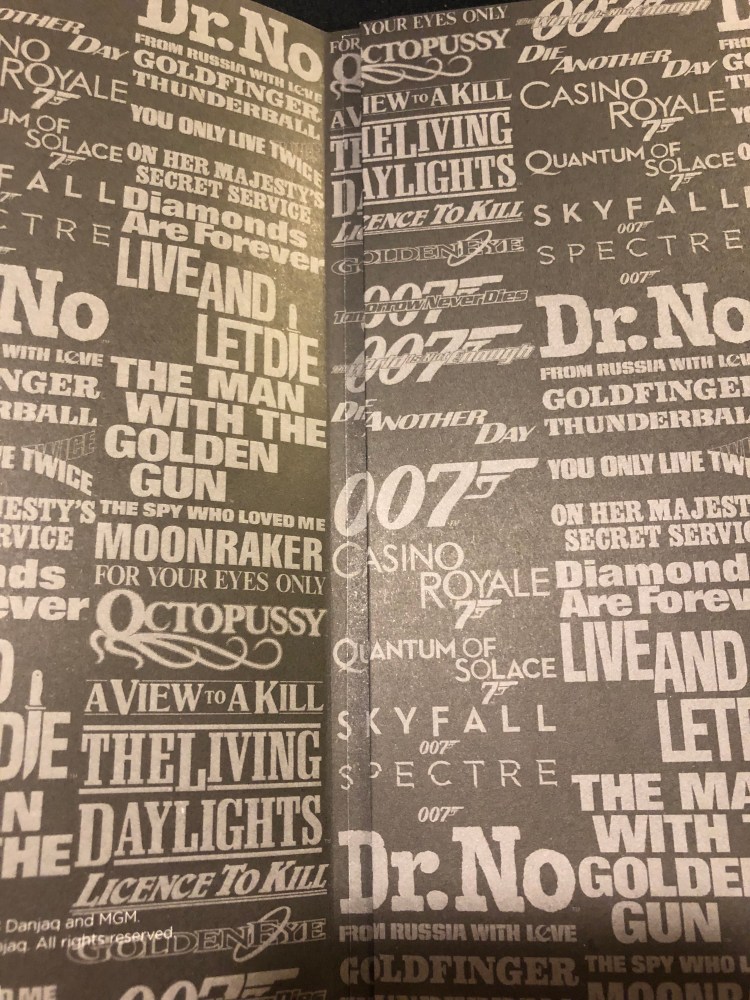
Back end page, with all the titles beautifully aligned.

Like all previous boxed sets, the notebook comes unwrapped (the box itself is wrapped) and so without the paper slip and its B-side around it. The sticker sheet that comes with this edition is the same as the other notebooks in this range.

The set originally cost around $35 but you can get it now for $25. If you’re a James Bond fan this is the one to get out of this edition, with the Carbon coming in second place and the Titles in third. The only minus to this notebook is that it is so sexy there’s a good chance that you’ll feel uncomfortable using it (ah, double entendre. What’s a James Bond movie without it?).

Ti Click EDC Pen Review

I am a big fan of Big Idea Design’s pens (the Ti Arto is my daily carry pen), and so of course I joined the Kickstarter for the Ti Click EDC Pen. Since I hadn’t tried their black anodised pens before, that’s the finish I opted for. It arrived yesterday, and even though I’ve been using it exclusively all day, I’l be the first to admit that these are only my preliminary thoughts on it. (See updates in the end for more detailed thoughts on this pen).

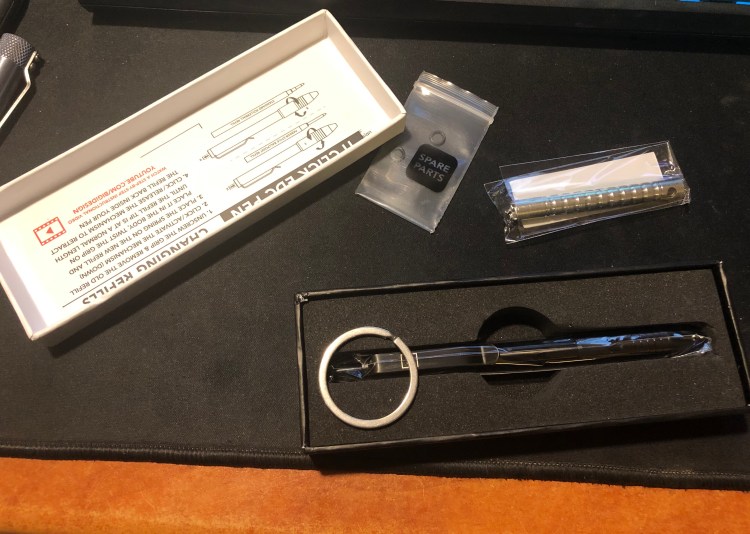
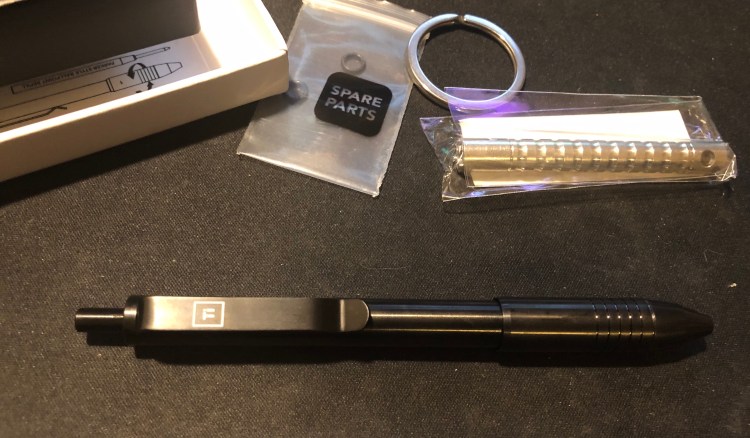
The packaging, as usual with BIGiDESIGN, is compact and neat. The pen comes with everything you need to fix it, should you need to (I’ve never needed to), and in a pretty nifty box.

The finish on this pen is shiny and black, but it’s surprisingly not a fingerprint magnet, as I would have imagined:

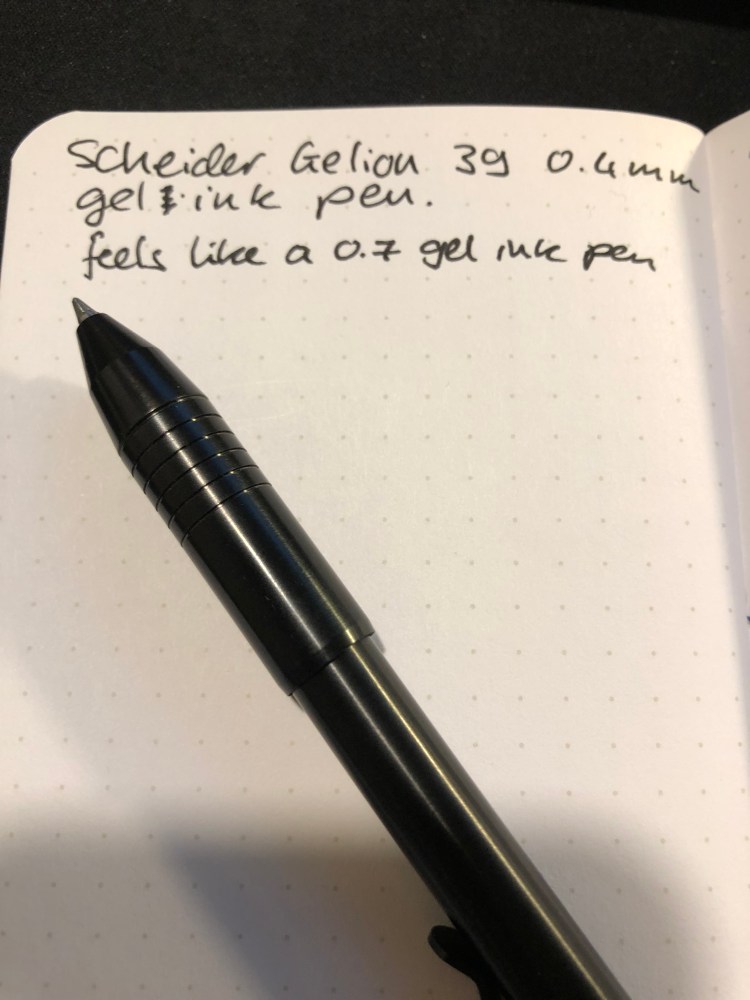
The pen came with a Scheider Gelion 39 0.4 mm gel ink refill. This is a new refill for me, and I can’t say I’m a fan. It’s as wide as a 0.7-0.8 mm refill, and I much prefer the Uni-Ball Signo UMR-85N refill that the BIGiDESIGN pens used to be shipped with (it’s me favourite gel refill).

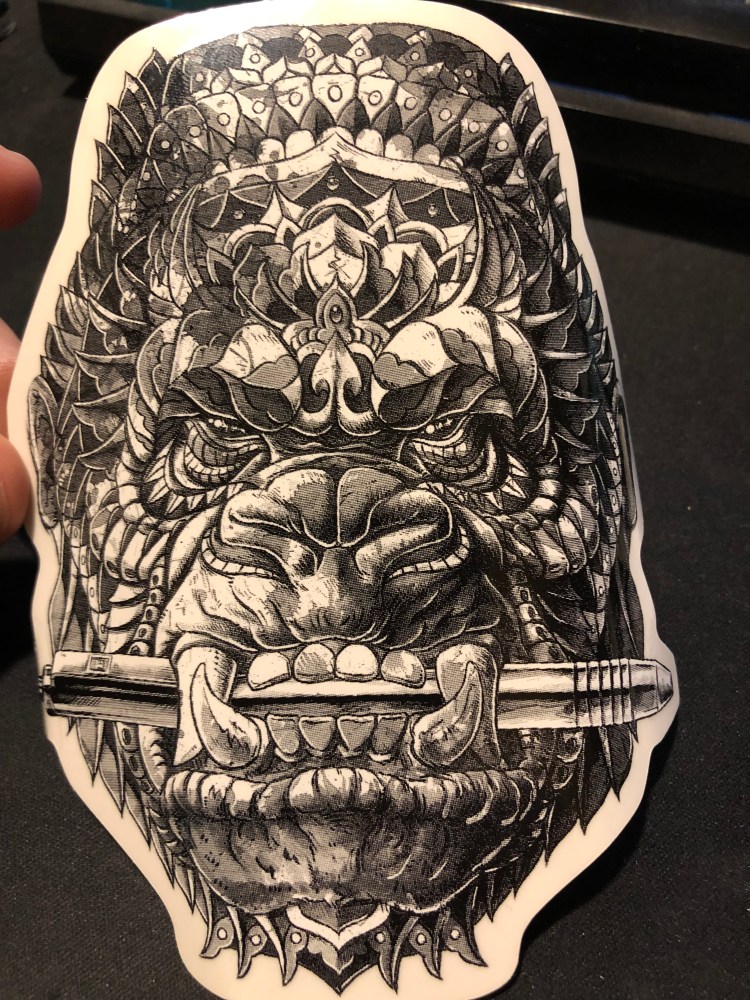
As part of the kickstarter, the pen came with a cool Bioworkz sticker, which you can see below:

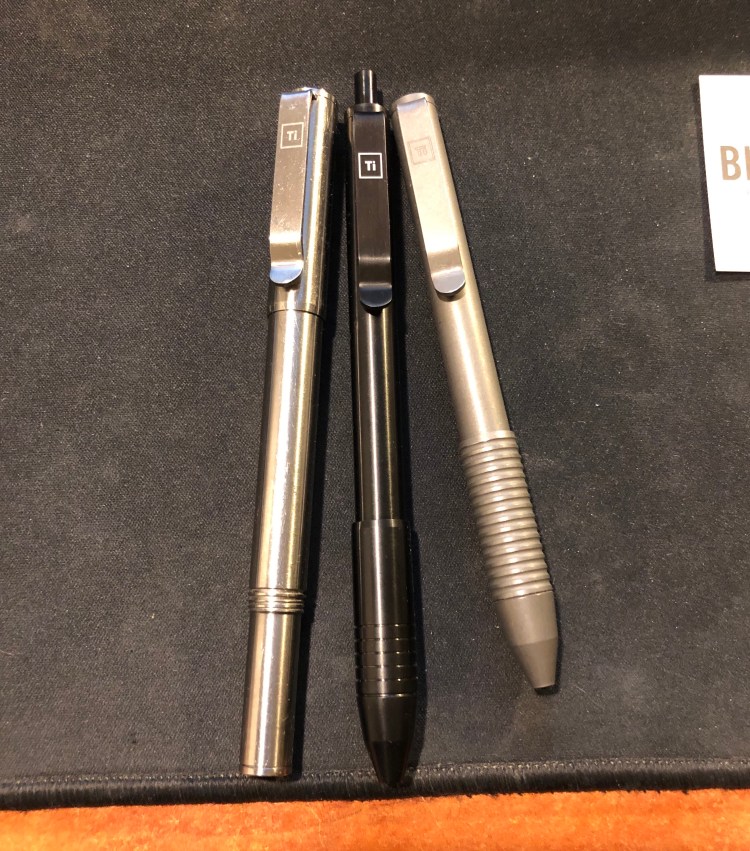
The pen itself is about the length of the Ti Arto, when the Ti Arto is capped, but the grip is much wider, about the size of the Ti Pocket Pro. That’s a bit large for an EDC pen, and it’s definitely not a pocket pen. The grip feels weird at first, but it’s very comfortable and well designed. You can see how the Ti Click EDC compares to the Ti Arto (on the left) and the Ti Pocket Pro (on the right) in the various finish options that the Ti pens come in (machined raw, midnight black, and stonewashed). My machined raw Ti Arto shows scratches much more than my stonewashed Ti Pocket Pro, but I’ve no idea yet how the midnight black finish wears.

This brings me to the only minus that the Ti Click EDC has – the click mechanism. It’s silent (no satisfying click), which will probably turn off those planning on using it as a fidget toy, and it doesn’t always engage properly. It’s especially prone to not engaging after you replace the refill. Make sure that you use the provided instructions to switch refills (and like other BIGiDESIGN pens this one accepts dozens of refills without using any spacers or requiring any special hacks), and take into account that you might have to fiddle with the grip a bit until most clicks work. This is not a minor drawback, as the whole point of the pen is its click mechanism. It should work 100% of the time and feel satisfying, not “soft” as it feels now.

For the price of the Ti Click EDC you could buy a Ti Arto (still their best pen), or a Ti Pocket Pro (if portability is super important to you), have some change for a bunch of refills and get a much better pen. I love supporting BIGiDESIGN and I’m glad that I got to try this pen, but for now it looks like the Ti Arto will continue to reign supreme in my rotation.

Update: After using this pen almost exclusively for a week, I stand by my first impressions. It’s slightly more comfortable to use in long form writing, but the click mechanism is garbage.

Update 2: The BIGiDESIGN guys contacted me and it turns out that you can significantly improve the click mechanism with some silicone grease. Using the clip fixing kit that came with the pen and their simple instructional video on how to use it you can get to the click mechanism, and then apply some silicone grease, which you can buy at Goulet Pens for example. I happened to have grease around, so I had no problem trying this out, and it fixes the problem of the click mechanism not engaging properly.

The click is now solid, but it’s still not much fun to use – there’s no satisfying click or solid feedback once the thing is engaged. You just push past a point, and then the mechanism partially bounces back. It’s a disappointment because most $2-3 pens have more satisfying click mechanisms and even Karas Kustoms EDK pen, which has a similar click mechanism, offers more feedback and an audible click once it’s engaged.

I don’t know how many Ti Click EDC pens were affected by this problem, and I’m glad that I have at least a “mostly OK” click mechanism for my pen now, but I stand by my initial review, that for a pen that advertises its click mechanism so prominently, this is not a great buy. Spend your money on the Ti Arto, it’s a pen worth having, or go for the Ti Pocket Pro if you’re looking for an EDC pen. Those are truly great pens, while the Ti Click EDC is OK to “sort of good” at best.

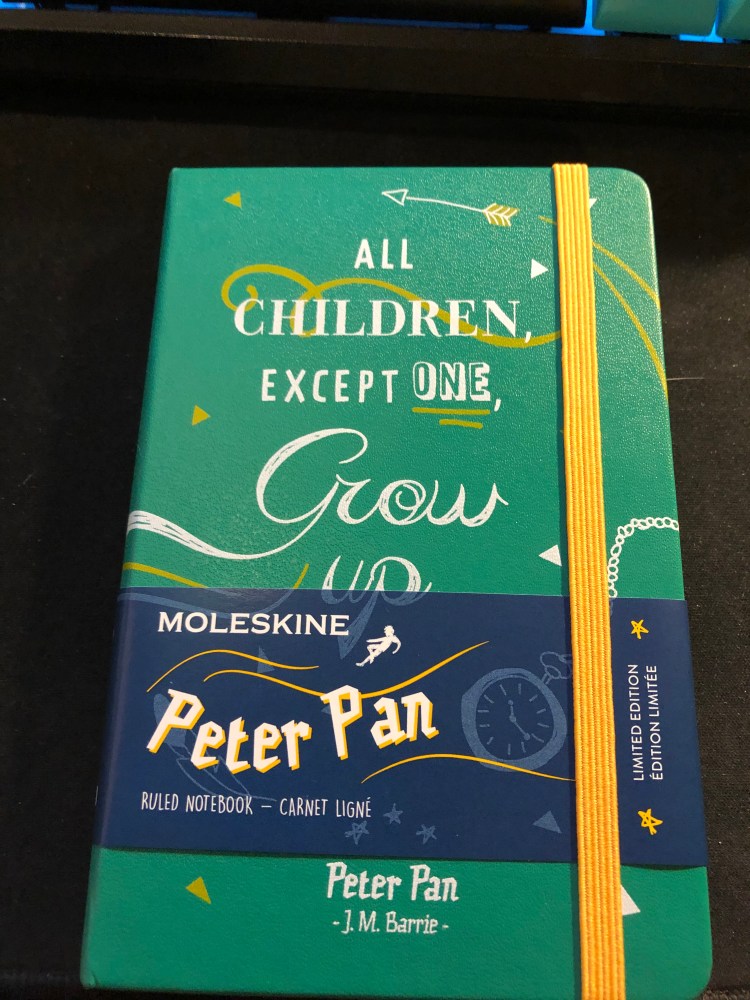
“Triggers” Daily Questions and a Moleskine Pocket Peter Pan Limited Edition review: All Children, Except One, Grow Up.

Ever since I’ve read the book “Triggers” by Marshall Goldsmith about six months ago I’ve been searching for ways to track the progress of my Daily Questions (“Did I do my best to…”). I tried using my journal for several months, then used a Google Sheet for two months, and in both cases something was missing. The Google Sheet was great for statistics and tracking, but not as satisfying and meaningful as writing my daily scores down (and I didn’t really find the statistics useful). The journal was much better, but as my goals changed it was time consuming to create a new table each time, and I needed a way to for me to justify my daily scores.

Enter tracking system number three: a Moleskine pocket Peter Pan limited edition notebook and an index card. Let’s start with the notebook:

The Peter Pan Moleskine limited editions showcase some of Moleskine’s best design work in recent years. Both the colourful covers, the drawing and the lettering evoke the spirit of Peter Pan without resorting to Disney-esque tropes. They’re naive without being childish, colourful without being brash, and the quotes on the covers are brilliantly selected.

Inside the covers are more illustrations in the same vein and even the famous “In case of loss” is set in a hand lettering like font. The palate of the entire Peter Pan line is limited (navy, orangey-yellow, green and white) but it never feels that way.

The back cover. Again, extra points for aligning the design so well with the back pocket. It almost seems like they’re flying into it:

This edition comes with stickers that are a lot of fun and well drawn in a naive style:

And the B-Side of the sleeve instructs you on how to build paper planes and also uses quotes from the books or that reference the book:

So that’s the review of the notebook itself. I highly recommend all of the Moleskine Peter Pan notebooks — they rank alongside the Denim and some of the Harry Potter limited edition notebooks as my favourites of recent years. I didn’t buy it specifically to try to use it as a Triggers Daily Questions tracker, but it was languishing in my “to use” pile and a used notebook is better than an unused notebook, so I decided to give it a spin.

The idea of writing down my Daily Questions each time was what made me stop using my journal for this purpose in the first place, so I decided to write them down once on an index card (which I would slip in the notebook’s back pocket), and then number each question, and date the card. Every day I would write down a score for each daily question, and a very short justification for the score. The justification is short to make it easy to write them down (if it’s a hassle I’ll have a hard time sticking with it), and that’s why I chose the pocket notebook (it’s also light and easy to carry around). When I feel like I need to change the questions up, I’ll create a new index card, put an end date on the old index card and archive it in the notebook’s back pocket. Every day will be dated in the notebook, and I use the appropriate index card if I really want to reference that particular day in the future. This may seem a little clunky for reference purposes, but as I learned over time, I don’t really go back to reference my past answers, so that’s not a meaningful setback.

I’ll check in a few months and document how it goes, but judging by my previous experience, this looks like a pretty good setup for now.

Kaweco AC Sport Carbon Fountain Pen Review

After reviewing the Moleskine James Bond Carbon it was only natural to review my recently acquired Kaweco AC Sport Carbon fountain pen, so here you have it:

I’m not a huge Kaweco fan, mainly because their practically non existent filling system makes using them something of a pain. Cartridges are sometimes very useful (especially when traveling), but I generally prefer a cartridge based pen to accept converters as well and Kaweco’s Sport converters are a joke. They are difficult to fill and hold less than a drop of ink, and oftentimes come loose, so they’re basically terrible. Kaweco seems to be aware of that because they also make them difficult to obtain. You really have to want the pain to experience it (and believe me, you don’t. Save your money and buy yourself several cups of coffee).

So what possessed me to buy this pen? It’s pretty. There, I said it. That red, that carbon fibre — this pen is basically a Ferrari in pen shape: gorgeous and not very practical.

Look how pretty it is!

The nib is smooth and I was luck enough that it worked well out of the box. I’ve had mixed success with Kaweco nibs, so unless you’re comfortable dealing with baby bottom or flow issues I’d test the pen before buying.

The nib is also pretty handsome, and in this case a Fine, which is closer to a Japanese Medium. I got this pen on a closeout sale in a local art supply store so I lucked out on the nib, since you usually find Medium nibs in non-specialist stores.

I had a bunch of Diamine ink cartridges lying around, so I popped one in and gave it a spin. Here it is with Diamine Woodland Green, a very nice, well behaved ink with some shading:

The pen has a metal body but is not heavy. It can only be used capped (I have tiny hands so trust me when I say this), and despite its pocket size and rugged build, I’d never trust it, or any other fountain pen, in my trouser pocket. That way horror stories of stained pants lie.

Would you enjoy this pen? If you like the aesthetic, and are willing to compromise on ink cartridges, a steel nib and the price, then yes. If you’re looking for a daily workhorse or a practical pen, buy several Pilot Metropolitans, Lamy Safari’s, TWISBI ECOs or even a Lamy AL Star. This is a Ferrari pen — beautiful, frivolous and fun.

Moleskine James Bond Carbon Limited Edition

Dun da da da dun, dun dun dun, dun da da da dun, dun dun dun, DA DA, dun dun dun!

It’s the Moleskine James Bond Carbon Limited Edition and it is charming, it is sophisticated, it is elegant, it is everything you know James Bond has to be.

The cover has a carbon fibre like pattern and texture to it, and this time it’s all over the cover.

Moleksine went all in on the understated look this time, and just embossed the 007 logo on the cover, instead of gold foiling it. It’s the right choice in my opinion, and works well with their own embossed logo on the back.

So much texture…

The Moleskine logo isn’t as deeply embossed as the 007, which makes it half disappear in the texture of the cover, another good design choice on their part.

The endpapers, sleeve and stickers are exactly the same as the Moleskine James Bond Titles Limited Edition, but they’re slick, so I’ll photograph them anyway.

Front endpaper with the world map which I love so much:

Back endpaper with the titles design, another win, and yes, the back pocket print is aligned with the back cover print, so extra brownie points for that Moleskine:

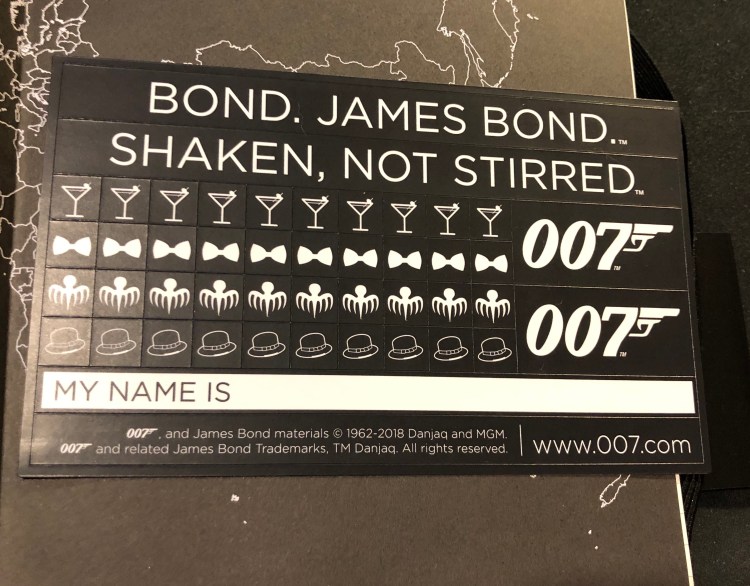
The stickers:

And the B-side of the sleeve:

The only flaw in this edition seems to be in the spine, which creased because of the texture of the Carbon design. It’s far from a deal breaker and I would normally not even mention it, but there is a possibility that it may break there over use. Only time will tell if it’s just a slight aesthetic thing, or if it’s a real design flaw.

So, should you buy this notebook? Yes, even if you aren’t a die hard James Bond fan. There’s no notebook I know of that managed to pull of such a cool texture without making it feel super cheap and plastic-y. It’s a notebook that you can carry at work and will look completely professional, and also one that will be fun to use as a personal journal, a travel journal, a project notebook, or on your next secret mission to outer space.

Moleskine James Bond Titles Limited Edition

Moleskine recently came out with three James Bond themed limited edition notebooks, and after a bit of scrambling, two orders that were cancelled on me, and a bit of trouble with the post office I finally got them. To be honest, if I had that much trouble getting any other recent Moleskine limited edition, I would have probably given up already, but this one is special, for two reasons. The first and main one is my dad. He introduced me to James Bond, we watched all the movies together (some on TV, the later ones in the theatre), and it’s our “thing”. The second one is that I have a thing for maps, and once I saw the map on the endpaper, I knew I had to have them.

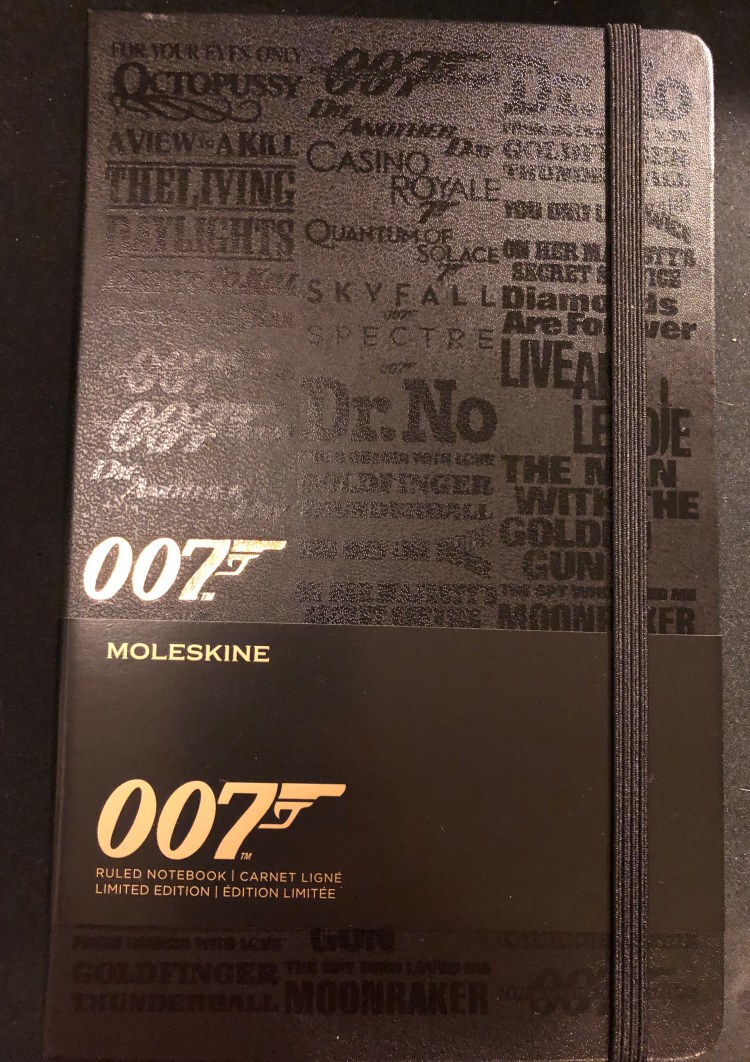
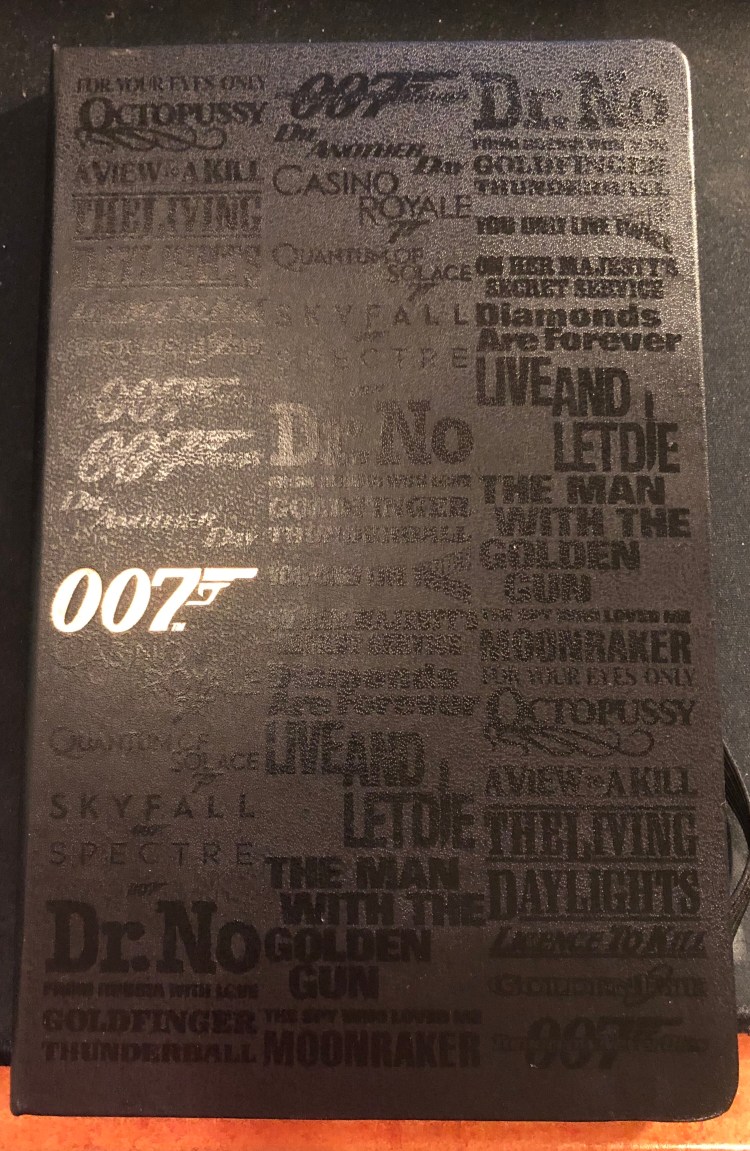
All three large notebooks are pretty great, but the Titles edition is probably the weakest among them. The front cover (and only the front cover) has a print of shiny black on the usual matt black of all the James Bond title logos. It’s so interesting seeing them together, with their various fonts and embellishments . It’s also hard to photograph because the gold 007 embossed on the cover of all three editions reflects so much light. Shiny!

But there are two minuses here: one, the design doesn’t wrap around the notebook, it’s only on the front cover, and two, the titles only appear to be embossed, in reality they add no real texture to the notebook. This is such a shame because the other two notebooks in the series, the Carbon and the Box Set are so very tactile. It takes this notebook down several pegs, from the “great” to the “just OK”. It’s on par with the Star Wars Ships and Lightsaber Duel editions for me. Another very good edition that missed becoming excellent by so little that it becomes mediocre.

Everything else about this edition is stunning. I love the map, and the idea of having it there and tying it to globetrotter Bond through the B-side of the paper sleeve around the notebook (keep reading, I’ll explain it all later on). You could easily use a white pen to mark your own travels if you are planning to use this as a travel journal.

The back end paper is also great, with the titles cover design printed on it. Can you imagine now how much better this notebook would have looked like if it had this design on the spine and back cover too? Embrace the typeface, embrace the titles Moleskine!

They do get extra browny points for aligning the pocket with the type on the endcover. That is not something trivial to do, and it gives it all a nice touch.

Like most Moleskine limited editions, this one comes with stickers which are pretty understated, and would probably come in handy if you’re planning to use this notebook as a personal or a travel journal.

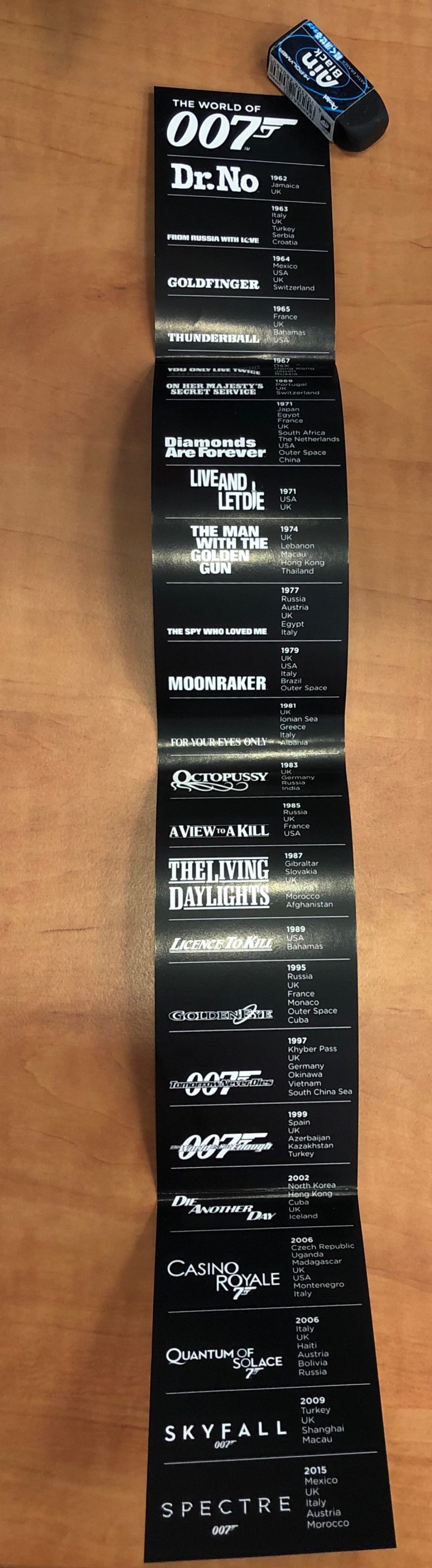
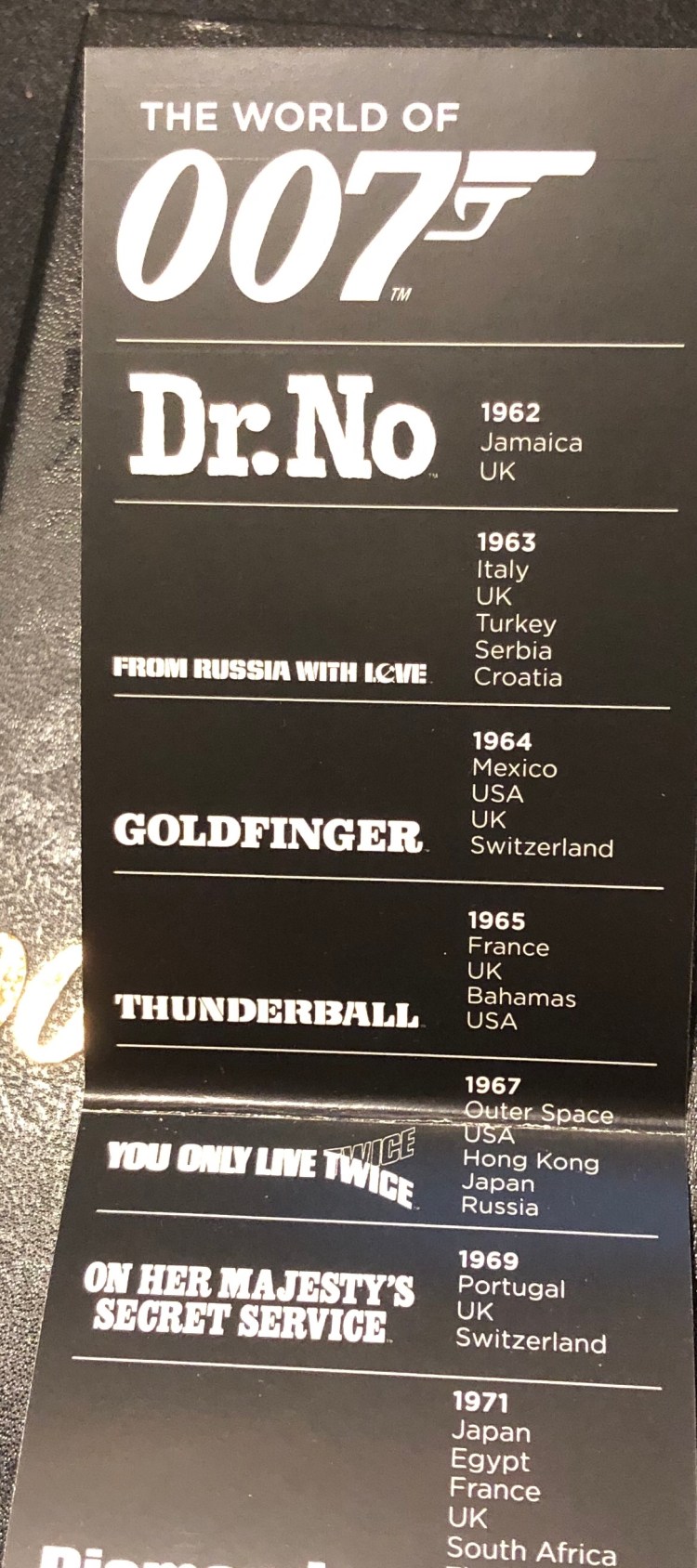
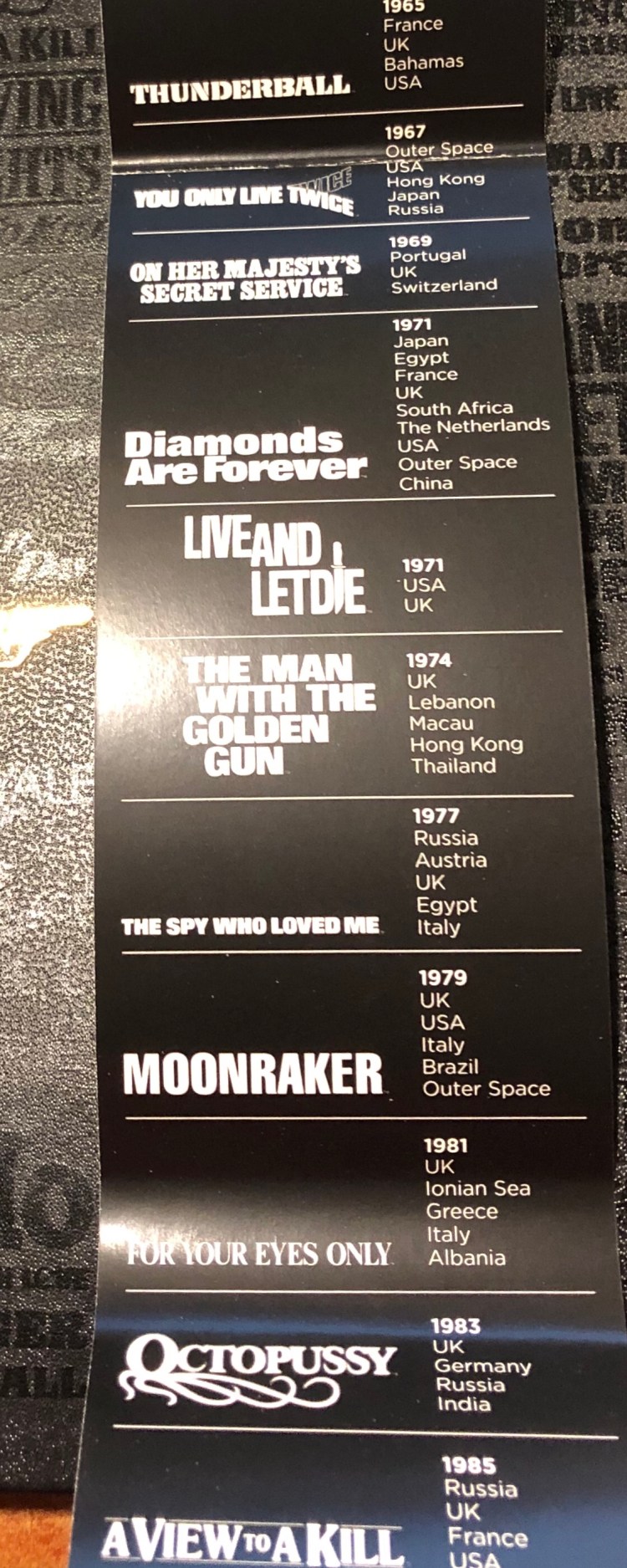
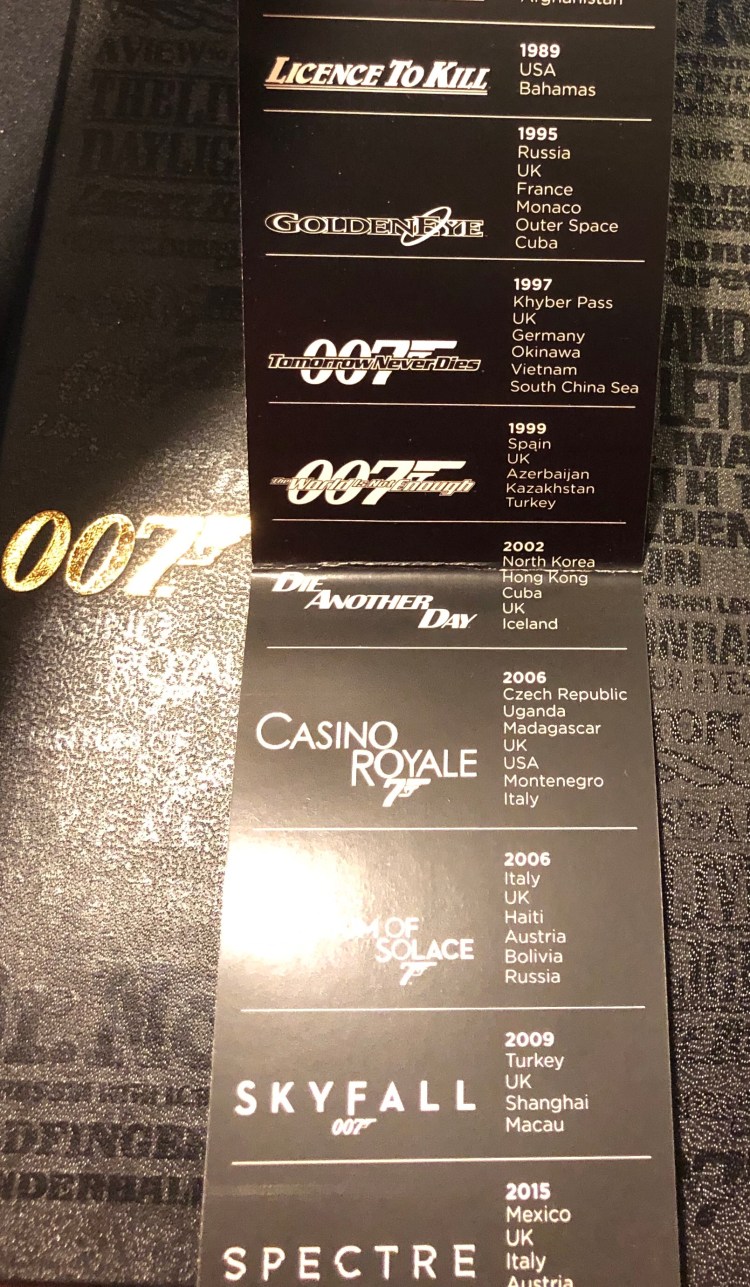
Remember the map on the front endcover? Well if you’re a huge James Bond fan, you can mark his travels on that map using the B-side of the sleeve. It has a list of James Bond film titles printed on it, with the date it came out on and the places the movie takes place in printed on it.

So, should you get this notebook?

If you’re a James Bond fan, then yes. If you’re looking for an interesting travel journal or a gift for a cool dad, then also yes. If you’re just looking for an alternative with a twist for your run-of-the-mill Moleskine large hardcover notebook, then I’d recommend the James Bond Carbon for a more understated but unique look, or one of the more colourful limited editions that Moleskine has issued lately.

Wait, what about the paper? It’s the same Moleskine fair of recent years. Expect significant ghosting and some bleed through to the other side of the page, no spreading but a little bit of spidering when using fountain pens, and a very smooth surface that may cause darker pencils to smear. It’s great for ballpoint, gel pens, highlighters (no spreading!), and certain kinds of fountain pen ink (Noodler’s black, Waterman Blue and Blue Black, and too many Diamine inks to list. Avoid J. Herbin and other watery inks like the plague) with medium or finer nibs. I don’t mind the ghosting (it’s the same as on Tomoe River Paper) and use both sides of the page, but that’s obviously up to you.