My New Weekly Review Format

I previously discussed how I plan my quarter, my week and my days, but there’s another side to planning: reviewing. The goal isn’t to set out a plan, then attempt to follow it and disregard any successes or failures in the process, but rather to take the time to figure out what tweaks and changes need to take place for your plan to work better for you. And remember – the plan works for you, you don’t work for the plan.

I’ve tried various review formats over the years, some were more successful than others, but here’s what I’ve come to realize: the weekly review is more crucial to the success of a quarterly plan (a 13 week year) than a quarterly review. I still perform a review of the previous quarter before planning the next one, but the weekly review is where the keys to happiness lie.

After a good amount of trials and errors, here’s the weekly review format that I’ve been using over the past few months and that has been working:

The weekly review format
  • What Worked – this is where I write down things that I did differently (first priority), consistently (second priority) and well (third priority) during the past week. The focus is things that I can learn from to take with me to the next week and to weeks following it.
    An example from the past week: I changed my running form, and had a faster series of runs that also felt better. This change required effort, but the results mean that it’s something I want to keep doing. The effort was worth it and it’s something that I want to emphasize for next week’s plan.
  • What Didn’t Work – this isn’t an opportunity for me to beat myself up. The point is to notice where my plans were too ambitious and need refactoring, where the context changed and my plan lacked enough flexibility to account for that, and where I need more infrastructure. What’s infrastructure? It’s the things you do ahead of time to help you build up consistent success: plan the next day every day, put reminders for everything, set out clothes for tomorrow (particularly exercise clothes). Have present you help future you make the decisions you want them to make.
    An example from the past week: I did not do well with my social connection goals. I didn’t take into account the fact that I had several busy evenings that week, and so ended up not making the calls that I wanted to make. I was more careful to add time for morning phone calls and visits into my schedule, and I cut down on the number of calls that I planned on making, which made this week much better. Context is crucial when planning. (Yes, you need to schedule these things and not do them spontaneously because otherwise you won’t do them. You’ll tell yourself that the Like on the Instagram post counts as staying in touch with your friends. It doesn’t. It counts for a billionaire’s bottom line.)
  • One Win – this may seem redundant, as the “what worked” is there, but I still think that this is important. We don’t take the time to celebrate our wins, even tiny ones, and then we feel depressed and go on shopping sprees, social media binges, etc to get a bit of a dopamine hit. Even if your week sucked, there was something in it worth celebrating. I try where possible to make it something that I did, but sometimes its something that happened to me.
    An example from the past week: I had a tough conversation with someone at work that ended up in us reaching a compromise that is much better than I thought that I could achieve. We both felt better after that conversation, even though neither of us wanted to have it.
  • One Challenge – this is something that I learned this week that is worth gearing up and preparing for. It’s a chance for the “anxiety” character in your mind to be productive in a safe environment. I don’t always fill this in, but I want it to be there to let me have space for this if I need to. An example can be feeling like you’re about to be come sick or are maybe are on the verge of an explosive situation at work or at home. This is a chance to note it, figure out if it’s a real challenge or an imagined one, and prepare to avoid it or deal with it.
    A past example: I felt a shoulder strain coming on, so I changed my training days and exercises around. Another example: I talked to my boss about my need to have a bit more variety in my work after I realized that I was getting progressively bored with the tasks that I was given.
  • People of the Week – so important – this is for people that made your week or that you want to particularly remember after the week you’ve had. They can be friends that came to your rescue, colleagues that made your day, family members that were there for you, or mentors and heroes that helped motivate you. I try to make it people that I know personally and not figures from the news or celebrities. No examples here, as this is too personal.

I write this review on Friday or Saturday in my regular journal, longhand. I then check if my weekly plan needs to change due to it. It takes me about 30 minutes, because I spend time thinking about it. Focusing on the wins and positive people in my life, working to continue with the successes and mitigate the failures, and looking with clear eyes and a level head to the challenges ahead helps make me happy. That’s the point of these reviews, and that’s why I do them.

Do you do a weekly review? What format do you use?
How I Plan a Quarter: 2025 Q1 Plan (13 Week Year)

It’s the beginning of January, and usually at this point people’s resolutions are starting to unravel. For years I used to do yearly goals but over 2024 I moved to using a 13 week year, or quarterly planning model. It affords me more flexibility and seasonality in my planning, and it’s a good, low stakes way to start long term planning and goal setting if you’ve never done it before.

There are those that say that you should go on a retreat to plan your year or quarter, and I’m sure that’s nice if you can afford to do it but unfortunately I can’t. What I do instead is take some time in the weekend before the end of a quarter to plan the next quarter, and this is the process I go through, step-by-step.

How I Plan A Quarter

I start my planning on a piece of scrap paper, sitting with my calendar, and start mapping out what big block of “stuff” I have next quarter. In particular I take Travel into account at this point. If I have a trip planned, then it means that I will have less time for non-trip related stuff this quarter, and I need to realize that I have less than 13 weeks to work on the rest of my goals. So if I have a week long trip, I calculate that I have only 11 weeks to work on the rest of my stuff. Why 11 and not 12? Because there’s time that will go to trip related stuff before and after I return, and it takes time after a trip to get back into routine.

Once that’s done and I realize how much actual time I have to achieve any goals, I divide my plan into Large Categories.These are areas I want to work on throughout the next quarter, and they generally stay the same from quarter to quarter.

Working Within Categories

The different categories I work on are the backbone of my plan, the basis of the quarter which I flesh out with detail during my planning session. For me these currently are (not in order of importance): Health and Fitness, Reading, Conversations, Mental Health, Creative Projects, Productivity, Professional Development, Blog, Decluttering, Money.

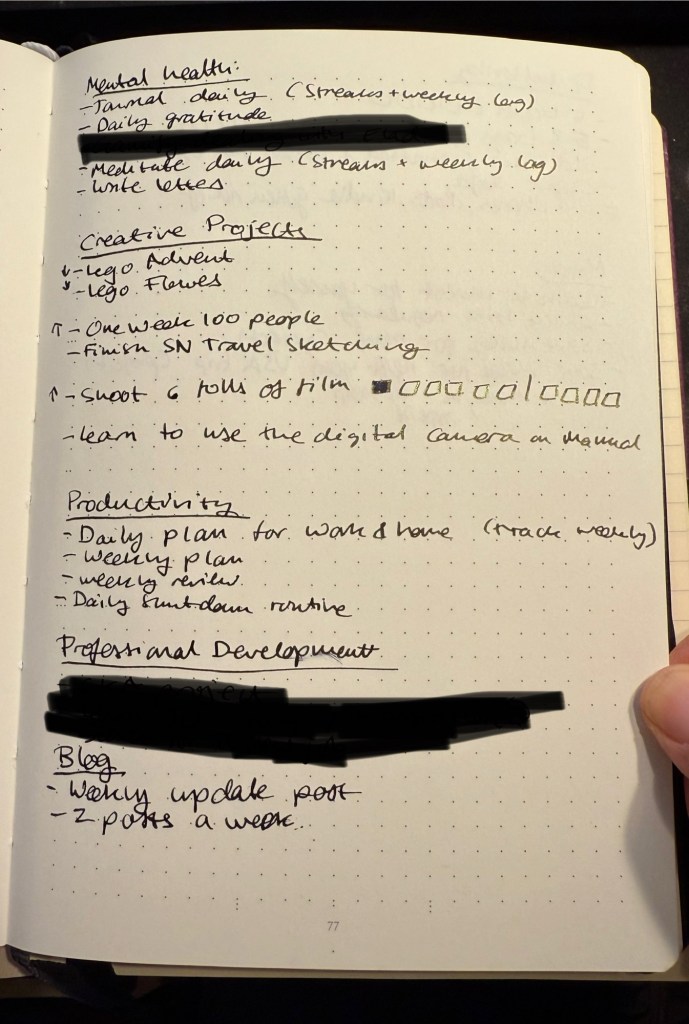
Page 1 of my Q1 2025 plan

I set individual goals for each category, all of them measurable, and this is the plan that I reference at least once a week, usually two or three times.

Wherever possible I set up the Streaks App and/or a tracker for the goals in my weekly plan. This makes sure that 60-70% of my goals are set on “auto pilot” and are included in every weekly and daily plan. I address the rest of my goals either when I plan my week, or not at all.

Wait, what?

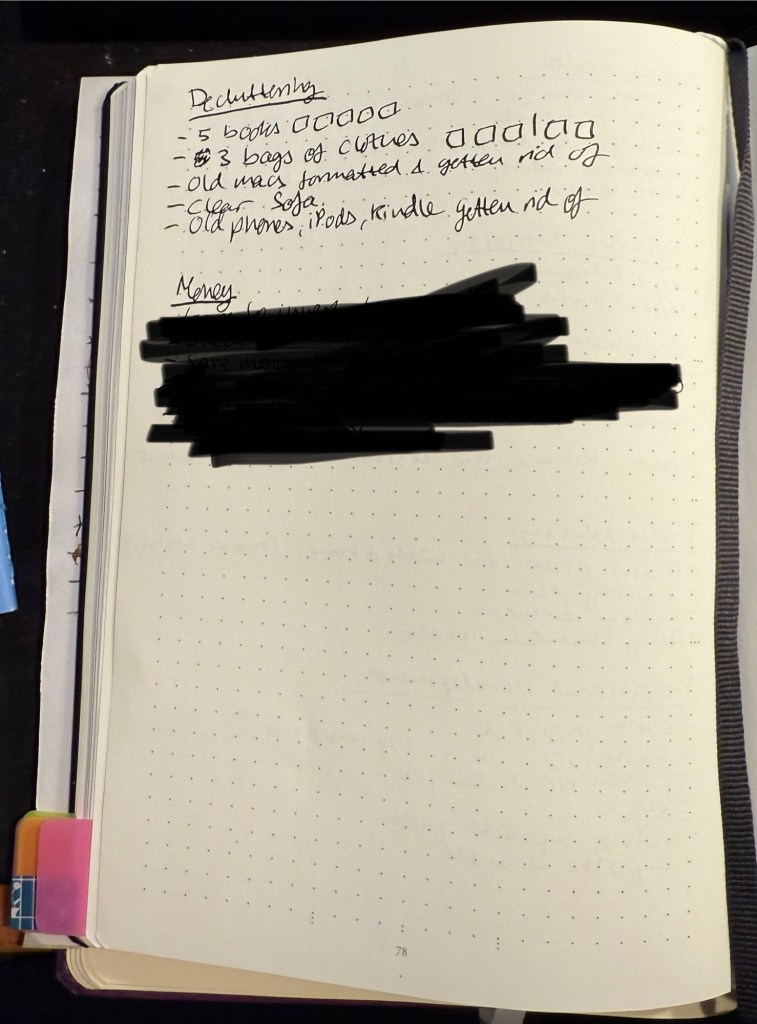
Page 2 of my Q1 2025 plan

I deliberately include goals that I know that I will have to stretch or significantly stretch to get to every quarter. Why? Because I view these goals not just as a plan, but as a call to action, a bit of a challenge. A good quarter is one where I got to 80% of my goals. I great quarter is one where I got to 90% of my goals, and if I ever get to 100% of my goals, then I’ve likely not been ambitious or creative enough when setting them.

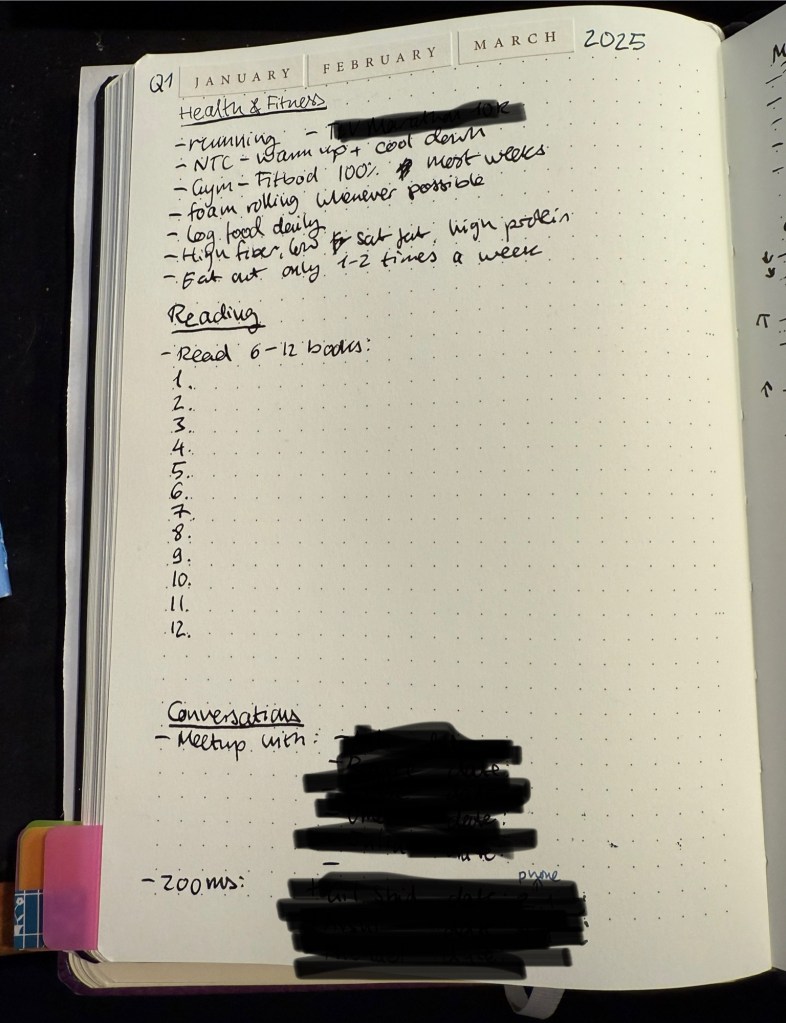
Page 3 of my Q1 2025 plan.

Life tends to throw us curveballs, and so I leave wiggle room in my plan (there are goals that I mark ahead of time as less important, and entire categories that I’m willing to neglect if things get to that), and room to recreate the plan from scratch if the need arises. The plan works for me, it’s a tool that I use, it’s not something that I have to tie myself in knots over. I refuse to beat myself up for missing a goal, because if I missed a goal it just means that:

  1. It was poorly planned.
  2. Circumstances/context significantly changed (a war broke out, a pandemic broke out, a family member or I got non-trivially sick, I got injured, etc).
  3. It was a “stretch goal”.

In this case I expect myself to rethink my goals and what I want to achieve, and replan them.

A bit about my current categories and how I planned out each one:

  • Health and Fitness – the most “auto pilot” of my planning categories and absolutely non-negotiable. I’ve been working with largely the same goals in this category for months and sometimes years, so this is the quickest and easiest category for me to plan. It’s also one where I have the most trackers set up for: there’s a tracker for my running, swimming, gym workouts, NTC workouts and food logging. I use various health and fitness apps that track these, and the Streaks app to make sure that I work on this category daily. As a cancer patient in remission, I am not messing around with my health or my exercise routine. It’s also a must for my mental health, even though that’s tracked in a different category. If possible I try to have a road race to train for each quarter, though usually I only have 2-3 races a year, and last year I only had one. The food logging is something I do to make sure that I’m getting the fibre, protein, calcium and other nutrients I need, and keeping my saturated fat and sodium intakes relatively low.
  • Reading – pretty self explanatory, this category has been with me for years. I try to read between 2-4 books a month, and this reflects this.
  • Conversations – this category is all about having real conversations with people – not just liking their posts and messaging them. I set a goal of meeting certain people face to face for coffee, a meal or any sort of outing, and another for talking with friends that are abroad on zoom. Beyond this I have weekly recurring goals of calling people – usually between 1-3 friends a week. Yes, you need to schedule and track this. You’re busy, it’s easier and less risky to message people and so we stop calling them or meeting up with them, and we trick ourselves into thinking that these messages are the same as having a real conversation with these people. It’s not the same. It’s worth investing time and effort into this, I promise. Even if you have social anxiety, even if you’re very busy. I’m going for a minimum of six 1:1 get togethers with friends, and 3 zoom calls (though I’ll likely get 5-6 zoom calls in).
  • Mental Health – most of this category is automatically tracked in the Streaks app and is part of my daily plan and daily routine. I suffer from cancer related PTSD so I don’t neglect this stuff. If I do the panic attacks return and I physically dread them, so this, like the Health and Fitness category, is a non-negotiable category. It always happens. What goes in here? Journaling, daily gratitude (goes in my journal), meditation, and other things that I may write about later in a separate post.
  • Creative Projects – this is a fun category, and it’s here to remind myself to enjoy my life. It included sketching goals, Lego building goals, photography goals, etc. I try to get at least half the things in this category done.
  • Productivity – this is here mostly as a reminder to plan every day, plan my week, and perform a shutdown routine on workdays so I don’t think about work when I’m not at work.
  • Personal Development – these are professional personal goals, usually tied to learning new skills or obtaining a certain certification.
  • Blog – I used to track this as part of my creative projects, but as I ended up neglecting this blog for a month or two last year, I separated this to its own category so that I can give it more focus. This is tied to a weekly tracker and just tracks the amount of posts I publish a week.
  • Decluttering – lists things that I want to get out of my house over the next quarter. Simple enough.
  • Money – this is a list of money related things that I want to take care of – pension and investment reviews and plans, saving up money for certain goals, reducing certain bills, etc. This is a useful category because if you’re anything like me then this is something that you dread and will put off unless you force yourself to be really on it.

Since I’ve been working with most of these categories for a long time and since many of them are repeatable, much of my planning is just reviewing and copying over last quarter’s plan. The rest of the plan is things that I put a bit of effort into researching before I commit to, sometimes drafting them a few times before settling on my final quarterly goals.

I hope this inspires you to create your own quarterly plan. Let me know if it does and if there’s anything else you want to know about my planning setup.