Day 3 of Inktober is for pelicans, and I resisted the urge and didn’t sketch this pelican with a Pelican. Instead I sketched it with a Kaweco Sport in frosted blueberry with a medium nib and a Graf von Faber Castell turquoise ink cartridge.
Pelican, Animal Kingdom, Disney World, Florida
We have flocks of pelicans passing in the country on their yearly migration, and they are impressively big and impressively loud birds when disturbed. I have a penchant for turquoise and teal inks, so you’ll see quite a lot of this hue during the coming weeks. I like the shade and shading of the Graf von Faber Castell turqoise, so I may yet buy more cartridges once this pack runs out.
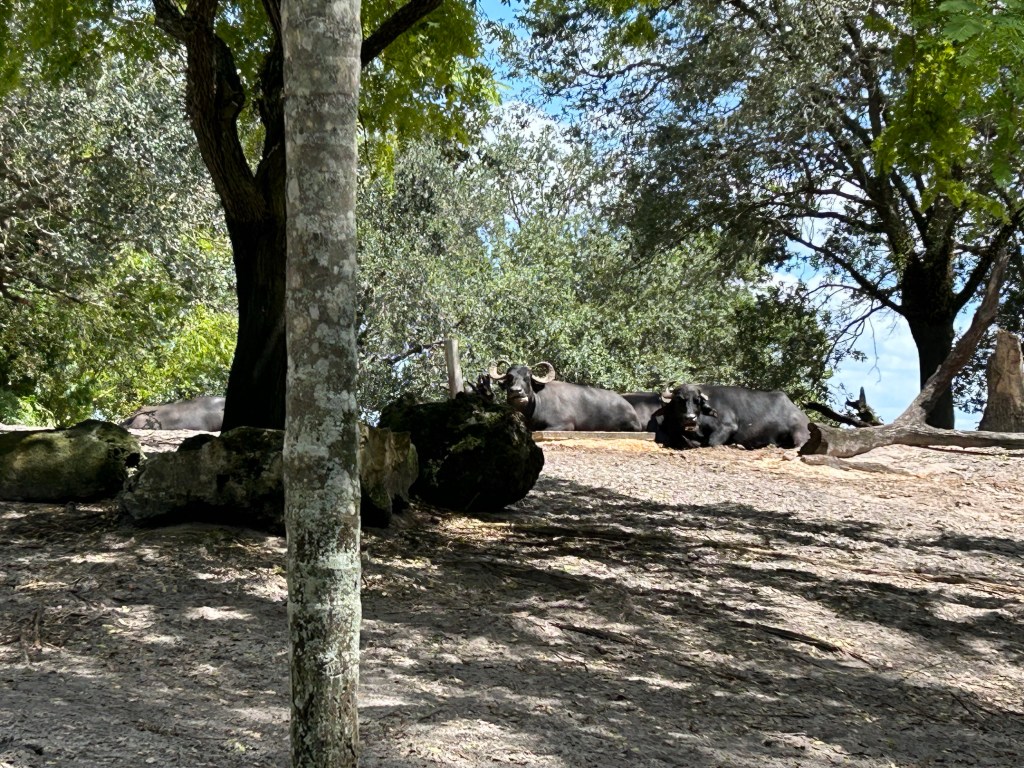
It’s day 2 of Inktober, and it’s water buffalo time. These are big, impressive and pensive beasts that you don’t want to mess with. They were chewing their cud in the sun, keeping an eye on us as we admired them from a distance when we saw them at Animal Kingdom, Disney World.
Water buffalo sketch, Animal Kingdom
I sketched them using a Lamy Safari fine nib and Platinum Carbon ink. Carbon ink lays down a shiny black line that takes forever to dry and so is my least favourite waterproof black fountain pen ink to sketch with (De Atramentis Document Ink is first place, with R&K Sketch Ink Lotte and Noodler’s Bulletproof Black in the middle of the pack). Since I was afraid of smudging the ink, it’s kind of a barebones sketch.
There was a delightful cast member standing nearby, ready to answer questions, and he was a massive Star Wars fan. He clocked my brother and I’s Star Wars Celebration shirts and we started talking Star Wars while standing in front of these guys and gals’ paddock. Of course he got a cast compliment from us (talking to him made our day), and we got to hear about past Star Wars events at the parks from behind the scenes.
The funny thing is that if we would have rushed past their paddock on the way to see the tigers (like everybody else did), we wouldn’t have had this moment and memory, and the tigers everyone was rushing to see decided to hide in the shade anyway.
It’s October and that means Inktober time. This year I’ve decided to participate in the challenge but to do it a bit differently than I did in previous years:
It’s still 30 ink sketches in 30 days. I’m using fountain pens for the entire challenge.
I’ve limited myself to the Traveller’s Notebook airlines edition insert. I’ll post a review of it later this month, but the idea was to deliberately use a notebook that I thought was too precious to use before.
I’m not following the official prompts (as usual). I never liked them, and this year’s prompts are no different.
I’m not posting these to social media. At all. I’ll be posting them here and here only.
Now without further ado, here’s Inktober day 1’s sketch:
Pink giraffes laying down to chew their cud, Animal Kingdom Lodge, Florida.
The giraffes aren’t originally pink, of course, but I sketched them with Pilot Iroshizuku Kosumosu ink and a Franklin Christoph 03 Iterum Sedona Spa fountain pen with a Nagahara fine cursive italic. It’s a beautiful combo, and fine cursive italics are great for getting interesting line variations while sketching with pen and ink.
Traveller’s Notebook and fountain pen.
Giraffes rarely sit down in the wild, as that’s way to risky for them (it takes to much time to get up and run, should they need to). In captivity they will sit down if they feel safe and comfortable, and it’s quite a sight. We saw these two during a night time safari at Animal Kingdom Lodge in Walt Disney World, Florida. Giraffes are suffering from poaching, from habitat fragmentation and from habitat lost, and many giraffe sub-species have only a few hundred individuals left. If you want to help them, the giraffe conservation fund focuses on these elegant and fascinating creatures: https://giraffeconservation.org
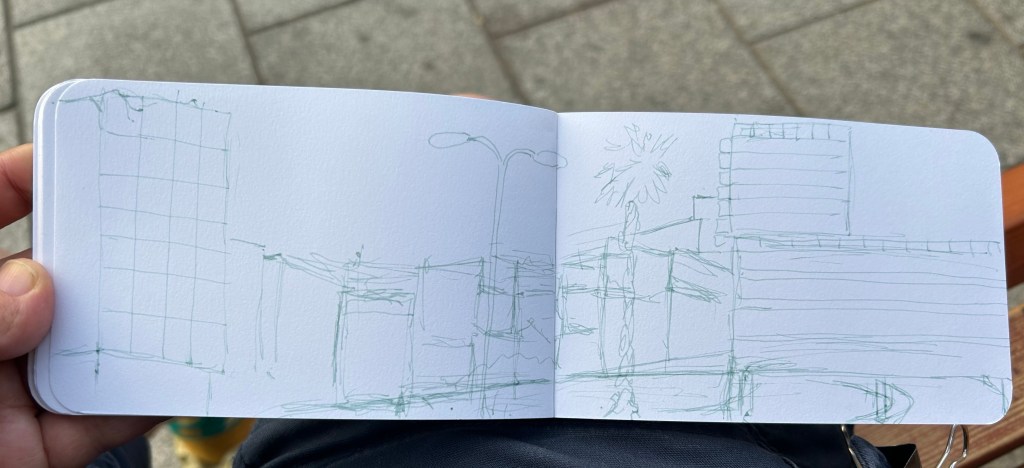
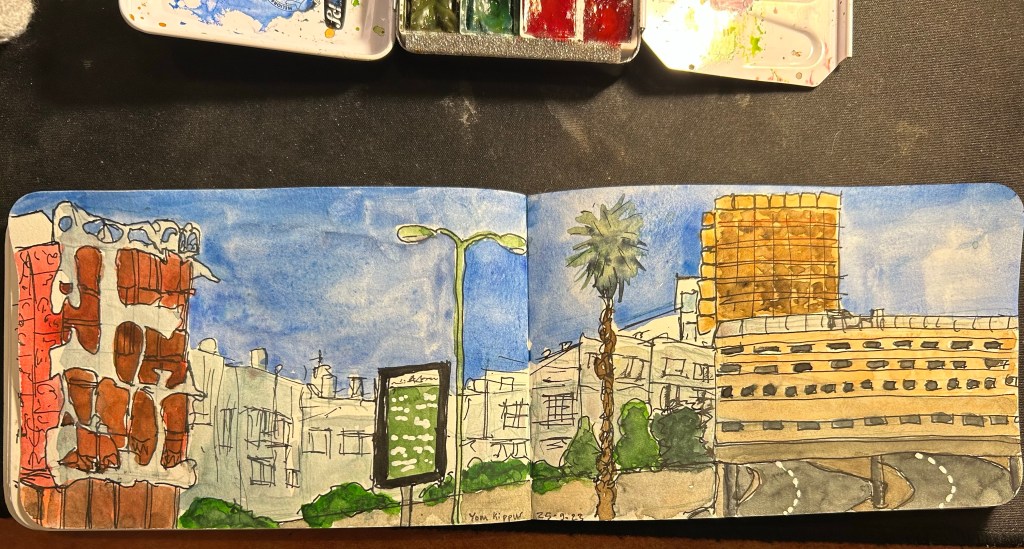
It was Yom Kippur today, a day when no cars drive around in Israel. I took the chance to go outside and sketch one of the most iconic buildings in the area.
I used my Pelikan 140 KEF fountain pen with De Atramentis Green Grey Document ink as an under sketch:
Sketch on Stillman and Birn Epsilon 51/2 X 3 1/2 in. sketchbook
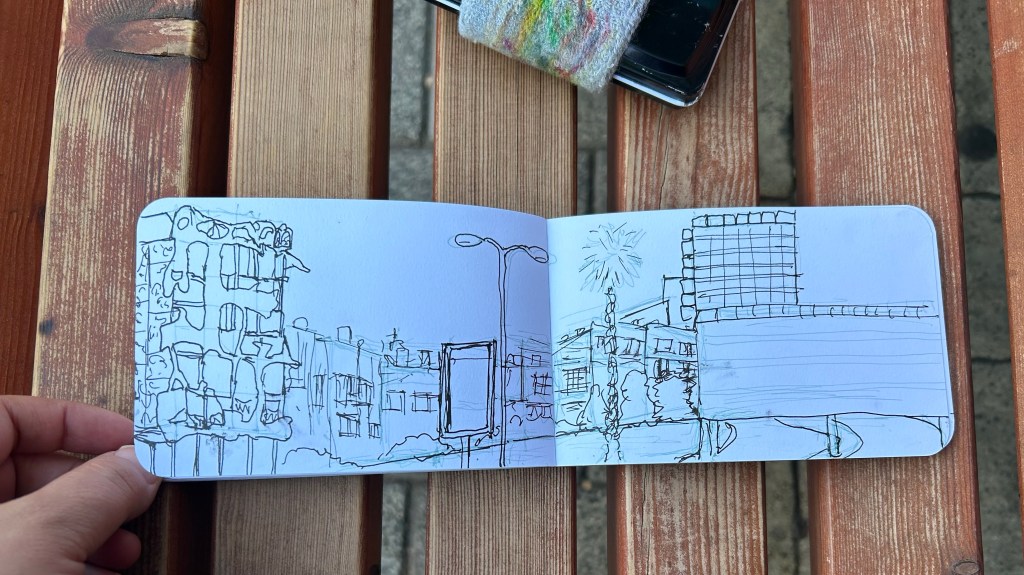
I then drew the line work with a Lamy Safari F nib and Platinum Carbon Black. The ink takes a while to dry, and it smudged a few times.
Line sketch.
It was getting hot, so I finished the watercolour at home:
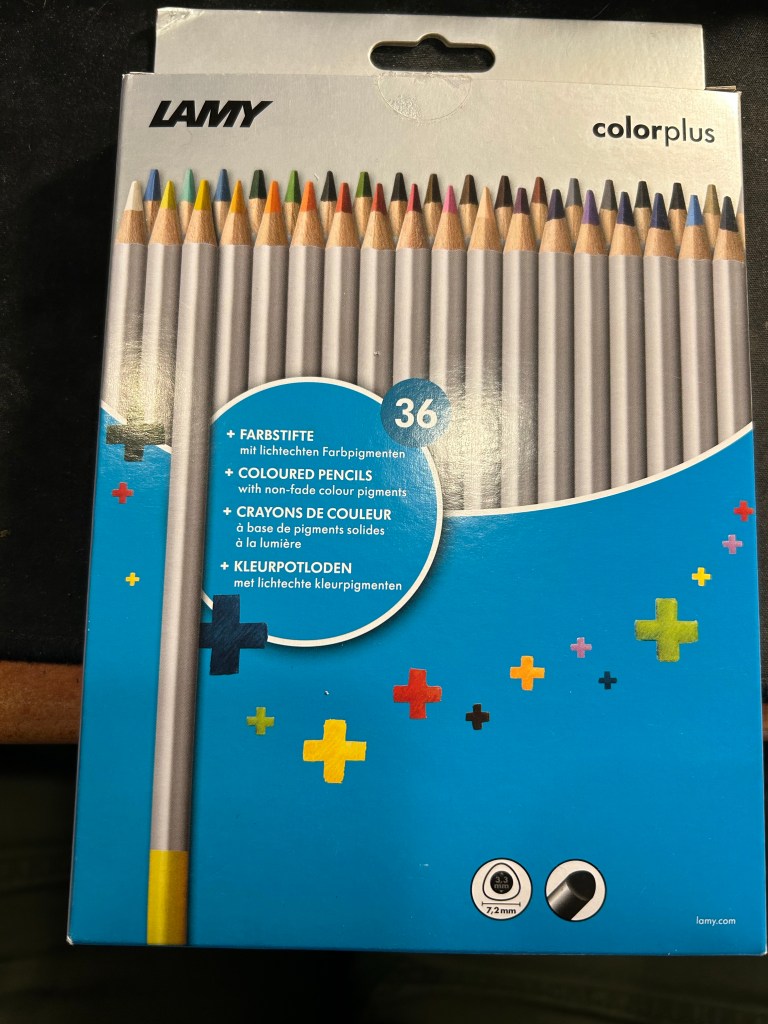
I rarely write reviews that trash products— because I tend not to waste my time and money on products that could potentially be bad. However, I was stuck in Tampa’s airport on a very long connection due to inclement weather and so I browsed their bookstore and found this:
Lamy ColorPlus 36 coloured pencils
Well it says Lamy on the box, so it can’t be bad, right? And it was just $15 for 36 pencils…
This is where the red flags should have popped up, but they didn’t. I bought the pencils.
When I got home and opened the box, my heart sank. The leads were broken on almost all of the pencils. Now the box was in my trolley, well protected from dropping or crushing, so there was really no reason for this amount of damage. I checked the back of the box:
“Highly resistant to breakage” it is not.
The pencils are triangular shaped, which is supposed to make them ergonomic. It makes them more unpleasant to sharpen, as there’s a steep “bump” whenever you turn the pencil to another side.
Triangular pencils
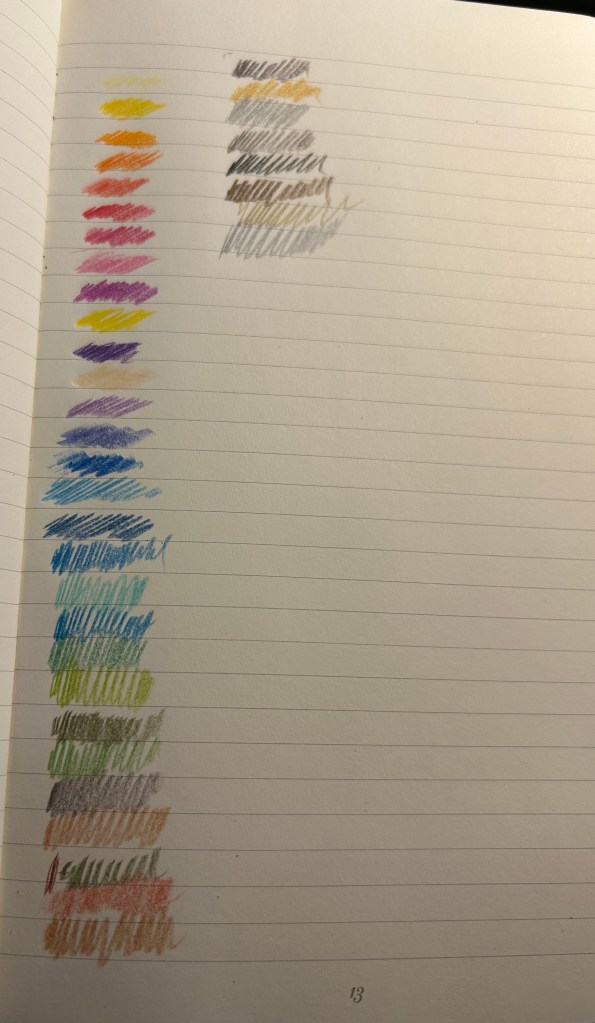
The colour selection is weird — there are a lot of various shades of brown, but no ochre. The browns themselves are nothing like the colours that you’d expect from their labelling. I use the term “labelling” loosely here, because there’s no colour labelling on the pencils, just a dip of colour that is vaguely similar to the actual pencil colour produced.
Pencil samples
The 36 shades chosen are wild – way to many similar brown, not enough greens, too many purples and blues, and of course utterly useless white and the bewildering gold and silver which are neither gold nor silver. Obviously the pencils crumbled while creating these samples so there are some duplicates here.
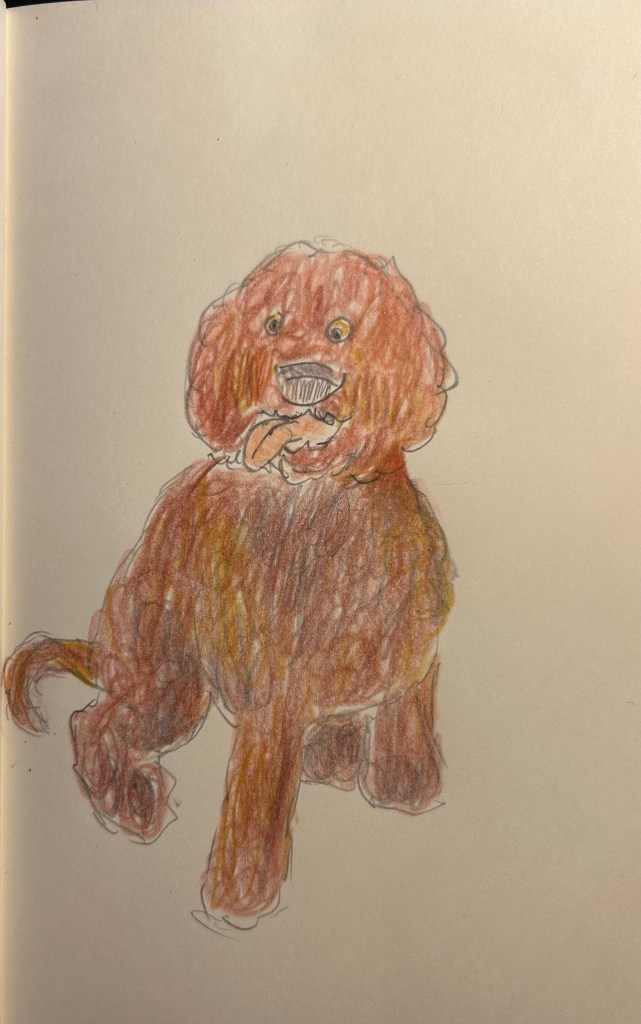
The pencils are very waxy, which means after 2-3 layers maximum the paper will be clogged and subsequent layers won’t be registered. The pencils also crumble easily —- even with very light pressure applied. Creating this sketch with them was nightmarish, as the leads kept crumbling, and I couldn’t get the shades that I wanted to the layering that I was trying to achieve.
Quick dog sketch
I honestly don’t understand why this product exists. It’s too expensive and not robust enough for children’s use, it’s definitely not artist grade (poor pigment, layering and no labelling), and even student grade pencils are properly labelled these days. In any case, save your money to buy better pencils. You deserve them.
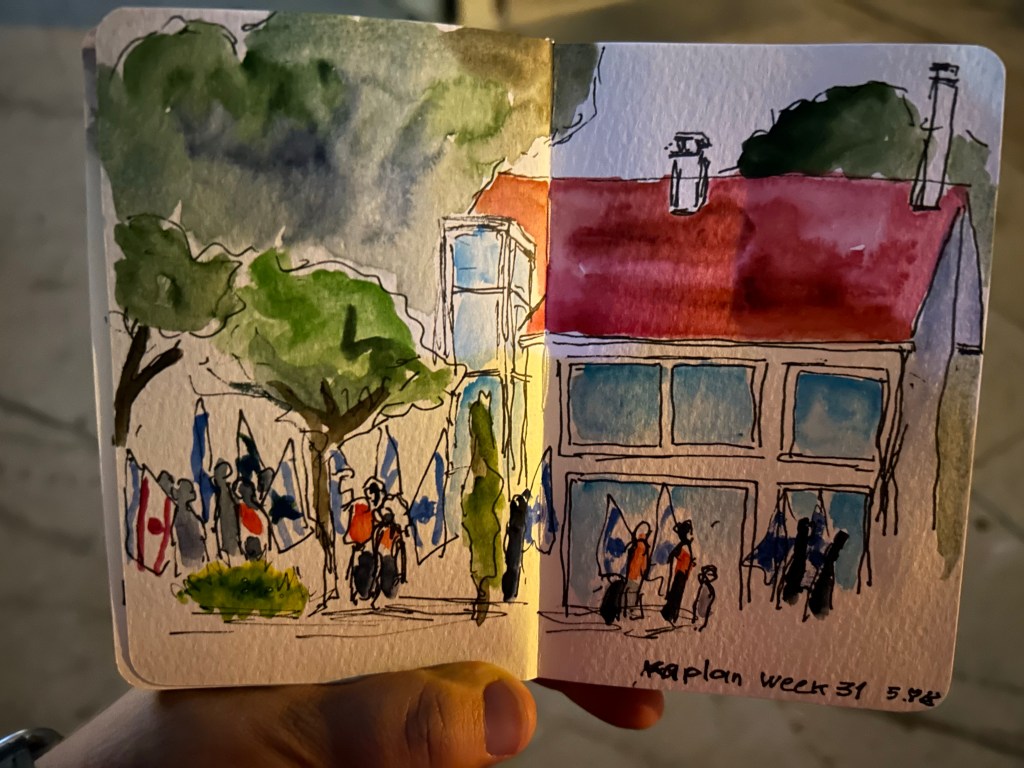
I had a tough week, hence the delay in some posts. I did go to the weekly central protest tonight, despite the terrorist attack earlier this evening in Tel Aviv.
Sketched this very quickly in the dark. Them took a photo of it in the dark, and decided that it captures the moment well.
Have a great week, and if you live in a democracy, don’t take it for granted.
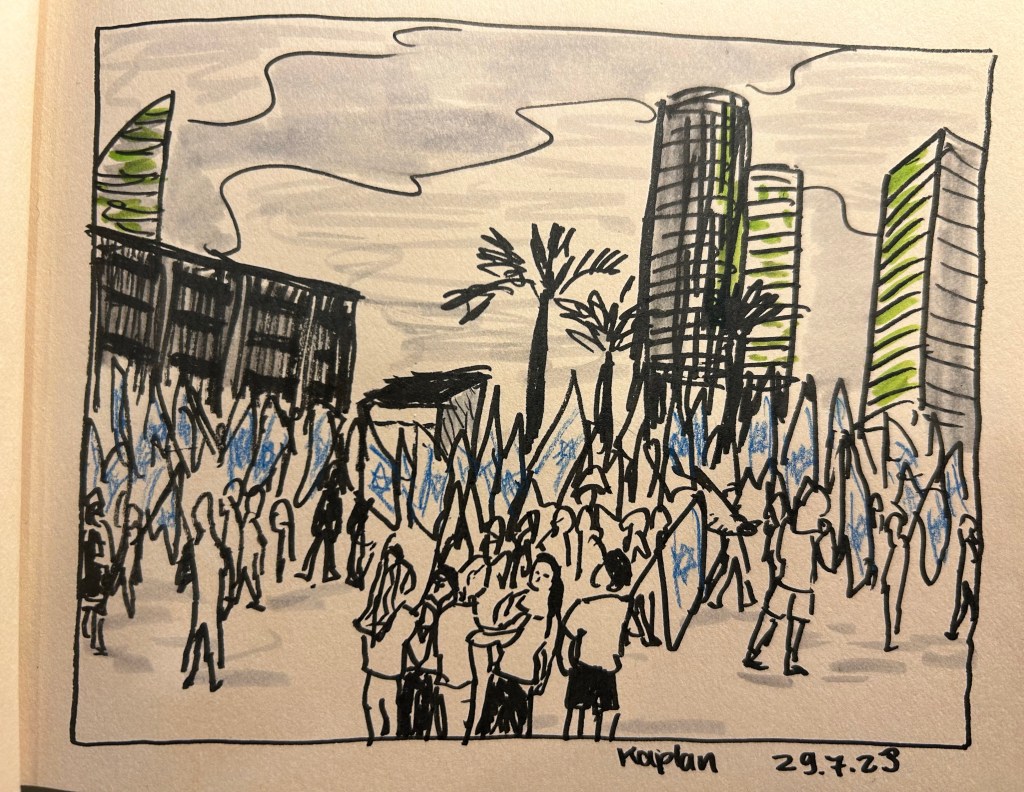
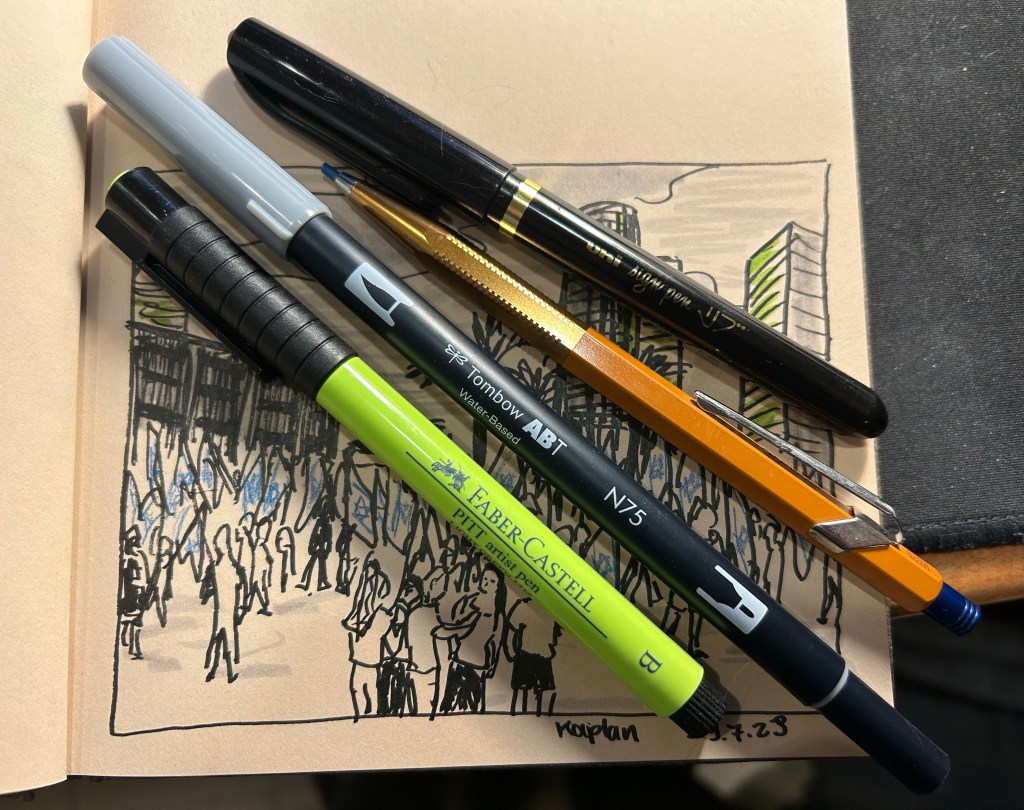
I went “shopping” in my stationery and art supply stash again, and this time used a Hahnemule Cappuccino sketchbook, a uni-ball sign pen, a Faber Castell PITT artist brush pen in light green (171), a Tombow ABT water based dual brush pen (I only used the brush side not the felt tip pen side) in light grey (cool grey 3 – N75), and a Caran d’Ache + Alfredo Haberli Fixpencil with a blue 2mm lead.
protest sketch
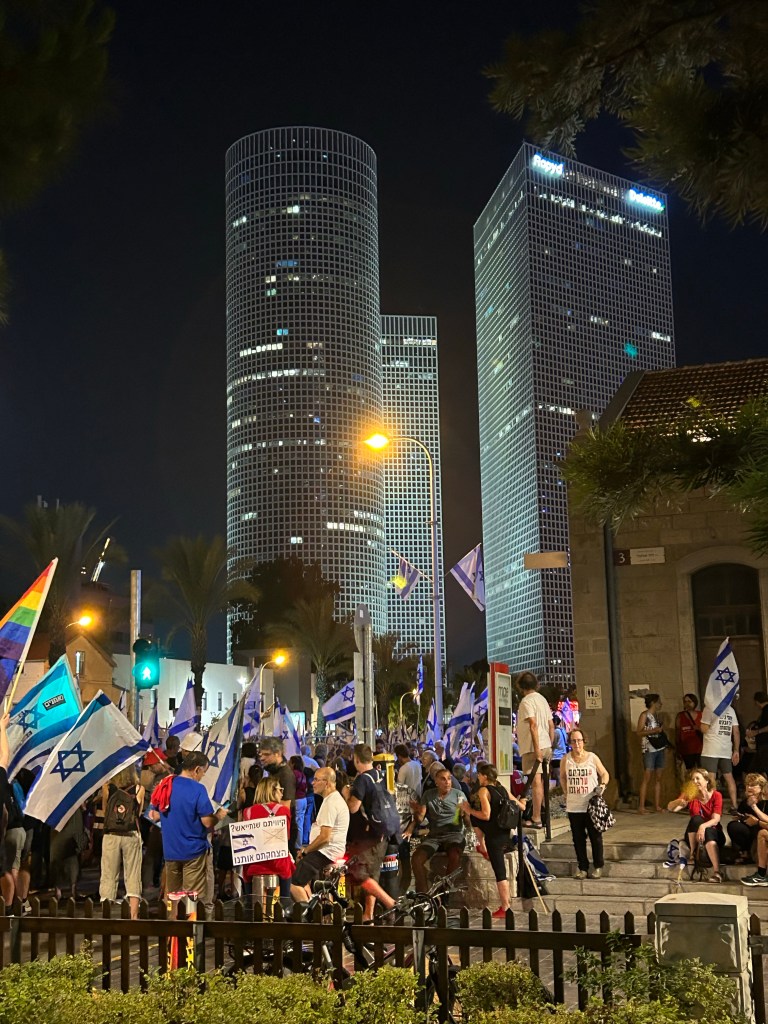
I used them all to draw the protest scene from this Saturday, using a photo I took during the protests. It was intensely hot and humid, and I went to the protests right after running a Dungeon World game at a small local tabletop roleplaying convention. With no art supplies on me, the best I could do was try and capture the scene to sketch later. When I was pulling things out to try out with this sketch, I decided to veer away from my comfort zone: I used tinted paper, a sign pen, mixed media, and an unusual colour. I like the result – for a quick sketch it captures the energy of the moment well.
tools used.
I like the Hahnemule Cappuccino sketchbook. The paper is smooth but has a touch of grain to it that makes it work for pencils as well. It’s way too thin for wet media, but works great for brush pens, pencils, markers, etc.
My main sketching tool was the Uni Sign Pen. This is the first time I’ve used a sign pen for “serious” sketching, as I normally only use them for illustrations that I gift to friends’ kids. I like it – it has relatively little line variation, but on the other hand offers more control, and a good bold line. If you are dipping your toes into brush pens for sketching for the first time, this might be a good place to start to get a feel for the kind of thick lines these kinds of pens create.
The Faber-Castell PITT brush pen is a classic, one that I’ve used many times before in sketches. I’d love to say that they don’t disappoint, but like most soft and medium soft brush pens, the tip doesn’t last for long. They do come in lots of great colours and if you cap them they last much more than many other markers and brush pens in the market. They’re also waterproof, which is a bonus if you’re mixing them with wet media.
The Tombow dual brush pen is completely new to me, and I liked it enough to want to add it to my current sketching setup. It works well for quick shading (and shading and colour make sketches pop).
The Caran d’Ache + Alfredo Haberli Fixpencil… This is something that I want to properly review sometime in the future, so it’s been waiting on my desk for a while. For now I’ll just say that it did the job, although I have other pens and pencils that would have done the job better.
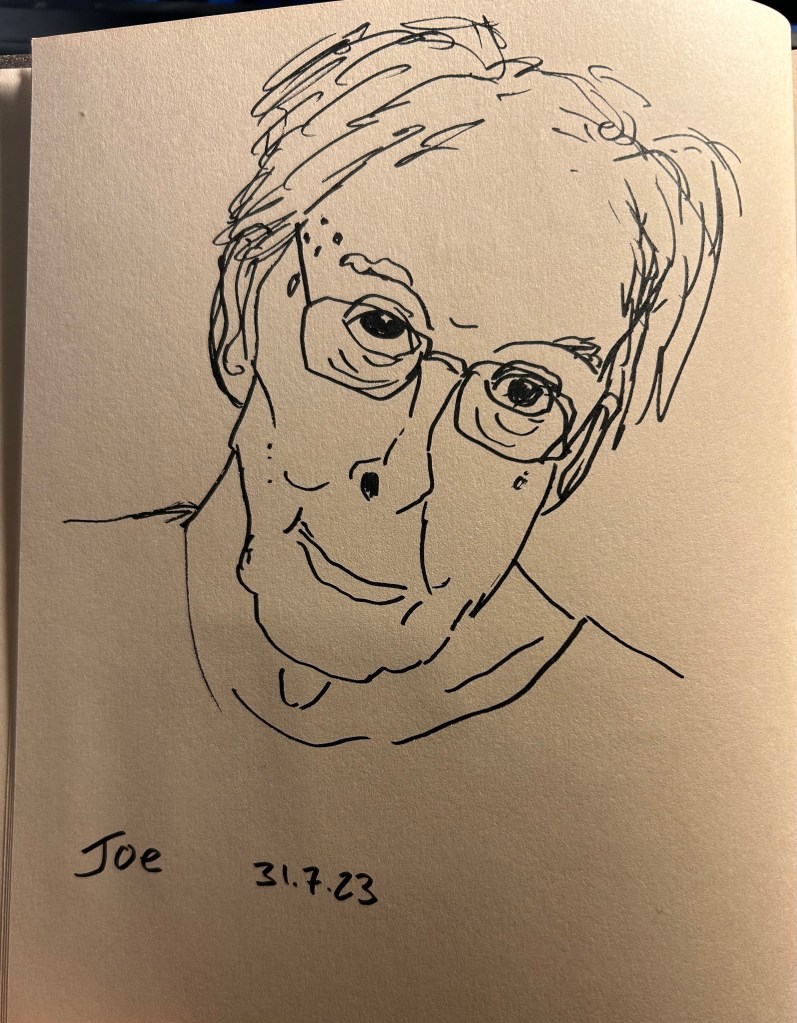
I also sketched our friend Joe during our weekly Zoom meeting, also on the Hahnemule Cappuccino and using the Uni Sign Pen. This was a very quick sketch, done it 2-3 minutes, and the sign pen does well with expressive lines.
Our friend Joe.
Now go rummage in your stationery/art supply stash and find something new to play with. It’s guaranteed to make you smile.