Dip Pens Part 1: Some Basics

It’s been a while since I used my dip pens, and since I had a project in mind for them, I thought I’d document parts of it here.

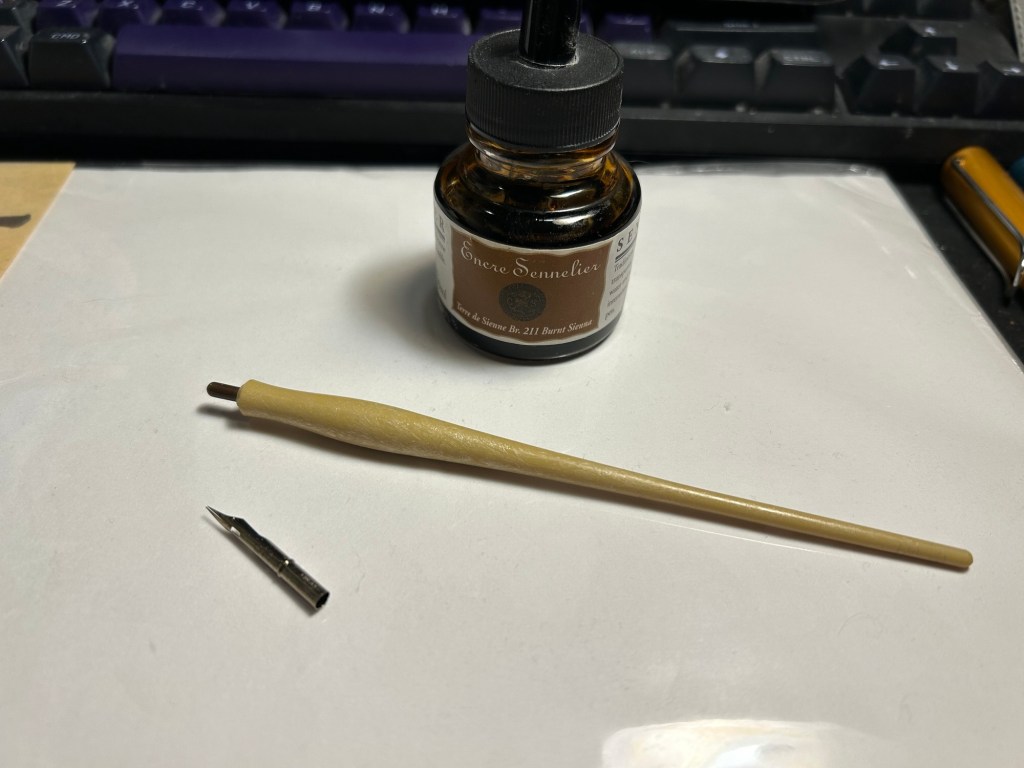
I was looking to draw a map, part of a series of maps for a D&D game. Since I was trying to get a certain look to these maps, I pulled out a mapping nib and a mapping nib holder, and some Sennelier Sepia ink.

The ink is shellac based and meant to be used in dip pens only. If you use it in a fountain pen it will destroy it upon first use. You only need to see how sticky these inks are once to understand that, but most of them helpfully provide warnings on the bottle.

The nib is a Leonardt 801 mapping nib, made in England by the British company Manuscript and purchased, together with the mapping nib holder at Cornelissen & Son in London. They have the largest and best variety of dip nib supplies that I’ve ever seen, and are used by many illustrators and cartoonists. The beauty of dip nibs, however, is that they’re pretty easily and cheaply obtainable. Speedball sells a kit that includes a wide variety of nibs, including a mapping nib, and two holders (a standard one and a mapping one, known as a crow quill).

What’s the deal with a mapping nib? It’s a small, round nib with an end that’s actually a cylinder, and you pop it onto the little peg at the top of the holder. Mapping nibs allow for very thin lines, and yet also a good line variety as the tines are sensitive to pressure.
If you’ve used a fountain pen before and then try to use a dip pen, you’ll likely be surprised by several things. The first is that most dip pen nibs, and mapping nibs in particular, are very sensitive to pressure. The slightest push down will give you more line variation that you’ll get from even the most flexible of flexible fountain pens. The second is that there’s no tipping material. That means more feedback from the page, and that you need to be aware of the directionality of the nib if you don’t want it to snag and spray ink everywhere. This is also why the paper you want to use will be smooth. Smooth surface cartridge paper is your friend.

India ink (the shellac based ink used for dip pens) lays on top of the paper and retains a level of gloss and a dimensionality that you just don’t get with fountain pen paper. You can feel the ink lines with your fingers once the ink dries. The ink dries quickly, and is sticky and staining when wet, so beware of nice clothes and wash your hands well once you’re done.

You can see the line variation and shiny properties of the ink.

The nib itself needs to be prepared before you use it for the first time. New nibs are coated in oil and sometimes with wax before being packaged. This prevents them from rusting, and helps them not stick to each other too much as they’re being packaged. If you use a new nib without preparing it, you’ll be disappointed. It will carry little to no ink, and you’ll find yourself dipping the nib again and again. The map above was made with 4-5 dips only, using a new nib, but one that I prepared.

How do you prepare a dip nib? The simplest and safest way (no, don’t take a lighter to it) is as follows: gently clean the nib with water and dish soap (you can use a soft toothbrush if you want, but it doesn’t really require scrubbing) and then put it in cup with boiling water for 1-2 minutes. Then fish the nib out and dry it very, very, very well with a paper towel. You don’t want to air dry the nib at any point or it will rust.
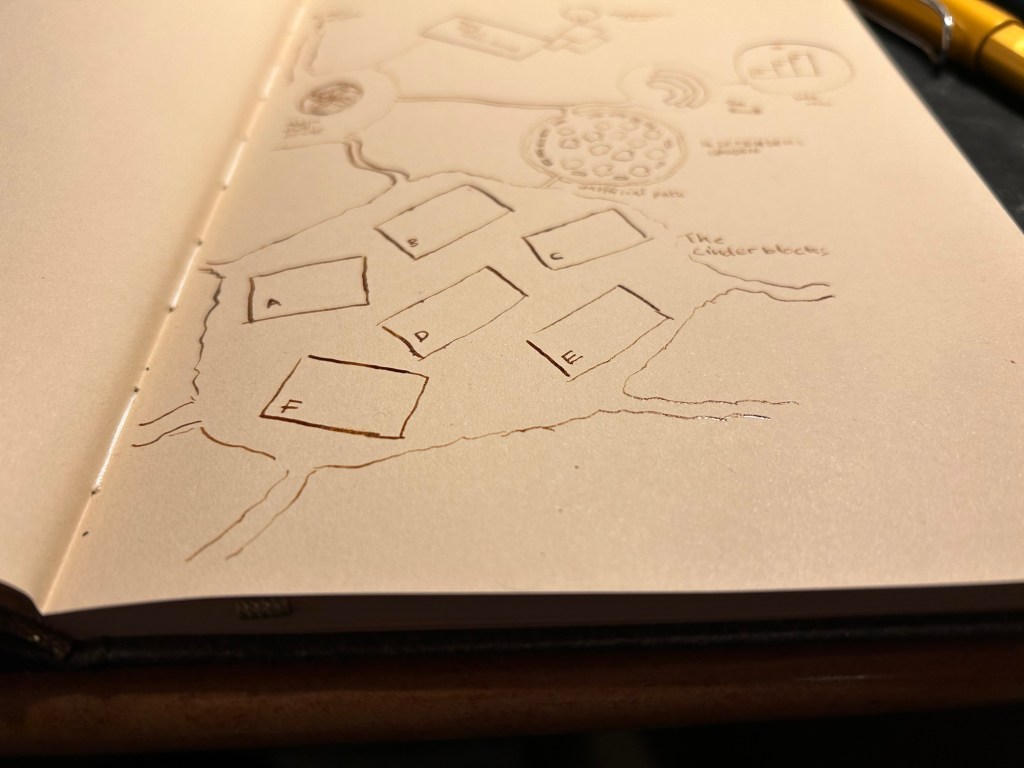
You can see that the ink is raised above the paper and retains its shininess

You can use fountain pen ink with dip pens, but I don’t recommend it. Fountain pen ink is thin and water based, so it doesn’t cling to the nib like India inks. You’ll be dipping a lot more often, and your results won’t be as good. If you plan on using a dip pen to test out fountain pen inks, know that your test will only show the colour properties of the ink but not its flow (wet/dry). Also don’t use a mapping nib for that – mapping nibs are best used for small sketches, maps, things that require very thin lines and some line variation.

When I work with a dipping nib I keep the nib constantly wet with ink (not water!), and immediately when I’m done I either wash the ink from the nib and dry it very well, or I wipe the ink off with a cotton rag if I just plan to take a short break. Ink left to dry on the nib may clog it (particularly with mapping nibs), and soaking a nib in water will cause it to rust.

You may find dip nibs in flea markets for very cheap, usually in a pile in a little box. Check if they aren’t rusted (don’t buy rusted nibs), and then clean them as you would a new nib (water, soap, heat).

I’ll be going over various kinds of India inks and various kinds of nibs in future posts, but in the meanwhile if there’s anything that interests you in dip nibs let me know in the comments.
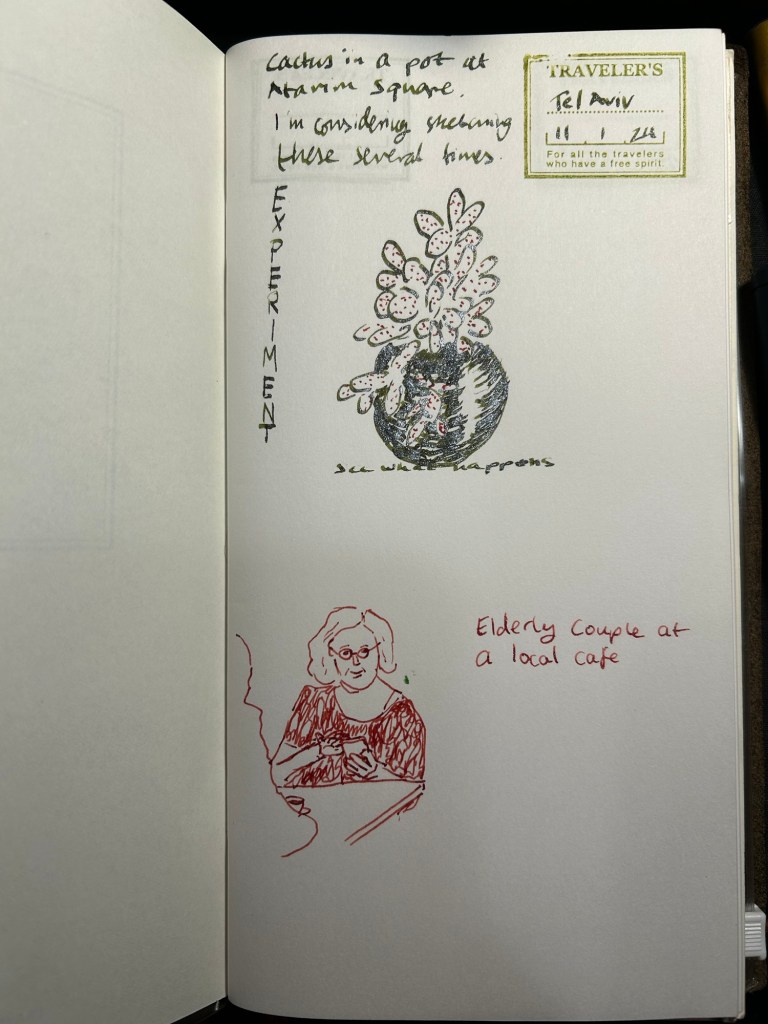
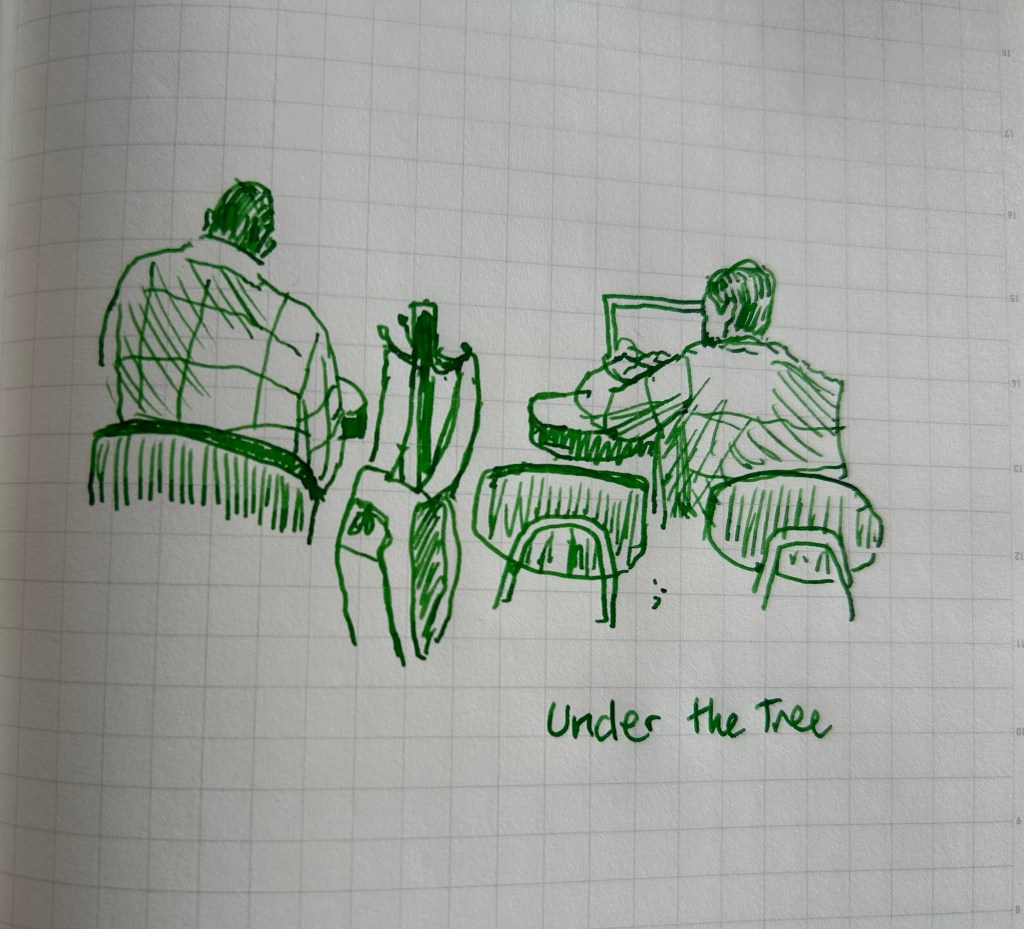
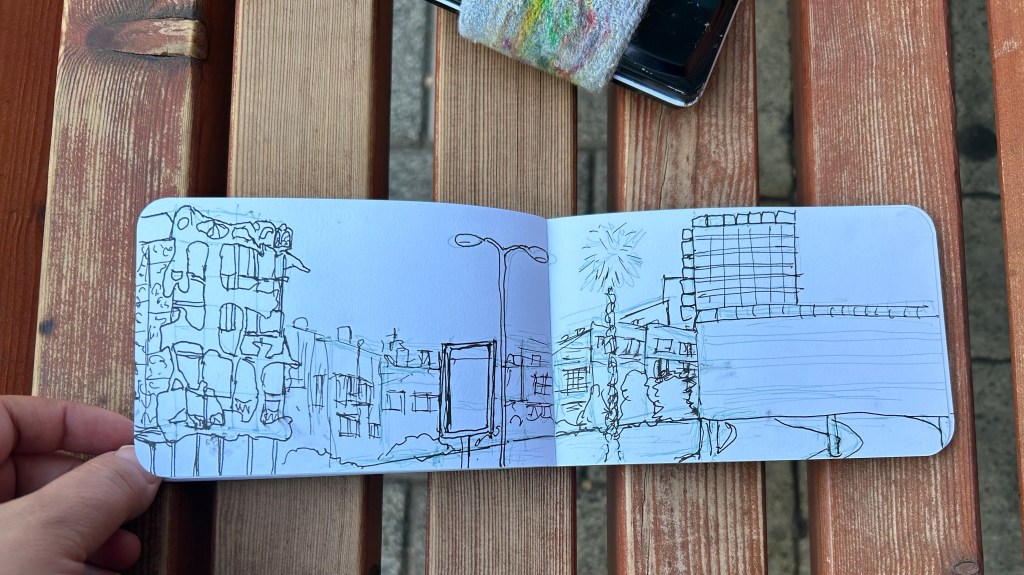
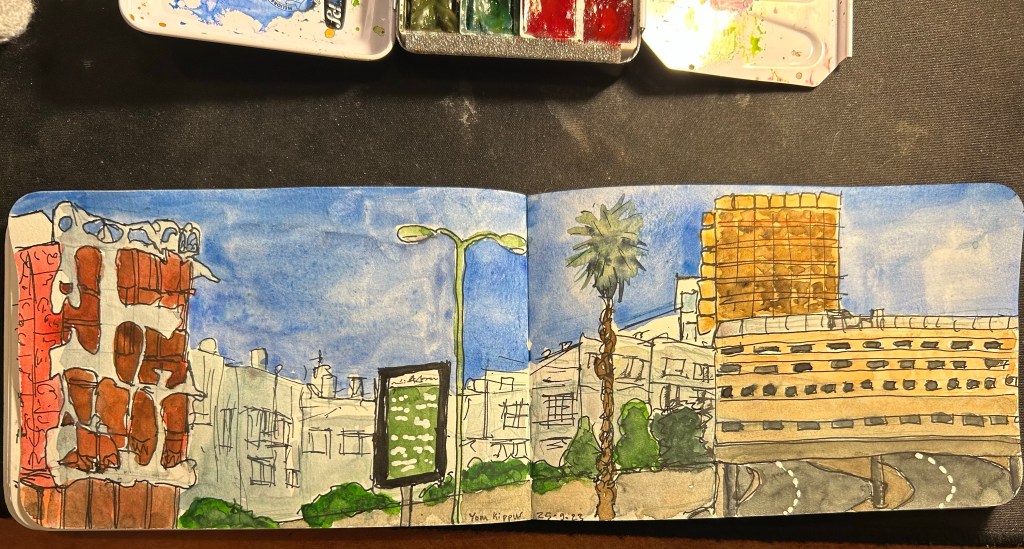
Two Traveler’s Notebook sketches.

I’m still working my way through the Inkvent inks (9 pens left to write dry), and I’m trying to sketch more even on busy weeks. So I dusted off an old Traveler’s Notebook that I set up years ago and didn’t fill, and I started playing with fountain pens.

Stocking Stuffer Ideas for Sketchers

If there’s a sketcher in your life and you’re looking for some stocking stuffers for them, here are a few ideas:

Sweat Bands

These are not only useful for tennis players, they’re great for Urban Sketchers or anyone who sketches on the go. You can find them very cheaply at any sports brand store, and they’re oftentimes discounted (so you can splurge on brand named ones). You wear one of these on your wrist as you use your waterbrush, and you can quickly and conveniently clean your brush on it. When it gets too “colourful” (pun intended) you just toss it into the washing machine. I have two pairs of these in rotation at all times (one from Nike and one from Lululemon, both cost about $5), and they’re an integral part of my portable watercolour kit.

Well used sweat band

Waterbrush

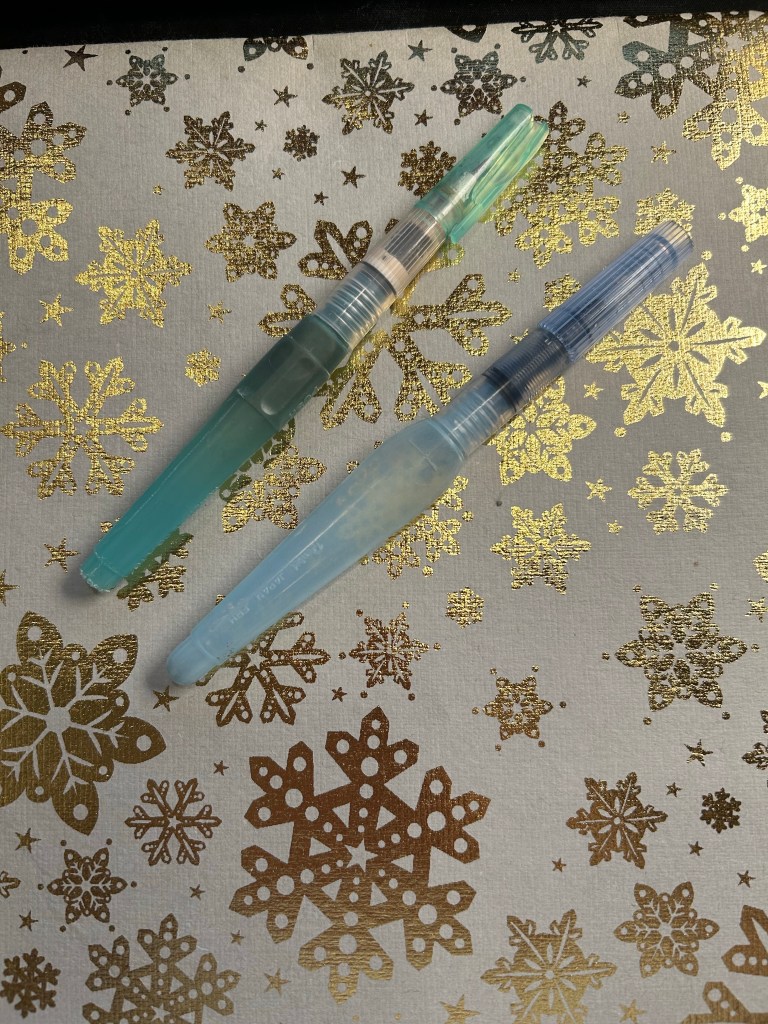
These are inexpensive and every sketcher can use one – even if they have one or two already. They can be used with watercolour or filled with a mixture of ink and water and used for sketches on the go.

Waterbrushes

Small Spray Water Bottle

These are great for anyone who uses watercolours. They can be used to quickly clean your palette, to wet your paint pans, to create effects on your paper, or even to play with ink. Plus, even if they have one, another one will still come in handy.

Spray water bottle.

Fineliner Pens

My favourites are Staedtler but Sakura may be more widely available (Uniball and Zebra also make good ones). In any case a 0.1, 0.3, 0.5, 0.7 will always be appreciated, even if they already have them. Buy black and not any wild colours, and avoid buying the Copic metal ones because they’re needlessly expensive.

Staedtler Pigment Liners

Excellent Pencils

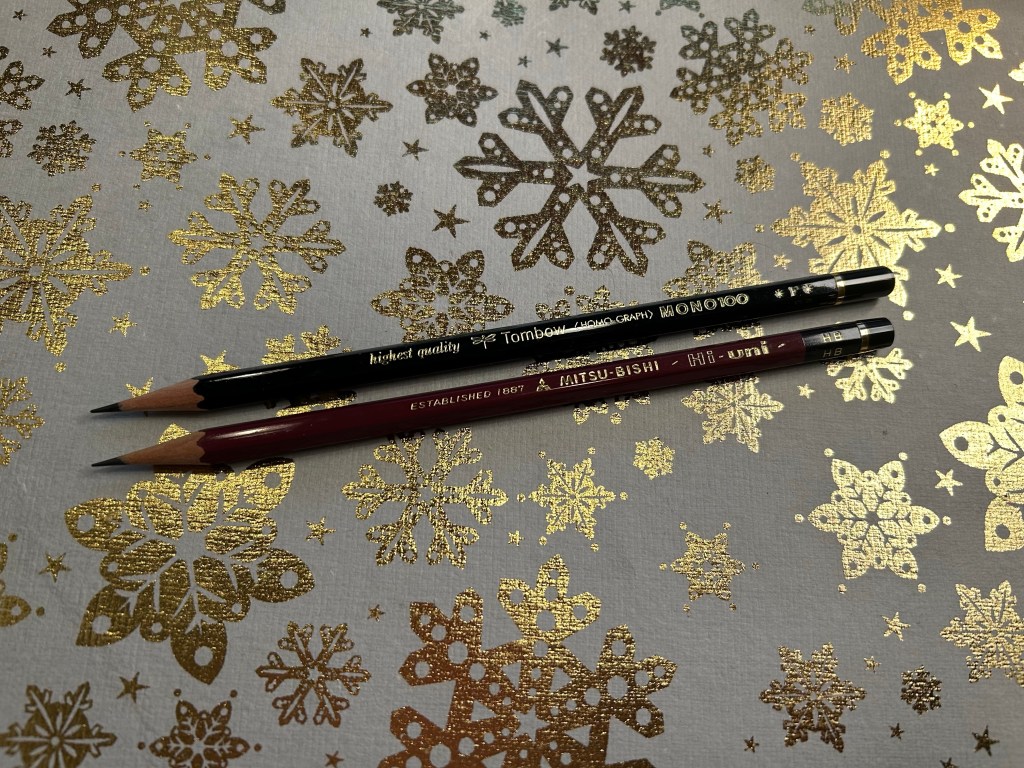
These can be a bit more expensive, depending on the quantity you buy them in, but Tombow Mono 100 pencils in 2B, B, H, F and/or HB or Mistubishi Hi-Uni also in 2B, B, H, F and/or HB would be greatly appreciated. Add a Tombow Mono Light eraser or a kneaded eraser for added thoughtfulness. If you can only purchase one harness, go for B or 2B, unless they work exclusively in watercolour, in which point go for F or H.

Tombow Mono 100 and Mitsubishi Hi-Uni

Faber-Castell Pitt Brush Pens

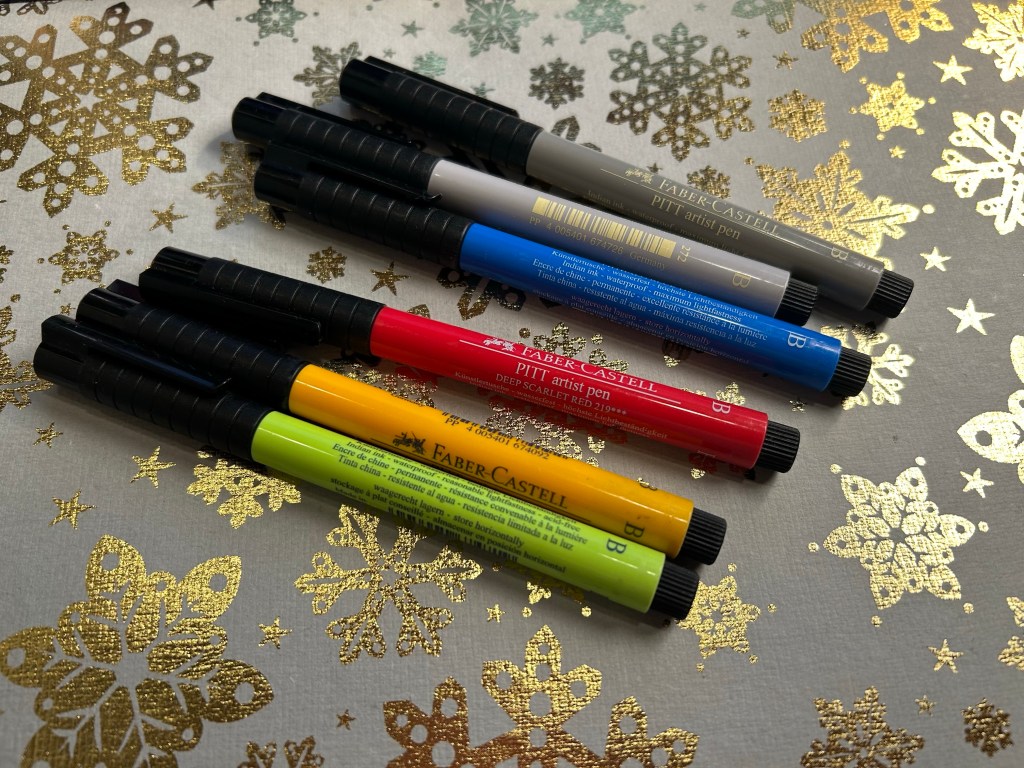
These are waterproof, and great for quick sketches. The tips wear down relatively quickly so even if they have them already, additional ones will be appreciated. Go for cool greys or just wild on the colours, and make sure that they’re brush pens, not fineliners (there’s a B on the end of the pen that denotes brush tip).

Faber-Castell Pitt brush pens. Notice the B on the end of the pens

I’d skip the black, because for that there’s:

Pentel Pocket Brush (GFKP)

A favourite with sketchers, cartoonists and calligraphers, this is the best black India ink brush pen that you can find. Throw in a a few refill cartridges or a Uni-ball Signo Broad white gel pen if you’re feeling generous.

A classic – Pentel GFKP

Stillman and Birn Pocket Alpha Sketchbook

A favourite among Urban Sketchers for good reason, this pocket sketchbook can take anything you can throw at it, has a plenty of pages, and can take a beating. Don’t be tempted by the Beta paper, it’s thicker but also contains fewer pages. Throw in a Fineliner or a Bic (you can splurge for a golden one if you’re bored), and a binder clip to keep the sketchbook closed and you have a complete Urban Sketcher set.

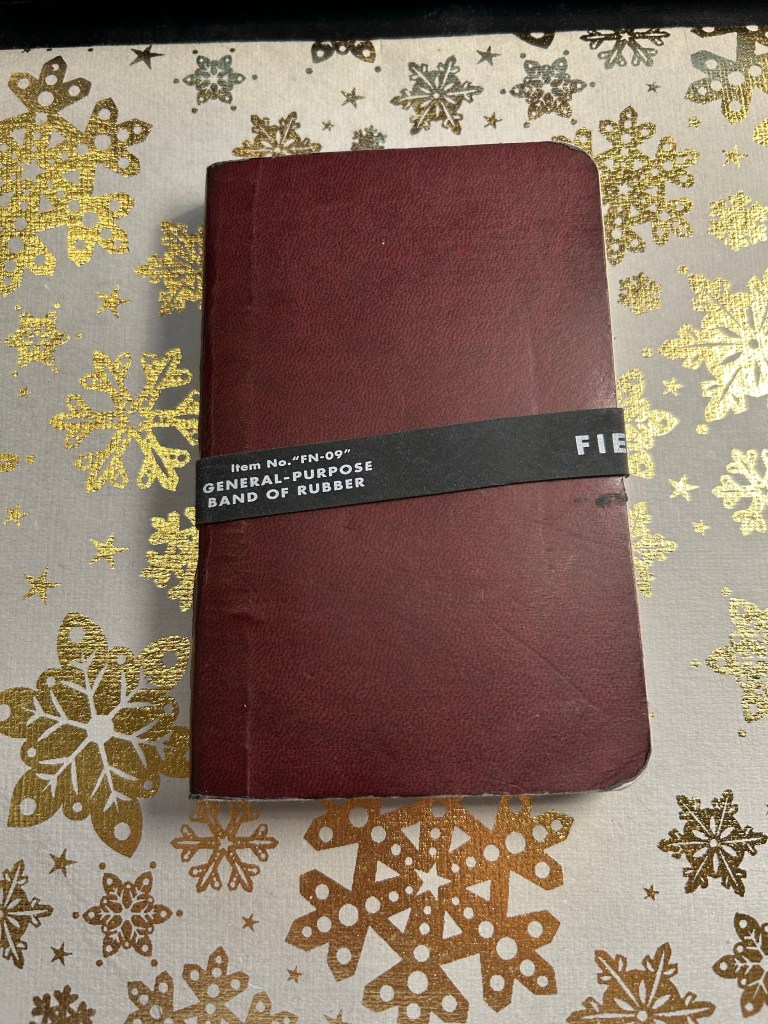
My battered and well-loved Stillman &Birn Pocket Alpha with a Field Notes rubber band to keep it closed.

Hopefully you’ll find some inspiration in this list. If you have any more ideas for stocking stuffers for sketchers, please write them in the comments below. Happy holidays!

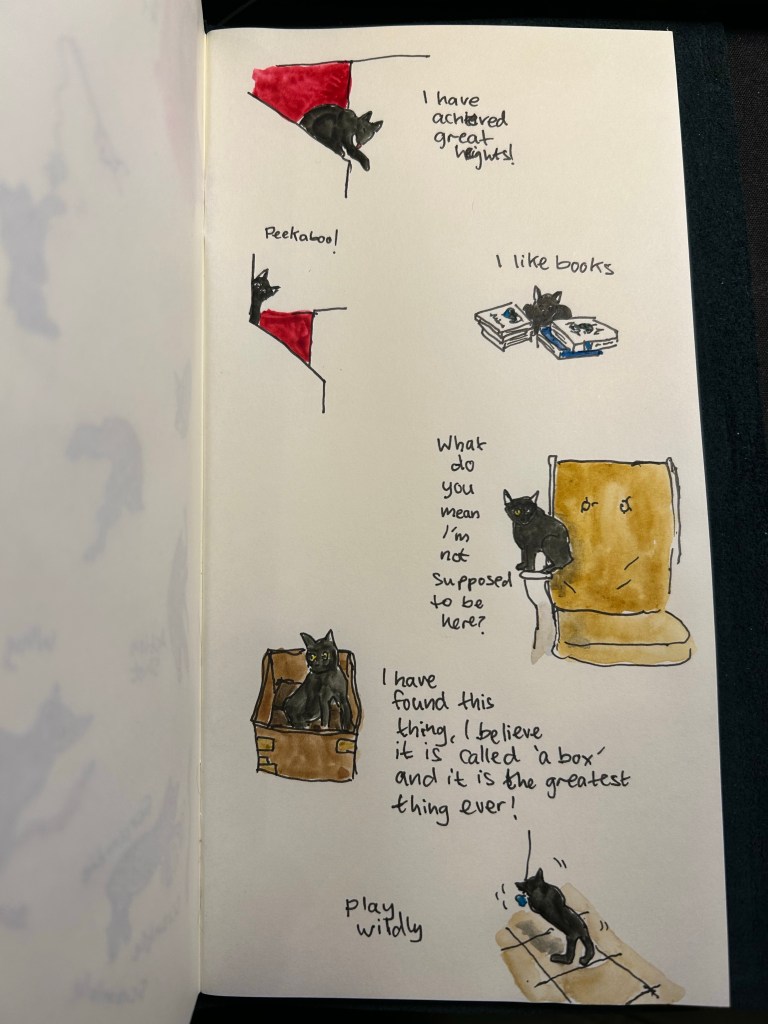
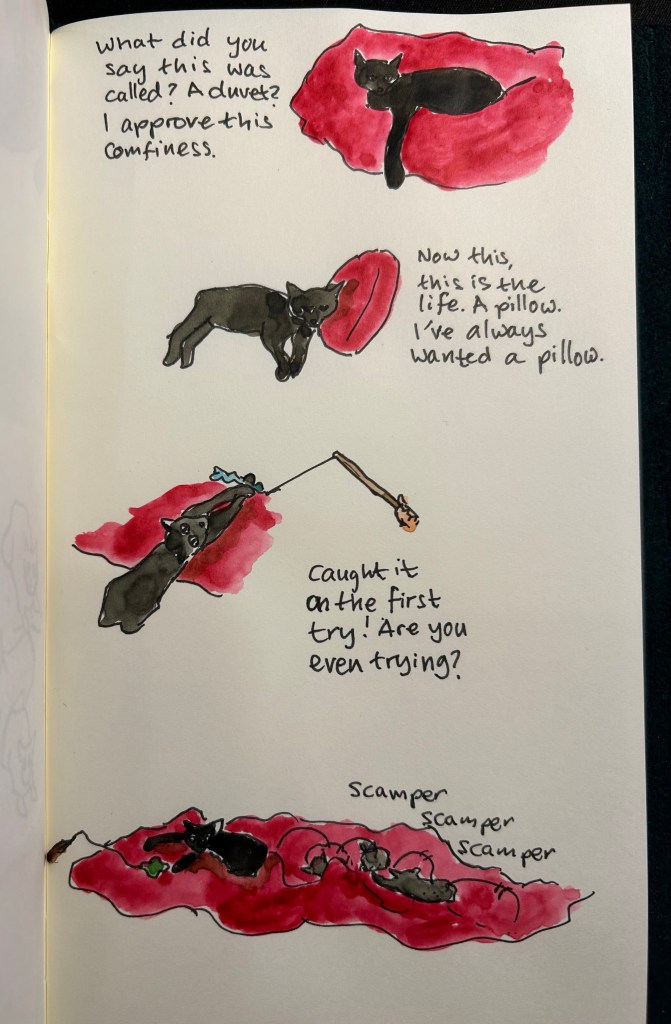
Kitten sketches and a dilemma

I’m torn between writing a post explaining why the calls for ceasefire are utterly disconnected from Hamas’s ceasefire record, the safety of the 240 kidnapped, and the safety of everyone living in the area, and creating an escapist post filled with cat nonsense and pen stuff. On the one hand I want to educate people, on the other hand if people wanted to be educated they’d spend 3 minutes googling before posting fictional maps of the area, calling for “ceasefire now” and ignoring Hamas leadership’s own disownment of their people, saying that they aren’t their responsibility, and having zero qualms about using them as human shield to provoke just the kind of reaction that they’re getting on social media.

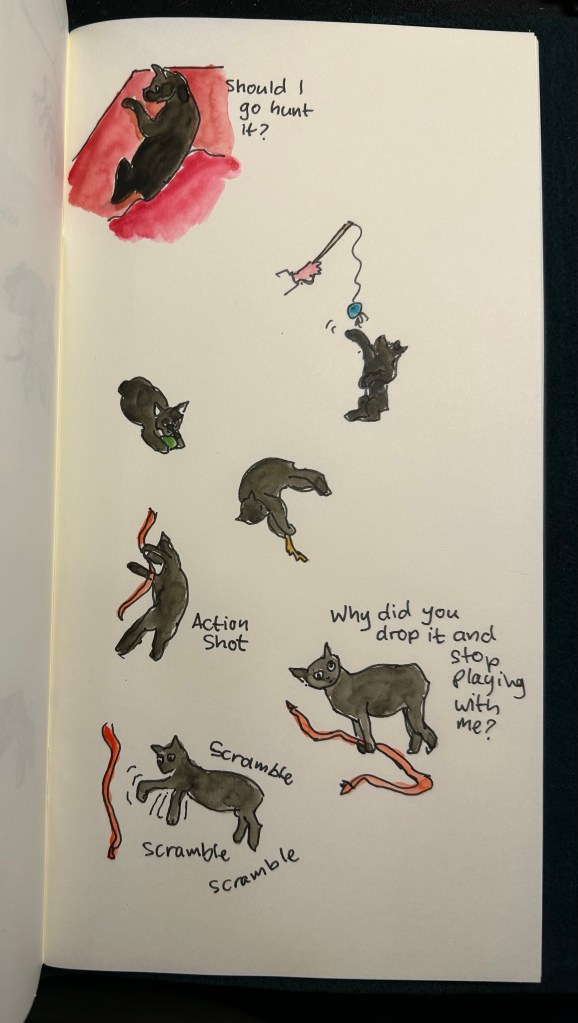
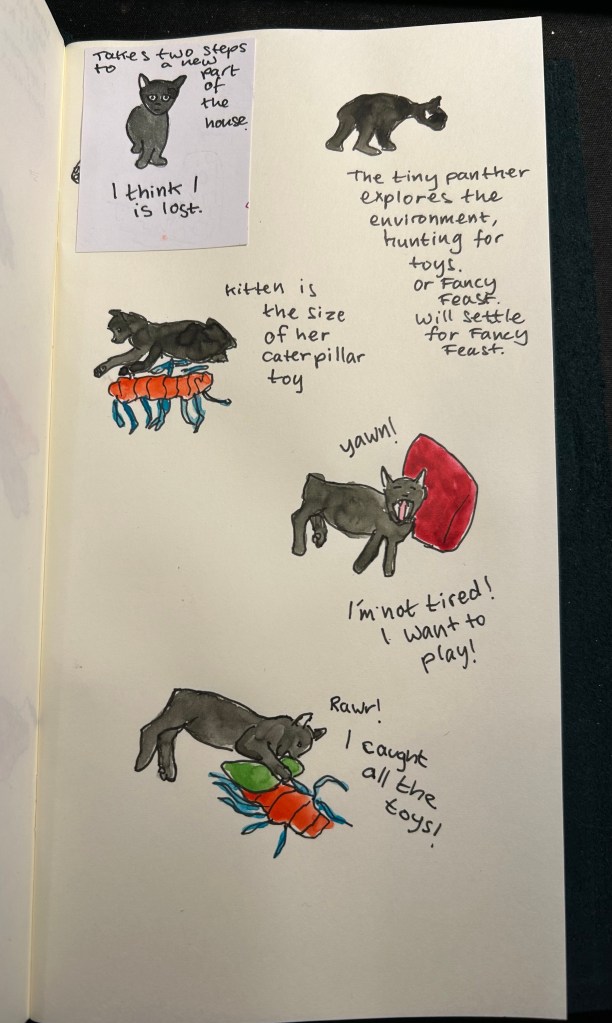
So here are kitten sketches, and please take the time to fact check stuff you like and repost on the internet, even if it came from your favourite hairdresser or singer.

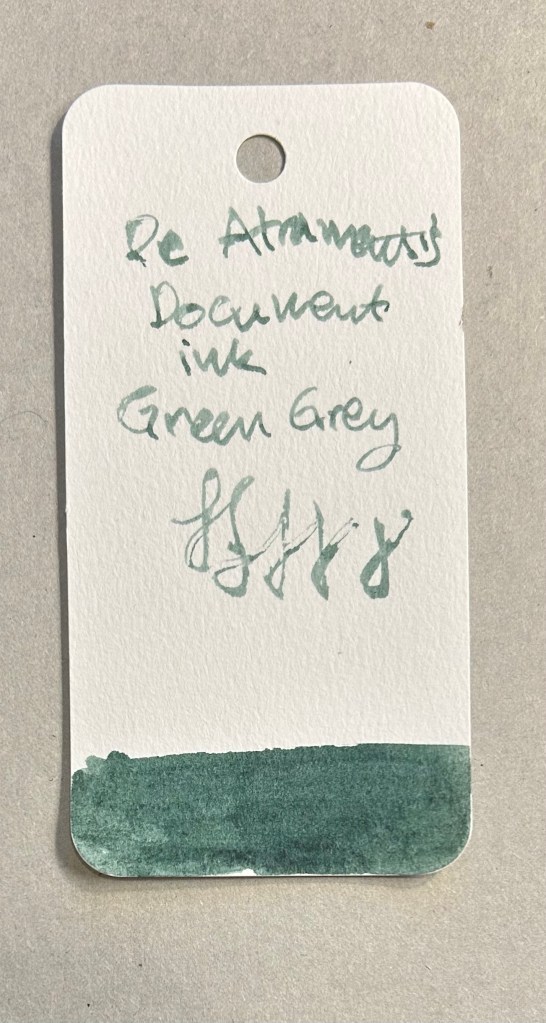
De Atramentis Document Ink Green Grey

De Atramentis Document Ink Green Grey is a waterproof fountain pen ink that could have easily been called “Sage Green”. It’s dry and offers a fair amount of shading, is quick drying and would be a good addition to any Urban Sketcher’s kit.

Ink swab on Col-o-Ring

While I think that De Atramentis Document Ink Green Grey is much too light to be useful as a writing ink (see sample below) its subtlety, natural shade and waterproofness makes it very useful when coupled with watercolours.

Writing sample with two different pens on Midori MD cotton paper.

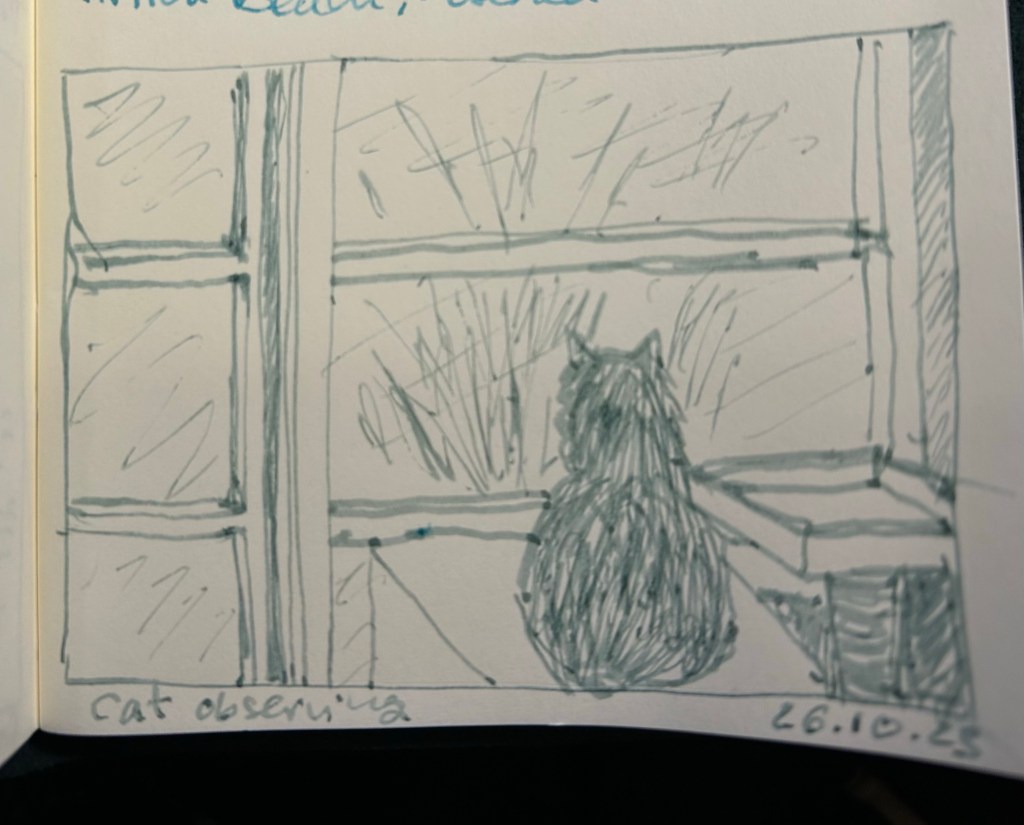
When used by itself, particularly in wider nibs, DA Geen Grey gives sketches a “vintage” feel and a good amount of interest: it both shades and allows for dry brushing effects because it’s so dry. Want a dry brush effect? Just work fast, and the tendency of this ink to skip will suddenly be an advantage:

Dry brush effect
Vintage look to a vintage motorcycle
This shade makes this sketch a bit melancholy, which is what I was looking for.

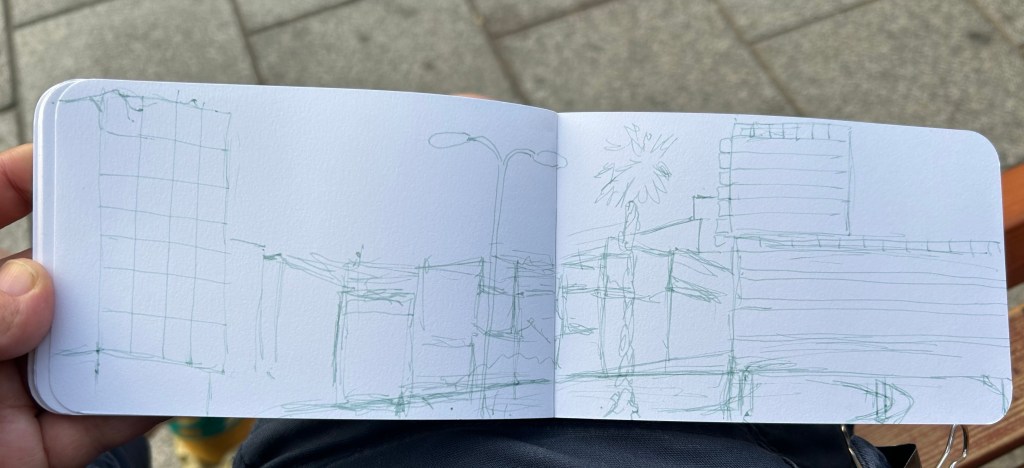
DA Green Grey truly shines as an under-drawing ink for watercolours. You can freely sketch guidelines and work directly in ink with it, and then add watercolour. It’s light enough to fade into the background, while still remaining permanent on the page and providing you with useful references.

Under-drawing/guideline sketch
Ink sketch with a Staedtler pigment liner

Can you even see DA Green Grey lines in this sketch? (you can, from very close by and if you know what you’re looking for)

If you work with watercolours, especially if you’re an urban sketcher, I highly recommend adding De Atramentis Document Ink Green Grey to your kit. It can replace a pencil for the under-sketches of your work, and it doesn’t change the shade of the watercolours, nor does it need to be erased. A pen with this is going to be added to my sketch kit, though I will probably use a fine or medium nibbed fountain pen for this ink and not go any finer because it’s so dry.

Inktober 2023 Day 31

I never thought this was how Inktober would end. It’s been a bad day for my PTSD, so I’m just quickly posting this and going to spend some time taking care of myself.

Journaling Series: Journaling When There Are No Words

The intro post to this series is here, journaling for mental clarity is here, journaling through fear is here. Journaling to clear your mind is here. Journaling to work out choices is here. The 5 year diary is here. Travel journaling is here.

There are times when there are no words, or words are not enough, but you still want to put marks on paper, because pens are a comfort, pencils are a comfort, paper is a comfort, just the sound they make as they meet is a comfort. Beyond doodling mindlessly, copying down a passage from a favourite book or a poem, or just practicing your handwriting or repeatedly writing down a mantra, here are some things you can try doing:

1. Pick an object or a photo and draw it without looking at the paper, and without picking up your pen (blind contour drawing). You need zero artistic skills for this, and the result doesn’t matter, just your focus on your subject and the movement of the pen or pencil on the paper.

2. Pick up a pen and then list 10 things that you see around you in that pen’s colour/the ink’s colour. This is a variant of a stress reducing exercise that I do regularly (find 10 objects in a certain colour in the area around you), and it helps ground you in the moment and take your mind off things. It’s best to choose an unusual colour for this (not black, blue or brown, but pink, purple, yellow, etc) – something that’s a bit more challenging to find. You can also do this with a pencil and then just pick 10 things in/with a certain shape (triangle, zigzag, hexagon, etc).

3. Pick a pencil, a pen and an eraser, and sketch them. It doesn’t have to be accurate, and nobody cares if you don’t get it anywhere near “right”. These are simple objects to sketch (basically rectangles and triangles smooshed together), they are readily available and usually don’t carry too much emotional baggage with them.

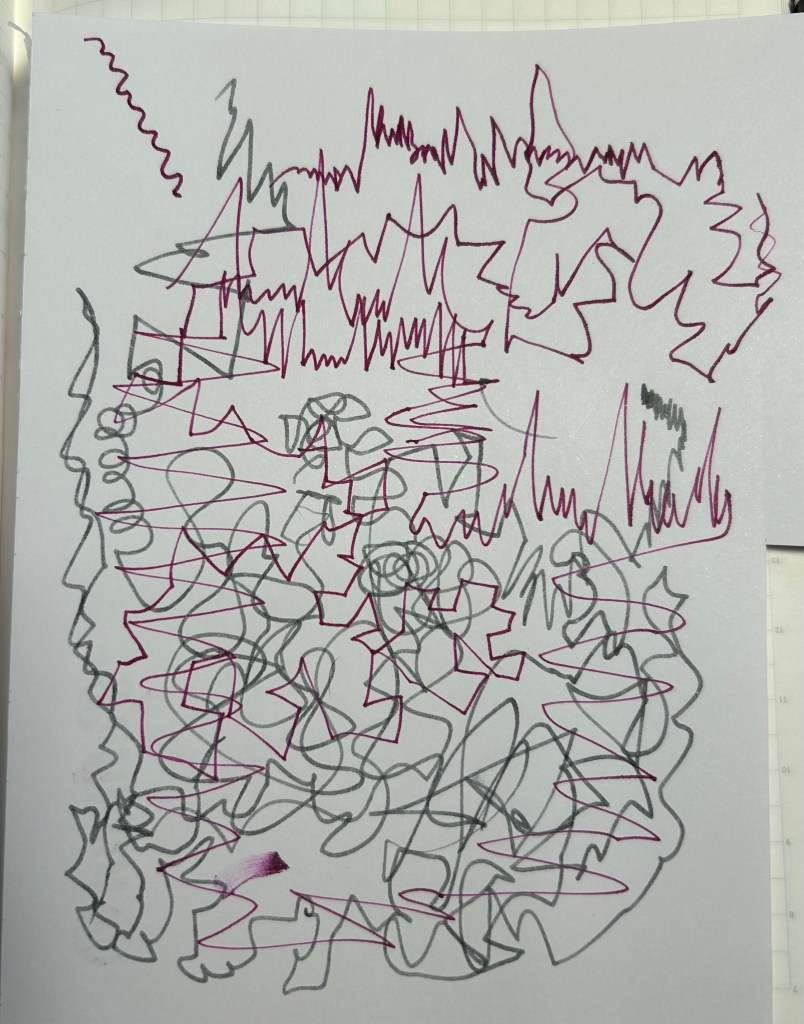
4. Put on some music with no lyrics, grab a piece of paper and some pens, and just sketch the piece. Go abstract, vary lines and shapes and colours with the change of tempo, instrument, etc. I love using Oscar Peterson or Thelonious Monk tracks for this, but it’s best to do it with tracks you already know and love.

I’ve been using a combination of all of these lately. Sometimes they help, sometimes they don’t.