I wrote the first few chapters of my first novel longhand, with fountain pen on loose sheets of A4 tomoe river paper. As I realized that I would have to type everything into Scrivener before I could even start editing, the lazy programmer within me balked. It was fine doing this with quick drafts, but writing an entire novel longhand was not for me.
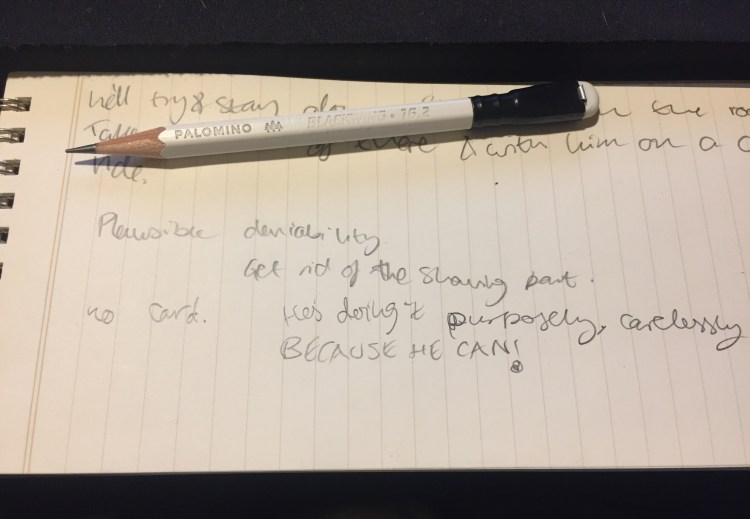
I still use pen, pencil and paper a lot in my writing though. I use a fountain pen (anything that doesn’t have a flex or novelty nib will do — from extra-fine to 1.1mm stubs) and loose sheets of A4 and A5 tomoe river paper to work on my outlines, for quick drafts, to test plot options out, or when I’m really, really stuck in my writing. A Field Notes Byline is constantly under my keyboard, horizontally. Yes, I know that the lines don’t go that way, but I ignore them. The form factor is perfect for that, and the ruling is pale enough for me to easily ignore it. I use a Blackwing 16.2 or 24 with it, to quickly capture any ideas that may come up during my writing, to remind myself where I was going with an idea or what I need to fix a previous place, to brainstorm names, etc. It serves as a scratch pad that allows me to maintain my writing flow and still remember things along the way.
Messy, messy handwriting, because getting things down on paper is more important to me then keeping them pretty.
So, even if you do all your writing using Ulysses or Scrivener (hopefully not Word), I recommend that you incorporate some analogue tools in your process. You’re bound to find them useful, particularly when you’re stuck or you’ve dug yourself into a hole.
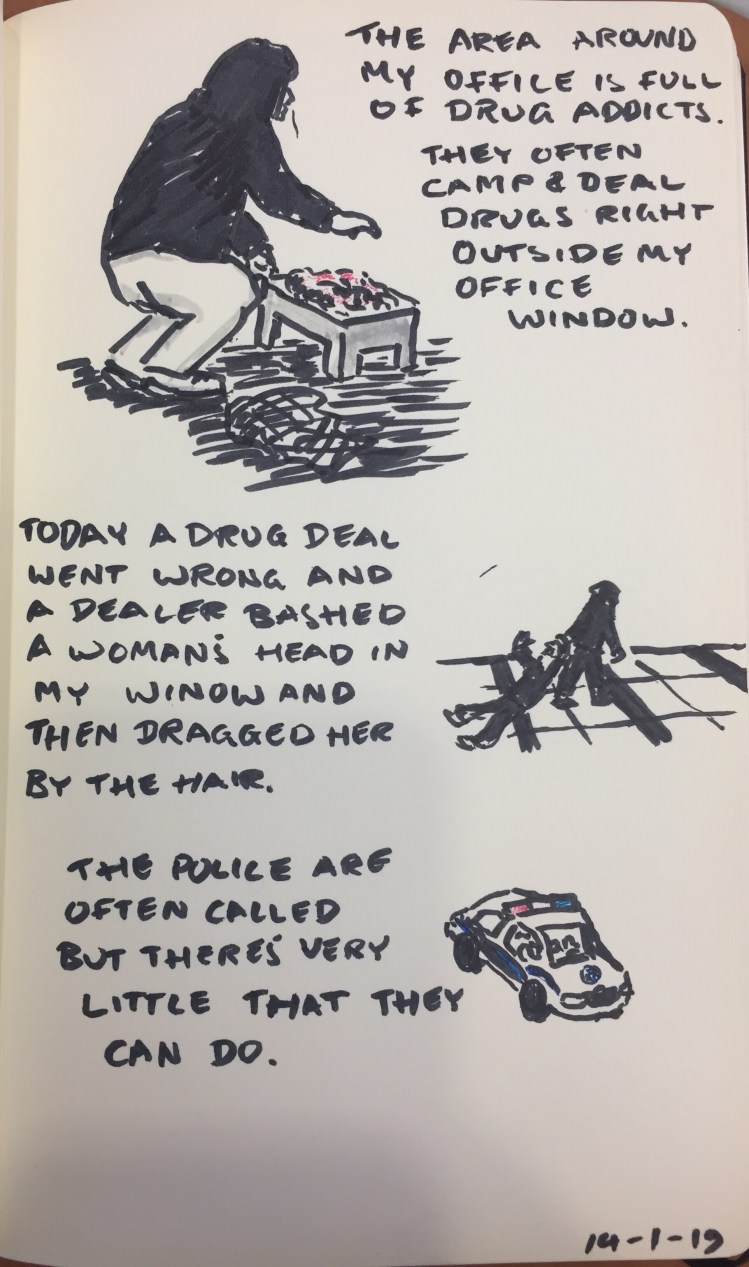
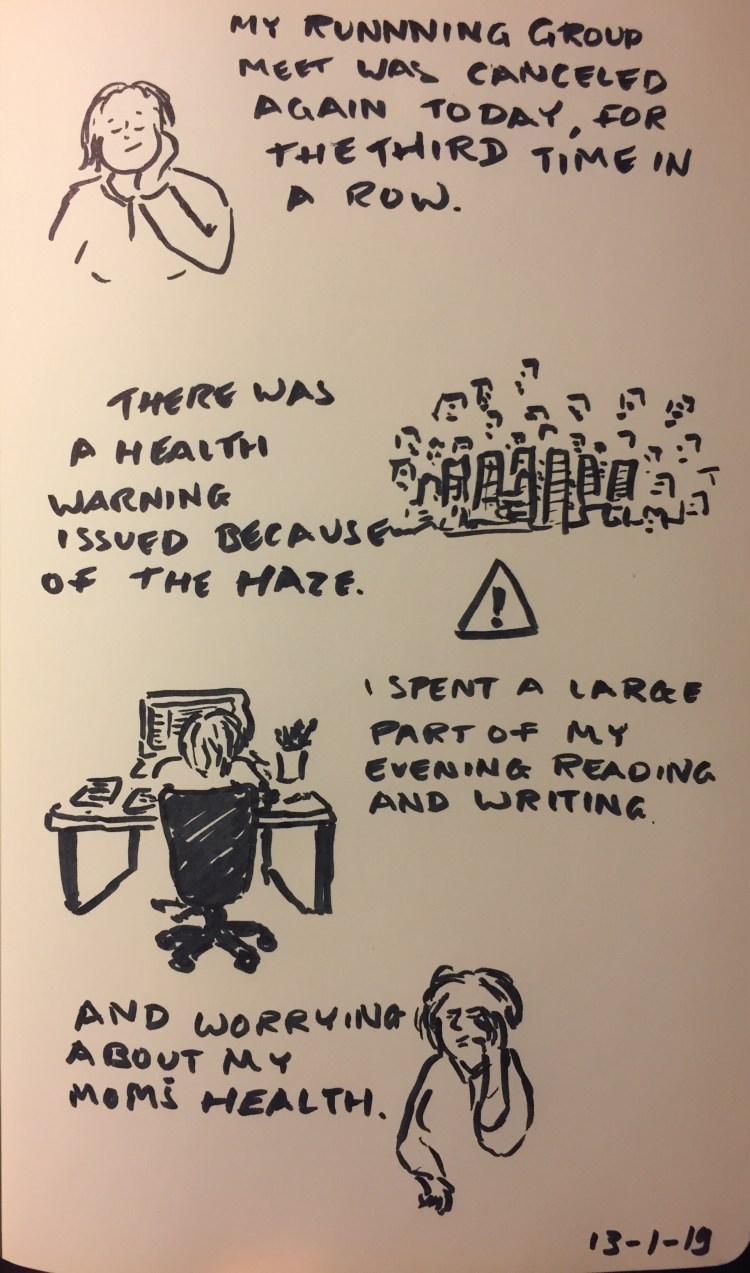
Journal comic drawn with a Sharpie brush pen, Pilot Hi Tec-C pens, and a Zebra grey mildliner highlighter on a Moleskine Star Wars scroll text limited edition blank notebook.
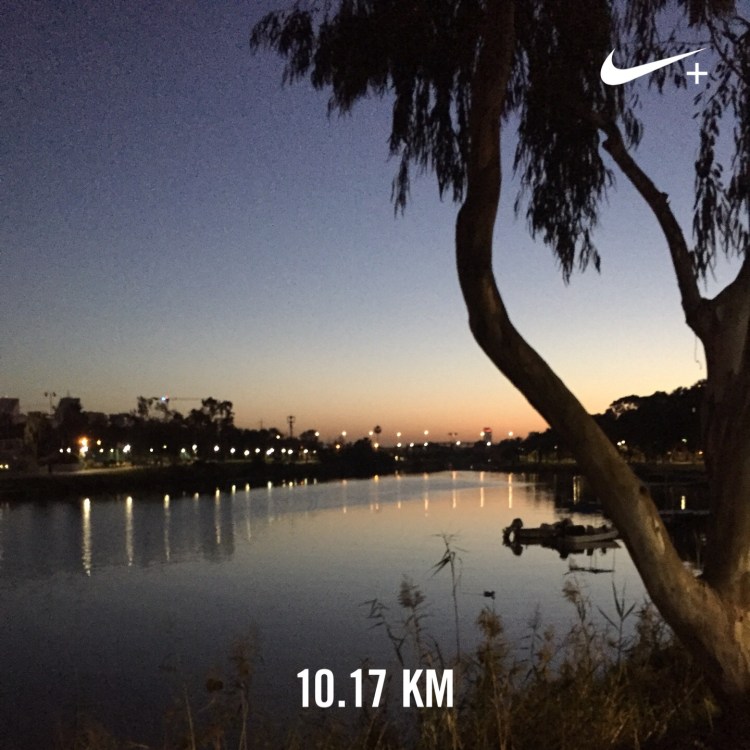
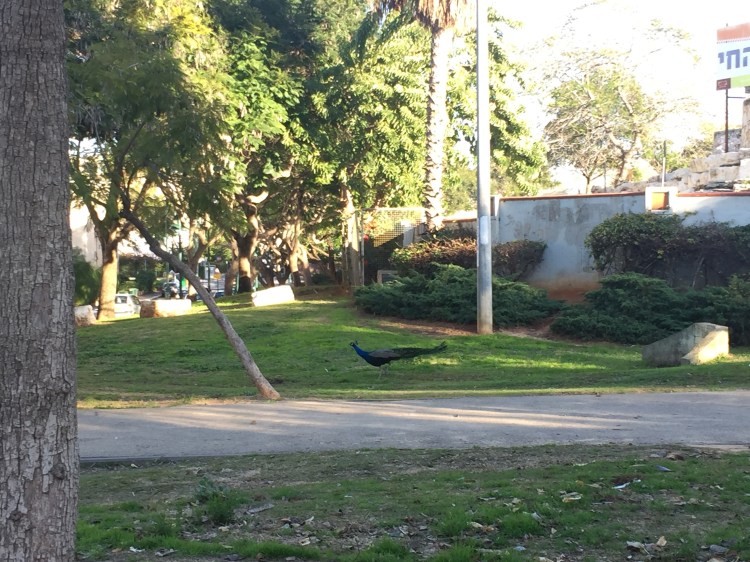
Started this week’s long run in the cold, very dark pre-dawn, with a deserted promenade mostly to myself. Things started looking up near the halfway point, with the sun rising and warming things up a little. I’ve had almost a week’s running hiatus because of the rain, so getting back to it on Friday and today (Saturday) was painful, but in a good kind of way.
My iPhone 8 died on me on Wednesday night and is now getting checked out in the lab, so these are iPhone 6 photos, so you’ll extra have to forgive me for the quality. And with that, here are a few pretty, pretty pictures:
I’ve tried shimmering fountain pen inks (inks with little sparkly bits in them) only once before, when J Herbin first started producing them, and they ruined a Lamy Safari pen and converter with their non-removable sparkle. Over time more and more reviews came out lauding these pretty, shiny inks and saying that they’re completely fountain pen friendly nowadays, yet I kept my distance. No amount of glitter was worth another ruined pen, after all.
Enter the TWSBI GO, which is a a TWSBI nib connected to a toy pen that is so cheap that it practically has “Bay State Blue ready” written on it (I still don’t recommend going anywhere near the stainiest of stainy inks, no matter how gorgeous it is).
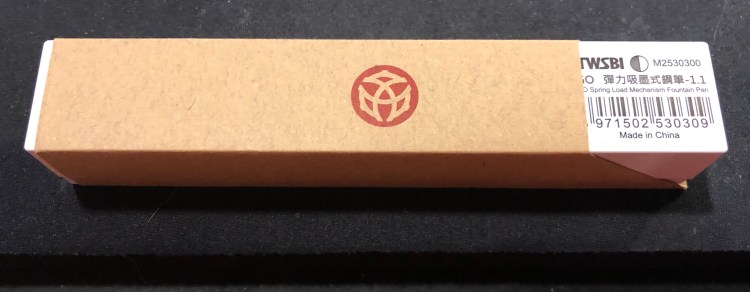
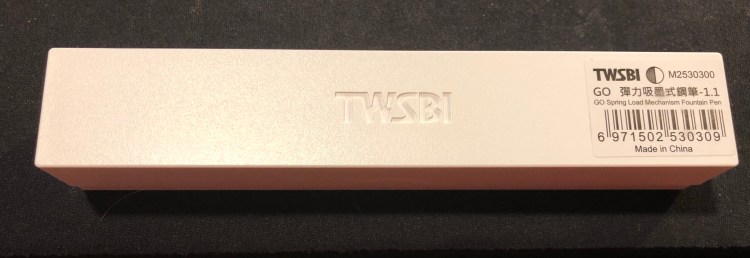
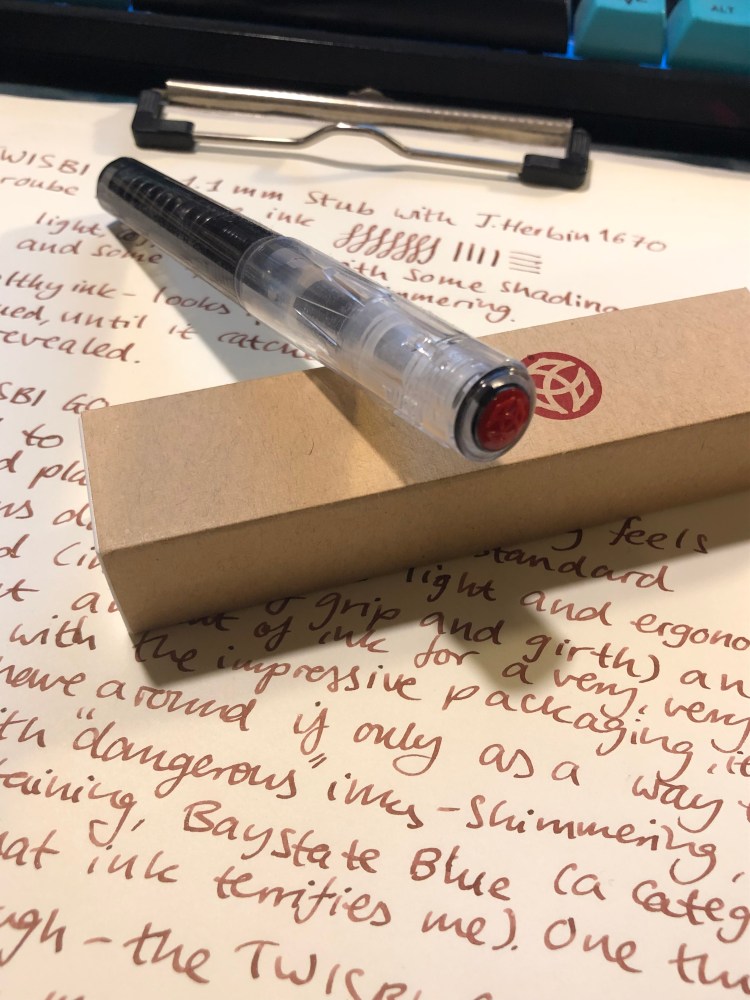
The packaging is bewilderingly good for such a cheap fountain pen. A cardboard sleeve over a plastic box that puts the cardboard Lamy Safari packaging (and price point) to shame.
Cardboard sleeve with TWSBI logoSolid plastic box for the pen. I’m not a packaging person, but this is disproportionally good for the price.
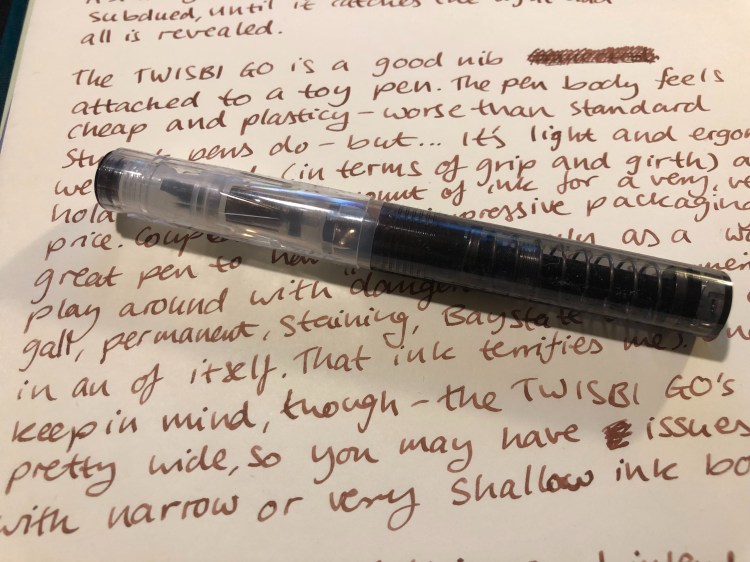
Then you open the box, and laugh. The pen looks and feels like a child’s toy, with its cheap feeling plastic, its light weight and ridiculous spring filling mechanism. It takes the ugly duckling bit a step beyond what even other TWSBI functional but ugly pens, like the ECO, have.
Ugly.
But then you start to write with it, and the silly little body has good ink capacity, is easy to fill, and most importantly, it has a TWSBI nib. TWSBI nibs are phenomenally good for the price, and they come in 1.1 stub sizes, which are super fun to use.
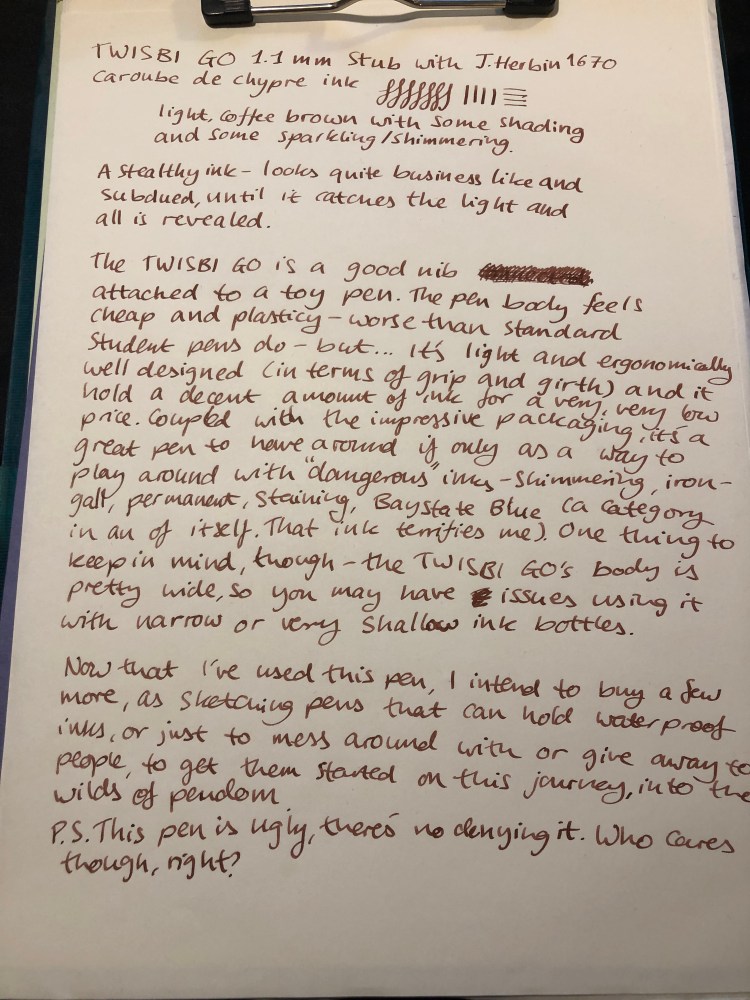
Here’s a writing sample with a TWSBI GO 1.1 stub, which I did late at night when I was pretty tired, and so I spelled TWSBI phonetically, so whoopsie.
The ink is J Herbin’s Caroube de Chypre, which I had bought but not yet used. It’s a light, coffee brown ink with a medium amount of shading and some gold sparkle that is just-impossible-to-photograph-unless-you-pour-half-a-bottle-of-the-stuff-on-the-page-so-you’re-going-to-have-to-trust-me-on-this-it-is-pretty.
Writing sample.
Can you get away with using this ink in a work setting? I believe you can, since the colour itself is pretty tame and the sparkle isn’t in your face, but just glints in the light in certain angles.
This photographed darker than it appears in reality, but is shows some of the depth of shading that you can expect to see with this ink.Ugly pen, ugly handwriting, pretty ink.TWSBI logo on the cap.The nib, which is the main reason to buy this pen.Pen grip and pen feed, with ink capacity on display.
The pen itself is a paragon of practicality: super light, super comfortable grip, good ink capacity, excellent nib and feed, easy to use filling mechanism. For less than $20 that’s a tremendous feat on TWSBI’s part and it makes this pen a “no-brainer”. Whether you’re a beginner or a hardened collector, you should have at least one of these in your pen case. It’s a great workhorse, good for experimenting with “dangerous” inks (keep well away from Bay State Blue, yes you, I’m talking to you. I can see what’s in your shopping cart), good as a loaner pen to get more people into the wonderful world of fountain pens, and even good for people experimenting with nib grinds. In the beginner fountain pen category it is uglier than even the platinum preppy, but when it comes to bang for your buck, this pen puts all others to shame.
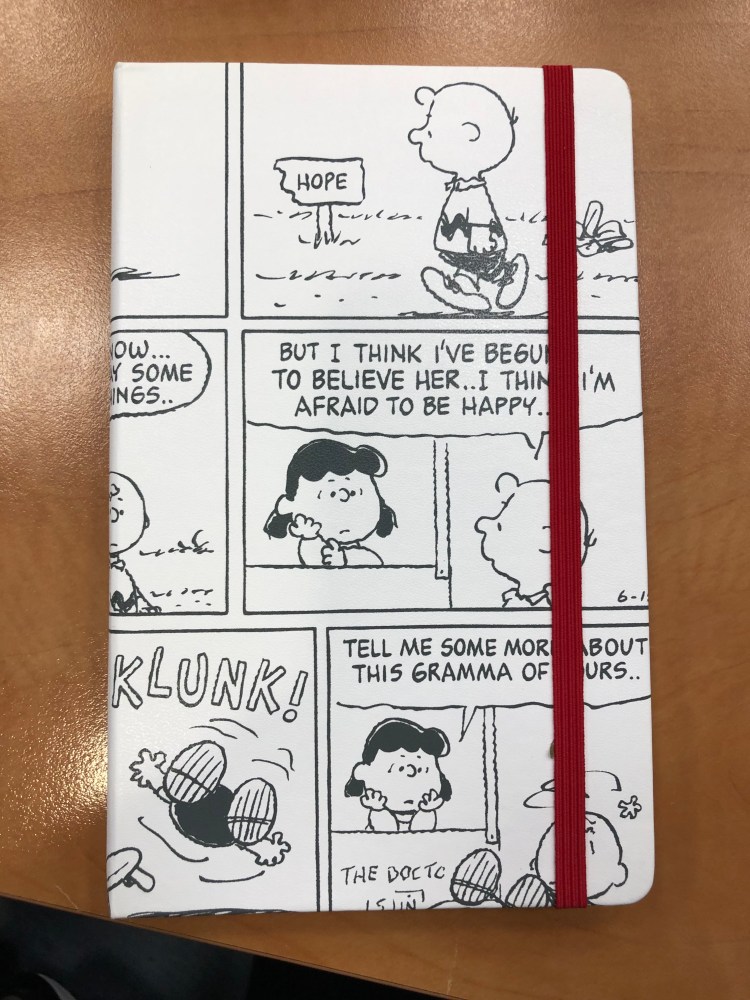
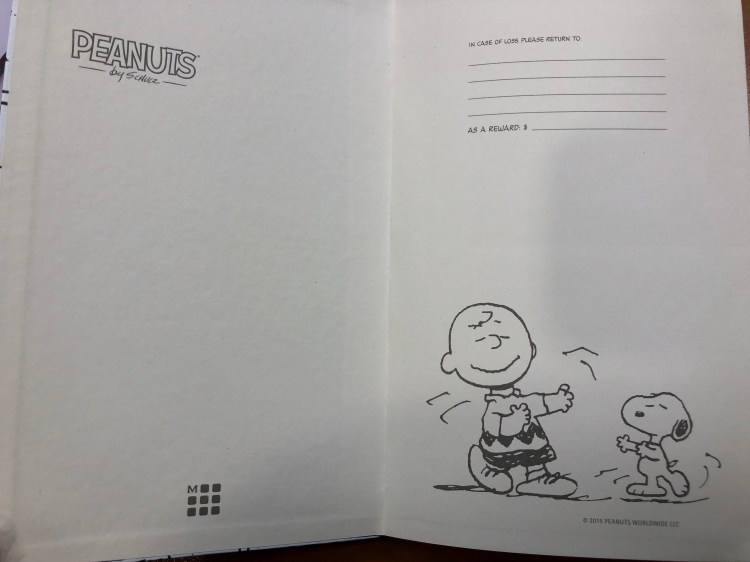
I started a new journal this month, this time a Peanuts limited edition Moleskine. This is one of Moleskine’s best designed limited editions in recent years, because of the simplicity of the design and the limited palate choice (white, black and red). So first up, here are some pretty pictures, and then I’ll get into how I start a new journal.
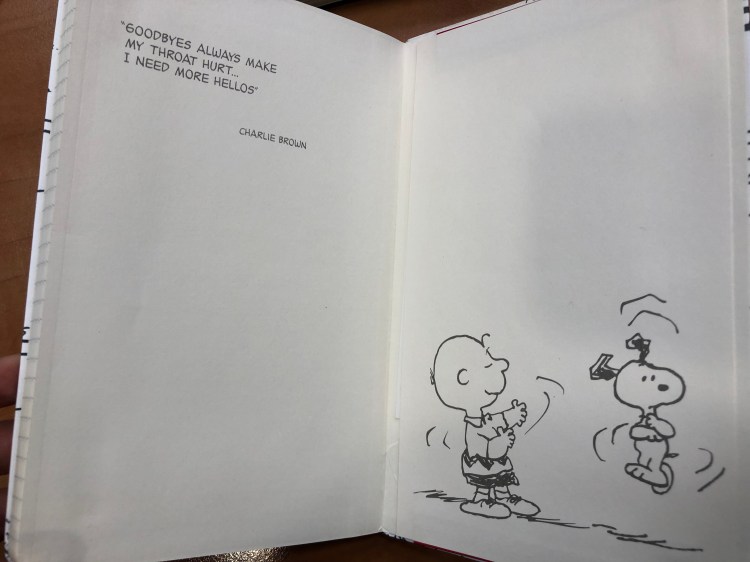
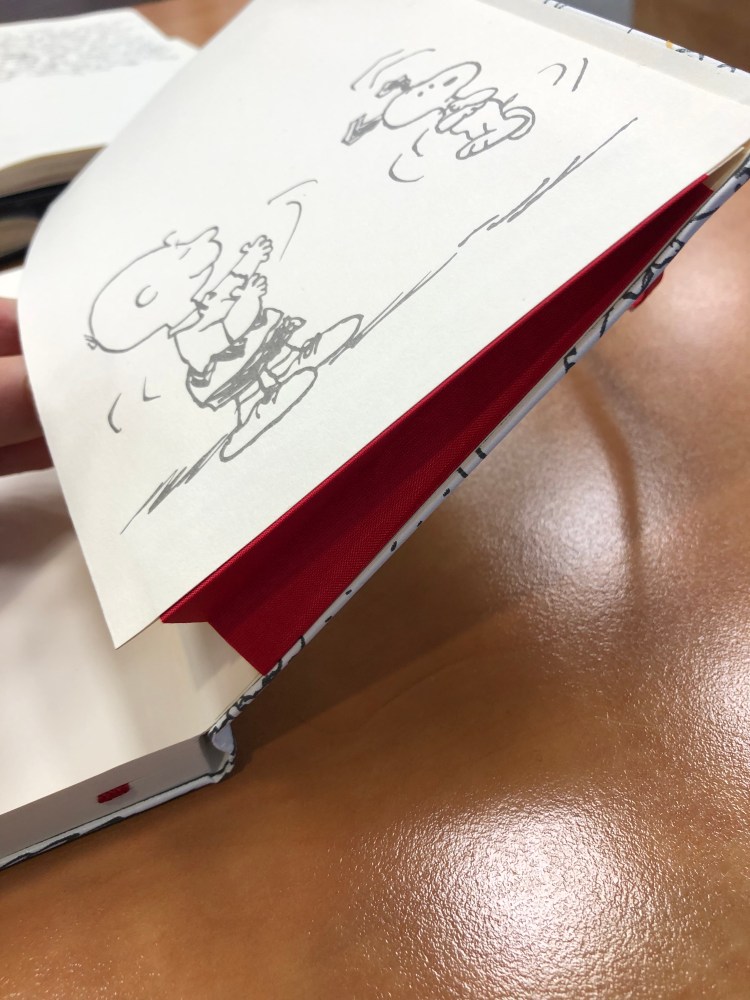
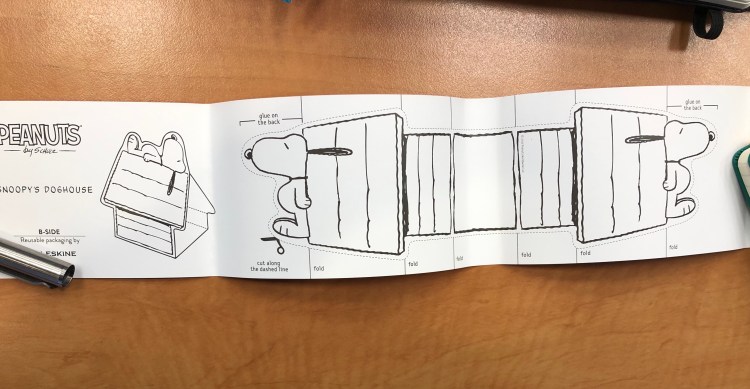
That sleeve looks transparent, but is just perfectly aligned, that’s all. “Are you happy right now?” “I guess so..”Gramma knows best.No ProblemOnly the best end papers in any Moleskine edition to date.The back end paper is a sweet and a little heartbreaking – like the best Peanuts strips.Bonk! Stickers galore.Red detail on the famous back pocket.Build your own Snoopy’s doghouse from the B-Side of the sleeve.
So this is definitely a top 10 edition for me, both because I love Peanuts so much, and because it is such a well-designed notebook.
Now to how I actually start a new journal:
I’ve noticed that the hardest part of journaling for me is when I’m just getting started with a new notebook. Blank pages are scary and discouraging, and at that point I’ve invested so much time and effort in my old notebook that I really don’t feel like moving to a new one. Like Charlie Brown says, “Goodbyes always make my throat hurt… I need more hellos”.
The trick is to get the new journal started well before you actually “move into” it, so that by the time you start using it full-time it’s already an old friend.
Once I get to about 20 pages before the end of my current journal I select a new one, fill in my personal info, and start filling the first few pages with various project ideas/running and training plans/writing plans/home improvement plans. These are specifically things that I know that I’ll need to start updating and referencing before I start using the new journal, so that it’ll start filling up with meaningful content ahead of time. I also use the last pages of the journal to test new pens, jot notes for myself or just for various stamps. By the time I start using it, the notebook isn’t just randomly used or “wrecked”, but meaningfully mine. It’s already working for me, being my outboard brain and eye and heart. And it doesn’t take a lot — I was too preoccupied this time to notice that my old Star Wars Duel notebook was running out, so I started the Peanuts one in a rush, only a few days before I fully moved into it. All it took was a running plan and a list of things that I want to pack up and give to charity for me to easily transition into it, as if I was merely turning another page in my old notebook.
If you have trouble starting new notebooks, give this idea a try, it may help you out.
Completing my Moleskine James Bond limited edition reviews (see here for the Titles notebook and here for the Carbon one) is the crowning glory of them all: the boxed set.
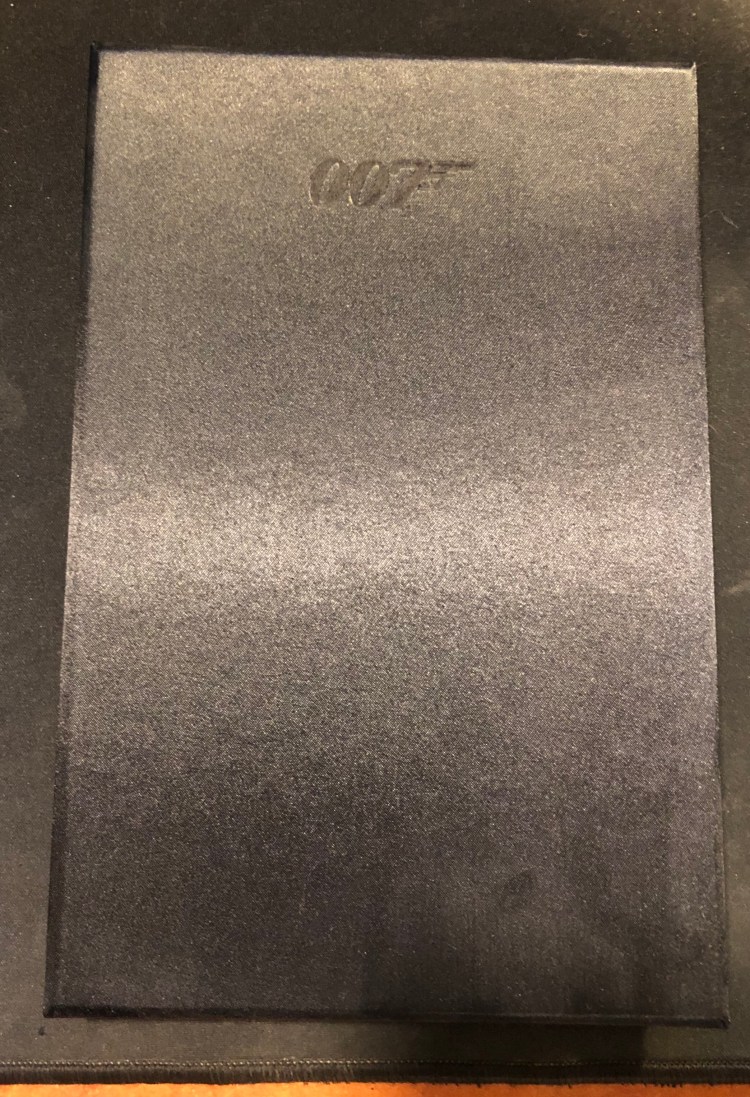
Unlike the other two notebooks, this is a numbered edition with 7007 notebooks total made worldwide. It comes in a silk covered box, with its own matching “tie” (to help you get the notebook out. It’s not really necessary, but adds another touch of luxury to this set), and is itself covered in black silk. All of this is terrifically excessive, like Q’s elegant little gadgets on an already over the top car. The result is a notebook and box that you just want to stare at and stroke every once in a while.
The BoxThe “tie” inside the box
The notebook with its shiny silk cover:
Moleskine did a limited edition run of silk covered pocket notebooks years back, for the van Gogh museum in the Netherlands. They were all the rage, especially at a time when Moleskine was not doing limited editions except for special events, and they were exceptionally difficult to obtain. The silk on those covers was thinner and rougher, and after a bit of use tended to fray, likely because silk is not an easy fabric to work with, and the company had very little experience with fabric covered notebooks.
The James Bond Boxed Set comes after the Blend, Rolling Stones, Denim and Marauder’s Map fabric covered editions, and you can tell that they know what they’re doing now. The silk on the cover is densely woven and substantial, and unlike the van Gogh notebooks, it actually shines with sheen. It feels like the notebook is wearing a high end tuxedo and just waiting for a gorgeous woman in a skimpy dress and a silly name to bring it a martini, shaken, not stirred.
Front end page, with the well designed map and the number of the editionBack end page, with all the titles beautifully aligned.
Like all previous boxed sets, the notebook comes unwrapped (the box itself is wrapped) and so without the paper slip and its B-side around it. The sticker sheet that comes with this edition is the same as the other notebooks in this range.
The set originally cost around $35 but you can get it now for $25. If you’re a James Bond fan this is the one to get out of this edition, with the Carbon coming in second place and the Titles in third. The only minus to this notebook is that it is so sexy there’s a good chance that you’ll feel uncomfortable using it (ah, double entendre. What’s a James Bond movie without it?).
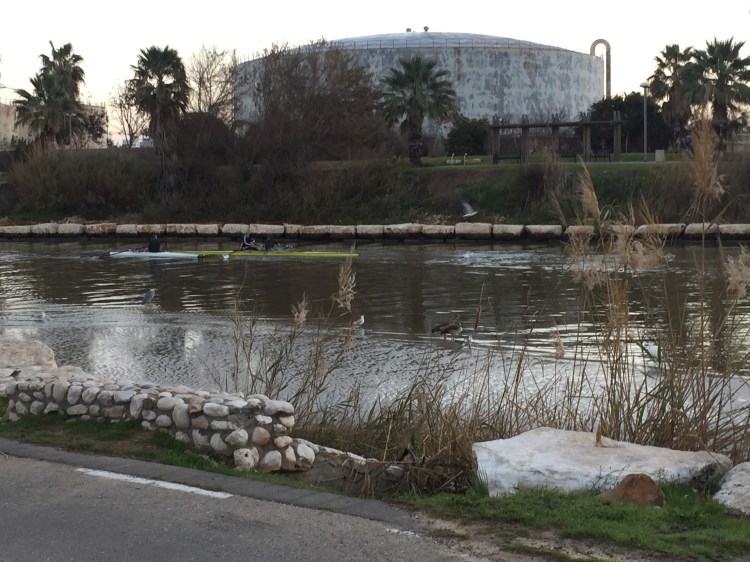
I set out at 6AM for my long run and was grateful for it, after last weekend’s pouring rain and freezing cold. A heron greeted me as I entered the park (both it and the fishermen behind it were fishing, but I think that it had more luck then they did, judging by their sour faces).
The owner of the paddleboats was trying to get the seagulls off his boats using homemade contraptions made out of string, poles and old CDs. I wished him the best of luck but had a feeling that it wouldn’t really work.
Another heron was fishing right across the paddleboat pier, and I only wish that I had a better camera so you could have seen more than a whitish smudge.
On my way back I got to witness just how effective the paddleboats’ guy’s contraption was (not very). You can almost hear the gulls laughing.
A bittern was perched on the the reeds, ready to pounce.
You know that you’re a terrible fisherman when a little egret is standing right next to you, just waiting for you to fail and throw it your small fry.
10k done and dusted. Can you hear the gulls laughing?











 Writing at Large