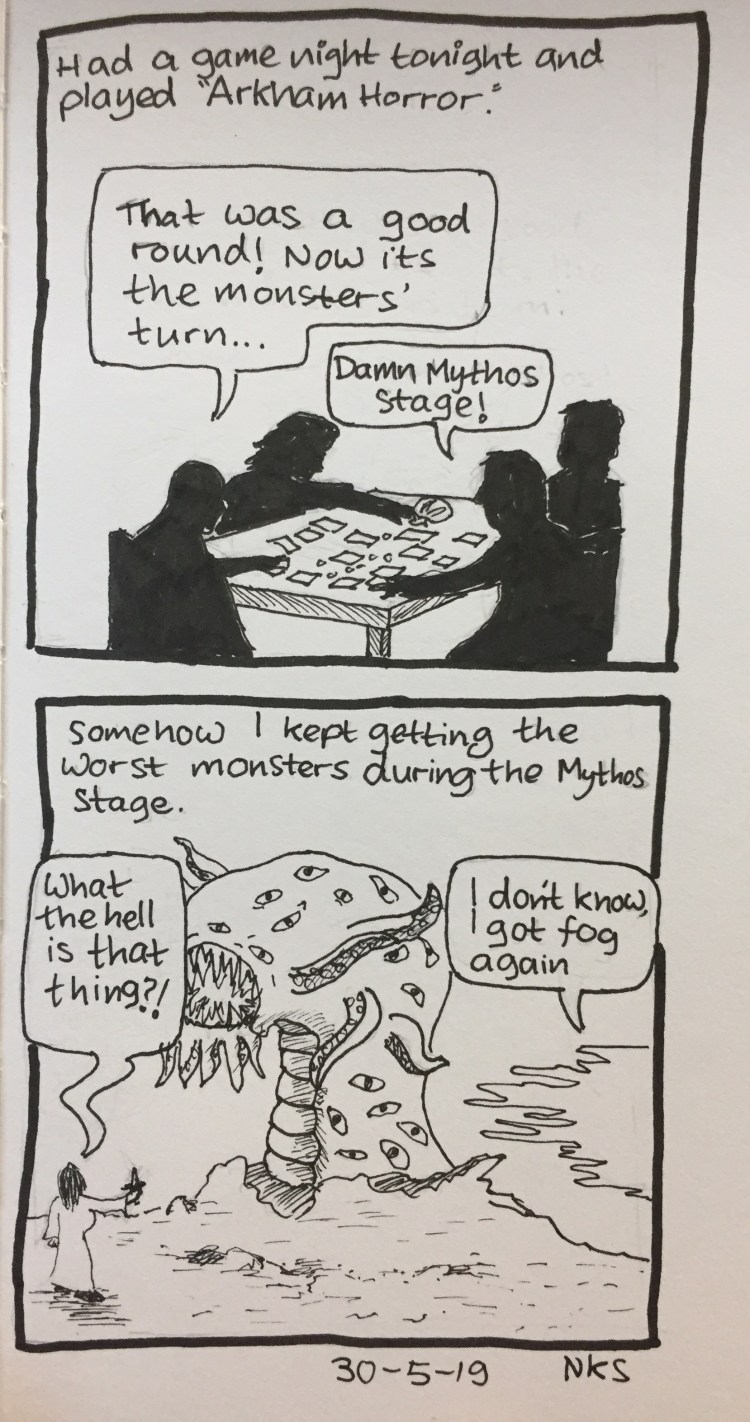
Pokestop (Journal Comic 26-5-19)

A blog about writing, sketching, running and other things


It’s the insane, glow in the dark Blackwing, and I managed to snag a box!
OK, enough with the hype. Plenty of other reviewers have given this limited edition pencil a spin, but my experiences and thoughts about “The Library Pencil” seem to be different enough to warrant a few quick words about the Blackwing 811.
First of all, the pencil is attractive. It’s darker than a banker’s lamp (I have one, so I checked), and the gradient is very well done. This could have looked cheap and tacky but it doesn’t. I would have liked a darker ferrule and I think that the pink eraser is ugly, but even so it’s a pretty attractive pencil.

The lighter part of the gradient disappears for the most part on the first sharpening, so that’s a shame. The coating on the pencil is grippier than the coating on the Blacking 54, 56, 24, 725 and 530 (and lacquered pencils in general), but less grippy and gritty than the coating on the Blacking 4. It has a matte feel.

It’s got a “firm” core, which means it has the Blacking 602. I absolutely hate that Blackwing doesn’t write its firmness on the barrel, or use “standard” hardness ratings, or makes it easy to see what the core grade is on the box or on their site. That’s like buying a fountain pen and not knowing whether you’ll get a fine or a broad. It’s bad enough that manufacturers play fast and loose with pencil grades within the standard 10H-10B range. Having a company invent its own grade and not even have it make sense, and then not even make it visible is a big no-no in my book.
Here’s a sketch of my banker’s lamp (which is a bit wonky after my cat dropped a giant pile of books on it) done with the Blackwing 211. I’d say it’s a B or a 2B, depending on the maker, but in no way is it a pencil that I’d call “firm”. It’s great for quick sketches, but I wouldn’t recommend it for under-drawings.


After a month off due to injury and a cold, it’s good to be back.
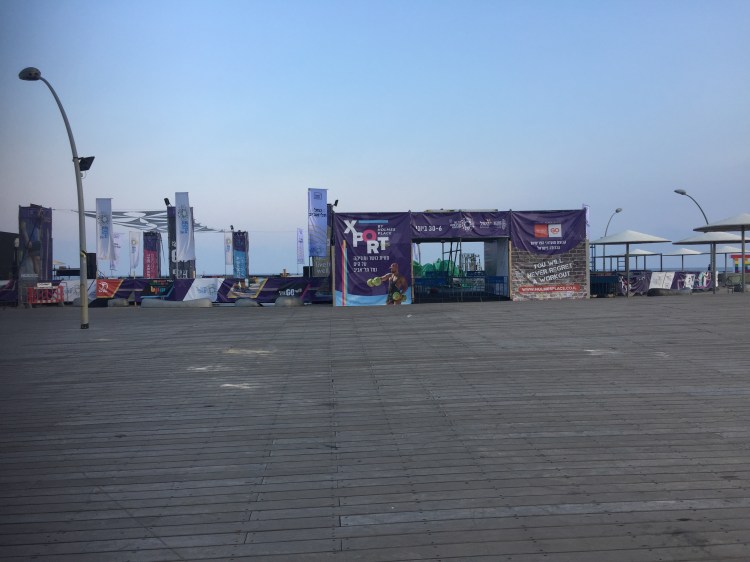
A quick sketch on location of the Eurovision 2019 Tel Aviv Euro Village as it was filling up.

Leuchtturm1917 Sketchbook, Super5 0.7 fountain pen and Rohrer and Klingner Lotte ink.

Moleskine has issued their Fall 2019 catalogue and it’s even more interesting than their Spring 2019 one. As usual, here are the highlights:
That’s it for me. I’m not interested in the “Smart” stuff or the accessories, and there’s enough here as there is. It looks like 2019 is going to be an excellent year for Moleskine, and I can’t wait to get my hands on several of these notebooks.


Leuchtturm1917 Sketchbook, Tombow Mono 100 2B and Pentel Color Eno 0.7
I finished reading the last Tournament of Books novel a few weeks ago, but I waited with the review until I could gather my thoughts about the whole experience. That’s a little unfair to what’s turned out to be one of the best books in the tournament, so my apologies to Urrea. The “The House of Broken Angels” by Luis Alberto Urrea was up against “So Lucky” by Nicola Griffith in the sixth round of the competition.
To call “The House of Broken Angels” heartwarming seems somehow insufficient. It is a heartwarming tale of a man celebrating the last days of his life with his extended family. It’s also an immigrant story, a story of overcoming abuse, poverty, racism, and your own preconceptions even when you’re on the verge of death. It’s a story of one generation passing the torch on to another. It’s a story of women finding their voice in a world of men. It’s a story with tremendous tragedy and a lot of humour. It’s a story about the poetry of everyday life.
But most of all it’s a story of family and love, created without cynicism or cliche: unique, realistic, flawed, and intensely powerful.
In two days life, in its mundanities and most profound and heroic moments, unfolds before your eyes and leaves you at times laughing, crying or merely breathless with anticipation. Urrea moves you from past to present, from one character to another, effortlessly and seamlessly. It’s one of the few cases that I’ve seem where a complex narrative structure feels like a light read simply because it’s so well created.
This is a must read, especially these days, when the Mexican and Latino population in the US is constantly under attack.
There’s not much in common between “So Lucky” and “The House of Broken Angels” apart from them both being centred around people who have fallen seriously ill. “So Lucky” deals with the first days of dealing with illness, and the “The House of Broken Angels” with the last. The protagonist in “So Lucky” is a lone woman, and in “The House of Broken Angels” it is a man surrounded by a large, loving family. The trick lies in reading the acknowledgements in the end, as it is then that you discover that both narratives are based on the true life experiences of the authors. That adds impact to the stories in some ways, but I think that it mainly creates a level playing ground where they both have a similar gravitas and you can simply judge them by their merits. I highly recommend reading both, but that being said “The House of Broken Angels” is a much better work of fiction. It’s also more enjoyable to read despite its oftentimes tough subject matter, and unlike “So Lucky”, it’s a literary novel and a story of its time that is also timeless. Imagine comfort food that isn’t boring and provides you with all your daily nutritional needs and you’ve got “The House of Broken Angels”.
Have you not read it yet, mijo?