Since November 2023 I have picked up a new habit of sorts – writing letters without posting them. I address them to people I know, some alive, some no longer so, and they’re usually short – an A5 page or two at the most. I write them with no intention of ever posting them, and I deliberately phrase them as letters to a specific person.
Why would I do that?
This started because I wanted to write about certain things with a particular person in mind, and I knew that with the state of our local post office they would never be posted. This was fine by me as I didn’t have the time and mental capacity to start and maintain a true correspondence with someone.
I wanted to write a letter and not a journal entry because I wanted to address my thoughts to someone. When you write a letter you find yourself shaping your thoughts, points, ideas to fit to the person you’re addressing – whether you’re trying to convince them of something, explain something to them, let them know what’s going on in your life, or argue with them. The writing needs to be clear, poignant, convincing and oftentimes entertaining.
I can be sloppy in my journal writing, but letter writing requires more discipline and care. It’s a good writing and thinking practice even if you have no aspirations of being a writer.
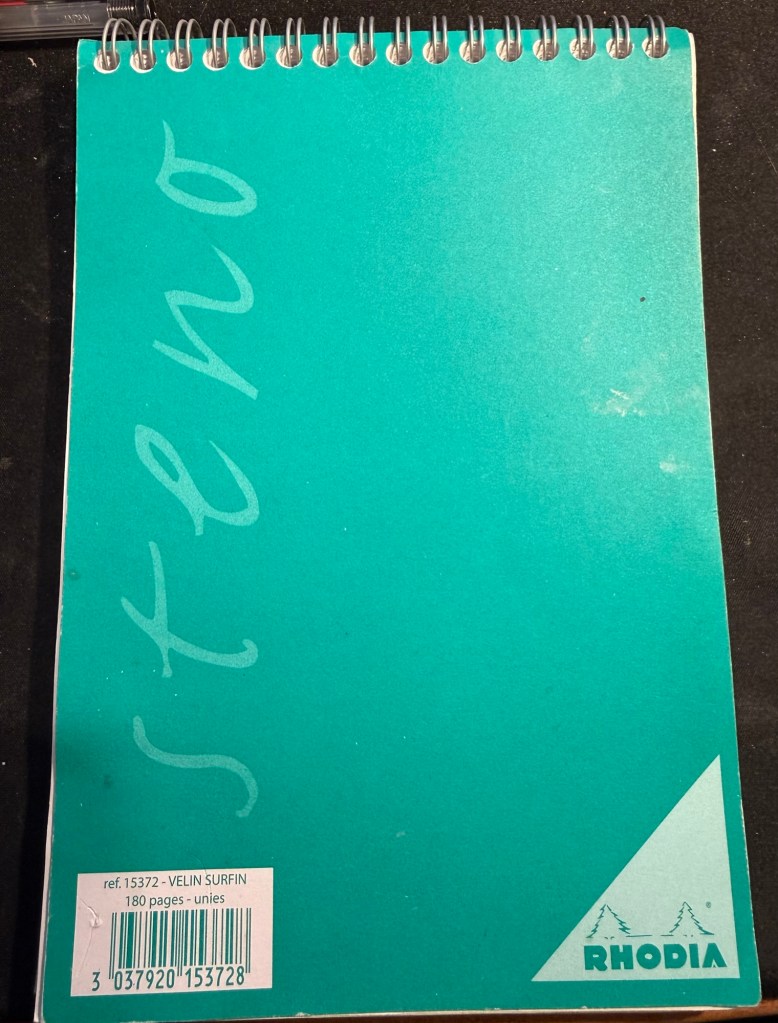
The pad that I use
Who do I address the letters to?
Mostly dead people. Dead mentors, dead relatives, people that are no longer in my life. I keep them posted on what’s going on, wonder what their opinion would be of current events, and through writing to them I work out what I think of what’s going on in my life and the world. Occasionally I’ll write to people that are alive and well and in my life – just things that I want to get off my chest but that are better off unsaid. Unlike what social media would have you think, not all thoughts are worth publicly airing.
I use a Rhodia blank steno pad and whatever fountain pens I have in rotation. The medium is less important than the actual practice. I tend to write about one or two letters a month, although there are months that I write more letters in and those where I write none at all.
I’d recommend giving this idea a try, and start by writing to people you know and not celebrities or famous people. It’s easier addressing someone you’re familiar with – like a grandmother, aunt, cousin or teacher. You can destroy the letter after you wrote it – the point of this exercise is the writing process of the letter itself, not the resulting letter.
I think you’ll find that it will give you some clarity and peace of mind.
I wrote about my newest notebook, my “Work in Progress” notebook here. It’s basically a notebook that I use for self improvement, dedicated for various exercises in focused meditation, working through gnarly personal issues, and for more intense personal journaling.
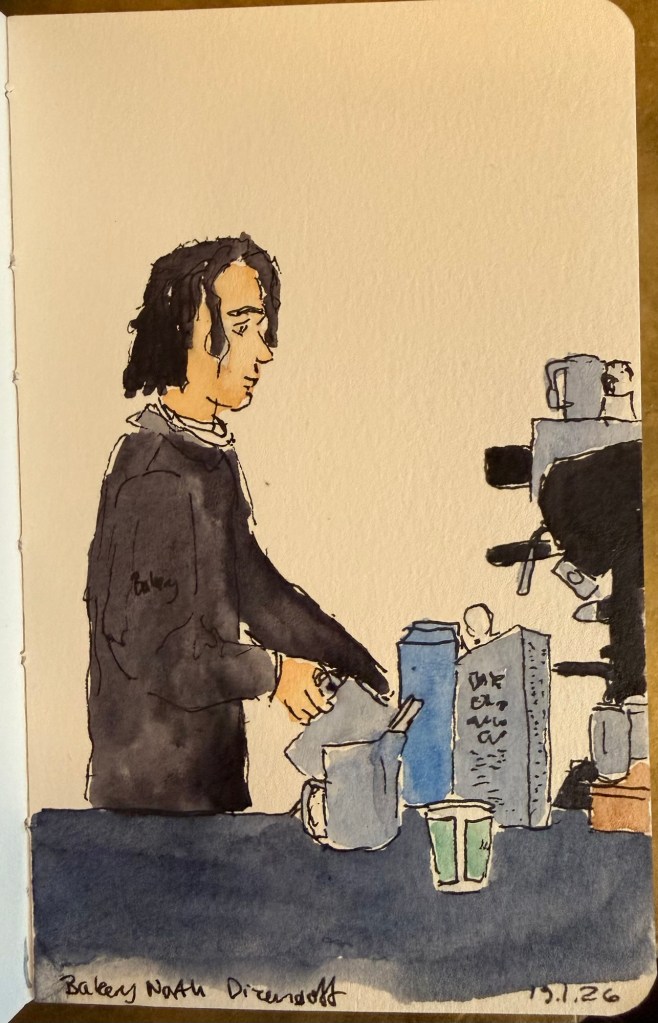
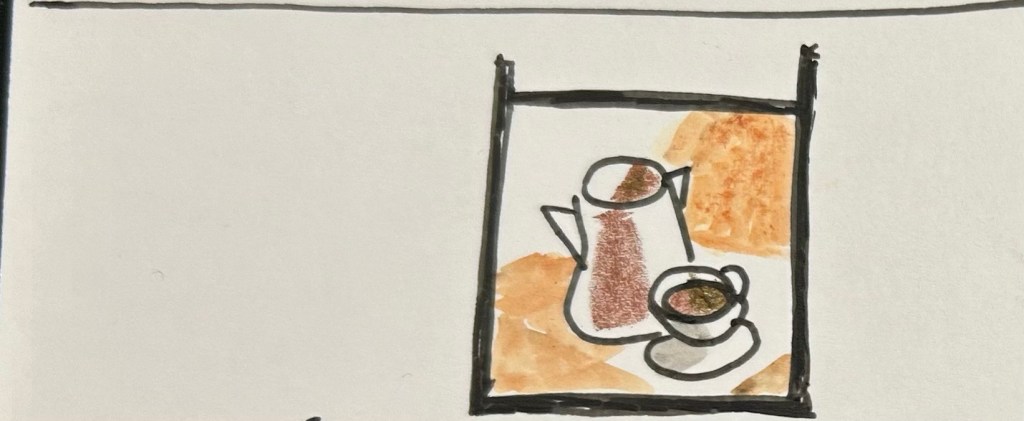
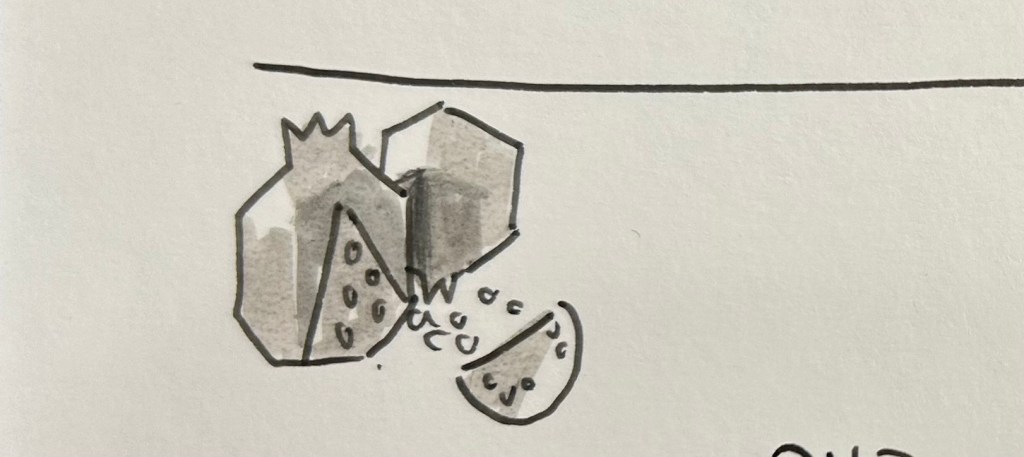
Barista sketch because people need pictures in posts or they get bored.
One of the things that I do as an ongoing exercise in this notebook is keep a list of people that I personally know (so no celebrities or influencers) and what I learned from them. The idea came to me as I was reading Marcus Aurelius’s Meditations.
The book starts with a list of people that Marcus is indebted to – from his immediate family, then onwards to friends, teachers and advisers. This inspired me to create a similar list of my own, also starting from my immediate family and expanding onwards from that.
Some people are kind, inspiring, provide a good example and so they were easy to add to the list. Others were more challenging, but I forced myself to confront my relationship to them, and to find the valuable lessons that I learned from them. The point isn’t to be vicious, cynical, or facetious, but rather to take a second look at people and relationships that you have labelled in a certain way. So the terrible boss taught me what I value in myself and in my managers, certain mean people taught me how to recognise hypocrites, and bad teachers taught me to appreciate good ones and to learn on my own.
I highly recommend doing this exercise and returning to it. It will make you appreciate and feel grateful for the people in your life, and you may even be moved to thank a few of them, even though that’s not the point of this. The point is to realise that:
No man is an island,
Entire of itself;
Every man is a piece of the continent,
A part of the main.
If a clod be washed away by the sea,
Europe is the less,
As well as if a promontory were:
As well as if a manor of thy friend’s
Or of thine own were.
Any man’s death diminishes me,
Because I am involved in mankind.
And therefore never send to know for whom the bell tolls;
A smorgasbord of stuff for your delectation. You can read part 1 here.
13. Big bold announcement: next month is Bloomsday, and after much hemming and hawing i’ve decided to reread James Joyce’s Ulysses and blog about it as I go along. I’ve read Ulysses three or four times between 2009-2013 but I haven’t touched it since. While I still have some of my notes on this book, my goal isn’t to reconstruct them or to lecture on the topic, but to enjoy a very good book, and see how my memory of it fairs post-chemotherapy (which has affected my memory). Why should you join along? Because Ulysses is a phenomenally good book that is enjoyable to re-read (but very challenging to read for the first time). It’s funny and touching, profound and full of adventure. It’s just built on very well crafted layers of language, meaning and context, and it’s paradoxically a book that is meant to be re-read, not read. Hopefully I will make it a bit easier and less scary to read for the first time for those brave enough to join me.
14. I have been switching my podcast listening queue around lately, which means that I got to listen to this wonderful two part episode of Alie Ward’s “Ologies”: Salugenology (Why humans require hobbies). Guest Julia Hotz talks about the things that we need to be happy as humans, and the conversation is fun to listen to and enlightening. I highly recommend it, and the “Ologies” podcast in general.
15. I’ve stopped buying eBooks from Amazon after they stopped allowing customers to download the books that they purchased (so you basically don’t own the book that you paid for if you buy in from Amazon now). I still use my Kindle Paperwhite, but I’m buying books from Kobo. I buy them DRM free where possible, and if not I use Calibre to strip them of DRM and then this site to transfer them to my Kindle (if they are DRM free you just use the sendtokindle site to upload them to your Kindle). It took me 30 minutes to get the setup working the first time, and it now adds 1-2 minutes tops to every book purchase, which is plus for me. It means that I don’t mindlessly purchase books that I don’t intend to read, and I actually think through each book purchase. I also noticed that the books I’m interested in are priced slightly cheaper on Kobo, which is a nice little bonus.
16. Using yellow ink (Rohrer and Klingner Helianthus) has been a challenge but also an education. Helianthus is readable enough to be used for my daily todo list, but thanks to this ink I’ve been learning to enjoy using a fountain pen for highlighting purposes. It’s more subtle and better behaved than traditional highlighters, and the colour pops on the page without resorting to neon shades.
17.I am thinking about the next inks to put into rotation, which is a bit unusual for me as I normally start with the pens that I want to fill, and then go find inks that go well with them. I want a blue-black for practical reasons, a cheerful green, a pink or orange, and a turquoise or teal. How do you select which pens and inks you use?
18. A bit of behind the scenes: I draft these posts longhand in a Dingbats notebook and a fountain pen. I think better on paper and it’s a way to use the pens and inks that I have. There are no AI/LLM agents/bots involved in this blog, and that’s the way it will remain. I enjoy writing, I created this blog as a hobby because I enjoy writing, and while I use AI agents as part of my job, I have no intention of letting them take away any part of the creation of this site.
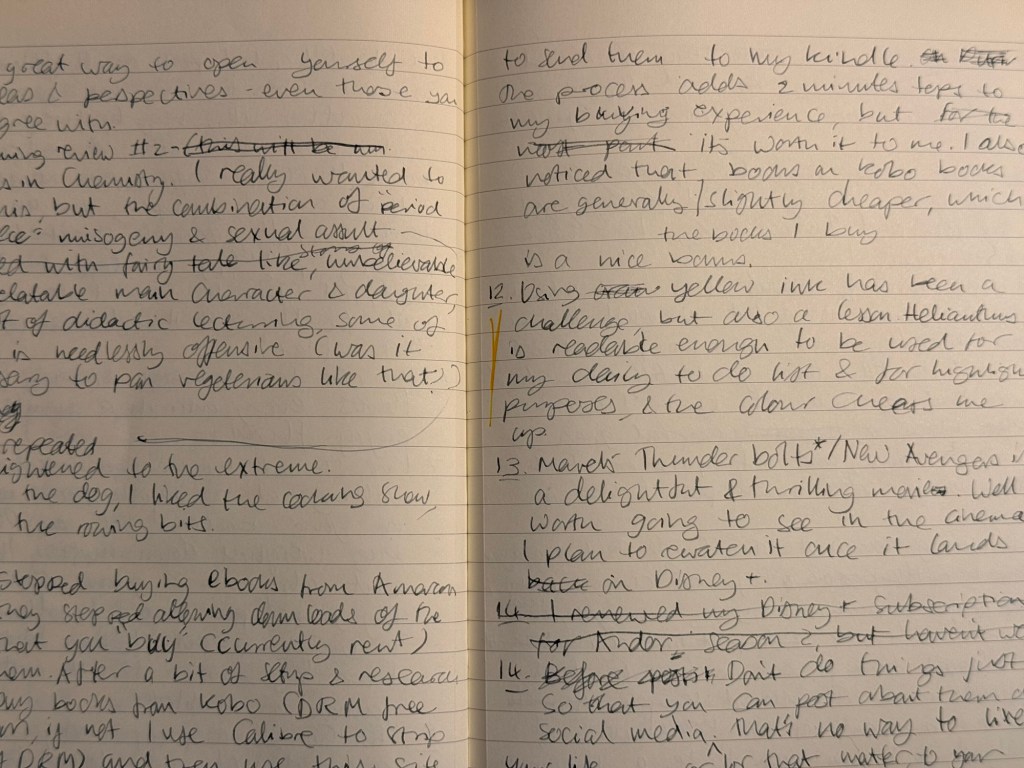
Draft of this post Well worn Dingbats blogging notebook
19. Journaling tip #1: If you’ve been feeling down lately, take the time at the end of each day to review your day and score it. It doesn’t matter what scoring system you choose, but I recommend that you keep it simple and not too granular: -1, 0, +1 or 1, 2, 3, or “great”, “OK”, “meh”, “terrible”. You just want a quick way to know if the day was a good day, an average day, or a bad day. At the end of every day for a week or two think back on what happened throughout the entire day, give it a score, and explain the score in no more than a sentence or two. So for me today was: “OK – was super tired at the start, but I managed to get two naps in and recovered enough to get most of what I planned done”. At the end of the week, when you do your weekly review and plan ahead what you want to stop doing, start doing and keep doing, use these scores as an input for your decisions. Repeat this whenever you feel the need to recalibrate.
20. Journaling tip #2: if you’ve stopped journaling and want to restart, don’t attempt to backlog the days that you missed. Forgive yourself the journaling “debt” and start fresh. This is easier to do if you switch something up in your journaling routine – use a new pen, pencil or ink, a new notebook, or write in a new location.
21. A dear friend and colleague has moved to a new job in a different company. While I’m happy for him and I wish him the best of luck, I already miss working alongside him. This brings me to the following journaling tip:
22. Journaling tip #3: Take a journal, either your usual one or a new one for a special journaling “events” and write down a list of names of people that have inspired or taught you something that you are grateful for, and write down what it is they taught you. Start with those that affected you by their positive actions (kindness, encouragement, setting good examples), and then challenge yourself to journal about those that taught you by being negative presences in your life. Did an office bully teach you to be kind? Did the talentless brown-nose teach you about how much you value your integrity? You can write about both people you personally know and those in the public sphere, and you can return and edit or add on to this list whenever you want. It’s a good reference in troubled times to remind you of who you are, what you stand for, and where you want to be.
Manufactus notebook that I plan on using for journaling tip #3
I used to be a heavy Twitter use. I discovered the service pretty early on through webcomic artists like Scott Kurtz, and I found the challenge of crafting short tweets to be a fun writing exercise. Yes, I was among those disappointed when they raised the character limit – half the fun of the service was trying to be as clear and concise as possible.
When Twitter stopped supporting third-party clients like Tweetbot, and started becoming an unpleasant place to hang out, I left. It hasn’t gotten better in the interim years and as I have largely cut social media out of my life so I have no plans of ever going back. However, while I don’t miss Twitter (not as it is, not even as it used to be) I do miss the challenge of crafting short and punchy snippets of text: the haiku like nature of tweets. I also have a large pile of unused Field Notes pocket notebooks, and a not insignificant stock of really cool gel ink pens, rollerballs and ballpoints that are all seeing very little use.
Could I put these together to achieve an analog version of what I enjoyed most about Twitter?
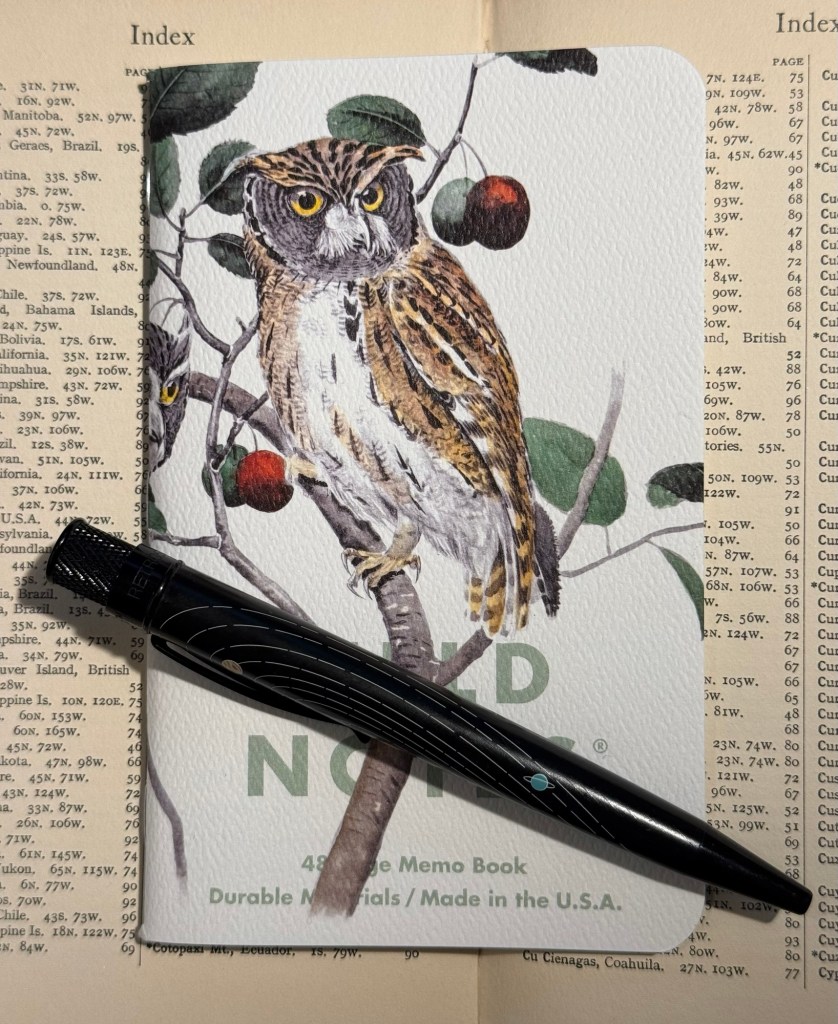
The Birds and Trees of North America, Fall 2024 seasonal edition of Field Notes.
Yes, I could and I did and it has been glorious.
I selected a Field Notes notebook out of the the Fall 2024 “Birds and Trees of North America” edition because it’s a beautiful edition, it has lined paper (which I rarely have use for in pocket notebooks), and it seemed appropriate. I randomly selected a Retro 51 Tornado – The System limited edition one which has Uniball Jetstream SXR-600-05 hybrid ballpoint refill in it instead of the original Schmidt refill which I don’t like. Then I started writing down “tweets” in it throughout the day.
Rocky Mountain and Mexican Screech Owls Field Notes notebook (illustrated by Rex Brasher) and Retro 51 Tornado The System limited edition pen
I’m not dating them, I’m not counting characters, I’m just limiting myself to a few rows for each entry, and I’m writing them as if I would be publishing them. The writing style is therefore different than what I would write in my journal, and so far it’s also focused exclusively on things that I don’t write about in my journal (mainly reactions to things I did or saw or read). I have no intention of ever publishing anything in this notebook, but I do enjoy the challenge of writing it as if it would be something that I would post somewhere.
So I get to practice my writing skill in a new way, I get to use some of my wonderful Field Notes stash, and I get to use some of my great standard pens. All this without filling the pockets of various billionaires with my work, and without encountering the bots and the foaming hordes of professional haters and rabble rousers online.
I highly recommend this practice, whether you do it with a fancy Field Notes or just any pocket notebook you have on hand. Using a notebook of this size will remind you to keep your entries short, and it’s something that you can easily carry with you and use in waiting rooms, boring meetings, or when you need a little break between tasks throughout the day.
There’s a new show out on a streaming service and I’ve started watching it. It’s part of a large franchise with a vocal fandom, and as usual, the fandom has opinions. These opinions are extreme, because that’s what social media and news sites amplify. Outrage sells. Hate sells. Abusive bot attacks drive up traffic and “engagement” so why should these companies stop them?
I too have opinions about this series, but they aren’t of the outrage kind. A few years ago I would have expressed them on Twitter, More recently I would have written about them in various group chats. These days I do neither.
I journal about them instead.
We have been trained to think that our opinions on the media we consume must be packaged attractively and shared as widely as possible. We have been told that it’s our responsibility to go on social media and let everyone know how we feel about a show, a movie, an album, a book, about every bit of culture we consume. We have been told that it’s for the benefit of our friends and for the benefit of the artists we like. It is not. It is for the benefit of a small group of shareholders.
I have no interest in feeding the outrage machine. Screaming into the bot filled void does nothing but make you hoarse, miserable, angry, and possibly part of a mob.
I also realized that I’m not interested in entering a debate or an echo chamber about this particular series. I just wanted to clarify for myself what worked in this series, what didn’t, and should I continue watching it or not.
So I journaled about it. No outrage. No drama. Just me and a blank page having a bit of a think about a streaming series. There’s no personal affront here, no mob cheering you on to hurl abuse on the series creators, no mob telling you what to think about certain casting choices, plot choices or the series creators.
My thoughts and conclusions about this series aren’t interesting, just as the name of the specific series is irrelevant. I recommend this process with every bit of media you feel the need to share your opinion about, BEFORE you share your opinion on it. It’s what I do with the books that I review. It’s what I do about podcasts, movies, series and shows. It allows for a guiltless, safe place to voice my opinions, to consider and rework them. It’s also far from the maddening crowd, which means I know that these are my own opinions and not the regurgitated opinions of others.
If you’re interested in the process, here are some questions you can use as prompts:
Why did I start watching/reading/listening to this?
Who would I recommend this to?
Am I enjoying each episode/chapter? Am I looking forward to the next one?
What is my favourite thing about this show/movie/etc? What is my least favourite?
Bonus: How would I change the show/movie/etc to make it better? What would be gained and what would be lost with this change?
Do you journal about media? What prompts do you use?
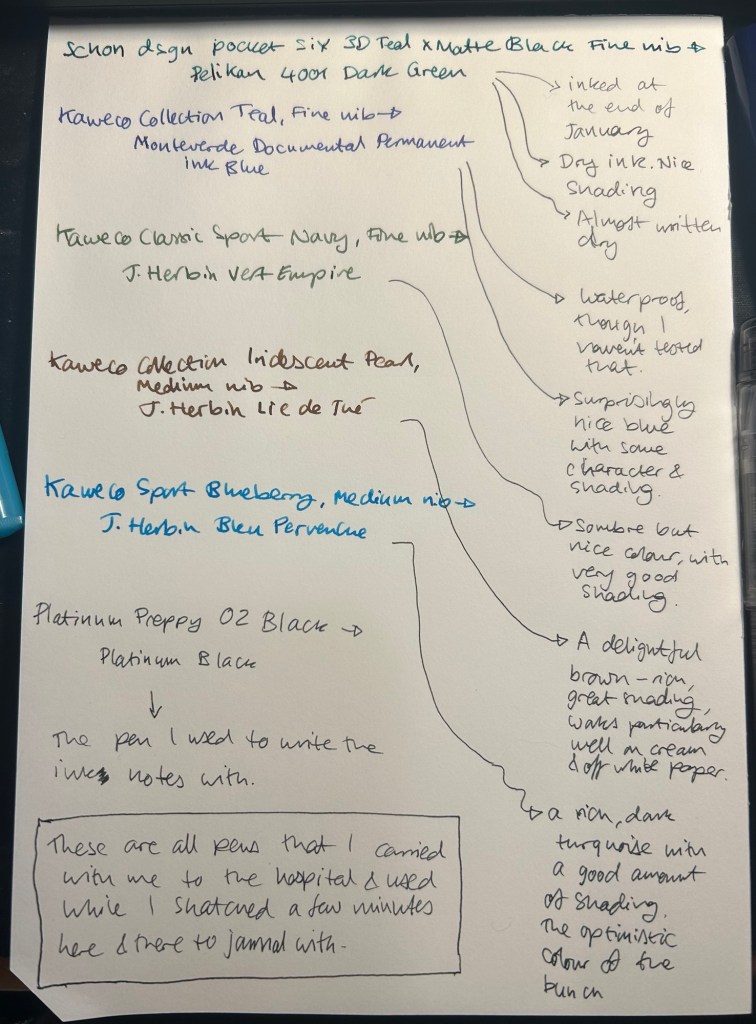
I started the month ready to spend the first half of it in hospital, with my dad. So the fountain pens I chose were all expendable pocketable pens that I was willing to have stolen (apart from the Schon Design Pocket 6 which was a leftover from January and never left my desk). So that meant I inked 4 Kaweco Sport fountain pens using various ink cartridges that I had on hand.
The portable lineup:
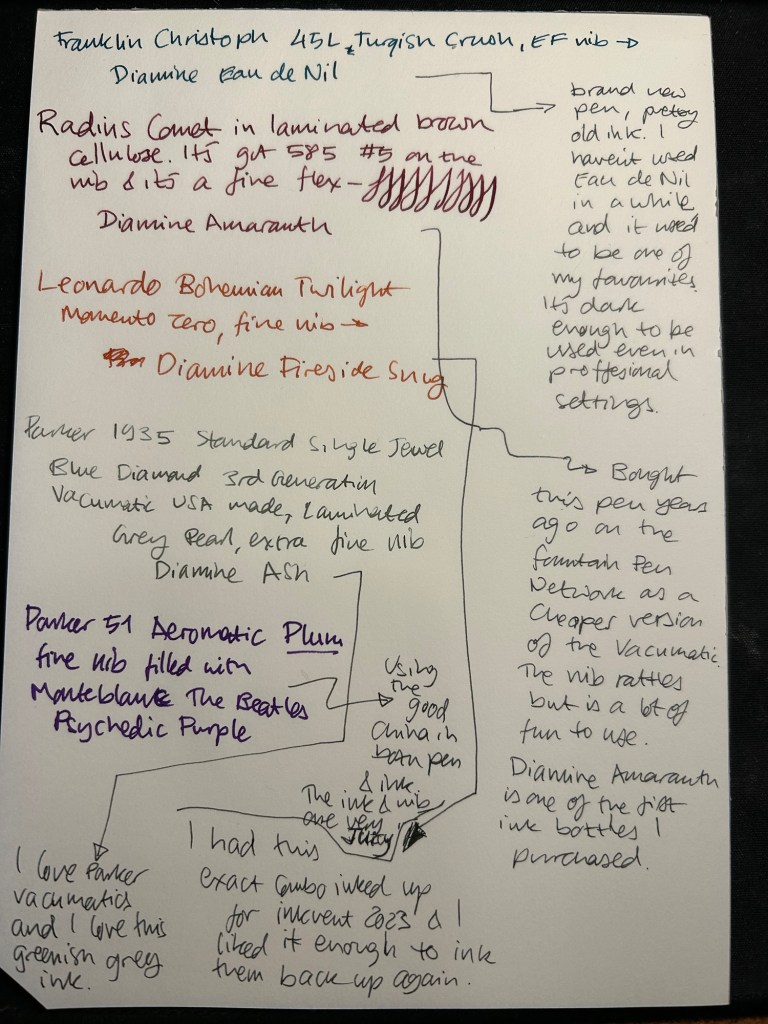
Once my dad got out of hospital and back home, I decided to celebrate by “shopping” from my collection. I inked up a Parker 51 Plum (use the good china!), a Parker Vacumatic, a Franklin Christoph 45L Turqish (spelled like that on their site) Crush that I had purchased but hadn’t inked before, and a vintage Radius Comet (because I heard that the brand was being revived).
The Franklin Christoph EF nib isn’t the best companion to the Eau de Nil as the ink tends to dry in the nib, causing hard start issues. The Radius is a flexible nib of the vintage kind, which means it’s really flexible and not just springy. It also rattles, which makes me not carry it around with me — it stays at home at my desk. The Leonardo is a beautiful pen with a beautiful ink that I refilled immediately — the only Inkvent 2023 ink I did that with. The two vintage Parkers are phenomenal, as usual. The extra fine nib on the vacumatic somehow really well with Diamine Ash, though I was worried at first that the combination would be too light to be readable. The Parker 51 Aeromatic is a treat to use. It’s the rare Plum colour, and it’s got a fantastic nib (as all 51’s have) which pairs very nicely with the Monteblanc The Beatles Psychedelic Purple.
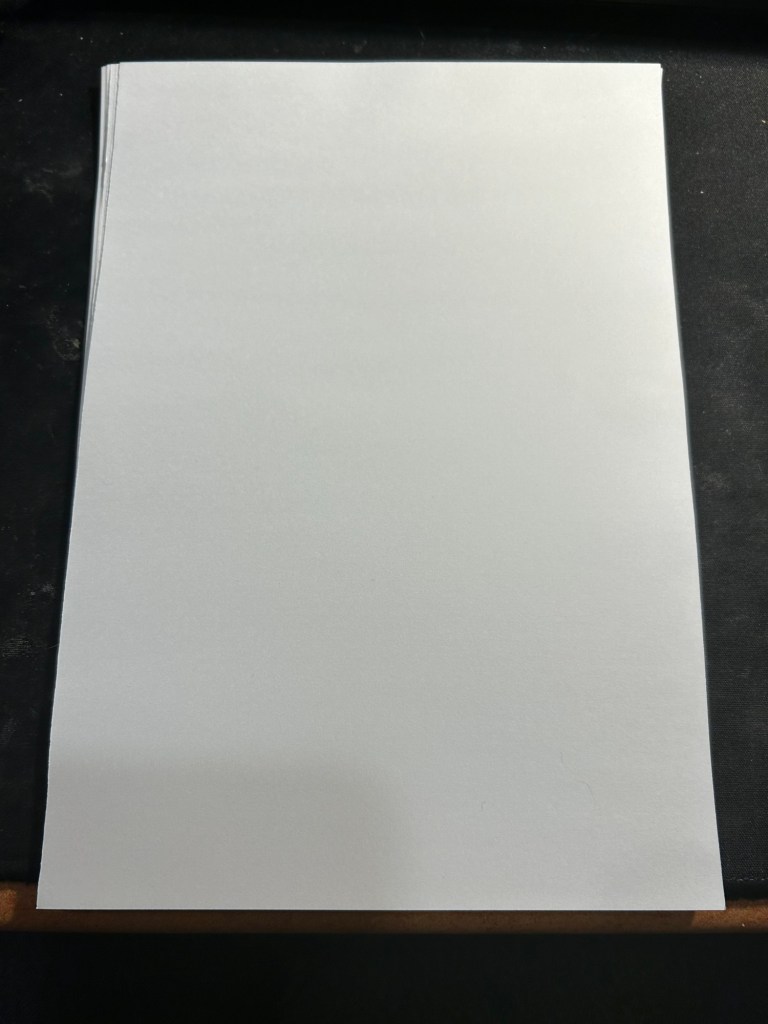
In terms of paper I’ve been using Kokuyo A4 KB paper which I cut to half size (so A5) to manage my daily to do list. The paper is relatively cheap and very fountain pen friendly. I’m also able to use both sides of the page despite there being some show through.
Kokuyo A4 KB paper cut in half to A5 size. This is why standards are great.
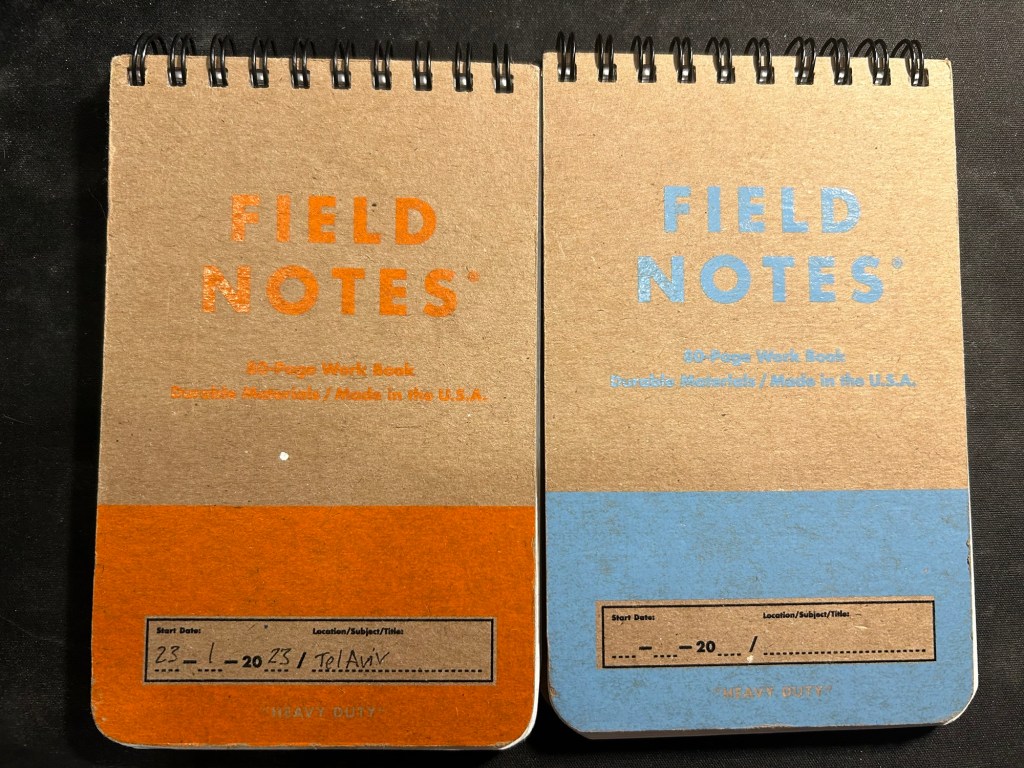
I’ve got a Field Notes Heavy duty on my desk at home and at work, and I just bought a new stock of them. These are where I jot down quick notes, phone call details, doodles during boring meetings. When they’re filled up they get tossed out as nothing in them is permanent — everything important in them moves to somewhere else as I work my way through them.
Field Notes Heavy Duty pocket spiral bound reporter notebooks
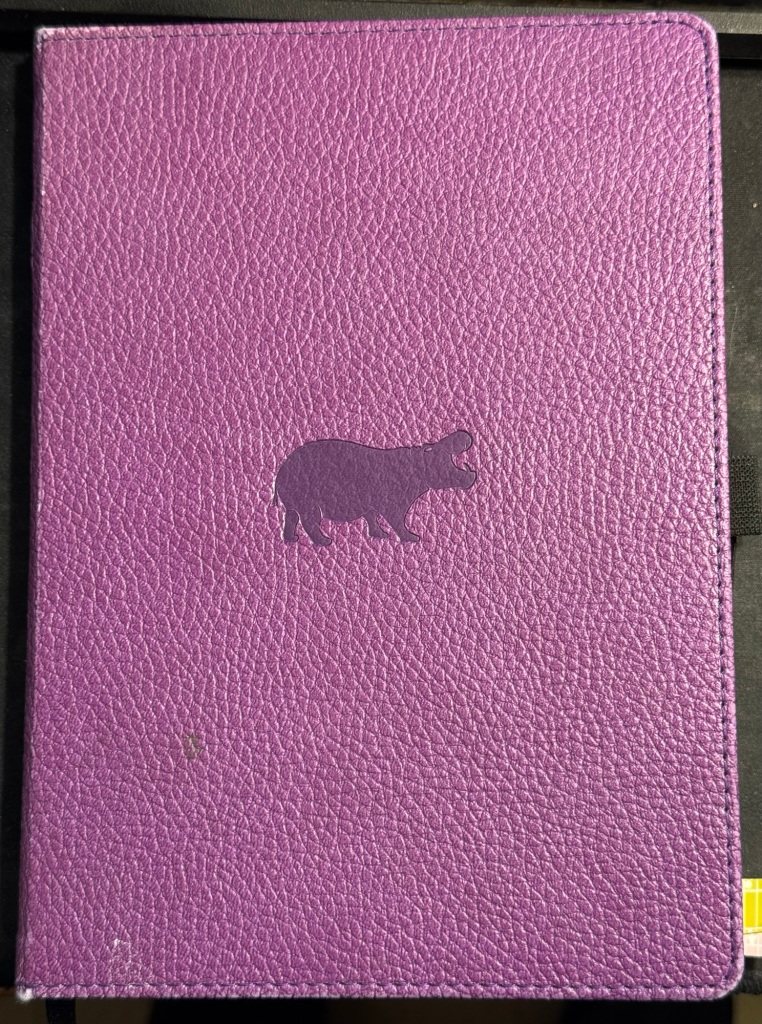
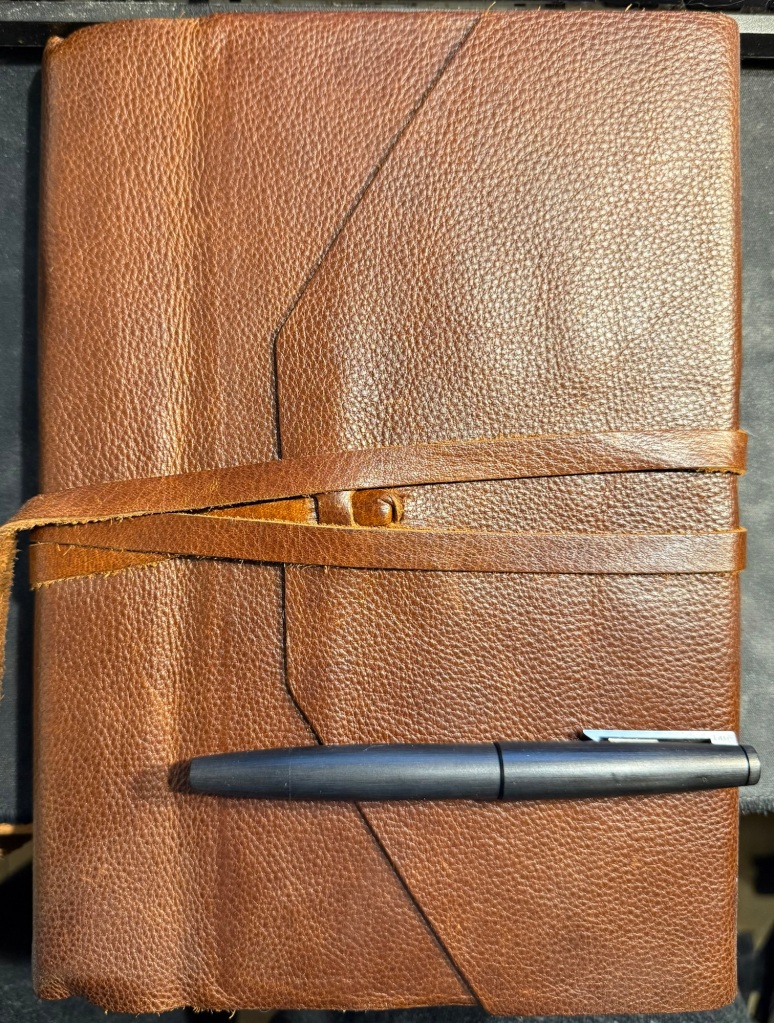
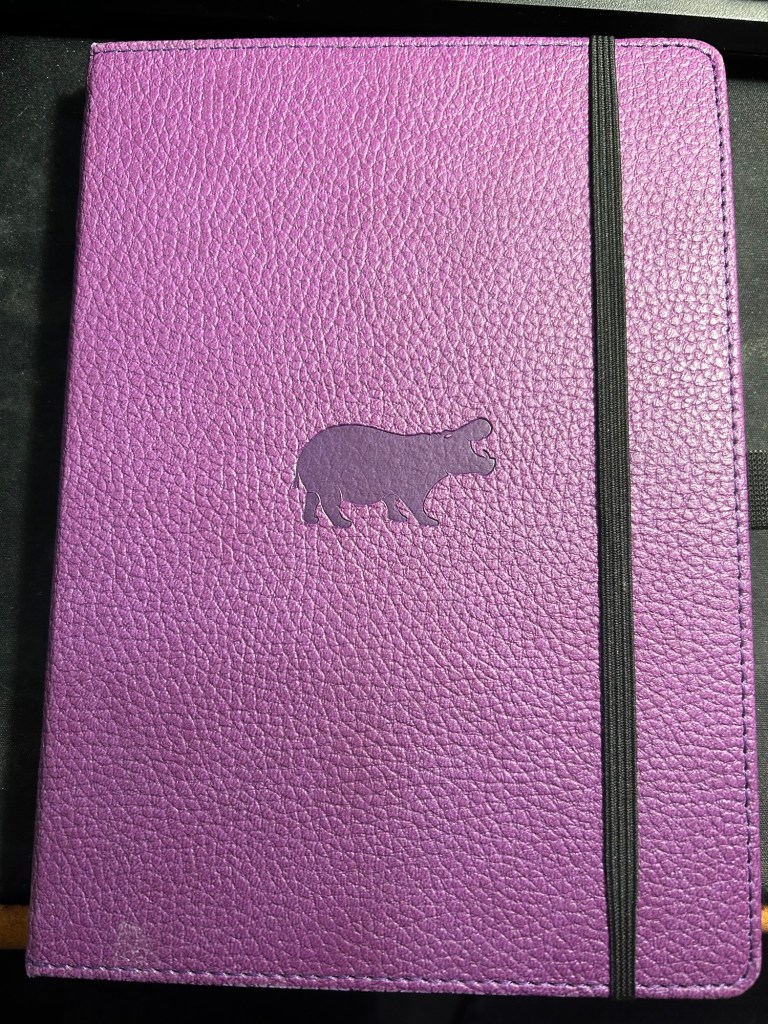
I have finally found a use for my Dingbats notebooks (beyond giving them away as gifts, as I have in the past): this lined purple hippo one is my blog notebook. I discovered that I have a much easier, much quicker time writing blog posts if I first draft them on paper, and this is where I do it in. I’ll likely write a dedicated post to this notebook soon.
Dingbats Puple Hippo A5 lined notebook
Apart from them I still use the notebooks I used last month.
Pencils
I’ve been using the Drehgriffel Nr. 2 as my daily driver. I use pencils extensively to plan, as my plans tend to change, and there’s something about this solid little mechanical pencil that makes me want to use it.
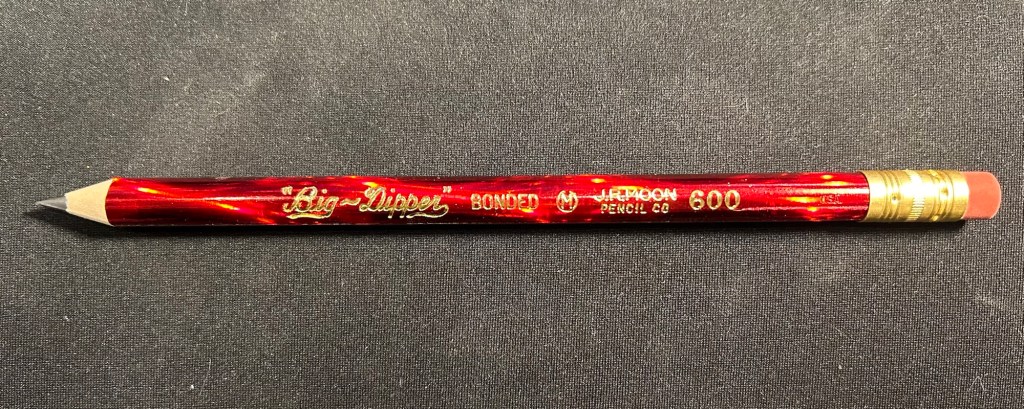
Apart from that I brought two pencils into the rotation, to try to use. One is from my last purchase from the late and great C.W. Pencils Enterprise, and it’s the “Big Dipper” J.R. Moon Pencil Co 600. It’s an oversized pencil, the kind of pencil that kids who are learning to write are expected to use. I’ve been having pretty significant neuropathy in my hands lately and I thought that this would be nice and easy to use, as after all it’s designed for kids just learning to develop their fine motor skills. So far it’s been a disappointment – the eraser and ferrule make it very top heavy, and I’ve been having a hard time manipulating it. I can’t imagine kids using this pencil and having an easy time with it. I like the over the top red foil with gold writing look though, so I haven’t given up on it yet.
Big Dipper J.R. Moon 600
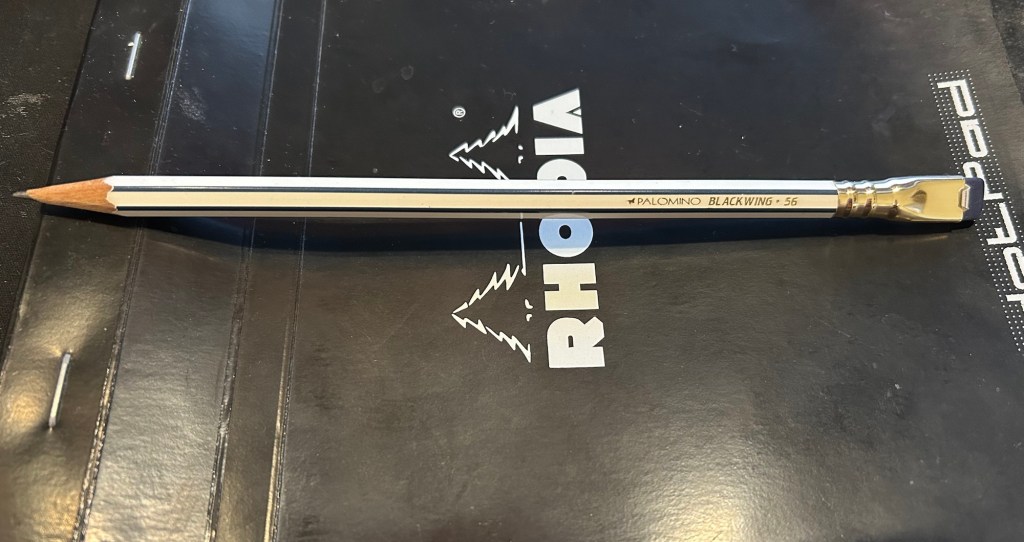
The second pencil is a Blackwing Volumes 56, the baseball themed one. The core is soft and dark, and I’ve been using it for quick and loose sketches. I’m trying to ease into one week 100 people by training myself to work faster than I normally would.
Blackwing Volumes 56
What did you use in February? Any planner changes? Pencil revelations? Pen preferences?
After finishing my previous journal I just started a new journal, which is both an exciting and daunting prospect whenever it happens. There is so much potential in a new journal – it makes me want to crack it open and fill as many pages as possible in the first sitting. Yet opening that first blank page also makes me freeze in fear of “ruining” a perfectly good notebook with my scrawls.
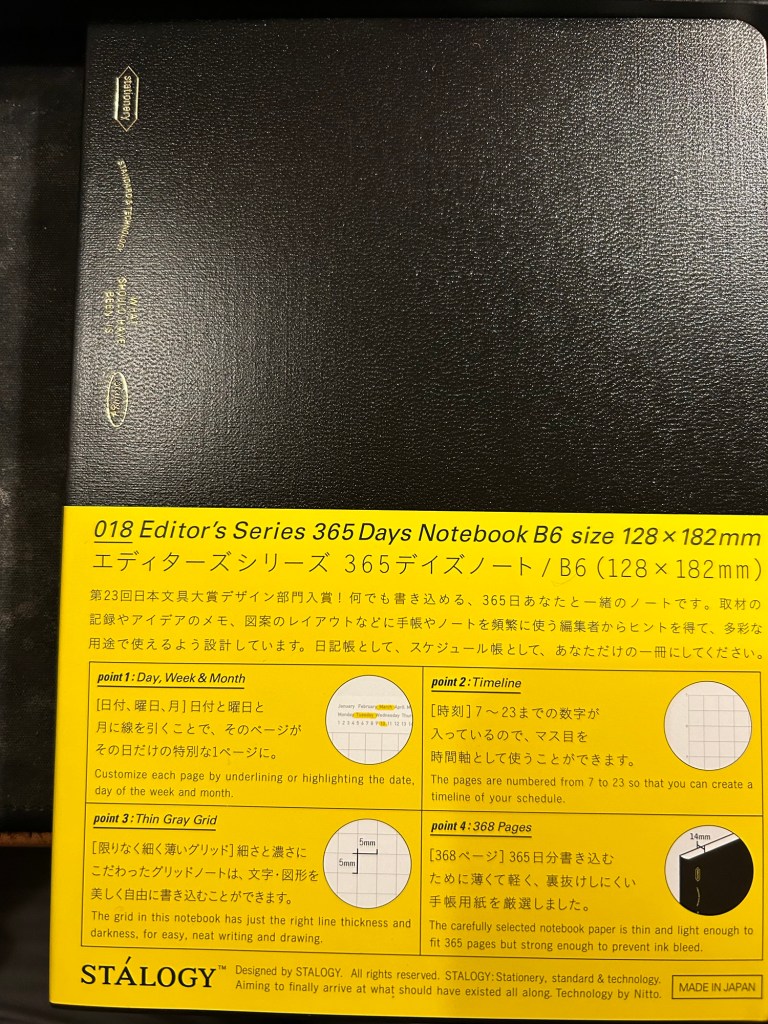
Stalogy 365 Days B6
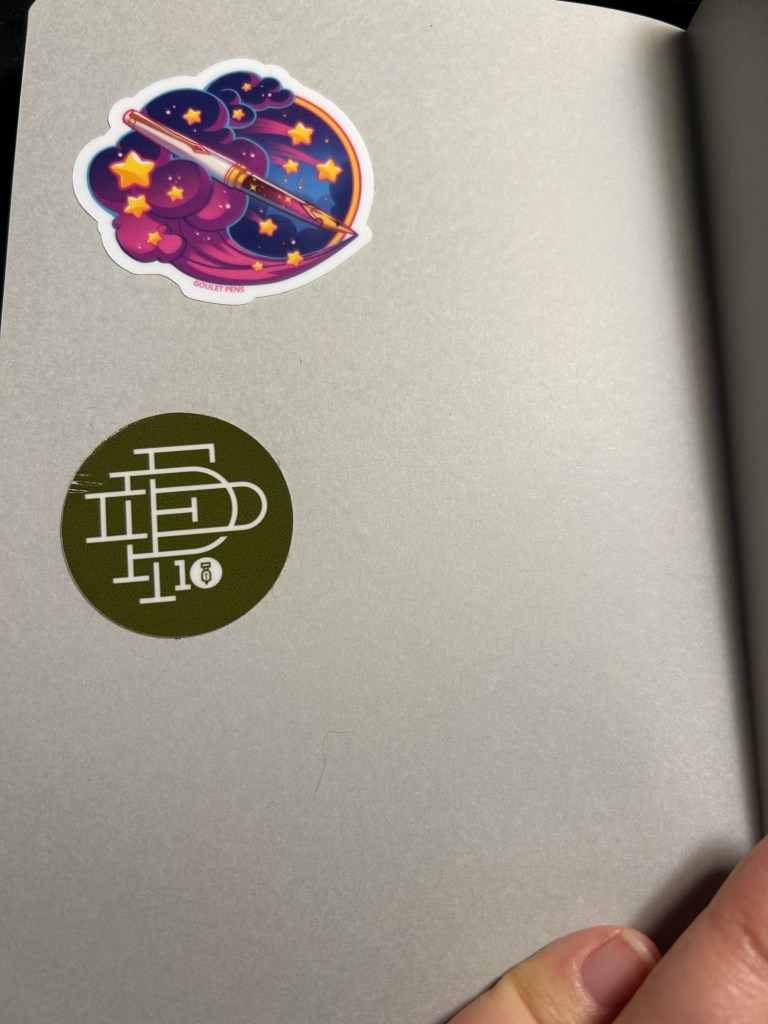
There are many tips on how to overcome that fear, ranging from deliberately destroying the first few pages to using various formulas to inspire you to fill those first pages. What I currently do is just open a new Stalogy 365 Days notebook, turn it upside down (so the header, which I don’t like, is at the bottom) and slap 2-3 stickers on the back endpages. This time I chose a 10th anniversary fountain pen day sticker and a Goulet Pens dream pen sticker to start off, but I usually add a few more stickers as I use the journal.
Stickers on the back
I then turned to the first page and started my first journal entry with the following sentence:
“New journal! My third Stalogy 365.”
After that came my usual daily gratitude list, and so I had most of the first page filled up in no time and had no problem moving on after that.
For those still in search for “new journal” inspiration, here are some pointers:
Personalize your new journal in some way. It’s about to hold your innermost thoughts, so you might as well make it your own.
Switch formats mercilessly if you find an old journaling format isn’t working for you – page size, ruling, type, etc.
Have a starting formula for your journal. If you find it difficult to start journaling each day, then pick a formula that you can use each day – like a daily gratitude list, a quote, notes about the weather, your plans for the day.
The first few entries are the hardest, but they’re also only 2-3 days out of the entire life of a journal. It’s worth remembering that and plowing through those days.
When in doubt pick a quote from a book or article you’re reading and start a discussion with the author.
If you’re really at a loss for starting ideas, use the first page, not the last one, as an ink testing page.
Do you have any new journal rituals or tips? Do you enjoy starting a new journal or find it daunting?
I’ve been spending practically every day for the past week or so with my dad in hospital.
There’s this phenomena that when you most need journaling, the it will help you the most, you find yourself least able to do it.
Hospitals are journaling hostile environments. There are no tables to use, there’s constant noise and distractions, there’s zero privacy and you never know when the staff will pop into the room with something. Whether you yourself are hospitalized or you’re there with someone else, there’s very little opportunity to crack open your journal and start writing.
Hospitals are also where weird, interesting, scary and new things happen, so you generally do what to write about them, to process them on paper. Fo instance, today three policemen escorted a prisoner into the heart surgery department. It wasn’t something I ever expected to see, a sort of non-sequitur that took me a minute or two to process.
The solution is to take temporary notes on your phone, put a reminder for an appointment with your journal in the evening or when things quiet down around you.
If you’re the one hospitalized, try to journal two or three times a day, documenting what’s going on, how you’re feeling, what the staff said, who visited you, etc. The best time to journal is during the nursing staff shift changes, because that’s when nobody will bother you.
Journaling is like running – oftentimes it’s really hard to start, but I haven’t regretted a run or a journaling session yet.
At night you can escape to these empty spaces and write
When my brother and I visited The Wizarding World of Harry Potter at Universal Orlando we bought a pack of postcards and some postage at Hogsmeade and posted some postcards home. They have a little “Owl Post” booth where you can get your postcard stamped with an owl post stamp, and it’s a charming experience. We ended up with a few postcards left over, so we posted them from our Disney hotel. A few weeks after we got home the postcards arrived and made out day.
I was just at a Shalom Sebba exhibition at the Tel-Aviv Museum of Art and after my visit I went to the museum store and bought some postcards there. Later that evening I spent some time writing postcards for my family, with little sketches inspired by Sebba’s work:
I had no idea where I would post them, as most of the post boxes in my area have been removed, but I wanted to at least try to post them before my dad’s surgery this week. With today’s postal service sending them would be a bit like tossing a message in a bottle into the sea and hoping it would eventually arrive at its destination. Yet there’s something about not just the wonderful experience of receiving snail mail which I wanted to give to my family, but something particular about postcards that made me want make the effort to post these cards that I could more easily hand deliver myself.
More than letter postcards evoke some things to me – a break from routine, a holiday, exotic places, better days. There’s something creative about the selection you make, and they make me want to sketch in them, write in their margins, be creative in the tiny space I’m given to work with. The limited space, zero privacy and the need to withstand the elements at least somewhat makes them a creative challenge we rarely encounter in days where everyone is an instant message away.
Yet that’s what made them appeal to me, because more than anything postcards speak of hope, and these days I need all the hope I can get.
I am trying something new here, to see if I can start using this blog to update on what’s going on with me plus as an accountability aid. Let’s see if it sticks.
Health
I spent the week recovering from Chemo number 8. I started the week with muscle aches and pretty strong neuropathy that made typing and writing a real pain, but by mid week the muscle aches subsided and the neuropathy, while still with me, is much less sever. Next week is Chemo number 9 out of 12. Getting into the home stretch, but the side effects are getting more pronounced. I no longer try to work on the day of the Chemo, and I may need to take a day off on the day after as well, but we’ll see. Next week I also finally get to see a psychologist at the cancer treatment centre. I’ve been on the waiting list for two months, so I really hope our appointment will go well.
Reading
I finished Kazuo Ishiguro’s fantastic “Klara and the Sun”. Not a breezy read and a very typical Ishiguro book, but I enjoyed his treatment of AI and humanity in this novel. It starts slow, and builds up a world and an atmosphere like few writers can. Highly recommended.
Started reading Hilary Mantel’s “Bring Up the Bodies” and will likely also start reading “Cibola Burn”, the 4th Expanse book by James S.A. Corey. Mantel is mesmerising as usual, but a bit too demanding to read during Chemo. That’s what “Cibola Burn” is for.
Writing
Got some writing done on my non fiction project, although not as much as I would have liked. I’m still writing in my notebook so I’m not counting words, but I estimate I got about 5 pages of writing in. Not great, but better than nothing, especially considering the material involved. I’m also considering picking up work on a novel that I stopped working on once the pandemic hit. I’ll have to rework the premise quite a bit, but I believe that the core of the story still works.
Currently Inked
I wrote my Diplomat Aero Champagne fine nib pen with Sailor Studio 123 dry this week. I really enjoyed the pen and the ink, so I think that they’ll be back in rotation pretty soon.
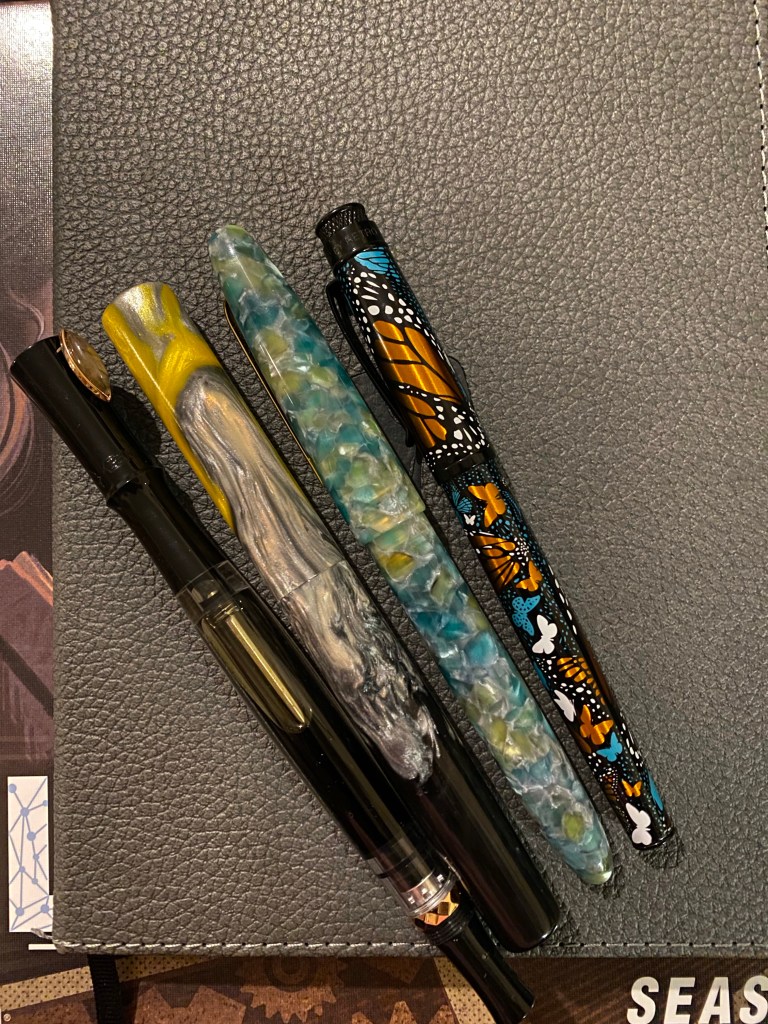
From left to right: PenBBS, Kanilea, Esterbrook, Retro 51
The PenBBS Year of the Ox pen and the Kanilea pen have been my journalling pens this week, with the first being filled with Pilot Iroshizuku Ina-Ho and the second with Diamine Earl Grey, both wonderful shading inks. The Retro 51 Monarch has a stub nib and is filled with Caran d’Ache Saffron, and the the Esterbrook Estie Sea Glass is filled with Diamine Jack Frost. Both are in use for my “Three Good Things” entries.





 Writing at Large