Diamine Inkvent Calendar is an advent calendar with a tiny (7ml) bottle of ink behind 24 windows, and a larger, 30ml, bottle of ink behind the 25th window. All the inks are limited edition, and only available through this calendar. You can read more about the calendar here.
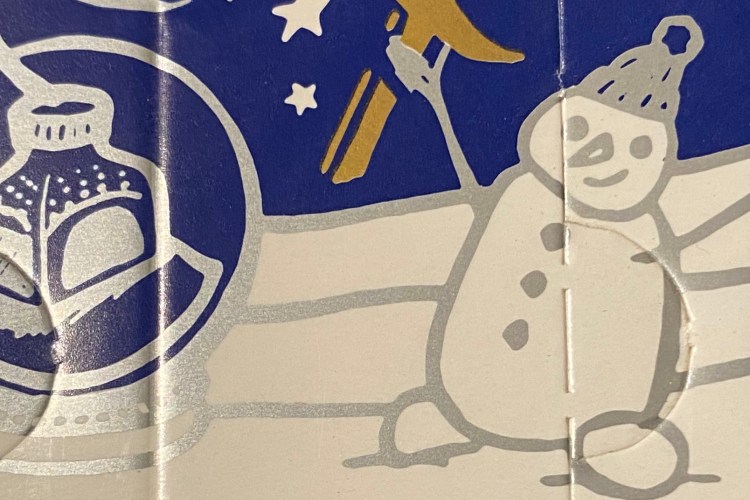
Day 4’s window isn’t exactly aligned with the printing, but you get a cute snowman with it, so who cares?
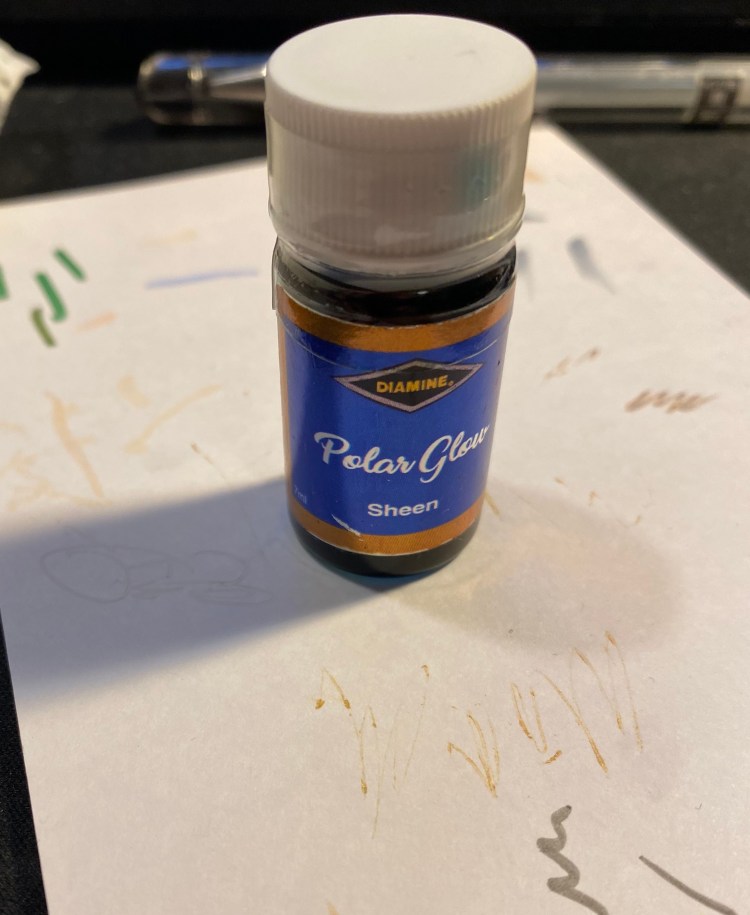
The day 4 ink is Diamine Polar Glow, which is a royal blue ink that has sheen. How much sheen you ask? Well…
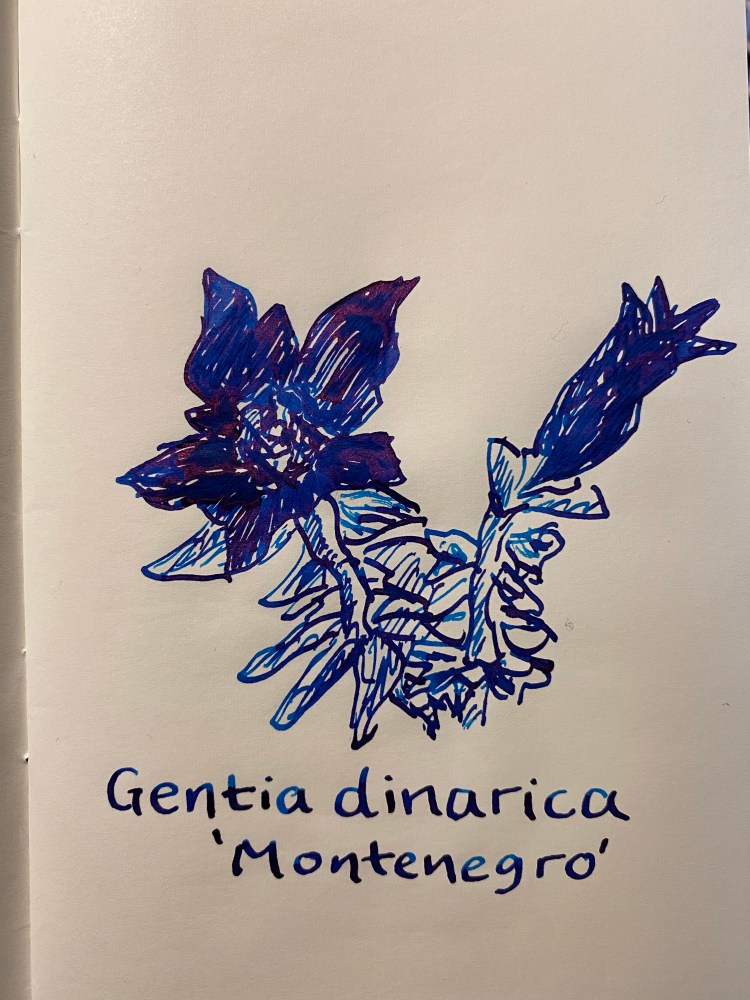
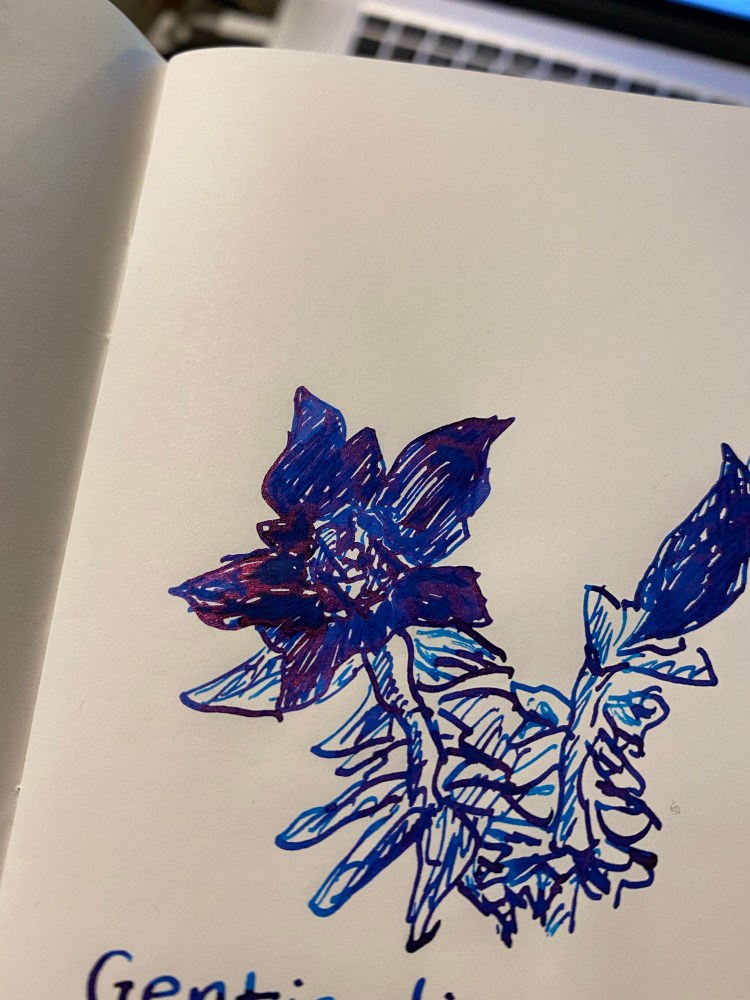
There’s so much red in that gloriously rich blue. I used a vintage italic Waterman ideal nib, and this was drawn on a Kanso Sasshi 3.5” x 5.5” Tomoe River Paper notebook, so this is probably close to maximum sheen, but still, it’s impressive.
Even as a standard ink, Diamine Polar Glow pops. The blue is deep, rich, and yet shades a lot, from cyan to royal blue (you can see it in the leaves in the drawing above). The red sheen just adds a little extra zing to it, without overshadowing the already good qualities of the ink.
This is an ink designed for wide, broad, italic, flex nibs that lay down a lot of ink. It really shows it’s best properties on Tomoe River paper, but even on Rhodia/Clairefontaine paper I could see sheen in every letter (using the same broad italic nib).
Would I buy a bottle of this, if Diamine offered it? Probably yes, since it’s dark enough for office use, but is also more interesting and appealing than a run-of-the-mill dark blue.
Diamine Inkvent Calendar is an advent calendar with a tiny (7ml) bottle of ink behind 24 windows, and a larger, 30ml, bottle of ink behind the 25th window. All the inks are limited edition, and only available through this calendar. You can read more about the calendar here.
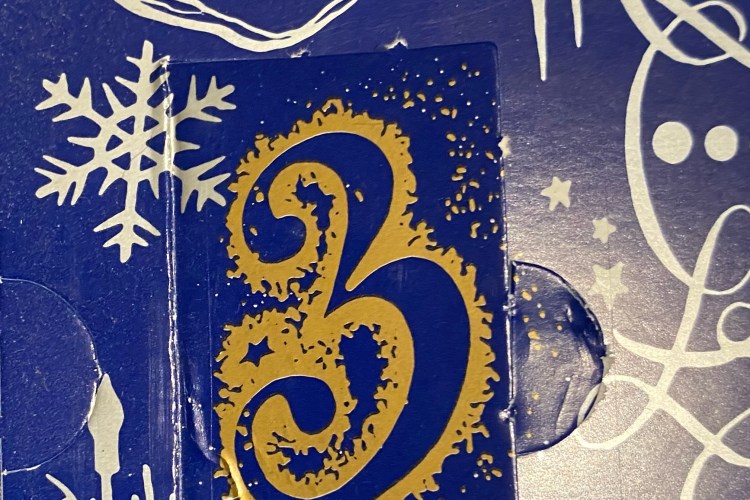
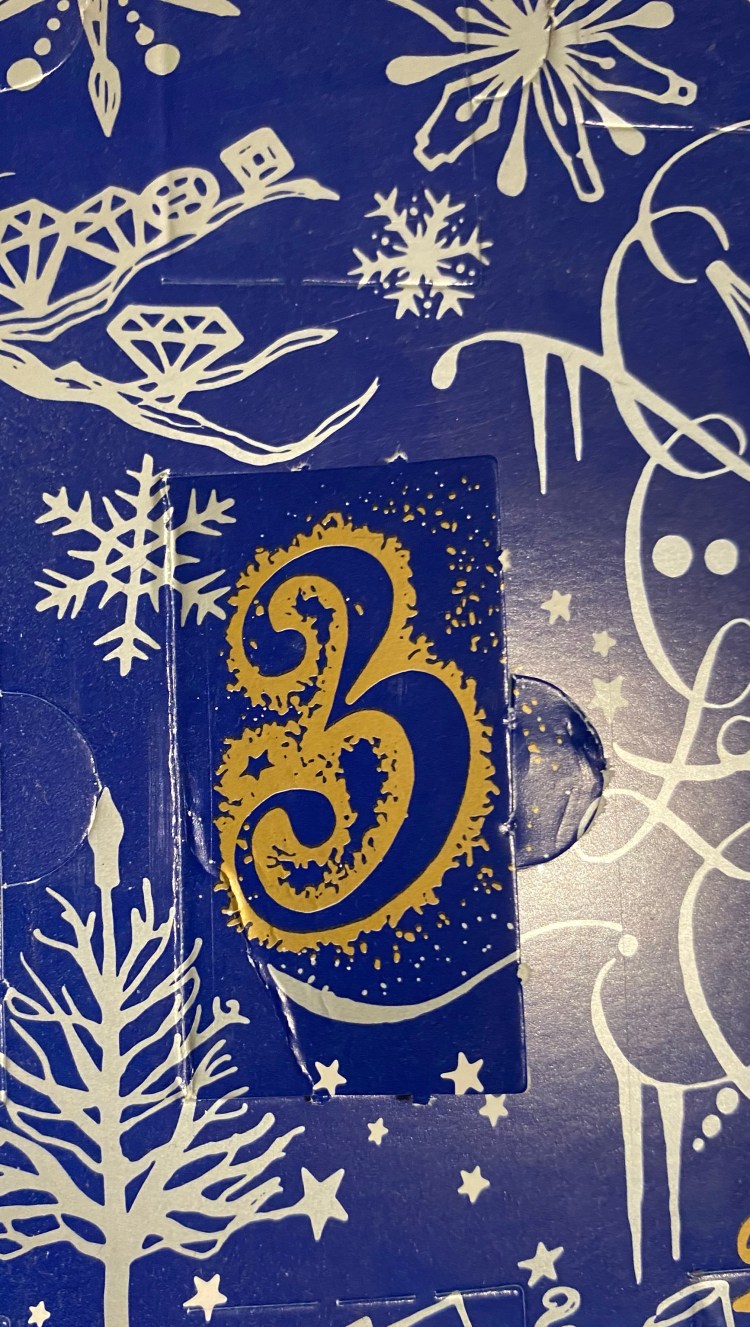
Don’t you just love the design on these? Diamine did a fabulous job with the packaging of this calendar.
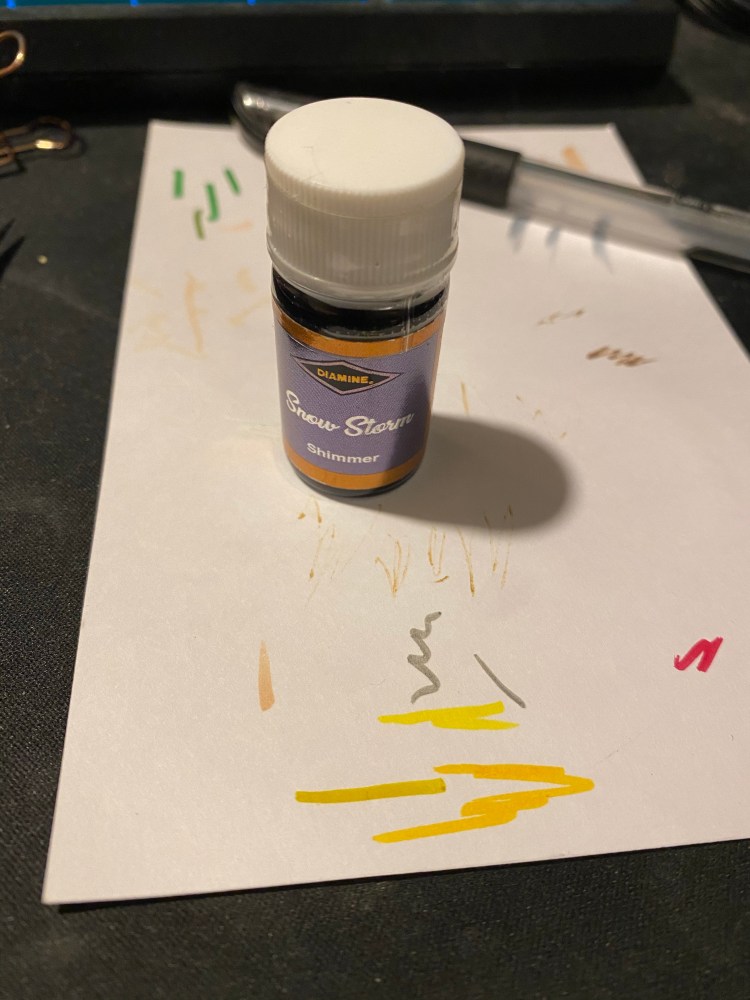
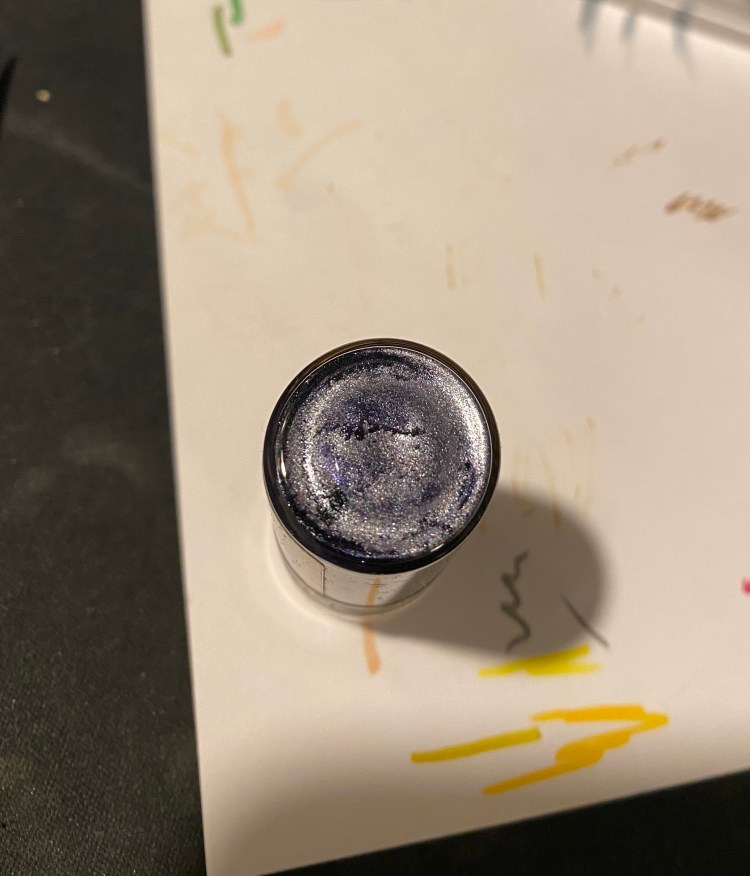
Day 3’s limited edition Christmas ink is Snow Storm. It’s a shimmer ink, with a lot of silver particles, much more than day 1’s Blue Peppermint. This is how the bottom of the bottle looked like when I took it out from it’s little nook:
This is definitely an ink that you’d want to thoroughly shake before using.
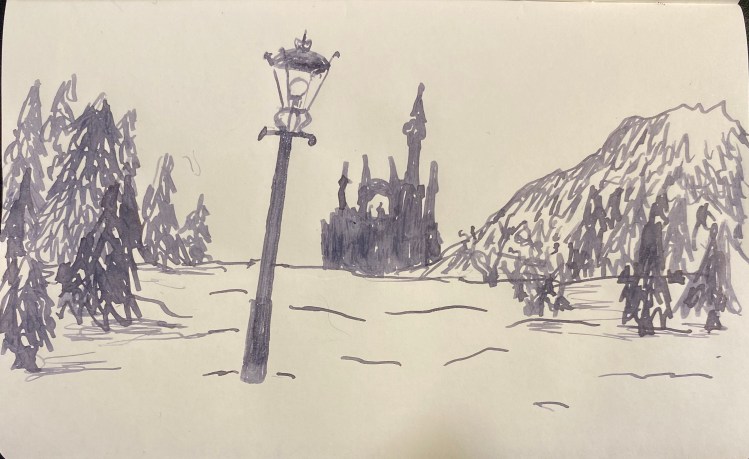
Lantern Waste, “The Lion, the Witch, and the Wardrobe”, C.S. Lewis.
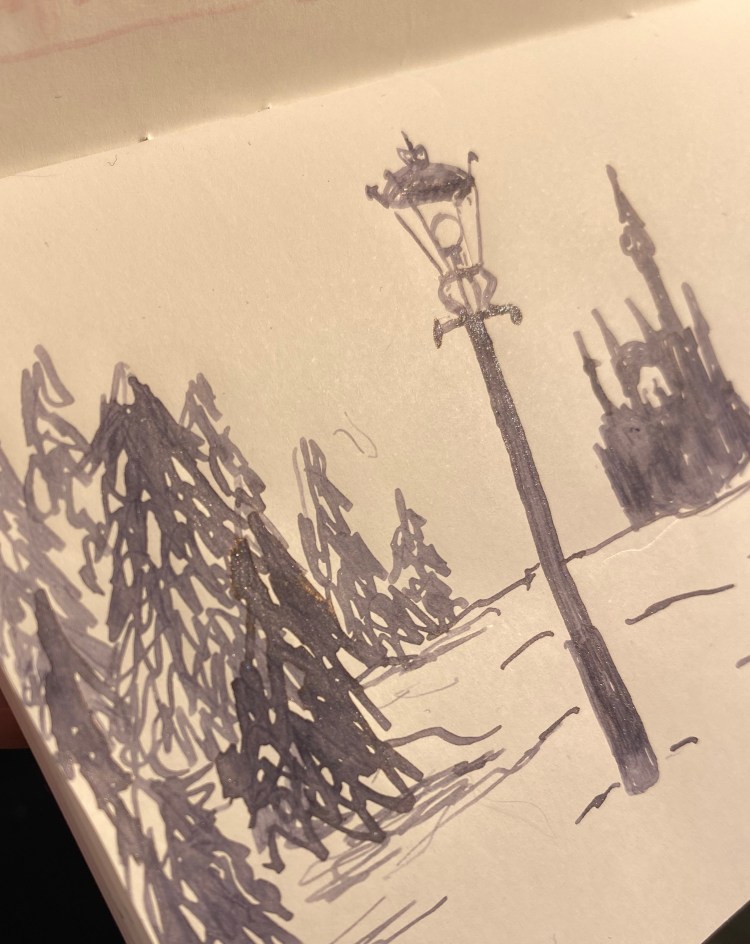
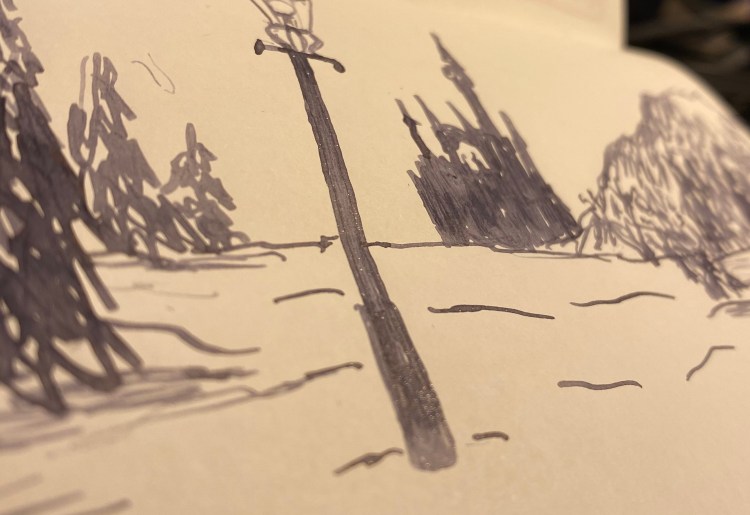
Diamine Snow Storm is a grey ink that looks a lot like Diamine Graphite, if you dumped a whole sack of silver glitter on it. It also shades and outlines like mad. Diamine certainly went all out on this one.
Look at all that glitter. There’s so much of it, it sheens.
This was drawn on a Kanso Sasshi 3.5” x 5.5” Tomoe River Paper notebook using a vintage Swan broad italic nib (dipped in the ink, because boy did I not want to clean this ink out of a lever filler), and this combination shows the properties of this ink beautifully. Diamine really proves that grey doesn’t have to be boring .
I’m not a big fan of shimmering ink, but Diamine Snow Storm is so wild, with it’s shading, outlining and silver particles, that it makes me smile. It would be a good replacement for silver gel ink pens, when it comes time to write greeting cards.
Diamine Inkvent Calendar is an advent calendar with a tiny (7ml) bottle of ink behind 24 windows, and a larger, 30ml, bottle of ink behind the 25th window. All the inks are limited edition, and only available through this calendar, which I already feel is going to be a shame. I want more of today’s Blue Peppermint ink, and we’re only on day one. You can read more about the calendar here.
This was drawn on a Kanso Sasshi 3.5” x 5.5” Tomoe River Paper notebook, using a Lamy AL-Star Pacific fine nib fountain pen. Peppermint Blue shades a lot, even not on Tomoe River Paper, and it shimmers (which I just can’t seem to capture) with silver sparkles. It seemed appropriate for today’s topic.
The bottle is tiny and very cute. This is an ink that I’d love to see in Diamine’s regular lineup (or even available for purchase as a seasonal 30ml bottle), and it’s very winter appropriate.
The Zebra Sarasa Clip is an excellent gel ink pen, with a unique and well done clip design. I have a bunch of the black and blue black pens laying around at home and in the office, and although I prefer the Uniball Signo line of pens, I do use them and recommend them to people looking for an upgrade from the Pilot G2.
I don’t usually buy limited edition disposable pens because there has to be a limit, and I already own way too many pens. I can’t afford to start collecting all the Uniball and Zebra collaborations with various (usually animated) IPs. But sometimes Japanese makers manage to floor you with just how far they’ll go with their big-box, disposable pen lines, and the Zebra x Snoopy Sarasa clip line is that case. I just had to buy it once I saw it surface on JetPens.
Yes, I bought all of them. I don’t have a problem, you have a problem!
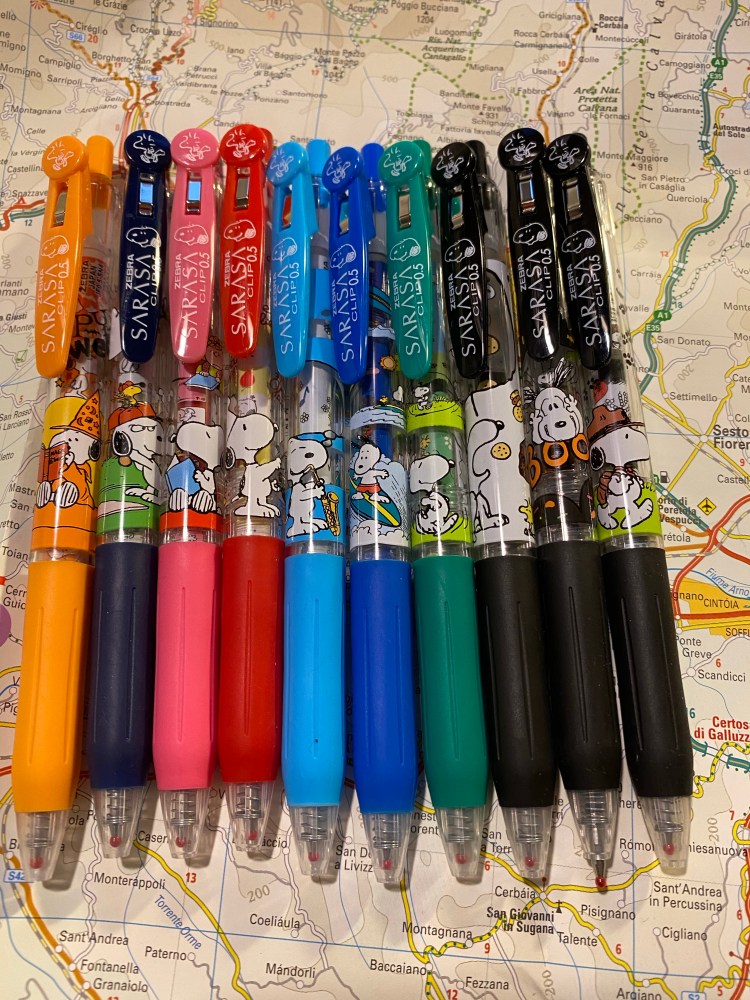
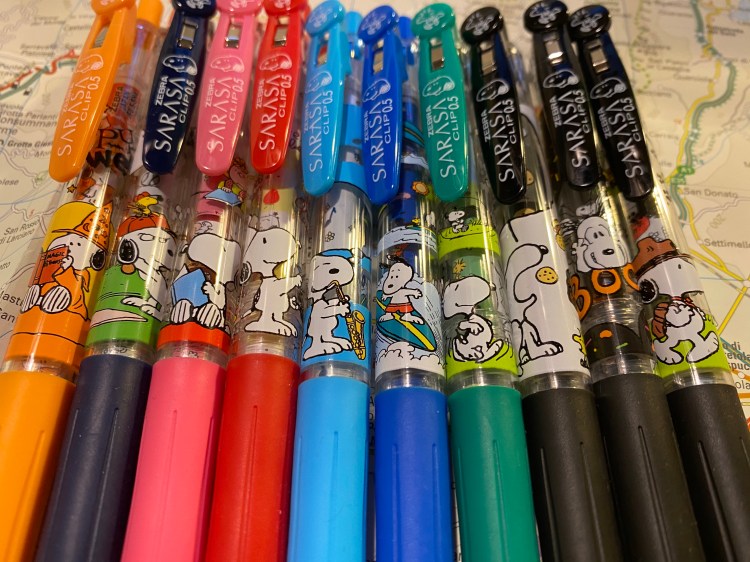
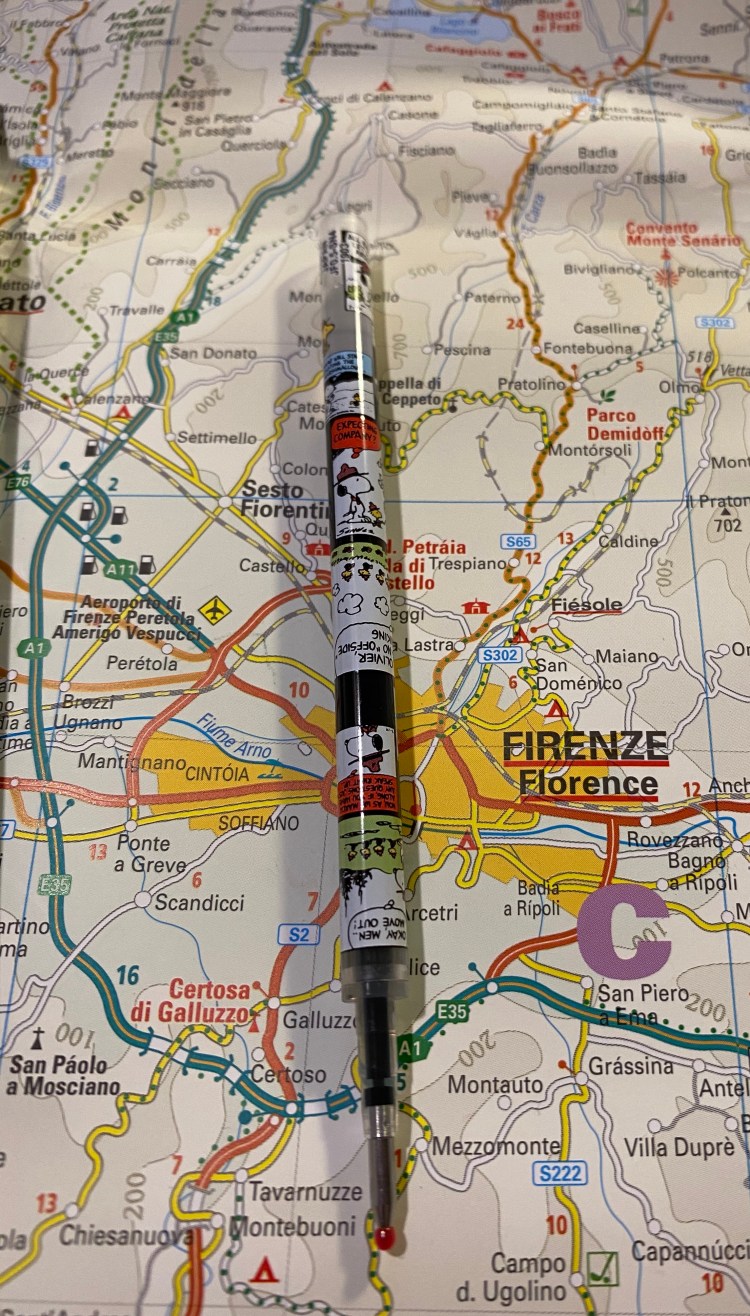
This is the 4th (!) limited edition Zebra Sarasa Clip Peanuts limited edition, and it consists of two sets of 4 pens (each in a plastic, resealable pouch), plus three extra stand-alone pens (two black and one blue-black). The clips have a drawing on Woodstock on the top and Snoopy’s head near the Sarasa logo. Each pen body has an opaque drawing of Snoopy and Woodstock doing something together, and two of the pens (the orange, which is part of a set B, and one of the black pens, which is part of set A) are Halloween themed.
The pen body is still the usual Sarasa transparent body, which brings us to what made me do a double take:
The refills have Peanuts drawings on them.
If you look closely at the transparent part of the pen body you can see the refill prints.
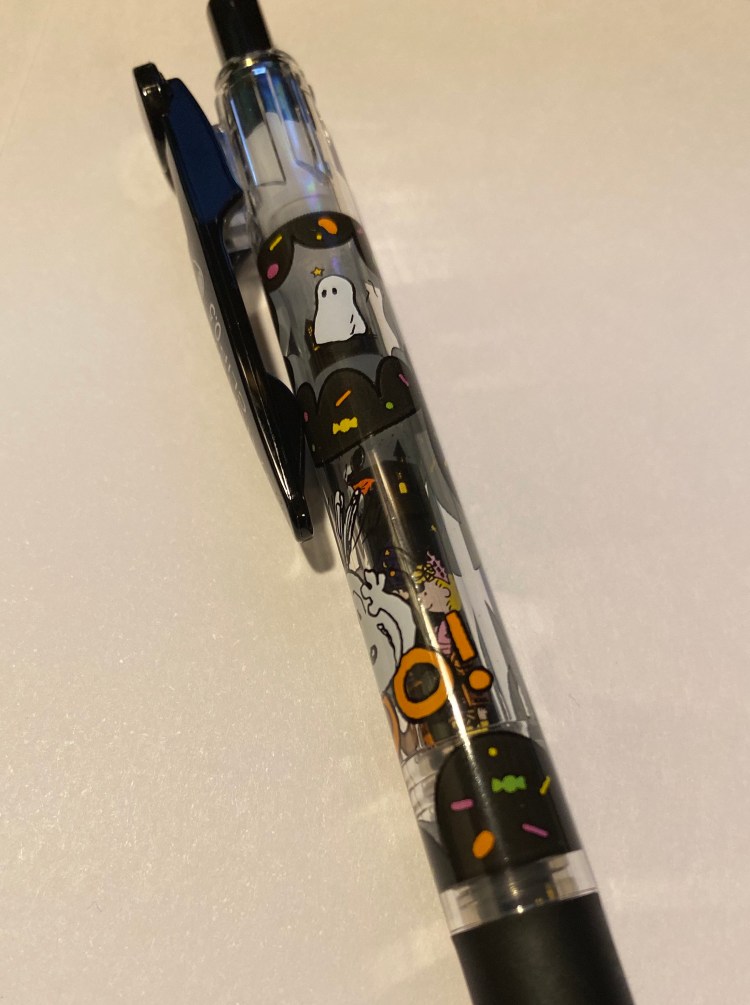
Here’s a close up of the “Boo” black pen:
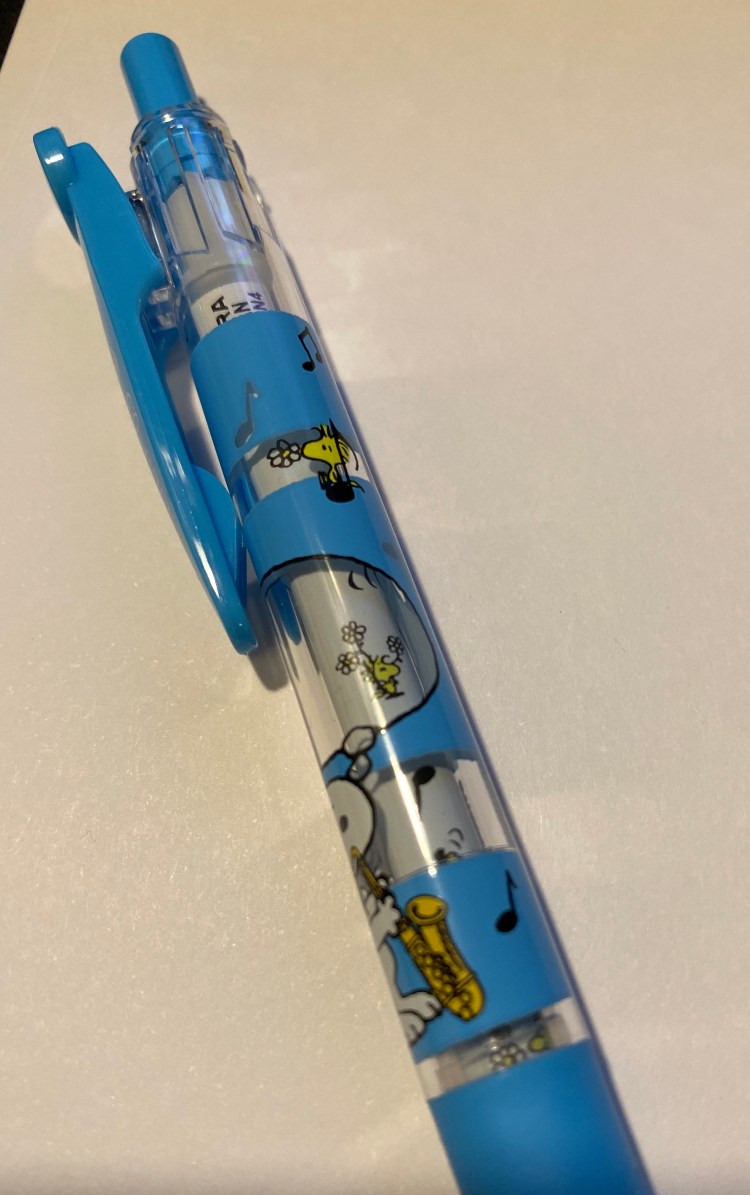
And here’s the blue “Saxophone” pen:
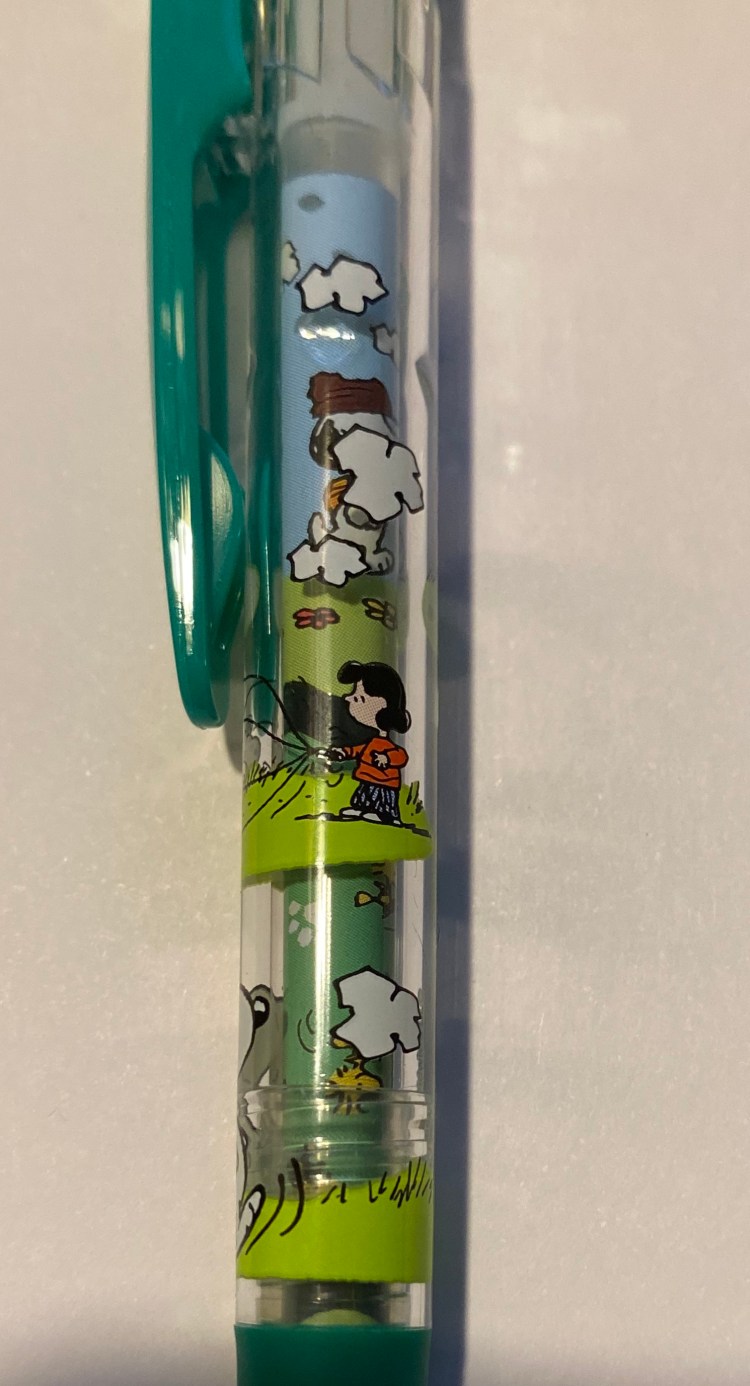
The green pen has the most transparent parts, and so shows it off the best:
This is so wild. You can barely see the refills from up close, not to mention from a distance, so Zebra totally did not need to do this. Regular refills would have worked just fine. Instead, this is what you get:
This is why I love Japanese stationery so much: the utterly unnecessary but charming attention to detail.
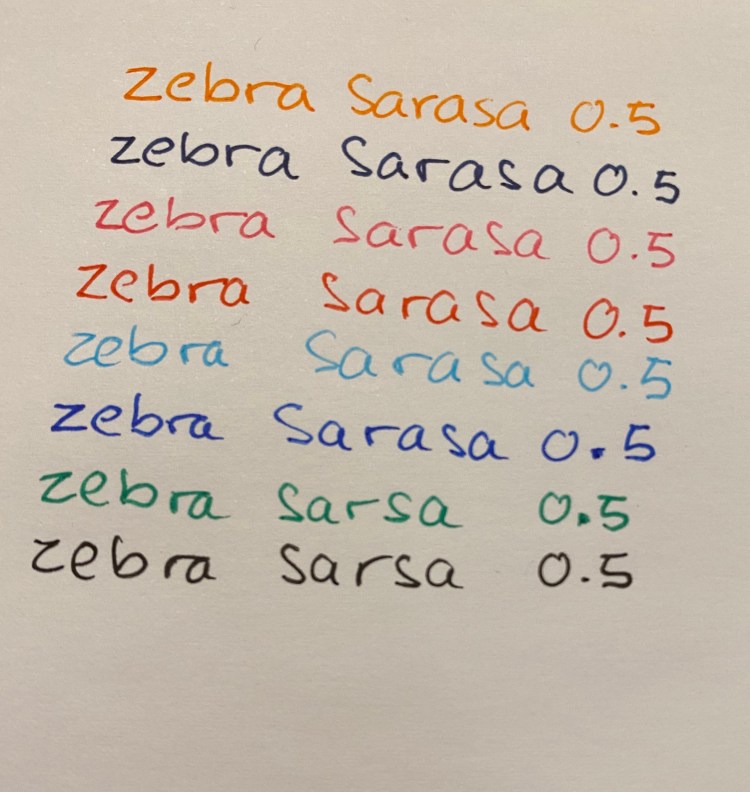
The Sarasa pens are excellent gel ink pens, and I like the colour choices in this set (especially the orange). I personally would have replaced the red in the set with a blue black, but red is a classic pen colour so I guess it would have been strange if it wasn’t there:
Sometimes you just want a pen that will make you smile when you pick it up, and Zebra has really delivered on that with these limited edition pens. For $12 a set and $3 a single these are a nice, not overly expensive pick-me-up. They aren’t available on JetPens anymore, but you can probably still find them on Etsy or eBay (or just wait for the 5th limited edition, which will surely show up eventually).
After I reviewed the Waterman Phileas I noticed that I have hardly reviewed the writing/drawing tools that I use most. So I making it a point to start to rectify that, at least a little bit.
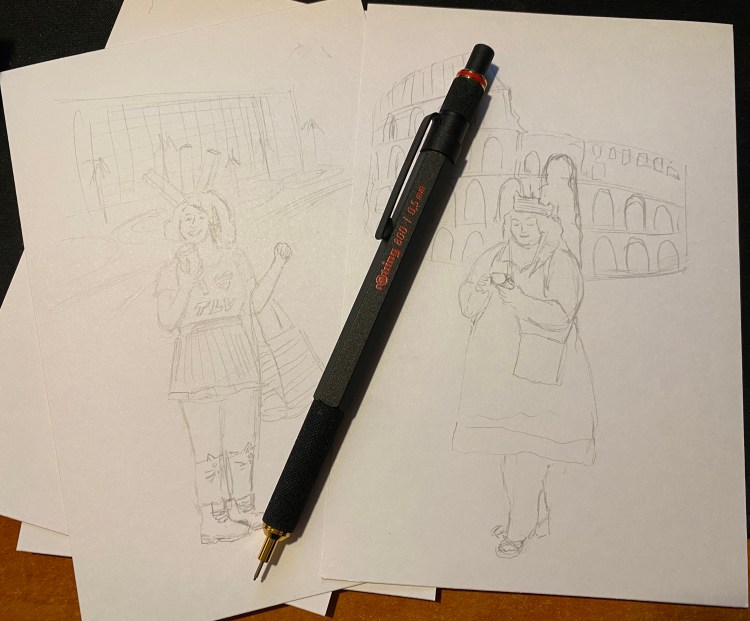
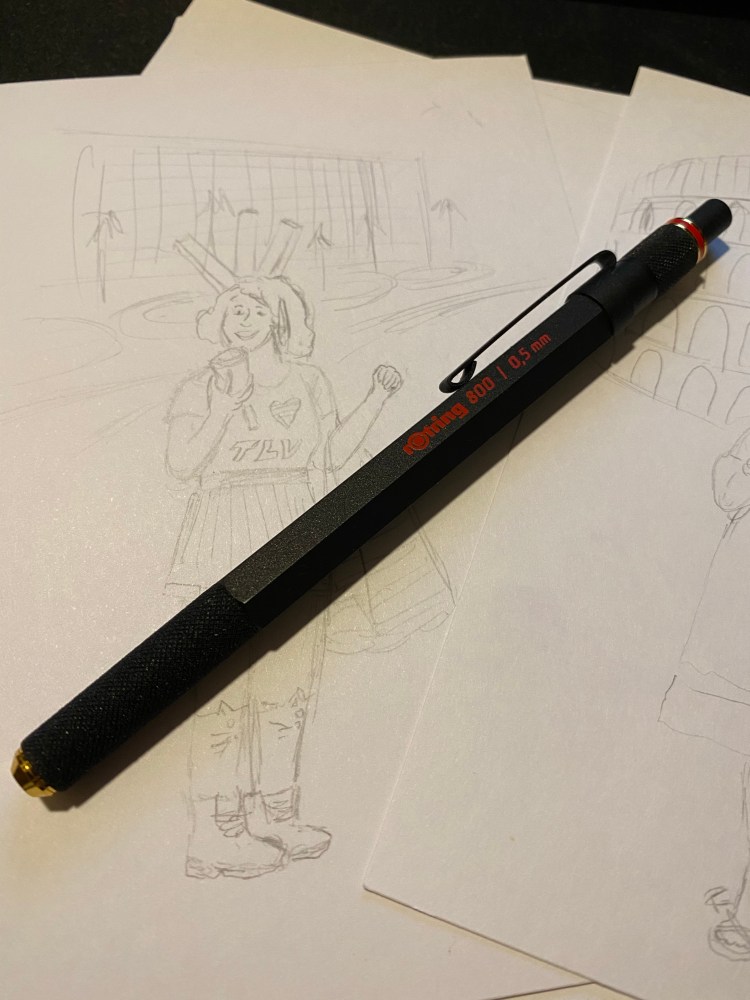
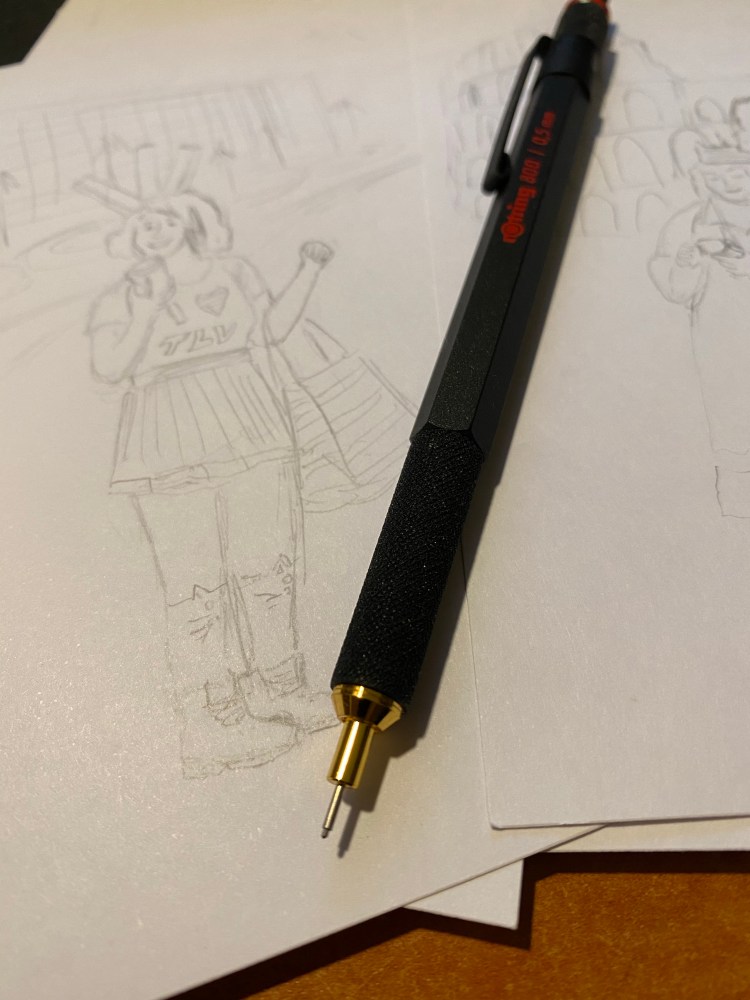
The Rotring 800 is Rotring’s high end drafting pencil, and it costs significantly more than its popular counterpart, the Rotring 600. It’s also my preferred drafting pencil, and the one pencil that’s a constant in my drawing kit. While I own the Rotring 600, and I agree that it’s a very good drafting pencil, I’ve abandoned it entirely for it’s more big brother, the Rotring 800.
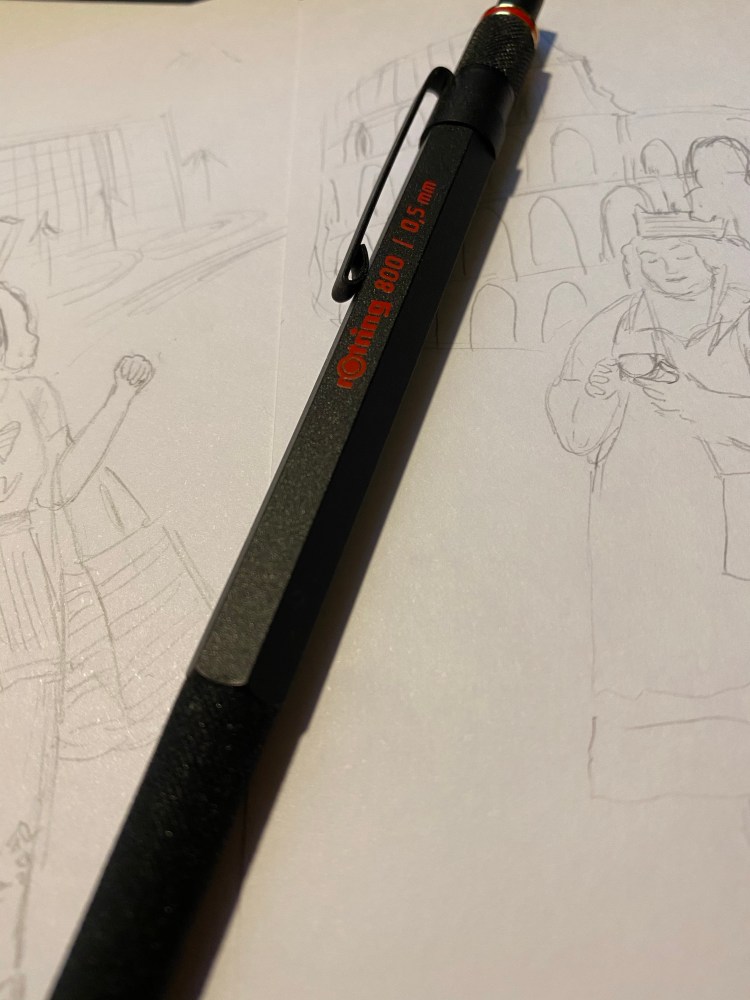
This is a handsome, elegant drafting pencil.
The Rotring 600 and 800 are both full metal (brass) bodied drafting pencils. This means that they were built for drafting (architectural plans) and sketching, not so much for writing. You can use a drafting pencil for writing, but they’re not built for that (that’s what mechanical pencils are for). Drafting pencils are metal bodied with a knurled grip, a lead grade indicator, and a sleeve that both protects the lead and allows you to more easily use it with rulers and templates, and to get a better view of what you’re drawing.
Herein we get to the problem: both the Rotring 600 and the Rotring 800 are almost perfect drafting pencils. Each one has a significant flaw, which means that you have to decide when purchasing what are you willing to live without.
Retractable tip
I think that the Rotring 800 is a slightly more good looking drafting pencil than the Rotring 600, and it weighs more than the 800. That’s nice, but that’s not “$20 more” nice. The reason to buy the Rotring 800 is the retractable tip. That’s it. The Rotring 600’s non-retractable, sharp-yet-delicate tip makes carrying it around an issue. It can bend and it can do damage – piercing through case fabric, clothes, and I wouldn’t carry it in my pocket (ouch!).
Retractable tip extended. The tip allows for precision work, and prevents the lead from breaking.
I carry my Rotring 800 in a Nock Co Sinclair, together with the rest of my sketching kit, and I really needed the retractable tip. For that I had to pay extra, and I also had to give up on a crucial drafting pencil feature that the Rotring 600 has and the Rotring 800 doesn’t have: the lead grade indicator. This is a basic feature of drafting pencils, and I have no idea why Rotring didn’t add it here. It doesn’t bother me too much as I don’t switch lead grades that often, but it’s still a baffling choice on Rotring’s part.
I love the texture on the pen grip and the pen itself: it’s beautiful and functional at the same time. This is a pencil that will not budge from your hands as you’re working with it. Also, the added weight of the retractable mechanism means that it’s perfectly balanced and you need to apply zero pressure on the lead.
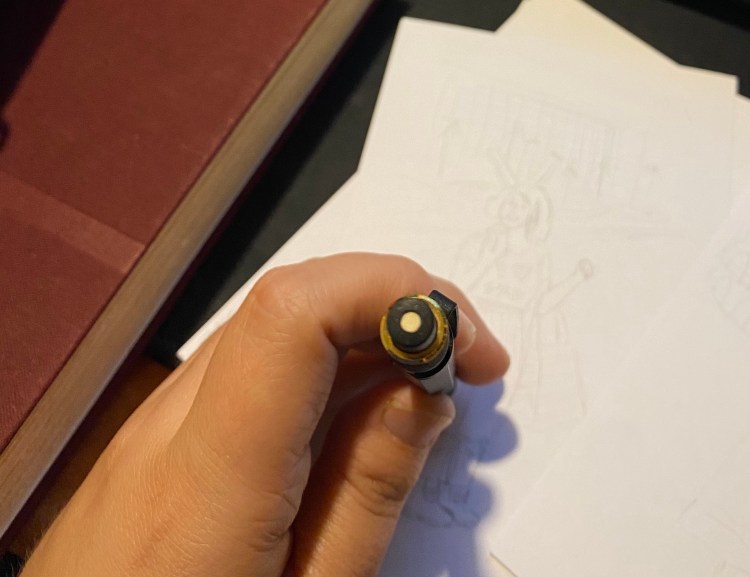
There’s an eraser beneath this cap. I wouldn’t use it.
The Rotring 800 is a handsome, heavy and expensive drafting pencil. If you’re just getting to know drafting pencils the Pentel Graph Gear 1000 is what I’d recommend (it’s cheaper, lighter, has a great design, more tip sizes, and a lead indicator), as it really works as an excellent mechanical pencil as well as a drafting pencil. The Rotring is what I use because it aggravates my RSI least (YMMV),the added weight lets me work faster and yet retain control over my line, and I really needed the retractable tip (I ruined a Rotring 600’s tip). If you’re wondering whether to purchase a Rotring 800 (or 600) I highly recommend testing it out first, especially if you have small hands or have a “non-standard” way of holding a pencil, since you may find its weight uncomfortable.
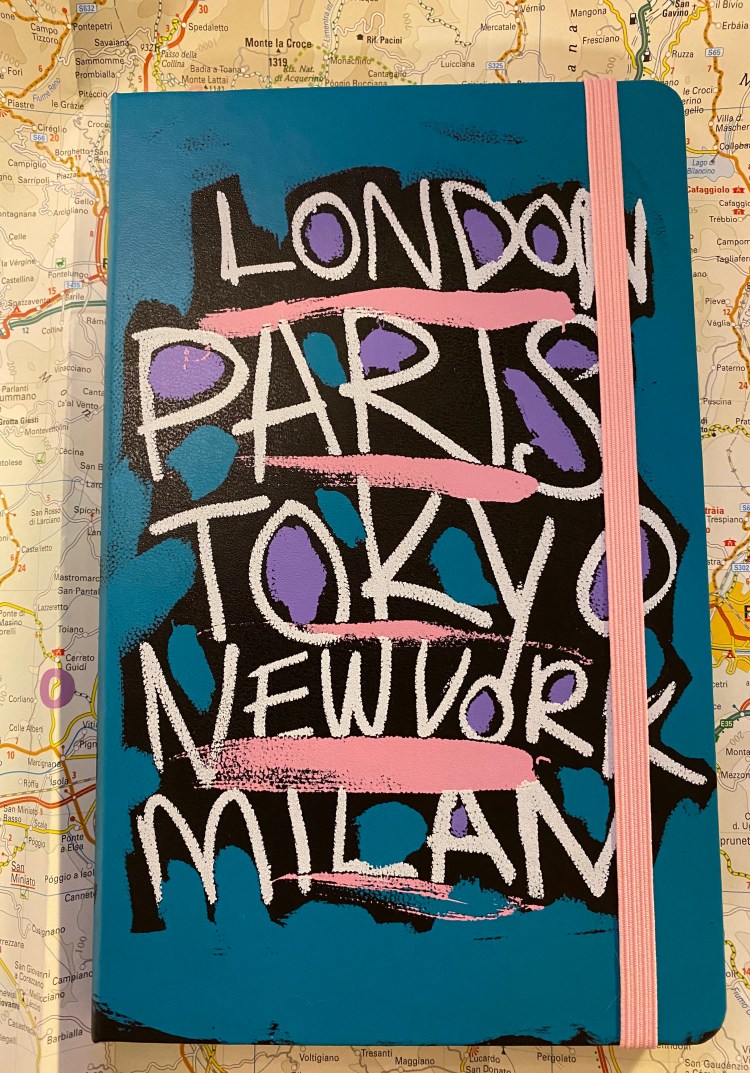
This is an unusual Moleskine limited edition notebook, and I wasn’t planning on reviewing it, but I just finished my Moleskine Moria journal and my hand just reached for this one as my next Moleskine, so here we are.
The Bradley Theodore limited edition Moleskine came out in 2017 as part of Moleskine’s lineup for the Milan Design Week. As far as I can tell the notebooks where designed primarily as a giveaway for the Moleskine’s and Bradley Theodore’s bag collection, and for some reason the three notebook designs somehow landed in the Moleskine UK physical stores. That’s where I found this fellow, languishing on a high shelf in the Moleskine Covent Garden shop, nestled above the Bradley designed bags. The design was bold enough to make me interested.
Will you look at that?
This notebook is just that front cover, and in this case it’s enough. If I remember correctly it was priced like a regular edition Moleskine, and considering the amount of work that went into the design, I think that it’s a fair price. I don’t like reviewing products that are out of stock, but you may be able to find one on eBay or Amazon marketplace, and there’s a point to this review, trust me.
The ribbon, elastic band and the back pocket hinges are a shade of pink that matches the graffiti design on the cover:
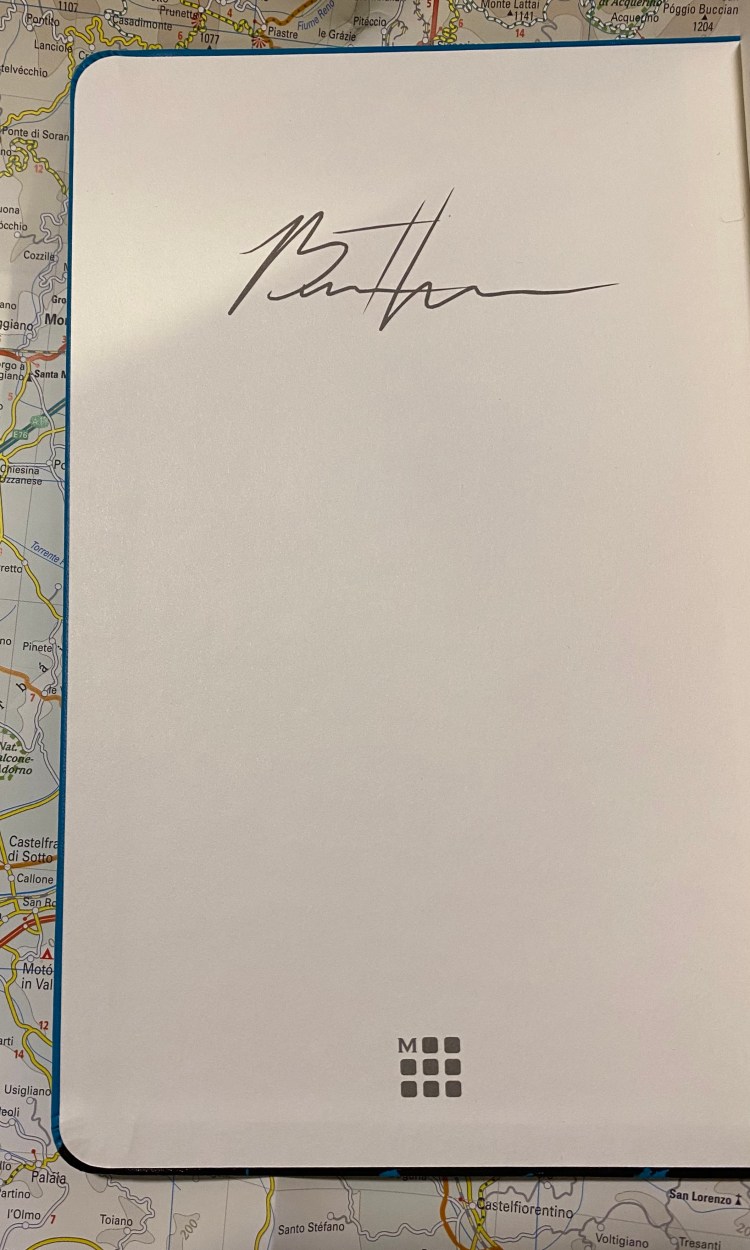
Bradley Theodore’s signature is on the left side of the front endpaper:
And that’s it. The back cover is plain black, there are no stickers/add-ons/cute side-B of the paper band, and there is no real design on the front or back endpapers. It’s probably the cheapest limited edition that Moleskine could make, which brings me to my point:
This notebook is an outlier. It actually surprised me when I opened it up, how little there was here. That made me appreciate even more just how much design work goes into a “regular” Moleskine limited edition notebook.
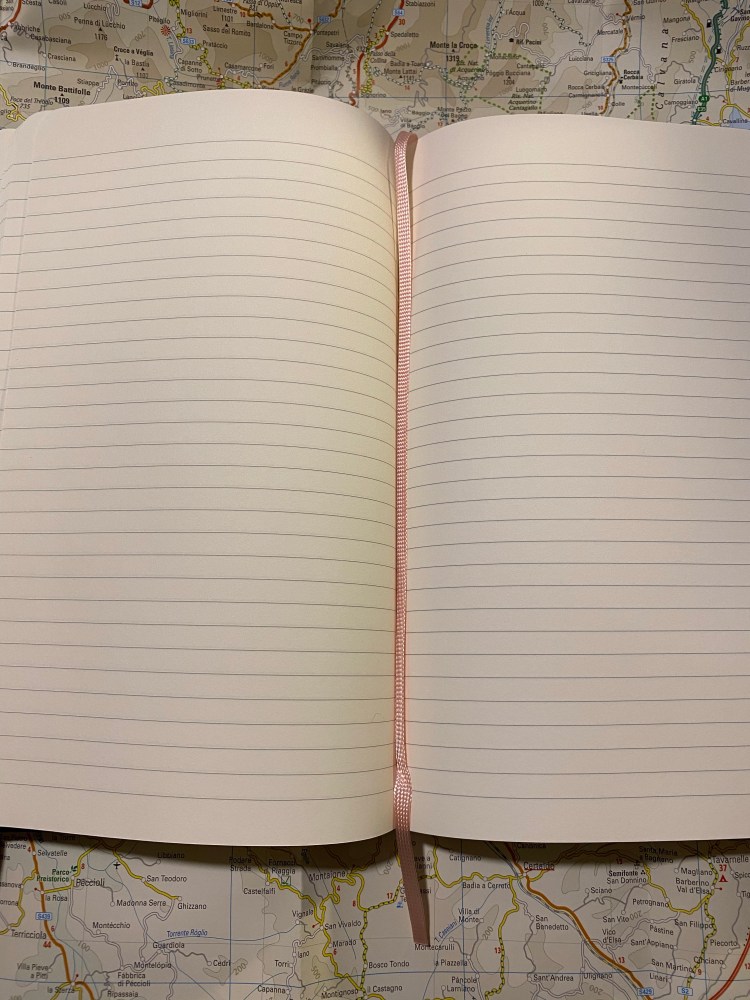
I’m “moving into” this notebook tomorrow, but it already has one entry that I slipped in from October, and a cool promotional postcard that I stuck inside, plus my “In case of loss” all filled in. If you’re looking for tips on how to start a new journal, I recommend reading the end of this post.
The Waterman Phileas was my first fountain pen, one that I bought after careful research on eBay, shortly after they were discontinued. It cost me £15 at the time, a small fortune for me, and the most I had ever spent on a pen. My RSI was at its worst, and I had to take a lot of notes (I was still in the university), so I splurged mostly out of desperation. Internet research brought up fountain pens as something that could possibly help with my RSI, and so I decided to give it a try. I found the Fountain Pen Network and combed the boards for information about fountain pens for newbies like me. Two pens kept coming up as good first fountain pens to buy: the Lamy Safari, and the Waterman Phileas. It was relatively newly discontinued by Waterman, and so I could find it easily and buy it NOS from a reputable seller. It’s been over 11 years since I bought it, and it’s still one of my favourite pens, and one of my most frequently used ones.
Look how pretty this pen is!
The Waterman Phileas is named after Phileas Fogg, Jules Verne’s “Around the World in 80 Days” protagonist. It comes in blue, green, red and black, and is cartridge converter pen with a large two-tone steel nib. The nib and pen have an art deco look to them, and the pen is also designed to look somewhat like a cigar. It’s a classic “fountain pen” look that makes it appear more expensive than it is, and it’s part of the reason why you’ll see it popping up in various commercials, even to this day. It’s a very beautiful and elegant pen that just looks classy.
Unlike it’s cheaper sibling, the Waterman Kultur, the Phileas has a brass insert in the body, which means that it has got some heft to it, weighing (filled, with a converter) 24g, as opposed to the Lamy AL-Star’s 22g (filled, with a converter). The weight is perfectly balanced for writing, especially for beginners, since it encourages you to lay off putting pressure on the pen. The pen let you feel that it’s putting the pressure on for you.
The look of the Phileas is phenomenal, especially for the price, but it’s the nib that made me fall in love with it specifically and with fountain pens in general. I chose the extra fine nib, and it is nothing short of magical. Take a look for yourself:
From hairline to European fine – the Phileas line variation at work.
Yes, that’s line variation. No, it doesn’t come from applying pressure to the nib. It works like a less extreme Sailor Zoom nib: vary your writing angle just a bit and it will go from 0.4 mm lines to 0.7 mm ones. The nib is also smooth, but gives a little feedback, which reminds me a little of the feedback you get from using a really good pencil. Couple that with the fact that the Phileas is a cartridge converter (with a sizeable converter), and so very easy to clean, and you’ll understand why this is still my favourite sketching fountain pen.
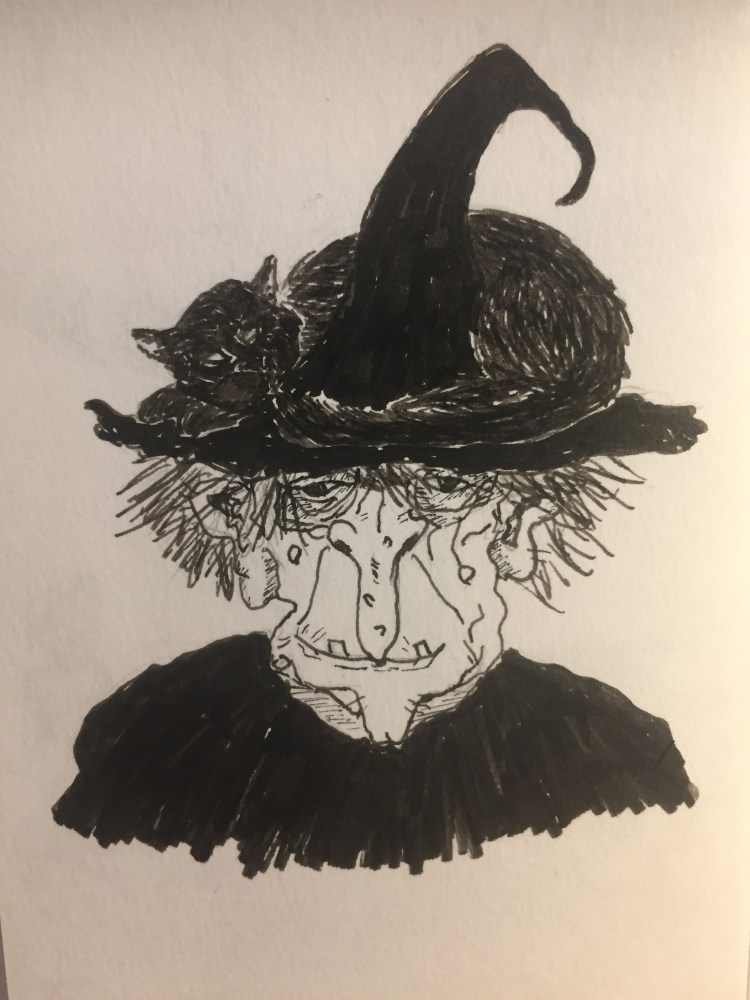
Drawn with a Phileas, except for the witch’s cloak and hat.
The Phileas accepts long international cartridges, and Waterman is one of the few makers that make those cartridges. They excellent (especially the blue-black) and very convenient when travelling with your fountain pen.
Look at that nib! It’s hard to photograph, but it’s such a great design.
Which brings me back to the beginning of my story. It’s 2019 and I have a substantial collection of fountain pens, most of them costing well over 10 times what the Waterman Phileas cost me. None of them are 10 times the Phileas as a pen. I could have stopped here, but the Phileas has proven to be a gateway into fountain pen madness for many people over the years. It’s a pen to fall in love with, in a way that I haven’t ever fallen in love with my Lamy’s, good-though-they-are. Its design is classic and timeless, and its quality is unparalleled for the price (yes, even today).
SO WHY HAS WATERMAN DISCONTINUED IT? WHY? WHY?
This should have been their Lamy Safari, TWSBI Eco or Pilot Metropolitan – a more classic version of the beginner’s fountain pen, as opposed to the other’s more modern design. It boggles my mind that they not only discontinued the Phileas, but also it’s cheaper cousin, the Kultur. What on earth are they doing over there? Do they not want new people to fall in love with their pens? It’s the same weird move with their ink line (their refusal to jump on the limited edition/shimmer/sheen ink bandwagon), but even more baffling. YOU WOULD SELL THESE WATERMAN!
So frustrating.
Anyway – if you can get your hands on a Waterman Phileas for a reasonable price, I highly recommend it. It’s a charming pen that will never go out of style.
Every year Moleskine comes up with new designs for its planners, and 2020 was no different. On the one hand, it’s great that every year there’s something fresh, on the other hand, if you happened to really love one of their previous designs you are going to be disappointed.
I was planning on being disappointed.
For the past three years I’ve been using the Moleskine pocket weekly notebook to get an idea of how my week looks like (I also use Fantastical as my digital calendar/reminders app), and every year I’ve bought the latest limited edition. Last year’s denim edition was so beautiful and popular I had some hope that it would return in some version or other this year.
Battered but beautiful.
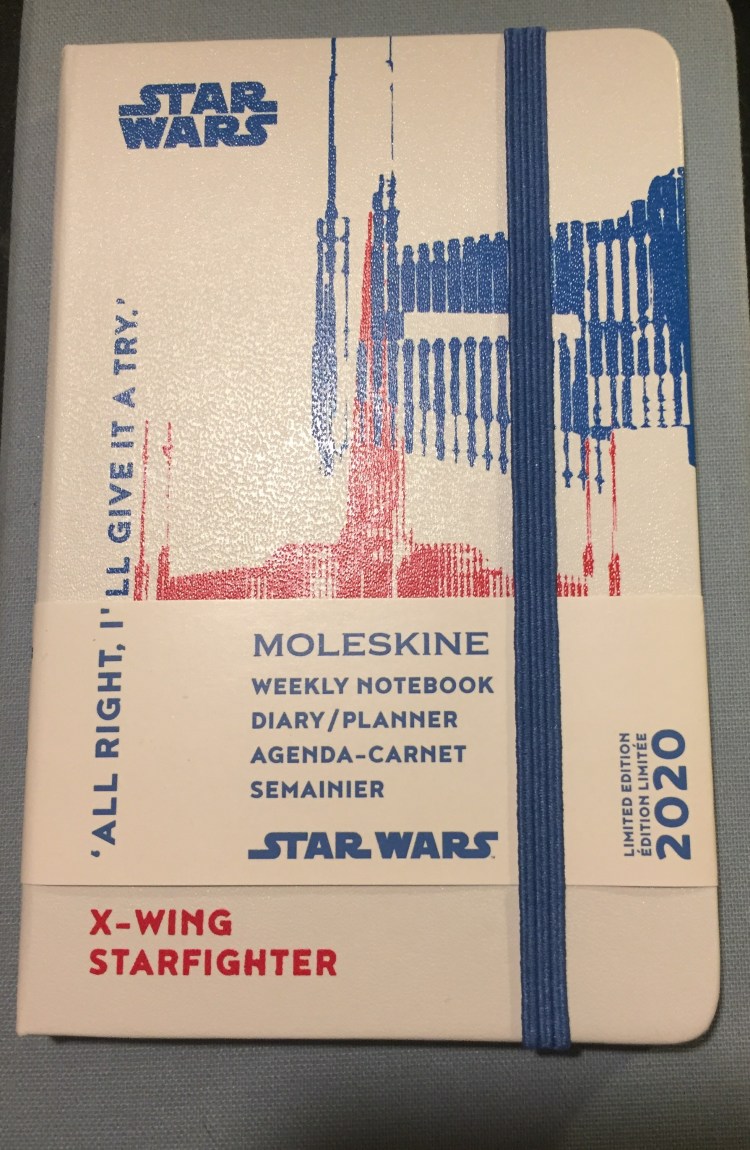
So when Moleskine came out with Star Wars themed limited edition planners, I was slightly disappointed, I admit. That disappointment faded away when the new planner arrived.
The design of the cover of this planner is phenomenal. The colour choice, the overlay, the way that it looks like someone stamped or screen printed the design – very ’70s retro, and really well done.
Moleskine’s choice of elastic band colour and the quote on the cover are also great. A red band would have been too much, I think, and the quote is inspirational and makes me smile.
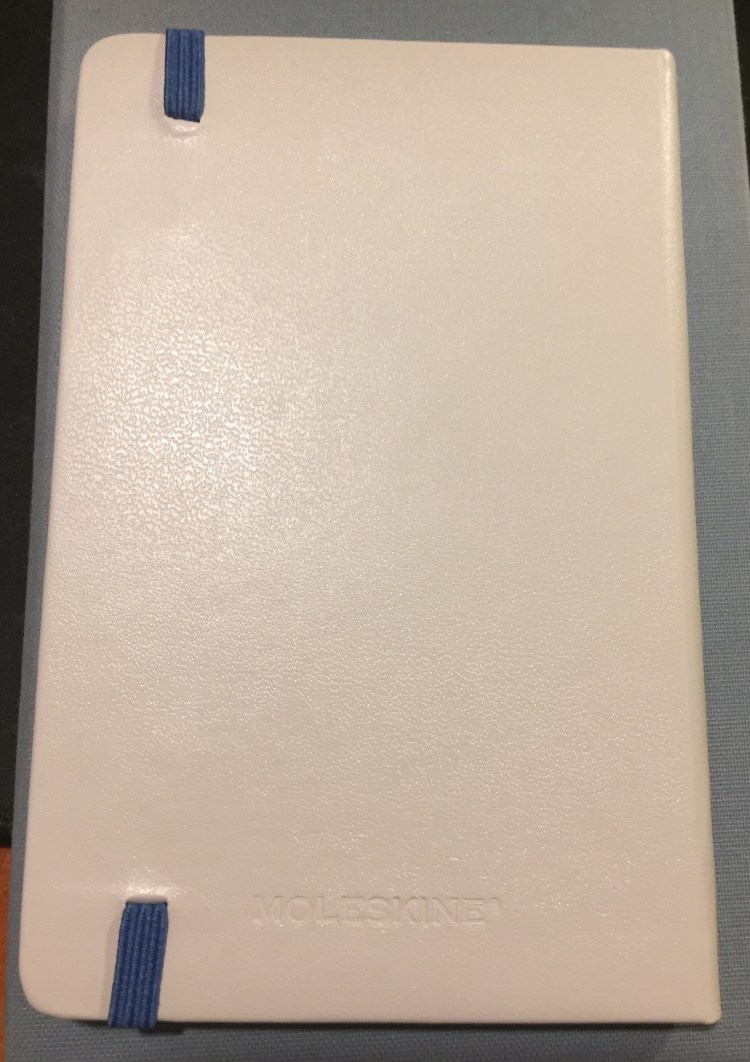
The branding on the back is subtle. It’s a Star Wars planner before it’s a Moleskine planner.
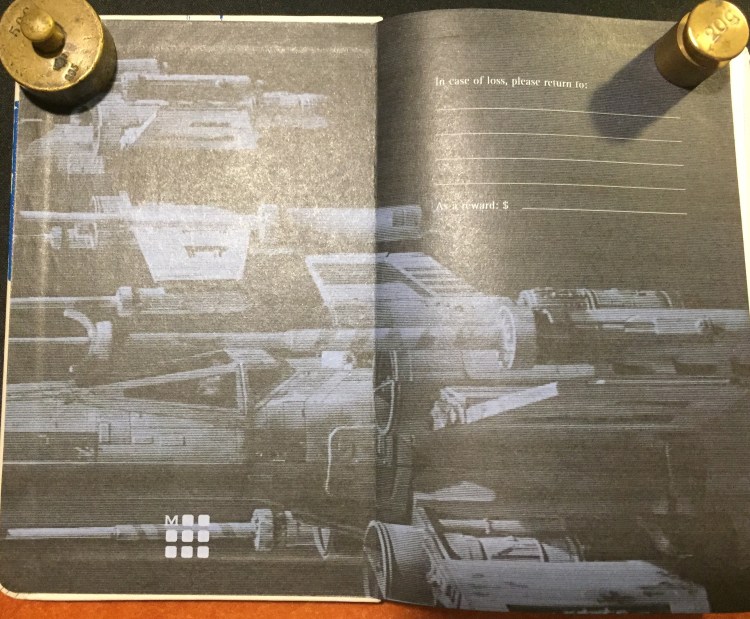
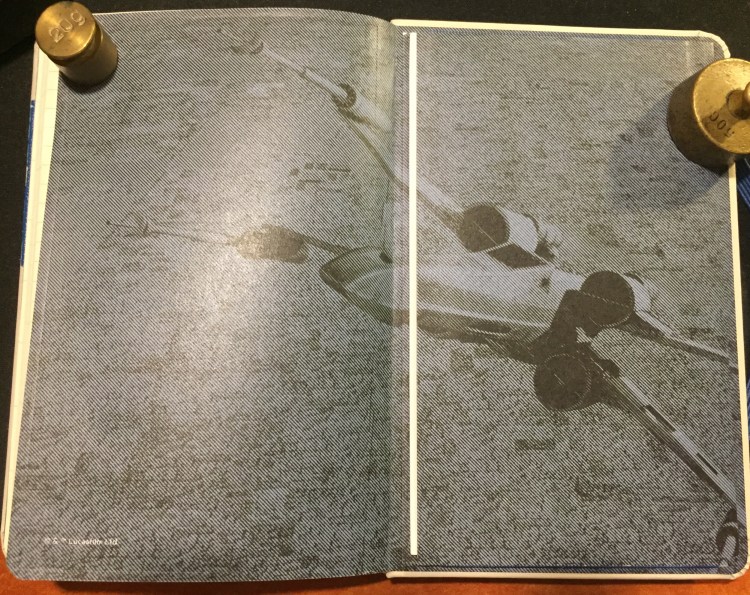
Continuing the retro vibe, the front and back endpapers are excellent (although the stickers do stick out, somewhat ruining the effect.
Sticker page sticks out of the back pocket, because it’s too large.
The sticker page itself is cool, but not really planner themed.
The planner itself is in the usual pocket weekly format, with a ton of pages for your information, monthly and yearly planning calendars, and general information (maps, international holidays, etc). Then the actual planner, which is a week on one page, with a notes page opposite it. The paper is thin, which makes the planner thin and light, but there’s going to be show through with everything, and it’s not fountain pen or rollerball friendly. Gel ink, ballpoint and pencil are what works best with it.
Look at that pretty ribbon bookmark!
There’s not a lot of writing space for each day, but after trying several other formats over the years, this is the one that works for me. It’s just enough to give me a feel for what the week is like, without tempting me to dump everything from my calendar and to-do list on the thing. Only what must go in the planner (appointments, running meets, races, trips, meetings with friends and other events that don’t generally move) gets written down, and so I have a way of seeing exactly how much time I have for various projects during the week. It’s a way for me to make fluid time more concrete and managed.
As usual, there’s a cool B-side to the paper slip around the cover, and this one shows how to make an origami X-Wing.
From previous years’ experience these little notebooks can take a beating, and even though the cover on this planner is white, I expect nothing less from it. If you’re looking for a weekly planner that is lightweight, durable, and well designed, the Moleskine Star Wars 2020 Weekly Planner is worth checking out.
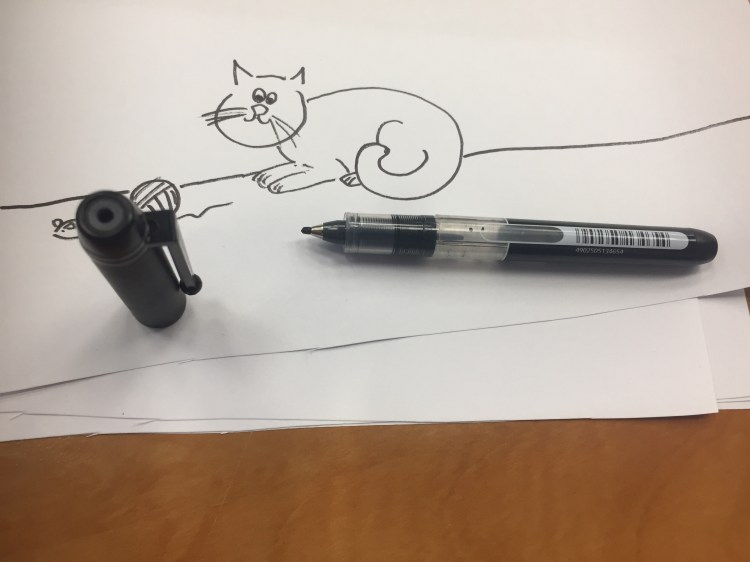
The end of summer is upon us and my services as creator of kids’ colouring pages are now in high demand in the office, as desperate parents bring their kids to work for a few hours in lieu of camp or a sitter. After ruining several brush pens on these drawings I’ve settled on the best pen for this purpose: the Pilot V Sign Pen.
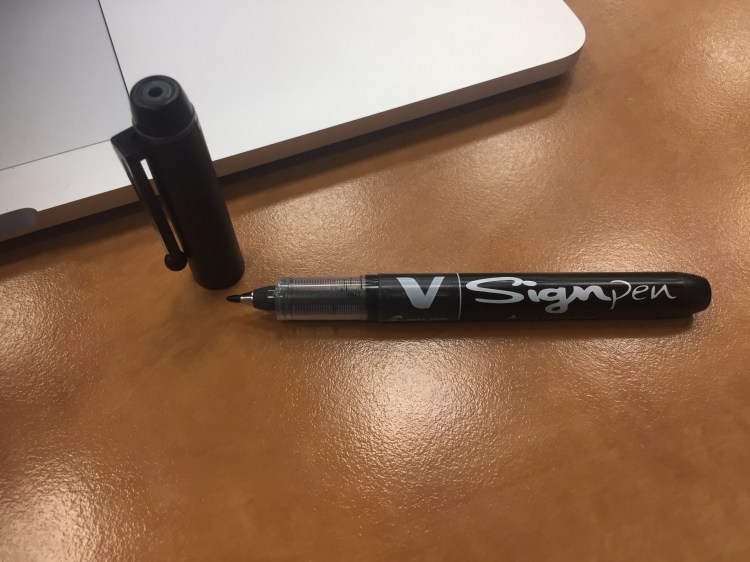
The Pilot V Sign Pen is a liquid ink pen with 2.0 mm bullet tip that creates the consistent kind of lines that kids seem to prefer.
The V Sign has a cheap looking plastic body, complete with ugly barcode printed on the barrel. It’s pretty ergonomic though, with a relatively wide barrel and a light weight body.
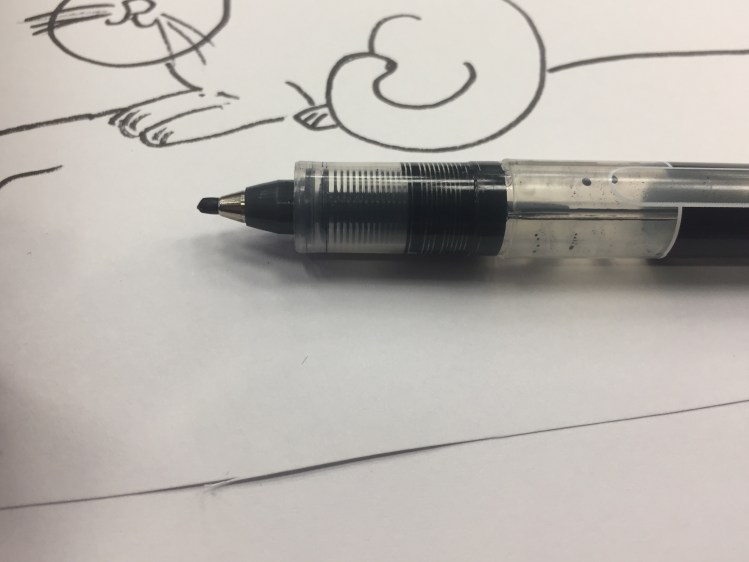
I just replaced my old V Sign Pen as it has run out of ink, and as you can see above and below, the tip does get worn down with use, though compared to most plastic tipped pens it’s super durable.
This V Sign works on cheap copier paper with a little bleed through and a lot of show through. It’s non-waterproof, and I’m pretty sure it’s not archival. It is, however, a lot of fun to use. For office doodles of this kind, it’s absolutely perfect; For anything else, I’d recommend something archival and waterproof instead.
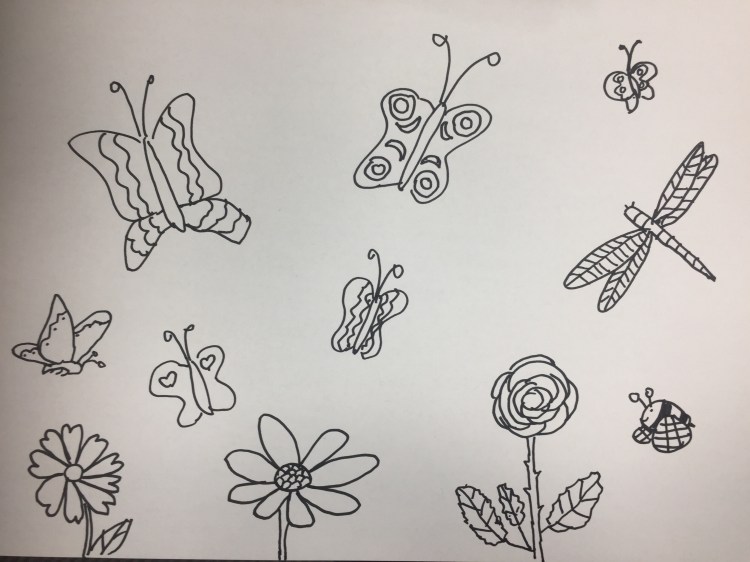
To all those parents out there, here are some colouring pages that I’ve drawn. Feel free to print them out for your own personal use, and gain a few minutes of peaceful bliss.
My Spoke Pen Orange Crush arrived a week ago, and I’ve been using it exclusively for journaling and meeting notes since then. How do I love thee? Let me count the ways…
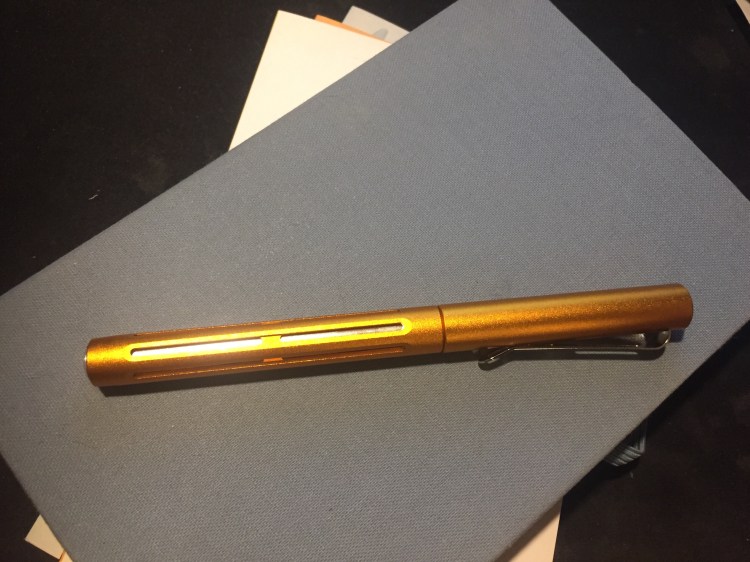
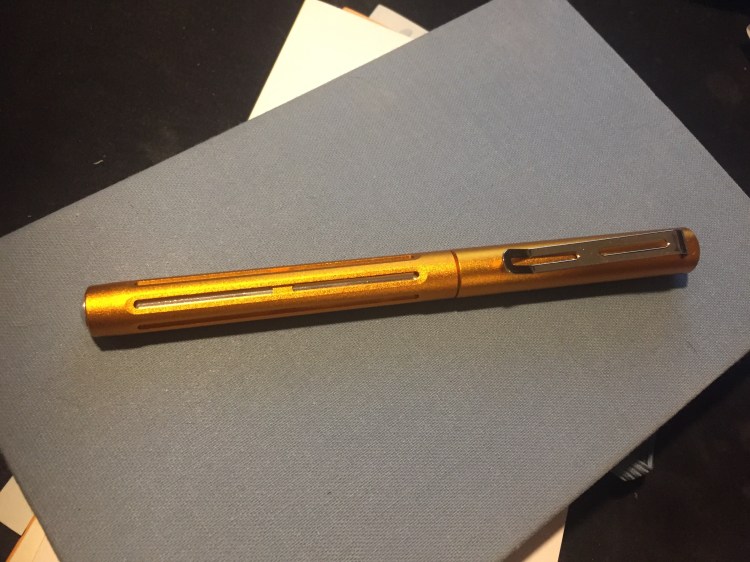
First comes the colour, because there’s just absolutely no way to ignore it. It’s nothing like I would have expected orange pen to be: it’s like an amalgamation of gold and bronze with a dash of copper. This is a rich and SHINY finish that sparkles and glows. You cannot ignore it, the very opposite of subtle, and yet it isn’t gaudy and doesn’t look cheap. Orange isn’t a colour that I’m overly fond of, but I’m glad that I picked it out for this pen: it’s perfect.
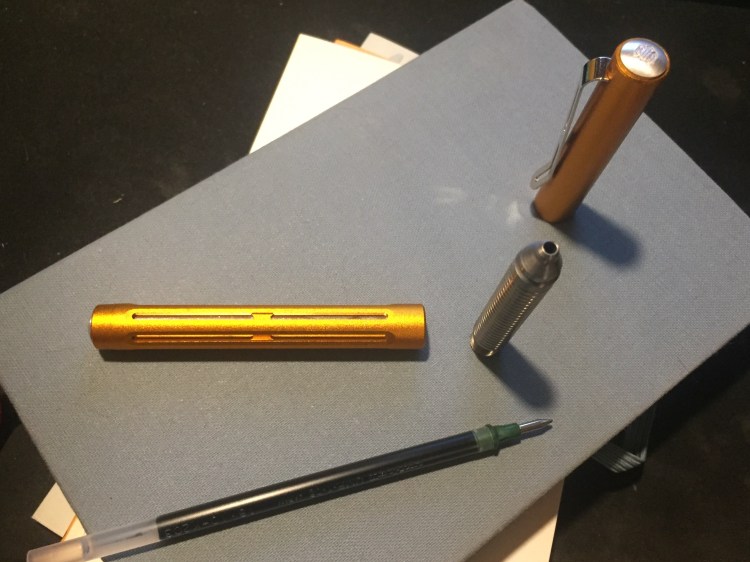
The second thing you notice about this pen is the weight. It’s super light, though it appears to be a solid and heavy looking pen. It shouldn’t have surprised me, as it’s made of aluminum, but the Spoke Pen still looks like it a heavy pen because there appears to be so much metal in use in it that it seems impossible for it to be so light. The first time I picked it up it really surprised me. It’s lighter than my beloved Ti Arto, even though it looks like it should be heavier. At first I had to consciously remind myself to use the Spoke Pen and not the Ti Arto when journaling, but now it’s become the pen I turn to for long writing sessions because it fatigues my hands less. Could it replace my Ti Arto as my favourite pen? Time will tell, but it’s entirely possible the way things stand now.
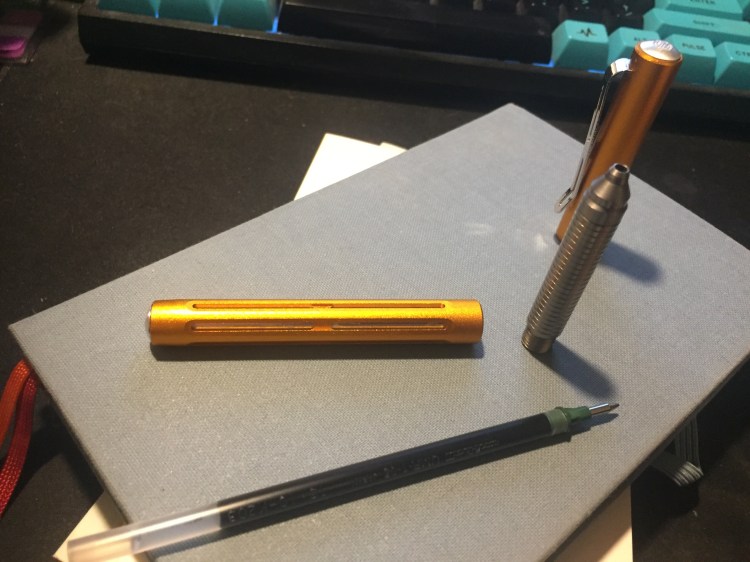
The Spoke Pen was designed entirely around Brad Dowdy‘s beloved Uni-ball Signo DX refill (UMR-1), but also accepts the Uni-ball Signo UMR-85N (my favourite refill), UMR-87N, and other refills of the same size. To change refills you unscrew the section, take out the old refill, and then the magic starts. When you put in a new refill it will appear to jot out quite a bit from the pen body. “There’s no way this thing will close back up again,” you think to yourself. Have faith, it does: there’s a hidden spring in the back of the pen, and you’re going to have to apply a tiny bit of force to push the section back close to the body, but once you start screwing the section back everything fits snugly back in place. The tolerances on this pen are flawless, as I’d expect from a pen with this provenance.
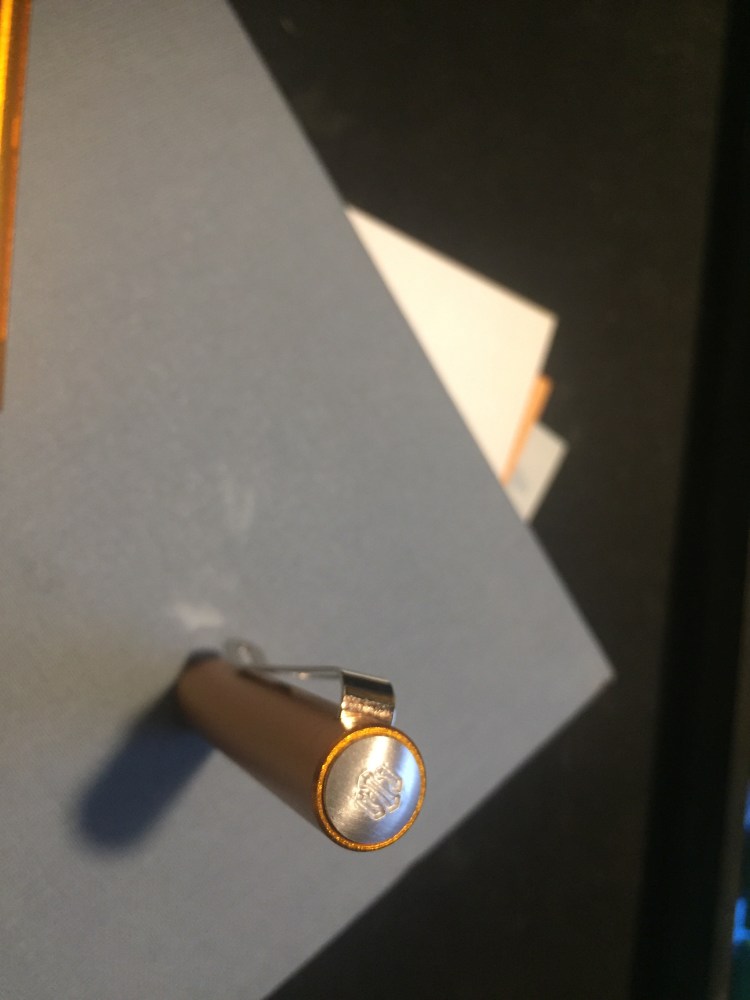
Machined pens seem to be divided into two schools of thought when it comes to branding: either the over the top, in your face, you can’t miss it branding style, or the barely branded one. The Spoke Pen belongs to the latter group, as there’s a discreet stamp of the Spoke logo on the top finial and that’s it. Very classy move.
The third great thing about this pen is the magnetic closure. I actually thought that this would be a more significant feature than the colour or the weight of the pen, but after using the Ti2 Techliner for a while the novelty of magnetic cap closures must have worn off for me. If the most important thing for you is the magnetic closure, then I recommend the Ti2 Techliner instead, as its magnets are significantly more powerful, and you can both cap and post the pen with them, even from a distance. The Spoke Pen’s cap magnet engages only halfway through capping the pen, basically functioning like the click at the end of a regular pen capping. It’s fun to use, and fun to fidget with, but I don’t think that it’s the pen’s main selling point.
Are there any cons to this pen? Of course, rarely anything in life is perfect. You may not like the Spoke Pen’s tactical aesthetic. If you carry the Spoke Pen in your pocket lint will probably get wedged in its “fins”. The clip looks like a determined person with something to prove could bend it out of shape (for normal use I think it’s perfectly fine). These are not issues for me personally, but they may be issues for you.
As it is, the Spoke Pen Orange Crush is one of my favourite (non-fountain) pens ever, and is looking to replace the Ti Arto at the top of my list. Kudos to Brian Conti and Brad Dowdy for creating such a great product out of the gate.














 Writing at Large