My 2023 Year in Reading

I read 35 and two half books in 2023, and for various reasons this year’s reading contains more detective novels than usual. The topics and style range widely, so there’s bound to be something for everyone in this list. So make a nice cup of coffee or tea and sit down for a bit of a long read.

Note: the links are to reviews I wrote in my blog or to Goodreads. No affiliate links whatsoever here.

Fiction

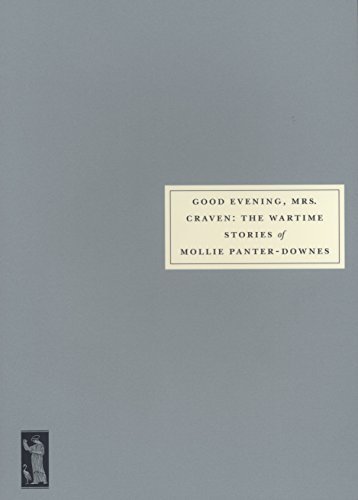
The Murder on the Links, Agatha Christie

The second appearance of Hercule Poirot, Christie’s “little Belgian” detective. Christie weaves a clever plot here, particularly around various character pairings. If you’re looking for a satisfying light read, I recommend picking this book up. Bonus tip for Christie books: they can often be found at your local library or for very cheap at second hand bookshops.

Murder on the Orient Express, Agatha Christie

If there’s one Agatha Christie mystery you need to read, it’s this one. I’ve read this book several times before but return to it when I want to see a master at work. Christie is perfectly polished here, and this book is always a joy to read.

A Gentleman in Moscow, Amor Towles

Delightfully charming, polished and delightful I highly recommend this book for everyone, even if historical fiction isn’t your cup of tea. Towles doesn’t create a realist novel, but rather casts a fairytale that is a joy to read, and yet still reminds you of the time and place it takes place in and the implications of that on all the characters at play. One of the best books I read in 2023 and one that I keep remembering and will likely return to.

Offshore, Penelope Fitzgerald

Offshore won the Booker in 1979, and while it’s a well written novella length novel, it hasn’t stood the test of time. Fitzgerald writes about houseboat dwellers on the Thames, people that are in between land and water, outsiders to London and its society and yet still moored to it. I think that to readers in 80s this book would have resonated more, but somehow it seemed to remain on the surface level, detached and amorphous to me. Not a book I would go out of my way to read.

Drive Your Plow Over the Bones of the Dead, Olga Tokarczuk

Wow. The best book I’ve read this year by a large margin. Tokarczuk is an astoundingly good writer and this is a phenomenal book that I highly recommend. It’s not a light read but it’s a very, very good one.

The Books of Jacob, Olga Tokarczuk

This is one of the two books that I stopped reading halfway through. It’s exceptionally well written and researched but I just couldn’t bring myself to finish it at the time for personal reasons. I do, however, see myself returning to it at some point.

Miss Pettigrew Lives for a Day, Winifred Watson

This book is featherweight and frothy, a little ditty about a middle-aged governess that finds herself in the middle of the flashiest, most debauched group of young people you can imagine. It was written in 1938 so there’s racism and favourable talk about wife abuse here, and I’m not at all sure that this servants’ fairytale is worth it. It’s well written, but loses its charm whenever the naughtiness is coloured by its racism and sexism.

How Steeple Sinderby Wanderers Won the FA Cup, J.L. Carr

I read Carr’s wonderful “A Month in the Country” and I wasn’t disappointed by this fairytale. Yes, it’s about football. No, you don’t need to know a thing about the game. Do read the book’s introduction, though, as it does clarify and highlight a few things worth knowing.

This is Ted Lasso decades before Ted Lasso, but as Carr wrote it there’s also a touch of melancholy to the affair. It’s a charming little thing that will win your heart over much like its bunch of villagers win the coveted FA Cup. Like “A Month in the Country” this little book is an ode and a slice of brilliantly clever comedy. It reminded me of “Dad’s Army”: poking fun at its characters while deeply loving and respecting them, with a mist of nostalgia over it all.

All Systems Red, Martha Wells

For years this has been on my list and highly recommended by several friends and boy were they right. Wells created one of the best written, most distinct voices in fiction (yes, fiction, not just science fiction) in her murderbot. It’s a funny story about a misanthropic android saving a bunch of human scientists, but it’s also a tale about who gets to be human and who doesn’t, how fiction creates humanity, the future of corporations and how people learn to trust each other. Even if you don’t like science-fiction, this is a must read. If you don’t end up loving murderbot in the end, I suggest you check your pulse. They will make you laugh and they will make your heart ache for them, and you’ll want to be a better person to deserve to live in a world where murderbot exists.

Artificial Condition, Martha Wells

The second of the murderbot series, this one introduces ART. Murderbot teams up with a research transport with an attitude and I learn that I am in fact capable of loving this series even more than I did before. Wells deals so well with the themes of friendship, trauma and humanity as well as fiction as a bonding medium between strangers that it’s astounding. Again, even if you’re not a science fiction reader, this book is for you.

Rogue Protocol, Martha Wells

This isn’t as good as the first two murderbot stories, but is still very good and worth reading. The humour is still great, the questions about humanity are still there, as is the commentary about the growing power of corporations.

Exit Strategy, Martha Wells

This is the fourth murderbot story and one that closes the GreyCris arc. Murderbot cares now, how revolting 🙂 Full of humour, action and questions about personhood and friendship. A fitting end for the first arc of Murderbot diaries.

Network Effect, Martha Wells

A new murderbot arc begins, and ART is back. The two of them are superb together, the plot is very well done as are the action sequences. It lacks some of the innovation of the first two murderbots, but that’s to be expected in what is now a pretty well established world. Very enjoyable, funny and deeply touching.

Fugitive Telemetry, Martha Wells

This is another excellent murderbot story, but outside the timeline of the new murderbot arc and after the GreyCris arc was completed. It’s much more a detective novel than previous murderbot stories, and it’s very well done and fun to read.

System Collapse, Martha Wells

The seventh and latest instalment of the murderbot diaries, this story picks up not long after Network Effect finishes. There are some interesting ideas about communication and establishing trust, and some very good writing about trauma. Very well done and worth reading.

Home, Martha Wells

I think this is the best description of post traumatic stress disorder that I’ve read. As someone who suffers from cancer related PTSD this story really hit home. It’s an excellent short story, and it’s not told from murderbot’s point of view, but from Dr. Mensah.

The Well of Ascension, Brandon Sanderson

One of the biggest disappointments of the year. I really liked the first Mystborn novel and I was looking forward to reading the second book in the trilogy. It was not good. The characters were stupid, flat, and annoying. The villains were stereotypical and the twist (which at least brought the pace up in the end) wasn’t worth it. A long, bloated tale that never landed for me and has me wondering whether it’s worth slogging through the third book in the trilogy.

Winter’s Gifts, Ben Aaronovitch

I love Aaronovitch’s Rivers of London but this novella fell flat. The characters didn’t come to life, Henderson was somehow less likeable than she was in her previous appearances and the story didn’t gel. I’d recommend skipping this one unless you’re a completionist or looking for a light read.

Starter Villian, John Scalzi

Scalzi is back in full force here, light, funny and entertaining. If you liked the Kaiju Preservation Society you’ll love Starter Villain. Charlie inherits his uncle’s super villain operation, including secret volcano lair, talking cats and communist dolphins and it’s a delight from start to finish. There’s a plot but it doesn’t really matter: the dialogue, characters and situations make this novel hum. A perfect pick-me-up.

Slow Horses, Mick Herron

I saw the Apple TV series (it’s phenomenally good) and decided to try reading the books it’s based on. The first book, Slow Horses, is almost entirely like the series, though if you pay attention you can see the cracks here and there (particularly in the ending). Not really worth reading as the series is the same, but better.

Dead Lions, Mick Herron

This was the second book in the Slow Horses series that I read, and it will be the last one. The book is far inferior to the series in terms of both plot and dialogue. Watch the series instead.

The Long Game, Ann Leckie

A short story from Ann Leckie with some interesting ideas about society building. It remains a little too abstract, although it is interesting in terms of character and concept.

Translation State, Ann Leckie

A very high concept novel, even more so than her previous work. What makes a place home? What makes being connect with others? What constitutes personhood and free choice? What makes a being, nature or nurture? What takes precedence: the needs of the many or the rights of the few? What makes you belong to a place, group or family? There are some excellent characters here, and some excellent questions raised. The most interesting sci-fi book I read this year, and worth picking up.

Death in Fine Condition, Andrew Cartmel

I liked Cartmel’s Vinyl Detective series, so I was looking forward to reading the Paperback Sleuth. I was disappointed. This book suffered from all the minuses of Cartmel’s previous work (a tendency to overwhelm with tedious details, an infatuation with certain characters, plots that are oftentimes outlandish even for detective novels) with none of the charm. Large swaths of it are regurgitated characters and bits from his previous work, and I don’t see myself returning to this series any time soon).

Lot No. 249, Arthur Conan Doyle

This is a horror story about a resurrected mummy, and it’s competently written but not the genre for me.

Passenger to Frankfurt, Agatha Christie

The second book that I didn’t finish reading, and so bad that it should never have been published. Christie is clearly being taken advantage by her publishers here, as she’s obviously already suffering from dementia at this point. Don’t read it, and hopefully it will go out of print and stop tarnishing a wonderful writer’s reputation.

The Making of Another Major Motion Picture Masterpiece, Tom Hanks

This is lightweight fun, a good read for an airplane ride or a holiday. I’d recommend skipping or skimming the in-character preface as it’s the weakest part of the book by far. There are comic strips involved and in the book itself, so I recommend reading the book so you don’t miss them as they’re very well done. It’s charming, with no real villain and a lot of love for filmmaking and filmmakers.

Non-Fiction

You Just Need to Lose Weight, Aubrey Gordon

Gordon writes a compelling set of essays about anti-fat myths. It’s well written and informative, and regardless of what your thoughts are on the subject, it’s worth a read.

Erebus, Michael Palin

Excellent, excellent, excellent. Palin takes a fascinating topic and renders it to perfection. A Victorian ship designed for war but converted for arctic exploration has two epic voyages: on the first it reaches the farthest south that anyone had reached before, and on the second it vanished as it was searching for the Northwest passage. Multiple attempts were made to find her and her 129 crew members, but for 160 years nobody knew where it was. Until it was found, perfectly preserved, in 2014. The story of the ship, Erebus, its crew, voyages, and the search for it is interesting in and of itself, but Palin really makes it all come to life for the reader.

Your Head is a Houseboat, Campbell Walker

Walker is better known for his YouTube moniker Struthless. This is an illustrated book about reaching mental clarity through journaling. It’s well written, well drawn and well conceived, and if you have any interest in journaling for mental clarity, I highly recommend it.

The Miracle of Mindfulness, Thich Nhat Hanh

A short, beautiful guide to meditation written as a series of letters between master and student. It’s gentle, humorous and kind, and well worth a read, and many rereads.

M Train, Patti Smith

Patti Smith rambles around world drinking coffee. The general theme is dealing with loss, but in hindsight Smith’s writing didn’t leave much of a mark on me, even though I really wanted to like it. It’s like she’s trying to be Joan Didion and failing, because somehow her landscapes and people remain abstract shadows, not really leaving their mark on the reader.

Deep Work, Cal Newport

How to get meaningful work done in an age of constant distraction, especially if you’re a knowledge worker. Some very good ideas here, though it could have been better organised. One of the few productivity books I’d actually recommend.

Digital Minimalism, Cal Newport

How to turn down the signal to noise ratio on your digital devices using a methodical approach that allows you to tailor your technology use to your needs. This could have been a series of blog posts and suffers from the usual self-help book bloat, but there are some very good ideas here that I’ve successfully used. Recommended.

So Good They Can’t Ignore You, Cal Newport

After reading Deep Work and Digital Minimalism, this book was a disappointment. Newport struggles to make his point, it’s overly long and padded with examples that do him little favour. The whole thing should have been a blog post. The basics? Don’t look for a job that fits your passion, find a job that lets you have the lifestyle you want to have (hours, control, impact, etc). Do that by gradually and systematically acquiring skill in something that is rare and valuable. This is done through deliberate practice, like a musician or an athlete.

These Precious Days, Ann Patchett

A well written series of essays about a pretty wide range of topics. It was very well written and enjoyable to read. I recommend it even if you normally don’t read essay collections.

Think Again, Adam Grant

Organisational psychologist Adam Grant talks about how to change your mind. Some interesting ideas here, though as usual with this sort of book Grant doesn’t shy away from cherry picking anecdotes and manipulating data to support his argument. I take all social study research papers and everything based on them with a grain of salt after their replication crisis, but there are some things here that are worth trying out or considering.

Here’s to a 2024 full of good books!

Weekly Update: Reading and Pen Inking

Long time no update, so I decided that it’s about time to write one up.

Reading

I’ve been in a terrible reading rut, and I blame the book that I’m currently reading: “The Books of Jacob” by Olga Tokarczuk, a 912 (!) page historical epic about Jacob Frank and his followers. I’m halfway through, and I’ve decided to put it aside for now and train my brain to enjoy reading again with some lighter and more fun material.

The book itself is masterfully written and researched, with the narrative made out of a carefully pieced together mosaic of characters, voices and narrative styles. I just cannot handle the subject matter right now. As my rights are being taken away by religious, power hungry fanatics, I don’t want to spend my free time reading about religious, power hungry fanatics. It has reached a point where I balk at the idea of reading again, and that’s just not healthy. I hate giving up on books like that, especially good books, but if I want to actually read again and not just beat myself up for not reading, I’m going to have to start reading something else.

Health

I went through a CPET (Cardiopulmonary Exercise Testing) last week and it was pretty intense. My lungs aren’t working well in high intensity since my chemo, and so a lung specialist sent me to get this test, to see whether my heart or my lungs are the issue.

It started with a spirometry test (which is a simple test done to check your lung capacity and performance), and then went on to the CPET itself. I was hooked up to an EKG and pre-test measurements were taken. Then I was fitted with a special mask and filter that recorded my air intake and CO2 levels. Finally I was put on a special stationary bike, attached to a blood pressure monitor and a blood oxygen level monitor, and told to pedal without stopping until I felt chest pain or was about to faint, or until I was told to stop. As the technician calmly told me, they have a lot of people fainting during this test, which is why they do it on a bike and not a treadmill. I said it was intense, right?

Anyway, I pedalled for my life, with the bike’s resistance being constantly raised, and me gradually getting out of breath. The point was to see why, so I didn’t stop until the technician stopped me, at which point a little over 10 minutes of constant intense exercise had gone by and I was drenched in sweat and panting. H

ere’s hoping that I get some useful insights from the results. In the meanwhile I’m still running 5 times a week, just not as fast as I would like.

Pens and Ink

I wrote most of my pens dry and filled in a new batch, this time consisting of mostly vintage pens. There are also two expensive pens in this rotation, a few old ink favourites and some completely new to me inks, and a weird selection of colours.

Writing samples
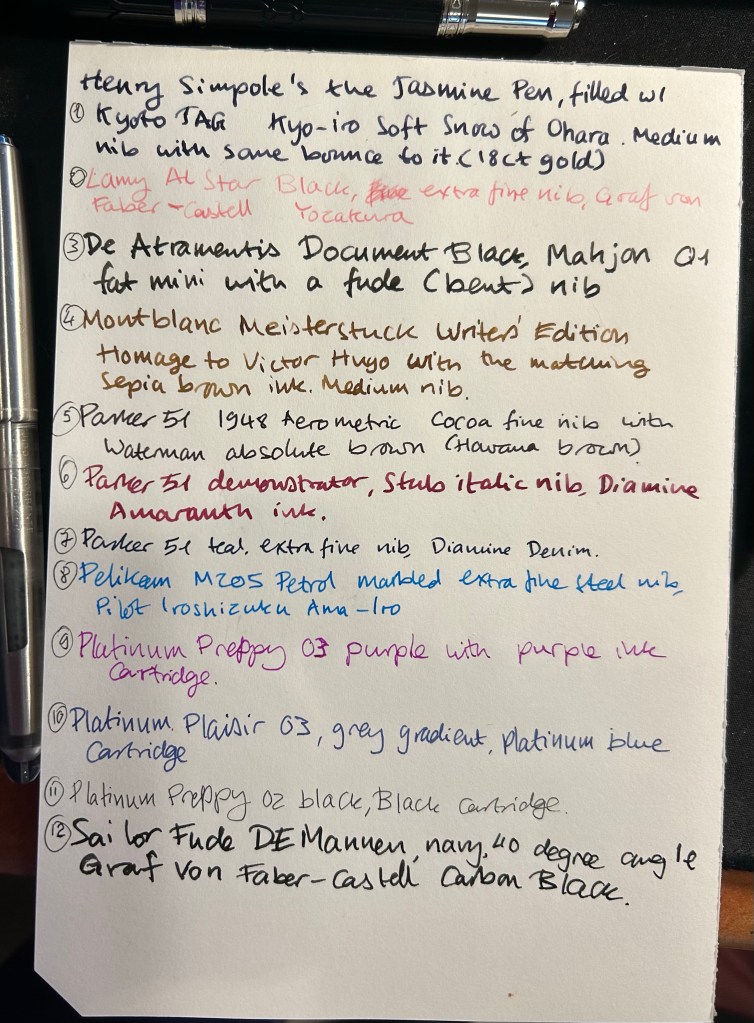
  • The Henry Simpole Jasmin Pen is one of the most expensive fountain pens I own, and one that doesn’t leave the house because I can never ever replace it. It’s a Conway Stewart button filler with a bouncy 18K gold nib, with silver overlay created by Henry for it. The late Henry’s birthday was on the 4th of July, and so to commemorate him and his work I inked this pen up. I chose the Kyo-iro ink because it’s an interesting dusky purple that I haven’t had enough time with. Like the Jasmine Pen (bought in Portobello Road market), I bought the ink in London (at Choosing Keeping).
  • The Lamy AL Star isn’t interesting, but the ink in it is new to me. The Graf von Faber-Castell Yozakura is a pale and shading pink that I normally would never have purchased, because it’s so light it’s almost unreadable. It was deeply discounted during the closeout of a local pen shop, and I came in late and had very little to buy to show my support. I probably should have inked a much wider nibbed pen with this, but I have a big bottle of it, so there’s always another time.
  • In the Mahjon Q1’s case the pen and nib are interesting, the nib is not. This is one of two pens (the other being the Sailor Fude in the end) which I inked solely for sketching purposes. It’s a weirdly shaped pocket eyedropper fountain pen that I bought with a fude (bent) nib. I’ll probably review it at some time in the future.
  • The Montblanc Victor Hugo was a pen that I bought at the end of last year, during my last visit to Mora Stylos. This was an impulse buy, something that would never have happened if not for the display that Montblanc used to sell this pen. I love the Notre Dame de Paris, I’ve visited her and sketched her many times, and my heart broke when she burnt down. She’s a survivor, and seeing this pen displayed in a diorama of the Notre Dame in all her white glory, I just had to buy it. The ink was a gift that Mr. Mora gave me with the pen.
  • Parker 51 pens. The cocoa and the teal were all purchases made in the local flea market, and the cocoa is part of a set (with a pencil) and the earliest of the bunch (from 1948, a first generation Aerometric). The teal was in pretty bad shape, and took me a while to flush out. The demonstrator Parker 51 is from Mora Stylos, has a gorgeous stub italic nib, and is likely one of the Argentinian, aftermarket demonstrators. The Parker 51 is my favourite pen, and I have a hard time not buying all of them.
  • The Pelikan M205 Petrol was a Black Friday purchase, and I haven’t inked it until now. The nib is great, the pen is great, and Iroshizuku Ama-Iro turquoise ink is quickly becoming one of my favourites. Such an optimistic, summery colour.
  • The Platinums include two Preppy’s that I’m trying out, after being disappointed with their durability in the past. The Plaisir is the pen that’s been inked the longest of the bunch.
  • The Sailor fude is filled with a new ink to me, the Graf von Faber-Castell Carbon Black. The ink was purchased in the same closeout sale as the pink Yozakura, and I’m planning on testing it out as a non-waterproof sketching ink.
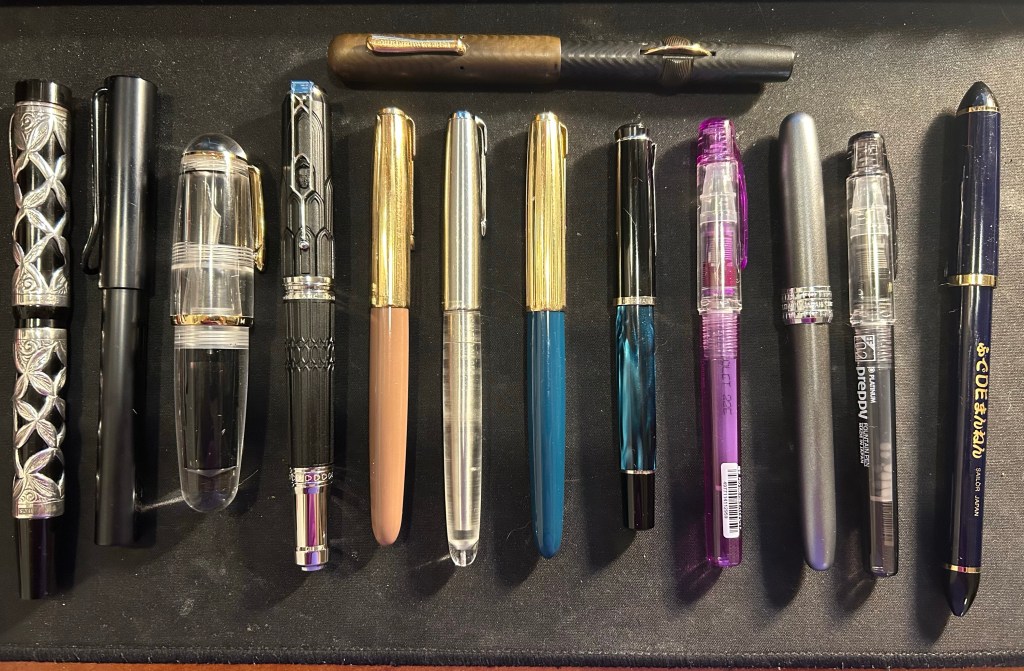
  • I wrote the Conklin Lever filler on top dry just as I was planning this post, so it’s here for reference only. I purchased it at Mora Stylos, it’s from 1919 and it’s in user grade condition (cap discolouration, significant brassing, the imprint isn’t in perfect condition). The lever filling mechanism is infuriating to use, both for filling and for cleaning the pen, but there nib is magnificent. It’s a true flex nib, going from medium to triple broad with no effort or railroading, and it’s a joy to use. The fact that I enjoyed it so much, coupled with its tiny ink capacity, meant that it took me about a week to write it dry. I used Waterman Serenity Blue in it, and that ink once again proved its worth in troublesome vintage pens. It’s a great shade of blue that is very pen safe and super easy to clean out of pens (think the opposite to Bay State Blue). A must have for anyone dabbling in vintage pens IMHO.
The pens, from left to right, matching the order of the writing samples with an added guest on top

Other Stuff

I’m working on an adventure for a 30+ tabletop roleplaying convention at the end of the month. I may publish something here about how I write adventures for conventions.

In the meanwhile my D&D 5E game, set in a university like setting and a university town next to it, is progressing nicely. It’s the most complex campaign that I have ever written, but it’s wonderful to see the players rush around in this world, having the time of their lives exploring, interacting and trying to break stuff. D&D is a pure joy and a wonderful escape from the pretty dark reality we live in these days.

Speaking of both dark reality and things that cheer me up:

  • It’s week 27 of the pro-democracy protests, and we’re still showing up in numbers (that are growing again). It’s great seeing whole families show up, including the dogs, to say no to stripping the judicial branch of its oversight powers.
  • I’ve been sketching people’s dogs, and it’s a pure delight to try and capture their personality with each sketch. Plus, it’s making people happy, which is a good thing.
  • I’ve managed to help a few people get back to running, and that’s always a joy. Go get some exercise. Do something you enjoy, and even 10 minutes is enough. As Dr. Jen Gutner says, exercise is like finding money in the street: if you find $10 lying around, you’re not going to leave them there because they aren’t $100. Invest a little in yourself, because you’re worth taking 10 minutes a day for.

Weekly Update: Pre-Dawn Running, Ducks, Books and Fountain Pens

It’s been a busy time, what with my new job taking a lot of time and effort, my running and training taking up a good bit more, and the rest of my spare time going mostly to reading lately, I found myself creating less. That’s not great. My journalling has suffered, my drawing has suffered, my blogging has suffered. The truth is that creating is like running: I feel good during my runs and great after them, but it doesn’t make lacing up and getting out the door any less of a struggle some days. It takes more effort to sketch and blog (I’ve been utterly unable to write since my cancer diagnosis, so at the moment writing is off the table), than to curl up with a book, so I’ve been consuming more content than I’ve been creating.

That’s something that I hope will change over the next few days and weeks. I have a lot of catching up and different kinds of posts that I’ll publish here (pen reviews, sketch posts, art supply reviews, planners and Moleskines, etc). And as September is lymphoma awareness month, and childhood cancer awareness month, expect some posts related to that in the near future.

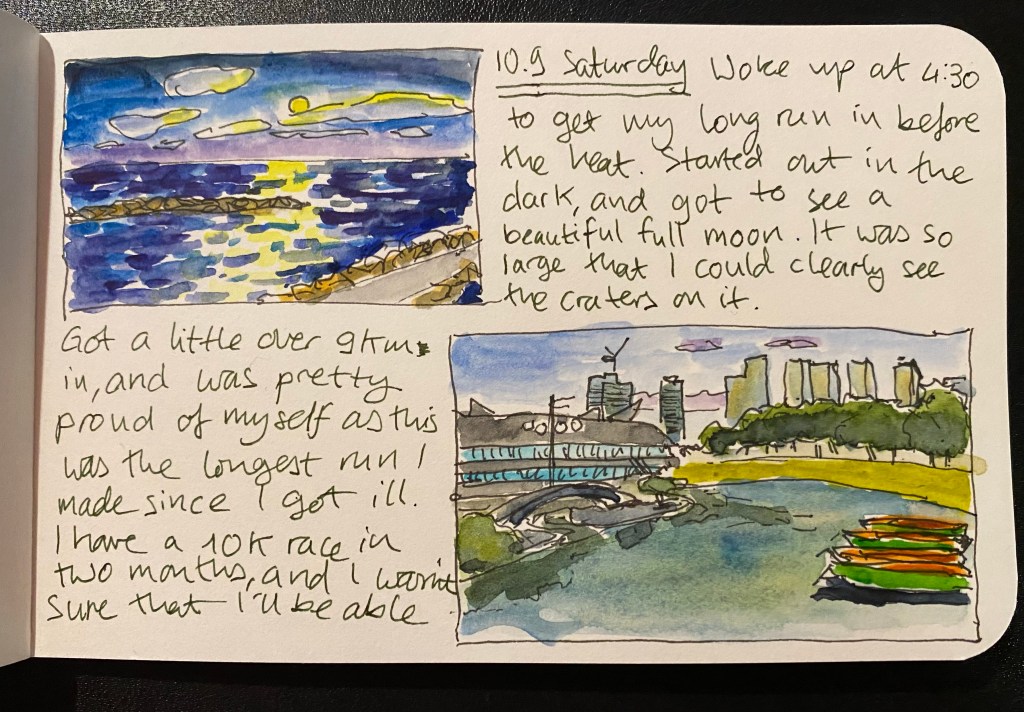
Despite the heat and humidity my running has stayed on track. This morning I woke up at 4:30 to get my long run in before the heat made things too unbearable. The weather is starting to get a bit better now, and I managed to run a little over 9 kilometres. That’s the longest run I managed to finish since my breathing issues started, and it’s a big milestone. I have a 10k race in two months and when I enrolled I wasn’t sure that I’ll be able to complete it. Today was a good indicator that I have a just may be able to do it despite having a busted lung.

Running in the dark and boats at sunrise.

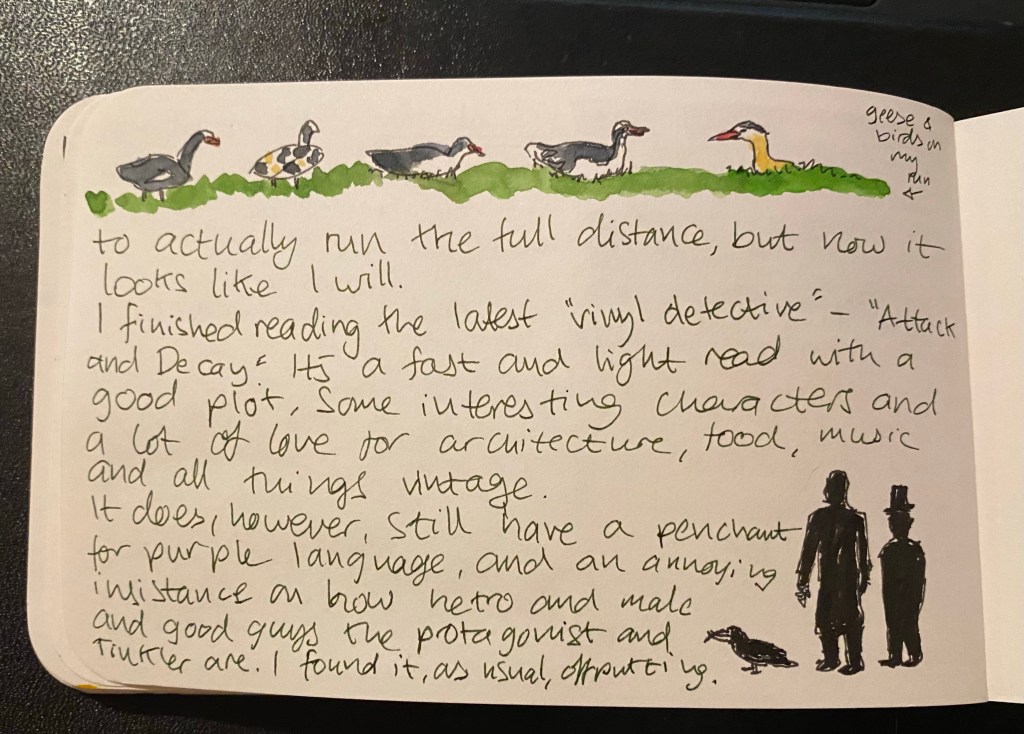
I finished reading Dr Jen Gunter’s “The Vagina Bible,” which I recommend that anyone with a vagina read (it’s very informative and empowering), and Andrew Cartmel’s latest Vinyl Detective novel, “Attack and Decay”. It was a fun and fast read, and Cartmel knows how to write compelling plots and off beat characters, but his insistence on using purple language and calling attention to his protagonist’s hetro maleness is annoying at times. We get it, he’s a dude and he finds women attractive.
Next up on the reading list is likely “The Sentence” which is a Tournament of Books book (and I decided not to continue with the tournament reading list this year), but as I’ve already bought it and it seems interesting, I’ve decided to give it a go.

Ducks, geese and the Vinyl Detective.

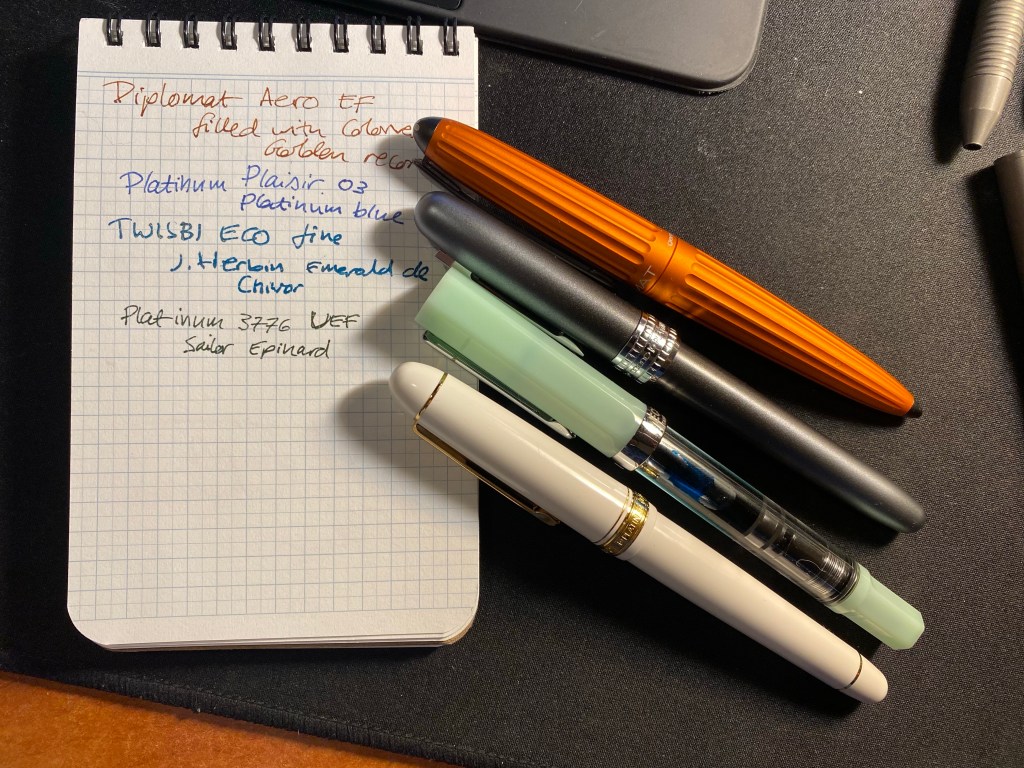
I’m using four fountain pens at the moment, and none of them are for sketching (although I write my sketch journal’s out with my Platinum 3776 UEF). All of these are new pens, inked for the first time. The Diplomat Aero is an excellent pen at a great price point with a very unique and elegant streamlined design. The Colorverse Golden Record, on the other hand, is a disappointing ink. This is the second time that I’m using it, and it darkens considerably when left in the pen, becoming more brownish than golden orange.
The Platinum Plaisir 03 is a pretty decent pen for anyone first venturing into fountain pens. It’s a cartridge pen, and I’m not a fan of the Platinum blue it came with, but I’m not going to invest in trying to find other ink options for it.
The TWSBI ECO is an excellent pen, particularly for the price point, and J. Herbin Emerald de Chivor is a really fun, utterly impractical ink. This ECO is the jade one, and it doesn’t glow in the dark, despite its looks.
The Platinum 3776 UEF is one of the best pens that I’ve bought in a long time, because of the nib. Yes, it’s scratchy, no I don’t mind. It doesn’t feel different than my beloved, finicky Pilot Hi-Tech-C and I get more personality from its fine lines than I get with something like a fineliner. Sailor Epinard (this is from a bottle of the discontinued ink, which is now no longer discontinued), is a good, dark and muted green that has a good amount of personality.

Pens in rotation.

Have a great week, and take care of yourselves in these hectic times.

Weekly Update: Ink Washes, Health Scare and Finding My Stride

It’s been a while since I posted an update, and there’s been fewer posts than usual during the last two months. This is mostly because I started a new job in June, and it’s been longer hours and more work than I anticipated at first. I am enjoying myself, but the change means I have less free time, and that I need to prioritise things differently to better fit the things that I care about into my life. Was moving from a cushy and undemanding job to an interesting and fun but much more demanding one a mistake? Time will tell, but so far I’m not regretting the switch.

As I’m starting to find my footing, I’ve been able to find more time for my hobbies. During the early days of my new job the only thing I did was work, exercise, sleep and eat. Then reading came back into my life, and journalling and sketching followed. Meanwhile the Sketching Now Watercolour course is over and I only had time for the first week, but thankfully the materials are all available online so I’ll be able to complete it all eventually.

What’s left my life almost entirely so far is watching TV, and I doubt that it will regularly return. In terms of media consumption, I read and listen to podcasts and that’s about it. I will watch specific things on Disney Plus or watch Adam Savage make things on YouTube, but even that isn’t something that I do often these days. It’s not a value judgement on TV – it’s just that I have less time now, and of the things I could easily get rid of, this was one of them.

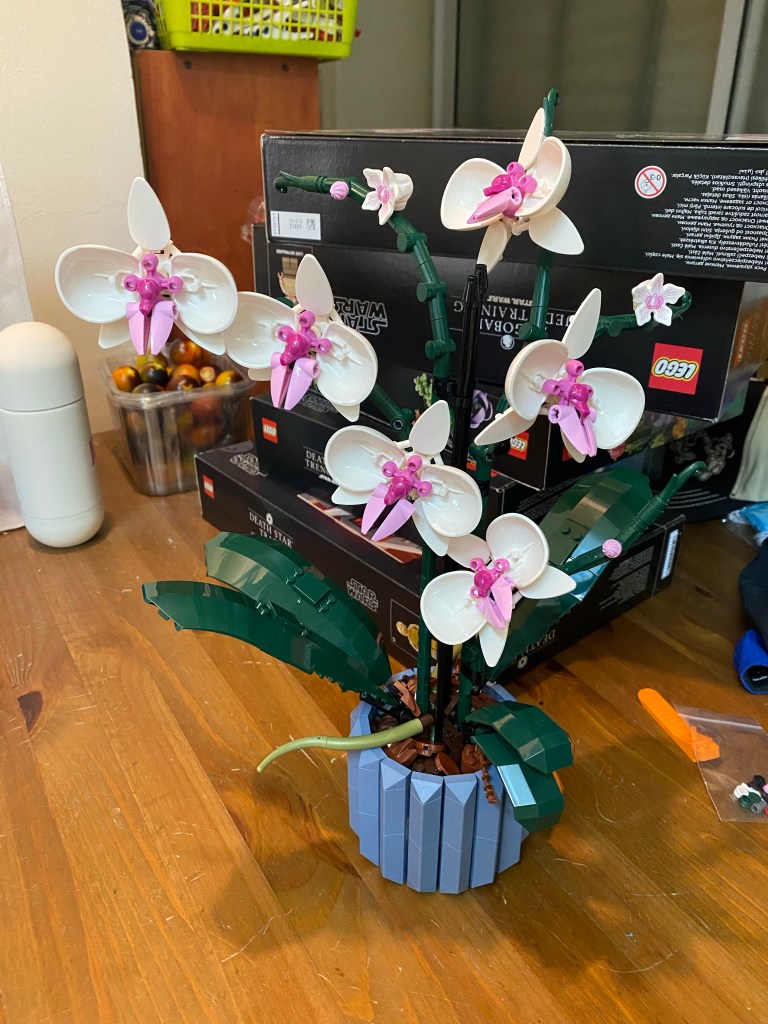
Lego Orchid set (it’s gorgeous). I find building these sets very relaxing, and as you can see in the background, I have quite a few more to build…

Another thing that went out the window is social media. I’ve stopped checking Twitter and Facebook regularly. The only thing left is Instagram, which I still spend too much time on for my liking, and as Facebook starts messing with it I may likely leave as well.

Health

I had a bit of a health scare in late June. It was 6 months after my last chemo treatment, and I had some blood work done for a check up with my hemato-oncologist. One of the results was extremely low, and it was for a test that people rarely get and I certainly have never gotten before, so I had no baseline to compare it to. What little information I found online indicated that I either was going through kidney failure/had a kidney tumor or had a rare form of blood cancer (beyond the blood cancer that I already had). Two sleepless nights later my hemato-oncologist (bless her), told me that everything was OK. The rest of my blood work was good, and this test was meaningless for people in my condition. She never asked for it, and I don’t know what possessed my GP to ask for it. In any case, I am now officially well enough to go on the regular post treatment checkup schedule, which means once every three months. Yay!!!

I’m running five times a week now, four 5ks a week and I’ve now started to work in a long run in the hopes to get back to running 10k. It’s tough running in this heat and humidity, especially with my lungs not being 100%, but I’m pushing through and enjoying myself. Running is my meditation, and has remained that way even though I now also meditate as part of ACT.

I’m also going twice a week to lift weights in the gym, nowadays with a mask on to avoid COVID. I’ve been vaccinated four times, but am now working from home again and staying masked as I can’t afford to get sick with the state of my lungs. Practically nobody is wearing masks anymore, and almost everyone around me is sick, so it’s been frustrating to try and stay healthy under these conditions. I’m hoping that the Omicron variant vaccine will be available here in a month or so, and I’m keeping an eye on the numbers to know when I can go back to the office and see people face to face again.

Reading

I’ve finished Hillary Mantel’s “The Mirror and the Light”, the third and final book in her trilogy about Thomas Cromwell. I’ll write a more lengthy review of it on Goodreads, but I will say that I got tired of the book at around the 60% mark (it’s about 900 pages long), and it didn’t really recover from that point on. I can see why Mantel struggled with this one, and I don’t regret reading it, but it’s not as good as the previous two books, and it could have done with some robust (and perhaps ruthless) editing.

I’ve also finished Ali Smith’s “Companion Piece”, which is a companion piece to her seasonal quartet of novels (Autumn, Winter, Spring, Summer) and is excellent. You don’t need to read the quartet to enjoy this book, and “Companion Piece” would also be a good introduction to Smith’s writing. It’s written in stream of consciousness style, although it’s fairly easy to understand (nothing as complex as Joyce), and there’s a joy in her writing, compassion, insight and humour that make reading her always an enjoyable and worthy pastime.

As these were a bit challenging to read, I had an Agatha Christie “palate cleanser” in the shape of two novels: “The Man in the Brown Suit” and “Crooked House”. “The Man in the Brown Suit” is a detective/adventure story that was originally light hearted, but today just doesn’t work. There’s too much racism and sexism to bear, especially if you know anything at all about the history of South Africa, diamond mines, and labour relations in Africa. “Crooked House” was one of Christie’s favourite novels, and it’s a fun and interesting book with many original characters (and yes, also spots of racism).

Pens, Pencils and Notebooks

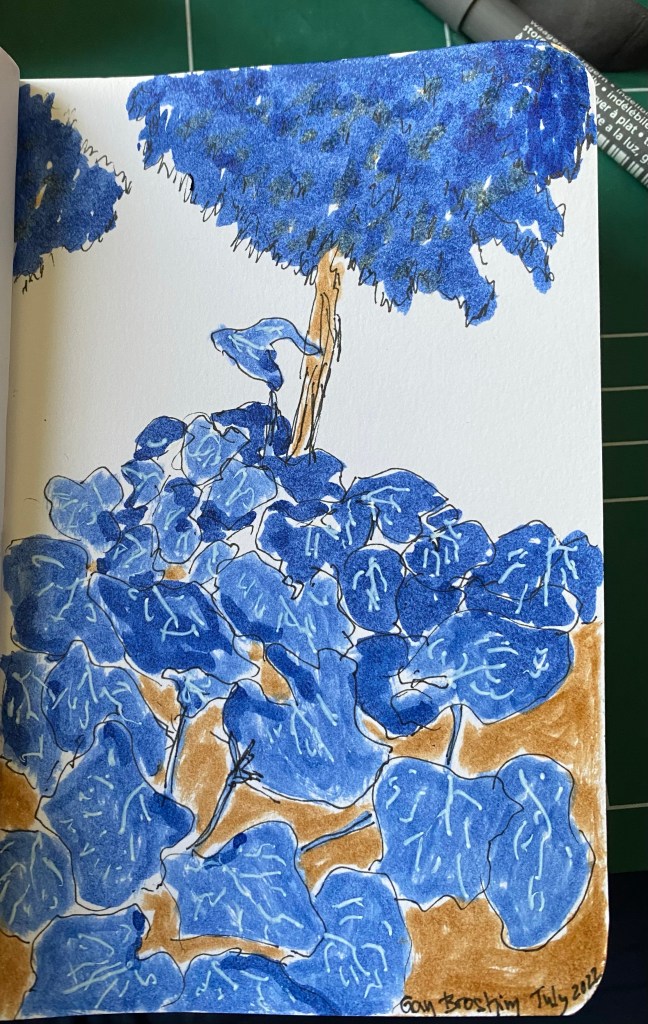
I’ve been playing around a lot with ink washes lately, as I’ve written here. They’re a fun and quick way to add colour to a sketch, and having a limited palette makes me appreciate colour values more.

Quick sketch of squash plants gone wild in a local garden.

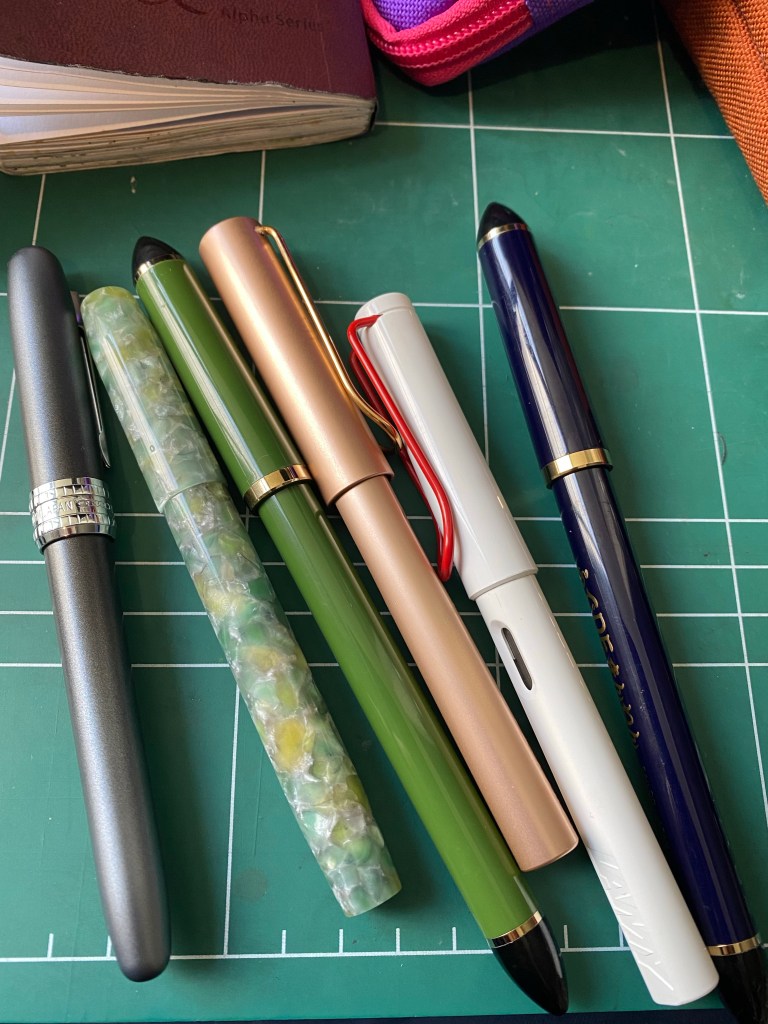
I’ve written almost all of my fountain pens dry, with the exception of a Franklin Christoph 45L Sage with a S.I.G fine nib (filled with Bungobox June Bride Something Blue ink) and a Platinum Plaisir filled with the blue cartridge it came with. The other fountain pens I have inked (two Lamy’s and two Sailor Fude pens) are used for sketching and not writing. I’ll likely fill up a few pens next week.

From left to right: Platinum Plaisir, Franklin Christoph 45L Sage, Sailor Fude pen, Lamy Lx Rose Gold, Lamy Safari white and red, Sailor Fude pen.

The BigIDesign Dual Side Click pen arrived from the kickstarted that I backed, and it’s fantastic. I hope to have a review up next week, but so far I’ve really enjoyed using it, and I think that it’s their best pen yet (which is saying something).

I’ve decided to start switching around the pencils that I use, instead of writing one down to a nub. I’ve been using a vintage Eberhard Faber Mongol pencil this week, and a Musgrave Tennessee Red one. They’re both #2 or HB pencils, but the Tennessee Red one is much softer and darker.

I’ve changed the way I use my notebooks, streamlining certain things, consolidating notebooks on the one hand, and starting a new notebook (MD A5 blank paper notebook) for insights and ideas that I would have previously explored on social media and now prefer to explore in private, on paper. I’m no longer chasing likes for these things, as I’m more interested in giving the thoughts in my head time and space to grow and change, and Twitter and Facebook are the last places to allow for that.

All the Rest

I’m back to decluttering my house, a project that I had started working on before I got sick and until now didn’t have energy to get back to. Yesterday I found a stash of half used notebooks that I forgot that I ever had, and it was bizarre to go over them and read what my pre-Covid, pre-cancer self thought about life in 2014-2015.

Weekly Update: PET CT, Pens and Mischief Movie Night In

I haven’t written an update in a long time, because my neuropathy has gotten much worse since I finished my treatments. It’s painful to type, to write or draw, and it gets worse in the cold. Of course we’ve been having a series of cold days here, which has meant that typing a blog post has been a considerable challenge.

Two Egyptian Geese are having a dip in a roadside “pond”.

Health

I went through a PET-CT, my third and hopefully my last, last Sunday. It’s a long and not very pleasant experience, but it’s not the worst thing in the world. This week I’ll get the results and discuss with my doctor what to expect over the coming months. Meanwhile, neuropathy is kicking my ass, so posts will be sporadic until things get a little better.

This contraption injected me with radioactive sugar before my PET-CT.

I also got my fourth Covid vaccine, in the hopes of staving off the dreaded Omicron variant. I’ve been constantly masked and hiding as much as possible at home, but I’ve got a series of hospital visits coming up, so I’m hoping that the vaccine (and mask) will help me avoid infection and stay safe.

Reading

I started a new reading challenge, but I’m taking my time with it. I just finished the fabulous “The Trees” by Percival Everett, and the pretty terrible “All’s Well” by Mona Awad (lots of good intentions, terrible delivery). If you enjoyed “My Sister, Serial Killer,” you’ll love “The Trees”. It is a darkly funny, fast and very clever detective/revenge story that is just a joy to read, despite the very difficult topic.

I’m not sure what’s next on my reading list, but it may just be a non-fiction book before I delve into the next Tournament of Books pairing.

Writing

My hands are making writing problematic, but I did manage to write a pretty long post on the blog this week. It’s a taste of a project that I’ve been wanting to work on even since I got sick, and I look forward to be able to actually sit down and type for longer periods of time to get it done.

Currently Inked

I finished my Diamine Inkvent 2021 reviews with 32 pens inked, and I promised myself that I will write them all dry. That’s the most pens I’ve ever had inked at one time, and it’s turning out to be quite a challenge, but a fun and interesting one. This week I’ve written four pens dry (a Lamy Safari, two Monteverde Giant Sequoias and a Sailor Pro Gear Graphite Lighthouse), bringing the count of inked pens down to 22. It’s slow going because I have trouble using my pens, but I am making an effort to journal each day with them, so I do hope to write them all dry by the end of next month. I’ve been using them in my Moleskine, because I love their format the best, and just writing on one side of the page since I have enough notebooks to afford to do that. That way I can use the pens I like in the notebook I like and not worry about avoiding bleedthrough.

Other Things

I got back to running, which is major. I’ve been a runner since November 2011, until the 7 month break in running that I was forced to take last year due to my cancer and treatments. It was very hard for me to stop running, and it is difficult to get back into it now for various reasons, but I’m lacing up and getting out there and that’s what matters at this point. The most important thing I’m having to learn is to be kind and patient with my body after all it’s been through.

I’ve also watched the charity broadcast of the Mischief Theatre group (of “The Play that Goes Wrong” fame), “Mischief Movie Night In: The Wizard of Paddington Station” . You have until the 31st of January to purchase a ticket to see the broadcast and all the profit goes to charity. It’s a fun, family friendly way to pass an evening and do some good at the same time.

On Reading and the Tournament of Books

I’ve started a new reading challenge: reading all the Tournament of Books 2022 books. I’ve done this twice in the past, in 2019 and in 2020, and it has been a great way to read contemporary fiction that is not necessarily on the best sellers list or the awards circuit. I would never have read “The Book of Broken Angels,” “Overstory,” “Milkman,” “My Sister, Serial Killer,” “So Lucky,” “America is Not the Heart,” “A Terrible Country,” “The Brief Wonderous Life of Oscar Wao,” “Cloud Atlas,” “Wolf Hall,” “A Mercy,” “On Earth We’re Briefly Gorgeous,” “Nothing to See Here,” or “Girl, Woman, Other” if not for the Tournament of Books lists, and that would have been my loss. And while I generally like the list and particularly the way that books are pitched against each other, I tend to not like the judges’ commentary or choices, so I usually ignore them and create my own rankings. Why compare pairings of books in this way in the first place? It’s usually a way to gain some more insight into the books that I’m reading, which is why I keep the “tournament” aspect of it in mind when I log or review the books that I read.

The Tournament of Books logo for this year.

I read significantly less last year (2021) than I did in previous years, only partly because I got cancer. I allowed myself to get off the “maximum books per year” racetrack, and focused more on reading either books that interested me, or books that comforted me. Some of my reading plans went completely awry once I got sick – I was planning on reading the Tournament of Books Tournament of Tournament books (I still do, as they all seem fantastic), but I just couldn’t face the effort once I started chemotherapy. Books were a huge comfort and a necessary distraction for me during my hospitalization and treatments, but they weren’t literary fiction kind of books. I read cozy mysteries and fast paced sci-fi because that’s my reading equivalent of comfort food. Sometimes that’s what you need in a book, and that’s part of the magic of reading: there is a whole array of “comfort books” geared perfectly for your specific needs, if you only know what you’re looking for. 

I’ve talked to other people who have gone through chemotherapy (they tend to come out of the woodwork once you start treatments yourself), and even the avid readers among them stopped reading during treatments, and sometimes well after them. Chemo brain is a real thing, and it makes reading challenging, and oftentimes you want something a lot more attention grabbing than a book during treatments or while you’re recovering from surgery. That’s what streaming is for, and I thank Disney+’s “Loki” and “The Mandalorian” for helping me out during some really rough nights. But somehow books never lost their appeal to me, despite the lure of endless, easily consumable, entertaining content. This isn’t to condescend on “non-readers,” especially not my fellow cancer patients. It’s just to say that different minds are wired in different ways, and mine is wired in this specific way. Once I start reading I generally get carried away and have trouble putting the book down (unless it’s a truly terrible one). This was useful when I tried to forget that I was connected to 3-litres of poison that was dripping into my veins, although it was a little annoying to my long suffering family who were with me during treatments and often just wanted to talk. Sorry, guys. You deserved better.

Once the 2022 Tournament of Books list was published I decided to give it a go again this year, to challenge myself to read all eighteen books on the list. Unlike in previous years I’m being kind to myself and not trying to rush through all of them by the time the tournament judging begins in March. As I started reading before the brackets were published, and so started alphabetically, I read Mona Awad’s “All’s Well” first. It’s a very well intentioned book that completely fails on delivery for me, and I struggled to finish it. I almost gave up on the challenge entirely, except thankfully I decided to read the book that it’s up against, “The Trees” by Percival Everett before doing so and it is phenomenal. I’m almost done with it, and it is viciously funny, dark, thought provoking, and a fascinating and original read. Everything you hope for in a book, and all this in a book that I’ve never heard of before, from a writer I’ve never heard of before. This is exactly why I put myself up for this challenge in the first place.

My neuropathy is killing me in this weather, and this was a literal pain to write, so I will end here by saying: treat yourself to some book exploration this year, if you haven’t done so recently. You never know what gems you’ll find. 

2021: Looking Back at a “Heavy” Year

My hands have been killing me with the worst neuropathy since my treatments began, so I’ve been trying to limit my typing to what I need to do for work. That is why this post took so long to write, and why my posting schedule may be a little off until things improve with my neuropathy.

2021 was a hell of a year for me. It started with me doing Liz Steel‘s excellent Sketchbook Design course. I also took some fantastic and very illuminating tea seminars with Juyan Webster from the Chinese Tea Company. If you have any interest in tea and you get a chance to have a tea seminar with her, I highly recommend it.

Early on in the year is also when a close family member got diagnosed with thyroid cancer, and that’s also when my journalling went on the fritz. This was the notebook I was using at the time, a Moleskine Pokemon Charmander limited edition and I abandoned it 2/3rds of the way through.

Abandoned Moleskine.

Covid was raging, I was working from home, at a new job, and I spent the first quarter of the year trying to fit my drawing and running into the new quarantine rules that kept getting both stricter and more confusing with each iteration. I happily got vaccinated as soon as I could, and I’m still very grateful to the amazing scientists and doctors who came up with vaccines in such a short time frame.
I managed to participate in the OneWeek100People challenge, which is very demanding but also a lot of fun. If you can spare the time I recommend giving it a try.

In the beginning of April I started having shortness of breath (dyspnea) while running. It got worse with time and soon I couldn’t run at all, and then I couldn’t walk very fast or far, climb stairs, etc. After a long and laborious road to get a diagnosis, in the beginning of June I learned that I had cancer, and in the beginning of July I got a diagnosis and started ABVD chemotherapy to treat Hodgkin’s Lymphoma.
A few things helped me get through that incredibly difficult time. First and foremost, my phenomenal family (mother, father and brother) that rallied around me and took care of me from the moment of the first diagnosis and to this day. I can’t imagine going through this process without them. Almost as important were my friends, who visited me in the hospital and cheered me up, and kept in touch and cheered me on during the treatments. Finally it was journaling and reading. I started this Moleskine “I am New York” on the day I was first admitted to hospital, and writing in it gave me perspective and kept me sane.

Journal of a bad year.

And books? Books have always been my comfort and escape. I saw a few things on Disney+ while I was hospitalized, but books helped distract me from a lot the most unpleasant and painful parts of this journey.
I was happy to discover that one of my favourite Moleskine limited edition series, the denim ones, was back in stock, and so once I finished the “I am New York” journal I moved into this Moleskine “Skinny. Flared. Bookcut.” one. It’s such a well conceptualized and executed design, it was a joy to use. This was when I decided to regularly use fountain pens to journal with, and just use only one side of the page. I have more than enough notebooks to support that decision.

This notebook took me through the second part of chemo to the end of it.

And now, and the beginning of 2022 I started a new journal, a Moleskine Peanuts Sakura. Pretty, right? Let’s hope I get to fill it with good news and positive thoughts.

A new Moleskine for a new and better year.

Some favourites from the past year:

My favourite pen was the Esterbrook Estie Sea Glass. Quite a surprise for me, but it hasn’t been out of rotation since I got it.

Esterbrook Estie Sea Glass – fantastic and beautiful pen.

Another pen purchase that came in at a close second was the Diplomat Elox Rings and the Diplomat Aero (basically the same pen with a slightly different body design). These are wonderful workhorses, and a joy to use.

Diplomat Elox Rings on the left and Diplomat Aero in Champagne on the right.

I didn’t read as much this year as last year, but I did read a few really great books. Here’s a list of a few standouts among them:

  • The Good War, by Studs Terkel. WWII as I’ve never experienced it before – as seen and told by the “regular people” who lived through it.
  • Cloud Atlas, by David Mitchell. Not an easy read by far, but a breathtaking work of fiction nonetheless. Worth the effort.
  • The Brief Wondrous Life of Oscar Wao, by Junot Diaz. A surprisingly moving tale of a character that you won’t expect to fall in love with, and yet you will.
  • Wolf Hall, Bring Up the Bodies, by Hillary Mantel. Why should I care about Thomas Cromwell? How can you not care about Thomas Cromwell after reading these books? An era and place come to life, in a world filled with complex and compelling characters.
  • Nomadland, by Jessica Bruder. Watch the movie AND read the book. Both are excellent, and both offer a chance to look into a part of modern living that we were hitherto oblivious of.
  • Project Hail Mary, Andy Weir. Just a fun and interesting sci-fi novel. If you enjoyed the Martian, you’ll enjoy this.
  • Underland, by Robert Macfarlane. What happens in the deep dark places beneath our feet? A lyrical work of non-fiction.
  • The Song of Achilles, by Madeline Miller. The love story between Achilles and Patroclus told with great gentleness and heart.
  • Klara and the Sun, by Kazuo Ishiguro. An understated and masterful work of science fiction that explores themes of humanity, identity, friendship and love, among other things.
  • Harlem Shuffle, by Colson Whitehead. How can you write a heist novel that isn’t a heist novel but rather a story of a person, a time and place? Whitehead’s writing is exceptional, and Harlem Shuffle is just another proof of that.
  • The Expanse books 1-4, James S.A. Corey. I haven’t read book 5 and onwards yet, but I did read the first four books of The Expanse this year. They aren’t perfect (Holden is a bit much), but they are very good at world-building, with interesting and unique plots and complex and believable characters (apart from Holden, who is a bit much). The books are each written in a different style, and they improve with time.

In terms of art supplies, 2021 was the year of the super-granulating watercolours from Schmincke, and also when I added Daniel Smith watercolours to my palette. Schmincke just announced that the super-granulating colours will be permanently added to their offerings, and that they are issuing three more permanent sets into this series (Desert, Shire and Vulcano), and another limited edition set, Haze.

I’ll be talking about planning for 2022 on one of my next posts. In the meanwhile, have a great new year, and don’t forget to take time and breath.

Weekly Update: Chemo and Klara and Ink, Oh My

I am trying something new here, to see if I can start using this blog to update on what’s going on with me plus as an accountability aid. Let’s see if it sticks.

Health

I spent the week recovering from Chemo number 8. I started the week with muscle aches and pretty strong neuropathy that made typing and writing a real pain, but by mid week the muscle aches subsided and the neuropathy, while still with me, is much less sever. Next week is Chemo number 9 out of 12. Getting into the home stretch, but the side effects are getting more pronounced. I no longer try to work on the day of the Chemo, and I may need to take a day off on the day after as well, but we’ll see. Next week I also finally get to see a psychologist at the cancer treatment centre. I’ve been on the waiting list for two months, so I really hope our appointment will go well.

Reading

I finished Kazuo Ishiguro’s fantastic “Klara and the Sun”. Not a breezy read and a very typical Ishiguro book, but I enjoyed his treatment of AI and humanity in this novel. It starts slow, and builds up a world and an atmosphere like few writers can. Highly recommended.

Started reading Hilary Mantel’s “Bring Up the Bodies” and will likely also start reading “Cibola Burn”, the 4th Expanse book by James S.A. Corey. Mantel is mesmerising as usual, but a bit too demanding to read during Chemo. That’s what “Cibola Burn” is for.

Writing

Got some writing done on my non fiction project, although not as much as I would have liked. I’m still writing in my notebook so I’m not counting words, but I estimate I got about 5 pages of writing in. Not great, but better than nothing, especially considering the material involved. I’m also considering picking up work on a novel that I stopped working on once the pandemic hit. I’ll have to rework the premise quite a bit, but I believe that the core of the story still works.

Currently Inked

I wrote my Diplomat Aero Champagne fine nib pen with Sailor Studio 123 dry this week. I really enjoyed the pen and the ink, so I think that they’ll be back in rotation pretty soon.

From left to right: PenBBS, Kanilea, Esterbrook, Retro 51

The PenBBS Year of the Ox pen and the Kanilea pen have been my journalling pens this week, with the first being filled with Pilot Iroshizuku Ina-Ho and the second with Diamine Earl Grey, both wonderful shading inks. The Retro 51 Monarch has a stub nib and is filled with Caran d’Ache Saffron, and the the Esterbrook Estie Sea Glass is filled with Diamine Jack Frost. Both are in use for my “Three Good Things” entries.

New Reading Journal

Yesterday I finished my fifth reading journal, and so I thought that it would be a good opportunity to write a post about how I set up my reading journal.

I use my reading journal to keep track of what I read and to encourage me to read more. This is the journal that I’ve just finished, a Moleskine Two-Go:

Moleskine Two-Go. The perfect size and format for my needs.

I used to use a Field Notes Arts and Sciences notebook for my reading journal, but once I got back to reading more it made sense to move to a larger journal. For the past three years I’ve used the Moleskine Two-Go, and I fill one book journal a year (70 books are logged in each notebook).

Start and end date for this reading journal.

This is the setup in my old reading journal. Three pages of index:

First index page. Red checkmarks for books that I’ve read.

The Moleskine Two-Go comes with pages that are blank on one side and lined on another, which is perfect for my use case, except for the second index page, which I need to rule myself:

Ruled second index page.

I missed a line on the second index page, so the index numbering came out a little wonky. It’s only for me, so I don’t mind.

Off by one error in my index.

Here’s a sample of a complete page. I talked more about my thoughts behind the design in a previous post, but you can get the gist by looking at this sample. I like drawing something that captures the book for me on the opposite page, which is why I love the Moleskine Two-Go format.

I remember really not liking this book, and this is a reminder of why.

At the very last page of the journal I keep a log of how many books I read that month. It’s ten books so far for December, but the month isn’t done yet so that line isn’t filled.

Number of books per month tracker.

Here is my new reading journal, a Moleskine Two-Go, this time in green (my previous ones were in light grey, dark grey and navy):

Front cover.

I love the texture of the fabric colours on this, and the shade of green is interesting. The two contrasting bookmarks and the endpapers are grey.

Back cover

The first page, marking when I started the notebook and which journal number it is. This notebook doesn’t leave my desk yet I still write my name and email in case I misplace it somehow.

Front page

Next comes the index page. Since this is my third Two-Go reading journal I already know to number the pages until 139 (I number odd pages only, since my reviews are on odd pages), which comes out to 70 books.

Index page.

I rule the second page, because I tried just winging it on the first year and it didn’t come out great.

Spoke pen for the win.

On the last page I create my books per month tracker:

Zebra mildliner highligher smears gel ink, but I still like it.

I number all the pages of the index, but only the first 25 pages of the actual book journal. I will continue numbering pages in batches as I add books to the journal. The great advantage of using a completely unstructured book here is that I can do whatever I want with it, including starting the numbering after the index pages and not on the first notebook page.

These are the pen and pencils that I’ll be using in this journal. The Rotring 600 is a ballpoint, and the only ballpoint that I regularly use. The Caran d’Ache Bicolor has been my companion in these notebooks for several years. I use it to highlight things, and sometimes in my book scene sketches. I used the Blackwing 611 in my previous reading journal, and this time I’ll be using the Blackwing 4.

Caran d’Ache Bicolor, Blackwing 4, Rotring 600 ballpoint.

The first non fiction book in this journal:

The Good War

The first fiction book in this journal:

Cloud Atlas. ToB means Tournament of Books.

That’s my new reading journal all set up and ready to go. I hope that this inspires you to keep a reading journal of your own, one that will encourage you to read more and help evoke the memories of reading a specific book.

Tournament of Books 2020: Optic Nerve

43793635. sy475

María Gainza’s “Optic Nerve” is a pleasant piece of what I now know to be termed “autofiction,” which is to say that it’s “fiction” based on the author’s life. It’s a nice way to while a way a few short hours, especially if you enjoy art history (or to be honest, art gossip). “Optic Nerve” is readable, inoffensive, largely forgettable, like most trivia-based works of its kind. There’s nothing to hate here, but there’s also not much to really love: the book remains on surface level with itself and its reader.
There are interesting and complex “characters” here, but the narrator is too self involved to get to know them, or too busy keeping herself at opaque for us to see them well. They are marks on the paper, nothing more, nothing less. You know nothing more about them, the artists or the narrator than you did at the book’s start. It’s a little disappointing, since it’s clear that Gainza knows how to write and is well aware of the dangers of judging an artist by the anecdotes we know of their lives.

I read this as part of the Tournament of Books 2020, where it’s up against Caleb Crain’s “Overthrow” in the 5th round of the tournament.