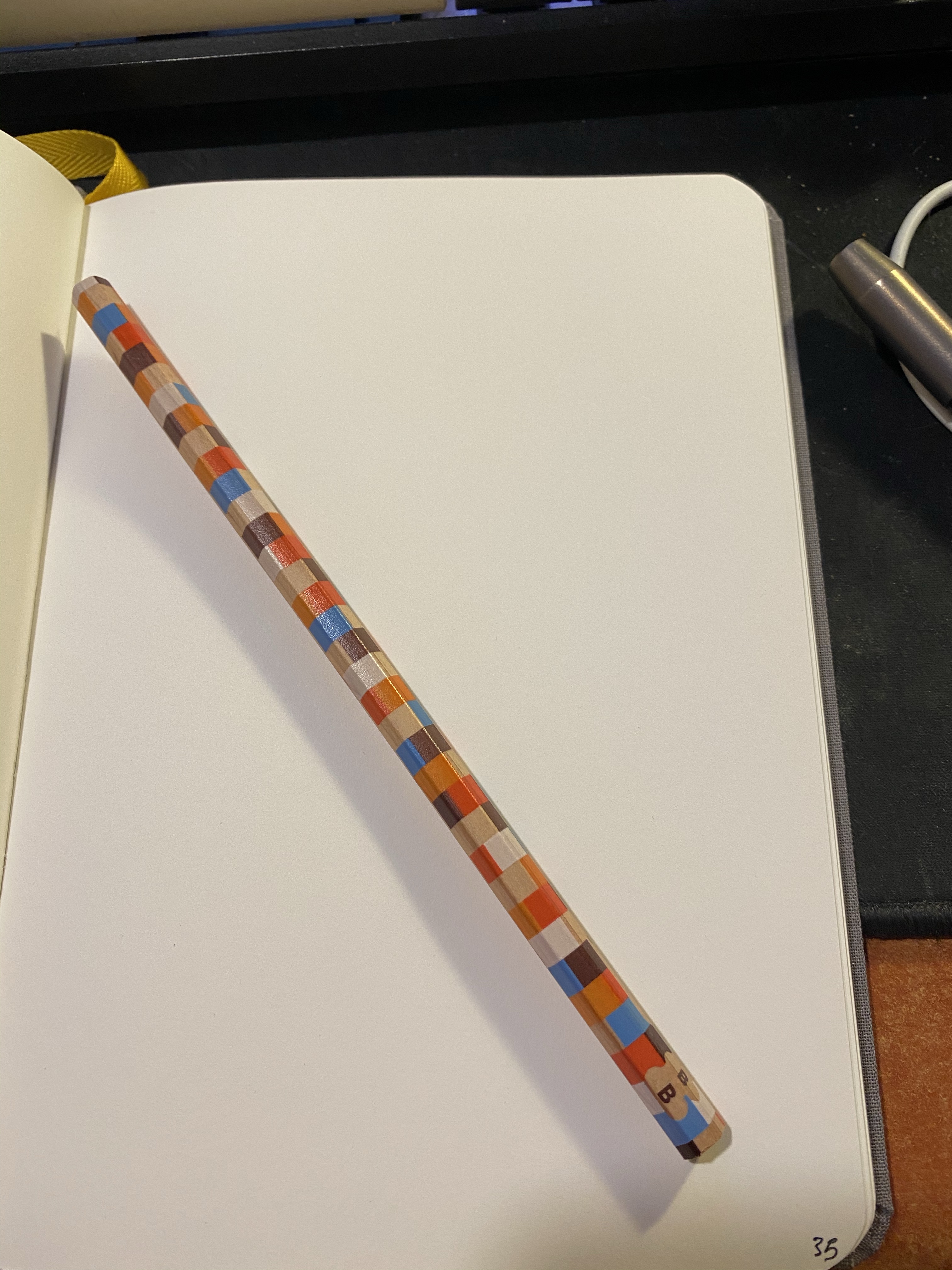
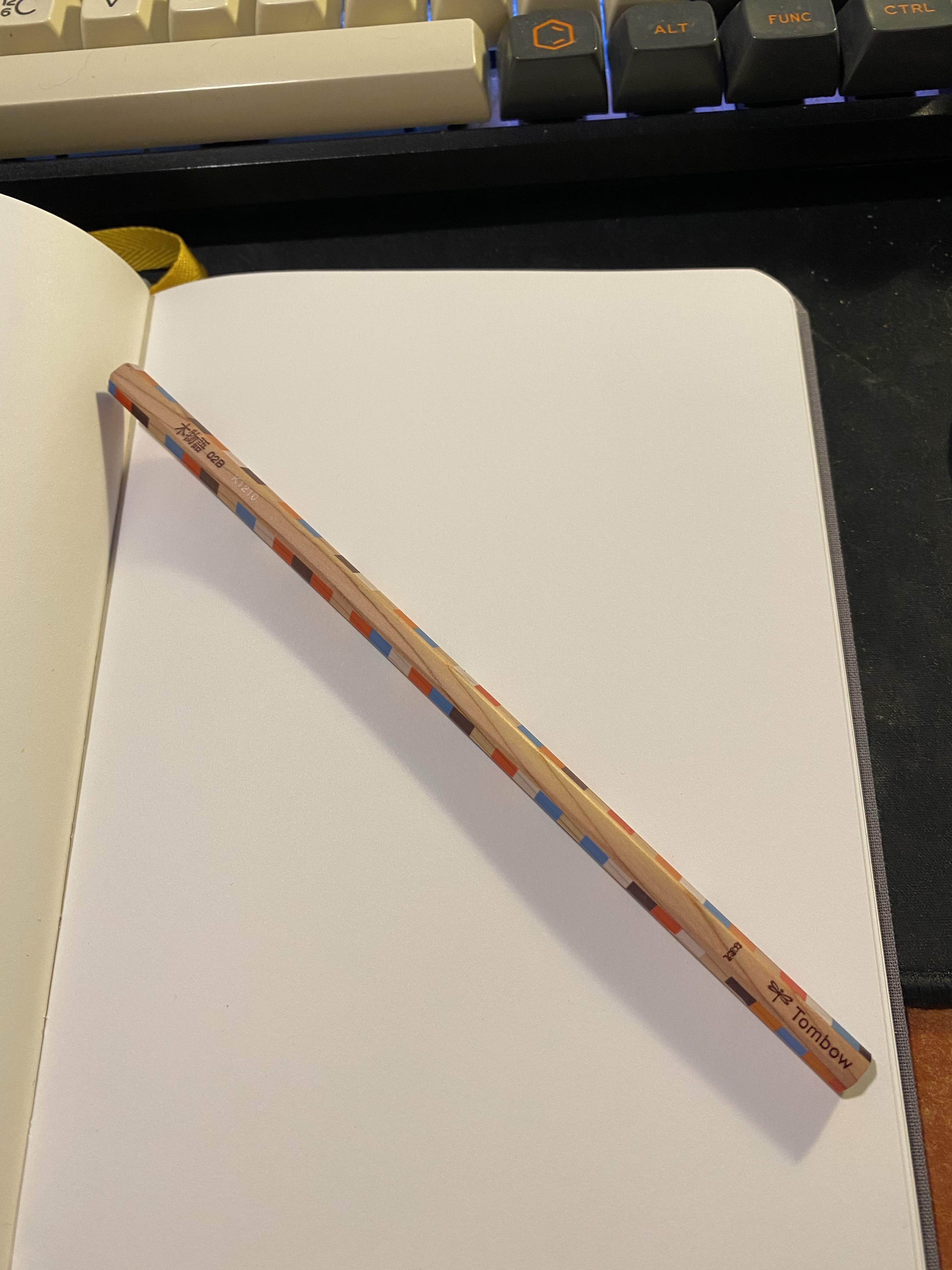
I was searching for a craft knife when I stumbled upon this cool pencil just lying around, being beautiful but of no use to anybody:
I’m pretty sure that I bought it somewhere in London, perhaps in the London Graphic Centre or in stationery section of Foyles, but in any case it isn’t new.
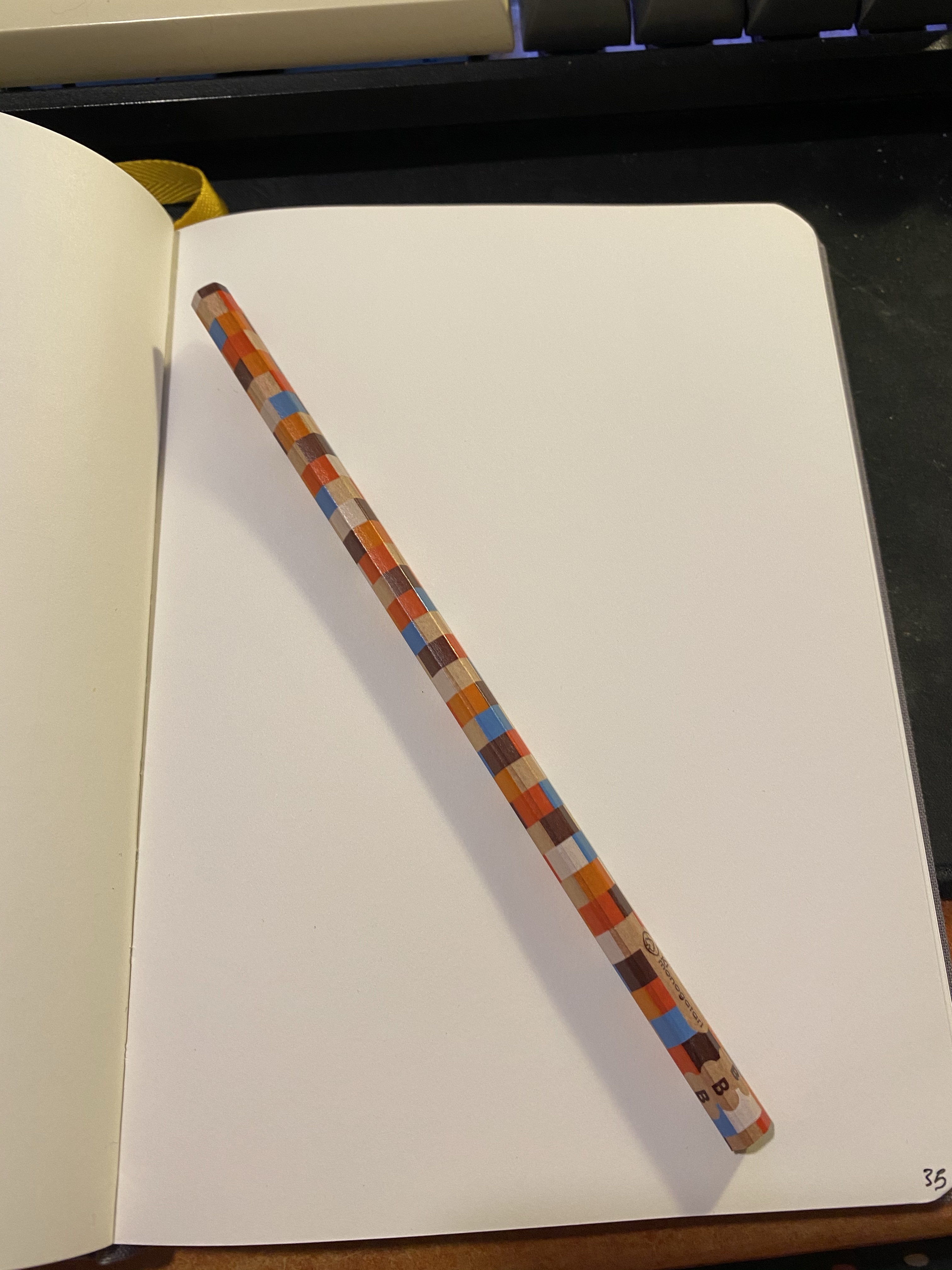
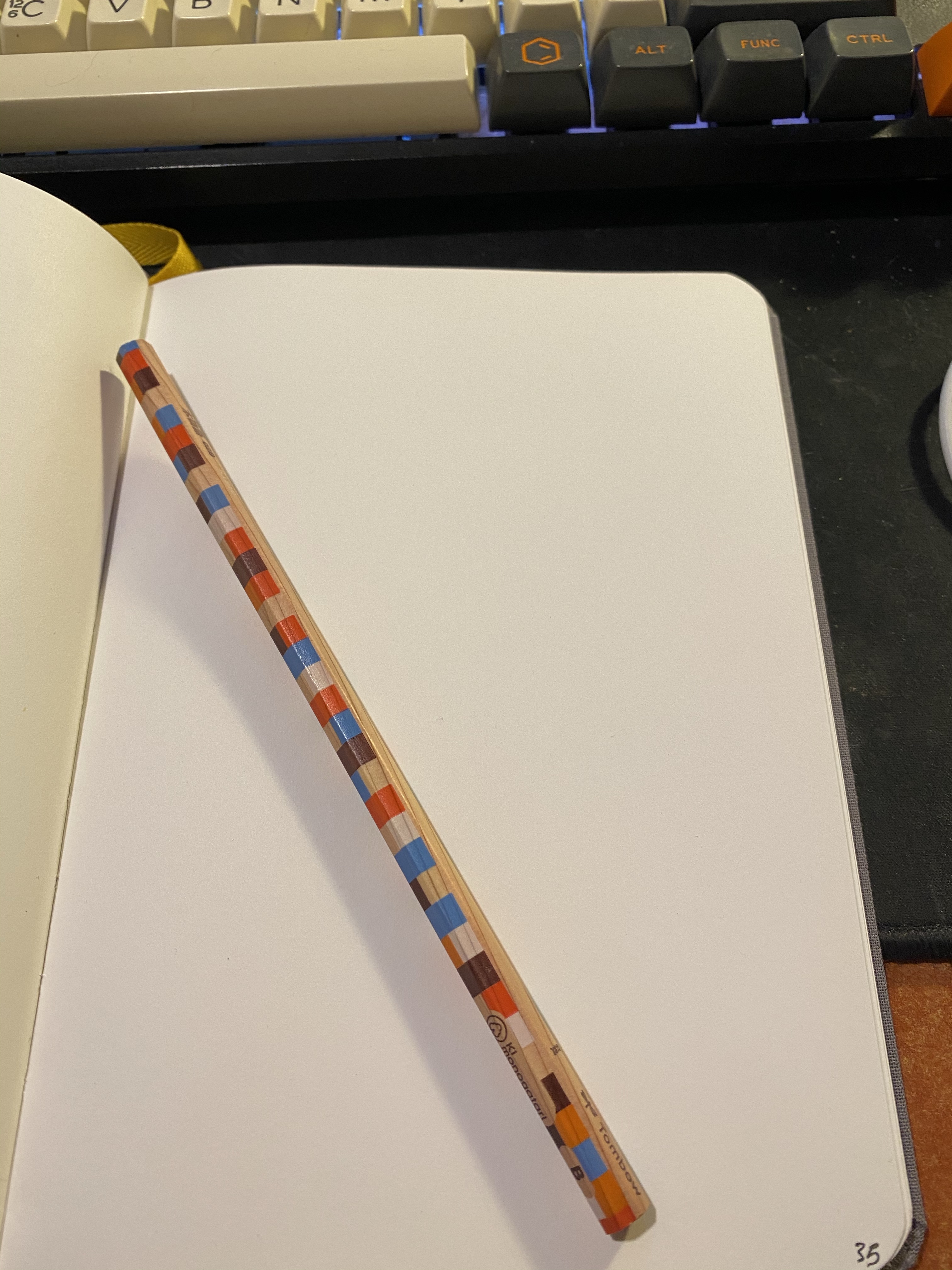
It’s an unlacquered woodcase pencil with a chequered print, a B grade core and it appears to be a Tombow Ki-Monogatari, part of their eco pencil range.
It has a silky smooth finish, and it’s one of the most attractive woodcase pencils I own. The wood is not cedar, but by the way it sharpens and feels it’s high quality stuff.
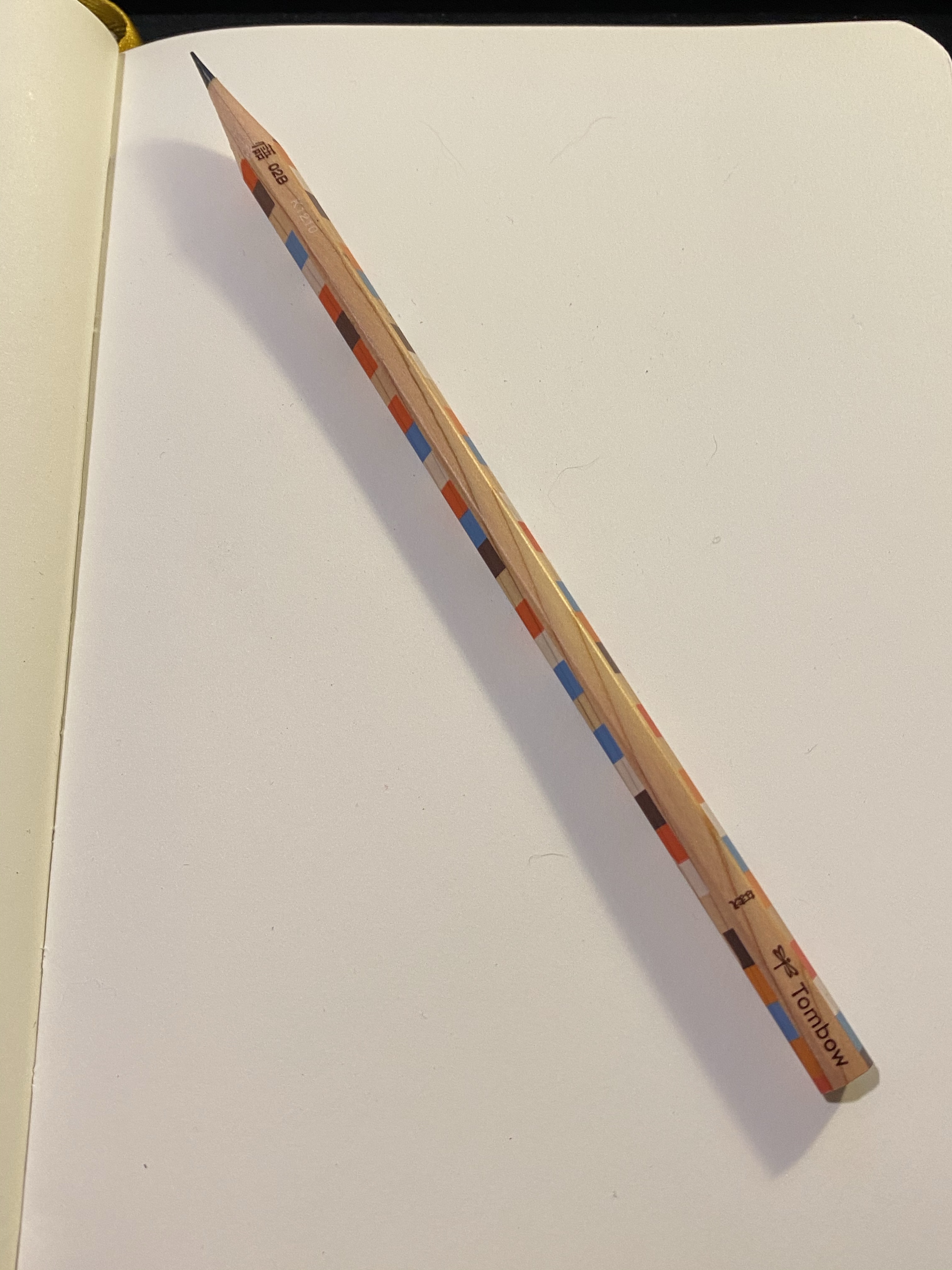
Tombow has one of the best logos in the business.
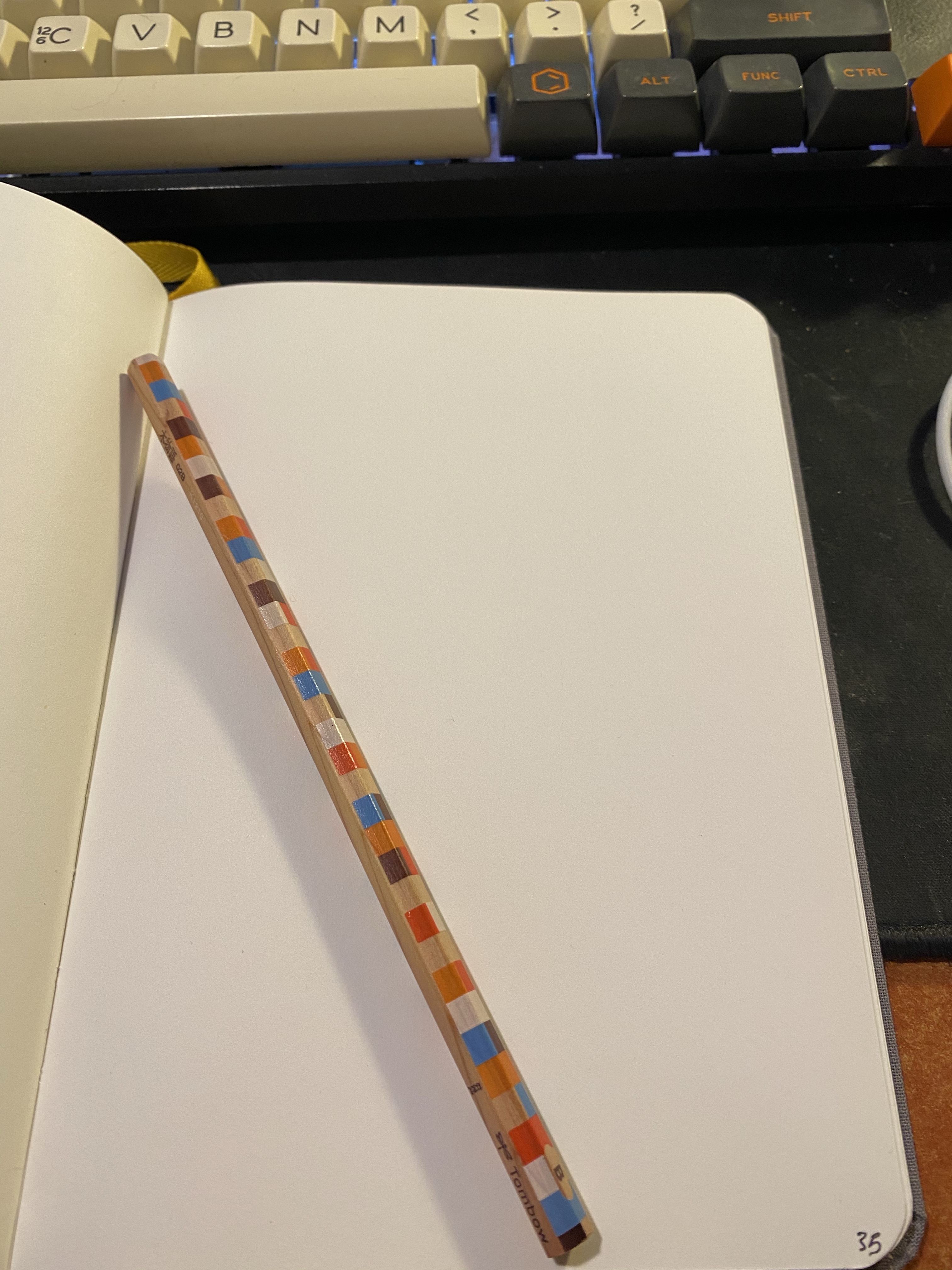
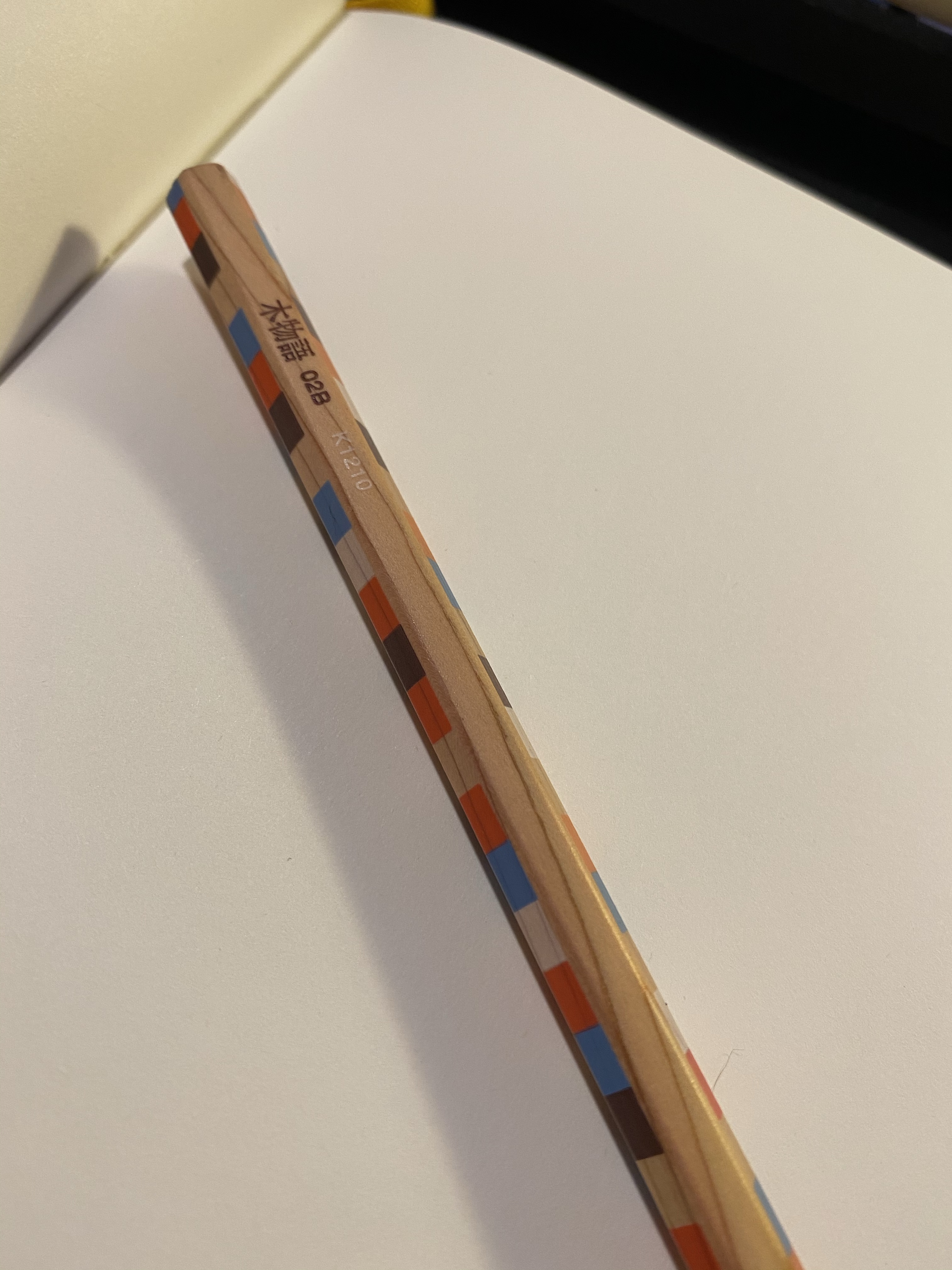
You can see the grain of the wood very nicely here:
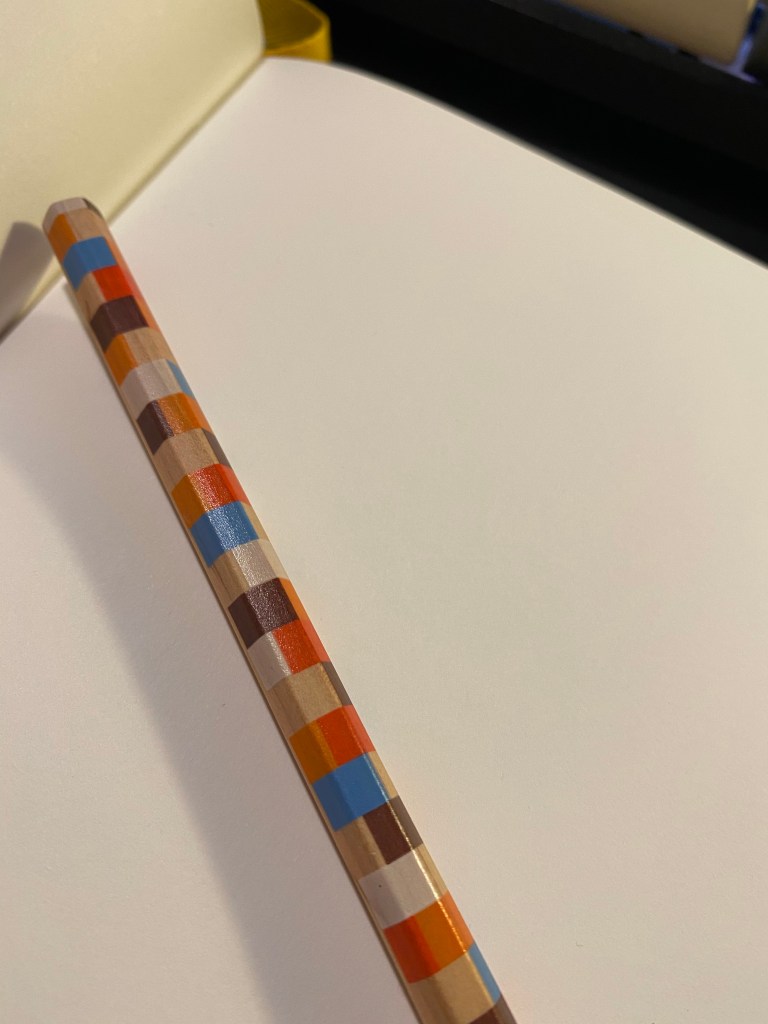
And also come through the chequered pattern:
It sharpens like a dream, with a perfectly centred core and no splinters or chunks falling out. High quality wood, high quality design, so what about the core?
This is a Tombow pencil and one of the things that Tombow do exceedingly well is make woodcase pencils. Drawing with this pencil is a dream – it glides on the page, there’s no “grit” to the core, it offers a good range of shading for a B grade, it doesn’t smudge and it keeps a point really, really well. This is a grade A drawing pencil.
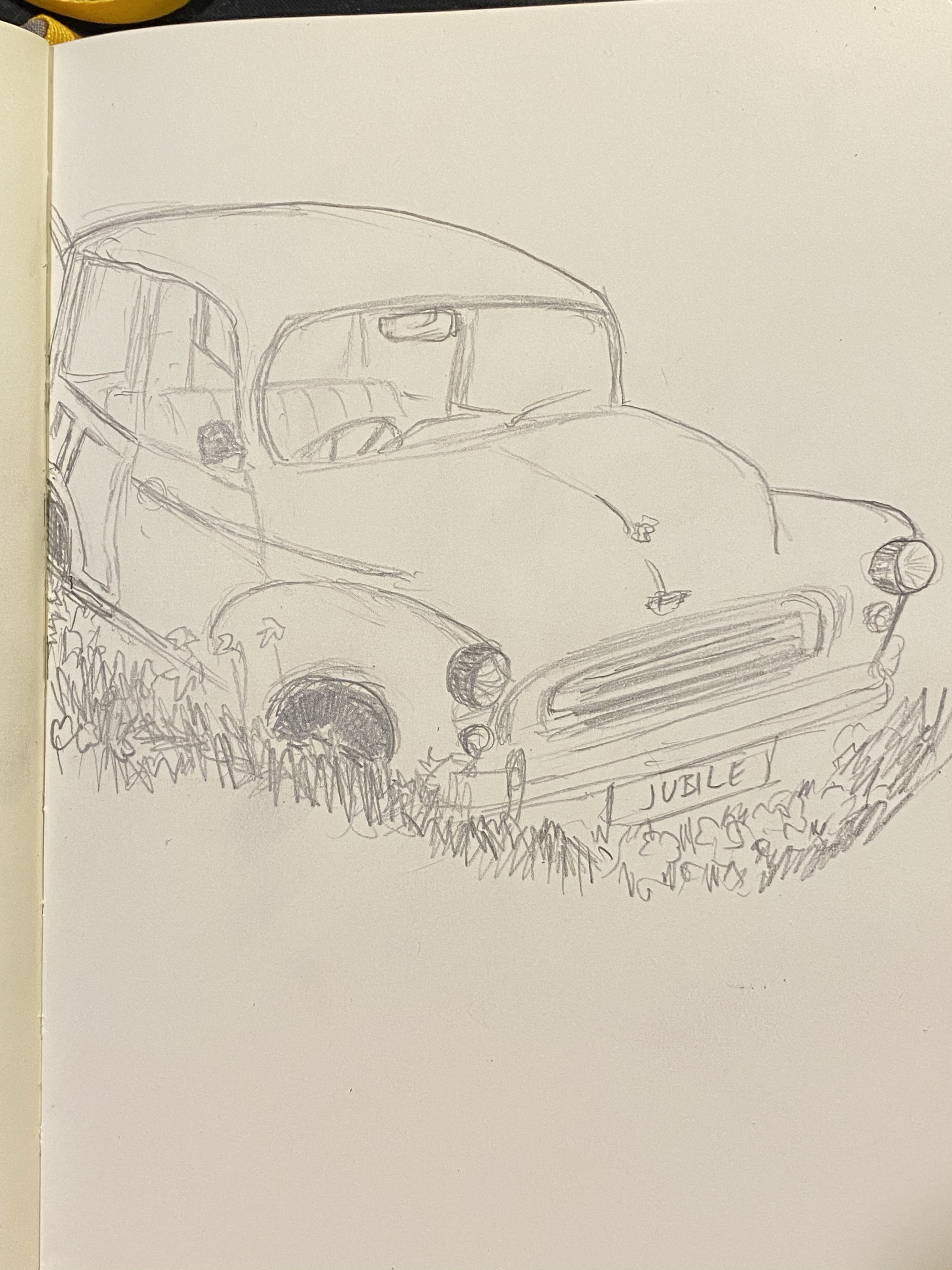
Drawn on a Baron Fig Confidant. You can barely see where I tried to smudge the graphite near the front tire.
I found this pencil by accident, totally forgetting that I ever bought it. I have cool stuff, so why don’t I use it?
I have no idea what the actual model of the pencil is, I’m just guessing that it’s a Ki-Monogatari, which means that this isn’t a “you should buy it” review. It’s a “go open you stationery drawer(s) and see what cool stuff you find there” post. Treat yourself to the stuff you already own.
I was organizing some things around the house when I found a brown paper bag with the Muji logo on it, and in it was some washi tape and three wooden writing instruments: two mechanical pencils and a pen. There appears to be an advantage to being a forgetful unpacker, as I get to enjoy a little trip to a London based Muji store while I’m stuck at home in quarantine times.
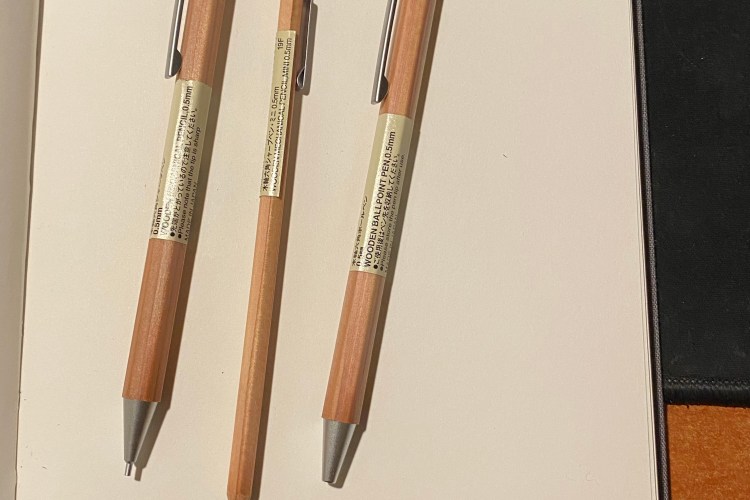
Here are the three writing companions:
Muji Wooden Mechanical Pencil, Muji Mini Wooden Mechanical Pencil and Muji Wooden Ballpoint Pen
I was drawn to them because they were wood encased, and they had that very sleek, minimalist Muji design. They weren’t expensive, so even though I’m generally not a ballpoint fan and the mini mechanical pencil looked more like a novelty piece than an actual writing implement, I bought all three.
And promptly forgot about them.
Muji Wooden Mini Mechanical Pencil
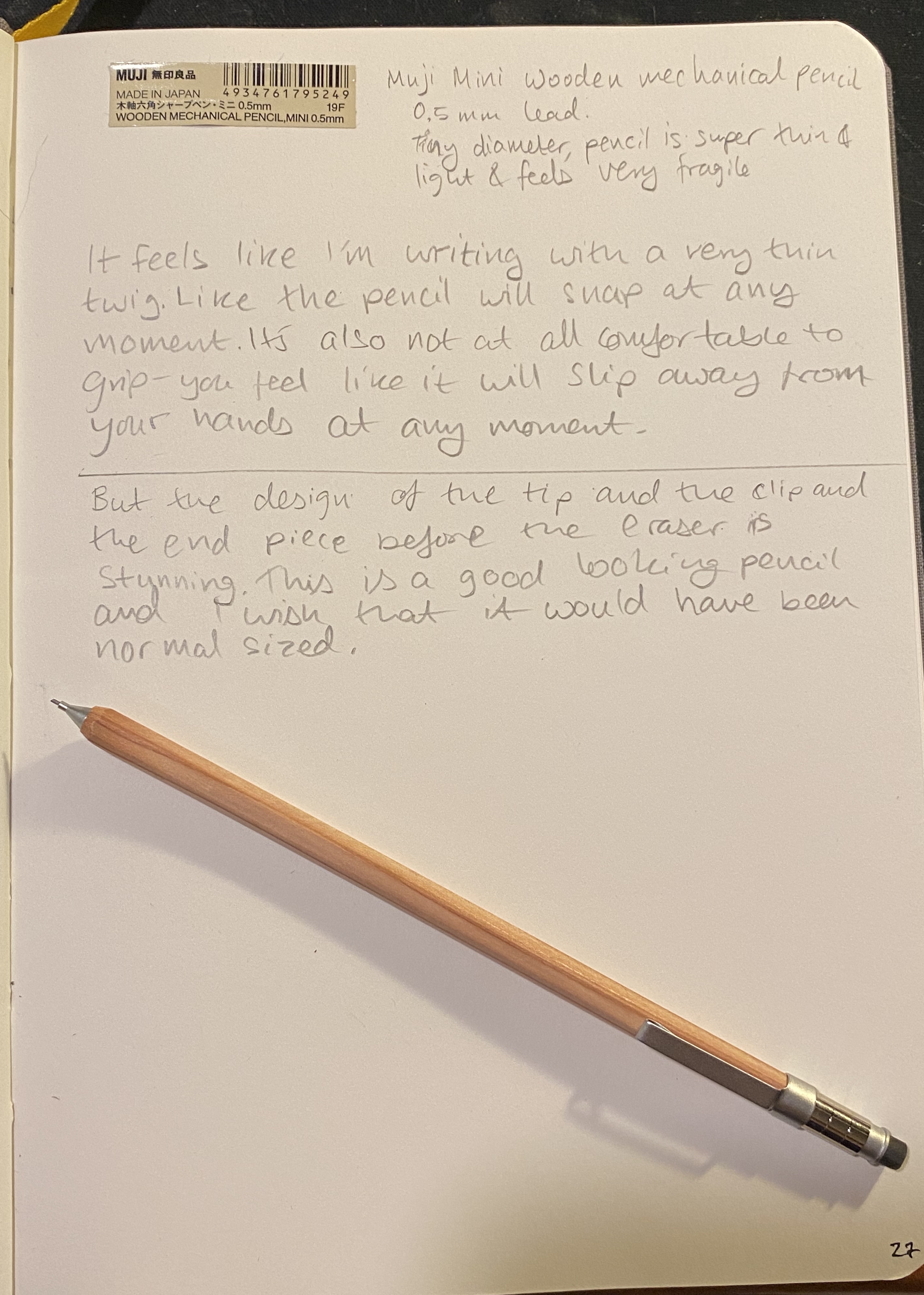
Well now I’m giving them a spin, and I can’t help but be intrigued the most by the least practical of the bunch: the wooden mini mechanical pencil. It’s a 0.5 point pencil, which is pretty bog standard for mechanical pencils, but here’s where the standard ends and you venture into the wild world of Muji industrial design. The pencil is very, very, very, very thin and also very, very light. It makes all other pencils, mechanical or not, look like veritable giants around it. It is 0.6 cm wide, which is tiny, and it feels like a delicate little twig that will snap at any minute, making it quite the adventure to write with. You get a little thrill when you pick it up and scribble with it: will it break? will it survive to write another day?
Your own mini “Survivor” in pencil form.
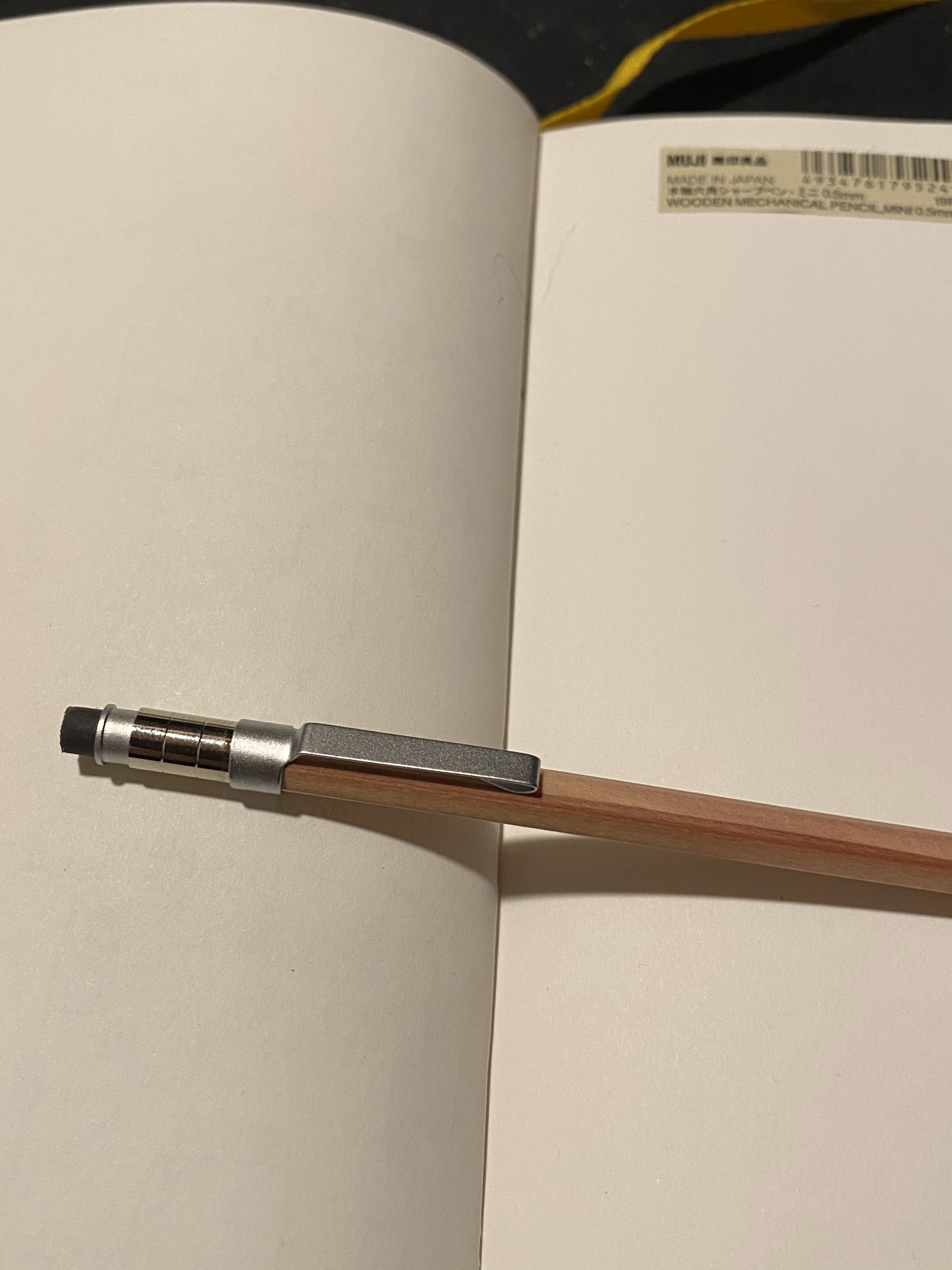
The design of the cap and clip area are both peculiar and handsome. There’s a combination of matt and shiny aluminum parts that make a striking statement, especially on an otherwise minimalistic pencil body. There’s no branding anywhere, and no indication of the lead size that this pencil takes (though that isn’t hard to guess). If the metal bands serve a practical purpose I can’t think what it is. They seem a bit blingy at first for such an understated pencil, but I think that they do add to the design.
The pencil tip is very short and stubby, which adds to the kawaii of the pencil and yet keeps the tip visible. Which would be important if you could actually do any kind of writing or drawing with this pencil, but it’s just too thin to be used for anything but a sentence or two once in a while when you have no other choice. It’s like trying to write with a pen refill without the pen body: not something you would ever do unless it was an emergency and it was the only option you had.
All in all this pencil feels like a designer or a maker got a challenge to “make the smallest usable mechanical pencil possible, something nice that we can use in a Filofax ad”.
The Pentel Graphgear 1000 in comparison to the Muji Mini Wooden Mechaical Pencil.
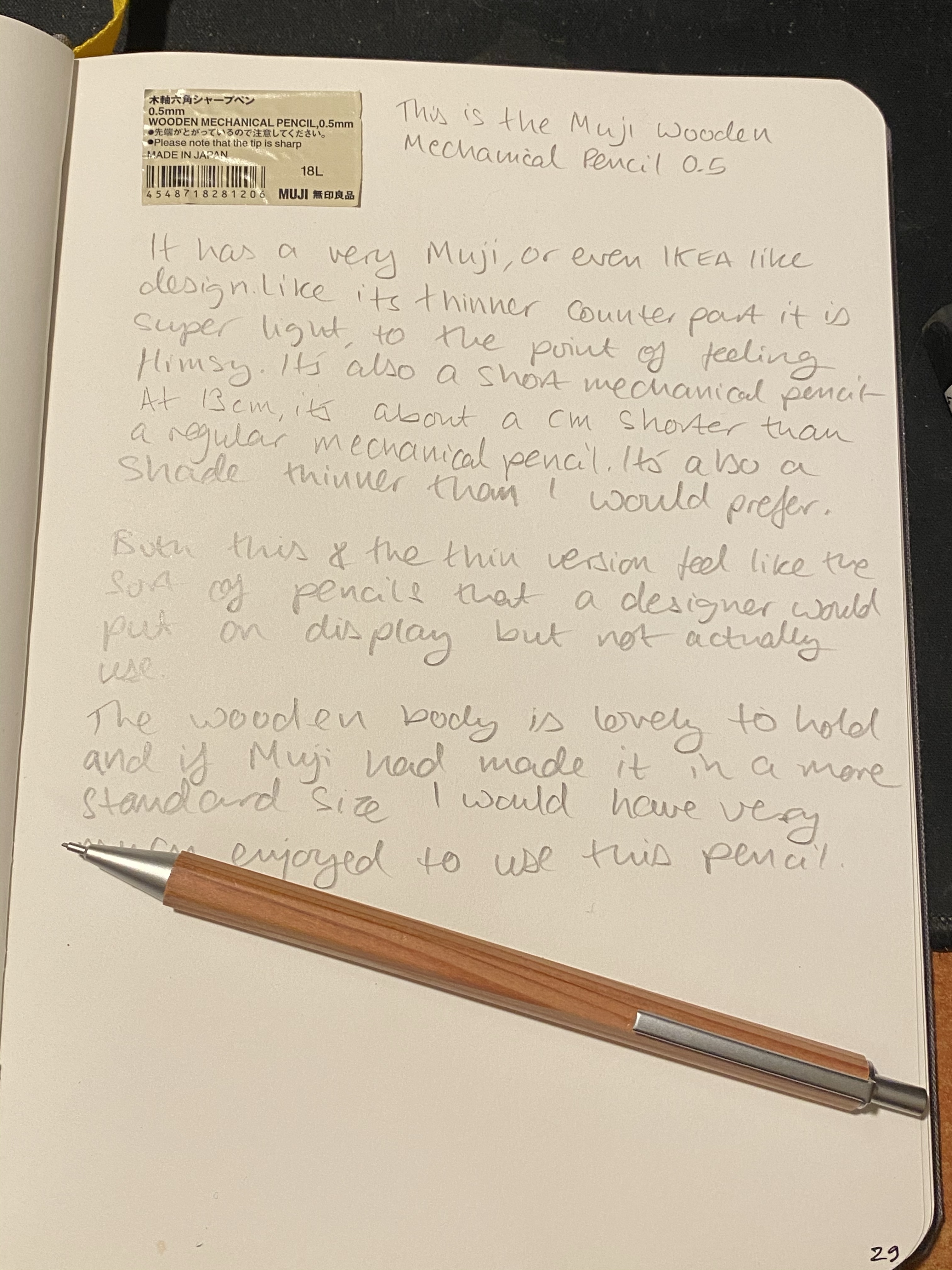
Now we’re back to normal pencil size world, and it’s time to take a look at the Muji Wooden Mechanical Pencil. It’s also a 0.5 pencil, and it has a very Muji/IKEA sort of look to it. It would definitely feel at home in an IKEA ad for a desk.
The wooden barrel is the highlight of this pencil, and since there aren’t many wooden mechanical pencils around and this was an inexpensive purchase I would recommend splurging for one if you have room on your desk.
I say “on your desk” because while the wooden pencil body is good looking and feels great in the hand, it is uncoated. This means that it will pick up dirt and dings from being carried around in a case, a bag or a pocket. Even on your desk it’s likely to become sullied with use, although I have had luck with using erasers to clean soiled wooden pencil bodies before.
Muji wooden mechanical pencil alongside a Uni-ball M9-552 drafting pencil.
The pencil is slightly shorter than a standard mechanical pencil, and it’s a very light pencil, but it’s absolutely usable, unlike its mini counterpart.
The Muji Wooden Ballpoint Pen is probably the one that I’ll use the most of all the bunch. It’s a 0.5mm needlepoint ballpoint that writes with a really fine, clean line. The refill, like the pen, is completely unbranded, but I’m pretty sure that it’s made by a large manufacturer like Uni-ball or Pentel. The only ballpoint pen that I have that writes remotely like this is the Traveler’s Company ballpoint, and this pen is more comfortable to hold and use.
The design aesthetic is the same as the mechanical pencil, very Muji/IKEA modern and minimalist. Like the mechanical pencil the wooden body makes for a lightweight pen that feels lovely to hold but is liable to easily get dinged and dirty.
The pen is on the thinner and shorter side when compared to other pens, so it isn’t the greatest for longer writing sessions. It is still a great pen for the price, as it’s solidly built with a good click mechanism and no wiggle in the tip or rattling while you write. Of the three I’d recommend this the most, as a general pen to keep in handy for those times that call for a ballpoint.
I’m drawing a lot of maps and schematics lately for a D&D game that I’m running so I’m using a slew of mechanical pencils for the occasion. Here’s the normal sized Muji wooden mechanical pencil at work on a Baron Fig Confidant:
The 5th of July is apparently mechanical pencil day, which is something that Cult Pens started most likely out of promotional reasons. I’m all for celebrating what ever little things we have because life in general and mine in particular sucks pretty badly now, so I’m jumping on the bandwagon and posting two mechanical pencil reviews.
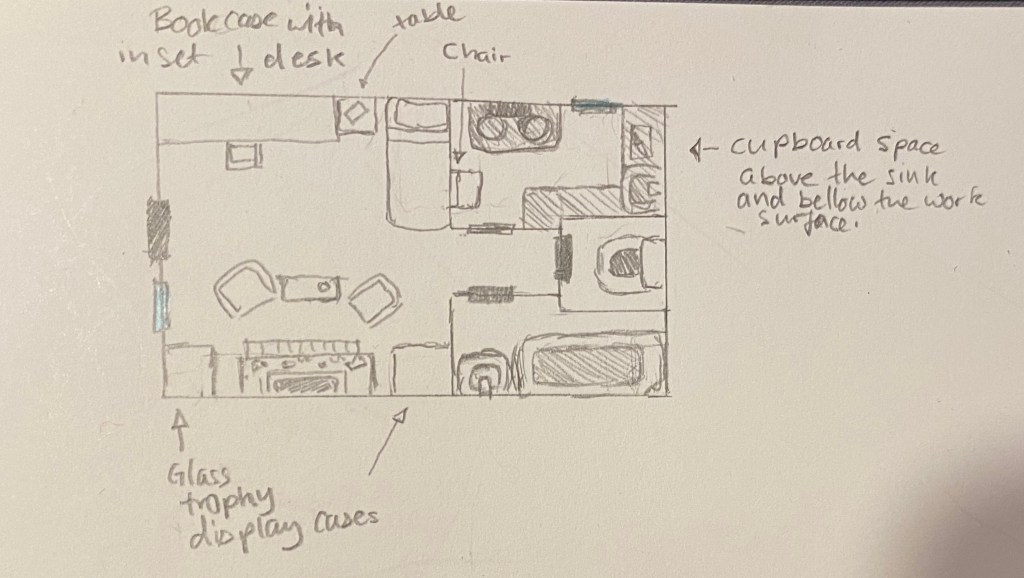
I mostly use mechanical pencils to sketch maps and plans.
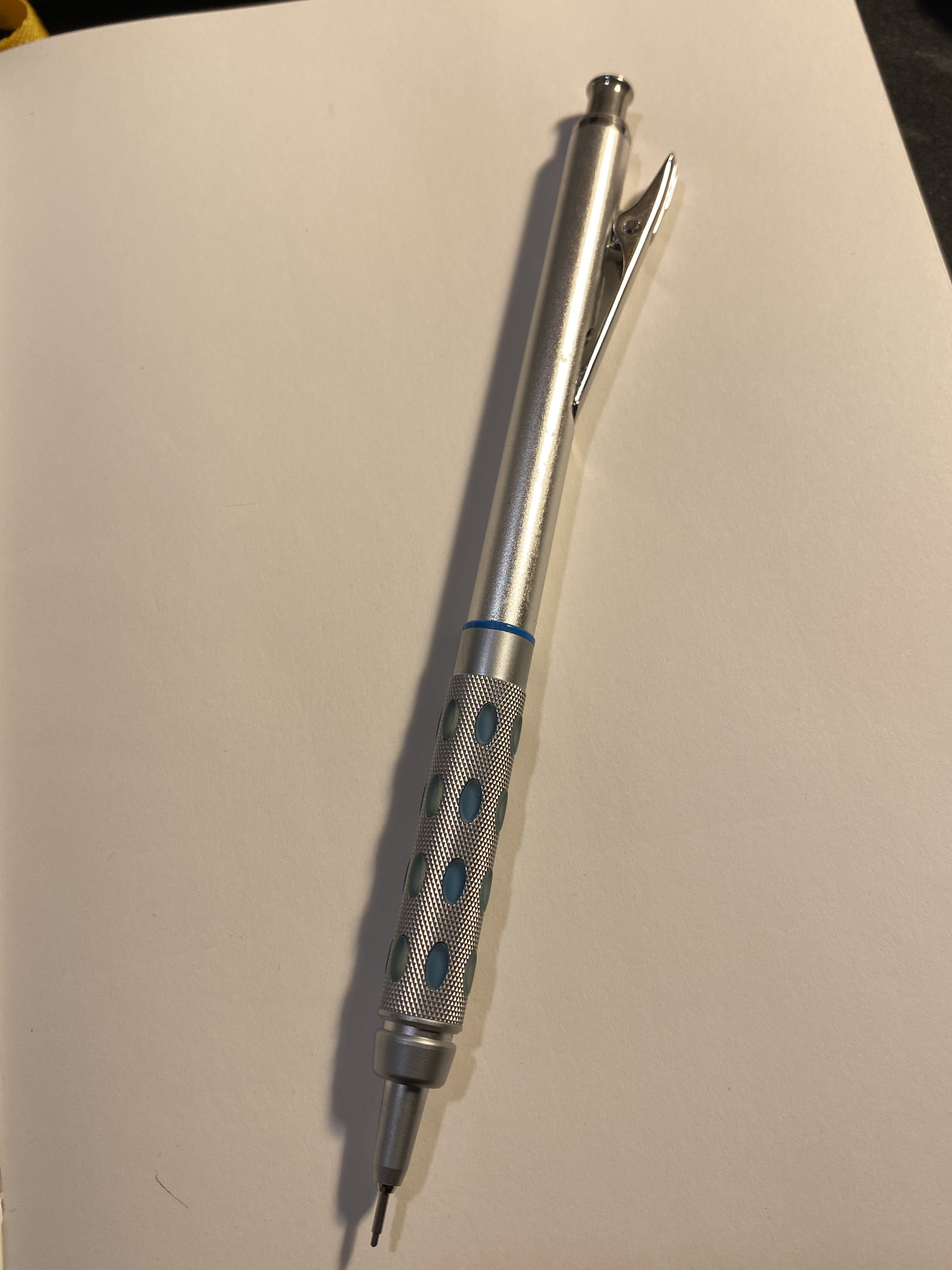
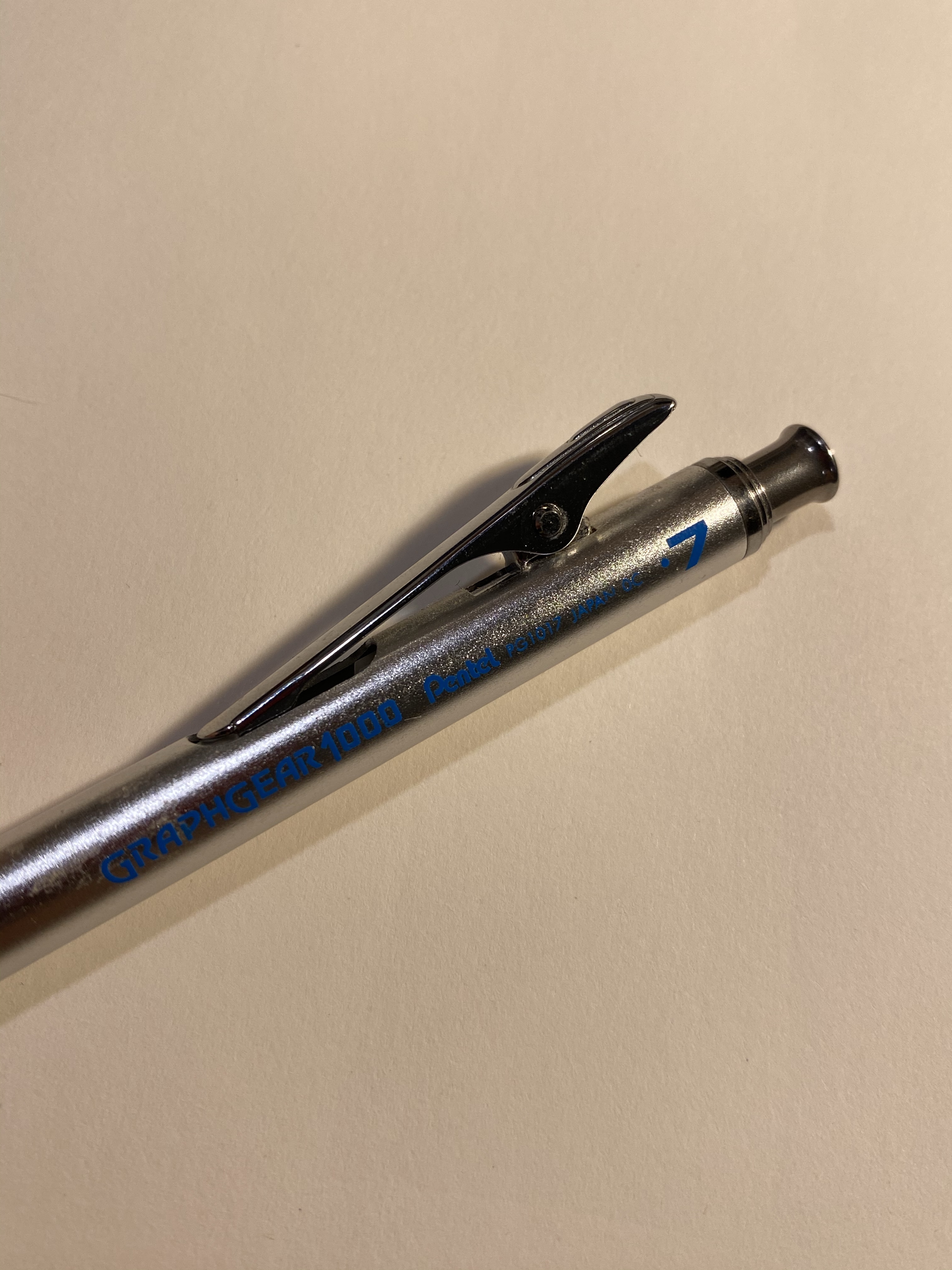
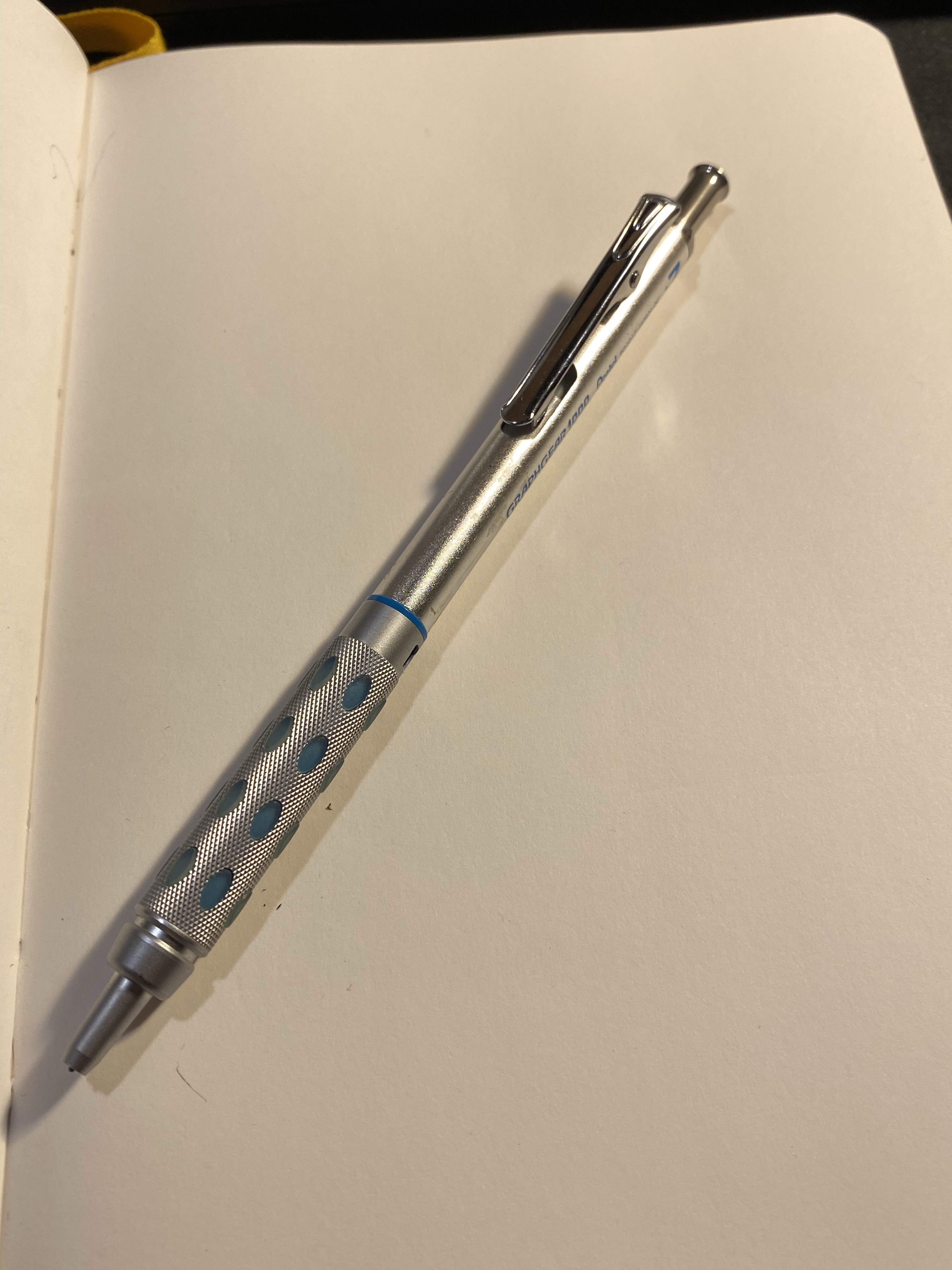
The first mechanical pencil is actually a drafting pencil, and it’s the excellent Pentel Graphgear 1000. I actually enjoy writing with the Graphgear more than I enjoy writing with my Rotring 600 and 800 (gasp!).
Pentel Grapgear 1000.
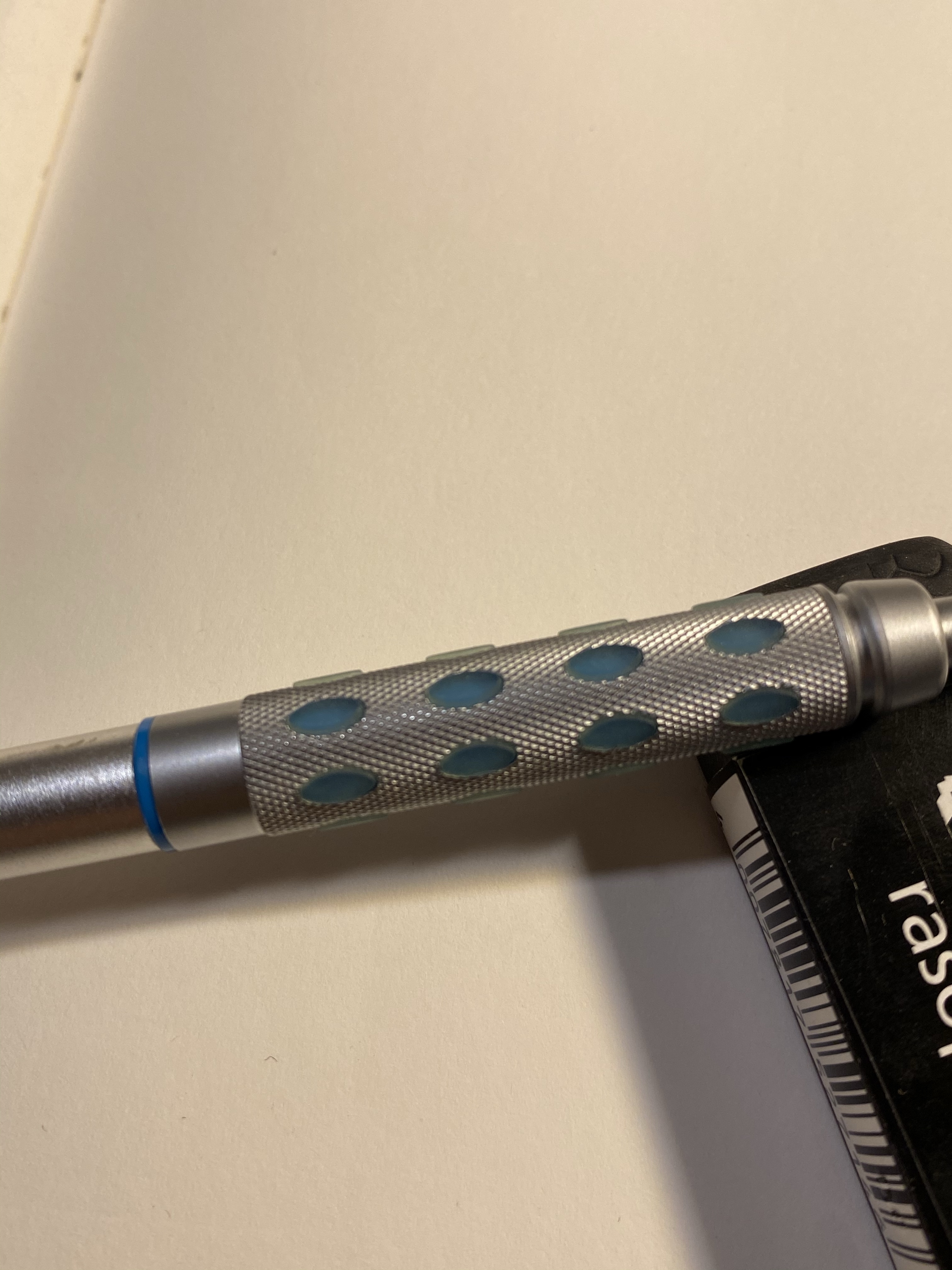
The Graphgear is lighter than my Rotring pencils, its knurling is less harsh on the fingers particularly because of the (non-latex) pads it sports, and the retracting mechanism means business.
It also helps that this is a well designed pencil, a beautiful writing tool to use, and whoever thought of creating different colour schemes for different lead sizes and incorporating that colour subtly over the pencils should get an employee of the month prize at the very least.
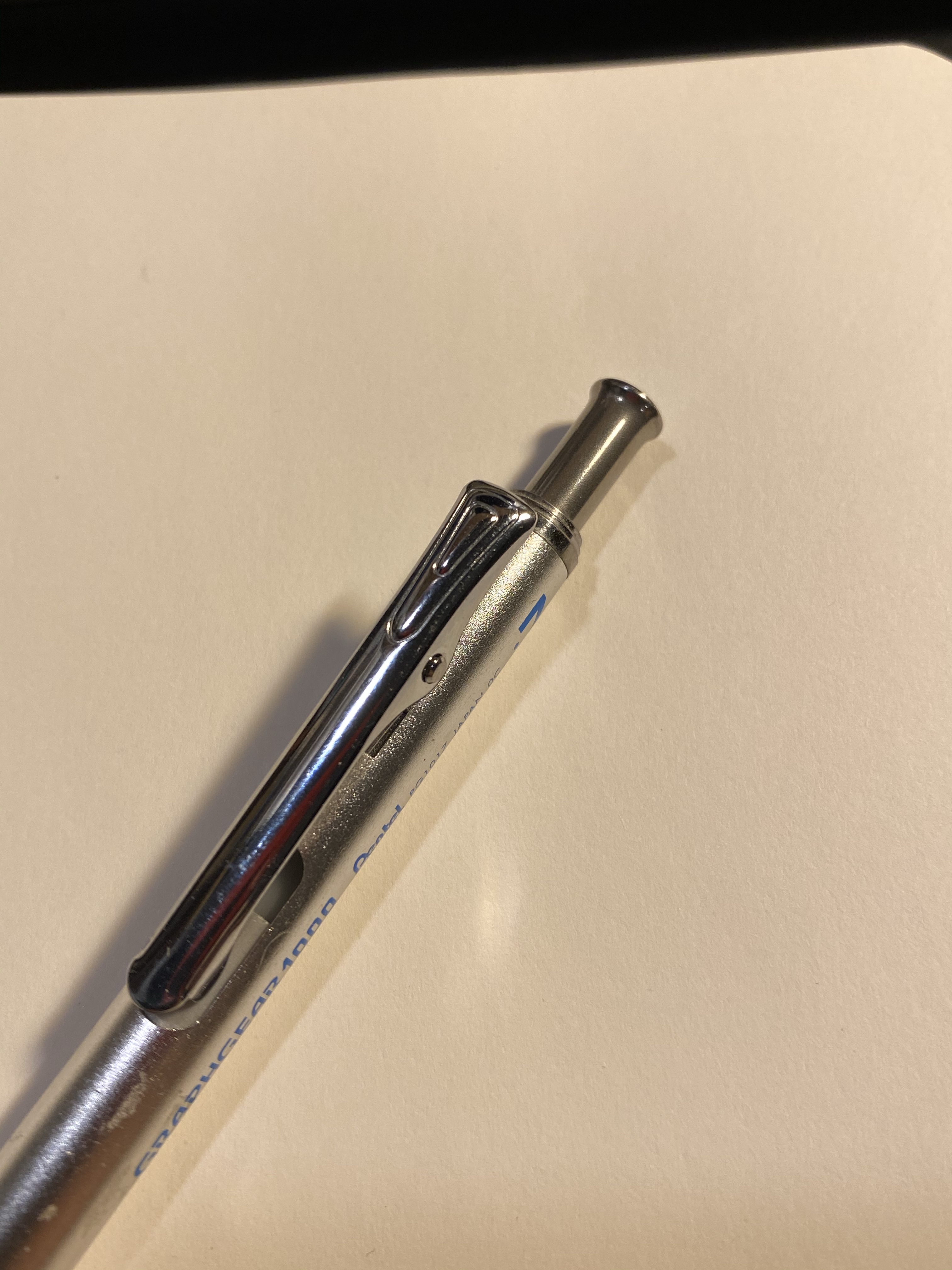
The clip. This thing will stay where you put it.
The retracting mechanism for the Graphgear sits in the clip, and works beautifully and makes the most satisfying “chunk” sound in the world. It retracts the pencil tip into the pencil body, ensuring that the lead doesn’t break and you don’t get stabbed while carrying your pencil around. This is a must-have feature for drafting pencils (together with the knurled grip, lead pipe, and lead hardness indicator), and it is done to perfection here. The only minus is the cutout below the clip that tends to collect pocket lint while being carried.
Look at that sleek design!
A click on the pencil cap extracts the lead sleeve once it has been retracted, and you press on the clip to retract the lead pipe, which is something that you’d do anyway to clip the Graphgear to you pocket, so this is a very intuitive pencil to use.
The design on the clip isn’t necessary, but it is beautiful.
The grip is superb: the Graphgear won’t accidentally slip from your hand, and the knurling won’t dig into either, even if you have a “grip of death”.
Closeup on the grip and pads.
The tip of the pen cap has a lead size indicator, in this case 0.7, and right above the grip you’ll find a lead grade indicator.
The Pentel Graphgear 1000 isn’t a cheap mechanical pencil, but if you are looking for a drafting pencil to use for long periods of time, or you’re looking for a mechanical pencil that’s a cut above (except for the Uni-Ball Kuru Toga), I highly recommend this pencil.
Bonus tip: If you’re starting out in watercolour on location or urban sketching, get a pencil like the Pentel Graphgear in 0.5 or 0.7 and some H leads and use that for your preliminary sketches. Even if you don’t erase them, they’ll disappear behind the washes.
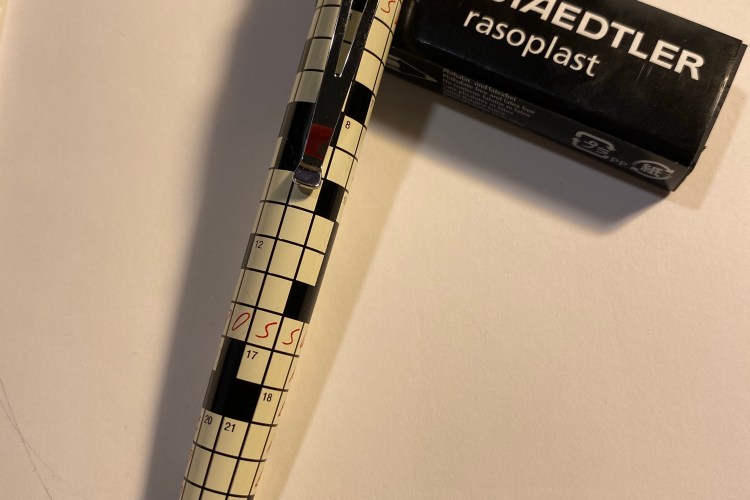
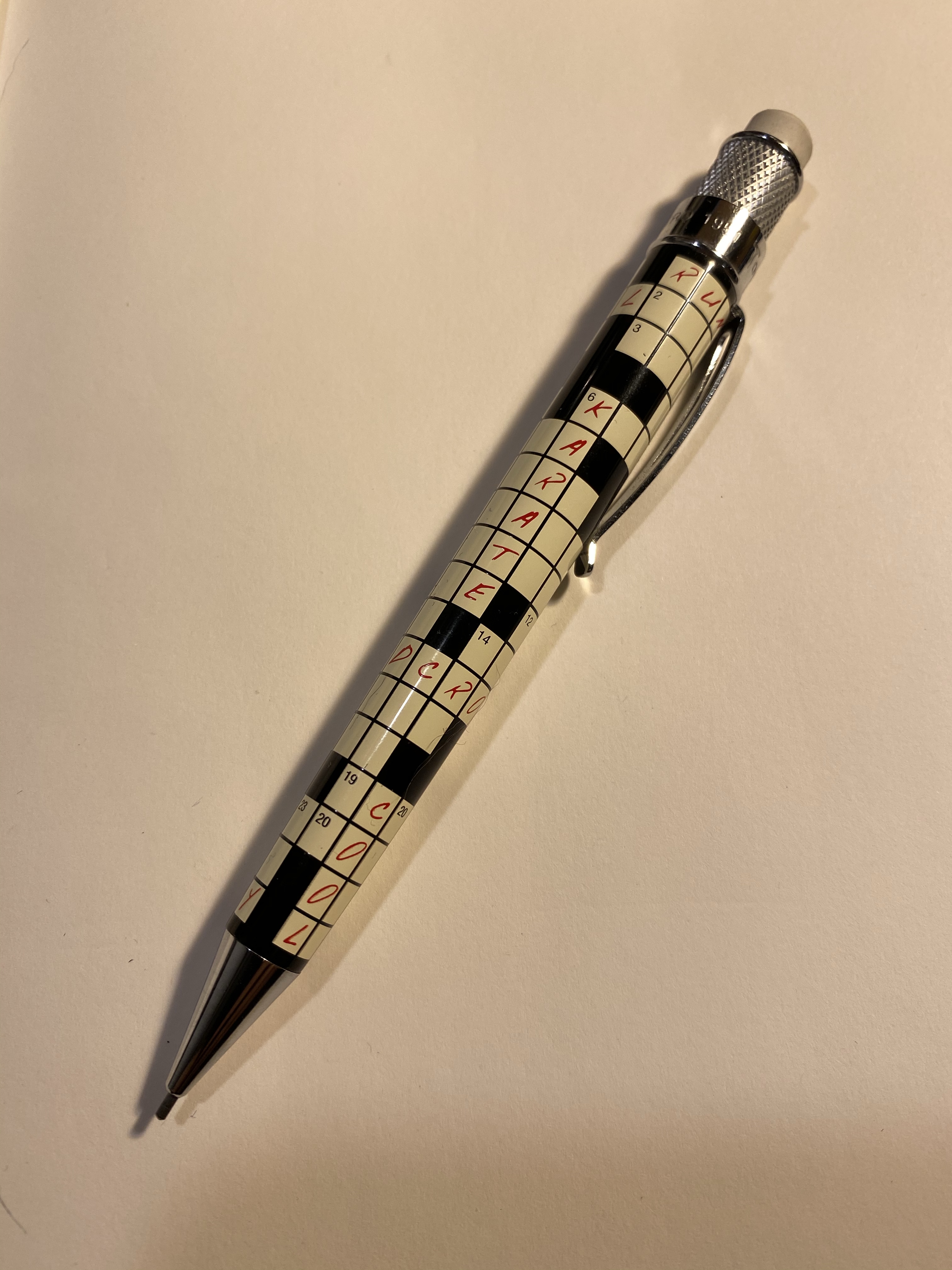
Now for the second mechanical pencil, which is also a unique beast: the Retro 51 Tornado Pencil.
The Retro 51 Tornado Pencil Crossword
There are two things that are unusual with this mechanical pencil: it uses a 1.15 mm lead, and it’s shaped like a Retro 51 Tornado rollerball. That means that this is a bigger than usual pencil that uses a bigger than usual lead. Is it any good?
It depends. I’d skip using it for drawing or sketching, because at that lead size either go the 2mm lead holder route, or stick to woodcase pencils. It is, however, a fun object to have around, and it’s pretty nifty for sudoku and crosswords. The lead size is perfect for that, creating a pretty bold line even on sub-par paper while still giving your the option to erase it.
Have a delightful mechanical pencil day, and when in doubt, Kuru Toga.
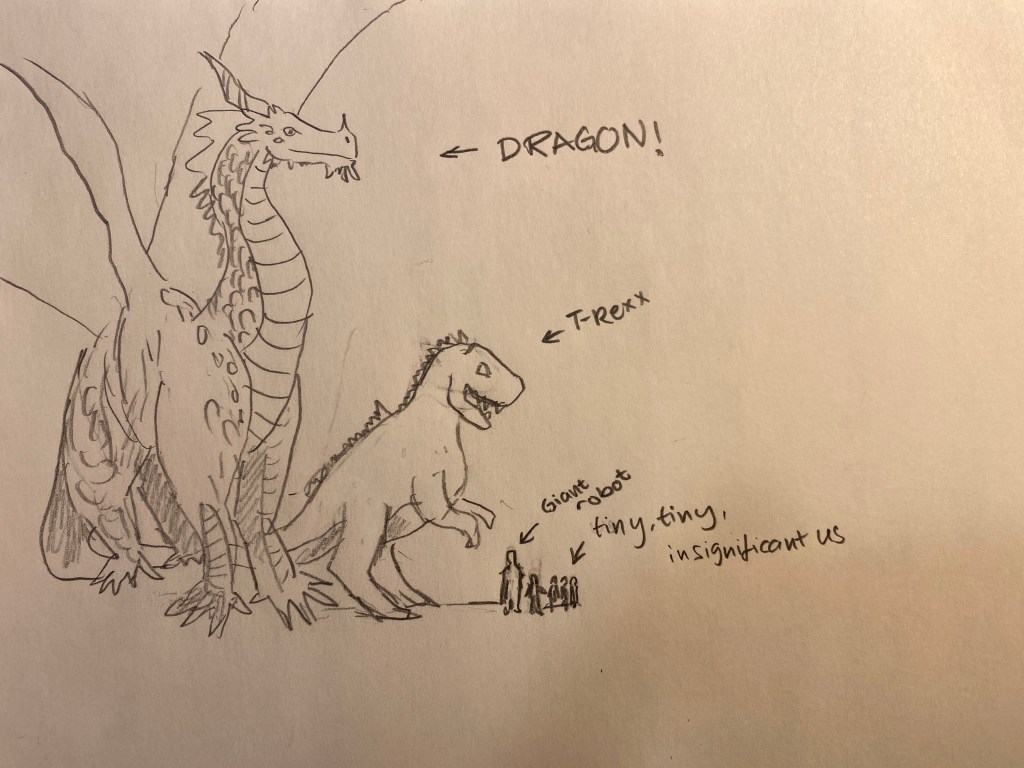
Our D&D group found itself next to a colossal sleeping white dragon, and one of the characters suggested that we could take it on. I grabbed my Blackwing (811) and created a quick illustration of relative sizes to emphasise just how crazy that idea was.
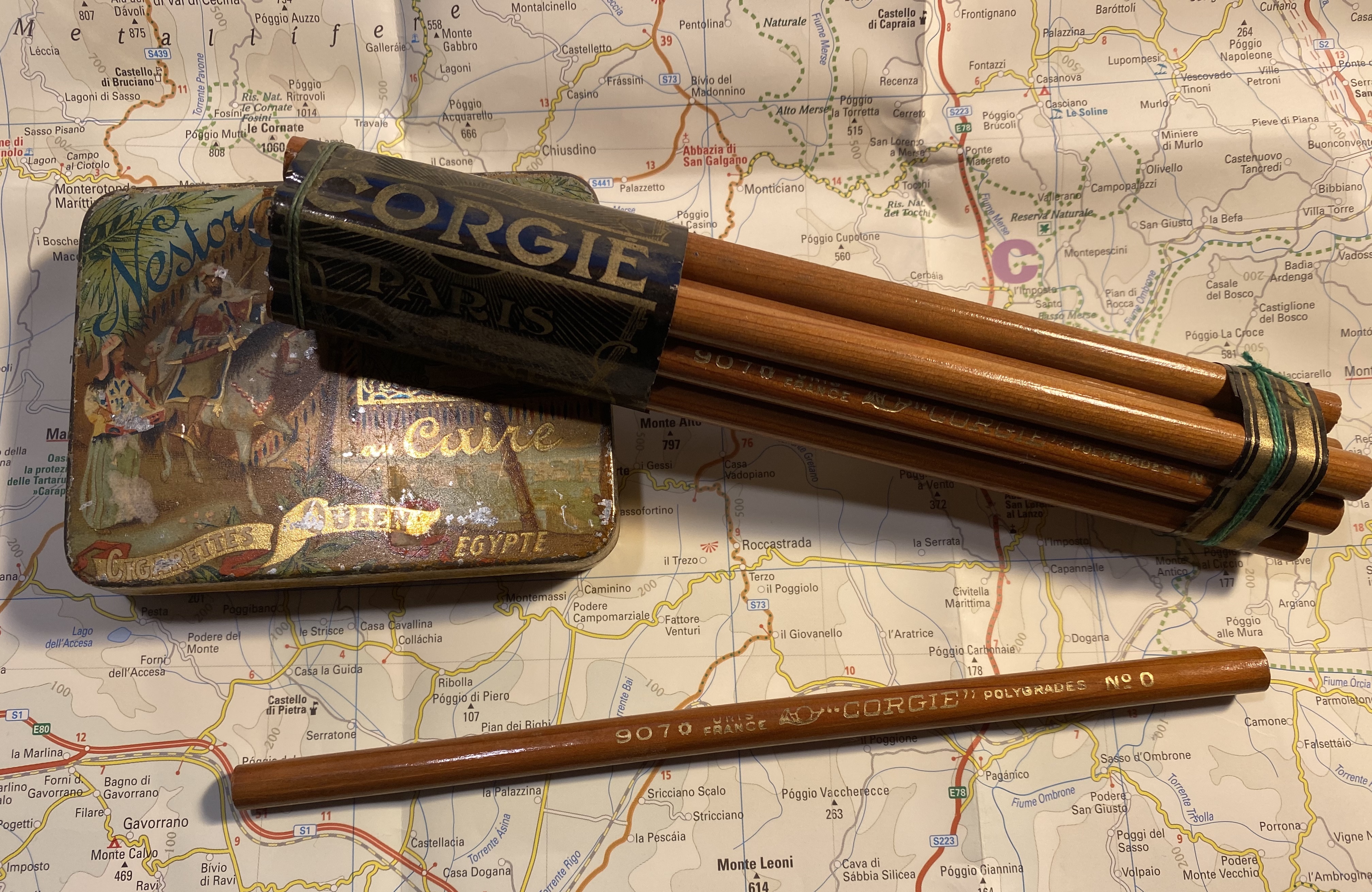
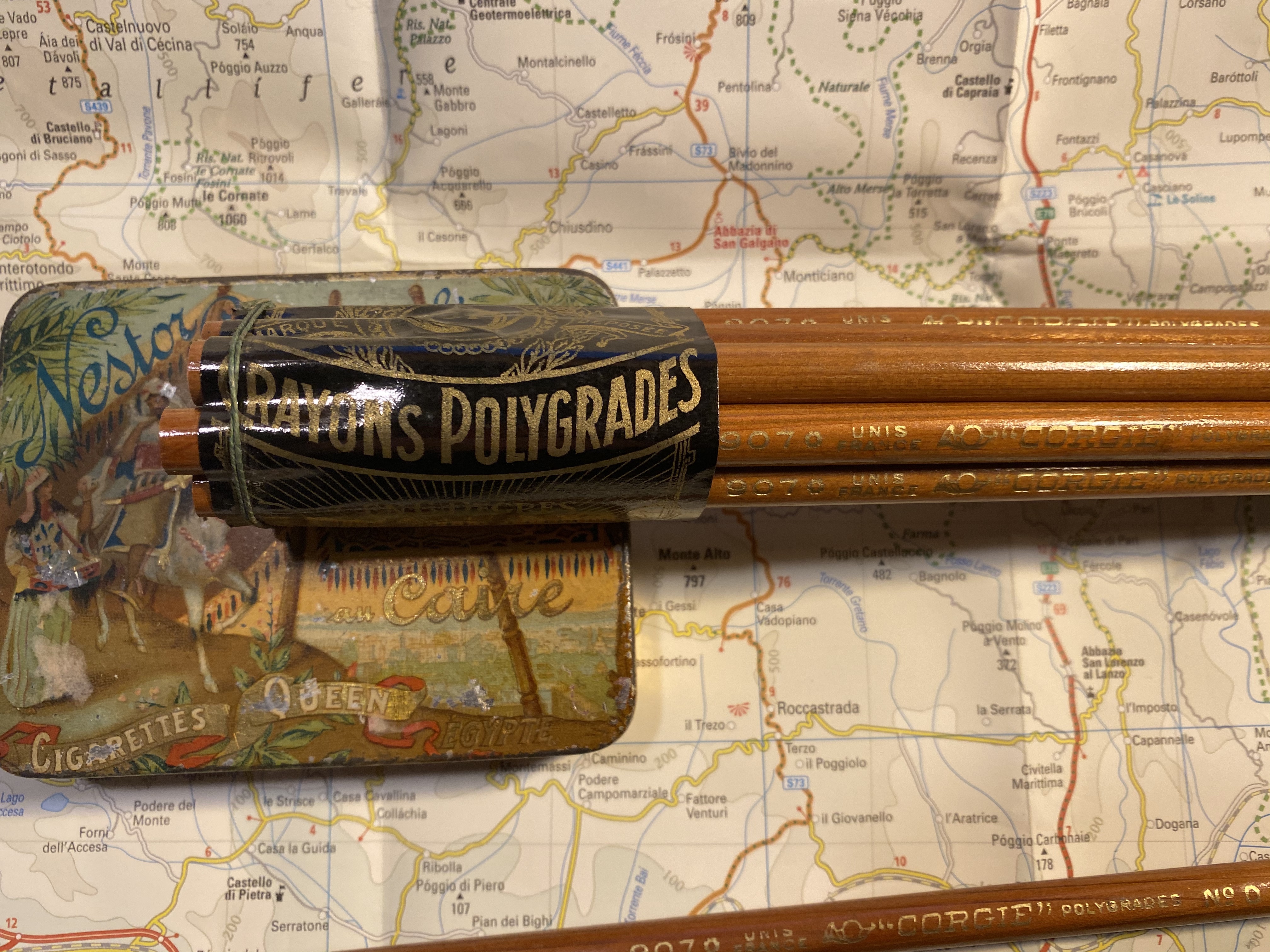
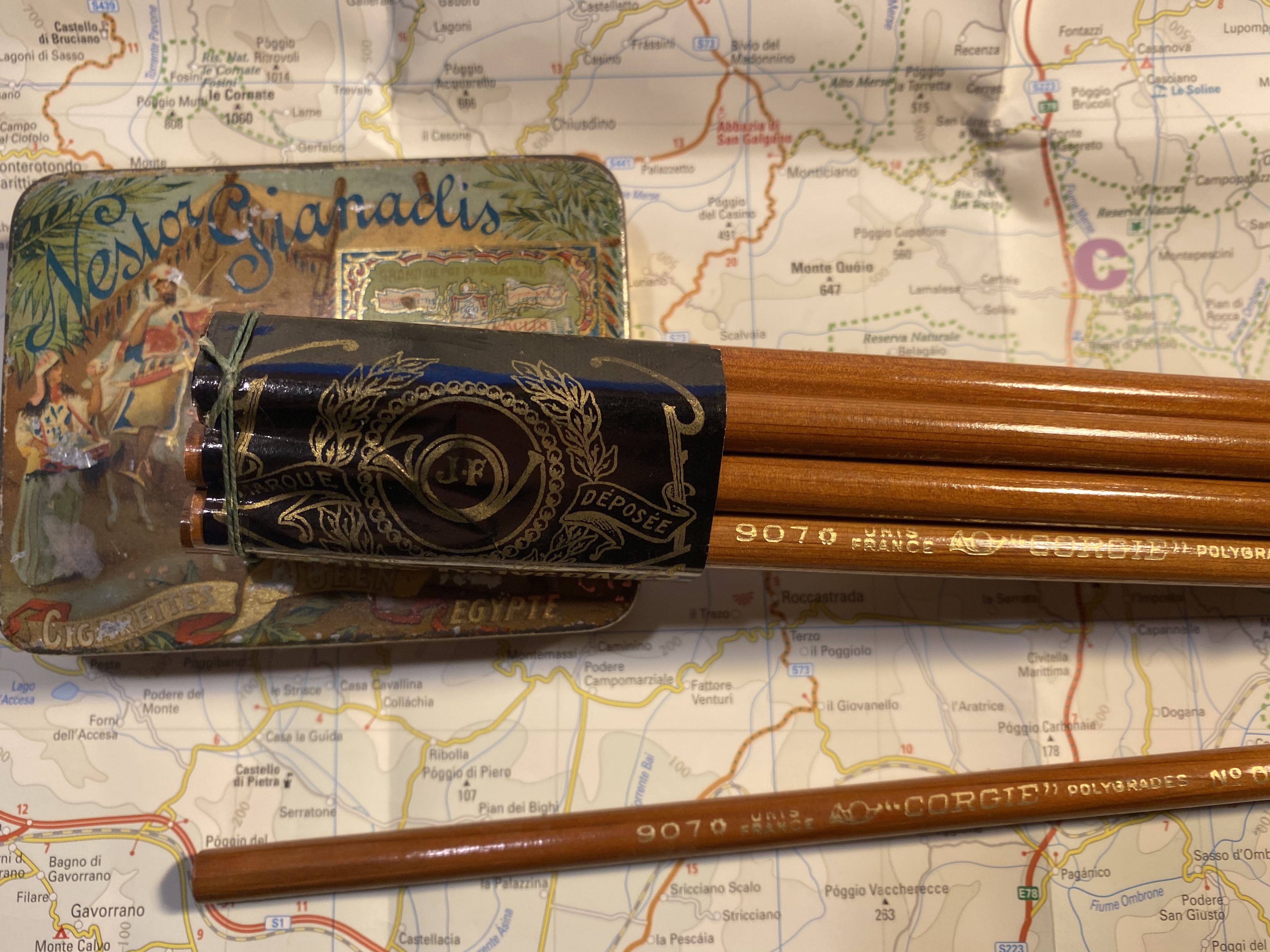
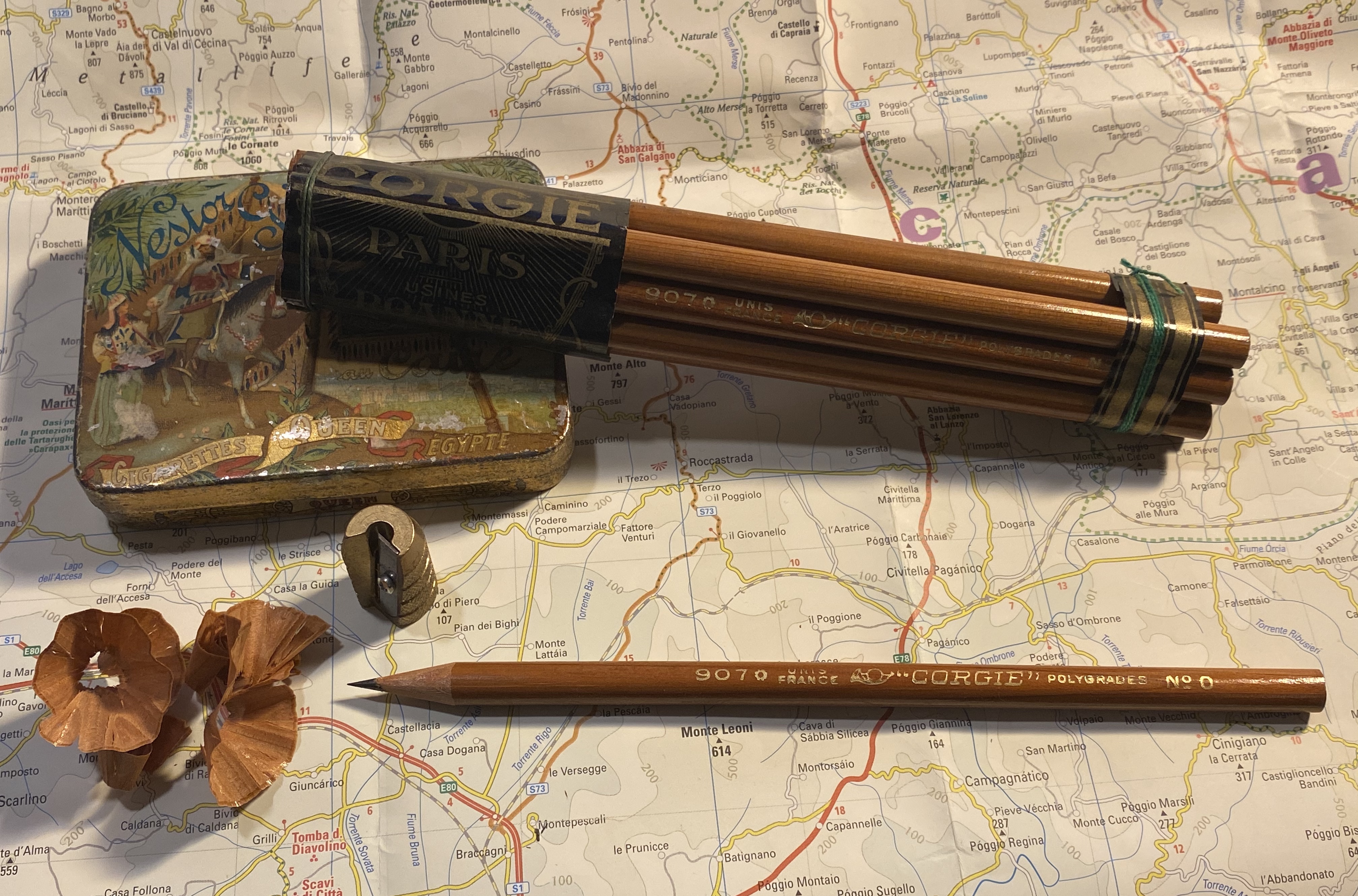
It’s National Pencil Day and I decided to celebrate. Last year I picked up some vintage pencils in a stall in Spitalfields market in London, and they’ve been languishing unloved in their box ever since. The truth is I felt that they were too pretty to sharpen and use, which is both understandable (I mean look at them!) and silly. Pencils are meant to be sharpened, period.
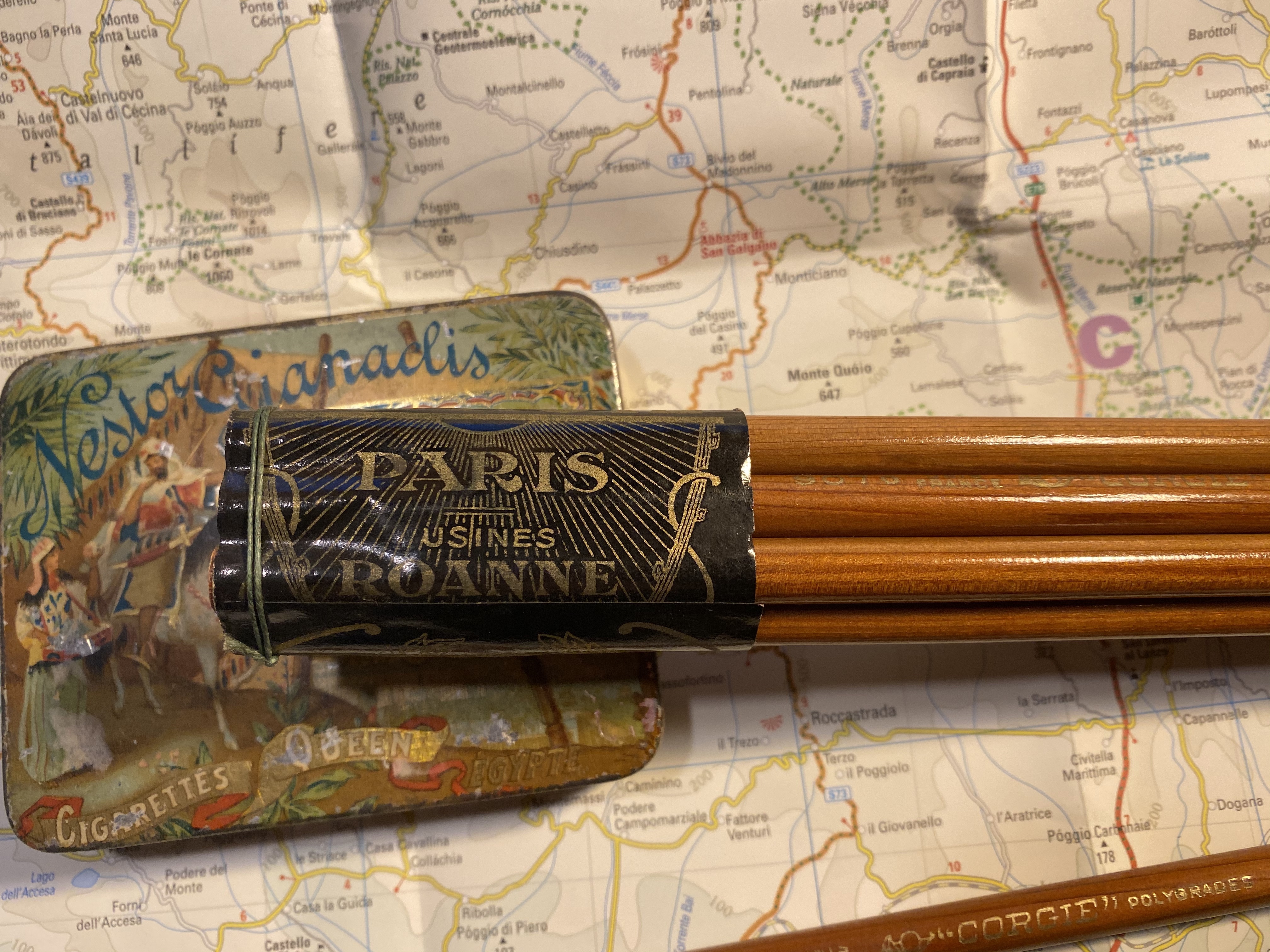
So I broke out the “Corgie” (à Paris) 907 pencils, which are natural pencils coated with a thick layer of lacquer that makes them both shiny and satisfying to hold. The French appear to be more restrained in their choice of imprint fonts, but they go all wild when it comes to the wrappers around the pencils. Behold, creativity let loose:
Stunning, right?
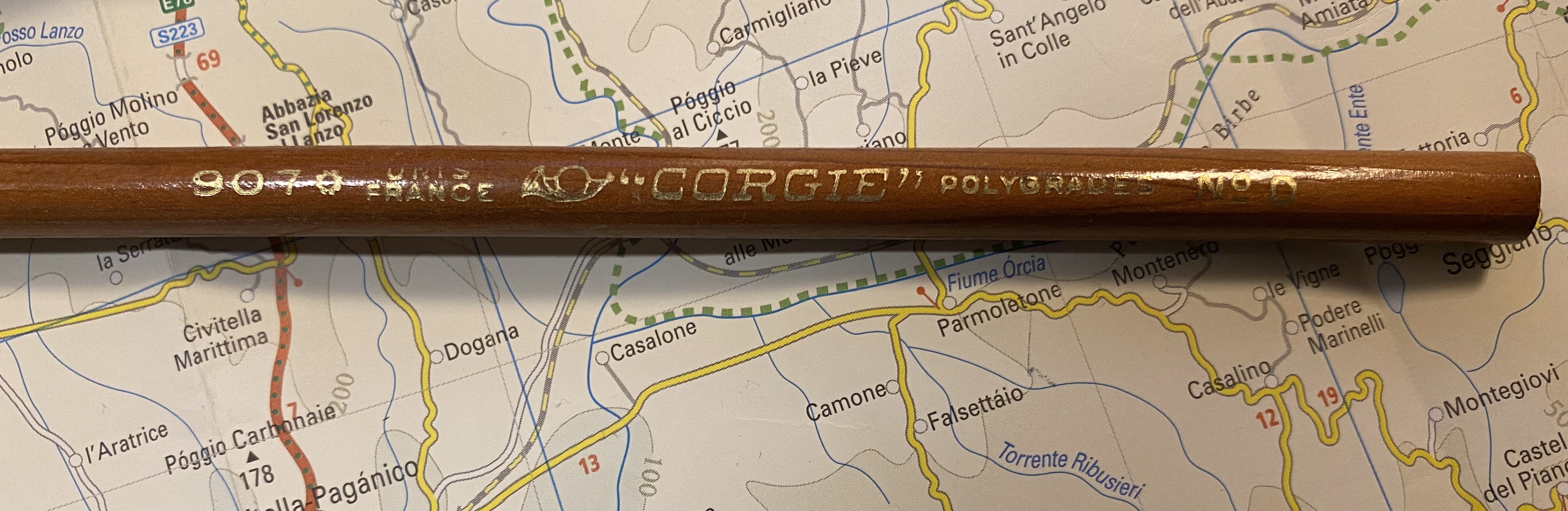
Here’s the imprint (it’s hard to photograph, as the lacquer gets in the way. There are basically two fonts in use, and a very charming bugle logo. The Corgié à Paris factory was active from 1923 to around 1986 (thanks Brand Name Pencils) and if I’d have to venture a guess I think that these are from the ’60s, but it’s really hard to tell.
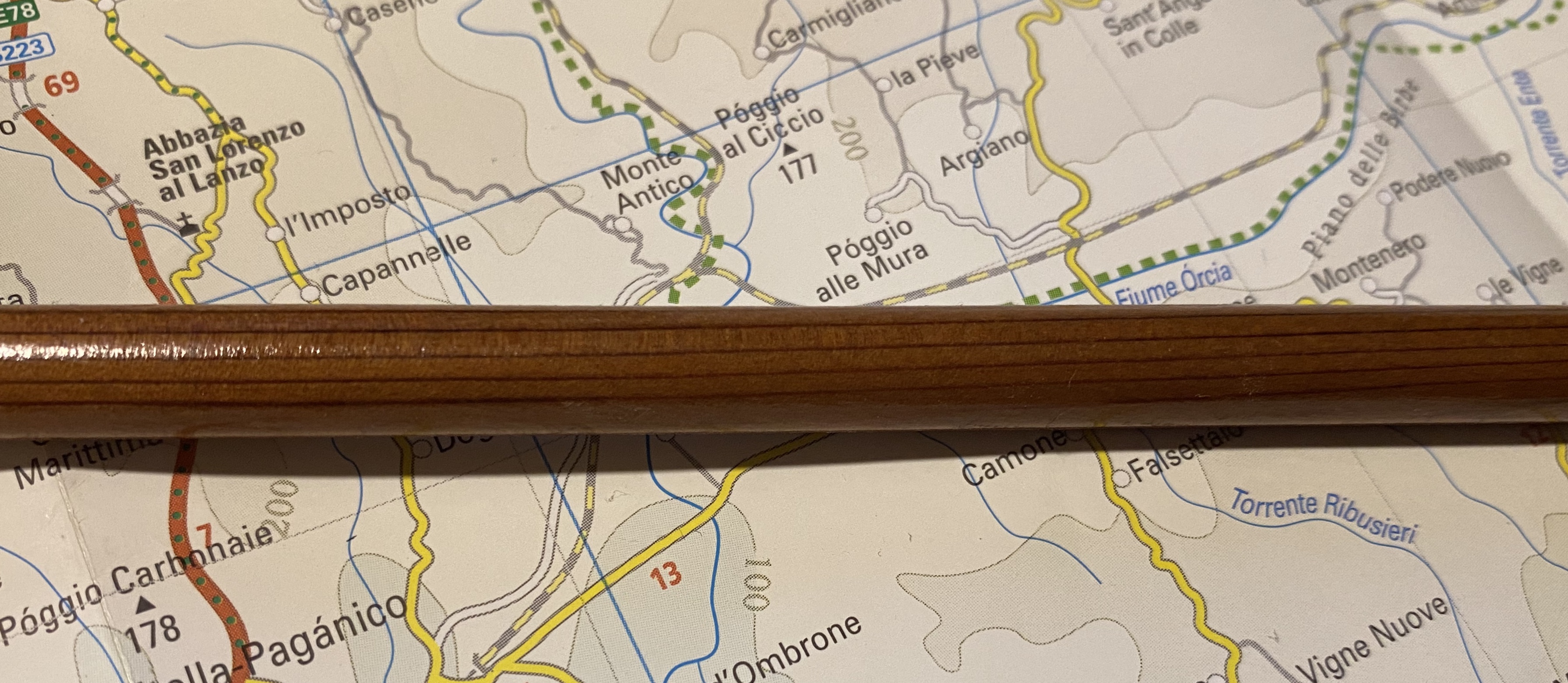
The grain on these pencils is fantastic. Just look at that:
Unlike some vintage pencils whose wood has dried out and become brittle with time, the Corgie 907s sharpen like a charm. They’re not very nice smelling (they just smell old), but there’s nothing to complain too much about.
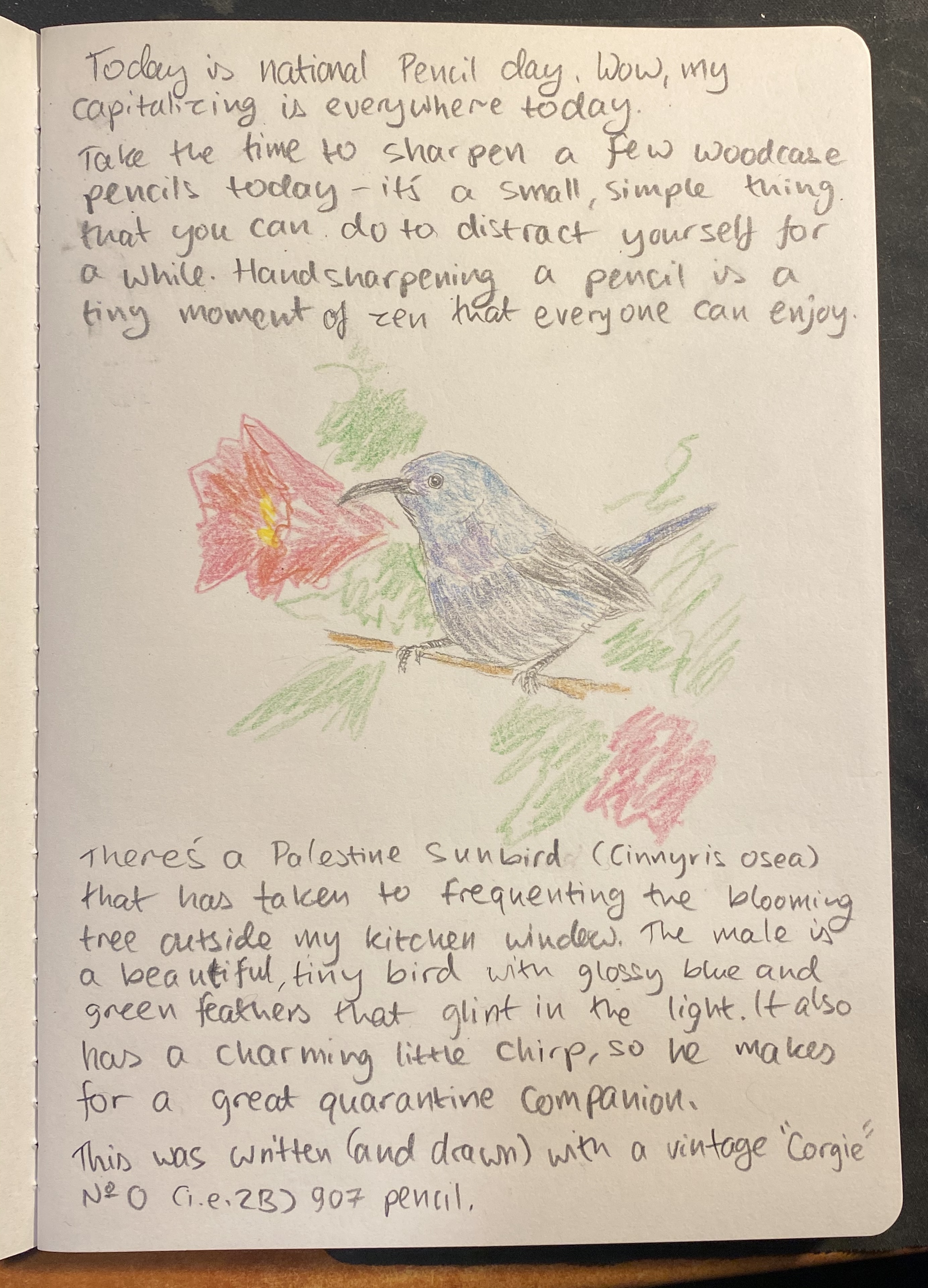
These are No. 0 pencils, which makes them about 2B-4B, depending on the manufacturer. They’re soft and dark, and a joy to draw with, although they don’t hold a tip for very long. The graphite does smudge, but it doesn’t crumble, and there’s a good amount of feedback while using them. Here they are with some Faber-Castell Albrecht Dürer watercolour pencils in use:
I had to sharpen the pencil three times to get through this A5 page. Not great for writing, great for expressive drawing.
Go sharpen a pencil, and have some fun drawing or writing a little something for yourself.
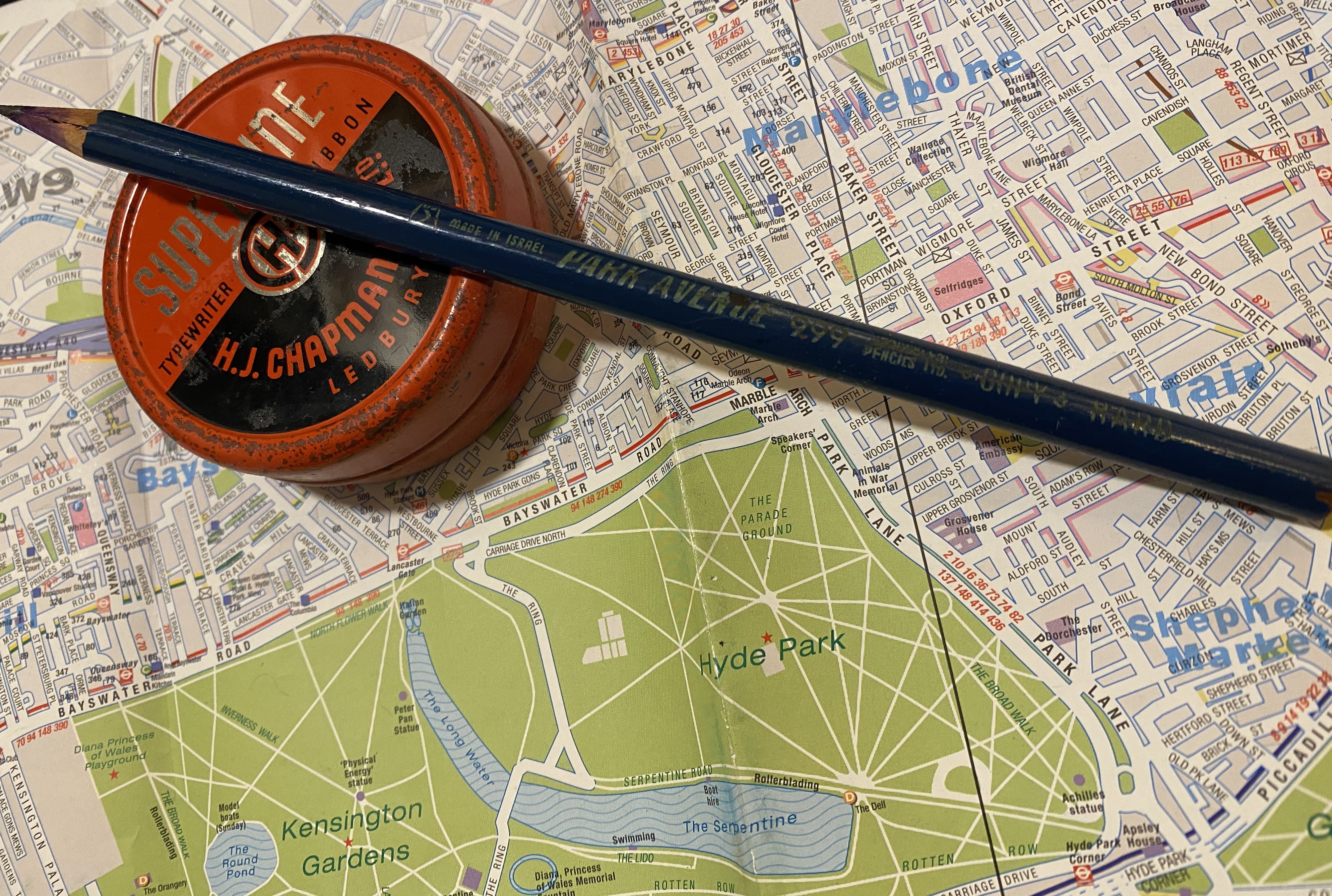
Vintage copy pencils are magic (albeit oftentimes poisonous magic). You take an ordinary looking and behaving pencil and dip it in water and purple, turquoise or blue ink comes out. The Sanford NoBlot is probably the most well known pencil in this category but there were dozens of others made by various pencil companies. The Israeli pencil manufacturer “Jerusalem Pencils” had a copy pencil by the worldly and sophisticated name of “Park Avenue” (very Israel in the ’70s and 80’s). Of the local vintage pencils available in Israel it’s not the easiest pencil to find, although it’s also not the hardest.
Not the prettiest pencil, but not too shabby.
When dry the Park Avenue writes like an F grade pencil, with a bit of a purplish hue. It’s not as hard and light as an H grade pencil, yet it is lighter and harder than an HB. It erases well when dry, and doesn’t smudge.
When wet the pencil lines turn purple, and so much more bold. You can either dip the pencil tip in water, write dry on wet, or for more gentle effects use a wet brush over the dry lines. Just don’t be tempted to lick the pencil tip or chew on it, as there’s a good chance that the lead is poisonous.
The Park Avenue is a deep royal blue pencil with a yellow imprint on it. Apart from the Jerusalem Pencils logo and the 999, I counted four different fonts printed on the barrel of what was meant to be a utilitarian office workhorse. This is in line with many vintage pencils, and this over-design, pride and attention to detail is why I like them so much.
The imprint is worn off but you can still see all the fonts.
Continuing the theme of “vintage pencils are awesome” today I’m using the Eberhard Faber Colorbrite red violet 2154 (which proudly notes that it’s both “woodclinched” and made in the USA). I counted 5 different fonts on this pencil, not including the 2154.
The fonts are my favourite thing on this pencil, although the end cap is elegant too and the colour is really unique and vibrant.
Go have fun with some pencils and listen to the birds for a while. They sing some hope into these dark times.
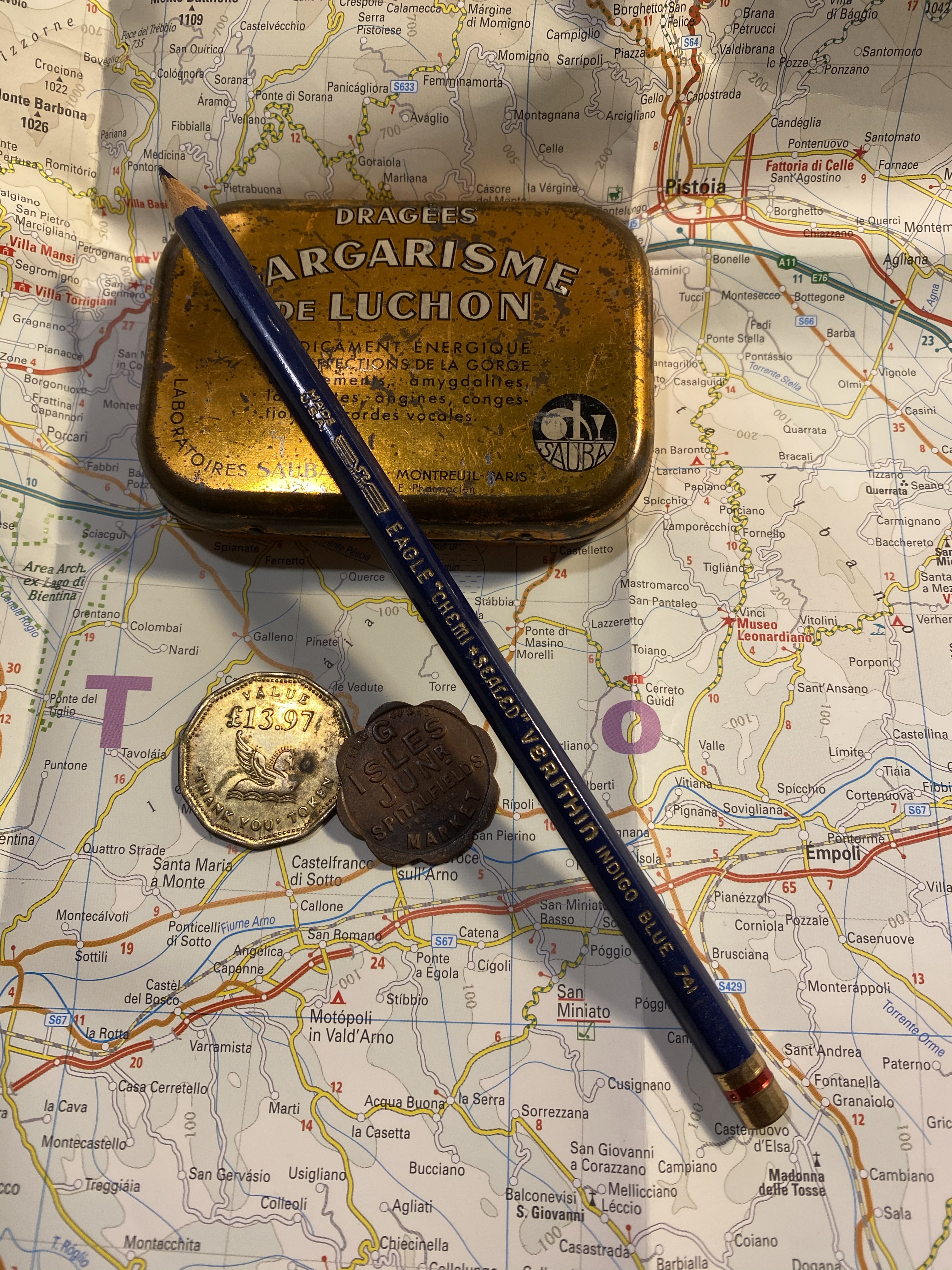
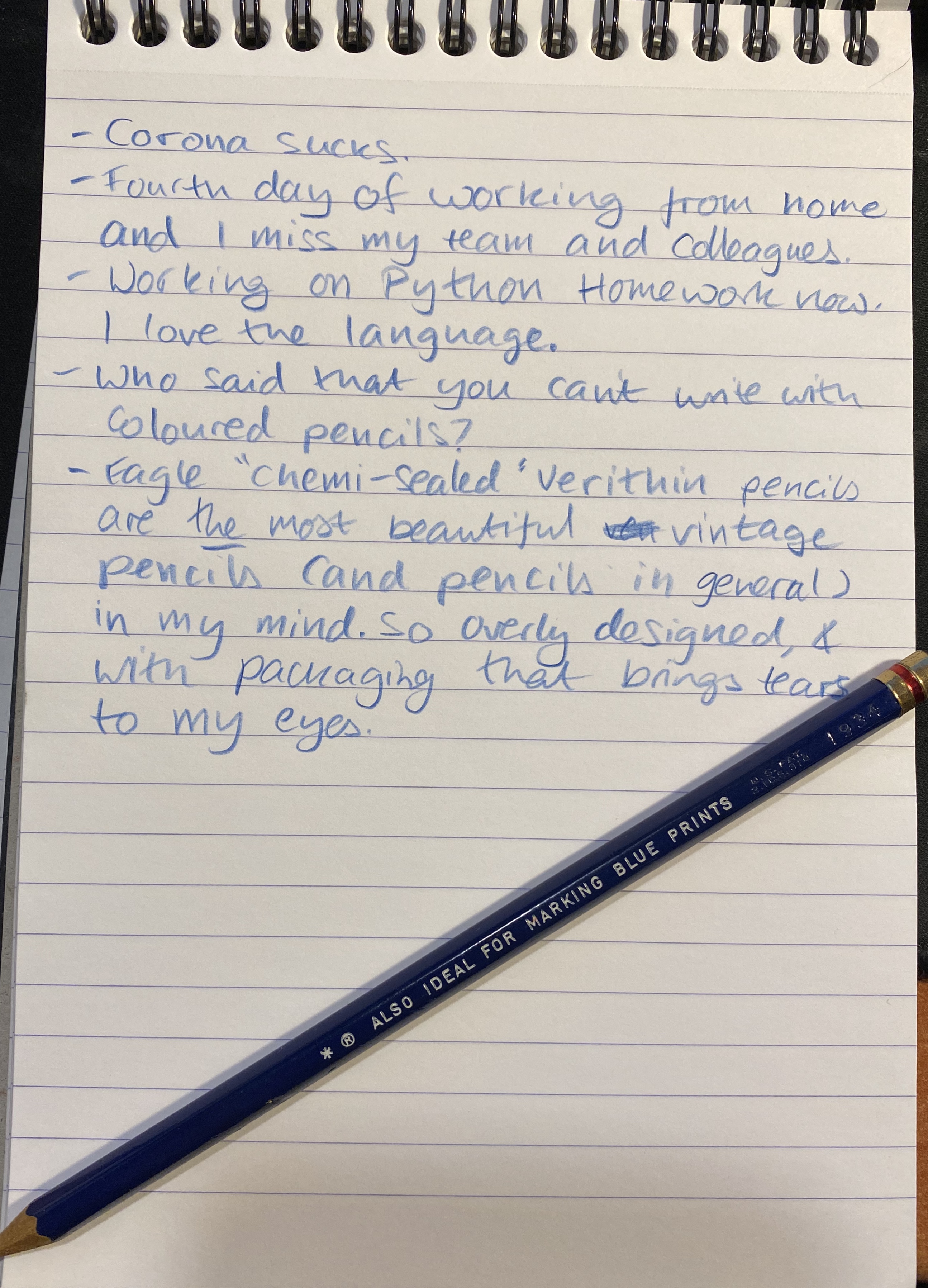
This isn’t a review. It’s just to say that coloured pencils and vintage drafting coloured pencils in particular can be used to “spice up” your everyday notes. Also, vintage pencils are often stunningly beautiful, especially the Eagle ones.
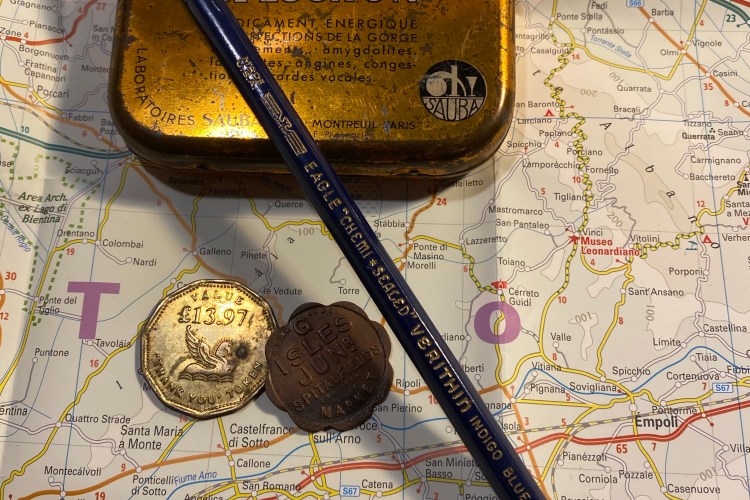
Look at that beauty! The “dragee” box is also vintage, as are the market credit coins, so much more elegant than today’s cards and digital payments (if more unwieldy).
Here’s a writing sample and a quick update for today:
“Also ideal for marking blue prints” indeed. Who doesn’t need one of those?
After I reviewed the Waterman Phileas I noticed that I have hardly reviewed the writing/drawing tools that I use most. So I making it a point to start to rectify that, at least a little bit.
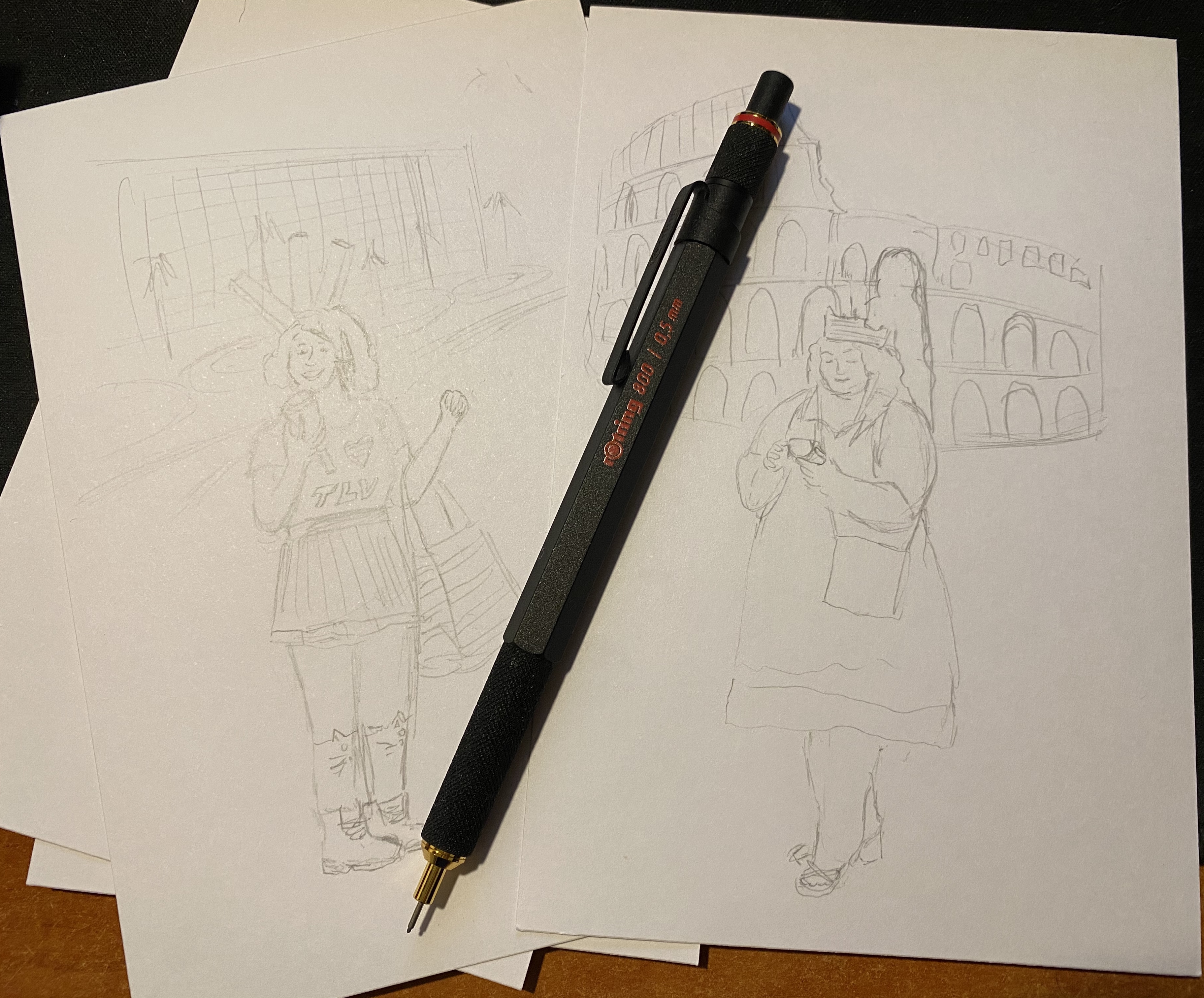
The Rotring 800 is Rotring’s high end drafting pencil, and it costs significantly more than its popular counterpart, the Rotring 600. It’s also my preferred drafting pencil, and the one pencil that’s a constant in my drawing kit. While I own the Rotring 600, and I agree that it’s a very good drafting pencil, I’ve abandoned it entirely for it’s more big brother, the Rotring 800.
This is a handsome, elegant drafting pencil.
The Rotring 600 and 800 are both full metal (brass) bodied drafting pencils. This means that they were built for drafting (architectural plans) and sketching, not so much for writing. You can use a drafting pencil for writing, but they’re not built for that (that’s what mechanical pencils are for). Drafting pencils are metal bodied with a knurled grip, a lead grade indicator, and a sleeve that both protects the lead and allows you to more easily use it with rulers and templates, and to get a better view of what you’re drawing.
Herein we get to the problem: both the Rotring 600 and the Rotring 800 are almost perfect drafting pencils. Each one has a significant flaw, which means that you have to decide when purchasing what are you willing to live without.
Retractable tip
I think that the Rotring 800 is a slightly more good looking drafting pencil than the Rotring 600, and it weighs more than the 800. That’s nice, but that’s not “$20 more” nice. The reason to buy the Rotring 800 is the retractable tip. That’s it. The Rotring 600’s non-retractable, sharp-yet-delicate tip makes carrying it around an issue. It can bend and it can do damage – piercing through case fabric, clothes, and I wouldn’t carry it in my pocket (ouch!).
Retractable tip extended. The tip allows for precision work, and prevents the lead from breaking.
I carry my Rotring 800 in a Nock Co Sinclair, together with the rest of my sketching kit, and I really needed the retractable tip. For that I had to pay extra, and I also had to give up on a crucial drafting pencil feature that the Rotring 600 has and the Rotring 800 doesn’t have: the lead grade indicator. This is a basic feature of drafting pencils, and I have no idea why Rotring didn’t add it here. It doesn’t bother me too much as I don’t switch lead grades that often, but it’s still a baffling choice on Rotring’s part.
I love the texture on the pen grip and the pen itself: it’s beautiful and functional at the same time. This is a pencil that will not budge from your hands as you’re working with it. Also, the added weight of the retractable mechanism means that it’s perfectly balanced and you need to apply zero pressure on the lead.
There’s an eraser beneath this cap. I wouldn’t use it.
The Rotring 800 is a handsome, heavy and expensive drafting pencil. If you’re just getting to know drafting pencils the Pentel Graph Gear 1000 is what I’d recommend (it’s cheaper, lighter, has a great design, more tip sizes, and a lead indicator), as it really works as an excellent mechanical pencil as well as a drafting pencil. The Rotring is what I use because it aggravates my RSI least (YMMV),the added weight lets me work faster and yet retain control over my line, and I really needed the retractable tip (I ruined a Rotring 600’s tip). If you’re wondering whether to purchase a Rotring 800 (or 600) I highly recommend testing it out first, especially if you have small hands or have a “non-standard” way of holding a pencil, since you may find its weight uncomfortable.
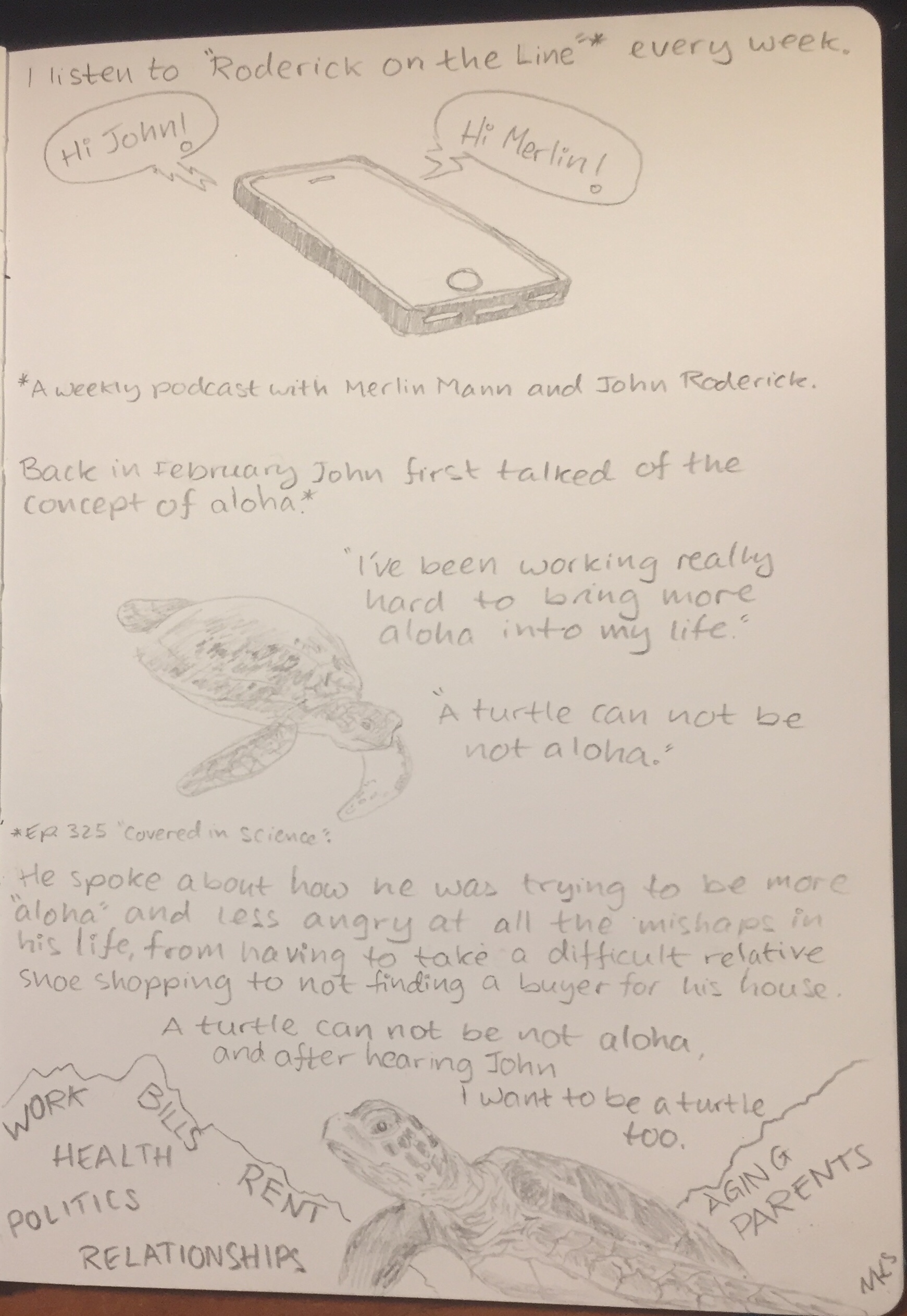
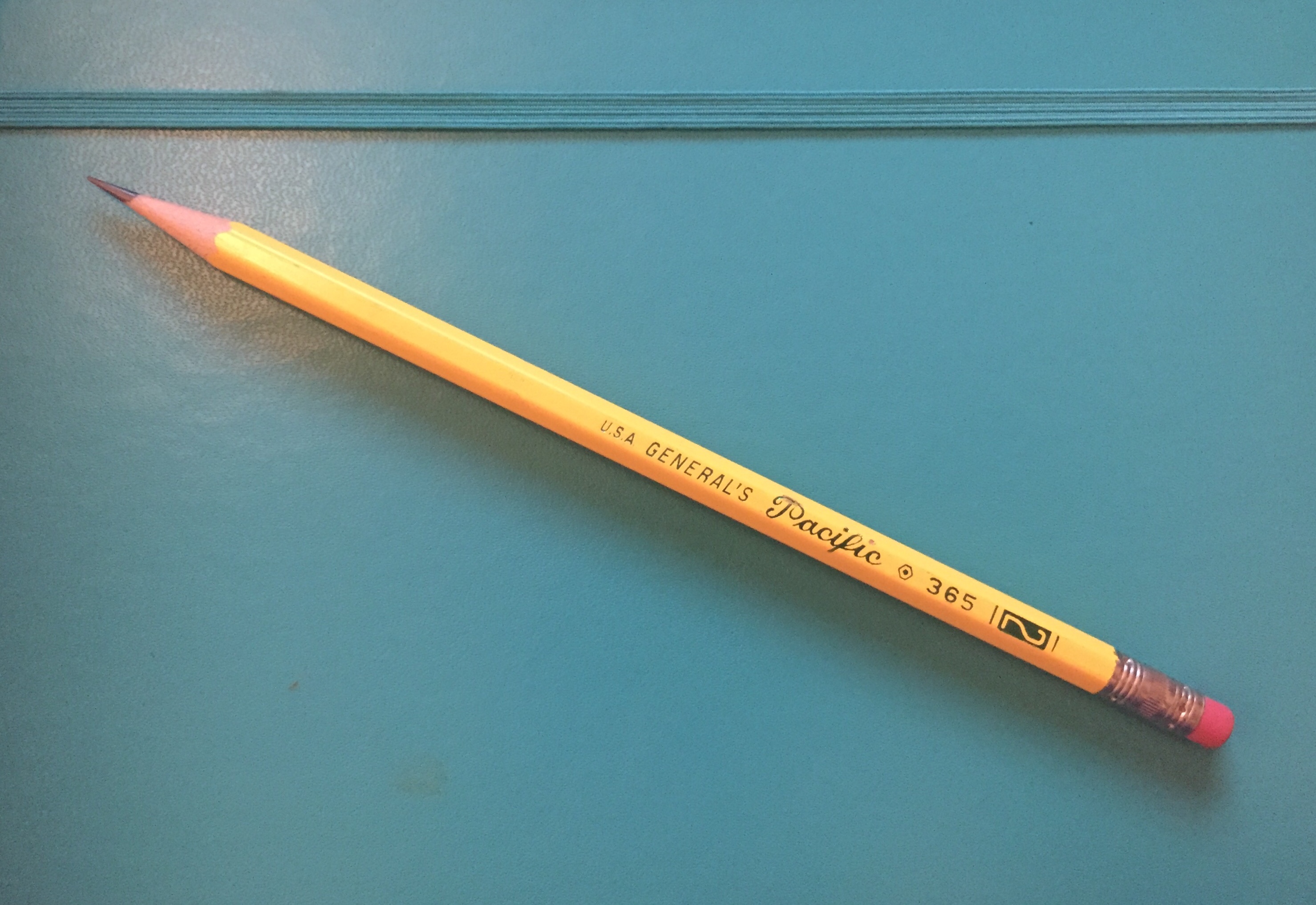
I have too many pencils which I don’t take the time to use. Inspired by this episode of the Pen Addict podcast I decided to literally do a random draw: I randomly drew a pencil from the pile, and then I randomly drew something with it. Today’s pencil: the General’s Pacific 365 #2.
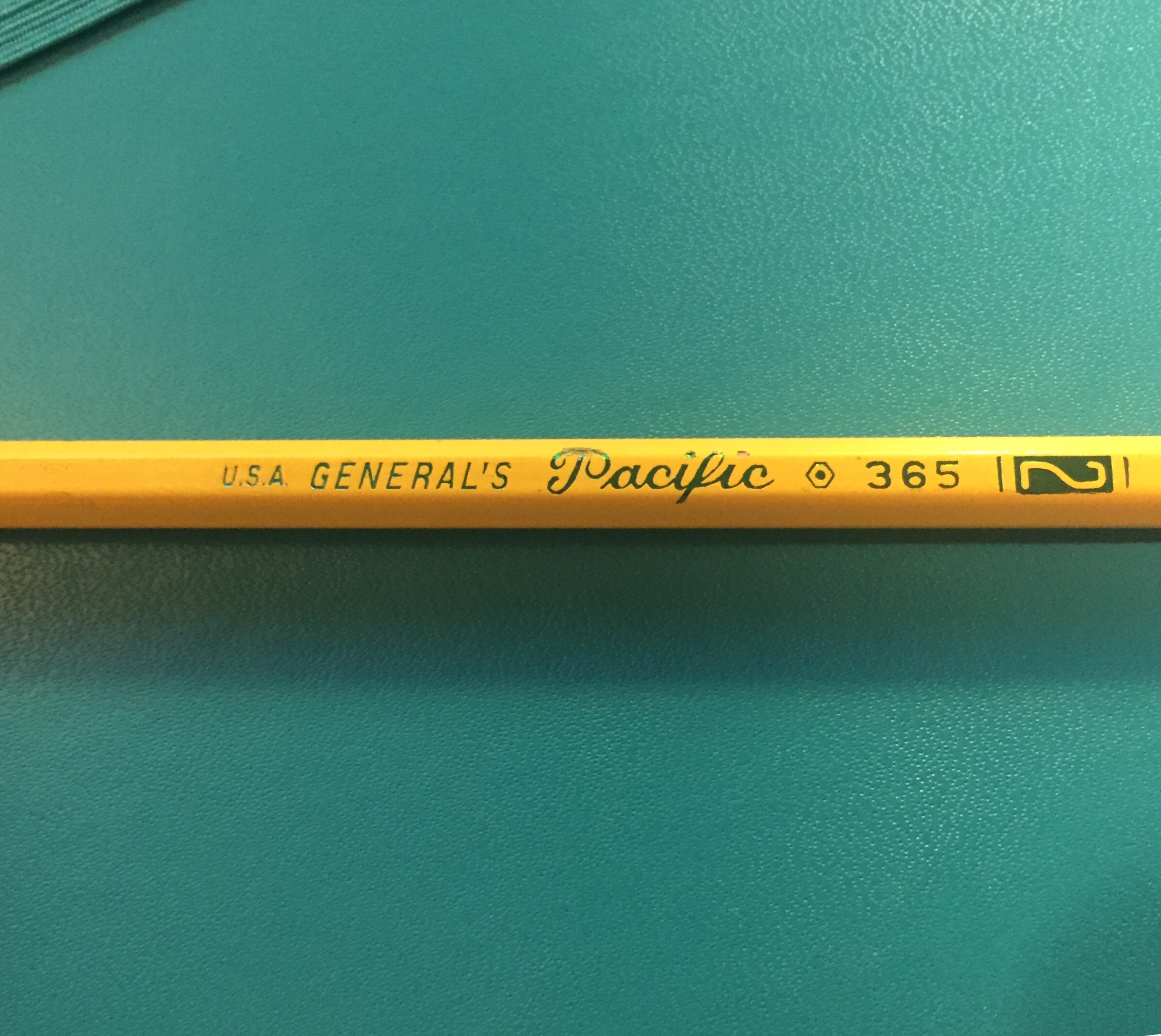
It’s a classic looking #2 (or HB) pencil, with for some reason three or four fonts on the barrel, depending how you count the numerals. It’s made in the USA, out of California incense cedar, and has a little red thing on the top that looks like an eraser, but trust me, I wouldn’t try to use it as one.
Why so many fonts?
The green foil imprint quality is not great, with the “Pacific” imprint chipping the pencil’s coating. The coating itself is pretty thinly layered, but the core is perfectly centred and sharpens like a charm.
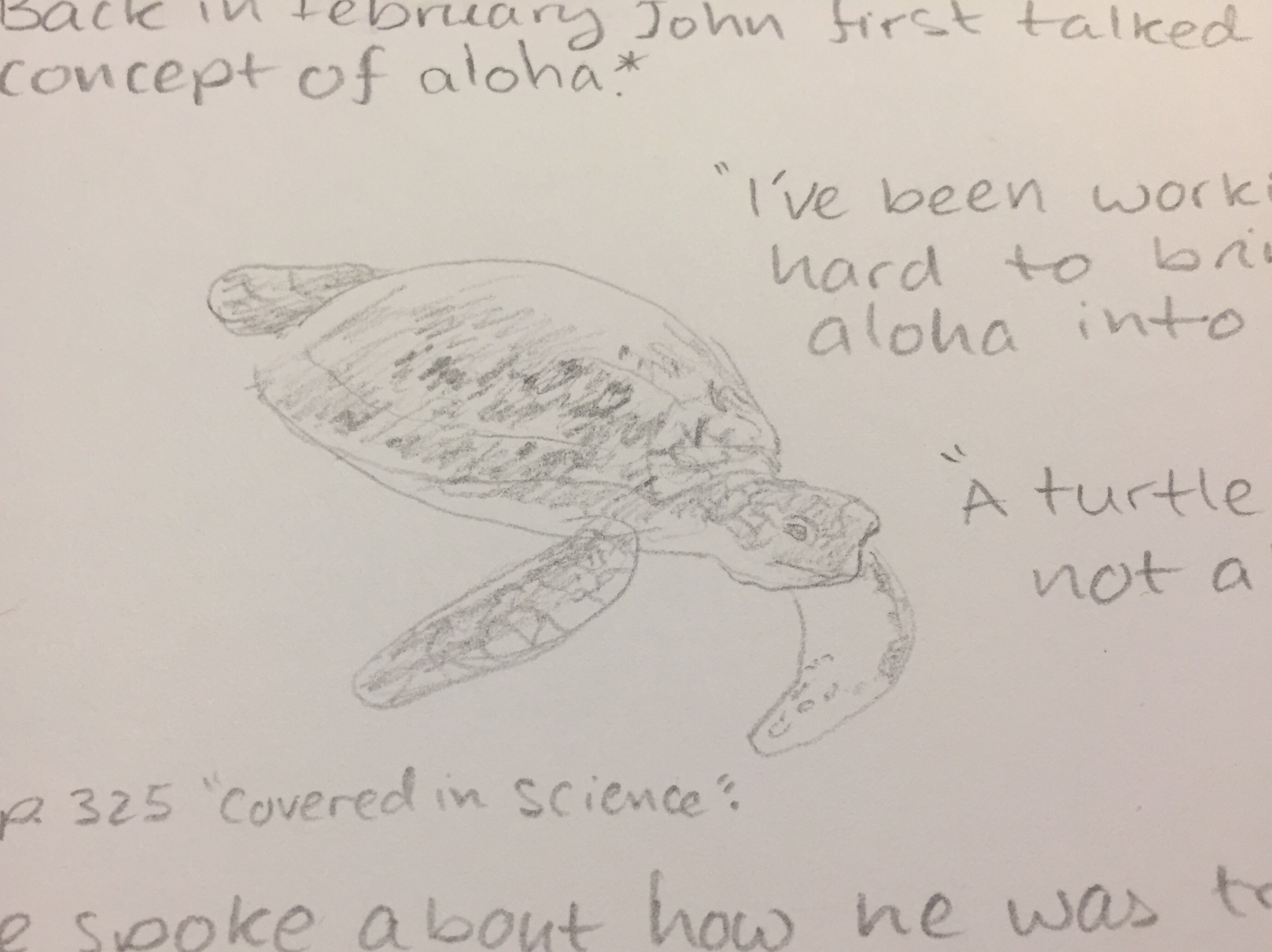
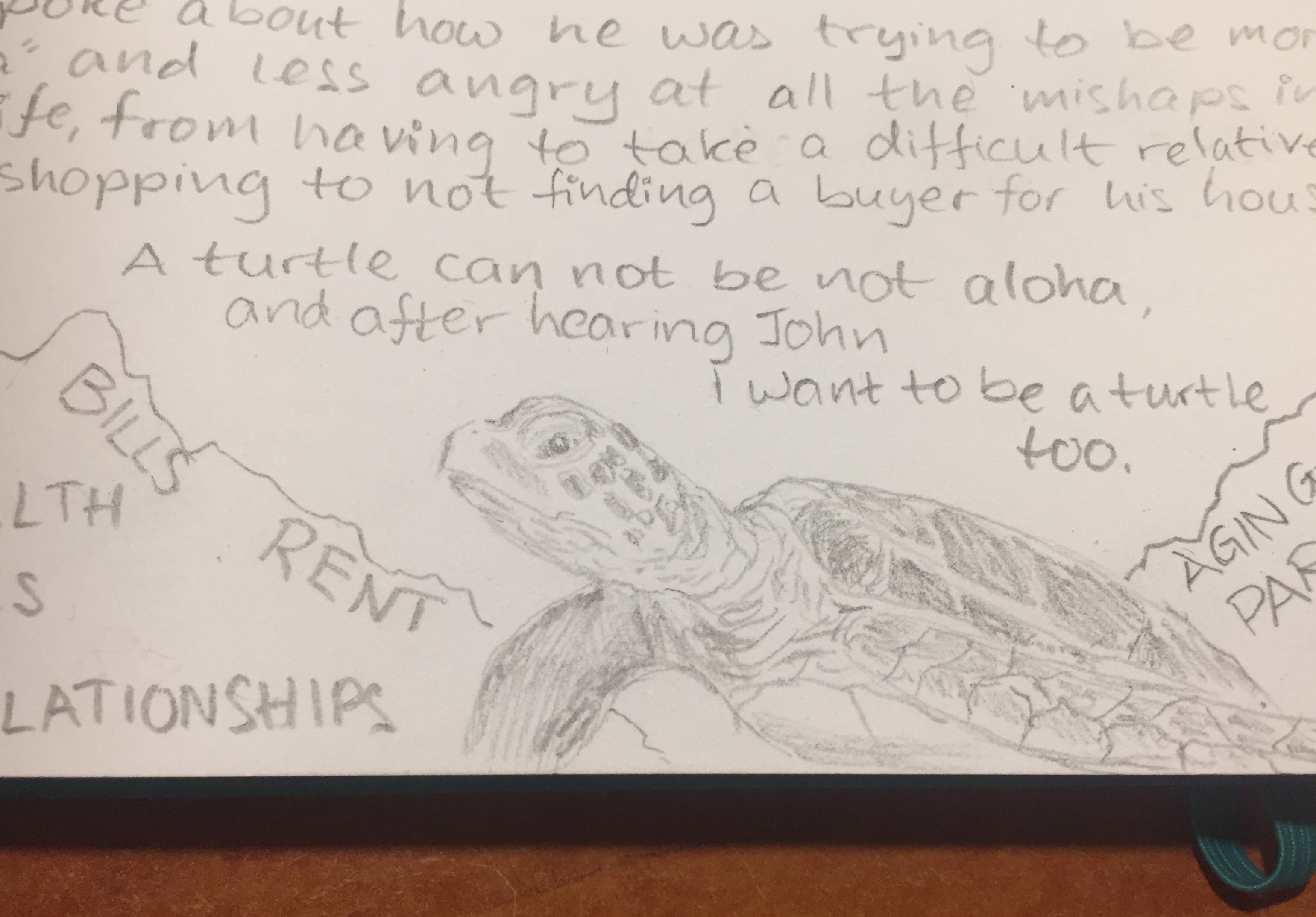
You can see the available shades that the General’s Pacific is capable of producing in the closeup of the sea turtle above. If you’re looking for a #2 writing pencil that could do for a quick sketch in a pinch, the Pacific ought to do the job. It doesn’t smudge and holds a point very well.
I erased a word between the “S” and the “LATIONSHIPS” on the left side of the closeup above. It erased out pretty well, even though the writing was dark and done with some pressure.
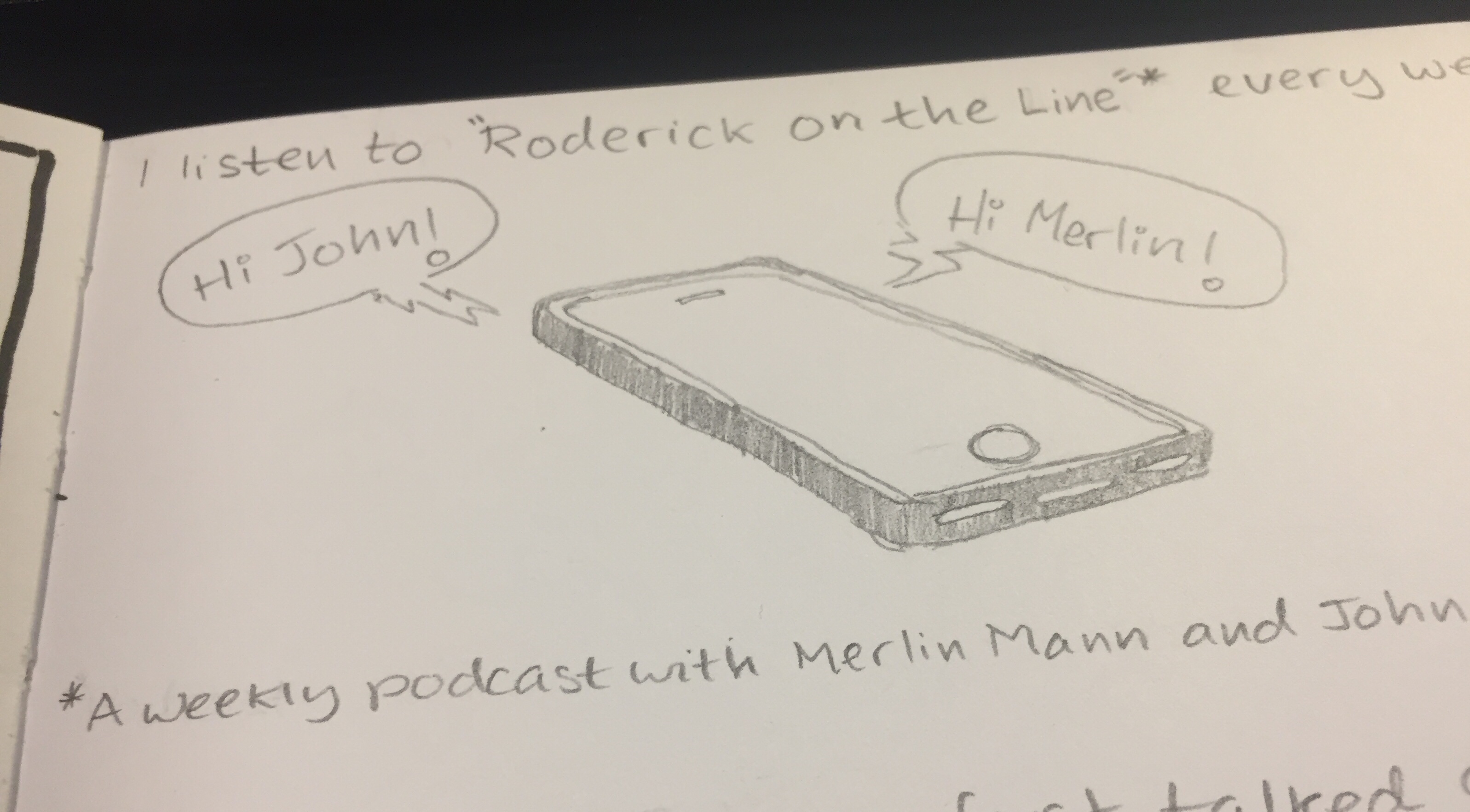
The phone above shows you the maximum darkness I was able to produce with the General’s Pacific. It’s not bad, considering that this is clearly not a pencil made for drawing, but one made primarily for writing.
If you’re buying from CW Pencils and are looking to add a workhorse cedar pencil with a fondness for fonts to your order, the General’s Pacific is a pretty good choice.















 Writing at Large