This book won the Booker award, the 2024 Booker award, and for the life of me I don’t know why.
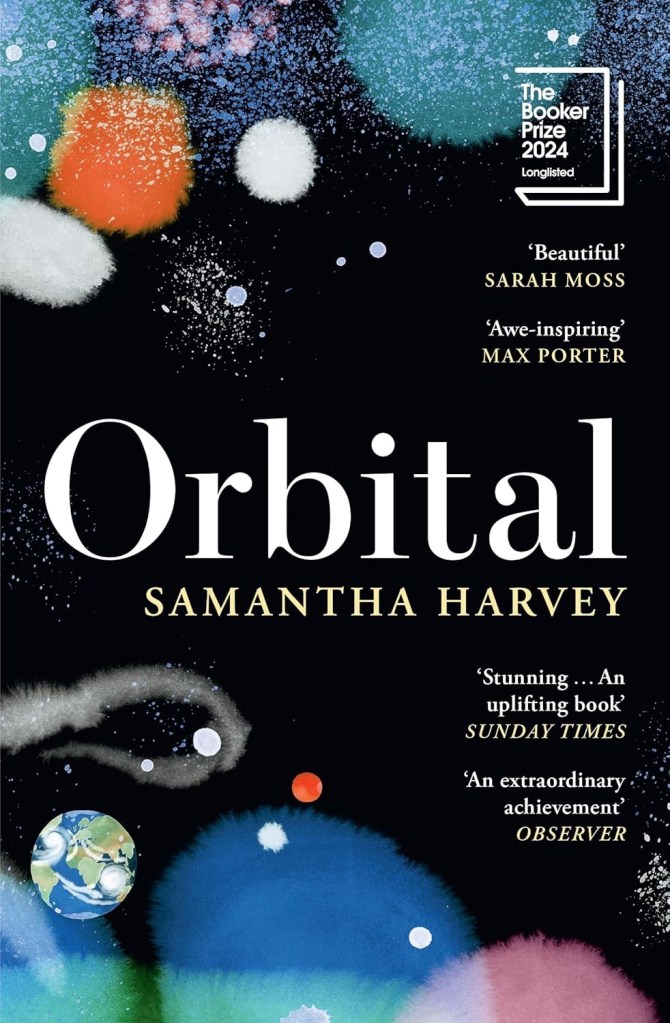
Though the book’s subtitle is “a novel”, at 137 pages Orbital is basically a novella. Mostly it’s a book about nothing, involving six people that you are guaranteed to not care much about, set in the International Space Station. Garnish the whole thing with a mountain of purple prose, and that’s Orbital for you.
Could Harvey have come up with a more interesting premise involving the International Space Station (ISS)? Of course she could. What if Orbital would have been set during the pandemic, with astronauts basically stranded up there, worried about their families and friends, worried about their resupply or how to get back home (see also the eight day space mission that will last for nine months). What if one of the astronauts that was meant to return from orbit refused to return? (It happened in the past). There’s no end to the interesting dramatic situations that being in orbit in the ISS offers. Harvey will have none of that.
The astronauts themselves are a dull lot, that you learn very little about. There’s a religious guy with a postcard that’s supposed to be profound but isn’t; there’s an Italian guy that went scuba diving on his honey moon; there’s a Japanese woman who’s mother dies of old age (spoiler: that’s the drama in the novel); there’s a woman that’s possibly Irish, possibly British that has a peculiar non-relationship with her husband, but don’t worry we don’t get to explore that. And there are two Russian guys. That’s the extent of the characters in Orbital, and that’s how well you get to know them or care about them.
The novella takes place during 16 orbits of the ISS around earth, and there’s a giant typhoon that takes place during a few of these orbits. There’s a weird “white saviour” bit, but without the “saviour” part of it with the Italian astronaut and a poor fisherman’s family that he met during his honeymoon and we’re to believe they kept in close touch with for years until the story takes place. Don’t worry – Harvey doesn’t want drama anywhere near her work, so there is none even at this point.
What there is a lot of is self-involved, bloated purple prose about the beauty and fragility of our planet, space and humanity. None of it is earned, none of it is attached to the narrative, all of it could have been cut out – but then there would be no Orbital.
I rarely review books that I dislike, and I should have given up on Orbital a quarter of the way through, like I originally wanted, but I didn’t. So let this be a warning to you: not all Booker award winners are worth reading.
 Writing at Large
hubertprevy
It sounds like a soap opera of sorts, just set in earth’s orbit.
Could it compare, to a degree, to the ‘Days of our lives’?
LikeLiked by 1 person
writingatlarge
No, because things happen in soap operas. Literally nothing happens here apart from one person getting notified that her elderly mother died of natural causes.
LikeLike
hubertprevy
OK, thank you for the info.
LikeLiked by 1 person
Daphna Kedmi
Ouch!
LikeLiked by 1 person
Daniel Owen
I’m about two-thirds of the way through it, and completely agree with your assessment. It feels like a series of creating writing exercises that have been loosely stitched together. Its brevity is its main redeeming virtue.
LikeLiked by 1 person
rupertarzeian
Thanks for the review. It seems that you enjoyed this even less than the Diamine Inkvent calendar🤣. I shall avoid both.
Wishing you all the best for the New Year.
LikeLiked by 1 person
fayfran
How interesting! I, on the other hand, found it profound, fascinating, and deeply moving. It made me think more deeply about the planet and, when I watch the ISS pass over the sky at night now, I think more about the people aboard. It talked about art, philosophy, life, the universe and everything (forgive the Douglas Adams joke). I loved the descriptions of the earth during those 16 passes in that one day, which made me feel I was up there with them. I adored it.
I totally respect your view, but I hope it’s okay to put a positive review as another ordinary reader with no affiliations (I don’t know her; I have no connection with the publisher; I bought my copies, both Kindle online and paperback from my local bookshop…)?
LikeLiked by 1 person
Jez
I also enjoyed this book. I read it because my partner is part of a book group and I’ll read most of their picks. She hated it as did most of the group.
Similarly to your point, I found it quite profound as though the point of the book is to reflect on our own lives and consider both whether we are making the most of it and also whether the way we live our life is appropriate.
The astronauts comment on how the planet has no borders, yet on the planet we are increasingly intolerant to one another at an individual and governmental level. Harvey is interested in the tension between humans’ insignificance and impact, their beauty and destructiveness.
The key passage for me is the discussion on Las Meninas where Anton says “the dog is the subject”. The dog is the only character in the image of Las Meninas not trying to engage the viewer and it could be interpreted that therefore is the only character content with life.
That’s my take anyway.
LikeLiked by 1 person
Brett
I could not agree with you more. This is not just the worst book to ever be short-listed for the Booker (let alone win it), it is one of the thinnest ‘books’ (for when does a pamphlet become a book) ever written. I kept trying to remember which writer it constantly reminded me of, and today, I got it. At last.
Who, I thought, could write about space with such infantile and obvious imagery as “The bright energetic black of space that slams their senses. Raw space is a panther, feral and primal.”
Who could make a point quite so vacant as this one: “A handspan away beyond the skin of metal the universe unfolds in simple eternities.” What are simple eternities, apart from eternities with a stupid adjective thrown at them?
It is a poet, very well known in the 80s, but less celebrated now, who could have knocked this pamphlet off in an afternoon, had he lacked the verve. I’m thinking of ‘Rick’, the character played by Rick Mayall in The Young Ones. The man who penned the great environmental classic tone poem ‘Pollution’. You can imagine the kid who wrote Orbital growing up one day and writing something this great:
Pollution: All around
Pollution Up, and Pollution. Down.
Pollution. Are you coming to my town?
LikeLiked by 1 person
Jacqueline
I found the lack of characterisation and narrative a problem as surely they are essential ingredients in a work of fiction. Some of the description was stunning and made me reflect upon the future and beauty of the earth. I found it repetitive in places and found myself skim reading some of it . I do agree that the author seems to be trying too hard to impress the reader with overlong sentences and tautology. I was surprised it won the Booker prize .
LikeLiked by 1 person
Mike McCormack
Can I leave a comment here? I decide to a google search, after having read this Booker Prize for 2024, to see what sentiments out here agreed with me. I would say toss this entire book in the garbage, which I could since it was gifted to me at Xmas 2024. However I would feel guilty throwing it away, but then if I gave it to somebody to read, I would feel guilty that either I didn’t warn them how desperately vapid it was, or that they suffered through reading this like I did. By the Second Orbit I was cringing… but I stuck it through to the end, and now here I am expounding upon how uninspiring it is. I’d rather read the creative prose of a “fifty-shades-of-anything,” then the desperate prose of “how-do-I-make-this-entire-one-day-on-the-space-station” interesting.
A Booker Prize? Good gracious! My plan is to go back to the bookstore and put it back on the shelf with a small pencil written message inside warning the next reader. 3 thumbs down… and I only have 2!!
LikeLiked by 1 person
WideAwakeOxfordshire
Thank you, thank you, thank you. I finished the book today (it only took me 3 months) and immediately searched for “Orbital book reviews” to see if there was anyone who hated it as much as I did. I don’t really mind being ‘the only one’, but I did feel a sense of relief that I am not!
I am going to pass it on to a friend tonight with your opening line of this article as a warning.
In part, it was the near 200-word sentences that I struggled with; together with the rapidly changing, unrelated and somewhat repetitive topics – perhaps synonymous with the changing landscape beneath the ISS.
I didn’t find it moving – and I weep watching Kobra Kai
LikeLiked by 1 person
Sarah
She turns another page and smooths the paper down. The covers of the book are thicker than the leaves, with a slightly velvet texture that clings to the palms, as if unwilling to surrender to the core of the novel the caress of the fingertips. The pages themselves are more textured, the individual chains of cellulose and lignin un-ravelled, flattened, transmuted from three dimensionality to a flat surface that can receive the printing ink.
Page 83. She is now more than half-way through this book, this novel, this work of fiction, which she must conclude in less than three days’ time in order to be ready for her Book Group. The covers are larger than the leaves, and bent over at the ends to receive the inner folios and to act as impromptu book-marks. Until page 68 she used the front cover, but that page marked the zenith (or the nadir) of her reading and from then on she tucked the sheets inside the rear cover.
She classifies books by her emotional response to each percentage completed. If the reaction when she has scanned 10% is a grudging admission that she must plough on through another 122 pages to attain resolution, then it is a less-than-ideal book. If, however (as with I Capture The Castle) she is begging the novel not to finish when she has attained the 90% value, then it is a good book. This novel is of the former category.
Each page is a pleasing pale cream colour, a shade lighter than brown, paler than biscuit. Blonde perhaps, straw or ochre, or whitish ecru. Beige is a dull word, and the pages should be beige, except that the word beige would draw attention to the dullness of the writing.
Page 86. 63% of the way through.
Someone has looked out of a window. Someone else has thought of their family. She thinks of her Book Group, at their accustomed table in The Grosvenor. Bob, their memory, who always can be relied upon to read each book twice, and to make notes. Rochelle, their conscience; Jane, their controlling mind; Bridget, their creativity; Elizabeth, their Foreign Secretary; Lucy, their glamour; Lee, their quiet wisdom; Sarah, their clown.
Why are there no speech marks, asks Rochelle. No inverted commas.
She explains it is a distancing device: the alienation of reported speech mimics their isolated status, the swooping of the ungarnished dialogues the rove and loop of the craft around the planet.
Someone has made a list.
Lists are good.
They take up more of the page, with fewer words.
List.
Words.
Good.
Bob is reading his list. Rochelle strokes the stem of her wine glass. The string of fairy lights over the door to the beer garden are reflected in the azure cerulean turquoise depths of the Merlot, no, hang on, that’s the wrong page of the thesaurus: Magenta. Garnet. Maroon. Crimson. Burgundy.
How the Hell did this win the Booker, asks Sarah. But there is no question mark on the end of her sentence. Question marks are rationed: they are heavy, every kilogram of question marks, exclamation marks, asterisks and colons costs a million dollars in fuel to deliver.
Perhaps that’s why there are no speech marks, says Jane. Too heavy.
She passes the crisps and looks out of the window again.
LikeLiked by 1 person
writingatlarge
😂
LikeLike
Christine Collin
Great review, made me laugh, my book group is in two days and I am now trying to classify the members. I thought the book was dreary, not a novel, a disconnected and generally uninformative diary of a day in the ISS. Even the personal hygiene aspects of 6 people in close quarters were very poorly handled.
LikeLiked by 1 person
Pingback: Orbital - Chatterton Books
Pingback: A Storm-Woven Message: Mirrors, Healing, and Riding the Waves - Abigail Mind Body Soul
Adam Grand
Great review, could not agree more. The fact it won the Booker Prize is an absolute joke. Embarrassing for all concerned.
LikeLiked by 1 person