Three Habits Worth Keeping

Happy New Year!

This is the time of year when people set resolutions, themes, goals, intentions, words of the year, etc. Ambitions are high, intentions are good, but well before March most of these efforts will be abandoned and forgotten. I’ll be writing about my quarterly plan and my 2025 planner later on, but for now here are three habits that worth keeping in 2025 and in general, and a few tips on how to get into them and persist:

Exercise

Any amount and any kind that you can do is excellent. Let’s repeat that: ANY amount of exercise and ANY kind of exercise is a tremendous win. Start with walking if nothing else speaks to you, but try to make sure it’s a brisk walk and not a shuffle if you can. It doesn’t need to take an hour, and it doesn’t need to be 10,000 steps. Remember, anything you can do is good. Local gyms and community centres usually have classes you can try out if you want to give yoga, pilates, kickboxing or jiujitsu a try.

Running offers the best “bang for your buck” in terms of time and money invested per health and fitness gains, but not everyone can run, and not everyone enjoys running. If you want to give running a start, I recommend using any “couch to 5k” app, and then transitioning to the excellent guided runs and training plans in the free NRC app to keep you going. If you need someone to keep you accountable, either join a group of some sort or find a friend or family member to work out with.

The NTC app offers a huge variety of training options – from yoga to full equipment gym workouts, with some excellent body-weight workouts in between. Swimming is a great low impact way to build up cardio and a bit of strength, and weight-lifting isn’t as intimidating as you think – a pair of dumbbells at home is a great way to start exploring it. Yoga with Adriene is great way to get into yoga if you don’t or can’t take a class and the NTC app seems too intimidating.

Soccer, basketball, baseball and other group sports are great ways to expand your social circle, and tennis, pickleball, badminton are great ways for couples to work out together.

The easiest way of getting into the habit is doing a little something every day, and doing it as soon after you wake up as possible. That way you start the day with a win and some endorphins, which is always a nice way to start your day.

If you think you don’t have time to work out, be honest with yourself and track your time for a day or two. How much time is spent on social media? Binge watching TV? Mindless scrolling? Could you cut some of that out? Could you go to sleep a little earlier and wake up a little earlier so you can have some alone time to exercise and clear your mind?

If you already have a solid exercise routine in place, take the time to diversify it if you can. This goes particularly to us runners: strength train. Swim. Cycle. Do things that aren’t just running, because just running is one of the main causes of such relatively high injury rates amongst runners compared to other athletes.

Reading

Most people don’t read, which is their loss because reading is a superpower. Train your brain off the social media dopamine hamster wheel and teach it how to focus for significant stretches of time by picking up a reading habit. You’re standing in line bored? Open your Kindle app and pick up that detective novel or space opera from where you left off. Replace TikTok, social media and YouTube with books, and make sure that they’re books that you want to read. Don’t go off bestseller lists or influencer recommendations or whatever one this or that award, or is considered a classic. When you’re getting back into reading you need to gradually train your mind to get used to this activity. Start with a book that really interests you (not one that’s impressive), and start with a physical copy because they’re easier to read. Reading will do to your brain what exercise does for all of your body: make you better, stronger, faster, healthier and happier.

If you’re already a reader, then mix things up a bit: if you only read non-fiction, read fiction for a change and vice versa. Try something new, because you may just end up liking it. If you’ve only done light reading so far, pick a challenging book and work your way through it. Treat your brain like a muscle you are training, where you gradually progress to bigger and bigger weights. Challenging books are often the most rewarding, but you probably should start with them.

Journaling

Digital or analog, it doesn’t matter, journaling is worth doing. Gain insight to yourself, unleash your creativity, and let loose to your thoughts in a safe environment. This is the path to self improvement, learning to be kind to yourself, and having a positive mental attitude towards life.

If you’ve never journaled before, start small and simple: pick a notebook that you will enjoy writing in (whatever speaks to you, no matter what other people think), use whatever pen or pencil you fancy, and write 3-5 things you are grateful for each day. Add more sections to your daily journal as you go along: a “story of the day”, an account of what you did or what you consumed and what you thought about it, a nightly summary, etc.

Make it a ritual of sorts: write in your journal every morning and evening, every time you switch between major tasks during the day, or when you feel the need to respond to something (don’t post online, post in your journal instead).

Don’t be intimidated by gorgeous and elaborate works of art in various journaling forums, blogs and on Instagram. These are journals as craft projects, and while they are nice, they aren’t what we’re trying to get to here. It’s OK to add stickers and bits and bobs to your journal, but its purpose shouldn’t be to be photographed and posted. It’s there to work for you, so treat it like a workhorse, not a circus pony. Also, remind yourself that many of these journal photos are there to sell: stickers, washi tape, pens, notebooks, ink, the poster’s journaling course, etc. People rarely show off their “real” journals because if you’re honestly journaling only for yourself, that’s just not something that you’ll want to share.

Planning Update – How I Plan a 13 Week Year

This is the second post on this topic. For an explanation on the 13 week year read this post.

As life tends to constantly throw curveballs at me, planning ahead in short bursts has proven to be invaluable. During the previous quarter my dad went through an unexpected open-heart surgery and I realized that I’d have to find a new apartment in the not so distant future. If I had planned ahead for an entire year (goals/themes, the system is immaterial), I would have had to scrap all my plans on February. As it was, I made a few minor adjustments, and finished not so far from where I originally planned.

Just before this 13 week/quarter started I got some bad news about my cat. That’s going to affect my plans, which I made before I realized that he was likely dealing with cancer. That’s OK – my plans are short term enough to allow me to easily change them, and I’ve already built plenty of wiggle room into the plans that I made. Unlike themes, which I find to be to vague to be useful, or yearly plans, which are too long term to be practical in my circumstances, 13 week planning allows for just enough time to make meaningful progress in the key areas of my life whilst being short enough to allow me to quickly pivot if necessary.

How I Make a 13 Week Plan

This is my third round with 13 week planning, and I’m getting progressively better at it. Here’s what I do that’s been working so far:

  1. List all the roles and areas in my life and make sure I’m covering all of them. Some examples of the areas I use: Health and Fitness, Reading, Mental Health (important enough for me with my PTSD to have it under a separate area), Conversations (meaningful connections with friends – that’s face to face get togethers or one on one phone calls or zoom meetings, not WhatsAapp messages), French, Creative Projects, Film Photography (more on that in a separate post), Professional Development (this is the only work related stuff that I track at home), Decluttering (trying to prepare for a future move), Drawing, Blog, Money. Yes there are a lot of them, yes it’s worth listing everything down and addressing as much of it as you can with your plan.
  2. Figure out measurable goals that can be reached during the 13 week stretch. Where possible I set a bare minimum, easily achievable goal, and then stretch goals. So for instance the minimum reading goal is 6 books, with 8 books and 10 books as my stretch goals. This means that if the unexpected happens, it’s almost always only my stretch goals that are affected. It also means that I’m not setting myself up to say: “this is impossible, why even bother?” Every little bit helps, and it helps to be kind to your future self.
  3. Set up various scaffolds and aides to your goals. Wherever possible I use the app “Streaks” to help me hit my goals. I also use the great NRC (Nike Run Club) app to help me keep track of my running goals and challenge me there, and I schedule as many things as possible in my calendar ahead of time. GoodReads has a reading challenge that helps me track books. Then there is my weekly planning session, where I build up next week’s plan. During that time I go over all of my goals for the quarter and make sure that I’m hitting at least a few of them that week.
  4. When executing your plan, break things down to monthly, weekly and daily goals. Whether it’s X amount of running sessions a month, X minutes of exercise a week, or how much time you spent away from screens every day, the longer term goals need to be broken down to shorter term chunks for you to actually be able to do them. It’s also helpful when reviewing your weekly or monthly plan to see where your quarterly (or 13 week) plan was too optimistic. If, for example, you’re travelling for two weeks in August, you need to make sure you didn’t account for those two weeks during your quarterly plan, because chances are you won’t be able to hit very many goals during that time.
  5. Don’t be afraid to refactor the plan when major things happen. Your plan should be flexible enough to account for the small and medium sized surprises life throws at us (broken fridge, out of town friend unexpectedly drops by for a few days, you picked up a new hobby), but don’t be afraid to rethink your plans when the big things hit (major illness, unexpected move, promotion, job change, etc). You don’t score points for sticking to the plan – the plan is just a tool meant to help you achieve your goals.

My planning is done on paper, and then I use Fantastical (a calendar app) and Streaks on my phone to help me keep daily track of things. I look at my weekly plan almost every day, and I track things there as well. On a weekly basis I review my progress and decide what to focus on next week. If it’s a busy week I’ll select only a few relatively easy goals, for example. The point is to build a plan that is detailed enough to cover the most important areas in your life well, and yet allows for flexibility.

A small snippet from this quarter’s plan

Have you found this helpful? What tools do you use to achieve your goals?

2024 Planning Update: The 13 Week Year

Back in January I wrote about trying a new long term planning system that isn’t the Theme System or theme based, and isn’t yearly goal based, but rather is based on breaking the year into four 13 week blocks, each one representing a fully independent quarter.

I’m now in week 11 of the second of these blocks (quarter two, to put it more simply), and I’m starting to plan the next quarter. While working on my plan I thought that it would be useful to document the procedure, talk about my review process, and discuss how I planned the previous quarters, how things went, and what I plan to do differently in the third quarter.

The point of this system is to break the year into more manageable parts. This allows for greater flexibility in planning, time to “recover” from life’s surprises, and time to work on meaningful, long term projects. On the one hand the entire year isn’t a wash when life deals one of its blows, and on the other hand you can allow yourself to express a realistic amount of ambition.

Starting the Third Quarter’s Setup

I use the Leuchtturm Bullet Journal for my planning, and it should last me to the end of the year. After that I’ll switch to a Leuchtturm 120gsm dot grid notebook, as I don’t use any of the Bullet Journal features in my current notebook.

The first bit is a bit mindless, but I prefer to see it as meditative. Each week in my planner gets two pages, and so I leave four empty pages after the last spread of the previous quarter. These four pages will contain my plan for the quarter, broken into various sections. More on how I build that in a later post.

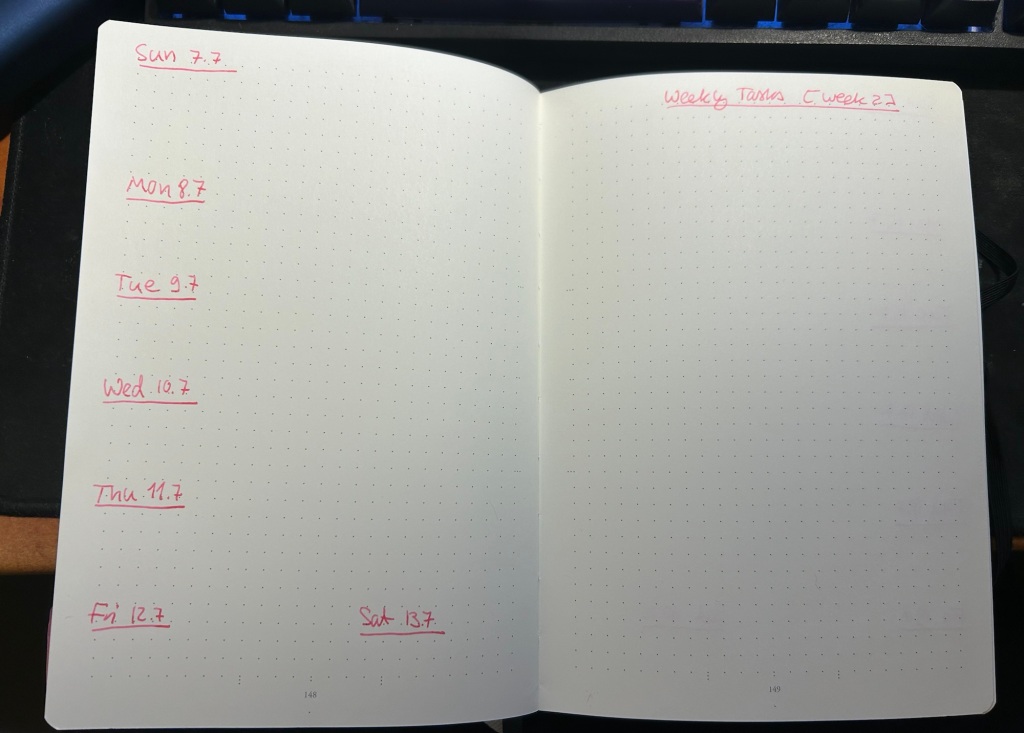
Then I sit down and draw out 13 weekly spreads. On the left side of the spread I write down the days of the week and the dates, and on the right I just put a “Weekly Tasks” title with the number of the week in the quarter in square brackets. I do this in one sitting for the entire quarter, and it takes about 30 minutes because I don’t rush it. This is how the pages look at this point:

This is how it looks when it’s filled and in use:

The left side gets filled with my exercise plan for the week, major appointments, and important things I don’t want to forget.

The right side has my weekly goals, both in the form of various checklists with checkboxes and more general lists. This is where my quarterly goals get put into action – every Friday or Saturday I look at my quarterly goals, and then try to advance as many of them as I can in the week. Things become more quantifiable at this point, though it’s often only in my daily to do lists that they become real, doable tasks. My daily to do list is something that I write the night before on an A5 loose sheet of paper, and recycle once I’m done with it.

Next time I’ll post a bit more about how I create the quarterly plan.

How do you plan your year? How is your planning going now that the year is halfway through?