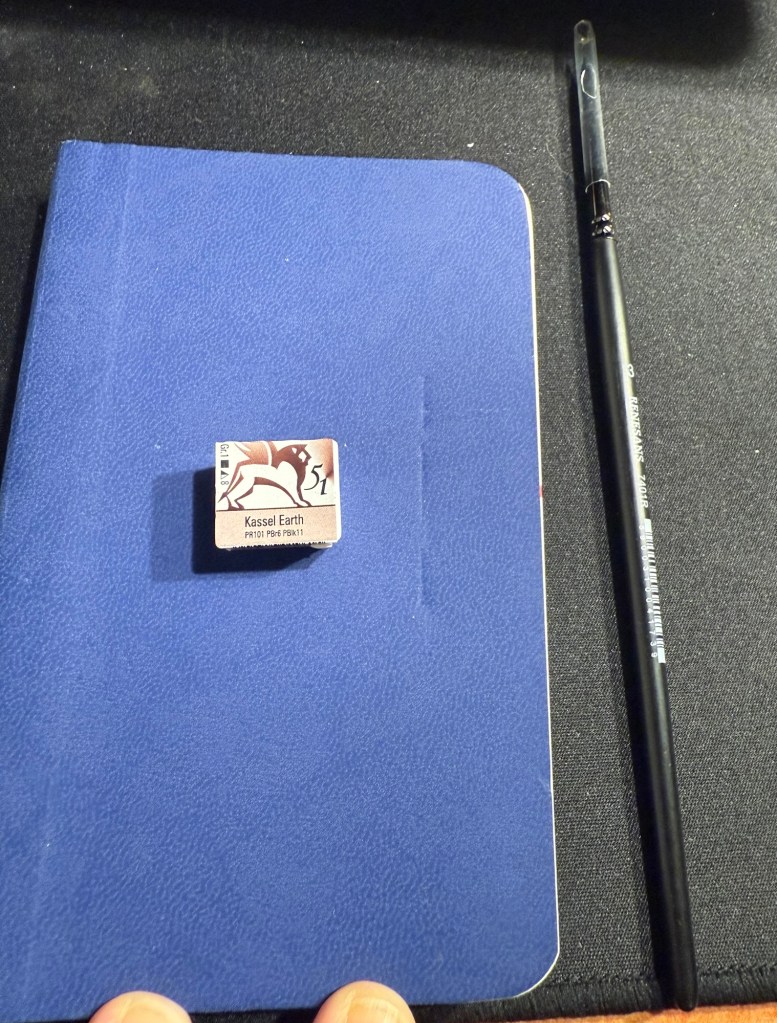
As part of the Urban Sketcher’s 2025 Symposium in Poznan I got a very generous goodie bag filled with art supplies from the Symposium sponsors. One of those sponsors was Renesans, a Polish art supply manufacturer, and they gave us a half pan of Kassel Earth extra fine watercolour and a number 3 synthetic watercolour brush.
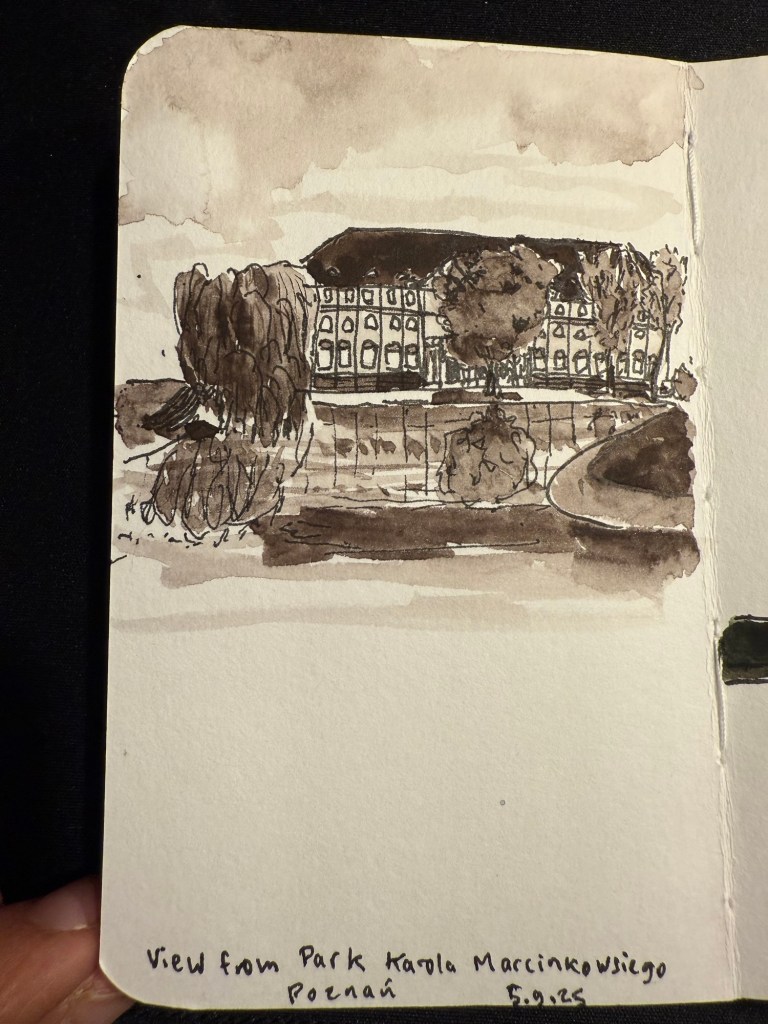
Today I decided to try them out. I used a Stillman and Birn pocket beta, a Staedtler 0.8 pigment liner and only the Kassel Earth watercolour and the Renesans brush. This is the result:
It’s a sketch of a beautiful building across from a pond in a park in Poznan. I drew it from a photo that I took during my morning run through the park. I was planning on returning to the park during the Symposium but I ended up not having time.
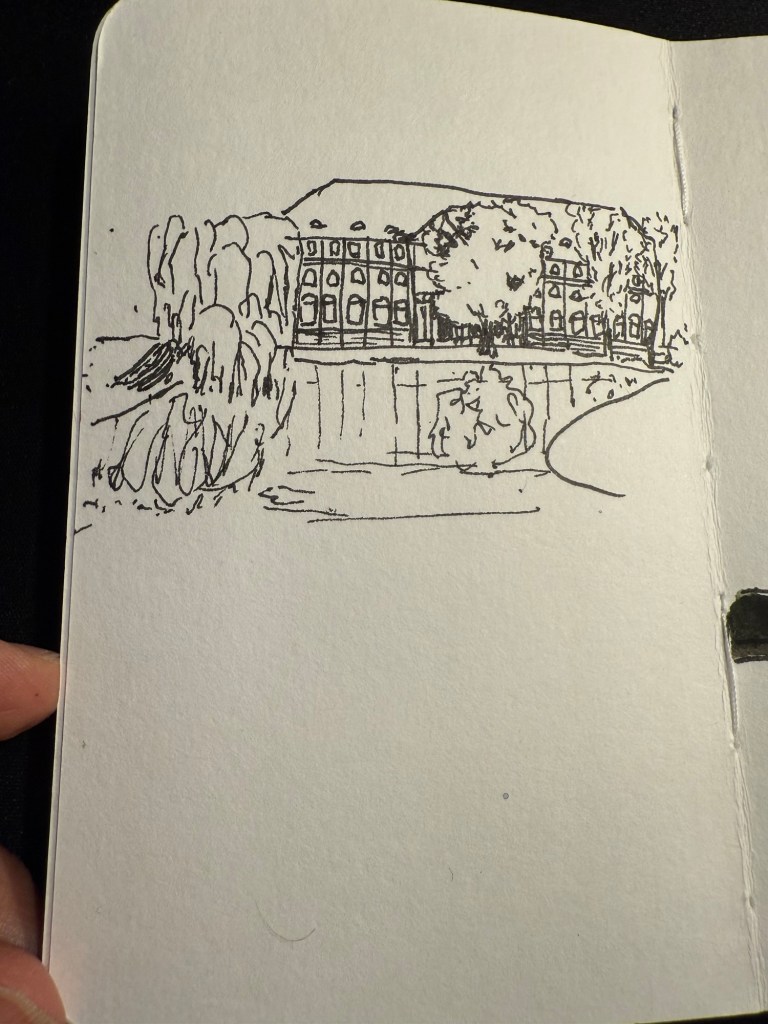
This is the sketch:
I used some of what I learned in the symposium to create more realistic trees.
I rarely sketch in monochrome so this sketch was a challenge. It’s about seeing the grades and shades in a scene, and not the colours, and that’s a hard exercise.
This is the paint and brush on the sketchbook:
And this is a swab of the paint. It’s a classic Van Dyke brown, artist grade quality. The brush was surprisingly good, especially for a synthetic brush. It retained quite a lot of water, and it has a good, sharp point.
Though the paint pan has bubbles in it, which isn’t great, I am happy with the quality of the paint and I would consider using Renesans watercolours in the future. The brush is excellent and I am adding it to my rotation. What a wonderful gift to get!
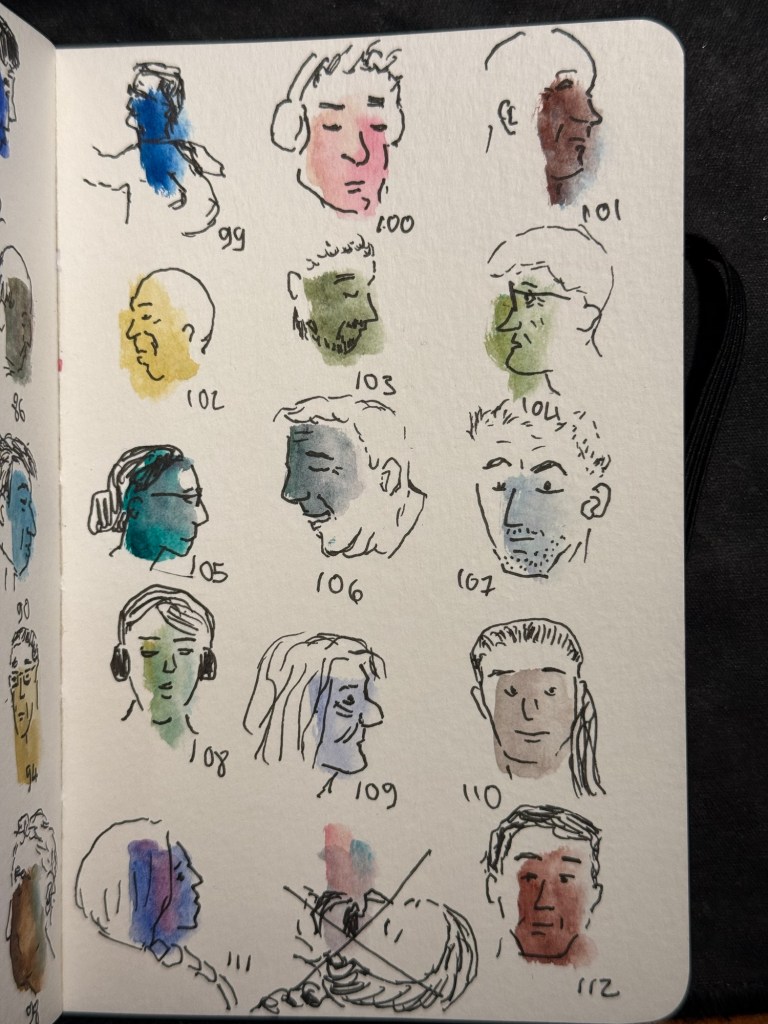
Last official day of the challenge, though I plan on doing a few more sketches tomorrow. These were all done at the gym, from 102-112, including a failed sketch.
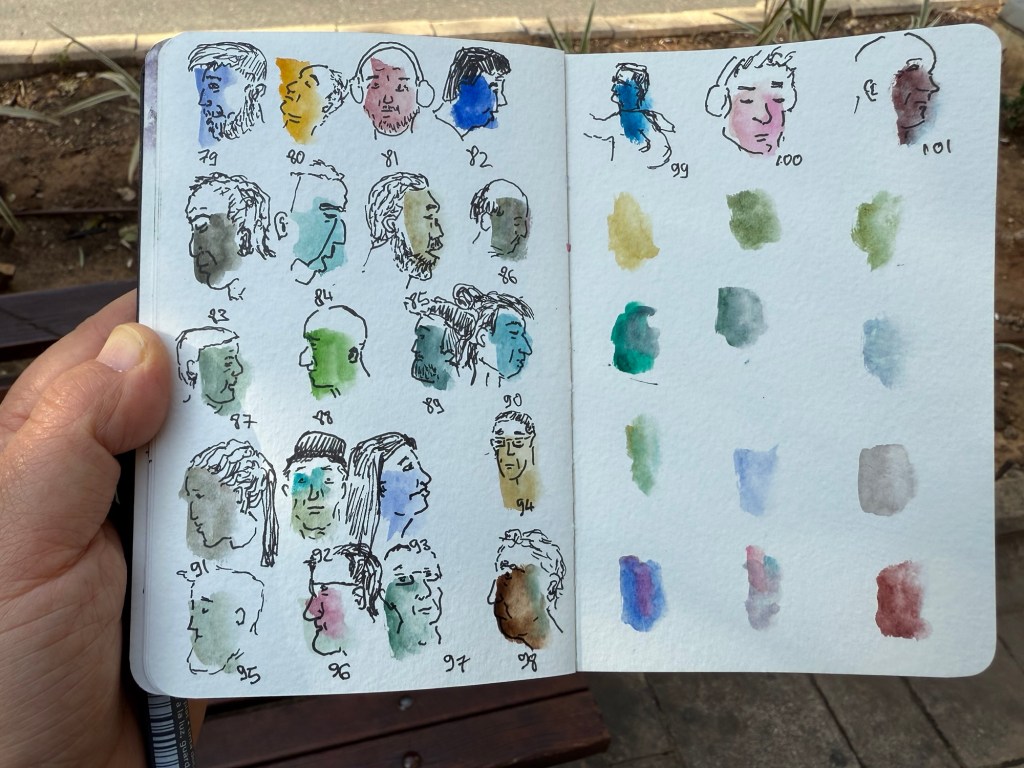
I have a super busy day so I took my sketchbook (Moleskine pocket watercolour) to the gym and did sketches 79-90 there, and then I completed 91-101 sitting on a bench on my way home.
So 100 people completed – the fastest ever I’ve done this challenge, and all of them sketched from life. I plan to complete this page tomorrow and then go back to my Field Notes sketchbook to try another style of sketching people on the move.
As usual, pick which one you like best. I am having trouble choosing.
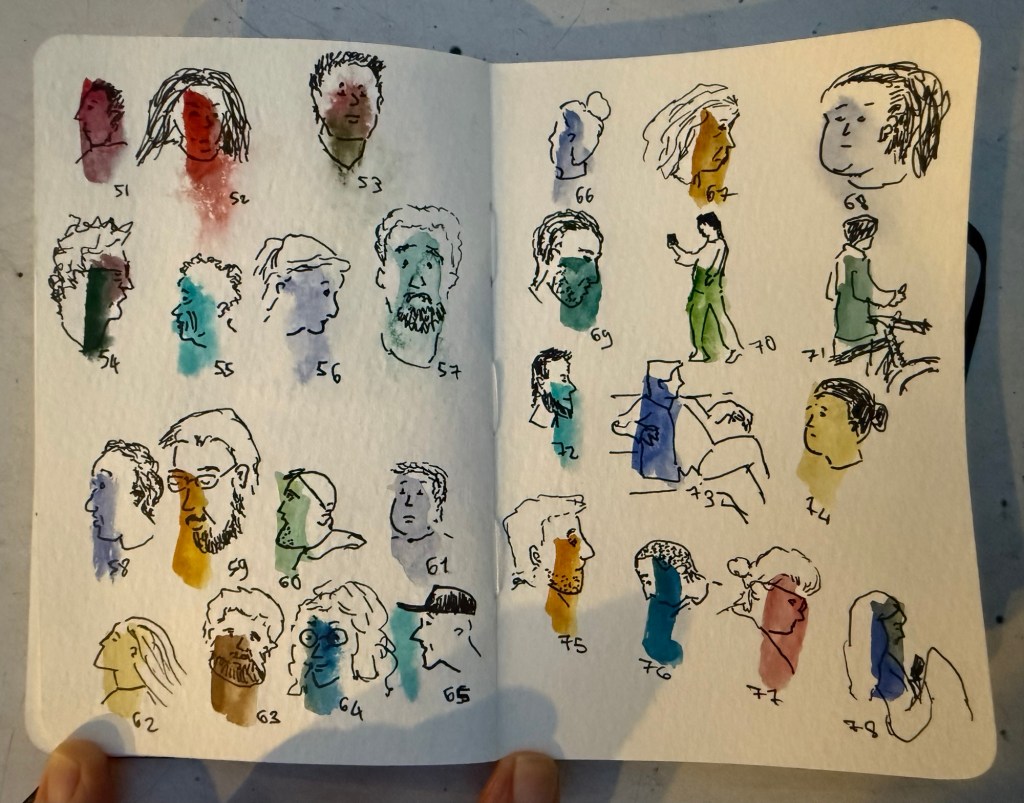
It was dark and cold once I finished, and my fingers had trouble grasping the pen because of my neuropathy. My original plan was to finish all 100 today, but I only got to 78. Tomorrow I have very little time to sketch, but I am getting faster and better and capturing quick moving targets.
I am using the watercolour “blobs” mostly as general guides for the size of each sketch. I create them first and then sketch over them later.
These were done on a Moleskine pocket watercolour sketchbook using Schmincke and Daniel Smith watercolours, a water brush and a Staedtler 0.3 pigment liner pen. They each took only a few seconds to sketch.
I mostly use fountain pens when I write. If not fountain pens then gel ink pens. I rarely write in pencil, but I often sketch with pencils, and sometimes when I plan, I pencil things in. Pencil is great for writing impermanence, even though pencil marks last longer than pen ones – unless erased.
Yet there’s always a ballpoint on my desk and in my bag. I don’t like writing with ballpoint – the lines are as dark as I prefer, even with hybrid ballpoints like Uniball Jetstreams, and they oftentimes streak and blob. So why do I have a ballpoint at hand at all times?
Because ballpoint pens are a useful tool. The ink is waterproof , they’re good for signing things, and they’re robust enough to handle being tossed into a bag or a pocket. Ballpoint pens are also good for sketching – you can get a decent amount of shading and character with them (providing you don’t use a Jetstream).
One of the best bang for your buck ballpoints is this pen:
Zebra 301A BP
So why do I like the Zebra 301 A BP 0.7?
It’s made from aluminium, so it’s light and ultra durable. It also wears really well.
I love the pen body design and colour.
The grip and click mechanism are good: well designed and well made. You get a decisive click from this pen, and the plastic grip has enough texture to it to make writing as comfortable as possible without all the lint gathering, stickiness and durability issues of softer grips.
No tip wiggle.
It comes with a good, dependable, black refill that is replaceable.
Clip and click mechanism
I like the Zebra 301 A BP enough that I bought a large box of them and I frequently give them away as gifts. People like getting nice pens and if you’re used to cheap, plasticky, disposable ballpoints it’s nice getting a pen that’s a grade or two above what you find in the office supply cabinet.
Grip
Here’s a quick sketch done with a Zebra 301A BP 0.7 on a Field Notes Sketchbook. Ballpoint pen sketching isn’t my favourite technique, but it is a very useful technique for quick urban sketching.
It’s been a hectic week as my team at work is basically crumbling: our new senior member is leaving after just two months, the team lead is leaving after a bit more than a year, and the other team member is on holiday until the end of the month. That just leaves me with two trainees to hold the fort for a while, and it’s far from ideal. As I’m also working my way through an intense certification course, posts on this blog have taken (and will likely continue to take) a bit of a hit.
Reading
I’ve finished reading Looking for a Ship by John McPhee and I’ve reviewed it here. It’s a fascinating narrative of a now extinct world, that of the American Merchant Marine. I’ve now started reading Oliver Burkeman’s Four Thousand Weeks as well as Legends and Lattes by Travis Baldree.
Stationery
My Field Notes order has arrived, as has the 2024 Hobonichi Techo (yes, 2024) that I bought with a Black Friday discount. The Hobonichi will be used to supplement my 2014 Hobonichi when it comes to testing out inks. The 2024 Techo has’s got paper that is close enough to original Tomoe River Paper that’s in my 2014 Techo, though from my understanding the 2025 Hobonuchi’s have worse paper than the 2024 ones, so take that into account if you’re considering buying one. I have posts planned for both purchases, and hopefully I’ll get the time to write them.
Model Sketching
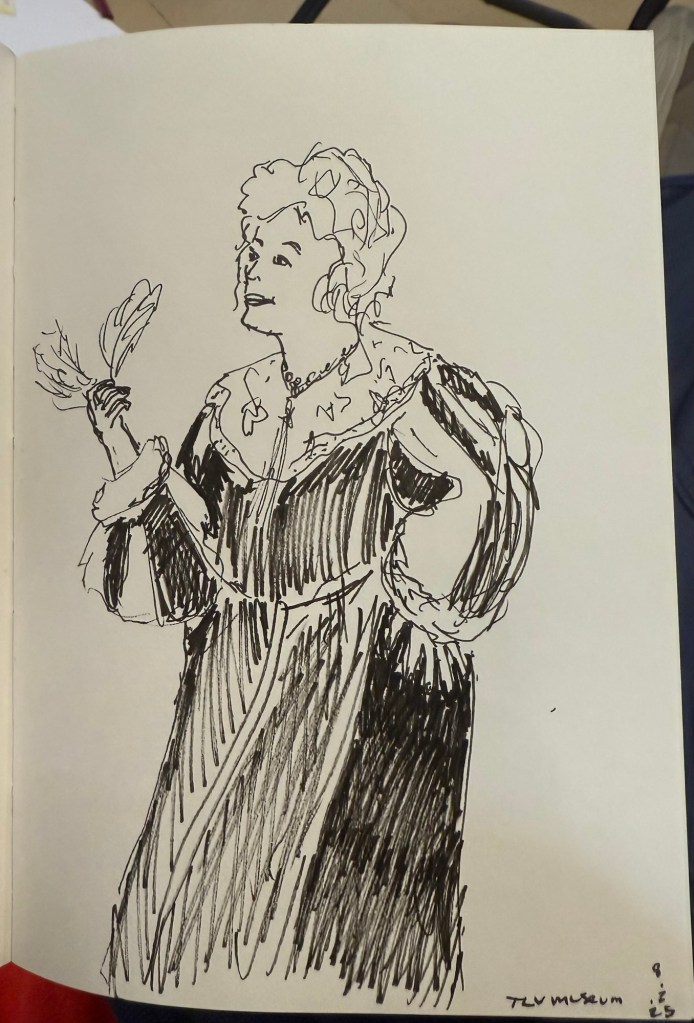
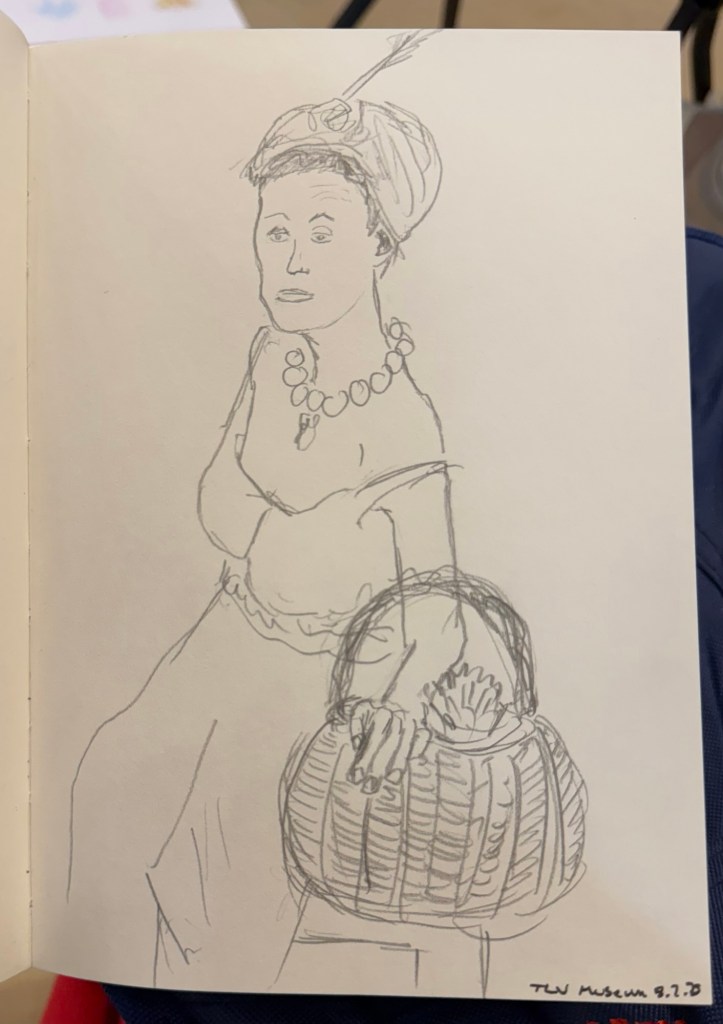
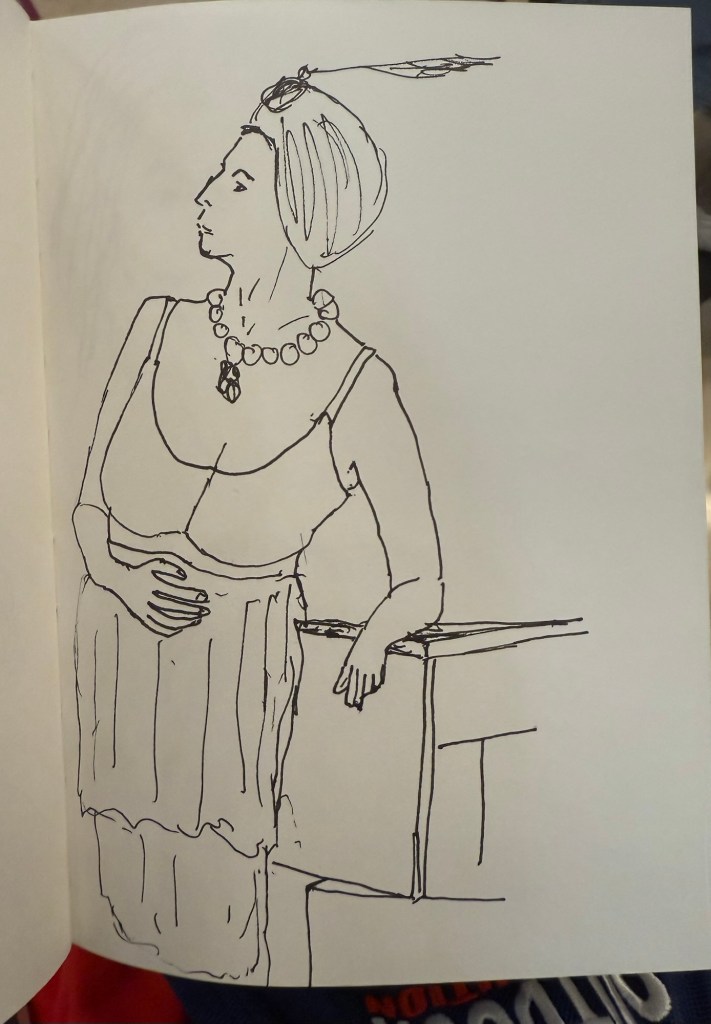
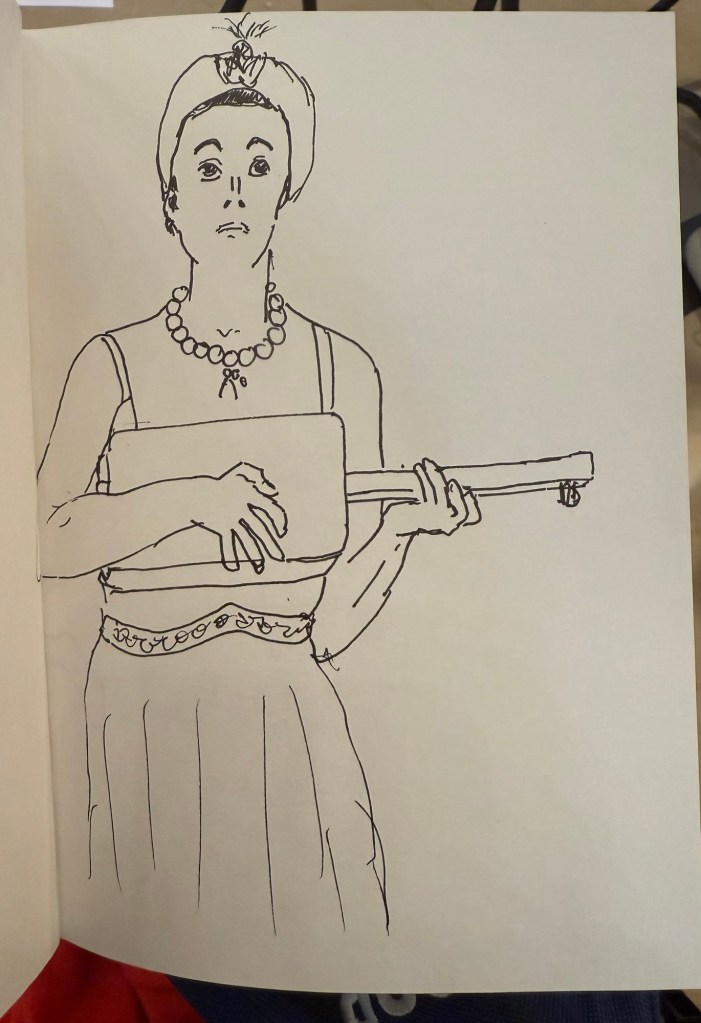
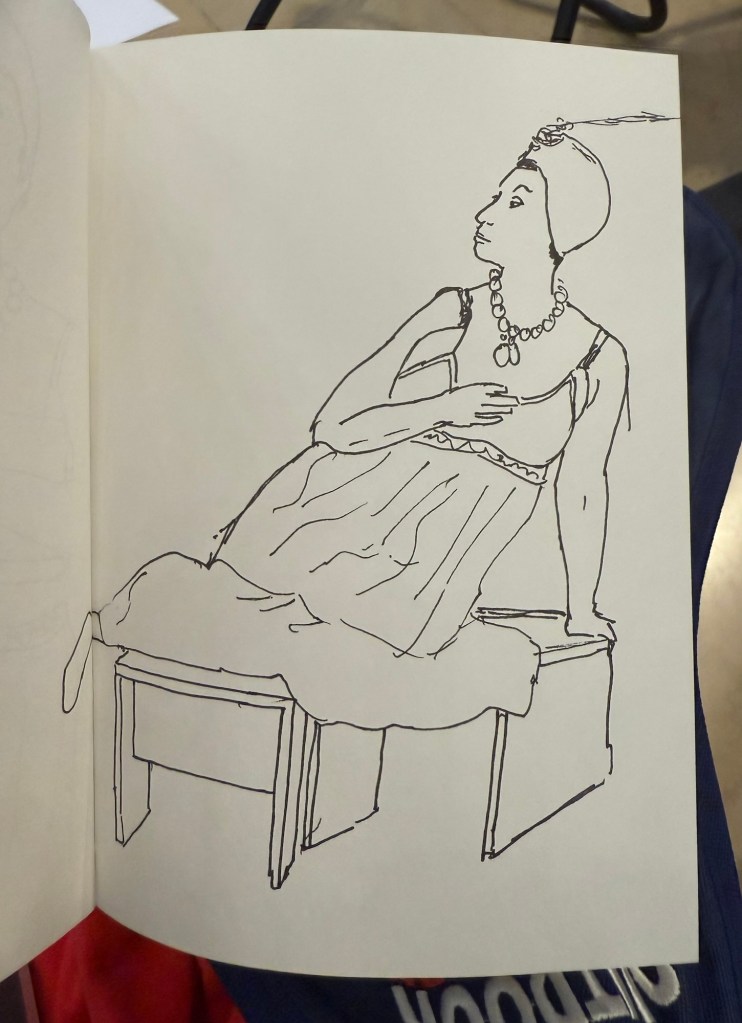
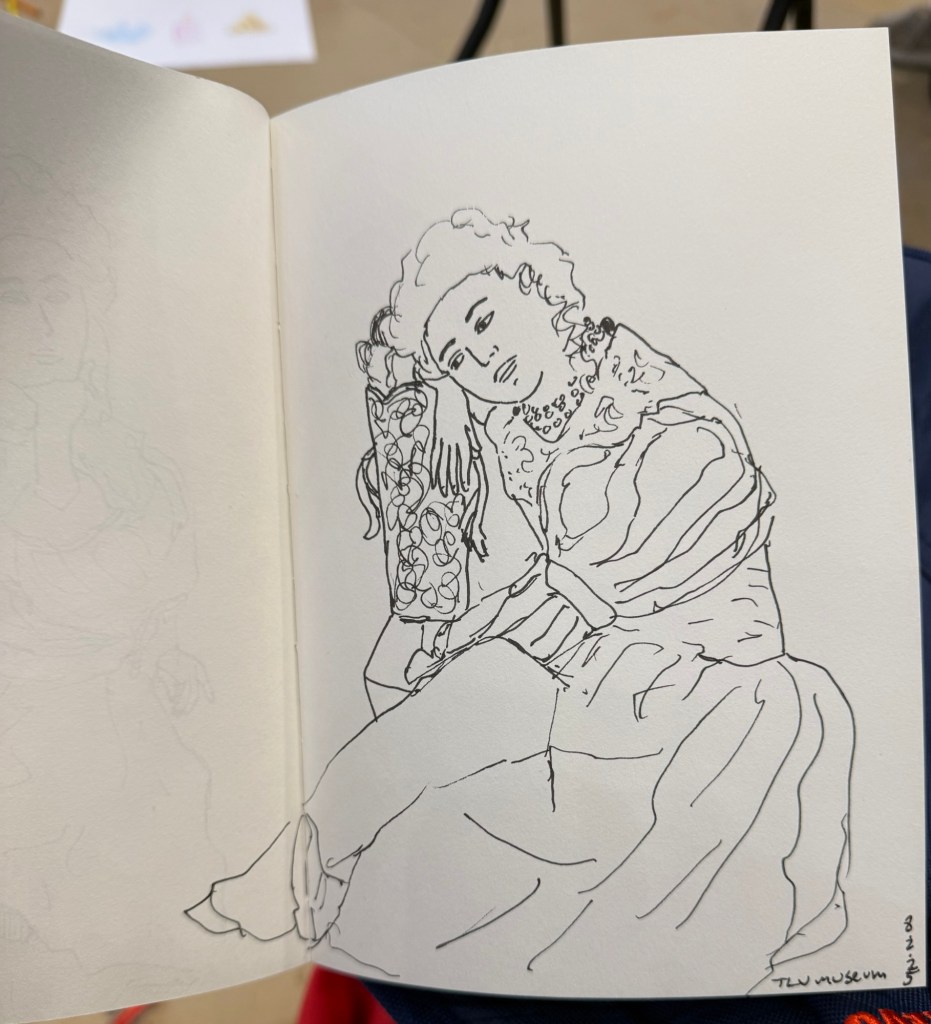
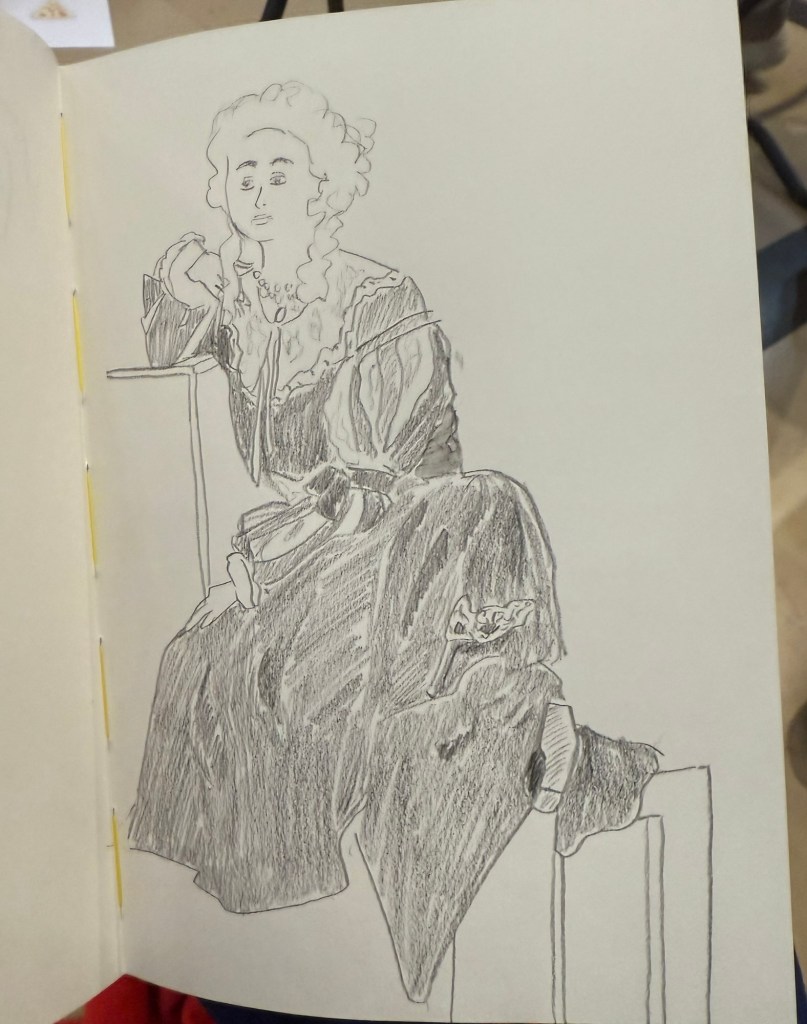
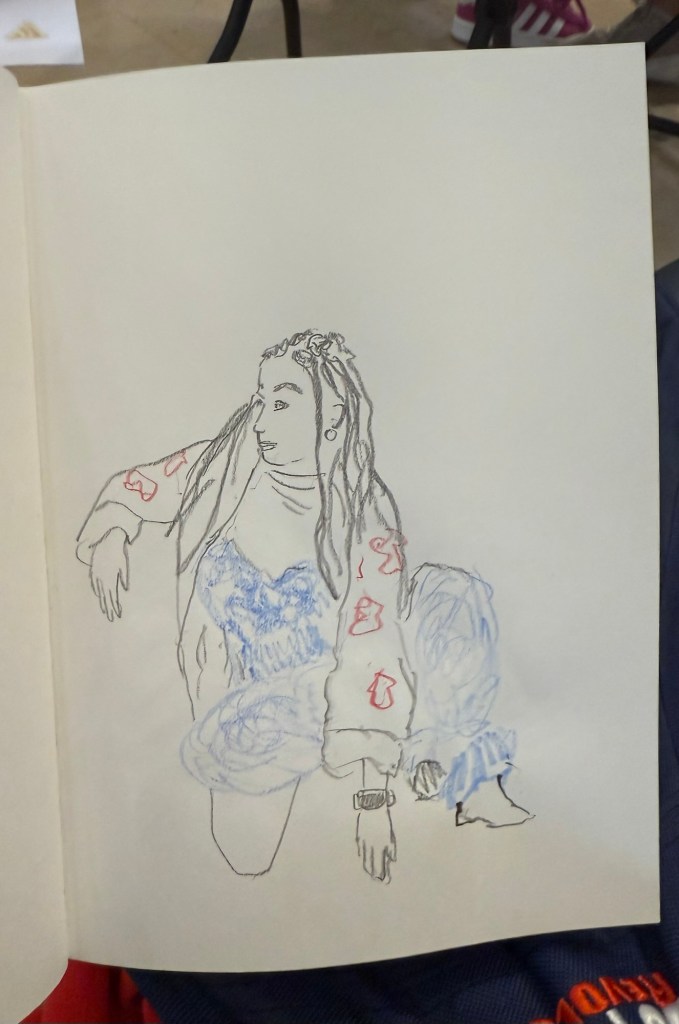
I went to the Tel Aviv Museum of Art today for a special sketching event that they organized: three models dressed in clothing that reflected some of the artwork in the collection, posing for sketches for 3 hours. These were mostly 10 minute sketches, with the last two poses being 20 minute ones. The last pose was a rare treat – a group pose, which is something you don’t get to sketch a lot.
In general when sketching models, whether clothed or not, you have one model that poses. Here there were three, and they switched places, so wherever you sat you got to sketch all three (and you could always sketch a model that was a bit further than the one right in front of you). The museum was busy, and there were children’s plays being shown in the auditorium, and so a lot of kids were around us, sketching on bits of paper with coloured pencils, with parents and grandparents cooing with delight and hovering around. It was wonderful to see how joyously kids took to sketching, whether it was the ladies in the dresses before them, or just anything that came into their imagination.
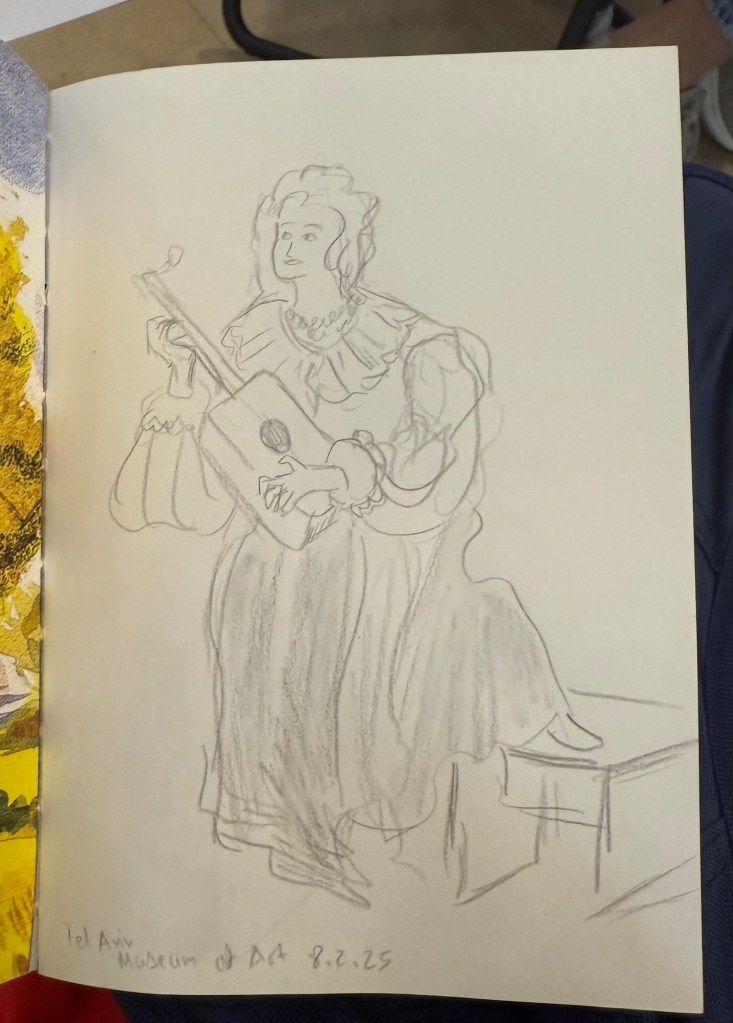
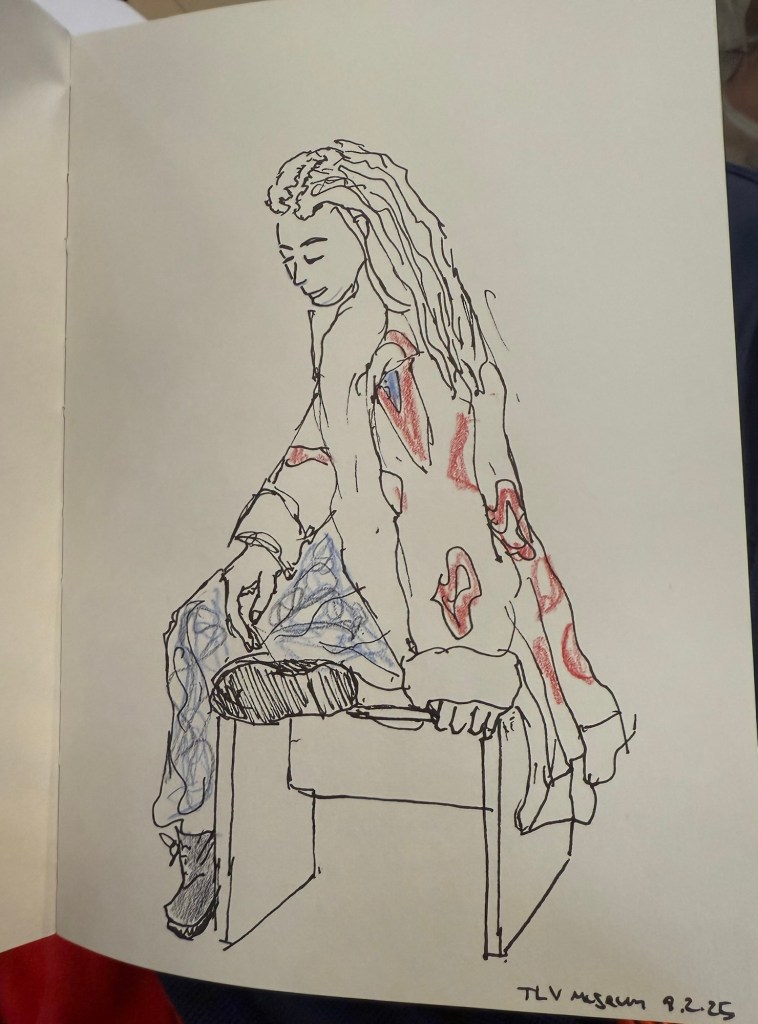
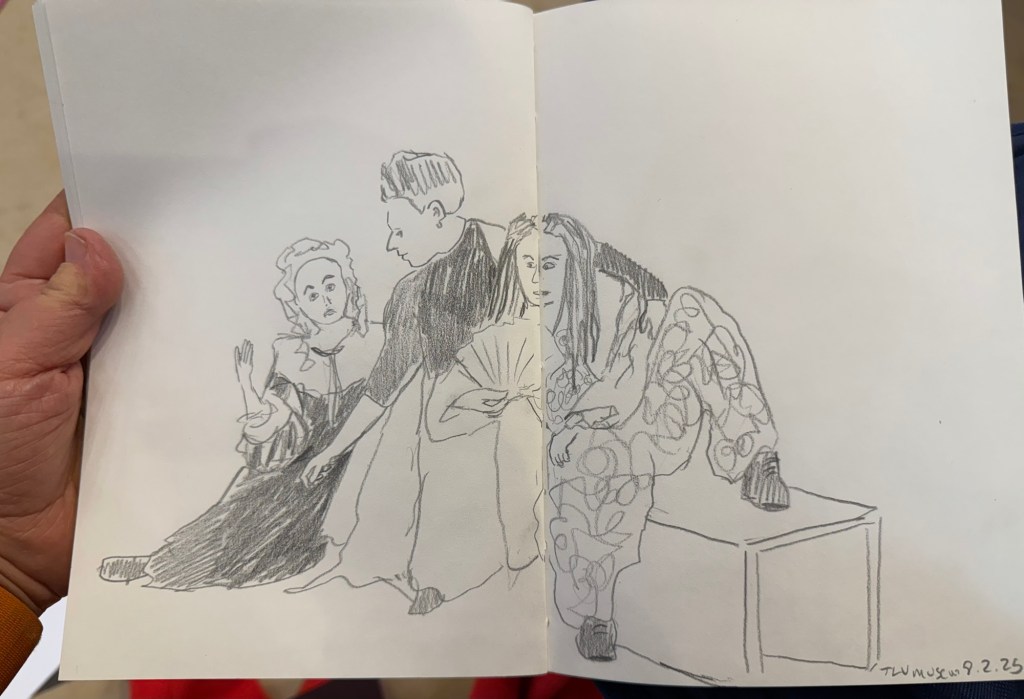
Here are the sketches I made throughout the event. The sketchbook I used was by French maker Pascale Éditions (it was lovely), and I used a Faber Castell 9000 2B pencil, a Faber Castell 4B Graphite Aquarelle pencil, various Faber Castel Albrecht Dürer watercolour pencils, a Tombow brush pen, and a 0.5 Staedtler Pigment Liner (this was my most used sketching tool).
First sketch. Warming up, so trying to keep it as loose as possible. 20 minute sketch, so I had time for some shading. The only sketch where I wet the paper slightly with a waterbrush before sketching20 minute final group posePotato quality photo of the three models
First thing’s first: if you are looking for a writing pen, then the Majohn Q1 mini fountain pen is likely not for you. While you can purchase it with an extra-fine, fine or medium nib, it’s weird body shape would likely make it uncomfortable for long writing session, and as it’s an eyedropper filler, it’s designed to have a giant ink capacity, normally suitable for long writing sessions.
If, on the other hand, you are looking for a fountain pen to sketch with, the Majohn Q1 may be a very worthy addition to your kit.
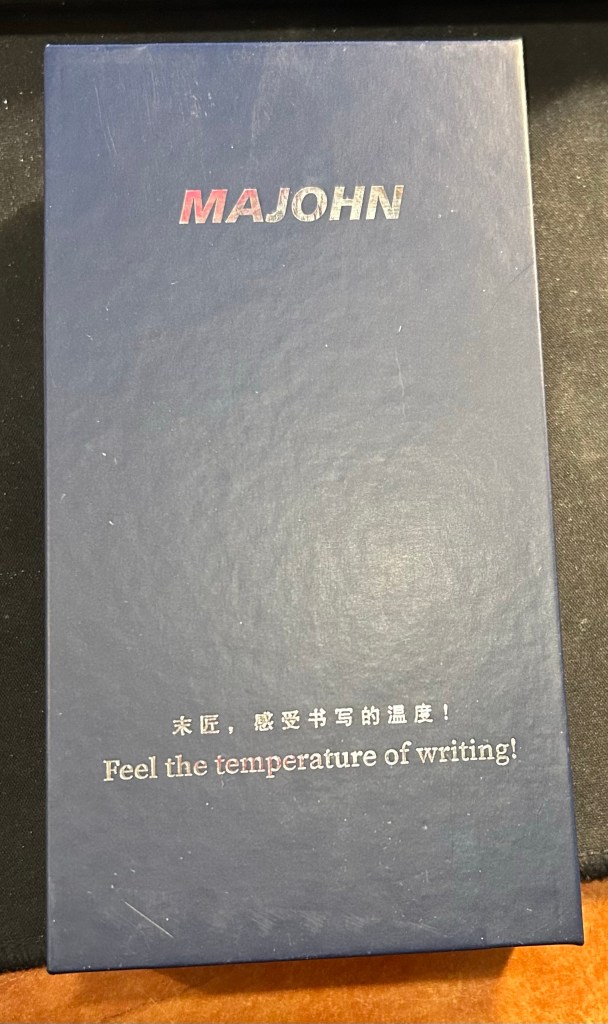
The box. I love the “Feel the temperature of writing!” inscription on it.
I purchased the Majohn Q1 bent nib fountain pen after seeing Paul Heaston use it in one of his sketches. “What is THAT?!” I asked, and immediately set out on getting one. This weird looking fountain pen reminded me of the Tombow Egg pen (google it. I’ll wait), which I always wanted and never got because I couldn’t afford one at the time. The Majohn Q1 appears to have almost the exact same design as the Tombow Egg, with a few minor details in the trim and molding of the grip section. I purchased mine on Amazon for $22.
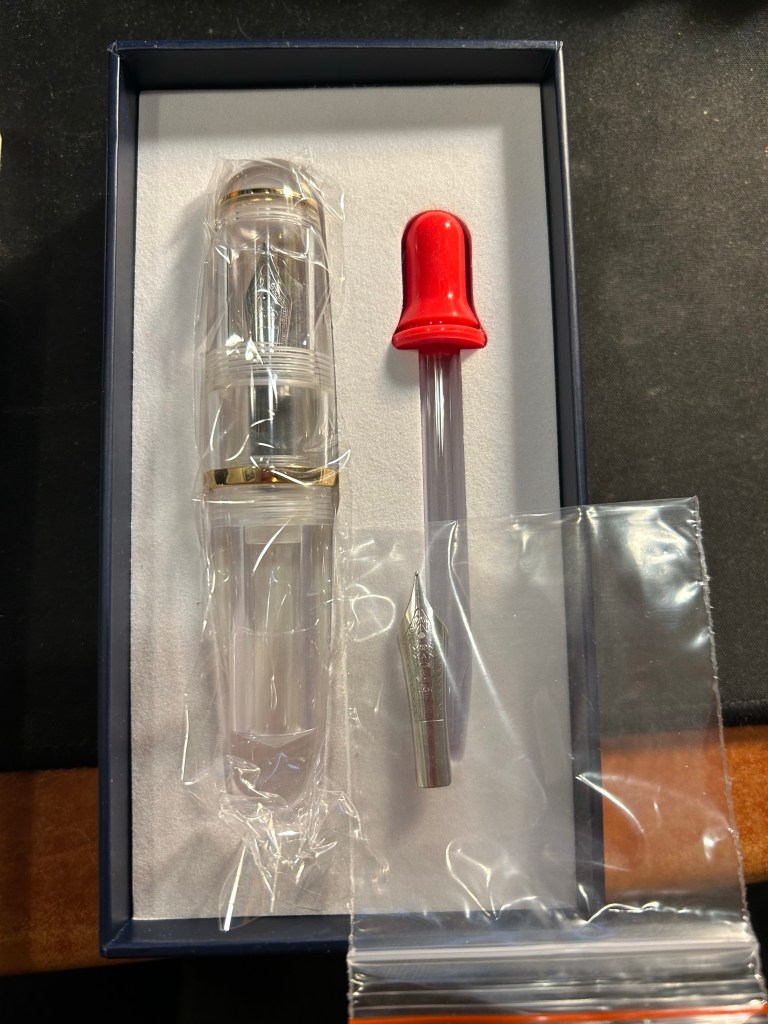
What’s in the box: fountain pen with bent nib installed, eyedropper, and a spare medium nib.
The box the Majohn Q1 arrives in is good looking enough to gift someone. Inside there’s the pen with the Fude/bent nib installed, a spare medium nib (the bent nib is an “aftermarket” installation) and a glass eyedropper that you can use to fill the pen with. The pen itself comes installed with an o-ring so that it can safely be eyedroppered. I filled mine with De Atramentis Black Document ink, which is waterproof when dry.
I filled the pen only to 3/4 and still it holds a tremendous amount of ink, especially for such a small pen.
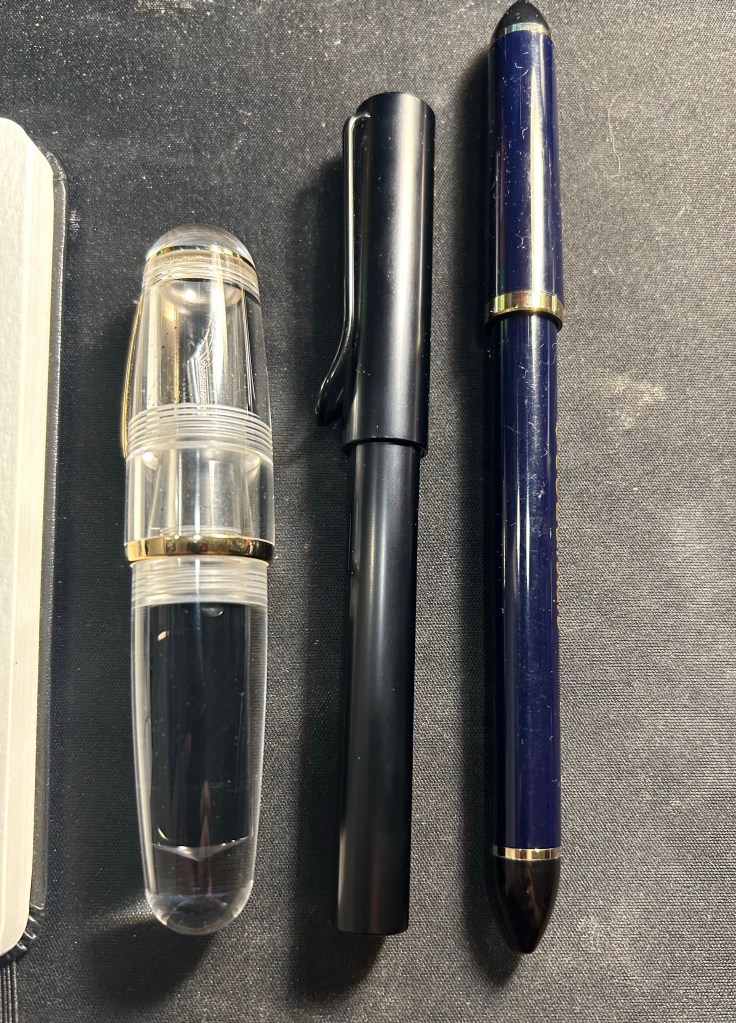
Now the Majohn Q1 is a very small pen, that holds a very, very large amount of ink. That’s why I was interested in it, as I thought that it would be a perfect fountain pen to add to my urban sketching kit. I currently use a Sailor Fude DE Mannen fountain pen for my urban sketching, and it’s a favourite among urban sketchers for the expressive, painterly lines it creates. It is, however, very long and pretty unwieldy: difficult to pack, and sometimes awkward to hold. Here are the Majohn Q1, a Lamy AL Star and a Sailor Fude pen laid next to each other, for size comparison:
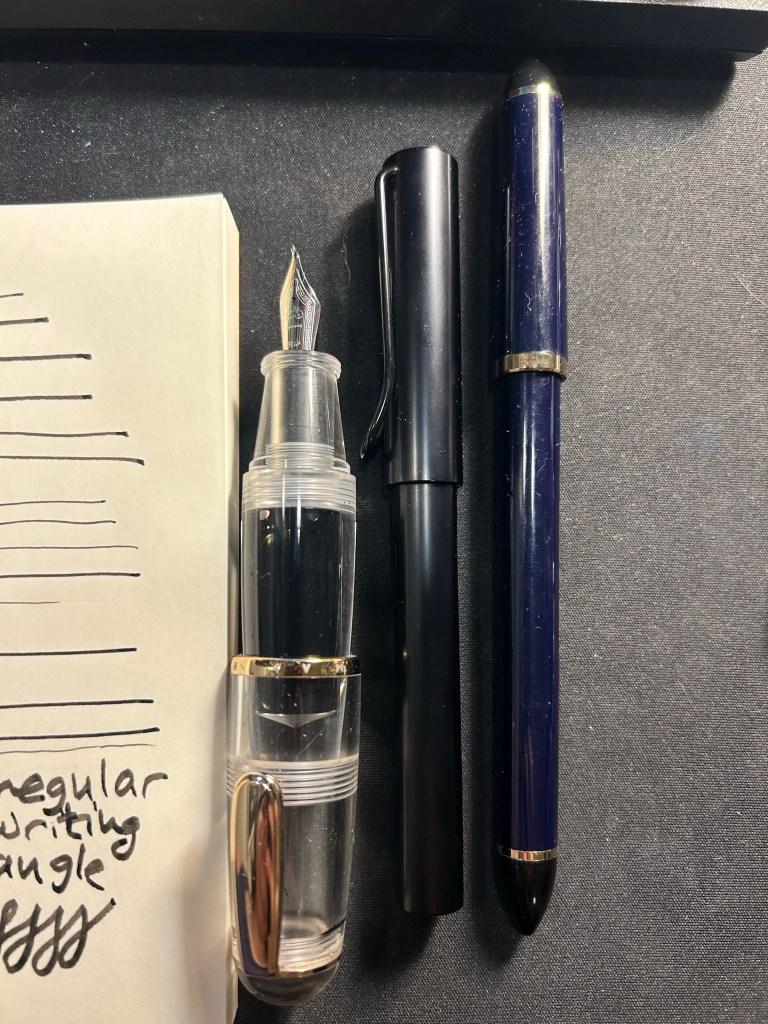
As you can see, the Majohn Q1 is pocket pen sized in length, and very, very wide. It can’t be used unposted, as is to be expected with pocket pens, but once it’s posted, it just becomes an extra wide standard length fountain pen:
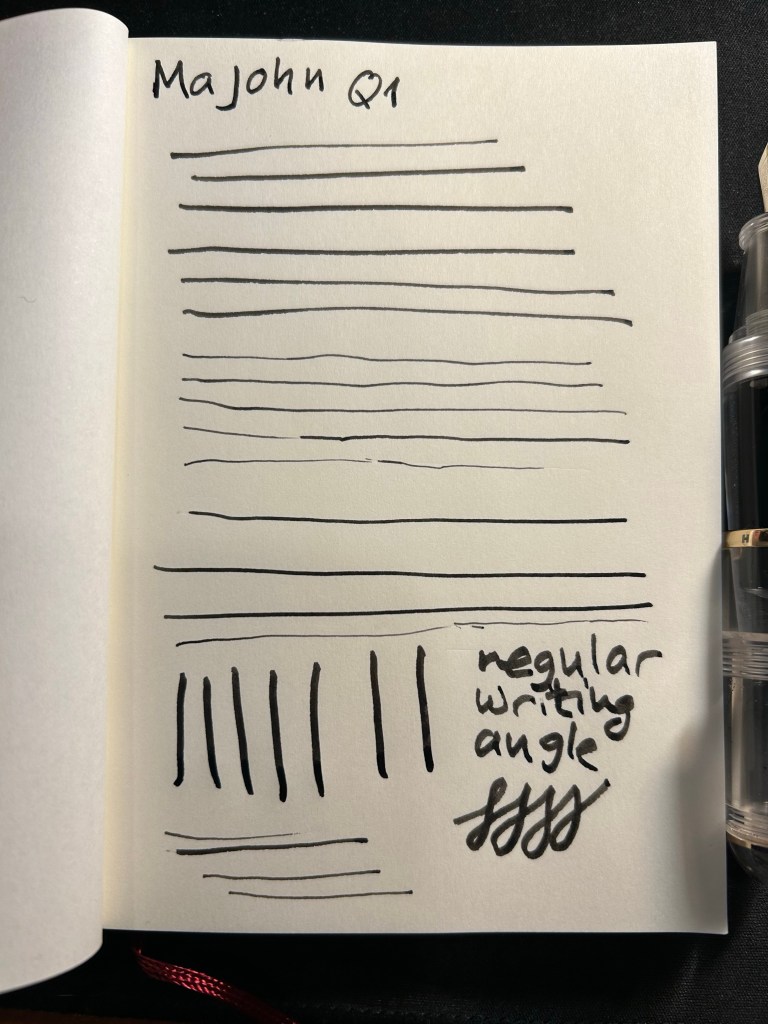
The point of this pen is the bent/Fude nib, so here it is, in all the different line widths it can create:
And here’s the Sailor Fude for comparison:
The Majohn Q1 offers much more line width control and consistency than the Sailor Fude, but you sacrifice some of the painterly quality and dynamism of the Sailor Fude to achieve that control.
The Majohn, like the Sailor, isn’t perfect in terms of gripping experience. While it’s much easier to grip the Majohn in a variety of different angles to get a variety of different lines, there’s a pretty pronounced step between the pen body and the grip section that can be uncomfortable if that’s where your fingers naturally land on. For me, I grasp the pen either closer to the nib, or not on the section at all but rather on the pen body. I’d recommend trying it out first, but for $22, it might be worth it just to buy the pen and try it out for a while.
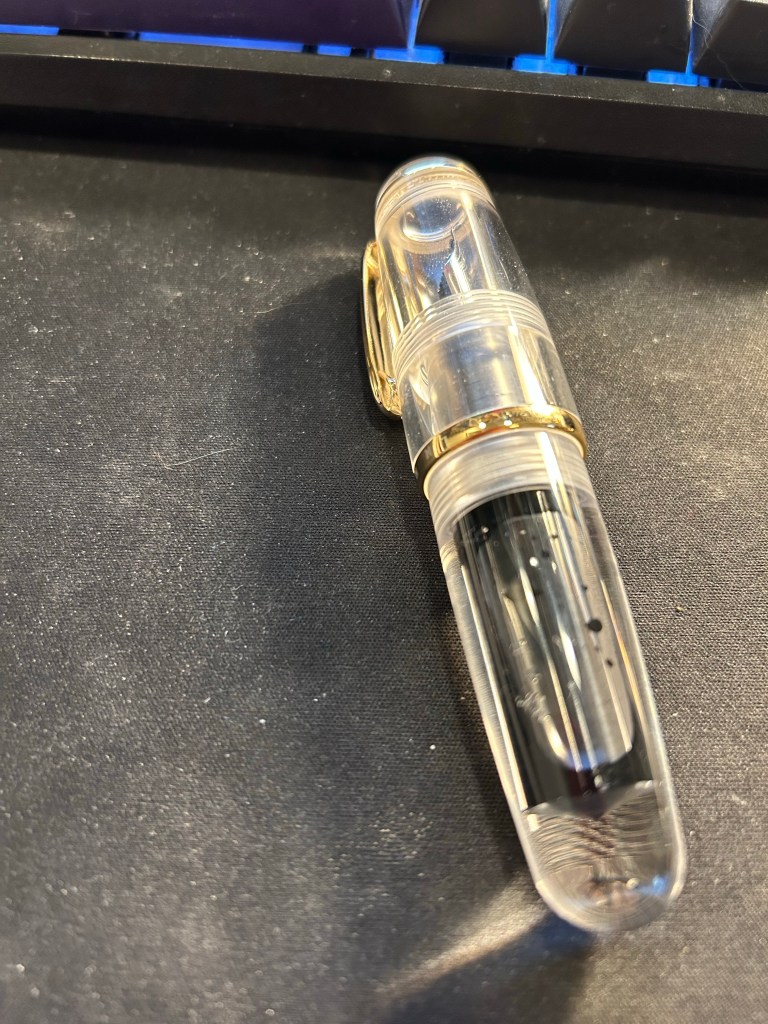
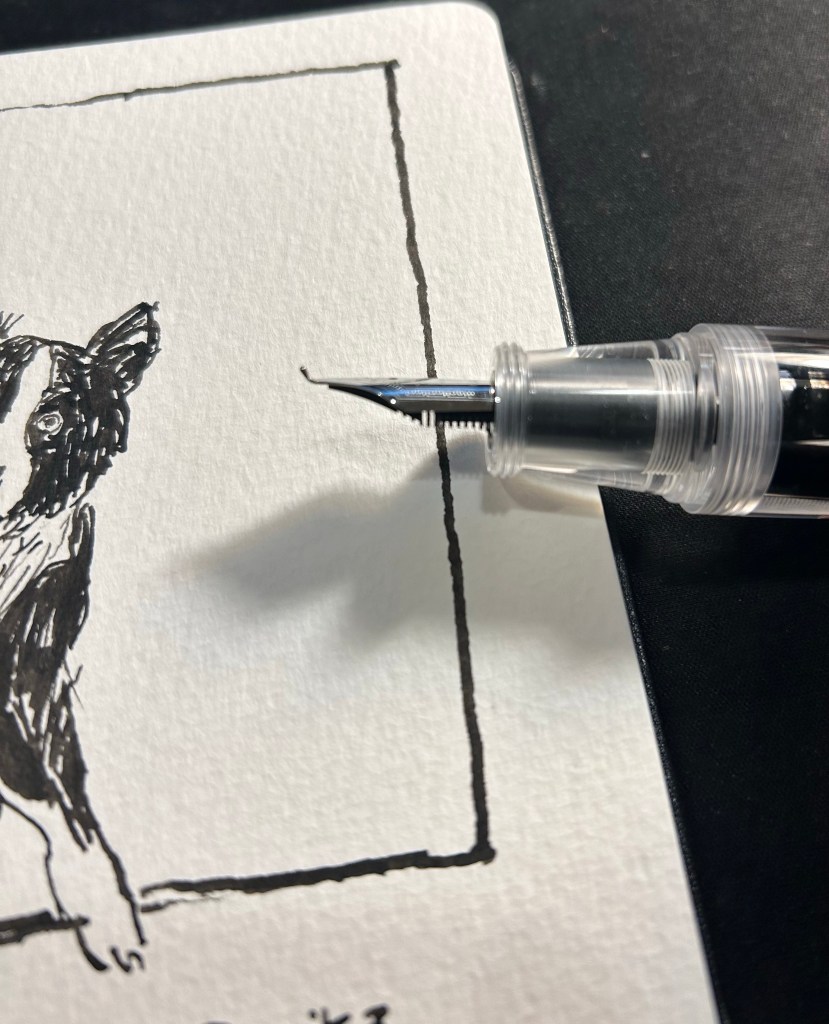
Bent nib and grip section closeup.
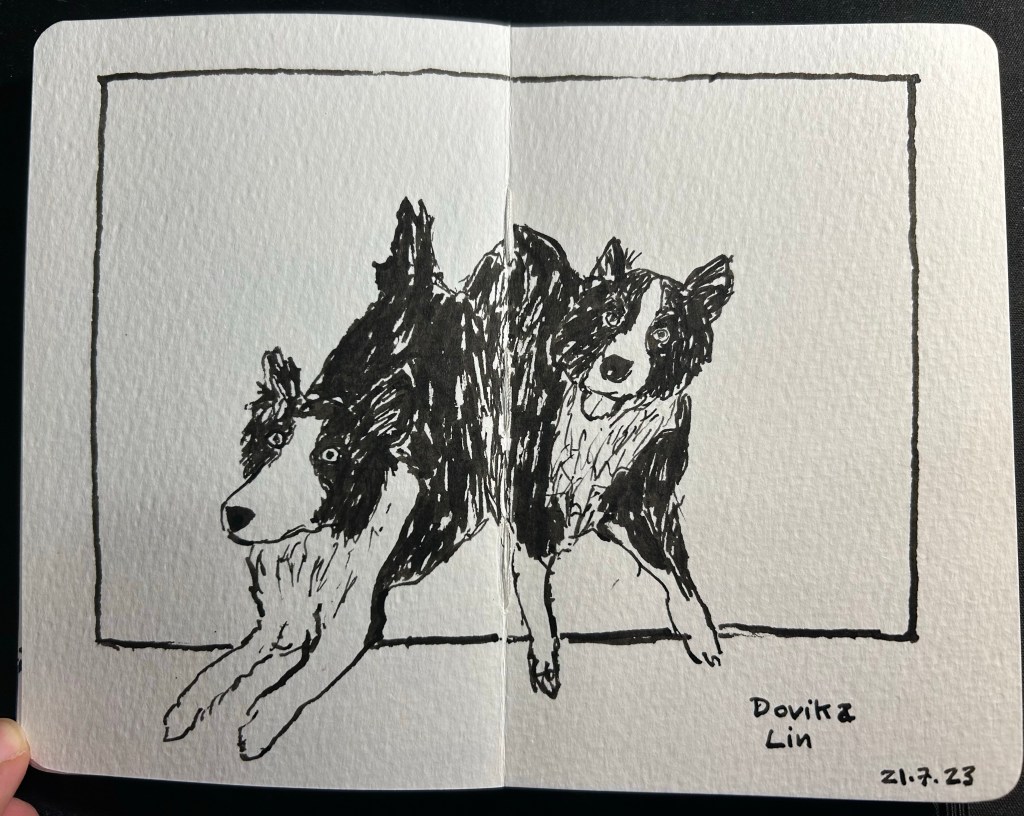
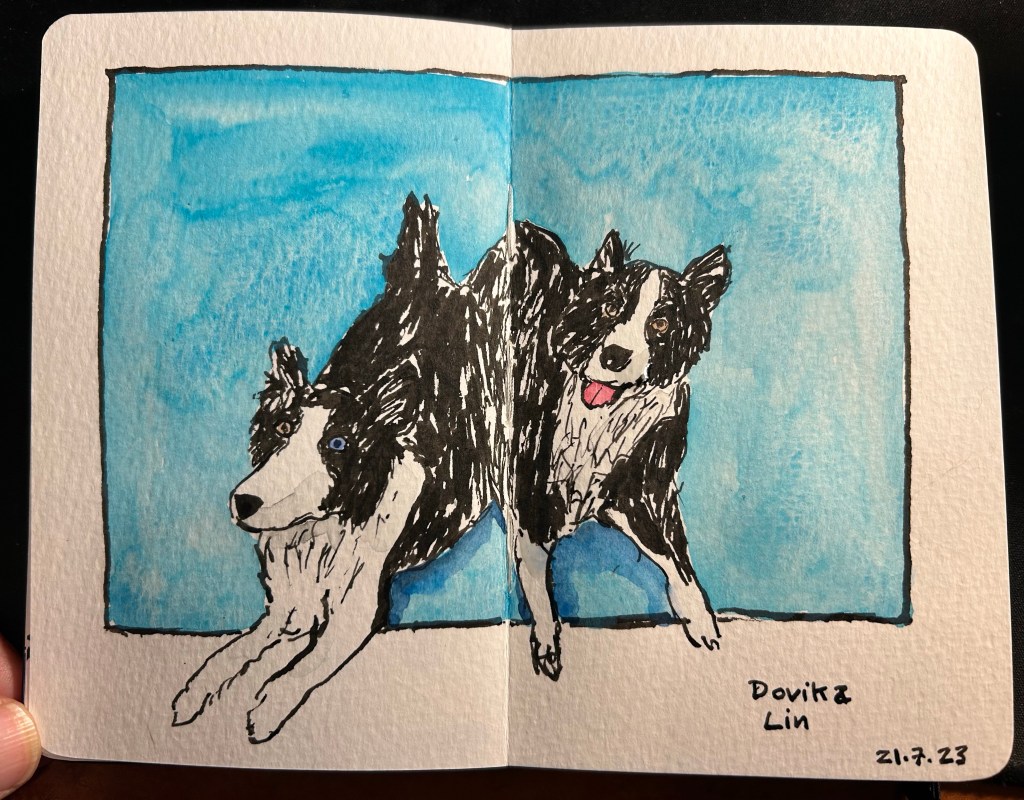
Here’s a sketch of a friend’s border collies sketched with the Majohn. As you can see, it’s relatively easy to get both a good level of control with this pen, a lot of line variation, and some of that painterly quality to the line that makes it more interesting and expressive.
Majohn Q1 bent nib, De Atramentis Document Ink Black, Moleskine Pocket Watercolour notebook.
Here’s the complete sketch, just for fun:
Schmincke watercolours added.
If you’re at all interested in fountain pen sketching, and especially if you are an urban sketcher, I recommend giving the Majohn Q1 bent nib fountain pen a try. It’s easier to control and to transport that a Sailor Fude, and holds a much larger ink capacity, which is great for long sketching sessions or when you need to block out a large section with ink. For such a low price you get quite a lot, and the learning curve is much less steep than with a Sailor Fude DE Mannen fountain pen. I don’t do calligraphy, but I assume that it could be worth a try for calligraphy as well, especially if you are looking for a travel friendly solution. And who knows, maybe you’ll get to feel the temperature of writing while using it…
I went to a very special Urban Sketchers sketchwalk and drink and draw today. The event celebrated the end of a special sketch swap between a group of sketchers in Barcelona and in Tel Aviv, and there were sketchers there from all over the world (Spain, the Netherlands, Canada, India, etc). We met at Gan Meir in central Tel Aviv for a sketchwalk followed by a drink and draw at the top of Libling house. It was hot, it was humid, and I needed a break by the time I got to the garden, so I went to the nearby Stephan Austrian Bakery for a cold coffee and a Sachertorte, a rare but much needed treat.
Coffee and cake.
A lot of people came in to pick up an ice cream cone, including this little fellow:
For some reason he didn’t get any ice cream.
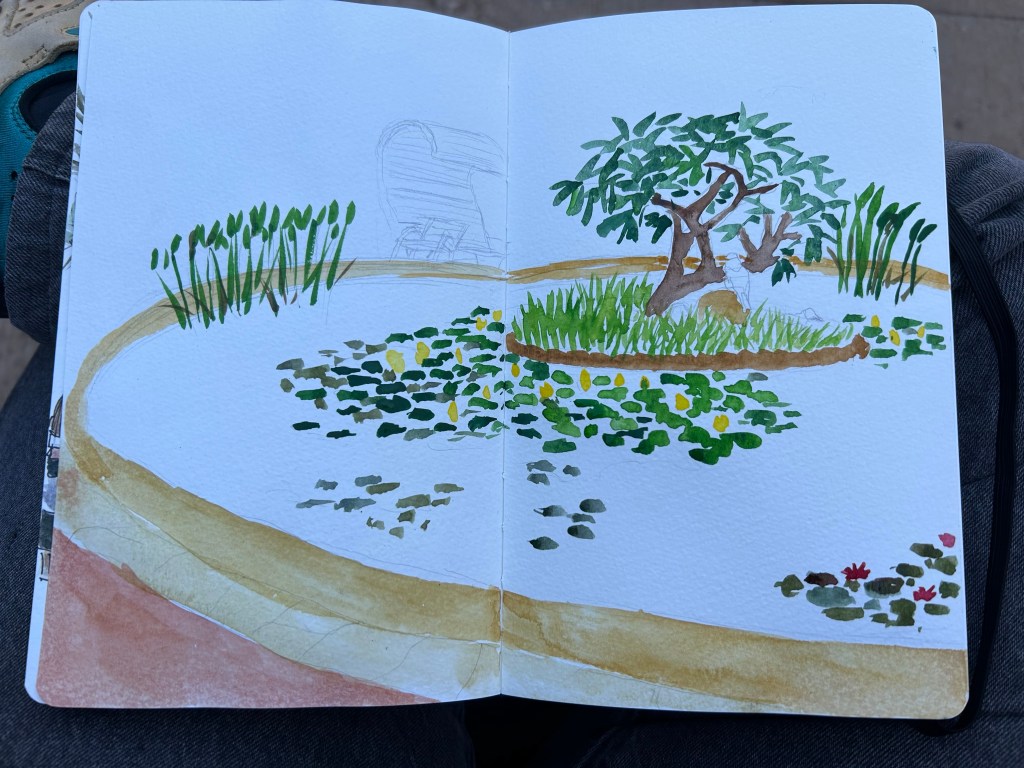
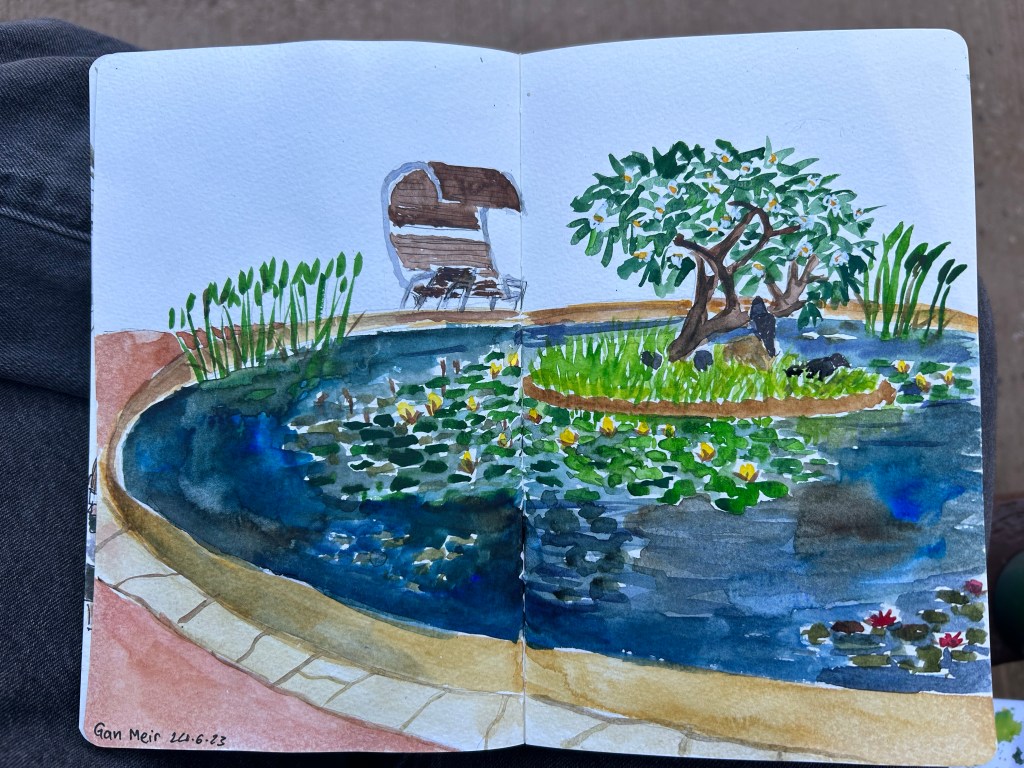
I then went back to the garden and started sketching the waterlily pool:
Work in progress
There was a group of ping pong players nearby, and I got hit by balls several times. I was also visited by several curious children. It’s all part of the Urban Sketching charm.
The waterlily pond complete
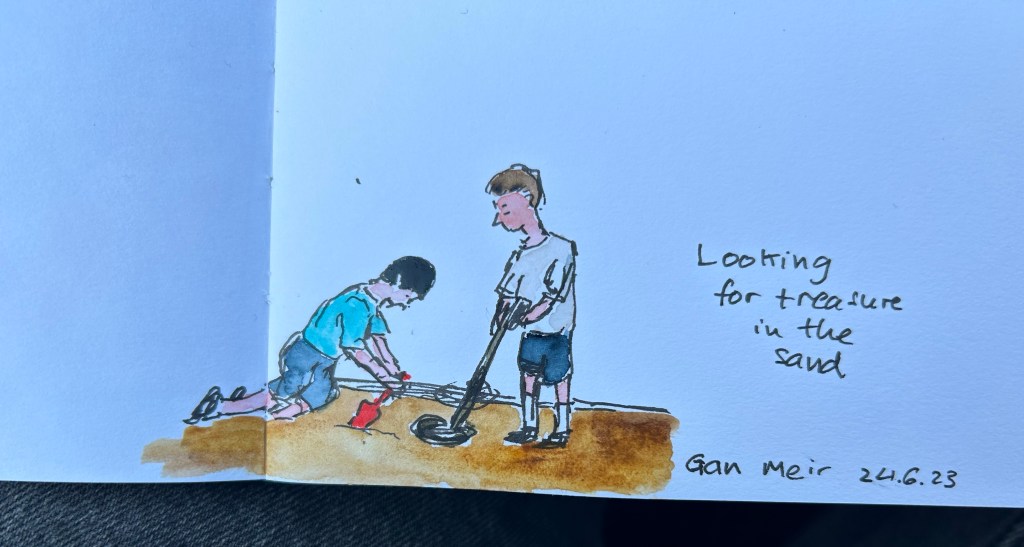
I then saw a group of kids with a metal detector, searching for treasure in the sand, so I sketched them quickly:
Treasure hunters.
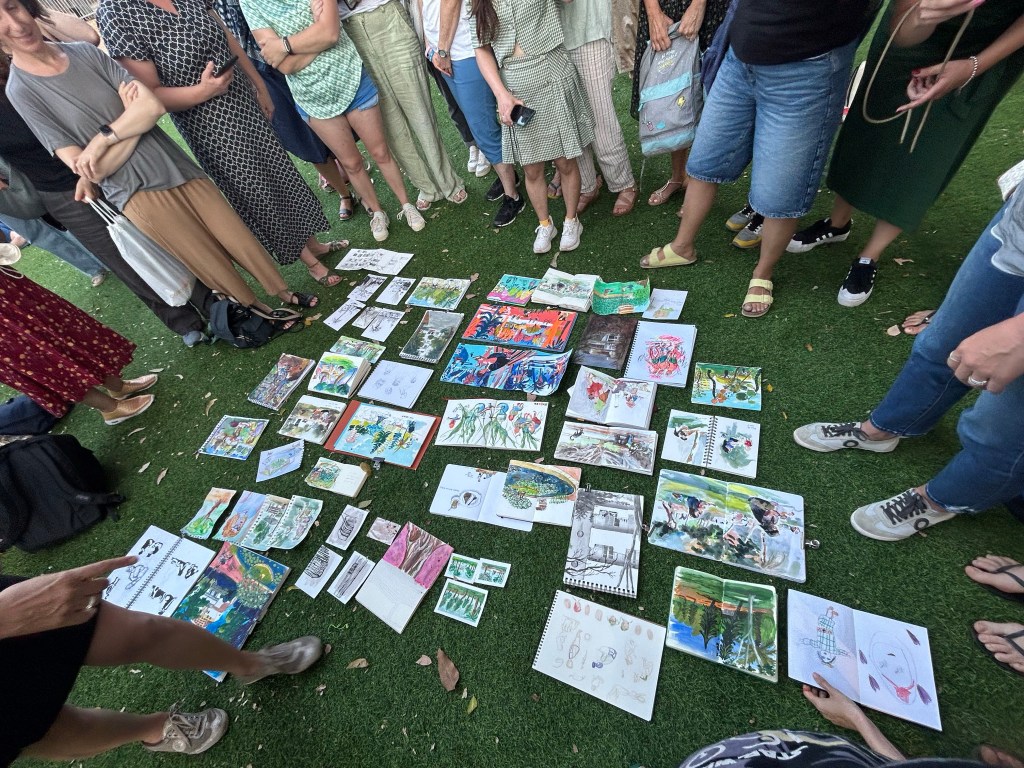
This was our sketchbook throw down, and I loved seeing all the different styles and sketch subjects together,
Sketchbook throw down.
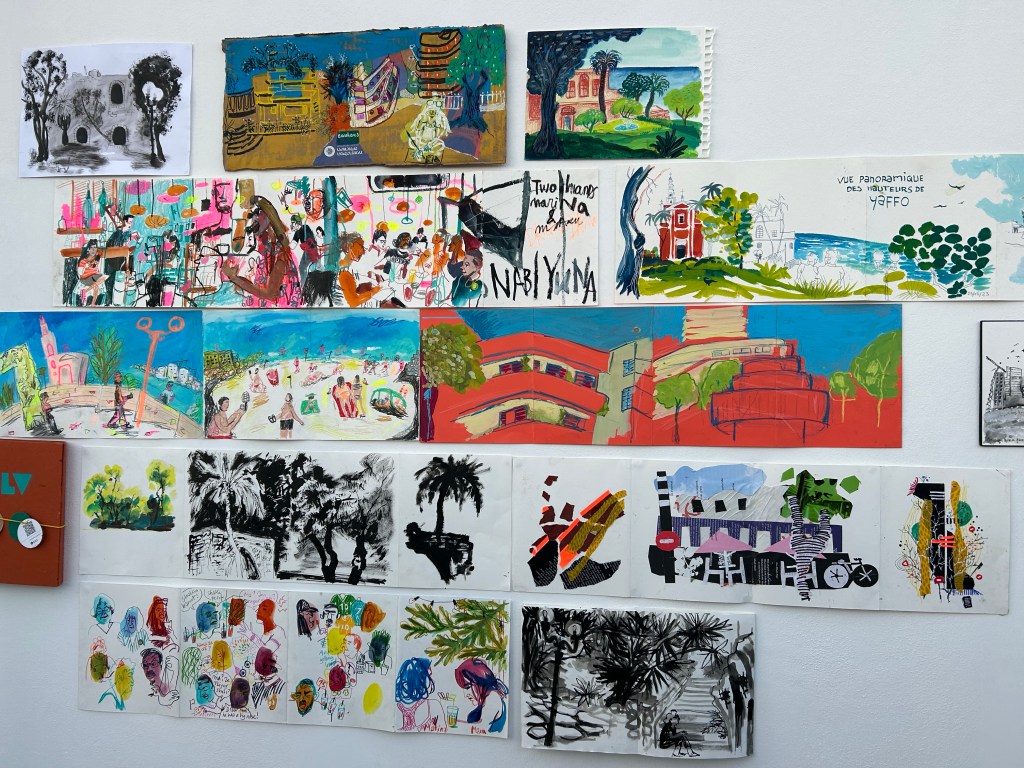
We then went to Leibling House nearby, and there saw some of the sketch swap participants’ work. We had a party on the roof, and I got to talk to sketchers from all over the world, and see so many different sketching styles.
The exhibition
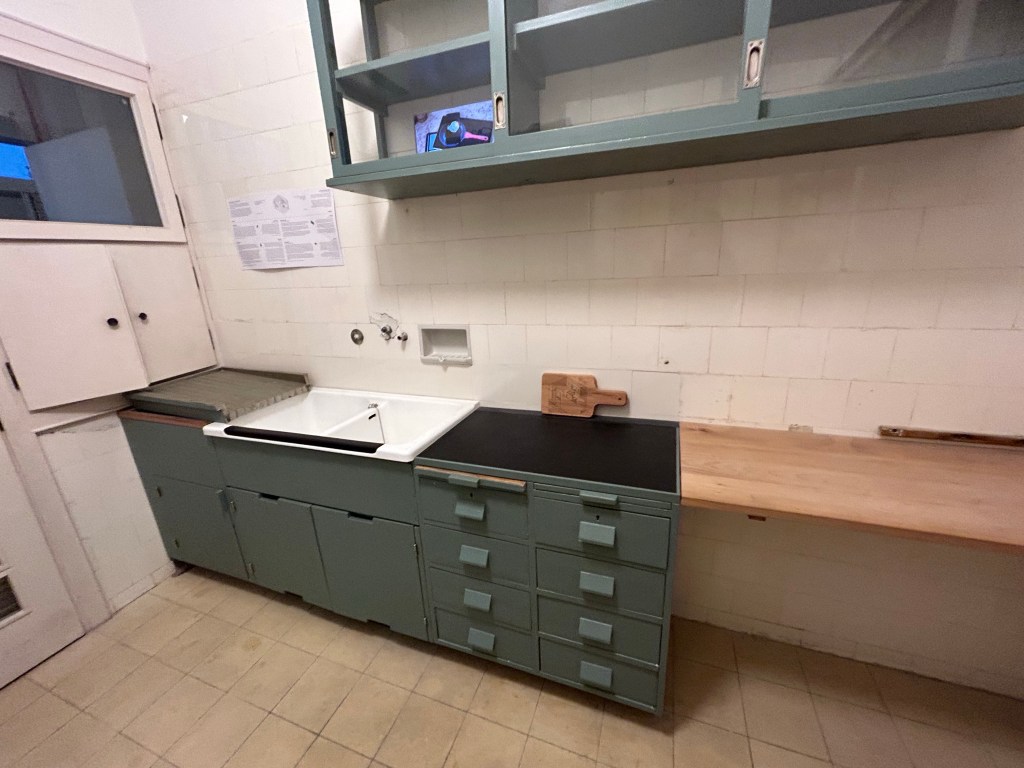
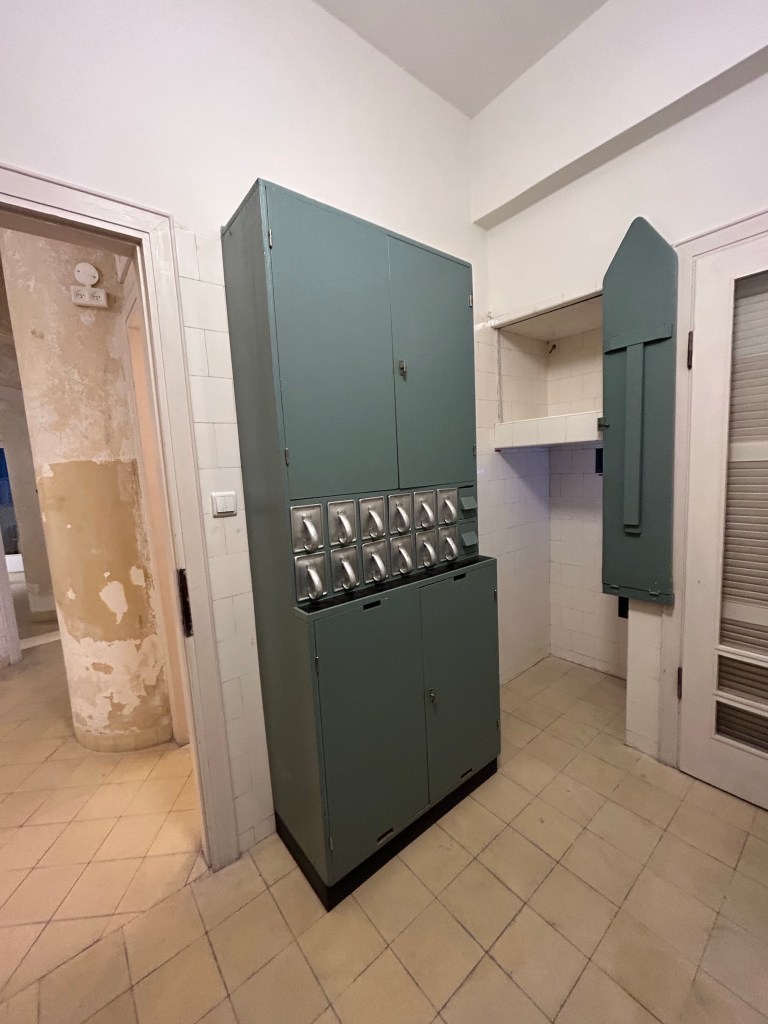
I had to leave early, but I did get to check out Leibling House and see their Frankfurt Kitchen, which is pretty amazing:
Actual storage space, proper sinks for washing dishes and room to dry the dishes.Storage space for dry goods, and foldable iron board. Perfect use of space.
What struck me most is how the sketchers from abroad saw and sketched the same tired old local monuments and tourist attractions. Through their work I got to see them with new eyes, and it made me want to visit them and try to sketch them myself. I also got to see Leibling House for the first time, and I plan on returning to it in the future, as it’s a wonderful museum and exhibition space.











 Writing at Large