Dip Pens Part 1: Some Basics
It’s been a while since I used my dip pens, and since I had a project in mind for them, I thought I’d document parts of it here.
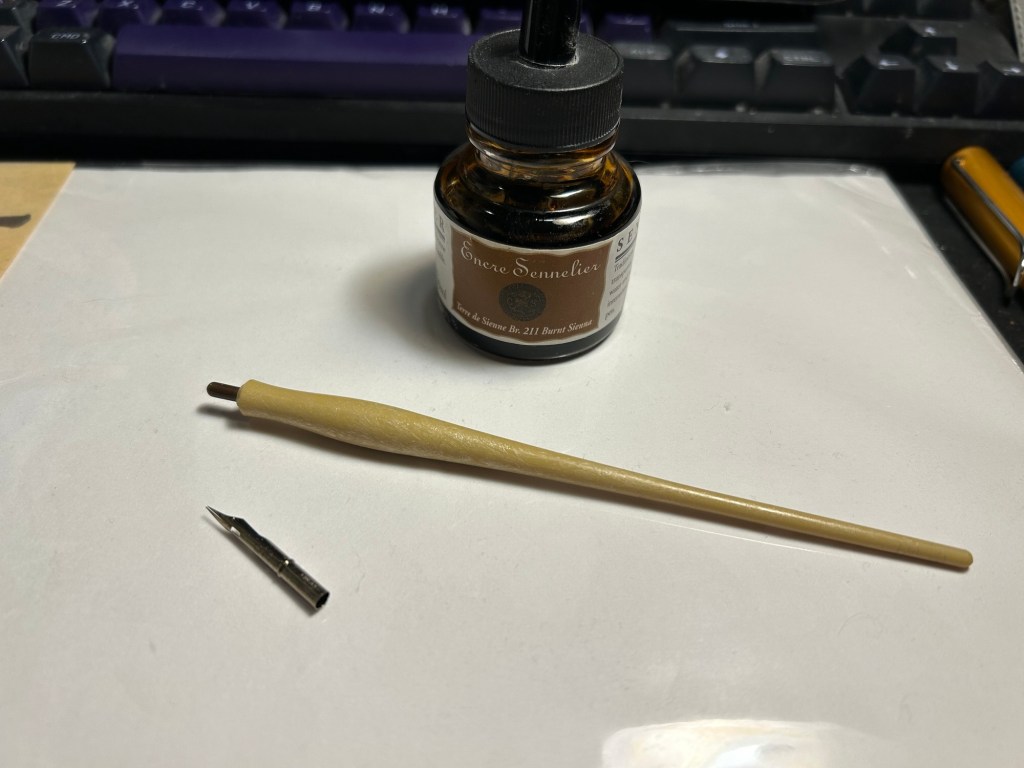
I was looking to draw a map, part of a series of maps for a D&D game. Since I was trying to get a certain look to these maps, I pulled out a mapping nib and a mapping nib holder, and some Sennelier Sepia ink.
The ink is shellac based and meant to be used in dip pens only. If you use it in a fountain pen it will destroy it upon first use. You only need to see how sticky these inks are once to understand that, but most of them helpfully provide warnings on the bottle.
The nib is a Leonardt 801 mapping nib, made in England by the British company Manuscript and purchased, together with the mapping nib holder at Cornelissen & Son in London. They have the largest and best variety of dip nib supplies that I’ve ever seen, and are used by many illustrators and cartoonists. The beauty of dip nibs, however, is that they’re pretty easily and cheaply obtainable. Speedball sells a kit that includes a wide variety of nibs, including a mapping nib, and two holders (a standard one and a mapping one, known as a crow quill).
What’s the deal with a mapping nib? It’s a small, round nib with an end that’s actually a cylinder, and you pop it onto the little peg at the top of the holder. Mapping nibs allow for very thin lines, and yet also a good line variety as the tines are sensitive to pressure.
If you’ve used a fountain pen before and then try to use a dip pen, you’ll likely be surprised by several things. The first is that most dip pen nibs, and mapping nibs in particular, are very sensitive to pressure. The slightest push down will give you more line variation that you’ll get from even the most flexible of flexible fountain pens. The second is that there’s no tipping material. That means more feedback from the page, and that you need to be aware of the directionality of the nib if you don’t want it to snag and spray ink everywhere. This is also why the paper you want to use will be smooth. Smooth surface cartridge paper is your friend.
India ink (the shellac based ink used for dip pens) lays on top of the paper and retains a level of gloss and a dimensionality that you just don’t get with fountain pen paper. You can feel the ink lines with your fingers once the ink dries. The ink dries quickly, and is sticky and staining when wet, so beware of nice clothes and wash your hands well once you’re done.

The nib itself needs to be prepared before you use it for the first time. New nibs are coated in oil and sometimes with wax before being packaged. This prevents them from rusting, and helps them not stick to each other too much as they’re being packaged. If you use a new nib without preparing it, you’ll be disappointed. It will carry little to no ink, and you’ll find yourself dipping the nib again and again. The map above was made with 4-5 dips only, using a new nib, but one that I prepared.
How do you prepare a dip nib? The simplest and safest way (no, don’t take a lighter to it) is as follows: gently clean the nib with water and dish soap (you can use a soft toothbrush if you want, but it doesn’t really require scrubbing) and then put it in cup with boiling water for 1-2 minutes. Then fish the nib out and dry it very, very, very well with a paper towel. You don’t want to air dry the nib at any point or it will rust.
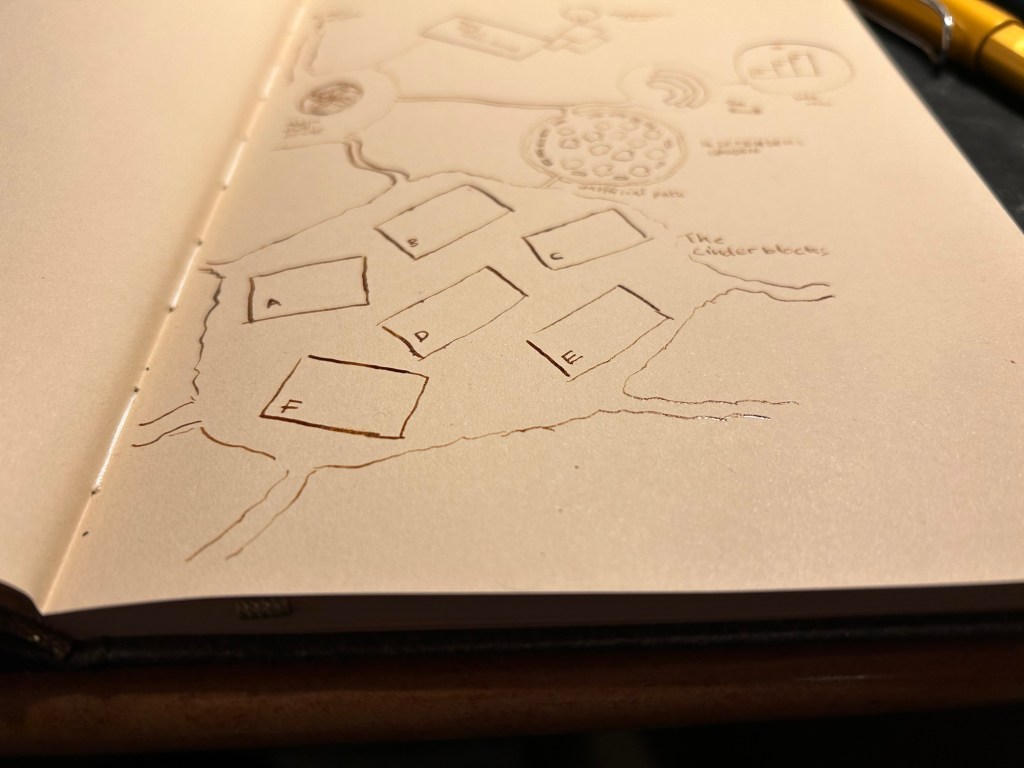
You can use fountain pen ink with dip pens, but I don’t recommend it. Fountain pen ink is thin and water based, so it doesn’t cling to the nib like India inks. You’ll be dipping a lot more often, and your results won’t be as good. If you plan on using a dip pen to test out fountain pen inks, know that your test will only show the colour properties of the ink but not its flow (wet/dry). Also don’t use a mapping nib for that – mapping nibs are best used for small sketches, maps, things that require very thin lines and some line variation.
When I work with a dipping nib I keep the nib constantly wet with ink (not water!), and immediately when I’m done I either wash the ink from the nib and dry it very well, or I wipe the ink off with a cotton rag if I just plan to take a short break. Ink left to dry on the nib may clog it (particularly with mapping nibs), and soaking a nib in water will cause it to rust.
You may find dip nibs in flea markets for very cheap, usually in a pile in a little box. Check if they aren’t rusted (don’t buy rusted nibs), and then clean them as you would a new nib (water, soap, heat).
I’ll be going over various kinds of India inks and various kinds of nibs in future posts, but in the meanwhile if there’s anything that interests you in dip nibs let me know in the comments.


 Writing at Large