Moleskine Fall 2019 Catalog

Moleskine has issued their Fall 2019 catalogue and it’s even more interesting than their Spring 2019 one. As usual, here are the highlights:

  • Classic Notebook Expanded. Johnny Gamber will be happy to see that these are staying on. 400 pages of goodness, which are for some reason also offered in soft cover. <shrug>
  • Classic Leather Notebooks. These got wider release (not just Barnes and Noble) and get more vibrant options besides Black —  Amber Yellow, Forget Me Not Blue, and Bordeaux Red. They feature thicker, 100gsm paper (as in the Two-Go notebooks), and are fountain pen friendly (as are the excellent Two-Go notebooks), but come with 176 pages instead of the regular 192 (soft cover) or 240 (hard cover).
  • Two-Go. These just got a colour change to one of their ribbons (it’s white now).
  • Blend Collection. Four new fabric designs/colours in the FW2019 Blend collection that are added to the four new fabric designs/colours in the SS2019 Blend collection. The covers on these are phenomenal and Baron Fig has a lot to learn from Moleskine when it comes to using fabric. These are still only offered with ruled paper, which in some ways makes sense (still what Moleskine sells the most) but I wish that they at least offered them in one other kind of ruling (dotted?). These all look smart and professional, and they do have a more “wintery” look to them.
  • Planners/Diaries. Fall is the time of year for these and Moleskine offers a LOT of them, in various colours and designs. This year’s limited editions are Alice in Wonderland, Star Wars (so, so pretty), Le Petit Prince, Dr Seuss, and Doraemon. My guess is that the Alice in Wonderland and Star Wars ones will sell much faster than Le Petit Prince or Dr Seuss, so if you like them, pre-order them.
  •  Limited Edition Notebooks. My favourites! Let’s dig in, shall we?
    • Harry Potter. The Boy Who Lived keeps getting new limited editions and that’s not really surprising. What is surprising is that Moleskine is coming out with 7 (!) Harry Potter notebooks, one dedicated to a pivotal moment in each book, with four coming out this year and three more coming out in Spring/Summer 2020. All the notebooks share a design language, and the four that are coming out this year are very good looking. The very popular Marauder’s Map edition is getting a fresh take as part of a limited edition, numbered box with a poster as an insert (something that Moleskine hasn’t done for a few years now).
    • Star Wars. Also not the first limited edition for this franchise, and this one has everything I look for in a Moleskine Limited edition. Somebody really thought about the design, the quotes, the colour scheme, and they’ve managed to create a nostalgic feel for a Sci Fi themed notebook.
    • Dragon Ball. THE FIRST DOT GRID LIMITED EDITION, you guys! Who’s excited? I’m excited! Is there anything else that needs to be said? (OK, quickly then: four notebooks, two ruled, two dot grid, really well designed, and there’s a chance that the covers are cloth covers, which gives the whole edition 10,000 more points in my book).
    • David Bowe. I kind of expected Bowe to get a limited edition before Bob Dylan, but Dylan got his in the spring. I think that these are nicer than the Dylan notebooks, but I really need to see one without the paper band to tell.
    • James Bond/007. Moleskine’s second attempt at making a 007 notebook and overall it looks better. Two notebooks, one blue and one black, with the 007 logo and the iconic swirling gun barrel, a secret code table on the B-side of the paper band and a themed sticker sheet. Simple but effective.
    • Year of the Rat. Chinese New Year! It’s nice to see Moleskine trying some new and interesting things with their limited editions, and these are puh-retty! Two notebooks (one red and one blue) and one boxed notebook (not numbered), each with 2 lucky red envelops, and all of them very well designed. Simple, evocative, beautiful.
  • Watercolour Blocks. These are interesting but a little strange. Moleskine’s appeal has always been that they are one of the few to offer halfway decent hardbound watercolour notebooks that can be used on the go. There’s a lot of fierce competition in the watercolour pad market and I really don’t understand what Moleskine are doing there. Waterford, Canson, Strathmore, Bockingford, Windsor Newton, Daler-Rowney, Fabriano, and even Clairefontaine offer artist grade and student grade watercolour pads. Why buy Moleskine’s, especially when they still offer only 35% cotton paper?
  • Log Book. I assume that this was created with the Bullet Journaling crowd in mind, but the dotted paper, index, numbered pages, thicker paper, pen test section, flap and double ribbons will have a wide appeal.
  • Voyageur. This popular, themed notebook is getting two new colours: Hibiscus Orange and Elm Green.

That’s it for me. I’m not interested in the “Smart” stuff or the accessories, and there’s enough here as there is. It looks like 2019 is going to be an excellent year for Moleskine, and I can’t wait to get my hands on several of these notebooks.
 

Tournament of Books: House of Broken Angels

I finished reading the last Tournament of Books  novel a few weeks ago, but I waited with the review until I could gather my thoughts about the whole experience. That’s a little unfair to what’s turned out to be one of the best books in the tournament, so my apologies to Urrea. The “The House of Broken Angels” by Luis Alberto Urrea was up against “So Lucky” by Nicola Griffith in the sixth round of the competition.

To call “The House of Broken Angels” heartwarming seems somehow insufficient. It is a heartwarming tale of a man celebrating the last days of his life with his extended family. It’s also an immigrant story, a story of overcoming abuse, poverty, racism, and your own preconceptions even when you’re on the verge of death. It’s a story of one generation passing the torch on to another. It’s a story of women finding their voice in a world of men. It’s a story with tremendous tragedy and a lot of humour. It’s a story about the poetry of everyday life.
But most of all it’s a story of family and love, created without cynicism or cliche: unique, realistic, flawed, and intensely powerful.
In two days life, in its mundanities and most profound and heroic moments, unfolds before your eyes and leaves you at times laughing, crying or merely breathless with anticipation. Urrea moves you from past to present, from one character to another, effortlessly and seamlessly. It’s one of the few cases that I’ve seem where a complex narrative structure feels like a light read simply because it’s so well created.
This is a must read, especially these days, when the Mexican and Latino population in the US is constantly under attack.

There’s not much in common between “So Lucky” and “The House of Broken Angels” apart from them both being centred around people who have fallen seriously ill. “So Lucky” deals with the first days of dealing with illness, and the “The House of Broken Angels” with the last. The protagonist in “So Lucky” is a lone woman, and in “The House of Broken Angels” it is a man surrounded by a large, loving family. The trick lies in reading the acknowledgements in the end, as it is then that you discover that both narratives are based on the true life experiences of the authors. That adds impact to the stories in some ways, but I think that it mainly creates a level playing ground where they both have a similar gravitas and you can simply judge them by their merits. I highly recommend reading both, but that being said “The House of Broken Angels” is a much better work of fiction. It’s also more enjoyable to read despite its oftentimes tough subject matter, and unlike “So Lucky”, it’s a literary novel and a story of its time that is also timeless. Imagine comfort food that isn’t boring and provides you with all your daily nutritional needs and you’ve got “The House of Broken Angels”.

Have you not read it yet, mijo?

Tournament of Books: There There

There There” by Tommy Orange was originally going to be the last Tournament of Books  novel that I read, but because “The House of Broken Angels” was delayed by the post office, it turned out to be the penultimate book to be read. It was up against “America is Not the Heart” by Elaine Castillo in one of the toughest rounds to judge, at least for me.

Wow this book was quite a ride. There are 12(!) protagonists in this book, and a good deal of the subject matter is difficult, but the challenge is worth it. The stories of several Urban Indians converge as they gather to celebrate the Great Oakland Powwow.
Are all the characters necessary? No. But most of them are, and the story that emerges, of urban Native American life is worth reading. It’s a tight-knit and small community so there are a lot of ties between the various characters, and it could have been a very small, very anecdotal story if not for Orange’s moving interstitial background passages. The tragedy of the characters’ lives is made manifest through these pieces, and the result is not unlike a patchwork quilt, where a lot of small parts make a beautiful, interconnected whole.
Not an easy read, well worth your time.

Tournament of Books: The Mars Room

The Mars Room” was the book that I most dreaded reading once the final list of the Tournament of Books 2019 contest was published. The story of a stripper sentenced to three life sentences in a California prison for killing her stalker didn’t seem like the kind of reading that I’d enjoy. In some ways I was right — this wasn’t a fun read. What I hadn’t anticipated was being moved and touched by a story not so dissimilar from those that I’ve recently read and heard about in the news or in “This American Life”.

“The Mars Room” is about as far from light reading as you can get. It’s gut-wrenching. It’s violent. It’s relentless. It’s excellent.
We are living in a time where at least in parts of America there seems to be a growing awareness of the failings and injustices of their criminal justice system. There are a lot of non-fiction pieces coming out now that are bringing to light the toll mass incarceration, the “war on drugs” and prison privatization have taken on communities. So why read a work of fiction, no matter how well researched, when you can read an article or a book, listen to podcasts or watch documentaries on the American criminal justice system and the people at its mercy?
Because Kushner lets you into Romy’s mind, into her fellow inmates minds, into her victim’s mind. You see the people working in the system and incarcerated in the system as intimately as you possibly can – their mistakes, the tragedy of their lives, their big and small moments, their cruelties and their kindnesses. They aren’t opaque any more, they aren’t invisible. You get to see not only the systems of poverty, injustice, racism and abuse that started them on their respective journeys to prison, but you get to see them, to experience them as full human beings. That’s what makes it so terrible, and such a great work of fiction to read.

Tournament of Books: The Golden State

I finished reading the eleventh Tournament of Books 2019 book, Lydia Kiesling’s “The Golden State“, which is running against Jesse Ball’s “Census” in the fourth round of the competition.

You would be forgiven if you read the premise of “The Golden State” book and thought that you are about to read an “Eat, Pray, Love” kind of book. This is nothing of the sort. Kiesling has written an intensely realistic and touching piece about loneliness, particularly female loneliness.
The heroine of “The Golden State”, Daphne, is a young, neurotic mother to a precocious 2 year old, left alone due to the machinations of the US Immigration system. The daily grind at her unfulfilling job finally makes her snap, and she decides to take her toddler and run back to Altavista, where her late grandparents lived. The narrative follows her through the 10 days of her escape. So far the “Eat, Pray, Love”.
Daphne is a victim of a society that does nothing to help young mothers (except pile guilt and anxiety on them in the form of study after study), especially young mothers who marry outside the tribe. She is caged in a pointless job that is full of daily humiliation, but the money is “good” (not good enough for SF) and the health insurance… She has no friends, no family, nothing of interest in her life except her daughter, who she can’t afford to spend time with. Her husband and his loving family is in Turkey, and apart from skype calls, she has very little chance of seeing them any time soon. No wonder she snaps.
Altavista is no paradise, and isn’t portrayed as such. It’s a semi-deserted place full of angry white people, only a handful of which remember Daphne and her grandparents. She has unknowingly fled to the only place where she could be more lonely than she was back home. So when an old lady who visited Turkey one time befriends her, she can’t help but reach out.
This novel would not work in any place but today’s US. It’s a novel of time, place and character more than plot. Every breathless rush to change diapers or calm a screaming toddler becomes momentous once you realize just how alone Daphne is, just how alone the society she lives in wants her to be.
The novel is interesting, fresh, sharp and well written, and it beautifully breaks down large political ideas to small, everyday encounters.

This book is running against “Census” in the fourth round of the Tournament of Books, and though they have very little in common apart from being stories about single parents and their children out on a trip, it was not hard for me to pick “The Golden State” as a winner. It’s a better book in terms of writing accomplishment, and it has much more heart than “Census”. I highly recommend skipping “Census” entirely, and reading “The Golden State”. It’s a very good piece of contemporary fiction.

Westinghouse No. 2 Pencil: Not a Review

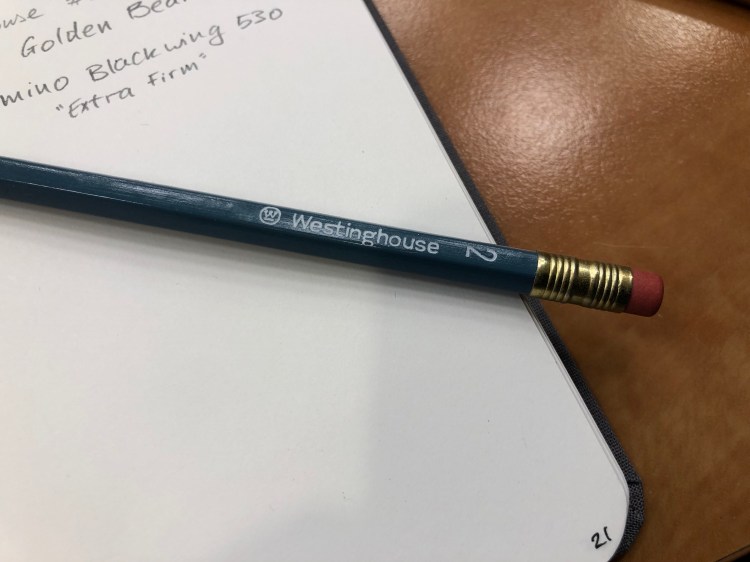
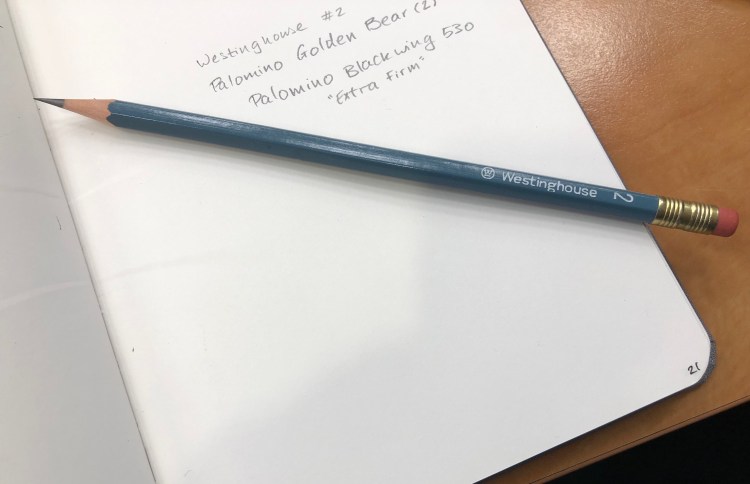
I just started using a vintage Westinghouse number 2 pencil, instead of the Palomino Blackwing 530 which reached the Steinbeck stage. There’s no point in reviewing a pencil that isn’t widely available, but I got a pack of these on eBay for a pittance and they are excellent pencils, so if you’re looking for great, super cheap pencils and don’t mind petrified erasers, give branded vintage pencil listing on eBay a try. You never know what you’ll find.

Tournament of Books 2019: America Is Not the Heart

I just finished reading the third Tournament of Books 2019 book, the final play-in contestant “America Is Not the Heart” . It’s up against “Speak No Evil” and “A Terrible Country“, which are both excellent books that I highly recommend that you read, and I’m pretty sure that it’s going to win.

“America Is Not the Heart” is an immigrants’ tale, a romance, a family saga, and a bildungsroman met in a Filipino restaurant and “America Is Not the Heart” came out.
Ignore the reviews that say that this is a difficult or confusing read. The characters have flashbacks every once in a while. That’s the big challenge of reading this fascinating book, full of rich characters and interesting glimpses into the history, culture and lives of Filipinos both in the Philippines and in the US. It’s a also a touching love story (with some pretty graphic sex scenes), a story about the importance of family, especially the one that you create for yourself, and a story about women overcoming PTSD (whether it’s from growing up starving poor or from being held captive and tortured in a military camp for two years). What’s amazing is that the result is an interesting book with a lot of heart that you just can’t put down, despite the tough topics it deals with. It’s a testament to the skill of Castillo that she manages to pull all that off, and in her first novel too.


Tournament of Books 2019: A Terrible Country

I just finished reading my second Tournament of Books 2019 book, the play-in contestant “A Terrible Country“. It’s up against “Speak No Evil“, which I’ve already read and was excellent, and “America is Not the Heart,” which I’m about to start reading. I’ll comment which of these three needs to win this round once I finish reading “America is Not the Heart,” but I can already tell that it is going to be a very hard decision, and I don’t envy the judges.

It’s very rare to find a book that is so stylistically innovative, and yet so readable, so familiar that it’s kind of like an out of body experience to read it. This novel is a work of fiction that reads entirely like a memoir/travelogue written by the main character Andrie. It’s so convincingly well done that several times I checked the author’s name and the book description to make sure that it was a work of fiction that I was reading.
This feat of technical mastery is entirely at the service of a moving and relatable plot, wherein a young American man, completely out of depth, tries to take care of his 89 year old grandmother in Putin’s Russia circa 2008. It’s the heroics of everyday life, with its triumphs and tragedies, enmeshed in memories of the Soviet past, great Russian literature, and the dangers of living in such a terrible country, and it is well worth the read.

Paper for Fountain Pens Notebook Review

Back in the (not so good) old days, Tomoe River Paper was an exotic kind of paper available only in bulk order from Japan, or through various indie creators that advertised mostly on the Fountain Pen Network. The magical paper that made all your inks shine (not literally, this was in the pre-sparkle days of ink, when shading is all we dared dream of in an ink) was very hard to obtain, and very expensive.

It was at that time, in 2013, when I was looking for reasonable priced Tomoe River Paper notebooks that could be shipped to Tel Aviv, that I ran into Paper For Fountain Pens, through the Fountain Pen Network. Since I just received my latest three-pack of notebooks from Jay at PaperForFountainPens.com, I decided that now would be as good a time as any for a review.

The notebooks that I ordered are the larger, 374 pages (187 sheets), ones, which are available only around this time of year. The regular notebooks have 320 pages, but are otherwise identical. Jay uses 52 gsm Tomoe River Paper for the notebooks, which are 4 3/4 x 8 3/8 inch page size; 5 1/4 x 8 1/2 inch cover size.

The notebooks used to be shipped with a paper cover, now they arrived vacuum packed as well, to protect them from the elements, and in a heavy duty box that prevents them from getting damaged by the postal services of the world.

Vacuumed packaging.
Paper wrapper.

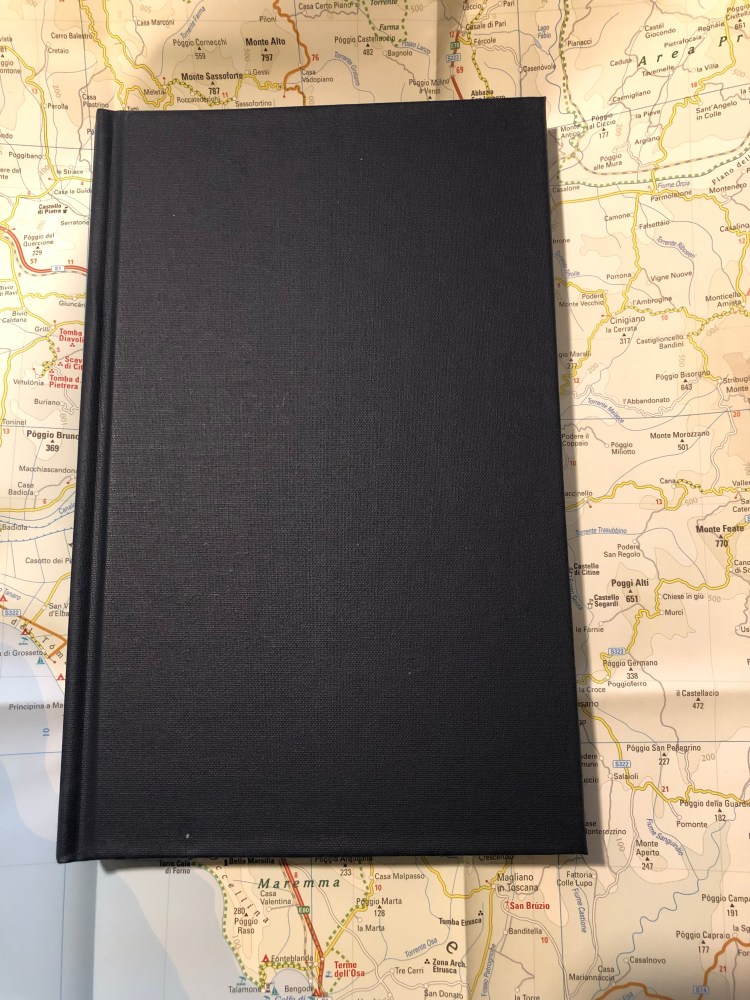
Tomoe River Paper is much easier to find now and these notebooks aren’t cheap, as you are paying for the binding. The covers are very durable, made from a material that (with the binding) makes the whole notebook look and feel like a vintage hardcover book. It has that solid, over-engineered feel to it, and is very pleasant to use and hold.

The notebook isn’t inconveniently thick, even with the larger page count.

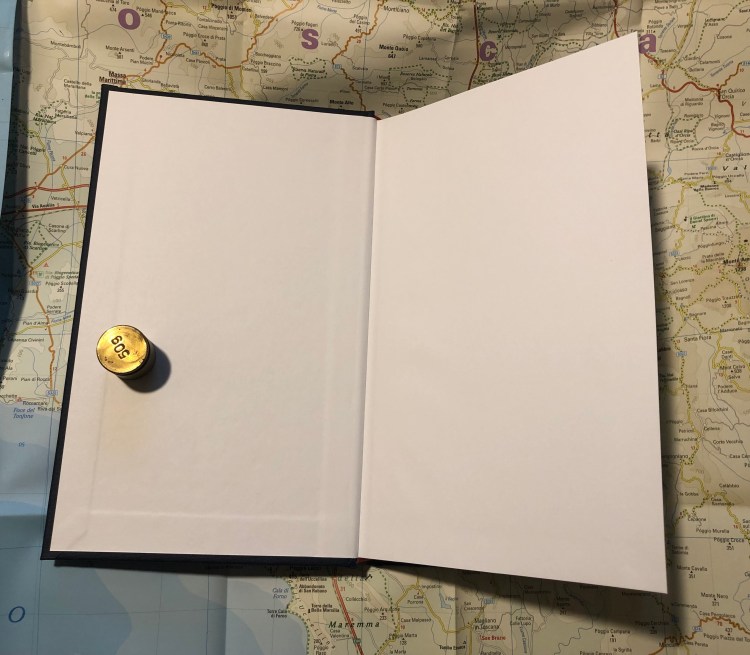
There are no frills to this notebook, just blank end papers, no elastic closure or bookmark, nothing but the paper and the covers. The pages lie flat, and the binding is extremely durable (I page a lot, a lot in my Paper for Fountain Pens notebook and not a page has wavered in my years of using it).

The front endpaper 

I’ve used the slimmer version of this notebook as a research notebook for my novel and it has held up well through years of use. I do, however, only keep it on my desk. Travelling with such fragile paper in a notebook with no elastic closure is a recipe for disaster, so if you do intent to use one of these beauties as your everyday carry notebook or journal, I highly recommend placing it in some kind of protective cover that you can zip up.

The back endpaper

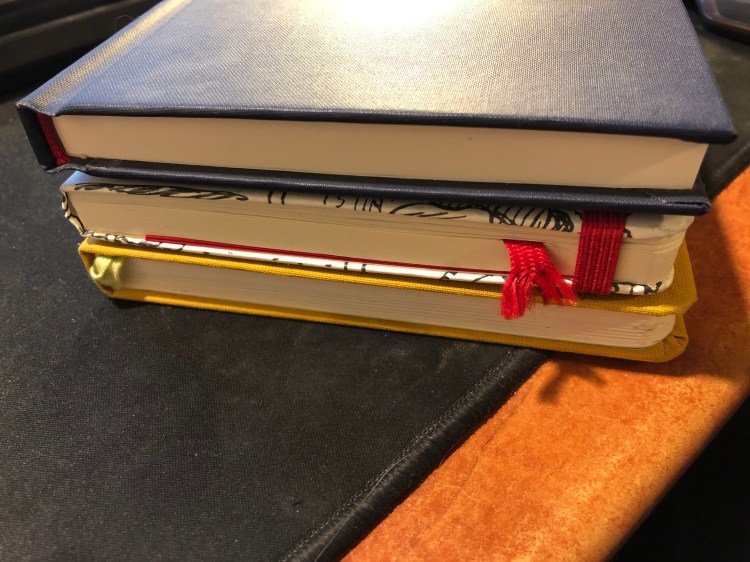
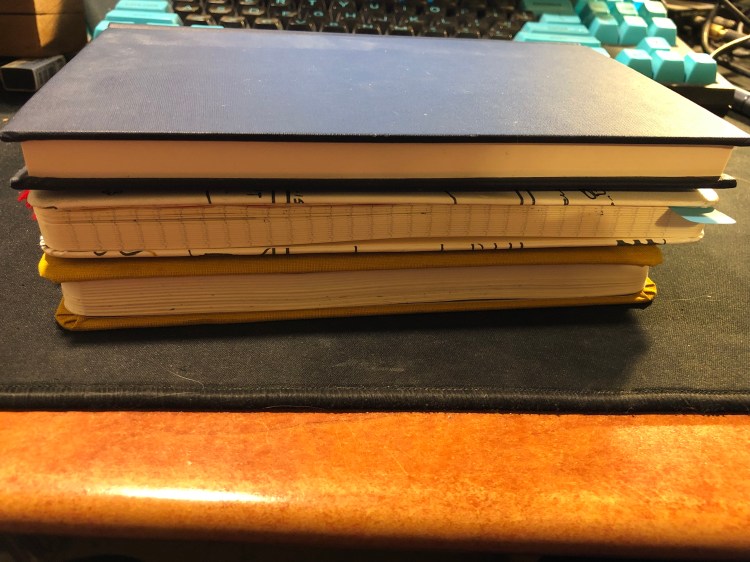
This notebook is slightly thicker than the Baron Fig Confidant and Moleskine large notebook, is about as wide as the Moleskine, but a tad taller.

Paper for Fountain Pens above a Moleskine Large notebook and a Baron Fig Confidant

You can see the difference in sizes with the notebooks stacked up. The Paper for Fountain Pens notebooks have thicker and heavier covers than the Moleskine and Baron Fig ones, but the lightweight paper in them keeps them from being overly heavy to carry around.

Paper for Fountain Pens above a Moleskine Large notebook and a Baron Fig Confidant

All in all I recommend these notebooks, with one caveat: they may intimidate you to a point where you won’t use them. There’s something about their book-like format that makes you feel that you can only write the next Booker prize winning novel in them. Notebooks should be used and not stacked and stared at, so if this one will scare you off, pick a more humble notebook instead. Otherwise, buy a three-pack of these — it’ll come out cheaper (particularly with shipping), and there’s an excellent chance that they’ll become your new favourite.

Tournament of Books 2019: The Challenge

Each year for the past 15 years The Morning News has run the Tournament of Books — a March Madness like competition for books published during the previous year. It’s fun and light-hearted and super interesting because unlike other literary prizes, you get to see the judges’ thought process as they decided which book progresses and which doesn’t.

I first learned about it a few years ago through Field Notes, who sponsors the competition and issues a special, limited edition notebook to accompany it. At first I just bought the notebook, because I was a budding Field Nut and that’s what Field Nuts did. A year later I read and enjoyed some of the books that were in the competition, and I started to really look forward to reading the judges’ debates on each round.

Which brings us to this year, which is the year that I’ve decided to finally challenge myself to read every book on the Tournament of Books 2019 shortlist. That’s 18 books total, and as the tournament starts in March, there’s very little chance that I’ll be able to finish reading all of the books in time for their round. That just means that I’ll be following along a little later than usual, but I don’t think that it matters much.

What’s challenging isn’t just the sheer volume of books, but also their topics. There are no “light read” books on this list. There are books about death, prison, war, bigotry, racism and all the other “wonderful” sides of humanity. It would be a tough challenge on a regular year, but as I’m struggling with death and sickness in my family, this will be extra tough.

So why am I doing this? To challenge myself. To make myself a better, more empathetic human being, and hopefully a better writer. And because I can.