Tournament of Books 2019: America Is Not the Heart

I just finished reading the third Tournament of Books 2019 book, the final play-in contestant “America Is Not the Heart” . It’s up against “Speak No Evil” and “A Terrible Country“, which are both excellent books that I highly recommend that you read, and I’m pretty sure that it’s going to win.

“America Is Not the Heart” is an immigrants’ tale, a romance, a family saga, and a bildungsroman met in a Filipino restaurant and “America Is Not the Heart” came out.
Ignore the reviews that say that this is a difficult or confusing read. The characters have flashbacks every once in a while. That’s the big challenge of reading this fascinating book, full of rich characters and interesting glimpses into the history, culture and lives of Filipinos both in the Philippines and in the US. It’s a also a touching love story (with some pretty graphic sex scenes), a story about the importance of family, especially the one that you create for yourself, and a story about women overcoming PTSD (whether it’s from growing up starving poor or from being held captive and tortured in a military camp for two years). What’s amazing is that the result is an interesting book with a lot of heart that you just can’t put down, despite the tough topics it deals with. It’s a testament to the skill of Castillo that she manages to pull all that off, and in her first novel too.


Tournament of Books 2019: A Terrible Country

I just finished reading my second Tournament of Books 2019 book, the play-in contestant “A Terrible Country“. It’s up against “Speak No Evil“, which I’ve already read and was excellent, and “America is Not the Heart,” which I’m about to start reading. I’ll comment which of these three needs to win this round once I finish reading “America is Not the Heart,” but I can already tell that it is going to be a very hard decision, and I don’t envy the judges.

It’s very rare to find a book that is so stylistically innovative, and yet so readable, so familiar that it’s kind of like an out of body experience to read it. This novel is a work of fiction that reads entirely like a memoir/travelogue written by the main character Andrie. It’s so convincingly well done that several times I checked the author’s name and the book description to make sure that it was a work of fiction that I was reading.
This feat of technical mastery is entirely at the service of a moving and relatable plot, wherein a young American man, completely out of depth, tries to take care of his 89 year old grandmother in Putin’s Russia circa 2008. It’s the heroics of everyday life, with its triumphs and tragedies, enmeshed in memories of the Soviet past, great Russian literature, and the dangers of living in such a terrible country, and it is well worth the read.

Tournament of Books 2019: The Challenge

Each year for the past 15 years The Morning News has run the Tournament of Books — a March Madness like competition for books published during the previous year. It’s fun and light-hearted and super interesting because unlike other literary prizes, you get to see the judges’ thought process as they decided which book progresses and which doesn’t.

I first learned about it a few years ago through Field Notes, who sponsors the competition and issues a special, limited edition notebook to accompany it. At first I just bought the notebook, because I was a budding Field Nut and that’s what Field Nuts did. A year later I read and enjoyed some of the books that were in the competition, and I started to really look forward to reading the judges’ debates on each round.

Which brings us to this year, which is the year that I’ve decided to finally challenge myself to read every book on the Tournament of Books 2019 shortlist. That’s 18 books total, and as the tournament starts in March, there’s very little chance that I’ll be able to finish reading all of the books in time for their round. That just means that I’ll be following along a little later than usual, but I don’t think that it matters much.

What’s challenging isn’t just the sheer volume of books, but also their topics. There are no “light read” books on this list. There are books about death, prison, war, bigotry, racism and all the other “wonderful” sides of humanity. It would be a tough challenge on a regular year, but as I’m struggling with death and sickness in my family, this will be extra tough.

So why am I doing this? To challenge myself. To make myself a better, more empathetic human being, and hopefully a better writer. And because I can.

Tournament of Books: Speak No Evil

Speak No Evil is part of the Tournament of Books 2019 play-in round, which means that it is up against two other books before it can make its way into the initial rounds of the competition. As this is the first book I’ve read in the ToB and it was excellent, I can’t imagine what the rest of the field looks like.

I have never read a book so full of heart, life and joy, that was also tragic. “Speak No Evil” is a timeless tale that is deeply imbedded in our time and is well aware of it. To say that it deals with Issues (capital I) like Homosexuality, Race, Bullying, Policing, Gender and (above and beyond) Friendship would do this gem of a novel injustice. It’s first and foremost a very good book, with beautifully and richly crafted characters moving around in a plot that is inevitable but far from dull or expected. Every person is propelled forward by their past and their character, but is also somehow aware that he or she are actors in the story of their life. An astounding achievement, and a must read.

Hard Times

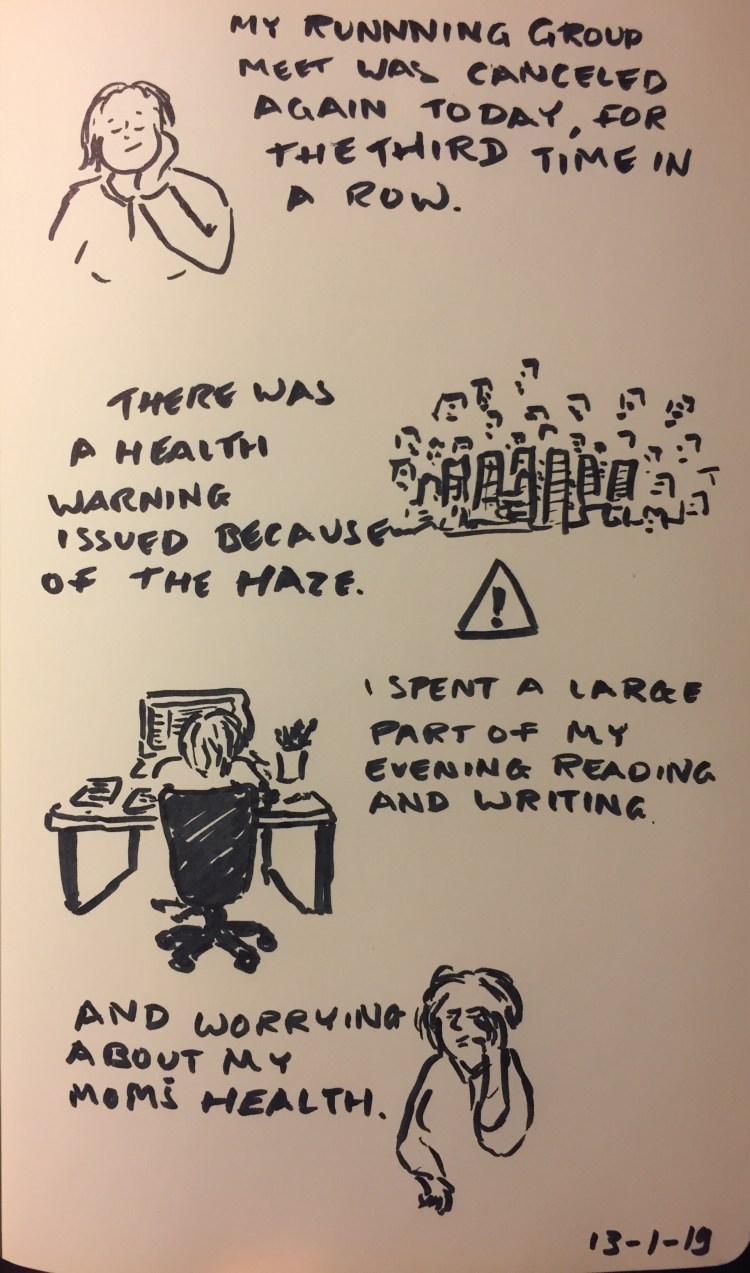
Journal comic drawn with a Sharpie brush pen on a Moleskine Star Wars crawl text limited edition plain notebook.

Haze and Worrying

Journal comic for January 13th, 2019. Sharpie brush pen on a Moleskine blank Star Wars crawl text limited edition notebook.

How I Started Reading More (Again)

A few more insights into how I got back to reading, beyond using a reading journal, as it has come up in conversations lately (people are gearing up for 2019 resolutions, I guess):

  • I started with detective novels, easy reads, things that were fun and not too challenging to dig into. M.C. Beaton, P.G. Wodehouse, John Scalzi were my friends. I was trying to rebuild a habit, and so the last thing I needed was to start with books that I would resist reading. My mind had to learn to treat reading as a pleasant pastime and not “homework” anymore, so the more challenging books came in only about a year after I started.
  • I used streaks to challenge myself to read 10 minutes a day, every day. Why 10 minutes? Because I felt that this was the minimal amount of time required for me to start easing myself out of the choppy, constantly distracted and interrupted reading habits that I had picked up after years of using social media.
  • I deleted the Facebook and YouTube apps from my phone, and after a great deal more struggle and a few relapses, Twitter. Instead of browsing them when I had a minute or two to spare, I used the Kindle app.
  • I put reading in my new year’s resolutions (yes, I have been doing those for the last three years, and I’ve been pretty successful in meeting them for the last three years, but that’s a different post). At first it was just for a certain quantity of books (24), and then it was for a certain number of books of each kind — challenging books and long books.
  • I set up a Goodreads account and started a reading challenge there. As with the resolutions, it’s important to keep the goal not only attainable under normal circumstances, but also attainable when things go horribly wrong with your life. Start lower than you think, and ignore other people’s goals. You’re doing this for yourself. If it’s 5 books, 10 books, 20 or 20, it should be what you can do. I chose 24, because that was 2 books a month, and something that I felt I could get to without resorting to reading only short and simple books.
  • I cut out TV almost entirely from my life. This wasn’t just about reading, it was about making more time in my day for things that were more important to me, but it definitely helped with my reading. I cancelled my cable subscription and I watch about 2 hours of TV a week.

This has been my journey back into reading. Take from it what you wish, but if I can distill them they’d look like this:

  1. Decide you want to do it. If it’s not coming from you, it won’t happen.
  2. Set up systems of daily reminders and goals. These can be private or public, they can be analog or digital, as long as they help you keep on track.
  3. Make it pleasurable. Start with easy reading in a genre that you enjoy, maybe with a writer that you know, and keep your goals easy and attainable even not on the best of days.


My Reading Journal, or How I Taught Myself To Enjoy Reading Again

Ironically enough, by the time I finished with my MA in English Literature a few years ago I had “lost” the habit of reading. From someone who used to read at every available (and not so available) moment I had turned into a non-reader almost entirely. This bothered me so I set up to rectify it by “gamifying” reading until I had tricked myself back into the habit again.

Field Notes had just come out with their Arts and Sciences, the perfect format for my plans. The idea wasn’t only to create a journal where I would log my thoughts on each book as I read it, but create a little set of “achievements” that I could unlock for each book as I read it. For each quarter of the book I read, I got an achievement, a little logo that symbolized the book which I drew on a separate page. The accumulation of those silly little symbols was enough to push me forward as I learned to enjoy reading again. I kept that up for three Field Notes Arts books and then when I ran out of them, I simplified the format and moved to the Moleskine Two-Go, which had just come out. The Field Notes Arts notebook wasn’t fountain pen friendly so I used a Karas Kustoms Render K, a Blackwing pencil and the Caran d’Ache Bicolor 999 double sided coloured pencil.

On the first year that I tried using this system (from March 2016) I got from not reading any new books (just my old familiar favourites) to reading almost 20 new books. On the second year (2017) I got up to 42 books. This year to date I’m at 58 books, and I’ll probably read 60-61 books by the end of the year. I no longer need to spend time drawing little “achievement badges” as my reading habit is back here to stay. I do, however, still keep a book journal even though I’ve started using Goodreads since 2017. It’s a satisfying way to keep track of my reading and organize my thoughts on the books that I’ve read.

You can check out the format of the entries for fiction and non-fiction below. The unlined left side of the spread (verso) is where I do a little doodle that reminds me of something central in the book, and explain the star rating that I gave the book in each category. I really recommend that if you choose to create your own analog reading journal, you create your format yourself. Mine has changed over time, particularly for non-fiction, and it works with my reading goals for the year.

This is the index, which is useful for reference later on and is a good way to check my reading progress throughout the year.

Quick update

  • I’ve started reading my 54th (!) book of the year, John Scalzi’s “The Collapsing Empire”. I’m not skim trading anything, it’s just that my newly acquired Kindle Paperwhite allows me to fill more empty time with reading.
  • Adding more strength workouts to my training schedule has made me appreciate yoga more.
  • I’ve played Matt Leacock’s “Forbidden Sky” cooperative board game and it is fantastic. I’ll post a review once I’ve run through it a few more times.

  • It’s still not raining here, which is worrying.
  • I’ve been back to writing every day, even if some days it’s only 200 words.

Keep at it, don’t let them get you down, you’re awesome! Swing for the fences.

New Books

An eclectic bunch arrived today. Can’t wait to dig in.