Pelikan Hubs 2025 and On Being A Female Pen Collector

Yesterday was the 2025 Pelikan Hubs event. Pelikan is so wonderful to organize these events, so generous and thoughtful with their gifts, and I love the company and their pens so much that I’m really heartbroken that this isn’t just a glowingly happy post.

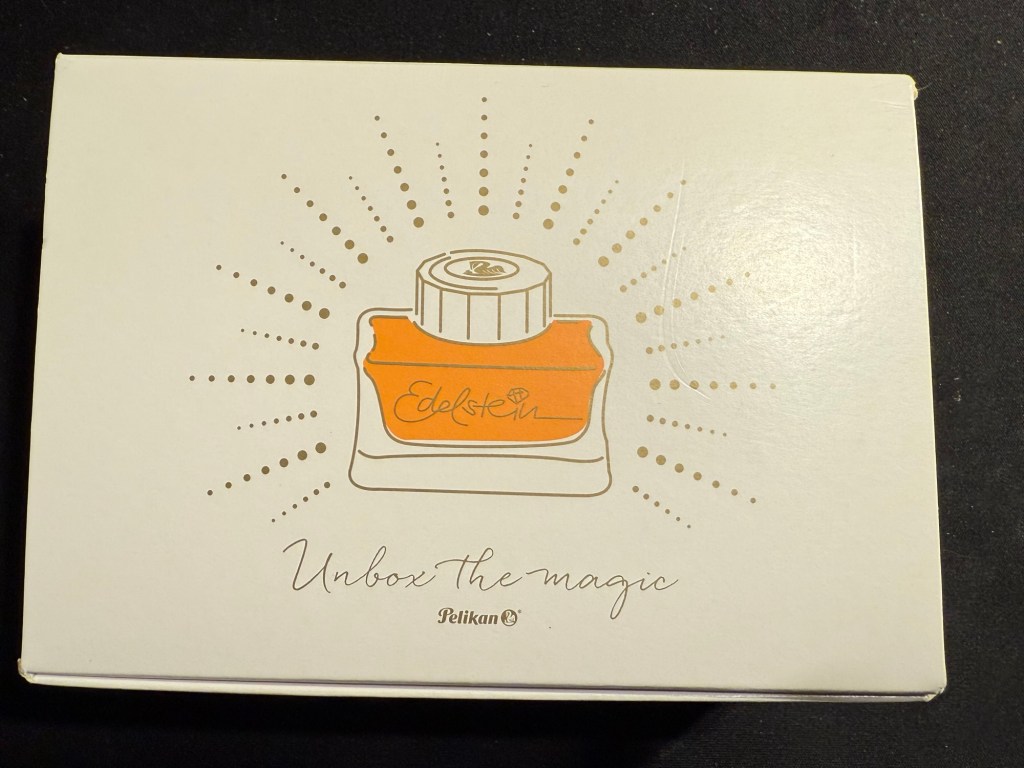
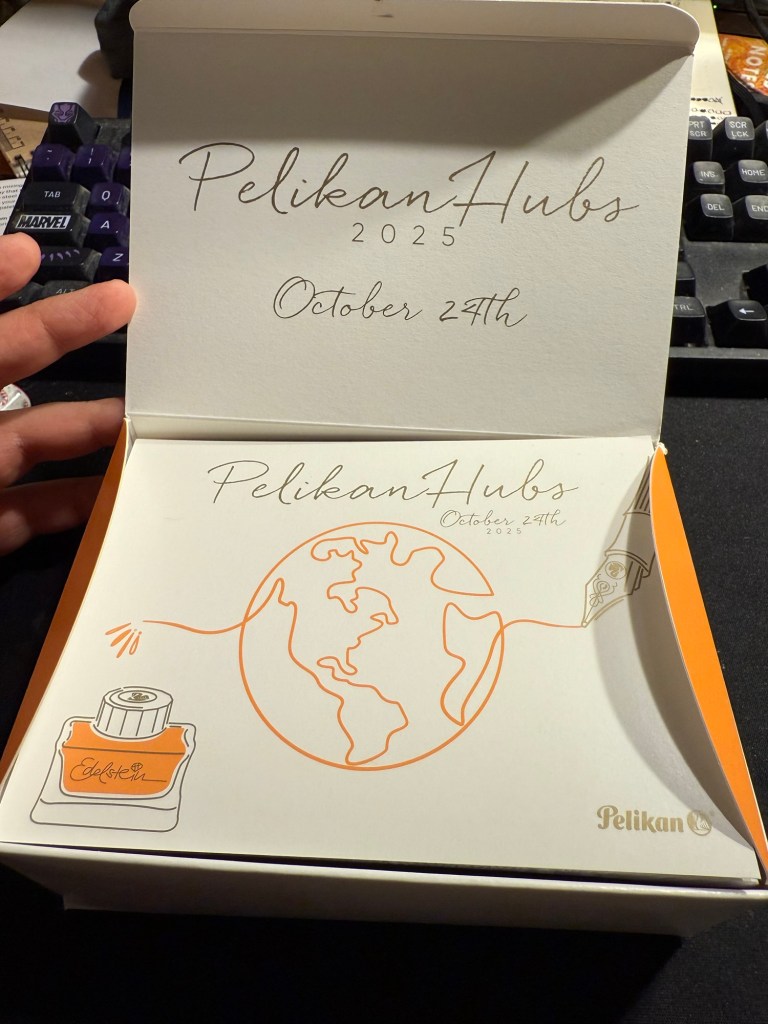
This isn’t Pelikan’s fault. Their organization was as usual, impeccable. Their gift was tremendous – a beautiful box, with the Edelstein’s ink of the year Apricot Achat, a postcard and a notepad. Everything was so well designed it was breathtaking to open the box and see it all laid out perfectly.

The box

Here’s the open box and the postcard:

The open box and the postcard

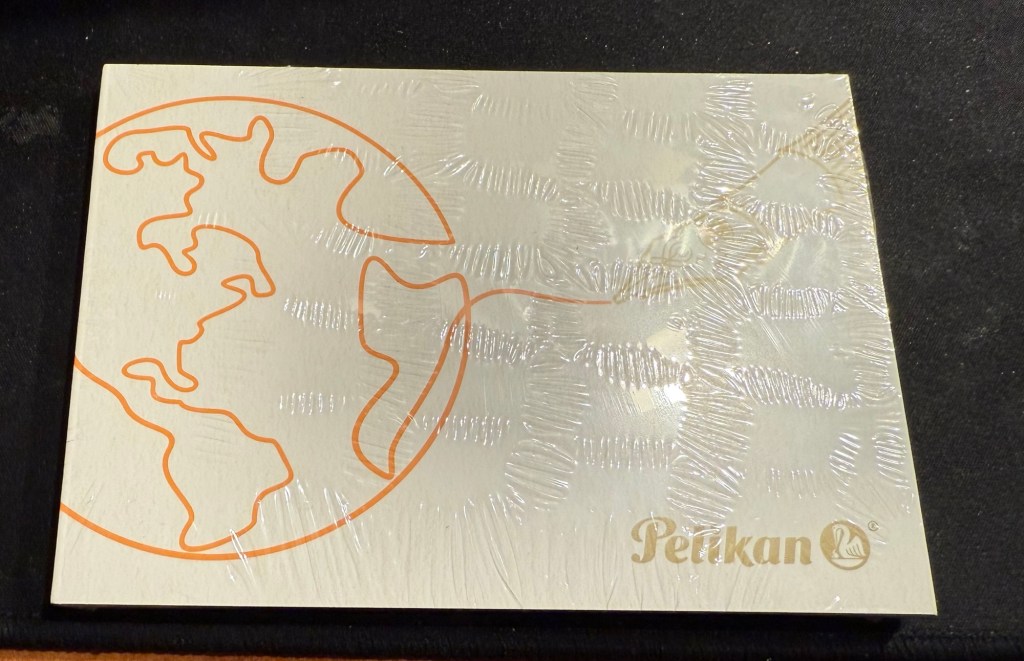
Here’s the notepad. You can see the design on the cover better in the next photo, but the paper is smooth, thick and perfectly fountain pen friendly.

Small notepad

I love the design of the cover of the box, the postcard and the cover of the notepad. It’s playful but elegant, and it works well together and ties in well with the typography and the design of the Edelstein box. That’s a 10/10 for design and quality.

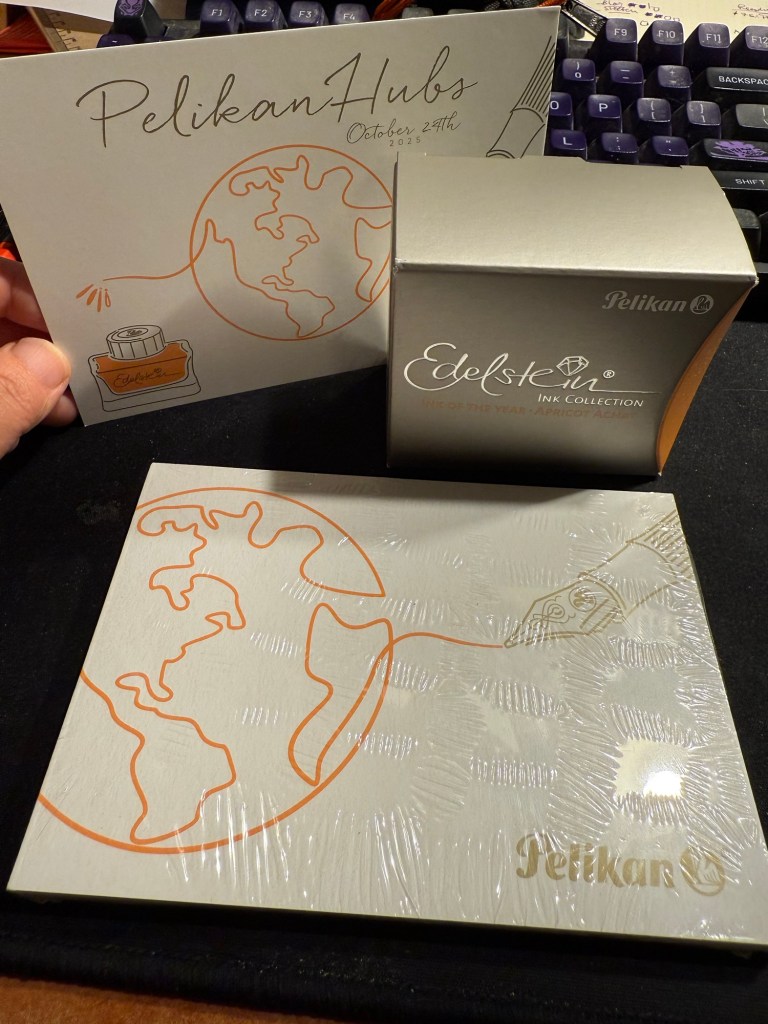
Everything that was in the box: postcard, Edelstein Apricot Achat ink, and notepad

The that we received is the Edelstein Apricot Achat, which is the ink of the year 2025. The bottle is gorgeous, and the ink is non-shimmer this year, so it should be easy to clean out of pens.

Edelstein Apricot Achat

The ink itself is indeed an apricot ink, with a hint of shading. It’s bright but light – a tad too light for me if I’m honest. I think that this exact ink just slightly more saturated would have been the perfect orange for people who like their orange right in the middle of the orange spectrum – not too yellow or too red.

Swab on Col-o-Ring

I filled a Pelikan M215 Rechteck (rectangle) with this ink, but I chose poorly, forgetting that it has an EF nib. Pelikan EF are on the wide side, but this ink would fare better in a medium or even a broad nib. I will still enjoy it as it works well with the other inks I currently have in rotation, but if you are looking to use this ink I’d suggest wide and generous nibs for it.

Writing sample on Kokuyo paper.

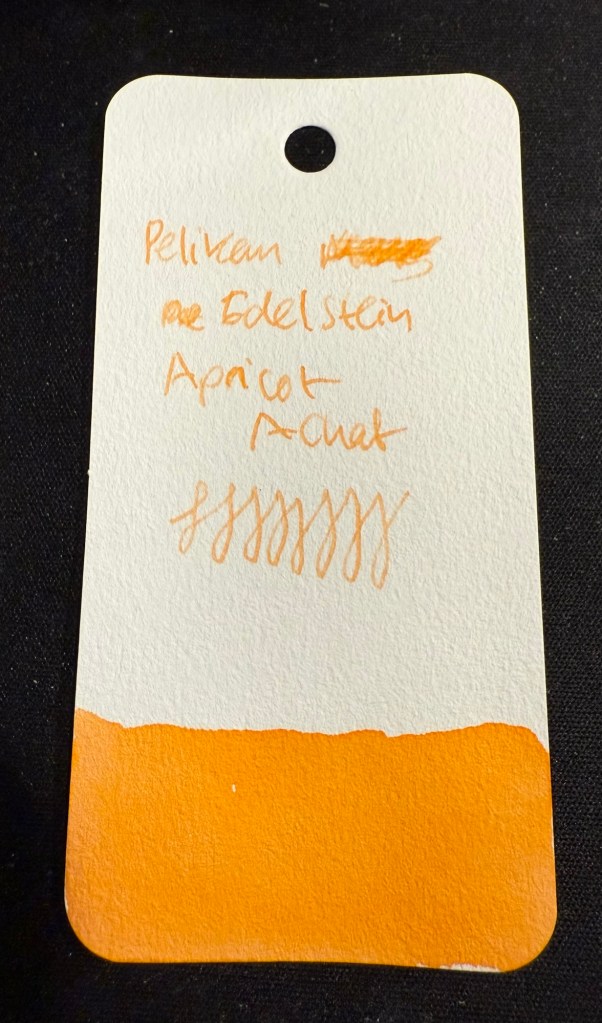
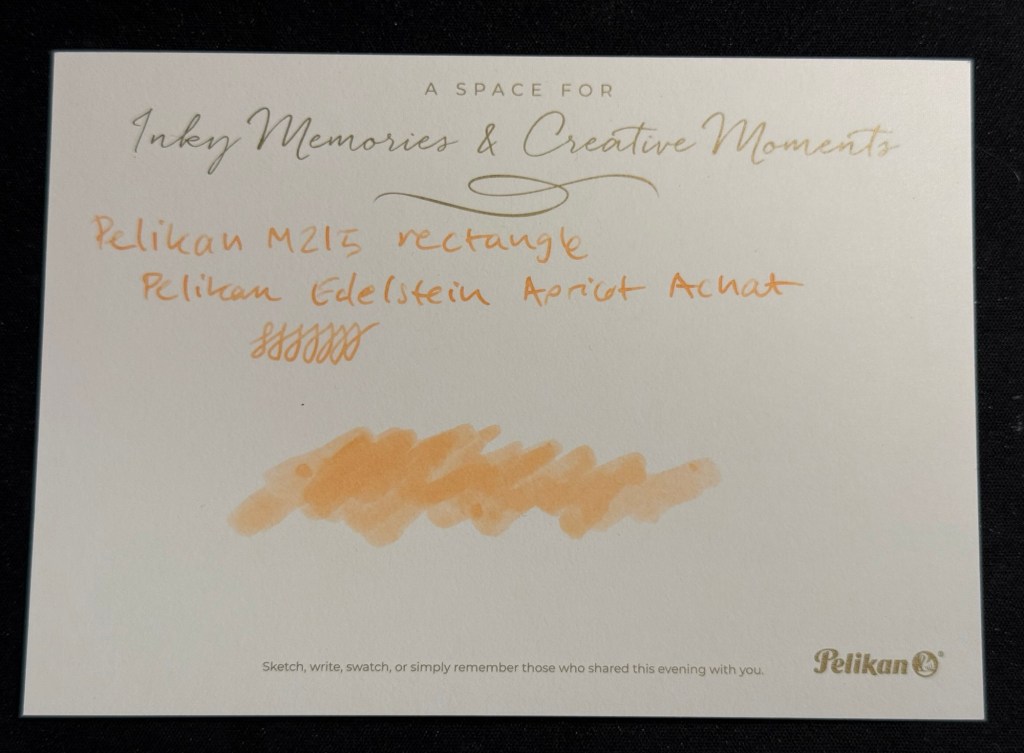
I tried it on the Postcard. The paper isn’t coated but is still rather sleek:

The postcard with an ink swab and writing sample

So thank you very much Pelikan for organizing this worldwide event and for your wonderful gift! I am actually considering buying the matching M200 because I like the look of the ink.

Now for the sad and ugly part:

Pen collection has a misogyny problem. I have experienced it during the previous Pelikan Hubs, I have experienced it when I tried to buy pens in brick and mortar shops, in flea markets, from pen makers. I experienced it during this year’s Pelikan Hubs and I’m tired of it, and kind of tired of all the talk about how wonderful and welcoming the pen community is. It’s wonderful and welcoming if you’re a guy, and time and again I have seen it close ranks and snarl if you’re a gal.

Just during yesterday’s event, where I stayed on for less than an hour (and even that was just to be at the edge of the group photo), I was told several times that:

  • Women don’t collect pens.
  • Only men collect pens.
  • I am not a real pen collector.
  • I can’t possibly be a pen collector.
  • I can’t possibly have enrolled to the Pelikan hub.
  • I am there as someone’s plus one.
  • Women don’t understand pen collecting.
  • I am a rare bird, the exception to the rule.

They had facts to back it up, they said. Their closed pen collectors group only had three women in it. That proved the point. I eye-rolled so hard. I had met and talked to one of the other female collectors at last year’s event and I fully understand why she didn’t brave this treatment to collect her gift this year. It’s because nobody wants to go out of their way to spend their precious free time with a bunch of *holes.

There are women collectors, they have every right to enjoy this hobby, and if you’re a guy and you don’t see women in your group, it’s not because they don’t collect pens. It’s because you’ve created a group that women don’t want to join.

Do better.

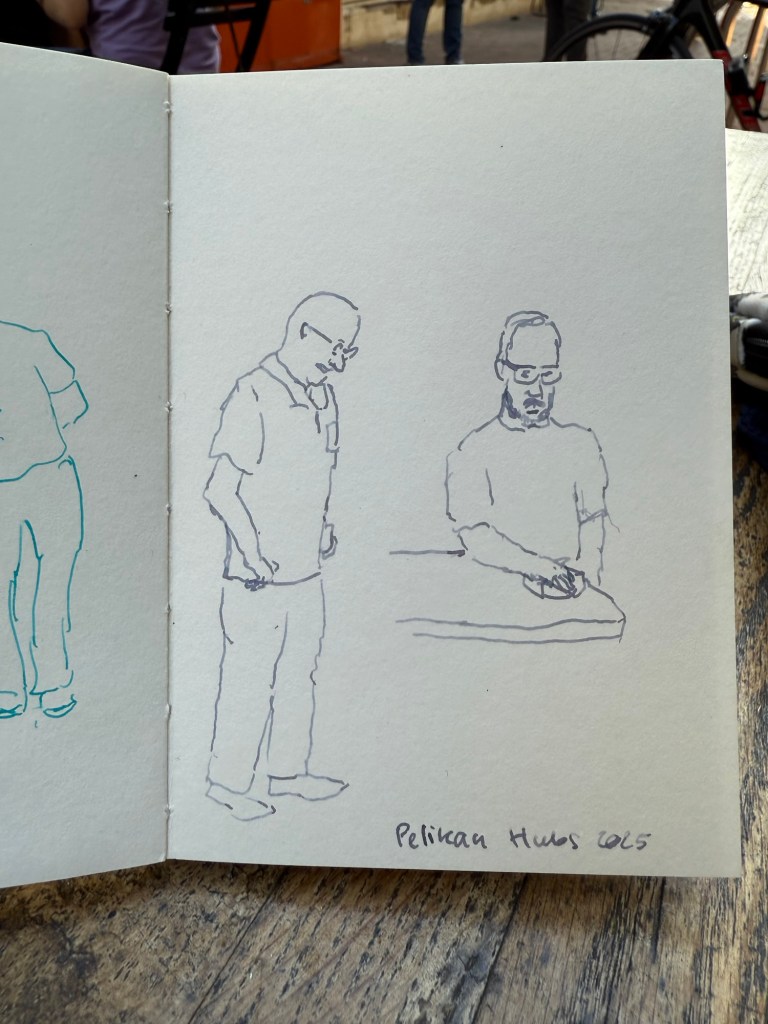
End of rant – and to end on a more positive note, I did manage to do a few 2-3 minute sketches while I was waiting for the group photo:

Sketched with Pelikan M805 Ocean Swirl F nib and Montblanc Maya Blue on a Pith Kabosu Sketchbook
Sketched with Pelikan M605 Stresemann M nib and Sailor Ink Studio 123 on a Pith Kabosu Sketchbook

Thank you again Pelikan for the wonderful event. I intend to return next year even if the menfolk find my presence abhorrent. There were a few nice fellows that were willing to talk to me, and I will not let the trolls dissuade me from participating in a hobby that I have been enjoying for close to 20 years.

Currently Inked Fountain Pens – Pelikan Hubs Edition

Tomorrow is the Pelikan Hubs 2025 event, and to prepare I have inked up a whole flock of Pelikan fountain pens.

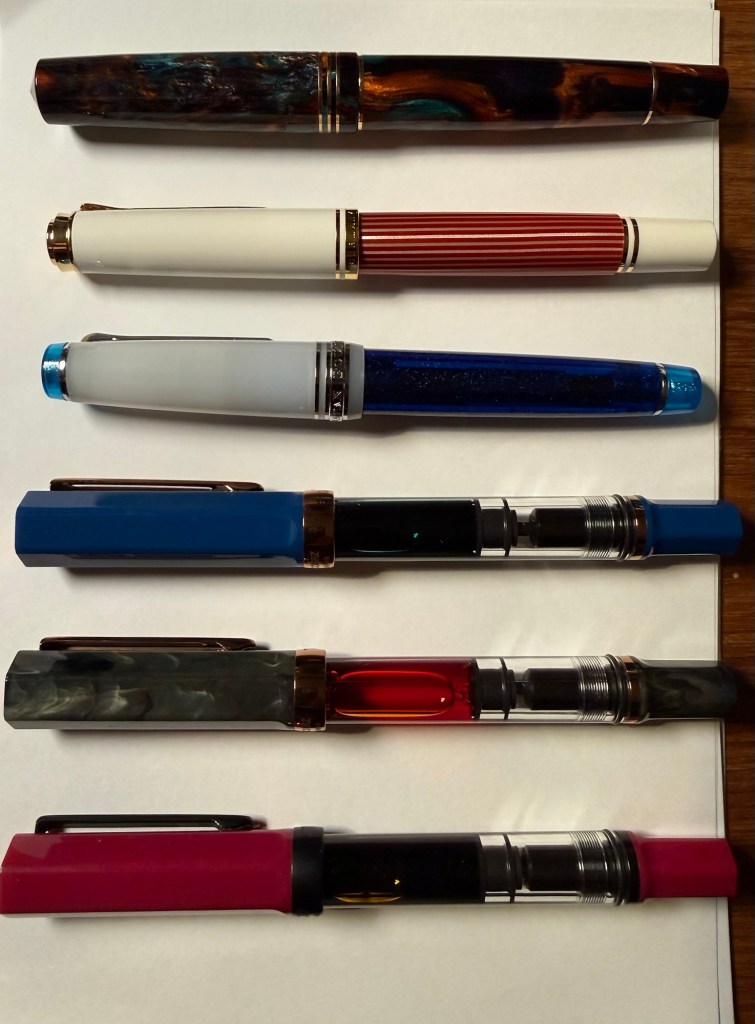
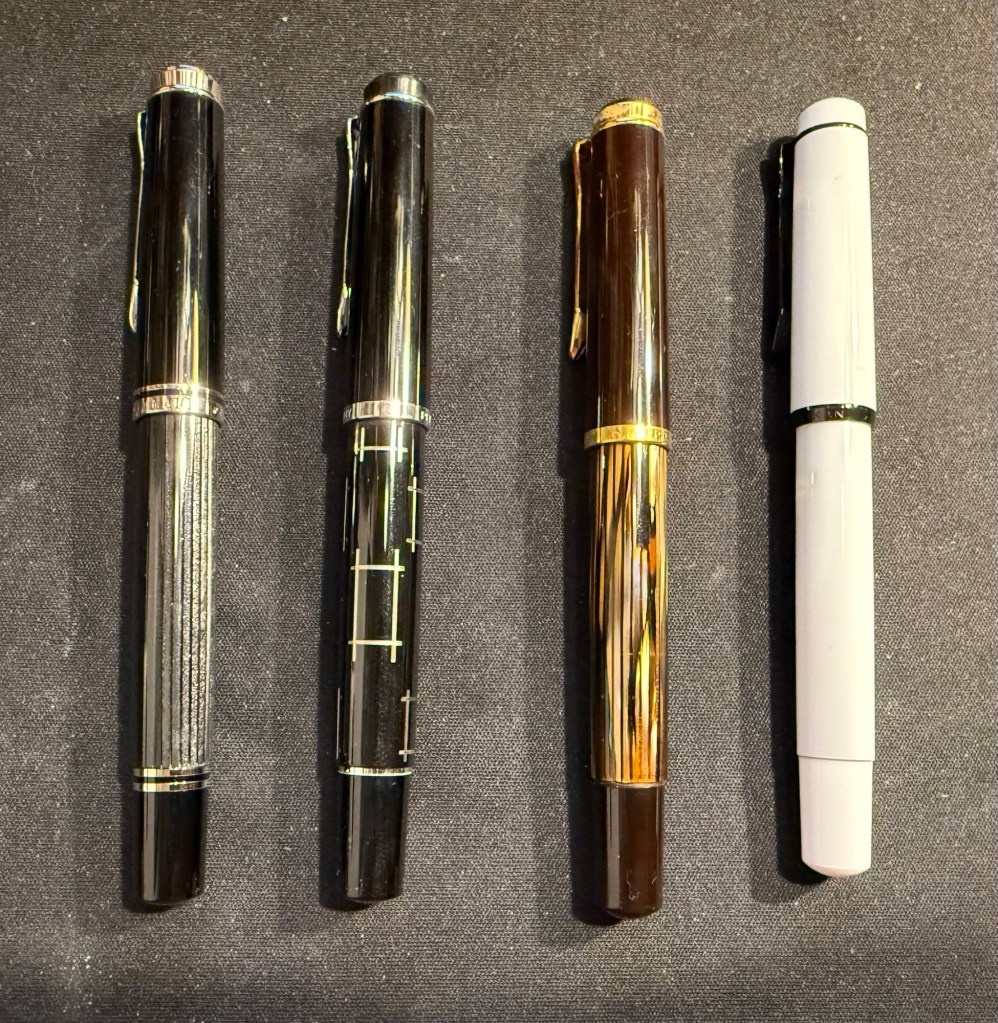
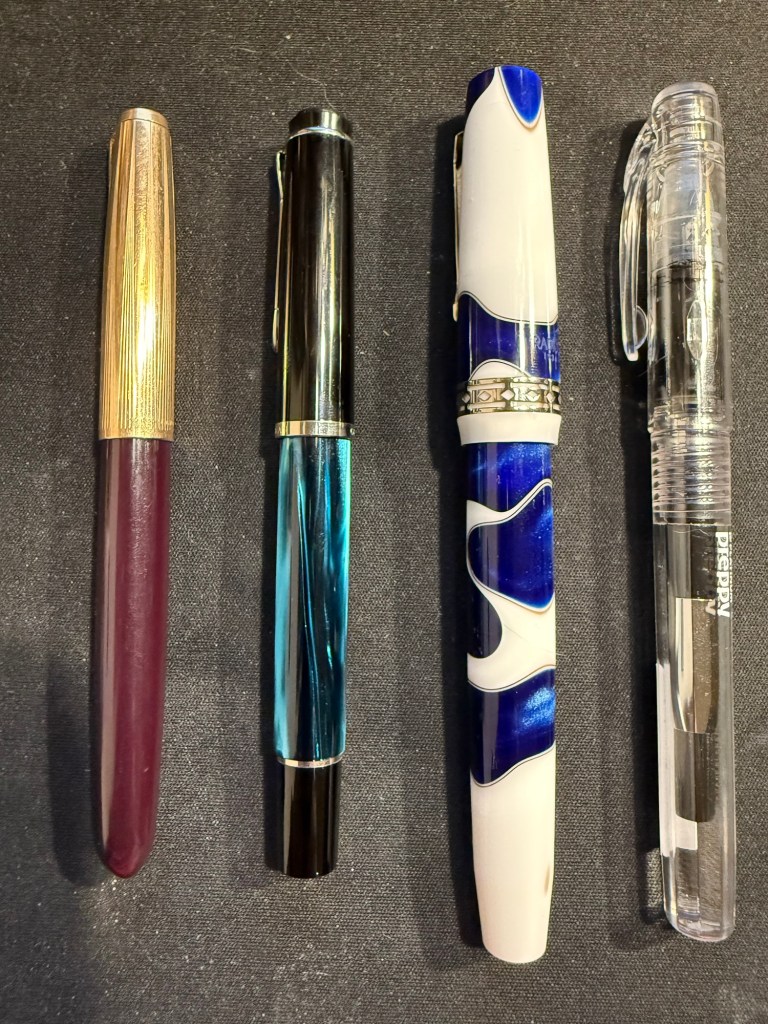
Here’s my current lineup of fountain pens and ink:

Currently inked part 1

The top four have been inked way back in the beginning of August, but because of my travel schedule I’ve yet to write all of them dry. You can read about the Radius 1934 and the Pelikan M205 here as well.

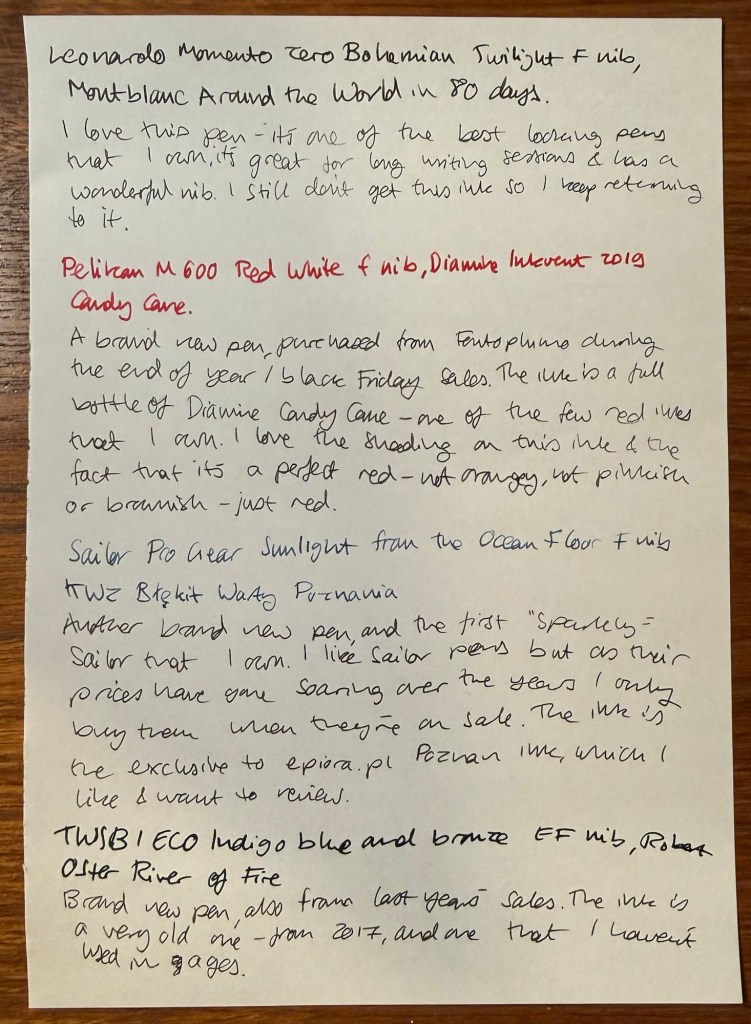
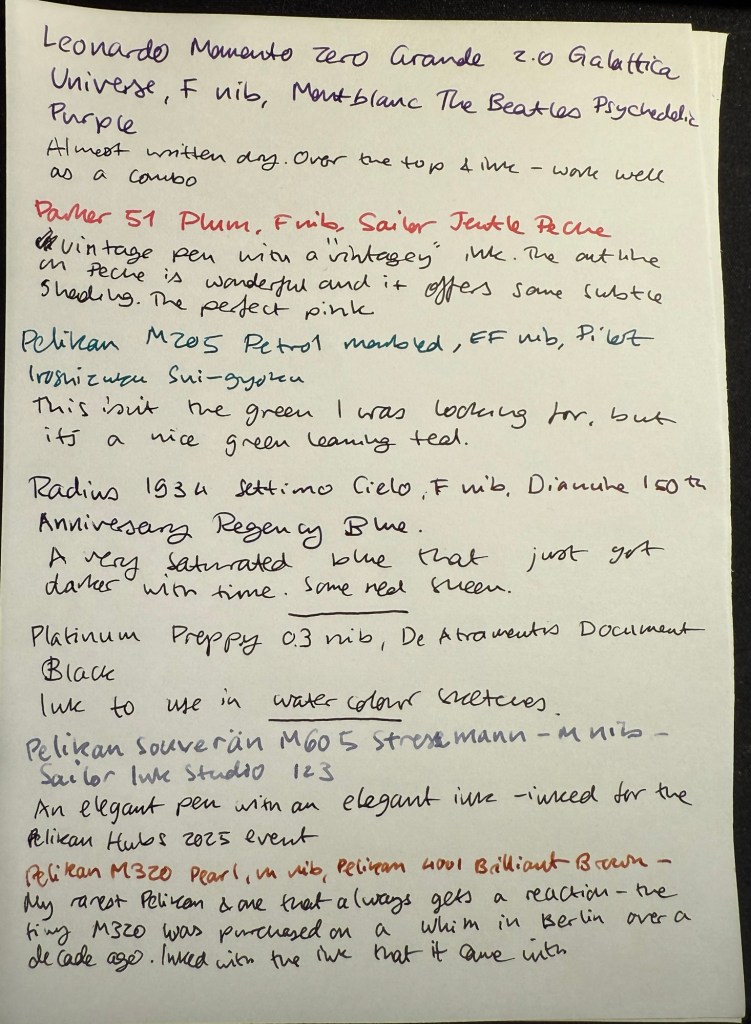
Leonardo Momento Zero Grande 2.0 Galattica Universe – F nib – Montblanc The Beatles Psychedelic Purple – great pen and ink combination. I wrote this pen dry just after writing the sample above.

Parker 51 Plum – F nib – Sailor Jentle Peche – all vintage Parker 51 fountain pens are fabulous and this one is no different. The plum colour is very rare, but I decided to “use the good China”. The ink is a long discontinued Sailor Jentle Peche, a beautiful pink with great shading and outlining. Sailor used to make fantastic inks at great prices – in terrible bottles. It was a struggle to fill this pen, even with their internal ink reservoir dingus.

Pelikan M205 Petrol Marbled – EF nib – Pilot Iroshizuku Sui-gyoku – I was hoping that Sui-gyoku would be the green ink that I was looking for, but it’s more of a teal than a green. The Pelikan M2xx series is a solid workhorse kind of pen, and I highly recommend it.

Radius 1934 Settimo Cielo – F nib – Diamine 150th Anniversary Regency Blue – the ink has grown darker with time, to the point where it’s almost black. This isn’t surprising as it was a very saturated dark blue ink to begin with, and it’s had some time in the pen. I will likely write this pen dry today or tomorrow. The new Radius pens by Leonardo feel very much like Leonardo Momento Zeroes but with a slightly different design. That’s not a bad thing – they are gorgeous pens, and for now they’re slightly cheaper than the Momento Zeroes.

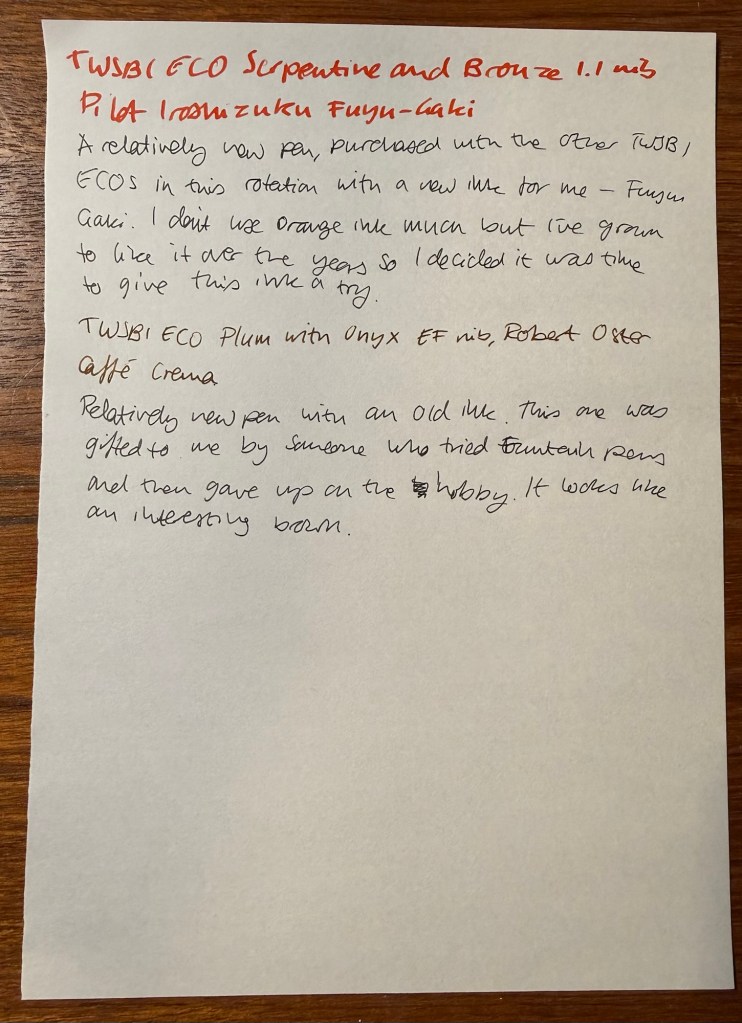
Last week I inked up a new Platinum Preppy 03 nib with De Atramentis Document Ink Black as part of a post that I am working on. It’s the first time I’ve used a Preppy with a converter and not the Platinum cartridge it comes with – and it works well.

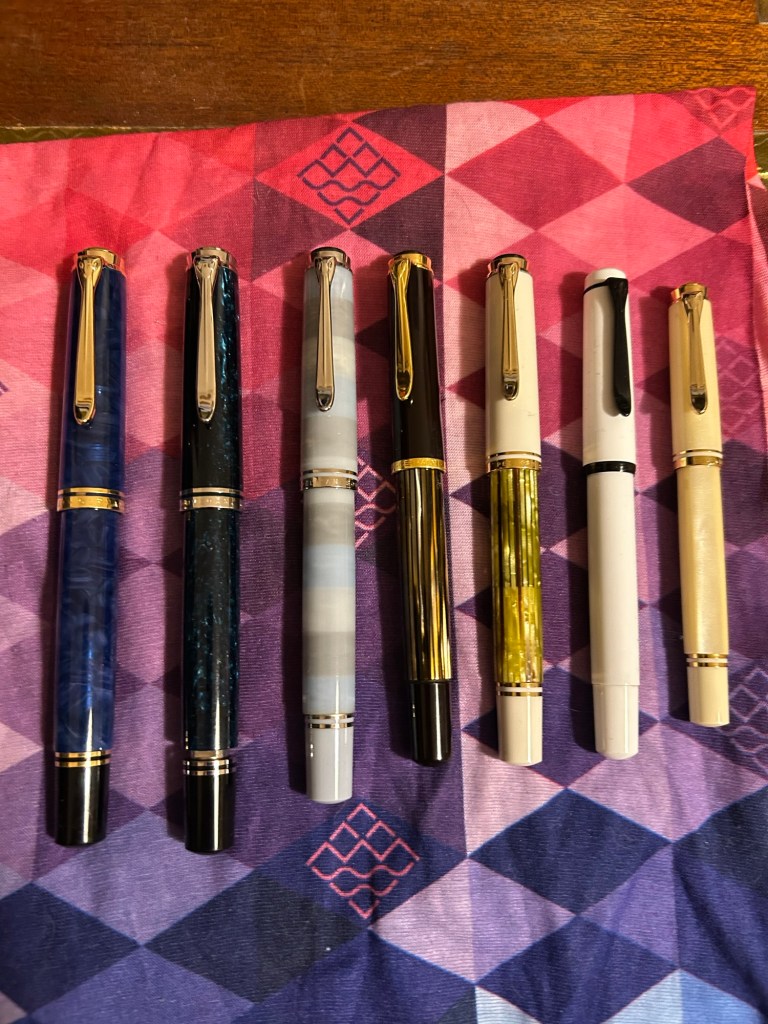
Pelikan Flock – currently inked part 2

I inked these pens today for the Pelikan Hubs event tomorrow:

Pelikan M605 Stresemann – M nib – Sailor Ink Studio 123 – a classic and elegant pen and ink combination. The Sailor 123 is really that good, and the generous medium nib shows off its dual shading properties.

Pelikan M320 Pearl – M nib – Pelikan 4001 Brilliant Brown  – my rarest Pelikan, always a crowd pleaser at the hubs. This tiny pen came with a tiny brilliant brown bottle and so far I’ve filled it only with that. I bought it about a decade ago in Berlin on a whim, and I’m so glad that I did.

Pelikan M800 Blue O Blue – F nib – KWZ Exclusive for epiora.pl Błękit Warty Poznania  – this pen was a very expensive birthday gift and my first M800 Pelikan. I bought it at a local pen store that no longer exists. The ink is even more special – it’s my first KWZ ink, gifted to me from the store that it was exclusively made for. I had purchase my M600 Glauco Cambon there just before they were closing for the day on the last day of the USK Symposium in Poznan. The name means Poznan Warta Blue – and it’s tied to the unique blue of the city and the Warta river. It’s a gorgeous blue and it reminds of Poznan, the store, the lovely seller and the nice symposium volunteers that saw me in the store and helped me out with my purchase.

Pelikan M400 White Tortoise – M nib – Sailor Ink Studio 767 – This is the green I was looking for! I purchased this ink last month at Choosing Keeping in London, and it’s the perfect bright and cheerful green that I was looking for, with some great shading to boot. The Pelikan Tortoise pens are gorgeous, and this one is a particularly nice one.

Pelikan M805 Ocean Swirl – F nib – Montblanc Maya Blue – I have been priced out of Montblanc inks (there’s only so much I’m willing to pay for ink) but this ink was heavily discounted at the Montblanc boutique in Heathrow. It’s a lovely bright turquoise with great shading, and it works well coupled with this pen.

Pelikan M600 Art Collection Glauco Cambon – F nib – Pilot Iroshizuku Ajisai – this is the pen that I purchased at Epiora in Poznan, and while I saw it online and loved the concept, I never thought that I’d buy it because of the price. Seeing it in person changed my mind because no photos can do this pen justice – the pattern on it glows! It’s beyond vibrant, and the pen body itself feels different than other Pelikans – heavier and cooler to the touch. The ink is also a Choosing Keeping purchase, and I love the colour very much.

Currently inked part 3

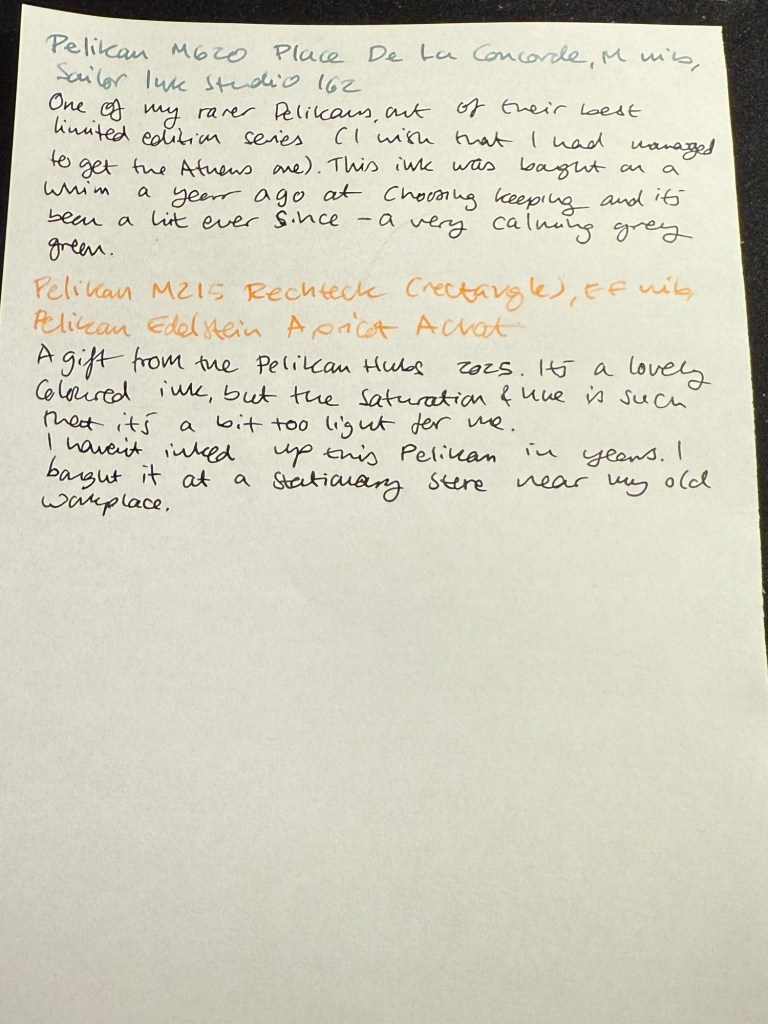
Pelikan M620 Place De La Concorde – M nib – Sailor Ink Studio 162 – this is one of my rarer Pelikans, one that I bought a year or two after the series had been complete and no longer for sale. If ever there was a series of pens that I wish that I owned it was the Pelikan M620 City series, and for years I searched for an Athens pen before giving up – it was just too expensive.

The Pelikans left to right – Place de la Concorde, Glauco Cambon, Ocean Swirl, White Tortoise, Blue O Blue, Pearl

Apart from my inked Pelikans, I’m also taking three uninked Pelikans with me – one to fill with the ink that we’ll be getting, and the others just to share.

Pelikan Flock – left to right – Stresemann, M215 Rectangle (uninked), vintage M400 Tortoise (uninked), Stormtrooper (uninked)
Left to right: Parker 61 Plum, M205 Petrol Marbled, Radius 1934 Settimo Cielo, Platinum Preppy

Are you going to a Pelikan Hub? If so, what pens did you bring with you?

Weekly Update: Catch Up Edition

It’s been a while since I’ve posted a weekly update, but as part of my effort to get back to a regular blogging schedule I want to start posting these.

Here are some cute kittens cuddling together to cheer you up

Reading

I’ve recently finished Ben Aaronovich’s “The Masquerades of Spring” (nice enough, I’m hoping to review it later) and John McPhee’s “Draft No. 4: On the Writing Process” which was fascinating and very well written. Then I started reading “Orbital” by Samantha Harvey. It’s this year’s Booker winner and yet I’m struggling to read it because it’s so dull and lifeless. I’m a quarter of the way through but I may just give up on it in favour of more interesting things on my list.
Running

After participating in a 5k and 10k at Disney World last month, I’ve been struggling to get back to my training plan. The solution, as always, is a combination of patience, perseverance and enrolling to another race. I have a 10k at the end of February and I want to be in good shape for it as the running conditions will likely be less than ideal (i.e. too hot).

Other things

  • At the Gentleman Stationer there’s some very good advice on which stationery items make for bad gift ideas. I will add to this: don’t buy the artist in your life art supplies unless they gave you very specific information on what to get them. Good art supplies are usually not inexpensive and you’re very likely to go wrong if you just try to muddle your way through an art supply store. Either get them a gift card to their favourite art supply store (a brick and mortar one, preferably), or ask them to tell what they want. If you insists on going on this route then sketchbooks from Stillman and Birn (go for the softcover ones and never buy coloured paper), or a set of Faber Castel 9000 sketching pencils will likely be welcome.
  • If you haven’t gone to see the movie “Wicked,” then go and see it. It’s a great adaptation to a very good musical and I promise you’ll enjoy it.
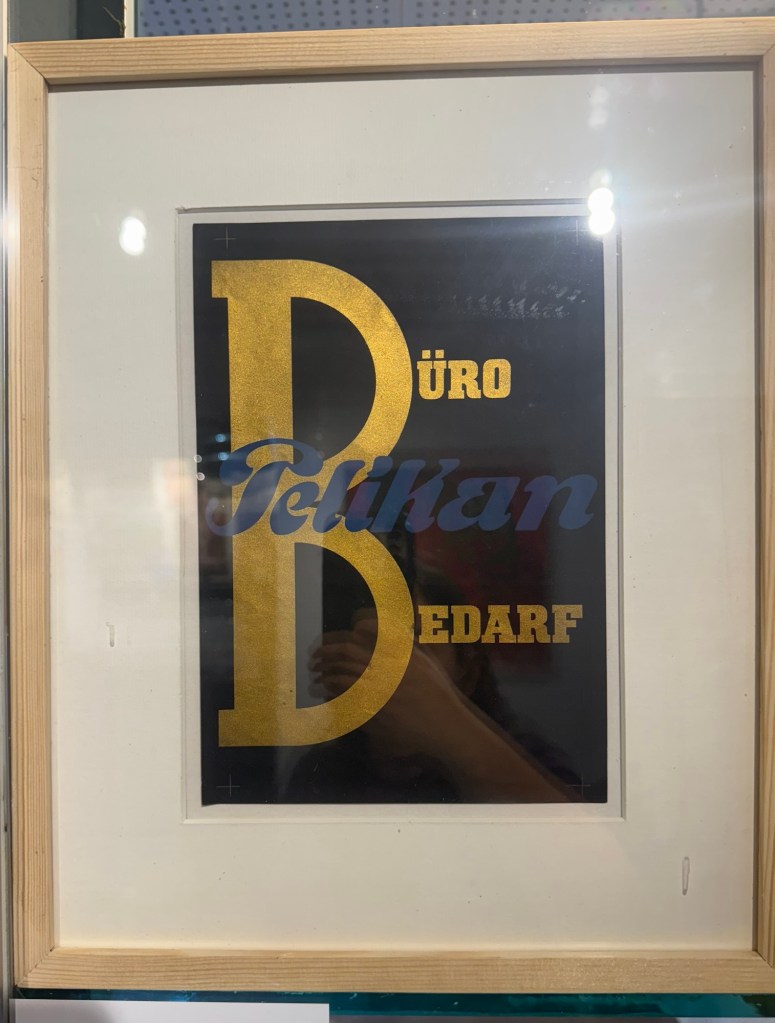
  • I went to a pre-auction exhibition today and got to see this original cover for a pre-war Pelikan catalog created in gauche and bronze powder by El Lissitzky:
Not a great photo for a pretty great design

The sky was melting into the sea this evening:

I hope you have a great week!

My Flock of Fountain Pens for the Pelikan Hubs 2024

We just had the 2024 Pelikan Hubs event and I wanted to talk about which Pelikan fountain pens I brought with me to the event, and to note a few things that may be useful for those looking to get into Pelikan fountain pens.

This was my flock:

From left to right they are:

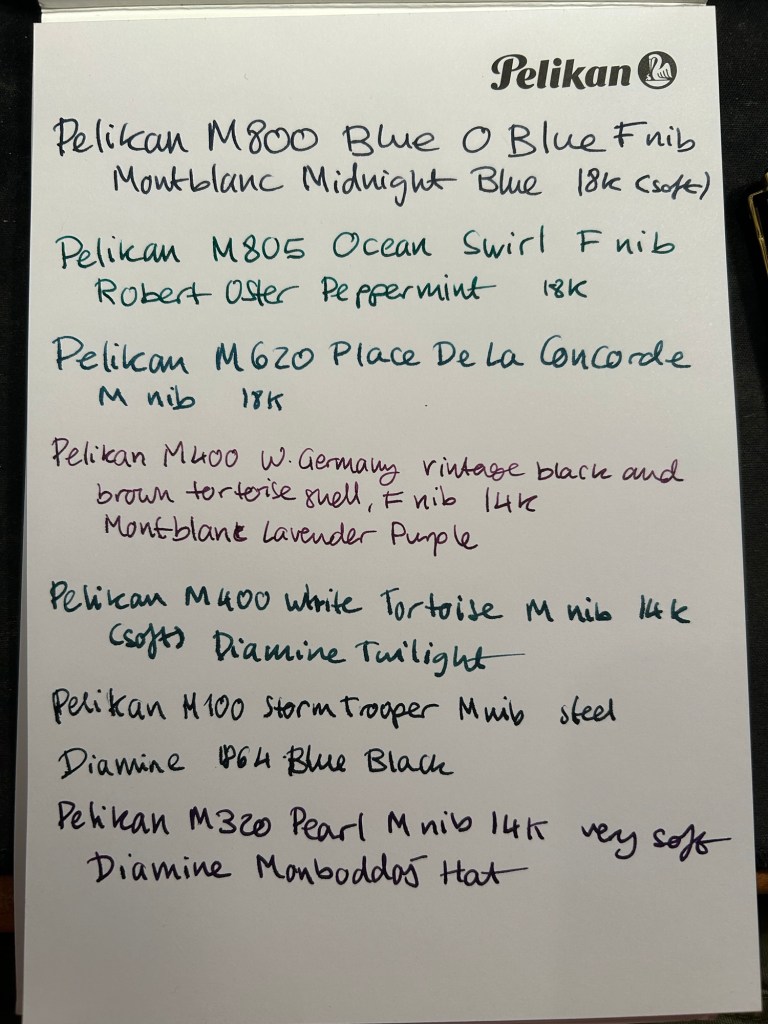
  • Pelikan M800 Blue O Blue – one of the most expensive pens in my collection, and one that I (partially) got as a gift for my birthday. This pen has an 18 Karat fine nib that is soft and springy. Note: Some of Pelikan’s gold nibs are softer than others, so it’s worth testing the pen out before you buy it, especially if you’re not used to Pelikan nibs. This pen has a semi transparent blue swirly body and a typical Pelikan wide and juicy nib.
  • Pelikan M805 Ocean Swirl – gorgeous, gorgeous pen that draws attention every time I use it. The depth and shade of the material is something else, and the palladium trim and rhodium plated 18k nib work very well with the turquoise and black shades of this pen’s body. This pen also has a fine 18k nib but this one is much firmer than the one in the Blue O Blue.
  • Pelikan M620 Place De La Concorde – so, so glad I got this pen though it was expensive for me at the time. This was part of Pelikan’s city series and the only Pelikan I have in the M600 size, which is just a shade longer than the M400. There’s marbling in this pen’s stripes, as is befitting its name, and the 18K M nib is wide and juicy and of a standard Pelikan nib firmness.
  • Pelikan M400 W. Germany vintage black and brown tortoise shell – I brought this pen so that people could compare the old tortoise shell design to its modern counterpart. There’s just one band on the cap, the bottom and top finials are more rounded and there’s the old Pelikan logo engraved (not screen printed) onto the finial. The nib design is also completely different, though it still feels like a standard fine 14k Pelikan nib (wide and on the firm side).
  • Pelikan M400 white tortoise shell – this is the modern counterpart of the previous pen, and it has a 14k medium nib that is on the soft side. Both the black and white tortoise shell pens have semi transparent pen bodies so you can easily see the pen level through them.
  • Pelikan M100 storm trooper – on the rarer side of Pelikans, this steel nibbed fountain pen has a medium nib that feels just as good as Pelikan’s gold nibs. While I understand why Pelikan didn’t want to continue making M100 still nibbed fountain pens, I kind of wish they would have. These could have been slightly higher end alternatives to Lamy’s Al Stars and Safaris – a step down from the M200.
  • Pelikan M320 Pearl – the rarest Pelikan in my flock, and always a crowd pleaser. This fountain pen is tiny, and came as part of a set with Pelikan brown ink and a nice presentation box. I bought it more than 10 years ago in Berlin, and nobody was interested in them because of the pen’s size. It’s a piston filler, a fantastically well made pen and it has a very soft 14k medium nib.

Here’s a writing sample for all these pens:

Writing sample on a Pelikan Hub 2022 notepad

Did you go to a Pelikan Hub this year? If so, which pens did you bring with you?

Pelikan Edelstein Ink of the Year Golden Lapis Review and Pelikan Hubs 2024

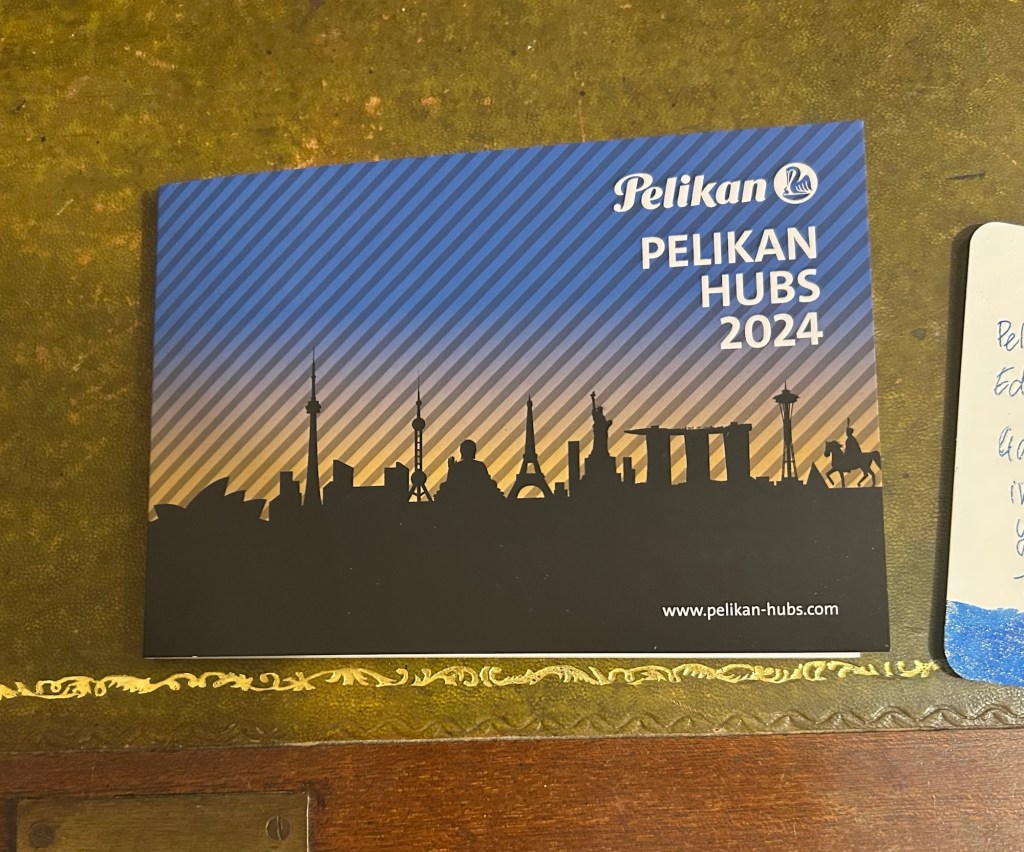
Yesterday Pelikan celebrated their annual Pelikan Hubs event, and we had a local Pelikan Hub. Since 2014 the German pen company has invited its fans to gather in groups all around the world and for one evening celebrate their love of Pelikan fountain pens and ink. The events are well organized, with a local volunteer in each country organizing the Hub location and orchestrating the event. And every year Pelikan gives Hub participants a generous gift for their participation.

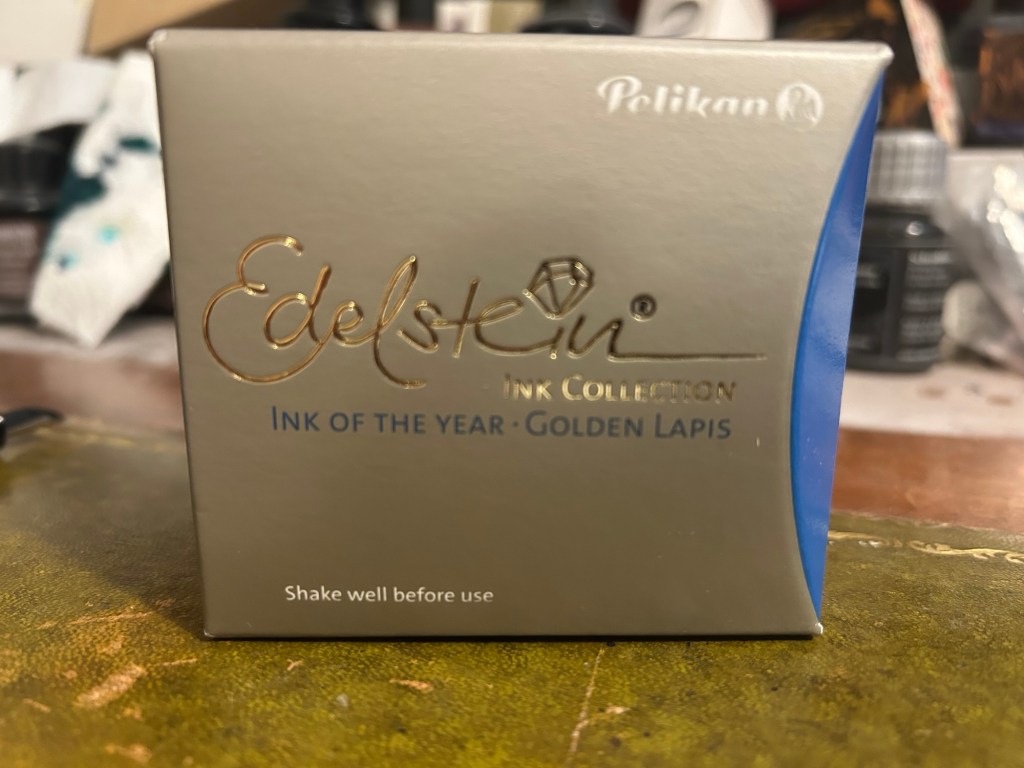
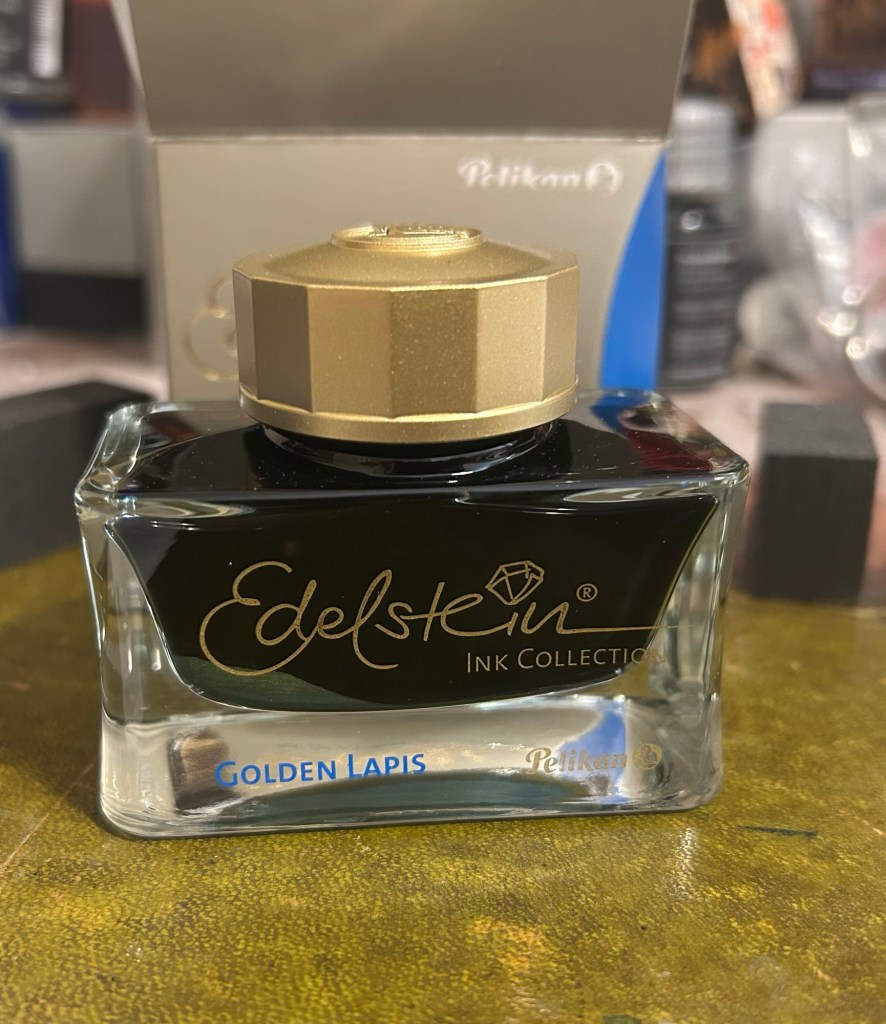
This year was no different, and Pelikan Hub participants got a full sized bottle of Pelikan’s premium ink collection, Edelstein, in the Ink of the Year 2024 colour: Golden Lapis.

Pelikan Edelstein Ink of the Year Golden Lapis

As is customary with luxury inks, the bottle is a glass work of art:

Edelstein ink bottle.

The extra thick base and wide opening work well with Pelikan Souveran pens which tend to be wider barrelled and often difficult to impossible to fill with certain ink maker’s narrow and tall ink bottles. With certain Sailor ink bottles and Diamine’s 30ml plastic bottles there’s a risk of your M400 or M800 not fitting into the bottle or of tipping the bottle while trying to fill the pen with ink. There’s no risk of that with Edelstein bottle design, though when the ink level runs very low its likely you’ll need to get creative when trying to fill your pens with ink.

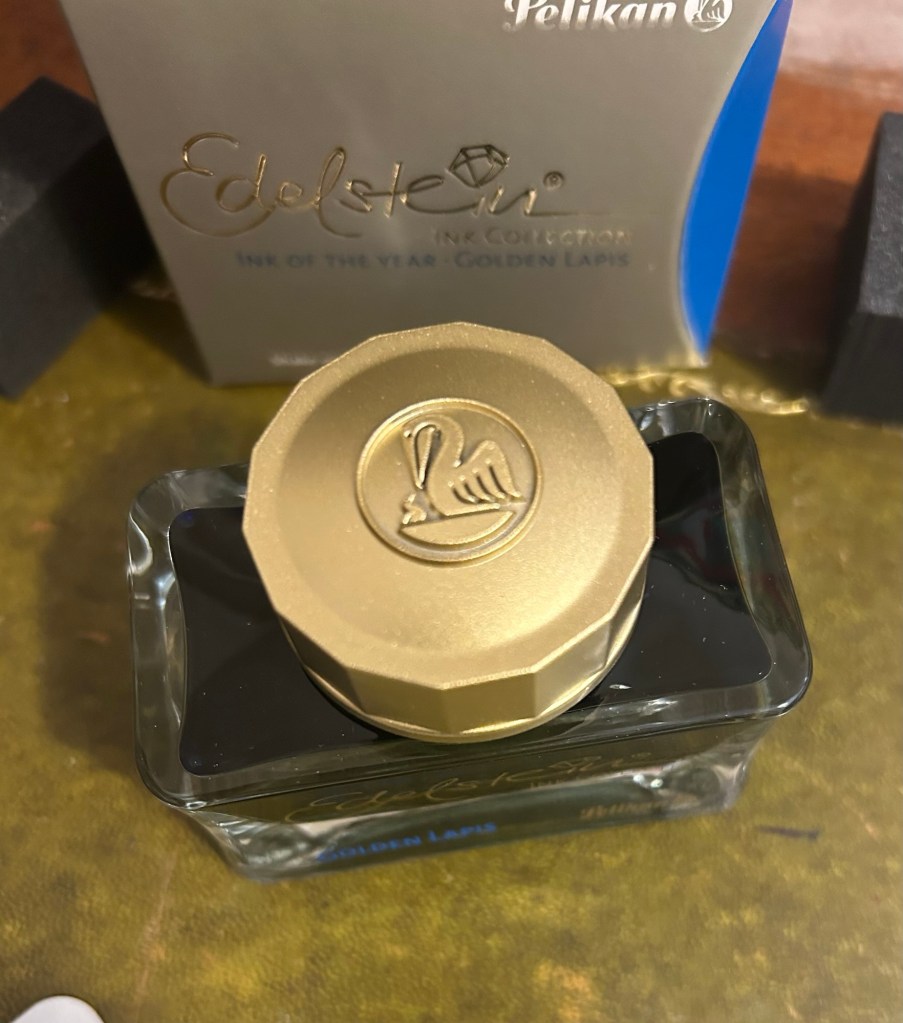
The golden cap has the modern Pelikan logo on it, with a Pelican and one chick:

The Edelstein cap

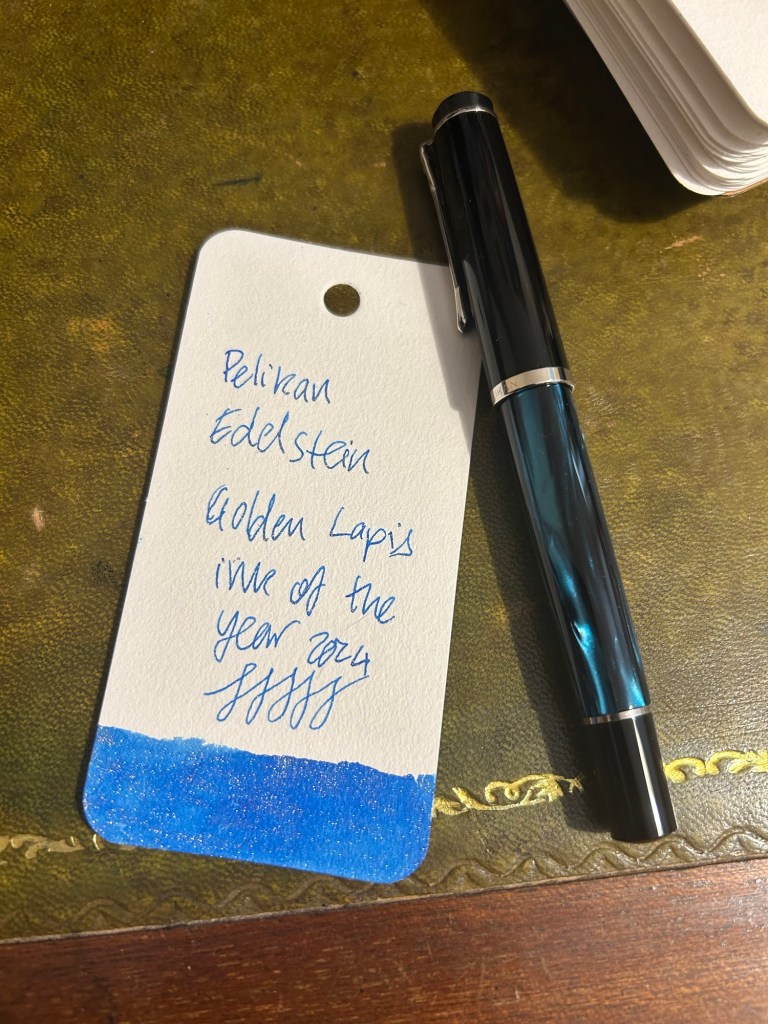
I filled a Pelikan M205 Petrol Marbled EF pen with the ink and used it for the swab and writing sample below. Here’s Golden Lapis on a Col-O-Ring card:

Pelikan Edelstein Golden Lapis ink swab

We got a nice A6 writing pad with bristol thick fountain pen friendly paper in it as part of the Pelikan Hub 2024 gifts. The paper is great though I wish there wasn’t a Pelikan logo on each page mostly because it takes so much space. The paper is thick enough for both sides of it to be useful, so it’s a shame to have to flip the page over and write only on one side if you want the full A6 page to yourself.

The A6 notepad that we received as part of the Pelikan Hub

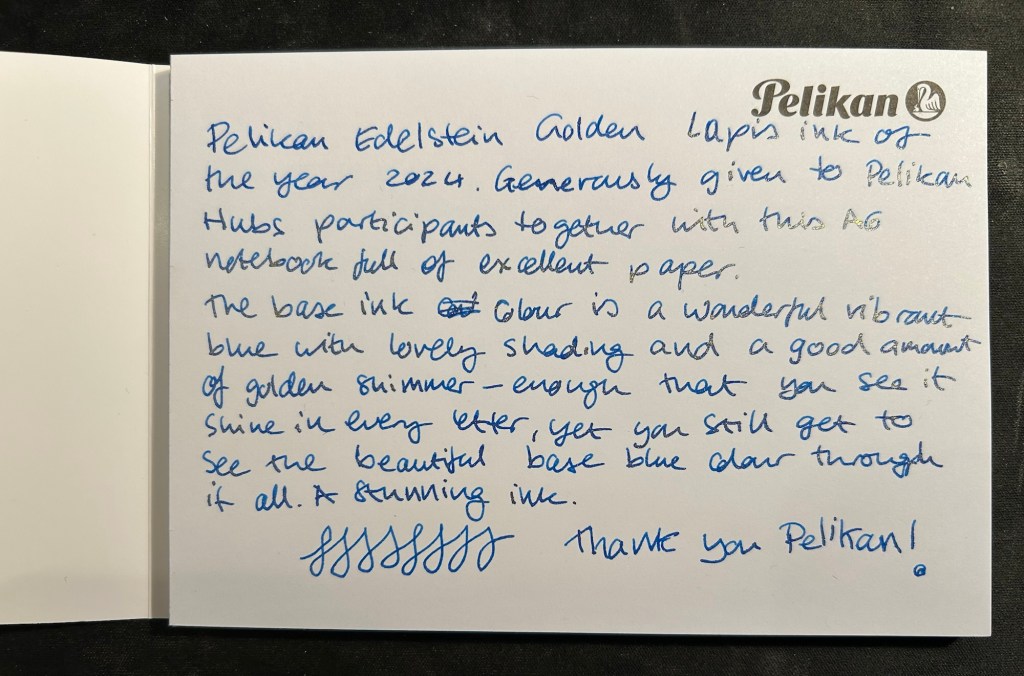
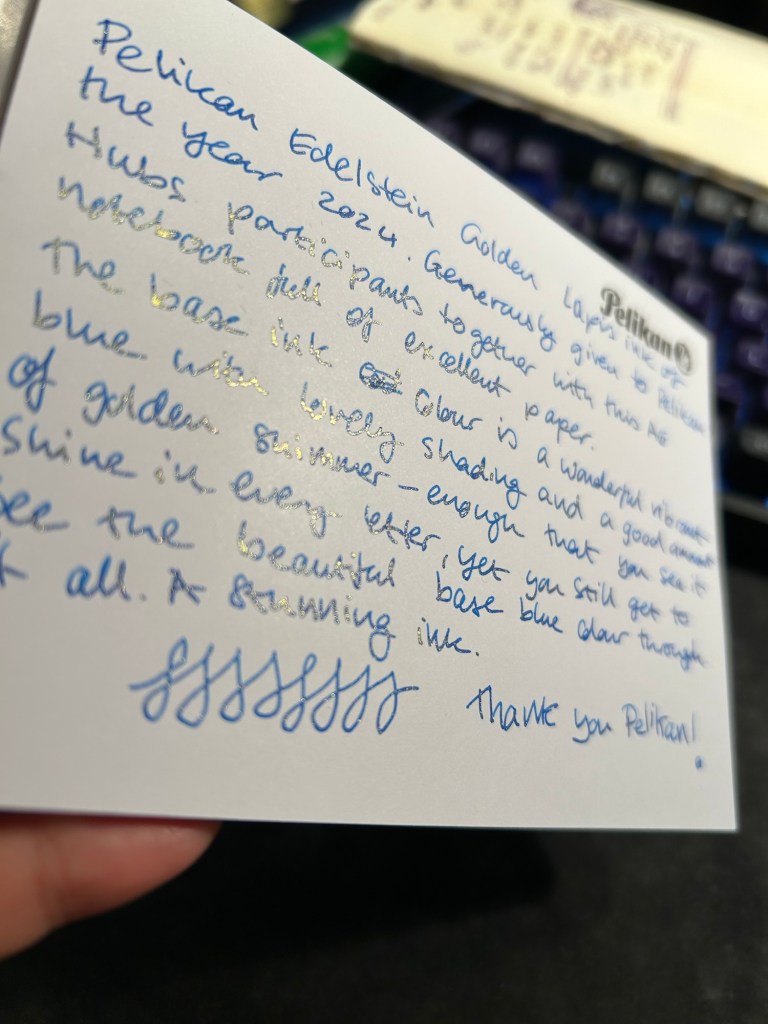
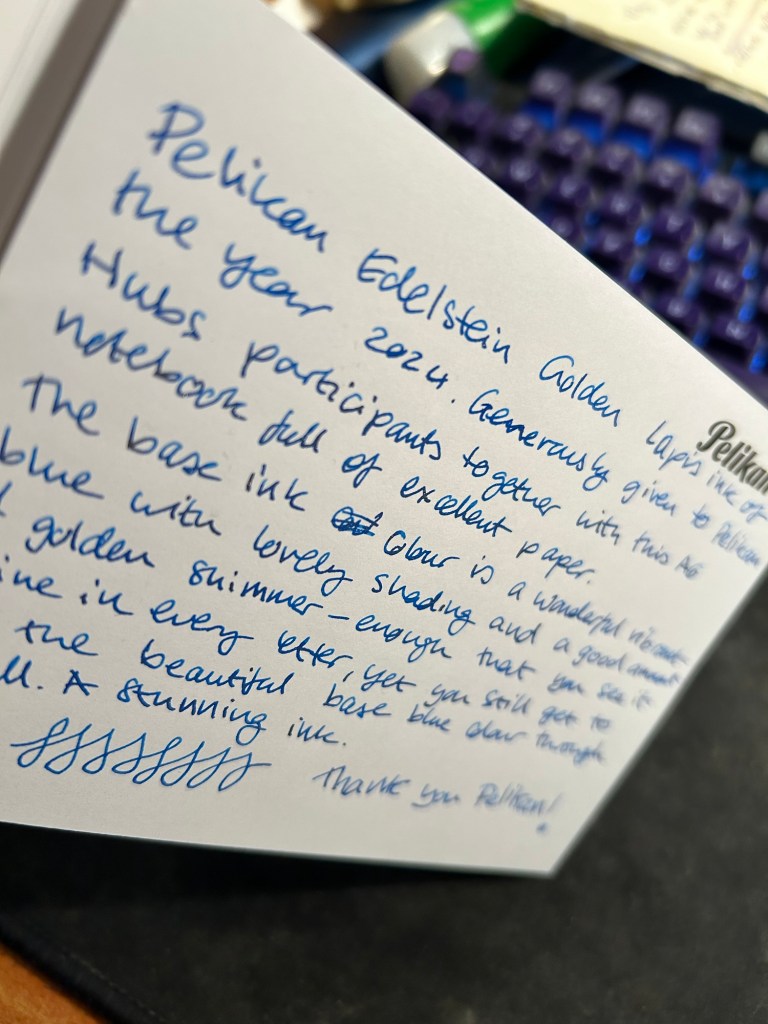
Pelikan Edelstein Golden Lapis is a gorgeous ink, period. The base rich, turquoise-y blue reminds me of Pilot Iroshizuku Asa Gao and that is high praise. The colour is rich, vibrant and has a good amount of shading that sets it apart from standard blues. To this fantastic base ink Pelikan added lots of fine, golden shimmer, and the result is stunning. Viewed directly from above the shimmer is present but subtle, oftentimes taking on the look of sheen:

Writing sample on the Pelikan A6 pad

But tilt the page slightly and the amount of gold in each letter makes the page glow:

Tilt it to the other side and the shimmer “vanishes”, which allows you to see the lovely blue ink’s colour shading much better:

Pelikan Edelstein Golden Lapis is a spectacular ink that manages to be unique in a market overflowing with blue inks with gold shimmer. The combination of the base colour, its shading properties, and the good spread of the shimmer make this an ink worth having in your collection if you’re a shimmer ink fan.

As for the Hub I participated in: it was fantastically well organized and I had a lot of fun meeting other fountain pen enthusiasts and seeing the pens they brought.

A Friendly Suggestion for Beginner Vintage Fountain Pen Users

I’ve been catching up on the Pen Addict members-only “Friend of the Show” podcast (highly recommended), and person after person said that they prefer modern pens, and they have a vintage pen, an Esterbrook, which they don’t really use. That people’s first vintage pen is an Esterbrook didn’t surprise me, as it’s a great little pen at a very compelling price, and it can be easily modified to suit your writing style by swapping out the nib. What did surprise me a little is that people aren’t really using the Esterbrooks that they have.

Then again, I own five Esterbrook pens:

Yet I haven’t used them in years. They all have nibs that I carefully selected to fit my writing style perfectly, and still I haven’t used any of them since 2016 or so. And the reason I don’t use them is the reason why I’m going to suggest to people starting out with vintage pens to maybe not pick the Esterbrook as their first vintage pen, ubiquitous and cheap and beautiful as they may be.

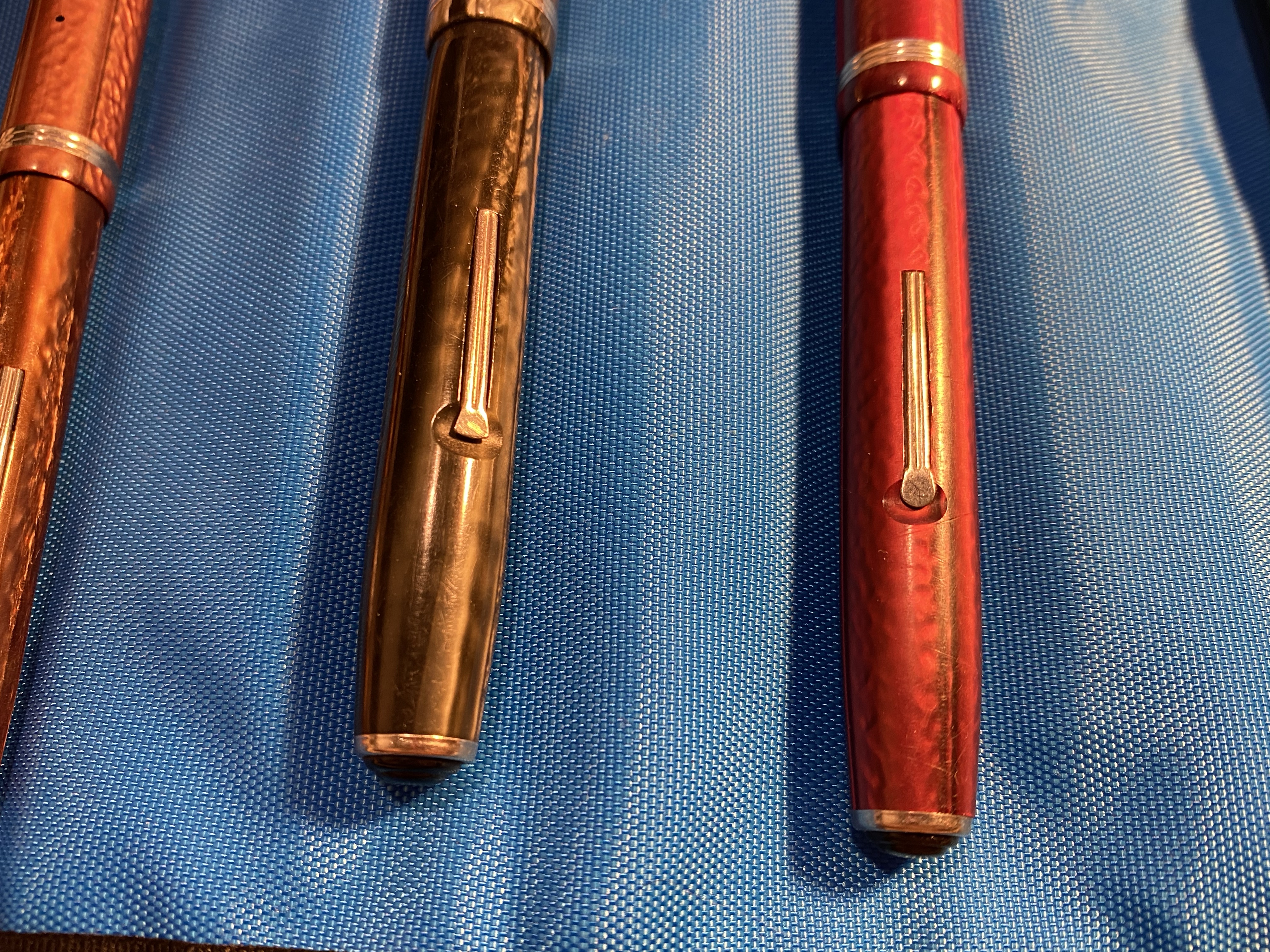
They’re lever fillers, every last one of them.

The dreaded lever.

Lever filler mechanisms are very common in vintage pens, because they are so cheap and easy to produce. They’re also fairly easy to mend, and so you’ll find them everywhere on a vintage dealer’s table or on a vintage pen site. They are my second least favourite filling mechanism (hello button fillers, you get first place) because they are not great to use when you’re filling a pen, and they are really not great to use when you’re cleaning it.

The Esterbrook does allow you to bypass the annoying cleaning part in that you can unscrew the nib and clean the pen like that, but you still have to use the lever when you fill the pen, and you still have no earthly idea how much ink is in your pen while you’re writing with it.

So my friendly suggestion would be to delay your first purchase of a vintage fountain pen and buy something a little more expensive (in the $100-$150 range) that is easier to fill and clean. If it turns out that you like vintage fountain pens, then you can start getting used to lever fillers and their quirks.

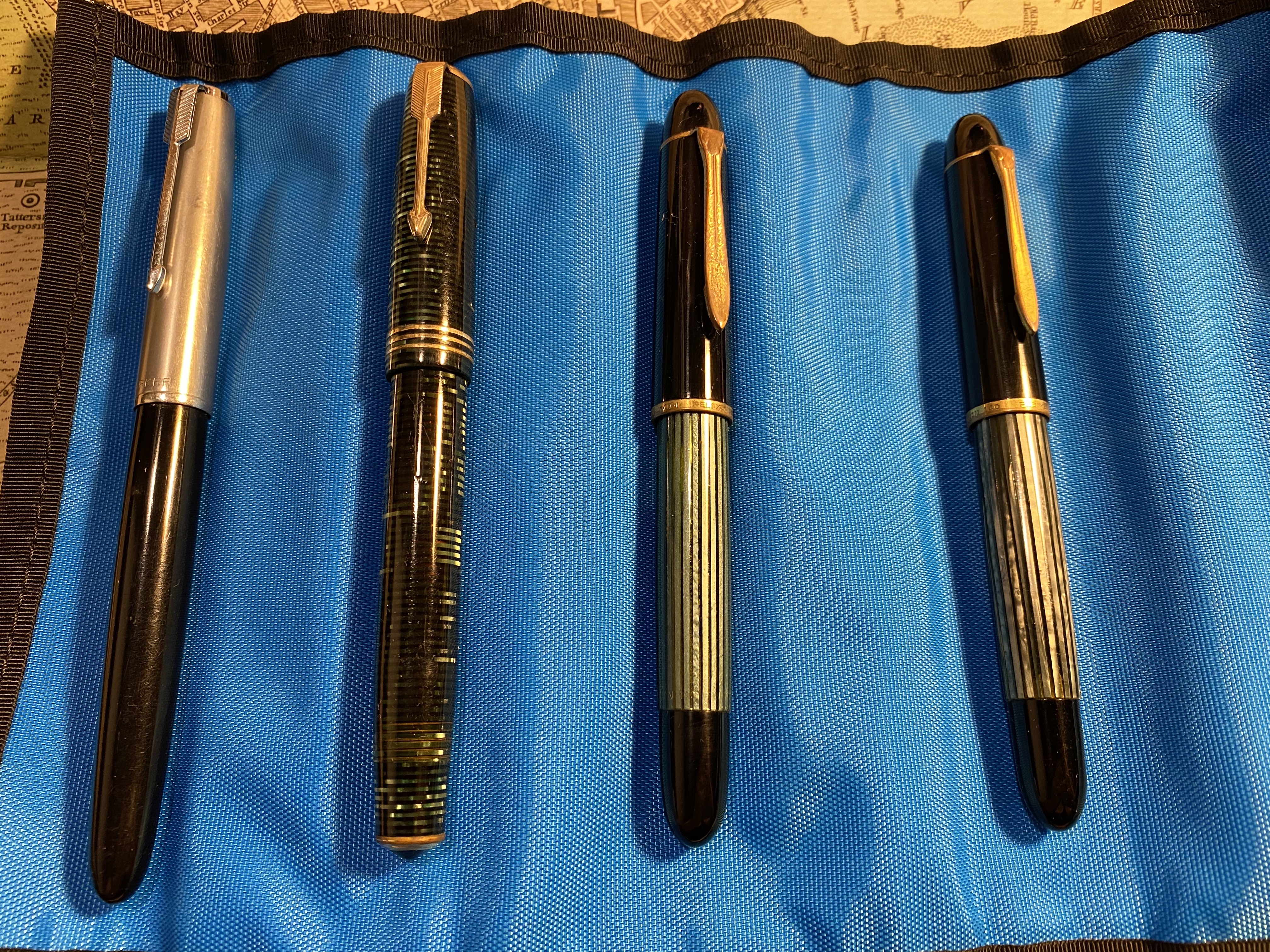
Parker 51, Parker Vacumatic and Pelikan 140

Here are my top three suggestions, in order of most beginner friendly to least beginner friendly (but still friendlier than a lever filler): the Pelikan 140 (a piston filler), the Parker 51 aerometric (an aerometric filler that works like a squeeze converter), and the Parker Vaumatic (a vacumatic filler).

Aerometric, Vacumatic and Piston filing mechanisms.

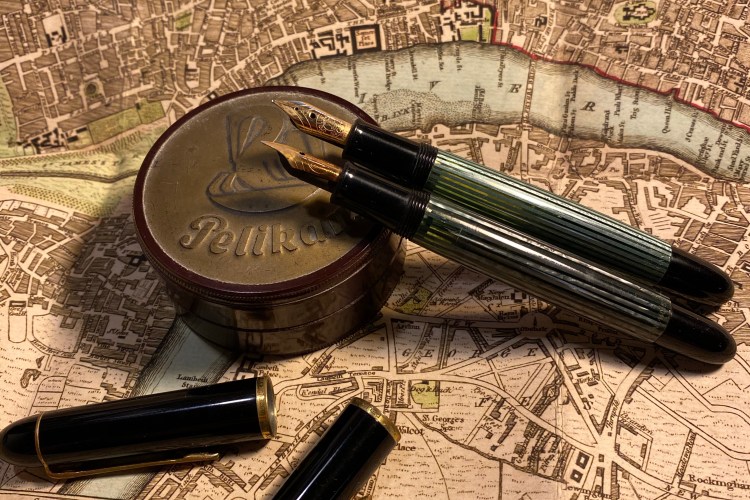
The Pelikan 140 is a piston filler with a gold nib, and a semi transparent body which allows you to see if you filled the pen properly and how much ink is left. It was made for over a decade and has a wide variety of nibs, so you can quite easily find it, and look for the perfect nib for you, just like with the Esterbrook. It is a more expensive pen, but you can still get a phenomenally good pen (ebonite feed, gold nib which can sometimes have flex, and a large ink capacity) for significantly less than what the same features would cost on a modern pen. The downside is the aesthetics, which can be a little spartan (Pelikan 140s are mostly black with green stripes), and the trim’s tendency for brassing. But brassing adds character, as once a very good vintage pen blog said. These pens are also likely to be more easily obtained in Europe than in the US or Asia.

Pelikan 140

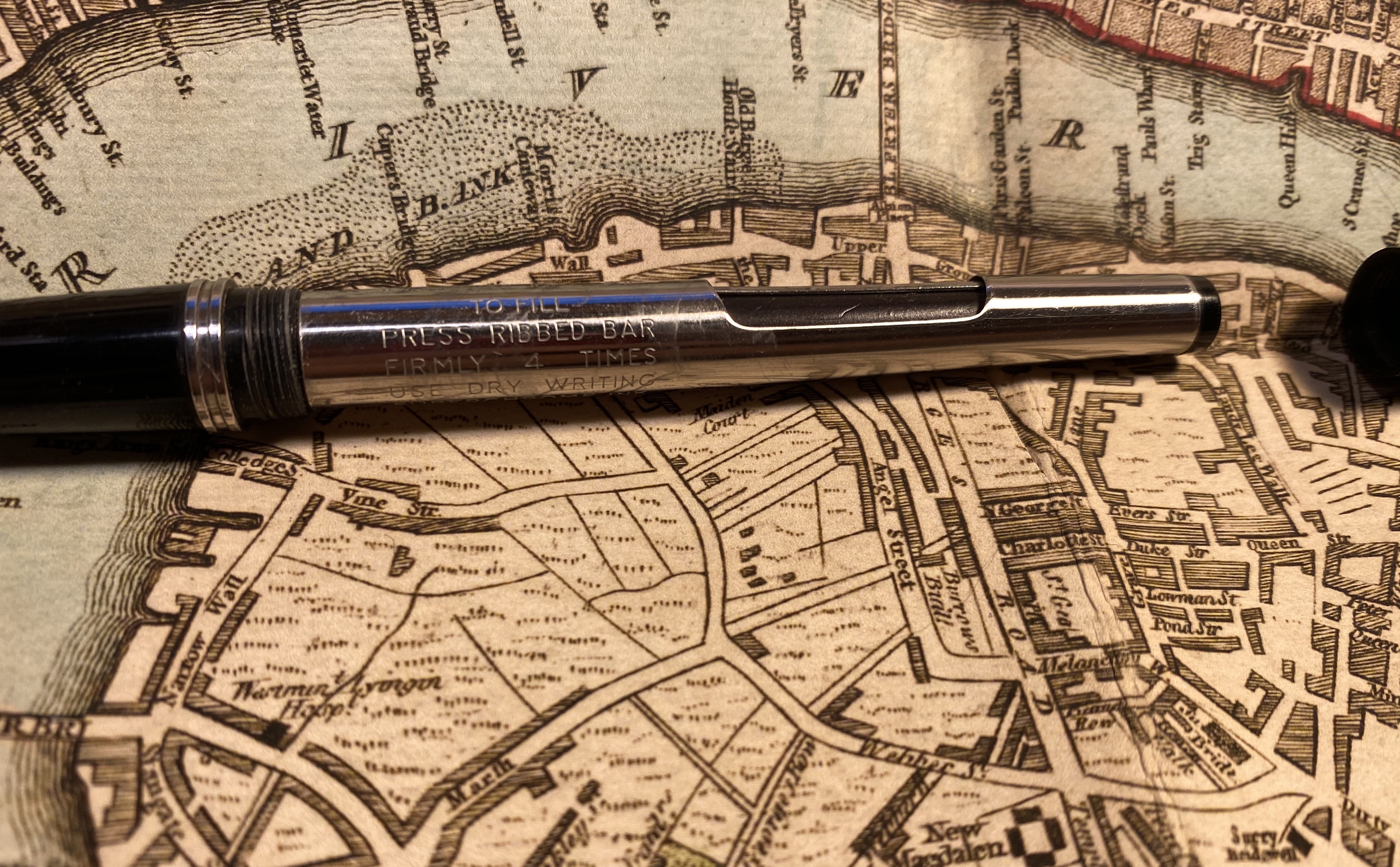
The Parker 51 is still my absolute favourite vintage pen, but that’s not why it’s here. It’s here because the aerometrics (which are also cheaper) sport a filling mechanism that works very much like a modern squeeze converter, albeit permanently attached to the pen, and the filling instructions are etched into the pen, which is very helpful of Parker.

Parker 51

Theoretically you can gauge if there’s ink in the pen using the transparent sack but in most cases the sack will no longer be transparent, and even if it was, its position doesn’t really tell you a lot about the state of the ink in the pen. So it’s relatively easy to fill and clean the pen, but you’re not going to have any indication as to how much ink is in it at any given time.

Filling instructions on the pen body.

The Parker Vacumatics are gorgeous pens with great nibs, and the striped Vacumatics let you know what the ink level is unless they are stained beyond belief, in which case I’d wait a bit for a pen in better condition. The Parker Vacumatics I’m recommending are those with a lock down mechanism. Of the three pens they are the most fiddly, and that’s why they’re in third place, but they allow for a relatively large ink capacity, and the option to see the ink levels at all times, so they go on the list. To fill the pen you unscrew the blind cap, give the metal nob on the top a slight turn and push (a bit like opening a child proof pill bottle) and then the metal plunger springs out. You push the plunger a few times to fill the pen, and then you push down the plunger and twist it once it’s down so that it locks back into place. If you’ve ever used a child-proof pill bottle then you’ll be familiar with the push and twist mechanism, and if not have it demonstrated when you buy the pen or find a youtube video that shows you how to do it. It’s not difficult.

This is a more expensive, double jewelled model, but the filling mechanism is generally the same on cheaper vacumatics.

The Parker Vacumatics are not as intuitive to use as a lever filler, but they allow for an ink window which means that you can see if you have ink left or if you’ve filled or cleaned the pen properly pretty easily:

You can see the ink levels through the orange transparent bits between the stripes.

These pens are never going to compete with the Esterbrook pens on price because they have gold nibs and more sophisticated filling mechanisms. They do quite easily compete with modern pens in terms of bang for your buck when it comes to getting things like a piston filler with a flexy double broad gold nib. If you’re buying a vintage fountain pen that you want to have a relatively easy time filling, using and cleaning, and that will give you a unique and oftentimes exceptional writing experience, any one of these three pens ought to do.

And just to set the record straight: I love Esterbrook pens, and there was a time when I used them constantly, and I still heartily recommend them as they are little workhorses of delight. It just occurred to me that perhaps that little lever combined with the opaque body may be off-putting to new users, and so I’m suggesting a few (much more expensive, sometimes harder to obtain) alternatives. With vintage fountain pens purchase patience is required and not FOMO, so it’s worth waiting for a great $100 pen that you’ll use more than buying a $50 one that you won’t.

Pelikan Ocean Swirl, Sailor Peacock and Last Run Outside

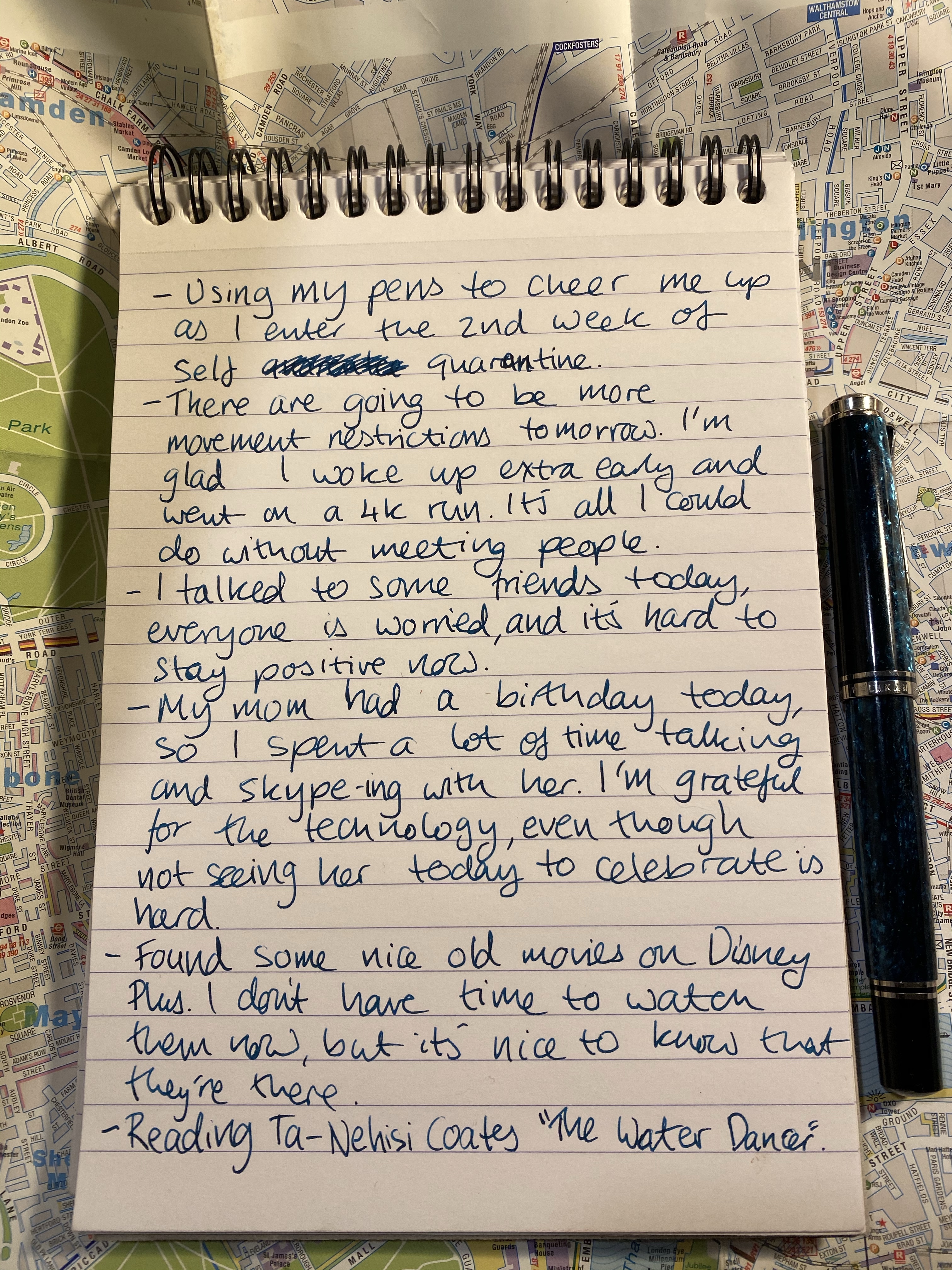
I’m using my pens to cheer me up a little, as we get ready for even more serious movement restrictions, and as the political and economical situation here go haywire. This was written using a Pelikan M805 Ocean Swirl with a fine nib and Sailor Peacock ink. The lighting situation at my desk doesn’t do this ink justice – it’s beautiful.

I managed to squeeze in a 4k run this morning. As I avoided people, I couldn’t run further than that, but I’m glad that I did. The weather is perfect for runs right now, and I really miss my running, but today’s run looks to be the last I’ll be able to go on for a while. I usually run along the waterfront, but so does everyone else, so I ran in parallel streets. This is a temporary goodbye to the sea, and I hope that it’s not a long one:

Stay healthy and safe, and look for the little things and little moments to keep you happy.

Diamine Inkvent Calendar Day 6

Diamine Inkvent Calendar is an advent calendar with a tiny (7ml) bottle of ink behind 24 windows, and a larger, 30ml, bottle of ink behind the 25th window. All the inks are limited edition, and only available through this calendar. You can read more about the calendar here.

Day 6’s door has a bonus bird, which is nice. It also has the best named ink of the bunch so far. Allow me to introduce you to:

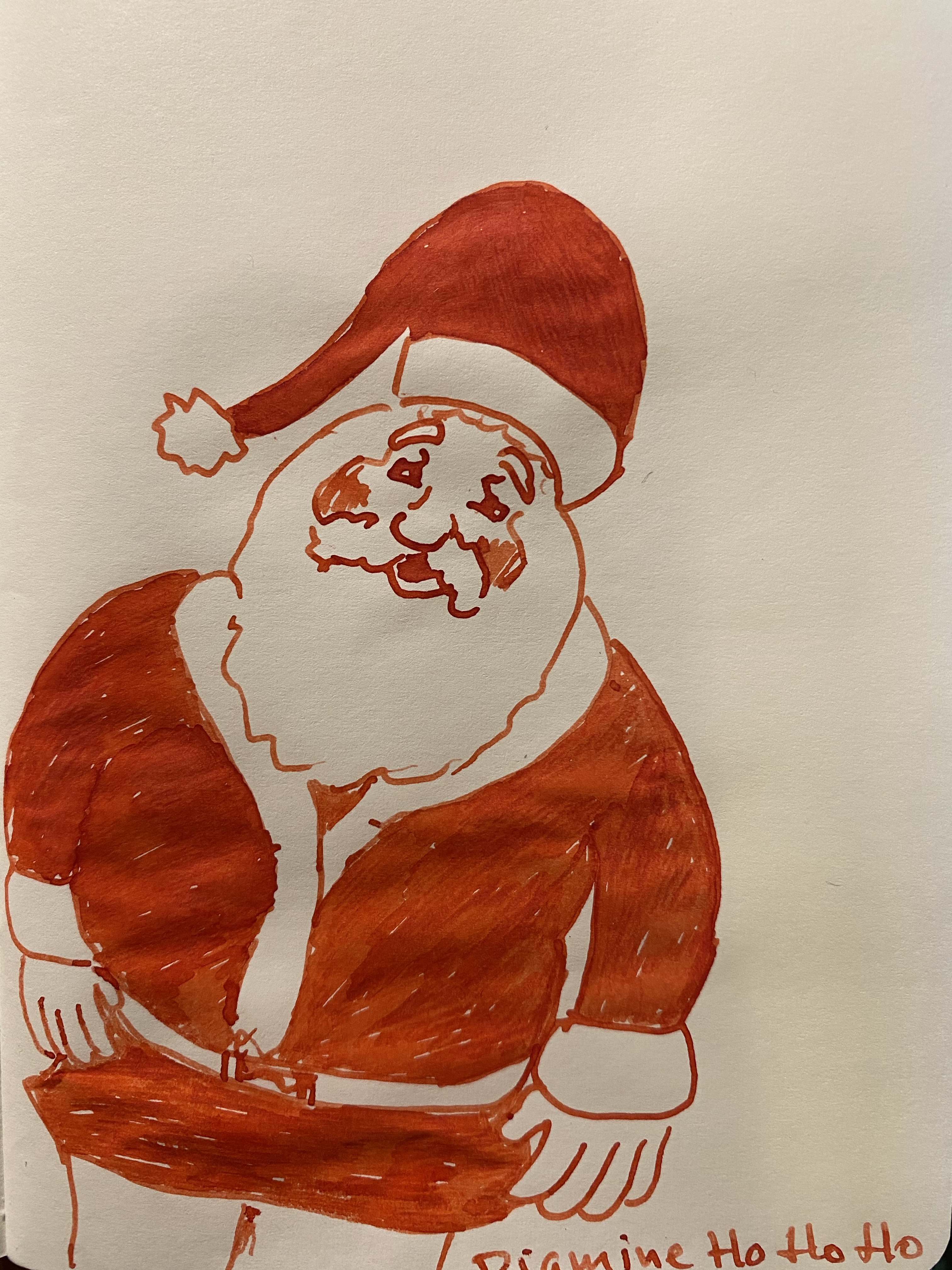
Diamine Ho Ho Ho! This delightfully named ink is a orangey-red that shades beautifully.

Like all the rest of the Inkvent reviews, this was drawn on a Kanso Sasshi 3.5” x 5.5” Tomoe River Paper notebook, which really makes the best properties of each ink shine. Here it’s the shading, that goes from a dark orange to fire engine red, and is really warm and cheery.

This was drawn using a Pelikan Pelikano medium (which should be called a broad, but it’s Pelikan, so hey), and you can see the shading in almost every stroke above. I tried not to draw over the same place twice, just so you can get a better feeling for the shading properties of this ink.

The above was written on Clairefontaine paper, so you can see that the ink shades on it as well. This is a terribly impractical ink for day to day use (you can’t even mark papers with it, it’s too cheerful and bright for that), but it’s an excellent ink for Christmas cards or Christmas themed art.

How to Buy Your First Vintage Fountain Pen

I just listened to the latest Pen Addict Podcast, where a listener asked for tips on buying their first vintage fountain pen. I have well over 100 vintage fountain pens, and I’ve been buying vintage fountain pens since the early 2000s, so I decided to take the time and write a guide to buying your first vintage fountain pens (for the sake of this guide vintage fountain pens are those made before the ’70s).
  1. First, set a budget. Vintage pens are no different than modern pens in this respect, but somehow vintage fountain pen buying guides tend to skip this step. You can get great vintage fountain pens for under $50 and well over $500. Pick a number you’re comfortable with, and stick to it, no matter what.
  2. Decide why do you want a vintage pen:
    1. Flex – You’re looking to add line variation to your writing or drawing. Apart from dip pens, vintage fountain pens are the cheapest way to get that desirable flex. No modern fountain pen, despite any manufacturer promises, offers the line variation of a vintage flex fountain pen, and the premium you pay for a bit of springiness in modern nibs is painfully high. Vintage fountain pens also offer flex “combos,” such as italic flex, needlepoint flex, etc. And if you’re considering the Noodler’s fountain pen lineup, I recommend going dip pen instead. They require less fiddling and are more reliable.
    2. Gold/Specialty Nib – You want to get into gold nibs as cheaply as possible, or you want non-standard nib configurations (a fountain pen that works on carbon copy paper, perchance?). You can get fantastic gold and crazy nibs on vintage fountain pens for much, much less than certain manufacturers ask for a generic steel nib pen with a colourful plastic body.
    3. Looks – You can find a vintage fountain pen that utterly matches your style, whether it’s an understated elegant pen, a stunning showstopper one, or an out of this world wacky wildcard pen. Did I mention also that these lookers will likely cost you much less than any modern equivalent?
    4. History – You’re looking for something with a past, with a story. It can be something that’s passed down the family, a treasured pen found in an estate sale and begging to be researched, or a bold attempt by a brazen small company to create something completely new.
    5. Quirkiness – Things were wild in the heyday of the fountain pen, and you want  a piece of that. Retractable and adjustable nibs, crazy filling mechanisms, pens made out of strange materials: works of genius and madness that call out to you.
    6. Collectable Value – This is the first thing people think about when they hear about vintage fountain pens, and there’s a reason it’s the last on my list. If this is what interests you, I highly recommend walking away before you even start. This isn’t a money making venture. There are no great deals or finds to be made. All the good ones have been taken long before you, and are now passing from hand to hand, available only to people in the know. If you get into vintage pens for another reason and then decide you want to collect a few of the same kind, maybe nab one that’s a bit hard to get – fine. Otherwise, you’re getting into a losing game.

    P1010319
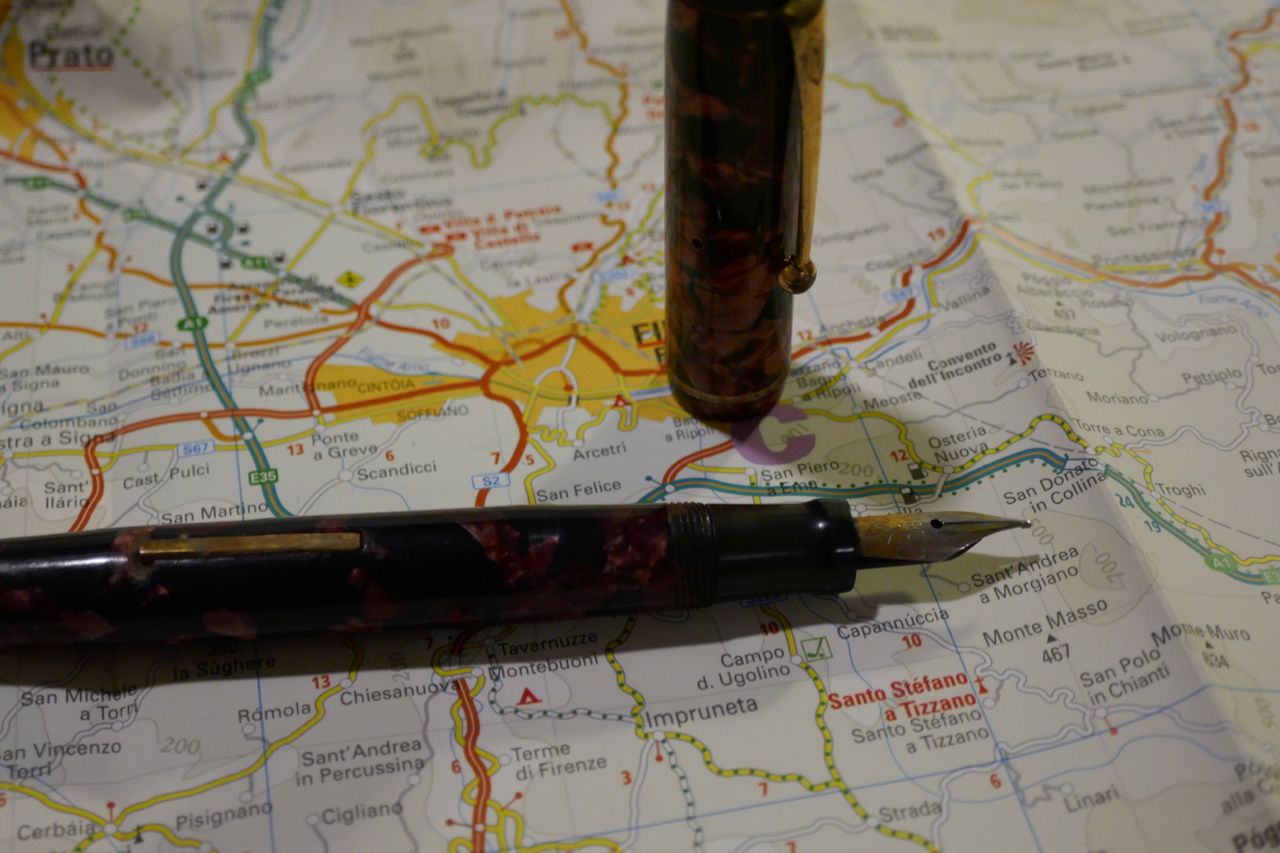
    Ugly no name lever filler with phenomenal gold wet noodle nib and feed, in utter user-grade condition. Bought for $30. 
  3. Your next move depends on what you chose in the last step:
    • Flex – Get thee to a vendor. Writing samples on the internet are lovely, and they’re a great way to shop for inks. Vintage flex needs to be held in hand and tested. Go to a pen show or a vendor and specifically ask for pens with a flex nib. Then ask to dip them, and try writing with them. Be very gentle at first, until you figure out how the nib works. The magic of vintage flex isn’t so much the nibs themselves, it’s the feeds. A good vintage wet noodle can keep the ink flow going even when you’re writing in giant poster letters. A modern pen’s feed will give up and you’ll end up with railroading. Things to remember:
      • A vintage flex nib may look wonky (dropping, slightly wavy). Ignore that – the test is in the writing. If the vendor won’t allow you to dip test, say thank you politely and walk away.
      • You’re interested in the nib, not the pen. Ask if the filling mechanism works (99% of the time vintage flex are lever fillers), and check the body for cracks. That’s it. It can be a black chased hard rubber (BCHR) Waterman brown with discolouration, brassing, and 3 different personalizations, it shouldn’t matter. You’re there for the nib, and the uglier the pen, the cheaper it’s likely to be. Vendors used to not even repair these ugly ducklings until recently, when the interest in vintage flex spiked and people figured out that you can get a wet noodle for $30.
      • The maker doesn’t matter. Waterman made great vintage flex nibs, but people know that, so you’re going to pay a premium for it. Some of my best flex nib pens are from no-name small manufacturers, and I got them all for a song. Waterman is great, just don’t get locked in to looking only at them. Test the nib and let it speak to you.
      • If you want to be extra sure that the pen works, ask the vendor to fill the pen for you once you’ve completed the purchase but before you’ve left the table. Just don’t forget to empty the pen out if you’re going on an airplane later on.
      • Never touch a pen, especially not a flex nib pen, without talking to the vendor first.

P1010317
Ugly no name Italian pen with personalization, bought for the phenomenal flex italic nib. Bought for £25

    • Gold/Speciality Nib – Much of what applies to flex nibs applies to these types of nibs. Unlike with flex nibs, online shopping for vintage gold/specialty nib pens is an option, but going to to a pen show or a vendor and try them out is still the best and safest approach. Don’t buy for the pen’s looks or condition (beyond checking that it works and there are no visible cracks), but for how it feels to write with this nib. Things to remember:
      • Great vintage pens with gold nibs are very common. If the price for a pen is high, you’re not paying for the nib, you’re paying for something else. Walk away.
      • If you just want your first gold vintage fountain pen, I recommend the Parker 51. You can get a great one for well under $100 (often under $50 if the body’s been personalized), so long as you aren’t fixated on one of the rare colours or an early year. Focus on aeromatics, in Black, Navy Grey, Burgundy, Forest Green, Midnight Blue, Teal Blue with a lustraloy cap. You pay a premium for special colours, caps in gold and sterling silver, red band vacumatic filling systems, and the cap condition. If the cap is dinged or lost its frosting, or if the pen is personalized, you can get it for a song. The Parker 51 nibs are PHENOMENAL. There’s absolutely nothing like them, and they make your writing look great. This is a large part of their appeal. The nibs aren’t graded, and most of them are in the fine-to-medium range. Just make sure there’s plenty of tipping material when you buy the pen (try out the pen and feel if it’s scratchy/look at the tip/ask to see a close up of it when buying online). The Parker51 website and the Parker forum on the Fountain Pen Network are a great place to learn more about these pens.
      • Speciality nibs are harder to find, so focus on two companies: Esterbrook or Pelikan. Both made great pens with a wide variety of interesting nibs, and both can be had relatively cheaply. These pens were also built like tanks, so they’re very likely to be in great working condition when you buy them, just be sure to ask. If you’re in Europe, Pelikans will be cheaper for you to acquire, and if you’re in the US Esterbrook is your friend. These are also pens that you can buy online relatively safely. Start with the Fountain Pen Network Esterbrook/Pelikan forums (FPN is still the #1 resource for vintage fountain pens), Esterbrook.net or the Pelikan’s Perch to educate yourself and purchase pens. I’ve purchased great vintage Pelikans from Berlin Collectibles, but again, I’d recommend trying the pen in person before going to the online shopping route. Esterbrook is going to be significantly cheaper than Pelikan, and you can buy one pen body (I recommend the J) and several nib units. But Pelikan has phenomenal OB, OBBB, OBBBBB… nibs that Esterbrook just never made.

P1010318
Esterbrook J double jewel (i.e. super common) with a 9556 nib. Bought for $16.5

P1010310
Pelikan 140 with a flexible OM gold nib. Piston filler, bought for 120 euros.

    • Looks – this is probably the hardest one to give recommendations for, except go to a pen show and look around to see what catches your eye, but there is one thing worth noting. If there’s a particular design you like but it’s beyond your budget, look for “knock offs” made in the same era. Smaller makers made great pens “inspired” by more expensive ones made by the big manufacturers. You can get a Parker Vacumatic Golden Web look alike for $50-$80, gold nib and all, and only you’ll know that it’s a lever filler made by a no-name Italian maker and not the real deal (don’t sell it as such, though).
  • P1010309
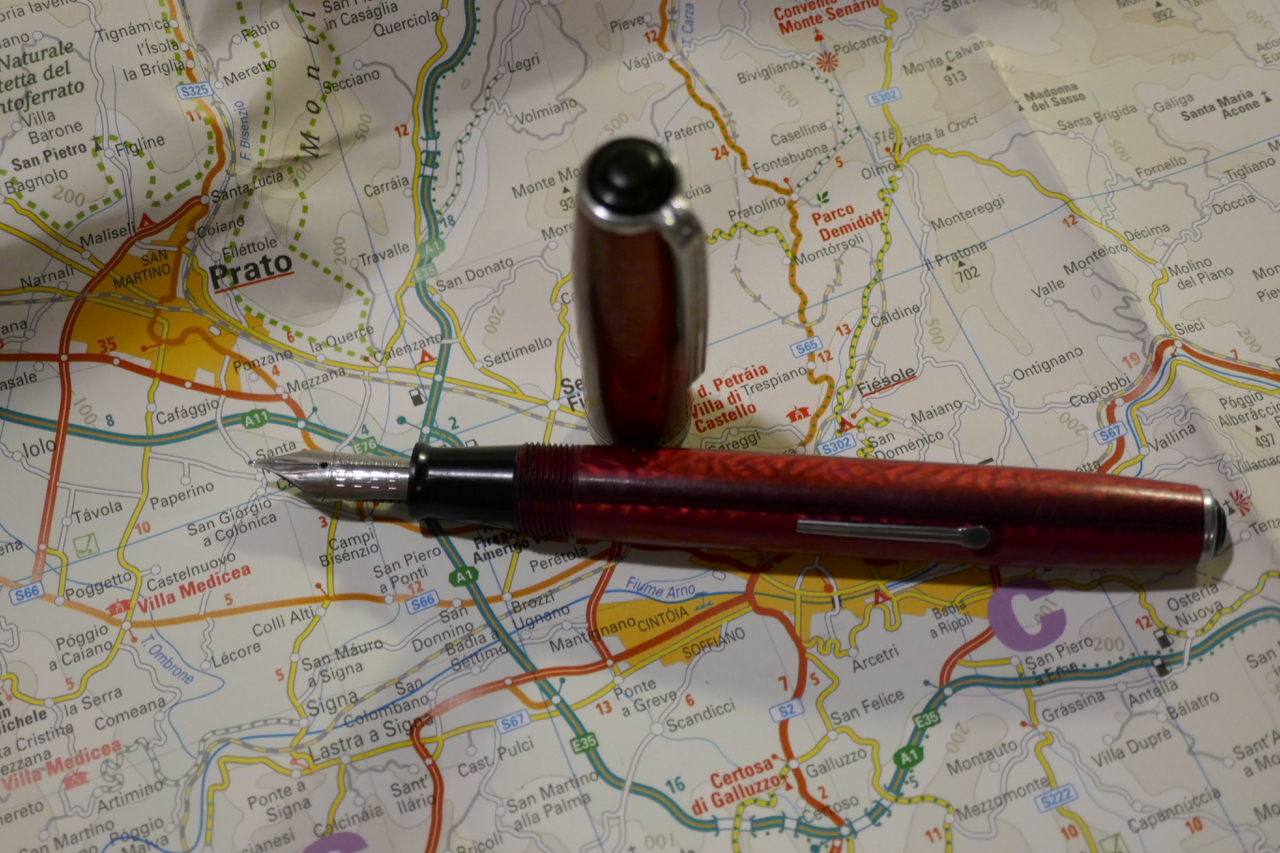
    Waterman, bought for the crazy look and the superflex nib. Notice how the nib looks dented.

    • History – tell friends and family that you’re into fountain pens, and you’ll likely be inundated with old pens that they’ve found in the back of desk drawers. Most of them will be ruined, but you may get grandpa’s Parker 51, or grandma’s Esterbrook nurse pen, you never know. If it’s something from the family, I recommend investing in having it professionally repaired and restored if the history aspect interests you. Otherwise, this category of purchase requires dedicated research. I’d check the Fountain Pen Network, and go on from there. If you like to know that your pen had a past, skip stickered pens and go for personalized ones and you’ll also save a lot of money.
    • Quirkiness –  this is the most fun category. Go to a pen show or vendor and ask if they’ve got anything strange. A pen with a weird body design/colour. A pen with a strange filling mechanism. Something wild engineering attempt to make the pen leak proof. The prices here can vary a lot, depending on whether the pen works or not, and if you plan on restoring one of these and they have a strange nib or filling mechanism take into account that it will add a lot to the price, and not every restorer will take the job. I wouldn’t start with one of those.
    • Collectable Value – don’t. If you really, really want to, go to the relevant Fountain Pen Network forum and check what everybody’s wild about. Don’t go by what eBay sellers call “rare,” and remember that not everything that’s rare is desirable.

P1010308.jpg
One of these is a user grade black Parker 51, and the other is a plum Parker 51. Would you pay well over 4 times the price of one for the other?

#Inktober 22: Expensive

The expensive but coveted Pelikan M800 Stone Garden fountain pen.

Staedtler pigment liner 0.7 on a Field Notes Signature sketchbook.