Two Years of Daily Journaling

This week I celebrated two years of daily journaling. While I’ve been keeping journals for years, until the last two years I’ve only done so sporadically. Journaling was something that I did only when things got really rough, to keep myself going, or when I was travelling, to preserve the memories of my trip. I used pocket notebooks for my sporadic journals, as it was more important for me to capture things than to reflect on them. It was a utilitarian process, not an enjoyable one. I knew that once I decided to really start a journaling habit, that would have to change.

These are all the journals which I’ve used during the past two years.

So the first thing I did was pick a notebook that I knew I’d want to use, and use daily. The only rules were that it had to make me happy, and that it had to be large enough for me to be able to actually write in it, not just jot things down. I wasn’t looking for the best notebook with the best paper in the best format (I don’t think that exists, actually, but for us stationery geeks the search is always on), just a good enough notebook for me.
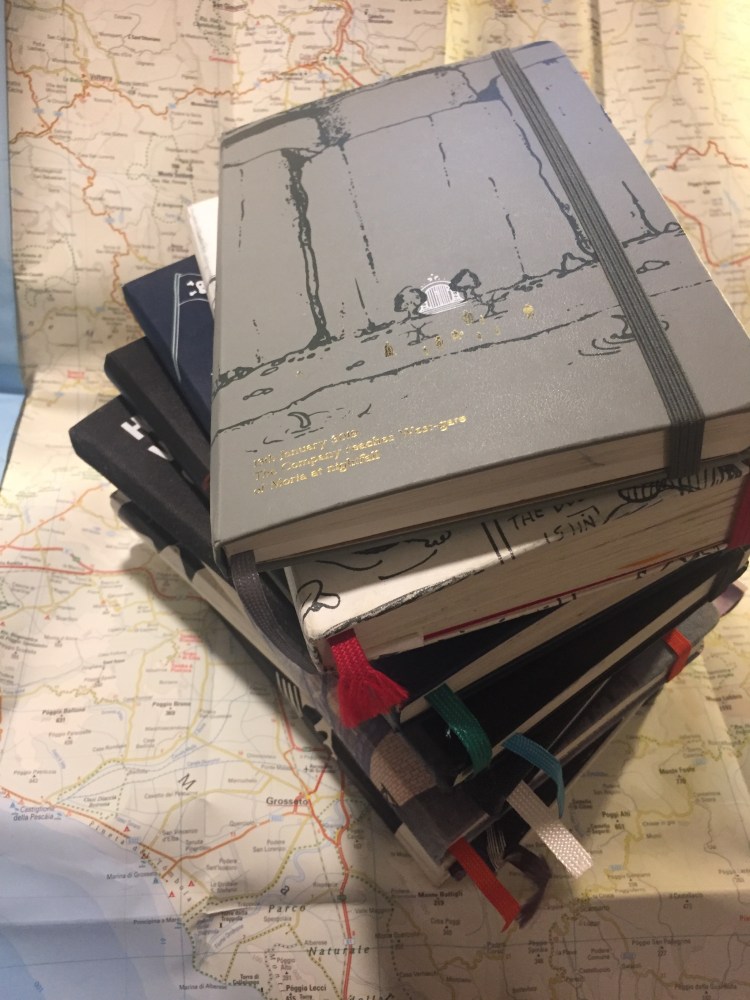
My notebooks of choice.

I also decided very early on that I couldn’t use a fountain pen for this, because I wanted a pen that I could write with even not under the most ideal circumstances. I was also planning for both the notebook and the pen to bash around freely in my bag. These were going to be used and look used.
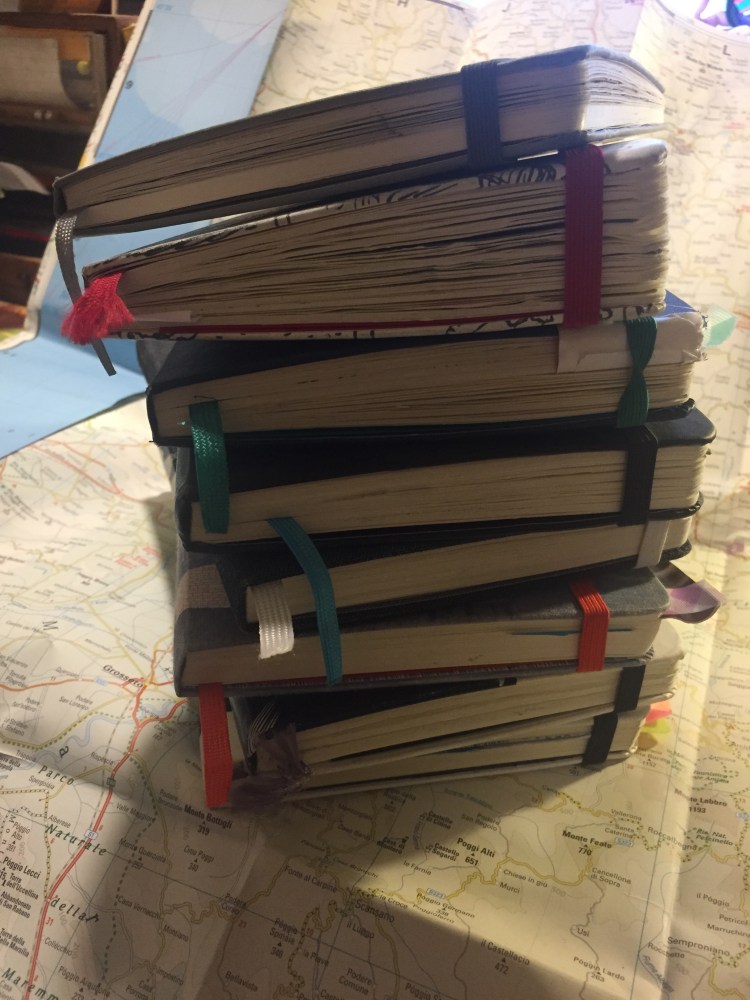
Can you see how bloated these notebooks are? Moleskine makes them sturdy enough to take a beating. 

I chose Moleskine large ruled hardcover notebooks as my notebook of choice, and the uni-ball Signo RT 0.5 gel ink pen as my pen/refill (UMR-85N) of choice. I wanted a sturdy lined notebook that I’d enjoy using and looking at once it was done, and after years of neglecting the Moleskine for other notebooks I came back to it because of some of their limited edition designs. I knew that I was going to use the uni-ball Signo RT 0.5 as my pen or refill of choice (inside a BigiDesign Ti Arto or Ti Arto EDC), so I didn’t need fountain pen friendly paper. I had decided to pick up the steady journaling habit by starting with a travel journal, which I already had some experience with, and then carrying on from there. On the first evening of a trip to London I happened to walk by the Moleskine store in Covent Garden, and I decided to go in and check out what they had. There was a beautifully designed Batman limited edition notebook in exactly the kind of format I was looking for, and it was only available for sale at the Moleskine stores. I bought it, unwrapped and stamped it with the Moleskine Covent Garden stamps, and I haven’t looked back.

That pen and notebook combo has hardly changed over the years. What has changed is the format I use to journal, and the amount of daily journaling I do. When I started out I was used to only jotting a few lines down here and there when I journaled, so I knew I couldn’t expect to write 4-5 pages per day right from day one. Starting with just a paragraph to half a page a day, I pretty quickly moved to one page per day of just writing.

Then I saw a Neistat Brothers video on Youtube and realized that I could use my journal as a visual capturing device as well, and anything could go in it, so long as it made me remember a moment or a place.

Limited Edition Cola Zero tab created for the 2019 Eurovision song contest in Tel Aviv. I don’t even drink Cola Zero, but this little piece of metal is still totally evocative to me.

That’s when the notebooks really started to get bloated. From clothing labels to business cards and ticket stubs, if I can put glue on it and it’s visually appealing or evocative, it goes in. I almost always also write a little note for future me, to remind myself what I’m looking at and why it’s there. That change really made these notebooks a kind of personal artifact for me, and I can’t say how precious they’ve all become.
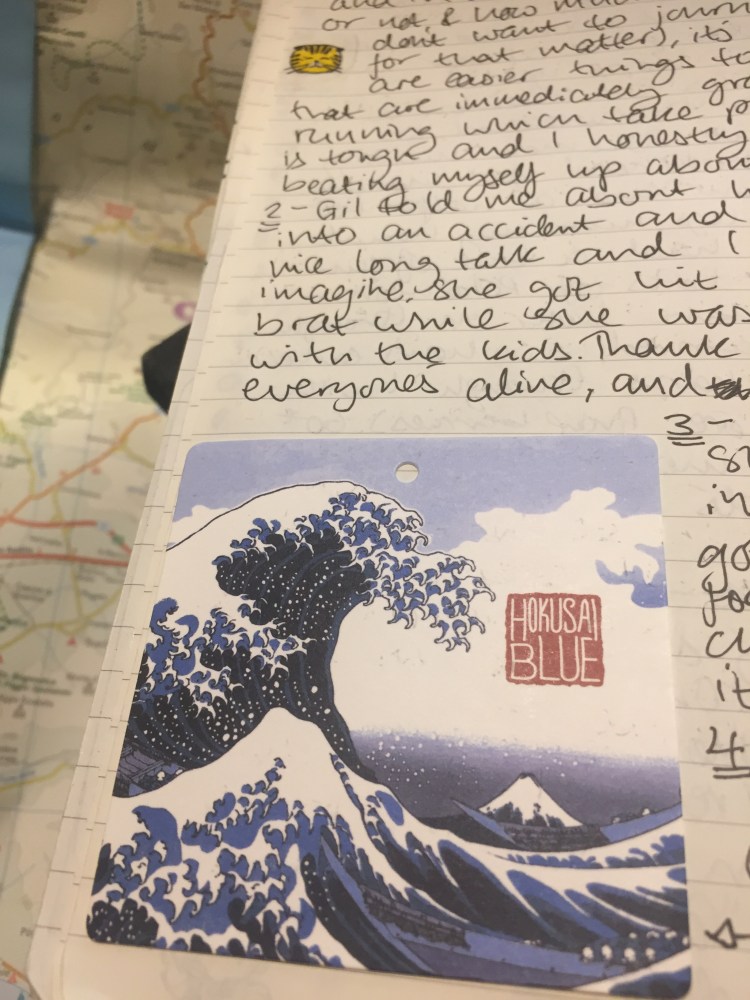
A bit of cat themed washi tape and a Uniqlo shirt label. Sometimes things go in because I find them visually appealing or they make me smile.

At a certain point I started getting ambitious, moving from writing one page a day to two pages, then four pages, then six. That’s when I had to take a step back and make sure that I wasn’t burning out on journaling for all the wrong reasons. I enjoy writing and I enjoy journaling, but I’m also trying to write fiction, and my journal can’t become something that consumes that, an excuse for not writing. It’s also easy to get carried away and want to finish the notebook as fast as possible just so you can open a fresh one, or brag (even if it’s only to yourself) that you’ve finished a notebook. Nowadays I write one or two pages a day for most days, moving up to more pages only if I really have something special to write about.
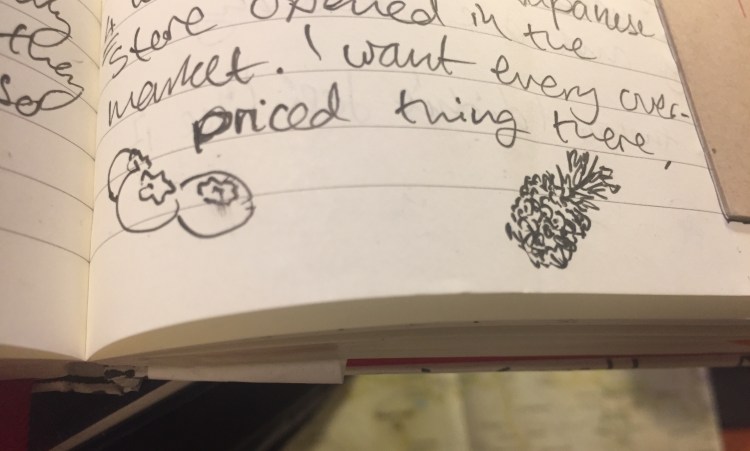
Doodling seasonal fruit in the margins.

Life also happens, and oftentimes it’s scary and ugly, a black hole that threatens to consume all that is good in your life, including journaling. My mom got unexpectedly and very seriously ill last year, and we’ve been struggling with her disease ever since. When she was in hospital I couldn’t bring myself to journal. I backlogged those (thankfully few) dark days, and I realized that I would have to accept that as much as journaling is important to me, family comes first, so backlogging is going to have to become acceptable. I try to backlog as little as possible, but some days just demand that.

If I want to remember a good meal I’ll sometimes draw it.

I also draw a little in my notebook, tiny thumbnails of things that I want to remember later, or that I just feel like drawing. These are usually food doodles, as I don’t really like to photograph my food.

I still use my journal in trips, and ticket stubs and bit and bobs like these make it more interesting.

If you’re looking for some journaling tips, I wrote two posts on that subject here and here. If there’s one thing I can leave you with it’s that if you want to journal, you need to figure out a way to it make it work for you, and be ready to adapt as your life changes over time. There is no perfect journaling system, or perfect journaling notebook, there’s only what works for you.

Go write.
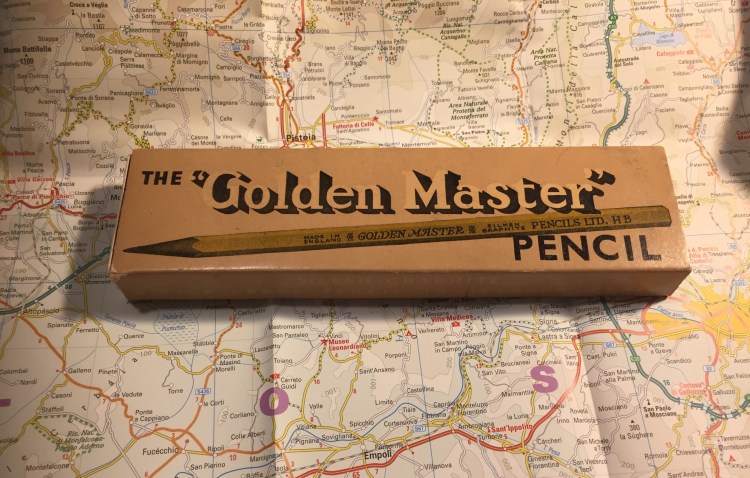
Golden Master Pencil Review

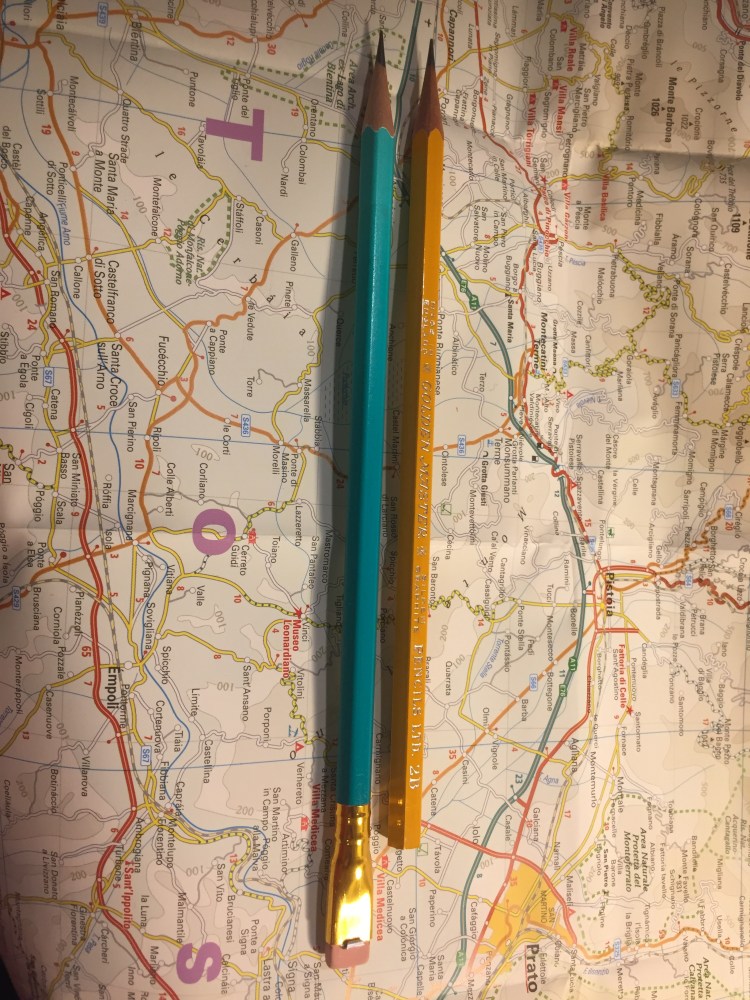
A box of these beauties was languishing together with other art supplies in a stall in London’s Spitalfields market. I saw the box, saw their name, “The ‘Golden Master’ Pencil” and I couldn’t resist.

Just look at this design:

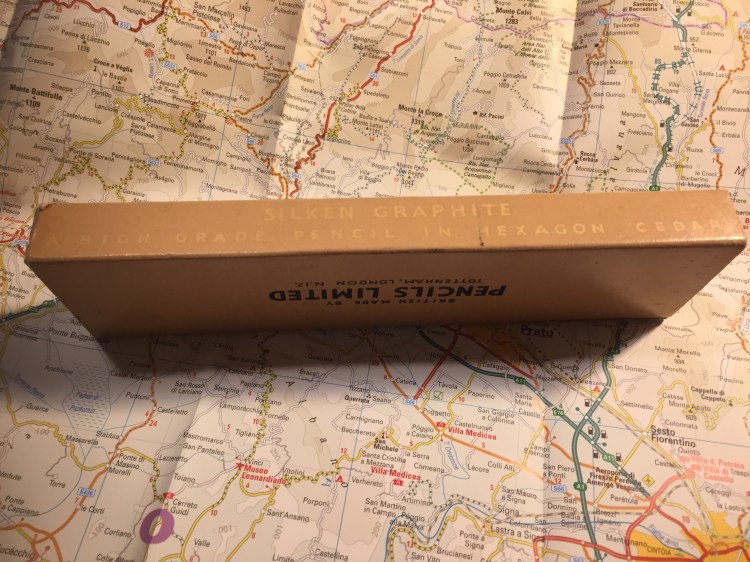
Who doesn’t want “Silken Graphite”? Or “A High Grade Pencil in Hexagon Cedar”? I’ve rarely seen a company take such pride in a pencil, outside of the Japanese market.

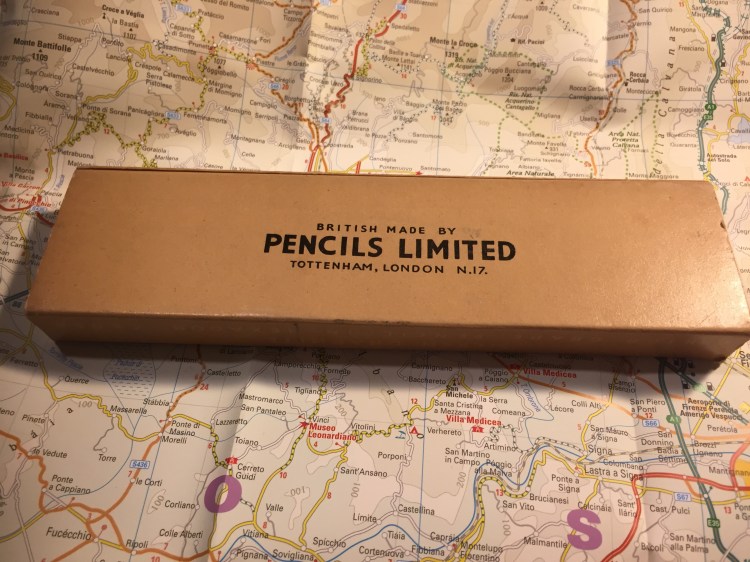
British made, from an era where Britain made things — and in London, too!

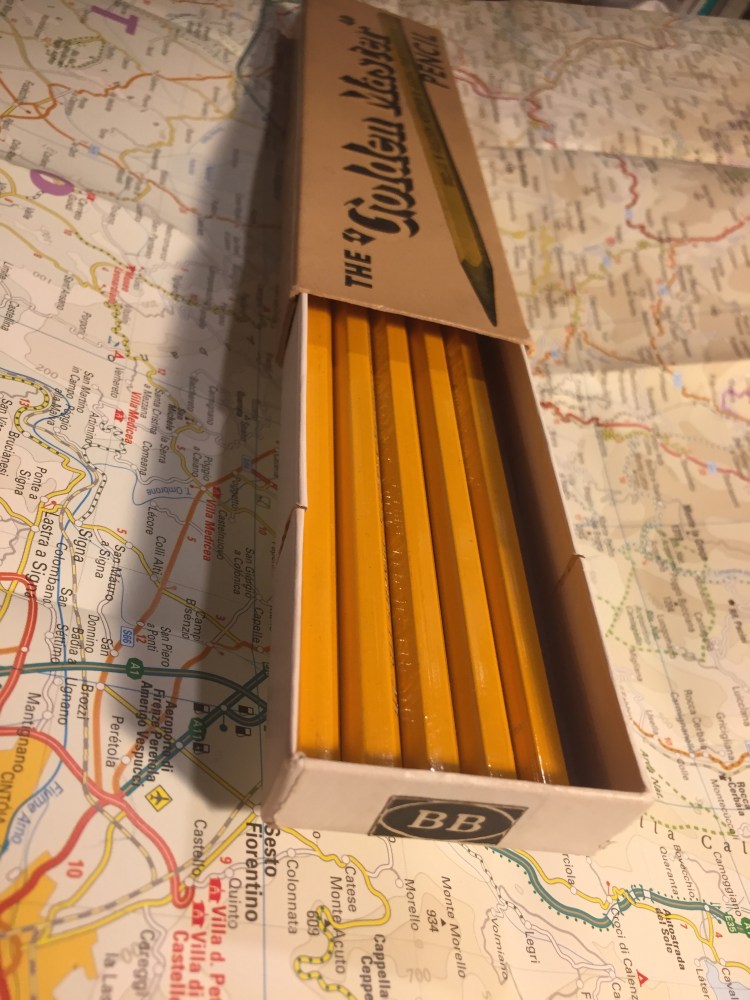
The pencils aren’t really Golden Master HB, but 2B (a bonus from my point of view). They’re labeled as such on the pencil, and strangely enough as two Bs on the box. I’ve never seen 2B pencils labeled that way. I wonder if they printed six Bs for their 6B pencils. I doubt they’d have room on the box.

In any case, the pencils slide out of the box in a sort of cardboard tray that is pretty robust. It works just like an old Eagle Pencil box, and I wish that more modern pencil makers would use this design.

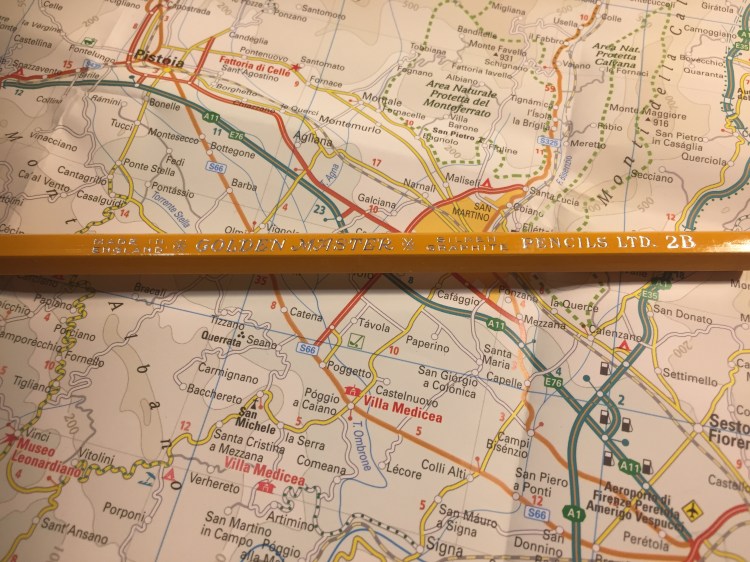
The pencil itself has a good coating of yellow lacquer that has withstood the test of time, and has “Made in England”, “Golden Master”, “Silken Graphite”, “Pencils LTD.” and the grade stamped on it in gold foil.

The hexagonal shape is sharper, has sharper edges, than more modern pencils do. It doesn’t cut into your hand, but you feel it, and I have a feeling that without the lacquer this pencil wouldn’t be as nice to use.

The pencils come unsharpened in the box, and they’re a standard pencil size. As you can see there’s no eraser and no ferrule, but I don’t mind that. I rarely use pencil erasers, but rather keep a block eraser on my desk, or scribble things out if I’m writing.

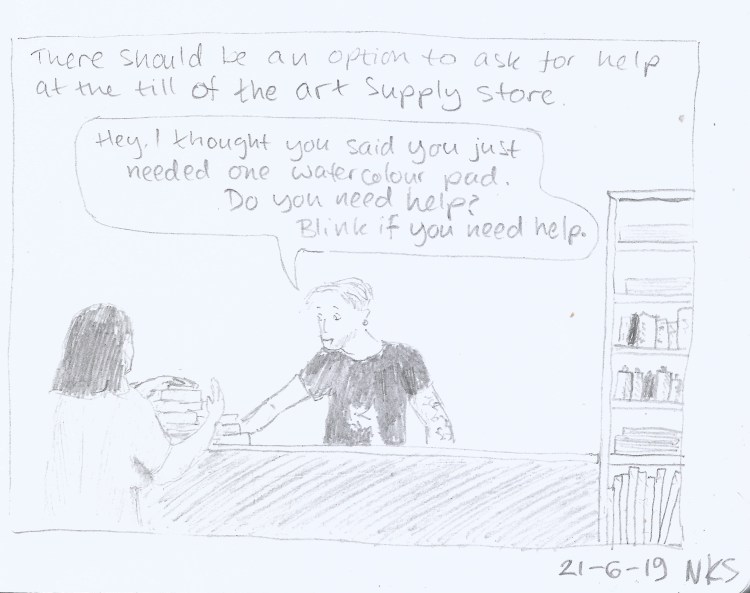
I drew a journal comic with this pencil. It’s very smooth and holds a point forever, but it’s not a 2B pencil in terms of darkness. It’s closer to a standard B, but there’s a chance that time has done wonky things to make the graphite lighter. It erases well, and every core in the box that I have is perfectly centred. If you can get your hands on these, I recommend giving them a try. They’re great pencils, and I wish that they were still in production today.

Journal Comic 21-6-19.jpeg

A few journaling tips

Notebooks are meant to be used, and I use many of mine for journaling. Here are a few journaling tips that I’ve found useful over the years:

  • Don’t constrain yourself to pre-dated or restrictive formats, just pick a not too fancy lined or blank notebook (or dot grid or squared). The notebook just needs to be nice enough and special enough for you to want to crack it open and write in it, but not too nice to be intimidating.
  • Start with a title and a date. The title is a neat way to get yourself writing, and to help you search through previous entries later on.
  • Even lined notebooks can be doodled in.

  • Stick bits and pieces of things into your notebook to make it come to life. Business cards are great for this (restaurants usually make their cards extra interesting and colourful), as are ticket stubs, clothing tags, labels, etc. Write a little something about what you put in, or just let the graphics speak for themselves.
  • If you just feel like writing a line or a paragraph, then do it and don’t beat yourself up about it.
  • If you’re having an extra busy day that you want to remember but don’t have time to fully log, bullet points are your friend. You can always go back and flesh them out later if you feel like it.
  • Write 2-3 things as topics for each day to avoid describing your breakfast and what you did at work. Just document a few things that made the day memorable, special, interesting, fun, unique, or even just a thing or two that are on your mind right now and you want to hash out.
  • Did you see a TV show or movie you liked? Read a good book or went to a good restaurant? Write about it as a way to relive and capture your good experience.
  • Be kind to yourself and others. Put cringeworthy things elsewhere, or you won’t want to open that notebook again. I work through pain and loss in my journaling sometimes, but never anger. Obviously your milage may vary on this one, just be careful not to make yourself be afraid to open a pandora box that you created with your own writing.

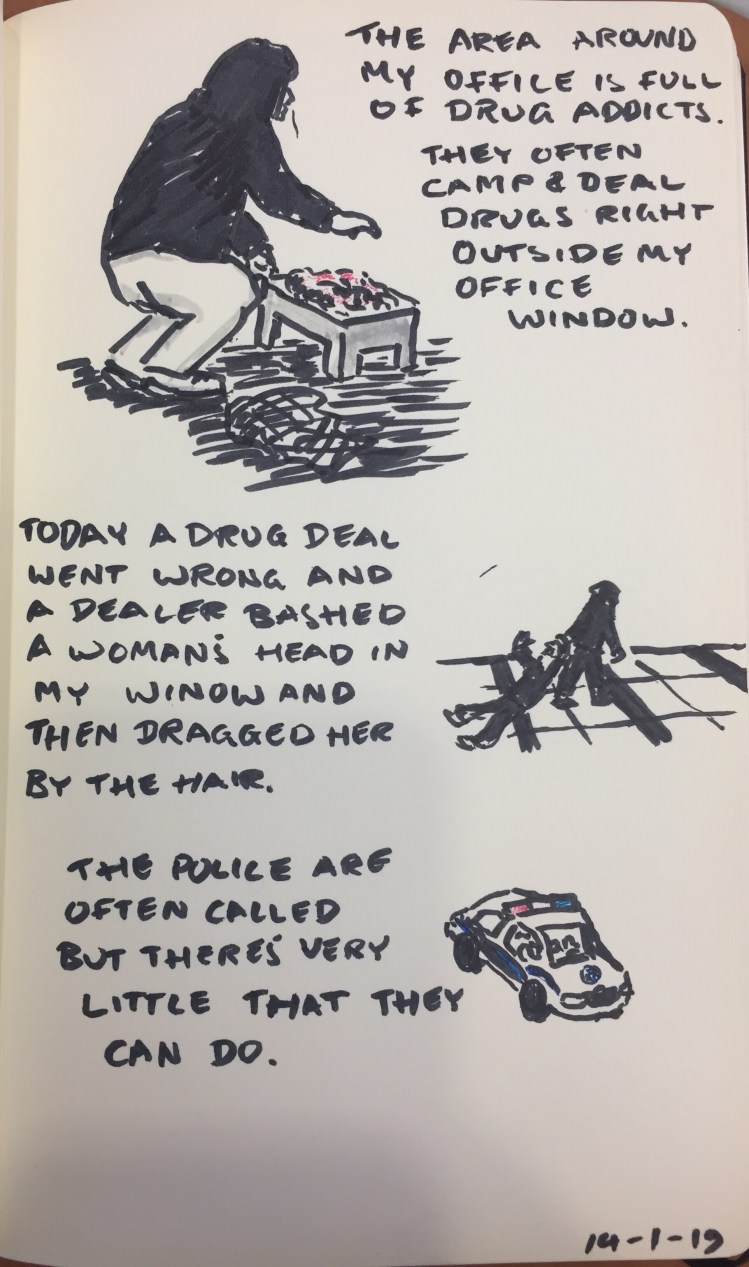
Hard Times

Journal comic drawn with a Sharpie brush pen on a Moleskine Star Wars crawl text limited edition plain notebook.

Sometimes my life looks like an episode of The Wire

And there’s a police station 200 meters away…

Journal comic drawn with a Sharpie brush pen, Pilot Hi Tec-C pens, and a Zebra grey mildliner highlighter on a Moleskine Star Wars scroll text limited edition blank notebook.

New Year’s Resolutions

For the last three years I’ve been making and tracking yearly goals in a Baron Fig Three-Legged Juggler Confidant. I call my new year’s resolutions my yearly goals because unlike resolutions, goals are something concrete and well defined that you continually strive to achieve.

The goals are personal, so I’m not going to share them here, but I am going to go over how I set them up, in the hopes that it might help and inspire those working on their own yearly goals.

  • Set yourself up for success by picking goals that you:
        1. Actually care about.
        1. Are measurable.
        1. Are achievable even if your year goes horribly wrong. The trick is to set up easily achievable basic goals, and then “bonus” or extended goals that go beyond them in various tiers. So if you aren’t reading at all and you want to read more a good basic goal would be “read 4 books a year”, with extended goals of “read 8 books a year”, “read 12 books a year” and so on.
        1. Are a mix of things that you track all year and one time events ( for example: participate in X number of races, and run X kilometers a month/year).
        1. Aren’t focused on one area only (to avoid boredom and burnout).
  • I use a paper notebook to track my yearly goals and the “Streaks” app to get my streaks going. The notebook is something I open and update at least once a week and so is constantly on my desk, resting against my laptop. It’s a physical and constant reminder of what I need to do. I can’t emphasize enough how important the physical aspect of putting a check mark or crossing out a box is for this to work.
  • Be ambitious only with extended goals, or you are going to disappointed and discouraged very quickly. Human beings are terrible at assessing deadlines and the amount of effort required to achieve a goal. Cut your goals by 25-50% at least from what you think you can achieve. Yes, it’ll make them easy, but the point is to create a momentum of action and success, not frustration and failure. If you know you’ve missed all or most of your goals you’ll stop looking at them, and by March 2019 you’ll be done.

How I Started Reading More (Again)

A few more insights into how I got back to reading, beyond using a reading journal, as it has come up in conversations lately (people are gearing up for 2019 resolutions, I guess):

  • I started with detective novels, easy reads, things that were fun and not too challenging to dig into. M.C. Beaton, P.G. Wodehouse, John Scalzi were my friends. I was trying to rebuild a habit, and so the last thing I needed was to start with books that I would resist reading. My mind had to learn to treat reading as a pleasant pastime and not “homework” anymore, so the more challenging books came in only about a year after I started.
  • I used streaks to challenge myself to read 10 minutes a day, every day. Why 10 minutes? Because I felt that this was the minimal amount of time required for me to start easing myself out of the choppy, constantly distracted and interrupted reading habits that I had picked up after years of using social media.
  • I deleted the Facebook and YouTube apps from my phone, and after a great deal more struggle and a few relapses, Twitter. Instead of browsing them when I had a minute or two to spare, I used the Kindle app.
  • I put reading in my new year’s resolutions (yes, I have been doing those for the last three years, and I’ve been pretty successful in meeting them for the last three years, but that’s a different post). At first it was just for a certain quantity of books (24), and then it was for a certain number of books of each kind — challenging books and long books.
  • I set up a Goodreads account and started a reading challenge there. As with the resolutions, it’s important to keep the goal not only attainable under normal circumstances, but also attainable when things go horribly wrong with your life. Start lower than you think, and ignore other people’s goals. You’re doing this for yourself. If it’s 5 books, 10 books, 20 or 20, it should be what you can do. I chose 24, because that was 2 books a month, and something that I felt I could get to without resorting to reading only short and simple books.
  • I cut out TV almost entirely from my life. This wasn’t just about reading, it was about making more time in my day for things that were more important to me, but it definitely helped with my reading. I cancelled my cable subscription and I watch about 2 hours of TV a week.

This has been my journey back into reading. Take from it what you wish, but if I can distill them they’d look like this:

  1. Decide you want to do it. If it’s not coming from you, it won’t happen.
  2. Set up systems of daily reminders and goals. These can be private or public, they can be analog or digital, as long as they help you keep on track.
  3. Make it pleasurable. Start with easy reading in a genre that you enjoy, maybe with a writer that you know, and keep your goals easy and attainable even not on the best of days.


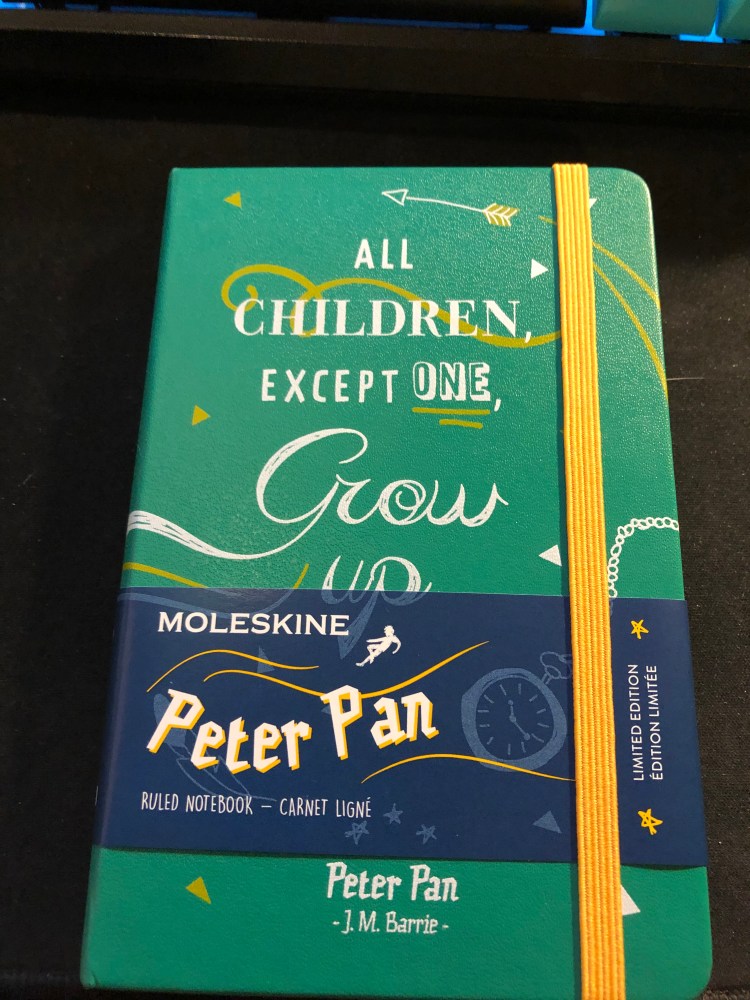
“Triggers” Daily Questions and a Moleskine Pocket Peter Pan Limited Edition review: All Children, Except One, Grow Up.

Ever since I’ve read the book “Triggers” by Marshall Goldsmith about six months ago I’ve been searching for ways to track the progress of my Daily Questions (“Did I do my best to…”). I tried using my journal for several months, then used a Google Sheet for two months, and in both cases something was missing. The Google Sheet was great for statistics and tracking, but not as satisfying and meaningful as writing my daily scores down (and I didn’t really find the statistics useful). The journal was much better, but as my goals changed it was time consuming to create a new table each time, and I needed a way to for me to justify my daily scores.

Enter tracking system number three: a Moleskine pocket Peter Pan limited edition notebook and an index card. Let’s start with the notebook:

The Peter Pan Moleskine limited editions showcase some of Moleskine’s best design work in recent years. Both the colourful covers, the drawing and the lettering evoke the spirit of Peter Pan without resorting to Disney-esque tropes. They’re naive without being childish, colourful without being brash, and the quotes on the covers are brilliantly selected.

Inside the covers are more illustrations in the same vein and even the famous “In case of loss” is set in a hand lettering like font. The palate of the entire Peter Pan line is limited (navy, orangey-yellow, green and white) but it never feels that way.

The back cover. Again, extra points for aligning the design so well with the back pocket. It almost seems like they’re flying into it:

This edition comes with stickers that are a lot of fun and well drawn in a naive style:

And the B-Side of the sleeve instructs you on how to build paper planes and also uses quotes from the books or that reference the book:

So that’s the review of the notebook itself. I highly recommend all of the Moleskine Peter Pan notebooks — they rank alongside the Denim and some of the Harry Potter limited edition notebooks as my favourites of recent years. I didn’t buy it specifically to try to use it as a Triggers Daily Questions tracker, but it was languishing in my “to use” pile and a used notebook is better than an unused notebook, so I decided to give it a spin.

The idea of writing down my Daily Questions each time was what made me stop using my journal for this purpose in the first place, so I decided to write them down once on an index card (which I would slip in the notebook’s back pocket), and then number each question, and date the card. Every day I would write down a score for each daily question, and a very short justification for the score. The justification is short to make it easy to write them down (if it’s a hassle I’ll have a hard time sticking with it), and that’s why I chose the pocket notebook (it’s also light and easy to carry around). When I feel like I need to change the questions up, I’ll create a new index card, put an end date on the old index card and archive it in the notebook’s back pocket. Every day will be dated in the notebook, and I use the appropriate index card if I really want to reference that particular day in the future. This may seem a little clunky for reference purposes, but as I learned over time, I don’t really go back to reference my past answers, so that’s not a meaningful setback.

I’ll check in a few months and document how it goes, but judging by my previous experience, this looks like a pretty good setup for now.