Jaffa Sketchwalk and Tips for Beginner Urban Sketchers
On Friday we went to an Urban Sketchers outing in Jaffa. It was celebrating local designers, and there were street performances as well as open studios and an arts and crafts market. The weather was hot and sunny, and the place was pretty packed with people and full of interesting old buildings. The main trouble I had was focusing on what to draw, as there were so many subjects.
I took a new sketchbook, a Pith Oroblanco in A4 size, and an A5 portrait Etchr Labs 100% cotton watercolour sketchbook. I don’t normally work in such a large format, but I decided to challenge myself to use the Oroblanco as much as possible. The 170gsm paper is identical to the one in the smaller Pith Kabosu, and so is great for mixed media and light washes. The Etchr Labs sketchbook is the best watercolour sketchbook that I’ve ever used – the paper works wonderfully with washes, and is very forgiving for mistakes and reworking.
I started out 30 minutes before the official start time, and sketched a local building. I liked the combination of the beautiful old stone building together with the graffiti and the semi wild trees and shrubs. Inspired by Liz Steel’s Patreon sketching community (I just joined it) and December’s theme of “Red” I selected to sketch this building with Diamine Inkvent 2025 Day 3’s Carousel – a red ink – and to highlight the rust colour in the shutters and door. I had enough time to finish the line sketch before going to say hello to Marina, our local chapter head and the organizer of this sketchwalk (a wonderful person and artist). I took reference photos just in case, and then returned and quickly finished the sketch:
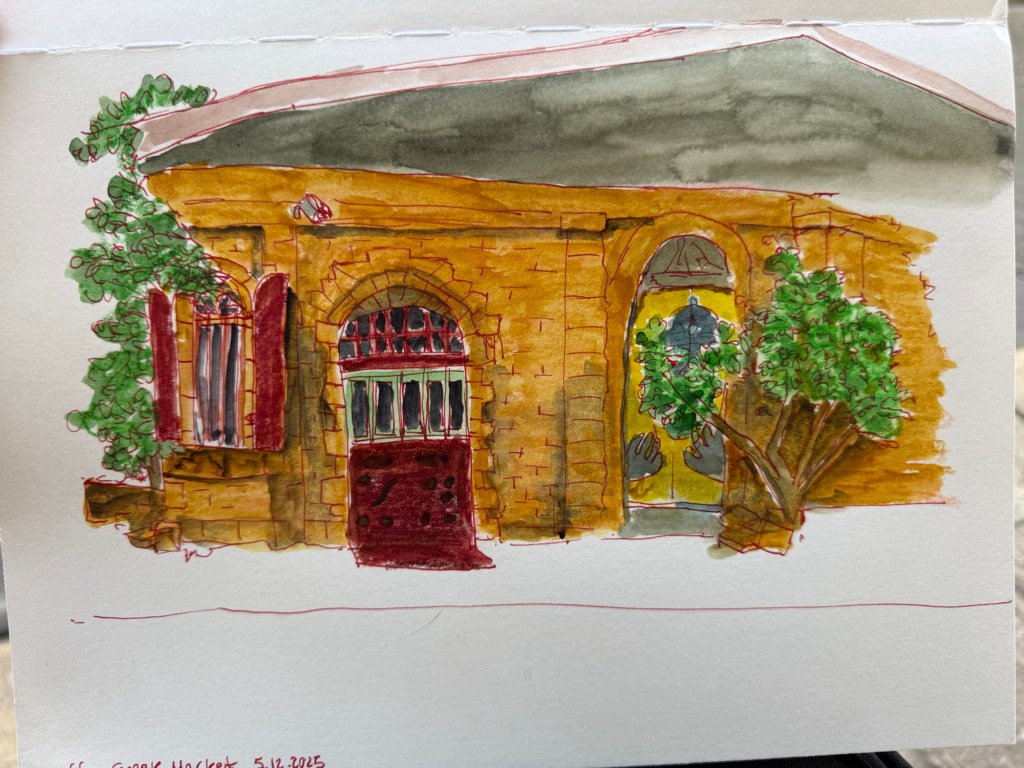
To avoid having to lay down a large wash I used Caran d’Ache Neocolor II to lay in most of the base colour – except for the roof bit (where you can see why laying down a large wash on this paper was problematic).
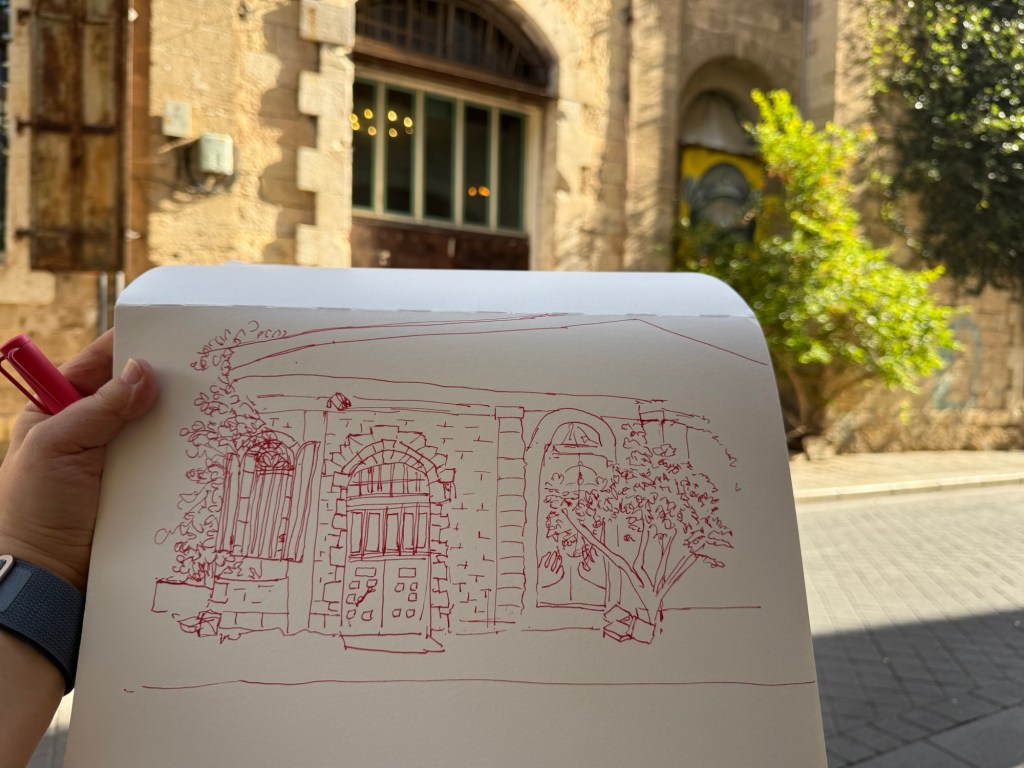
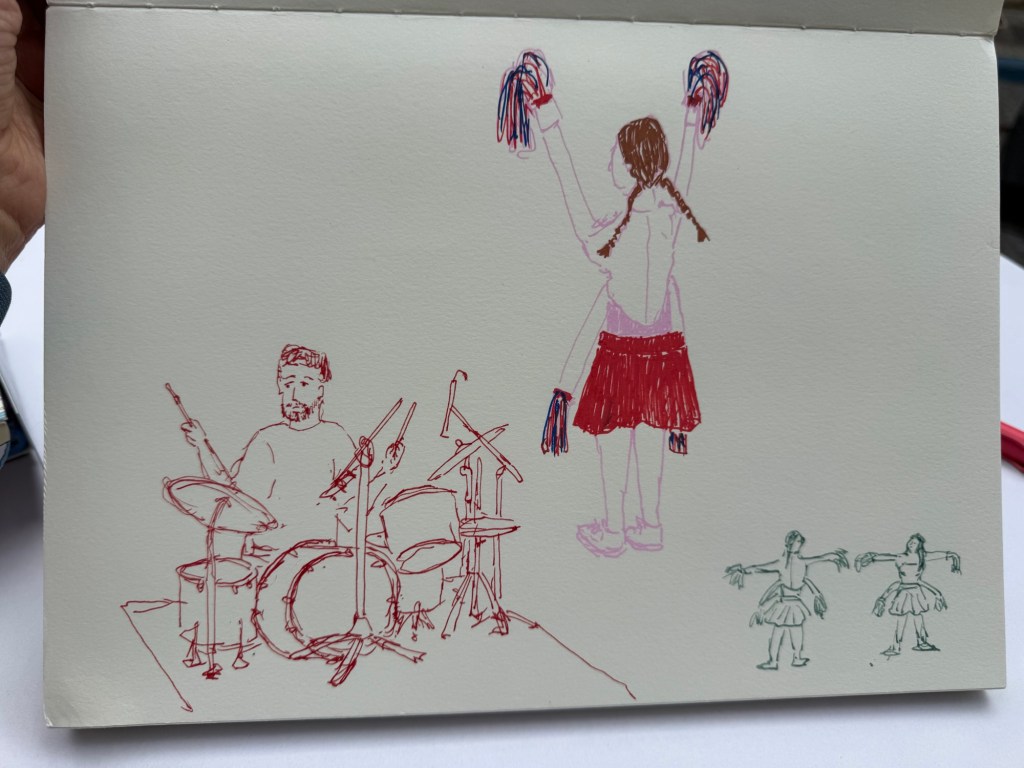
I then went in search for the music performance that was supposed to take place in an adjacent street. I managed to sketch the drummer as he was doing a sound check, but then he left and two girls in peculiar 4 armed cheerleader outfits came out and did a sort of otherworldly dance-march. They kept moving but I did manage to capture them. I used Diamine Carousel in a Lamy Safari medium nib for the drummer, and Posca markers for the cheerleader. The tiny cheerleader thumbnail was sketched with a TWSBI Eco 1.1 fountain pen and De Atramentis Document Ink Green Grey.
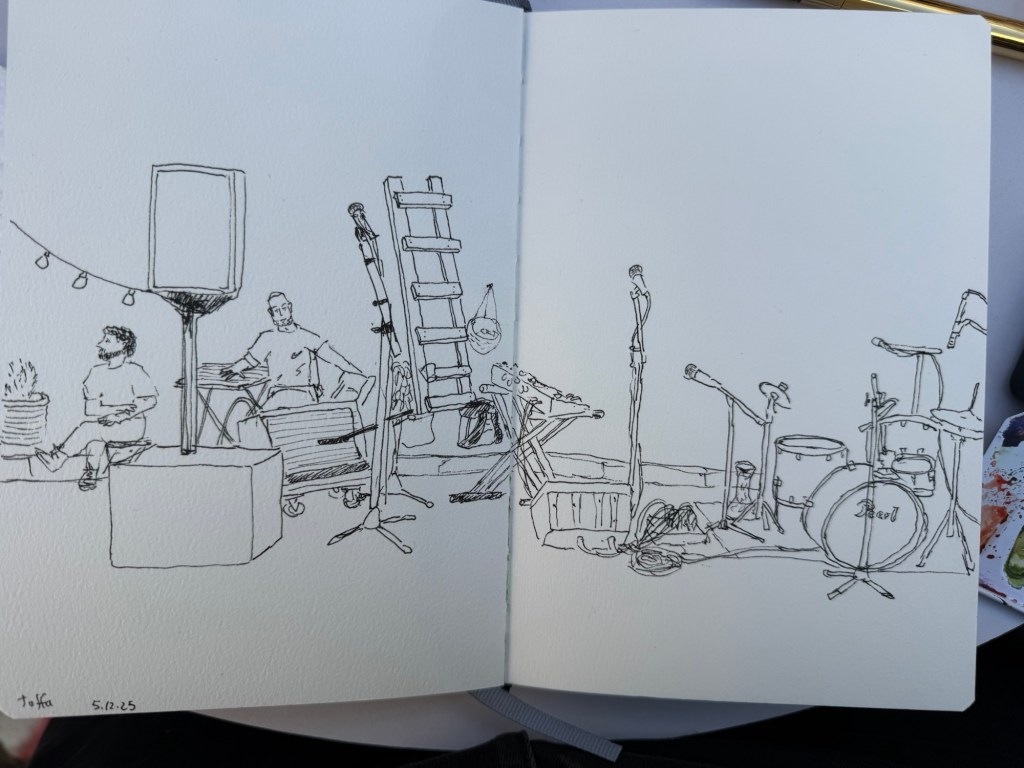
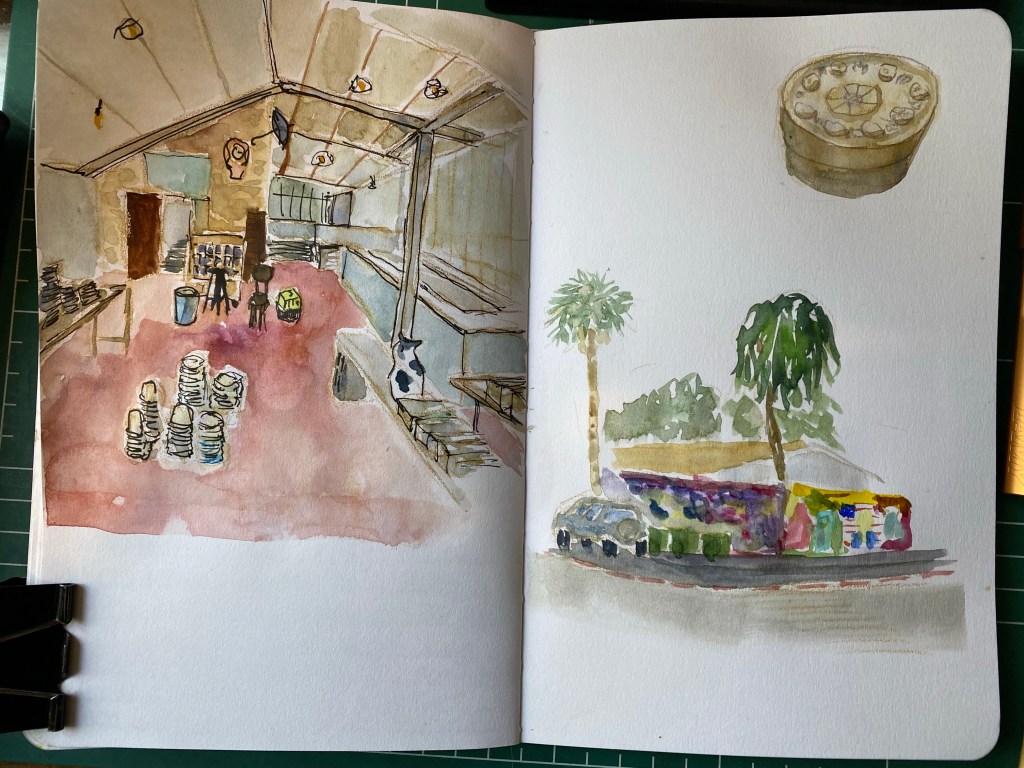
I then settled in to prepare to sketch the musicians when they returned. There was a Flamenco dancer in a nearby stage, but the place was too crowded for me to get a good viewing angle of her dancing so I spent the time creating a detailed fountain pen and watercolour sketch of the location where the musicians were supposed to play in. I was hoping to add them in once they started, but their show was delayed and i had to get back to the throwdown. I did get a sketch of their instruments and some local viewers, but I rushed in the end and didn’t get a chance to get proper shadows in. Oh well.
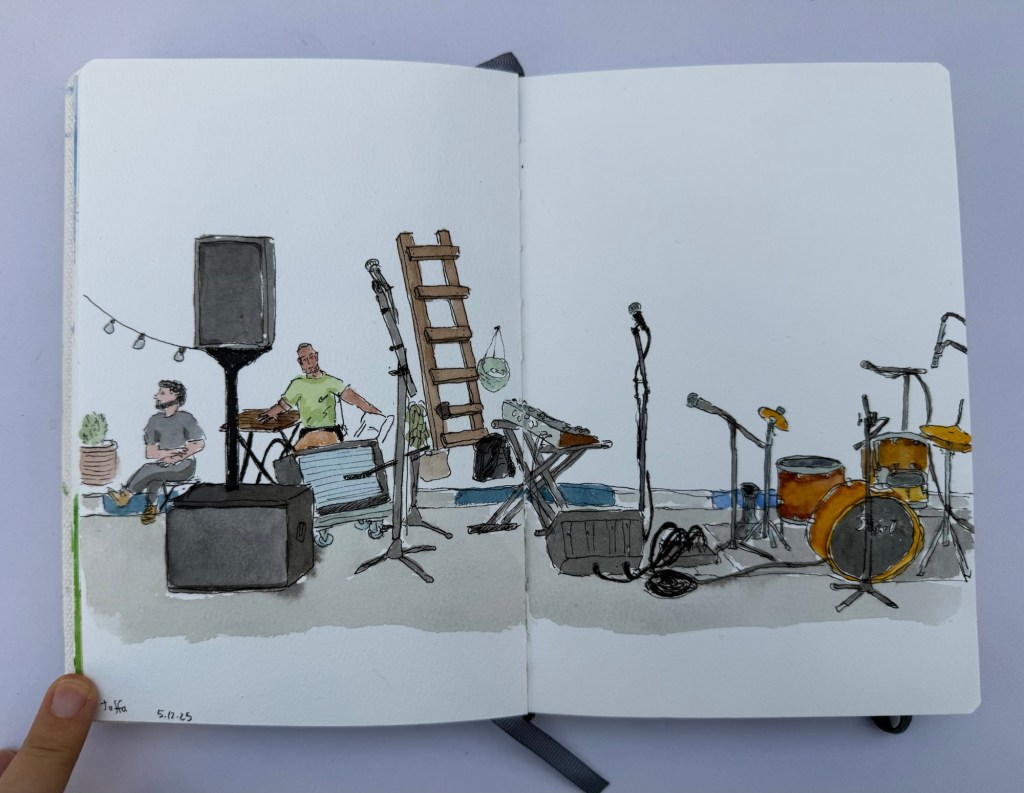
The line work was done with a Platinum Preppy 0.3 filled with De Atramentis Document Ink Black on an Etchr sketchbook:
There was a lady there that was clearly on her first every Sketchwalk, and my heart went to her. Seeing her struggle made me realize that there are so many things that are obvious to me as a seasoned “sketchwalker” that aren’t obvious to people going out with an Urban Sketchers chapter for the first time. Here are a few useful tips:
- Say hello. Sketchwalks start at a meeting point and usually end in the same one. Come a few minutes early and talk to people – they’re usually nice and friendly and share many of your interests. Say hello and introduce yourself to the organizers, and thank them for organizing the walk – it’s a lot of work! If there’s a local special event that’s taking place during the walk, be sure to get the details of the time and place and be there. Even if you don’t end up sketching the event, there is bound to be something else interesting going on, and you’ll help represent the chapter. If you come in late and miss the initial gathering, find a sketcher in the area and politely ask when and where the end meeting is. It’s usually posted in advance, but it is worth double checking.
- There’s a throwdown in the end of sketchwalk, and group photo. Even if you don’t like your picture taken, bring your sketches to the throwdown. It’s a great way to see great sketches in a large range of styles, and get inspiration from wonderful artists. Do not compare your work to others. Be generous and specific with complements (“The way you caught the energy between the dancers is amazing!”, “The colour choices are phenomenal – that building really comes to life!” is better than “that’s so pretty!” Although, of course saying a sketch is beautiful is also nice). Take photos not just of your work, but of other’s work that inspires you, especially of those that do work in a style that’s far from your own. Learning and experimentation is part of the Urban Sketchers experience.
- Thank the organizers. I know I said that before, it’s worth repeating.
- Never ever critique another artist’s work. It’s not that kind of an artistic gathering.
- Bring less. We all fail at this (I did too, of course), but the less stuff you bring the more fun you’ll have. Choose one or two sketchbooks, at least one in a size and format you are comfortable with. Bring only the supplies you know you’ll use, not those that you might need. It’s OK to bring something new with you, but if you do I suggest that you force yourself to actually use it, and start the first sketch with it.
- Do not bring an easel, particularly not to your first sketchwalk. You want to be mobile and flexible. The best way to get the most out of a sketchwalk is to change locations at least 2-3 times. The idea is to work quickly and loosely and to capture a location from several angles and with different focuses (that’s why it’s called a sketch walk). There will be those that choose to stick to one location, but having an easel tends to force you into a single location, as does having too much gear.
- Bring a stool. It doesn’t have to be the most comfortable one in the world, but it does have to be portable. That will allow you to sketch wherever you like, and not just where there’s a free bench or table.
- Take reference photos, in case you don’t get to finish a sketch or the lighting changes, or a white van decides to park in front of the building that you were just sketching.
- Talk to people. Share art supplies. Ask questions about their process – unless you see that are too absorbed in their work to answer. But people usually are kind and enjoy sharing information and tools with other sketchers. That being said, bring all the gear that you’ll actually need.
- If you’re just starting out sketchwalking, use smaller formats (no larger than A5), sketchbooks and not loose paper, and supplies that are portable and well known to you. That will allow you to work faster, and it will give you a chance to get more comfortable with working on location.
- Sketchwalks usually last 3 hours. That’s both a lot of time and not enough time. Keep an eye on the clock, take into account that it takes time to warm up, and be kind to yourself, especially during the first 30 minutes. I usually take the first hour to work very quickly and loosely, and leave the last hour, hour and a half to work on a more detailed, well composed piece. Take breaks – sketchwalks are in urban environments so there’s usually a place to grab a coffee and snack (which you can and should sketch – it’s an Urban Sketcher’s tradition!). It’s not a race – the point is to enjoy yourself. I usually take a few minutes to stroll around, getting a feel for the location and the options before I settle in and get to work.
- Bring water and weather appropriate gear. Be a responsible adult and check the weather before you go. Bring a hat and sunscreen, coat, umbrella, etc depending on the weather.
- Post to social media, and tag your local chapter. There’s usually a Facebook group, and an Instagram account for the USK chapter. If the sketchwalk involved a local business, museum or organization, be sure to tag them too. You are an ambassador to the community now. Represent this wonderful organization with pride.
If you go on Urban Sketcher Sketchwalks and have tips for newcomers, I would love it if you could reply with them.









 Writing at Large