Weekly Update: One Week 100 People, Newly Inked Pens and Preparing for a Doctor’s Visit

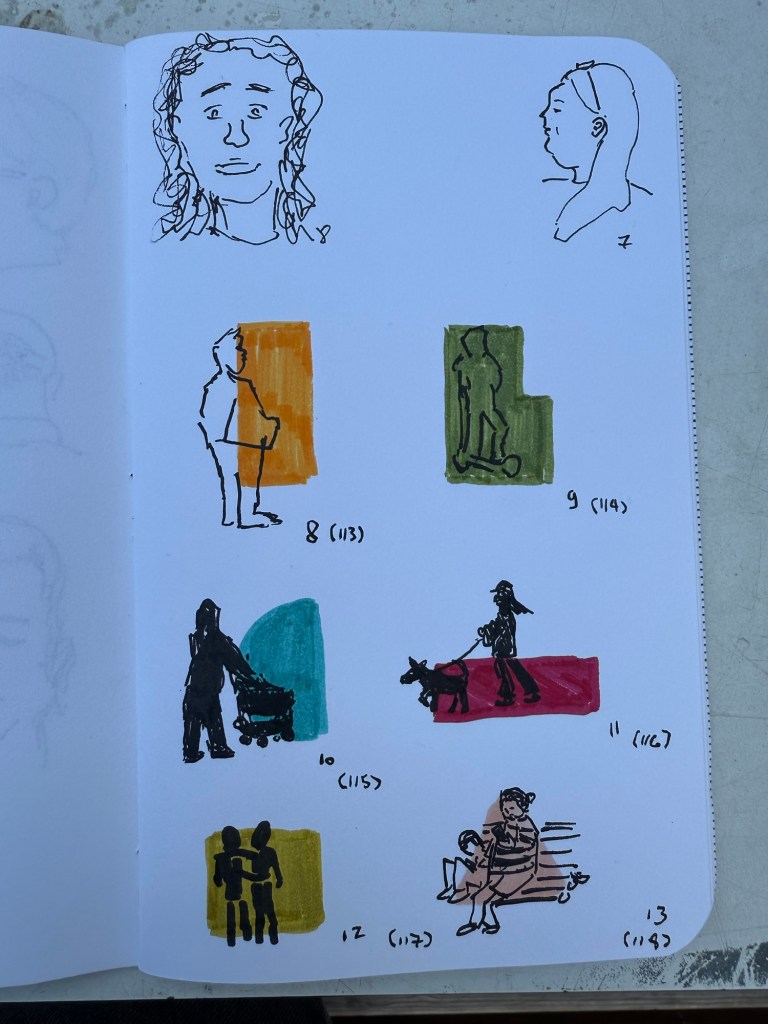
I finished the One Week 100 People challenge on day 4, but kept going for day 5 (which was yesterday) and added a few sketches on day 6 (even though the official challenge is 5 days long). It was the first time that I sketched only live subjects and not from photos, and it really pushed me to find ways to work fast.

Today I added a few final sketches to my Field Notes sketchbook, this time using Faber Castell Pitt brush pens for blocks of colour and a Pilot brush pen for the sketches themselves. I was trying to work mainly with silhouettes and capture people in movement. It took me longer than I thought to capture a mere 6 subjects, mostly because what people do when they walk around nowadays is stare at their phones.

As I wrote two fountain pens dry this week, I filled six new fountain pens, bringing my rotation up to nine pens. Next week I’ll write a post about the pens and inks that I chose, but I will say that there are some pretty rare ones in the rotation this time.

Next week is pretty stressful as I have some tests and a checkup coming up with my hemato-oncologist (that’s a cancer doctor that specializes in blood cancers, which is the kind of cancer that I’m in remission from). I will give out one important tip for anyone who is going to see a doctor for any reason:

Write down ahead of time whatever it is that is bothering you/you need help with, and make sure that it’s in order of importance. There’s a good chance that if you won’t do this you will forget things, or you’ll focus on the least important thing, or you’ll have trouble articulating the issue. A doctor’s office is a stressful location, so you want to take the time and prepare this list in advance when you are sitting calmly at home. Make sure that the first 2-3 items on that list are really the most important things that you want to focus on because there’s a good chance that you’ll only get to focus on these items (your time in there is going to be limited). Reference the list when in the doctor’s office (don’t be embarrassed, there’s nothing embarrassing about being prepared). Be clear and specific, and insist on getting all your questions answered when it comes to these things. Double check before you leave that all the medications you discussed and tests that the doctor ordered were properly documented. Doctors are people too and the electronic medical record systems they work with aren’t the best, so it’s worth checking that everything is in order before you leave (even if you do the check with the medical secretary, just so long as you’re still in the doctor’s office and any errors and omissions can be fixed).

Take care of yourself and have a great week!

Three Habits Worth Keeping

Happy New Year!

This is the time of year when people set resolutions, themes, goals, intentions, words of the year, etc. Ambitions are high, intentions are good, but well before March most of these efforts will be abandoned and forgotten. I’ll be writing about my quarterly plan and my 2025 planner later on, but for now here are three habits that worth keeping in 2025 and in general, and a few tips on how to get into them and persist:

Exercise

Any amount and any kind that you can do is excellent. Let’s repeat that: ANY amount of exercise and ANY kind of exercise is a tremendous win. Start with walking if nothing else speaks to you, but try to make sure it’s a brisk walk and not a shuffle if you can. It doesn’t need to take an hour, and it doesn’t need to be 10,000 steps. Remember, anything you can do is good. Local gyms and community centres usually have classes you can try out if you want to give yoga, pilates, kickboxing or jiujitsu a try.

Running offers the best “bang for your buck” in terms of time and money invested per health and fitness gains, but not everyone can run, and not everyone enjoys running. If you want to give running a start, I recommend using any “couch to 5k” app, and then transitioning to the excellent guided runs and training plans in the free NRC app to keep you going. If you need someone to keep you accountable, either join a group of some sort or find a friend or family member to work out with.

The NTC app offers a huge variety of training options – from yoga to full equipment gym workouts, with some excellent body-weight workouts in between. Swimming is a great low impact way to build up cardio and a bit of strength, and weight-lifting isn’t as intimidating as you think – a pair of dumbbells at home is a great way to start exploring it. Yoga with Adriene is great way to get into yoga if you don’t or can’t take a class and the NTC app seems too intimidating.

Soccer, basketball, baseball and other group sports are great ways to expand your social circle, and tennis, pickleball, badminton are great ways for couples to work out together.

The easiest way of getting into the habit is doing a little something every day, and doing it as soon after you wake up as possible. That way you start the day with a win and some endorphins, which is always a nice way to start your day.

If you think you don’t have time to work out, be honest with yourself and track your time for a day or two. How much time is spent on social media? Binge watching TV? Mindless scrolling? Could you cut some of that out? Could you go to sleep a little earlier and wake up a little earlier so you can have some alone time to exercise and clear your mind?

If you already have a solid exercise routine in place, take the time to diversify it if you can. This goes particularly to us runners: strength train. Swim. Cycle. Do things that aren’t just running, because just running is one of the main causes of such relatively high injury rates amongst runners compared to other athletes.

Reading

Most people don’t read, which is their loss because reading is a superpower. Train your brain off the social media dopamine hamster wheel and teach it how to focus for significant stretches of time by picking up a reading habit. You’re standing in line bored? Open your Kindle app and pick up that detective novel or space opera from where you left off. Replace TikTok, social media and YouTube with books, and make sure that they’re books that you want to read. Don’t go off bestseller lists or influencer recommendations or whatever one this or that award, or is considered a classic. When you’re getting back into reading you need to gradually train your mind to get used to this activity. Start with a book that really interests you (not one that’s impressive), and start with a physical copy because they’re easier to read. Reading will do to your brain what exercise does for all of your body: make you better, stronger, faster, healthier and happier.

If you’re already a reader, then mix things up a bit: if you only read non-fiction, read fiction for a change and vice versa. Try something new, because you may just end up liking it. If you’ve only done light reading so far, pick a challenging book and work your way through it. Treat your brain like a muscle you are training, where you gradually progress to bigger and bigger weights. Challenging books are often the most rewarding, but you probably should start with them.

Journaling

Digital or analog, it doesn’t matter, journaling is worth doing. Gain insight to yourself, unleash your creativity, and let loose to your thoughts in a safe environment. This is the path to self improvement, learning to be kind to yourself, and having a positive mental attitude towards life.

If you’ve never journaled before, start small and simple: pick a notebook that you will enjoy writing in (whatever speaks to you, no matter what other people think), use whatever pen or pencil you fancy, and write 3-5 things you are grateful for each day. Add more sections to your daily journal as you go along: a “story of the day”, an account of what you did or what you consumed and what you thought about it, a nightly summary, etc.

Make it a ritual of sorts: write in your journal every morning and evening, every time you switch between major tasks during the day, or when you feel the need to respond to something (don’t post online, post in your journal instead).

Don’t be intimidated by gorgeous and elaborate works of art in various journaling forums, blogs and on Instagram. These are journals as craft projects, and while they are nice, they aren’t what we’re trying to get to here. It’s OK to add stickers and bits and bobs to your journal, but its purpose shouldn’t be to be photographed and posted. It’s there to work for you, so treat it like a workhorse, not a circus pony. Also, remind yourself that many of these journal photos are there to sell: stickers, washi tape, pens, notebooks, ink, the poster’s journaling course, etc. People rarely show off their “real” journals because if you’re honestly journaling only for yourself, that’s just not something that you’ll want to share.
The Cancer Project: Hair Part II

Hair Part I is here.

I started losing my hair after the second chemo treatment. 

It was terrifying. 

You don’t realize what losing your due to chemo means until you’ve experienced it first hand. It’s not like your hair sheds more, as it does with women postpartum or when men start losing their hair after a certain age. 

It falls out in large clumps, without warning. You brush your hand casually against your hair and are left with a thick clump of it in your hand. It was like something out of a cheap horror movie, like some sort of farce. I had no idea my body could do that. Why hadn’t anyone told me that this was how it was going to be?

It also hurt. It was if my scalp suddenly felt the weight of each and every hair, and it couldn’t take it anymore. Imagine the feeling of having weights tied to each hair follicle, constantly tugging your hair down, and you’ll get some kind of idea how it feels.

I lost the most hair during the first shower after my second chemo treatment, and I couldn’t get to the hairdresser fast enough. “Off, I want all of it off!” I commanded him. He gave me a buzzcut that made me look like a punky 16 year old, but I was relieved. My scalp stopped hurting, and I didn’t see hair falling out in clumps anymore. Yes, my hair kept falling out throughout the treatments — normal hair falling out an a strange fuzzy plume growing instead only to fall out too — but I didn’t feel it and I didn’t see the scary clumps. That was good enough for me. 

You see it was these clumps that gave me a vivid visual representation of just what my body was going through. You don’t otherwise see the damage the chemotherapy is doing to each and every one of your cells — you just feel it. So when I go that buzzcut I was taking control, pushing the damage away so I could better handle it. Other patients react differently to this message — oftentimes with denial, or by fighting it. They hold on to every wisp of hair, they hope against hope that somehow they won’t be affected. 

At the time I thought they were being silly and immature and just causing themselves unnecessary pain. I know better now. This journey is excruciatingly hard and scary for anyone who goes through it. What gets you through, how you react to it, these are personal things that cannot and should not be judged, even by a fellow cancer patient. Some of us need to mourn through our hair. I needed to learn that and accept that. One of the things that helped me do that is the bitter realization that we live in a world where losing your hair isn’t a superficial change. 

More on that in Hair part III. 

How I Use My Notebooks: Yearly Goals (Resolutions)

Near the end of one year and the beginning of another various articles and podcasts about New Year resolutions start popping up. They either give tips on how to make resolutions, debunk resolutions in favour of something else, and almost all of them try to sell you something.

This post is about how I create yearly goals (i.e. resolutions), using things that I already have, in a way that has worked for me since 2015.

I wrote about the way I do “New Years Resolutions” in the past. I call them that because I like the non-business ring of “resolution” over the “business-jargon” sounding goal. My “resolutions” are, however, S.M.A.R.T. goals: specific, measurable, attainable, relevant and time-bound. I manage them using the least used notebook that I had lying around (a Baron Fig Confidant), and whichever pen I have at hand. They aren’t made for instagram, rather I use my plain ugly handwriting, and what marking are on the page are there because they’re useful. Over the past five years I’ve attained about 90% of what I set out to achieve, with even an annus horribilis like 2018 not putting me too much off track. My goals are tiered, much like Kickstarter stretch goals, with most goals having a fairly easily attainable first tier, just in case life decides to kick me in a tender place.

I’m going to go over this year’s goals, and last year’s goals (apart from a few that I’ve censored for privacy’s sake). I know that February is usually the month when people give up on their resolutions. I hope that this post will help and inspire people to give yearly goals or resolutions a chance.

img_3592
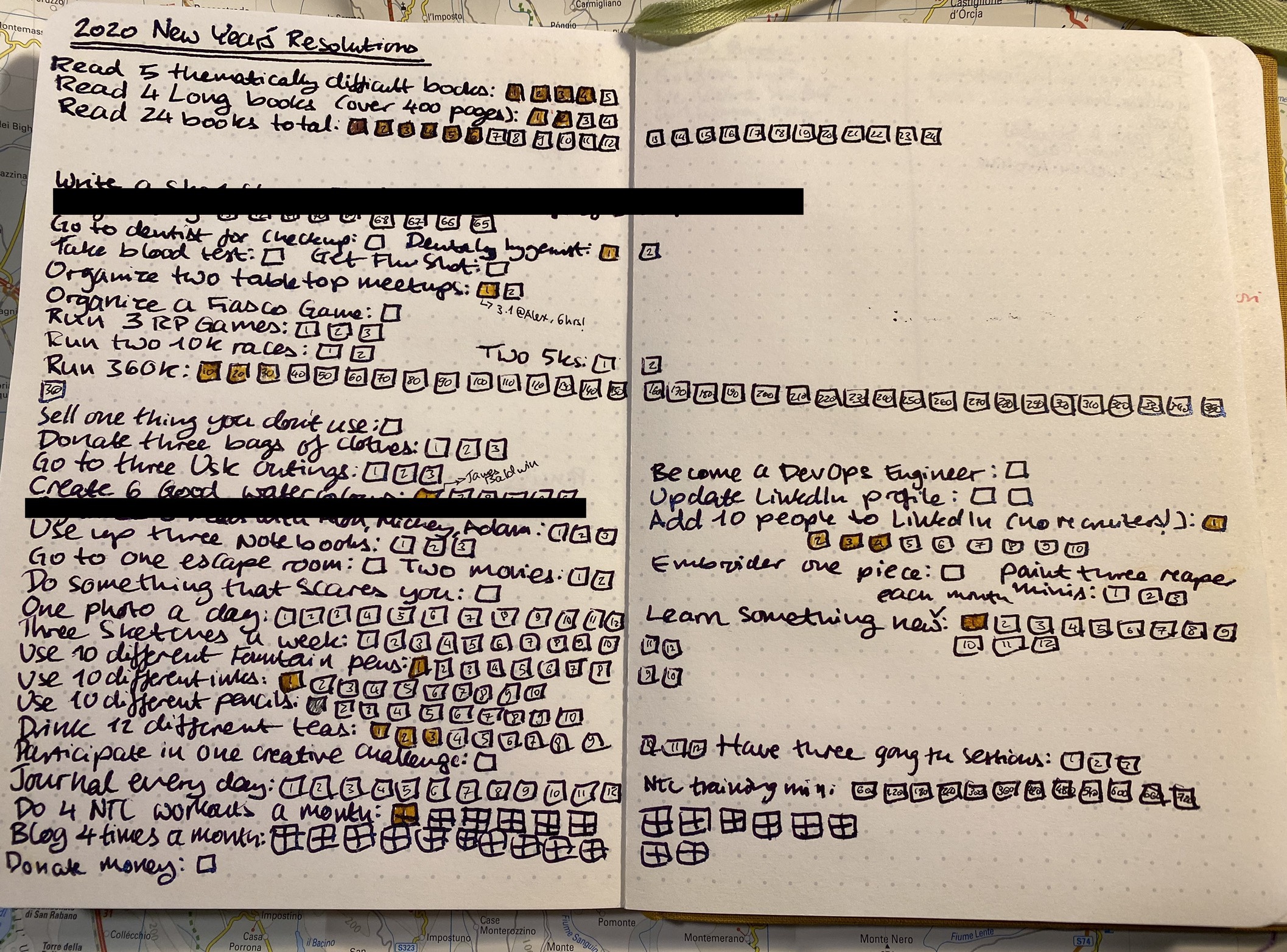
My 2020 resolutions

Above you can see my 2020 resolutions. A lot of them are things that appear in almost every year. The professional goals are all new (I didn’t manage my professional goals with my personal goals until this year, and even now only a small part of my professional goals are here). 

Every goal at this point only has the basic, first tier goals set beside it. The first three goals for example, all reading related, will eventually have stretch goals. They’re interesting to note here because back in 2016 I only had one reading goal: read 24 books. Once I got back into the habit of reading, I started to challenge myself with longer and more challenging books. These are all my base reading goals. I usually stretch them to around 50 books a year.

Why don’t I start with 50 books then? Because the point of these goals is to build myself up for success. The basic goals are the “even if I have a horrible year I should be able to reach these” goals. They are there to remind me that there’s a tomorrow, and something I can and should do about that tomorrow, even if a family member is hospitalized (or worse). The stretch goals are then built in small increments, reaching to my my final goal for the year.

Why don’t I write my stretch goals down from the start? Because the point is to keep myself focused on the next small step. That’s why things are broken down to the smallest increment that makes sense: one book, 10k, one month.

There’s a reason for each goal on this spread. I won’t go into each one specifically, but they all fall into the following general categories:

  • Read more.
  • Write more (my writing goals are censored, because if I publish them, I won’t do them. I know myself well enough by now).
  • Use the stuff I own.
  • Challenge myself to get out of my comfort zone.
  • Social goals (partly censored).
  • Health goals (running, cross-training, bloodwork, dentist visits).
  • Professional goals (partial list).

Everything has to fit in on a two page spread, or I lose track of things. That’s why I spill over to other pages in the same notebook to track some of the details of my goals:

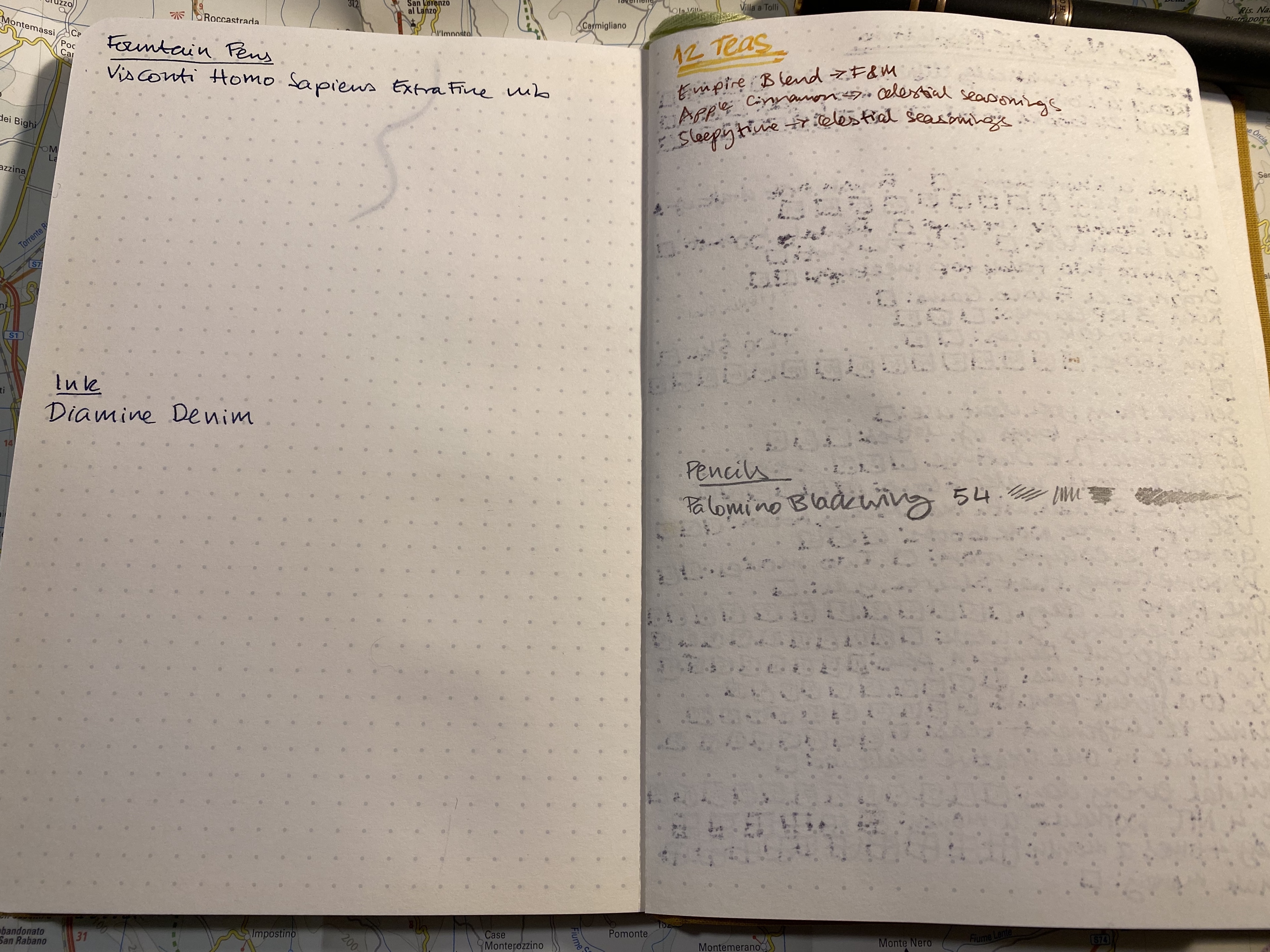
Tracking page for fountain pens, ink, tea and pencils.

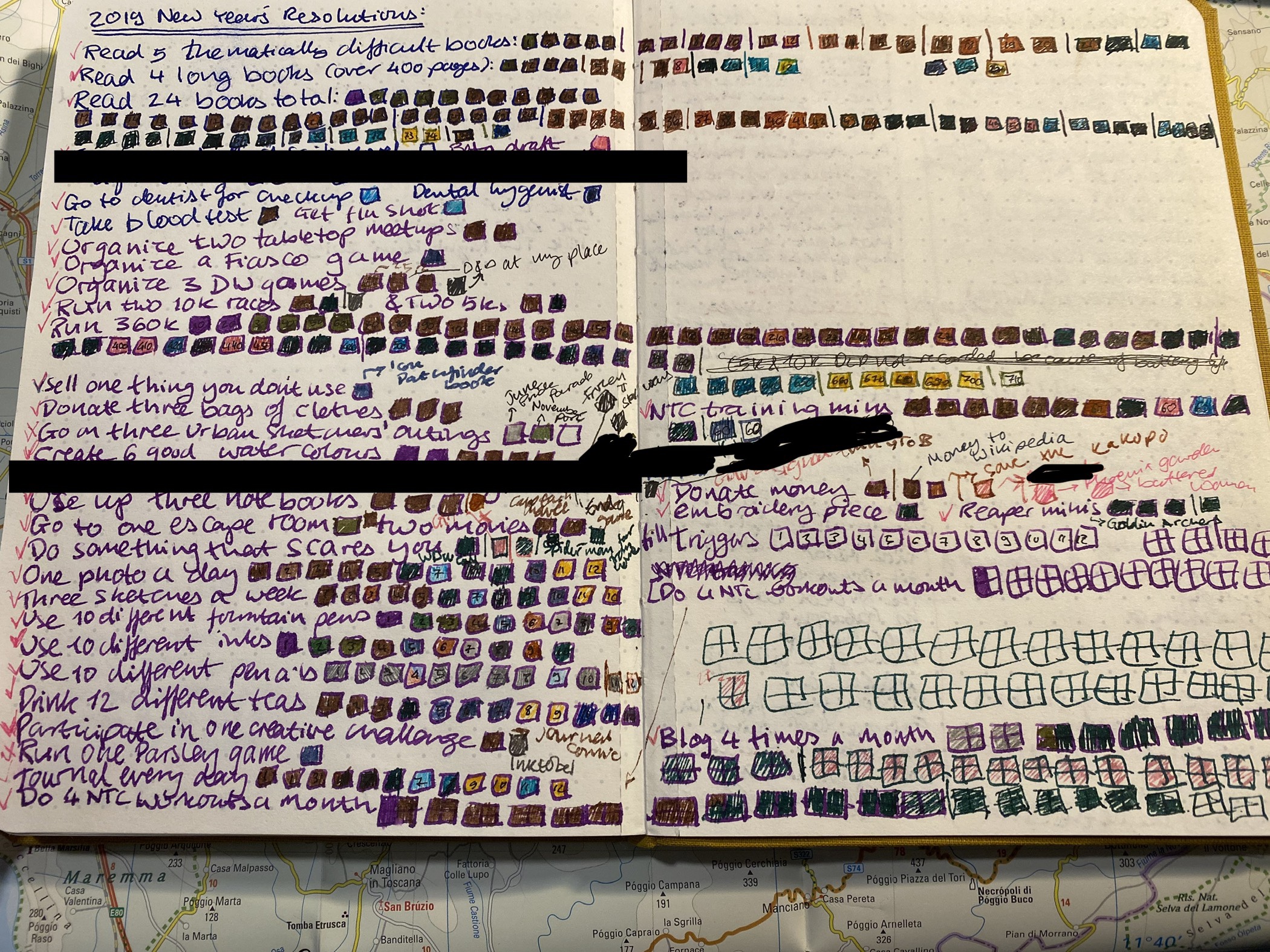
Here are my 2019 resolutions. A pink check mark means that the basic goal is finished. You can see the increments things grow by (my stretch goals):

2019 resolutions

You may have noticed that the “fill triggers” goal isn’t filled up at all. This is the “relevant” part of the S.M.A.R.T. goals. I used the trigger system from Marshal Goldsmith’s “Triggers” book for a few months in 2018, and I decided at the beginning of 2019 to not continue with it. It was a conscious decision, and so I just ignored that goal. 

Here are my 2019 “spill” pages, just to get an idea of how the whole thing works together:

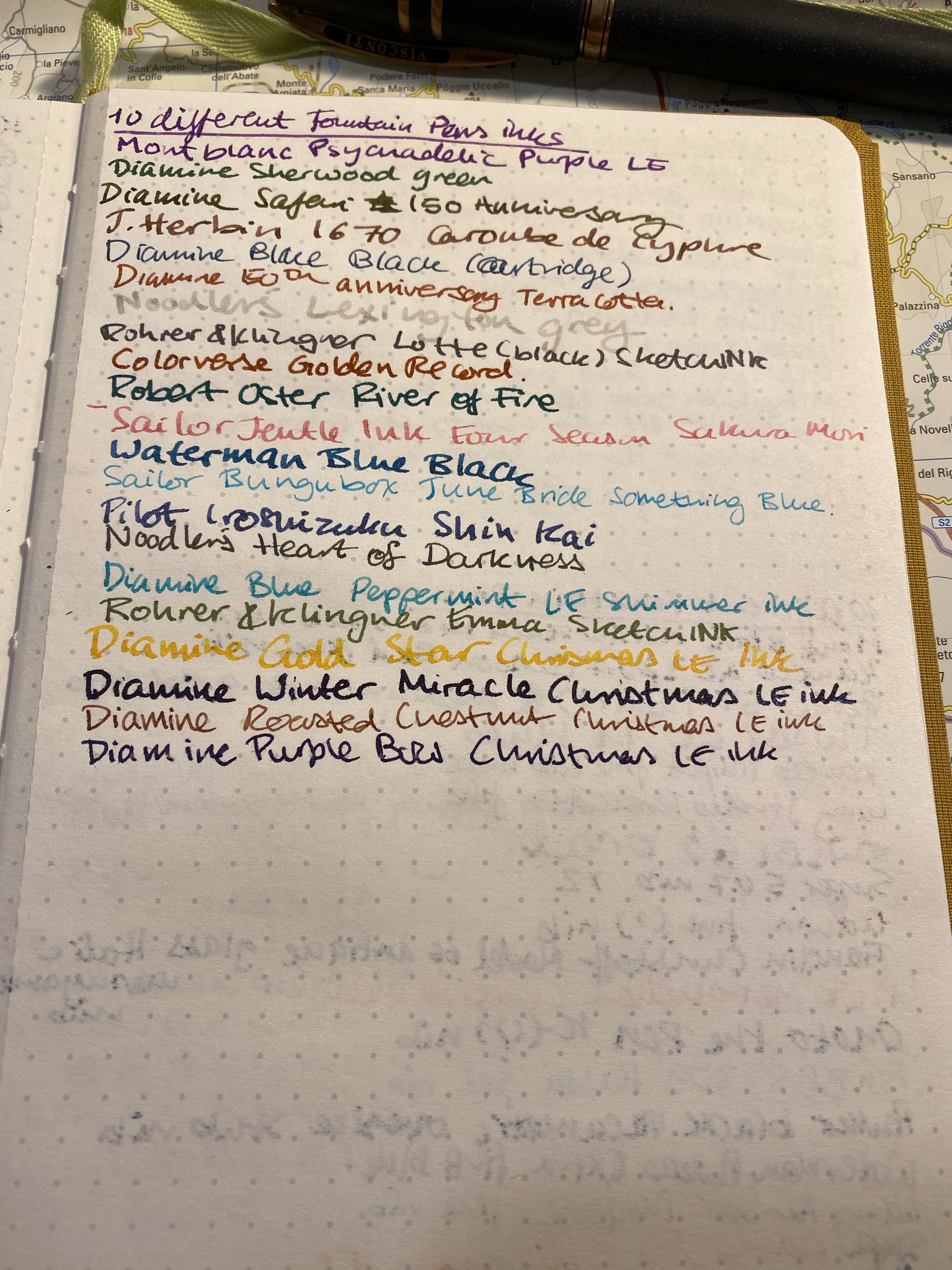
10 different fountain pen inks. Can you see where the stretch goal is marked?

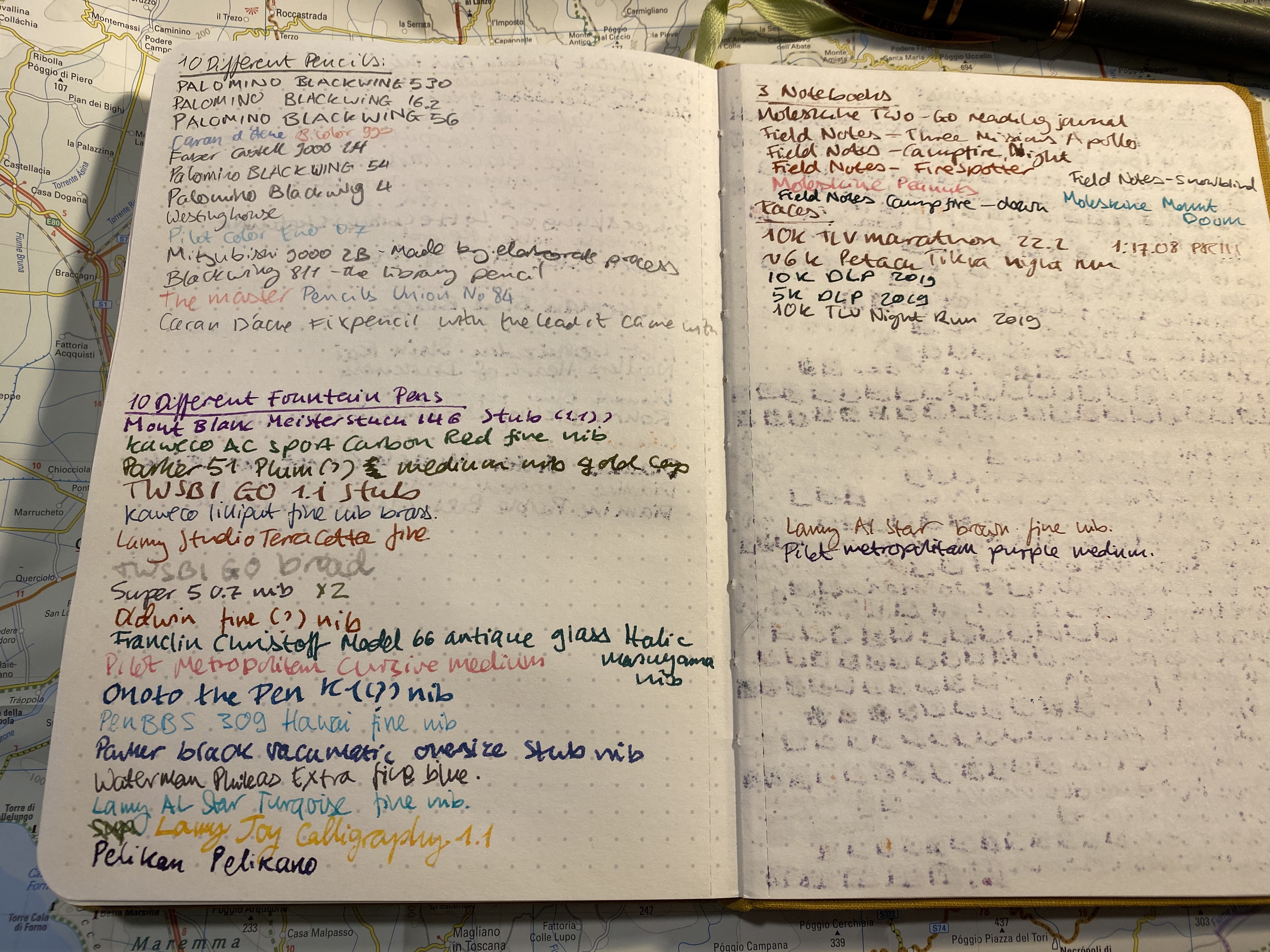
Here are pencils, fountain pens, notebooks and races tracking:

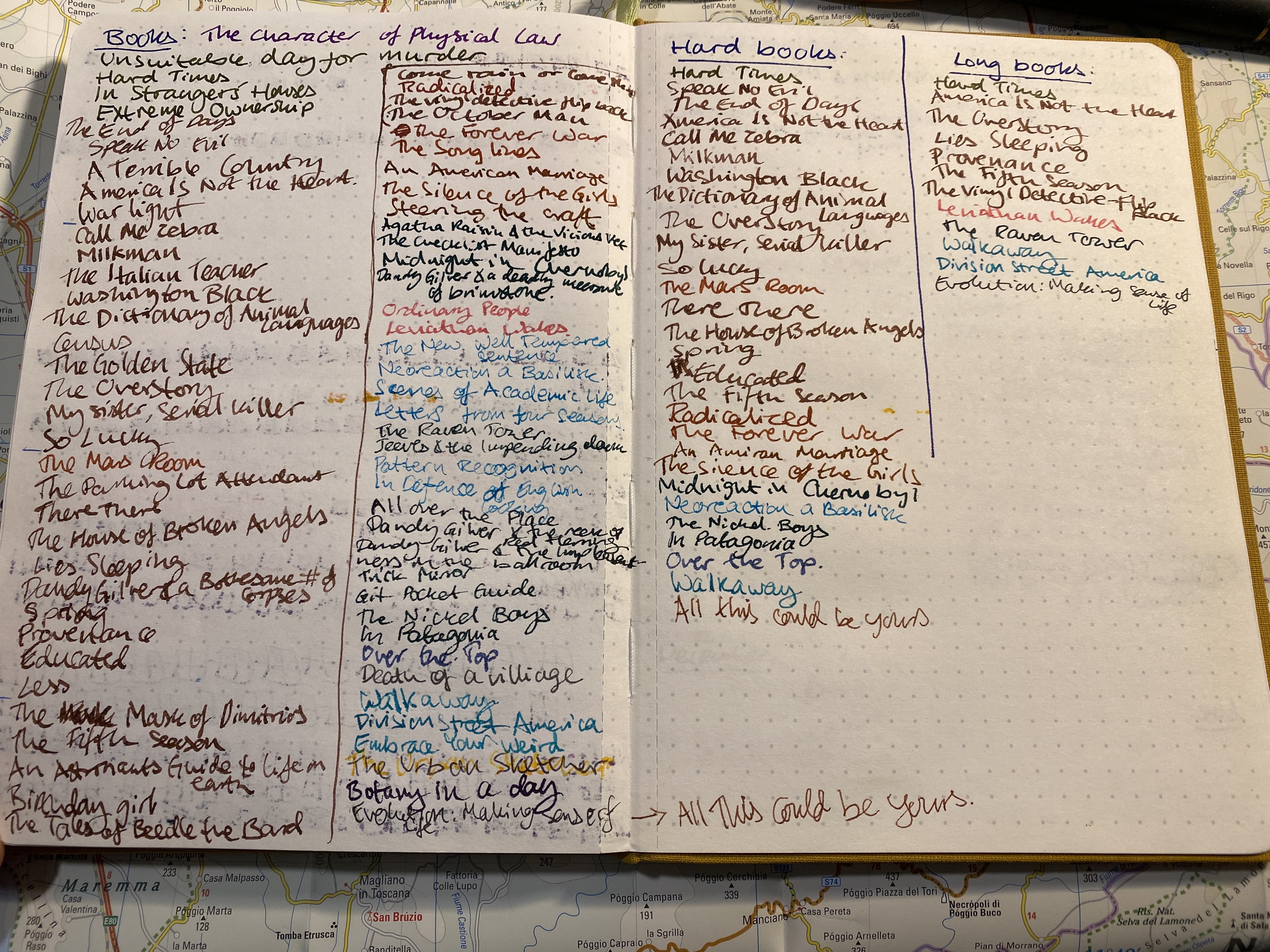
And my largest tracking list, books:

The Baron Fig Confidant that holds this list has a bright cover and sits right in front of me, on my desk, at all times. I set up my goals that at every day or two I crack the notebook open and update the lists. Once there, I scan everything and check if there’s something that I can do to get it done. The point is to have this list on the top of my mind as much as possible, or else I’ll just forget about it, or it becomes something that I avoid checking out.

This is a system that supports me every day, giving my goals and aspirations much needed structure. I hope that this will help you build a personal system of this kind for yourself.  

How I Use My Notebooks: Running Planner

The thing that you learn very quickly about running is that no matter which Couch to 5k plan you started with, if you want to have any hope of persisting with your running you are going to have to tailor make your own running plan.

I make a fresh plan every three months or so, and I always create it in my current Moleskine journal. In the spirit of showcasing notebooks in use, that are not created for Instagram, this is my latest running plan:

Things are penciled in with an H pencil, and I ink them in with gel ink pens as they happen. Green highlighted blocks show me where things went according to plan, and other blocks represent where things had to change due to injuries or circumstances.

I’ve been running for 8 years now, and I have around 6 years of running plans in all my previous notebooks, each one looking pretty much the same: messy and functional.

This week’s long run: how to run when you really don’t want to

My mom has some very serious health problems, and that (coupled with some travel) has  made me put my running on a two week haitus. Except for an “angry run” of 4k that turned into 6k, I haven’t been lacing up lately, and that’s not good.

Yesterday I put in a 4k, and as usual after a break, it was pretty rough. Not as rough as I knew this morning’s run would be. It was scheduled to be a 10k, but I dropped it to a 7k, knowing that all things considered even that would be a challenge. I would have to fight my lizard brain all the way through this one, so I would have to use all the tricks I had to get through it:

Trick #1: Remove all obstacles to getting out the door. For me that meant setting an alarm, setting out my workout clothes, and charging my headphones the night before.

Trick #2: Promise yourself something nice once you complete the run. For me it was breakfast at my favourite cafe.

Trick #3: Distraction, distraction, distraction. This is the most important thing, and why I chose a new route, and I saved my favourite podcast (Do By Friday) for this run.

Trick #4: Give yourself a break. I allowed myself to stop for breaks, so long as they were only for a few seconds, and I went right back to running again. I needed to decide this in advance so I wouldn’t feel bad about taking the breaks that I knew that I would need. The point was not to beat myself up for something that couldn’t be helped.

It worked, and I got rewarded with some pretty nifty new views:

Get out there and run. You can crush it, no matter what the little lizard says.