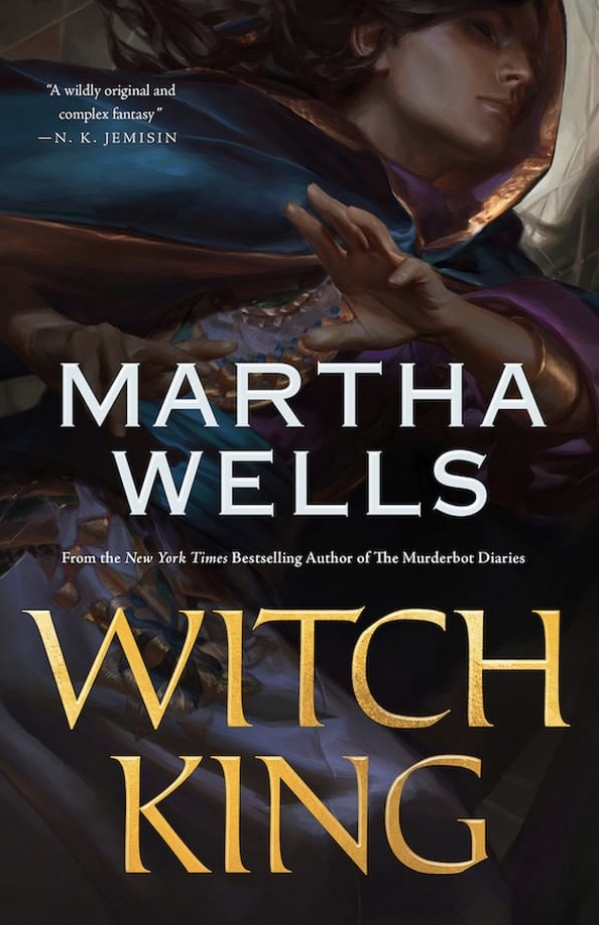
Martha Wells is a phenomenal world-builder, and she knows how to create brilliant characters that you just can’t help rooting for. She did it in the Murderbot series and she’s done it again in Witch King.
The titular character, Kai, a demon prince, is captured and entombed by unknown enemies. As he frees himself, his witch friend Ziede, and street urchin Sanja, the three go on a quest to find Tahren, Ziede’s wife, and figure out who was behind the conspiracy to capture them. The narrative splits early on, with the main thread following current events and the search for Tahren and her brother Dahin, and a secondary thread following the past – Kai’s origin story and the story of the Rising World Coalition.
Wells knows how to write a fast and intricate narrative, and the conspiracies of the present and rebellion of the past unfold independently and yet somehow also mirror and enmesh with each other. There’s a lot Wells says here about friendship, belonging, loyalty, and courage, but none of it feels obvious, didactic or forced. Relationships are earned here, as are your affections towards Kai, Ziede, Sanja, Dahin, Bashasa and others.
The world-building is rich and dense, with no “standard” human/clothing/culture/architecture. Wells walks us through it, but there’s no hand-holding here. You are meant to jump in and immerse yourself in her world, learning about it as the plot speeds you along. It’s disorienting for the first chapter or two, and then it just flows. You end up wanting to spend more time in this world, exploring it, really getting to know its people, cultures and geography.
The only minus in Witch King is that you don’t get enough time with certain characters. I want to know Tahren and Tenes more, I want to see the group in their home at Avagantum. This is why I immediately bought the second book in the series, Queen Demon, once I finished this one.
A superb fantasy book that is hard to put down and is well worth your time.
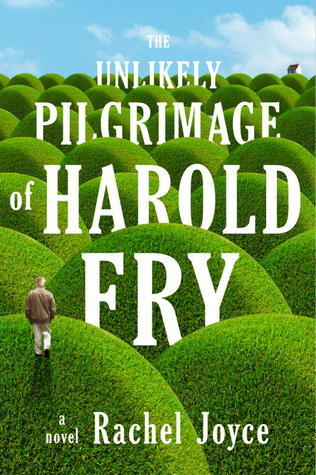
I picked up this book because I was supposed to go see the West End musical based on it and I wanted to know what to expect before I went.
The book is built to be a tear-jerking, moving affair, and it delivers on its promise. Joyce clearly knows the tropes that we expect, and cleverly weaves her narrative in and around them. The things that you are sure to happen to Harold on his way don’t happen, though the narrative is well aware of their possibility. What you’d expect his wife Maureen to do is also something Joyce enjoy subverting. There is something delicious about seeing a capable writer at work.
In any case, the basic plot is that Harold, a recently retired company man who lives in a village in southern England is stuck in his life. His wife Maureen lives in the same house with him, both of them recluses, and spends her days cleaning the house, finding fault with everything Harold says or does (the couple live in separate rooms and have been for years) and complaining about him to their son David. Maureen keeps expecting David to come visit, and Harold seems to have no friends, no hobbies, no prospects, no future.
This all changes when Harold gets a letter from his friend Queenie, a coworker that he hasn’t been in touch with for 20 years. She’s in a hospice, dying from cancer, and the letter is her farewell note to Harold. It moves him deeply, and he decides to write back to her. Instead of just posting the letter, he starts to aimlessly walk from one postbox to another, each time postponing sending the note – until a chance conversation with a woman at a gas station has him setting on an ill conceived pilgrimage to Queenie’s hospice, 450 miles away in the border between England and Scotland. As he meets people on the way he contemplates about his past, and we slowly piece together what happened that brought Harold, Maureen and Queenie to where they are today.
There are moving bits, frustrating bits, and one big, gut-wrenching revelation that makes you want to hug all three characters tightly. But mostly it’s a story about invisible people, people that seem dull but have huge tragedies and love stories and dreams in their lives, a story about connecting with others and about finding redemption through your feet.
Is this book perfect? No. It’s like Harold – a bit frumpy, sometimes dull, but it has a lot of heart in it, good intentions and it’s worth spending an afternoon with, preferably with some hot tea and biscuits.
There’s a story of tight-knit community under threat. There’s a love story of a kind rarely portrayed in fiction these days – one deeply mundane, pragmatic, pedestrian, and also deeply tragic, transformative and profound. There’s a Bildungsroman element, a gangster story element, a mystery, a religious element, and even time devoted to plants. There are many stories of friendships, many of them unlikely, and a few stories of rivalries, some of them rivalries to death. There’s a particular story of friendship, through hardship, alcohol, cheese and furnaces, that is alone worth the read. There’s a budding romance between two star-crossed and not young lovers. There are heart breaking moments, and there are laugh out loud funny ones (the funny ones outnumber the heartaches, I promise). There’s a cop story, a feisty grandma story, a story of racial struggle, and a story of medieval religious art.
Read this book. It’s a delight, it’s full of heart and surprises, and it’s one of the most original works of fiction that you’ll get to read. Wonderfully well written, jumping with life, and a joy to experience.
It’s been a while since I’ve posted a weekly update, but as part of my effort to get back to a regular blogging schedule I want to start posting these.
Here are some cute kittens cuddling together to cheer you up
Reading
I’ve recently finished Ben Aaronovich’s “The Masquerades of Spring” (nice enough, I’m hoping to review it later) and John McPhee’s “Draft No. 4: On the Writing Process” which was fascinating and very well written. Then I started reading “Orbital” by Samantha Harvey. It’s this year’s Booker winner and yet I’m struggling to read it because it’s so dull and lifeless. I’m a quarter of the way through but I may just give up on it in favour of more interesting things on my list.
Running
After participating in a 5k and 10k at Disney World last month, I’ve been struggling to get back to my training plan. The solution, as always, is a combination of patience, perseverance and enrolling to another race. I have a 10k at the end of February and I want to be in good shape for it as the running conditions will likely be less than ideal (i.e. too hot).
Other things
At the Gentleman Stationer there’s some very good advice on which stationery items make for bad gift ideas. I will add to this: don’t buy the artist in your life art supplies unless they gave you very specific information on what to get them. Good art supplies are usually not inexpensive and you’re very likely to go wrong if you just try to muddle your way through an art supply store. Either get them a gift card to their favourite art supply store (a brick and mortar one, preferably), or ask them to tell what they want. If you insists on going on this route then sketchbooks from Stillman and Birn (go for the softcover ones and never buy coloured paper), or a set of Faber Castel 9000 sketching pencils will likely be welcome.
If you haven’t gone to see the movie “Wicked,” then go and see it. It’s a great adaptation to a very good musical and I promise you’ll enjoy it.
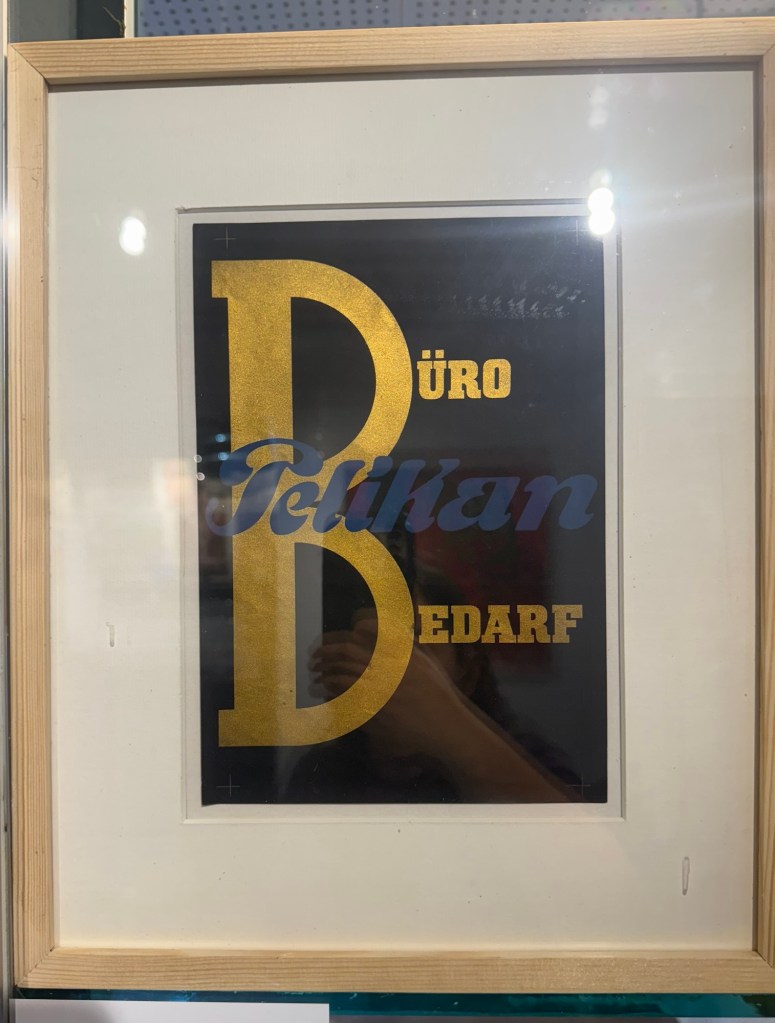
I went to a pre-auction exhibition today and got to see this original cover for a pre-war Pelikan catalog created in gauche and bronze powder by El Lissitzky:
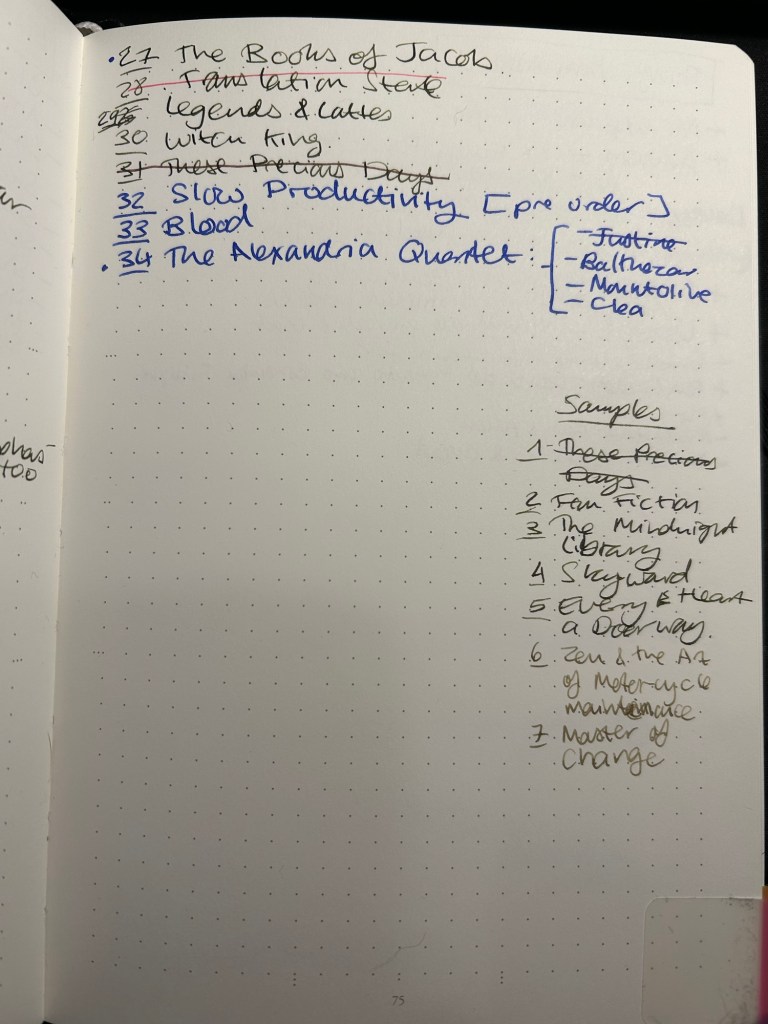
One of the things that I set up in my Leuchtturm1917 Bullet Journal is a list of the unread books on my Kindle. It’s supremely easy to buy books on a Kindle, as the whole system is set up a way to make book purchasing as fast and frictionless as possible.
This is a problem for me.
I love books, I adore reading, and I have pretty large group of friends that love reading too. This means that I’m inundated with great recommendations that run the gamut from light hearted fantasy and sci-fi to contemporary and classic literary fiction, with a whole host of fiction and non-fiction books in the middle (I don’t read horror and I don’t read romances and I rarely read poetry but that’s about the only limits I have in terms of my reading tastes). I get several such book recommendations a month, and with my initial impulse to rush out and buy them, and with the ease of purchasing books on a Kindle, things could get out of hand very quickly. This was one of the reasons why for years I was so resistant to buying a Kindle.
You see, it’s very easy to lose track of just how many unread books you have on your device. Even if you sort by unread books, you just don’t get a real feel for how many of them are actually waiting to be read. There’s no bookshelf groaning with the weight of unread books, and I was feeling the lack of that.
Enter my list of unread books on my Kindle:
It’s a simple numbered list of books that I haven’t read and are on my device. As I read a book, I cross it out. As I purchase more books I add them to the end of the list. As I’ve gotten into the habit of downloading samples, I’ve started to write them down too so they don’t get out of hand. It’s super simple, as bare-bones as it can be, and as practical as possible. The point is just to give my brain an idea of the scale of unread books on my device, and it works.
It works.
I’ve stopped compulsively buying books in the fear of “running out of something to read” or “forgetting what I was recommended”. Recommendations go into my GoodReads “Want to Read” list. And my brain can now see that there’s just no chance that I’ll run out of things to read any time soon. If I buy something I have to go over the list and convince myself that what I’m buying deserves precedence over the lovely books waiting patiently in line, some of them for years. I also photograph this list and keep it on my phone for reference, to prevent me from accidentally buying the same book in physical format (unless I purposefully intend to, which is rare).
What about the physical books stacked on shelves, some of them two books deep? I would love to have such a list for them as well, but that task is too daunting for me now. I remember where my books are visually, and moving them all just to catalogue them not only seems like an awful lot of backbreaking work, it will destroy my “memory catalogue of books”. So it seems that my physical books will remain uncatalogued for years to come.
Do you keep a list of all the books you own but haven’t read yet? Do you just keep a list of the books you intend to read next? Do you track your physical books in some way?
I decided to try and create monthly reading reviews of what I read instead of individual reviews or a giant yearly reading list post. Here’s what I read this January:
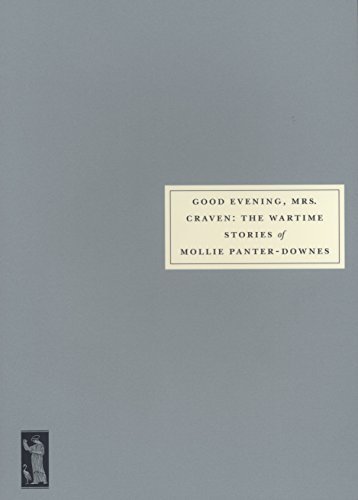
Good Evening, Mrs. Craven: The Wartime Stories of Mollie Panter-Downes, by Mollie Panter-Downes
A collection of very well written realistic short stories mostly about British women during WWII. Mollie Panter-Downes was a prolific and long time contributor to the New Yorker, and wrote both fiction and non fiction pieces for the magazine. This collection is bookended by two of her “Letter from London” non-fiction pieces, one from the beginning of WWII and one from the end. In between are 21 gems of short stories, all very realistic, all showing aspects of the war rarely discussed. Panter-Downes shows the great upheaval in British society at the time, both in the role of women and in the class system. She is sympathetic to her characters with all their flaws and foibles, and you grow to love them over their brief appearances. There are hints of dry humour, wonderful characterization, and an exploration of character that is both tied to Britain during WWII, and yet still universal. Highly recommended, even if you’re not a fan of short stories or historical fiction.
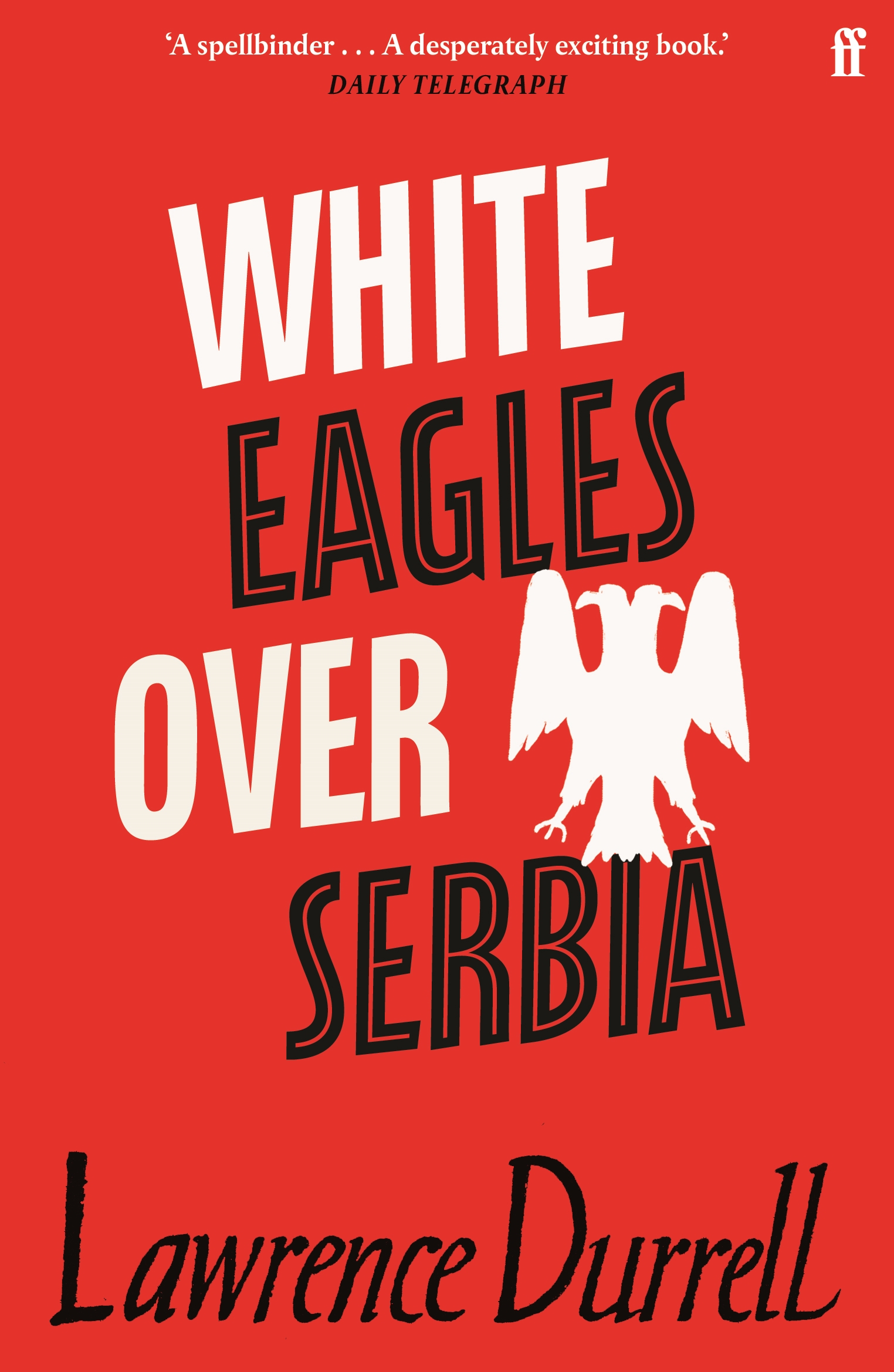
White Eagles Over Serbia, Laurence Durrell
Laurence Durrell started his career as a writer writing poetry, and it shows. The descriptions of landscape and character here are stunning. Never have I read a spy thriller that is written like a Literature with a capital L on the one hand, yet is still supremely entertaining and exciting to read – and very realistic.
Durrell is an excellent writer, and White Eagles is based on his experiences working for the British Foreign Office. The book is not flashy, it’s not high stakes, and it reads like something that could actually happen. The main character, Methuen, is a reluctant, tired hero spurred to action by his love of fishing more than his love of danger and intrigue. The descriptions read like poetry, and the characters are all individual gems – none of them are perfect, none of them are heroic, they are real people in very real situations. I wish there was a series of Methuen books (there isn’t), and I recommend this even to those who normally don’t read Cold War era spy thrillers.
Ragtime, E.L. Doctorow
Set in the New York area at the turn of the 20th century to the syncopated beats of ragtime, Ragtime is a tour de force of modern writing. The first part of the book is slightly overwhelming, as Doctorow takes us with lightening speed and fast cuts through many luminaries of New York city during the early 20th century, and intersperses them with the story of a wealthy WASP family, a Jewish immigrant family and a black family to be. The cuts remind me of a Wes Anderson movie, and it takes a while to realize that the narrator is actually creating a ragtime with his description of the events: the emphasis on seeming minutiae is deliberate, and the juxtaposition of things that don’t go together is purposeful. You feel like all the books you’ve read so far have been horse drawn in comparison to this piece, and suddenly you’re speeding your way on a model-T.
Very original, not an easy read, but highly recommended.
Note: the narrator speaks in the voice of a reporter from that era, and hence there’s a lot of the N-word (and worse) in this book.
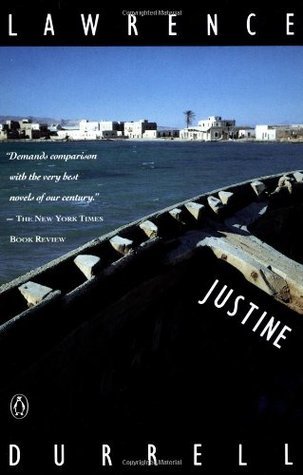
Justine, Lawrence Durrell
The first of Durrell’s Alexandria Quartet of novels.
Some books are easy to review, but this one isn’t. I’ll try to do it justice, but reading Justine was an experience difficult to summarize in words.
The good – the writing is exquisite. Durrell is a phenomenally good writer, and he’s at his best when bringing Alexandria to life. Alexandria itself appears to be the main character here, and it’s a fascinating portrait of the city during the ’30s. Durrell is doing interesting things with narrative structure here, and while it makes following along difficult at the start, the narrative builds up in layers over time. You aren’t viewing the story of the four lovers chronologically, but rather through the reminiscences of the narrator, as things come to his mind and gain importance. Thus you survey the scene several times from different angles, through the growing understanding of the narrator. It’s a fascinating narrative structure, and it adds nuance and interest to the story, and fits well with Durrell’s evocation of Alexandria.
The bad – the characters aren’t quite there. They remain ghosts of themselves, mythical creatures, never becoming palpably real. The only exception is Scobie, a character that seems to have been created as a caricature of sorts, a comic relief, and yet is the most fully realized character in the novel. My guess is that as we are returning to the same characters from different points of view in the following novels of the quartet, that this issue may be resolved.
The ugly – whether these are Durrell’s views or his narrator’s views, Justine is rife with misogyny, homophobia and whiffs of racism and antisemitism. The novel was written in the ’50s and its views on homosexuals were likely advanced for the time, but they’re still terrible. There’s also depictions of child prostitution, prostitution, and mentions of slavery that seem perfectly fine with the narrator and the people around him.
Justine is a difficult book to read, both for the narrative structure, which is disorienting at first, and the way it jars on modern sensibilities. It is well written and intriguing enough for me to give the rest of the Alexandria Quartet a chance.
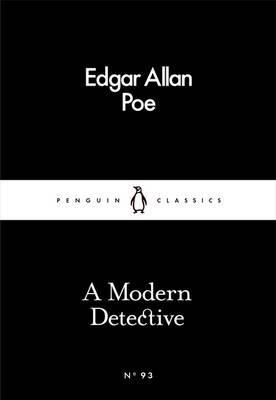
A Modern Detective, Edgar Allan Poe
This is a mini collection of two short detective stories featuring C. Auguste Dupin, the first fictional detective.
Poe is pretty talkative here, and his detective, Dupin, is a long-winded, charmless, cerebral Sherlock Holmes type. The cases discussed are interesting, and the second story in this collection was inspired by a real unsolved murder case. The characters, though, lack charisma, mystery or charm, and the reader is left wondering why they ended up spending time with them.
The detecting techniques are more primitive than those portrayed by Conan Doyle, and they are magnificently padded with paragraph upon paragraph of Poe delighting at his protagonist’s cleverness. A full third of the first story is skippable without missing a beat, and the second one fares much the same. What Poe does do well is evoke an atmosphere of gothic horror around both cases. What he utterly fails to understand (but Agatha Christie knew so well) is that the heart and interest of a detective story is the characters in it, not so much the analytical prowess of the detective at large. Holmes, Marpel, Poirot, and Father Brown are all first and foremost compelling characters. Dupin has not earned his place among them, and is remembered merely for being the first, not (as Poe would have you think) for being the best.
Dull, overly wordy, not worth reading, despite its historical importance.
That’s it for January 2024. What interesting books did you read this month?






 Writing at Large