January 2024 in Reading
I decided to try and create monthly reading reviews of what I read instead of individual reviews or a giant yearly reading list post. Here’s what I read this January:
Good Evening, Mrs. Craven: The Wartime Stories of Mollie Panter-Downes, by Mollie Panter-Downes
A collection of very well written realistic short stories mostly about British women during WWII. Mollie Panter-Downes was a prolific and long time contributor to the New Yorker, and wrote both fiction and non fiction pieces for the magazine. This collection is bookended by two of her “Letter from London” non-fiction pieces, one from the beginning of WWII and one from the end. In between are 21 gems of short stories, all very realistic, all showing aspects of the war rarely discussed. Panter-Downes shows the great upheaval in British society at the time, both in the role of women and in the class system. She is sympathetic to her characters with all their flaws and foibles, and you grow to love them over their brief appearances. There are hints of dry humour, wonderful characterization, and an exploration of character that is both tied to Britain during WWII, and yet still universal. Highly recommended, even if you’re not a fan of short stories or historical fiction.
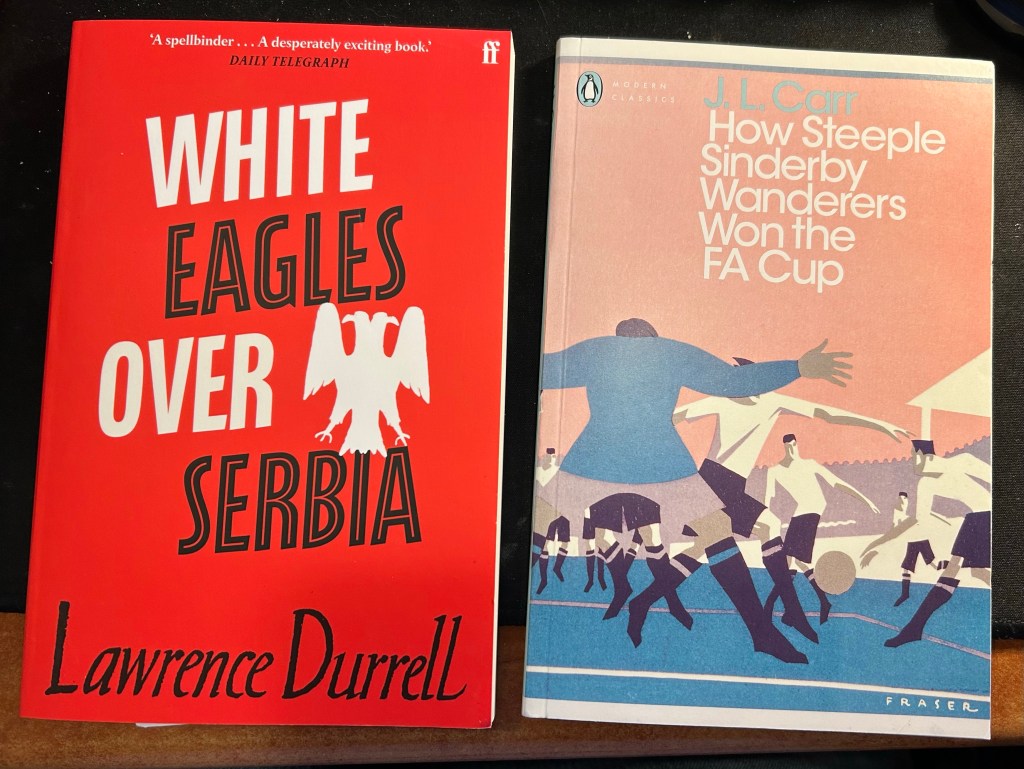
White Eagles Over Serbia, Laurence Durrell
Laurence Durrell started his career as a writer writing poetry, and it shows. The descriptions of landscape and character here are stunning. Never have I read a spy thriller that is written like a Literature with a capital L on the one hand, yet is still supremely entertaining and exciting to read – and very realistic.
Durrell is an excellent writer, and White Eagles is based on his experiences working for the British Foreign Office. The book is not flashy, it’s not high stakes, and it reads like something that could actually happen. The main character, Methuen, is a reluctant, tired hero spurred to action by his love of fishing more than his love of danger and intrigue. The descriptions read like poetry, and the characters are all individual gems – none of them are perfect, none of them are heroic, they are real people in very real situations.
I wish there was a series of Methuen books (there isn’t), and I recommend this even to those who normally don’t read Cold War era spy thrillers.

Ragtime, E.L. Doctorow
Set in the New York area at the turn of the 20th century to the syncopated beats of ragtime, Ragtime is a tour de force of modern writing. The first part of the book is slightly overwhelming, as Doctorow takes us with lightening speed and fast cuts through many luminaries of New York city during the early 20th century, and intersperses them with the story of a wealthy WASP family, a Jewish immigrant family and a black family to be. The cuts remind me of a Wes Anderson movie, and it takes a while to realize that the narrator is actually creating a ragtime with his description of the events: the emphasis on seeming minutiae is deliberate, and the juxtaposition of things that don’t go together is purposeful. You feel like all the books you’ve read so far have been horse drawn in comparison to this piece, and suddenly you’re speeding your way on a model-T.
Very original, not an easy read, but highly recommended.
Note: the narrator speaks in the voice of a reporter from that era, and hence there’s a lot of the N-word (and worse) in this book.
Justine, Lawrence Durrell
The first of Durrell’s Alexandria Quartet of novels.
Some books are easy to review, but this one isn’t. I’ll try to do it justice, but reading Justine was an experience difficult to summarize in words.
The good – the writing is exquisite. Durrell is a phenomenally good writer, and he’s at his best when bringing Alexandria to life. Alexandria itself appears to be the main character here, and it’s a fascinating portrait of the city during the ’30s. Durrell is doing interesting things with narrative structure here, and while it makes following along difficult at the start, the narrative builds up in layers over time. You aren’t viewing the story of the four lovers chronologically, but rather through the reminiscences of the narrator, as things come to his mind and gain importance. Thus you survey the scene several times from different angles, through the growing understanding of the narrator. It’s a fascinating narrative structure, and it adds nuance and interest to the story, and fits well with Durrell’s evocation of Alexandria.
The bad – the characters aren’t quite there. They remain ghosts of themselves, mythical creatures, never becoming palpably real. The only exception is Scobie, a character that seems to have been created as a caricature of sorts, a comic relief, and yet is the most fully realized character in the novel. My guess is that as we are returning to the same characters from different points of view in the following novels of the quartet, that this issue may be resolved.
The ugly – whether these are Durrell’s views or his narrator’s views, Justine is rife with misogyny, homophobia and whiffs of racism and antisemitism. The novel was written in the ’50s and its views on homosexuals were likely advanced for the time, but they’re still terrible. There’s also depictions of child prostitution, prostitution, and mentions of slavery that seem perfectly fine with the narrator and the people around him.
Justine is a difficult book to read, both for the narrative structure, which is disorienting at first, and the way it jars on modern sensibilities. It is well written and intriguing enough for me to give the rest of the Alexandria Quartet a chance.
A Modern Detective, Edgar Allan Poe
This is a mini collection of two short detective stories featuring C. Auguste Dupin, the first fictional detective.
Poe is pretty talkative here, and his detective, Dupin, is a long-winded, charmless, cerebral Sherlock Holmes type. The cases discussed are interesting, and the second story in this collection was inspired by a real unsolved murder case. The characters, though, lack charisma, mystery or charm, and the reader is left wondering why they ended up spending time with them.
The detecting techniques are more primitive than those portrayed by Conan Doyle, and they are magnificently padded with paragraph upon paragraph of Poe delighting at his protagonist’s cleverness. A full third of the first story is skippable without missing a beat, and the second one fares much the same. What Poe does do well is evoke an atmosphere of gothic horror around both cases. What he utterly fails to understand (but Agatha Christie knew so well) is that the heart and interest of a detective story is the characters in it, not so much the analytical prowess of the detective at large. Holmes, Marpel, Poirot, and Father Brown are all first and foremost compelling characters. Dupin has not earned his place among them, and is remembered merely for being the first, not (as Poe would have you think) for being the best.
Dull, overly wordy, not worth reading, despite its historical importance.
That’s it for January 2024. What interesting books did you read this month?



 Writing at Large