I started losing my hair after the second chemo treatment.
It was terrifying.
You don’t realize what losing your due to chemo means until you’ve experienced it first hand. It’s not like your hair sheds more, as it does with women postpartum or when men start losing their hair after a certain age.
It falls out in large clumps, without warning. You brush your hand casually against your hair and are left with a thick clump of it in your hand. It was like something out of a cheap horror movie, like some sort of farce. I had no idea my body could do that. Why hadn’t anyone told me that this was how it was going to be?
It also hurt. It was if my scalp suddenly felt the weight of each and every hair, and it couldn’t take it anymore. Imagine the feeling of having weights tied to each hair follicle, constantly tugging your hair down, and you’ll get some kind of idea how it feels.
I lost the most hair during the first shower after my second chemo treatment, and I couldn’t get to the hairdresser fast enough. “Off, I want all of it off!” I commanded him. He gave me a buzzcut that made me look like a punky 16 year old, but I was relieved. My scalp stopped hurting, and I didn’t see hair falling out in clumps anymore. Yes, my hair kept falling out throughout the treatments — normal hair falling out an a strange fuzzy plume growing instead only to fall out too — but I didn’t feel it and I didn’t see the scary clumps. That was good enough for me.
You see it was these clumps that gave me a vivid visual representation of just what my body was going through. You don’t otherwise see the damage the chemotherapy is doing to each and every one of your cells — you just feel it. So when I go that buzzcut I was taking control, pushing the damage away so I could better handle it. Other patients react differently to this message — oftentimes with denial, or by fighting it. They hold on to every wisp of hair, they hope against hope that somehow they won’t be affected.
At the time I thought they were being silly and immature and just causing themselves unnecessary pain. I know better now. This journey is excruciatingly hard and scary for anyone who goes through it. What gets you through, how you react to it, these are personal things that cannot and should not be judged, even by a fellow cancer patient. Some of us need to mourn through our hair. I needed to learn that and accept that. One of the things that helped me do that is the bitter realization that we live in a world where losing your hair isn’t a superficial change.
This is the first of 26 posts on cancer, as part of the alphabet superset challenge. You can read about it here.
In the wonderful sequel to the novel “Daddy Long Legs”, “Dear Enemy”, Sallie McBride, the red haired protagonist who finds herself running an orphanage, clashes with the institution’s doctor, Robin ‘Sandy’ McRae:
“Sandy has two passions in life: one is for cod-liver oil and the other for spinach, neither popular in our nursery. Some time ago—before I came, in fact—he had ordered cod-liver oil for all of the {aenemic}—Heavens! there’s that word again! aneamic children, and had given instructions as to its application to Miss Snaith. Yesterday, in his suspicious Scotch fashion, he began nosing about to find out why the poor little rats weren’t fattening up as fast as he thought they ought, and he unearthed a hideous scandal. They haven’t received a whiff of cod-liver oil for three whole weeks! At that point he exploded, and all was joy and excitement and hysterics”.
Jean Webster, Dear Enemy
The Science
Anaemia, which Sallie struggles to spell correctly in her letters to her friend, is a medical condition common not only among malnutritioned orphans in the early 20th century. Almost a quarter of the population worldwide suffers from anaemia, a condition marked by a deficiency in red blood cells or in hemoglobin in the blood. It means that your cells aren’t getting enough oxygen, and the symptoms include tiredness, dizziness, weakness, shortness of breath, pallor. Anaemia in general is associated with poor health outcomes, increased morbidity and mortality, and tends to complicate any existing medical conditions.
It’s also one of cancer’s best friends.
Wait, what? I thought anaemia just meant that I need to get more iron, B12 or folic acid in my diet?
While most cases of anaemia are caused by dietary deficiencies, anaemia is also a symptom of many types of cancer. In particular it’s a symptom of blood cancers (leukemia, lymphoma and myeloma), breast cancer, lung cancer, colorectal cancer, cervical cancer, kidney cancer and prostate cancer. If you have anemia it doesn’t mean that you have cancer, but if you have cancer, there’s a good chance that you’ll have anaemia.
Why does cancer cause anaemia? For various reasons – from bleeding that causes red blood cell loss (cervical cancer, colorectal cancer and breast cancer), to blood cancers which affect the bone marrow directly or indirectly, to high red blood cell turnover caused by immune system targeting affects of cancer, to iron deficiency (lung cancer and advanced cancers in general).
If the cancer itself left your hemoglobin levels normal, the cancer treatments are likely to trash them. Chemotherapy and radiotherapy target fast growing cells, which include our bone marrow. In the case of blood cancers this is particularly acute. Leukemia and lymphoma patients are particularly susceptible to anaemia, as these cancers indirectly affect red blood cell production, and the treatments target the same areas as well.
And anaemia spells poor outcomes wherever it appears, which is why oncologists aggressively combat it, with medication or with blood transfusions.
My Story
When I was first hospitalized I got a battery of blood tests — blood is the love language of hematologists (blood doctors). I had a lymphoma diagnosis (though it was yet unclear which type of lymphoma it was), and unsurprisingly, I had anaemia. Enter iron infusions — sacks of brown, burnt caramel smelling stuff that was infused into my veins over several days in an attempt to get me in as good as shape as possible into the treatments.
You see, we have iron stores in our body, and even if we don’t consume enough iron in a particular day, our bodies know how to use these iron stores to make up for it. My anaemia was caused not by red blood cell destruction (at this point), but by low Ferritin — low iron stores.
Iron infusions are a bit aggressive — usually if you have iron deficiency anaemia you’ll be told to take iron supplements. These used to cause stomach issues, but there are new “soft iron” supplements that are more gentle on the gastric system. They do take time to take affect, and time wasn’t something I had, so I got the fast lane — iron infusion.
That wasn’t my last bout with anaemia though.
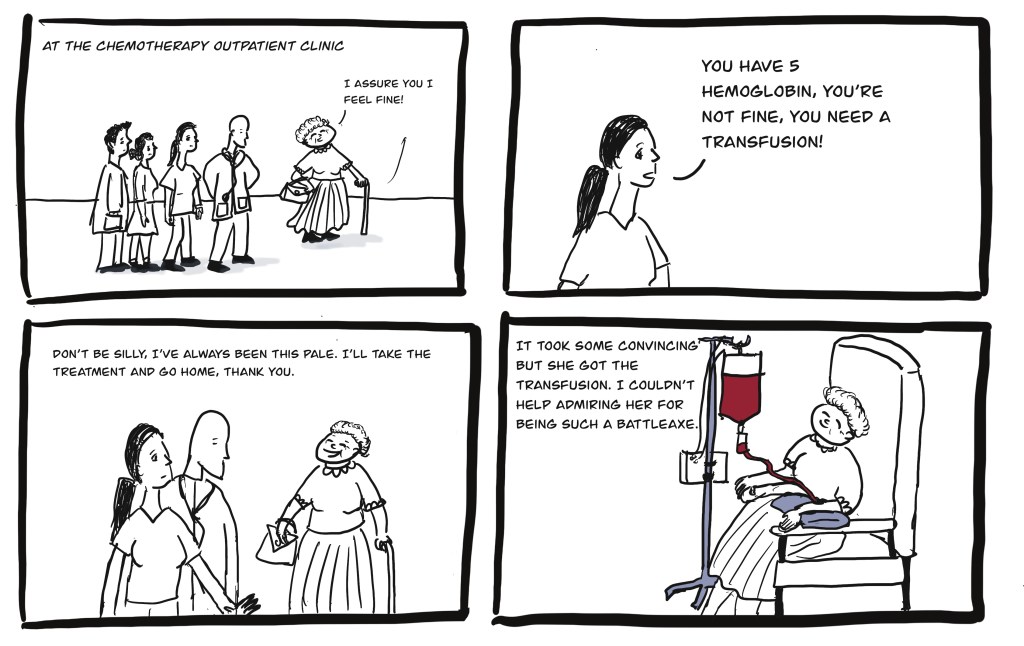
My chemotherapy caused anaemia several times, which I was expecting as it’s a common side effect of blood cancer chemotherapy treatments. Every time I came in to get treatments I had to have my blood tested and if my hemoglobin was too low then the treatment was postponed or if it was very low, you’d get a blood transfusion before treatment. Luckily enough for me my bone marrow was robust enough to survive treatment without me needing (extremely painful) bone marrow growth medication or (very painful and very lengthy) blood transfusions.
Blood transfusions take hours and they burn because of the anti-coagulation medication mixed in with the transfused blood (it’s how the blood is store without clotting). There’s never enough blood to go around (particularly during the pandemic) so doctors have to fight over every blood transfusion they order, and nurses hate dealing with them because of the paperwork and procedure around them and how long they take, and patients loath them because who wants to be connected for hours to a burning IV?
This means that if you’re getting a blood transfusion during treatments it’s because you really, really, really need them. Which brings me to this little anecdote that happened during one of my treatments:
While I was prepared for anaemia during treatments, what caught me by surprise was the anaemia after the treatments. A persistent and annoying “friend” that I had collected along the way, post-treatment anaemia is common with the type and intensity of chemotherapy that I had received. I had also been forced to change my diet significantly post treatment, which meant that I had a B12 deficiency — another common cause of anaemia (particularly among vegetarians, vegans and those that have had bariatric surgery). Several months of B12 supplementation and time for my bone marrow to recover kicked the anaemia’s ass — for now. However, like many cancer patients, anaemia is a red flag, and so my blood work is being constantly monitored, several times a year. It’s probably not surprising that it’s the first thing that both I and my hemato-oncologist check when we go over my blood tests.
What Can I Do About It?
1. Get regular bloodwork done. Talk to your family physician/GP about getting regular blood tests — before I was diagnosed with cancer I got them once a year. Once you get your bloodwork done, check your hemoglobin levels. Hemoglobin blood tests are part of a CBC (complete blood count) test.
2. If you do feel weak, dizzy, you’re pale, your feet are swollen, you have heart palpitations, shortness of breath or any other anaemiarelated symptoms, talk to your doctor.
3. If you can donate blood, please donate blood. Blood transfusions help cancer patients survive, as well as helping trauma patients, patients undergoing serious surgery and pregnant women during labour. Every blood donation saves lives (usually multiple). Be a hero — donate if you can.
In April 2022 I sat down and wrote the first part of what was supposed to be a long term writing project, the toughest one that I wrote yet. It was called “Hair Part 1” and it was part of something that I called “The Cancer Project”. The plan was to write a series of posts, all taken from my personal experience with cancer, and the point was to open a window into a very scary disease — humanizing it and the people who go through it, and arming the reader with information.
I didn’t post anything beyond that first snippet of a post, and I didn’t draft any more posts in the project. I was 4 months out of treatment when I wrote that post, and it was excruciatingly difficult to write. After I posted the post, I decided to focus on writing about other topics, easier topics. Topics that anyone else could write about, if I’m being honest. Sure, I could write a pen review from my own unique perspective, and of course people would read it because it’s useful and interesting to see different takes on the same thing, but then again… “so what, who cares?”
That challenge, “so what, who cares?” was something one of my professors used to say, and at the time it drove me mad. The point was that we didn’t have to make an argument, we had to make the reader care about the argument, we had to explain why it was meaningful and important, not just why we thought it was true. Pen and ink reviews are awesome, but every time I post one nowadays, I feel guilty. I know that I could be writing about other things, things that can maybe help people.
Last week this video popped into my YouTube feed, from the wonderful Struthless channel. Campbell Walker is starting a new community challenge meant to get people creating and posting their creations. It’s called Alphabet Superset, and the idea is to pick a theme, pick a creation medium and a publishing medium, make some aesthetic choices to limit yourself, and for 26 weeks create and post something that fits this framework — one piece a week, with the topic being tied to a letter of the alphabet. I looked at the schedule, and quickly realized that I won’t be able to follow it, but that didn’t matter. The challenge presented an opportunity, and more specifically a framework. I no longer had a giant abstract monster of a topic to maul, I could break it down to smaller chunks, albeit somewhat arbitrary ones.
Running through the 26 letters of the alphabet proved to me very quickly that my issue won’t be so much finding a topic that would fit the letter, but having too many things to cover per letter. “Ah!” my brain said, “an excellent reason not to start!” As you can see, it’s going to be a struggle between my need to write this project and my brain’s resistance to it. The odds aren’t in my favour: my brain, and specifically my PTSD, has shown itself to be a ruthless and tenacious opponent. It’s going nowhere, and it *will* fight me all the way through. However, I plan to dodge, feign and crawl my way through this one way or another. My PTSD may be persistent but I’m STUBBORN.
On to the practical side: I will be running through 26 letters of the alphabet. As the next three months are travel heavy, I won’t be able to stick to the “one post a week” schedule. Each letter will get at least one (maybe more?) blog post, and perhaps also a comic that I’ll create (no promises). I will clearly title all the posts in this project “The Cancer Project” so if you are one of those people who is absolutely terrified of cancer to the point of being incapable of hearing the word, you can avoid reading them. I do encourage you to grit your teeth and read them though. It may end up helping you, it may up end helping you help a loved one. The reality is that almost all of us will encounter cancer face to face at some point in our lives — whether as caregivers for a parent, sibling, spouse or child, or as cancer patients ourselves. So it’s useful to remember this:
So there’s a whole thing going on with Will Smith slapping Chris Rock at the Oscars for making fun of his wife’s hair. Jada Pinkett Smith has alopecia, which is something that one of my oldest friends suffers from as well. Hair can fall out due to a multitude of reasons, from autoimmune diseases to genetics, traction, poor nutrition and stress. But I’m not here to talk about Jada Pinkett Smith and her alopecia, or even about my friend’s journey with alopecia: I’m here to talk about cancer related alopecia.
The very first thing my doctor told me when she came to my hospital room to talk about treatments was that I’d lose my hair. I was on oxygen at the time because the tumour in my mediastinum (that the middle bit of your body, where your most important veins go, right up against the heart and lungs) was so large it was restricting my lungs enough to make me need oxygen to stay alive. At that point I had barely been sleeping in days, I had barely been eating, the main thing that I was doing was inhaling and exhaling, fighting for each breath. I had been waiting all day for a hematologist-oncologist (that’s a hematologist, a blood doctor, who specializes in blood cancers, which is what I had – Hodgkin’s Lymphoma) to take up my case and start taking care of me. I was very happy that the doctor that I wanted took up my case despite her already heavy caseload: she was kind and brilliant, and that’s not a common combination. She came in to my room with the paperwork for the chemo treatments (you have to give consent to getting poison pumped into your system, as chemo is basically poison in a dose that is meant to kill the cancer but leave you alive).
And the first thing she told me was that she was sorry, but that I was going to lose my hair.
I had read up about the side effects of the treatment that I was about to go through (ABVD chemotherapy), and I was afraid for my heart, my lungs, nausea, getting a chemical burn during treatment, and neuropathy. The last thing on my mind, the last thing I was worried about was my hair. The mouth sores seemed more scary.
The hair loss theme returned during my first meeting with the cancer centre’s social worker. An efficient yet caring battle-axe of a lady she told that from her experience ABVD patients didn’t lose all of their hair, they just lost most of it. She was looking at my head at the time, and it was before my 2nd treatment, so I still had all of my hair. My doctor had told me that the hair-loss happens after the 2nd treatment, and she was, of course, 100% correct.
Then there were the women in the closed cancer Facebook groups. I had joined a few, one for Lymphoma patients, one for young adults with cancer. They were a source of information and camaraderie, and a good amount of gallows humour. One of the women in the group, a new member like me, said that she would lose her mind if she lost her hair and asked if there’s a way to prevent it. Another asked about wigs and young children: is there a way to have the wig attached so that they can’t pull it off.
I thought that they were all being a bit silly. Yes, I know, that’s unkind and insensitive and I’d learn better with time, but I’m being honest here. I was literally fighting for my breath before the treatments, and they allowed me to breath. The side effects were far from being a walk in the park, but losing your hair didn’t hurt (I was wrong), and was just a superficial change (I was wrong), and a temporary one, so why focus on that and not on more serious side effects? (I was clueless).
 Writing at Large