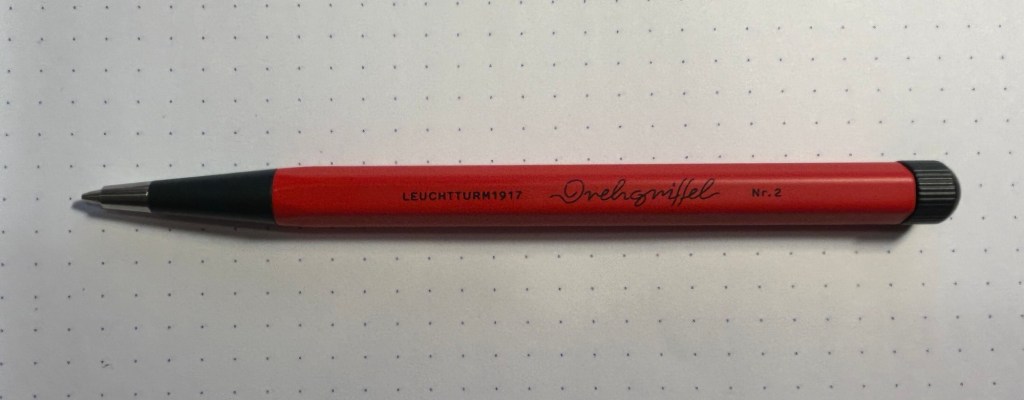
The Leuchtturm1917 Drehgriffel Nr.1 is a charming little pen that comes with either a gel refill or a ballpoint refill. The Drehgriffel Nr. 2 is its pencil counterpart: a short but hefty mechanical pencil with a twist mechanism that comes in a variety of colours. My pencil is a bright red and dark grey one, and it has quickly become my most used pencil by far.
Small but mighty, the Drehgriffel Nr. 2
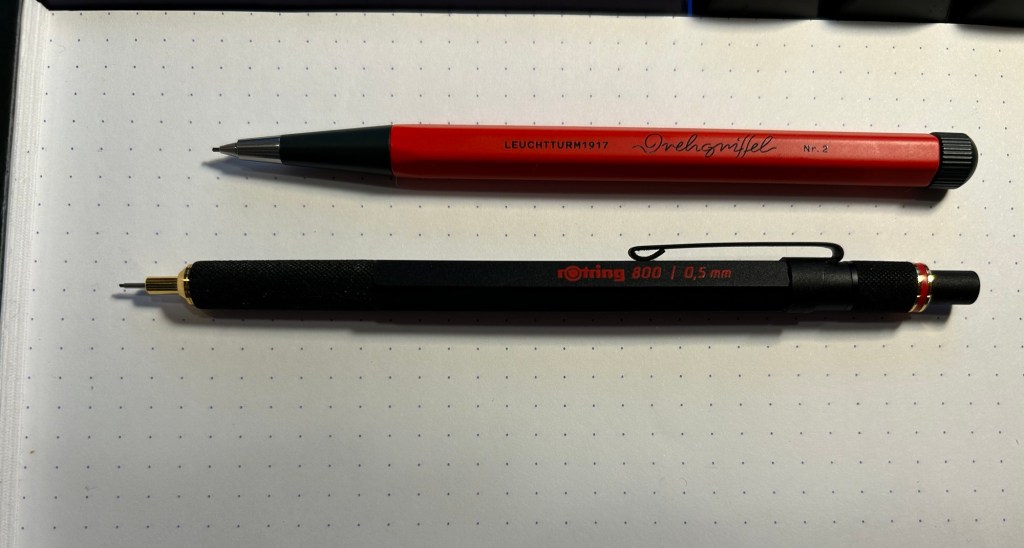
The pencil is shorter than other mechanical pencils, but as it’s an aluminium bodied pencil with a steel tip it has some weight and heft to it. It’s lighter than the Rotring 800, and the weight is balanced towards the tip so it’s very comfortable to use.
Drehgriffel Nr. 2 on top, Rotring 800 on the bottom
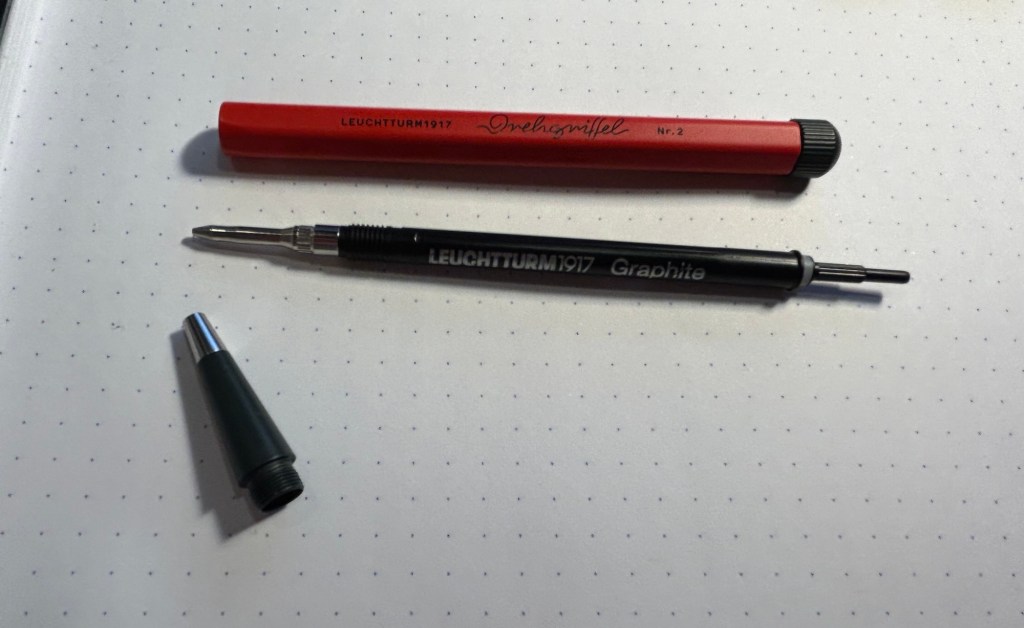
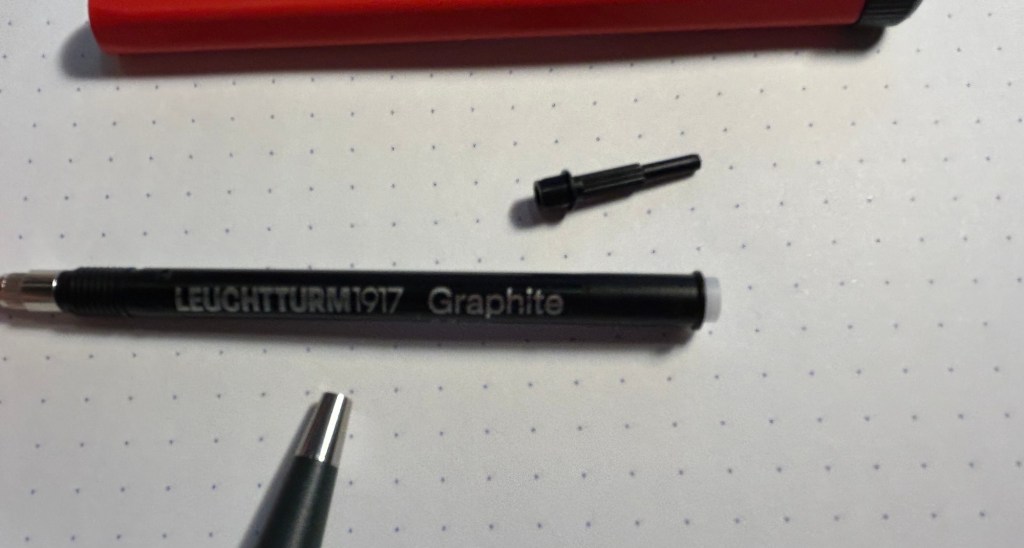
The pencil mechanism is proprietary to Leuchtturm, and it’s a pretty unique affair. You give the nob on the top a quarter twist and then you hear a satisfying click and the lead advances. The pencil mechanism looks like a gel ink or ballpoint refill, but the little pole on the top pulls out and you can add more pencil leads to the pencil that way. You get to the mechanism through unscrewing the front cone tip of the pencil.
The Drehgriffel Nr. 2 and its mechanism
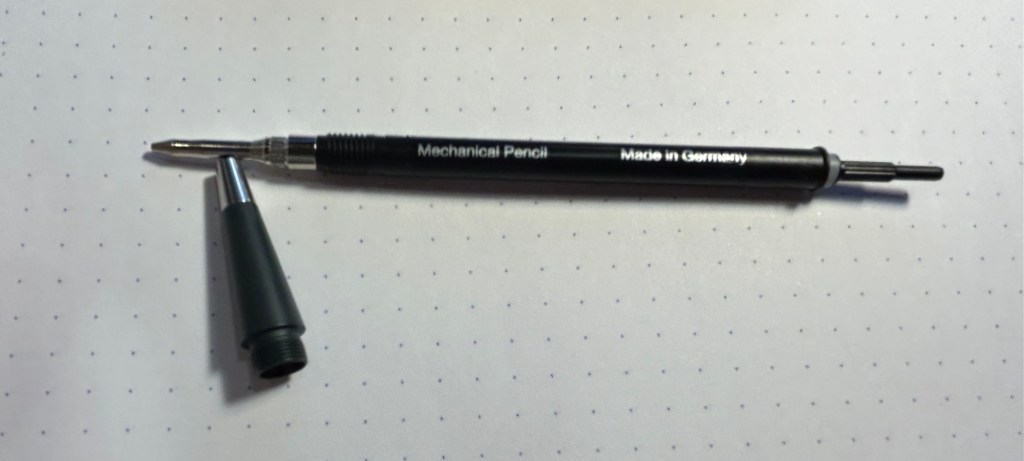
Here’s a closeup of the mechanism (my camera had issues focusing on the lettering):
Here you can see where the leads go in:
The Drehgriffel Nr. 2 is a 0.7 mechanical pencil and it comes with HB leads inside. It’s a great pencil with a classic, sleek design, and a very solid and unique mechanism. The size is plus as it makes it ideal for everyday carry, and it doesn’t have the silly little eraser that certain mechanical pencils have and is always terrible. The only minus to this design is that to add more leads to it you basically have to take the pencil apart. That’s no big chore, but the end bit (the little pole thing) is very small and would be easy to misplace. I’d suggest doing the refilling in batches of a few leads at a time, and being careful to not lose sight of the mechanism end bit.
Otherwise this is an excellent mechanical pencil, a solid and handsome little workhorse that’s a joy to use and would make for a great gift even for people who are not great pencil lovers.
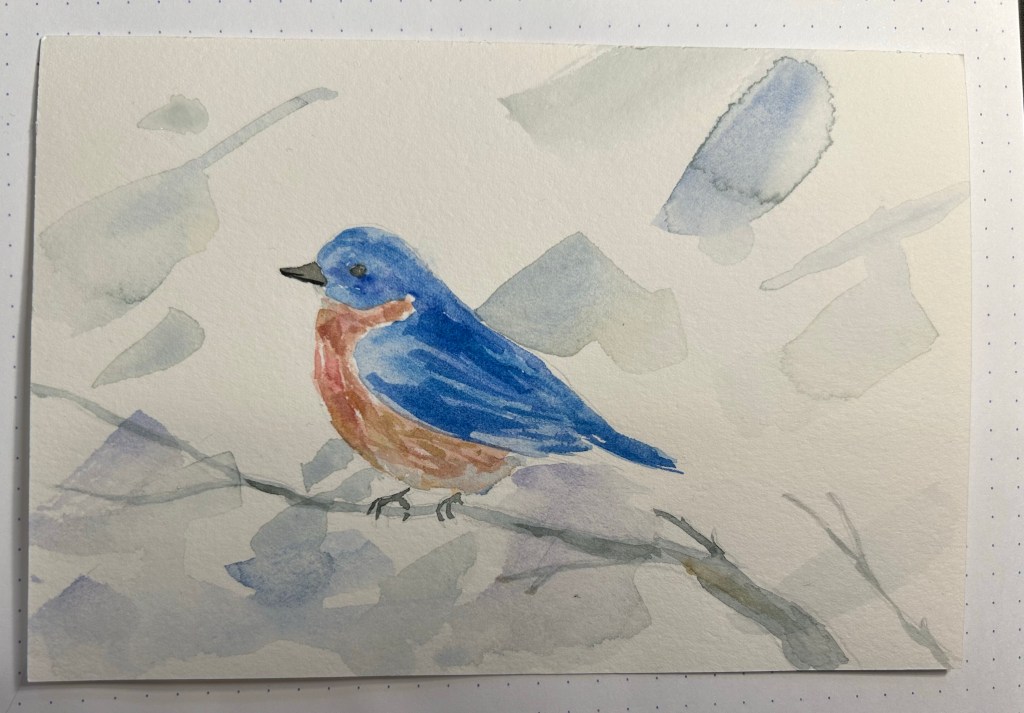
I’m coming on my two year anniversary from the end of my chemo (it’s at the end of next month, so basically on Christmas Eve), and I have a check up with my hemato-oncologist in two days. I sketched this to give her with a box of pralines, a small token of my gratitude for the past two and a half years:
Bluebird watercolour
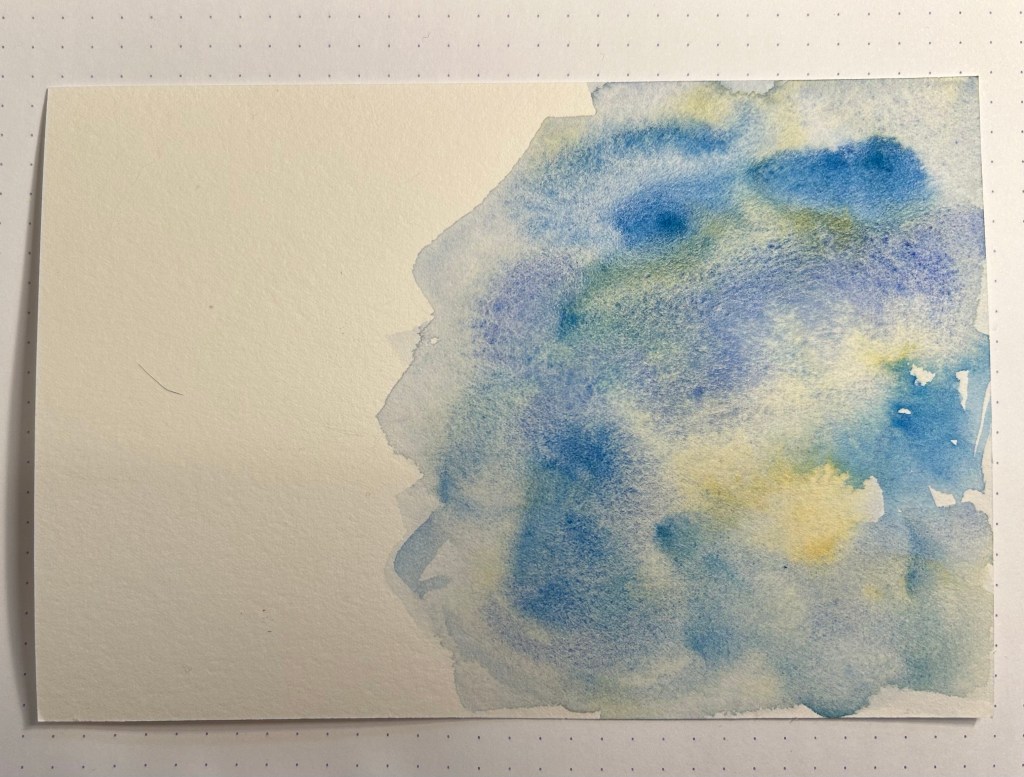
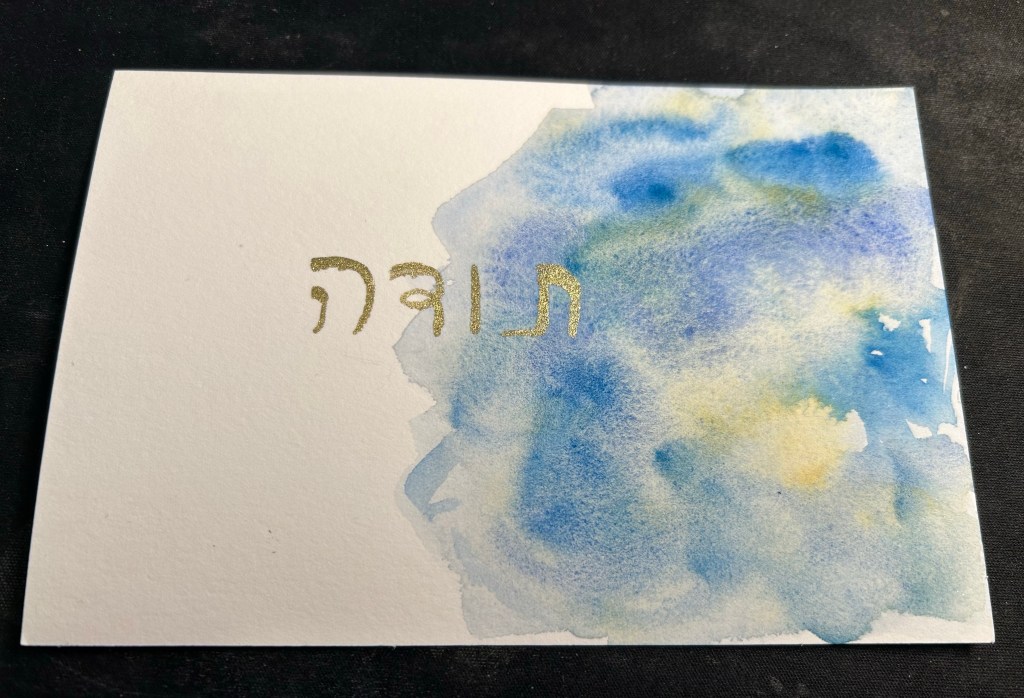
It’s a new kind of paper so it came out a bit more blotchy than I’d like, which made me want to play with it a bit more. I wanted to make another quick card for one of my mom’s doctors, who’s retiring, so I had some pigment fun:
If you don’t like granulating watercolours then you’d hate this paper.
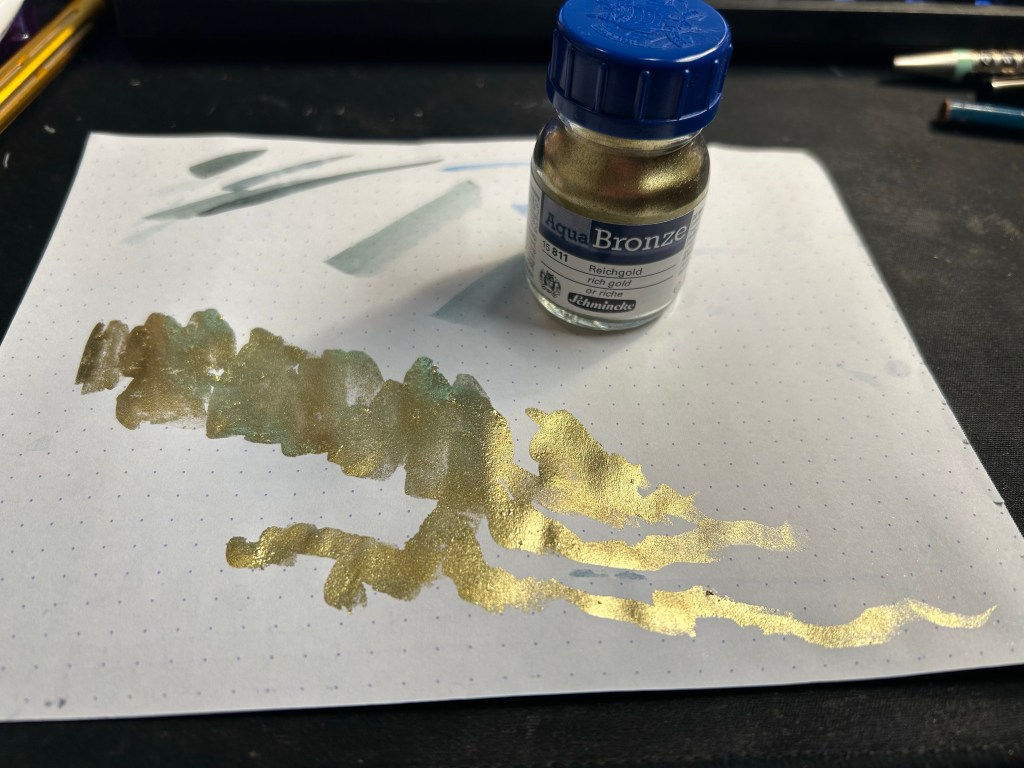
I then used Schmincke’s Aqua Bronze rich gold to add some writing to it. Aqua Bronze is basically a small jar full of glitter powder that you mix with a little bit of water (a very, very small bit of water) on your palette and it turns into metallic watercolour. Unlike other metallic watercolours Aqua Bronze has good coverage and opacity, and it really pops off the page. It’s the very last thing you add to your drawing, after everything else has completely (and I mean completely) dried up. You need very little of the powder and even less water, a cheap plastic palette and a cheap synthetic brush and you’re all set.
Aqua Bronze in action
There are several different kinds of metallic hues, and they all work the same. Do remember that you want to use a cheap brush and a palette you don’t care about because this is glitter. You also don’t want to clean the brush in your regular water pot, or to use the same water for another drawing later on. Aqua Bronze sticks to everything, and you can’t ensure that it was completely cleaned out of your tools, so don’t use your best brush or your usual palette for this.
You mix up the powder with a tiny bit of water and a bit of patience (it takes less water and more time than you think) and then apply it to your dry drawing. The paint stays in place but if you brush your fingers on it, they will come out with a fine dusting of glitter. Here’s how it turned out:
If you want even more opacity, you’re going to have to use a paint marker. In this case I wanted the yellow in the abstract blue rose to be reflected in the thank you written in gold so I wanted the soft edges of the Aqua Bronze.
If you’re thinking about creating watercolour holiday cards and want to add a little bling to them, Aqua Bronze could be an option. I’d select one colour as the jars aren’t cheap, and I’d finish the sketches and then add the glitter highlights in one batch.
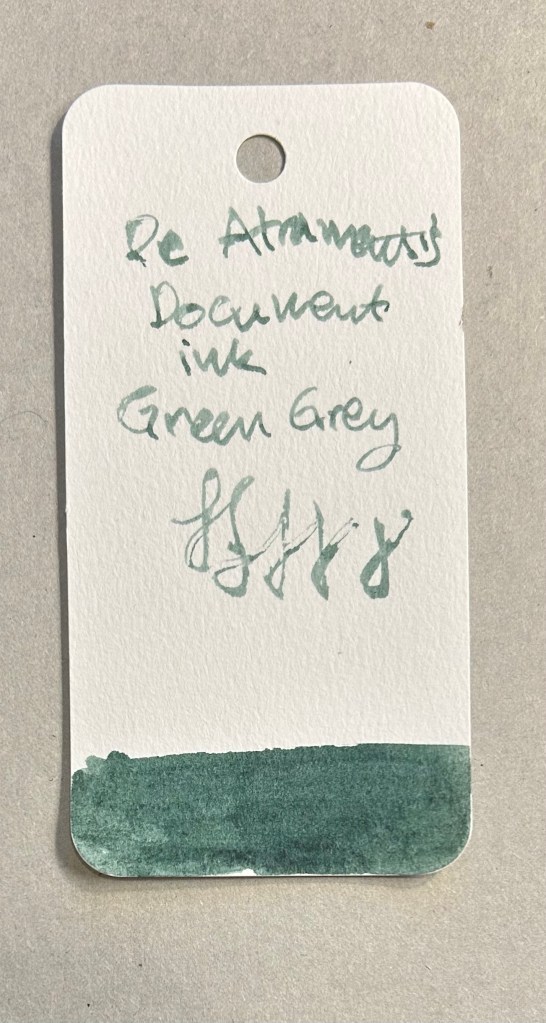
De Atramentis Document Ink Green Grey is a waterproof fountain pen ink that could have easily been called “Sage Green”. It’s dry and offers a fair amount of shading, is quick drying and would be a good addition to any Urban Sketcher’s kit.
Ink swab on Col-o-Ring
While I think that De Atramentis Document Ink Green Grey is much too light to be useful as a writing ink (see sample below) its subtlety, natural shade and waterproofness makes it very useful when coupled with watercolours.
Writing sample with two different pens on Midori MD cotton paper.
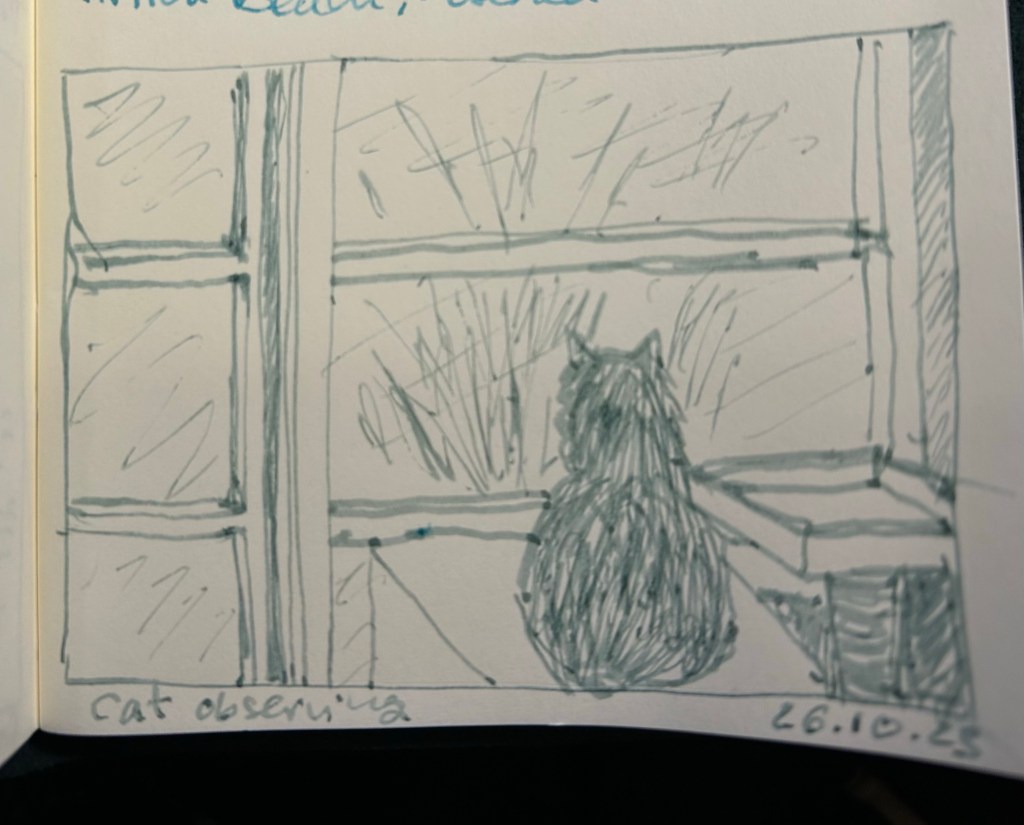
When used by itself, particularly in wider nibs, DA Geen Grey gives sketches a “vintage” feel and a good amount of interest: it both shades and allows for dry brushing effects because it’s so dry. Want a dry brush effect? Just work fast, and the tendency of this ink to skip will suddenly be an advantage:
Dry brush effectVintage look to a vintage motorcycleThis shade makes this sketch a bit melancholy, which is what I was looking for.
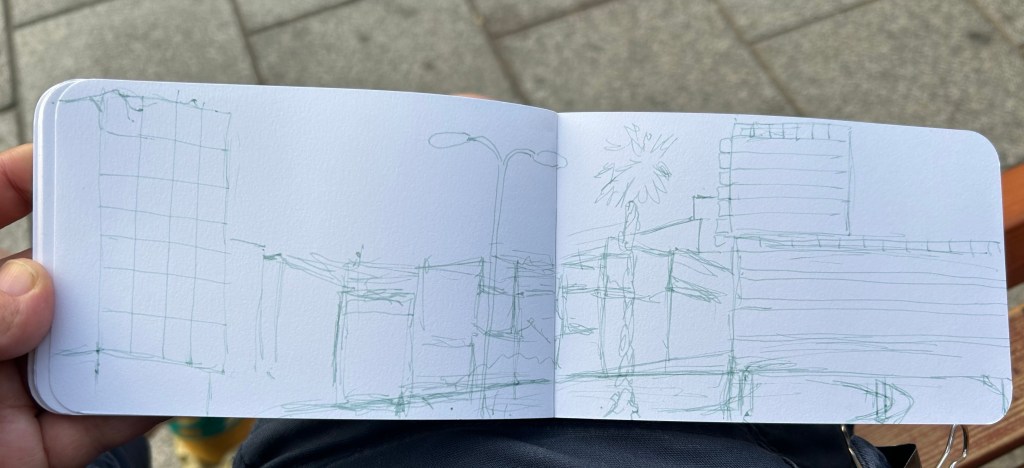
DA Green Grey truly shines as an under-drawing ink for watercolours. You can freely sketch guidelines and work directly in ink with it, and then add watercolour. It’s light enough to fade into the background, while still remaining permanent on the page and providing you with useful references.
Under-drawing/guideline sketchInk sketch with a Staedtler pigment liner
Can you even see DA Green Grey lines in this sketch? (you can, from very close by and if you know what you’re looking for)
If you work with watercolours, especially if you’re an urban sketcher, I highly recommend adding De Atramentis Document Ink Green Grey to your kit. It can replace a pencil for the under-sketches of your work, and it doesn’t change the shade of the watercolours, nor does it need to be erased. A pen with this is going to be added to my sketch kit, though I will probably use a fine or medium nibbed fountain pen for this ink and not go any finer because it’s so dry.
If you use watercolours you usually find yourself in one of two camps: those who want as much control of their painting as possible and so hate granulating watercolours, and those who love the magic of granulating pigments, and the unexpected effects they create. For the first few years that I was using watercolours I hated the “cauliflower” and “graininess” of granulating watercolours and so I actively avoided those pigments. Nowadays I have several granulating watercolours on my palette (and two super granulating ones) and I enjoy the watercolour magic and pigment parties that they create.
A few years ago Schmincke started issuing “super granulation” watercolours, which are watercolours with extra pronounced granulation effects and two different pigments in the same paint – something that created a dual colour effect and added tons of texture to any painting they were used in.
I reviewed the first of those paints here, and since then Schmincke have come out with three more series of super granulation paints: Shire, Desert and Volcano. Of the three the Volcano interested me the most as it seemed to fill in a gap that the very blue and green leaning previous sets were missing: warm, red hues. As Schmincke watercolours aren’t cheap, and the full volcano set came out to more than I was willing to pay for just to experiment with, I purchased a trio box of 5ml tubes to try out.
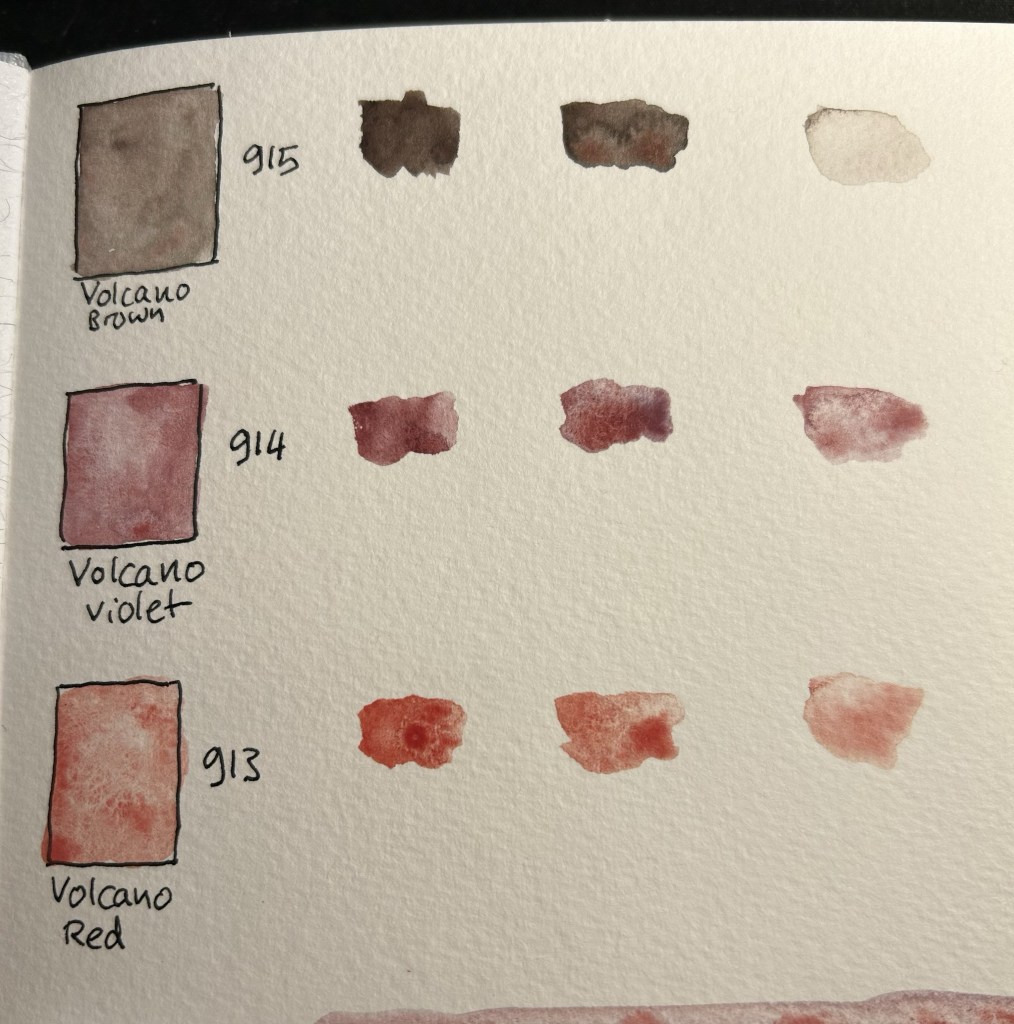
The test page
The trio I got contained 913 Volcano Red, 914 Volcano Violet and 915 Volcano Brown. The one that I was most interested in was the volcano red. The one that I ended liking the most is the one that I had the least expectation for: volcano brown.
Trio Super Granulation Volcano
I filled three half pans with paint and let them dry out for 24 hours (Schmincke watercolours are much easier to pan fill than Daniel Smith as they come out of the tube better and they dry quicker). I then did a colour swab for each, and a paint test with three paint consistencies (honey, milk, tea as Marc Taro Holmes calls them): the first with very little water, the second with more pigment than water and the third with very little pigment. In the case of the volcano brown I overdid the water in the tea swab, so it’s much lighter than the rest.
Volcano red is semi-transparent and semi-staining, volcano violet is semi-opaque and semi-staining, and volcano brown is semi-opaque and staining. The opacity-transparency spectrum in watercolours is important if you mix watercolours, as the more opaque a paint is the less well it mixes and the more chance you’ll get a “muddy” mixture out it. It is also important for layering, as opaque paints will not layer as well as transparent ones. For this reason I use opaque and semi-opaque paints sparingly, and usually only during the final stages of my painting.
Staining is a measure of how easy it is to “lift” the paint off the page with water or by dabbing it off, should you need to. The more staining the paint, the harder it is to lift without leaving a stain behind (this also depends on the paper you use, of course).
Looking at the paints, the volcano brown shows dual brown and red pigments, the volcano violet shows red and purple pigments, and the red shows red and maybe orange pigments, but it’s hard to tell. The volcano brown is the most dramatic and interesting of the three, though the volcano red is by far the most granulating of them.
Paint swabs and honey, milk, tea tests.
I tried to create a sketch using only these paints (on 100% cotton watercolour paper) and boy do they show their super granulating properties. while the volcano red by itself isn’t impressive, it does layer spectacularly well on the other two paints, and the volcano brown adds a lot of interest and drama to the painting. Of the three I’m likely to add the volcano brown into the rotation, and perhaps, for certain effects, the volcano red. The violet would come in handy if I was working on portraits maybe, but otherwise it reminds me of potter pink: a pigment that is too washed out to be of any regular use in my palette, and not worth the space when it comes to keeping it around for mixing purposes.
Volcano sketch
If you’re just building your watercolour palette, these paints are not for you. However, if you have an established palette and a certain style of painting that favours texture and layering, I’d recommend giving at least some of the Schmincke super granulation watercolours a try. They are bound to result in something interesting and unexpected.
I rarely write reviews that trash products— because I tend not to waste my time and money on products that could potentially be bad. However, I was stuck in Tampa’s airport on a very long connection due to inclement weather and so I browsed their bookstore and found this:
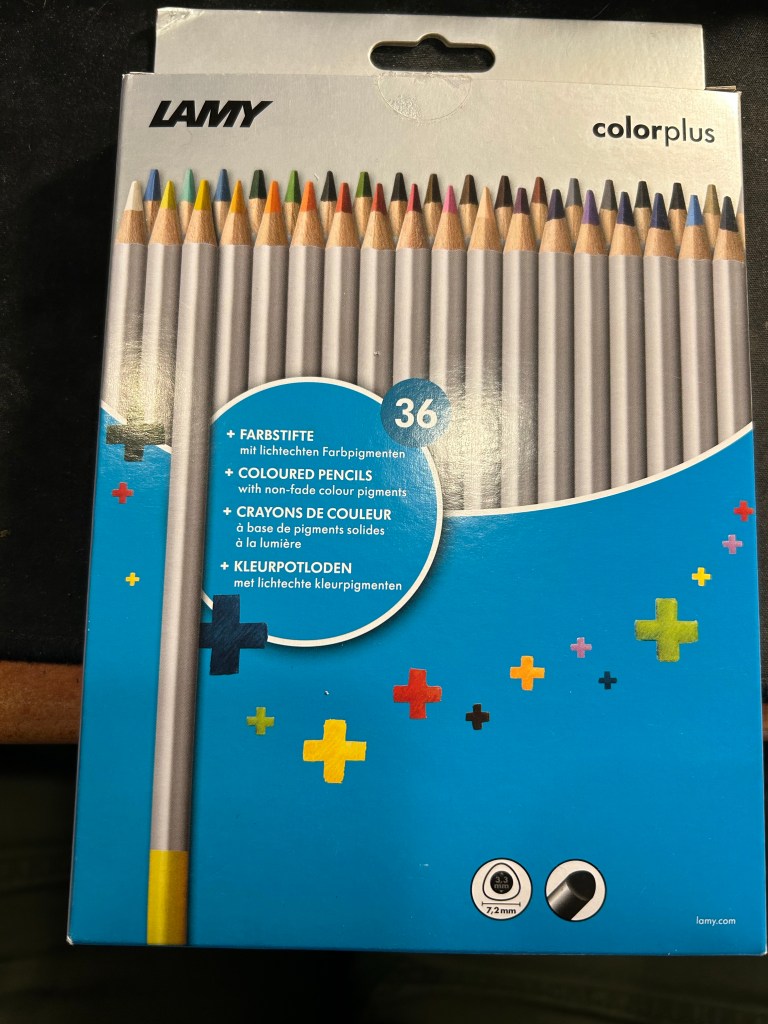
Lamy ColorPlus 36 coloured pencils
Well it says Lamy on the box, so it can’t be bad, right? And it was just $15 for 36 pencils…
This is where the red flags should have popped up, but they didn’t. I bought the pencils.
When I got home and opened the box, my heart sank. The leads were broken on almost all of the pencils. Now the box was in my trolley, well protected from dropping or crushing, so there was really no reason for this amount of damage. I checked the back of the box:
“Highly resistant to breakage” it is not.
The pencils are triangular shaped, which is supposed to make them ergonomic. It makes them more unpleasant to sharpen, as there’s a steep “bump” whenever you turn the pencil to another side.
Triangular pencils
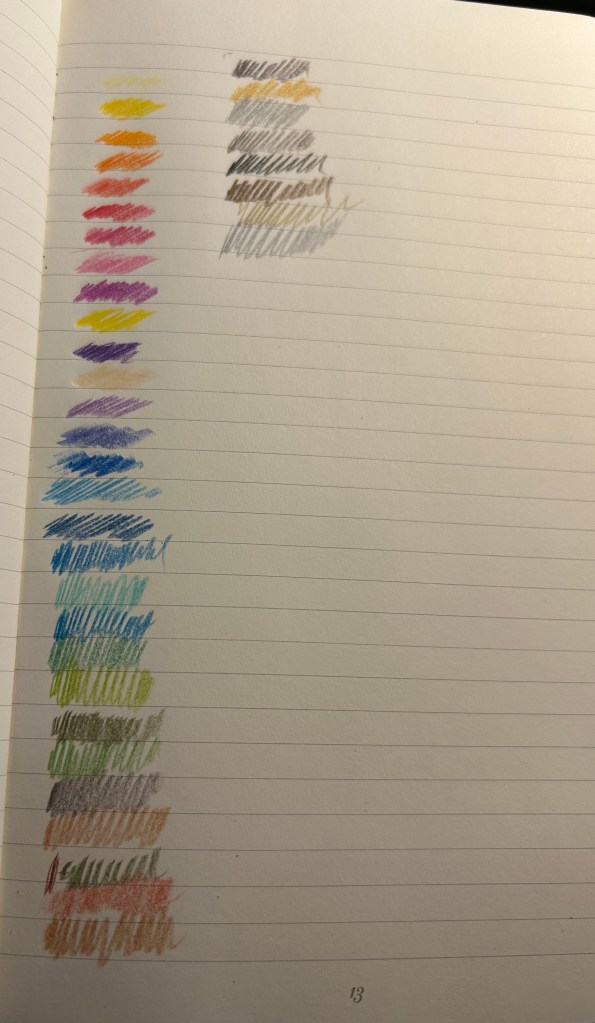
The colour selection is weird — there are a lot of various shades of brown, but no ochre. The browns themselves are nothing like the colours that you’d expect from their labelling. I use the term “labelling” loosely here, because there’s no colour labelling on the pencils, just a dip of colour that is vaguely similar to the actual pencil colour produced.
Pencil samples
The 36 shades chosen are wild – way to many similar brown, not enough greens, too many purples and blues, and of course utterly useless white and the bewildering gold and silver which are neither gold nor silver. Obviously the pencils crumbled while creating these samples so there are some duplicates here.
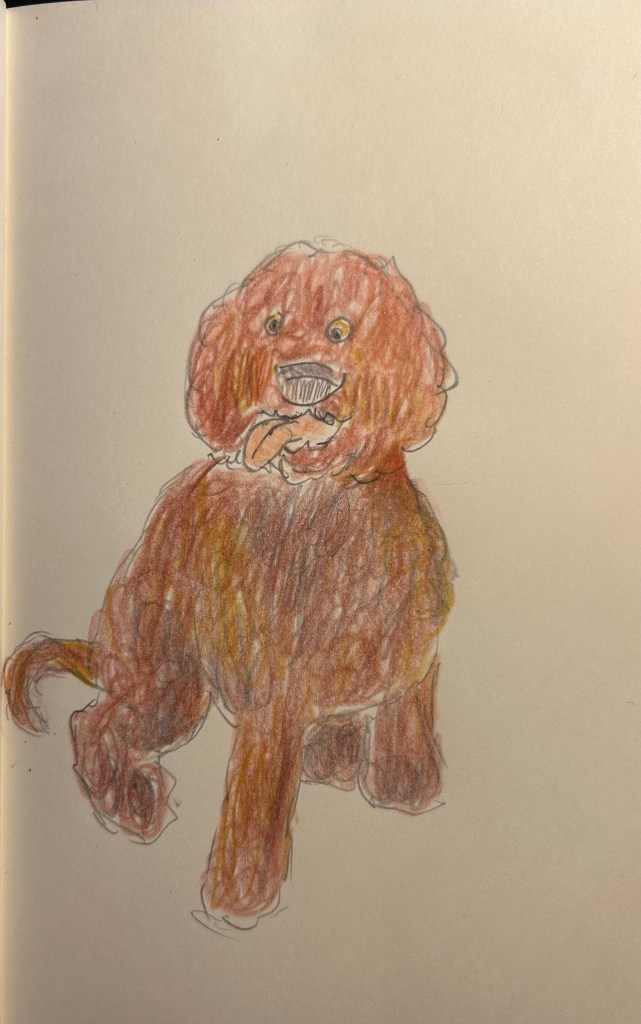
The pencils are very waxy, which means after 2-3 layers maximum the paper will be clogged and subsequent layers won’t be registered. The pencils also crumble easily —- even with very light pressure applied. Creating this sketch with them was nightmarish, as the leads kept crumbling, and I couldn’t get the shades that I wanted to the layering that I was trying to achieve.
Quick dog sketch
I honestly don’t understand why this product exists. It’s too expensive and not robust enough for children’s use, it’s definitely not artist grade (poor pigment, layering and no labelling), and even student grade pencils are properly labelled these days. In any case, save your money to buy better pencils. You deserve them.
While most of my fountain pen collection consists of vintage fountain pens, I understand that for many people purchasing vintage fountain pens is too risky. You might get a pen that needs repair, you might misjudge the value of the pen and overpay considerably, you might be buying a fake. As even the cheapest of vintage pens isn’t just a few bucks, making a mistake here could end up being very expensive.
Yet there’s a joy in vintage items, in seeing the craftsmanship, design and care put into them, in learning their history and placing them on a timeline, and in the knowledge that you saved something from the landfill. If you want to experience some of that joy with less of the risk of buying vintage fountain pens, vintage pencils are your friend. Flea markets are full of vintage pencils, pencil tins, pencil sharpeners, leadholders, etc that are usually very cheap to buy, and hold little to no risk.
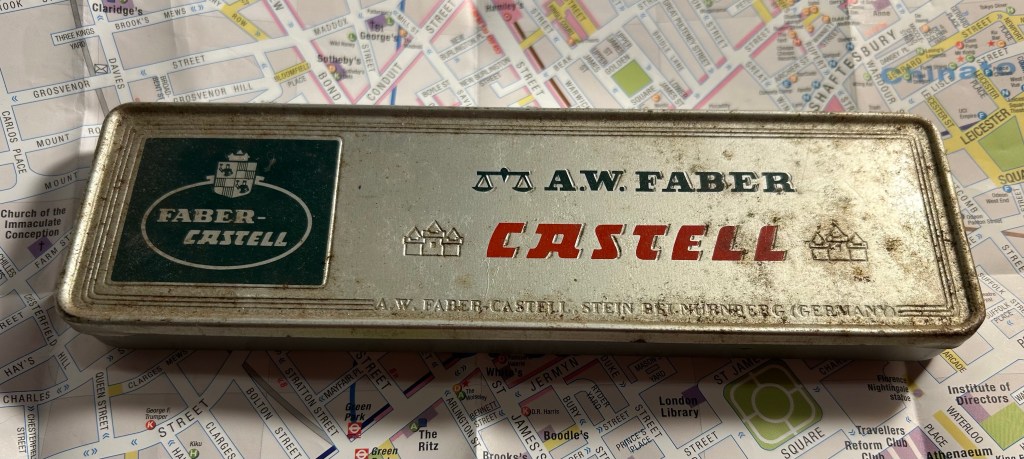
When I was in Spitalfields market, buying vintage books, I saw this tin propped up against a bookshelf in the stall I was purchasing my Arthur Ransome books from. This is how it looked:
Grimy but not full of rust or beaten up A.W. Faber Castell pencil tin.
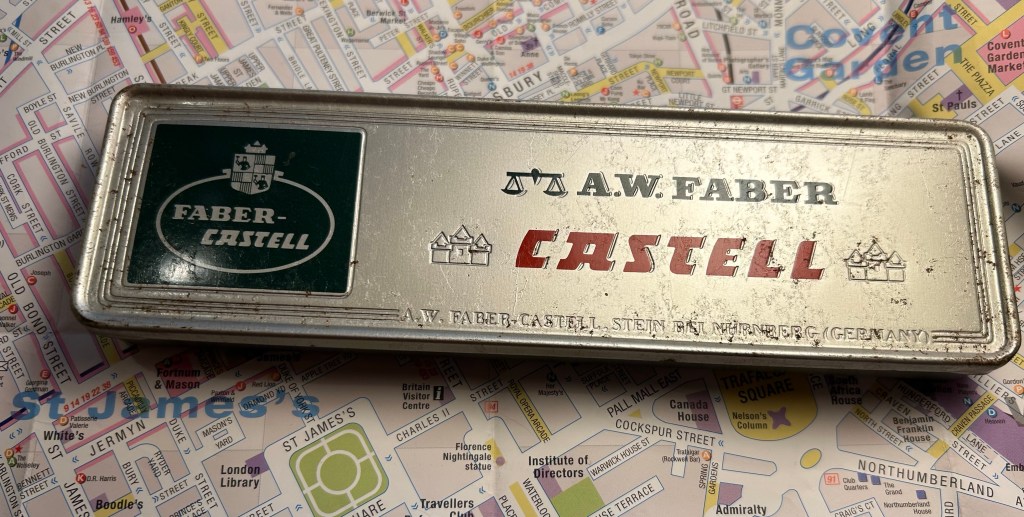
It’s an A.W. Faber Castell pencil tin, and after just a few minutes with some wet wipes it already started to look better:
A bit cleaned up.
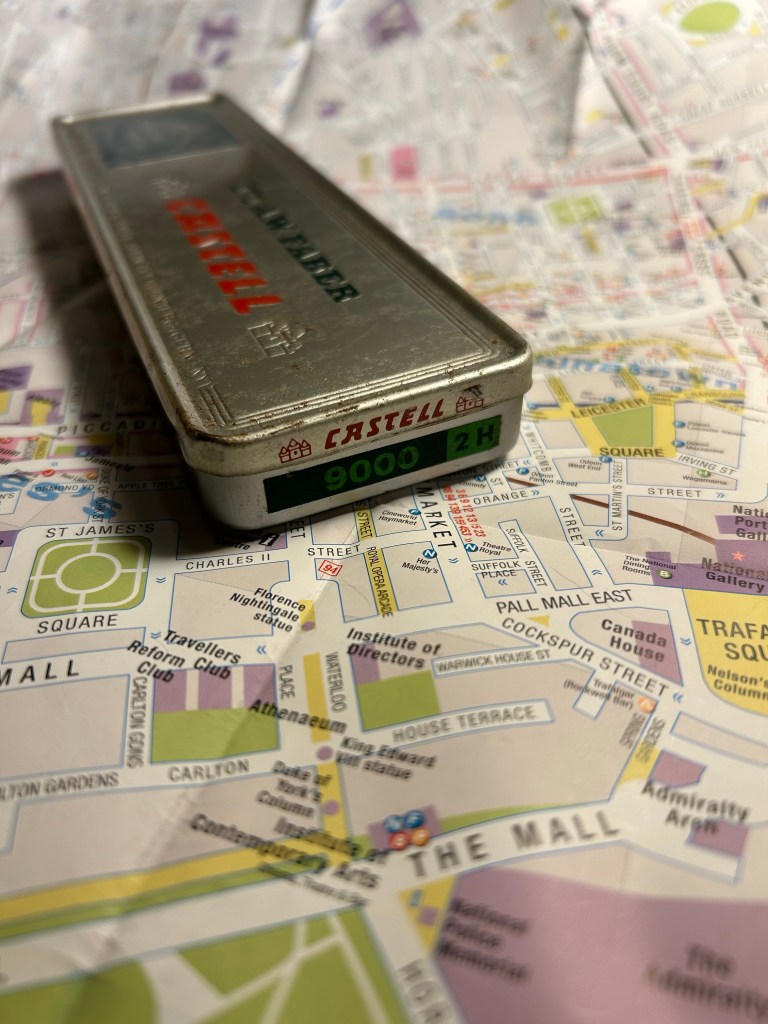
The tin and the pencils inside cost me only a few pounds, and truth be told I would probably have purchased the tin even if it was empty. The design and typography are absolutely delightful:
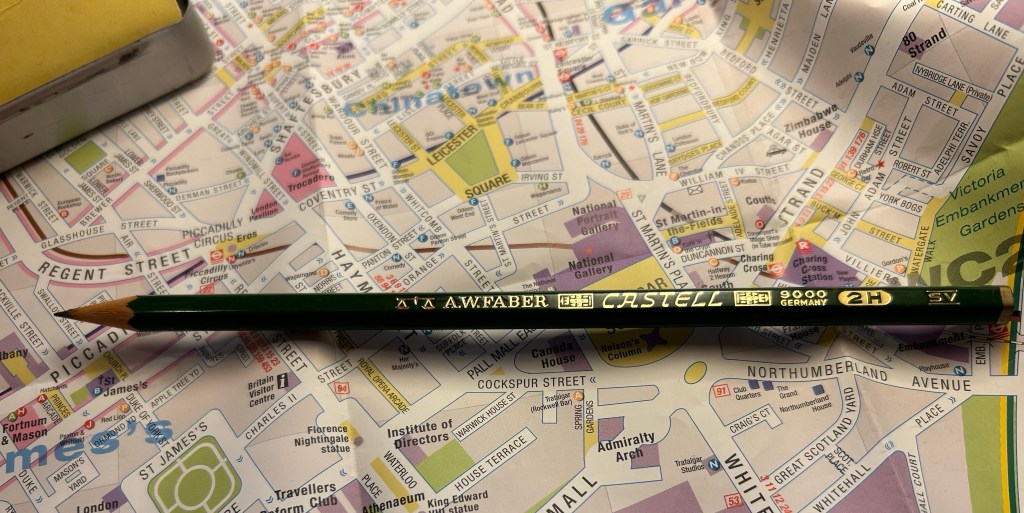
Castel 9000 2H. I can imagine having a stack of these in different lead grades on a shelf.
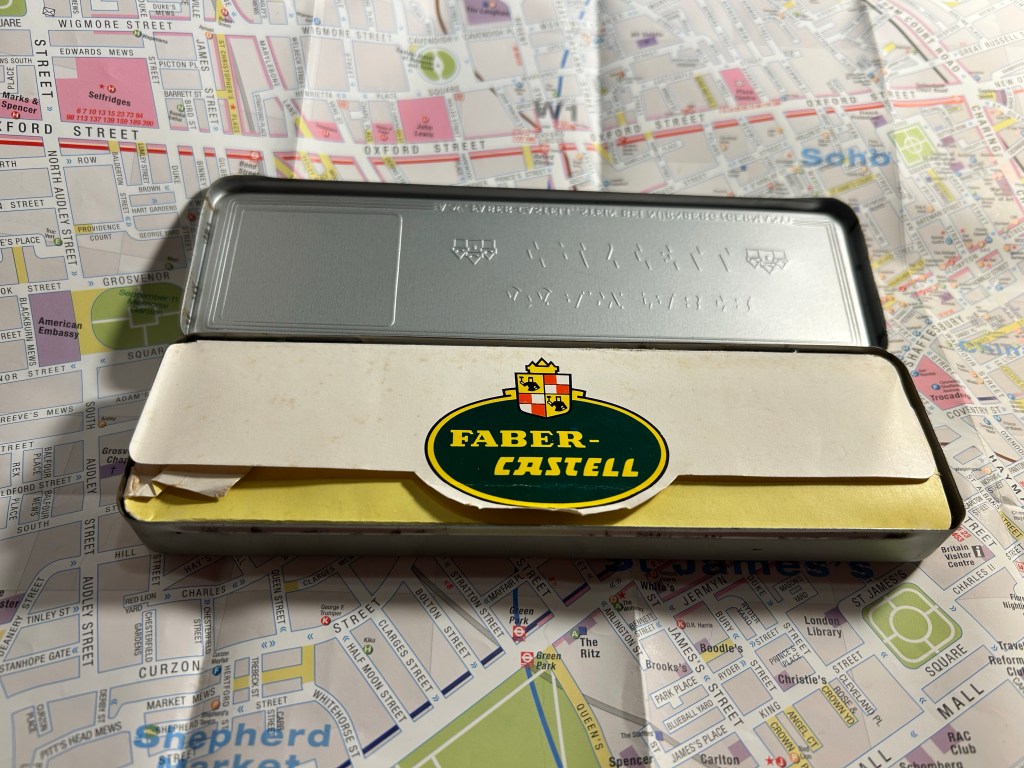
The over packaging continues inside – you wouldn’t want your pencils rattling around in the tin, would you?
Paper insert to protect the pencils inside.
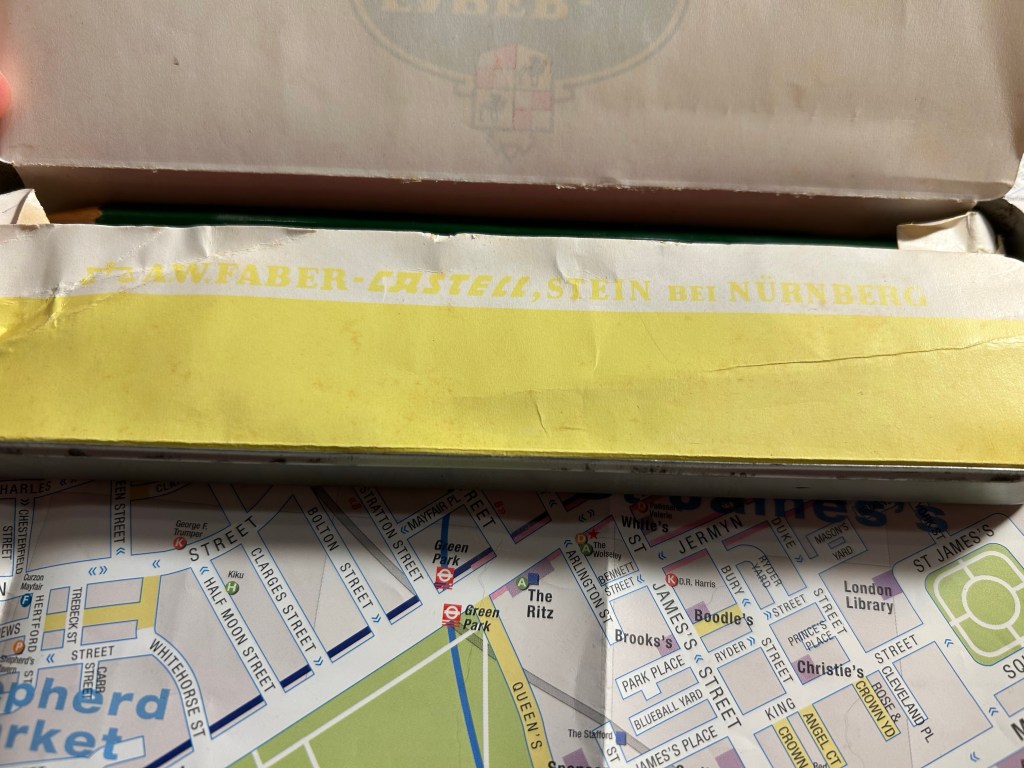
Faber Castell’s factory in Stein proudly represented on the outer tin and here too:
A.W Faber-Casterll, Stein Bei Nürnberg
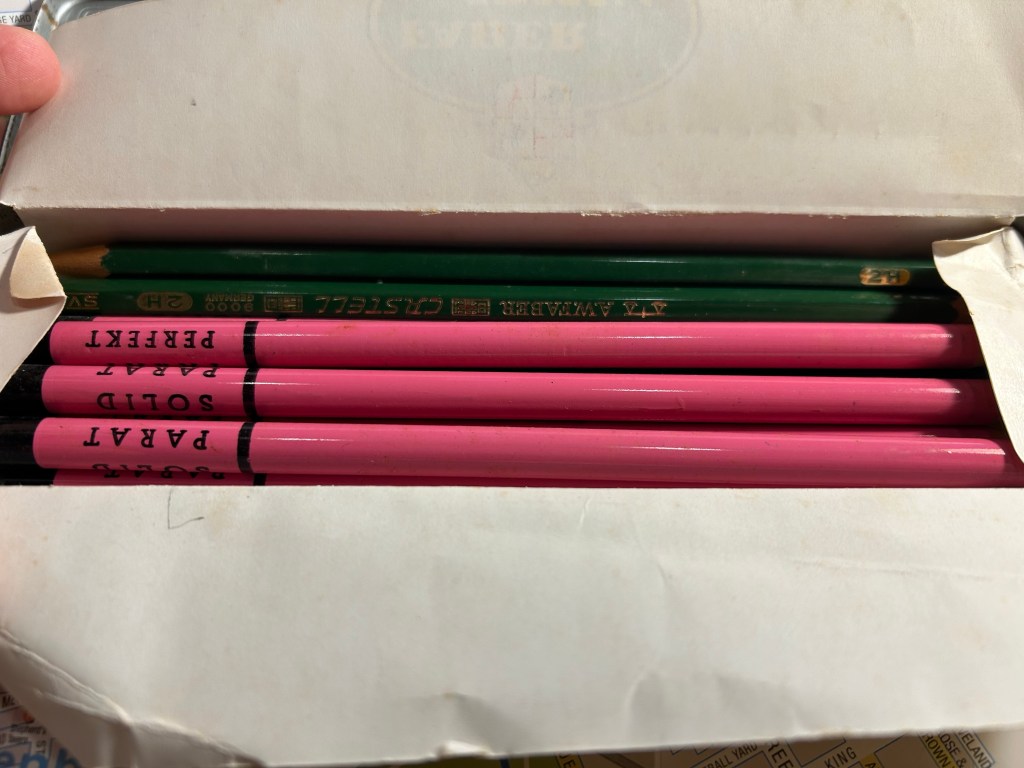
Inside were about half of the original Faber-Castell 9000 2H pencils, and half pink advertising pencils for a thread company that I think no longer exists.
It’s like opening a box of chocolates – you never know what you get
Faber-Castel 9000 are excellent artist pencils, and the vintage ones are just as great as the current ones in production, only they’re usually cheaper and have much better typography and logos on them. Look at this little masterpiece:
Vintage pencils always have a ton of stuff stamped on them. You needed the INFO, right?
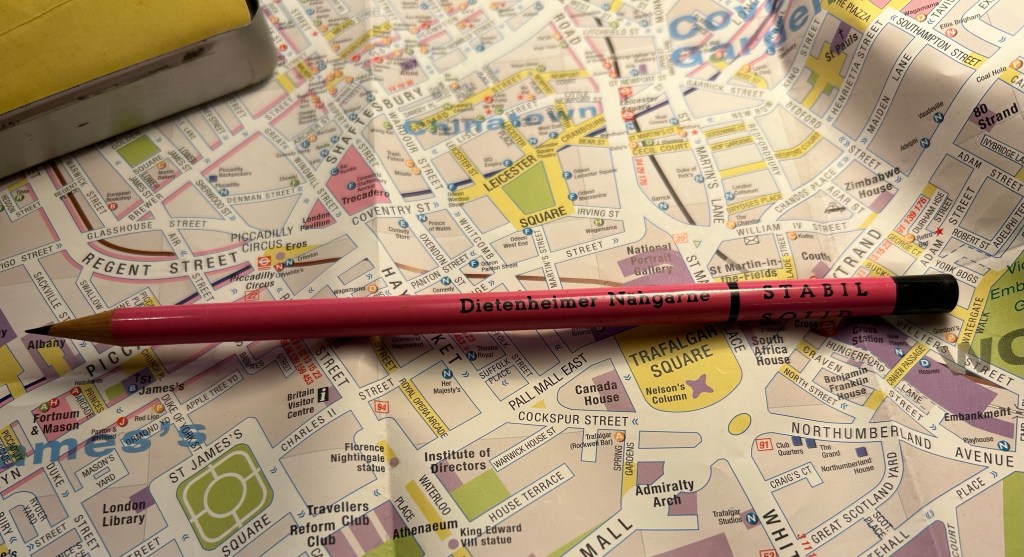
The pink pencils were round advertising pencils, for a German thread making company that seems to no longer exist. They are solid HB pencils, and have an 80s sort of vibe to them.
Advertising pencils.
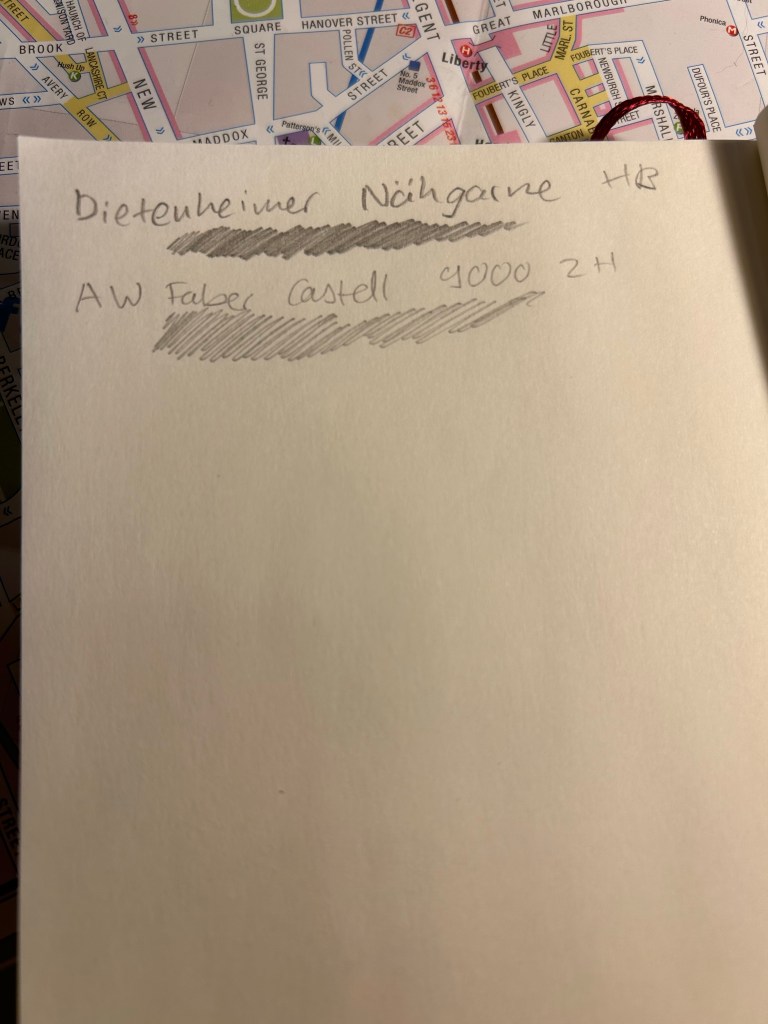
The great joy of vintage pencils is that they of course write just as they used to when they were originally made. If they have erasers they’re going to be unusable (these pencils don’t), and sometimes the wood is a bit brittle and dried out so a bit more care needs to be taken whilst sharpening them (these pencils are in excellent condition), but otherwise time affects pencils very little.
Writing samples
So next time you’re at a flea or antique market, rummage around its hidden corners for some cool old pencils to try out. You never know what you’ll find — I picked up some Sanford Noblots from a giant jar of pencils that way.
P.S. If you’re wondering, 2H pencils are perfect for watercolour under-sketches, as so long as you keep your pressure light, they disappear beneath the paint.
Never have I ever fallen in love with a standard pen faster than the Zebra G-450. Even the Uni-ball Signo RT 0.5 took a bit of time until it became my favourite, and I had much less experience with gel ink pens at the time. I liked the Zebra G-450 so much that after writing a few pages with it, I put in an order for two more packs, just so I’ll have backups and multiples of it.
So, what’s so special about this pen?
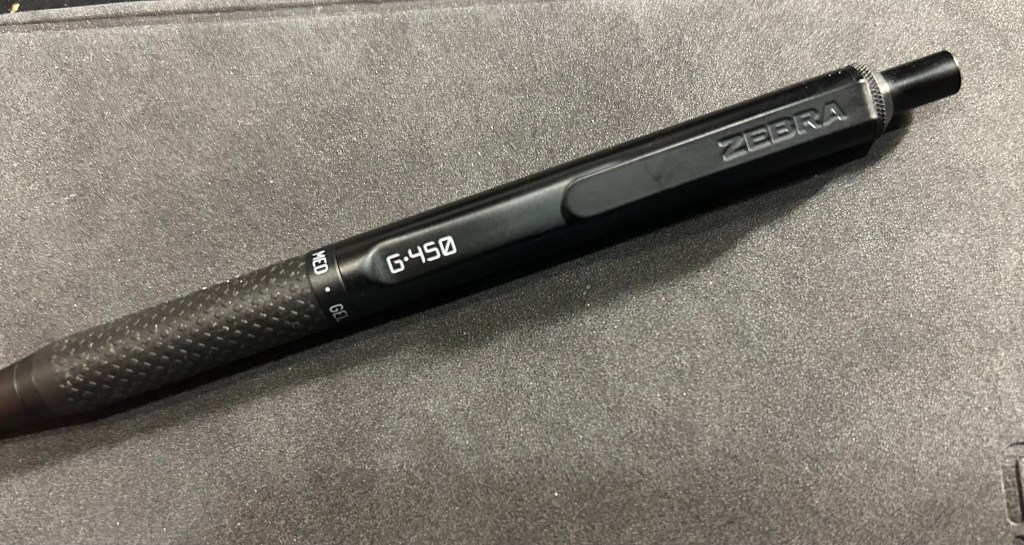
Zebra G-450
First of all, the Zebra G-450 looks like it was designed to be a prop in the Jason Bourne movies. It doesn’t have the “I’M A TACTICAL PEN, LOOK AT ALL THE WEAPON LIKE APPLICATIONS YOU CAN GET WITH ME” look of tactical pens. I find that look childish, and I find that it makes for very uncomfortable to write with pens. The G-450 is nothing like that: it’s sleek, features a durable and hefty-without-being-heavy brass body, knurling on the top, a very well designed rubber grip, and very Jason Bourne like fonts.
G-450
The G-450 has a well designed and solid clip, with a step down/cutout right in front of it that adds interest to the pen silhouette and makes it easier to clip onto things.
Step down, clip and fonts
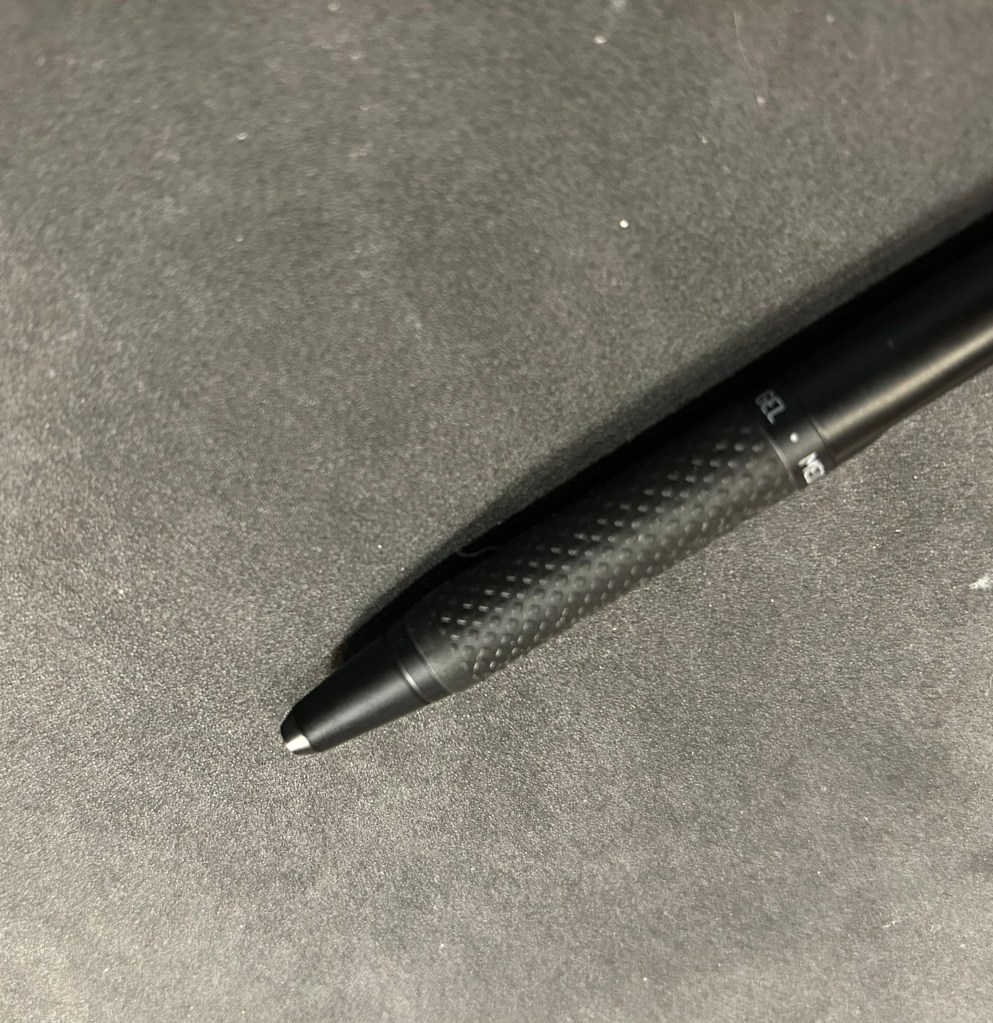
I love the console like fonts in white, and I really love the grip. It isn’t mushy like a silicon grip, but it is softer than the pen body, and with the raised pattern on it, gives you a rock solid grip on the pen. The ring on top of the grip announces that this is gel pen, with a medium (0.7) tip. The pen cone has an extra small taper towards the tip, adding interest and perhaps also helping stabilize the refill. There’s no clicking, jiggling or noise from the tip as you write with the G-450.
Grip closeup.
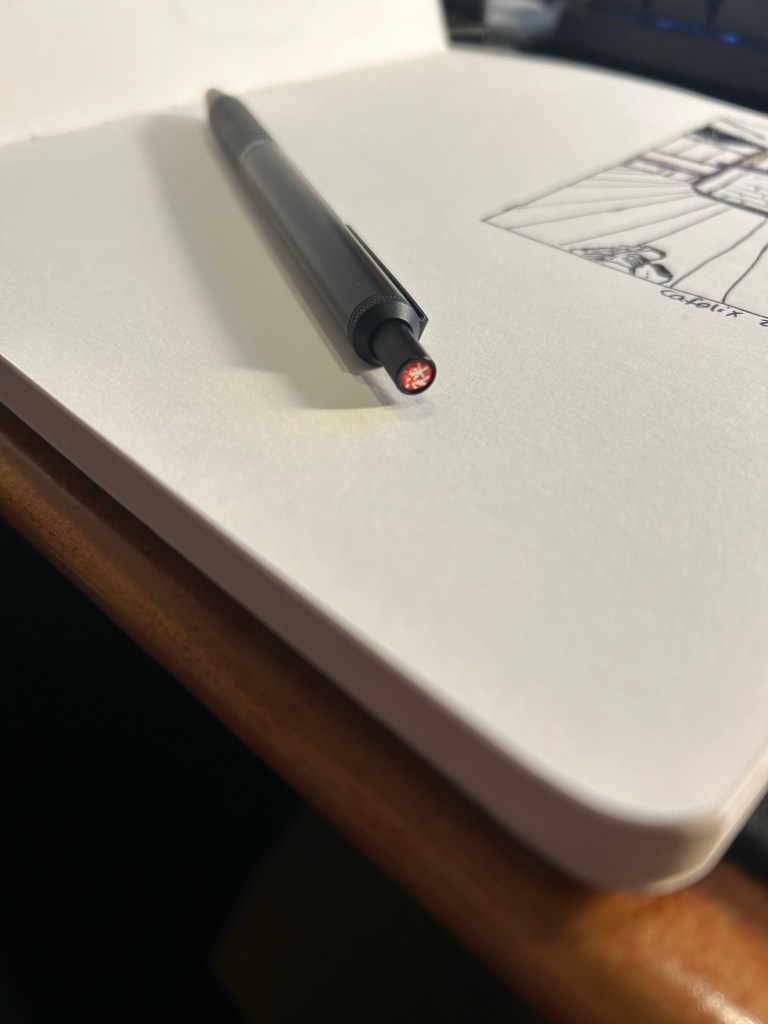
The click mechanism is solid. The clicker (is it called that? let’s assume it is) stays extended at all times, even when the tip is engaged, and it has a very satisfying click. There’s a red jewel with Japanese writing in silver on the end cap, and it adds a nice and subtle splash of colour to the pen.
end-cap closeup
All this is wonderful, but it’s the refill that makes it all sing. It’s dark, super smooth, and it dries almost instantly. Yes, even on Stalogy paper, even on Rhodia and other fountain pen friendly paper, it just dries as soon as you write with it. This is a perfect lefty pen (I’m not a lefty) and it’s perfect for jotting things down in a rush. It will write a bold, clear line, and not smudge.
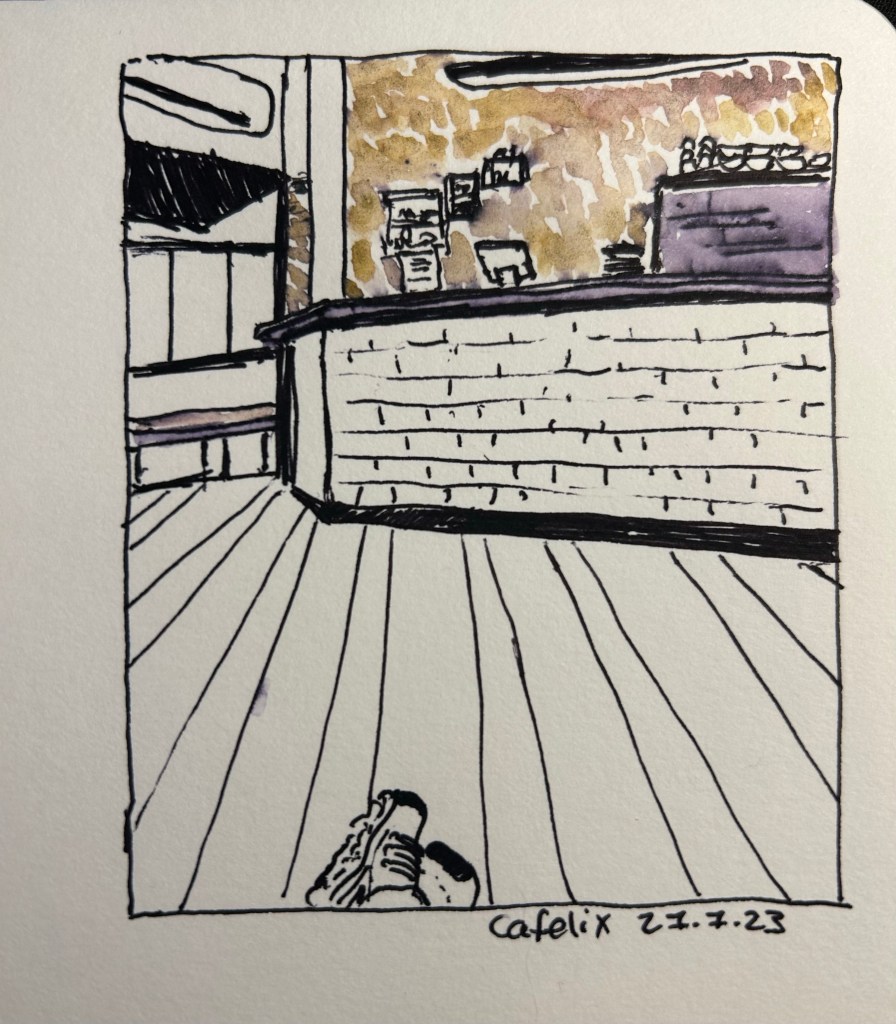
I sketched a local cafe with the Zebra G-450, on Stillman and Birn Alpha paper. I then “opened” up the lines using a waterbrush, as the the Zebra G-450’s fast drying refill isn’t waterproof (as is to be expected with gel ink pens). The result was a nice greyish purple that you can see on the coffee machine on the right. The coloured graphite was provided by the Derwent Inktense paint set, but that’s a review for a different day. Suffice to say that while the Zebra G-450 isn’t a sketching pen, it will work well as one in a pinch, as long as you like thick lines, and don’t mind it not being waterproof.
Rarely have I encountered a pen that I wholly like after just a day of use. I love the G-450’s aesthetic, its refill and its feel in the hand enough to immediately add it to my daily carry. I used Zebra’s wonderful G-301 pen daily for years, and I can see the G-450 easily replace it on merits of the refill alone. Sometimes a pen just ticks all the boxes for you, and this one clearly does for me. I recommend giving it a try if you possibly can. Who knows, maybe it will become a new favourite for you as well.
First thing’s first: if you are looking for a writing pen, then the Majohn Q1 mini fountain pen is likely not for you. While you can purchase it with an extra-fine, fine or medium nib, it’s weird body shape would likely make it uncomfortable for long writing session, and as it’s an eyedropper filler, it’s designed to have a giant ink capacity, normally suitable for long writing sessions.
If, on the other hand, you are looking for a fountain pen to sketch with, the Majohn Q1 may be a very worthy addition to your kit.
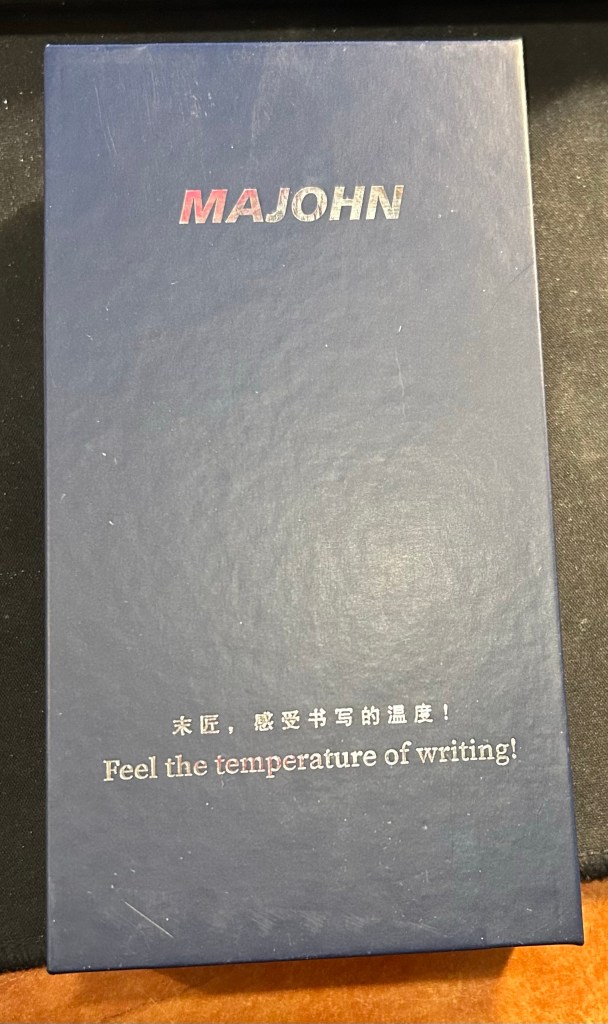
The box. I love the “Feel the temperature of writing!” inscription on it.
I purchased the Majohn Q1 bent nib fountain pen after seeing Paul Heaston use it in one of his sketches. “What is THAT?!” I asked, and immediately set out on getting one. This weird looking fountain pen reminded me of the Tombow Egg pen (google it. I’ll wait), which I always wanted and never got because I couldn’t afford one at the time. The Majohn Q1 appears to have almost the exact same design as the Tombow Egg, with a few minor details in the trim and molding of the grip section. I purchased mine on Amazon for $22.
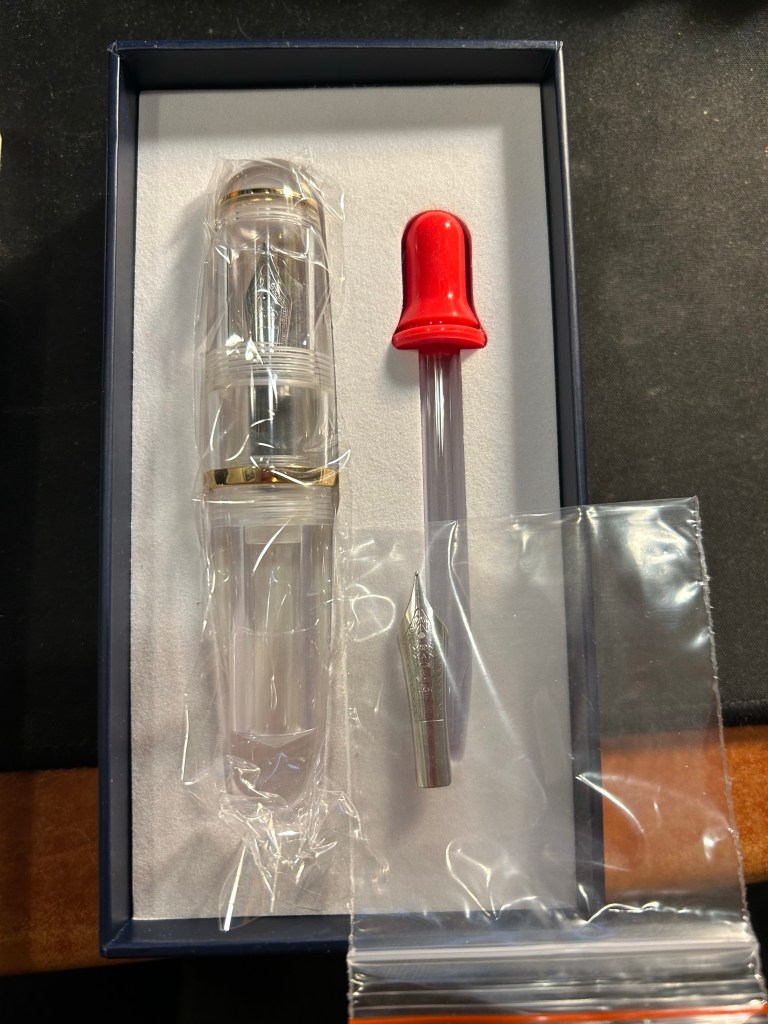
What’s in the box: fountain pen with bent nib installed, eyedropper, and a spare medium nib.
The box the Majohn Q1 arrives in is good looking enough to gift someone. Inside there’s the pen with the Fude/bent nib installed, a spare medium nib (the bent nib is an “aftermarket” installation) and a glass eyedropper that you can use to fill the pen with. The pen itself comes installed with an o-ring so that it can safely be eyedroppered. I filled mine with De Atramentis Black Document ink, which is waterproof when dry.
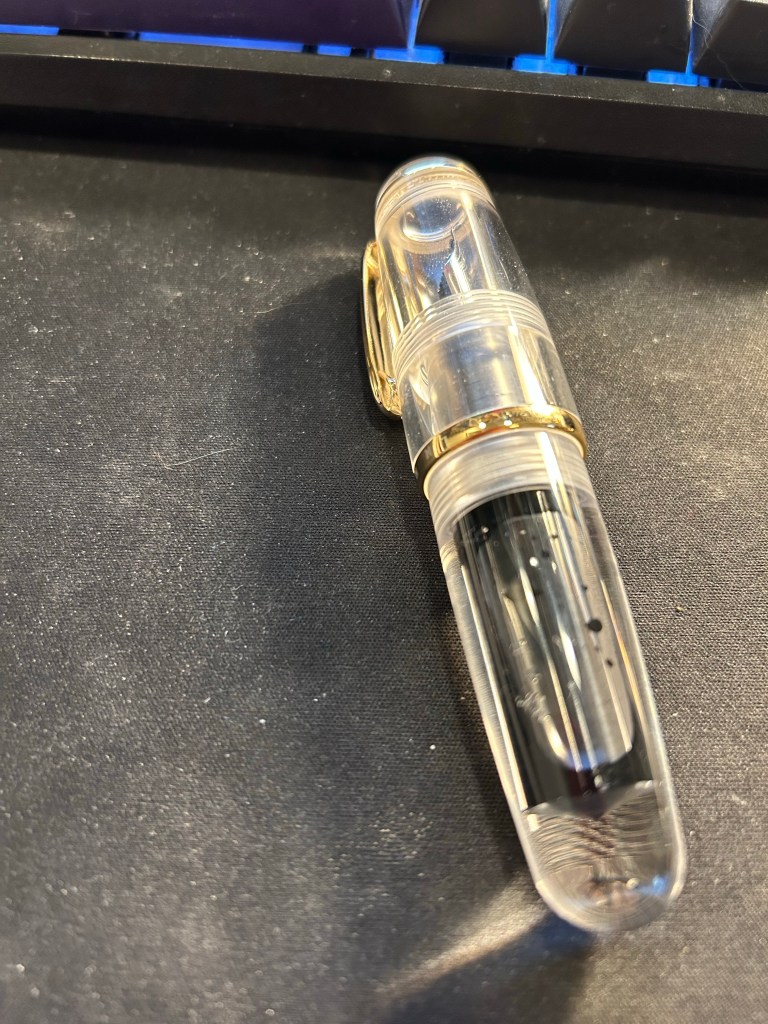
I filled the pen only to 3/4 and still it holds a tremendous amount of ink, especially for such a small pen.
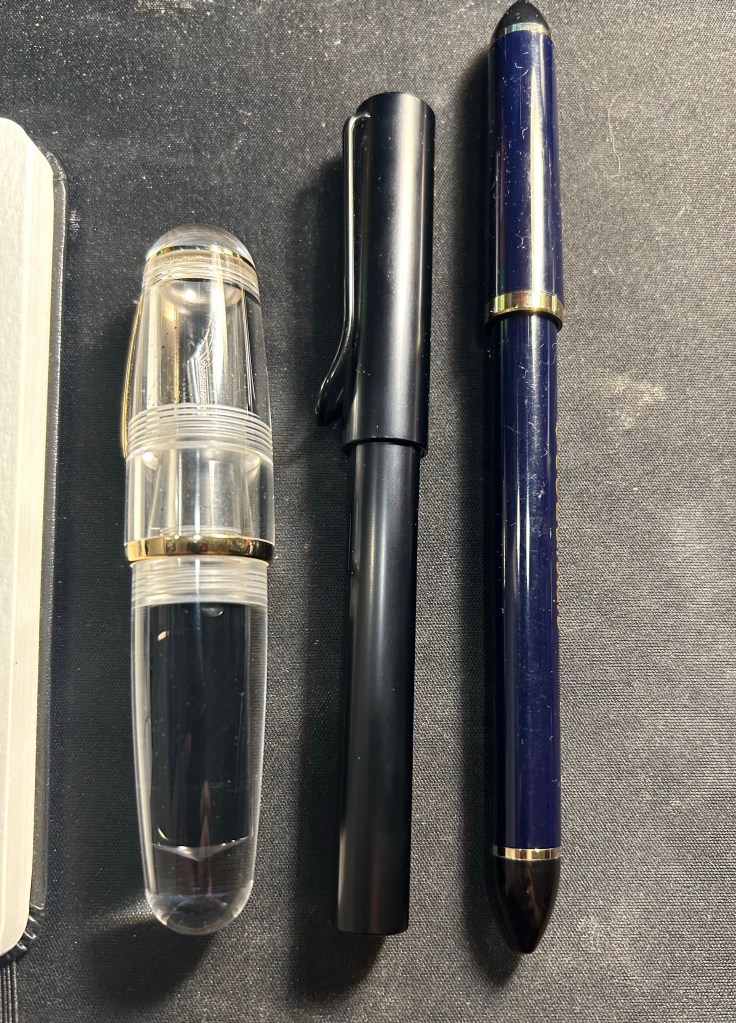
Now the Majohn Q1 is a very small pen, that holds a very, very large amount of ink. That’s why I was interested in it, as I thought that it would be a perfect fountain pen to add to my urban sketching kit. I currently use a Sailor Fude DE Mannen fountain pen for my urban sketching, and it’s a favourite among urban sketchers for the expressive, painterly lines it creates. It is, however, very long and pretty unwieldy: difficult to pack, and sometimes awkward to hold. Here are the Majohn Q1, a Lamy AL Star and a Sailor Fude pen laid next to each other, for size comparison:
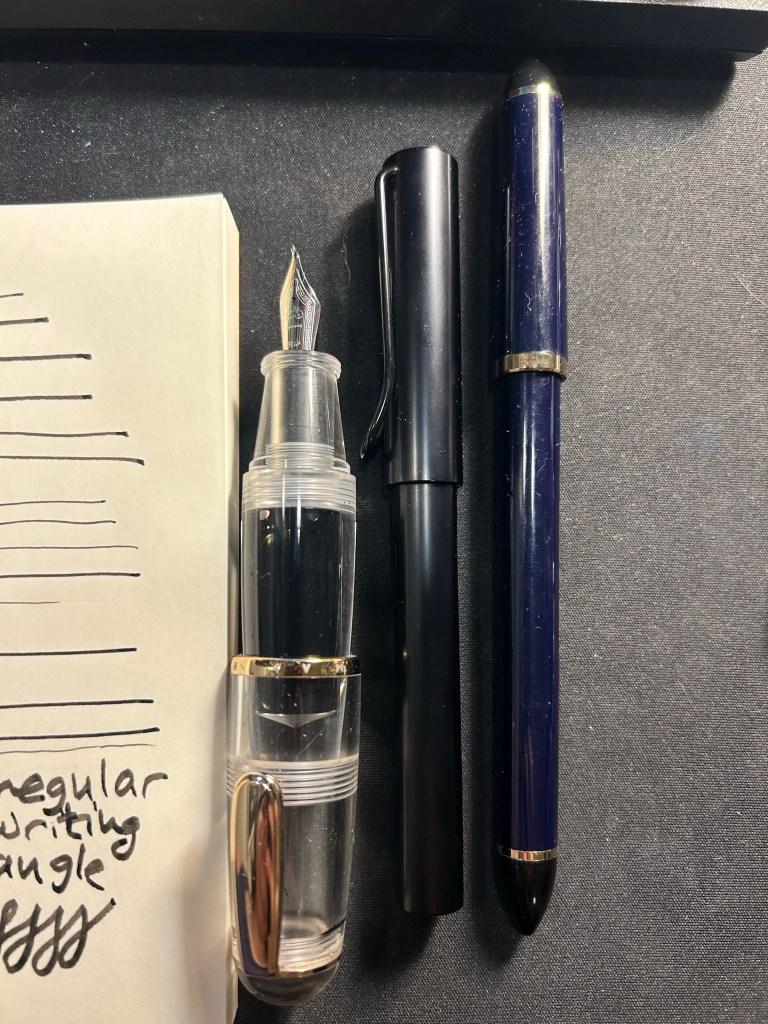
As you can see, the Majohn Q1 is pocket pen sized in length, and very, very wide. It can’t be used unposted, as is to be expected with pocket pens, but once it’s posted, it just becomes an extra wide standard length fountain pen:
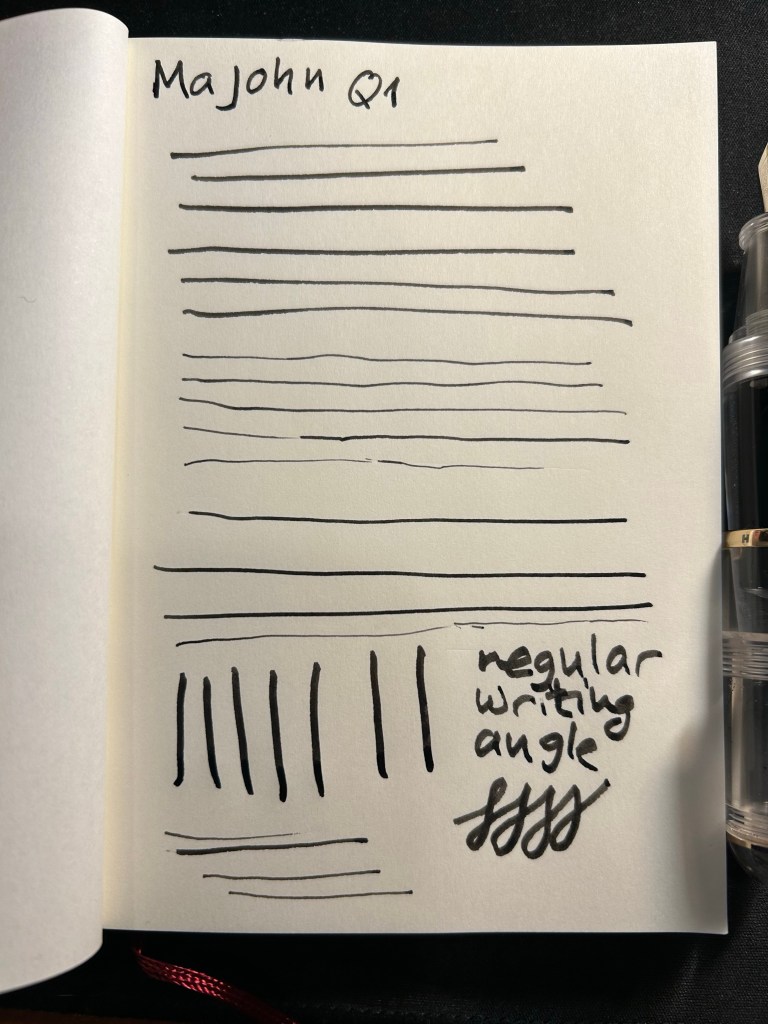
The point of this pen is the bent/Fude nib, so here it is, in all the different line widths it can create:
And here’s the Sailor Fude for comparison:
The Majohn Q1 offers much more line width control and consistency than the Sailor Fude, but you sacrifice some of the painterly quality and dynamism of the Sailor Fude to achieve that control.
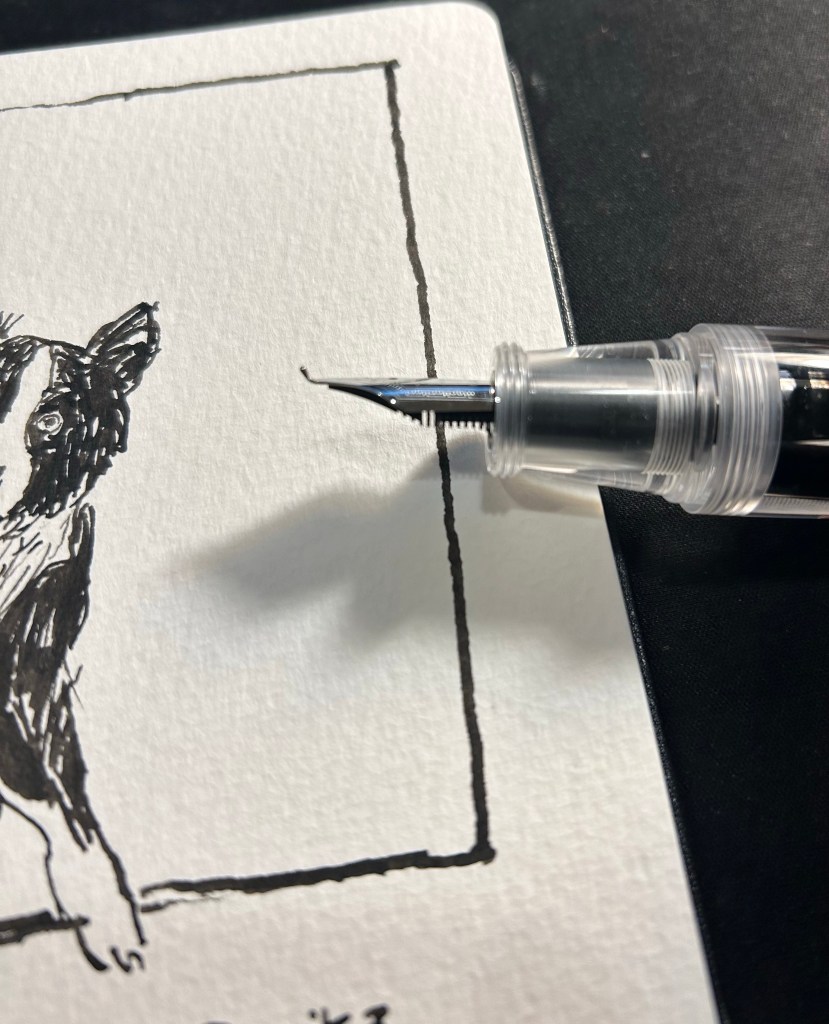
The Majohn, like the Sailor, isn’t perfect in terms of gripping experience. While it’s much easier to grip the Majohn in a variety of different angles to get a variety of different lines, there’s a pretty pronounced step between the pen body and the grip section that can be uncomfortable if that’s where your fingers naturally land on. For me, I grasp the pen either closer to the nib, or not on the section at all but rather on the pen body. I’d recommend trying it out first, but for $22, it might be worth it just to buy the pen and try it out for a while.
Bent nib and grip section closeup.
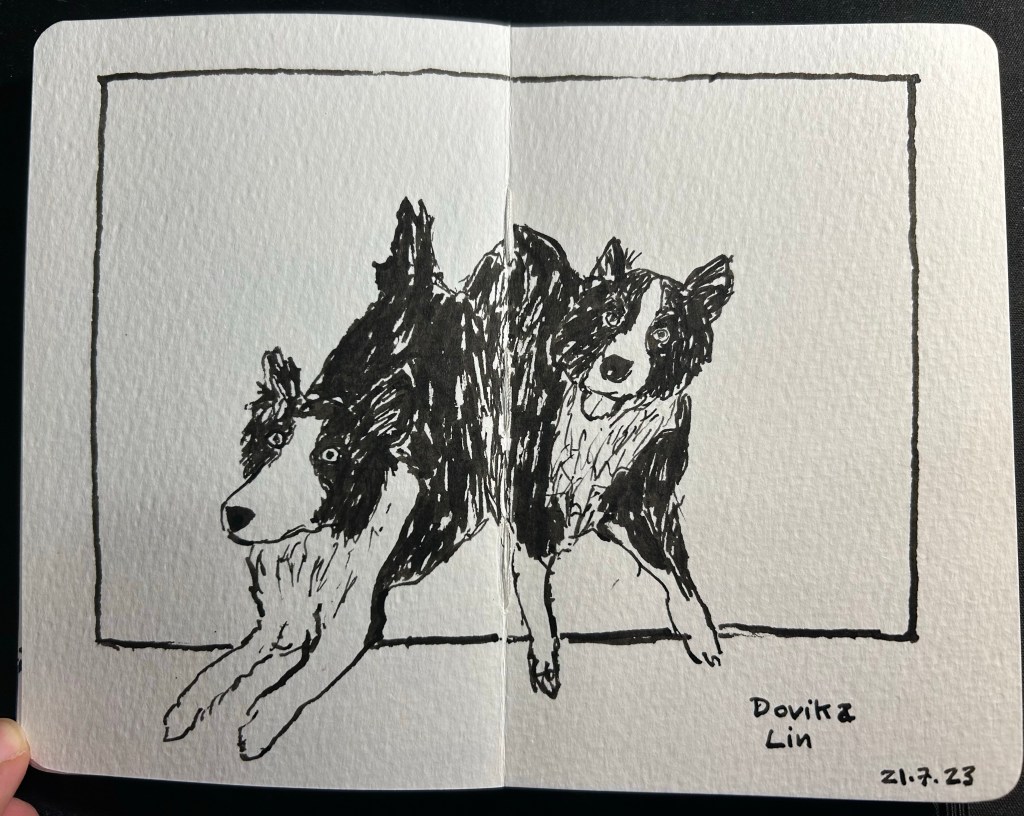
Here’s a sketch of a friend’s border collies sketched with the Majohn. As you can see, it’s relatively easy to get both a good level of control with this pen, a lot of line variation, and some of that painterly quality to the line that makes it more interesting and expressive.
Majohn Q1 bent nib, De Atramentis Document Ink Black, Moleskine Pocket Watercolour notebook.
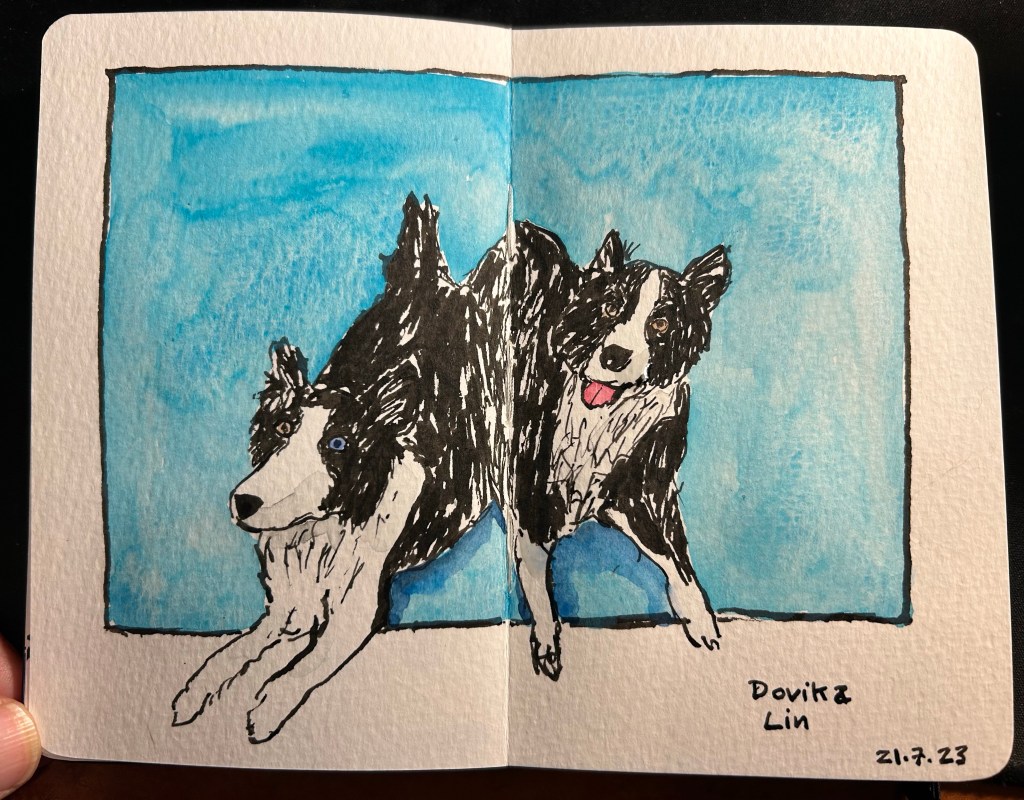
Here’s the complete sketch, just for fun:
Schmincke watercolours added.
If you’re at all interested in fountain pen sketching, and especially if you are an urban sketcher, I recommend giving the Majohn Q1 bent nib fountain pen a try. It’s easier to control and to transport that a Sailor Fude, and holds a much larger ink capacity, which is great for long sketching sessions or when you need to block out a large section with ink. For such a low price you get quite a lot, and the learning curve is much less steep than with a Sailor Fude DE Mannen fountain pen. I don’t do calligraphy, but I assume that it could be worth a try for calligraphy as well, especially if you are looking for a travel friendly solution. And who knows, maybe you’ll get to feel the temperature of writing while using it…
Long time no update, so I decided that it’s about time to write one up.
Reading
I’ve been in a terrible reading rut, and I blame the book that I’m currently reading: “The Books of Jacob” by Olga Tokarczuk, a 912 (!) page historical epic about Jacob Frank and his followers. I’m halfway through, and I’ve decided to put it aside for now and train my brain to enjoy reading again with some lighter and more fun material.
The book itself is masterfully written and researched, with the narrative made out of a carefully pieced together mosaic of characters, voices and narrative styles. I just cannot handle the subject matter right now. As my rights are being taken away by religious, power hungry fanatics, I don’t want to spend my free time reading about religious, power hungry fanatics. It has reached a point where I balk at the idea of reading again, and that’s just not healthy. I hate giving up on books like that, especially good books, but if I want to actually read again and not just beat myself up for not reading, I’m going to have to start reading something else.
Health
I went through a CPET (Cardiopulmonary Exercise Testing) last week and it was pretty intense. My lungs aren’t working well in high intensity since my chemo, and so a lung specialist sent me to get this test, to see whether my heart or my lungs are the issue.
It started with a spirometry test (which is a simple test done to check your lung capacity and performance), and then went on to the CPET itself. I was hooked up to an EKG and pre-test measurements were taken. Then I was fitted with a special mask and filter that recorded my air intake and CO2 levels. Finally I was put on a special stationary bike, attached to a blood pressure monitor and a blood oxygen level monitor, and told to pedal without stopping until I felt chest pain or was about to faint, or until I was told to stop. As the technician calmly told me, they have a lot of people fainting during this test, which is why they do it on a bike and not a treadmill. I said it was intense, right?
Anyway, I pedalled for my life, with the bike’s resistance being constantly raised, and me gradually getting out of breath. The point was to see why, so I didn’t stop until the technician stopped me, at which point a little over 10 minutes of constant intense exercise had gone by and I was drenched in sweat and panting. H
ere’s hoping that I get some useful insights from the results. In the meanwhile I’m still running 5 times a week, just not as fast as I would like.
Pens and Ink
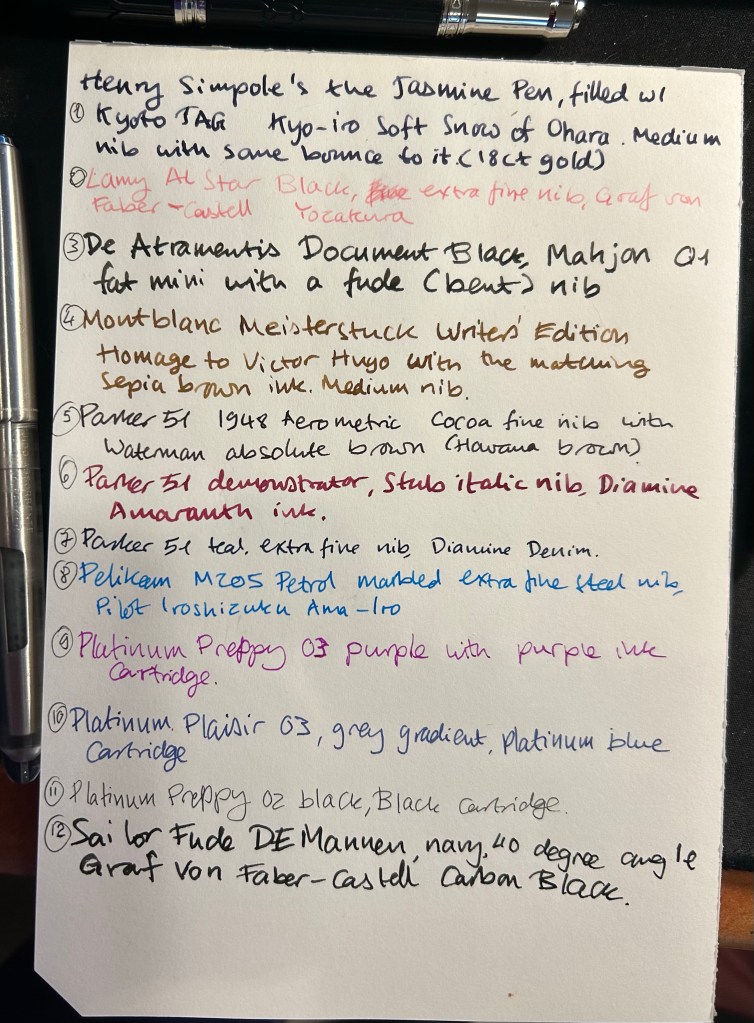
I wrote most of my pens dry and filled in a new batch, this time consisting of mostly vintage pens. There are also two expensive pens in this rotation, a few old ink favourites and some completely new to me inks, and a weird selection of colours.
Writing samples
The Henry Simpole Jasmin Pen is one of the most expensive fountain pens I own, and one that doesn’t leave the house because I can never ever replace it. It’s a Conway Stewart button filler with a bouncy 18K gold nib, with silver overlay created by Henry for it. The late Henry’s birthday was on the 4th of July, and so to commemorate him and his work I inked this pen up. I chose the Kyo-iro ink because it’s an interesting dusky purple that I haven’t had enough time with. Like the Jasmine Pen (bought in Portobello Road market), I bought the ink in London (at Choosing Keeping).
The Lamy AL Star isn’t interesting, but the ink in it is new to me. The Graf von Faber-Castell Yozakura is a pale and shading pink that I normally would never have purchased, because it’s so light it’s almost unreadable. It was deeply discounted during the closeout of a local pen shop, and I came in late and had very little to buy to show my support. I probably should have inked a much wider nibbed pen with this, but I have a big bottle of it, so there’s always another time.
In the Mahjon Q1’s case the pen and nib are interesting, the nib is not. This is one of two pens (the other being the Sailor Fude in the end) which I inked solely for sketching purposes. It’s a weirdly shaped pocket eyedropper fountain pen that I bought with a fude (bent) nib. I’ll probably review it at some time in the future.
The Montblanc Victor Hugo was a pen that I bought at the end of last year, during my last visit to Mora Stylos. This was an impulse buy, something that would never have happened if not for the display that Montblanc used to sell this pen. I love the Notre Dame de Paris, I’ve visited her and sketched her many times, and my heart broke when she burnt down. She’s a survivor, and seeing this pen displayed in a diorama of the Notre Dame in all her white glory, I just had to buy it. The ink was a gift that Mr. Mora gave me with the pen.
Parker 51 pens. The cocoa and the teal were all purchases made in the local flea market, and the cocoa is part of a set (with a pencil) and the earliest of the bunch (from 1948, a first generation Aerometric). The teal was in pretty bad shape, and took me a while to flush out. The demonstrator Parker 51 is from Mora Stylos, has a gorgeous stub italic nib, and is likely one of the Argentinian, aftermarket demonstrators. The Parker 51 is my favourite pen, and I have a hard time not buying all of them.
The Pelikan M205 Petrol was a Black Friday purchase, and I haven’t inked it until now. The nib is great, the pen is great, and Iroshizuku Ama-Iro turquoise ink is quickly becoming one of my favourites. Such an optimistic, summery colour.
The Platinums include two Preppy’s that I’m trying out, after being disappointed with their durability in the past. The Plaisir is the pen that’s been inked the longest of the bunch.
The Sailor fude is filled with a new ink to me, the Graf von Faber-Castell Carbon Black. The ink was purchased in the same closeout sale as the pink Yozakura, and I’m planning on testing it out as a non-waterproof sketching ink.
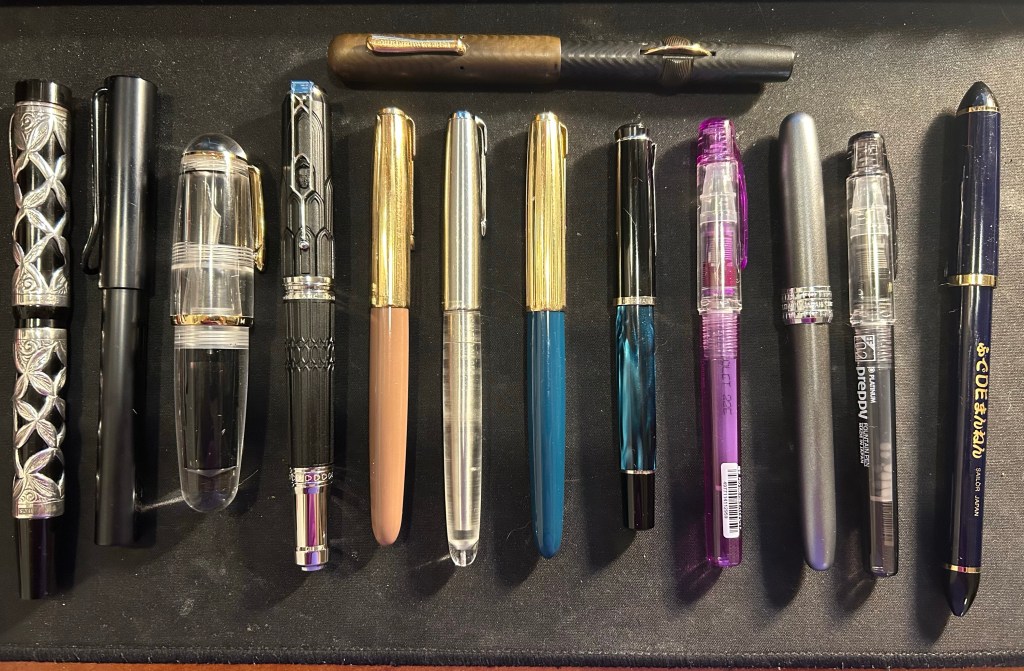
I wrote the Conklin Lever filler on top dry just as I was planning this post, so it’s here for reference only. I purchased it at Mora Stylos, it’s from 1919 and it’s in user grade condition (cap discolouration, significant brassing, the imprint isn’t in perfect condition). The lever filling mechanism is infuriating to use, both for filling and for cleaning the pen, but there nib is magnificent. It’s a true flex nib, going from medium to triple broad with no effort or railroading, and it’s a joy to use. The fact that I enjoyed it so much, coupled with its tiny ink capacity, meant that it took me about a week to write it dry. I used Waterman Serenity Blue in it, and that ink once again proved its worth in troublesome vintage pens. It’s a great shade of blue that is very pen safe and super easy to clean out of pens (think the opposite to Bay State Blue). A must have for anyone dabbling in vintage pens IMHO.
The pens, from left to right, matching the order of the writing samples with an added guest on top
Other Stuff
I’m working on an adventure for a 30+ tabletop roleplaying convention at the end of the month. I may publish something here about how I write adventures for conventions.
In the meanwhile my D&D 5E game, set in a university like setting and a university town next to it, is progressing nicely. It’s the most complex campaign that I have ever written, but it’s wonderful to see the players rush around in this world, having the time of their lives exploring, interacting and trying to break stuff. D&D is a pure joy and a wonderful escape from the pretty dark reality we live in these days.
Speaking of both dark reality and things that cheer me up:
It’s week 27 of the pro-democracy protests, and we’re still showing up in numbers (that are growing again). It’s great seeing whole families show up, including the dogs, to say no to stripping the judicial branch of its oversight powers.
I’ve been sketching people’s dogs, and it’s a pure delight to try and capture their personality with each sketch. Plus, it’s making people happy, which is a good thing.
I’ve managed to help a few people get back to running, and that’s always a joy. Go get some exercise. Do something you enjoy, and even 10 minutes is enough. As Dr. Jen Gutner says, exercise is like finding money in the street: if you find $10 lying around, you’re not going to leave them there because they aren’t $100. Invest a little in yourself, because you’re worth taking 10 minutes a day for.
I’ve been putting off writing this post because of all the planning systems I discussed, this Bullet Journalling (BuJo) is such a big topic and the system that I’ve used the most and the longest, apart from GTD. This will be the last post in this series as I’m planning on starting another series of posts on a different “how I use my notebooks” kind of topic. The previous posts are here: Chronodex, Weekly Planners, Daily Planners, Filofax, GTD and Friends.
So, Bullet Journalling was started by Ryder Carroll as a very utilitarian, relatively simple, glorified to do list combined with a calendar and some forward planning. At first glance it looked like another GTD system, and it’s clear that they share a common ancestry. This is the first video that Ryder Carroll published on the topic. He’s using a Moleskine squared large notebook here (he’ll switch to a Leuchtturm once he hears about the brand from the Pen Addict podcast, and he’ll land a collaboration deal with them later on), and there are no Instagram worthy spreads, metaphysical musings on how BuJo can transform you into a more enlightened human being, or attempts to upsell anything. It’s like the early days of Moleskinerie and 43folders posts – a guy finds a way to manage his to do list that works for him, and may work for others and so he shares it. Ryder Carroll knows how to explain complex things succinctly and clearly, and the video is beautifully made. It gained a lot of traction at the time, although it’s clear that Carroll prefers that you don’t watch that version of the BuJo explanation.
This is version of bullet journalling is what I started using, and what I still sort of use to this day. Why sort of use? Well, because the basis of the system is a daily to do list with a monthly calendar (and a monthly review), an index and a set of “collections” which are basically project to do lists. I still use the daily to do list and “collection” lists, so I sort of bullet journal. But I also sort of don’t – because none of this is new or unique. To do lists with checkboxes written out on notebooks, with project lists alongside them? There’s a monster list of those. You can’t get a book deal and a stationery collaboration based on that, right?
The official Leuchtturm1917 Bullet Journal
Wrong. About a year passes from the original video, and Carroll signs a deal with Leuchtturm1917 and suddenly there’s an official Bullet Journal and a new video. Stuff gets added to the system. A future log. A whole set of new symbols instead of checkboxes. There’s an added aura of importance and self improvement sprinkled on top. This system will help you be a better person, not just a more productive one.
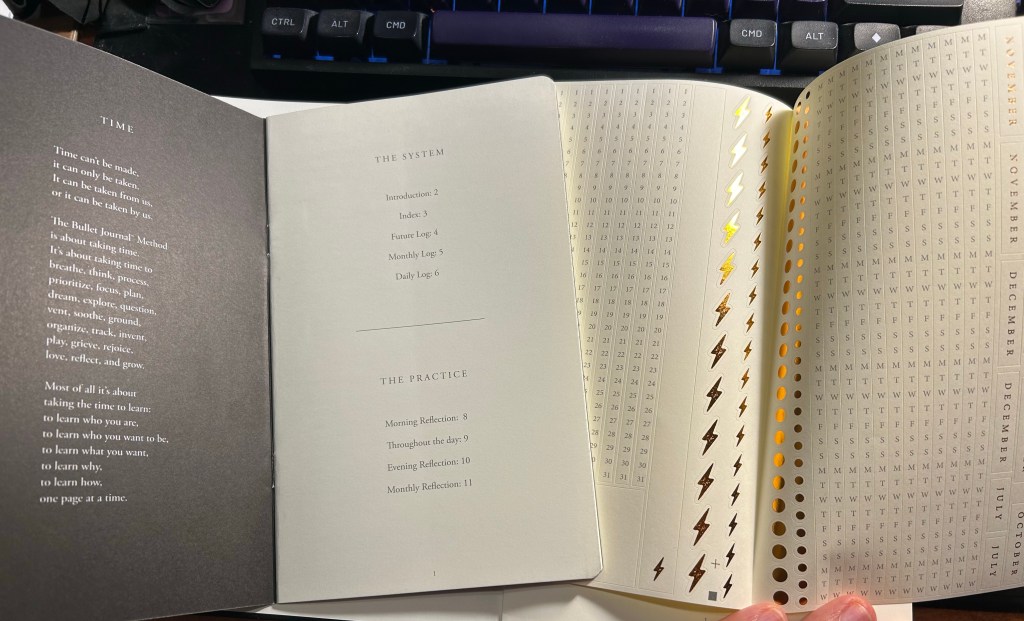
The included pamphlet – with a poem about BuJo no less – and sticker sheet
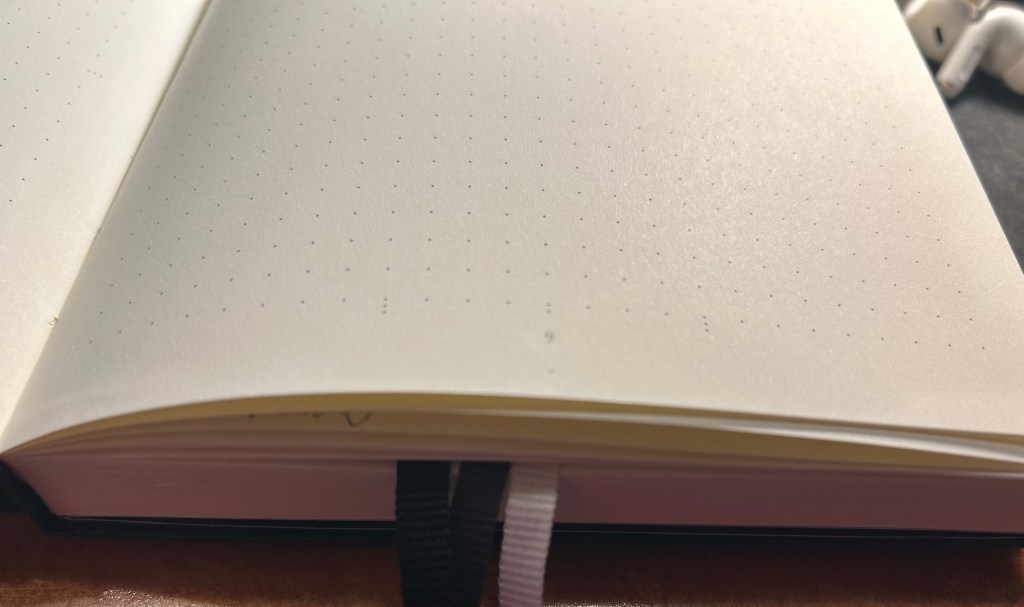
This is where the Bullet Journal system starts taking a problematic turn for me (and others, gathering by the comments to the videos). It starts becoming an Instagram thing. People spend hours making gorgeous, Instagram worthy monthly spreads. They spend money on templates, markers, stickers, and notebook bling for this. There’s an army of BuJo influencers. It’s no longer a “getting things done” system, it’s a “make pretty planner pages” system. Carroll inflates the system’s importance and “holistic” approach more and more. Out of curiosity I bought the second edition of the official Leuchtturm1917 Bullet Journal. My PTSD makes planning a real struggle now, and I was at the point where I was willing to try anything. Well, for quite a bit of money you get an overly thick notebook full of Leuchtturm paper, which is tolerably useful with fountain pens. Don’t expect Tomoe River levels of fountain pen friendliness, as there is spreading, and it doesn’t show off the full properties of all your cool inks. Then again, it’s not really meant for that. There’s also an added 12 (!) page manual about the system and a large sheet of planner stickers (and three ribbon bookmarks). There’s also stuff printed on the end papers that shows you how you can divide the dot grid page using the supplied markings. If you create tables often, I guess it’s useful. What I mostly feel using it is that it’s a lot.
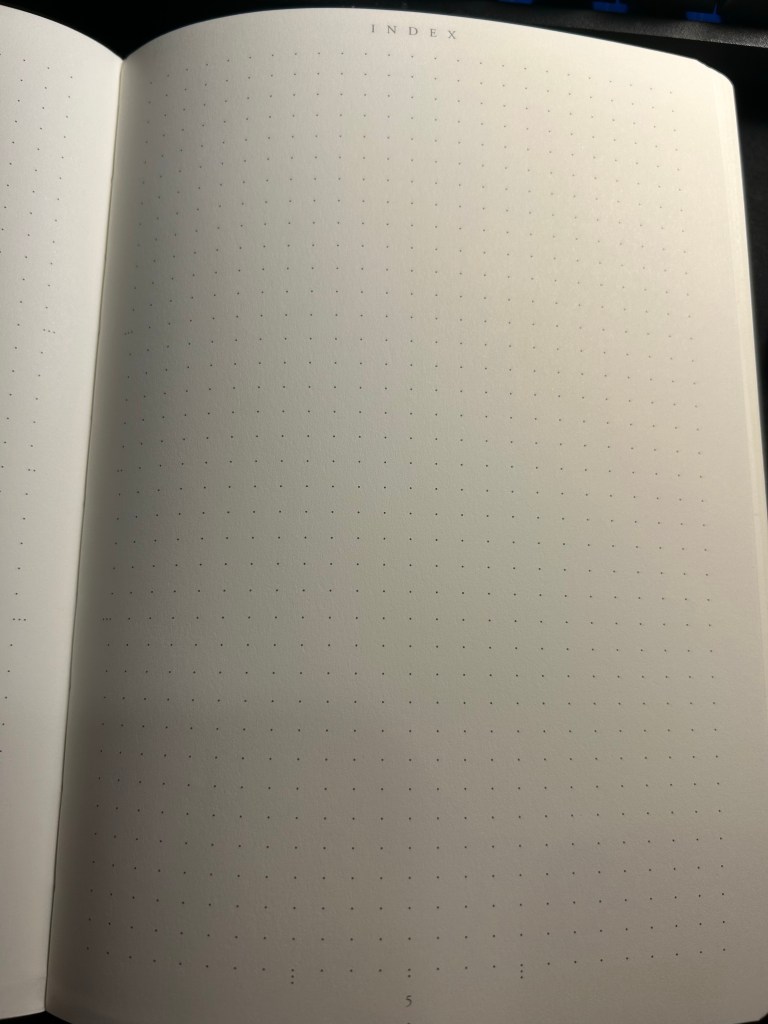
Index page
Have you ever tried to write an essay using Microsoft Word? Have you ever been able to do that without futzing with the formatting, the alignment, the spacing, etc? Word is a program created with printing in mind, and it shows. Writing applications like Scrivener supply you with full screen blank canvases that contain zero formatting prompts because that’s how you get the actual writing done. What the Leuchtturm1917 Bullet Journal does is give you all the tools you need to distract yourself from actually planning your stuff as quickly and efficiently as possible so you can move on to get them done. It’s full of calls to design pages, and I had a hard time at first training my brain to ignore the noise that the notebook came with. Ignore the wide margins, the little division markings, the pages with titles, the stickers and the pamphlet.
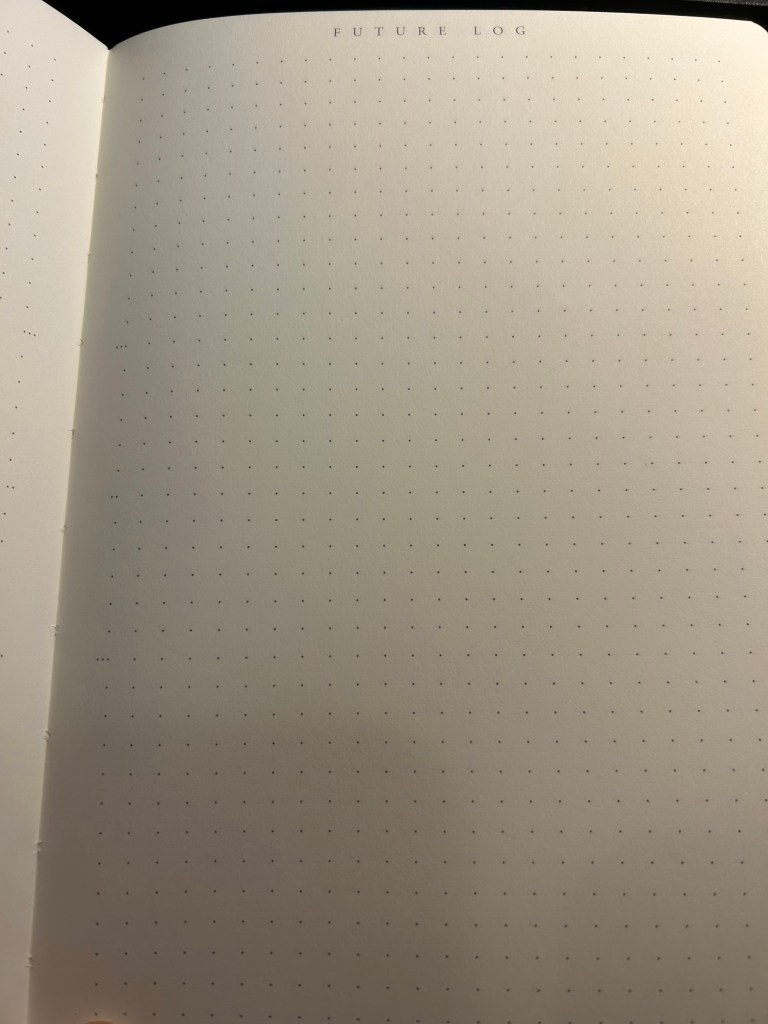
Future log
But back to the Bullet Journal system itself: stripped of its self-importance and its need to preen for Likes and Favs, is it still useful as a planning system?
Let’s take a look at it part by part:
Index – I didn’t keep one. I think I might have tried this during the first month, but I gave up quickly on this. It’s too much hassle for very little gain. How many times a month do you actually need to find something in your notebook, and when do you not just flip through it? There were many GTD systems with indexes and indexing systems, and I never found the indexes useful.
Monthly log – I keep a version of this separately on a small “Rebel Plans” pad from the Well Appointed Desk. It contains a monthly calendar that’s shaped like a calendar (and not a list of days), with important days in the month circled in a different colour, with basic monthly goals and big monthly milestones/events marked on it. I keep it before my eyes constantly as I work, and so having it tucked away in a notebook doesn’t work for me. I also find listing on paper the events of the day for the entire month a waste of time. That’s what digital calendars are for, and they’re much better than paper ones for it.
Future log – a new invention made for the official bullet journal notebook. I tried using it and found it to be useless for me. If you want true long term goal tracking, I suggest you try the theme system journal or something of the kind.
Daily log – this is the heart of the system, and it works because it’s a to do list. See also my post about GTD. I fluctuate between using the dash-plus annotation system and simple checkboxes, but you can use whatever works for you, of course. The important part is, of course, defining your tasks properly – actionable, doable in a short amount of time, and something that you can and should be doing.
Reflections – these are just a rebranding of GTD reviews. These work well if you do them, but it’s been my experience that it’s very easy to stop doing them because who wants to review what you didn’t get to complete as planned?
So there’s good stuff in Bullet Journal if you are able to strip it down from its anxiety inducing beauty contest trends. The question is, will you be able to ignore all the Bullet Journal page design noise and make use of this as a pragmatic planning system, or will you get carried away and start decorating pages and comparing monthly spreads with people who do this for a living, as you buy yet another template and another BuJo perfect pen? I’ll leave you to answer that one for yourself.
Three ribbon bookmarks and divider markings closeup. You can also see the white margin all around the dot grid page.












 Writing at Large