The Cancer Project: Alphabet Superset

In April 2022 I sat down and wrote the first part of what was supposed to be a long term writing project, the toughest one that I wrote yet. It was called “Hair Part 1” and it was part of something that I called “The Cancer Project”. The plan was to write a series of posts, all taken from my personal experience with cancer, and the point was to open a window into a very scary disease — humanizing it and the people who go through it, and arming the reader with information. 

I didn’t post anything beyond that first snippet of a post, and I didn’t draft any more posts in the project. I was 4 months out of treatment when I wrote that post, and it was excruciatingly difficult to write. After I posted the post, I decided to focus on writing about other topics, easier topics. Topics that anyone else could write about, if I’m being honest. Sure, I could write a pen review from my own unique perspective, and of course people would read it because it’s useful and interesting to see different takes on the same thing, but then again… “so what, who cares?”

That challenge, “so what, who cares?” was something one of my professors used to say, and at the time it drove me mad. The point was that we didn’t have to make an argument, we had to make the reader care about the argument, we had to explain why it was meaningful and important, not just why we thought it was true. Pen and ink reviews are awesome, but every time I post one nowadays, I feel guilty. I know that I could be writing about other things, things that can maybe help people. 

Last week this video popped into my YouTube feed, from the wonderful Struthless channel. Campbell Walker is starting a new community challenge meant to get people creating and posting their creations. It’s called Alphabet Superset, and the idea is to pick a theme, pick a creation medium and a publishing medium, make some aesthetic choices to limit yourself, and for 26 weeks create and post something that fits this framework — one piece a week, with the topic being tied to a letter of the alphabet. I looked at the schedule, and quickly realized that I won’t be able to follow it, but that didn’t matter. The challenge presented an opportunity, and more specifically a framework. I no longer had a giant abstract monster of a topic to maul, I could break it down to smaller chunks, albeit somewhat arbitrary ones. 

Running through the 26 letters of the alphabet proved to me very quickly that my issue won’t be so much finding a topic that would fit the letter, but having too many things to cover per letter.  “Ah!” my brain said, “an excellent reason not to start!” As you can see, it’s going to be a struggle between my need to write this project and my brain’s resistance to it. The odds aren’t in my favour: my brain, and specifically my PTSD, has shown itself to be a ruthless and tenacious opponent. It’s going nowhere, and it *will* fight me all the way through. However, I plan to dodge, feign and crawl my way through this one way or another. My PTSD may be persistent but I’m STUBBORN. 

On to the practical side: I will be running through 26 letters of the alphabet. As the next three months are travel heavy, I won’t be able to stick to the “one post a week” schedule. Each letter will get at least one (maybe more?) blog post, and perhaps also a comic that I’ll create (no promises). I will clearly title all the posts in this project “The Cancer Project” so if you are one of those people who is absolutely terrified of cancer to the point of being incapable of hearing the word, you can avoid reading them. I do encourage you to grit your teeth and read them though. It may end up helping you, it may up end helping you help a loved one. The reality is that almost all of us will encounter cancer face to face at some point in our lives — whether as caregivers for a parent, sibling, spouse or child, or as cancer patients ourselves. So it’s useful to remember this:

Knowledge is power, and knowledge saves lives. 
One Year Since I Finished Chemo

When you finish your chemo treatments that’s not the end of your journey with cancer. In a way, it’s just beginning. You enter a new phase, one of constant dread, one of “wait and see”. You are in remission – for now.

And who are you to complain? You are in remission. Many cancer patients don’t get to this blessed state, and you are happy you made it, but it’s alway a happiness with an asterisk. Especially during the first year post treatment.

So, it’s been a year. I got my last treatment on the 21st of December 2021 (nice date: 21.12.21), and then had about a month of feeling like absolute trash – like three locomotives carrying every ailment in the world slammed into me at once. I was on old school chemo, not the new fangled targeted stuff, no immunotherapy for me: my treatment was discovered in the ’70s and it’s good enough to remain the gold standard 50 years later.

But I kept on walking, and I kept on eating and drinking and taking my meds, and gradually I started to feel better. I got my tastebuds back. My hair started to grow again. My blood tests started to improve. The number of meds I was on got smaller and smaller until it was replaced just by a few vitamins that I was prescribed to take care of the damages still left. I got to see my doctor less and less often. We’re now at the wonderful “every three months” mark. I lost the weight that I gained from the steroids.

I got back to running: 1k, 2k, 3k for while as my lungs got better, my heart got better, and I learned to deal with my PTSD better. Then 4k, 5k, and back to long runs. These days I run five times a week, four 5ks and one 10k long run. And running means so much to me I can’t express how much it means that I get to enjoy it again.

I also got back to lifting weights at the gym, to meeting people face to face, to listening to podcasts that I used to love (though there are some old favourites that I can’t listen to these days). I went back to the office, back to public transit, back to travelling abroad, back to participating in races. I went to two escape rooms with my friends.

But I didn’t go back to being the same person.

That’s impossible, and all the time I see cancer survivors struggling to come to terms with that. Even if you lucked out and didn’t get PTSD (about 25% of patients do), cancer leaves an indelible mark on you, on the way you think, feel and react.

Thankfully I realised that about halfway through my treatments, and I like the new me. And I’m comfortable enough saying that without hedging, explaining or apologising. Period.

I have another year of high risk of relapse, which means a checkup every three months, and then three more years after that of checkups every six months. Then, at the five year mark, I’m ostensibly free. From the cancer patients groups I know there’s no real freedom from this, but it’s something that I’m gradually learning to live with.
Right now I’m still at the “every twinge, cough and ache is a cause for panic” phase. It’s not a fun place to be, and you get to stay there for a good long while. But I’ve made it through the most high risk year for my kind of cancer, the first year, so I get to celebrate for a bit. I brought a cake to work this week, and I plan on celebrating with my family this weekend, and completely ignoring the panicking voice in my head that is yelling that I am tempting fate. If my cancer returns, it returns and I’ll deal with it then.

For now it’s been one year since I finished chemo and I get to celebrate.

A quick post about running

A year ago, on the 13th of July 2021, I started my first round of chemo. I was hospitalised and connected to oxygen at the time (my tumour was so large that it had collapsed both of my lungs, and my lung capacity was well below 35%).
My last run was 1.2km on the 3rd of May 2021, done at a crawling pace on a treadmill. My lungs couldn’t carry me through my runs, and I had started feeling it from April 2021, but tried to push through it as my GP insisted that I was OK.

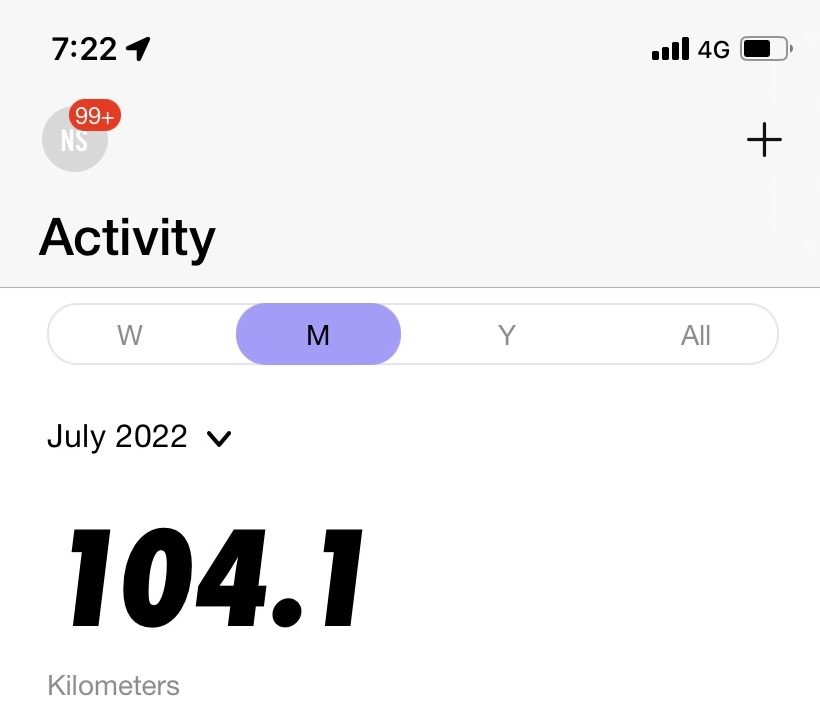
Today is the last day of July, 2022. This is my running distance for the month:

104.1 km of running in July 2022.

Running was one of the things that I missed the most while I was hospitalised and then throughout chemo and the months immediately after treatment, when my body was too broken down to carry me through a run. Words cannot express what running means to me. They just can’t.

I ran more than a 100 kms this month, lacing up for 21 times, getting back to a baseline of 5k runs five times a week. Despite the heat. Despite the humidity. Despite my lungs and my PTSD.

I only wish there was a way to send a message back to the me that lay in that hospital bed connected to the chemo IV, to let her know where I’d be a year from then.

The Cancer Project: Hair, Part 1

April, 2022

So there’s a whole thing going on with Will Smith slapping Chris Rock at the Oscars for making fun of his wife’s hair. Jada Pinkett Smith has alopecia, which is something that one of my oldest friends suffers from as well. Hair can fall out due to a multitude of reasons, from autoimmune diseases to genetics, traction, poor nutrition and stress. But I’m not here to talk about Jada Pinkett Smith and her alopecia, or even about my friend’s journey with alopecia: I’m here to talk about cancer related alopecia.

The very first thing my doctor told me when she came to my hospital room to talk about treatments was that I’d lose my hair. I was on oxygen at the time because the tumour in my mediastinum (that the middle bit of your body, where your most important veins go, right up against the heart and lungs) was so large it was restricting my lungs enough to make me need oxygen to stay alive. At that point I had barely been sleeping in days, I had barely been eating, the main thing that I was doing was inhaling and exhaling, fighting for each breath. I had been waiting all day for a hematologist-oncologist (that’s a hematologist, a blood doctor, who specializes in blood cancers, which is what I had – Hodgkin’s Lymphoma) to take up my case and start taking care of me. I was very happy that the doctor that I wanted took up my case despite her already heavy caseload: she was kind and brilliant, and that’s not a common combination. She came in to my room with the paperwork for the chemo treatments (you have to give consent to getting poison pumped into your system, as chemo is basically poison in a dose that is meant to kill the cancer but leave you alive). 

And the first thing she told me was that she was sorry, but that I was going to lose my hair.

I had read up about the side effects of the treatment that I was about to go through (ABVD chemotherapy), and I was afraid for my heart, my lungs, nausea, getting a chemical burn during treatment,  and neuropathy. The last thing on my mind, the last thing I was worried about was my hair. The mouth sores seemed more scary. 

The hair loss theme returned during my first meeting with the cancer centre’s social worker. An efficient yet caring battle-axe of a lady she told that from her experience ABVD patients didn’t lose all of their hair, they just lost most of it. She was looking at my head at the time, and it was before my 2nd treatment, so I still had all of my hair. My doctor had told me that the hair-loss happens after the 2nd treatment, and she was, of course, 100% correct.

Then there were the women in the closed cancer Facebook groups. I had joined a few, one for Lymphoma patients, one for young adults with cancer. They were a source of information and camaraderie, and a good amount of gallows humour. One of the women in the group, a new member like me, said that she would lose her mind if she lost her hair and asked if there’s a way to prevent it. Another asked about wigs and young children: is there a way to have the wig attached so that they can’t pull it off. 

I thought that they were all being a bit silly. Yes, I know, that’s unkind and insensitive and I’d learn better with time, but I’m being honest here. I was literally fighting for my breath before the treatments, and they allowed me to breath. The side effects were far from being a walk in the park, but losing your hair didn’t hurt (I was wrong), and was just a superficial change (I was wrong), and a temporary one, so why focus on that and not on more serious side effects? (I was clueless).

On Reading and the Tournament of Books

I’ve started a new reading challenge: reading all the Tournament of Books 2022 books. I’ve done this twice in the past, in 2019 and in 2020, and it has been a great way to read contemporary fiction that is not necessarily on the best sellers list or the awards circuit. I would never have read “The Book of Broken Angels,” “Overstory,” “Milkman,” “My Sister, Serial Killer,” “So Lucky,” “America is Not the Heart,” “A Terrible Country,” “The Brief Wonderous Life of Oscar Wao,” “Cloud Atlas,” “Wolf Hall,” “A Mercy,” “On Earth We’re Briefly Gorgeous,” “Nothing to See Here,” or “Girl, Woman, Other” if not for the Tournament of Books lists, and that would have been my loss. And while I generally like the list and particularly the way that books are pitched against each other, I tend to not like the judges’ commentary or choices, so I usually ignore them and create my own rankings. Why compare pairings of books in this way in the first place? It’s usually a way to gain some more insight into the books that I’m reading, which is why I keep the “tournament” aspect of it in mind when I log or review the books that I read.

The Tournament of Books logo for this year.

I read significantly less last year (2021) than I did in previous years, only partly because I got cancer. I allowed myself to get off the “maximum books per year” racetrack, and focused more on reading either books that interested me, or books that comforted me. Some of my reading plans went completely awry once I got sick – I was planning on reading the Tournament of Books Tournament of Tournament books (I still do, as they all seem fantastic), but I just couldn’t face the effort once I started chemotherapy. Books were a huge comfort and a necessary distraction for me during my hospitalization and treatments, but they weren’t literary fiction kind of books. I read cozy mysteries and fast paced sci-fi because that’s my reading equivalent of comfort food. Sometimes that’s what you need in a book, and that’s part of the magic of reading: there is a whole array of “comfort books” geared perfectly for your specific needs, if you only know what you’re looking for. 

I’ve talked to other people who have gone through chemotherapy (they tend to come out of the woodwork once you start treatments yourself), and even the avid readers among them stopped reading during treatments, and sometimes well after them. Chemo brain is a real thing, and it makes reading challenging, and oftentimes you want something a lot more attention grabbing than a book during treatments or while you’re recovering from surgery. That’s what streaming is for, and I thank Disney+’s “Loki” and “The Mandalorian” for helping me out during some really rough nights. But somehow books never lost their appeal to me, despite the lure of endless, easily consumable, entertaining content. This isn’t to condescend on “non-readers,” especially not my fellow cancer patients. It’s just to say that different minds are wired in different ways, and mine is wired in this specific way. Once I start reading I generally get carried away and have trouble putting the book down (unless it’s a truly terrible one). This was useful when I tried to forget that I was connected to 3-litres of poison that was dripping into my veins, although it was a little annoying to my long suffering family who were with me during treatments and often just wanted to talk. Sorry, guys. You deserved better.

Once the 2022 Tournament of Books list was published I decided to give it a go again this year, to challenge myself to read all eighteen books on the list. Unlike in previous years I’m being kind to myself and not trying to rush through all of them by the time the tournament judging begins in March. As I started reading before the brackets were published, and so started alphabetically, I read Mona Awad’s “All’s Well” first. It’s a very well intentioned book that completely fails on delivery for me, and I struggled to finish it. I almost gave up on the challenge entirely, except thankfully I decided to read the book that it’s up against, “The Trees” by Percival Everett before doing so and it is phenomenal. I’m almost done with it, and it is viciously funny, dark, thought provoking, and a fascinating and original read. Everything you hope for in a book, and all this in a book that I’ve never heard of before, from a writer I’ve never heard of before. This is exactly why I put myself up for this challenge in the first place.

My neuropathy is killing me in this weather, and this was a literal pain to write, so I will end here by saying: treat yourself to some book exploration this year, if you haven’t done so recently. You never know what gems you’ll find.