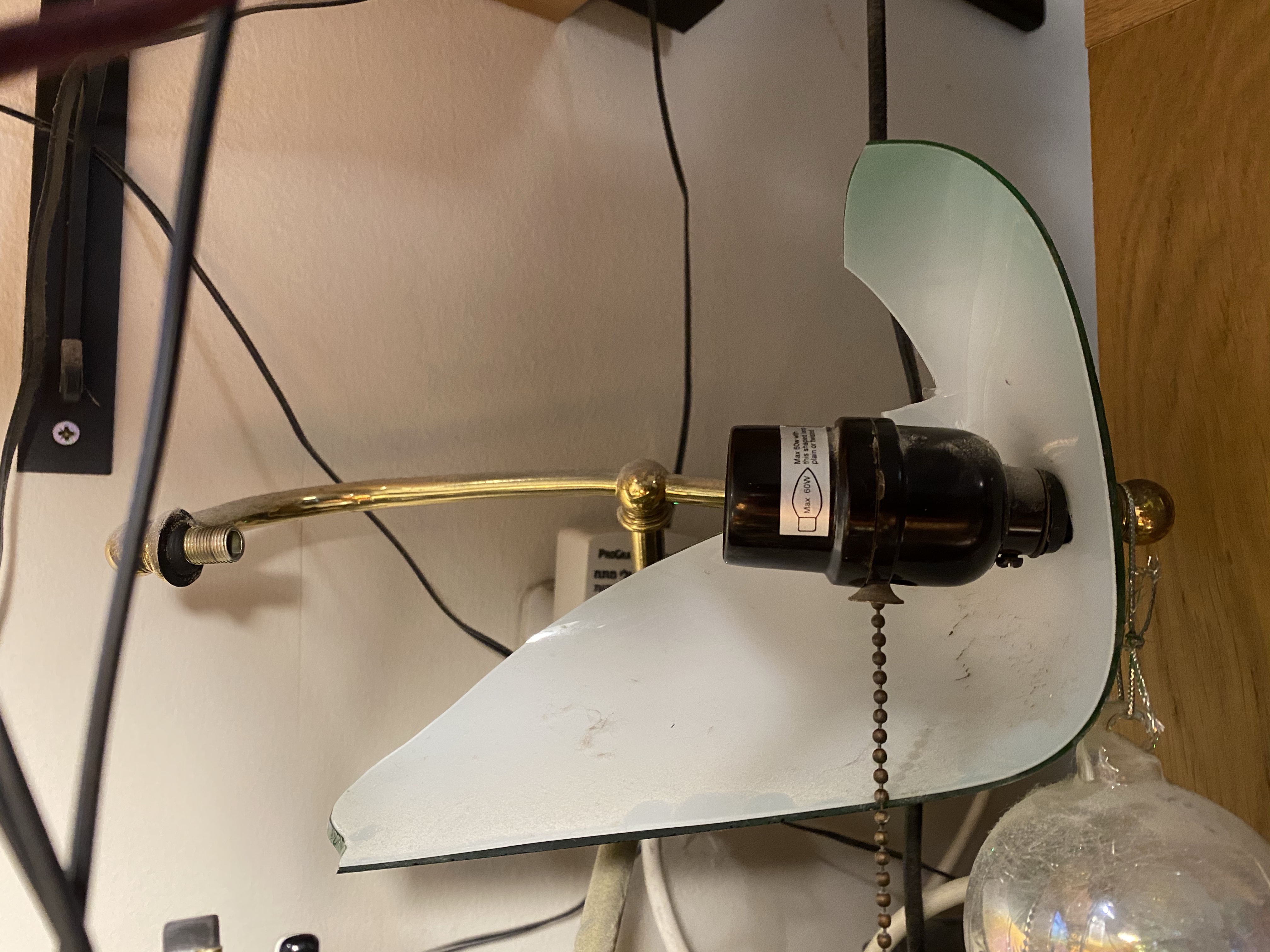
My little cat (I have two, a little black and white cat, and big black cat) managed to drop a desktop table sharpener on my banker’s lamp and it cracked the glass lampshade clear in half. So I had an interesting but unexpected project today: I bought a replacement lamp shade and took the lamp apart to get rid of the broken glass pieces. A youtube video and a Philips screwdriver took care of the taking apart bit; let’s just hope that I can put it back together again.
Broken shade halfway through dismantling.
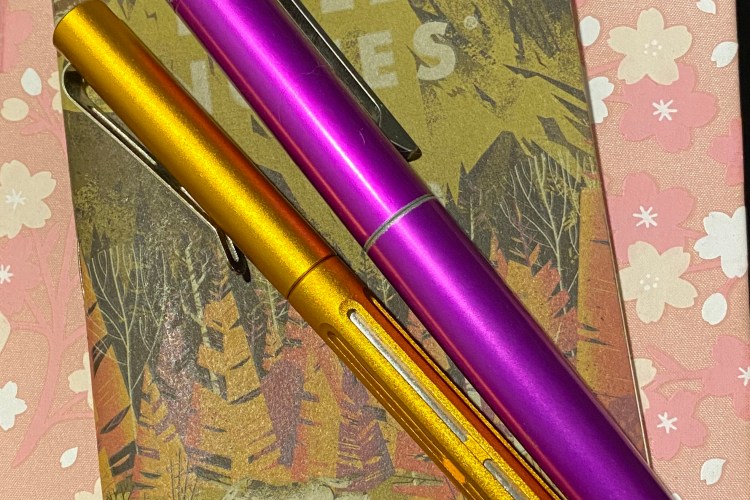
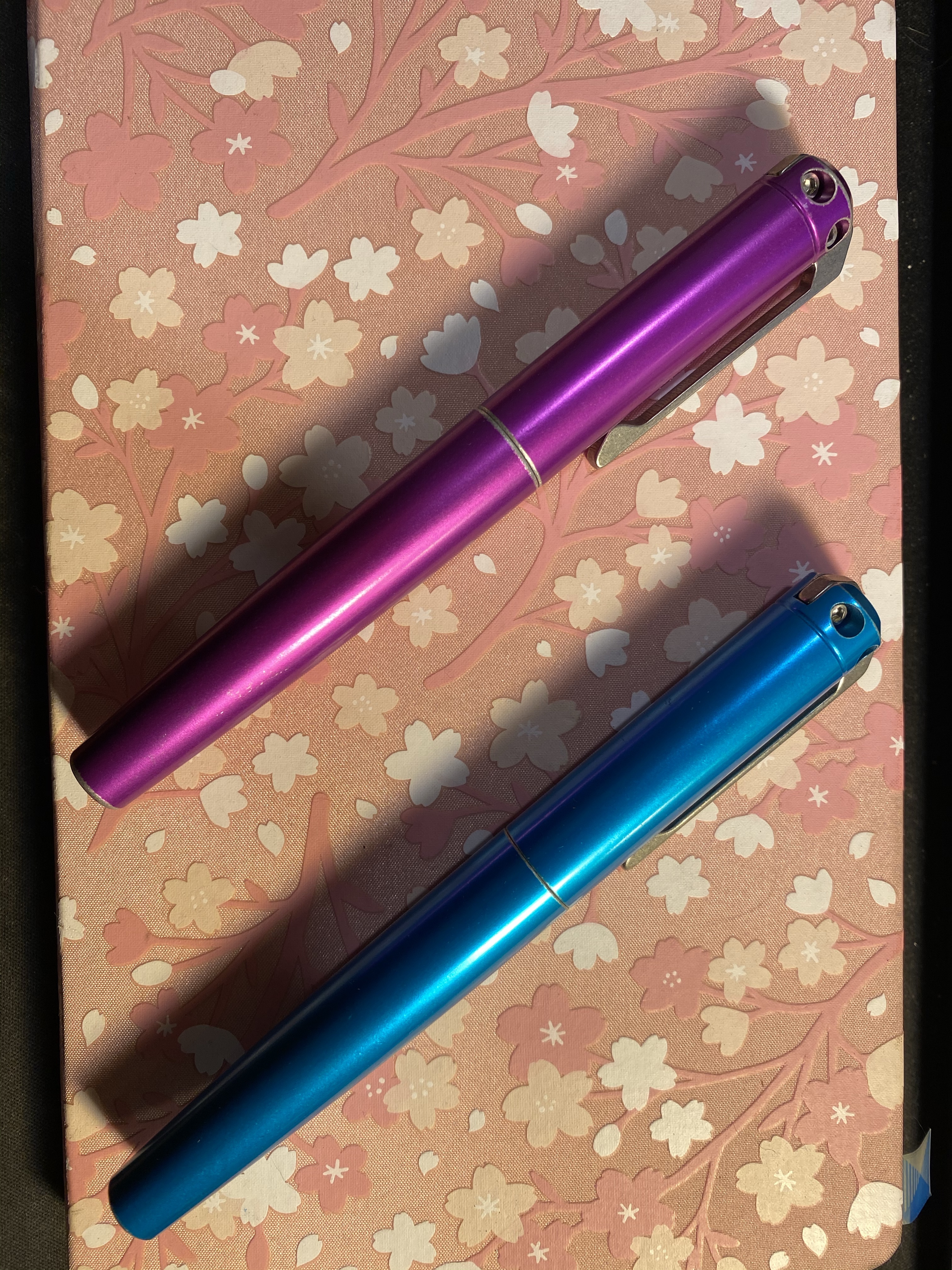
I got my Battleworn INK 2.0 Karas Kustoms grab bag rollerballs today. This was my first Karas Kustoms grab bag and my first ink rollerball and I’m very pleased with both the colours that I got and the way the INK 2.0s look and feel. These are chunky but relatively light pens, and I look forward to using them and maybe reviewing them in the future.
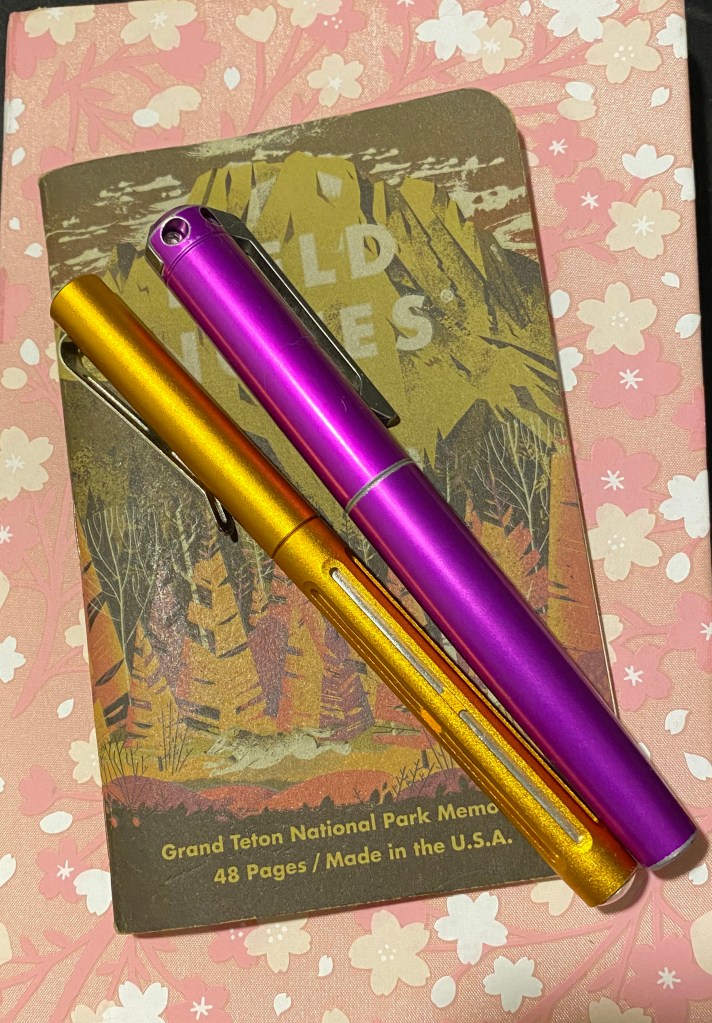
Karas Kustoms Battleworn INK 2.0 purple and cyan.
The INK 2.0 uses the Pilot G2 LG2RF refills, which are larger than the usual G2 refills, and built a little different. I haven’t yet tried to swap them out for a different refill, but I suspect that they won’t accept my beloved Uni-ball UMR-85, which is something I was aware of ahead of time.
These are the pens and some of the notebooks that I’ve been using today (I’m not getting much fountain pen use lately): my beloved Orange Crush Spoke pen, and the new purple Karas Kustoms Battleworn INK 2.0 rollerball.
These two pens look great together. Spoke on the left, INK 2.0 on the right.
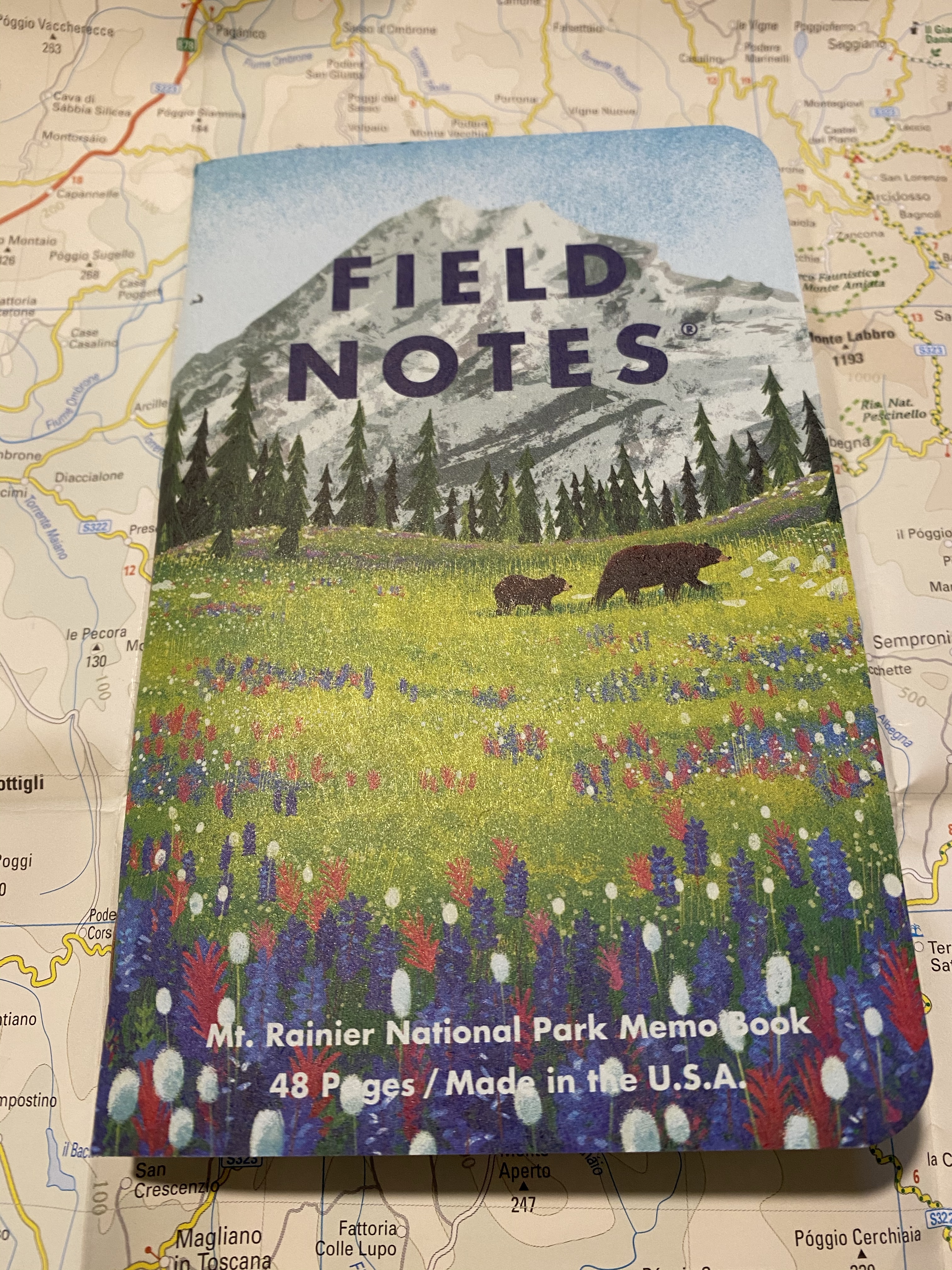
Field notes came out with a new addition to their National Parks series, which I’ll probably pick up on my next purchase there. They’ve got an offer for a free decal for purchases made by the 30th of August if that speaks to you.
I had an issue with my Ti2 Techliner where my favourite gel ink refill (the Uni-ball UMR-85) and basically all gel ink refills dried out and stopped writing a few words after I uncapped the pen. While ballpoint refills like the Jetstream faired better, they also would “fade out” after a few lines, and then, after some coaxing, return to normal. It couldn’t be that the refill was drying out, as after capping the pen, it wrote well enough again for a few words. It was a refill problem, as the same refill wrote perfectly fine in a different pen.
I tried searching for answers and asked around in the Pen Addict slack but got no answers. It was frustrating, since I liked the pen, but couldn’t use it because it wouldn’t work with my preferred refills. I had a feeling that the magnet at the tip of the pen was what was causing the ink flow issue, but it only yesterday did I figure out how to bypass the very thing that was holding the pen together.
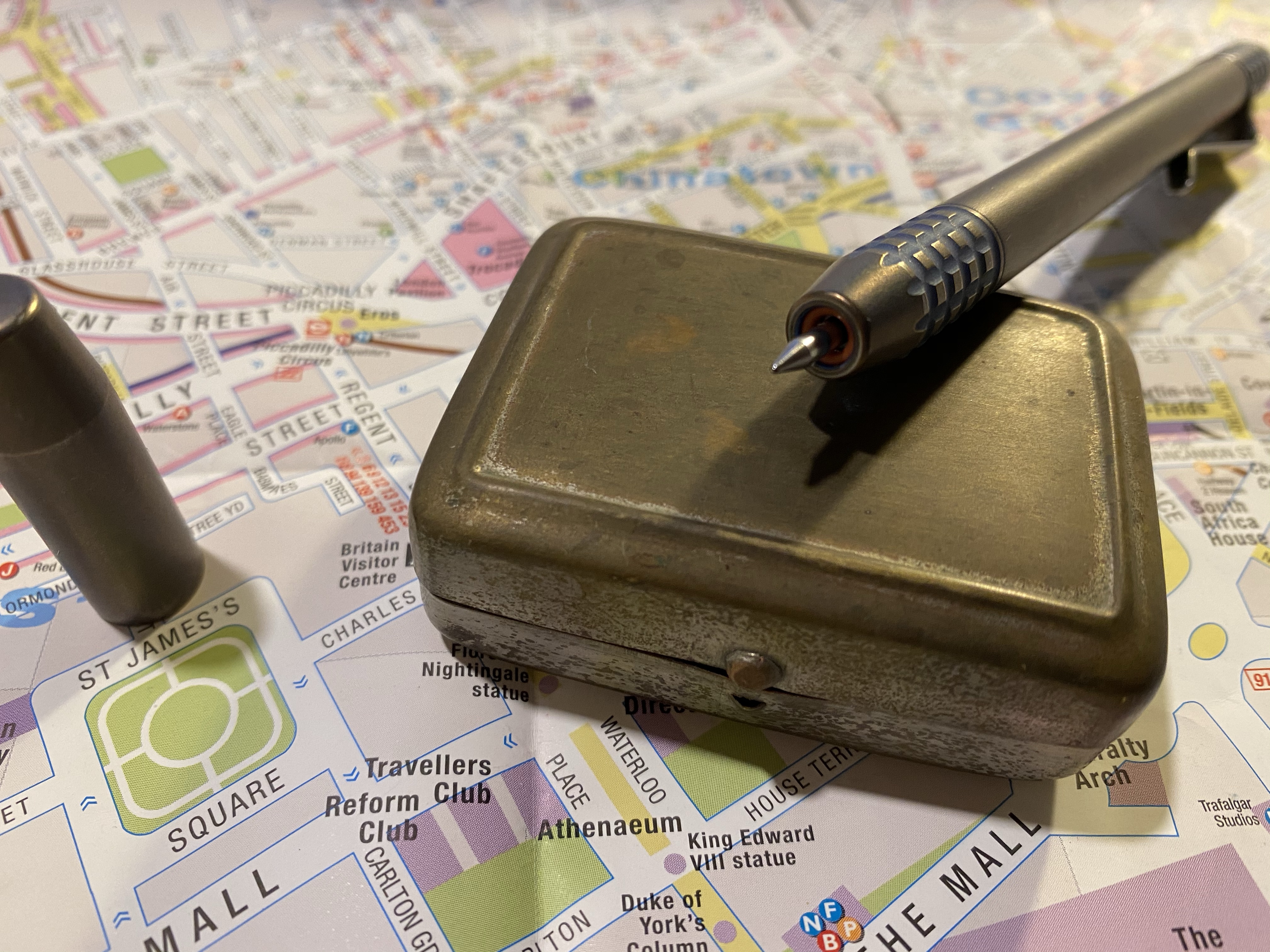
What I did was change the order of the parts in the front section of the pen. The original order was refill, plastic spacer, red o-ring, magnet and then the section screwed over that. What I did was reverse the o-ring and the magnet so now it’s: refill, plastic spacer, magnet, red o-ring, and then the section. The result is kind of pleasing to the eye, and more importantly it fixed the flow problem completely, and now I can actually use this fetching pen.
You can see the red o-ring around the tip of the pen.
I tend not to review Field Notes because they arrive so late to me (due to postal issues, not Field Notes issues) that it seems irrelevant to review last quarter’s edition when everyone already has the new one at hand. Covid-19 has made the postal problems even worse, and so only now, and after contacting the wonderful Field Notes people and getting a reshipment, have my Vignette notebooks arrived.
What also arrived were my Field Notes Rooster 2020 notebooks, which are part of Field Notes’ yearly sponsorship of the Morning News and the Tournament of Books. I read all of the books in the Tournament of Books shortlist this year, for the second year in a row. I didn’t post reviews of them all in this site as I didn’t enjoy the last 3-4 books, and I didn’t feel like posting negative review after negative review.
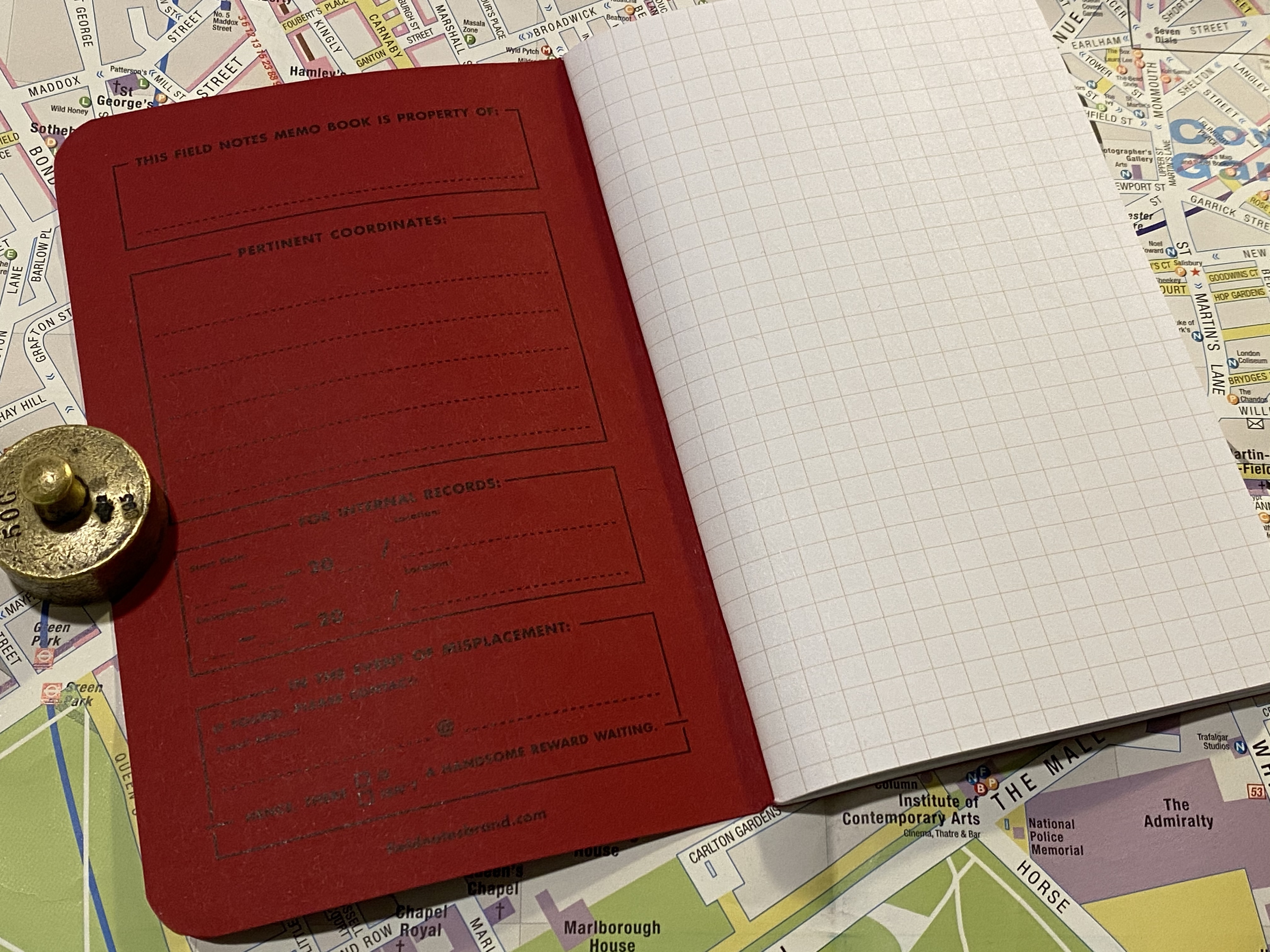
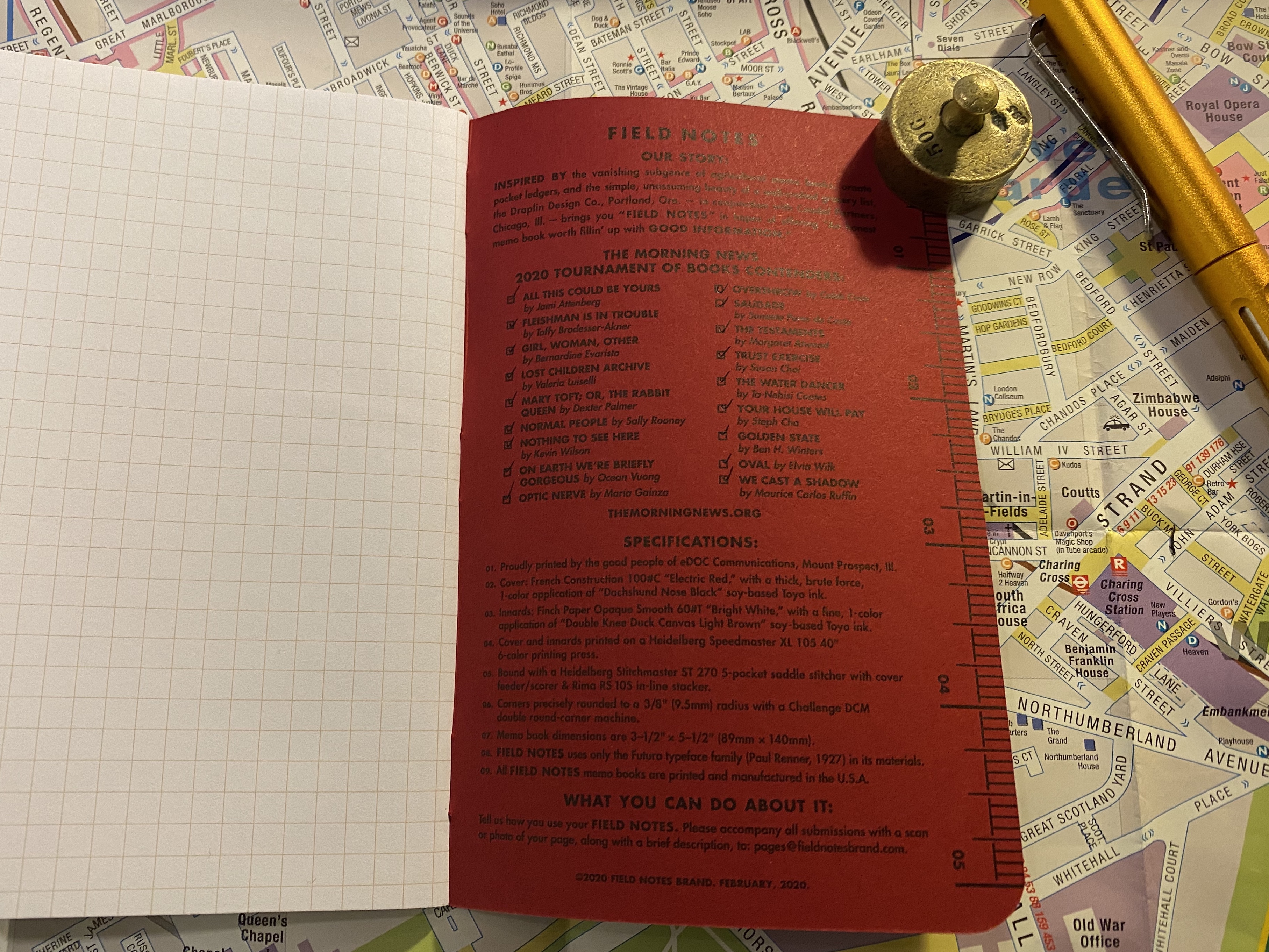
I did, however, love this year’s Field Notes Rooster special edition notebook, and it is by far my favourite Rooster special edition notebook that Field Notes ever issued. It is a squared notebook, and not lined, for the first time ever, and the bold red and black print on the cover is much more striking than their usual craft or cream choices for this series.
Bold, bright colours on the cover.
The fact that these notebooks (sold as singles, with the proceeds going to literacy related charities) arrived so late means that I have a had a few months to think about the Tournament of Books 2020 reading list.
Squared notebook.
I enjoyed the 2019 reading list more, but the 2020 list was overall a good, interesting list of contemporary writing that I for the most part would not have read otherwise. There were a few mediocre books on it, and a few that I really disliked, but as a whole it wasn’t a bad list. I may try reading next year’s list too.
The list. There are 18 books on the list, 4 books that I though weren’t worth reading, of them two were a silly, bloated waste of time and two were infuriatingly bad. There were 7 books that I thought were real gems.
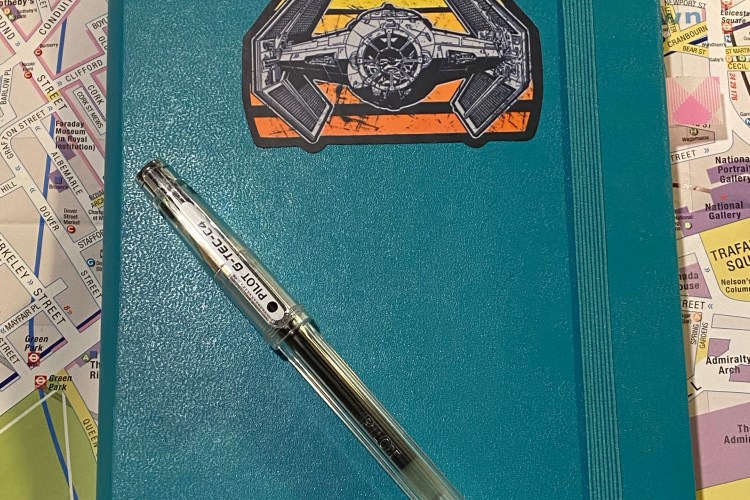
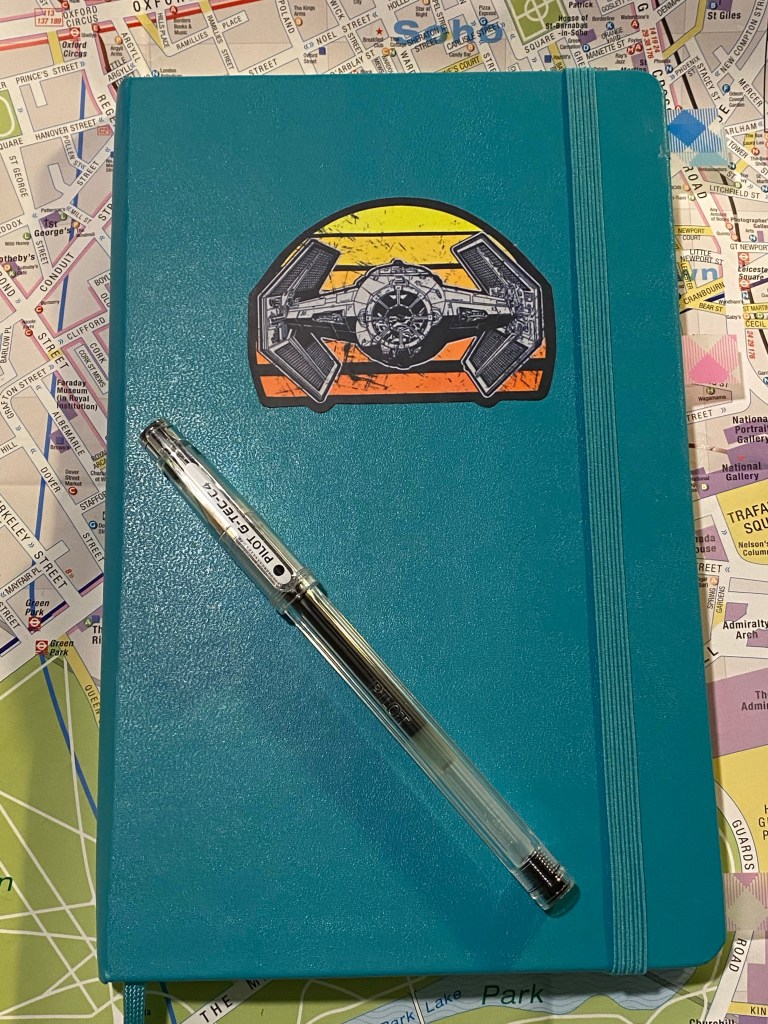
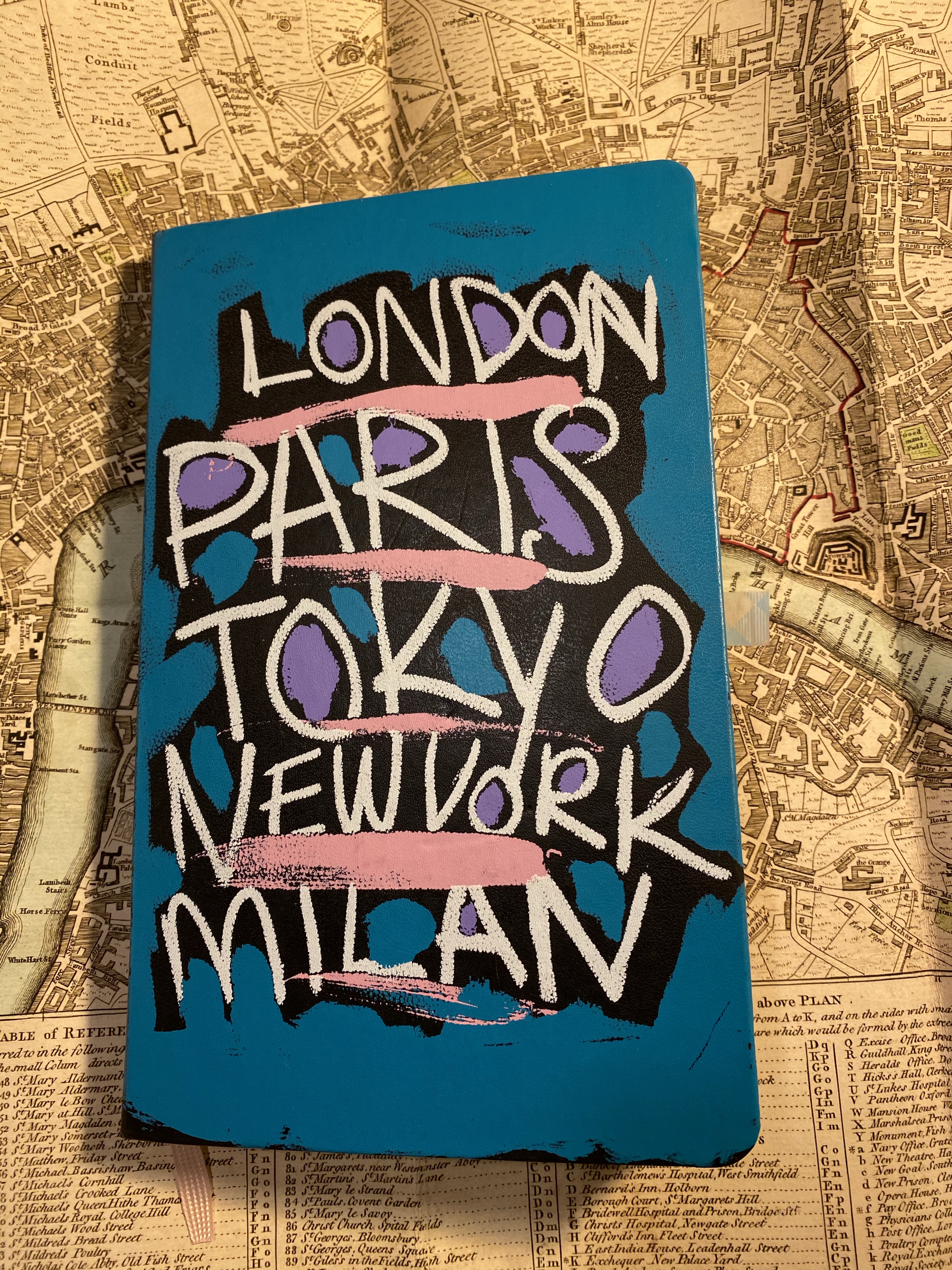
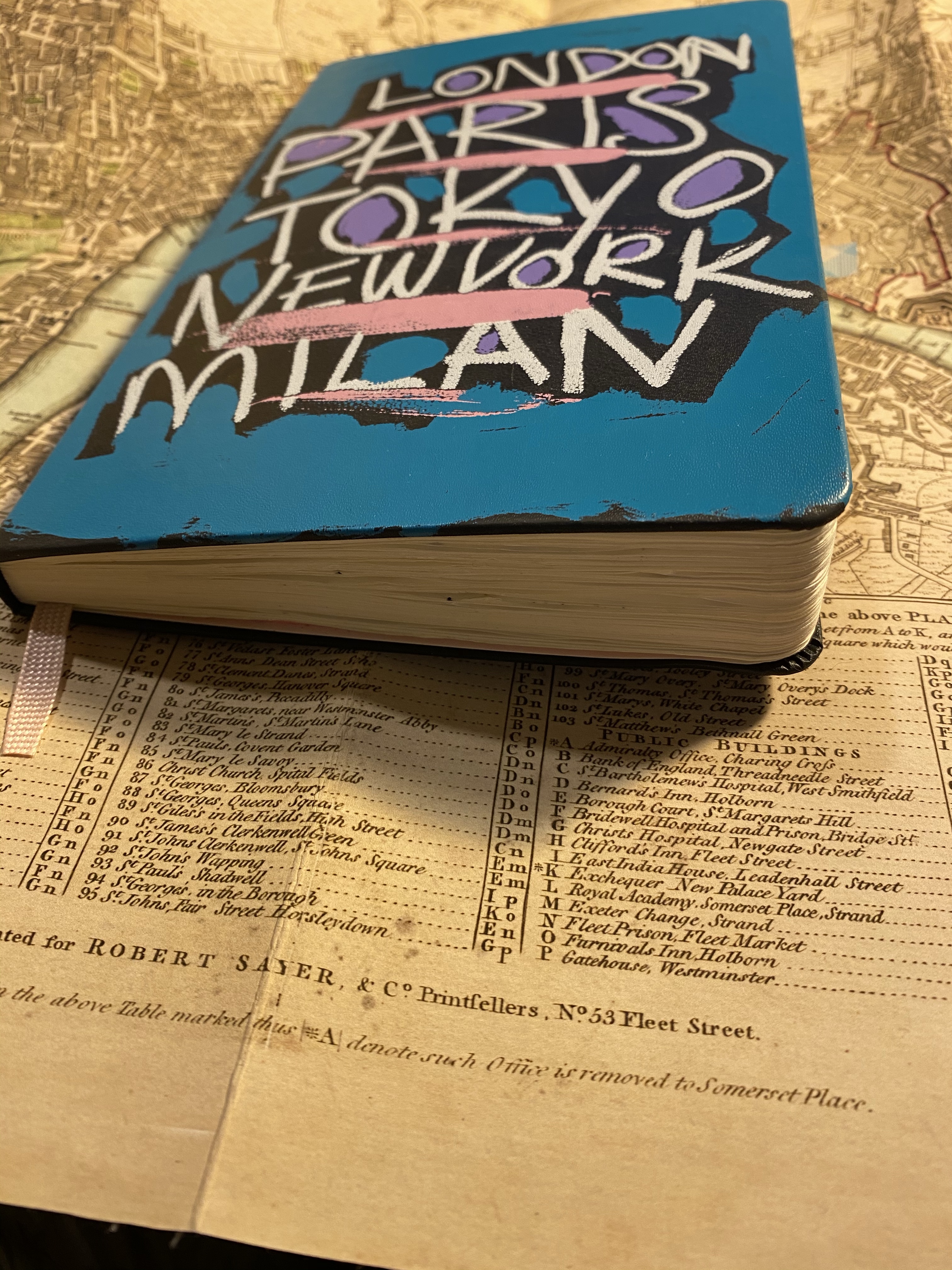
I wrote a few weeks back that I was struggling with my notebook setup, and things have changed since then. I’ve settled on using a blank large Moleskine hardcover in Reef Blue and a Pilot Hi-Tech C 0.4 for a running list of work projects and related notes.
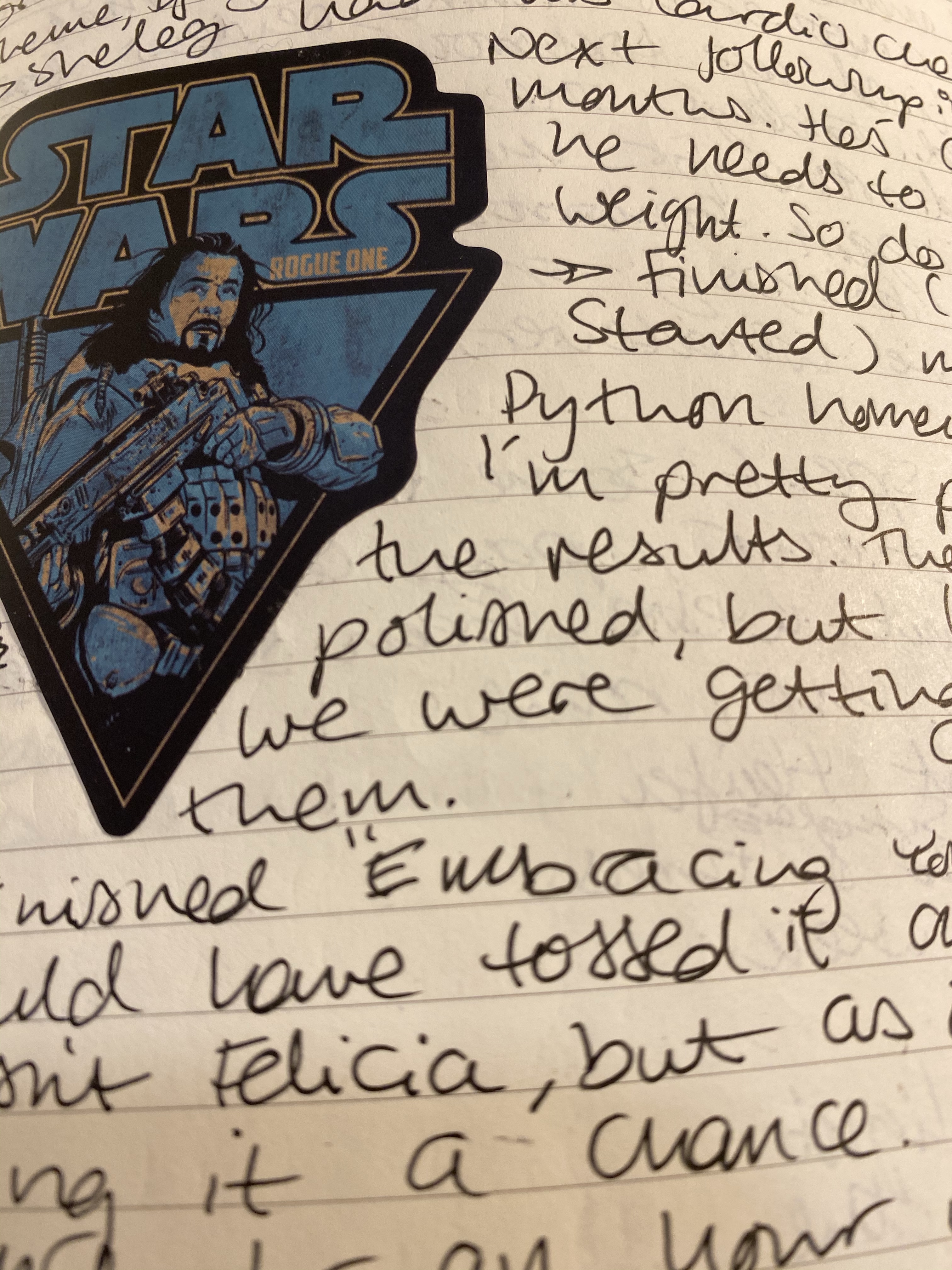
I’ve customized the cover with a Star Wars decal to make it pop and let me easily identify it.
I use the right hand side for a running tasks per project (I still manage major project points in the Things app), and the left hand side for related points, reminders and ideas. Each project has at least one spread, and I drop in pages with ideas and things to remember in between the project pages.
The Pilot Hi-Tec-C (also known as the G-Tec-C4) is not a pen that I would recommend because it’s so very delicate and unreliable, but I used to be a fan years ago, and in a burst of nostalgia (and against my better judgement) I’ve gone back to using these pens. There’s something about the barrel design of this pen, combined with it’s needle tip that makes me enjoy writing with it. Again, I wouldn’t recommend it, as you’ll rarely see a refill through (the tip will bend, or it will become to scratchy to use, or it will dry out and become unusable) and in general the Uni-ball Signo DX are much better 0.4 tipped gel ink pens. But the heart wants what the heart wants, and this is what I prefer for daily work use right now.
In the beginning of the month I started working in a new team, in a new career path, in a new technical job, under new circumstances. After working for two and a half months from home, I now work half a week at home and half a week at work, in a pretty empty office. I haven’t met all my team members, as we work in separate “capsules,” ensuring that if one of us got sick at least 50% of us would remain unaffected and capable of working. After 17 years of being a Mainframe system programmer, I’m now a DevOps engineer. I’ve been training for the past six months for it, and I love the work, but it’s still not the easiest switch to make. I have a new set of managers, with a new management style, and my old job keeps calling on me, which results in some wild context switching.
And meanwhile the world is burning, as incredible stupid leaders worldwide decide that their pockets are worth more than other people’s lives.
I’m not a huge fan of change, and so my productivity systems tend to stay around with me for years. During the early days of the pandemic, when I just started working from home, I thought that this was temporary. On the second week I realized that the mess of notes in whatever writing pad was around would need to change. And my mindset would need to change.
I wasn’t in Kansas anymore.
I tried to replicate my old work setup at first (a large Moleskine squared hardcover with only the daily todo part of bullet journalling), keeping my home setup intact (a Field Notes with a running todo, lists, trackers etc). That held until I realized that I was starting a new job in a place that moved at a completely different pace than what I was used to. I was also no longer a manager, so the focus of my work was different. I needed to tear everything down and start over again.
I went back to digital task management. I’d tried OmniFocus for a while two years ago and didn’t like its complexity. I had used Things for a good long while before that but stopped and change back to a paper notebook once I decided that I had to have a physical barrier between work and home to have any balance in my life. Those were wild times, and I’m glad that I made that choice, but now it was time to bring Things back into my life. I’ve been using it since the 1st of June, and while it isn’t yet 100% set up to perfection, it’s working well so far.
I’m now managing both work and home from Things, because I can’t handle the added hassle of remembering to lug which notebook where every day, especially now, when I’m not yet set up in my new place. I also don’t realistically think that I could have kept track of my work in a paper notebook right now. I’ve “outgrown” it.
The issue is that I still love paper notebooks, and I still love writing with pen and pencil on a piece of paper. I still keep a pad next to me when I work and scribble ideas on it, but this switch has dwindled down my daily stationery use significantly.
As I was clearing my old desk I found physical evidence of all my years of work there: notebooks full of todos, meeting notes, project notes, ideas and problem solving pointers. I could see the work that I’ve put in. My new system is searchable, but it’s still an amorphous pile of bits somewhere in the Cloud.
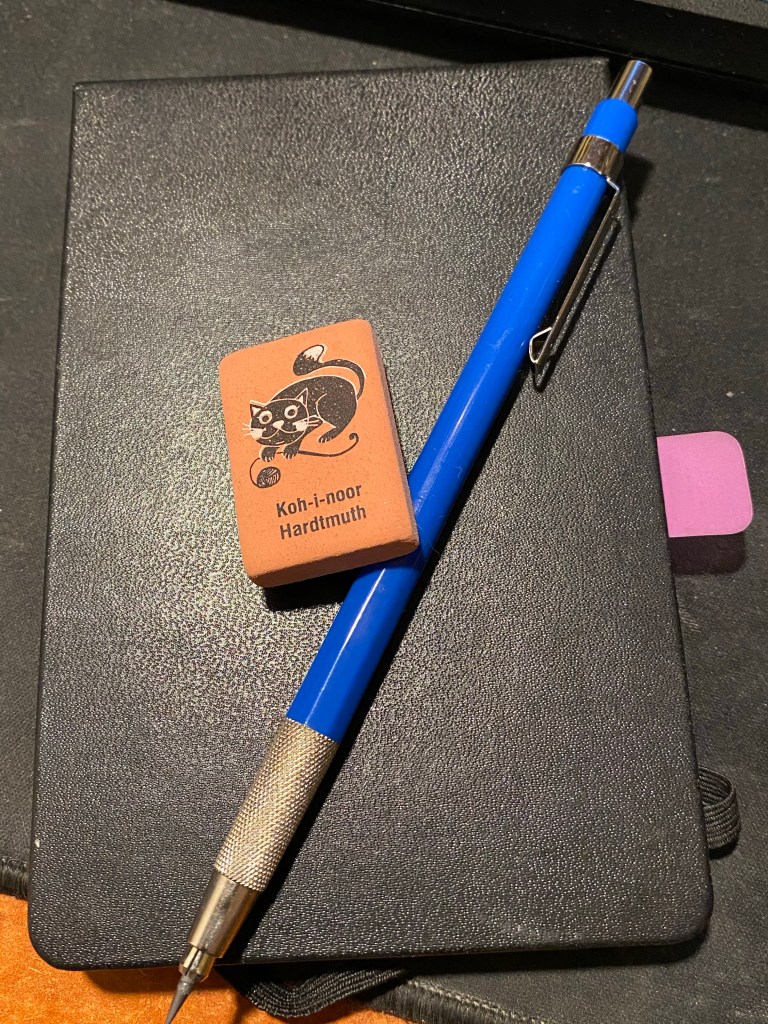
I don’t recommend this eraser. It’s just one that makes me smile.
When I went into quarantine I had an inexplicable yearning to get back to the first ever real productivity system I used, the PigPogPDA. I loved my Moleskine pocket plain reporter notebooks, set up just right, full of all the important information that I might ever need. I had shopping lists, trackers, drawings, story ideas, directions, packing lists, cheat sheets in those notebooks: they were my everything at the time. I also remember how terribly expensive they were for me, and how difficult to obtain. Every page was precious, and I had to be careful not to waste any. I used the Hi-Tec-C and the Staedler Mars technico lead holder for that, and these little notebooks lasted for ages and travelled the world with me. Only in the past three years have I stopped using them, replacing them with a much simpler system in Field Notes pocket notebooks. Out of nostalgia I brought one back to life. It has done a lot to cheer me up and give me a sense of stability during these hectic times. Yes, I know it’s just a notebook. Sometimes “just a notebook” is all it takes.
If I have any advice to offer it’s this: be kind to yourself and pick whichever system works for you, and doesn’t make you work for it. Pick something that you’ll enjoy using. If it’s a sleek app, let it be a sleek app. You’ll find use for the notebooks in your cupboard eventually. If it’s notebooks, then make them entirely your own. That’s the joy of using paper planning anyway. And don’t be shy of saying: “This doesn’t work for me anymore”.
So I’m back to digital planning, and I’m going to find a way to have fun with my pens and paper somehow (I still journal and draw and write after all). This is something that’s likely to change as the times do, my work and my life circumstances do. So long as I don’t fall into the trap of Productivity Pr0n and forget what all this is in service of, I’m fine.
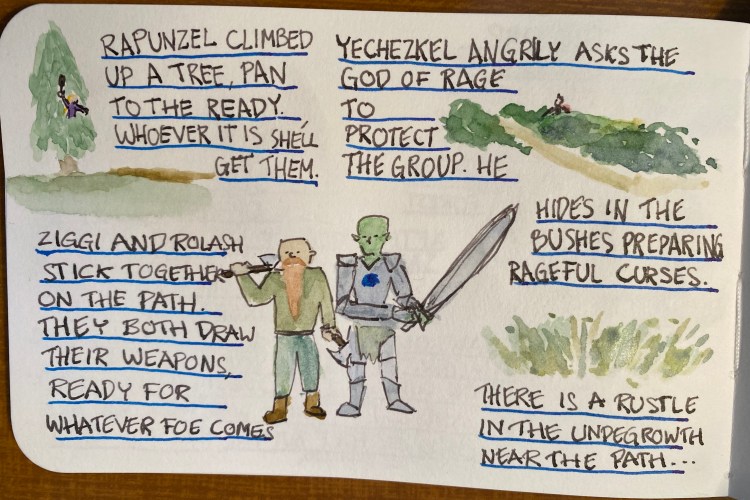
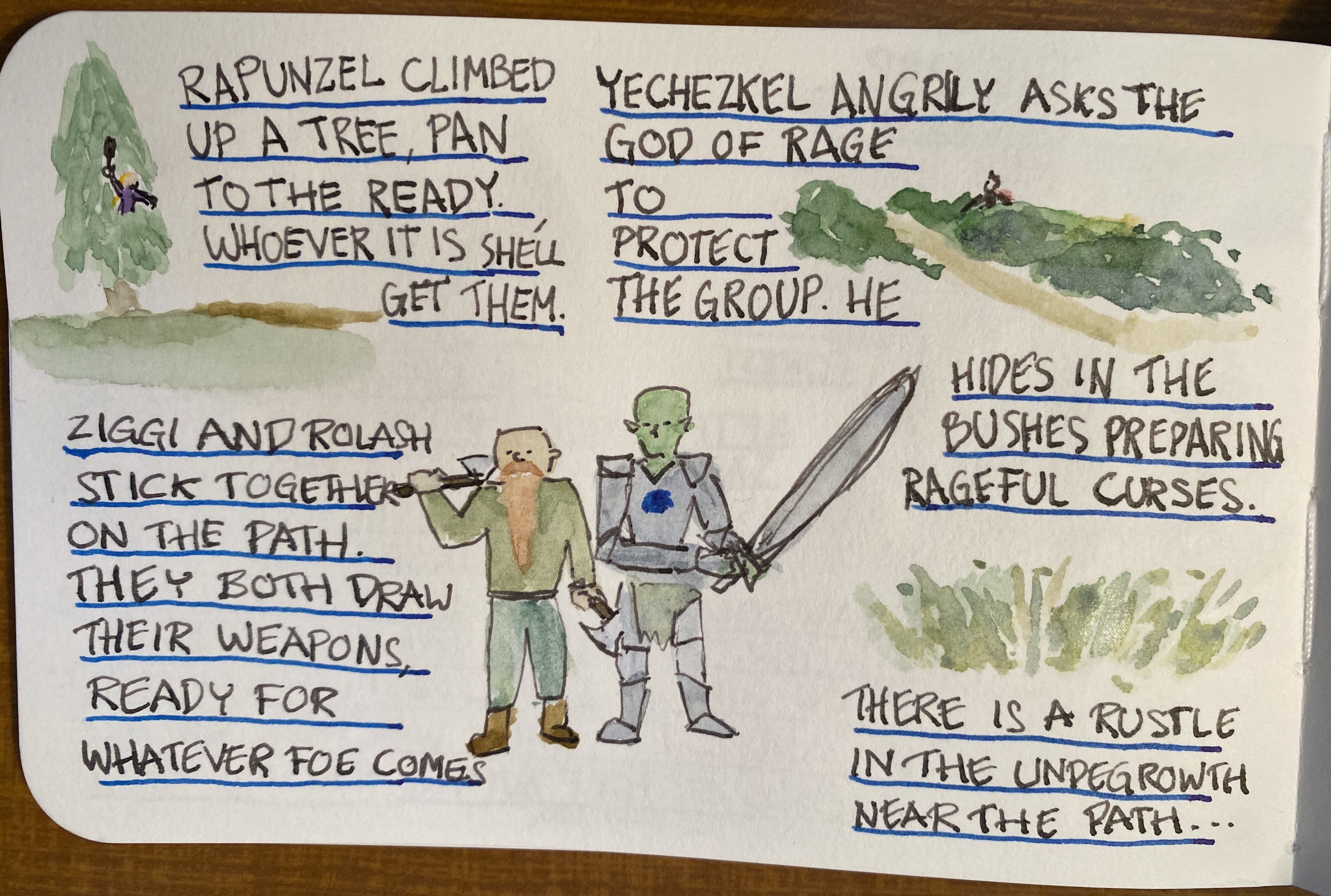
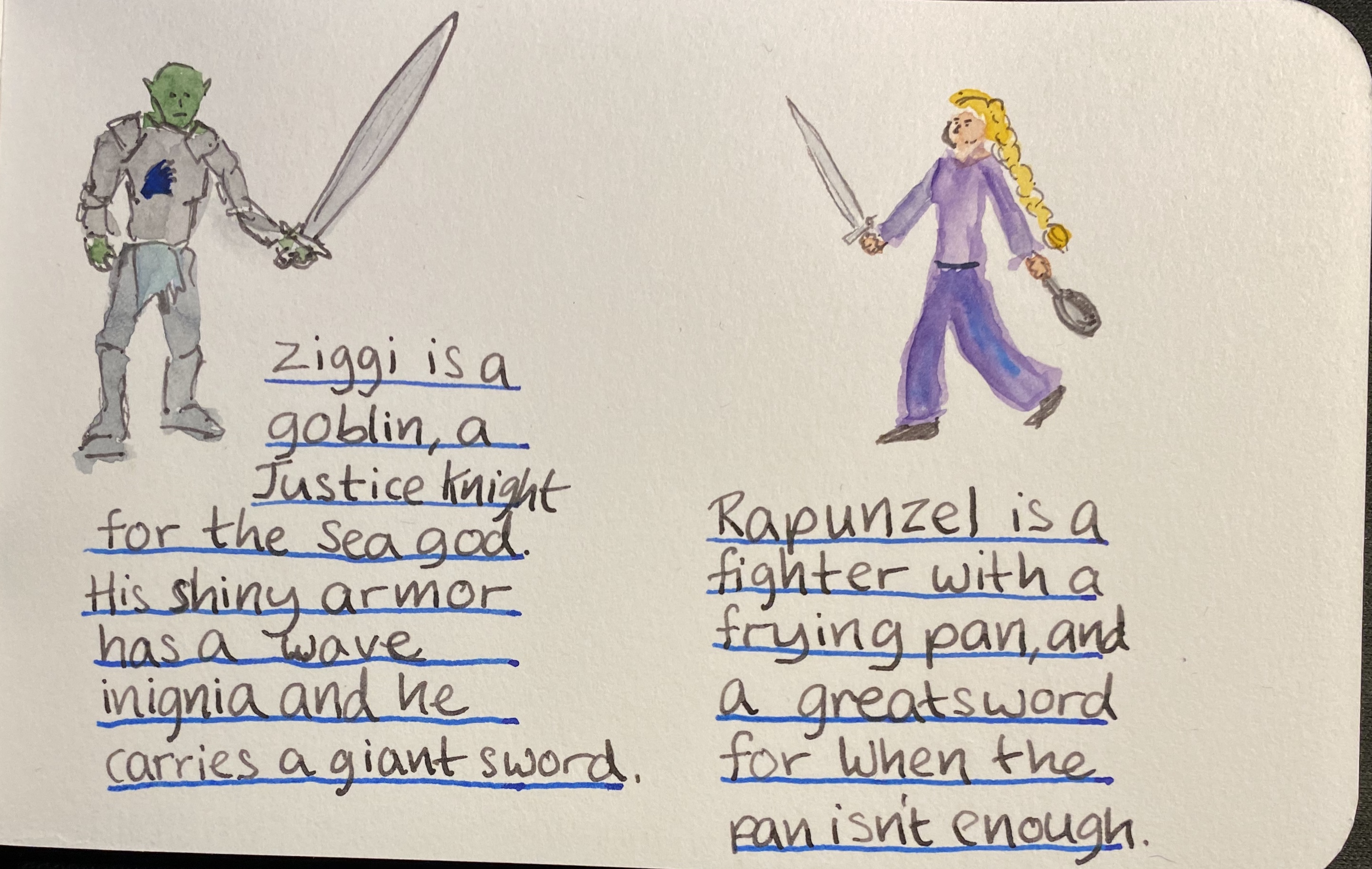
You can find part 1 here. You can see that there is a slight bit of show through with the Stillman and Birn Epsilon, but at only 150 gsm that’s to be expected.
The show through is most pronounced in the area between the goblin’s sword and the text above him.
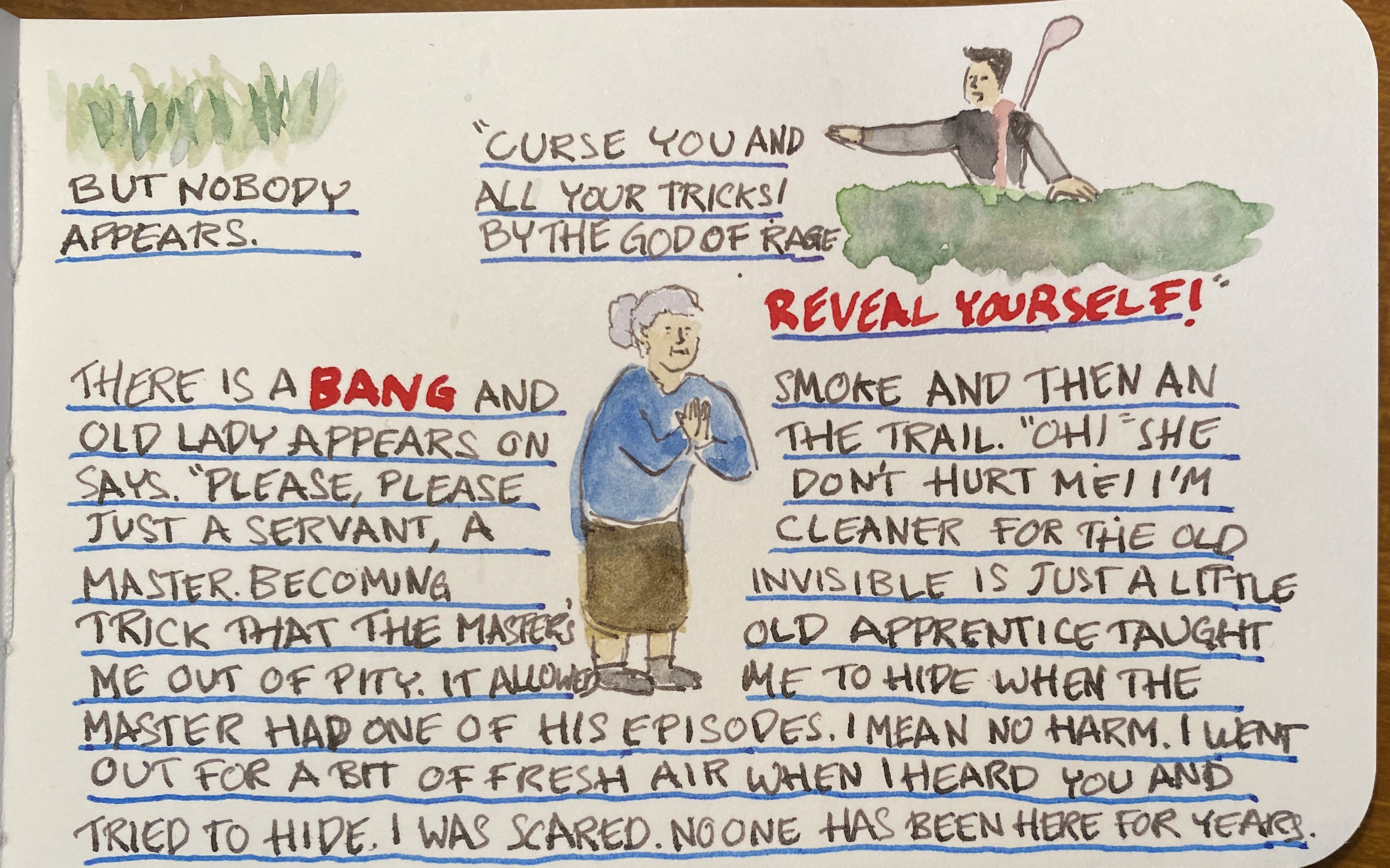
I decided to play a bit more with ink colours and wider nibs here, so that’s a Sailor medium stub nib and Diamine Inkvent Blue EditionCandy Cane ink for spells and effects:
There’s no show through for the ink, and though it may not seem that way, there was no spreading. Also, if you like granulating watercolour effects, the Stillman and Birn Epsilon paper seems to be a champ for that.
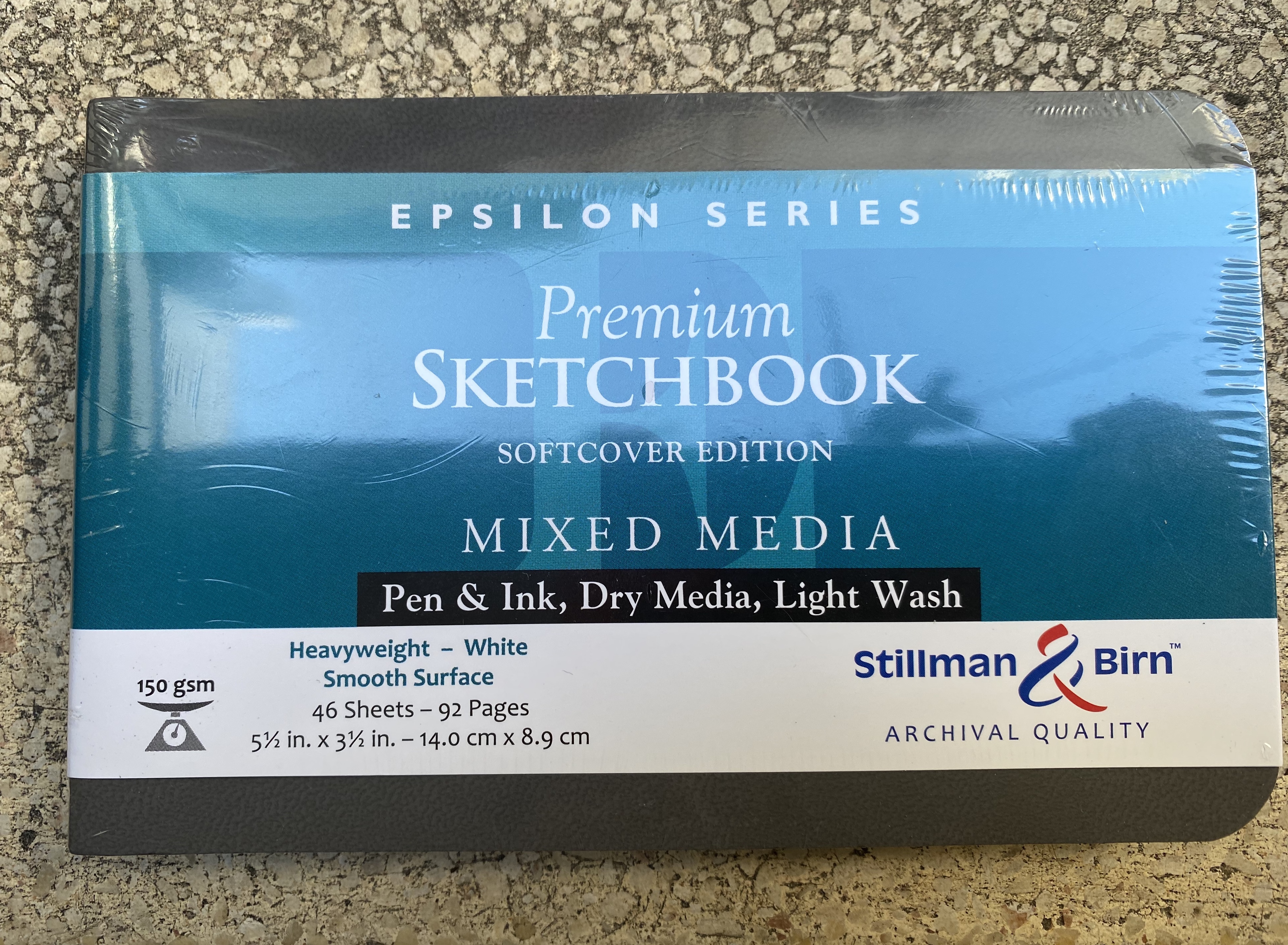
A while ago a local art supply shop started stocking a wider variety of Stillman and Birn sketchbooks. I currently use the Stillman and Birn pocket Alpha as my daily sketchbook, but I decided to give the pocket Epsilon a try. The Epsilon features smooth, white 150 gsm pages which should work for pen, ink, dry media and light washes.
This sketchbook is in landscape format, which is what I normally prefer. I was planning to use it once I’ve finished with my current Alpha, but weeks stretched to months and meanwhile this sketchbook has been languishing away, unused.
So when I saw Liz Steel going on a virtual sketch tour in Italy, I was inspired to grab this notebook and fill it with a sketch tour of my own. I initially planned to sketch out my cancelled London trip, and I may yet do that, but something inspired me to take this idea to a completely new direction.
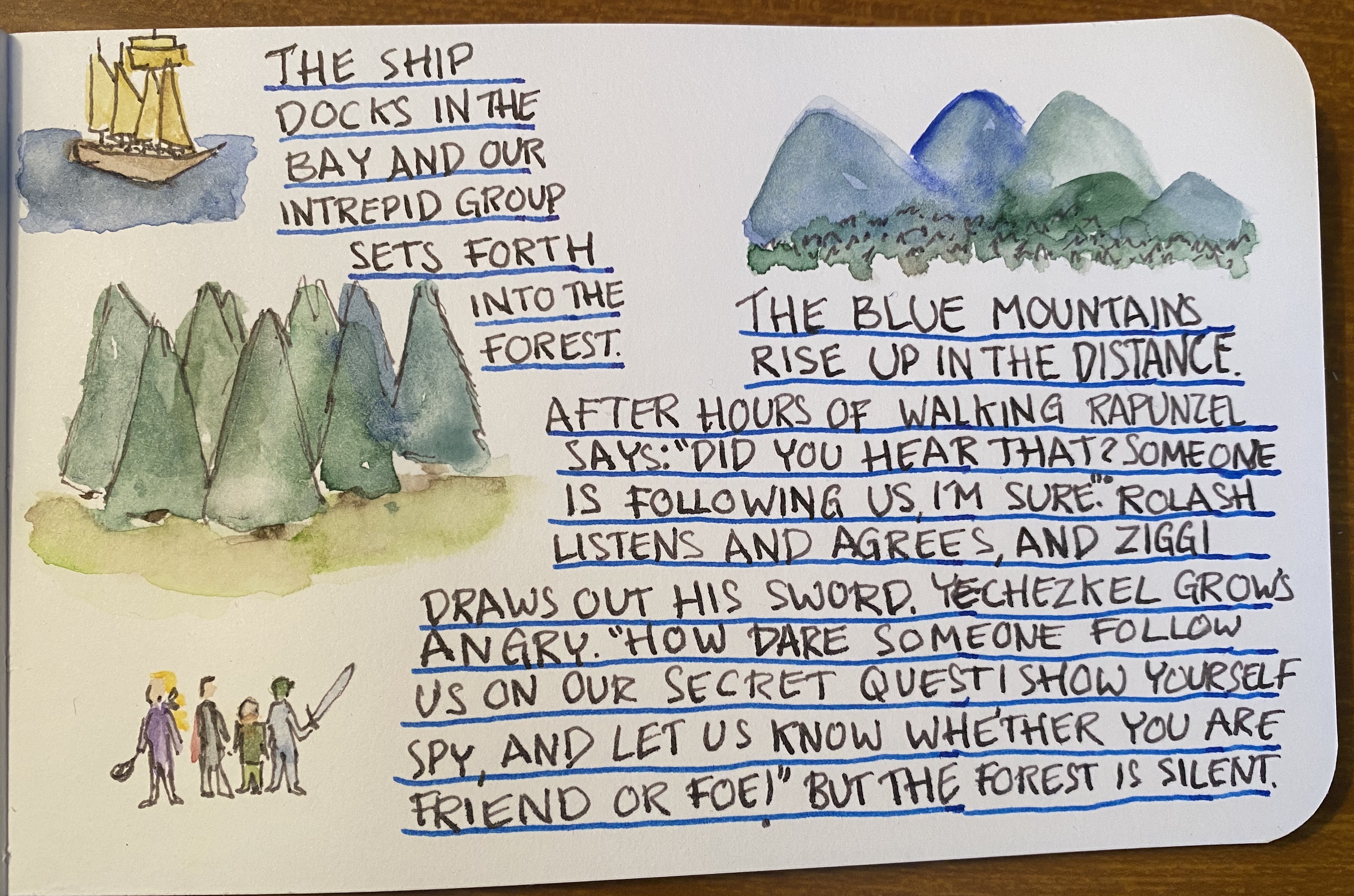
I’m going to sketch out a freeform fantasy roleplaying adventure for my regular D&D group, and use that as a way to test out this sketchbook, and to make good use of my fountain pens.
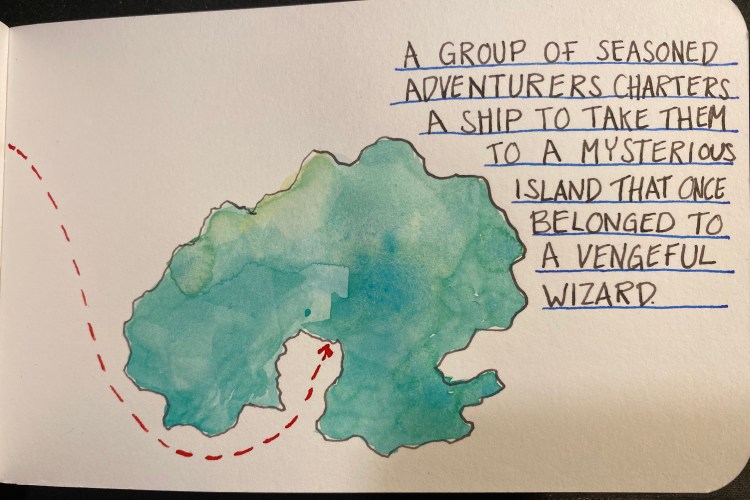
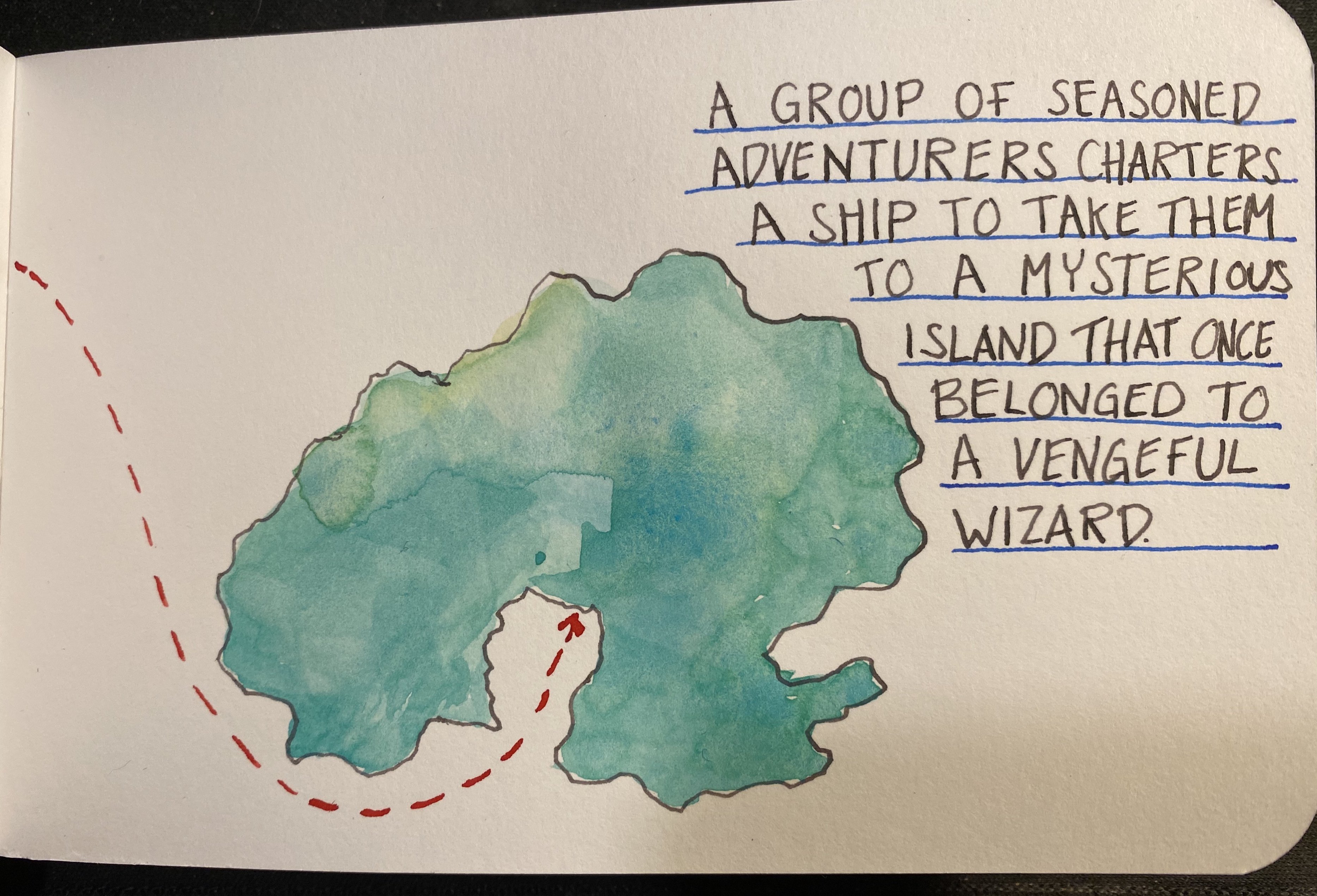
So without further ado: Vengeful Forest, a fantasy freeform adventure.
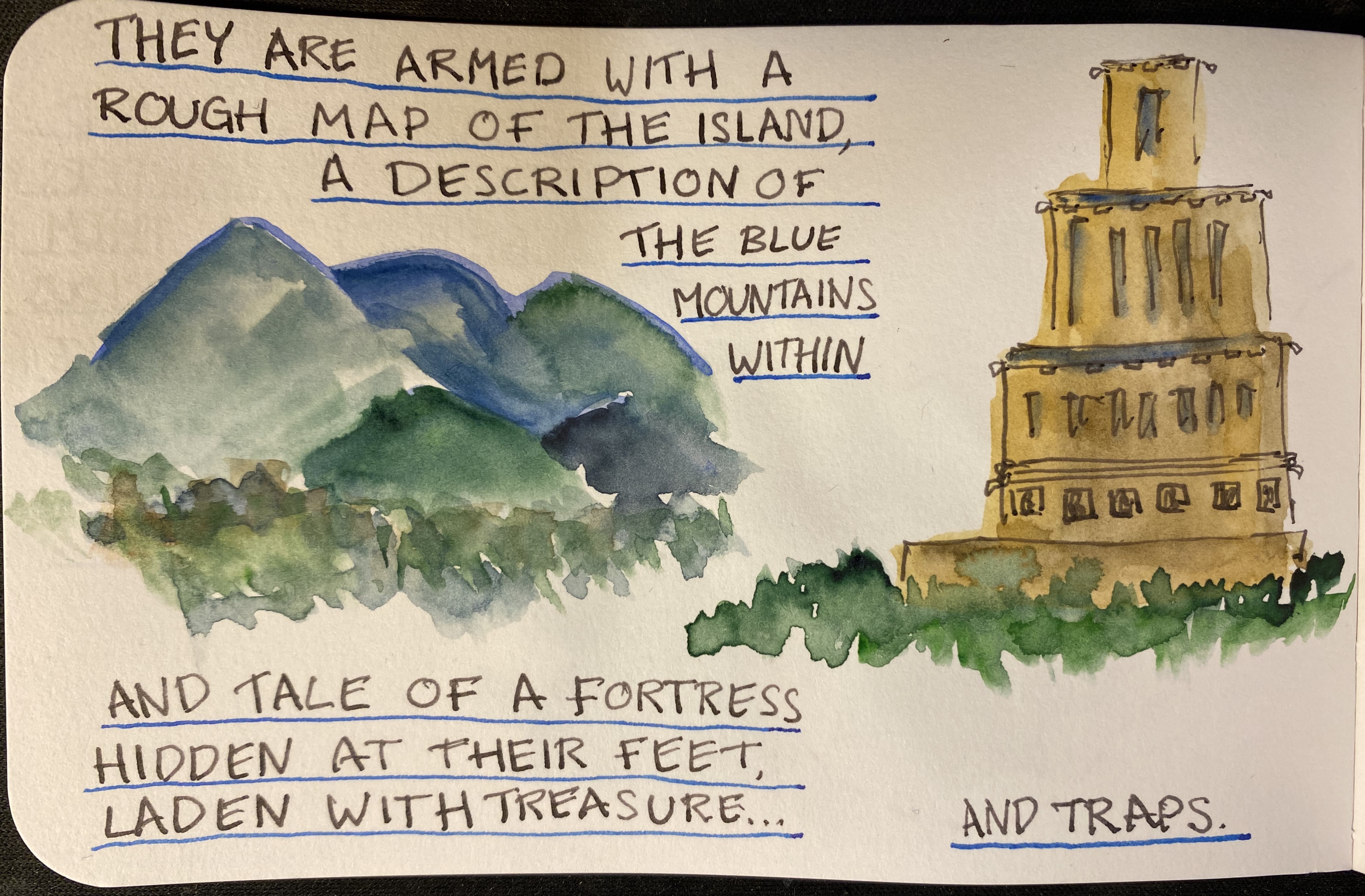
Sketch and writing done with TWSBI 540 Diamond F nib and Rohrer and Klingner Lotte SketchINK.
Blue lines done with PenBBS 500 Fine and Sailor Sky High ink.
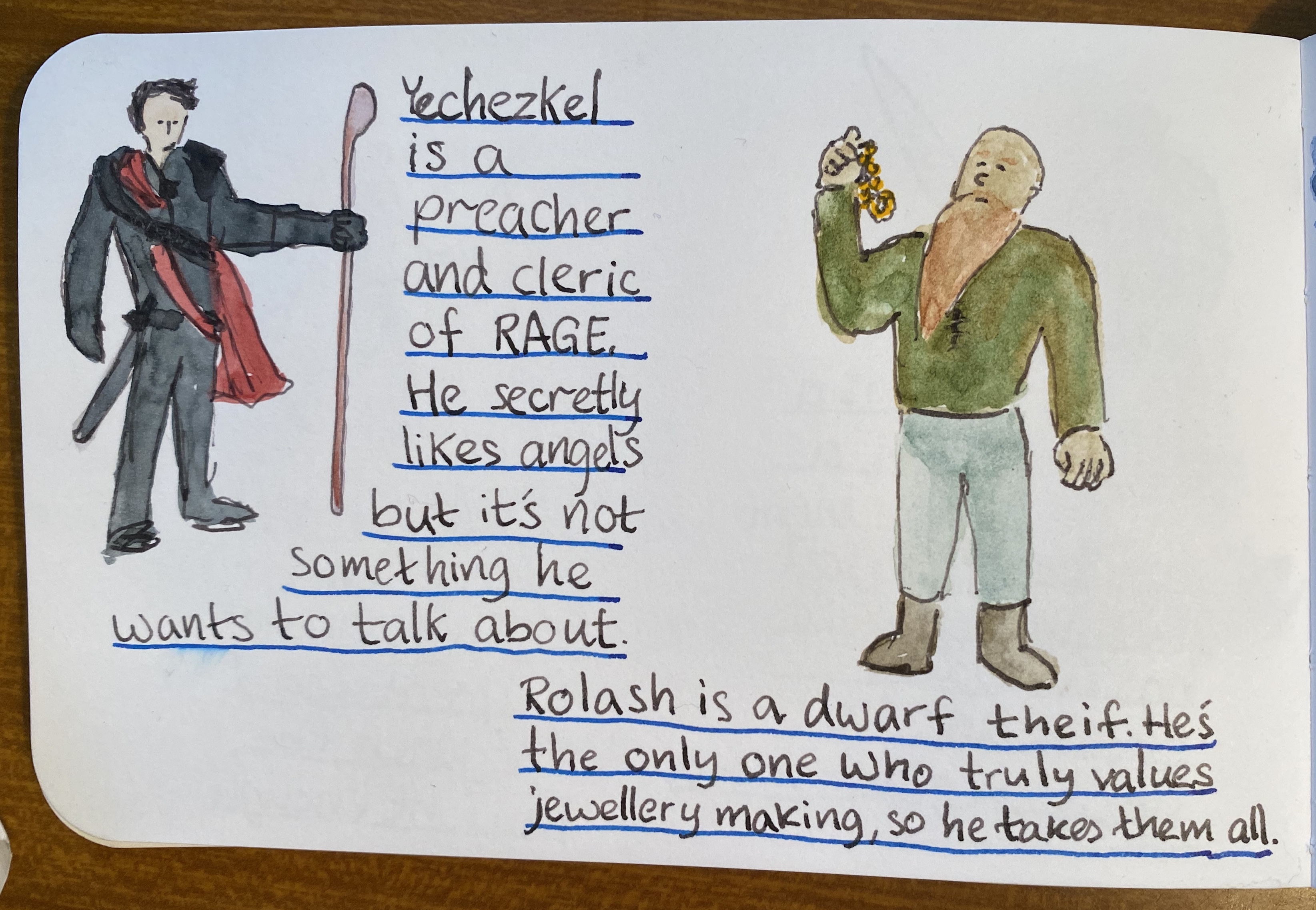
Frying pan Rapunzel dressed in purple is probably copyrighted by Disney, but one of my players thought it would be funny to make my life interesting, so here she is.
I tried to give each character a distinct enough colour scheme so you’ll be able to recognize them from a distance. Each player had one sentence to describe their character.
The watercolours are Schminke and I used a Windsor and Newton Series 7 number 2 brush and a Rosemary and Co 772 brush
I’ll continue posting as the adventure progresses, but so far this has been a lot of fun, and the players seem to be enjoying it too. The Stillman and Birn Epsilon has been an absolute champ: it takes light washes beautifully, with very little buckling, allowing me to use both sides of each page. It also works well with fountain pens, especially fine nibbed ones, which are commonly used for sketching. The white paper makes everything pop, and even though 150 gsm isn’t much when it comes to watercolour, it did allow for some layering and reworking without turning into a messy paper pulp. This is a sketchbook that I’m definitely going to purchase again.
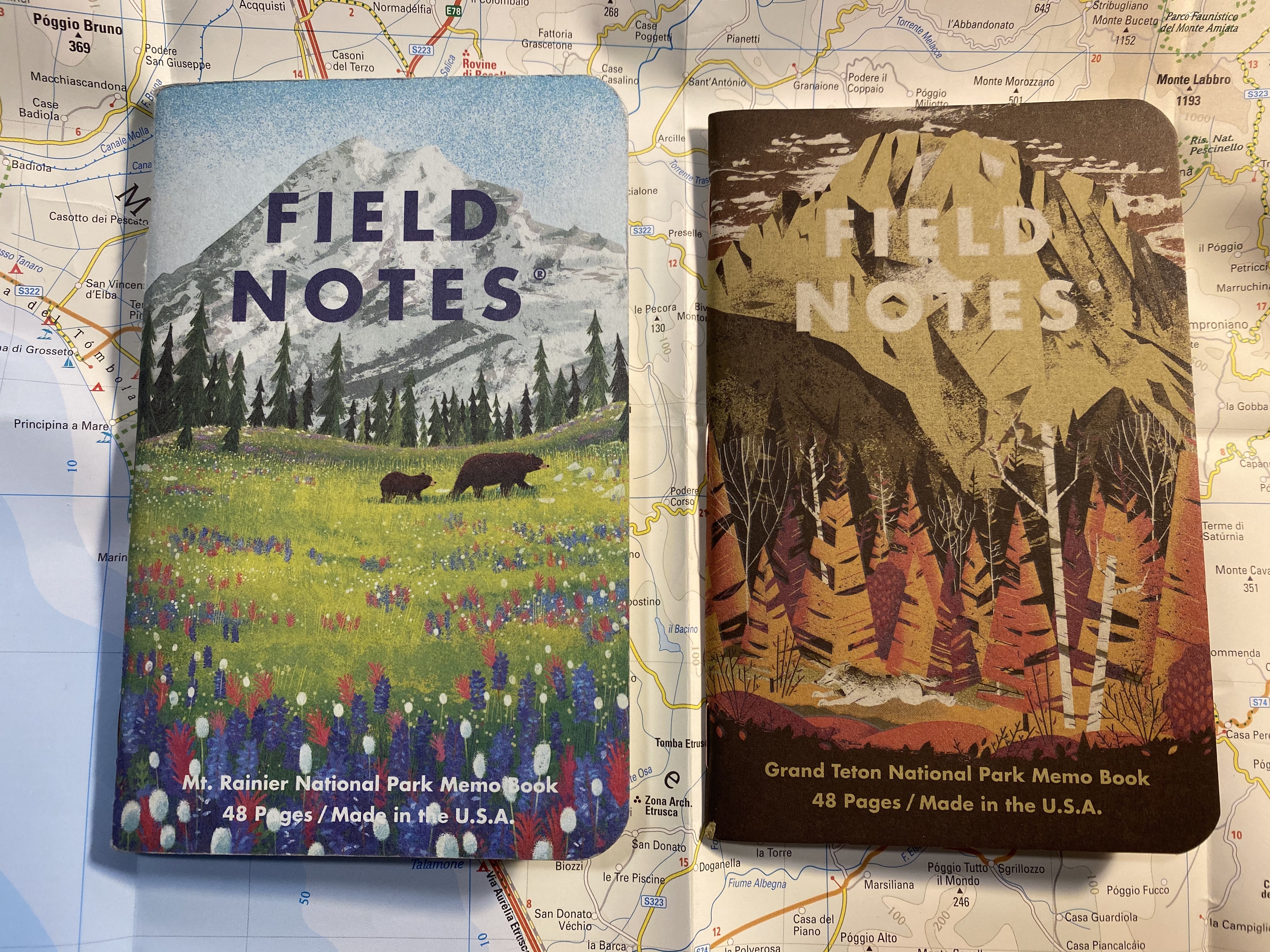
Out: Field Notes National Parks Mount Rainier (the last of series B that I’ve been using).
In: Field Notes National Parks Grand Teton (the first of series D to be put to use).
National Parks is my favourite Field Notes edition since Two Rivers. I’ve bought additional packs of series B and series C, beyond what I received with my subscription. I highly recommend splurging on a pack or two of these pocket notebooks.
In early 2019 I found out that Moleskine had come out with a Sakura Limited Edition that they were selling originally only in Japan. This is not the dark pink/light pink limited edition Sakura that is available as part of their 2020 spring catalog, but a smaller run of notebooks that came out before that. The edition garnered enough interest that it started appearing outside of Japan in Moleskine stores near the end of 2019. After searching for this notebook online with no success, I was surprised to find it in a Moleskine store on Oxford street, London. I try not to buy notebooks abroad, because they can very quickly weigh down your luggage, but I couldn’t pass these by. There were two versions of Limited Edition Sakura in large format, and two pocket ones. I showed some restraint and “only” bought the large ones.
I just finished one journalling notebook and I was casting for the next one to use, when I decided to go for this Sakura one. It was difficult to acquire and expensive, so there was a risk that it would stay in its wrapper forever, but I decided that if anything would cheer me up as I journal through these difficult times it’s this notebook.
Front cover with wrapper. Notice how the wrapper design matches the fabric print.
The Moleskine Sakura is a cloth covered notebook, with an utterly unique design. There’s an imprint of cherry blossoms over the slightly shimmering pink fabric, and the imprint looks like it’s floating over the fabric cover. The result is a stunning and tactile notebook that looks extremely luxurious. It’s almost too pretty to use.
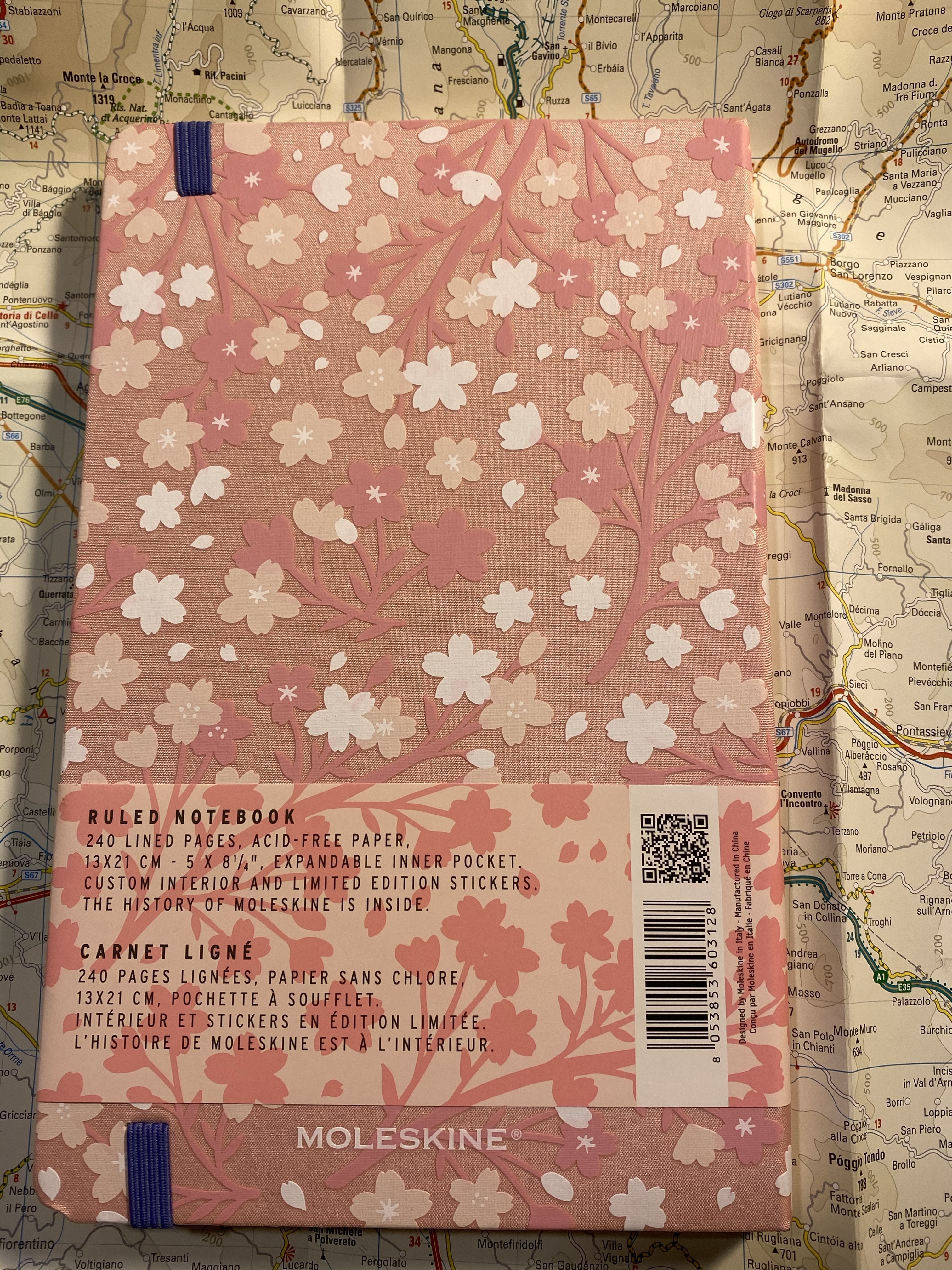
Back cover.
The fabric is clearly synthetic, and it has some shimmer to it because of that. The imprint on top has part of the fabric’s texture, and I’d venture to say that it was screen printed, but I’m not a screen printing expert so I could very well be wrong. It’s hard to capture how the covers look in person, but it’s as if there’s an invisible layer between the floral print and the fabric cover. The flowers appear to be floating in the air.
The print. Nobody does fabric covered notebooks as well as Moleskine does.
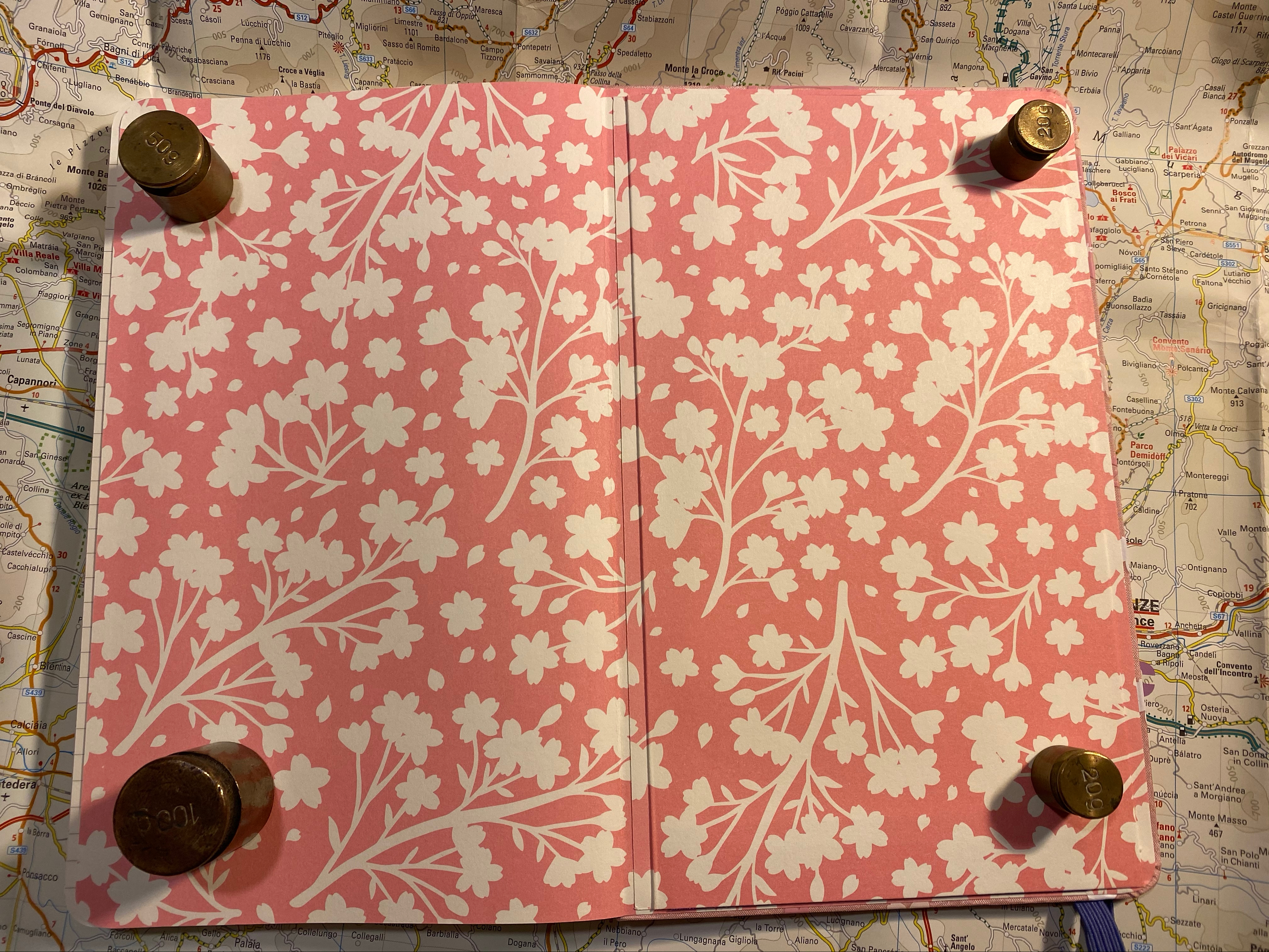
Inside the covers the endpapers feature the same print but in monochrome pink and white.
Here are the back endpapers, and Moleskine again gets full points for prints matching perfectly on the back pocket and the back cover.
The back pocket edges are in purple fabric, much like the elastic closure and the bookmark.
The bookmark features a slightly lighter purple than the elastic closure and back pocket.
Like most limited edition Moleskines the Sakura comes with a sticker sheet. This one is of cherry blossoms in white and various shades of pink. It’s a beautiful sheet of stickers, and the washi-like design of the bottom half of the sheet is a very nice touch.
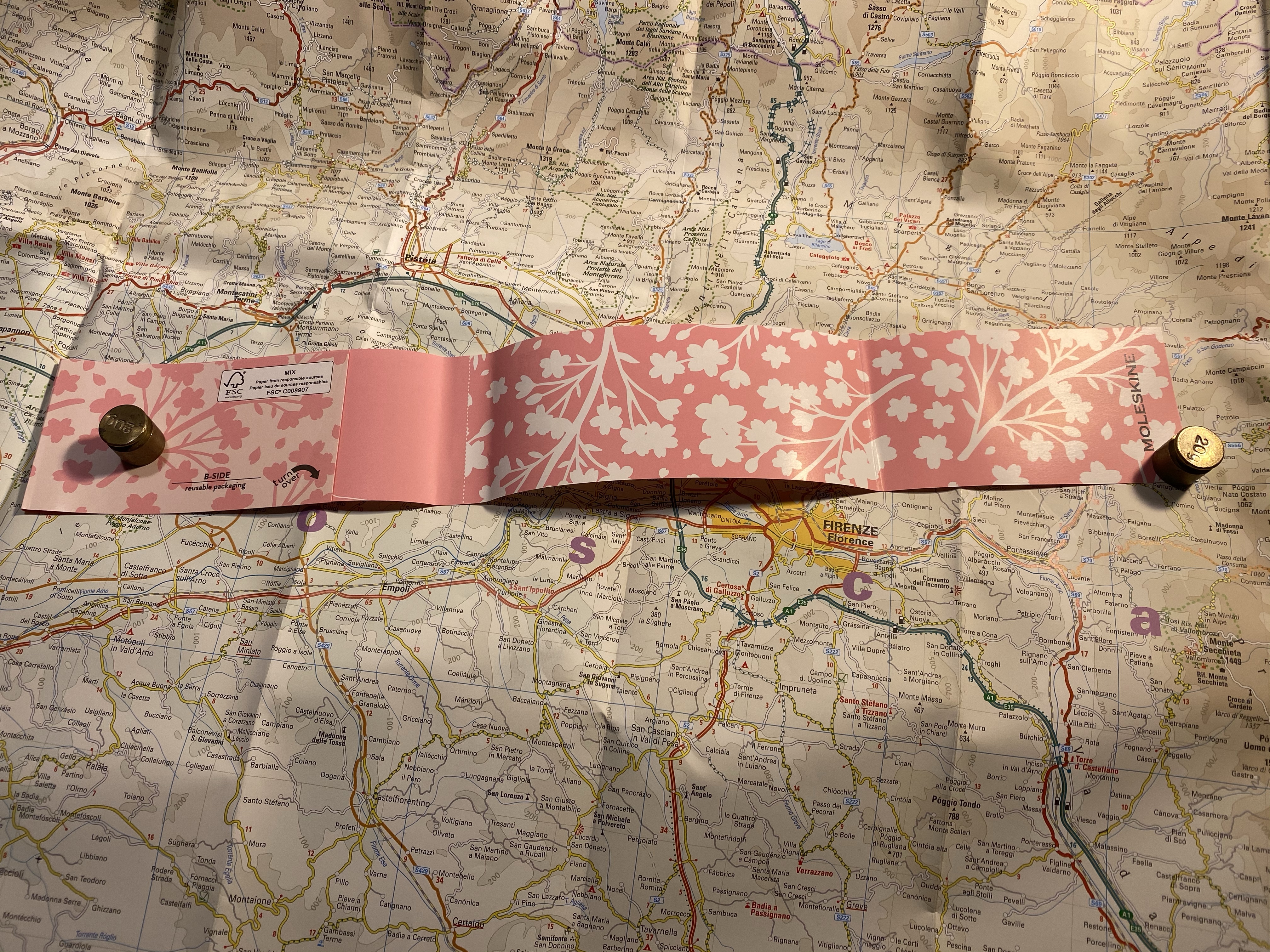
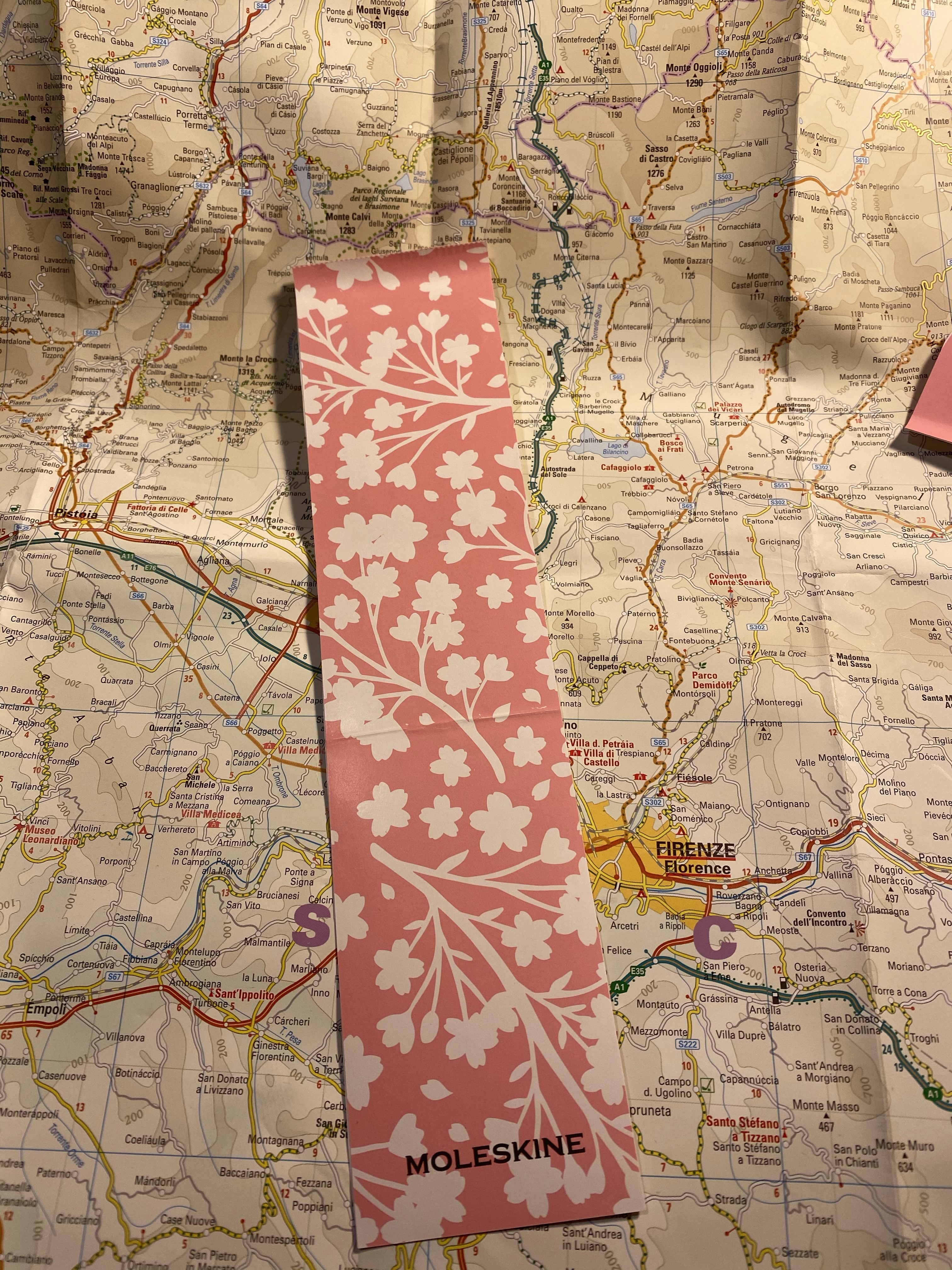
Like all the Moleskines in recent years the paper wrapper features a “side-B” that you can reuse. This one is meant to be a bookmark, and design on it was so fetching, I actually cut it out and faced it with card-stock to make a bookmark that I’m now using.
My completed bookmark:
The Moleskine Sakura is one of the most stunning designs Moleskine has produced in recent years. I’m glad that they’re making a version of this design more widely available, and I really hope to see them utilizing this printing technique for other designs in the future.
A handwritten journal is an artifact in a way that an app can never be. It’s tactile, endlessly flexible, there to be used and customized in every way possible. Tear out pages, glue stuff in, doodle, scribble, sketch and write whatever you wish however you wish. There’s no autocorrect, nothing editing or censuring your words. Analogue journalling is about freedom, flow and pure creativity.
This is my last day journaling in this journal, and tomorrow I’ll write up the last page and start a new one for the thoughts of that day.
Every time I finish a journal, I use the last two pages to summarize what that journal contains and means to me. Analogue journals are fantastic, but they do make searching for old entries a bit of a chore. Luckily I don’t find myself looking for an old entry that often, and if I do the last two pages help me narrow it down to the specific journal, and the dates and titles to the specific entry.
I also like taking the last few pages as a chance to reflect on the time the journal covers and how things have changed (and I have changed) as the time has gone by. There’s usually about three months in each journal, sometimes more, so that’s a good chuck of time to look back on: short enough to make it simple to summarize and contextualize, and yet long enough to have some impact and meaning. This journal contains two trips abroad, my decision to move into a new career path, and a pandemic that wrecked havoc on everyone I know (including me, of course). That’s quite a lot, even for a journal that covers a relatively long span of time (almost 6 months).
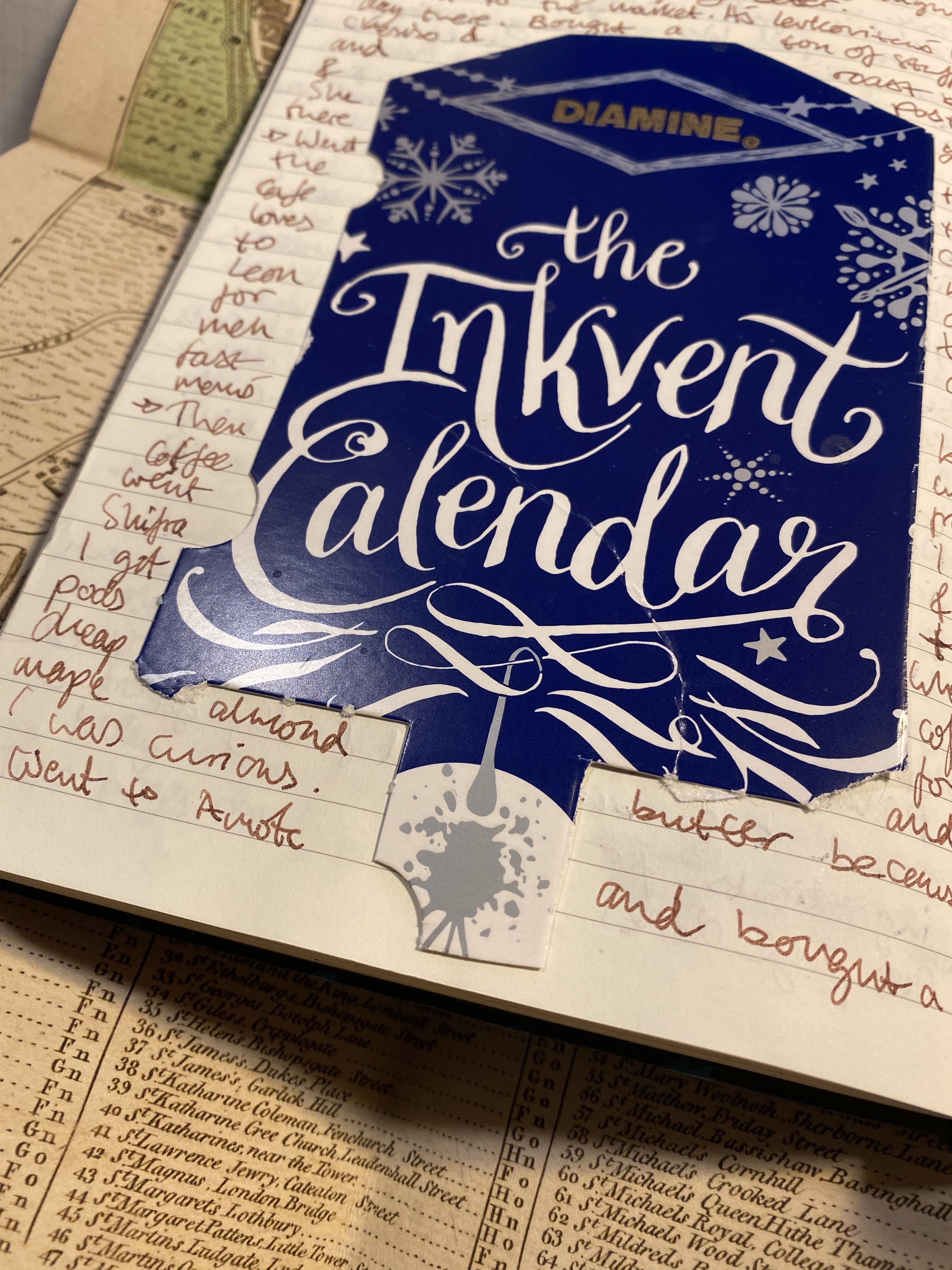
It’s also full of bits and pieces that I stuck in, to make the page come to life. So here’s part of the Diamine Inkvent packaging that I glued in after I opened the last window and before I tossed out the box:
I just ripped out a panel that I liked. This journal is for me, not Instagram, and it can be as messy as I need it to be.
Cool clothing tags also sometimes make it in, especially if it’s from a piece of clothing that I really like:
This tag came of one of my favourite sweatshirts.
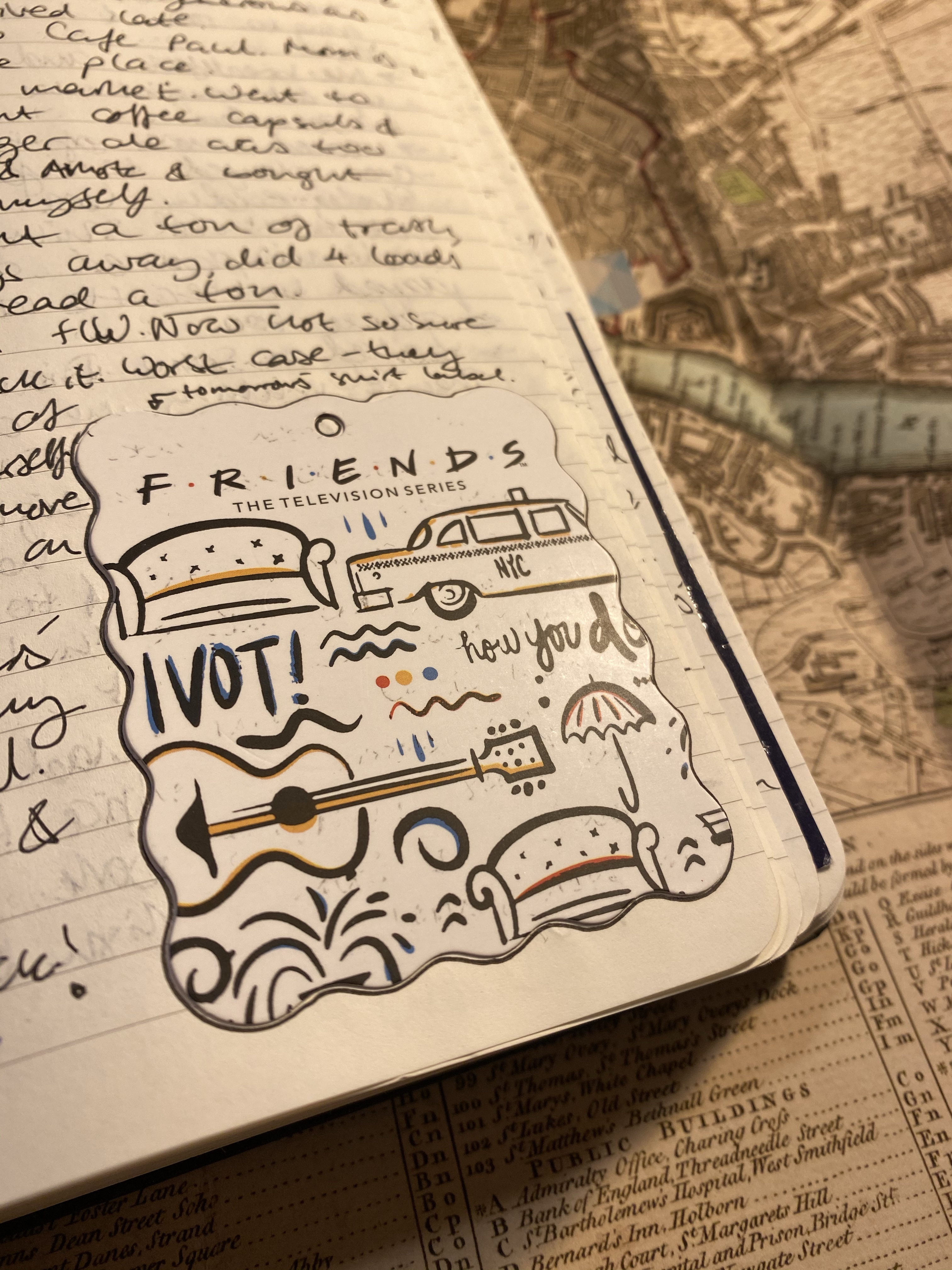
I got a lot of Star Wars themedvinyl stickers as a gift near the end of last year and a lot of them ended in my journal:
Even the silliest of things can be used to brighten up a page:
See that bleedthrough? It’s fountain pen bleedthrough. I don’t give a damn. If I wanted to write with a Sharpie in here, I’d write with a Sharpie. Use what makes you feel good.
There are little drawings and illustrations everywhere:
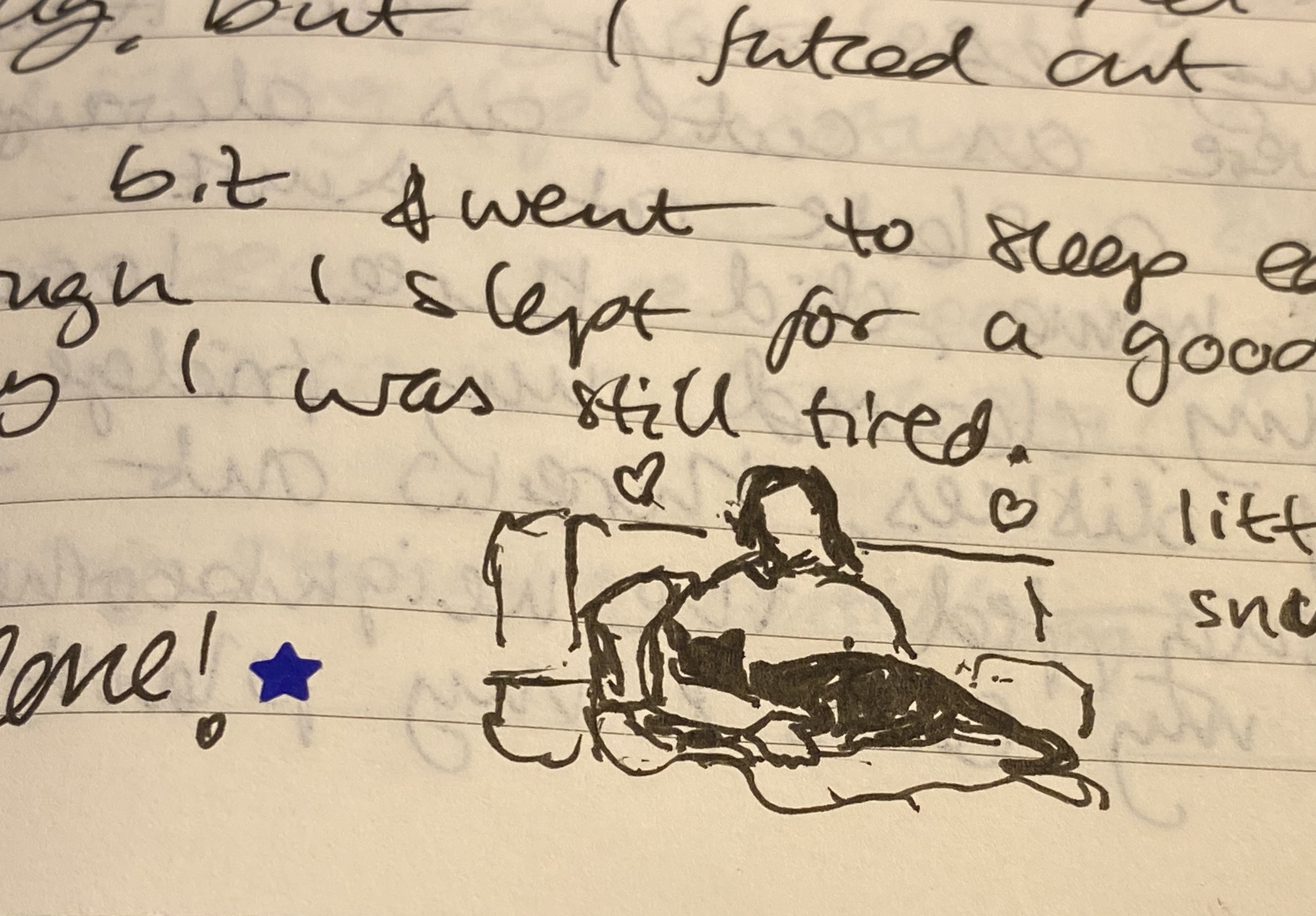
Messy, messy handwriting.
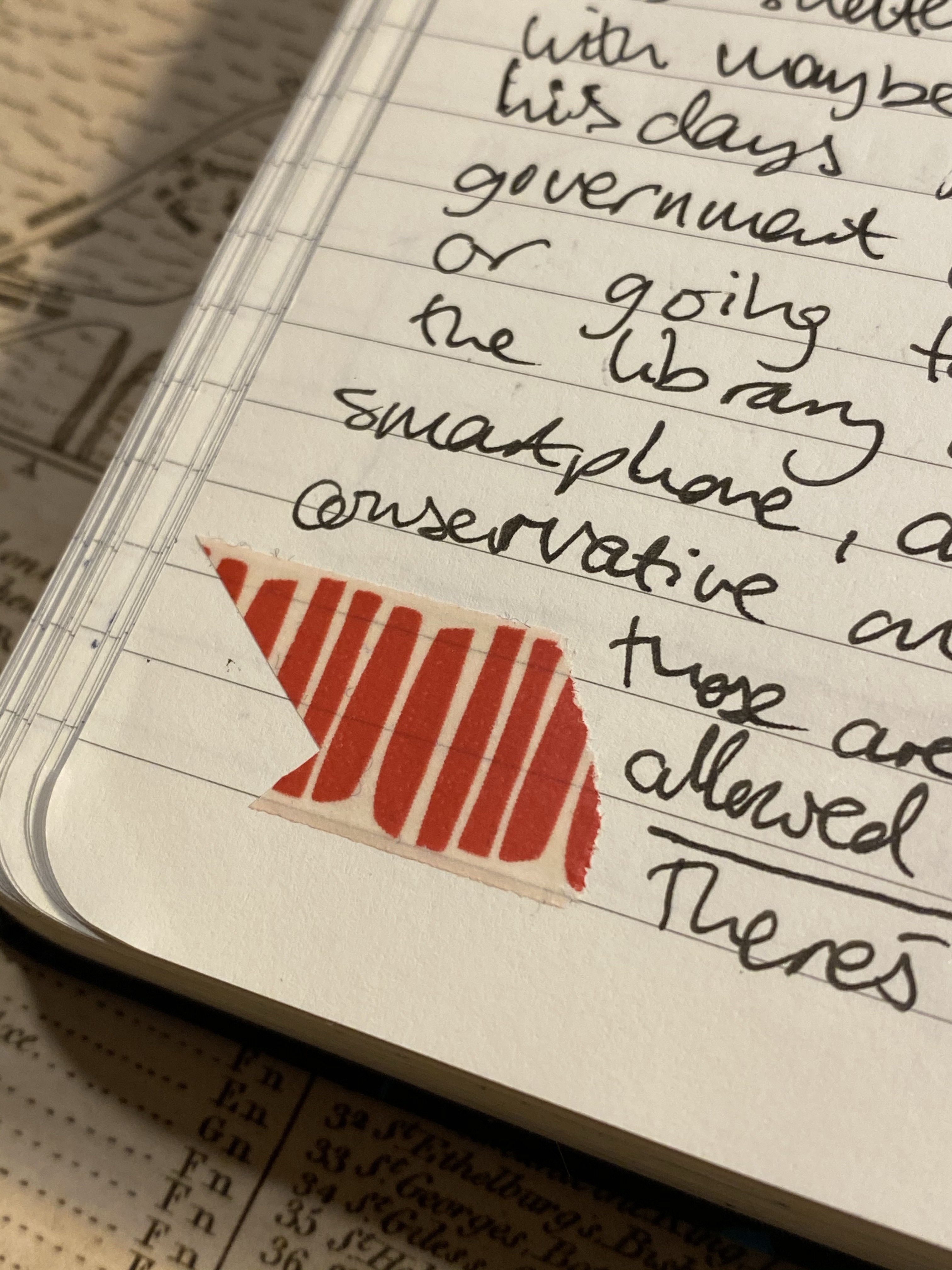
And bits and pieces of washi tape that were leftover from other projects:
The point is, tomorrow I finish another journal, a small analogue memory artifact that is entirely mine. I created it for me and me only, and it was worth every minute I put into it.
If there’s one habit that you can pick up during your time at home these days, pick journaling. You’ll end up getting quite a treasure in the end, and I’d be truly surprised if you won’t enjoy the process.
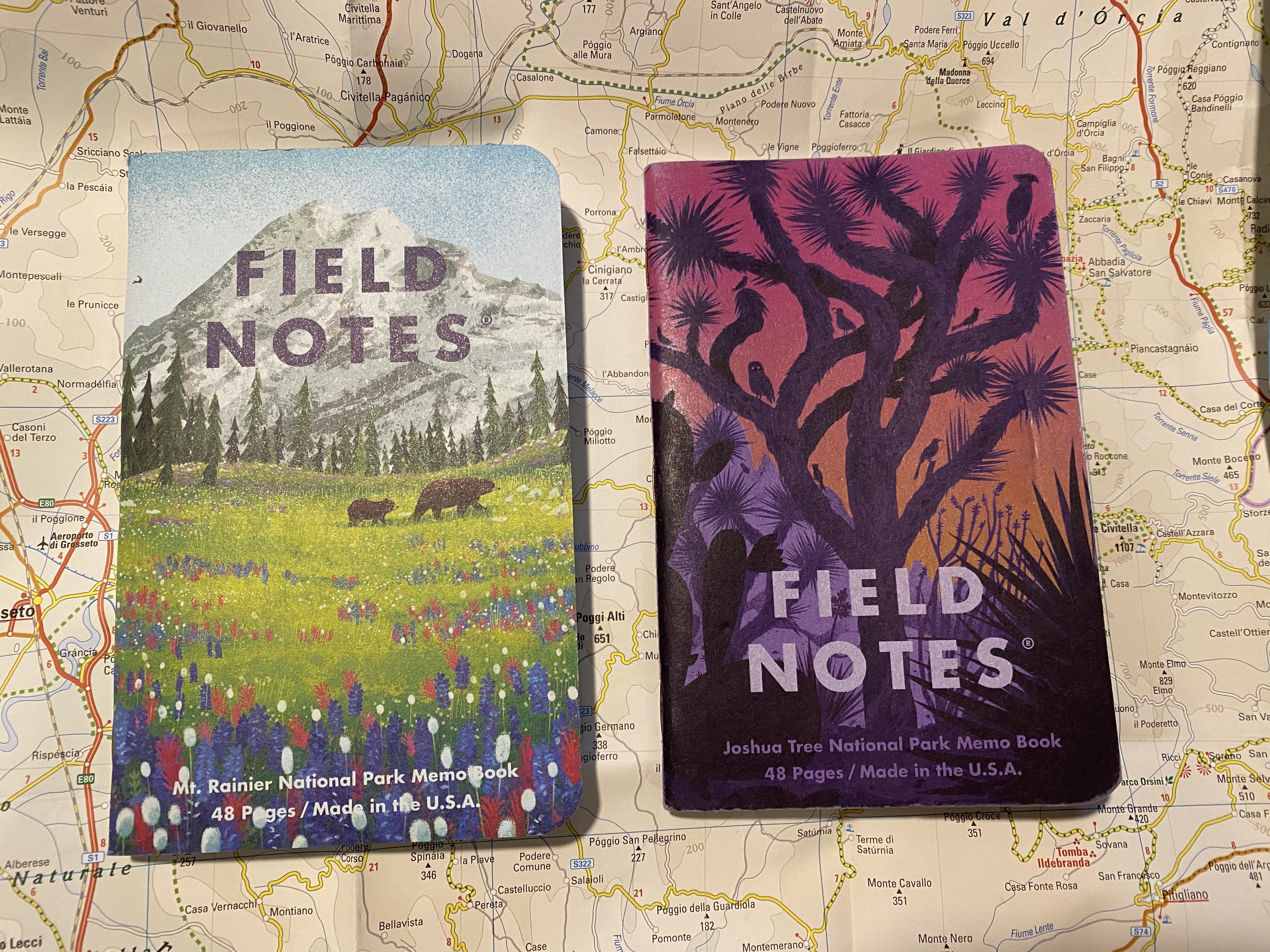
I just finished my first Field Notes of the year. In: Mr. Rainier National Park (Field Notes National Parks), Out: Field Notes Joshua Tree National Park (Field Notes National Parks).
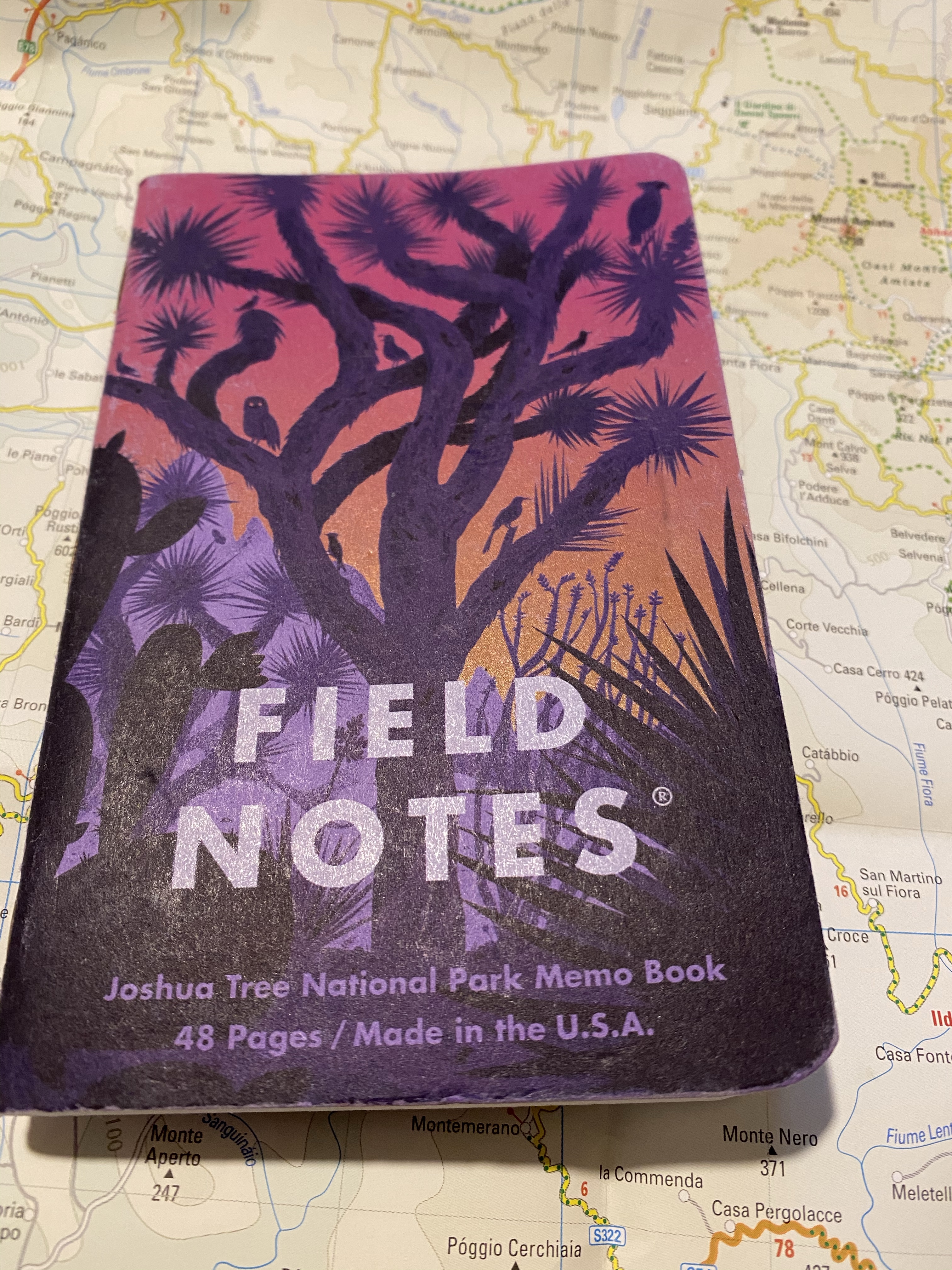
This has become one of my favourite Field Notes editions, right up there with Two Rivers and Balsam Fir. It also wears surprisingly well. This notebook has been bashing around in my bag for the past three months and you can barely tell:
The dent on the side is from where I clip it shut.
The Mt. Rainier is the last of the National Parks C pack (which also included the Grand Canyon) and the cover just brings a smile on my face. What a great edition.
Near the end of one year and the beginning of another various articles and podcasts about New Year resolutions start popping up. They either give tips on how to make resolutions, debunk resolutions in favour of something else, and almost all of them try to sell you something.
This post is about how I create yearly goals (i.e. resolutions), using things that I already have, in a way that has worked for me since 2015.
I wrote about the way I do “New Years Resolutions” in the past. I call them that because I like the non-business ring of “resolution” over the “business-jargon” sounding goal. My “resolutions” are, however, S.M.A.R.T. goals: specific, measurable, attainable, relevant and time-bound. I manage them using the least used notebook that I had lying around (a Baron Fig Confidant), and whichever pen I have at hand. They aren’t made for instagram, rather I use my plain ugly handwriting, and what marking are on the page are there because they’re useful. Over the past five years I’ve attained about 90% of what I set out to achieve, with even an annus horribilis like 2018 not putting me too much off track. My goals are tiered, much like Kickstarter stretch goals, with most goals having a fairly easily attainable first tier, just in case life decides to kick me in a tender place.
I’m going to go over this year’s goals, and last year’s goals (apart from a few that I’ve censored for privacy’s sake). I know that February is usually the month when people give up on their resolutions. I hope that this post will help and inspire people to give yearly goals or resolutions a chance.
My 2020 resolutions
Above you can see my 2020 resolutions. A lot of them are things that appear in almost every year. The professional goals are all new (I didn’t manage my professional goals with my personal goals until this year, and even now only a small part of my professional goals are here).
Every goal at this point only has the basic, first tier goals set beside it. The first three goals for example, all reading related, will eventually have stretch goals. They’re interesting to note here because back in 2016 I only had one reading goal: read 24 books. Once I got back into the habit of reading, I started to challenge myself with longer and more challenging books. These are all my base reading goals. I usually stretch them to around 50 books a year.
Why don’t I start with 50 books then? Because the point of these goals is to build myself up for success. The basic goals are the “even if I have a horrible year I should be able to reach these” goals. They are there to remind me that there’s a tomorrow, and something I can and should do about that tomorrow, even if a family member is hospitalized (or worse). The stretch goals are then built in small increments, reaching to my my final goal for the year.
Why don’t I write my stretch goals down from the start? Because the point is to keep myself focused on the next small step. That’s why things are broken down to the smallest increment that makes sense: one book, 10k, one month.
There’s a reason for each goal on this spread. I won’t go into each one specifically, but they all fall into the following general categories:
Read more.
Write more (my writing goals are censored, because if I publish them, I won’t do them. I know myself well enough by now).
Use the stuff I own.
Challenge myself to get out of my comfort zone.
Social goals (partly censored).
Health goals (running, cross-training, bloodwork, dentist visits).
Professional goals (partial list).
Everything has to fit in on a two page spread, or I lose track of things. That’s why I spill over to other pages in the same notebook to track some of the details of my goals:
Tracking page for fountain pens, ink, tea and pencils.
Here are my 2019 resolutions. A pink check mark means that the basic goal is finished. You can see the increments things grow by (my stretch goals):
2019 resolutions
You may have noticed that the “fill triggers” goal isn’t filled up at all. This is the “relevant” part of the S.M.A.R.T. goals. I used the trigger system from Marshal Goldsmith’s “Triggers” book for a few months in 2018, and I decided at the beginning of 2019 to not continue with it. It was a conscious decision, and so I just ignored that goal.
Here are my 2019 “spill” pages, just to get an idea of how the whole thing works together:
10 different fountain pen inks. Can you see where the stretch goal is marked?
Here are pencils, fountain pens, notebooks and races tracking:
And my largest tracking list, books:
The Baron Fig Confidant that holds this list has a bright cover and sits right in front of me, on my desk, at all times. I set up my goals that at every day or two I crack the notebook open and update the lists. Once there, I scan everything and check if there’s something that I can do to get it done. The point is to have this list on the top of my mind as much as possible, or else I’ll just forget about it, or it becomes something that I avoid checking out.
This is a system that supports me every day, giving my goals and aspirations much needed structure. I hope that this will help you build a personal system of this kind for yourself.