Nikecraft ISRU Summer Camp

Yesterday was the last day of Tom Sachs and Nikecraft’s I.S.R.U Summer Camp challenge. Since the 17th of August you could download the ISRU (In Situ Resource Utilization) app and participate in a series of “rituals” to earn points towards getting the chance to purchase Sachs’s coveted Mars Yard 3.0 Nike sneakers.

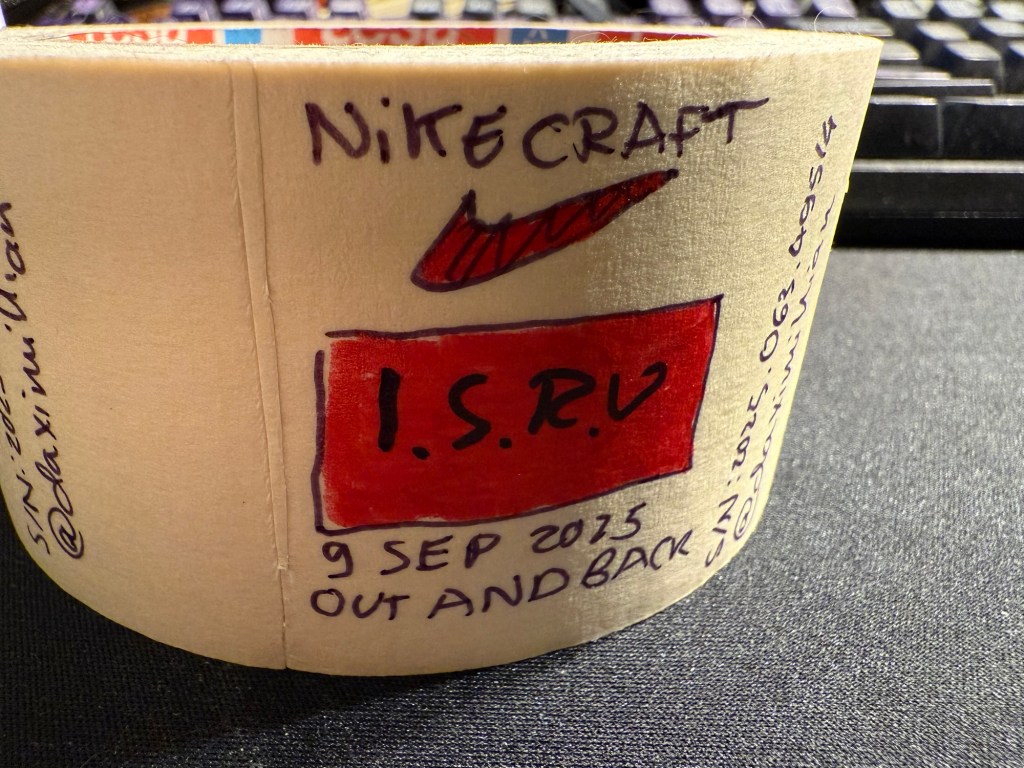
Tape waiting for the Out and Back ritual

So what’s the deal with the shoes? You can see a film about the Mars Yard shoes here, but for me personally they are just cool shoes with an interesting design story. I downloaded the app out of curiosity and even though I participated in all the “rituals” and am currently in the 95th percentile of people on the ISRU app’s leaderboard, I doubt that I will get the chance to purchase them.

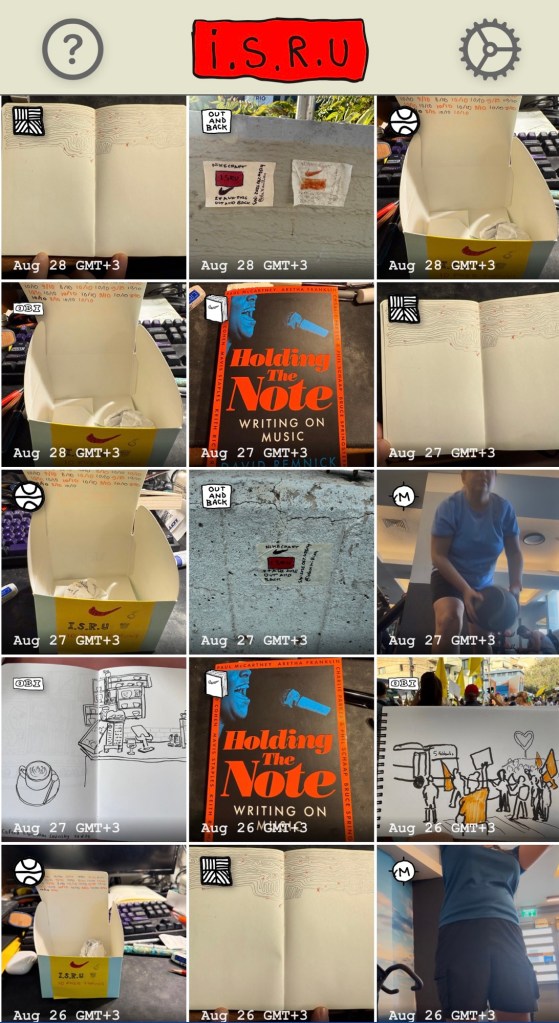
Part of my wall in the ISRU app.

I’m writing about this challenge and this app because after a month and a half of participation I think the rituals and habits that I garnered from the experience are worth sharing.

There are six daily rituals in the app, and they were revealed week-by-week. If you plan on participating, I’d suggest adding all the rituals gradually and in the same order that they were added in the app: you are building a set of disciplines after all.

The rituals are:

  • Ten Free Throws – shoot 10 free throws at something. I settled on a small box and a crumpled piece of paper as a ball, and I use an orange and a black sharpie to keep score on the box. This seems silly but it’s a lot of fun and a quick palette cleanser in the middle of the day.
  • Output Before Input – if there’s only one ritual/habit that you should take from this it’s this one. When you wake up, don’t reach for your phone. Create something instead. I started out this ritual by journaling, but now I’m sketching in the morning and it’s the best way to start the day.
  • Out and Back – another great habit – run for 20 minutes, and mark the halfway point. I run for more than 20 minutes usually, and there are rest days when I walk, but this has been a great reminder to get out there and move.
  • Wall Drawing – tire out your arms with push ups, and then draw a line on a “wall” (either a real one or a piece of paper). Stop when your line touches a previous line or when you lift your pencil up from the wall or when you reach the end. Mark your stopping point with a red X. This is a way to get push ups and some interesting artwork done.
  • Read Before Bed – read a physical book before bed instead of staring at a screen. Excellent ritual, and one that I really needed.
  • Medicine Ball – create your own medicine ball out of cans, bubble wrap and duck tape (I used the one in the gym), and perform 5 daily exercises with it.

Apart from these there was a one time “Choose Your Ritual” challenge where you had to create a 1 minute or less movie about your ritual and upload it to the app. This was a tough challenge, but it got me to learn iMovie and how to edit videos on my phone, so I really appreciate it.

Even though the challenge has ended I’ve decided to continue doing these daily rituals and updating the app. These are just good habits to have and the ISRU app is a pretty great habit tracker for these.

There are also some great films that were uploaded to the app as part of the challenge. My favourite is How to Learn How to Surf.

How about you? Did you participate in the challenge? Are you interested in any of these rituals?

Weekly Update: New Journal and 10 Years of Writing at Large

It’s been a while, mostly because life has been hectic, not because I don’t have things to write about. Here’s to trying to get more posts in, even if they aren’t perfect or particularly long.

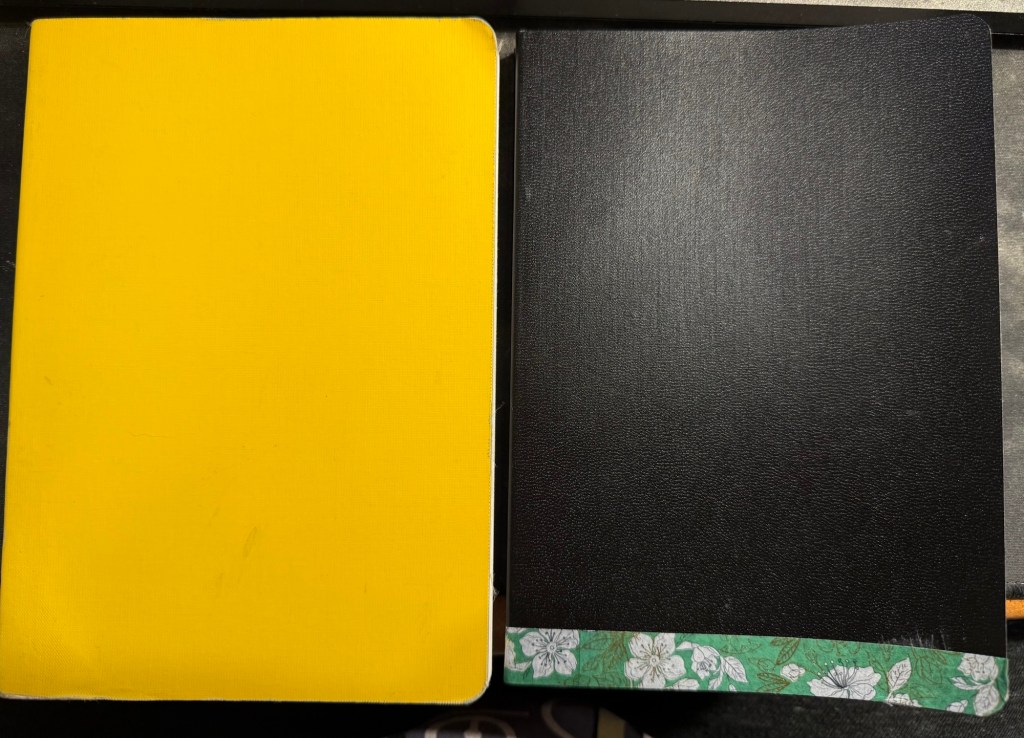
I’ve just finished another journal (the yellow one on the left in the photo below) and have set up my new one. Both are Stalogy 365 B6 notebooks, and both have a similar initial setup:

1.I flip the notebooks upside down so that the header with the dates is on the bottom and out of the way, as I don’t use it.

2. I use the front endpaper to write an “in case of loss” message (my name, email, phone number and a request for the finder to do the right thing).

New journal on the right, old journal on the left.

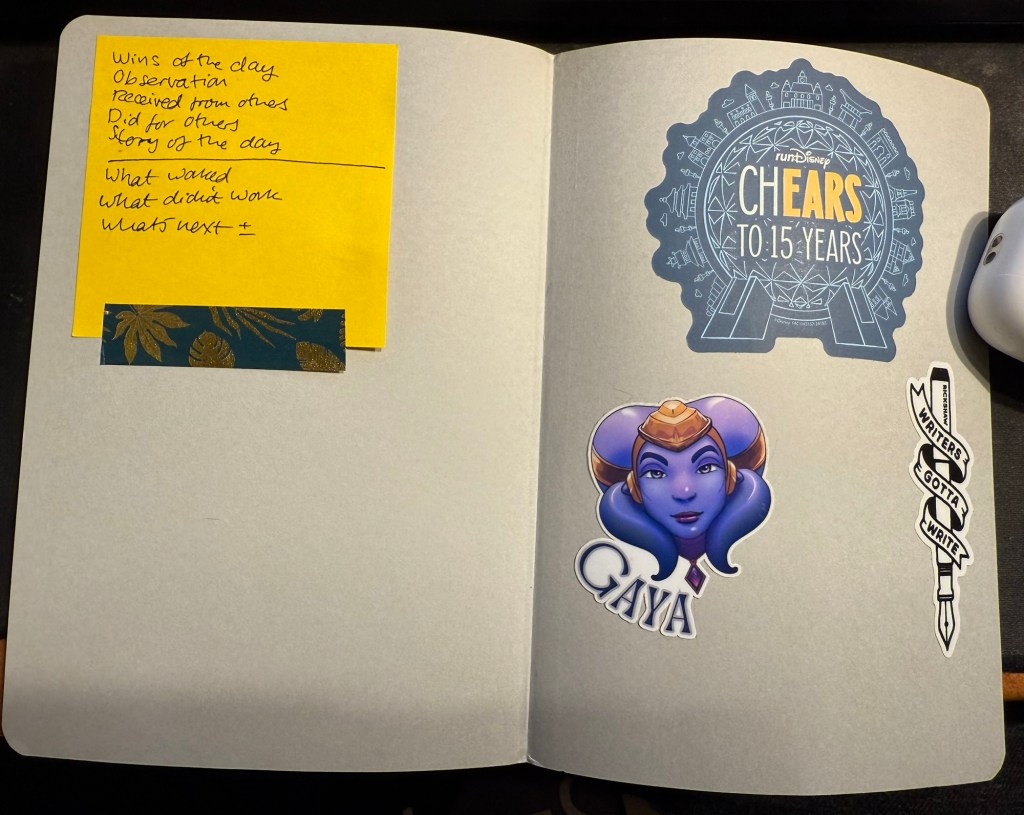
3. I use the back endpaper as a sort of “dashboard”. One side gets stickers on it, the other gets a post it with some journaling and review prompts.

Endpaper view of the new journal.

My new journal’s cover was damaged in transit, so I covered the worst of the damage with washi tape. It adds some character to the black cover, and if it gets too grimy or peels off I can always replace it.

My old journal lasted me for 5 months, which is about what these notebooks last for. My Moleskine journals lasted for 3-4 months because they had fewer paged and I used them for scrapbooking as well.

In other news “Writing at Large” is 10 years old. I never thought that I’d be publishing it for so long, but I’m glad that I started it way back in July of 2015, and I hope to keep it going for many years more. I’ve been through a lot over the past decade, and this site reflects a tiny part of that. If I can recommend something it’s to invest your time in your own site and your own work instead of on social media. If you persist, it pays dividends.

Reading

Finished The Day of the Jackal by Fredrick Forsyth and found it fascinating. I’m planning on reviewing it here.

Started on We Solve Murders by Richard Osman and I’m working on some Ulysses posts.

Health and Fitness

It’s getting hard to run outside, harder than it ever was, in this heat and humidity. Global warming is making treadmill runs more attractive. I’ve started using the NRC app‘s guided treadmill runs and they are pretty good and making treadmill running more bearable.

Have a great week and be kind to each other.

Three Habits Worth Keeping

Happy New Year!

This is the time of year when people set resolutions, themes, goals, intentions, words of the year, etc. Ambitions are high, intentions are good, but well before March most of these efforts will be abandoned and forgotten. I’ll be writing about my quarterly plan and my 2025 planner later on, but for now here are three habits that worth keeping in 2025 and in general, and a few tips on how to get into them and persist:

Exercise

Any amount and any kind that you can do is excellent. Let’s repeat that: ANY amount of exercise and ANY kind of exercise is a tremendous win. Start with walking if nothing else speaks to you, but try to make sure it’s a brisk walk and not a shuffle if you can. It doesn’t need to take an hour, and it doesn’t need to be 10,000 steps. Remember, anything you can do is good. Local gyms and community centres usually have classes you can try out if you want to give yoga, pilates, kickboxing or jiujitsu a try.

Running offers the best “bang for your buck” in terms of time and money invested per health and fitness gains, but not everyone can run, and not everyone enjoys running. If you want to give running a start, I recommend using any “couch to 5k” app, and then transitioning to the excellent guided runs and training plans in the free NRC app to keep you going. If you need someone to keep you accountable, either join a group of some sort or find a friend or family member to work out with.

The NTC app offers a huge variety of training options – from yoga to full equipment gym workouts, with some excellent body-weight workouts in between. Swimming is a great low impact way to build up cardio and a bit of strength, and weight-lifting isn’t as intimidating as you think – a pair of dumbbells at home is a great way to start exploring it. Yoga with Adriene is great way to get into yoga if you don’t or can’t take a class and the NTC app seems too intimidating.

Soccer, basketball, baseball and other group sports are great ways to expand your social circle, and tennis, pickleball, badminton are great ways for couples to work out together.

The easiest way of getting into the habit is doing a little something every day, and doing it as soon after you wake up as possible. That way you start the day with a win and some endorphins, which is always a nice way to start your day.

If you think you don’t have time to work out, be honest with yourself and track your time for a day or two. How much time is spent on social media? Binge watching TV? Mindless scrolling? Could you cut some of that out? Could you go to sleep a little earlier and wake up a little earlier so you can have some alone time to exercise and clear your mind?

If you already have a solid exercise routine in place, take the time to diversify it if you can. This goes particularly to us runners: strength train. Swim. Cycle. Do things that aren’t just running, because just running is one of the main causes of such relatively high injury rates amongst runners compared to other athletes.

Reading

Most people don’t read, which is their loss because reading is a superpower. Train your brain off the social media dopamine hamster wheel and teach it how to focus for significant stretches of time by picking up a reading habit. You’re standing in line bored? Open your Kindle app and pick up that detective novel or space opera from where you left off. Replace TikTok, social media and YouTube with books, and make sure that they’re books that you want to read. Don’t go off bestseller lists or influencer recommendations or whatever one this or that award, or is considered a classic. When you’re getting back into reading you need to gradually train your mind to get used to this activity. Start with a book that really interests you (not one that’s impressive), and start with a physical copy because they’re easier to read. Reading will do to your brain what exercise does for all of your body: make you better, stronger, faster, healthier and happier.

If you’re already a reader, then mix things up a bit: if you only read non-fiction, read fiction for a change and vice versa. Try something new, because you may just end up liking it. If you’ve only done light reading so far, pick a challenging book and work your way through it. Treat your brain like a muscle you are training, where you gradually progress to bigger and bigger weights. Challenging books are often the most rewarding, but you probably should start with them.

Journaling

Digital or analog, it doesn’t matter, journaling is worth doing. Gain insight to yourself, unleash your creativity, and let loose to your thoughts in a safe environment. This is the path to self improvement, learning to be kind to yourself, and having a positive mental attitude towards life.

If you’ve never journaled before, start small and simple: pick a notebook that you will enjoy writing in (whatever speaks to you, no matter what other people think), use whatever pen or pencil you fancy, and write 3-5 things you are grateful for each day. Add more sections to your daily journal as you go along: a “story of the day”, an account of what you did or what you consumed and what you thought about it, a nightly summary, etc.

Make it a ritual of sorts: write in your journal every morning and evening, every time you switch between major tasks during the day, or when you feel the need to respond to something (don’t post online, post in your journal instead).

Don’t be intimidated by gorgeous and elaborate works of art in various journaling forums, blogs and on Instagram. These are journals as craft projects, and while they are nice, they aren’t what we’re trying to get to here. It’s OK to add stickers and bits and bobs to your journal, but its purpose shouldn’t be to be photographed and posted. It’s there to work for you, so treat it like a workhorse, not a circus pony. Also, remind yourself that many of these journal photos are there to sell: stickers, washi tape, pens, notebooks, ink, the poster’s journaling course, etc. People rarely show off their “real” journals because if you’re honestly journaling only for yourself, that’s just not something that you’ll want to share.

Shana Tova and Quick Update

  • Shana Tova to all who celebrate the Jewish New Year. The passing year has been an extremely tough one on a personal and national level. I sincerely hope that the coming year will be better in every possible way, that the hostages will return and we will have some much needed peace in our region.
  • I’ve had a lot of the worst kind of upheaval at work during the past two weeks and so I haven’t been keeping up with all the comings and goings in the stationery-sphere. There has been drama of the ugly kind, which I don’t intend to get into. I will just say that this blog is LGBTQIA+ friendly (I am a member of the community myself), and anyone equating homosexuality to murder is both extremely wrong and very hateful person.
  • I have had to take a break in the SketchingNow Travel Sketching course but am now returning to it and will be making a post about the second week of classes (Shapes).
  • I will not be participating in Inktober this year. I just don’t have the time for it, and I want to focus on working through the Travel Sketching course instead, as I have some travel planned for later this month and I’m hoping to incorporate what I learned into my travels.

How I Use My Notebooks: Gym Journal

Here’s an idea that I haven’t seen discussed before: take a pen and a pocket notebook with you to the gym and journal in between sets.

This is my gym journal:

Moleskine Pocket lined hardcover Mickey Mouse limited edition and Zebra G-405 pen

It’s a battered Moleskine pocket hardcover lined notebook, a limited edition Mickey Mouse one from years ago. There was a series gash in the spine, so I fixed it with some gaffer tape. I use a Zebra G-450 gel ink pen, and it lays down a bold, 0.7 black line.

I don’t use this notebook during every gym session, but when I’m trying out new things, when I’ve got a lot on my mind, or when I’m trying to solve a specific problem I take it with me. I don’t write details about my workout (rep numbers, weights, etc) as I have an app for that.

So what do I write in this notebook?

  • How things felt during the workout, particularly when I’m trying something new or if I’m recovering from an injury.
  • Notes on other gym goers bad behavior. I don’t want to confront them, but I do get frustrated when people don’t return weights, don’t use a towel or wipe down the equipment, and hoard equipment during the gym rush hour. Writing it down allows me to let off steam and focus on more productive things (like my workout, or returning equipment that I know is no longer in use back to its place, or on anything else).
  • Ideas or projects that I’m brainstorming at the moment. I oftentimes use a workout to think about something I’m considering or something I’m stuck on. I jot a few notes in between sets to not forget the ideas I came up with during that time.
  • Things I want to journal about later, in my “regular” journal. These are usually things that I forgot to journal about and want to get back to later in the day, when I have time to sit down and better process them.

The main point of this journal is to get me as much as possible off my phone. It’s tempting to check the news for the umpteenth time, or doom scroll various feeds, or play mindless games while you wait between sets. My goal is to bring these habits down to a minimum, and this journal is a useful tool in the search for less screen time.

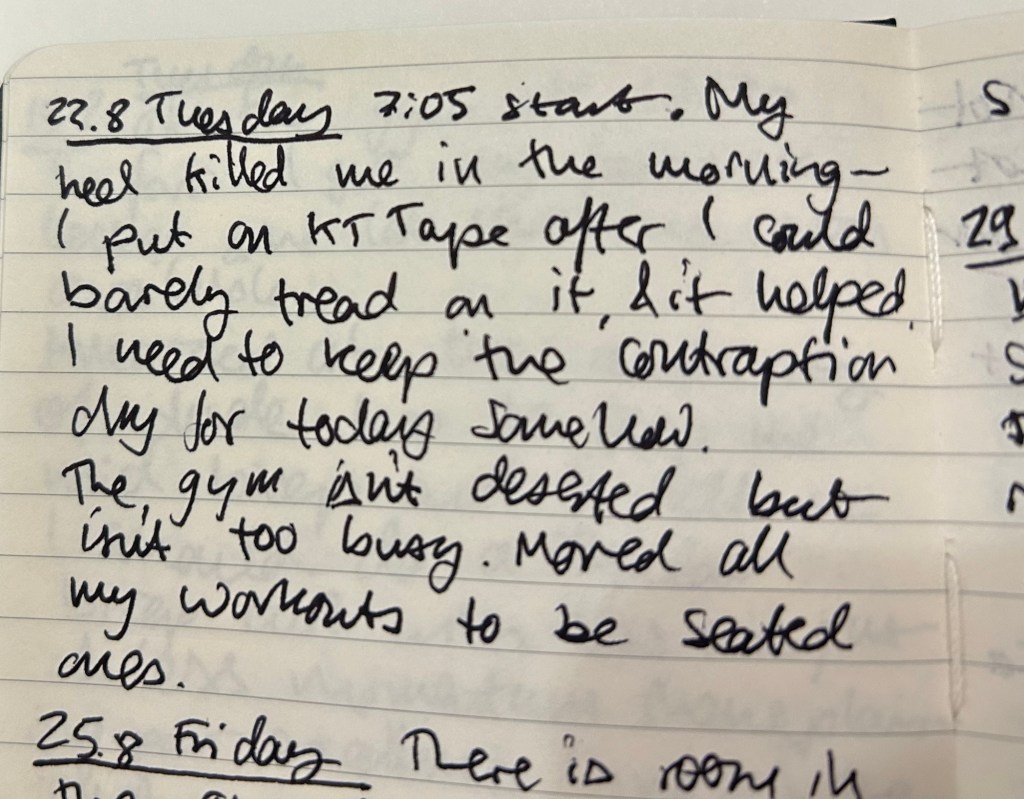
Sample entry from last year. I write with gym gloves on, hence the atrocious handwriting.

I originally thought that it would be embarrassing to use a notebook in the gym, but I decided that “so what, who cares” is the attitude to take in this case. People do much more embarrassing things at the gym and nobody comments on it. I use an inconspicuous notebook that isn’t at all precious, and a hardy, inexpensive, inconspicuous gel ink pen to go with it. Both have survived falls and encounters with misplaced weights, so they are gym hardened, Don’t bring large, colourful notebooks with you, and don’t bring pens that look expensive or draw attention to themselves. You’re going for the “boring, not worth paying attention to” look here.

Would you consider taking a pen and notebook with you to the gym? If you already do, how do you use your gym notebook?

Journaling Series: Journaling in Response to Media

There’s a new show out on a streaming service and I’ve started watching it. It’s part of a large franchise with a vocal fandom, and as usual, the fandom has opinions. These opinions are extreme, because that’s what social media and news sites amplify. Outrage sells. Hate sells. Abusive bot attacks drive up traffic and “engagement” so why should these companies stop them?

I too have opinions about this series, but they aren’t of the outrage kind. A few years ago I would have expressed them on Twitter, More recently I would have written about them in various group chats. These days I do neither.

I journal about them instead.

We have been trained to think that our opinions on the media we consume must be packaged attractively and shared as widely as possible. We have been told that it’s our responsibility to go on social media and let everyone know how we feel about a show, a movie, an album, a book, about every bit of culture we consume. We have been told that it’s for the benefit of our friends and for the benefit of the artists we like. It is not. It is for the benefit of a small group of shareholders.

I have no interest in feeding the outrage machine. Screaming into the bot filled void does nothing but make you hoarse, miserable, angry, and possibly part of a mob.

I also realized that I’m not interested in entering a debate or an echo chamber about this particular series. I just wanted to clarify for myself what worked in this series, what didn’t, and should I continue watching it or not.

So I journaled about it. No outrage. No drama. Just me and a blank page having a bit of a think about a streaming series. There’s no personal affront here, no mob cheering you on to hurl abuse on the series creators, no mob telling you what to think about certain casting choices, plot choices or the series creators.

My thoughts and conclusions about this series aren’t interesting, just as the name of the specific series is irrelevant. I recommend this process with every bit of media you feel the need to share your opinion about, BEFORE you share your opinion on it. It’s what I do with the books that I review. It’s what I do about podcasts, movies, series and shows. It allows for a guiltless, safe place to voice my opinions, to consider and rework them. It’s also far from the maddening crowd, which means I know that these are my own opinions and not the regurgitated opinions of others.

If you’re interested in the process, here are some questions you can use as prompts:

  • Why did I start watching/reading/listening to this?
  • Who would I recommend this to?
  • Am I enjoying each episode/chapter? Am I looking forward to the next one?
  • What is my favourite thing about this show/movie/etc? What is my least favourite?
  • Bonus: How would I change the show/movie/etc to make it better? What would be gained and what would be lost with this change?

Do you journal about media? What prompts do you use?

Planning Update – How I Plan a 13 Week Year

This is the second post on this topic. For an explanation on the 13 week year read this post.

As life tends to constantly throw curveballs at me, planning ahead in short bursts has proven to be invaluable. During the previous quarter my dad went through an unexpected open-heart surgery and I realized that I’d have to find a new apartment in the not so distant future. If I had planned ahead for an entire year (goals/themes, the system is immaterial), I would have had to scrap all my plans on February. As it was, I made a few minor adjustments, and finished not so far from where I originally planned.

Just before this 13 week/quarter started I got some bad news about my cat. That’s going to affect my plans, which I made before I realized that he was likely dealing with cancer. That’s OK – my plans are short term enough to allow me to easily change them, and I’ve already built plenty of wiggle room into the plans that I made. Unlike themes, which I find to be to vague to be useful, or yearly plans, which are too long term to be practical in my circumstances, 13 week planning allows for just enough time to make meaningful progress in the key areas of my life whilst being short enough to allow me to quickly pivot if necessary.

How I Make a 13 Week Plan

This is my third round with 13 week planning, and I’m getting progressively better at it. Here’s what I do that’s been working so far:

  1. List all the roles and areas in my life and make sure I’m covering all of them. Some examples of the areas I use: Health and Fitness, Reading, Mental Health (important enough for me with my PTSD to have it under a separate area), Conversations (meaningful connections with friends – that’s face to face get togethers or one on one phone calls or zoom meetings, not WhatsAapp messages), French, Creative Projects, Film Photography (more on that in a separate post), Professional Development (this is the only work related stuff that I track at home), Decluttering (trying to prepare for a future move), Drawing, Blog, Money. Yes there are a lot of them, yes it’s worth listing everything down and addressing as much of it as you can with your plan.
  2. Figure out measurable goals that can be reached during the 13 week stretch. Where possible I set a bare minimum, easily achievable goal, and then stretch goals. So for instance the minimum reading goal is 6 books, with 8 books and 10 books as my stretch goals. This means that if the unexpected happens, it’s almost always only my stretch goals that are affected. It also means that I’m not setting myself up to say: “this is impossible, why even bother?” Every little bit helps, and it helps to be kind to your future self.
  3. Set up various scaffolds and aides to your goals. Wherever possible I use the app “Streaks” to help me hit my goals. I also use the great NRC (Nike Run Club) app to help me keep track of my running goals and challenge me there, and I schedule as many things as possible in my calendar ahead of time. GoodReads has a reading challenge that helps me track books. Then there is my weekly planning session, where I build up next week’s plan. During that time I go over all of my goals for the quarter and make sure that I’m hitting at least a few of them that week.
  4. When executing your plan, break things down to monthly, weekly and daily goals. Whether it’s X amount of running sessions a month, X minutes of exercise a week, or how much time you spent away from screens every day, the longer term goals need to be broken down to shorter term chunks for you to actually be able to do them. It’s also helpful when reviewing your weekly or monthly plan to see where your quarterly (or 13 week) plan was too optimistic. If, for example, you’re travelling for two weeks in August, you need to make sure you didn’t account for those two weeks during your quarterly plan, because chances are you won’t be able to hit very many goals during that time.
  5. Don’t be afraid to refactor the plan when major things happen. Your plan should be flexible enough to account for the small and medium sized surprises life throws at us (broken fridge, out of town friend unexpectedly drops by for a few days, you picked up a new hobby), but don’t be afraid to rethink your plans when the big things hit (major illness, unexpected move, promotion, job change, etc). You don’t score points for sticking to the plan – the plan is just a tool meant to help you achieve your goals.

My planning is done on paper, and then I use Fantastical (a calendar app) and Streaks on my phone to help me keep daily track of things. I look at my weekly plan almost every day, and I track things there as well. On a weekly basis I review my progress and decide what to focus on next week. If it’s a busy week I’ll select only a few relatively easy goals, for example. The point is to build a plan that is detailed enough to cover the most important areas in your life well, and yet allows for flexibility.

A small snippet from this quarter’s plan

Have you found this helpful? What tools do you use to achieve your goals?

Quick Update – Cats and Shoulders

I’ve had a rough few weeks, which is why there’s been a dearth of posts. At first I was sick, then I found out that my beloved cat has a tumour (as yet to be determined if it’s benign or malignant, but chances are that it’s malignant), then I almost lost him due to stress induced urinary blockage. We’ve been recovering from that over the past week, when my right shoulder decided to act up again with a pretty painful bout of inflammation. Writing has been a bit challenging under the circumstances.

That being said, I like this blog, I’ve kept it going for quite a few years now, and I have no intention of quitting.

The little prince recovering from his ordeal. They shaved him quite a bit, poor thing.

2024 Planning Update: The 13 Week Year

Back in January I wrote about trying a new long term planning system that isn’t the Theme System or theme based, and isn’t yearly goal based, but rather is based on breaking the year into four 13 week blocks, each one representing a fully independent quarter.

I’m now in week 11 of the second of these blocks (quarter two, to put it more simply), and I’m starting to plan the next quarter. While working on my plan I thought that it would be useful to document the procedure, talk about my review process, and discuss how I planned the previous quarters, how things went, and what I plan to do differently in the third quarter.

The point of this system is to break the year into more manageable parts. This allows for greater flexibility in planning, time to “recover” from life’s surprises, and time to work on meaningful, long term projects. On the one hand the entire year isn’t a wash when life deals one of its blows, and on the other hand you can allow yourself to express a realistic amount of ambition.

Starting the Third Quarter’s Setup

I use the Leuchtturm Bullet Journal for my planning, and it should last me to the end of the year. After that I’ll switch to a Leuchtturm 120gsm dot grid notebook, as I don’t use any of the Bullet Journal features in my current notebook.

The first bit is a bit mindless, but I prefer to see it as meditative. Each week in my planner gets two pages, and so I leave four empty pages after the last spread of the previous quarter. These four pages will contain my plan for the quarter, broken into various sections. More on how I build that in a later post.

Then I sit down and draw out 13 weekly spreads. On the left side of the spread I write down the days of the week and the dates, and on the right I just put a “Weekly Tasks” title with the number of the week in the quarter in square brackets. I do this in one sitting for the entire quarter, and it takes about 30 minutes because I don’t rush it. This is how the pages look at this point:

This is how it looks when it’s filled and in use:

The left side gets filled with my exercise plan for the week, major appointments, and important things I don’t want to forget.

The right side has my weekly goals, both in the form of various checklists with checkboxes and more general lists. This is where my quarterly goals get put into action – every Friday or Saturday I look at my quarterly goals, and then try to advance as many of them as I can in the week. Things become more quantifiable at this point, though it’s often only in my daily to do lists that they become real, doable tasks. My daily to do list is something that I write the night before on an A5 loose sheet of paper, and recycle once I’m done with it.

Next time I’ll post a bit more about how I create the quarterly plan.

How do you plan your year? How is your planning going now that the year is halfway through?

The Cancer Project: Hair Part II

Hair Part I is here.

I started losing my hair after the second chemo treatment. 

It was terrifying. 

You don’t realize what losing your due to chemo means until you’ve experienced it first hand. It’s not like your hair sheds more, as it does with women postpartum or when men start losing their hair after a certain age. 

It falls out in large clumps, without warning. You brush your hand casually against your hair and are left with a thick clump of it in your hand. It was like something out of a cheap horror movie, like some sort of farce. I had no idea my body could do that. Why hadn’t anyone told me that this was how it was going to be?

It also hurt. It was if my scalp suddenly felt the weight of each and every hair, and it couldn’t take it anymore. Imagine the feeling of having weights tied to each hair follicle, constantly tugging your hair down, and you’ll get some kind of idea how it feels.

I lost the most hair during the first shower after my second chemo treatment, and I couldn’t get to the hairdresser fast enough. “Off, I want all of it off!” I commanded him. He gave me a buzzcut that made me look like a punky 16 year old, but I was relieved. My scalp stopped hurting, and I didn’t see hair falling out in clumps anymore. Yes, my hair kept falling out throughout the treatments — normal hair falling out an a strange fuzzy plume growing instead only to fall out too — but I didn’t feel it and I didn’t see the scary clumps. That was good enough for me. 

You see it was these clumps that gave me a vivid visual representation of just what my body was going through. You don’t otherwise see the damage the chemotherapy is doing to each and every one of your cells — you just feel it. So when I go that buzzcut I was taking control, pushing the damage away so I could better handle it. Other patients react differently to this message — oftentimes with denial, or by fighting it. They hold on to every wisp of hair, they hope against hope that somehow they won’t be affected. 

At the time I thought they were being silly and immature and just causing themselves unnecessary pain. I know better now. This journey is excruciatingly hard and scary for anyone who goes through it. What gets you through, how you react to it, these are personal things that cannot and should not be judged, even by a fellow cancer patient. Some of us need to mourn through our hair. I needed to learn that and accept that. One of the things that helped me do that is the bitter realization that we live in a world where losing your hair isn’t a superficial change. 

More on that in Hair part III.