Book Review: M Train

“M Train” by Patti Smith is a book about drinking black coffee in various cafe’s around the world, and watching serial crime dramas. That’s a factual if somewhat facetious review of “M Train,” and if that premise appeals to you, then by all means, I highly recommend this book.

But wait, there’s more to “M Train” than that. Smith wrote a book about loss and dealing with loss, memory, and the crushing passage of time. The prose is beautiful: if Joan Didion would have used more drugs I imagine that this is exactly how she would sound like. There are vivid and impactful descriptions of places and objects, interspersed with a dream sequences, symbolic moments and sentimentality. Smith does fall short when it comes to bringing other people to life, something Didion excelled at. The other people in “M Train” remain fleeting shadows, insubstantial vignettes of themselves.

And this is what I felt detracts from the book: despite all the loss described in it, it lacked substance. The most vivid things about it are the dream sequences and the internal monologues, which makes the book a bit of a featherweight. Somehow in the end you are left with the feeling that all you have read was a book about Patti Smith drinking black coffee and watching crime series.

Journaling Series: 5 Year Diary

The intro post to this series is here, journaling for mental clarity is here, journaling through fear is here. Journaling to clear your mind is here. Journaling to work out choices is here.

I first heard about 5 year diaries a few years ago. The idea is simple enough: 5 year diaries have a page for every day of the year, but the page is divided into 5 sections. Every day for 5 years you write a few lines about your day, and in the end you have a diary that reflects on how you and the world around you have changed over those 5 years. You can see an example of such a diary here. There are also 3 year diaries that work the same.

I journal daily, and have journaled daily for many years (with breaks for a few months here and there), so you’d think that a 5 year diary would have little to no appeal to me: after all, what is the point of summarizing what I already wrote? That was indeed the case for a good long while, until a month ago to be exact. On the 22nd of July I sat down and created a 5 year diary for myself.

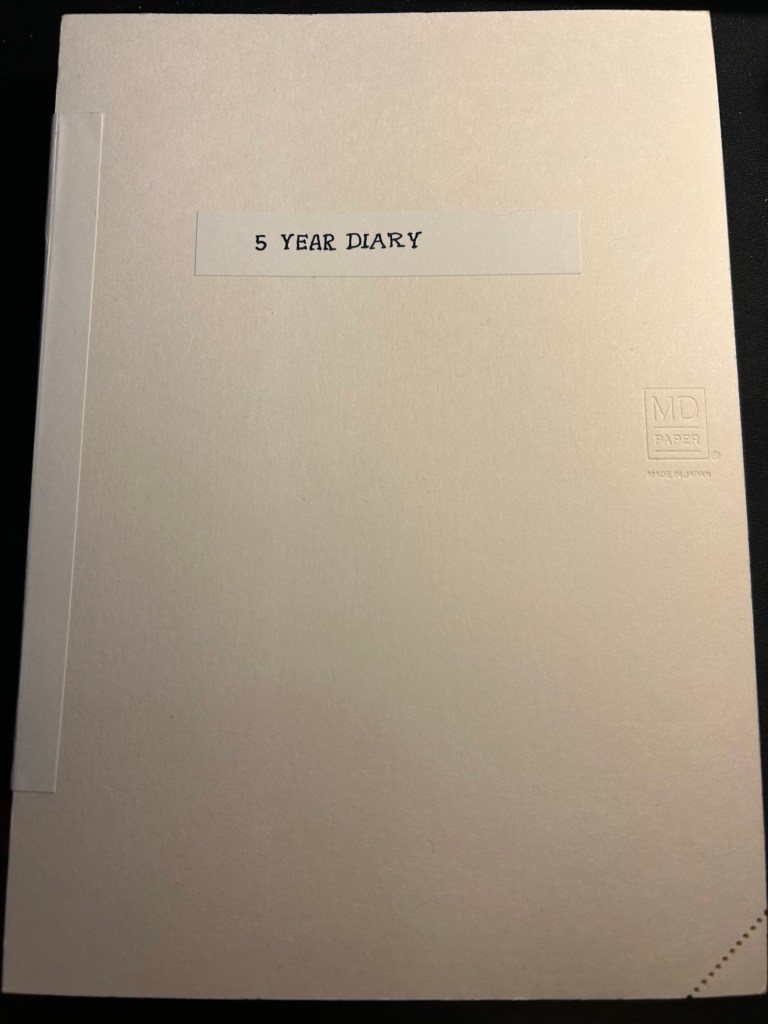
My own, handmade Midori 5 Year Diary

Midori makes beautiful 5 year diaries, but I found the format unappealing. I hate it when something has lines that don’t run all the way to the edge of the page, and I didn’t like the diary’s size and layout. So I took a blank A5 Midori Journal Codex that has one page per day, and created my own 5 year diary. I had purchased the journal on a whim when I was last in Paris, and I hadn’t found any use for it previously. It has 368 pages with no formatting beyond two lines on the bottom of each page that I used to write the day of the month and the month in.

Hand labeled diary.

This isn’t a notebook review blog post. It also isn’t a “you should start a 5 year diary” post, nor is it a “make it don’t buy it” post. It’s a “how I journal” post, and specifically, it’s a “how I journal for self improvement” post. It’s not titled that way because I have another post planned on this topic in the future. This is about a specific technique that I’m trying out now, and which may or may not work for me or for you.

How a page looks

Here’s what’s going on:

Like many cancer patients, I ended up with PTSD. Among other delights, my brain is firmly programmed to think that I don’t have more than a few days to live, so there’s no point in planning ahead. I used to love planning ahead, and I used to be very good at it. I had systems, and notebooks and planners galore. And now I have a brain that simply will not accept the fact that I will be around by the end of next week. It’s irrational, which is why it’s a mental disorder, but it’s also not moving. It started as a very useful coping mechanism, one that allowed me to survive from chemo treatment to chemo treatment, but now it’s refusing to go away, and it’s affecting my quality of life pretty significantly. Nobody likes to live with the constant thought that there is no future to look forward to (and to those curious, no, that’s far from the only delightful affect PTSD has on me. It’s just the one that’s relevant to this post).

So the state of things for the past two years is that planning ahead is like pulling teeth: painful, traumatic, and something that I try to actively avoid. So far I’ve had little to no success dealing with it, and you’d think I’d give up by now but I won’t because I’m stubborn like that. Which brings me to the 5 year diary as a journaling for self improvement practice.

I have an upcoming trip to the US at the end of the month, and I’ve been fighting my brain for the last two months trying to get it to let me plan for this trip. The trip is important and expensive and requires careful pre-planning and my brain has been super obstinate about me not getting to do that. Imagine having a phone call with your bank manager, high-school principal and class bully rolled into one and you’ll get a taste of what’s going on in my head every time I sit down and try to plan ahead. Are you getting heart palpitations? Are you hands sweating? Would you do anything to hang up the phone?

So on the 22nd of July I had enough of that. I took out the Midori notebook and dated 365 pages by hand out of rage. I was going to prove to my brain that I was here to stay, at least for the next 5 years. The idea was to create daily positive feedback, a trail of breadcrumbs that proves that I’m here to stay and I plan on staying alive for a while yet. As I write more than a page a day in my regular journal, I don’t get that positive feedback unless I stop and read back entries, and I rarely have time for that. The page layout of the 5 year diary, coupled with the fact that there is some show-through to the previous page, helps reinforce a constant reminder that hey, I’m not dead yet, and that I’m making good progress to keep staying alive. I wish I had thought of it sooner, so I could show my brain today where I was last year (the first year post chemo), and where I was a year before that (actively getting chemo or dealing with aggressive cancer), but better late than never.

Will it work? Maybe. It’s something that I haven’t tried before. Will this post help anyone else? Maybe. If you’re suffering from depression and anxiety maybe this will help. Maybe this is the way you start a journaling habit – after all, 2-3 lines a day isn’t much to ask, and I sometimes batch entries to 2-3 days at once. In any case I’ll update how the experiment goes as the year progresses, and if this does happen to help you, I’d love to hear about it.

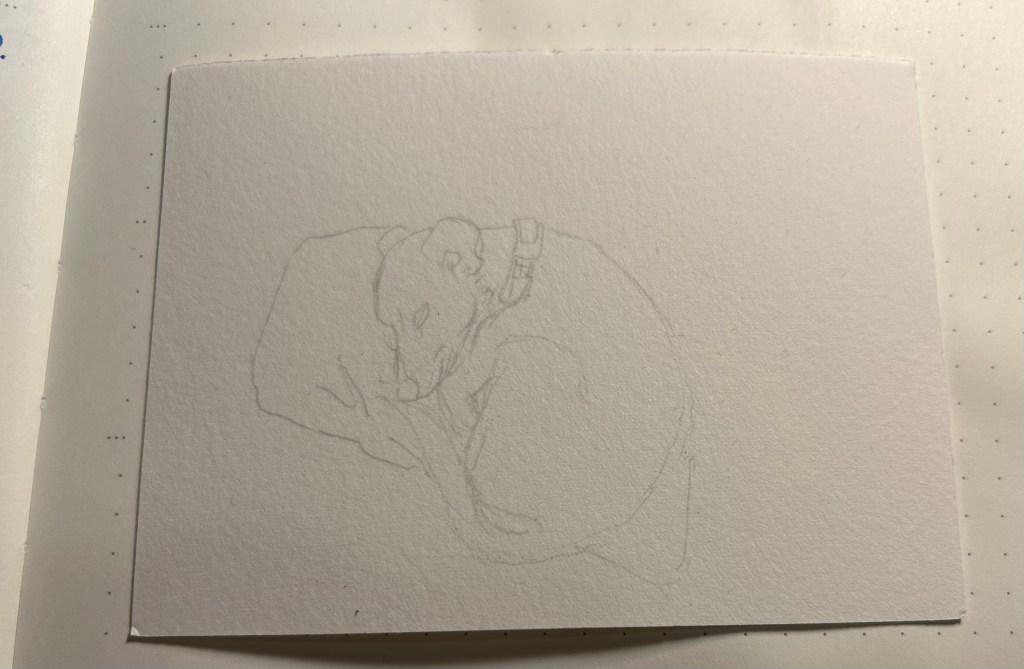
Quick dog sketch

Done as a gift for a colleague.

Pencil sketch

Used a 4H vintage pencil for the initial sketch.

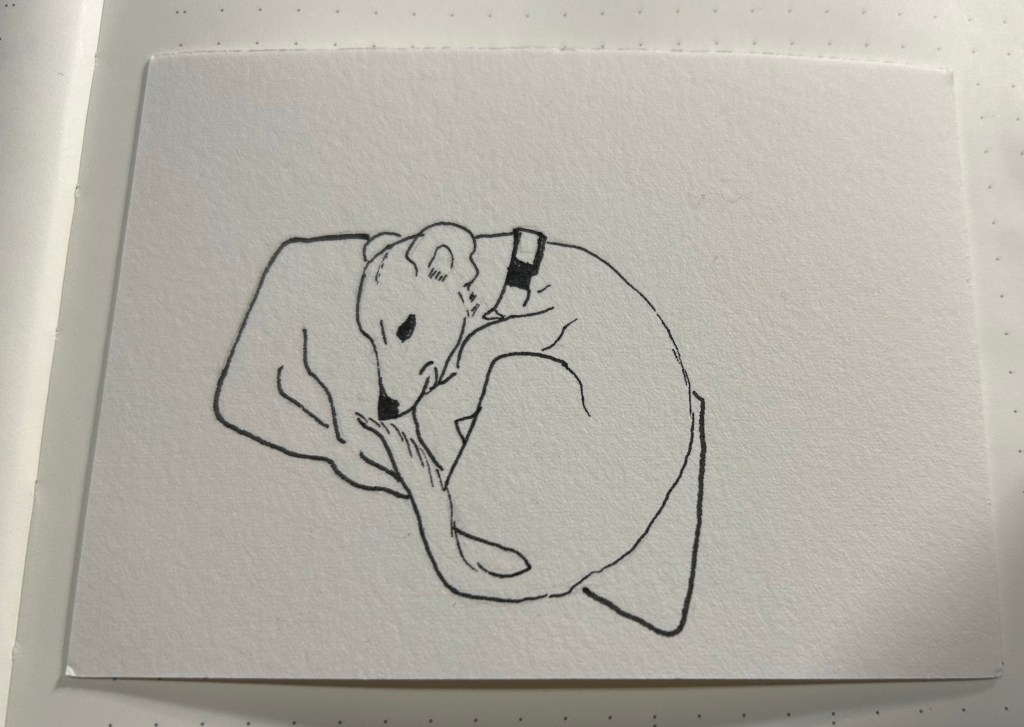
Inking

Used a Staedtler pigment liner 0.3 and 0.8 for the line work. Cleaned it up with a Boxy eraser.

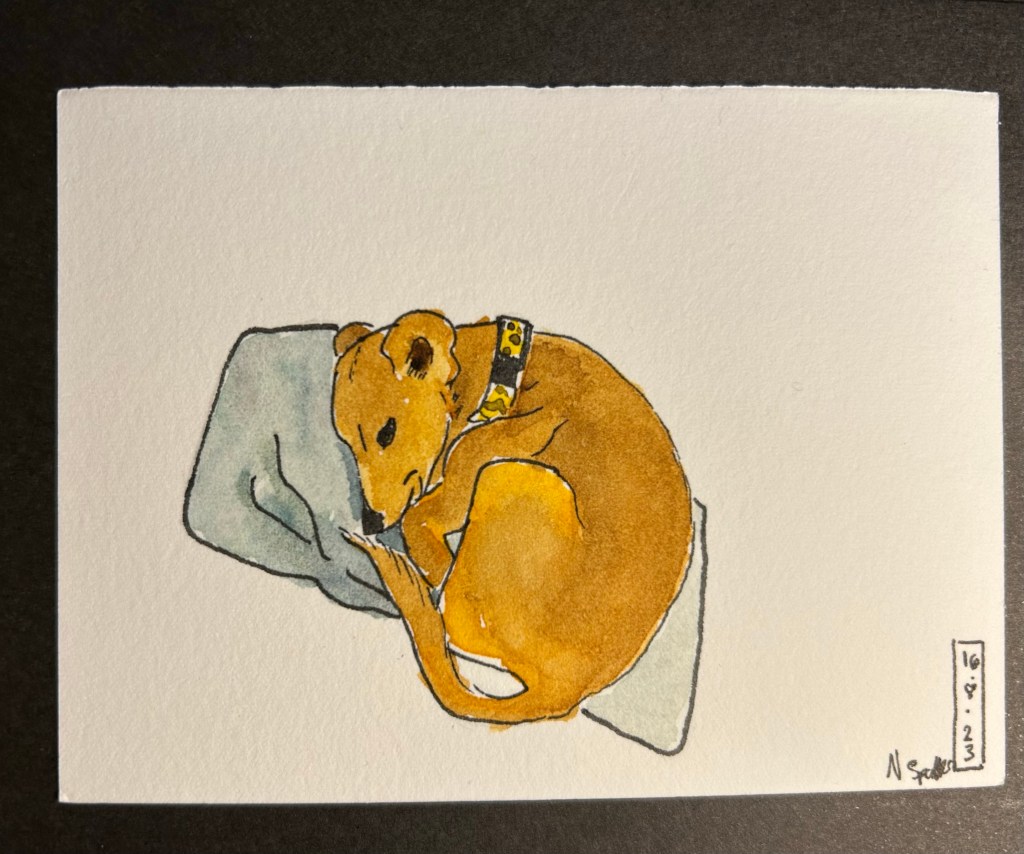
Finished sketch

Watercolours for the finished work. 15 minutes total with most of the time going on the pencil sketch.

Journaling Series: Journaling to Work Out Choices

The intro post to this series is here, journaling for mental clarity is here, journaling through fear is here. Journaling to clear your mind is here.

Journaling to work out choices seems pretty obvious: write down all your options in a table of some sort and compare them. There’s no need for a blog post on that. You know how to create comparison tables — the only trick to them is to find the appropriate comparison criteria to use.

This isn’t a post about how to compare a vacation at home with a vacation abroad, or which large screen TV to buy. This is a post about working through the tough choices in life, those that keep you up at night, those that torment you well before you make them and well after. If I’ve scared you off, you can jump to then end where I discuss journaling as a way to avoid the FOMO frenzy involved in all collection based hobbies.

Journaling to Work Out Tough Choices

There’s a pretty silly rule called the “5×5 rule” that states that if it won’t matter in 5 years, don’t spend more than 5 minutes stressing about it. That’s suposed to help people deal with anxiety and stress — like I said, it’s pretty silly and not very useful. If telling an anxious person “don’t sweat it, it won’t matter in 5 years” would have helped life would have been a lot simpler for a lot of people, but our brains just don’t work that way.

Instead I’d suggest trying this approach:

1. Open your journal and consider the issue you’re facing. Start by answering the following questions: is this a choice? Is this a choice that I can and should make on my own? Is this a choice that I can make now or does something need to happen first (someone needs to get back to me, I need to research something, something needs to happen before I can decide what to do)?

2. Is this something that will affect me and the people around me for 5 minutes, 5 days, 5 weeks, 5 months, 5 years?

3. If it’s for 5 months or 5 years — are you in the right mindset to make this choice now, or do you need to calm you mind first, get away and change perspective?

4. Imagine that a colleague at work is telling you about how they faced the exact same choice, and then imagine them selecting each option in turn. Do you think they’re an idiot? If someone else would say that they made the wrong choice could you defend them by articulating why the choice they made makes sense?

5. Imagine making a choice regarding the issue you’re facing, and then in six months from now defending/explaining your choice after it turned out to be wrong. How do you feel? Is there anything you could do to improve your odds of success?

These may sound a bit abstract so I’m going to give an example of how I used these prompts with one of the toughest questions I ever faced. This is going to get a bit dark, so if that bothers you, skip to the next heading.

Making a Really Tough Choice

Very early into my chemo treatments my oncologist told me that after my interim PET CT we might have to make a choice about the rest of the treatment course. If the results were bad (i.e. my cancer wasn’t responding well to treatment), then there wouldn’t be a choice to make: I’d have to go on more aggressive chemo, period. However, if the cancer was responding well to treatment, there would be several treatment options that we would have to discuss. I won’t go into all the options and discussions we had, I’ll just go into the main one: I could continue the full course of treatment at full dosage, or I could continue the treatment on a reduced dose and a smaller chemo cocktail. The full dose of treatment was harder on my body, would pretty certainly cause permanent neuropathy and perhaps damage my lungs and heart, but would provide the best chances of avoiding recurrence. The reduced dose was easier on the body, but provided less protection from recurrence. It wasn’t clear cut, there were no guarantees, and there was a good chance that I could go through the full treatment, ruin my body, and still have a recurrence – in fact a few months after I finished treatment that is exactly what happened to a woman that I was mentoring through the process. This is cancer, and that’s just the way it goes.

I had about a month to consider the options, and a few weeks to make my choice. It spanned a lot of journal entries, many of them repetitive, so the following is a condensed, cleaned up version of them all:

  1. Is this a choice? As my PET CT results came back with a good response to treatment, then yes, it was a choice that I could make. Is this a choice that I can and should make on my own? I talked to my family and I talked to my doctor several times, but ultimately I had to make the choice myself as I was the one that was going to have to live with the consequences. Is this a choice that I can make now? I added this question after having this debate with myself, in an attempt to stop the anxious “what if”in g in my head through the early part of treatment. I will be honest – it didn’t help. I knew there was no point in considering anything before my PET results came in, but my brain (actually, brains in general) didn’t work like that. I was in a constant anxiety driven “what if, what if, what if” loop, scanning for indication of treatment success or failure, information gathering obsessively, in what turned out to be the early manifestations of my PTSD. I’m being honest here so that if you use these prompts and they don’t help you, you won’t go beating yourself up about it. They are merely a suggestion, they may not help, and you may need more than journaling to get through certain points in your life. I know that I did.
  2. Is this something that will affect me and the people around me for 5 minutes, 5 days, 5 weeks, 5 months, 5 years? This was a 5 years kind of issue, so I felt fine taking it seriously and investing a lot of time and effort into making the best choice I could under the circumstances.
  3. Are you in the right mindset to make this choice now? I’ll cut to the chase – I wasn’t in the right mindset, I had no idea how bad my mindset was at the time, but it didn’t matter. I had to make the choice. Sometime you just have to make important, tough decisions when you’re not in the right mindset. That’s just life.
  4. I didn’t do the “what if this was somebody else’s problem” bit for this choice. I just couldn’t bring myself to do that.
  5. Imagine if you’ve made the wrong choice – I’m not going to discuss this here, because it’s very dark and pointless. I will discuss the odds of success bit though – there wasn’t much I could do to improve the treatment odds once I made my choice, but, and here’s the important bit, there were some things that I could. They were extremely tough and would provide minor improvements at best, but it was the best that I had, and minor improvements are not zero improvements. This is what made me drag myself out each day for a walk, even when my body was screaming that it couldn’t, it wouldn’t, it just won’t go on one step further dammit. It’s what made me isolate myself from people, follow my doctor’s and nurses’ instructions to the letter, etc. Maybe it helped, maybe it didn’t, there’s no way of knowing without a time machine really. The point is I made a choice and I did my best to make sure that it would be a good one.

Do I really want this or am I buying it out of a fear of missing out?

Hey, you’re here! It means that you’re interested in the lighter side of this exercise, which is basically journalling yourself out of FOMO. This is what I write in my journal to make sure that I’m buying something because I really want it, or whether I’m being carried away by the feeding frenzy of a new release, a limited edition, or a special “once in a lifetime” deal.

  1. Write down why you want the thing. If you are doing this exercise, then your reasons can’t be because it’s limited, because it completes a set, because you’ve bought every other thing in the series, because everyone is talking about it, because you think you’ll be able to flip it later. It also can’t be because it’s for charity – if you want to donate, donate directly.
  2. Write down how many other things similar to it do you already own, and when was the last time you used/appreciated one of them. How often will you be able to use the new thing?
  3. Write down an experience you could have with the money that thing costs – anything from a concert ticket, to a theatre/musical ticket, a meal at that place you’ve been wanting to try, an hour lazing about at that cool coffee place trying some new things to eat/drink, an entrance to the local climbing gym, a pottery class, etc.
  4. Write down what are the chances of a better thing popping up in the near future, and ask yourself if you’re buying this thing because that’s what you can afford now, but really you’d much rather splurge on a better thing.

Look at what you wrote down, and then wait a few days or a week, read it again and see if the thing you want to buy is still attractive to you.

And if you’re just looking for a nice pick me up, try shopping in your existing stash. I’m pretty sure you’ll find something there that will make you smile.

Two Drawings: A Real Dog and a Pretend Cat

Drew this for a colleague about to go on maternity leave. It’s a small watercolour of her parents’ dog:

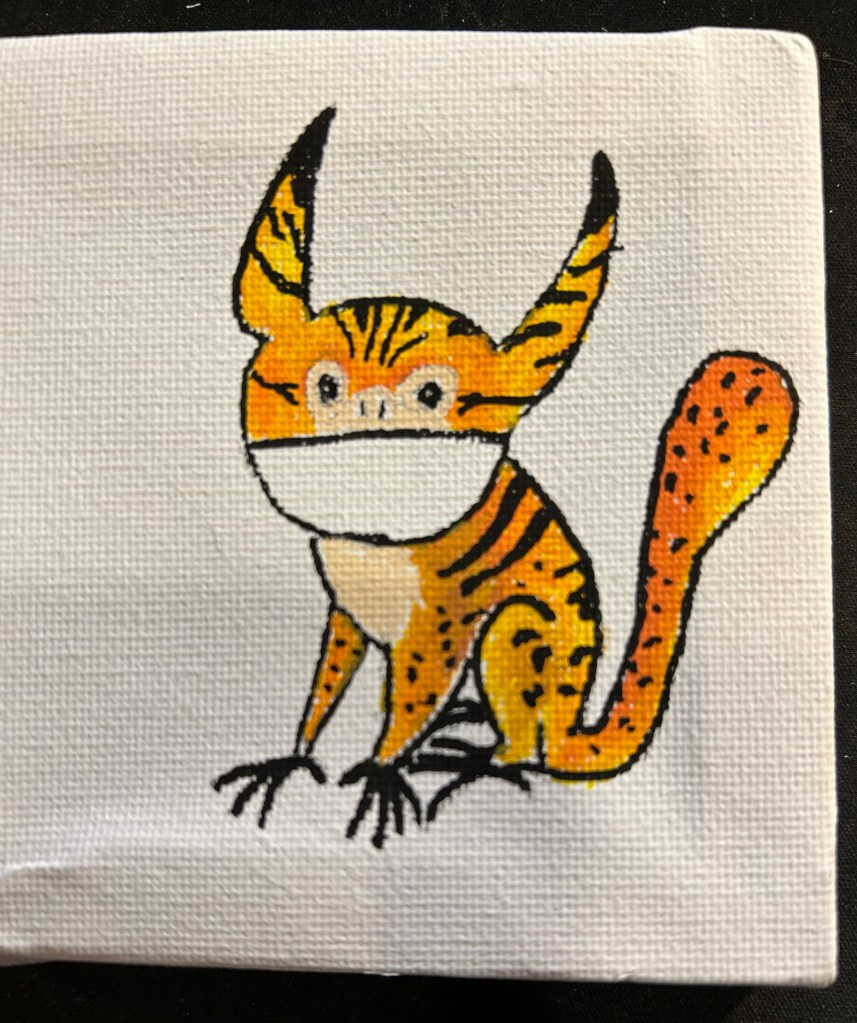
Drew this using Uni Posca paint markers. It’s a Loth Cat from Star Wars:

Both will be gifts. Which do you prefer?

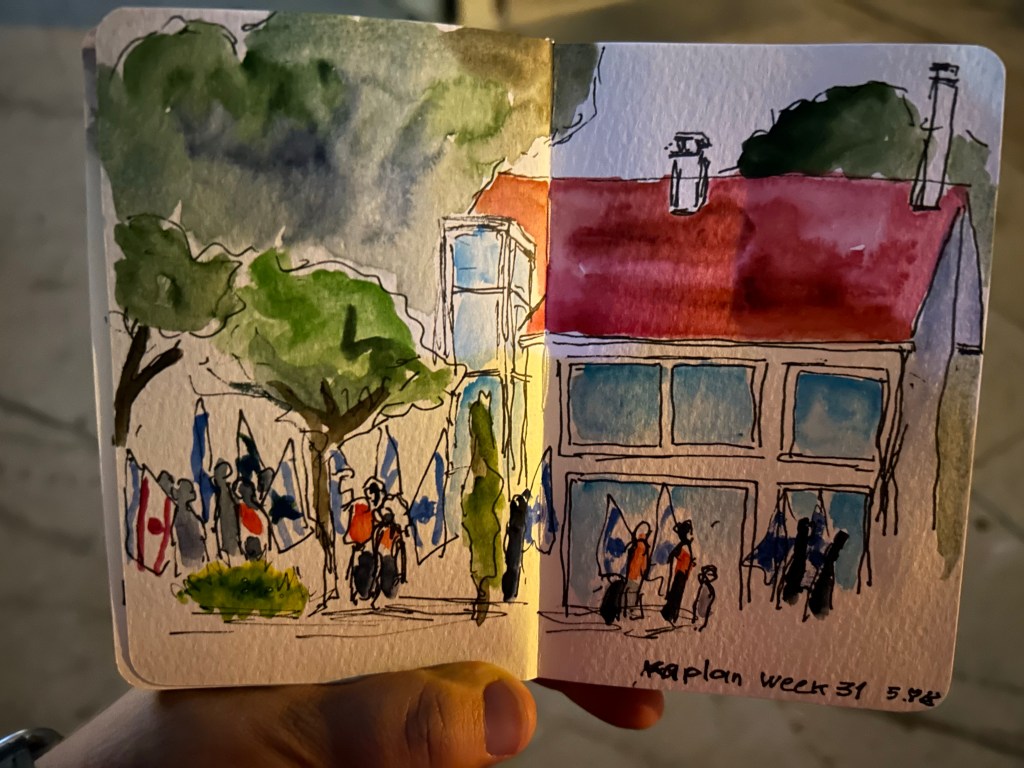
Week 31 of the Pro Democracy Protests

I had a tough week, hence the delay in some posts. I did go to the weekly central protest tonight, despite the terrorist attack earlier this evening in Tel Aviv.

Sketched this very quickly in the dark. Them took a photo of it in the dark, and decided that it captures the moment well.

Have a great week, and if you live in a democracy, don’t take it for granted.

Shopping from My Stationery Stash: Brush Pens and Lead Holder

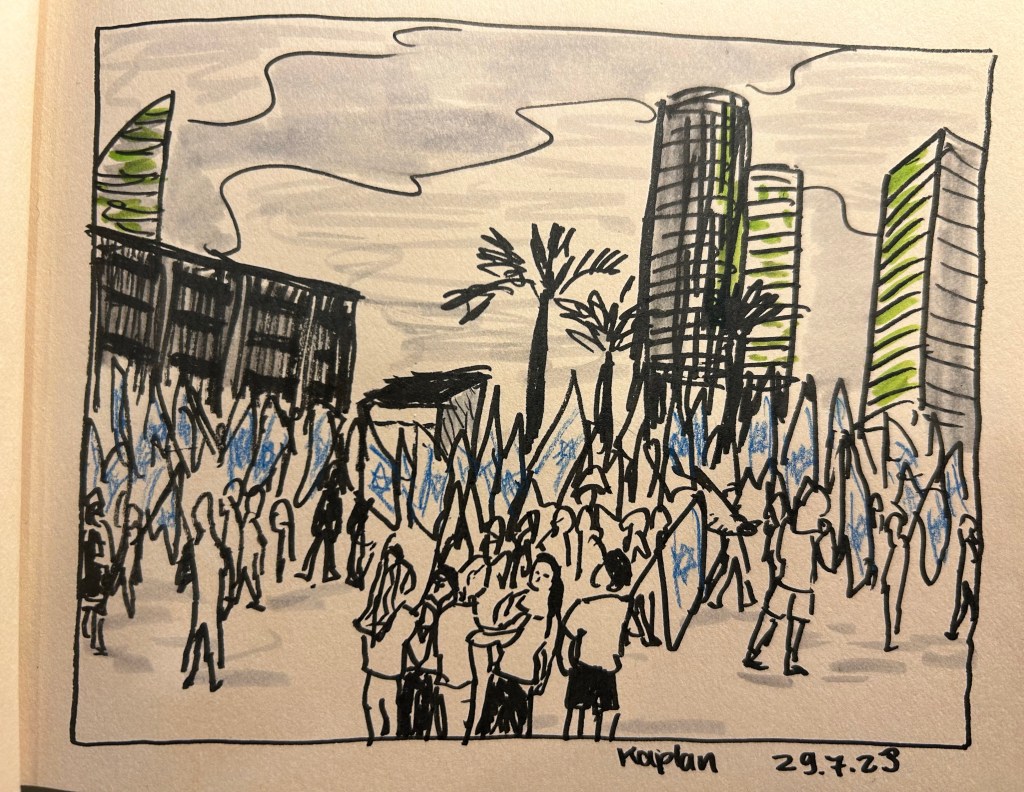
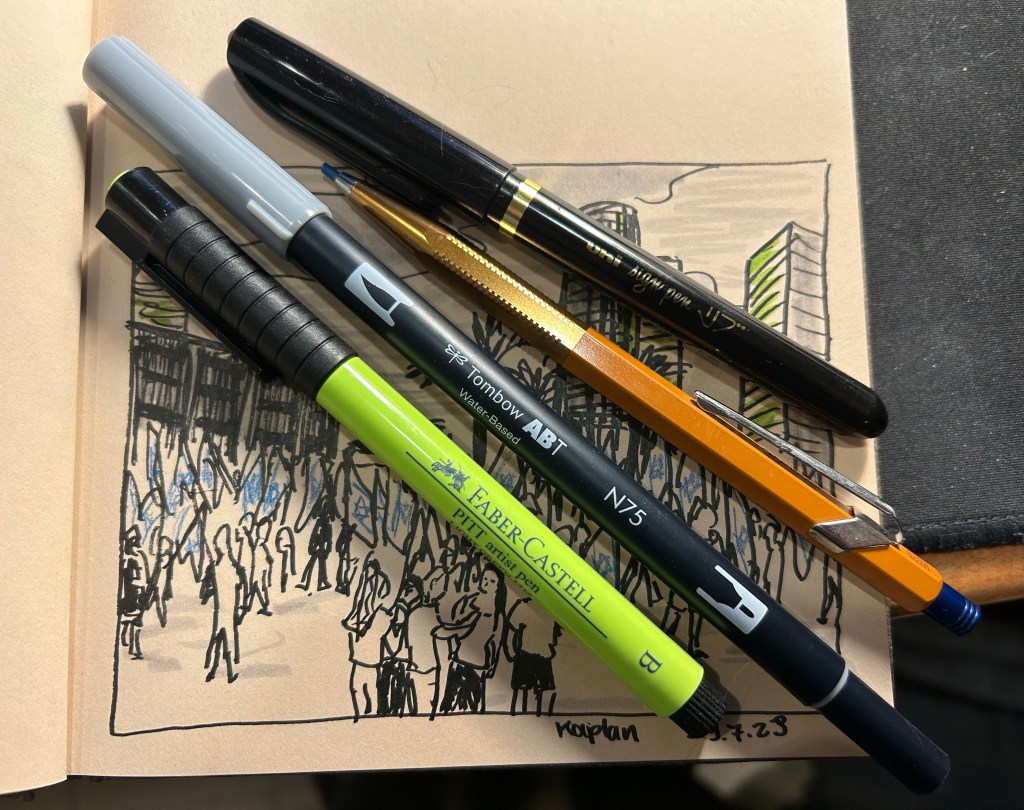
I went “shopping” in my stationery and art supply stash again, and this time used a Hahnemule Cappuccino sketchbook, a uni-ball sign pen, a Faber Castell PITT artist brush pen in light green (171), a Tombow ABT water based dual brush pen (I only used the brush side not the felt tip pen side) in light grey (cool grey 3 – N75), and a Caran d’Ache + Alfredo Haberli Fixpencil with a blue 2mm lead.

protest sketch

I used them all to draw the protest scene from this Saturday, using a photo I took during the protests. It was intensely hot and humid, and I went to the protests right after running a Dungeon World game at a small local tabletop roleplaying convention. With no art supplies on me, the best I could do was try and capture the scene to sketch later. When I was pulling things out to try out with this sketch, I decided to veer away from my comfort zone: I used tinted paper, a sign pen, mixed media, and an unusual colour. I like the result – for a quick sketch it captures the energy of the moment well.

tools used.

I like the Hahnemule Cappuccino sketchbook. The paper is smooth but has a touch of grain to it that makes it work for pencils as well. It’s way too thin for wet media, but works great for brush pens, pencils, markers, etc.

My main sketching tool was the Uni Sign Pen. This is the first time I’ve used a sign pen for “serious” sketching, as I normally only use them for illustrations that I gift to friends’ kids. I like it – it has relatively little line variation, but on the other hand offers more control, and a good bold line. If you are dipping your toes into brush pens for sketching for the first time, this might be a good place to start to get a feel for the kind of thick lines these kinds of pens create.

The Faber-Castell PITT brush pen is a classic, one that I’ve used many times before in sketches. I’d love to say that they don’t disappoint, but like most soft and medium soft brush pens, the tip doesn’t last for long. They do come in lots of great colours and if you cap them they last much more than many other markers and brush pens in the market. They’re also waterproof, which is a bonus if you’re mixing them with wet media.

The Tombow dual brush pen is completely new to me, and I liked it enough to want to add it to my current sketching setup. It works well for quick shading (and shading and colour make sketches pop).

The Caran d’Ache + Alfredo Haberli Fixpencil… This is something that I want to properly review sometime in the future, so it’s been waiting on my desk for a while. For now I’ll just say that it did the job, although I have other pens and pencils that would have done the job better.

I also sketched our friend Joe during our weekly Zoom meeting, also on the Hahnemule Cappuccino and using the Uni Sign Pen. This was a very quick sketch, done it 2-3 minutes, and the sign pen does well with expressive lines.

Our friend Joe.

Now go rummage in your stationery/art supply stash and find something new to play with. It’s guaranteed to make you smile.
Zebra G4-450Gel Retractable Pen Review

Never have I ever fallen in love with a standard pen faster than the Zebra G-450. Even the Uni-ball Signo RT 0.5 took a bit of time until it became my favourite, and I had much less experience with gel ink pens at the time. I liked the Zebra G-450 so much that after writing a few pages with it, I put in an order for two more packs, just so I’ll have backups and multiples of it.

So, what’s so special about this pen?

Zebra G-450

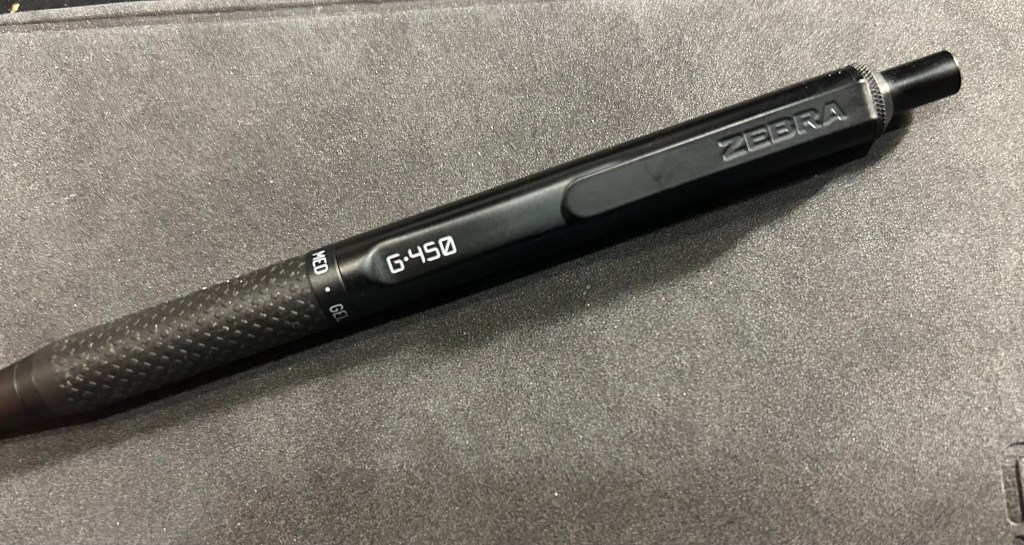
First of all, the Zebra G-450 looks like it was designed to be a prop in the Jason Bourne movies. It doesn’t have the “I’M A TACTICAL PEN, LOOK AT ALL THE WEAPON LIKE APPLICATIONS YOU CAN GET WITH ME” look of tactical pens. I find that look childish, and I find that it makes for very uncomfortable to write with pens. The G-450 is nothing like that: it’s sleek, features a durable and hefty-without-being-heavy brass body, knurling on the top, a very well designed rubber grip, and very Jason Bourne like fonts.

G-450

The G-450 has a well designed and solid clip, with a step down/cutout right in front of it that adds interest to the pen silhouette and makes it easier to clip onto things.

Step down, clip and fonts

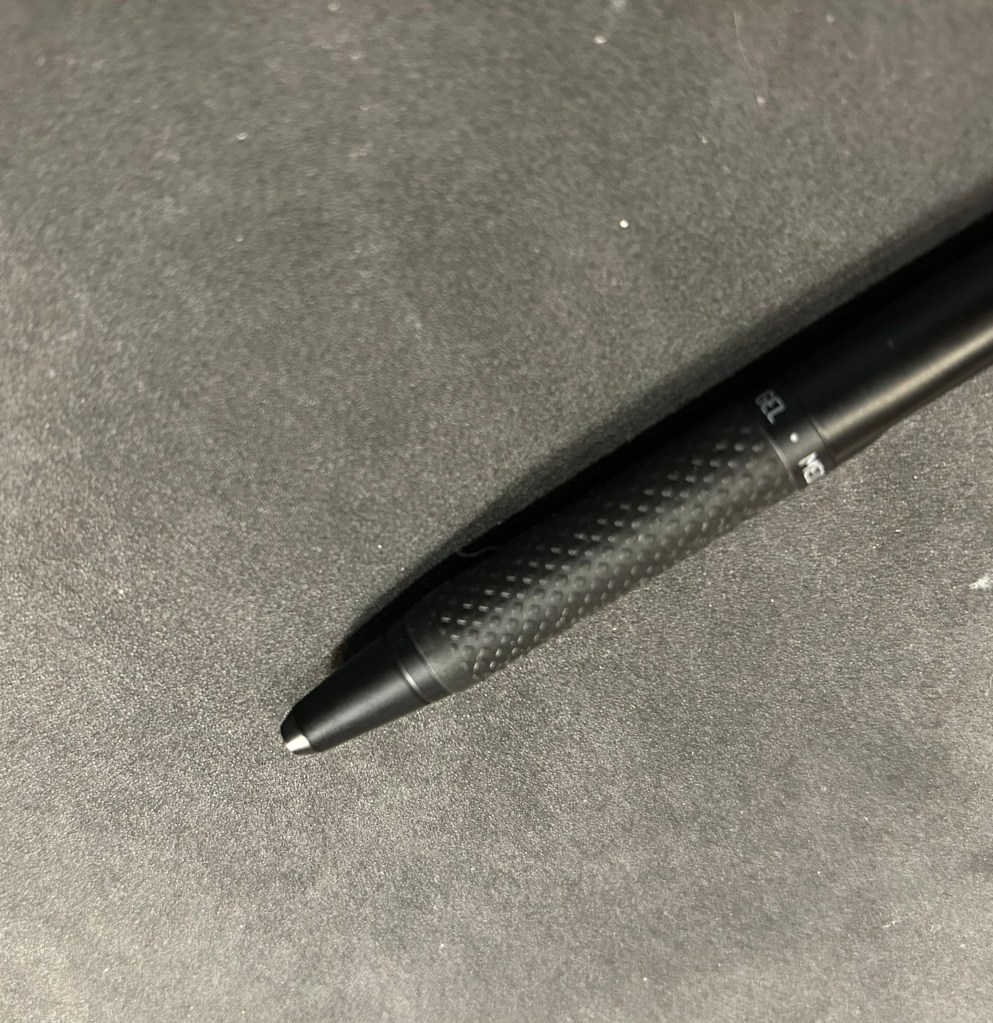
I love the console like fonts in white, and I really love the grip. It isn’t mushy like a silicon grip, but it is softer than the pen body, and with the raised pattern on it, gives you a rock solid grip on the pen. The ring on top of the grip announces that this is gel pen, with a medium (0.7) tip. The pen cone has an extra small taper towards the tip, adding interest and perhaps also helping stabilize the refill. There’s no clicking, jiggling or noise from the tip as you write with the G-450.

Grip closeup.

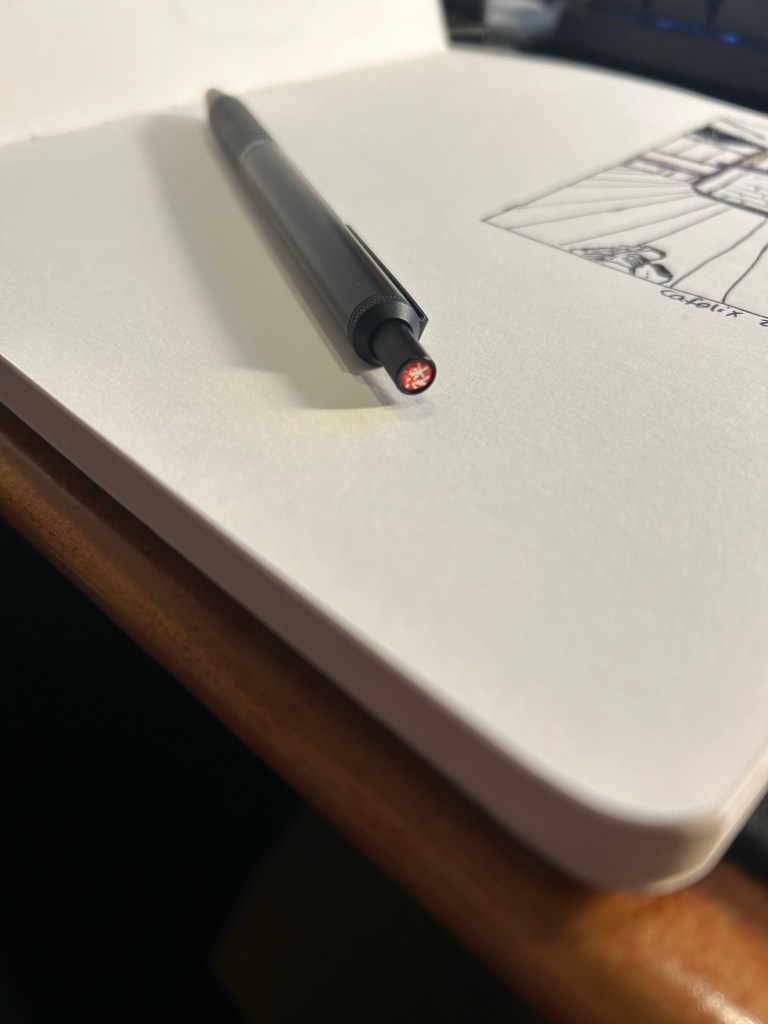
The click mechanism is solid. The clicker (is it called that? let’s assume it is) stays extended at all times, even when the tip is engaged, and it has a very satisfying click. There’s a red jewel with Japanese writing in silver on the end cap, and it adds a nice and subtle splash of colour to the pen.

end-cap closeup

All this is wonderful, but it’s the refill that makes it all sing. It’s dark, super smooth, and it dries almost instantly. Yes, even on Stalogy paper, even on Rhodia and other fountain pen friendly paper, it just dries as soon as you write with it. This is a perfect lefty pen (I’m not a lefty) and it’s perfect for jotting things down in a rush. It will write a bold, clear line, and not smudge.

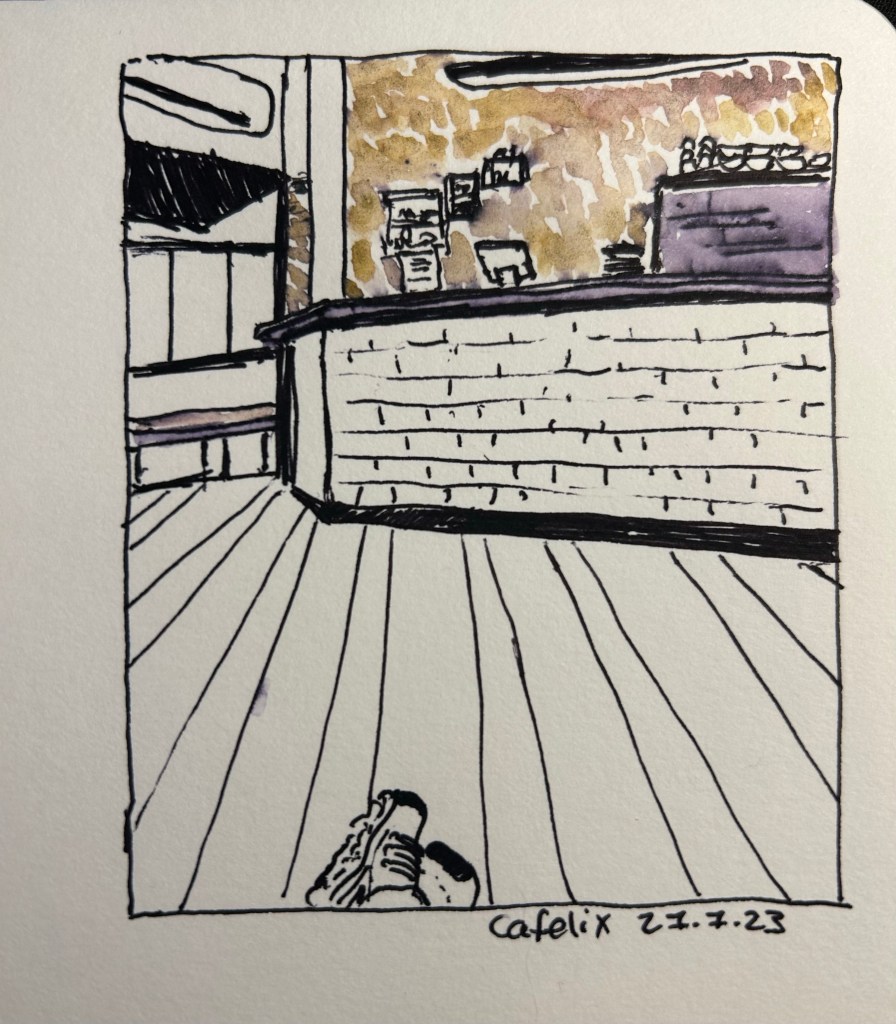
I sketched a local cafe with the Zebra G-450, on Stillman and Birn Alpha paper. I then “opened” up the lines using a waterbrush, as the the Zebra G-450’s fast drying refill isn’t waterproof (as is to be expected with gel ink pens). The result was a nice greyish purple that you can see on the coffee machine on the right. The coloured graphite was provided by the Derwent Inktense paint set, but that’s a review for a different day. Suffice to say that while the Zebra G-450 isn’t a sketching pen, it will work well as one in a pinch, as long as you like thick lines, and don’t mind it not being waterproof.

Rarely have I encountered a pen that I wholly like after just a day of use. I love the G-450’s aesthetic, its refill and its feel in the hand enough to immediately add it to my daily carry. I used Zebra’s wonderful G-301 pen daily for years, and I can see the G-450 easily replace it on merits of the refill alone. Sometimes a pen just ticks all the boxes for you, and this one clearly does for me. I recommend giving it a try if you possibly can. Who knows, maybe it will become a new favourite for you as well.

Journaling Series: Journaling to Clear Your Mind

The intro post to this series is here, journaling for mental clarity is here, journaling through fear is here.

There are many journaling methods and planning methods that tell you to “empty your mind onto a page,” or “perform a mind dump”. This is usually a first step on the way to some other goal: planning your week, dealing with anxiety or finding a direction in life, etc. From GTD to Morning Pages everyone expects you to press a hidden button and just directly dump everything on your mind onto your journal.

The idea is that by emptying your mind onto a page you will be able to free more “processing power” to more high level thinking and planning. Your mind will be free of noise, will be relieved of the need to track and remember things, and will be able to do what you really need it to do: make decisions, plan ahead, come up with new ideas, allow you to be creative.

This is great in theory, but in practice I find myself sitting at a desk with an empty page and and a pen, my mind buzzing with stuff, and the general instruction “just write everything down!”

Where to start? How do you pull out the first thread from all that tangled jumble? How do you focus on mind dumping and not reflexively go into the censoring, editing, sorting process?

How to Start Journaling to Clear Your Mind

Pick one of these prompts to start with. I’ll explain later why they work:

  • Time — what were you doing just before you sat down to write? What do you do plan to right after you stop writing? When did you last look at your shoes?
    The first question is very easy to answer and works when you feel overwhelmed. The second is good for when you’re feeling aimless and are looking to start planning ahead. The third question is there to surprise your brain into being quiet for a second. It’s best for when things in your head are really noisy and chaotic.
  • Place — Describe where you’re writing this, as if you’re writing it in a letter to a friend. Is there anything missing around you? What’s the last national dish that you ate?
    The first prompt is the easiest, and works best when you feel overwhelmed. The second leads to planning ahead – stuff to buy, fix, etc. The third question is there, you guessed it, to take your mind by surprise. If you’re brain is full of screaming demons or chaos monkeys, this may help.
  • Media — What did you read/watch/listen to last? What’s the next thing you want to read/watch/listen to? What would your favourite movie look like if it was remade as an opera?
    This is the most fun of the bunch, and the reasoning is the same as in the Time and Place prompts so I won’t repeat it.

Why This Works

First of all, it works for me, it may not work for you — our brains are like that. From my experience the mind tends to follow the initial thread you gave it, so at least for a while you don’t have to stare at a blank page wondering what to write down. The first prompts are very easily answered for that exact reason. None of these prompts are inherently emotionally charged, so you can start writing without first dealing with your emotional state (you can ease into that later, or not). The third prompts are funny and weird (you can pick others like them for yourself), because when things get really bad it’s useful to have them as a distraction. Trust me on that one.

How to Stay Focused on Mind Dumping

If you’re working on planning ahead, then the second question in each prompt category can help you get started, but in many cases that’s not the point of the mind dumping exercise. If that’s the case, keep a notepad or a piece of paper on the side and once something that looks like a task comes into your head, write that down there and not in your journal/morning pages. You can process it once you’re done writing.

How to Stop

Here’s something that’s also not always discussed: you need to go into these kinds of exercises with a hard stop in mind. Set a page limit, a time limit, or better — set both and stop whichever limit you reach first. Your mind is constantly filling up with stuff, and if you don’t put a hard stop you could chase it forever, or tire yourself out with the first session or two and then never come back.

Mind dumping is a useful process that is best done often (daily or weekly). It’s hard to get into the habit if you find it hard to start, if you turn it into a task hunting chore, if you expect the process to be anything other than letting the junk in your brain get onto a page so that you can clear your head. Hopefully the prompts and tips here will help you get into the practice if you want to. If not, you could always just use them as regular journaling prompts. After all, who doesn’t want to see their favourite film remade into an opera?

Going Shopping in My Stationery Stash: Choosing Keeping Notebook, Eberhard Faber EFA 1000, Tombow Irojiten and Koh-I-Noor Magic Pencil

Over the past 24 hours things have gotten very depressing and very scary here. To distract myself a little bit, I decided to start working on a new project: Going Shopping in My Stationery/Art Supply Stash. I have a lot of stuff. I don’t use enough of the stuff that I have, to the point where I don’t even remember what I have. As I’ve significantly cut down on buying new stationery and art supplies, I’ve decided this would be a good time to go “shopping” for new things to use in whatever it is that I already have.

I bought this fancy looking A5 composition notebook from Choosing Keeping in London this April, after eyeing their gorgeous notebooks the last time that I was there.

Such a great looking notebook. Yes, the cover has gold foil on it.

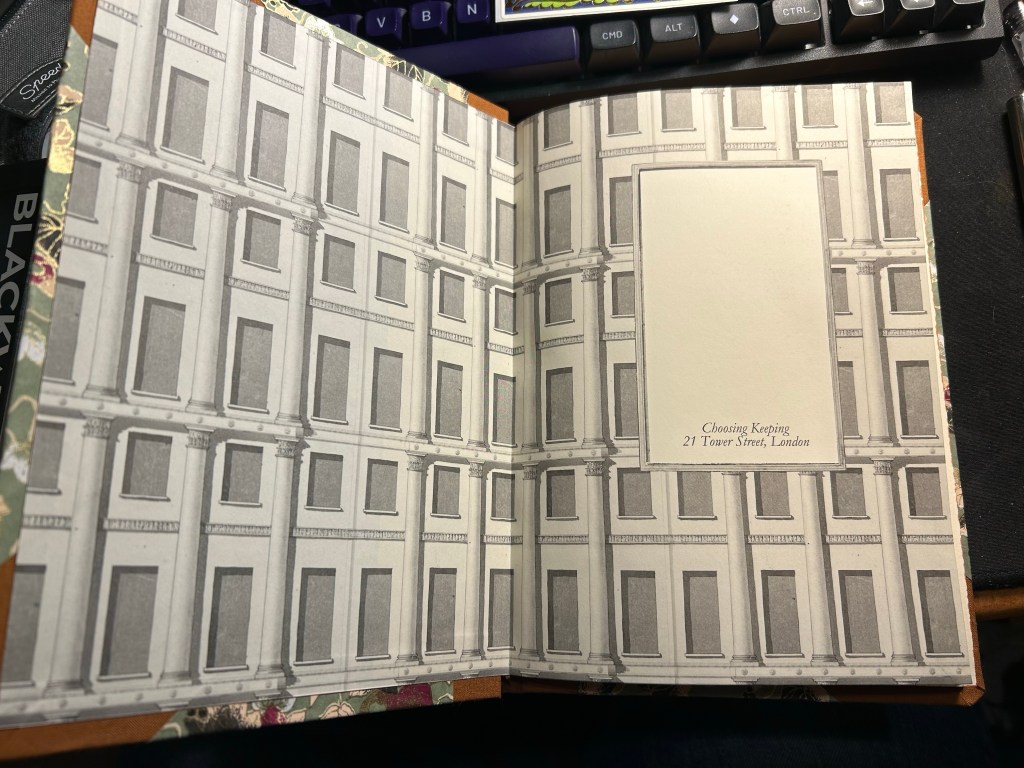
The endpaper is also very good looking:

Front endpaper
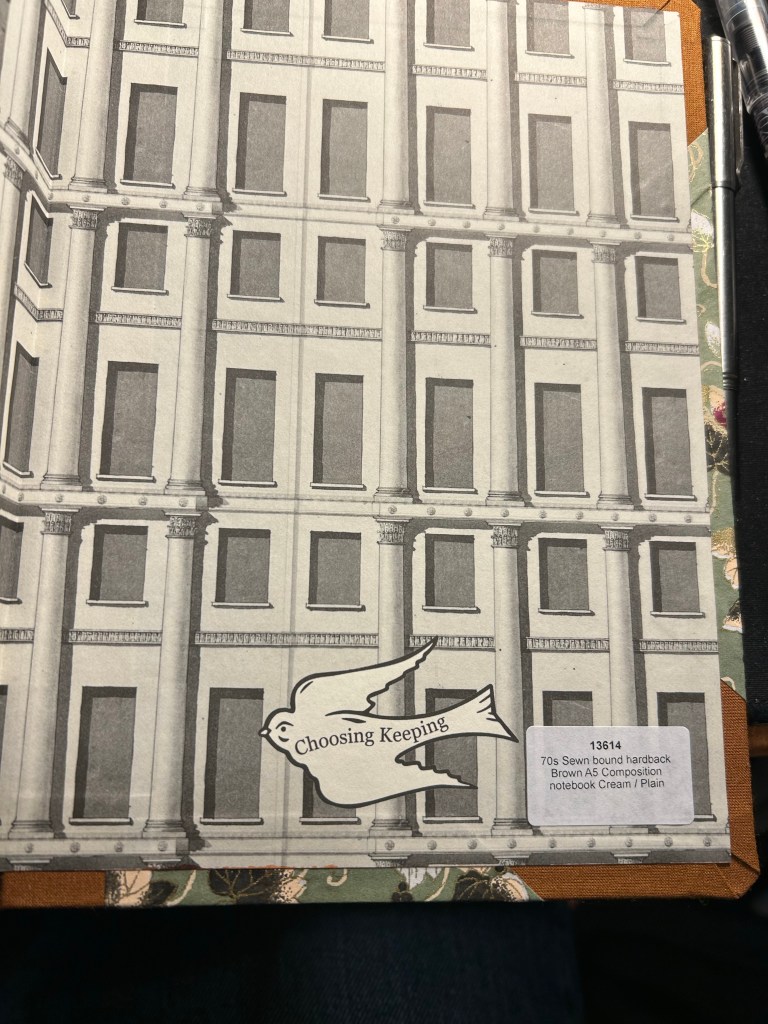
Back end paper with the Choosing Keeping bird sticker, and details on the notebook.

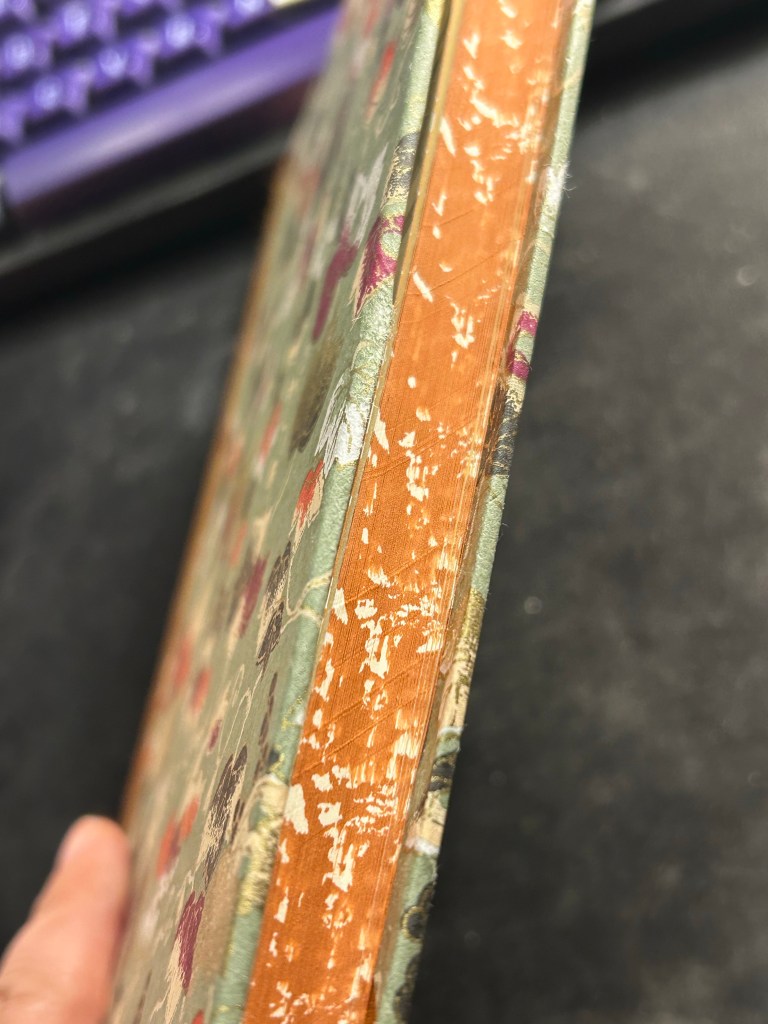
The paper is cream and unruled, and the edges of the paper are mottled brown. It is one of the best looking notebooks that I have:

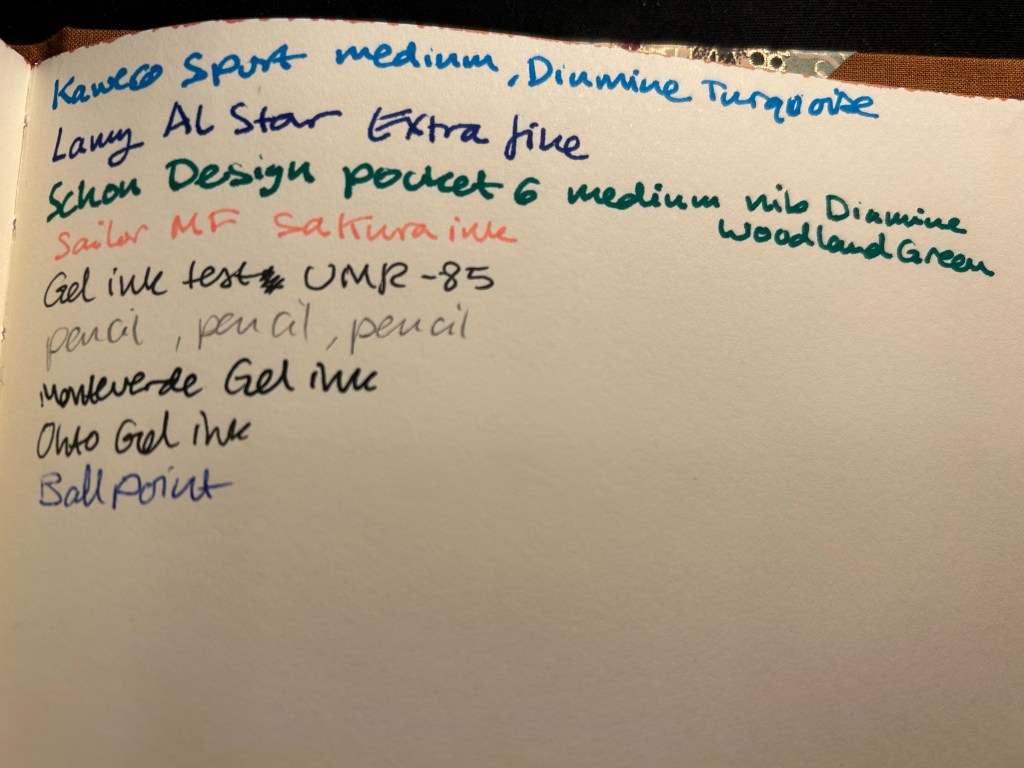
I was planning on using it as a journal, but the paper was an utter disappointment. It is not fountain pen friendly, which really surprised me — the ink spreads and feathers and bleeds through. I could have used a gel ink pen with this notebook, but it somehow seemed incongruous with how fancy and special (and expensive) the notebook is.

Ink test page

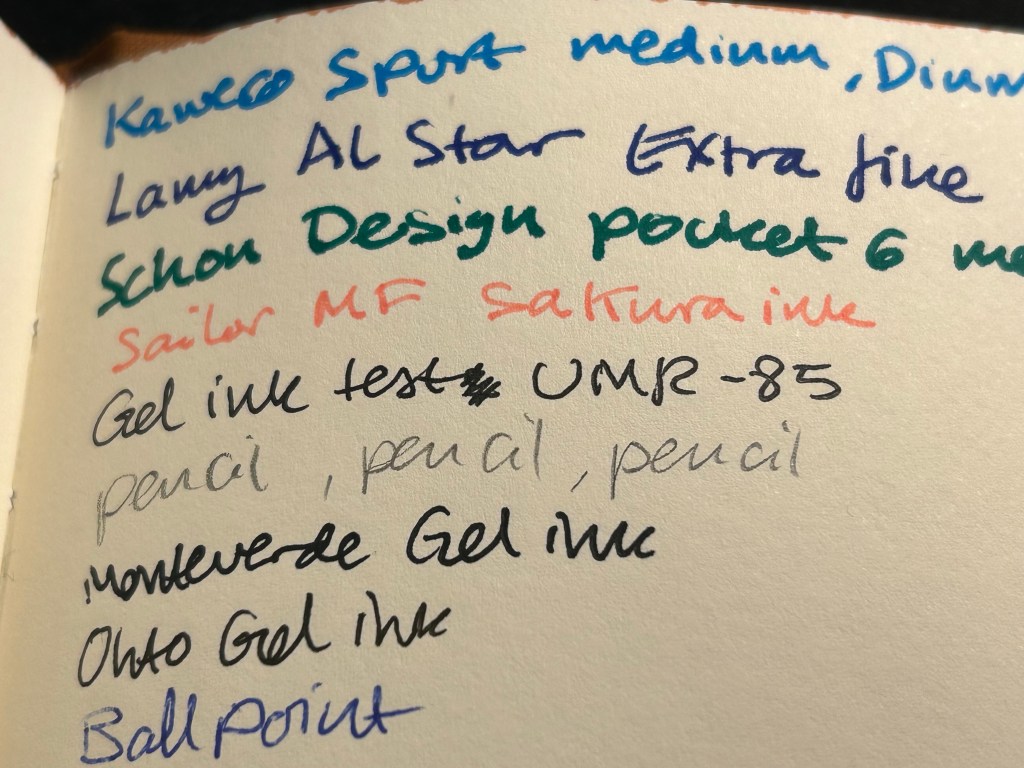
So I shelved it and I haven’t touched it in months, until today. My eye caught it as I was looking for a notebook to sketch in, and I remembered that the paper had some tooth and texture to it.

Closeup on the paper and the ink results.

It’s a soft, velvety kind of paper, which made me thing that it might work with pencil quite well. I also had some pencils I wanted to try out, so it seemed like a good opportunity to not let a fancy notebook go to waste.

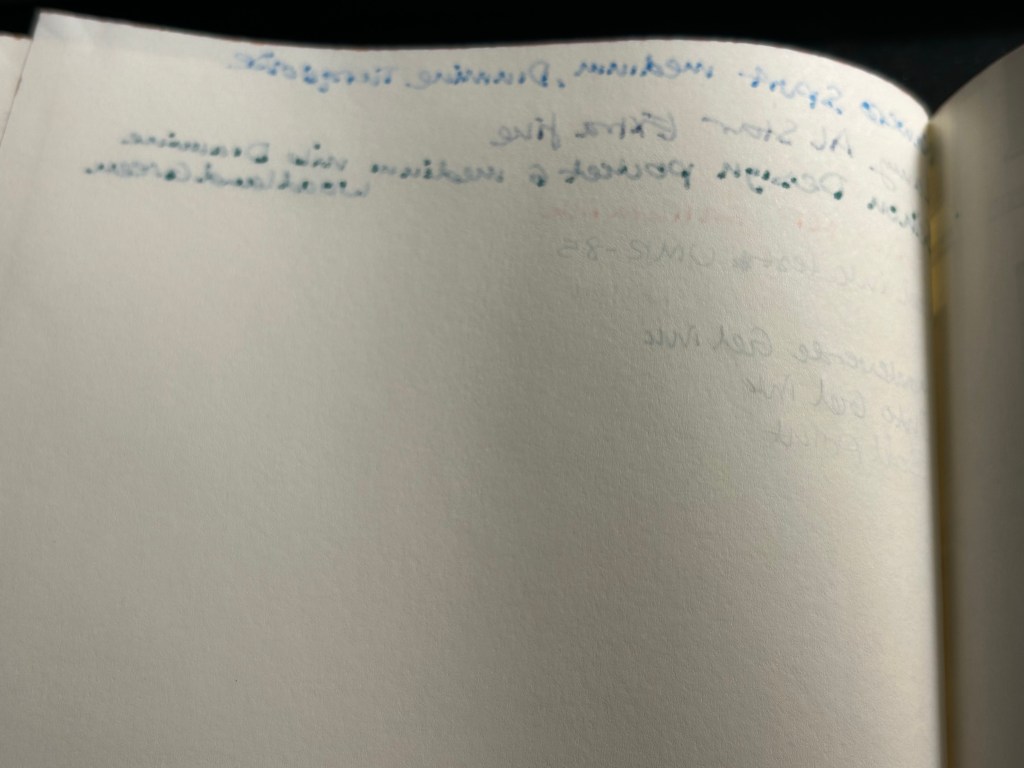
Massive bleed-through

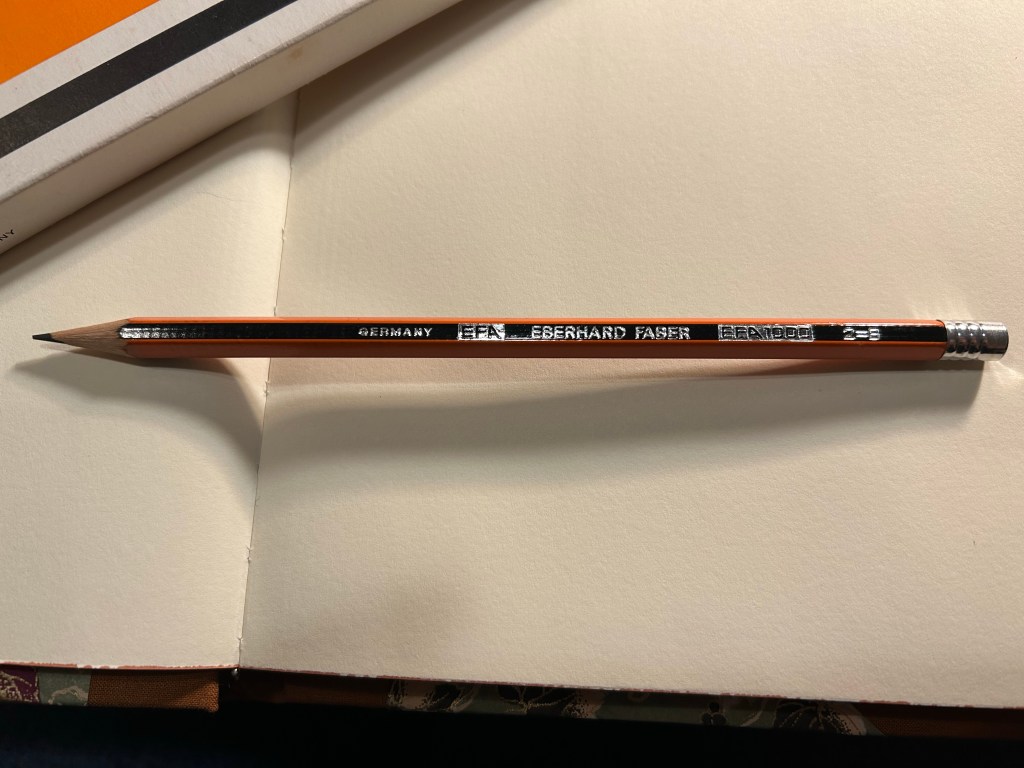
Enter the pencil that I wanted to try out most: the Eberhard Faber EFA 1000 vintage pencil in 2=B grade. I know, it’s weird. I don’t get it either. 2 is supposed to be HB.
I bought a box of these beauties at during my last visit at Present and Correct, and I’ve been wanting to use them since. They’re made in Germany, the lead is a B grade (slightly softer and darker than HB), very smooth and it retains its point surprisingly long for a soft pencil.

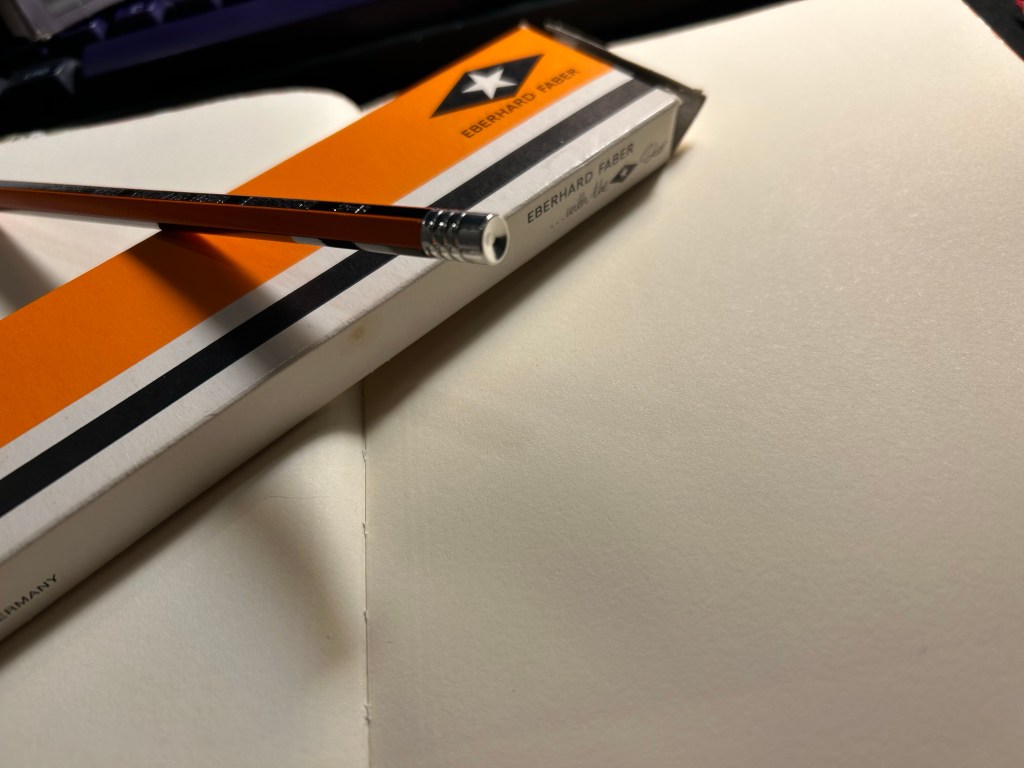
Eberhard Faber… with the Star. I love everything about the design of this pencil and this box.

The pencil comes pre-sharpened, and has an orange and black body that looks a bit like the Staedtler Noris, but in orange instead of yellow. It has “Germany”, “EFA”, “Eberhard Faber”, “EFA 1000” and “2=B” embossed on it silver foil. The fonts used look very futuristic and modern, which makes me think that this is a ‘70’s pencil.

Very fetching design

The biggest issue with vintage pencils is the eraser, which is always dried up and completely unusable. For this reason I prefer vintage pencils that don’t have erasers, or better yet, those that have endcaps. Well the EFA 1000 gets lots of bonus points for not only having an endcap, but having a really good looking one. It’s also silver in colour, and it features three rings and a concave top.

The endcap

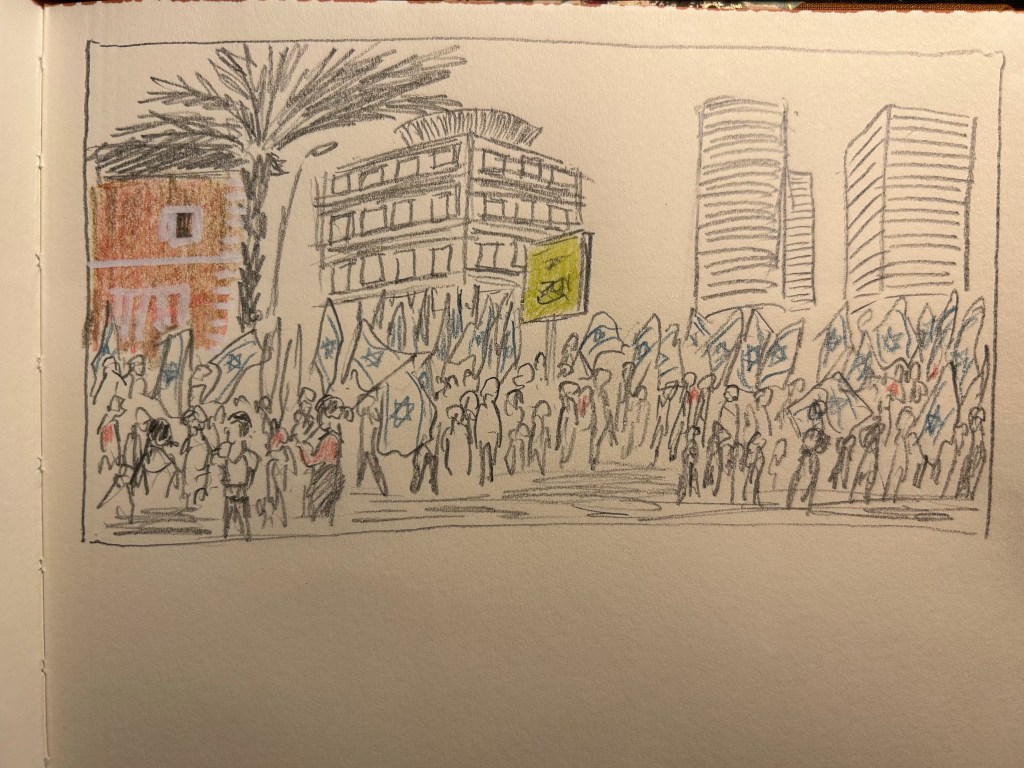
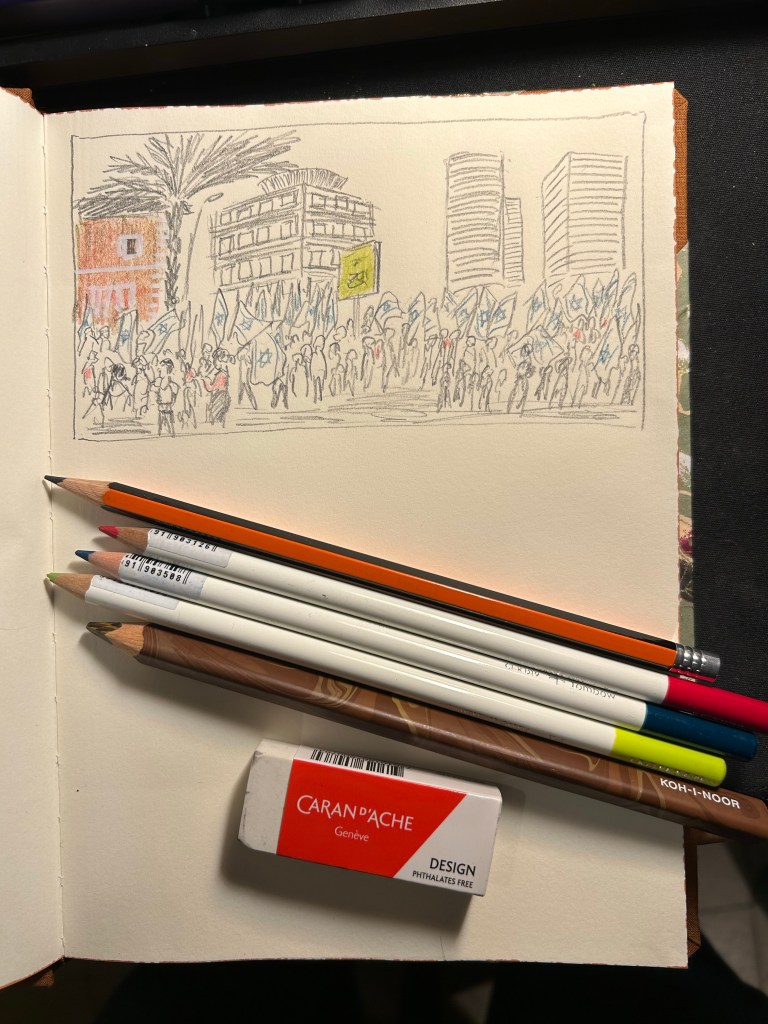
I then sat down to create this quick sketch of the latest round of pro-democracy protests. The pencil was a joy to use, and it worked very well on the paper. I was very happy with the feel of them both, and with the sketch results:

Choosing Keeping A5 Composition Notebook and Eberhard Faber EFA 1000 pencil

I added some colour with three Tombow Irojiten coloured pencils and a Koh-I-Noor brown Magic Pencil. The Tombow Itojiten was an utter disppointment. The green pencil crumbled twice, the others were mediocre at best. The Koh-I-Noor was a lot of fun, but brown works best with other coloured pencils layered on top, to give it some life.

Tools used here. Eberhard Faber EFA 1000, Tombow Irojiten, Koh-I-Noor Magic Pencil, Caran d’Ache Design eraser

All in all this first attempt at shopping from my own stationery stash was a success. The EFA 1000 is staying on my desk, I learned things about the Tombow Irojiten (I’m glad I only have three Itojiten pencils and not a box of them), and I got to use a notebook that I’d thought would just gather dust. This is definitely something I will try to do again.