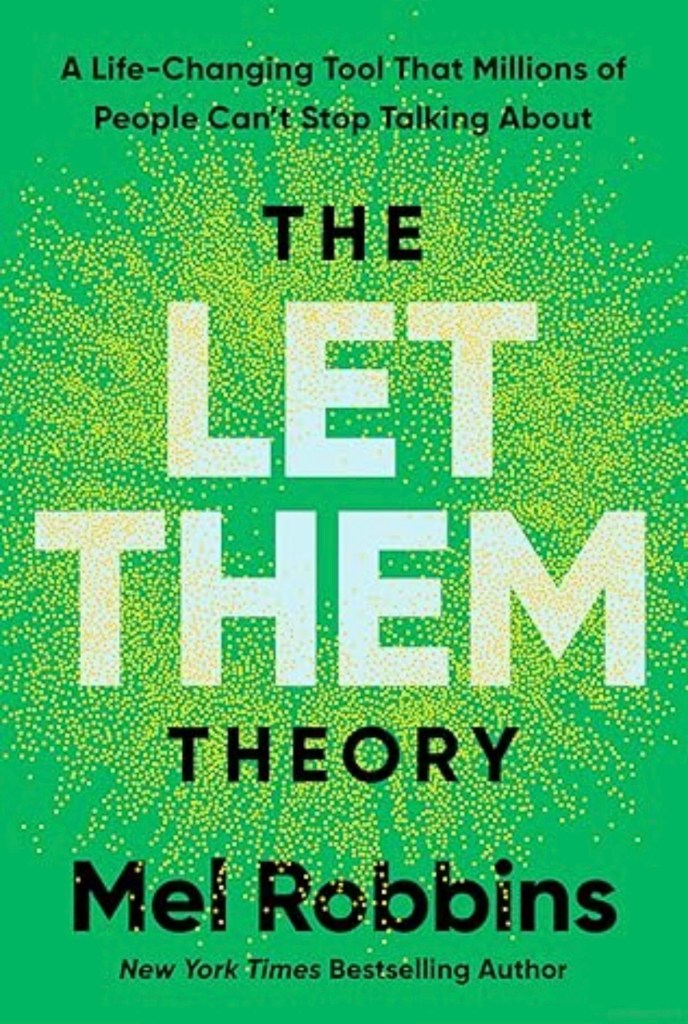
This is a book review that requires a bit of a preface.
I had no idea who Mel Robbins was but I did notice “The Let Them Theory” explode in popularity from the minute it was published. There are some self-help books, like “Atomic Habits,” that become phenomenons, and “The Let Them Theory” was clearly one of them. My first encounter with Mel Robbins was through a YouTube video Ryan Holiday made of her visit to his bookstore. Her over the top reactions seemed wild to me, particularly considering the setting. Once doesn’t expect people to be this vocally enthusiastic in a bookstore. As my interest in the video was more focused on the children’s books that Ryan recommended, I didn’t give Robbins much thought beyond noting that she was quite a character.
The YouTube algorithm being what it is, it next offered up her appearance on Rich Roll’s podcast. I don’t watch podcasts on YouTube (I listen to them on Overcast, usually during long runs or when I’m doing mindless chores), and I don’t subscribe to Rich Roll’s podcast, but I have listened to an episode here and there over the years. He’s generally a good interviewer, and as I was intrigued by Mel Robbin’s character and the book’s meteoric success, I downloaded the episode and listened to it while I was training for my latest 10k. I later also listened to Ryan Holiday interview Mel Robbins, and I have to say that was just pointless marketing fluff where both of them appeared to talk but not really listen to each other.
The Rich Roll interview on the other hand is worth listening to if you have any interest in the book or the phenomena around it. Roll not only delved into the ideas in “The Let Them Theory” but also pushed back against a good chunk of them, and the back and forth between the two taught me a lot about both Mel Robbins and her book. If you’re at all curious about “The Let Them Theory” I recommend listening to this podcast. You’ll get 80-90% of what’s in the book, plus a lot of interesting insights from Rich that go beyond what Mel Robbins provides.
End of preface.
I bought the book and read it. The amount of hate and vitriol that people seem to enjoy spewing at this book in places like GoodReads beggars belief. You’d think that Mel Robbins is the source of all the world’s problems.
The reality is that this a pretty standard self-help book. There’s two and half ideas in it, it could have totally been a blog post, and most of the book is anecdotes, personal stories, repetition and fluff. The ideas in it aren’t new. Mel Robbins doesn’t claim they are – she just found a pretty useful way to package them. If you’re familiar with detachment, there’s nothing new this book will teach you. It is, however, easily digestible, entertaining and light hearted. The main ideas in it are: “let them” (detach but preserve your ego in the process), “let me” (don’t be an aloof a-hole), and put yourself in their place to encourage empathy with other people and their perspective.
The thing that I find curious is the kind of “Oprah Winfrey” vibe the whole thing has. Robbins is very enthusiastic, seems very mercurially sincere, and seems to enjoy using herself and her close family as test subjects and example for her “theory”.
And here we come to the word that has maybe angered more reviewers than any other when it comes to this book: “theory”.
Let me be clear – this isn’t a theory, it never was a theory, it’s a catchphrase. But the “Let Them Catchphrase” doesn’t sell as many copies, does it?
In then end I’d give this book 3.5 stars, rounded up to 4. Why? Because I grade books on a curve, and compared to other self-help books this one is entertaining and is potentially useful. The ideas in it aren’t new, but there are practically no self-help books that present new ideas – it’s all in the packaging. I’ve tried the ideas in it, and I’ve offered them to others, and they work, because we are egotistical beings, and because remembering “let them” is easy when you’re in the heat of the moment. It’s also readable and fun, which is a rarity for a self-help book. Robbins knows how to tell a good story, and her character comes through in her writing. That may rub you the wrong way, or you may find it joyful – that’s mostly up to you.
Would I recommend this book? Maybe. Listen to the Rich Roll podcast. If you want to delve a bit more into the ideas there, then get the book. Otherwise, skip it. Just don’t buy the book to rage review how books like this are ruining Western Civilization. That’s neither true nor helpful.
 Writing at Large
martinlt
This book was thrown into my DNF pile. And I am sure to not finish it. I thought it badly written, the premise immature. I do appreciate your take on it though!
LikeLiked by 1 person
Daphna Kedmi
Although I have never heard of Mel Robbins and have no interest in the subject matter of her book, I still think it’s a great review. I really appreciate reviews that can steer one away from books, not necessarily negative reviews, but those with enough detail to allow the reader to decide if the book is of interest.
LikeLiked by 1 person