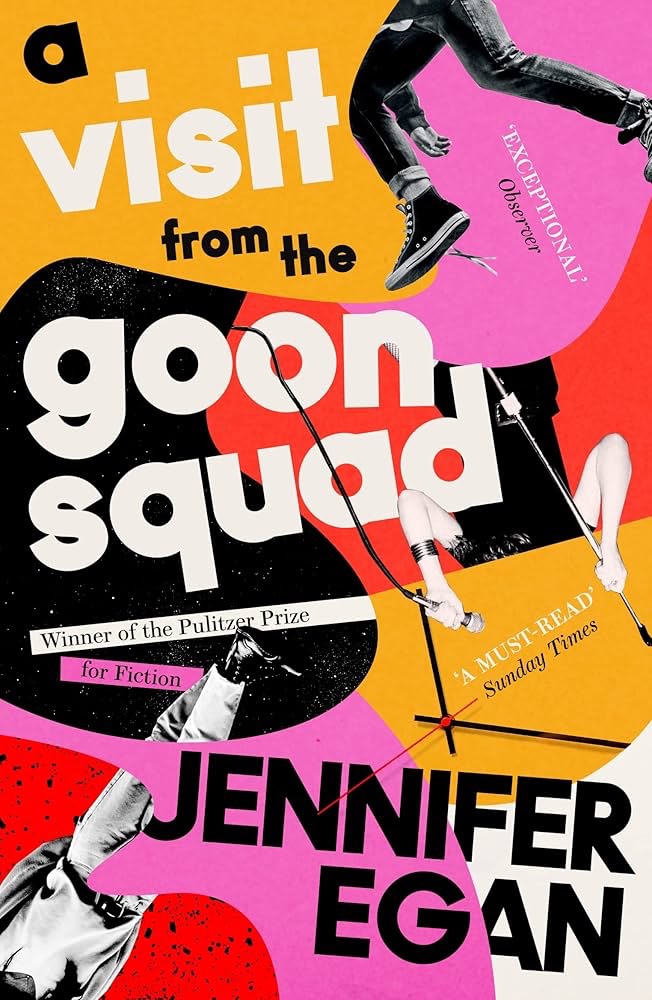
I bought A Visit from the Goon Squad back in 2011, as it was part of that year’s Tournament of Books. It has languished on my Kindle ever since. This year, however, I have decided to read the oldest unread books on my Kindle, and so it was A Visit from the Goon Squad’s turn.
First of all, the book has a dreadful name. It’s trying to be sophisticated, it ends up being uninformative and unappealing. It’s sounds like a book about comedians, or maybe a family saga of some kind, but it’s basically a string of partially connected episodes about people that work or have worked in the music industry.
I almost gave up on this book as about 50 pages in I found myself not liking any of the characters and finding the narrative dull and bland. Then Rhea appeared, and I found myself pulled into the story. She redeemed the book, and it got better and better as I read along.
A Visit from the Goon Squad is a very readable book, apart from the deliberately dreadful writing of the only writer in the novel, Jules Jones. There’s a character that didn’t redeem himself – the more I saw of him the less I liked.
The book didn’t age well, and will likely age even worse with time. It’s embedded in a certain era – pre smart phones, social media and AI – but it’s not written in a way that will allow it to be timeless. The powerpoint penultimate chapter reads as a dated gimmick, and the last, “futuristic” chapter is truly terrible. It really brings the book down, as even for its time it serves mainly as a window to Egan’s biases and anxieties more than to the true zeitgeist of the time.
Egan’s choice to build the narrative on episodic encounters with loosely connected characters was groundbreaking for the time, and the book won a Pulitzer Prize. In 2019 Bernadine Evaristo will take this concept and do it much, much better with Girl, Woman, Other thus leaving Egan’s novel in the dust.
While I don’t regret reading A Visit from the Goon Squad I wouldn’t recommend it. It didn’t stand the test of time, there are much better books to read, and it’s attempt to capture the zeitgeist of a time so fleeting it practically didn’t exist (the oughts) isn’t worth the reader’s time. Read Evaristo’s novel instead.
 Writing at Large
Daphna Kedmi
Excellent review Nofar! Thank you.
LikeLiked by 1 person