A smorgasbord of stuff for your delectation. You can read part 1 here.
13. Big bold announcement: next month is Bloomsday, and after much hemming and hawing i’ve decided to reread James Joyce’s Ulysses and blog about it as I go along.
I’ve read Ulysses three or four times between 2009-2013 but I haven’t touched it since. While I still have some of my notes on this book, my goal isn’t to reconstruct them or to lecture on the topic, but to enjoy a very good book, and see how my memory of it fairs post-chemotherapy (which has affected my memory).
Why should you join along? Because Ulysses is a phenomenally good book that is enjoyable to re-read (but very challenging to read for the first time). It’s funny and touching, profound and full of adventure. It’s just built on very well crafted layers of language, meaning and context, and it’s paradoxically a book that is meant to be re-read, not read. Hopefully I will make it a bit easier and less scary to read for the first time for those brave enough to join me.
14. I have been switching my podcast listening queue around lately, which means that I got to listen to this wonderful two part episode of Alie Ward’s “Ologies”: Salugenology (Why humans require hobbies). Guest Julia Hotz talks about the things that we need to be happy as humans, and the conversation is fun to listen to and enlightening. I highly recommend it, and the “Ologies” podcast in general.
15. I’ve stopped buying eBooks from Amazon after they stopped allowing customers to download the books that they purchased (so you basically don’t own the book that you paid for if you buy in from Amazon now). I still use my Kindle Paperwhite, but I’m buying books from Kobo. I buy them DRM free where possible, and if not I use Calibre to strip them of DRM and then this site to transfer them to my Kindle (if they are DRM free you just use the sendtokindle site to upload them to your Kindle). It took me 30 minutes to get the setup working the first time, and it now adds 1-2 minutes tops to every book purchase, which is plus for me. It means that I don’t mindlessly purchase books that I don’t intend to read, and I actually think through each book purchase. I also noticed that the books I’m interested in are priced slightly cheaper on Kobo, which is a nice little bonus.
16. Using yellow ink (Rohrer and Klingner Helianthus) has been a challenge but also an education. Helianthus is readable enough to be used for my daily todo list, but thanks to this ink I’ve been learning to enjoy using a fountain pen for highlighting purposes. It’s more subtle and better behaved than traditional highlighters, and the colour pops on the page without resorting to neon shades.
17.I am thinking about the next inks to put into rotation, which is a bit unusual for me as I normally start with the pens that I want to fill, and then go find inks that go well with them. I want a blue-black for practical reasons, a cheerful green, a pink or orange, and a turquoise or teal. How do you select which pens and inks you use?
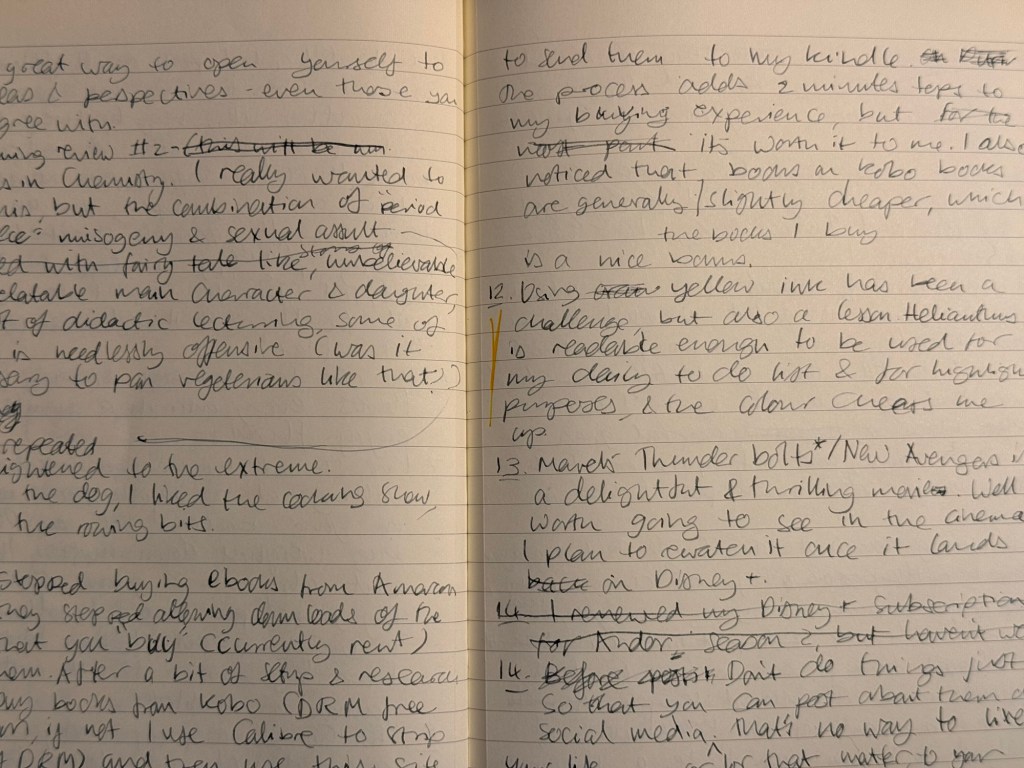
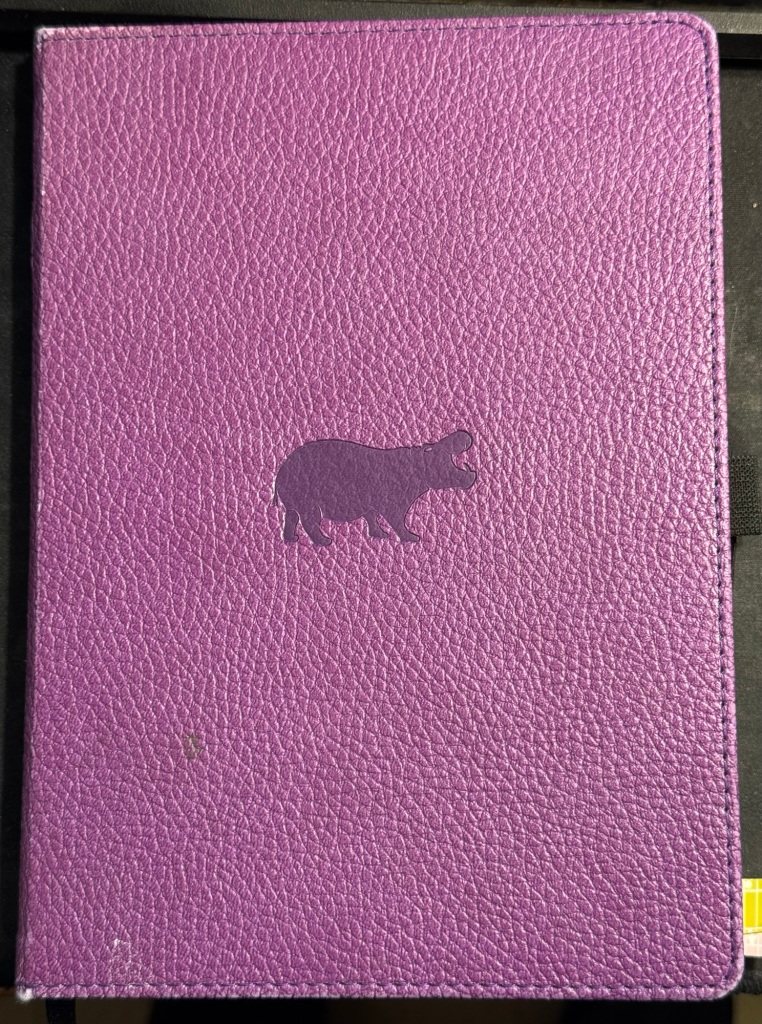
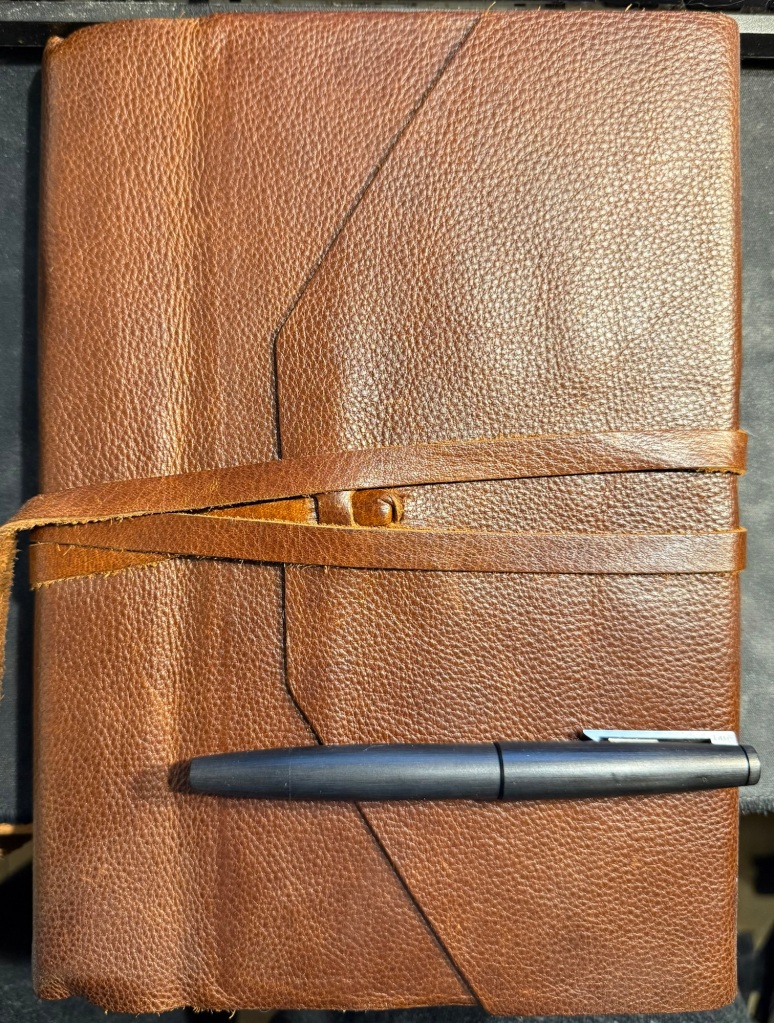
18. A bit of behind the scenes: I draft these posts longhand in a Dingbats notebook and a fountain pen. I think better on paper and it’s a way to use the pens and inks that I have. There are no AI/LLM agents/bots involved in this blog, and that’s the way it will remain. I enjoy writing, I created this blog as a hobby because I enjoy writing, and while I use AI agents as part of my job, I have no intention of letting them take away any part of the creation of this site.
19. Journaling tip #1: If you’ve been feeling down lately, take the time at the end of each day to review your day and score it. It doesn’t matter what scoring system you choose, but I recommend that you keep it simple and not too granular: -1, 0, +1 or 1, 2, 3, or “great”, “OK”, “meh”, “terrible”. You just want a quick way to know if the day was a good day, an average day, or a bad day.
At the end of every day for a week or two think back on what happened throughout the entire day, give it a score, and explain the score in no more than a sentence or two. So for me today was: “OK – was super tired at the start, but I managed to get two naps in and recovered enough to get most of what I planned done”.
At the end of the week, when you do your weekly review and plan ahead what you want to stop doing, start doing and keep doing, use these scores as an input for your decisions.
Repeat this whenever you feel the need to recalibrate.
20. Journaling tip #2: if you’ve stopped journaling and want to restart, don’t attempt to backlog the days that you missed. Forgive yourself the journaling “debt” and start fresh. This is easier to do if you switch something up in your journaling routine – use a new pen, pencil or ink, a new notebook, or write in a new location.
21. A dear friend and colleague has moved to a new job in a different company. While I’m happy for him and I wish him the best of luck, I already miss working alongside him. This brings me to the following journaling tip:
22. Journaling tip #3: Take a journal, either your usual one or a new one for a special journaling “events” and write down a list of names of people that have inspired or taught you something that you are grateful for, and write down what it is they taught you. Start with those that affected you by their positive actions (kindness, encouragement, setting good examples), and then challenge yourself to journal about those that taught you by being negative presences in your life. Did an office bully teach you to be kind? Did the talentless brown-nose teach you about how much you value your integrity?
You can write about both people you personally know and those in the public sphere, and you can return and edit or add on to this list whenever you want. It’s a good reference in troubled times to remind you of who you are, what you stand for, and where you want to be.
 Writing at Large
Daphna Kedmi
I have tried to read Ulysses several times throughout the years and I finally really read it with Benjamin MacEvoy’s Hardcore Literature online book club. It was the first time that I was able, with his admirable guidance, to give this monumental work the attention it requires. It was also the first time I didn’t succumb once again to the feeling of being so overwhelmed by it that I abandoned it time after time. With MacEvoy’s excellent guidance, it just opened up to me. It’s still a very challenging read, and since then I’ve read it again on my own. It seems to me that it can be read time and again and it never ceases to enrich. So, of course I’ll read it again with you. As for Kobe, I didn’t know that one could download from them to Kindle. I don’t really mind that I can’t download from Amazon because for my more complex and meaningful reads, the ones I read with a pencil and a notebook, I always order print books. But thanks for the tip and I’ll certainly check Kobe out.
LikeLiked by 1 person
Elizabeth
When you said, “There are no AI/LLM agents/bots involved in this blog, and that’s the way it will remain. I enjoy writing, I created this blog as a hobby because I enjoy writing, and while I use AI agents as part of my job, I have no intention of letting them take away any part of the creation of this site,” I cheered.
LikeLiked by 2 people
Pingback: Big Celebratory Birthday Update Part 3 – Writing at Large
Quieter Elephant
A few years ago, I took the first step to my self-commitment to read Ulysses… and bought a copy. Since then it joins many other tomes staring accusingly at me from one of my “to read” shelves. A couple of months ago my wife and I visited Portugal en route to my daughter’s 30th celebration in Salzburg. Yesterday I read a passage in a book about Portugal’s history that Lisbon was once called Olisipo, to denote that Ulysses (Ulixes) went there in his wanderings. Colour me reminded by the universe that I have a job to complete.
LikeLiked by 1 person
Quieter Elephant
Glad you’ve discovered Canadian Kobo, and the excellent Calibre conversion software. I rarely read eBooks, but have enjoyed a few early SciFi short stories in the medium. There is a plethora of free (legal) downloads via https://www.gutenberg.org/ – particularly classics, which tend to be out of copyright. I do enjoy the occasional free download from my library via Libby too (https://libbyapp.com/).
LikeLiked by 1 person
writingatlarge
The Gutenberg Project is an excellent place to find the classics. What a wonderful recommendation!
LikeLiked by 1 person
Pingback: Big Celebratory Birthday Update Part 4 – Writing at Large