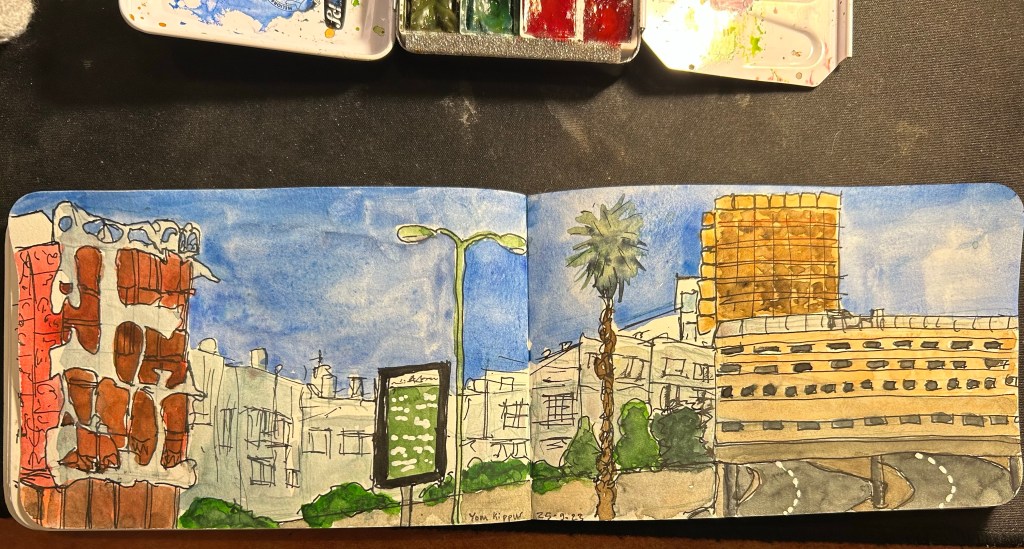
It was Yom Kippur today, a day when no cars drive around in Israel. I took the chance to go outside and sketch one of the most iconic buildings in the area.
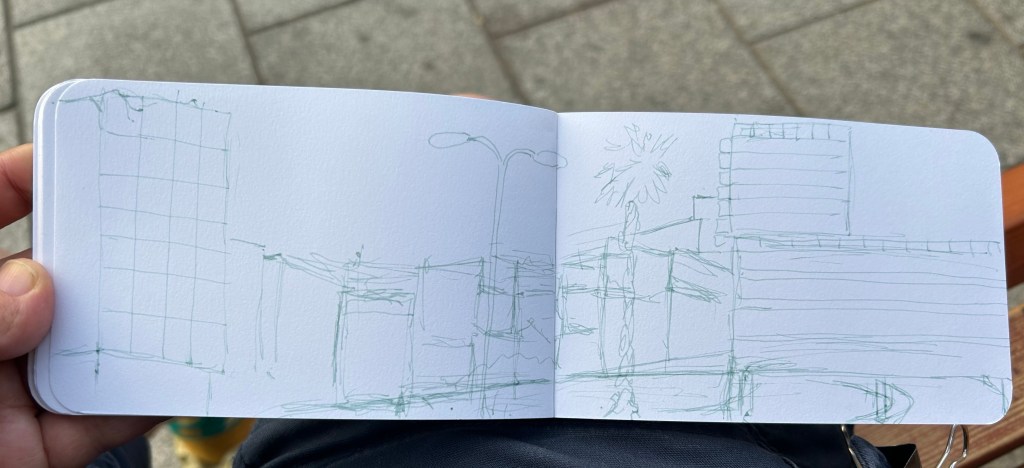
I used my Pelikan 140 KEF fountain pen with De Atramentis Green Grey Document ink as an under sketch:
Sketch on Stillman and Birn Epsilon 51/2 X 3 1/2 in. sketchbook
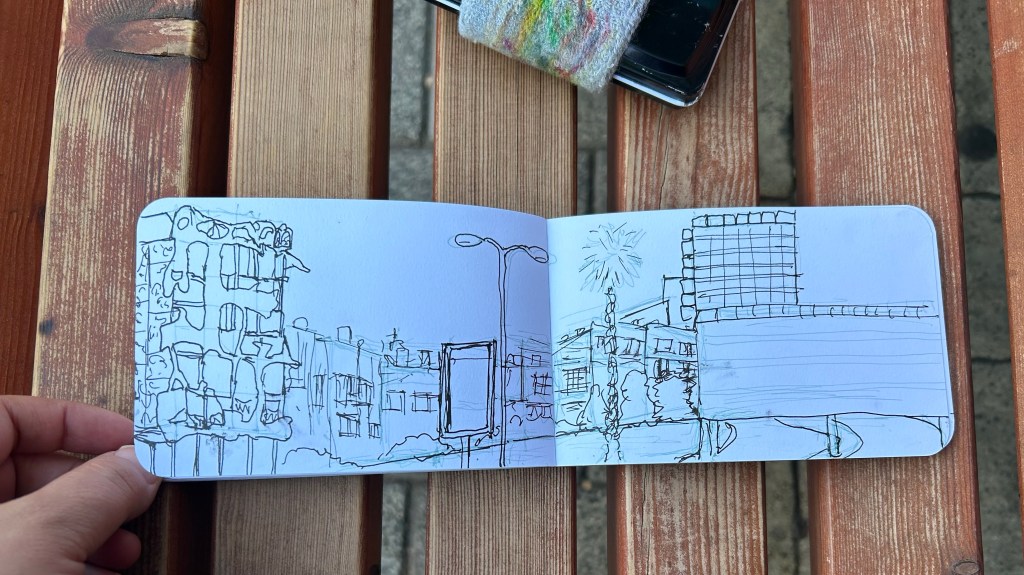
I then drew the line work with a Lamy Safari F nib and Platinum Carbon Black. The ink takes a while to dry, and it smudged a few times.
Line sketch.
It was getting hot, so I finished the watercolour at home:
St Jude is a research hospital in US that treats children who have cancer. They treat children both from the US and from outside the US, free of charge. If you know the US health system, you know what a big deal that is. They make their research freely and globally available, which in a world governed by the rush for profit, is also a big deal. They’re also spearheading an effort with the WHO to make cancer treatment more accessible and affordable to children around the world (Global Initiative for Childhood Cancer). 80% of children in high income countries survive cancer, but only 20% of children in low income countries do – and that’s because cancer medications (chemotherapy, immunotherapy, etc) are incredibly expensive. I live in a high income country and have a high income myself, but if my treatments weren’t funded by our healthcare system, I would have gone bankrupt.
Blood cancers (just like the one I had) are the most common cancers in children, and they are brutal. The cancers are aggressive, the treatment is aggressive, and any child that has to go through that, wherever they live in the world, wherever they happen to have been born, deserves the best chance that they can get — and I am saying that as an adult who’s lived through the experience.
They say that you need to repeat things 7 times for people to remember and act on them, so I’ve linked to the campaign 14 times in this post, just to be doubly sure you get the message.
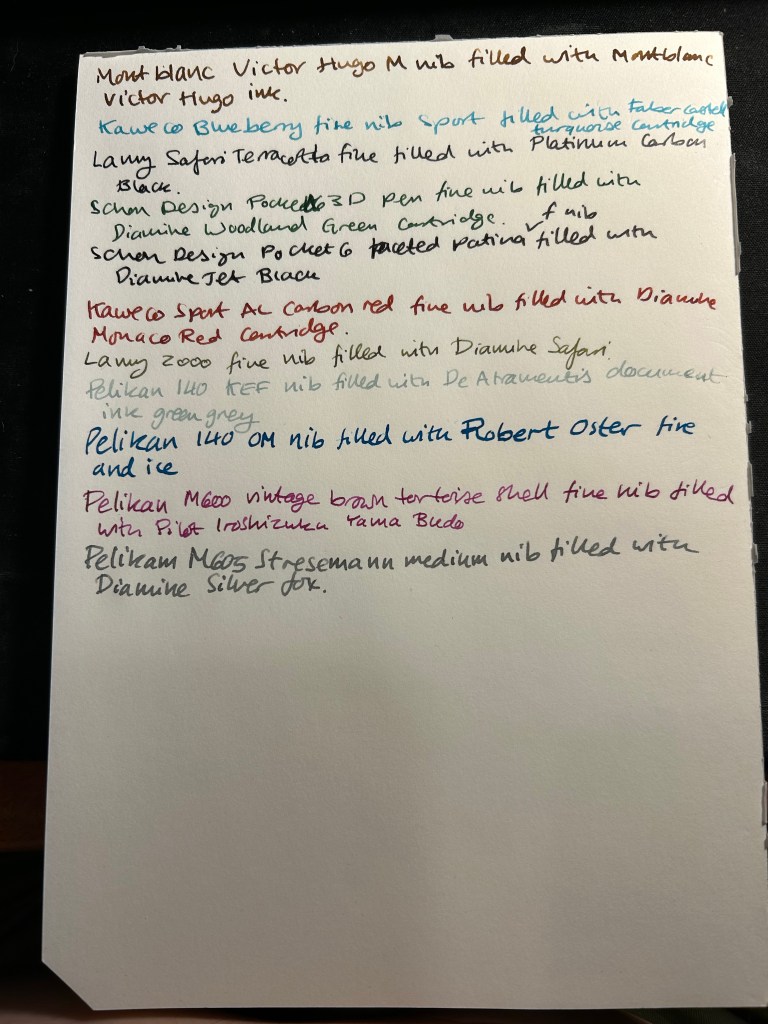
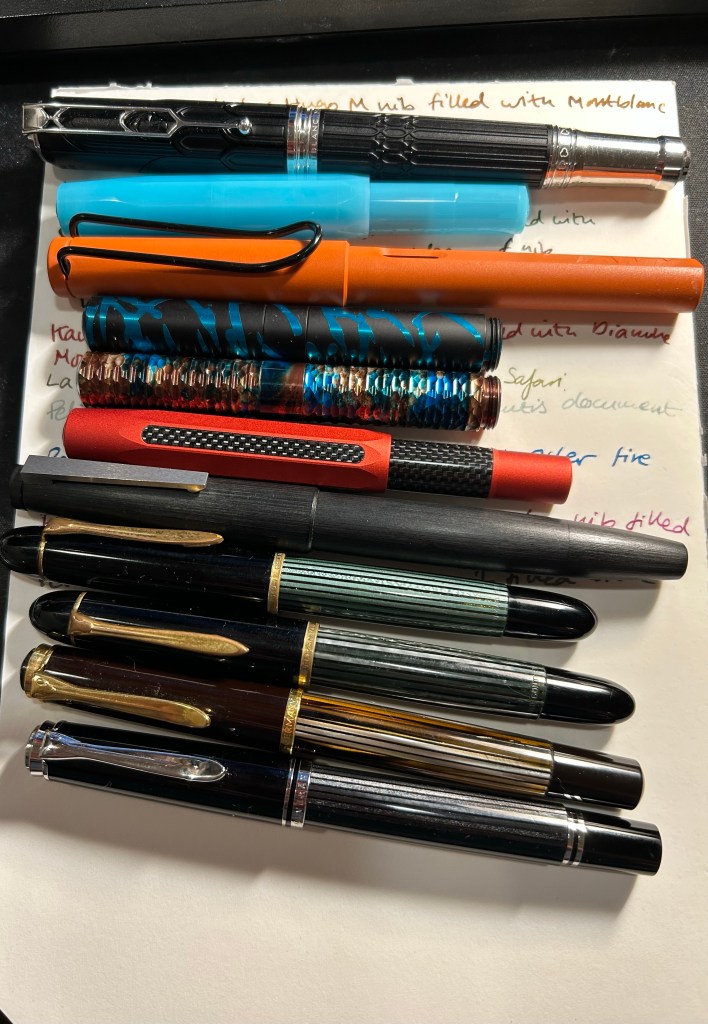
I’ve recently switched out most of my fountain pens and inks for a new batch, so here’s a quick overview of them (from top to bottom):
Currently inked writing sample
Montblanc Victor Hugo medium nib filled with Montblanc Victor Hugo ink. I bought this at Mora Stylos just before they closed, mainly because the design is based on the Notre Dame de Paris, which I adore. It’s a weird design and quite a hefty pen, but I enjoyed the nib, despite it being a medium. The ink, also limited edition (but knowing Montblanc is likely a relabeled existing ink) is a nice, warm brown with a good amount of shading. As I post this I’ve written this pen dry.
Kaweco Sport Frosted Blueberry fine nib filled with a Graf von Faber-Castell turquoise cartridge. This is the only fountain pen that I took with me on my recent trip to the US, and I used it on the plane (not during takeoff and landing).
Lamy Safari Terracotta fine nib filled with Platinum Carbon ink. I wanted a waterproof ink for my sketches, and I haven’t used Platinum Carbon for ages. The Safari Terracotta is the perfect coloured pen for this season.
Schon Design Pocket Six 3D Teal x Matte Black pen with a fine nib filled with a Diamine Woodland Green cartridge. This pen is already been written dry by the time I’ll post this.
Schon Design Pocket Six Faceted Patina fine nib filled with a Diamine Jet Black cartridge. Schon Design pens made me enjoy pocket fountain pens, and Diamine Jet Black is proving to be a solid, dark black ink (not greyish or brownish).
Kaweco Sport AL Carbon Red fine nib filled with a Diamine Monaco Red cartridge. The perfect pen and ink match. I don’t normally use red inks, but Monaco Red skews towards the raspberry side of things, and is very pleasant.
Lamy 2000 fine nib filled with Diamine Safari. Before I filled a flock of Pelikans, this was supposed to be my workhorse pen. Diamine Safari is great for sneaking unusually coloured inks into serious office settings without drawing attention to yourself.
Pelikan 140 KEF nib filled with De Atramentis green grey document ink. Another sketching combo, perfect for watercolours when I want my line work to melt into the background. KEF stands for Kugelspitze Extra Fine – or Ball-tip extra fine. It’s a very forgiving and rather firm gold extra fine nib. I inked this up on the Friday of the Pelikan hubs even though I didn’t go to a hub. The 140 is a piston filler from the 1950s with a gold nib that was dirt cheap and is an utter workhorse. It’s user grade due to the brassing, but brassing adds character.
Pelikan 140 OM nib filled with Robert Oster Fire and Ice – Pelikan stopped making OM nibs in 2014 because they’re scratchy and unpleasant to write with if you don’t hold them at the right angle. But at the right angle this nib is phenomenal, and it works great with inks that shade and sheen – and Robert Oster Fire and Ice is definitely one of those. You can see a visible sheen at the edges of each letter, and it makes them all glow. I inked this to celebrate the Pelikan hubs.
Pelikan M600 brown tortoise shell fine nib inked with Pilot Iroshizuku Yama-Budo. This is a vintage M600 from the 1980s, with West Germany printed on the band. It’s a lovely workhorse, like all Pelikan Souveräns, and the Yama Bodu ink manages to shade even with the Pelikan fine nib. Also inked for the Pelikan hubs.
Pelikan M605 Stresemann medium nib filled with Diamine Silver Fox. I haven’t had a grey ink in rotation for a while, and Silver Fox is an interesting and dark grey with plenty of shading, particularly with a juicy Pelikan medium nib. Also inked for the Pelikan hubs.
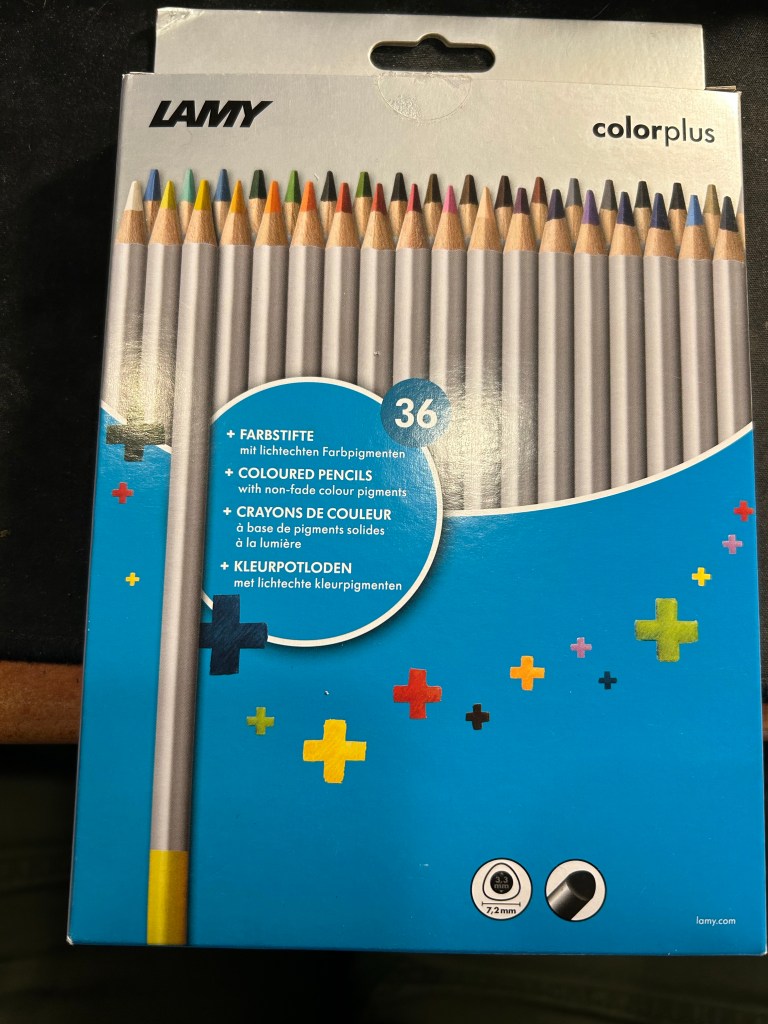
I rarely write reviews that trash products— because I tend not to waste my time and money on products that could potentially be bad. However, I was stuck in Tampa’s airport on a very long connection due to inclement weather and so I browsed their bookstore and found this:
Lamy ColorPlus 36 coloured pencils
Well it says Lamy on the box, so it can’t be bad, right? And it was just $15 for 36 pencils…
This is where the red flags should have popped up, but they didn’t. I bought the pencils.
When I got home and opened the box, my heart sank. The leads were broken on almost all of the pencils. Now the box was in my trolley, well protected from dropping or crushing, so there was really no reason for this amount of damage. I checked the back of the box:
“Highly resistant to breakage” it is not.
The pencils are triangular shaped, which is supposed to make them ergonomic. It makes them more unpleasant to sharpen, as there’s a steep “bump” whenever you turn the pencil to another side.
Triangular pencils
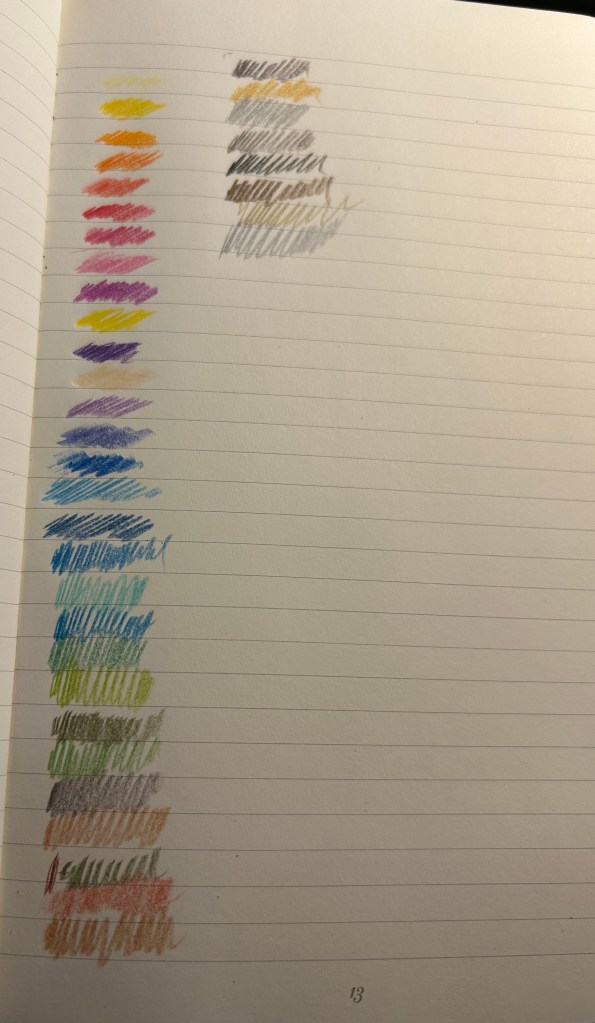
The colour selection is weird — there are a lot of various shades of brown, but no ochre. The browns themselves are nothing like the colours that you’d expect from their labelling. I use the term “labelling” loosely here, because there’s no colour labelling on the pencils, just a dip of colour that is vaguely similar to the actual pencil colour produced.
Pencil samples
The 36 shades chosen are wild – way to many similar brown, not enough greens, too many purples and blues, and of course utterly useless white and the bewildering gold and silver which are neither gold nor silver. Obviously the pencils crumbled while creating these samples so there are some duplicates here.
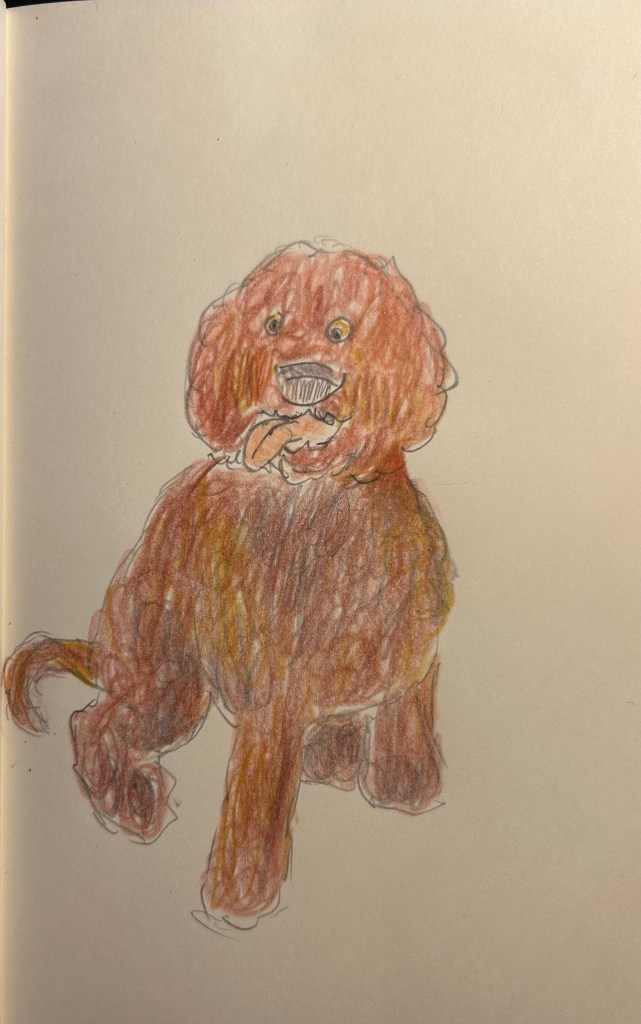
The pencils are very waxy, which means after 2-3 layers maximum the paper will be clogged and subsequent layers won’t be registered. The pencils also crumble easily —- even with very light pressure applied. Creating this sketch with them was nightmarish, as the leads kept crumbling, and I couldn’t get the shades that I wanted to the layering that I was trying to achieve.
Quick dog sketch
I honestly don’t understand why this product exists. It’s too expensive and not robust enough for children’s use, it’s definitely not artist grade (poor pigment, layering and no labelling), and even student grade pencils are properly labelled these days. In any case, save your money to buy better pencils. You deserve them.
The intro post to this series is here, journaling for mental clarity is here, journaling through fear is here. Journaling to clear your mind is here.Journaling to work out choices is here. The 5 year diary is here.
I recently got back from a trip, and later this year I have another trip planned so I thought that I’d dedicate a post to travel journaling.
My travel journaling differs pretty significantly from my normal, daily journaling in a few key ways:
1. I move to digital journaling.
2. I journal to share and not just for myself.
3. I oftentimes backlog journal.
Here’s a breakdown of what I do when it comes to travel journaling and why:
Digital Journaling
While my daily journal is always analog, when I’m traveling I switch to using Day One. There are several reasons for this:
1. The entry point to my travel journaling entries is the photos I take, and journaling makes me take more thoughtful photos. I used photos to capture a moment or tell the story of where I was, when and why. The entries in Day One then expound on that.
2. I compile my daily entries to share them with my family back home. It’s a way for us all to participate in the adventure, in a way.
3. I tend to return to the same places, and it’s easier to search what I liked or didn’t like about a place, or a place name using Day One than it is digging through notebook pages.
4. Writing quick entries on my phone while waiting in line for stuff is both convenient and helps the time go by faster, and my phone is always on me.
A digital photo of analog tools.
Journaling to Share
I normally write only for myself in my journal, but when I travel journal, I write with sharing in mind. While I don’t share my entries to social media or this blog, I do share them with my family.
Backlog Journaling (or Giving Myself a Break)
It’s often the case that I’m too busy to journal as things are happening, or during the day that they occur. In that case I just take pictures, sometimes supplementing them with a note on the list of activities done and places visited. When I have more time (for example on the flight back home) I can backlog these entries – with the added bonus that I get to live through them again.
I got back last week from a week in Orlando (no, I wasn’t at the pen show, I was on the Galactic Starcruiser — of which I will write a post later on) and am starting to get back to my routine, sort of. In any case, I haven’t posted a weekly update in a while, so I figured that it’s about time.
Health
I got my CPET (Cardio-Pulmonary Exercise Test) results back. I have less lung capacity to work with, which is likely the result of the chemo I underwent. There’s nothing to do about it but keep on running and hoping that my lungs will recover in time. It does mean that I won’t be able to break any more speed PRs anytime soon, but I can live with that. It’s better to be alive than to break running PRs.
I’ve been on an enforced break from running due to plantar fasciitis caused by my not getting my insoles replaced in time. As I have two races next month I’m really hoping to get back to running soon.
For the first time in my life I had perfect bloodwork results, which was very nice indeed and made me and my oncologist very happy.
Reading
I finished reading M Train, and found it both delightful and slightly disappointing.
I finished reading “Well of Ascension”, Brandon Sanderson’s second Mistborn novel. I really didn’t like this one, and I’m not really sure that I’ll bother with the third book in the trilogy.
I read “Winter’s Gifts”, a Rivers of London novella by Ben Aaronovich. I love the Rivers of London series, but this novella wasn’t the best, and you can feel free to skip it and not miss much. It was an OK plane read.
I’m reading “Deep Work” by Cal Newport right now, and so far it’s been pretty insightful. As someone who gets constantly interrupted while working I was interested in seeing if there was a way that I could carve out bigger chunks of time for more meaningful work, and I hope this book will help.
Sketching
I did a tremendous amount of repetitive sketching as giveaways on the Galactic Starcruiser, to the point where my carpal tunnel lifted its head and said hi. I’m giving myself a bit of a break from regular sketching and starting to plan out Inktober. Anything in particular that you’d like to see?
Pens and Ink
I’ve replaced almost my entire rotation. As this is starting to get a little too lengthy of a post, I’ll post a separate blog post about what I’m currently using.
D&D, tabletop roleplaying and LARPs
I ran a convention game, a new one I wrote just for the convention, and it turned out pretty well. Something that I can tweak and rerun in a different convention next year.
My adventure got accepted to the biggest convention in Israel, I-Con, and for the first time ever I’ll be running a game in the “big league”. My game was one of the first to be sold out, with all the tickets going in the first 24 hours, which was super nice and big boost to my confidence.
I’m nearing the end of another adventure in my current D&D campaign, and it’s been going well so far. I took a risk of creating a no combat adventure, but everyone seems to be enjoying themselves so far.
LARPs – I got to participate in the Star Wars Galactic Starcruiser before it shuts down at the end of the month and it was beyond amazing, and is going to get its own dedicated post. Locally, next week marks a turning point in the space themed LARP that we’re participating in and I can’t wait to see where the story takes us next.
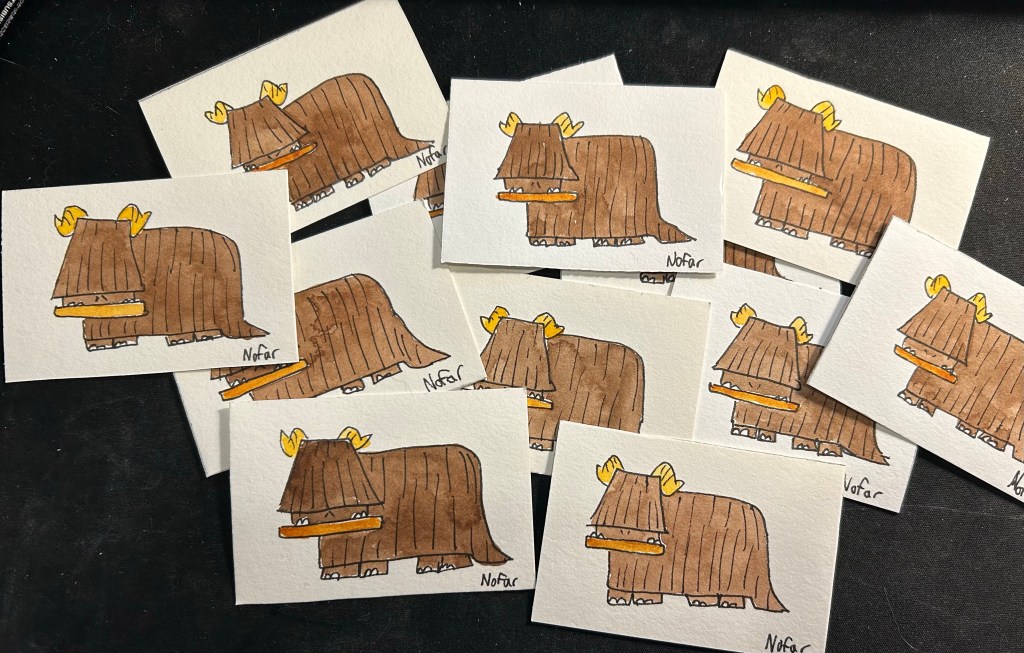
Sketches of Banthas for the Galactic Starcruiser. I drew about 100 of these.
General Stuff
I watched season 1 and 2 of “Slow Horses” on Apple TV and I loved it. Phenomenal actors, excellent writing, and my beloved London at its best. I purchased the first book in the series because I loved it so much.
I spent about two hours today clearing out all of my plant pots, adding new earth, sowing seeds. I haven’t planted anything since I got sick in 2021 because I didn’t want to burden anyone with taking care of my plants for me. It took more time and courage than I thought I would need to get out there and sow some seeds, but hopefully I’ll get to see them germinate, grow and bloom. All the seeds I have are from 2021, so I’m not sure they’ll germinate at all, but as I planted basically only nasturtiums and they’re hardy little plants, I’m hoping for the best. In any case progress is marked in the little things, and this little step is something too, I guess.
This is the first of 26 posts on cancer, as part of the alphabet superset challenge. You can read about it here.
In the wonderful sequel to the novel “Daddy Long Legs”, “Dear Enemy”, Sallie McBride, the red haired protagonist who finds herself running an orphanage, clashes with the institution’s doctor, Robin ‘Sandy’ McRae:
“Sandy has two passions in life: one is for cod-liver oil and the other for spinach, neither popular in our nursery. Some time ago—before I came, in fact—he had ordered cod-liver oil for all of the {aenemic}—Heavens! there’s that word again! aneamic children, and had given instructions as to its application to Miss Snaith. Yesterday, in his suspicious Scotch fashion, he began nosing about to find out why the poor little rats weren’t fattening up as fast as he thought they ought, and he unearthed a hideous scandal. They haven’t received a whiff of cod-liver oil for three whole weeks! At that point he exploded, and all was joy and excitement and hysterics”.
Jean Webster, Dear Enemy
The Science
Anaemia, which Sallie struggles to spell correctly in her letters to her friend, is a medical condition common not only among malnutritioned orphans in the early 20th century. Almost a quarter of the population worldwide suffers from anaemia, a condition marked by a deficiency in red blood cells or in hemoglobin in the blood. It means that your cells aren’t getting enough oxygen, and the symptoms include tiredness, dizziness, weakness, shortness of breath, pallor. Anaemia in general is associated with poor health outcomes, increased morbidity and mortality, and tends to complicate any existing medical conditions.
It’s also one of cancer’s best friends.
Wait, what? I thought anaemia just meant that I need to get more iron, B12 or folic acid in my diet?
While most cases of anaemia are caused by dietary deficiencies, anaemia is also a symptom of many types of cancer. In particular it’s a symptom of blood cancers (leukemia, lymphoma and myeloma), breast cancer, lung cancer, colorectal cancer, cervical cancer, kidney cancer and prostate cancer. If you have anemia it doesn’t mean that you have cancer, but if you have cancer, there’s a good chance that you’ll have anaemia.
Why does cancer cause anaemia? For various reasons – from bleeding that causes red blood cell loss (cervical cancer, colorectal cancer and breast cancer), to blood cancers which affect the bone marrow directly or indirectly, to high red blood cell turnover caused by immune system targeting affects of cancer, to iron deficiency (lung cancer and advanced cancers in general).
If the cancer itself left your hemoglobin levels normal, the cancer treatments are likely to trash them. Chemotherapy and radiotherapy target fast growing cells, which include our bone marrow. In the case of blood cancers this is particularly acute. Leukemia and lymphoma patients are particularly susceptible to anaemia, as these cancers indirectly affect red blood cell production, and the treatments target the same areas as well.
And anaemia spells poor outcomes wherever it appears, which is why oncologists aggressively combat it, with medication or with blood transfusions.
My Story
When I was first hospitalized I got a battery of blood tests — blood is the love language of hematologists (blood doctors). I had a lymphoma diagnosis (though it was yet unclear which type of lymphoma it was), and unsurprisingly, I had anaemia. Enter iron infusions — sacks of brown, burnt caramel smelling stuff that was infused into my veins over several days in an attempt to get me in as good as shape as possible into the treatments.
You see, we have iron stores in our body, and even if we don’t consume enough iron in a particular day, our bodies know how to use these iron stores to make up for it. My anaemia was caused not by red blood cell destruction (at this point), but by low Ferritin — low iron stores.
Iron infusions are a bit aggressive — usually if you have iron deficiency anaemia you’ll be told to take iron supplements. These used to cause stomach issues, but there are new “soft iron” supplements that are more gentle on the gastric system. They do take time to take affect, and time wasn’t something I had, so I got the fast lane — iron infusion.
That wasn’t my last bout with anaemia though.
My chemotherapy caused anaemia several times, which I was expecting as it’s a common side effect of blood cancer chemotherapy treatments. Every time I came in to get treatments I had to have my blood tested and if my hemoglobin was too low then the treatment was postponed or if it was very low, you’d get a blood transfusion before treatment. Luckily enough for me my bone marrow was robust enough to survive treatment without me needing (extremely painful) bone marrow growth medication or (very painful and very lengthy) blood transfusions.
Blood transfusions take hours and they burn because of the anti-coagulation medication mixed in with the transfused blood (it’s how the blood is store without clotting). There’s never enough blood to go around (particularly during the pandemic) so doctors have to fight over every blood transfusion they order, and nurses hate dealing with them because of the paperwork and procedure around them and how long they take, and patients loath them because who wants to be connected for hours to a burning IV?
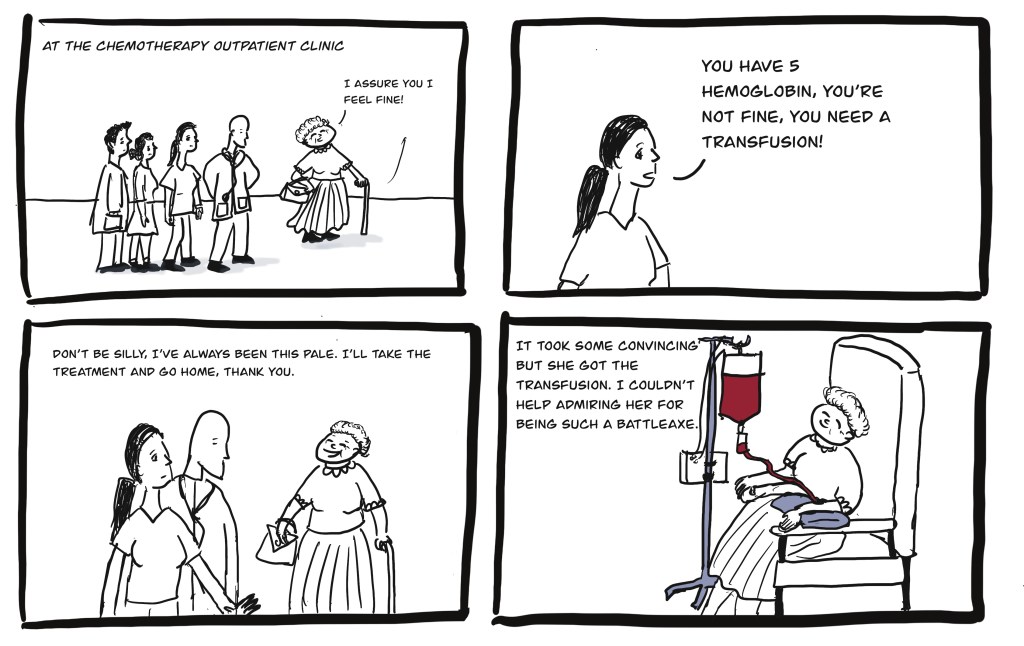
This means that if you’re getting a blood transfusion during treatments it’s because you really, really, really need them. Which brings me to this little anecdote that happened during one of my treatments:
While I was prepared for anaemia during treatments, what caught me by surprise was the anaemia after the treatments. A persistent and annoying “friend” that I had collected along the way, post-treatment anaemia is common with the type and intensity of chemotherapy that I had received. I had also been forced to change my diet significantly post treatment, which meant that I had a B12 deficiency — another common cause of anaemia (particularly among vegetarians, vegans and those that have had bariatric surgery). Several months of B12 supplementation and time for my bone marrow to recover kicked the anaemia’s ass — for now. However, like many cancer patients, anaemia is a red flag, and so my blood work is being constantly monitored, several times a year. It’s probably not surprising that it’s the first thing that both I and my hemato-oncologist check when we go over my blood tests.
What Can I Do About It?
1. Get regular bloodwork done. Talk to your family physician/GP about getting regular blood tests — before I was diagnosed with cancer I got them once a year. Once you get your bloodwork done, check your hemoglobin levels. Hemoglobin blood tests are part of a CBC (complete blood count) test.
2. If you do feel weak, dizzy, you’re pale, your feet are swollen, you have heart palpitations, shortness of breath or any other anaemiarelated symptoms, talk to your doctor.
3. If you can donate blood, please donate blood. Blood transfusions help cancer patients survive, as well as helping trauma patients, patients undergoing serious surgery and pregnant women during labour. Every blood donation saves lives (usually multiple). Be a hero — donate if you can.



 Writing at Large