Kevin Wilson’s “Nothing to See Here” is a sharp, fresh, unputdownable gem of a novel. A heartwarming story about finding your tribe and embracing your weirdness in a world that’s all about conformity. Larger than life gorgeous characters that aren’t caricatures, a page-turning plot that still leaves them room to breath and grow, and an interesting take on family, love, opportunity and class.
Plus, it’s a funny, fun and original read.
I highly recommend it, and I definitely will reread this book again.
I read “Nothing to See Here” as part of the 2020 Tournament of Books, where it’s up against “On Earth We’re Briefly Gorgeous” in round 4 of the competition.
It feels like a waste of time to write a review of Sally Rooney’s “Normal People“. It’s a boring novel with the basic “Ross and Rachel” love story plot, but with zero charm or meaning added. The characters are unlovely. They are surrounded by a cast of unlikable caricatures. The whole thing is immersed in lengthy paragraphs of descriptions of people opening wine bottles and making tea.
Was there potential for a story here about breaking the cycle of abuse, about finding redemption with the help of other people? Yes. All of it was squandered in the most infuriating way possible.
I read this as part of the Tournament of Books 2020 contest and it was an utter waste of time. It’s up against the fascinating and brilliant “Mary Toft; or, The Rabbit Queen” which is head and shoulders above it.
Near the end of one year and the beginning of another various articles and podcasts about New Year resolutions start popping up. They either give tips on how to make resolutions, debunk resolutions in favour of something else, and almost all of them try to sell you something.
This post is about how I create yearly goals (i.e. resolutions), using things that I already have, in a way that has worked for me since 2015.
I wrote about the way I do “New Years Resolutions” in the past. I call them that because I like the non-business ring of “resolution” over the “business-jargon” sounding goal. My “resolutions” are, however, S.M.A.R.T. goals: specific, measurable, attainable, relevant and time-bound. I manage them using the least used notebook that I had lying around (a Baron Fig Confidant), and whichever pen I have at hand. They aren’t made for instagram, rather I use my plain ugly handwriting, and what marking are on the page are there because they’re useful. Over the past five years I’ve attained about 90% of what I set out to achieve, with even an annus horribilis like 2018 not putting me too much off track. My goals are tiered, much like Kickstarter stretch goals, with most goals having a fairly easily attainable first tier, just in case life decides to kick me in a tender place.
I’m going to go over this year’s goals, and last year’s goals (apart from a few that I’ve censored for privacy’s sake). I know that February is usually the month when people give up on their resolutions. I hope that this post will help and inspire people to give yearly goals or resolutions a chance.
My 2020 resolutions
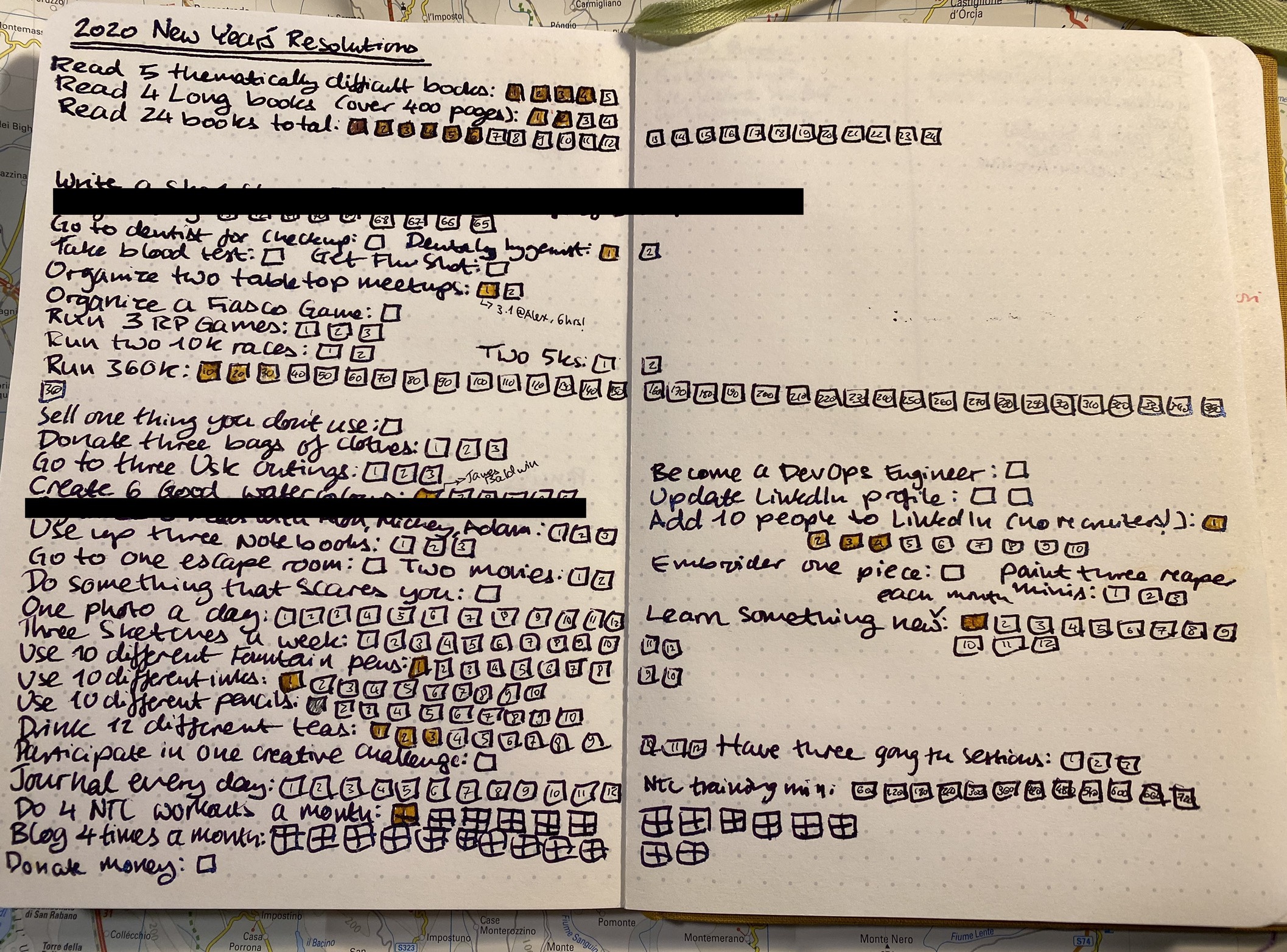
Above you can see my 2020 resolutions. A lot of them are things that appear in almost every year. The professional goals are all new (I didn’t manage my professional goals with my personal goals until this year, and even now only a small part of my professional goals are here).
Every goal at this point only has the basic, first tier goals set beside it. The first three goals for example, all reading related, will eventually have stretch goals. They’re interesting to note here because back in 2016 I only had one reading goal: read 24 books. Once I got back into the habit of reading, I started to challenge myself with longer and more challenging books. These are all my base reading goals. I usually stretch them to around 50 books a year.
Why don’t I start with 50 books then? Because the point of these goals is to build myself up for success. The basic goals are the “even if I have a horrible year I should be able to reach these” goals. They are there to remind me that there’s a tomorrow, and something I can and should do about that tomorrow, even if a family member is hospitalized (or worse). The stretch goals are then built in small increments, reaching to my my final goal for the year.
Why don’t I write my stretch goals down from the start? Because the point is to keep myself focused on the next small step. That’s why things are broken down to the smallest increment that makes sense: one book, 10k, one month.
There’s a reason for each goal on this spread. I won’t go into each one specifically, but they all fall into the following general categories:
Read more.
Write more (my writing goals are censored, because if I publish them, I won’t do them. I know myself well enough by now).
Use the stuff I own.
Challenge myself to get out of my comfort zone.
Social goals (partly censored).
Health goals (running, cross-training, bloodwork, dentist visits).
Professional goals (partial list).
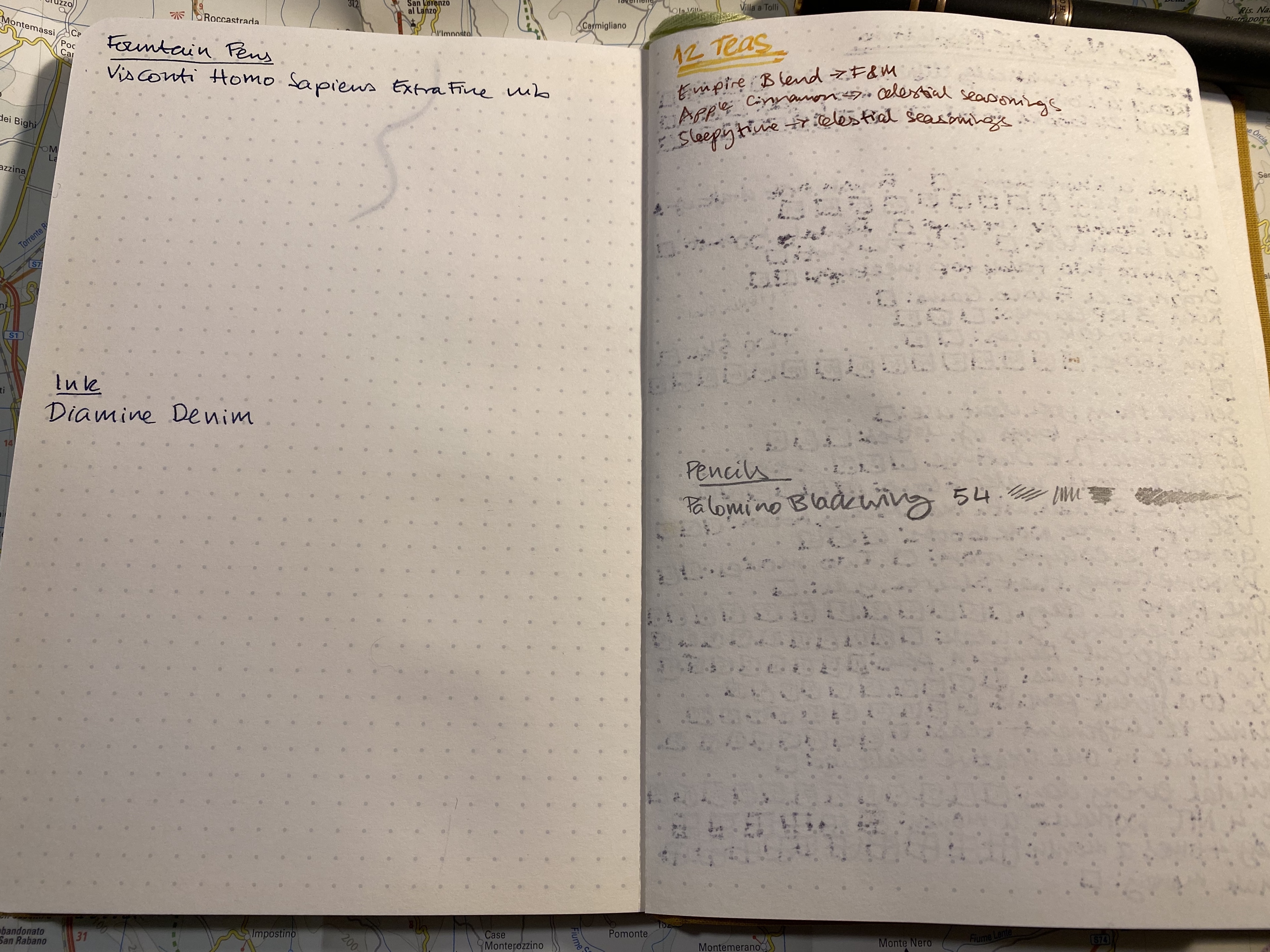
Everything has to fit in on a two page spread, or I lose track of things. That’s why I spill over to other pages in the same notebook to track some of the details of my goals:
Tracking page for fountain pens, ink, tea and pencils.
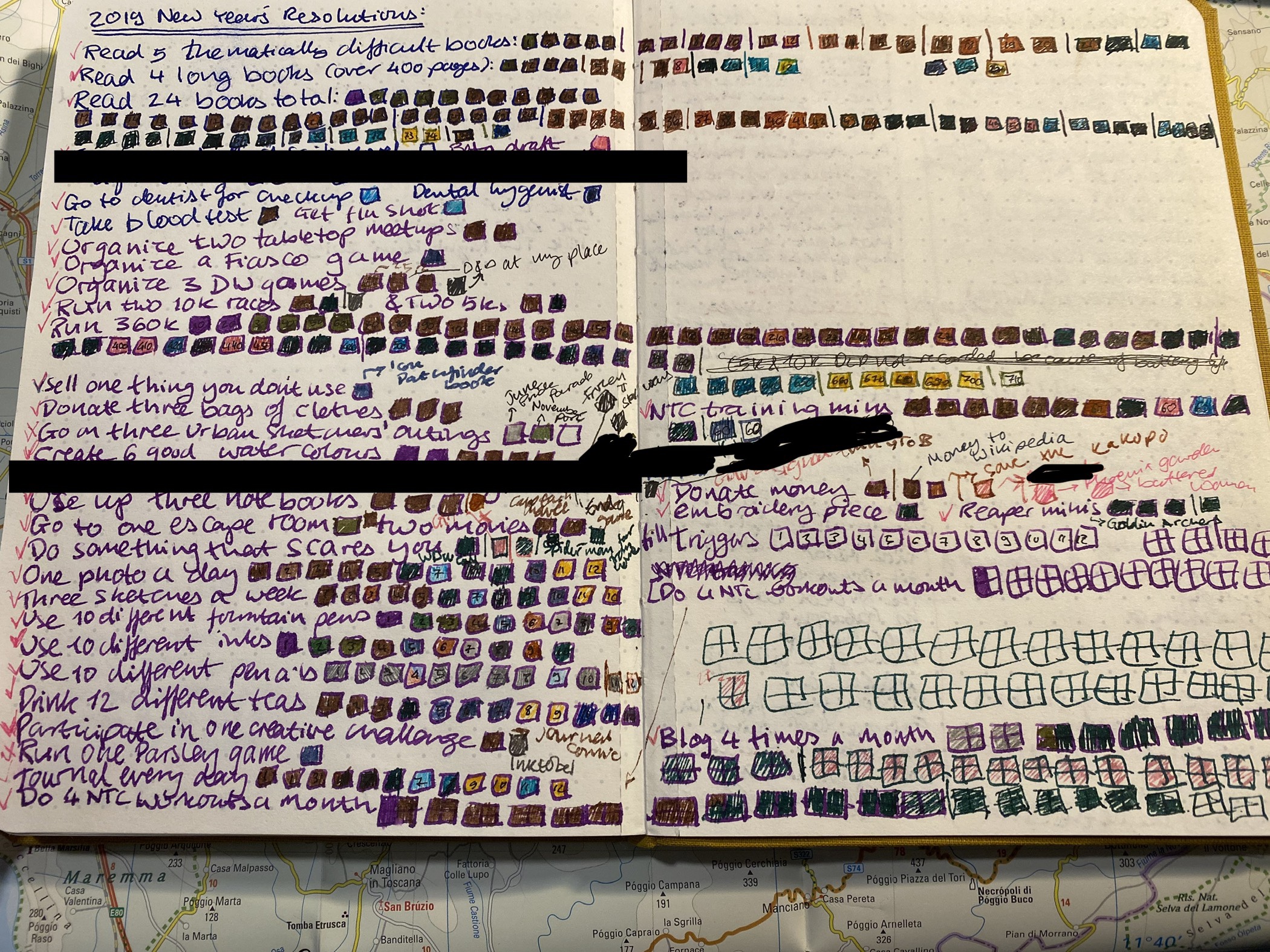
Here are my 2019 resolutions. A pink check mark means that the basic goal is finished. You can see the increments things grow by (my stretch goals):
2019 resolutions
You may have noticed that the “fill triggers” goal isn’t filled up at all. This is the “relevant” part of the S.M.A.R.T. goals. I used the trigger system from Marshal Goldsmith’s “Triggers” book for a few months in 2018, and I decided at the beginning of 2019 to not continue with it. It was a conscious decision, and so I just ignored that goal.
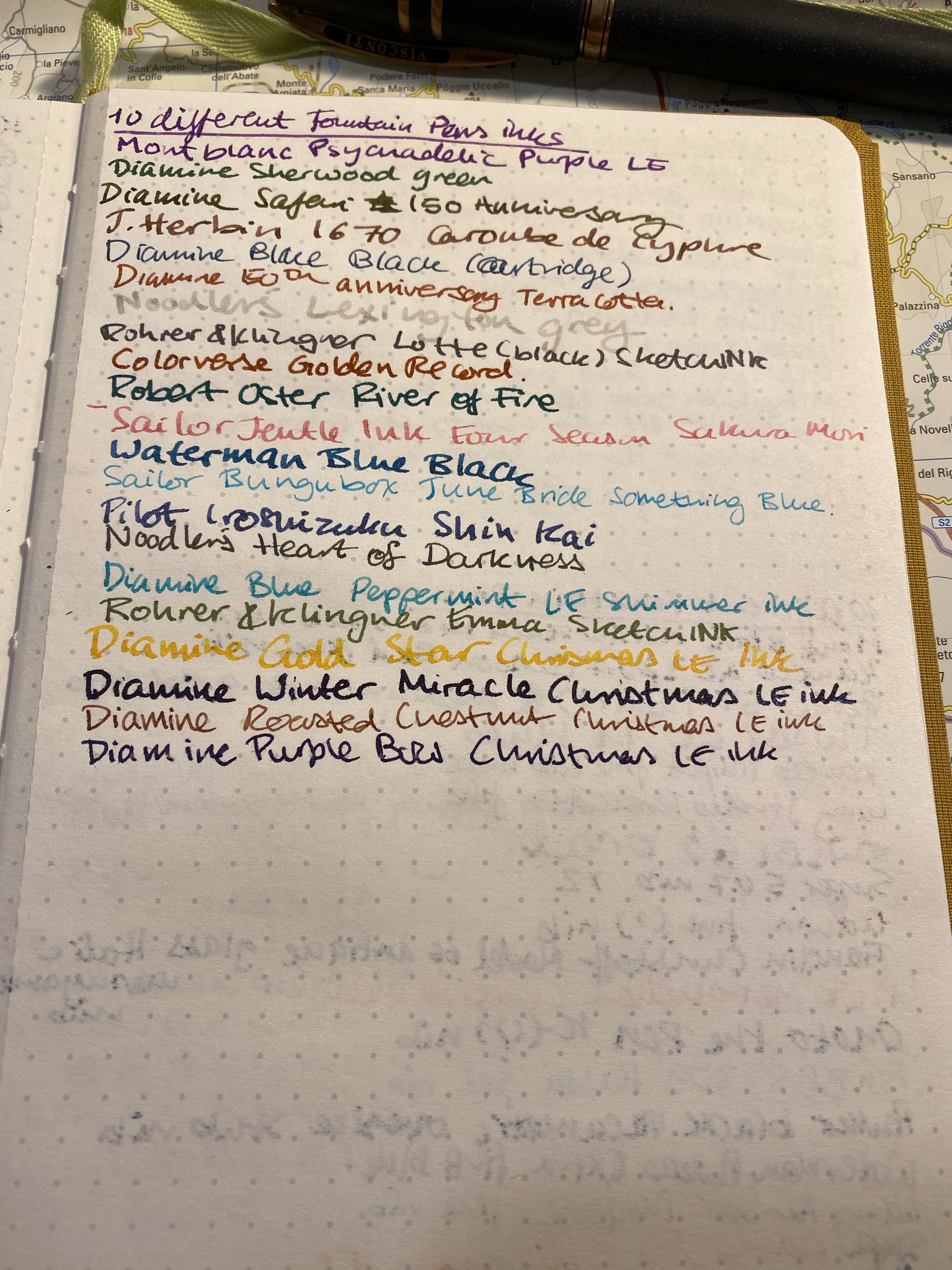
Here are my 2019 “spill” pages, just to get an idea of how the whole thing works together:
10 different fountain pen inks. Can you see where the stretch goal is marked?
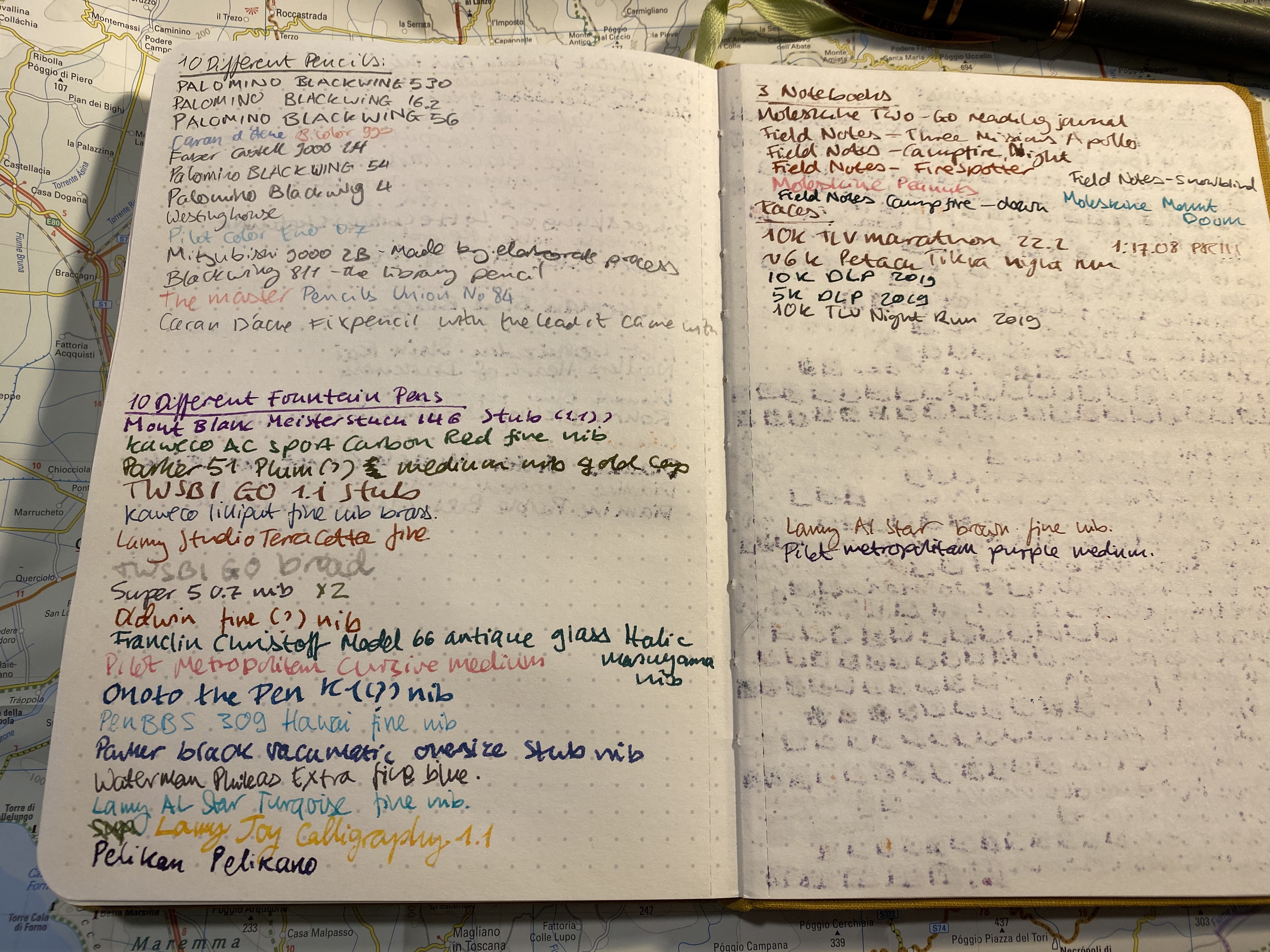
Here are pencils, fountain pens, notebooks and races tracking:
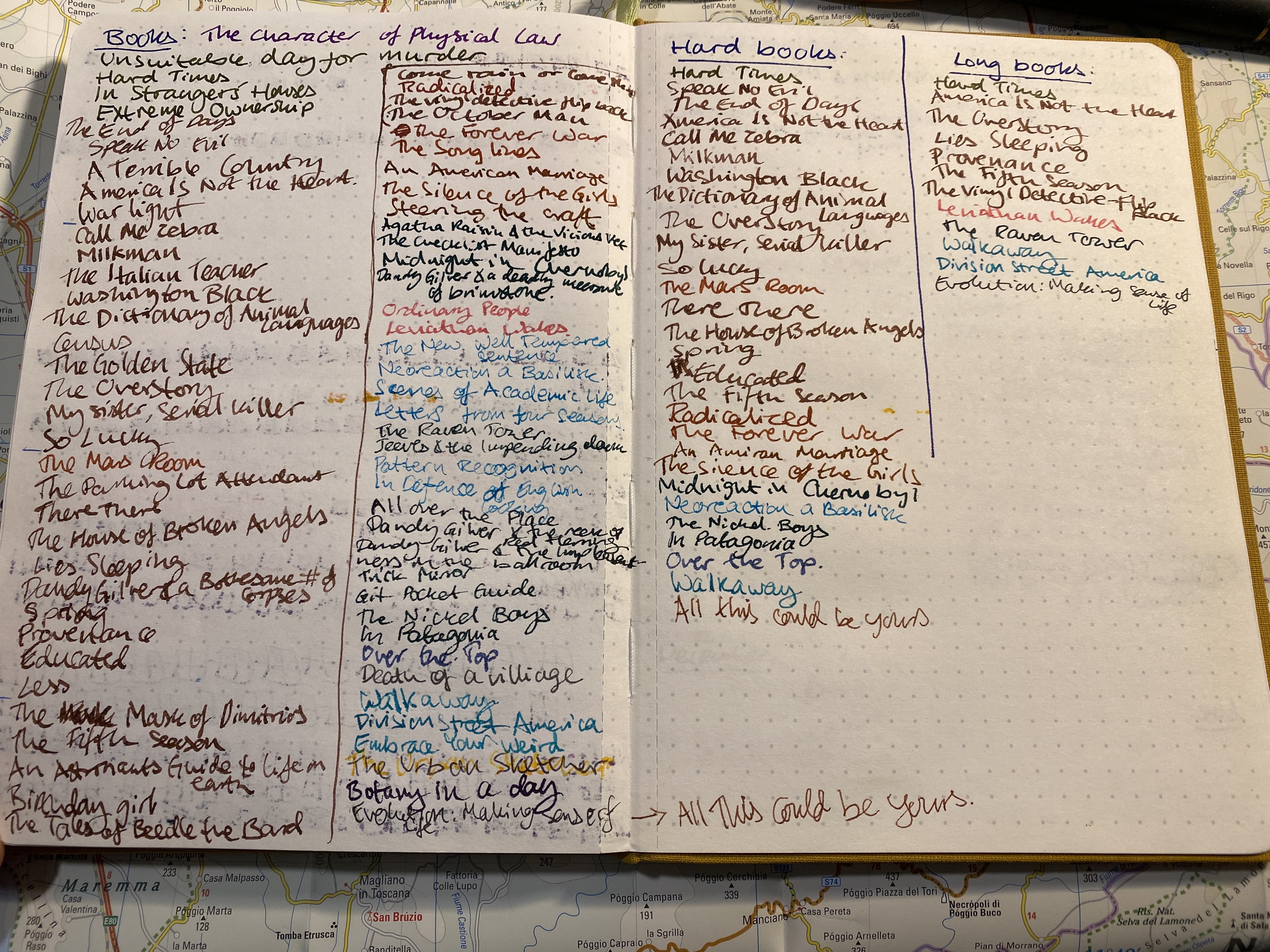
And my largest tracking list, books:
The Baron Fig Confidant that holds this list has a bright cover and sits right in front of me, on my desk, at all times. I set up my goals that at every day or two I crack the notebook open and update the lists. Once there, I scan everything and check if there’s something that I can do to get it done. The point is to have this list on the top of my mind as much as possible, or else I’ll just forget about it, or it becomes something that I avoid checking out.
This is a system that supports me every day, giving my goals and aspirations much needed structure. I hope that this will help you build a personal system of this kind for yourself.
A very surprising book. I was expecting a grotesque horror story, and I got nothing of the sort.
In “Mary Toft; or, The Rabbit Queen” Dexter Palmer takes a historical event and greatly expounds upon it to create a clever and subtle work of fiction which is at times breathtaking in its endeavours. This is a bildungsroman, it’s a tale of mastery and apprenticeship, it’s a love story, and most of all its a story about truth, fiction, and the complexity and variety of what lies between the two, and what defines them. The 18th century was the Age of Enlightenment, yet, Palmer says, look how dark and fragile that enlightenment was, and look and tremble at how dark and fragile our current age is. For the tale of Mary Toft in the 18th century is also the tale of flat-earthers, anti-vaccers, “Fake News” current West civilization, and it’s also the same tale of women who’s voices aren’t heard, who are abused, ignored, deemed “cow-like” and only good enough for breeding, who cry in pain in a room full of doctors that not once ask her how she’s feeling.
So why 4 stars and not 5? Because there’s a tremendously cruel and grotesque bit in the London part of the novel that I understand why Palmer brought in, yet I still wish he hadn’t. After a line or two I skipped the part, and my reading wasn’t spoiled for it. So: 1. Once the bull shows up in the arena, skip to the end of the chapter. 2. If I could skip the horror and not miss a bit, then Palmer could have done without it.
A very interesting, clever and subtle tale, worth reading and contemplating upon.
I read this novel as part of the 2020 Tournament of Books, which is fortunate, because otherwise I wouldn’t have even heard about it. It’s going up against Sally Rooney’s “Normal People”.
In late 2014 I visited the wonderful Mora Stylos in Paris, France. I was there to buy a pen. A specific pen. One that had made a buzz in the pen world the moment it came out. The Visconti Homo Sapiens:
There are dozens of Visconti Homo Sapiens reviews out there, and so I wasn’t planning on reviewing this pen. Yes, it’s beautiful. Yes, it has a satisfying heft to it, the material feels amazing to the touch, the nib has some delightful springiness to it, and did I mention that it’s a hulking large, beautiful pen?
It’s also a very, very expensive one. It was the most expensive pen I had purchased until then, and since then only three other pens in my collection have come close to it in price (my Nakaya, my Henry Simpole Silver Overlay Conway Stewart, and my Oldwin).
I remember spending a lot of time in that store, holding the pen (it’s large and I have tiny hands), trying out the nib (I bought an Extra Fine. Today I would have gone for something broader), debating the price of pen.
Look at that patina!
In the end I liked the aesthetics, the nib, the unique filling mechanism, and the story around the pen enough to buy it. As I bought it from Mora Stylos, it was customized with my initials on the finial. This made the pen even more special and precious to me.
The finial can be customized by dealers, using a special magnetic mechanism.
I got home and I couldn’t get enough out of just looking at this pen, this piece of art that looked like it belonged in a museum.
Just look at the nib and the clever closing mechanism.
Who would want to sully this with ink, right? I could accidentally drop it or something.
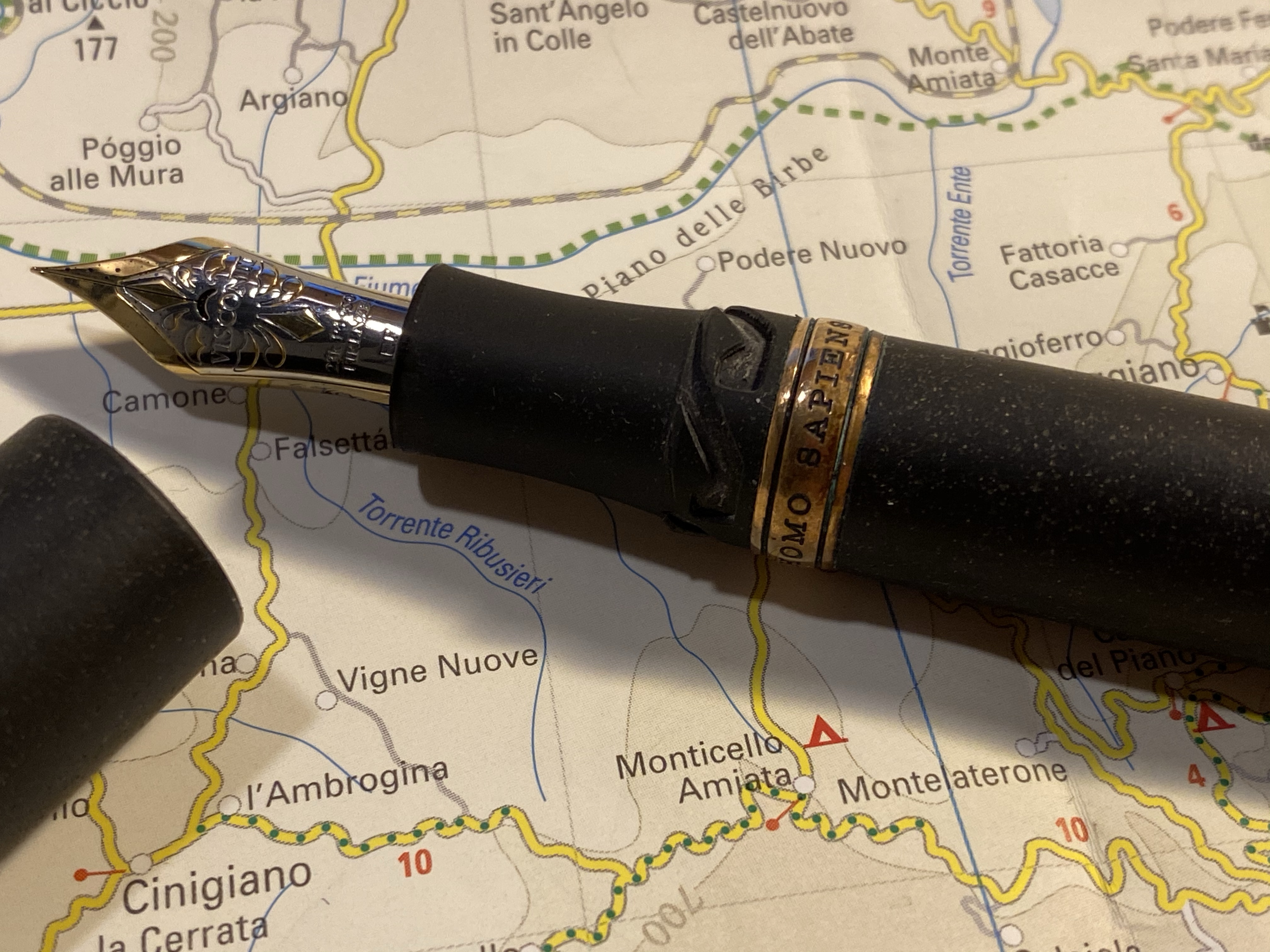
A closer look at the scrolling on the nib and the patina on the band.
But I forced myself to fill it and try using it, if only at my desk at home. I loved writing with it. It’s truly a joyous pen to write with, especially if you have a light touch. The nib is something else, comparable to my Nakaya in terms of feel.
But then I had to clean it out. And that was an absolute nightmare that took ages and ages. The filling mechanism was great to use, but terrible to fully flush out. Who has the time for that, especially for a pen that I daren’t carry with me at all times?
So over the past 5 years I’ve used my Visconti Homo Sapiens a grand total of three (!) times. It stands to reason I should sell it and let someone else enjoy it. Yet I can’t bring myself to do that. Why?
You see, I’ve grown lazy in my fountain pen use over the years, and this pen was one of the turning points. Fountain pens require effort. They have always had. That’s why people moved to ballpoints the moment they were a semi viable substitution. Fountain pens can be messy. They need filling and cleaning, and care during use and storage and while cleaning them out. You don’t use them for convenience, you use them because they bring you joy.
I’ve lost touch of that, just as I’ve lost touch with the joy of playing around with various inks. My pen usage has fallen into a rut of mostly easy to clean inexpensive cartridge-converters or TWSBI pens filled with easy to clean inks.
Diamine Denim, which I haven’t used in more than two years and used to be one of my favourite inks. Still is.
It has taken me a while to realize that. As I was building my goals for 2020 the realization that I’ve stopped actually enjoying my pens and ink dawned on me, and I’ve decided to see if I can’t change that.
So I filled my gorgeous Visconti Homo Sapiens, and I actually carried it with me in my bag (the skies haven’t fallen yet and the pen is OK), and I’m thoroughly enjoying using it. And I dusted off my beloved Diamine Denim, one of my favourite blue-black inks and previously one of my favourite inks that has seen absolutely no use over the past two years, and I’m giving it a spin. It’s as richly delightful as it ever was. There’s no sparkle or sheen to it, and not much shading to speak of, and yet I still love it. Diamine Denim is just a very good blue-black ink period.
So, who knows what the future holds, but I hope that this pen that does so much to evoke humanity’s past will get me interested again in my fountain pen future.






 Writing at Large